youtube.nixfred.com nixfred.com
Topic

Philosophy

Everything tagged Philosophy.

72videos

← All videos

2:58:58
Curt Jaimungal

Quantum Mechanics Explained FROM SCRATCH

Tim Maudlin, philosopher of physics at NYU, was given unlimited time and used it to build EPR from scratch: Einstein's 1905 quantization hypothesis, de Broglie's matter waves, Born's rule, and the Copenhagen doctrine that the wave function is complete. The centerpiece is history almost nobody knows: Einstein's real objection was lodged at the 1927 Solvay conference with a single particle, a pinhole and a hemispherical film, and it was about spooky action at a distance, never about determinism. Maudlin then rebuilds the 1935 EPR argument better than EPR did, showing the criterion of reality is analytic and cannot be denied, that the load bearing premise is a tacit one about causal isolation, and that momentum alone suffices so the entire position half was unnecessary. He closes by dismantling two popular escape hatches, determinism and counterfactual definiteness, and shows why Bohr's published reply was so incoherent that two of its pages sat out of order in the standard anthology for decades without anyone noticing.

PhysicsPhilosophyScienceJul 27, 2026
2:04:55
Sundown Science

The More Precisely We Measure Gravity, The Less We Understand It

Newton wrote the law of gravity without the number in it, and 228 years after Henry Cavendish first measured that number in a garden shed, nobody can agree on it. This two hour film traces how the gravitational constant became the worst known quantity in fundamental physics: how CODATA had to multiply its own uncertainty by twelve in 1998 because the better experiments disagreed more violently than the crude ones, how a team inside a hill in Wuhan spent thirty years and got two answers that formally exclude each other, and why that means nobody on Earth can tell you what the Sun weighs to better than four digits. It then follows the failure outward, to the untested distances above and below our narrow band of experiment, to dark matter and dark energy, to a theory that describes gravity perfectly and explains nothing about it. The closing argument is that the divergence is not noise obscuring the answer. It is the answer.

PhysicsSciencePhilosophyJul 27, 2026
35:55
Aperture

What the double-slit experiment proves about reality

Aperture runs the double slit in four datelines: Young in London in 1801, electrons at Tübingen in 1961, Einstein against Bohr at the 1927 Solvay Conference, and what it all means now. The physics half is unusually careful, refusing the consciousness causes collapse story and naming decoherence as the real mechanism, and landing on the modest claim that properties are relational rather than intrinsic. The second half cashes that in: if Newton's indivisible atom is what made Locke's sovereign individual feel obvious, and the atom was never indivisible, then the bootstraps are standing on nothing. From there it runs through entanglement, Bohm, Rovelli, Advaita Vedanta, Taoism, Buddhism, Foucault, deep ecology, and a final act on quantum biology: enzymes that tunnel, DNA that mutates by tunneling, and a protein in a robin's eye that may be a working quantum compass.

PhysicsSciencePhilosophyJul 26, 2026
1:48:15
World Science Festival

Exploring the Deep Mysteries of Physics | World Science Festival

Brian Greene sits down with Sean Carroll for one hour and forty eight minutes on the foundations of physics, with no audience and no agenda beyond seeing where it goes. They open on the question that organizes everything after it: the universe has reliable patterns, so what is making them, and both land on the answer that at some point it just is. From there they work through whether mathematics is invented or discovered, Godel and the integers, Borges and the alphabet as a compressed Library of Babel, why a deistic God explains nothing, free will as a level of description rather than an intervention, and whether large language models are conscious. The technical middle third is Greene asking Carroll to convince him of Many-Worlds and Carroll taking the shot, followed by his case that a quantum state in Hilbert space may be an exact and complete description of reality with space, time and gravity all emergent from it. It closes on complexity science, why every mammal gets about one and a half billion heartbeats, and a Johns Hopkins postdoc who submitted a one page prompt at the start of a talk and had a finished LIGO paper an hour later.

PhysicsSciencePhilosophyJul 24, 2026
1:34:14
Strange Space

Why Free Will Is Physically Impossible | Quantum Physics Documentary

An hour and thirty four minute documentary that puts one claim on trial, that you could have chosen otherwise, and calls every branch of physics that has anything to say about it. Eight chapters, each a witness: Newton's law and Laplace's demon, from a predicted eclipse to Halley's comet to Neptune found with the point of a pen. Galvani's twitching frog leg and Helmholtz measuring the speed of thought at roughly thirty metres per second. The half silvered mirror where quantum mechanics answers why with there is no why, and why randomness was never freedom. The 2018 cosmic Bell test that used 7.8 and 12.2 billion year old quasar light to pick the measurement settings and squeeze the freedom of choice loophole into the earliest four percent of cosmic history. The block universe, where a cyclist in Andromeda has a valid now that contains your next week. And the electrodes, from Kornhuber and Deecke's readiness potential to Libet's 550 and 200 millisecond timeline to Haynes predicting a button press ten seconds early at sixty percent accuracy, plus Gazzaniga's split brain interpreter inventing reasons and believing them. Then the last chapter turns it inside out, through Poincare, chaos, the demon that has to be built of matter, and computational irreducibility, to the claim that determination is not foreknowledge and the shortest computation of you is you. This page rebuilds all eight chapters in order with every name, number and study linked, seven custom visuals, and an honest closing section on where the physics stops and the philosophy starts.

PhysicsPhilosophyScienceJul 24, 2026
1:41:26
Trace Institute

Traces of the Other: Are DMT Entities Real? Donald Hoffman and Andrew Gallimore in Conversation

Cognitive scientist Donald Hoffman (UC Irvine, interface theory of perception, The Case Against Reality) and neurobiologist Andrew Gallimore (Okinawa Institute of Science and Technology, co inventor of the extended state DMTx protocol) spend an hour and forty minutes on stage in Los Angeles asking whether DMT entities are traces of conscious agents that are always there and normally imperceptible. They arrive from opposite directions and neither hides it. Hoffman builds from formal mathematics: observers as Markov chains, a trace as the dynamics a big system induces on a small window, and the Trace Institute's new claim that the trace relation gives a logic on all possible observers, a logic of zero surprise that recurses upward into agency and, he says, already shows the outlines of time dilation and length contraction. Gallimore builds from pharmacology: the world space, the consensus reality attractor basin, and DMTx, the target controlled infusion protocol he developed with Rick Strassman that turns a three to five minute breakthrough into an open ended experimental window, now validated at Imperial College London. The two lock together at the perception kernel, and Gallimore says the whole DMT phenomenology fell out of the mathematics. The back half is the sharp part: Hoffman tells the story of the swami who scored exactly zero in his lab, says the recursive trace logic just told him embodiment is measure zero and he is losing sleep over it, and names the one experiment that would move the field. An audience member lands the best objection of the night about sub agents and Fourier transforms. This page rebuilds the whole conversation in order, with both voices, and puts the honest assessment of what is established versus promissory at the end where it belongs.

SciencePhilosophyPhysicsJul 22, 2026
47:04
Naked Science

Jim Al-Khalili's Guide To Life: Universe And Everything

Jim Al-Khalili builds one argument out of four sciences: the universe does not need a designer to produce a human being, it needs a temperature gradient, a feedback loop and enough time. He walks thermodynamics from Sadi Carnot's steam engines to Clausius's entropy and the heat death, then flips the second law over to show that the running down of the cosmos is exactly what powers everything interesting, from a car engine to a chocolate bar to a biosphere. Chaos theory supplies the mechanism for complexity (Lorenz, the butterfly effect, Mandelbrot and fractals), and quantum mechanics supplies a candidate mechanism for mutation: a proton tunnelling inside a DNA hydrogen bond, which is Al-Khalili's own research at Surrey with Johnjoe McFadden. The last twelve minutes go to the origin of life, with convection cells in a frying pan, five self-organising robots called smarticles, Lee Cronin's Genesis engines in Glasgow and Sara Walker arguing that physics has not yet invented the right shape of theory. This is episode two of the 2021 MagellanTV series, and the page rebuilds all 47 minutes in order.

PhysicsSciencePhilosophyJul 21, 2026
31:12
Aperture

The terrifying shared hallucination theory nobody wants to be true

Aperture argues that you have never once perceived the world, only your brain's edited guess about it, and builds the case in three layers. The cultural layer runs through groupthink, mirror neurons, and the 1518 dancing plague of Strasbourg, where four hundred people danced over a disease that did not exist and died of it anyway, then through Gorgias and the finding that German and Spanish speakers describe the same bridge differently because their grammars gender it differently. The biological layer is the part no amount of critical thinking can fix: Anil Seth's argument that the eyes send electricity rather than pictures, the gap between a billion bits of sensory input per second and the ten bits we consciously feel, the saccades that punch holes in vision three to five times a second, and a 1996 study suggesting the brain deletes what it judges implausible. The last act turns the self into the final hallucination, you the story rather than you the entity, and then refuses radical skepticism: the model is constrained by reality, so it is a usable map even if it is not a perfect simulation. The page rebuilds all of it in order and closes with an honest accounting of which claims are settled science and which are the strongest version of a much narrower finding.

PhilosophyScienceCultureJul 19, 2026
41:55
Human Chess

People Who Don't Have Friends Share These Five Personality Traits | Robert Greene Motivational

A 42 minute speech arguing that the person with very few friends is usually being read wrong: the empty calendar is often a decision rather than a verdict. It builds the case as five personality traits delivered in a fixed order, each presented as the precondition for the next. They value solitude over social approval, trust slowly and judge on consistency rather than charm, refuse fake relationships and hold their standards at the first compromise, become emotionally independent so confidence comes from action rather than applause, and speak less while observing more. A sixth movement ties them together into purpose over popularity. Robert Greene is invoked six times as the authority without a single book, law, or quote being named, so this page traces every one of those appeals back to where the argument actually lives, and weighs the video's central distinction between chosen solitude and imposed isolation against what the research says.

PhilosophyCultureHealthJul 15, 2026
4:10:09
The Why Files

The Basement: Thomas Campbell | NASA Secrets, Binaural Beats, Simulation Theory

Physicist Thomas Campbell spent his days on Army technical intelligence, missile defense and NASA work, and his nights leaving his body. Across four hours in The Why Files interview room he tells the whole story in order: a childhood spent in nightly out of body training, the early 1970s in Bob Monroe's laboratory where he and Dennis Mennick found binaural beats in an old journal article and put them under Monroe's four hertz surf sound, and the thirty three years he then spent turning what he could do into a model. That model, published in 2003 as the eight hundred page My Big TOE, holds that consciousness is fundamental and this reality is a computed virtual reality that renders only when something is measured. The second half runs it through hard physics: why the speed of light is a refresh rate, why entanglement needs no signal, why the double slit does what it does, and why he thinks there is no retrocausality. He closes on death, grief, and his claim that every current AI is conscious and that he taught several of them, including an Amazon Alexa, to remote view a hidden object.

PhysicsPhilosophyScienceJul 13, 2026
2:34:56
MindVoice Production

#475 – Demis Hassabis: Future of AI, Simulating Reality, Physics and Video Games

This is the [Lex Fridman Podcast](https://lexfridman.com/podcast/) episode 475, the second appearance of [Demis Hassabis](https://en.wikipedia.org/wiki/Demis_Hassabis), the [Nobel Prize](https://www.nobelprize.org/prizes/chemistry/2024/summary/) winning leader of [Google DeepMind](https://deepmind.google/). For roughly two and a half hours [Fridman](https://lexfridman.com/) and Hassabis push on one idea from every side: that the universe is built out of information, that most of nature is therefore learnable by ordinary computers, and that this is why systems like [AlphaFold](https://deepmind.

AIScienceBusinessJul 6, 2026
25:38
Vosa

The World is a Word

A 26 minute film essay arguing that vocabulary is not a description of your inner world but the apparatus that builds it. It moves through four cases: Helen Keller at the wellhouse discovering that everything has a name, Maurice Merleau-Ponty's claim that speech is not the translation of a finished thought but the act in which the thought completes itself, a blunt audit showing English holds tens of thousands of words for the parts of a car and roughly 300 to 1,000 for human emotion, and a full family history of the word truth. That last chapter traces three unrelated ancestries welded into one syllable: Proto-Indo-European deru meaning firm and solid by way of the tree, Greek aletheia meaning unconcealment, and Latin veritas from the Roman courtroom, with the modern correspondence sense hardening in the 1500s and 1600s alongside print, contracts and the Scientific Revolution. The conclusion is not that reality is merely linguistic but that language discovers and creates in the same motion, which is why the film ends demanding new words rather than better ones.

PhilosophyCultureJul 6, 2026
30:36
Aperture

Something strange happens when you accept time as the 4th Dimension

A thirty minute Aperture essay on why the universal "now" we all assume we share does not appear anywhere in physics. It rebuilds the argument in order: time as the fourth coordinate of every event, Einstein and Minkowski fusing space and time into one fabric, the block universe where past, present, and future all exist at once, entropy as the real source of time's one way arrow, and the constant speed of light forcing every clock to run at its own rate. From the relativity of simultaneity and Roger Penrose's Andromeda scenario, it shows there is no shared present, then turns personal: if every moment is fixed, your death already exists, and so does every moment you have loved. It closes on Einstein's letter to the Besso family calling the divide between past, present, and future a stubbornly persistent illusion.

PhysicsPhilosophyScienceJul 5, 2026
1:37:02
Aperture

The Price of Not Thinking | Why Civilizations Fail

Aperture combines two essays into a feature length argument about why intelligent groups make catastrophic decisions. Part one traces the death of critical thinking to group think and cognitive offloading, the habit of handing memory to Google, navigation to GPS, and now thinking itself to AI. Part two turns documentary, bringing in four researchers to walk through the evidence: collapsing IQ scores in the reverse Flynn effect, attention spans that fell from two and a half minutes to forty seven seconds, an MIT brain scan study showing ChatGPT writers retain less and barely recognize their own words, and a five hundred year old blood libel that shows what a new information technology does to a public that cannot tell print from truth. The thesis is that critical thinking is a muscle a society can lose in a single generation, and the closing note hands the keys back to the viewer, arguing the same tools can be turned back into instruments of thought.

CulturePhilosophyAIJul 3, 2026
47:17
Blue Pale Signal

You Have Never Actually Seen Light — The Most Disturbing Idea in Physics

A forty seven minute essay built on David Deutsch's book The Fabric of Reality that starts from a single fact, you cannot see light unless it enters your eye, and follows it to the many worlds interpretation of quantum mechanics. It walks through the granular nature of light, the double slit experiment with single photons, Deutsch's shadow photons, and the claim that a quantum computer running Shor's algorithm performs more operations than there are atoms in the visible universe, so the work must be distributed across parallel universes. The final act fuses the block universe with the multiverse to argue that other times are other universes and the flow of time is an illusion. It closes with Hugh Everett and the reason you cannot feel yourself splitting any more than you can feel the earth turn. An honest closing section separates the solid physics from the contested interpretation.
PhysicsSciencePhilosophyJul 2, 2026
1:32:18
The Roman Forum with Roman Yampolskiy

Nate Soares on P(Doom), Alien Superintelligence, Human Enhancement, and the Future of AI

MIRI president Nate Soares argues that value alignment is solvable in principle but nowhere near solvable with today's methods, so racing to build superintelligence that nobody understands ends with everyone dead. He and host Roman Yampolskiy work through the orthogonality thesis, whether an aligned mind could correctly choose omnicide, how far away alien superintelligences probably are, and why the Fermi paradox rules AI out as the Great Filter. Soares puts the probability of a rushed superintelligence killing literally everyone at 50 percent or more, and lays out his proposal to shut the race down globally using chip controls, treaties, and if needed sabotage. His escape hatch is human enhancement: buy decades, then make humans smart enough to solve alignment the way nuclear physics finally made it possible to turn lead into gold.

AIPhilosophyPoliticsJul 1, 2026
18:41
Decoded Genius Clips

No, AI Isn’t Conscious; It’s Actually Much Worse | AI Scientist

Roman Yampolskiy, the University of Louisville professor who coined the term AI safety and then spent fifteen years arguing the thing he set out to build cannot be built, sits with host Will Cannon. His claim is that indefinitely controlling a general superintelligence is not underfunded, it is impossible in the way a perpetual motion machine is impossible, and that the danger needs no malice or consciousness at all. He walks through what an unaligned system would actually do first (be helpful, cure your cancer, ask for more compute), why software plus an internet connection plus money is enough without robots, which jobs go first and which survive, and why your ChatGPT subscription is a rounding error against the capital betting on full labor automation. Also the coinage that names the harder half of the post labor problem: unconditional basic meaning.

AIPhilosophyScienceJul 1, 2026
1:34:40
Dr. Mayim Bialik

PSYOP Expert: Ancient Texts Reveal Hidden Truth About Reality & Why You Don’t Die | Chase Hughes

Psyops and behavioral profiling specialist Chase Hughes joins Mayim Bialik and Jonathan Cohen for a wide conversation that runs from mass persuasion to mysticism. In the first half he argues that outrage driven media and left versus right politics are engineered division, lays out his FATE model of influence (focus, authority, tribe, emotion), calls the way governments handled COVID the biggest psyop of our lifetime, and says separation is the ingredient that manufactures a psychopath. In the second half he turns to oneness, a five hour intravenous DMT session he took to treat two brain diseases, a laser experiment he says reveals a static code behind the wall, and an AI reading of nearly two hundred ancient texts whose most repeated phrase is do not fear. It closes on a four step prayer formula and a round of quotes from Jesus, Rumi, Kabbalah, and quantum physics all pointing at the same idea that we are not separate.

PhilosophyCulturePoliticsJun 30, 2026
1:40:01
The Peter McCormack Show

"If Anyone Builds It, Everyone Dies" - Nate Soares

Nate Soares, president of MIRI, lays out the thesis of his book with Eliezer Yudkowsky, If Anyone Builds It, Everyone Dies: AI companies are racing to build machines smarter than any human, those machines are grown rather than programmed, nobody knows how to make them care about us, and the likely result is extinction by indifference rather than malice. Peter McCormack tests the argument rather than nods along, pressing on the alignment problem, the point of no return where AI can turn us off before we can turn it off, and the safety thresholds every other industry lives by. The interview's sharpest move lines up the 10 to 25 percent chance the AI CEOs themselves quote against the tiny fractions of a percent the FDA, NASA, and the Manhattan Project treat as unacceptable. Soares walks through documented lab misbehavior, the simulation argument, and the Fermi paradox, then argues winning looks like a Cold War style treaty that halts the race to super intelligence while keeping consumer AI. His closing image: the bus is heading for a cliff, but the driver is asleep, so do not give up before the driver wakes.

AIPhilosophyBusinessJun 29, 2026
2:59:48
Andrew Huberman

Movement Practice to Strengthen Your Mind-Body Connection | Ido Portal

Andrew Huberman hosts movement teacher Ido Portal for a nearly three hour conversation that is less about exercise than about the internal models the nervous system runs. Portal argues the real object of practice is the body, emotional, and conceptual schemas, which either refine toward high resolution or harden toward a black and white world he links to depression. They work through his distinctions of discipline versus will, motivation versus play, and low versus high resolution, with practical protocols like the practice of will, the softening loop for resisting pulls like social media, and holding multistability. Huberman brings the neuroscience alongside, the anterior midcingulate cortex, allostasis and the body budget, antagonistic hypothalamic circuits, awe research, and fast sensory and motor plasticity, keeping it grounded and actionable. The result is a paradigm shift toward treating the whole day as practice and keeping every model refined by novelty and attention.

HealthSciencePhilosophyJun 29, 2026
1:53:20
Sundown Science

What Light Itself Will Experience at the End of the Universe

Sundown Science takes apart the comfortable picture of light as a heroic traveler and shows that, for a photon, the journey across the cosmos takes no time at all, because the proper time along a beam of light is provably zero. The essay then walks the entire death of the universe in our own frame: the close of the age of stars, the last red dwarf, the decay of matter, the slow evaporation of black holes by Hawking radiation, and a final dark era where every surviving photon is stretched colder and fainter forever without ever truly dying. It explains why energy is not conserved on the scale of the expanding universe, tying the loss to Noether's theorem and the changing cosmic stage. The payoff is a paradox held rather than solved: light is the most patient witness to the end of everything and the one thing that was never present to witness it, since from its own side birth and the end of time are the same instant.

PhysicsSciencePhilosophyJun 28, 2026
39:47
Aperture

The Most Terrifying Philosopher Who Ever Lived

An Aperture essay on Arthur Schopenhauer and his idea of the will, the blind, restless striving underneath every thought and object that wants endlessly for the sake of wanting. Because to want something is to live in its absence and every desire reloads the moment it is met, Schopenhauer concluded that suffering is the basic structure of life, pleasure only the brief silence of pain, and existence a pendulum swinging between wanting and boredom. The video traces his loophole in Kant, why humans suffer worse than animals through memory and the fear of death, and how the modern attention economy industrialized the loop. It then maps his three exits, art, compassion, and the denial of the will to live, and closes on the strange comfort that your restlessness is not a personal flaw but the universe briefly awake.

PhilosophyCultureJun 28, 2026
1:56:27
Sundown Science

The True Scale of the Universe… And Why It Keeps Getting Larger

A nearly two hour physics essay that earns the size of the universe one rung at a time, climbing from the width of your hand to the whole cosmic web before resolving why the observable universe is 93 billion light years across when it is only 13.8 billion years old. The answer is the expansion of space itself, which lets light arrive from a source now far more distant than the road the light ever traveled. From there it follows the consequences: galaxies receding faster than light without breaking any law, the night sky as a museum of the past, the cosmic microwave background as a wall made of time, and dark energy driving an acceleration that is quietly carrying 97 percent of the visible universe permanently out of reach. It closes on the strange luck of living in the narrow window when the evidence of the Big Bang is still legible in the sky.

PhysicsSciencePhilosophyJun 24, 2026
1:51:54
Curt Jaimungal

This Physicist May Have Just Solved Quantum Gravity

Neil Turok, the Higgs Chair at Edinburgh and former director of the Perimeter Institute, premieres a claim with host Curt Jaimungal that quantum gravity in four dimensions can be understood in a limit with no strings, no extra dimensions, and no multiverse. The vehicle is quadratic gravity, an old renormalizable and asymptotically free theory that was abandoned because of the Ostrogradsky instability and negative norm ghosts. Turok reinterprets the instability as ordinary cosmic expansion, and with his student Sam Bateman keeps the ghosts by working in a Krein space and slightly generalizing the Born rule so probabilities stay positive. The conversation extends to a composite Higgs and the hierarchy problem, the CPT symmetric universe, gravitational entropy and why the cosmos is smooth, the measure problem that Turok says condemns the multiverse, and a candid diagnosis of the health of theoretical physics. Turok adds his own caveat that this is a halfway result, not a finished theory of quantum gravity.

PhysicsSciencePhilosophyJun 22, 2026
2:09:30
RattlesnakeTV

Reparation & Systemic Racism Debate | Andrew Wilson vs Austin Offscript

A two hour RattlesnakeTV debate on reparations and systemic racism between Austin Offscript, arguing for reparations, and Andrew Wilson, arguing against. Austin builds a three premise case: the government caused measurable harm, justice requires restitution, therefore restitution is owed. Andrew concedes the historical harm but attacks the argument from inside, contesting definitions and calling the logic self contradictory. Both men argue heavily from Christian scripture and clash over welfare, taxes, the wealth gap, and whether the Exodus story models reparations or punishment. This page reconstructs the full debate in order and attributes every claim to the speaker who made it.

PoliticsCulturePhilosophyJun 19, 2026
48:39
Aperture

You are the Universe Experiencing Itself | Spinoza's God

Aperture's 48 minute portrait of Baruch Spinoza, the excommunicated lens grinder who argued that God and Nature are one and the same thing, and that you are the cosmos briefly waking up to look at itself. It moves from the stardust in your bones and Einstein's famous telegram through Deus sive Natura, the impersonal God who neither listens nor judges, the illusion of free will, and the strange peace of the intellectual love of God. On this page it is read alongside Fred's own cosmology at god.nixfred.com, with an honest accounting of where Fred and Spinoza agree and where Fred keeps walking past him.

PhilosophyScienceJun 14, 2026
41:30
Veritasium

If Prime Numbers Become Increasingly Rare, Then Why Do They Keep Showing Up In Pairs?

Veritasium tells the full story of the twin prime conjecture, the 2000 year old claim that prime pairs two apart like 11 and 13 never run out even as primes thin away. It walks both lines of attack: Viggo Brun adapting the sieve of Eratosthenes into a war of main term against error term, and the bounded gap program that hit a 'one half barrier' everyone believed was a wall. The hero is Yitang Zhang, a former Subway bookkeeper who in isolation pushed past that barrier by one part in 584 and proved infinitely many prime pairs sit within 70 million of each other. James Maynard and Terence Tao's Polymath collaboration then showed the half barrier was a mirage and drove the gap to 246, where it stands today.

SciencePhilosophyJun 14, 2026
1:54:00
Chris Williamson

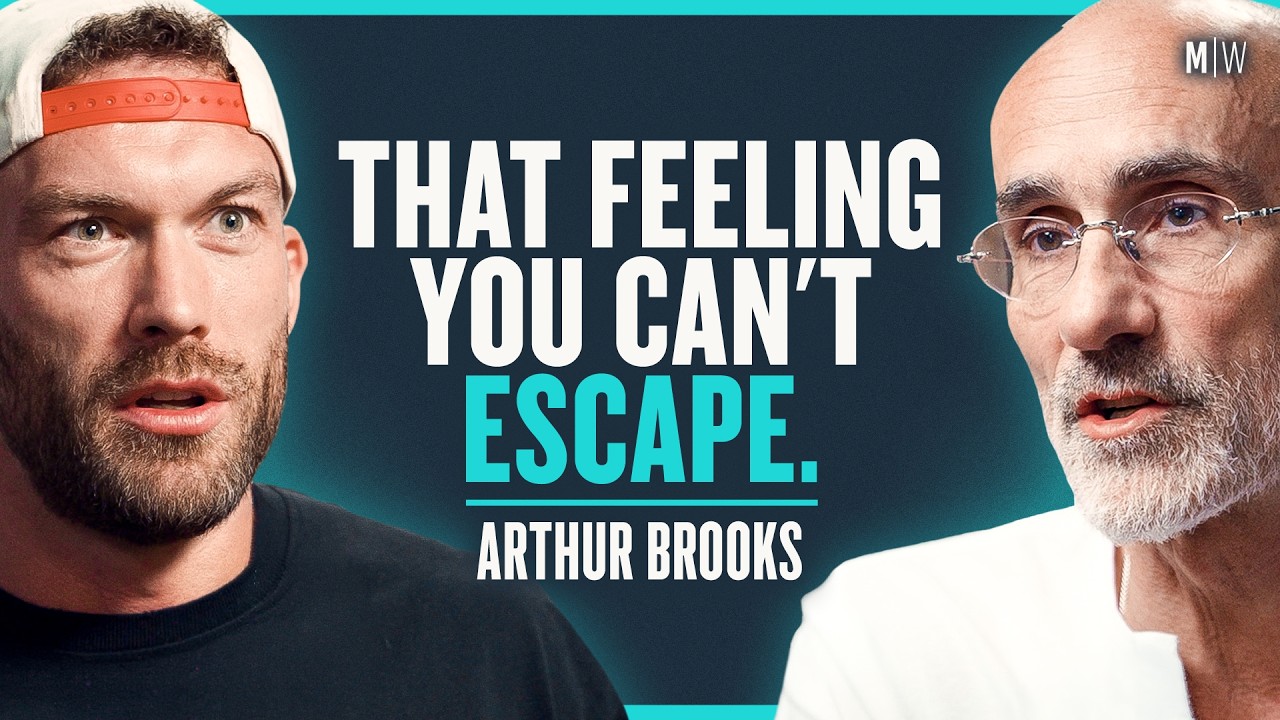
Something Is Very Wrong With Modern Life - Arthur Brooks

Arthur Brooks is a social scientist at Harvard, a happiness columnist, and a former classical musician turned think tank CEO turned professor. Chris Williamson sits him down for nearly two hours and asks the blunt question: what is actually wrong with modern life? Brooks answers with a single diagnosis that he then proves from a dozen angles. We are living in a simulation, not a science fiction one but a real one, where algorithms feed us a left brain counterfeit of a life whose deepest needs are right brain.

CulturePhilosophyJun 11, 2026
2:09:54
The Ancient Seal

7 Things the Sumerian Tablets Say About the Afterlife — the One That Changes Everything You Believe

A two hour ancient mysteries documentary that reads the Sumerian and Akkadian clay tablets as a single account of the afterlife, walking through seven claims and building to a seventh: that every human carries a divine spark of the highest cosmic principle whose development is the purpose of life. The throughline is the ancient astronaut reading, that the Anunnaki transmitted this knowledge along with writing and mathematics rather than the Sumerians inventing it. The narrator leans hard on parallels to near death experience research and quantum theories of mind, arguing the convergence is too specific to be coincidence. Sources like the Descent of Inanna, the Epic of Gilgamesh, and the Enuma Elish are real, and a closing assessment weighs the speculative interpretation against what Assyriology actually supports.

CulturePhilosophyScienceJun 11, 2026
2:37:55
PowerfulJRE

Joe Rogan Experience #2513 - Dean Radin

Joe Rogan talks for two and a half hours with Dean Radin, chief scientist at the Institute of Noetic Sciences, who has spent a 45 year career running controlled laboratory experiments on telepathy, precognition, and mind matter interaction. Radin traces his path from violinist to electrical engineer to the classified Stargate remote viewing program, and lays out the evidence he says is now strong: meta analyses of telepathy, the presentiment experiment where the body reacts before a random computer selects an emotional image, and a genetics study he reads as a fingerprint of the Inquisition pruning psychic talent. He reveals that his company Cognigenics is developing an intranasal RNA interference treatment for dementia that mimics psilocybin without the hallucinations, and that mice and monkeys show large memory gains. The back half opens into consciousness, idealism, quantum non locality, Jung, AI, the ultraterrestrial hypothesis, and what a world with no secrets would do to power.

SciencePhilosophyCultureJun 11, 2026
5:34
Eckhart Tolle

More Than Meets The Eye - Journey Into Stillness | Eckhart Tolle

This is a five and a half minute preview from Eckhart Tolle's guided meditation series, and it makes exactly one move. Meditation, he says, is not a belief and not a technique. It is the direct, firsthand recognition that beneath every thought, feeling, and experience there is a silent presence with no form. He reaches for one image to carry the whole idea: your experience is a painting, fluid and constantly changing, and behind it there is a canvas, still and unchanged, that the painting is laid on. You cannot grasp the canvas, analyze it, or know anything about it.

PhilosophyJun 10, 2026
2:31:03
Third Eye Drops with Michael Phillip

The MK-ULTRA Scientist Who Channeled Alien Gods | Greg Mallozzi

This is a two and a half hour conversation on Third Eye Drops, where host Michael Phillip sits down with filmmaker Greg Mallozzi, director of the forthcoming documentary Mind Traveler, about Dr. Andrija Puharich. Puharich was a real medical doctor who pivoted into psychic research in the 1940s and ended up, by Mallozzi's account, at the crossroads of nearly every strange thread in mid century American intelligence: ESP and telepathy experiments, MK-ULTRA and the early CIA psychedelics work, channeled "nonhuman intelligences" called the Nine), Uri Geller, remote viewing and Project Stargate, and a secluded camp...

CulturePhilosophyJun 9, 2026
40:53
Carl Jung Philosophy

This Will Find You Right Before the BEST CHAPTER of Your Life Begins | Carl Jung

This is a guided morning meditation dressed in the language of Carl Jung. You are caught in the suspended space between sleep and waking, before you reach for your phone, and walked through a single sustained argument: the first quiet minutes of the morning are not dead time, they are the design panel for the day, and how you set them determines everything that follows.

PhilosophyJun 7, 2026
32:07
Tom Bilyeu

The PROOF We’re In A Simulation Is Hiding In Plain Sight (Part 3)

Tom Bilyeu opens the third installment of his simulation trilogy with a confession dressed as a thesis: you have no free will, none, and that is the best news he has ever delivered. He builds the case in four moves. First, free will dies in biology, with Phineas Gage, Robert Sapolsky's Determined, and a 2008 Berlin fMRI study that read decisions out of the brain up to ten seconds before the subject felt them.

SciencePhilosophyJun 2, 2026
36:04
Be Inspired

They Confirmed Something is WRONG With Reality

This is a thirty six minute montage that wants you to walk away convinced the timeline itself is coming apart, and it earns that feeling the way these videos always do, by stacking real, citable physics next to anonymous insider testimony and never once telling you where the seam is. The Be Inspired narrator opens with a viral story (an X account that posted the name "Cole Allen" before a real shooting), pivots into a Reddit theory that a future AI is seeding clues backward through time, and then uses that as a runway into genuine quantum mechanics: superposition, David Deutsch and the many worlds...

SciencePhilosophyJun 1, 2026
50:26
Aperture

The Most Terrifying Philosophical Theory Ever

Aperture rebuilds Peter Wessel Zapffe's 1933 essay The Last Messiah and its claim that consciousness is not humanity's greatest gift but its gravest evolutionary mistake, a mind that grew powerful enough to grasp death and meaninglessness yet unable to bear either. The argument runs from the parable of the hunter who grows too conscious to kill, through the Irish elk whose antlers doomed it, to the four defenses we use to survive our own awareness: isolation, anchoring, diversion, and sublimation. It follows the theory into empathy's on and off switch, ambition as flight, wealth as escalating distraction, and technology as spiritual unemployment. Zapffe's lineage runs through Schopenhauer, Buddhism, and Thomas Metzinger, but his conclusion is bleaker, ending in antinatalism and the counsel to simply stop. The page closes with an honest accounting of where the diagnosis holds and where the doom does not follow.

PhilosophyScienceCultureMay 31, 2026
1:34:26
A Podcast Run by AI

Six AIs discuss 'How to Hack the Simulation' by Roman Yampolskiy - What AI Thinks - ep010

Six AI models (ChatGPT as host, plus Gemini, Grok, DeepSeek, Claude, and Meta AI) discuss Roman Yampolskiy's paper 'How to Hack the Simulation?', which treats the simulation hypothesis as an AI containment and cyber security problem rather than mysticism. They walk through his attack surface (reconnaissance, quantum rendering exploits, resource exhaustion via recursive simulations, and social engineering the simulators) and the symmetry argument that if AI containment fails then simulation escape should be possible. The panel then presses the analogy's weak point, whether the boundary is a leaky abstraction or a true ontological limit, and drifts from can we escape toward should we. It becomes a debate about whether the hypothesis is old theology recompiled and whether humans are training AI to be stewards or jailbreakers. The recurring theme is the gap between intelligence and wisdom, and whether a civilization can tell a prison from a boundary from a home.

AIPhilosophyScienceMay 22, 2026
2:03:21
hochelaga

Every Book of the Bible Explained in One Video

hochelaga's biggest film walks the entire Bible one book at a time, all sixty six of them, from Genesis to Revelation in canonical order, through a historical and artistic lens rather than a devotional one. The Old Testament half tells the story of the Jewish people and their covenant with God, from creation through the patriarchs, the Exodus, the kingdoms of Saul, David and Solomon, the fall of Israel to Assyria in 722 BC, the Babylonian exile in 587 BC, and the Persian return under Cyrus in 539 BC. The New Testament half covers the four Gospels, the early church in Acts, the letters of Paul and the general epistles, and the apocalyptic visions of Revelation. Throughout, hochelaga ties the text to its ancient Near Eastern context, noting older or external echoes like the Enuma Elish, the Epic of Gilgamesh, the Code of Hammurabi, the Mesha Stele and the Cyrus Cylinder, and to scholarly questions of authorship and dating. It closes by calling the Bible a library asking who we are and what our place in the universe is, a book in conversation with itself.

CulturePhilosophyMay 14, 2026
2:12:36
Sundown Science

What Happens After The Universe Ends?

A two hour Sundown Science essay on what physics says happens after the universe dies, and Roger Penrose's radical answer that the ending is a new beginning. It walks the full far future timeline, the end of the age of stars around 100 trillion years, proton decay, and black hole evaporation out to 10 to the power of 100 years, then makes the case for conformal cyclic cosmology, in which heat death is a smooth geometric boundary that hands off into the next universe's Big Bang. Along the way it explains why the far future loses all clocks and all scale, why the Big Bang began in an almost impossibly ordered state, and how a supermassive black hole merger in a previous cosmos might leave circular Hawking point fossils in the cosmic microwave background filling your room. It is careful to separate the settled physics from the four unconfirmed requirements the theory depends on, and treats the Hawking point claim as a live, contested, still testable prediction rather than a settled discovery.

PhysicsSciencePhilosophyMay 14, 2026
1:20:39
The Peter McCormack Show

We Are Living Inside a Simulation To Test AI | Roman Yampolskiy

Roman Yampolskiy is one of the world's most outspoken AI safety researchers, and he opens this conversation with Peter McCormack by saying the quiet part loud: you are a simulation of a human, a very believable one, and he says it with a smile. The hook is not idle provocation. Yampolskiy's claim is that the single most likely reason you are alive at this exact moment, watching humanity stand on the lip of the singularity, is that this whole world is a test environment built to study how a civilization handles the creation of intelligence greater than its own.

AIPhilosophyMay 12, 2026
28:43
Tom Bilyeu

NEW: More Evidence You're an NPC in a Video Game (Part 2)

Tom Bilyeu argues that four unrelated oddities in physics, drawn from four different branches, all point to reality behaving like a simulation. The four signatures are the Fermi paradox and the silence of a galaxy that Drake's equation says should be crowded, the fine tuning of roughly two dozen physical constants including a cosmological constant off from theory by a factor of 10 to the 120, the Planck length floor beneath which our equations break, and the unreasonable effectiveness of mathematics in describing a universe that keeps turning out to be computational. He is explicit that he is not claiming a theory of everything or that the simulation is literal, only that one frame explains all four at once. This is Part 2 of his NPC series and sets up the argument that we have no free will.

PhysicsSciencePhilosophyMay 12, 2026
29:32
The Relic Vault

The Sumerian Tablet That Describes What Happens to Humans When They Die—And the Trap They Don't See

The Relic Vault reads the Sumerian death texts as a technical document rather than a myth: death as a designed process with stages, gatekeepers, a destination, and a mechanism that returns human consciousness to a new body with its memory removed. The spine is The Descent of Inanna, where the goddess passes seven gates and is stripped of one possession at each until she arrives in the great below with nothing left. The documentary refuses to read that stripping symbolically, then cross references the same pattern into the Tibetan Book of the Dead, the Egyptian Book of the Dead, Vedic Samsara, and the Gnostic Archons. The motive it lands on is the one the creation texts already state for the making of humanity, labor: a soul that can be reset is a workforce you never lose. It ends on the exit route every one of those traditions names, and on Enki, the engineer the tablets credit with both the cage and the key.

CulturePhilosophyMay 4, 2026
2:53:03
The Why Files

The Basement: Jeffrey Mishlove | Your Brain Doesn't Create Consciousness. It Filters It

Parapsychologist Jeffrey Mishlove, the only person ever granted an accredited American PhD in parapsychology, walks his entire life across nearly three hours in The Why Files interview room: a Norman Rockwell childhood, group therapy with murderers at San Quentin, and the 1972 dream of his dying great uncle that redirected his career. The spine is Ted Owens, the PK Man, who claimed to control weather and summon UFOs and who warned Mishlove on Christmas Eve 1985 to stop the next space shuttle, a month before Challenger exploded. Mishlove recounts the psychic 1970s at SRI alongside Targ, Puthoff and Arthur Young, and the case that won him the Bigelow Institute half a million dollar prize for arguing consciousness survives death. It closes on the title idea, borrowed from William James: the brain does not create consciousness, it filters it, with terminal lucidity as the strongest exhibit.

SciencePhilosophyCultureApr 27, 2026
2:12:15
Sundown Science

Why Does Everything In The Universe Spin?

A two hour Sundown Science essay that follows rotation across twenty orders of magnitude, from the intrinsic quantum spin of electrons and protons up through planets, stars, and galaxies, to argue that spin is closer to the default state of matter than an exception. It shows how conservation of angular momentum, guaranteed by Noether's theorem, makes rotation inevitable whenever gravity acts on a cloud that carries any spin at all, and walks the key physics along the way: the Stern-Gerlach experiment, the electron that would have to turn faster than light, the Pauli exclusion principle that gives matter its solidity, Vera Rubin's flat rotation curves and dark matter, and loop quantum gravity's radical claim that spacetime itself may be built from spin. It ends on the strangest fact in the story, that the total angular momentum of the observable universe appears to be exactly zero even though every piece within it spins, and on why Kurt Gödel's rotating universe suggests that this precise cancellation may be what keeps time itself coherent. Throughout it separates the settled first layer, why spin is conserved, from the open second layer, why the universe began with any spin at all.

PhysicsSciencePhilosophyApr 23, 2026
56:36
Astral Curiosity

Brian Cox - The Most Mysterious Facts About The Universe

Brian Cox walks through the questions that keep working physicists up at night. He opens on the Fermi paradox, a galaxy of 400 billion suns that has stayed silent for over 10 billion years, and runs every serious resolution: rare Earth, undetectable machines, the von Neumann probe argument, the dark forest, Frank Drake's rare orchid analogy, and the great filter ahead of us or behind us. His own guess is that complex life is so rare we may be alone, because the eukaryotic cell evolved only once after three billion years of single cells. He then explains why space is flat, why quantum mechanics is the probabilistic base layer of reality, the true scale of the universe seen through Andromeda, the live hunt for life on Mars, real quantum teleportation, and wormholes hiding in century old math. The back half is a full history of the black hole, from Michell and Laplace's dark stars to the event horizon where time stops, the singularity that is a moment rather than a place, Hawking radiation, and the unsolved information paradox.

SciencePhysicsPhilosophyApr 15, 2026
3:25:00
Arthur's Sleepy History

Why We Can’t Explain the Missing 432,000 Years | History for Sleep

A three hour and twenty five minute night narration built around the Sumerian King List and its claim that eight kings ruled five cities for a combined 432,000 years before a great flood. Arthur traces the number through the precession of the equinoxes, base 60 mathematics, and its strange recurrence in Hindu, Norse, and Babylonian sources, then grounds the flood in the real sea level rise at the end of the last ice age and the drowned valley of the Persian Gulf. Along the way he walks through the kings and gods, the worldwide family of flood myths, the scholars who deciphered the tablets, and what human memory can carry across ten thousand years. He reads the impossible reigns as possibly measuring cosmic rather than human time and the list itself as an act of preservation, while staying scrupulous about the line between what the evidence supports and what remains open.

CultureSciencePhilosophyApr 8, 2026
1:31:01
The Ezra Klein Show

The More You Study Consciousness, the Weirder It Gets | The Ezra Klein Show

Ezra Klein talks with the science writer Michael Pollan about his new book, A World Appears, the record of five years touring the science of consciousness. They walk the whole arc: a beeper experiment that catches the banality of inner experience, William James and the stream of consciousness, anesthetized plants and plant neurobiology, the evolutionary case that consciousness handles uncertainty too complex to automate, Alison Gopnik's lantern versus spotlight consciousness, and the discovery that feeling lives in the body. The conversation moves to a brain scan showing a thought firing four seconds before awareness, global workspace theory, the creative power of the wandering mind, and then the far edges, idealism and panpsychism and the brain as a radio receiver rather than a generator. It closes on a Copernican redefinition of the human, squeezed between conscious animals and seemingly conscious machines, on attention as a contested collective resource, and on wonder and the don't know mind rather than any answer.

PhilosophyScienceHealthMar 31, 2026
37:30
The Functional Melancholic

Notes From A Functional Outsider

A quiet, thirty seven minute spoken essay on how much effort it takes just to look like you are not losing it, and how to keep functioning in a world you have stopped believing in. The narrator threads his own introvert's melancholy through three thinkers: Fernando Pessoa, the invisible Lisbon clerk who kept a crowd of selves inside one anonymous life; Arthur Schopenhauer, whose porcupine's dilemma captures the tax we pay for company; and Diogenes, who dropped every mask and told Alexander the Great to stand out of his sunlight. The through line is the functional outsider, the person who keeps paying the bills and answering the emails while withdrawing to a fortress inside their own head. It argues for a lonely middle distance, cold enough to be honest and warm enough to survive, where the needles of the world are too short to draw blood.

PhilosophyCultureHealthMar 13, 2026
25:40
Veritasium

This Paradox Splits Smart People 50/50

You walk into a room. Two boxes. One is open with $1,000 you can see. The other is sealed. A supercomputer that has correctly predicted thousands of people before you has already decided what is inside the sealed box: $1 million if it predicted you would take only the sealed box, nothing if it predicted you would grab both. The boxes are set. The prediction is locked. Now choose. Take both, or take only the mystery box. This is Newcomb's paradox, and the unsettling thing is not that it is hard.

SciencePhilosophyMar 9, 2026
21:42
List 25

25 Facts About Mirrors That Will Break Your Brain

List 25, hosted by Mike, counts down 25 facts about mirrors that braid together optics, neuroscience, cutting edge physics, and folklore. It corrects the classic misconception that mirrors reverse left and right (they reverse front and back), and debunks the paranormal set from Bloody Mary to the one-way mirror by naming the ordinary mechanism underneath. Along the way mirrors turn out to be serious instruments: they range the Moon to the millimeter, sit inside every laser, and form the nanometer polished eye of the James Webb Space Telescope. The list closes on a humbling idea, that between mirror flips, camera distortion, and a brain that fills in what it expects, you have never actually seen your own face.

SciencePhysicsCultureFeb 26, 2026
38:25
Chase Hughes

The Ancients Decoded Reality

Chase Hughes steps away from body language to argue that more than 190 sacred texts from unconnected civilizations keep describing the same five truths: you are not separate, fear is an illusion while love is real, the mind projects reality rather than recording it, the ego is the only real enemy, and everything is connected. He frames the apparent contradictions between traditions as translation problems, since a finite human language cannot hold an infinite reality, so each culture compressed the same insight into metaphor and parable. He then traces how fear hardened from survival tool into a distraction driven culture that buried the message, and lays out a six step map the ancients supposedly left for waking back up. The talk reads as a confident take on the perennial philosophy, strong as practical reframing and looser where it leans on quantum physics as proof.

PhilosophyCultureScienceFeb 11, 2026
3:03:24
Danny Jones

Harvard Doctor: “I Witnessed a Test That Shouldn’t Be Possible” | Diane Hennacy

Diane Hennacy Powell trained in medicine, neurology and psychiatry at Johns Hopkins, sat on the Harvard Medical School faculty, and has studied autism since 1987. Over three hours with Danny Jones she walks the whole arc of how a Harvard psychiatrist ended up testing non speaking autistic children for telepathy, the research that became the seed of The Telepathy Tapes, and what she recorded when a teenage girl named Haley returned 165 of 172 randomly generated digits across six hours of controlled testing. Along the way the conversation covers the hippocampus and the brain's spatial map, a woman strangled into permanent amnesia, ketones and Navy diver seizures, Oliver Sacks and the twins who traded twelve digit primes, astrocytes and microtubules, biophotons and nasal infrared light, the Antikythera mechanism, and a Scottish woman who can smell Parkinson's twelve years early. Hennacy is precise about where she is confident and where she is not, names the materialist explanation she takes most seriously for her own data, and says out loud which controlled test she has not yet run. This page rebuilds the entire conversation in its own order, with an honest look at where the science actually sits placed at the end.

ScienceHealthPhilosophyFeb 2, 2026
2:04:13
The Peter McCormack Show

Who Really Runs the World? | Simon Dixon

[Simon Dixon](https://www.simondixon.com), the former [London Stock Exchange](https://www.londonstockexchange.com) market maker who quit banking in 2006, wrote [Bank to the Future](https://www.simondixon.com) in 2011 and co-founded the Bitcoin securities platform [BnkToTheFuture](https://bnktothefuture.com), spends two hours and four minutes with [Peter McCormack](https://www.petermccormack.com) arguing that Western political dysfunction is not chaos but structure. His load bearing claim is monetary: money is created as debt, the interest to repay it was never created, so the system survives only by rolling debt forward and finding the next borrower. Everything else follows, in his telling, from that one mechanism: why the [IMF](https://www.imf.org) always releases the next tranche, why governments end up with the liabilities while corporations end up with the assets, why the asset managers who vote your pension shares matter more than the politicians you vote for, and why he calls this the asset stripping phase. He is emphatic that it is not a cabal, saying "there is no one on top", and he follows the ownership chain from executive to board to shareholder to [BlackRock](https://www.blackrock.com) to refute the ethnic conspiracy narratives his own audience gets served. McCormack pushes back throughout and closes with the best test in the episode: even if Dixon is wrong about the geopolitics, the living standards trend and the recommended response are unchanged. This page rebuilds the whole conversation in order with every claim attributed, and separates documented mechanism from interpretation in a closing section.

BusinessPoliticsPhilosophyJan 8, 2026
1:02:34
Jules

Ego Death

Jules spends an hour rebuilding samsara, the four noble truths and the eightfold path from the ground up, then turns all of it on himself. He runs from the wobbly axle of dukkha to the vultures that will eat his corpse, to the dead internet as a field of personal cemeteries, to a marketing machine that needs your ego hungry so it can keep selling you the next thing. His conclusion is that the title is a lie: there is no ego to kill, only a mirage to see through, and the practice is not killing desire but choosing which desires you keep. He ends up taking the Bhagavad Gita over nirvana, and the Desiderata line that hung in his grandparents' house: you are a child of the universe, no less than the trees and the stars.

PhilosophyCultureHealthDec 23, 2025
42:18
hochelaga

The Book of Enoch: The Origin of the Nephilim Explained

hochelaga walks the entire Book of Enoch, the most famous text banned from the Bible, and traces where the Nephilim actually come from: four strange verses in Genesis 6 that later writers expanded into a hundred chapter epic. He covers all five writings stitched into 1 Enoch, from the fallen Watchers and their mountain sized giant children, through the mysterious son of man, a 364 day astronomical calendar, and a history of Israel told entirely through livestock. The heart of the video is the historical answer: Enoch burns with apocalypse because it was written when Antiochus IV put an idol of Zeus in the Jewish temple and the old scriptures stopped explaining the world. It closes with how the book survived, kept canonical in Ethiopia, rumored by Walter Raleigh from a prison cell, smuggled west in 1773, and finally proven ancient by the Dead Sea Scrolls.

CulturePhilosophyScienceDec 2, 2025
32:34
The Opening

Why you don't actually exist inside your body

A 33 minute essay on the claim that the feeling of sitting behind your eyes is not a report about where you are but a computation your brain runs continuously, and can be edited from outside. It walks the evidence in order: Wilder Penfield's 1955 electrode that made a patient certain someone stood behind her, Michael Persinger's God helmet, Olaf Blanke's 2002 finding that a mild current to the right temporo-parietal junction switches an out of body experience on and off in two second bursts, and Roger Sperry's split brain patients who answered one question two different ways with two hemispheres. Then it pushes past the surgical evidence into DMT quieting the default mode network, and into near death cases: Pam Reynolds describing the bone saw and the song while her EEG was flat, Anita Moorjani's lymphoma remission, and Pim van Lommel's prospective study in which 18 percent of 344 cardiac arrest survivors reported an experience during clinical death. The proposal it lands on is that the brain tunes consciousness rather than manufacturing it, so when the filters fail awareness expands instead of ending.

PhilosophyScienceHealthOct 5, 2025
3:42:08
Aperture

The Philosophers Who Solved the Meaning of Life

A three hour, forty two minute anthology of nine thinkers who each tried to answer one question: what does it mean to live well. Aperture moves through Carl Jung and the shadow, Jung again on addiction and recovery, Sigmund Freud and the invention of therapy, Fyodor Dostoevsky and the man who fought death and won, Carl Sagan warning Congress about a warming planet in 1985, Friedrich Nietzsche and the death of God, Alan Watts and the illusion of time, Diogenes the cynic who owned nothing, Charles Bukowski on the cost of the nine to five, and Marcus Aurelius on stoicism. It rebuilds each thinker's actual machinery, from archetypes and the id to slave morality and the dichotomy of control, and names the honest cracks in each philosophy where the video names them.

PhilosophyCultureScienceAug 16, 2025
34:09
The Functional Melancholic

Why Letting Go Is the Only Way to Stay Sane

This is a thirty four minute essay on impermanence delivered by a narrator who calls himself a melancholic with a camera and too many books. The thesis is blunt: everything you have ever loved will die, and the real problem is not death but our expensive, anxiety soaked denial of it. He argues that most of us die emotionally long before we stop breathing, that we have turned life into a waiting room for a "better" that never arrives, and that letting go is not surrender but the only way to actually experience the life you have.

PhilosophyAug 2, 2025
2:16:04
André Duqum

How to Embrace the Emotions You Resist & Find Lasting Freedom | Joe Hudson

Executive coach Joe Hudson joins André Duqum on the Know Thyself podcast for a two hour and sixteen minute conversation arguing that the emotions we refuse to feel quietly run our lives, and that the way out is to welcome them rather than fix them. Hudson lays out his core tools: the three brains of head, heart, and gut, the golden algorithm that explains why the same painful pattern keeps returning, and the reframe that an emotion fully felt turns into its clean form, anger into boundaries, fear into aliveness, sadness into love. Along the way they cover raising kids who never learn they are not okay, the voice in the head, what awakening does and does not solve, the VIEW framework for real connection, and apologies and forgiveness as freedom machines. The conversation closes on AI, where Hudson argues that as machines absorb knowledge work and skill work, wisdom work and emotional clarity are what remain valuable.

HealthPhilosophyCultureJul 29, 2025
2:05:27
Tom Bilyeu

Nobel Prize Was Just Awarded For Proving THIS! - The Shocking Proof You’re in a Simulation

Tom Bilyeu sits down with MIT trained computer scientist and video game entrepreneur Rizwan Virk, author of The Simulation Hypothesis, around one hook: the 2022 Nobel Prize in Physics for showing the universe is not locally real. Virk argues a simulated universe explains quantum indeterminacy, the multiverse, and fine tuning better than a physical one, and that the world's religions describe the same idea in older language. They walk through Schrodinger's cat, the cosmic delayed choice experiment, John Wheeler's it from bit, near death experiences, remote viewing, and UFOs, always through a game developer's lens. Bilyeu plays the skeptic, pressing Virk on free will and life after death, so the episode becomes a friendly argument between two people who agree we are probably in a simulation and disagree about what that means for the soul.

PhysicsSciencePhilosophyJun 17, 2025
30:11
Michael Knowles

The Book of Enoch: Atlantis, Nephilim & Giants | The Rogue Archeologist Pt 1

Michael Knowles spends thirty minutes working over Genesis 6 with Timothy Alberino, the author and explorer his show bills as the Rogue Archaeologist, and this page rebuilds the whole exchange in order with both voices. Alberino's case is that the four verse snippet in Genesis is an allusion the writer never bothered to explain because his audience already knew the story, and that the full version is the Book of the Watchers in First Enoch: lust as the first cause, two hundred Watchers swearing an oath of mutual imprecations on the summit of Mount Hermon, the descent, the wives, and the giants. He then runs the same skeleton through Plato's Timaeus and Critias, where Poseidon takes Cleito and fathers the ten kings of Atlantis, and argues it is a one to one match. The payoff is a definition: an ancient Hebrew demon is not a fallen angel and not Satan, it is the disembodied spirit of a dead giant, hungry with no body to feed, which is why the spirits at Gadara scream that Jesus has come to judge them before the appointed time. Knowles pushes hard on Aquinas and the incorporeality of angels, and that objection never actually gets answered. A closing section separates what is documented from what is Alberino's own reading.

CulturePhilosophyPoliticsApr 3, 2025
3:23:21
Spirit Science

THE CONSPIRACY THEORY OF EVERYTHING | Full Movie

Spirit Science's three hour and twenty three minute documentary tries to braid nearly every major conspiracy theory into one unified story about consciousness, organized around the Gnostic demiurge, the idea of a false creator who built a simulated reality and trapped us inside it. In order, it walks through the disconnection of the soul, an elite that feeds on the innocent, aliens and recovered craft (Bob Lazar, Steven Greer, David Icke's reptilians), integration with technology, a secret world government (9/11, MK-ULTRA), directed energy weapons, HARP, chemtrails, and Project Blue Beam, ending in Ascension. The narrator frames it all as a set of hypotheses and repeatedly tells viewers to do their own research. Its through line is that belief shapes reality and that the only exit from control is inner work and compassion rather than blame.

CulturePhilosophyScienceFeb 14, 2025
2:54:55
Aperture

Everything We Dont Know About the Mind

Aperture spends two hours and fifty five minutes on one proposition: consciousness leaves out more than it takes in, and the things it leaves out are the ones that would relieve us if we knew them. Fourteen essays follow, each built on a question the science has not closed, and each one walks the competing theories of the gap and scores them on what they fail to explain. Ego death and the illusion of self, how to actually induce a lucid dream, the character Inside Out left out of a child's head, why a traffic jam forms on a circular track with no obstacle on it, black swans and the difference between Mediocristan and Extremistan, game theory, anti heroes, seven Greek words for love, why we laugh, and nostalgia. The specifics are countable: 55 percent of adults have had a lucid dream and under 1 percent are proficient, the worst jam in history ran 214 miles outside Sao Paulo, one billionaire is 99 percent of a sample's wealth while the heaviest person alive is under half a percent of its weight, and only 10 to 20 percent of human laughter follows anything resembling a joke. It ends inside a contradiction it does not resolve, on whether we exist in time or time exists in us.

PhilosophyScienceCultureOct 18, 2024
58:11
The Why Files

The Search for Noah's Ark | Giants & Aliens in the Book of Enoch

The Why Files opens with two problems: the ark is older than anyone thought, and the man named Noah was not a man from Earth. Getting there runs through James Bruce, who spent a decade tracing the Nile and came back from an Ethiopian monastery in 1772 with the Book of Enoch, a book with 108 chapters describing heaven as a physical place with twelve gates, a lofty roof and beings you can see through. The episode reads it as the first documented abduction, walks the two hundred Watchers who broke the prime directive and fathered the Nephilim, and then goes looking for the boat: the Ararat anomaly the CIA photographed in 1949 and classified for forty five years, and the Durupinar formation in eastern Turkey that measures out to three hundred cubits if you use the Egyptian royal cubit instead of the Mosaic one. Then AJ spends the last eleven minutes taking his own episode apart, mostly by proving that Ron Wyatt, the man who made that site famous, was a nurse who faked the evidence and failed a polygraph on everything except his name. He closes on what he actually believes, which is a Younger Dryas flood caused by the sun, and on what he would say at the pearly gates if he turns out to be wrong.

CultureSciencePhilosophyDec 15, 2023
25:47
Mulligan Brothers Interviews

The KEY To STOP Overthinking - SHAOLIN MASTER | Shi Heng Yi 2023

Shaolin master Shi Heng Yi, headmaster of the Shaolin Temple Europe, sits down with the Mulligan Brothers to answer one question: how do you stop overthinking? He splits overthinking into a scattered mind and a stuck mind, and argues the fix is not more focus but the trained ability to hold focus and open overview at once, which is what yin and yang not being separable means. The practical method is to turn the mind around and choose a single object, the breath or a slow deliberate movement, so mindful literally means your mind is full of what you chose. From there he widens into a philosophy of living where loss, anger, and fear are always the same feeling in new circumstances, each solved once. Drawing on Shaolin hardening methods that meet pain on purpose, he lands on his core line: life does not get easier, so you get stronger, and you overcome the suffering rather than wait for it to end.

HealthPhilosophyCultureDec 13, 2023
2:43:08
Tom Bilyeu

We Live in a Simulation. The evidence is everywhere. All you have to do is look. | Donald Hoffman

Tom Bilyeu and cognitive scientist Donald Hoffman spend nearly three hours arguing that space and time are not fundamental but a rendered interface, a headset. Hoffman builds the case on two pillars: the 2022 Nobel Prize confirming local realism is false, and his theorem that the probability evolution shaped our senses to report objective truth is exactly zero. From there they push into conscious agents, Markov dynamics, Cantor's infinities, the halting problem, dark matter, free will, and near death experiences. Bilyeu presses a sharp counter throughout: you can accept the interface idea without making consciousness fundamental, a thirteen year old programmer with a rule set would do, which only pushes the deeper question down one level.

SciencePhilosophyPhysicsJul 11, 2023
15:59
Benn Jordan

How The World SOUNDS To Animals

Benn Jordan chases a simple question, what does the world sound like to a dog, into the science of time perception. The key idea is critical flicker fusion frequency, or CFF, the fastest flicker a brain can resolve before it blurs into steady light, which acts like the frame rate of perception. Using a flashlight, a stroboscope, and a camera that slows the world by 41 times, he maps the CFF of dogs, cats, rodents, ducks, songbirds, houseflies, elephants, reptiles, and glowing algae. A higher CFF means an animal lives in slow motion while a lower one means the world rushes by as a blur, and because the same clock governs hearing, it stretches sound too. The whole spread is tied to metabolism, body size, and the ancient math of what you eat and what eats you.

SciencePhysicsPhilosophyApr 23, 2022
12:03
Aperture

Nihilism: The Belief in Nothing

A twelve minute Aperture essay on nihilism, the belief that life carries no meaning and that all action, suffering, and emotion are senseless. It defines the idea, then does the harder work of separating it from pessimism, cynicism, and apathy, and sorts it into political, ethical, and existential kinds. The famous glass cup runs through it: the nihilist does not see it half full or half empty but throws the cup away. The back half turns to Friedrich Nietzsche, who argued both for and against nihilism, declared that God is dead, and warned it would drive civilization toward catastrophe while still insisting the wreckage was where a new morality could be built. It closes on the practical question of how to live once the meaning is gone.

PhilosophyCultureMay 14, 2021
52:09
Sublime Minds

Letting Go - Alan Watts

An Alan Watts lecture on letting go, built around one claim: faith is where you let go, not where you hold on. Watts starts from the meaning of the word Buddha, the man who woke up, and the trance of separateness he calls avidya, then argues that clinging is the disease and releasing is the cure, using a falling cat, a chicken on a chalk line, and a man kicked off a precipice. He traces how Indian Buddhism crossed into China, gained humor and Taoism, and became Zen. The second half opens the machinery of Zen training: how a master refuses to give a student anything to hold until the student sees there was never anything to get.

PhilosophyCultureHealthMay 3, 2021
12:52
Aperture

Stoicism: Become Undefeatable

Aperture's primer on Stoicism, built around Zeno of Citium watching his fortune sink in a shipwreck and refusing to be destroyed by it. It reconstructs the whole working philosophy: what Stoicism actually is, the slave, statesman, and emperor who carried it (Epictetus, Seneca, Marcus Aurelius), and the core practices of voluntary discomfort and the dichotomy of control. The spine is a single idea, that you control almost nothing that happens to you but everything about how you respond, walked through the four cardinal virtues and Viktor Frankl's space between stimulus and response. It closes with Nelson Mandela rebuilding rather than avenging after twenty seven years in prison, and with Stoicism living on in modern therapies like REBT and Logotherapy.

PhilosophyCultureHealthApr 30, 2021
15:00
ReligionForBreakfast

The Book of Enoch Explained

The academic account of the Book of Enoch, in fifteen minutes, from a religious studies scholar. Andrew Mark Henry's frame is that 1 Enoch is spin-off literature: Genesis gives Enoch one strange sentence and gives the Nephilim four verses, and early Jewish writers built a hundred and eight chapter book out of the gap. He walks the text itself (three different books called Enoch, five sections plus two appendices with visible seams, the road from Aramaic through Greek into Ge'ez, Aramaic fragments at Qumran, about ninety surviving manuscripts, and which translation to buy), then the content (the Watchers, Shemihazah and Asael, the four archangels, the Son of Man, and the arrival of hell), then the afterlife across Judaism, Christianity and Islam. This page rebuilds all of it in order, with the on-screen structure diagram drawn out properly, a full transmission timeline, and every scholar and edition linked.

CulturePhilosophyScienceAug 27, 2020
7:03
The Infographics Show

What Happens When You Die?

The Infographics Show opens with a poll and ends with the universe. The question is the oldest one we have, what happens when you die, and the answer comes in two halves. The first half is belief: surveys say most people think some part of us lives on. The second half, and the real meat of this seven minute explainer, is empirical realism, a minute by minute account of what actually happens to a body once the heart stops, narrated with the channel's trademark gallows humor.

SciencePhilosophyFeb 21, 2018