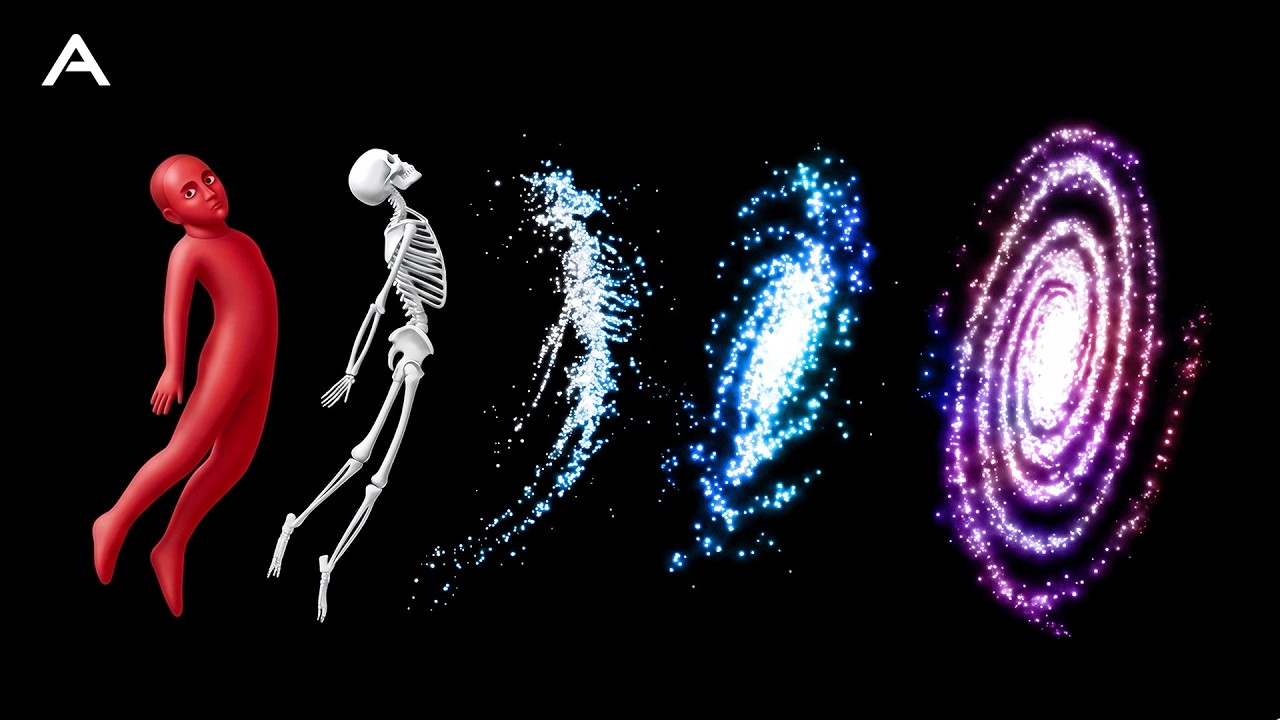
A three hour, forty two minute anthology of nine thinkers who each tried to answer one question: what does it mean to live well. Aperture moves through Carl Jung and the shadow, Jung again on addiction and recovery, Sigmund Freud and the invention of therapy, Fyodor Dostoevsky and the man who fought death and won, Carl Sagan warning Congress about a warming planet in 1985, Friedrich Nietzsche and the death of God, Alan Watts and the illusion of time, Diogenes the cynic who owned nothing, Charles Bukowski on the cost of the nine to five, and Marcus Aurelius on stoicism. It rebuilds each thinker's actual machinery, from archetypes and the id to slave morality and the dichotomy of control, and names the honest cracks in each philosophy where the video names them.
Published Aug 16, 20253:42:08 video47 min readAdded Jun 16, 2026Open on YouTube →
At a glance
This is a three hour, forty two minute anthology of nine thinkers who each tried to answer one impossible question: what does it mean to live well. Aperture moves through them like chapters in a single book, Carl Jung and the shadow, Jung again on addiction and recovery, Sigmund Freud and the invention of therapy, Fyodor Dostoevsky and the man who fought death and won, Carl Sagan warning Congress about a warming planet in 1985, Friedrich Nietzsche and the death of God, Alan Watts and the illusion of time, Diogenes the cynic who owned nothing, Charles Bukowski on the soul cost of the nine to five, and Marcus Aurelius on stoicism and the dichotomy of control.
It is not a survey from a safe distance. The video rebuilds each thinker's actual machinery: Jung's archetypes and individuation, Freud's id, ego, and superego, Dostoevsky's fake firing squad and Siberian prison, Sagan's verbatim greenhouse testimony, Nietzsche's slave morality and eternal recurrence, Watts's Zen, Diogenes's barrel, Bukowski's letter to John Martin, and Marcus Aurelius's Meditations. Two recurring devices hold it together, an interview thread with practicing analysts and the channel's own narrator confessing where each idea hit home. Read straight through, it is a guided tour of how the West has tried to make a life mean something, told in the order the video tells it, with the honest cracks in each philosophy named where the video names them and the full assessment saved for the end.
Carl Jung: the man who mapped the soul
The film opens with a question almost everyone recognizes. Why do certain people instantly irritate you. The loud one starting a dance circle, the friend who hogs the spotlight, the kid who never stops being cringe. Jung's answer is unsettling: the thing that grates on you in others is often the part of yourself you refuse to see. He called it the shadow, and learning to face it is the doorway into his whole psychology. The warning is blunt. Confront your shadow, or you will slowly become the very thing you despise.
Jung was a Swiss psychiatrist born in Kesswil in 1875, the son of a pastor whose rigid religion felt too confining to carry into adulthood. That first clash between faith and skepticism planted the seed. He spent his childhood alone, daydreaming, which he later called his first encounter with the unconscious. In his mid thirties he went through what he described as a horrible confrontation with the unconscious, seeing visions and hearing voices, worried he was sliding into psychosis. He survived it, and in 1900 went to work at the Burghölzli psychiatric hospital in Zurich studying schizophrenia. There he found Freud's work, wrote to him, and became Freud's protege and chosen successor.
But Jung would not stay inside Freud's frame. Where Freud reduced the mind to repressed sexual desire and childhood trauma, Jung saw the psyche as a self regulating system reaching for balance, built in three layers. The ego is the conscious self, the voice in your head right now telling you that you are watching this. The personal unconscious is your private storage of forgotten memories and suppressed emotion. And the collective unconscious, his real breakthrough, is a deep universal layer shared by all humans, filled with archetypes, the primal symbols and motifs that surface in myths, dreams, and stories across cultures that never met. Dragons appear in cultures oceans apart. That is an archetype.
Four archetypes mattered most to him. The persona is the mask we wear in public, shaped by what society expects. The shadow is everything we deny, reject, or hide, the home of repressed desire and impulse. The anima and animus are the inner feminine in men and the inner masculine in women, which integrating brings psychological balance. And the self is the goal of it all, the union of conscious and unconscious into wholeness. He named others too: the puer aeternus or eternal child, the person who refuses to grow up, sometimes called Peter Pan syndrome, and the senex or wise old man, the mentor figure like Obi-Wan Kenobi.
The friendship with Freud broke over exactly this. Freud insisted sexual desire was the primal driver of behavior; Jung thought that far too narrow, arguing that myth, spirituality, and the search for meaning shaped the psyche just as much. The rift never healed. Freud's path became psychoanalysis; Jung carved out analytical psychology, centered on personal growth and the internal journey toward self discovery.
Figure 1. Jung's three layer psyche and his four core archetypes. The ego sits on top of a personal unconscious, which rests on a collective unconscious shared by everyone. Individuation is the lifelong work of pulling persona, shadow, anima or animus, and self into one whole.
The shadow, and shadow work
The shadow is the psychological junk drawer where we stuff the traits we find incompatible with who we think we are: jealousy, greed, spite. Out of sight is not out of mind. The shadow leaks back through projection. You see the loud person at the party and feel a flash of contempt, and that contempt is the shadow recognizing a repressed quality of your own in someone else. The video's clearest example is a mother who scolds her bold, outspoken daughter. On the surface she is just harsh. The shadow tells a different story: she was once exactly that bold, got punished for it in a small town where tall poppy syndrome cut down anyone who stood out, lost a job for outshining a boss, lost friends for being too much, and buried that part of herself. Now her daughter's boldness stirs the buried thing, and instead of facing it she lashes out. "The greatest tragedy of the family is the unlived lives of the parents," Jung said. Our judgments often reflect inner wounds, not objective truths.
The cure is shadow work, which Jung framed as befriending the monster under the bed rather than slaying it. Facing the disowned parts reduces their grip and reclaims the energy spent suppressing them. In practice it looks like journaling about moments of strong emotional reaction and asking what part of me this is reflecting, or working with a therapist trained in Jungian analysis, or guided meditation and dream analysis. The point is not to become a new person. Against the entire self help genre of reinventing yourself, shadow work moves you toward wholeness by embracing both the light and the dark in you.
Individuation, and the loneliness in a crowded room
Then there is the ghost feeling, standing in a room full of laughter and feeling unseen, surrounded but unknown. Jung read that not as simple isolation but as a fragmented self longing to be whole, and the antidote is individuation, the lifelong process of becoming your true self. It is not self improvement in the ordinary sense, not polishing your weak spots; it is uncovering and integrating the most desperate parts of yourself, the things that make you say I would never do that in a million years. When ego, shadow, anima or animus, and self align, you move toward wholeness. When they are rejected, you drift from your essence and try to fill the hole with attention, admiration, and validation, which never fixes it.
Social media intensifies the trap, rewarding main character energy where your life is curated for an audience and you become a performer desperate for applause. Jung's counterintuitive move is to look outward to dissolve loneliness: strike up a real conversation with the people who fade into the background, the delivery guy, the shop owner, the ones you treat as NPCs. As you learn to see others deeply, you mirror that attention inward. Solitude matters too, but the productive kind, the solitude of being in tune with the unconscious through meditation, journaling, and creative expression, which weaves the fractured self back together. His concrete steps: make art for exploration rather than for a masterpiece, do depth therapy, practice mindfulness and ask what part of me is being activated here, build authentic relationships where vulnerability is allowed, and keep a dream journal by the bed.
The criticism Jung still draws
The film is honest that Jung is contested. Critics say his theories are too metaphysical to test. Where Freud kept an empirical scaffolding, Jung leaned into symbols, myths, and dreams, which struck many as speculative. His mysticism made it worse: he took astrology, alchemy, tarot, and the I Ching seriously, and built a theory of synchronicity, the claim that meaningful coincidences reveal a real connection. The author Richard Noll, who wrote The Jung Cult, argued Jung resembled a religious leader more than a scientist. The abstraction is also hard to apply: next to the clear, structured techniques of cognitive behavioral therapy, individuation can feel slow and vague, an introspective exercise with no obvious steps. And the anima and animus draw fire for reinforcing gender stereotypes, femininity as emotional and passive, masculinity as strength and logic. Yet his reach is undeniable, woven through cinema by directors like Christopher Nolan, George Lucas, and David Lynch, and through Joseph Campbell's hero's journey that structures everything from Star Wars to The Matrix. Jordan Peterson carries his ideas to wide audiences, with the usual argument over whether that popularizing dilutes them.
The man who solved addiction: Jung and recovery
The second chapter returns to Jung through a different door, addiction, framed around the roughly 53 million Americans diagnosed with a substance use disorder in 2023. The hook is the gap everyone feels in miniature: you tell yourself no phone after 10pm, and there you are scrolling; you swear off junk food and it pulls you back. The brain usually self regulates, but addiction is a hijacking. Drugs flood the nucleus accumbens with dopamine, the chemical of motivation and pleasure, fixing attention on the substance, while connections to the prefrontal cortex that govern judgment and self control are weakened. The first drink is voluntary; what comes after often is not.
But neuroscience explains the how, not the why, and that is where Jung comes in. In his famous correspondence with Bill Wilson, cofounder of Alcoholics Anonymous, Jung argued alcoholism stemmed from a spiritual thirst. "You see, alcohol in Latin is spiritus, the same word for the highest religious experience as well as for the most depraving poison." He thought addiction could only be solved by a spiritual awakening, and the core of that work was confronting the shadow. The shadow is not evil, just unacceptable, shaped by family, culture, religion. Ignored, it can dominate the personality, feeding addiction, compulsion, narcissism, violence, prejudice, and extremism. Addiction becomes an attempt to numb the pain of the shadow rising, and then the lying and harm of the addiction get repressed too, deepening the split. The more a person hates the addicted part, the stronger the shadow grows and the more substance is needed to quiet it. A vicious cycle. So confronting the shadow is a key step in recovery, and Jung called the suppressed talents that come back up alongside the dark traits the golden shadow.
Jung also read addiction as a mythological arc through archetypes. The orphan or rebel feels alienated and tries substances to fit in or to act out. The trickster deceives and rationalizes, just one drink won't hurt. The shadow or destroyer brings chaos, lost jobs, broken relationships, failing health. At rock bottom comes the wounded healer, based on the myth of Chiron, who suffers deeply and transforms that suffering into healing, which is why so many in recovery become counselors and sponsors. Finally the wise old man and the hero, giving meaning to others. Reframing addiction this way turns it from shameful into purposeful, a journey rather than a life sentence.
The narrator pushes his interview partner on the science. The brain is always learning through neuroplasticity, normally how you learn to ride a bike or remember a name, but in addiction that learning runs in the wrong direction, building stronger pathways to chase dopamine and eating away at other interests until people, places, and emotions become triggers. Both Jung and modern neuroscience agree on one thing: addiction is not a failure of character, it is a trained habit, and habits can be unlearned.
That leads to the disease versus disorder debate, illustrated by two houses, one with an obvious gaping hole, one that simply feels off without an obvious break. A disease is structural damage with a direct treatment; a disorder is a functional disruption, subtler and harder to define. The American Medical Association and the National Institute on Drug Abuse call addiction a chronic brain disease, but the film leans toward disorder, because the brain is neuroplastic and the changes are reversible, and because calling it a disease implies a person is helplessly at the mercy of biology when behavior and mindset clearly drive recovery. Healing means forming new connections and weakening old ones through exercise, therapy, reconnecting with natural rewards like a good meal or a game of fetch, emotional regulation, and mindfulness, which itself enhances neuroplasticity.
From the Jungian angle, addiction is a blocked individuation process. Substances offer a counterfeit wholeness; because addiction can feel like wholeness, it cuts a person off from the real thing. Recovery is becoming whole through self awareness, which is why Jung influenced the 12 steps and their surrender to a higher power, though that power is usually best understood as inner wisdom, the self, rather than a deity. The film is candid that Jung's evidence is thin, especially synchronicity, the scarab story, the car you decide to buy and then see everywhere, which both narrator and guest admit is probably ordinary pattern recognition, your brain focusing on what you have primed it to notice. His insistence on spiritual transformation can also feel unattainable to someone just trying to survive the day, and modern medicine and therapy can help without it. Still, Jung was one of the first to frame addiction as connected to a person's inner life rather than a moral failing, decades ahead of his time, and the practical takeaway is that recovery is real and can produce a better life than the one before.
Sigmund Freud: the man who invented therapy and destroyed himself
The Freud chapter opens at the end, a Saturday in Hampstead, London, an exiled old man on an invalid couch feet away from his legacy, the psychoanalytic couch. Seventy years of work running through his mind, jaw destroyed by mouth cancer from a lifetime of cigars. The pain is unbearable, so he asks his doctor to end it, and on September 23, 1939, a lethal dose of morphine does. The film frames his life as the myth of Icarus, the ambitious mind who flew too close to the sun, comparing his fate to Marie Curie dying of her own discoveries. The chapter is built around interviews with psychoanalyst and filmmaker Karen Doherty of the Toronto Psychoanalytic Society.
Freud was born May 6, 1856, a Jewish outsider in the Catholic town of Freiberg in what is now the Czech Republic. He embraced atheism and treated religion as wishful thinking, the desire for an all powerful father, an idea he laid out in The Future of an Illusion (1927). His household was unusual, his mother twenty years younger than his father and intensely close to him, dynamics that may have shaped his later theories of family. At medical school at the University of Vienna, starting 1873, he saw himself as a scientist first. Working with Josef Breuer, he learned of the talking cure through the patient Bertha Pappenheim, known as Anna O. Doherty calls listening to the patient the revolutionary act, the heart of all good psychotherapy: when patients feel heard, they tend to get better. Out of it Freud built free association, the patient on a couch talking freely while the analyst listens out of sight.
His structural model of the psyche is the spine of the chapter. First the unconscious mind, the radical claim that much of what drives us is hidden, a reservoir of repressed memory and desire that still shapes behavior, surfacing in dreams, in conditions like depression and anxiety, the return of the repressed, and in Freudian slips. Then the three part structure: the id, primal and driven by instinct and immediate gratification; the ego, mediating between id and the outside world; and the superego, the moral, judgmental part learned from parents and society, the source of shame and guilt.
Figure 2. Freud's psyche as an iceberg. Only a sliver of mind is conscious; below the waterline the superego, ego, and id contend out of sight. The id wants now, the superego forbids and shames, and the ego brokers between them and the real world.
The film does not soften the controversies. The Interpretation of Dreams (1900) split dreams into manifest content, what you literally see, and latent content, the symbolic meaning beneath, with a snake reading as repressed sexual desire. Against that the video sets the self organization theory of dreaming, better supported, where dreams are the byproduct of a sleeping brain sorting itself and consolidating memory. The Oedipus and Electra complexes, unconscious desire toward the opposite sex parent, draw the sharpest fire, and Doherty notes the irony that a man theorizing about infancy never analyzed a single child. Worse, the concept of penis envy ignores the obvious social reality that women were denied status and freedom, not anatomy. And the film raises the seduction theory controversy, the argument that Freud reframed real childhood sexual abuse reported by his patients as innate incestuous fantasy. Doherty pushes back on the caricature, arguing there is a lot of Freud bashing by people who do not know how much he revised, and that the claim he simply disbelieved women is not true.
Then the death drive, arguably his strangest idea, that humans carry an innate drive toward death and destruction. "The aim of all life is death," he wrote, conceived amid World War I and the death of his daughter Sophie. He paired Eros, the life drive of survival, reproduction, and pleasure, against Thanatos, the pull toward an inorganic state, rooted in entropy, expressed as aggression, self destruction, and the compulsion to repeat trauma, as in WWI soldiers reliving combat in dreams. Both drives, the film notes, are abstract and short on evidence.
The personal cost mounts. Freud's bond with Jung, sealed in a thirteen hour first meeting in 1906, was the father and son relationship that broke in 1913 over sexual drives, after which Jung wrote "the rest is silence." Then the deaths, Sophie from pneumonia in 1920, his grandson Heinz in 1923, and four of his sisters murdered in Nazi concentration camps after he himself, with help from Princess Marie Bonaparte, fled Vienna for London in 1938. Through all of it, the cigars, more than twenty a day, more than thirty surgeries over sixteen years, never quitting, because Freud could not admit he was wrong. Doherty's verdict on whether Freud is obsolete is sharp: not obsolete, just radical today, because a culture of TikTok and quick fixes is almost the opposite of the long, slow, expensive commitment real psychoanalysis demands. You do not get ill quickly and you do not get well quickly. His fingerprints are on Don Draper in Mad Men, on Fight Club, on Black Swan and Inception, and on the entire path from the talking cure to modern therapy.
Dostoevsky: the man who fought death and won
The Dostoevsky chapter begins with a tap on a cell door at 10am. A young man is told his execution is set for that very morning. He cannot form words, only "it is so sudden." Tied to a pillar with a bag over his head, seconds from the shots, he is released. His imperial majesty has granted us our lives. The whole thing was staged, psychological torture by the Russian state. One prisoner went insane from it. The young man was Fyodor Dostoevsky, and he came out of it embracing life like never before: "I see that life is everywhere. To be among people, that is the purpose of life."
Dostoevsky grew up at Moscow's Mariinsky Hospital for the Poor, his father a physician, surrounded by the sick and the destitute. He published Poor Folk in 1845 to immediate success, drifted into circles of utopian socialism, and suffered from epilepsy, seizures preceded by déjà vu and followed by crushing fatigue, that shadowed his whole life. His membership in the Petrashevsky Circle brought him under the suspicion of Tsar Nicholas I, who feared revolution, and after the mock execution in 1849 he served four years of hard labor in Siberia.
He turned that hell into The House of the Dead (1862), narrated through Goryanchikov, where the deepest cruelty is not the labor but its uselessness. As the narrator says, to crush a man utterly you would give his work "a character of complete uselessness, even to absurdity." The camp denies human dignity, makes monsters rather than reforming anyone, yet the prisoners find scraps of agency, smuggling alcohol to trade. Dostoevsky's lesson: our need for freedom is what makes us human. In Notes from Underground (1864) he attacked the dream that human behavior could be fully calculated and a utopia built on it, insisting people would go mad rather than be reduced to predictable machines, because what gives life meaning is the capacity to choose. The book seeded later dystopias, Yevgeny Zamyatin's We (1924), and through it 1984 and Brave New World.
In Crime and Punishment (1866) he put ideology on trial. Raskolnikov theorizes that extraordinary people like Napoleon may transgress morality to make progress, then tests his theory by murdering a pawnbroker and a bystander, and is torn apart by guilt until a Christian sex worker, Sonia, leads him to confess and repent. The film notes Raskolnikov's theory echoes Nietzsche's higher and lower types, though Dostoevsky never read Nietzsche. The Idiot (1869) drops a Christlike figure, the epileptic Prince Myshkin, into 1860s Russian society and shows it cannot tolerate genuine purity. Demons, here called The Possessed, attacks utopian socialism and enforced equality as the enemies of individual dignity. And in his last book, The Brothers Karamazov (1880), the chapter The Grand Inquisitor stages Christ returning during the Spanish Inquisition, only to be arrested by an Inquisitor who says people do not want freedom, they want security, held captive by "miracle, mystery, and authority." Dostoevsky, a believer who kept a working skepticism ("if someone proved to me that Christ is outside of the truth, I should remain with Christ rather than with the truth"), criticized both the Catholic Church and the socialists for imposing authority on people deemed too weak to choose. His Russian Orthodox faith was the religion of the common people, and Christ's silence in the chapter, ending with a kiss, is his refusal to override free will.
How he fought death and won: facing certain execution, surviving the camp, losing two children and his first wife and brother within months, he could have retreated into the craving for control that trauma breeds, and instead came to cherish life more and to insist on human dignity, freedom, and moral responsibility found in the common man rather than in intellectual scheming. The film draws the line into the present, Leninism realizing the nightmares of Demons, worker exploitation eroding the freedom to choose a life. You need not share his Christian worldview to take the core: there is nothing more important in this world than the living, so do not diminish a human being for the sake of an ideology.
Carl Sagan: the man who predicted the end of the world
The Sagan chapter is the most literal in the film, the near complete text of Carl Sagan's December 10, 1985 testimony to the United States Congress on the greenhouse effect. It opens on the present, flowers blooming in Antarctica, Antarctic hair grass and pearlwort growing faster than ever, glaciers melting, and the framing fact: when Sagan spoke, atmospheric CO2 was 346 parts per million; today it is 421. Everything he said forty years ago could have been said yesterday, because nothing has really changed.
Sagan explains the physics with the clarity that made him famous. The Sun heats Earth; sunlight arrives in the visible spectrum, and Earth re radiates it as infrared. Run the simple energy balance and Earth comes out about 30 degrees Celsius too cold, because the calculation leaves out the greenhouse effect. Gases like carbon dioxide and water vapor are transparent to visible light but strongly absorb infrared at wavelengths like 15 microns; if your eyes saw at 15 microns the air between two people in a room would be black. So sunlight comes in but the outgoing infrared is blocked, and the surface must warm until balance is restored. He is careful: a little greenhouse effect is what makes life possible, without it the oceans would freeze solid. The danger is the delicate balance, and we are pouring methane, nitrous oxide, and halocarbons from agriculture, refrigeration, and aerosols, plus enormous CO2 from burning wood and fossil fuels, into that balance with little concern for the long term.
His calibration is the other planets. Venus, nearly Earth's twin in mass and size, has a surface temperature around 470 degrees Celsius, about 900 Fahrenheit, not because it is closer to the Sun, its bright clouds reflect so much light it should be cooler, but because of a runaway greenhouse effect from an atmosphere almost entirely CO2, ninety times more than Earth's, confirmed by Soviet and US spacecraft that landed and measured it. Mars, Jupiter, and Titan give more cases, and the fact that the same theory predicts all of them correctly is the reason to trust it for Earth.
Figure 3. The numbers behind Sagan's 1985 testimony. The greenhouse effect lifts Earth from roughly minus eighteen to plus fifteen Celsius, which makes life possible; Venus shows what a runaway version does. Since he spoke, atmospheric CO2 has climbed from 346 to 421 parts per million.
Sagan's closing is the part the film most wants you to hear, because it is moral, not just physical. Greenhouse warming is an intergenerational problem: because the effects span more than a human lifetime, the temptation is to call it not our problem, not on my term of office, let the next century worry, but the time constants are long, so if you do not act now it is too late later. It is also global: it does no good for one or two industrial nations to act while others, China developing rapidly on its vast coal reserves, generate the problem alone. He names real options, cutting fossil fuel subsidies, solar power, safe fission, and eventually fusion, none of which vent infrared active gases. And he ends on the line that gives the chapter its weight: what this problem requires is "a global consciousness, a view that transcends our exclusive identifications with the generational and political groupings into which by accident we have been born, because we are all in this greenhouse together."
Nietzsche: the man who killed God
"God is dead. God remains dead, and we have killed him." The most quoted line in philosophy, and, the film argues, the most misread. Nietzsche was not cheering atheism. He was diagnosing a crisis and an opportunity. The full passage ends with the real point: "Must we not become gods simply to appear worthy of it." With belief in God collapsing, humans would have to become creators of their own values, which some found liberating and others, the video notes with Oppenheimer's "now I am become death," used to justify atrocity.
Nietzsche was born in 1844 to a line of Lutheran ministers, lost his father to a brain hemorrhage at five and his younger brother six months later, and grew up steeped in Christianity even as he turned from it. At university he discovered Arthur Schopenhauer, whose pessimism held that the will is an aimless, insatiable striving that always wants more and therefore always suffers, an idea Schopenhauer drew from Buddhism. His first book, The Birth of Tragedy, mourned the loss of Dionysian energy, the sensual, spontaneous, emotional side of life named for Dionysus, arguing the West had grown too logical since Socrates and could be revived through art and the music of Wagner, Beethoven, and Bach. His admiration for Wagner curdled, and in Human, All Too Human he turned toward a science grounded outlook and the aphoristic style that suited both his restless mind and his brutal, lifelong illness.
In The Gay Science he declared God dead, taking atheism as a given and focusing instead on the long shadow its absence would cast. Without God, the morals of Judeo Christianity lose their foundation, and the philosophers trying to rationally re justify them are naive. In On the Genealogy of Morality he traced slave morality to the resentment of slaves against masters who had a happiness they could not reach. Masters once judged by good and bad, by exceptionality; slaves inverted it, condemning the masters' values as evil and calling their opposites good, prizing equality, humility, selflessness, and forgiveness. He thought biblical values were not only irrationally founded but psychologically harmful, because guilt works like indebtedness, internalizing into a craving for self punishment that ends in the ascetic priest's victory, where people no longer merely endure pain but thirst after it.
Crucially Nietzsche was not a nihilist, he fought nihilism, because living in a valueless state leads to despair and suicide. He held perspectivism, that we have no access to a god's eye objective truth, only perspectives, so values must be created rather than discovered, almost as an artistic act, and judged by whether they produce a healthier psyche. His central value is affirmation, saying yes to all of life, the pain and joy alike, finding what is necessary beautiful (amor fati). Not hedonism, which treats pain as evil, but the embrace of pain as instrumental, the sickness that lets you appreciate recovery. He tests affirmation with the eternal recurrence: imagine living your exact life over and over forever; can you say yes to your most painful, embarrassing memories. The test pushes you to live a life you would be willing to repeat eternally.
In Thus Spoke Zarathustra the prophet prepares his disciples for the Übermensch, not a race destined to enslave but simply a person who affirms life to its fullest. And affirming all of life means embracing the will to power, the ingrained drive toward growth, strength, and expression, the happiness of overcoming resistance. This is the most controversial piece: it encourages self mastery but seems to license domination of others, which is why many blame Nietzsche for Nazi Germany. The film corrects the record: Nietzsche opposed the big state, nationalism, and antisemitism, refused to attend his sister's wedding to an antisemite, broke with Wagner partly over his hatred of Jews; Hitler read little of him and found his ideas useless. After Nietzsche collapsed in 1889 trying to protect a horse from being whipped, his sister Elisabeth, back from a failed Aryan colony, assembled his notes into The Will to Power with her own agenda.
His other values: truthfulness, brutal honesty about life, balanced against the danger that too much truth breeds nausea and suicide, so he allowed art as a necessary illusion to make life bearable; and pluralism, using many competing perspectives to approach knowledge, "the more eyes, different eyes, we know how to bring to bear, the more complete our objectivity." His values deliberately support and limit one another, which is why they do not form a tidy system. Above all he did not want disciples, telling readers through Zarathustra to "lose me and find yourselves," to become free spirits who create their own values rather than worship his, since fanaticism is the opposite of what he wanted. The film is candid that his obscure, aphoristic style carried real risk and invited misreading, but suggests the ambiguity was almost necessary: had he been concise, people would have taken his word as law, defeating the entire project of self created meaning. His influence runs through Freud and Jung, Alfred Adler's self actualization, the postmodernism of Derrida and Foucault, and the existentialism of Heidegger and Albert Camus, who like Nietzsche urged creating meaning despite life's inherent meaninglessness.
Alan Watts and the illusion of time
The Watts chapter is the most personal, opening with the narrator's own confession: when he started the channel he fixated on the day it would succeed, stopped seeing friends, and even when he did go out spent the whole time daydreaming about a future that would never come, because there is always something bigger to chase. Most of us live this way, haunted by the past, dreading the future, "obsessed with time." But the future and the past do not exist. Only the present does.
A clock measures movement, the Earth's rotation, not time itself; there is only the present, moving forward. The past is reachable only through fallible memory, which grows less accurate each time you recall it and can be edited into believing things that never happened, or through recordings that capture a sliver without the first person feeling. The past is just a previous experience of the present; it does not exist. The future has not happened, forecasts are often wrong, careers rarely go as planned. The ability to bind time, to carve a spear today for tomorrow's mammoth, is exactly what let humans build complex societies and survive, but the price is happiness and peace of mind, because we are too stuck in the future to be at ease now.
The British philosopher Alan Watts called this the big lie: we tell ourselves we will be happy in an imagined future, but when it arrives we are already living in a new imagined future, our minds chasing forward until the body has no pulse. It is a donkey chasing a carrot on a string; from the outside the donkey is foolish, from the inside we see only the carrot. Memory limits the present too, telling us we cannot do something because we could not before, declining offers that conflict with a past based identity, people dying clinging to a self image of self sufficiency tied to a past that does not exist. School trains us to climb the next ladder and treat the present as beneath us; we invent productivity gadgets that promise more time and use them to escape the now, and for fifteen years the smartphone has been the ultimate tool for fleeing the present, filling idle moments with plans, news, and the curated lives of others. Sitting still gives us anxiety because preparing for the future and anxiety are wired together, but we have evolved past the point where survival must always occupy the mind, and relationships, which live entirely in the present, suffer the more we escape it. Even the plans meant to strengthen them, saving for vacations and retirement, are plans for a future moment of presence we will not be present for when it comes.
Watts studied Buddhism, Zen, Daoism, and Hinduism, and distilled them for the West; not a strict scholar, but a prolific writer and lecturer. His focus was Zen, which holds that permanent enlightenment is impossible and the most we can reach is fleeting moments of pure presence called satori, when we are so completely in the present that past and future cannot enter, when we no longer see chairs as chairs but simply see. Words, logic, and schematic thought fail to capture Zen, which is why masters answer questions by raising a finger and Watts would strike a cymbal, demonstrating rather than explaining. Zen is not nothingness but affirmation, direct contact with the mind to give peace, and in it the past and future, being only forms of structured thought, have no way to enter. The lesson: we are not doomed to be stifled by time. Carpe diem, seize the day.
Diogenes: the man who had nothing but changed everything
The Diogenes chapter starts in a classroom in Athens. Parmenides is arguing that motion does not exist: if motion existed the universe would have a beginning and an end, motion would have had to be created from nothing, and nothing comes from nothing. It sounds wise, but of course motion exists, your own life proves it. One student found arguments like this so elaborate they missed the obvious realities of life, so to prove motion exists, he simply got up and walked out. That was Diogenes the cynic, the film calls him the craziest philosopher of all time.
Diogenes was born in the Greek colony of Sinope, in present day Turkey, and lived from roughly 400 to 323 BCE. Where most philosophers were respected sages, he lived in a large ceramic wine jar, begged for food, urinated, defecated, and spat in public, and pleasured himself in the open, on the principle that what is not shameful in private should not be shameful in public. Called a dog and pelted with bones as an insult, he walked over and urinated on them, then asked why a man would be surprised that a dog acts like a dog. He believed philosophers made life harder than it needed to be by inventing rules that block human nature, and that people who blindly follow pointless rules show they have no self mastery. Once, ignored while speaking wisdom, he started making strange noises and instantly drew a crowd, and observed that nonsense draws attention faster than wisdom, which the narrator notes is the state of social media exactly.
The name cynic and his philosophy came from a simple observation: watching a mouse scurry without anxiety for a place to sleep or fear of the dark, he saw that humans need very little to be happy, and that the endless pursuit of wealth led nowhere good, even for philosophers attached to their fame. Cynicism in his sense is the fear that most relationships are transactional, that friends and lovers stay for what they can get. Yet he thought people inherently good and society the corrupting force, and he broke customs not for chaos but to prove a point, usually at the expense of someone's prestige. Asked if life was evil, he said "not life itself, but living an evil life." He claimed to be a king among men despite being effectively homeless, because he felt no need to possess wealth at all. He walked a marketplace with a lantern in daylight saying "I am looking for a man," because no one in Athens was human enough.
His underrated core is self sufficiency and autonomy. He begged in front of statues to get used to rejection, and rolled in hot sand to harden himself against misery, the same logic as a modern cold shower, conditioning yourself against discomfort so that whatever life sends, the warmth of sunlight, the company of a dog, lands as the most beautiful gift imaginable. Even captured and sold into slavery he never considered himself less than the men buying him, reasoning that even slave owners need masters, and when asked what he was good for, replied "ruling over men." His teachings survive only as actions, his writings lost, and the film suggests that may be fitting. He critiqued conventional values, highlighted our growing distance from nature, and used humor, paradox, and shock to provoke thought, deeply influencing the school that followed him, the Stoics.
Charles Bukowski: why you are doomed to the nine to five trap
The Bukowski chapter is the film's labor critique, framed by his line that most people "simply empty out their bodies with fearful and obedient minds." The aching eyes after a day at the screen, jelly legs after a shift at the register, skin gone gray under warehouse lights: the nine to five diminishes morale and humanity, and the question is why we are doomed to it. Charles Bukowski, raised in 1930s Los Angeles amid abuse, poverty, and bullying, fell early into alcohol dependence, failed to launch as a writer in New York, and spent nearly a decade as a postal clerk, a job he detested. His autobiographical novel Post Office launched his career and made him a literary sensation at age 51, and fifteen years later he wrote the famous letter to John Martin about how nine to five work empties the body and drains the worker of any essential life.
The history is sharper than the cliché. The eight hour day came through activism. The Industrial Revolution moved labor out of the home into factories, raising living standards but stretching the workday to ten to sixteen hours and putting children on the floor. Activist Robert Owen proposed a ten hour day, and by 1817 the slogan crystallized: eight hours work, eight hours rest, eight hours recreation. The reform improved conditions and productivity, foremen learning that healthy workers produce more. But the tidy division does not survive reality, the film argues. Your eight recreation hours dissolve into meal prep, commuting, laundry, housework, child care, and errands, and what is left goes to TV, doom scrolling, or games, while smartphones bleed the workday into the night with emails answered in your pajamas, and none of it exempts you from clocking in at nine. Even the self help movement, the film says, secretly optimizes you into a better participant in capitalism, atomic habits and manifestation aimed at professional goals, a point it credits to Jia Tolentino's essay "Always Be Optimizing," where every part of modern life, from workout crazes to salad bars, is geared to produce a more efficient you who is never off the clock.
The dark consequence is "going postal," the wave of US postal shootings in the late 80s and early 90s that killed at least 35 people. The shooters, often middle aged men facing economic anxiety or termination at the peak of their earning years, are called workplace avengers, committing murder by proxy when colleagues become symbolic of the institution that wronged them. The postal service's internal review found no single cause, but one telling finding: rural postal workers were happier than urban ones, because rural workers set their own schedules and decide how to do the job, while urban workers negotiate workload with managers under pressure for maximum efficiency. That one variable, choosing how you complete your work, is a determining factor of happiness, and when profit is king there is no room to restructure work to support people. Bukowski likened work to slavery for this reason, and unless you have generational wealth or accept a monkish life, work is inevitable, often isolating and repetitive, your body a machine generating money, your humanity denied for forty hours a week through cognitive dissonance.
Bukowski escaped only by luck. In 1969 John Martin offered to pay him to quit the post office and write full time; Bukowski wrote, "I have one of two choices, stay in the post office and go crazy, or stay out here and play at writer and starve, and I have decided to starve," then finished his debut novel in his first month and published with Martin's small press for the rest of his life. Since that rescue will not come for most people, the film offers what coping it can: say no to work when you can and protect your work life balance, take your lunch and breaks, refuse unpaid overtime, know your worth, and use unions to enforce rights collectively. Structures are changing, a four day work week trial in New Zealand raised happiness without much productivity loss, and remote work returns commuting time and a sense of control. Above all, reclaim free time that means exactly nothing productive, walking, picnics, reading, staring into space, the alone moments that build a self outside work. You were not put on earth to work; you owe it to yourself to build the best life you can inside the constraints of the nine to five.
Marcus Aurelius and the guiding principles of stoicism
The final chapter is the philosopher king. In 165 CE the Antonine Plague swept the world, claiming as many as 18 million lives and nearly destroying the Roman Empire. Under Marcus Aurelius it survived, and the film attributes that to his Stoic philosophy. Regarded as the last of the five good emperors, a term coined by Machiavelli, he set ego aside during the plague, surrounded himself with talented public servants rather than aristocrats, hired the best physicians, and steadied the economy by canceling debts, selling imperial possessions, and taxing the upper class. When his old friend and general Avidius Cassius declared himself Caesar and rebelled, Marcus waited to give him a chance to come to his senses, then ordered him captured but not killed, saying it is best "to forgive a man who has wronged one, to remain a friend to one who has transgressed friendship."
His philosophy was compiled in Meditations, his private diary, shaped by Seneca and Epictetus. Its keystone is the dichotomy of control: he could not control what happened around him, only how he responded. From it the film draws five lessons.
Stoic lesson
What Marcus meant
The example
Perception is power
"The things you think about determine the quality of your mind." You can dispense with misperception at will.
Car won't start, no promotion: anger accomplishes nothing. Train perception not to be moved by what is outside your control.
Refuse imitation
"To refrain from imitation is the best revenge." Do not despise the one who despises you.
He forgave the rebel Cassius rather than make a brutal example of him.
The obstacle is the way
A rational being turns each setback into raw material, as nature works around every impediment.
Struggle builds character and resilience; perceive an obstacle as a test of virtue, not a knockout punch.
Love your fate
Amor fati: accept what fate binds you to and love it, wanting nothing to be different.
Epictetus, crippled when a master broke his leg, said wish that what happens happens as it does, then you will be happy.
Remember death
"You could leave life right now. Let that determine what you do and say and think." Memento mori as motivation, not morbidity.
Seneca, ordered by Nero to take his own life, accepted his fate and opened his veins, stoic to the end.
Figure 4. The five lessons the film pulls from Meditations, each anchored to the dichotomy of control. They run from how you read events, through how you treat enemies and obstacles, to loving your fate and using mortality as fuel for a virtuous life.
Marcus's whole reign rested on the first principle. He faced Germanic invasions and internal uprisings he could not alter, and found his real power in how he perceived them, seizing his own mind and making just decisions free of emotional attachment. Despite being one of the most powerful men alive, he kept reminding himself of the fleetingness of his life and of all those who greedily accumulated power and left nothing behind, using mortality as inspiration to live with virtue and gratitude. The film closes the chapter, and the entire anthology, on his line: "Waste no time arguing what a good man should be. Be one." There are things in your control and things that are not. Which will you focus on.
Key takeaways
Nine thinkers, one question. Each chapter is a different answer to what it means to live well, and the film lets them disagree rather than forcing a single conclusion.
Jung: wholeness comes from facing the shadow, the disowned parts of yourself, not from reinventing yourself. The same shadow work reframes addiction as a blocked search for meaning, recoverable through neuroplasticity.
Freud: made the unconscious visible and invented modern therapy through listening, but tied too much to sexuality and left little hard evidence; brilliant and flawed, and his own pride and cigars destroyed him.
Dostoevsky: after a fake execution and a Siberian camp, he concluded that human dignity, freedom, and moral responsibility matter more than any ideology, and that nothing is more important than the living.
Sagan: the 1985 greenhouse testimony was correct and is still unheeded; the planet needs a global, intergenerational consciousness because we are all in this greenhouse together.
Nietzsche: God's death is a crisis and an opportunity to create your own values; affirm all of life, fight nihilism, and never become anyone's disciple, not even his.
Watts: the past and future do not exist; the smartphone is the ultimate tool for fleeing the only thing that does, the present.
Diogenes: we need almost nothing to be happy; self sufficiency, conditioning yourself to discomfort and rejection, is freedom.
Bukowski: the nine to five denies your humanity; reclaim free time that means nothing productive, and you were not put on earth to work.
Marcus Aurelius: control your perceptions and responses, not events; love your fate, treat obstacles as the way, and remember death. Be a good man rather than arguing about one.
Chapters
Click any timestamp and the floating player jumps there and keeps playing.
0:00:00 Countdown
0:00:59 The Man Who Solved Life (Carl Jung)
0:34:41 The Man Who Solved Addiction (Jung on recovery)
1:14:20 The Man Who Invented Therapy and Destroyed Himself (Freud)
1:46:21 The Man Who Fought Death and Won (Dostoevsky)
2:12:19 Carl Sagan: The Man Who Predicted The End of the World
2:29:43 The Story of Nietzsche: The Man Who Killed God
2:58:49 Alan Watts and the Illusion of Time
3:09:00 The Man Who Had Nothing but Changed Everything (Diogenes)
3:19:22 Why You Are Doomed to the 9-5 Trap (Bukowski)
3:30:57 Marcus Aurelius and the Guiding Principles of Stoicism
Notable quotes
Everything that irritates us about others can lead us to an understanding of ourselves.
Carl Jung, quoted at 0:35
The greatest tragedy of the family is the unlived lives of the parents.
Carl Jung, quoted around 6:00
You see, alcohol in Latin is spiritus, the same word for the highest religious experience as well as for the most depraving poison.
Carl Jung to Bill Wilson, quoted around 0:42:00
The aim of all life is death.
Sigmund Freud, on the death drive, around 1:33:00
I see that life is everywhere. To be among people, that is the purpose of life.
Fyodor Dostoevsky, after his mock execution, around 1:46:00
It once came into my head that if I were desired to reduce a man to nothing, to punish him atrociously, it would be necessary to give his work a character of complete uselessness, even to absurdity.
Dostoevsky, The House of the Dead, around 1:54:00
We are all in this greenhouse together.
Carl Sagan, to the United States Congress, December 10, 1985
God is dead. God remains dead, and we have killed him. Must we not become gods simply to appear worthy of it?
Friedrich Nietzsche, The Gay Science, quoted around 2:30:00
One pays a teacher badly if one always remains nothing but a pupil. Now I bid you to lose me and find yourselves.
Nietzsche, Thus Spoke Zarathustra, quoted around 2:53:00
The obstacle is never in the way. The obstacle is the way.
Marcus Aurelius, paraphrased from Meditations, around 3:40:00
Do not seek for things to happen the way you want them to. Rather, wish that what happens happens the way it happens. Then you will be happy.
Epictetus, quoted around 3:38:00
Waste no time arguing what a good man should be. Be one.
Marcus Aurelius, the closing line, 3:42:00
Where it stands
This is a video essay anthology, not a peer reviewed lecture series, and it is honest about that more often than not. To its credit, it names the weak spots itself: that Jung's synchronicity is probably ordinary pattern recognition and that his mysticism cost him scientific credibility, that Freud's death drive and Oedipus complex lack empirical support and that he never analyzed a child, that Nietzsche is endlessly misread and was not the proto Nazi the caricature claims. Those internal corrections are the film at its best.
A few things a careful reader should hold lightly. The chapter titles ("the man who solved life," "the man who solved addiction") promise more closure than nine open questions can deliver; these are competing visions, not solutions, and the film knows it even as the packaging oversells. The Sagan chapter is the strongest because it is almost entirely his own verbatim words and the underlying physics is settled science, the surface temperature of Venus and the rise from 346 to 421 ppm are not in dispute. The historical chapters compress real scholarly debate into clean narrative, the seduction theory and Elisabeth Nietzsche's editing of The Will to Power are both more contested than a single pass can show, and the labor chapter blends documented history (the eight hour day, the postal shootings) with a strong editorial thesis about capitalism that viewers will weigh differently. The transcription also carries small errors in spelling of names that this remake has corrected against the historical record. Taken as what it is, a serious, well sourced tour through how nine very different minds tried to make a life mean something, it earns its three and a half hours. The thread that actually unifies them, stated by half of them in different words, is that meaning is not found lying around in the world but made: by facing yourself, by choosing, by affirming, by controlling what you can. That is a conclusion worth three hours.
Most people go through life looking for
comfort. These men weren't most people.
They didn't run from the chaos. They
stared into it. Into the madness of the
mind, the silence of the stars, the
meaning of suffering, and the absurdity
of modern life. Some were scientists,
some were poets, some were emperors,
some lived in gutters. But all of them
asked the same impossible question. What
does it mean to live well?
This is a journey through their minds,
their philosophies, and their battles.
These are the men who solved life.
Carl Jung, a man who believed that truth
hides in our dreams, our shadows, and
the ancient symbols buried deep within
us. He didn't just explore the mind. He
tried to map the soul.
Everything that irritates us about
others can lead us to an understanding
of ourselves.
Carl Young. Do you ever stop to wonder
why certain types of people just
instantly piss you off? Maybe it's a kid
in class who never stops being cringe or
people who sing all the time or a friend
who constantly hogs the spotlight.
According to the philosophy of Carl
Young, there might be something deep
within you that's just like that
annoying person. It's the part of us
that we refuse to see, our shadow. But
embracing this part of us might bring
forth answers to questions about
ourselves we've always had. In this
episode, we'll dive into Carl Young's
groundbreaking ideas about the human
mind, exploring the hidden world of the
unconscious. You'll learn how to
confront your shadow. Because if you do
not, you will slowly become the very
thing you despise.
Imagine what it takes to be the kind of
person willing to spend an entire
lifetime digging into the depths of the
human mind. Does such a person become
more human or do they trade their
humanity in the process of finding
meaning? All the great thinkers
throughout history likely encountered
this dilemma as they dug deeper into the
human psyche. A man who wasn't spared
from that fate is Carl Young, a Swiss
psychiatrist and psychoanalyst.
Young is pretty well known as a pioneer
in his fields, particularly because he
did a lot more than study the mind. He
mapped it out like an explorer charting
unknown territories. His work laid the
foundation for some of the biggest ideas
in technology today. From personality
types to concepts like the inner child.
At least that's how textbooks describe
him. However, he wasn't some sage who
found understanding after a week of
meditation to understand why he was able
to provide reliable insights for many
people. It's best to take a peek into
the life that led him down a road that
he paved with his own hands and perhaps
extra hands some of you may be familiar
with. To help guide us through this
journey, I've brought along my friend
Noah, who will take it over from here.
Young was born in 1875 in KZwell,
Switzerland. The son of a pastor, Young
respected his father, but found that his
rigid religious beliefs were too
confining to follow into adulthood. This
was the first clash between spiritualism
and skepticism, planting seeds that
would allow him to genuinely explore his
eventual fascination with the
unconscious mind.
Young spent a lot of time alone as a
kid, often daydreaming and reflecting on
his own thoughts. He later described
this period as his first ever encounter
with the unconscious, a theme that would
go on to dominate his life's work.
Originally pursuing medicine, Young had
no inclination towards clinical
psychology, but an interest in mental
illness led him to psychiatry. How this
sprung up is fascinating.
At some point in his mid30s, Carl Young
experienced what he described as a
horrible confrontation with the
unconscious. One where he saw visions
and heard voices. It got to the point
where he even began to worry that he was
menaced by a psychosis or doing a
schizophrenia. It makes you wonder if
his knowledge of mental illness wasn't
advanced, would he have had the chance
to emerge from this confrontation? Or
would he have succumbed as another
nameless victim of his time? Thankfully,
we got the former. Due to these events,
in 1900, Young decided to transition
into working at the Burke Hololey
Psychiatric Hospital in Zurich. It was
here that he began studying patients
with schizophrenia.
This location was also his first
encounter with Sigment Freud's work.
Soon after looking into Freud's ideas,
he made contact with him and the two
began exchanging letters. Quickly, the
pair gained a friendly and
intellectually stimulating relationship.
They would often engage in strong
debates on Freud's work. And over time,
Young rose through the ranks of
psychoanalysis and became Freud's
protege. He evolved into the man that
Freud believed was fit to carry on his
legacy.
But Young didn't stop at Freud's
theories. He expanded on them, sometimes
in radical ways. While Freud was fixated
on repressed sexual desires and the
influence of childhood on individuals,
Young believed that the human mind was
more than a fleshy storage unit for past
traumas.
He envisioned the psyche as a
self-regulating system that strives to
maintain balance and develop itself. He
also believed that it consists of three
layers.
The ego, this is the conscious mind or
the part of us that interacts with our
world. It's your sense of self. It's the
voice that you hear when you're
thinking. Like for example, right now,
you aware that you're watching this
video and that voice in your head is
telling you this. The personal
unconscious.
This is sort of like a personal storage
unit for forgotten memories and
suppressed emotions. It's highly unique
to each person. And finally, the
collective unconscious. Now, this is
where Young really broke new ground in
psychology. This concept is one that is
centered on a new approach. One where
the personal unconscious is the product
of a deep universal layer of unconscious
that all humans share. This collective
unconscious is filled with the
archetypes that can be found among
people. In other words, primal symbols
and motifs that appear in myths, dreams,
and stories across cultures that have
never made contact with each other. For
example, you'll find some variation of
dragons as a myth in cultures located
vast oceans away from each other. That's
an archetype. However, for Young, these
archetypes help to better define human
behavior.
Among the many archetypes that Carl
Young defined, there were four that he
identified as the most influential on
human behavior.
the persona, the mask that we wear in
public. It's the version of ourselves
that we present to the world, one that's
shaped by societal expectations,
the shadow, the part of ourselves that
we deny, reject, or hide. It's the thing
that is behind our repressed desires and
impulses, like the culmination of
everything that we would never admit
that we are.
or animus. The inner feminine side
within men is thema while the masculine
side within women is the animus.
To young, integrating either aspects as
they apply to genders could lead to a
better psychological balance. The self,
this is the ultimate goal of young
psychology. The self is what represents
a union between the conscious and
unconscious mind, creating wholeness and
individuation.
[Music]
But before we look further into that,
let's take a peek at some of the
interesting archetypes proposed by
Young. While those four are the most
well-known, there are others worth
learning about as you dig deeper into
Youngian philosophy.
An archetype that might quickly grab
your attention is the pternos or eternal
child. This archetype reflects a person
that resists growing up, much like the
fictional character Peter Pan.
In fact, some psychologists actually
refer to it as Peter Pan syndrome.
You most likely know a Peter Pan in your
life, the person who peaked in high
school and can't seem to let the past
go. They avoid responsibility and are
stuck in a rebellious teen phase. While
these people can inspire wonder and
creativity, if left unchecked, they can
become stuck in a loop of escapism.
Often lost in a fantasy version of who
they are, unable to put in the work that
it takes to make their ideas a reality.
If you can relate to this, recognizing
the traits of this archetype can be the
first step towards personal growth.
Another intriguing but less popular
archetype is the SunX or wise old man.
one that serves as a symbol of wisdom
and guidance.
You'll often find these figures in
dreams or stories as mentors, like for
example, Obi-Wan Kenobi in the original
Star Wars trilogy. This archetype can
help individuals find direction during
periods of tough time or uncertainty.
Despite finding a tight-knit friendship,
the nature of their works mixed with
individual brilliance meant that there
would be disagreements between Young and
Freud. But it wasn't just because of
professional disagreements that they
grew apart. It was tied to how Freud
believed that sexual desires were the
primal driver for human behavior. But
Young thought that this was far too
narrow, maintaining that the idea could
go further than that. Young argued that
myths, spirituality, and a person's
search for meaning played just as
important a role in shaping the human
psyche. These ideological differences
became a rift that never fully healed.
With some hard lines drawn, it was clear
that Young's departure from Freud's
circle was much bigger than a personal
matter. It was more like a split between
the field of psychology itself. Freud's
legacy would eventually evolve into
psychoanalysis.
Meanwhile, Young carved out a completely
new path called analytical psychology.
This approach was quite broad,
emphasizing the importance of personal
growth, simple interpretation, and the
internal journey towards self-discovery.
Understanding who Young was and how he
developed his theories is helpful when
looking deeper into the concepts we'll
explore later in this video. From shadow
work to individuation,
the Swiss psychologist's ideas offer a
road map for anyone seeking to
understand themselves better. But his
theories weren't flawless ideas accepted
by all psychologists.
Toward the end of this episode, we'll
take a look at the resistance that Young
faced, especially from Freudian circles.
For now though, let's take a leap of
faith into the shadow where the hidden
parts of ourselves await in hope and
misery.
You're at a party when you meet a loud,
attention-seeking person who wants to
start a dance circle. You've always
disliked when people try to make
themselves the main character out in
public. You're not quite sure when it
started. In some ways, you feel like
you've always been this way. You roll
your eyes thinking, "I could never be
like that." But what if that reaction
wasn't a simple bit of annoyance? What
if it was a reflection of something
hidden and buried deep inside you? This
discomfort you may start to feel is a
doorway into one of Carl Young's most
compelling ideas, the shadow. One of the
four core archetypes.
Young described the shadow as a part of
our psyche where we stuff away traits,
emotions, and desires that we find
incompatible with who we think we are.
It's kind of a psychological junk drawer
that holds parts of ourselves that we'd
rather not acknowledge. You know that
stuff that you never want to see
yourself as jealous, greedy, or
spiteful. But out of sight doesn't
always mean out of mind. The shadow has
ways of sneaking into our lives, such as
showing up in projections.
Like the moment that you see that person
at a party, and for a brief moment, you
see your repressed qualities in other
people. A mother scolds her daughter for
being outspoken, confident, and friendly
with people. On the surface, it might
look like this mom is just a mean and
harsh person, but the shadow tells a
different story. The mother could have
been much like her daughter early on in
life, but that changed when she faced
rejection for being too much. Growing up
in a small town where tall poppy
syndrome was a thing, a term used to
describe bringing down successful
individuals who stand out, she lost a
job for outshining her boss, and her
friends abandoned her for being a pickme
because she was outspoken. With such
experience in her youth, the mother
buried those parts of herself, learning
to value quiet humility instead.
Now, seeing her daughter embody that
same boldness stirs uncomfortable
emotions, and instead of confronting the
shadow, she lashes out. Unbeknownst to
her, it's not her daughter's behavior
she despises, but the echoes of her
younger self, a person she works so hard
to repress.
The greatest tragedy of the family is
the unlived lives of the parents. Carl
Young.
This is how the shadow dances in our
lives, slipping through generations and
relationships. It's a strong reminder
that our judgments often reflect inner
wounds, not objective truths. Once we
recognize these dynamics in our
relationships, empathy can quickly
replace frustration. The mother's
scolding is more than a harsh reaction.
It's an invitation to heal. By
acknowledging the hidden parts of
ourselves, we soften our edges and inch
closer to self-acceptance.
But what do we do once we encounter the
shadow to young? Confronting this part
of ourselves could unlock growth and
more self-awareness. This process is
known as shadow work.
Shadow work isn't a fancy term to lucid
dream your way into defeating your inner
demons, as cool as that sounds. Instead,
it's a bit like befriending the monster
under your bed. By facing the parts of
us that have only known darkness for so
long, we reduce their hold on us and
reclaim the energy we once spent
suppressing them. In practice, it looks
like this. journaling about moments
where you had strong emotional
reactions, asking yourself, "What part
of me is this situation reflecting or
working with a therapist trained in yian
analysis?" Yes, you can engage with
professionally trained therapists on
this topic. Modern psychology has
embraced shadow work as a tool for
healing. And you'll often find
therapists who guide patients in
exploring unresolved childhood
experiences or repeated patterns in
relationships. Helping trace these
patterns back to unagnowledged parts of
their psyche. Even outside of a
therapist's office, people tend to use
shadow work as a form of personal
growth, exploring guided meditations,
self-reflection exercises, and even
dream analysis. all to engage with their
inner self. At its core, the concept of
shadow reminds us that growth isn't
about becoming a new person. Contrary to
the popular advice about reinventing
yourself, shadow work encourages us to
move closer to wholeness by embracing
the light and dark sides within us.
Do you ever walk into a crowded room
filled with conversation and laughter,
yet you feel like a ghost? You're
present but unseen. It's like everyone
else is plugged into something greater
and you're not. Instead, you stand
apart, disconnected. This peculiar
loneliness, this sensation where you're
surrounded but unknown, is one that
points to something much deeper than
mere isolation. To Carl Young, it
reveals a fragmented self, longing for
integration. The antidote to this,
individuation. Now, individuation sounds
like a fancy word to justify
selfisolation.
If you listen closely, though, it might
just help you discover ways for you to
be your most authentic self among
others. In many ways, individuation is a
lifelong process of becoming your true
self. It's the process that people go
through as they achieve a distinct and
stable personality. It's not really
about self-improvement, at least not in
the conventional sense. With
individuation, you're not adopting new
habits or polishing aspects of yourself
that you consider weak.
Instead, it centers on uncovering and
integrating the most desperate parts of
yourself. You know, the thing in you
that sees something and makes you
automatically think, "I'd never do that
in a million years."
The ego, the shadow, thema/animus,
and the self are all integral to this
delicate dance within.
Once these elements are aligned, we are
able to step a little closer to
wholeness. However, if they are rejected
or ignored, we drift further away from
our essence. This amplifies feelings of
alienation. And the worst part about
that is constantly trying to fill the
hole with things that will never truly
fix you.
Individuation isn't a one-sizefits-all
solution, but with it, you stand a
chance to handle your inner turmoil with
strengths you haven't truly realized are
there. Loneliness is often a signal that
this inner work is being neglected.
Because of that, we attempt to fill this
void externally by seeking attention,
admiration, and validation. We start to
hold on to the hope that if others
notice us, maybe the ache inside will
subside. Social media doesn't help with
this tendency either, encouraging main
character energy where one's life is
curated for an audience. We slowly
become performers in our own stories,
desperate for validation and applause.
Yet, Young argues that this pursuit is
hollow. How is this possible? For one,
individuation teaches that fulfillment
doesn't come from being seen, but from
seeing ourselves and others with
clarity. Mix that with a healthy dose of
compassion and things start to make a
lot more sense.
Let's use this example. You scroll
through your Instagram feed,
occasionally pausing when you're looking
at a perfectly curated life of an
acquaintance. As you stare intensely at
their photos, you feel a twinge of envy
arising. Rather than dismissing this
bitter emotion in embarrassment,
consider this moment as an invitation to
experience individuation. What could be
the unmet desire or repressed quality
that this envy highlights? Do you envy
their holiday photos because you're
secretly longing for adventure?
Do you talk down about them returning to
their ex for the third time because
you're secretly scared nobody loves you
enough to want to keep trying? Do you
have secondhand embarrassment for their
weird Tik Tok videos because you've had
to keep up an appearance of being put
together? All it comes down to is the
parts of yourself that have gone
unnoticed. Individuation asks you to sit
with these feelings in totality. No
judgment, just you looking in the mirror
and unraveling the messages held within
your discomfort.
This process of turning inward is what
helps cultivate a richer connection to
the self. In a paradoxical way, it also
lessens loneliness. As we engage in deep
self-reflection, we grow and become
better equipped to engage with the world
authentically. Slowly, the need for
external validation fades, and it's
replaced by a cool, quiet confidence,
one that is entirely rooted in
self-awareness.
A practical approach to individuation
and by extension combating loneliness
involves shifting our focus outward.
Now, sure, this may seem
counterintuitive, but by noticing others
constantly striving to be noticed, we
dissolve the barriers that isolate us.
So, the next time you're outside,
instead of thinking about how depressing
it is that you don't have many friends,
try something new. Living outside of
your own head, consider striking up a
genuine conversation with someone who
often fades into the background. the
types of people that you'd think of as
NPCs, a delivery guy or a shop owner.
Nothing too crazy, just a little bit of
human connection. Pay attention to the
unnoticed details of their story. By
building a habit out of a simple act,
you can experience some transformative
changes in your own life. As you learn
to see others deeply, we mirror that
same sort of attention inwards,
fostering the same recognition within
ourselves. It all starts to make sense
once you draw it out in your own head.
If there are parts of you that aren't
ever seen as relevant within your own
self, you're likely using a similar
level of harshness in how you judge
other people to some extent.
Young believed that solitude was an
essential ingredient in individuation,
but it's not the loneliness that happens
when you're disconnected from the world
around you. Instead, it's the solitude
that exists when you're in tune with the
unconscious mind. Through constant
practices like meditation, journaling,
and creative expression, we're able to
engage with the hidden parts of our
psyche, allowing the unconscious mind to
finally speak. These solitary moments
are what weave together the fractured
aspects of the self, drawing us ever
closer to psychological wholeness.
To begin this journey, here are some
practical steps worth looking into.
Engaging in creative outlets. Creativity
is often overlooked in the journey
towards self-improvement. But being
familiar with who you are and how your
mind prefers to express itself is
crucial.
Art, music, and writing are the sorts of
things that bypass our ego's defenses.
Allowing hidden aspects of ourselves to
surface. Forget about producing a
masterpiece. Instead, create for the
sake of exploration. It's the journey or
process itself where the true value
lies. Therapeutic exploration.
Yian analysis or other depth oriented
therapies are strong sources for a sense
of structure towards individuation.
A trained therapist can guide you in
steps like engaging with the shadow,
uncovering projections you've held
towards other people, and integrating
unconscious material.
Practicing mindfulness. When you're able
to carve out moments of stillness every
day, it'll go a long way in getting you
comfortable with being yourself. It also
allows you to reflect on emotional
triggers, recurring conflicts, or
intense reactions.
Asking yourself, "What part of me is
being activated here?" is a helpful way
to unlock some profound insights.
Building authentic connections.
Individuation thrives in a relationship.
This goes beyond the romantic side of
things and into communities or
friendships where vulnerability is
encouraged. By sharing your inner world
with others, you can accelerate
individuation, revealing hidden
strengths and blind spots within.
Journaling emotions and dreams. Dreams
are seen as the language of the
unconscious. They offer clues about
neglected parts of our psyche. When you
keep a journal by your bed and quickly
write down your dreams upon waking,
you'll gain some cool insights. Over
time, symbols and patterns start to
emerge, pointing to areas of yourself in
need of integration. Instead of viewing
life as some sort of performance, you
start to fully inhabit it. The
loneliness fades not because the
external world shifts, but because
you're able to deepen a relationship
with yourself. You start to recognize
that the connections you seek outwardly
are at their core a reflection of the
connections that you've cultivated
within. Young's perspective on
individuation isn't some far-fetched
ideal meant for philosophers or mystics.
It's for the everyday person. A
practical path laid bare for anyone
willing to engage with their inner
landscape. While the journey is sure to
be solitary at times, it leads us back
to the collective, making us more
connected, whole, and a lot more at
peace with who we really are.
Although Carl Young has proven himself
to be a helpful voice in the field of
psychology today, his influence hasn't
been met without a healthy amount of
skepticism.
Concepts like the shadow, archetypes,
and the collective unconscious have
helped to shape psychotherapy, pop
culture, and literature. Yet, critics
have had one specific issue with the
philosophy. And the issue in question is
the metaphysical nature of Young's
theories. To put it simply, there are a
lot of people who feel that Young's work
can't really be tested with science or
put in practical terms. If we truly want
to fully appreciate this iconic
philosopher's work, it's essential to
explore his strongest criticisms and the
debates they've ignited within
psychology as a whole.
It's well established that Young was
seen as Freud's protege and potential
successor. Both agreed on a lot,
especially in their interests in the
unconscious mind. As we noted earlier,
their philosophical paths eventually
diverged and this led them to some
significant theoretical clashes. Freud,
who is known for a psychoanalytical
framework, emphasized the importance of
sexual drives and repressed desires as
the primary forces that shape human
behavior. Creating a model of the
psyche, he believed that our behavior
revolved around the id, ego, and
superego, painting an image of humanity
that's largely driven by our early
childhood experiences. For Young, he
proposed a broader, more spiritual view
of the unconscious. Instead of focusing
solely on the personal feelings of
repression, he introduced the collective
unconscious as an idea, using it as a
collection of shared archetypes and
symbols that our species inherited from
our ancients. Critics believe that
Young's departure from Freud's beliefs
pushed him in a direction that was much
more imaginative than his old friend.
However, it also lacked the empirical
foundations that were emphasized and
maintained by Freud. By choosing to
focus on symbols, myths, and dreams,
Yian psychology felt too out there, and
some considered it to be in speculative
territory.
Now, the biggest part of Yian philosophy
that raises eyebrows is his mysticism.
This is a person who was never one to
shy away from astrology, alchemy, or
religious symbolism. Young was ready to
explore the human psyche in ways that
had never been done before. This further
cemented his reputation as a thinker who
constantly straddled the line between
metaphysics and psychology.
Some interesting things about Young
include his belief in synchronicity, the
idea that coincidences always have a
meaningful connection. He also used
tarot cards and an Iching, an ancient
Chinese text that functions similarly to
tarot. These resources helped Young
better understand the psyche. But he
also drew sharp criticism from numerous
contemporary psychologists who preferred
to be more grounded in empirical
research. Some argue that Young's
embrace of mysticism tends to detract
from his work's credibility. Modern
psychology is something that prioritizes
constant results that are repeatable
with tests and datadriven methods.
Meanwhile, with young analysis, there's
a lot of emphasis on subjective
experience, which means that it
struggles to meet the criteria set out
by modern standards. There are critics
like Richard Null, an award-winning
author known for the Young Cult, the
origins of a charismatic movement, who
believe that Young's approach is a quasi
spiritual movement rather than a
scientific discipline. even going
further to claim that Young's approach
is similar to that of a religious
leader, not a psychologist.
This mystical quality, which is often
the subject of criticism for Young, is
also what makes him so appealing. The
innate willingness to engage with the
unknown and explore the mind is
something that resonates with certain
types of people. You know, the sort of
people who seek meaning beyond the
confines of materialism. For many,
Youngian psychology is what offers a
bridge between science and spirituality.
It addresses questions of purpose,
transformation, and identity, the things
that psychological models tend to
overlook.
Another common critic of Carl Young's
work lies in the complexity it brings,
yet there aren't many practical ways to
apply them. When you take a look at
concepts like the enema and animus,
individuation and the shadow, there's
this abstract way that they are
described. This makes it difficult for
the average person to implement in their
daily life or fully grasp. Unlike
something along the lines of cognitive
behavioral therapy, which is a form of
treatment that uses clear, structured
techniques when addressing mental health
issues, in young analysis, things tend
to feel slowm moving or for a niche
audience.
With individuation, there's a strong
belief that it's an essential element
for psychological growth. Yet, it lacks
any clear or actionable steps. Critics
argue that without any concrete methods,
young therapy is really just a type of
introspective exercise that yields
basically no tangible progress. In
clinical settings, this ambiguity can
get frustrating for patients seeking
immediate relief from their
psychological distress.
In the 21st century, you'll notice that
Youngian psychology has evolved quite a
lot. Some practitioners have attempted
to ground some of Carl's ideas into
contemporary research. Neuroscience is a
field that has started to show interest
in the role of the unconscious,
particularly in the ideas like the
unconscious mind and its role in
influencing patterns of behavior. This
heavily echoes Young's notion of
archetypes. Yet, we also have some
modern psychologists like Jordan
Peterson who draws heavily from Youngian
ideas in his writings and lectures. He
also has faced a lot of criticism for
oversimplifying or misrepresenting
Young's more nuanced theories.
Peterson's take on concepts like the
shadow has introduced Young to wider
audiences, but it has also sparked a
debate on whether or not these
simplifications dilute the richness of
Young's original work. One thing Yungian
psychologists can't seem to shake away
from is this portrayal of the animus.
Arguments are often made about the
description of these inner figures as
they tend to reinforce gender
stereotypes. On one side, femininity is
seen as emotional and passive, while
masculinity is represented as strength
and logic.
While Youngian analysts point towards
the fluid and constantly evolving nature
of these archetypes, critics argue that
such frameworks actually risk promoting
outdated notions of gender roles.
Despite the strong criticisms, Young's
work continues to prove valuable. His
theories invite exploration into the
inner world in ways that extend beyond
diagnosing symptoms. Instead of feeling
like a checklist, Young and Psychology
encourages a holistic approach to mental
health. Although some of his ideas can't
withstand scientific scrutiny, they
still offer tools for self-discovery and
artistic inspiration. On a deeper level,
criticisms of Young mirror the dualities
that he sought to explore in his work,
especially relating to science versus
spirituality.
Young's greatest contribution doesn't
lie in providing definitive answers to
questions, but rather promoting us to
ask much deeper questions about the
nature of the human mind and the
mysteries shaping our existence.
Carl Young's ideas didn't fade out with
the 20th century. No, they've woven
themselves into the very fabric of
today's art, pop culture, and
psychology. His exploration of
archetypes and the collective
unconscious play a major role in the way
stories are told and how we understand
ourselves. In cinema, we can easily see
this impact on some of the most iconic
works of our time. Directors like
Christopher Nolan, George Lucas, and
David Lynch have openly drawn from
Youngian philosophy to craft complex and
symbolic narratives. The hero's journey
storytelling structure popularized by
mythologist Joseph Campbell, himself, a
devout student of Young, is the basis of
countless blockbusters ranging from Star
Wars to the Matrix. These stories
resonate so deeply with audiences
because they mirror the archetypes and
patterns described by Young in his work.
This philosophy is so relatable, it
helps pop culture by reflecting
humanity's shared psychological
experiences. Outside of film, Young's
ideas are solidified in music,
literature, and even video games. The
concept of a battle between light and
dark, a search for self-actualization,
and an integration of the shadow are
recurring themes found in countless
creative works. Artists usually channel
the unconscious to make their best work,
transforming personal and collective
symbols into expressions that are
understood universally. Now that we live
in an era of identity exploration and
increased mental health awareness,
taking a look at Young's emphasis on
individuation feels more relevant than
ever. His work offers something beyond
simple insights. Instead, it's a map for
those seeking meaning in an increasingly
fragmented world.
This is the brain of around 53 million
Americans who in 2023 were diagnosed
with a substance use disorder. On the
left is someone who can enjoy a drink or
a high and walk away. While the one on
the right can't because for them, the
craving just doesn't stop even when the
substance is actively harming them. But
this isn't just about drugs or alcohol.
At the core of addiction is something
that all of us struggle with.
Compulsion, escapism, and negative
patterns that we can't seem to break.
Why does this happen? And more
importantly, what can we do about it? To
answer that question, I studied the
psychology of addiction, searched
through the latest neuroscience, but the
answer I found was much older than you
might think. What if addiction isn't
just about chemicals or choices, but
about meaning and wholeness?
Addiction used to be a dirty word.
People who struggled with substance
abuse would suffer in silence alone.
Families were ashamed, unsure of how to
feel about their loved ones who seem to
be plagued with unsolvable problems.
Students were taught that they could
just say no through academic programs
that shaped addiction as a choice. But
now we know the reality is much more
complicated. Still though, addiction
feels like a reality that's difficult to
talk about, even though its root cause
might be a lot more common than many of
us would like to believe.
Have you ever tried to stop doing
something, even if it's just something
small, and then realized you couldn't?
Um, for instance, uh, you tell yourself
you won't check your phone after 10
p.m., but there you are scrolling again.
Or you've sworn off caffeine or junk
food, but it keeps pulling you back.
>> Yeah, definitely. Um, especially the the
junk food part is definitely something
that I've I've seen, you know, come up
again and again. And I guess my question
has always been, even if I know that
these things aren't good for me, like my
brain knows these things aren't good for
me, but yet it's still my brain that
can't stop craving them. Um, I've always
wondered like what is that disconnect
between, you know, these cravings and
basically the functional brain saying,
"Okay, I don't need this thing." You
know, and that's something I've always
wish to understand. That feeling of
being at odds with yourself might not be
a full-blown addiction, but it does give
us a glimpse. For most people, the brain
tends to self-regulate. And if you try
hard enough, that craving can fade, but
addiction is a lot different. Addiction
is like a hijacking of the brain. These
substances basically take over the brain
and completely rewire its natural
learning system. They reprogram the
brain to obsess over and pursue these
substances even when it's actively
causing harm. And while that first drink
or sniff might be voluntary, what
happens next often isn't. The person
becomes trapped in some kind of
psychological prison. Drugs stimulate
the brain's reward system, especially a
part of the brain called the nucleus
acumins by causing a surge in dopamine,
our neurotransmitter that relates to
motivation and pleasure. That surge of
dopamine then fixates your attention on
the substance that you're using. With
repeated use, those dopamine surges in
the hyperactivation of the reward system
keep you coming back for more without
any control. Our preffrontal cortex
governs judgment, self-control, and
decision-making. Connections to that
part of the brain get weakened when
someone is struggling with addiction.
Their ability to choose or delay the
gratification of using drugs is
impaired. After reading and
understanding all of this, I still
wasn't satisfied. Sure, all of this
explains how addiction works from a
neurological point of view, but it still
didn't explain why it happens in the
first place. Why is the brain who is so
good at ensuring its own survival
suddenly create this psychological trap
and why is it so difficult to break out
of it? During my research into all of
this, I discovered Carl Young.
Now, have you heard of the psychologist
Carl Young?
>> Oh, yeah. I have actually. I know that
he used to work with Freud u and I know
a lot about like Freudian psychology.
So, yeah, that's how that's how I know
him. What does he have to do with
addiction?
>> He worked on addiction uh quite
extensively, but he's done a lot more
than that. As I was doing the research
for this video, I discovered that even
his ideas on addiction go a lot deeper
than even um like basic neuroscience.
Jung believed that people struggling
with addiction were often seeking deeper
connection or fulfillment that they
thought they would find through
substances or addictive behaviors. In a
famous letter with Bill Wilson, the
founder of Alcoholics Anonymous, Young
suggested that alcoholism stemmed from a
spiritual thirst. He wrote, "You see,
alcohol in Latin is spiritus. The same
word is used for the highest religious
experience as well as for the most
depriving poison." Jung thought that
addiction could only be solved through a
spiritual awakening, which is why many
of his ideas on addiction recovery have
to do with a sort of spiritual journey.
The main part of which is something he
refers to as confronting your own
shadow.
Do you ever feel like there's a part of
yourself that you can't reach? Like
you're doing certain things and you're
just saying to yourself, "Wow, I I
cannot believe I just did that. That is
not who I am." um you know there are
certain things that that you do and you
just you know you feel like was that me
who did that thing you know and and I
think what's even worse is that you end
up like in this place of of shame um and
just feeling really bad about the thing
that you did and just trying to like
hide it as much as possible not even
from anyone else but like from yourself
in a way and you kind of want to just
put it in the back mind in somewhere
that you even you can access. So yeah,
it's it's it's a very strange
experience,
>> but that's actually what Carl Jung would
call your shadow. Uh the shadow is the
repressed parts of ourselves, uh
desires, fears, and unresolved traumas.
Um our conscious self, which he refers
to here as the ego, refuses to accept
the shadow and actually keeps the shadow
buried. The ego is shaped by
socialization and your personal
decisions. Whereas the shadow is um more
kind of what the ego wants to exclude or
or or get rid of. It wants to disown it,
you know. Um but you know, the irony is
always that the more you try to suppress
the shadow, the more it fights to get
its own way to kind of operate on its
own.
Addiction isn't always about substances.
Sometimes it's the subtle daily
compulsions like checking your phone
every few minutes that quietly rewires
your brain. We often think we're in
control until we try to stop. But not
everything about our phones is
inherently bad. In fact, when I started
understanding how addiction works, I
realized I could take back control by
being intentional with my screen time,
one of the best decisions I made was
replacing doom scrolling with learning.
Real active learning. That's where
Brilliant, the sponsor of today's
episode, completely changed the game for
me. Instead of passively watching
lectures, you learn on Brilliant by
solving puzzles, interacting with
concepts, and building intuition. A
method that's proven to be six times
more effective than just video lessons
alone. Whether it's AI, math, science,
data analysis, or programming, Brilliant
walks you through step by step, helping
you grasp the fundamental principles
that make the world tick. Marcus
Aurelius truly believed in not just
learning, but implementing the lessons
that he learned. This is exactly the
same philosophy that Brilliant applies
to their courses. I recently took their
how AI works course and it completely
opened up the confusing world of AI
chatbots like chat GPT Claude and Grock
that have pretty much taken over our
world by this point. Through this
course, I learned how AI thinks, learns,
and makes decisions and it changed how I
interact with them. Daily learning like
this can rewire your brain and help you
think more critically, solve realworld
problems faster, and recognize the
hidden logic behind everything from
basic equations to advanced algorithms.
Brilliant courses are crafted by an
award-winning team of educators and
researchers from Stanford, MIT, Caltech,
Microsoft, Google, and more. If you
truly want to live like the philosopher
king, then learning every day is
definitely for you. And Brilliant makes
this accessible to everyone. To try out
the how AI works course or any of
Brilliant's incredible content, you can
do it completely free for 30 days by
visiting brilliant.org/apperture
or by scanning the QR code on the screen
right now. You'll also get 20% off an
annual premium subscription if you want
to take your learning to the next level.
So stop scrolling and start thinking and
make learning a daily habit.
The shadow isn't necessarily the evil
part of ourselves. It's just the parts
that seem unacceptable. This usually
stems from the opinions of our family,
culture, religion, or even our own life
experiences. But if the shadow is
ignored, Young warned, it can dominate
your whole personality, leading to
addiction, compulsion, narcissism, and
even violence. The ignored shadow can
also cause prejudice or moralistic
superiority. It fuels extremism both
within ourselves, but also in our
society. A repressed shadow is just as
much a breeding ground for addiction as
it is for an authoritarian movement.
Young felt that addiction could be an
attempt to escape or soothe the
discomfort caused when the shadow starts
to rear its head. Instead of confronting
those painful feelings or traumas,
addiction offers a way to push them back
down. Substances or behaviors can act as
numbing agents against this psychic
pain. Instead of doing the often painful
inner work of facing one's shadow,
someone may turn to substance abuse
instead. Jung saw all this as evidence
of the split psyche between the ego and
the shadow. When a person becomes
addicted, the ego is no longer in charge
and the shadow begins to express itself
through substance abuse. Someone
struggling with addiction might say it
wasn't me or I don't know why I acted
like that. Jung tells us that they are
probably right. It wasn't the part of
themselves that they know their ego. It
was their unconfronted shadow taking
center stage, which can be a very
jarring and very dangerous experience.
Addiction doesn't just stem from the
shadow, but it becomes a part of the
shadow as well. The behaviors and
consequences of substance use like
lying, stealing, or harming others are
often shameful and even further
repressed, which according to Jung
increases the psychic split between ego
and shadow. The more a person judges or
hates the addicted part of themsself,
the more it is banished to the shadow
and the stronger the shadow becomes and
the more substances the person needs to
numb that ever growing pain. It is a
vicious cycle of hurt.
This is why confronting the shadow is a
key step in overcoming addiction. Shadow
work helps individuals own all pieces of
themselves, including those unwanted
parts like anger, envy, and grief. In
recovery, people find their authentic
whole selves.
But it takes a strong ego to confront
and integrate the shadow without being
overwhelmed by it. Shadow integration
can be used in addiction recovery
through techniques like journaling or
creative expression to explore repressed
feelings or memories. Dreamwork to
understand the symbols of chaos or the
unknown and therapy focused on
reintegrating the rejected parts of the
self. As destructive as the shadow can
be in the cycle of addiction, it also
contains a lot of positive potential
like unrealized talents or creativity
that were suppressed alongside these
unwanted traits. Sometimes the more
creative or complex pieces of our psyche
are lumped in with the dark and
traumatized ones, so we learn to repress
them all the same. For people with
substance abuse disorder, this
repression can be even more pronounced.
But when the shadow is confronted in
recovery, those creative instincts can
manifest in incredible ways. Young
refers to those pieces as the golden
Have you ever thought about how our
lives, how they reflect stories found in
ancient myths or religious texts like
the uh Bible or the Quran? Yeah. Um, as
someone who, you know, grew up in the
church, so I read a lot of of Bible in
in in Sunday school and as an adult, I
started to learn, you know, about other
religions and cultures, even my own. And
one of the interesting things that I
found is that you kind of almost get
these sort of recurring characters who
have a names, but they kind of do very
similar things. So you'd you you'd
almost always have like a savior type of
person, like a trickster and and you
just have like these different
personalities. So yeah, that's something
that's always like intrigued me
honestly.
>> Yeah, I mean that's that's really
insightful because uh surprise surprise.
Uh Jung talks about those. He refers to
them as archetypes. Uh now archetypes
are universal patterns or symbols within
our collective consciousness. Um a few
examples we have the hero, the mentor,
uh the lover, the trickster. Jung
actually suggests that these archetypes
play roles in the dynamics of addiction.
And you can actually view addiction as a
mythological arc uh like in these
stories.
In the beginning, the person is the
orphan or the rebel feeling alienated.
The orphan tries substances to fit in.
The rebel wants to go against the grain
and might try substances because it's a
way to act out and rebel. Then that
person falls deeper into addiction and
loses control. Jung associated this
stage of addiction with the trickster
using substances to manipulate their own
reality. The trickster is a chaotic,
deceitful, and clever force that
disrupts order and plays with its
boundaries. In the journey into
addiction, this manifests in different
ways. One might rationalize their
consumption by saying, "Oh, just one
drink won't hurt." Or they may deceive
others in their lives by hiding their
use or manipulating people. They may
also find a sense of confidence at this
point by skirting consequences and
always landing on their feet for a
while.
From here the person has developed a
substance abuse disorder and embodies
the archetypes of the shadow as we
discussed or the destroyer.
This stage is marked by chaos, a loss of
control, shame, and destruction.
Relationships will fall apart. Physical
health will begin to fail. One might
lose their job or their general sense of
responsibility. Eventually, they hit
what is often known as rock bottom. In
this stage of hitting rock bottom, the
person reflects the archetypes of the
wounded healer finding themselves with a
sense of hopelessness, grief, and
surrender to the substance abuse
disorder. The wounded healer is based on
the myth of Chiron and suffers deeply
but eventually transforms that suffering
into healing. We can see this happen in
real time with many people who recover
from addiction going on to become
counselors, sponsors, or therapists.
They heal through their own wounds. From
there, one can become the wise old man
or woman and ultimately the hero,
providing spiritual insight during and
after their recovery. These archetypes
are associated with transformation and
giving meaning to not only their own
lives but the lives of others. Jung felt
that using these archetypes can add
meaning to the process of addiction and
recovery. He believed that addiction is
not random but deeply symbolic. Viewing
addiction through archetypes reframes
the suffering as purposeful and not
shameful, as a journey that one can go
through and not a lifelong sentence that
one must endure.
Archetypes can help people struggling
with addiction understand the invisible
forces driving their behavior and give
names and references to their struggles.
Substance abuse, Jung thought, is often
the soul's misguided dream and
archetypes offer a map to wake up,
return to life, and heal.
>> So far, I understand a lot of Young's
ideas on how they show up during
addiction and even recovery. Uh but just
like stepping away from from his ideas
for a little bit, I wanted to I wanted
you to sort of explain to me the
neuroscientific
aspect of it like when we actually look
at these two brain scans, what's the
real tangible difference between them?
>> That's that's a great question. So while
young saw addiction as he he saw it as
like a spiritual crisis, brain
scientists and neuroscientists describe
it more as a disorder of learning and
habit. Addiction rewires the brain,
especially the parts that deal with
reward and decision-m. And how that
works is our brains are always learning.
That's that's a process called
neuroplasticity. It's um it's
essentially your brain's ability to
change based on our experiences. It's
how we learn to say ride a bike or play
instruments or remember people's name.
But in addiction, that same learning
ability actually goes in the wrong
direction. So the brain starts to focus
on one thing and and that happens to be
the drug and it learns to obsess over
it. So at first the the drug floods the
brain with dopamine and that's the
really that's the feelgood chemical that
we get, you know, when we see a sunrise
or, you know, after a really good jog,
you feel great. And drugs cause the
brain to flood with dopamine. And
obviously the brain loves that and we
love that. So the brain begins to build
stronger and stronger pathways so it can
chase that feeling again. So over time
it actually starts to um it it eats away
at other interests like uh music,
relationships or heck even food. And
instead the brain starts to become
really laser focused on just that one
thing. And it's getting more and more of
that substance because it wants more and
more of that dopamine. But it doesn't
even stop there. Um, certain people,
places, or or things or even emotions
actually, they get tied up with that
drug, with that dopamine rush. And just
seeing that person, place or feeling
that emotion can trigger a craving. And
eventually the brain gets stuck in a
really, really awful loop. And that's
when addiction stops being about a
choice and it starts being a compulsion.
One thing that both Jung and modern
neuroscience agree on though is that
addiction isn't a failure of character.
It's a powerful habit the brain has been
trained into. And like any habit, it can
be unlearned. But it takes time,
support, and a lot of relearning to
rebuild those pathways.
And that brings us to a bigger question,
one that shapes how we treat addiction
and how we fund its research and even
how we judge the people who suffer from
it. Is addiction a disease or a
disorder?
Is there really a difference?
>> Well, actually, uh, there is. So,
imagine that you're looking at two
houses on your street and one of them
has this huge gaping hole in the side
and the damage is obvious. You know,
there's the the shingles are falling off
and you you know as soon as you look at
it what's wrong. Now, there's a second
house uh right next to it. And the
second house looks like it's off. Make
no mistake, it you know, you can't quite
place what it is, but you know there's
something wrong with it. And so if you
were asked to fix one of these houses,
which one would be easier to fix?
>> Um, definitely the one with the walls
broken in. Um, even though it sounds
like a lot more work, I think just the
fact that I know exactly what is wrong
from just looking at it means that I
also know what to fix. With the second
one where you said like I don't really
know what's off, like I feel like that's
going to take a lot more time to figure
out first what's wrong before like
figuring out how I can fix it. So
definitely the first one the walls
broken in.
>> That's essentially the difference
between a disease and a disorder. So uh
describing a disease it usually means
that there's something wrong physically
like there's something damaged
physically. There's a structural change
in the body or the brain and that change
can produce symptoms and the treatment
for a disease is usually pretty direct
uh whether it's medication uh surgery or
or some kind of intervention you know.
But a disorder on the other hand is a
lot more subtle and that's the house
where you can tell something's off but
you're not sure what. It's a functional
disruption and uh it means that things
aren't quite working the way they should
but nothing really looks obviously
broken and that can mean that the
symptoms or or even the causes and
therefore the treatments are a lot
harder to define.
There has been a debate about whether
addiction is a disease or a disorder.
Many institutions like the American
Medical Association and the National
Institute on Drug Abuse define addiction
as a chronic brain disease. But some
researchers, clinicians, and
philosophers argue that calling
addiction a disorder more accurately
captures its psychological behavior and
social dimensions.
Addiction changes brain function not
because the brain is broken physically
but because someone's normal processes
have gone ary. While addiction changes
the brain, the brain is neuroplastic. So
these changes are not irreversible as
they are in many other diseases.
Perhaps the most convincing argument
that addiction is a disorder and not a
disease is that to label it a disease
indicates that someone is simply at the
mercy of their own biology as they would
be if they got cancer or diabetes. But
we know that behavior plays a major role
in how people who struggle with
substance abuse recover. In many cases,
changes in behavior and mindset can lead
to a full recovery.
The main takeaway here, whether you want
to think of addiction as a disease that
creates a structural biological problem
or a disorder that affects someone's
functionality, is that people can
recover from it. But stopping use is
only one part of that recovery.
Crucially, recovery also relies on
neuroplasticity.
Those in recovery have to find new
behaviors and experiences that can
rewire the brain towards healthier
habits. To heal from addiction, the
brain must form new connections and
weaken old ones. This can be done by
building new habits like exercise and
therapy. Reconnecting with natural
rewards like an amazing meal or playing
fetch with your dog, developing
emotional regulation and stress
tolerance when things get tough, and
practicing mindfulness, which has been
shown to enhance neuroplasticity.
Labeling addiction might help some
people navigate it, but what's important
to remember is that recovery is
possible.
It is shifting things around in that
house to make it livable again. This is
where Carl Youngung's philosophy offers
a more practical approach to healing.
Addiction and substance abuse from a
Yungian perspective are not just
behavioral or biological disorders. They
are signs of a disrupted or blocked
individuation process. There are several
elements that all of us but especially
those with substance abuse disorder have
to reconcile.
One is the ego or our conscious mind.
This is our sense of identity.
Individuation starts when the ego
recognizes that it is not the whole self
but just part of the larger psyche. Then
there's the personal unconscious which
is the layer of ourselves that contains
forgotten memories, repressed emotions
and experiences that are unique to us
and only us.
Individuation requires that we confront
and integrate this unconscious. This can
happen through methods like reflection
in the form of journaling or meditation
or dreamwork where we analyze symbols
and stories that come up in our
And then we have the shadow, which we
now know is all the traits that the ego
has rejected or repressed. A major step
in individuation, especially for those
dealing with addiction, is facing the
shadow without fear or judgment and
reclaiming its energy in a conscious,
meaningful way. Addictive behavior can
be understood as a symbolic search for
inner wholeness. For men, this might
mean accepting vulnerability, emotional
depth, and relational sensitivity. For
women, this could be embracing
confidence, rationality, and assertive
self-expression.
It's not about the binary of gender, but
a guide towards emotional balance that
often gets thrown out of whack during
this cycle of addiction. And then
there's the self. The self is the
central archetype of wholeness, the
totality of psyche, both conscious and
unconscious. It is the guiding force
behind individuation which is often
symbolized by wise figures or spiritual
experiences. When the individuation
process is stalled or avoided as is
often the case in a struggle with
addiction, the individual may feel
empty, fragmented, anxious, or depressed
or or disconnected to any sense of
purpose.
Substances offer a temporary escape or
counterfeit version of this wholeness.
Since addiction can seem like wholeness,
it cuts someone off from individuation.
The person with substance abuse disorder
gets so deep in the addiction cycle that
they then think that they are whole, but
really they're just pushing away any
intention to explore their inner selves.
The addiction cycle seeks comfort and
escape, suppresses inner life, and is
driven by compulsion and results in a
loss of identity. On the other hand, the
individuation process seeks truth,
engages with the inner life, is guided
by meaning and self-awareness, and
allows people to emerge as their
authentic selves with an understanding
of their true identity. Recovery is,
according to Jung, a process of becoming
whole through self-awareness and
resolving internal conflict, as in the
12 steps of Alcoholics Anonymous, which
Jung influenced. Recovery often involves
surrender to a higher power. Most people
think of this as a religious experience
and the higher power as a deity, but
that doesn't have to be the case. In
fact, in most cases, this higher power
is seen as the inner wisdom or the self.
I think what I'm learning here is that
Young really knew his stuff. If he
understood this much about addiction
hundreds of years ago, why isn't
everything he said taken as, you know,
fact by modern neuroscience? A lot of
what Young has said about addiction does
really help with addiction recovery and
a lot of it has been applied. The
problem with a lot of what Young has
said is there isn't a lot of data or
evidence to support a lot of his
theories. One of the biggest examples of
this is actually his theory of
synchronicity.
Have you ever experienced it's it's a
phenomenon where you dream about a
friend and then you wake up and you
check your phone and right there it's
you get a text from them or you've had a
song stuck in your head and then you
hear it three times in one day like you
know really like too much to be a
coincidence.
>> Um yeah, all time. Um I remember uh
there was a time that I wanted to to buy
a car and once I had made a choice on
like the car I wanted I just started
seeing the model everywhere. It was like
the whole city had the car I wanted to
buy. So, uh, Jung actually had a word
for that and it's synchronicity and it
refers to meaningful coincidences that
show a connection between our inner
world, say the example that I used of of
dreaming or your example of wanting to
buy a car or a certain kind of car and
external conflicts. In addiction
recovery, people often report moments of
synchronicity, which fascinates me.
They're they're um unexpected events
guiding them towards sobriety and
transformation. Uh again these coinc
coincidental events that are kind of
giving them that push towards
um recovery and uh where that comes from
is Jung was very influenced by Taoism
and Eastern philosophy especially the
Iching. It was a Chinese divination text
which assumes that the universe is
interconnected through patterns of
meaning. Unlike western medicine and
western kind of logic where uh cause and
effect are very much the view of
reality. East the eastern worldview
embraces patternbased thinking and more
symbolic resonance if that makes any
sense to you. Now, one example that Jung
co-opted of synchronicity is a story
that he would repeatedly tell about a uh
it was a scarab um in ancient Egypt and
they were they were the symbol of
rebirth and transformation and the cycle
of life. Now uh this actually happened
to Jung. He was seeing a patient who was
describing a dream involving a golden
scarab. Um it was a golden scarab and at
that exact moment an actual scarablike
beetle struck Young's window. So it's
pretty crazy. He was just thinking about
it and then it happens. So he opened up
the window and caught the beetle and
presented it to his the patient who was
like absolutely stunned that they were
just talking about this and suddenly
there's this beetle. And that appearance
of the beetle as she was describing the
dream about a beetle broke through her
resistance to therapy and then she was
ready to start her um her healing
journey which uh you know obviously was
amazing enough for Young to build an
entire theory off of. And um Jung claims
that in fact we all all of us experience
this uh all the time in our daily lives.
Um so we we talk about a friend we
haven't seen in years and the next day
you know there they are on the street.
Uh we quote a line from a movie and
suddenly the movie shows up first on our
on our recommended um moments like it
feels kind of fun when these moments
happen. It's surprising and you feel
like oh am I tapping into the Matrix or
something like that. But the problem is
with this theory and with a few of
Yung's theories is there's again really
no data to support that this isn't just
our brains regular pattern recognition
at work.
>> Yeah. Like honestly as you were talking
about it and as I was thinking about it
as well that's kind of what was going
through my head. It kind of just feels
like when you consciously think about
something your brain starts to focus
more on it. Like with the cars for
example, I don't know if I would
necessarily say there were actually more
cars there. Um I just think it's because
my brain was now focused on this one
particular car. I started recognizing it
a lot more compared to the other cars.
>> I think there's a certain degree of just
our own biases that we put on our
experiences of synchronicity.
But on the other hand, um our experience
of synchronicity can also support the
process of individuation. And um it sort
of acts like a guide or nudges us
towards this path of self-realization.
We have to take control for ourselves in
our lives by making room for our whole
selves. And this nudge can be really
helpful in addiction and in addiction
recovery. And it can act as a turning
point for a lot of people like you know
the scarab how it broke through that
patient's emotional barriers for
therapy. She said, "Oh, nope. You know
what? I've seen the signs. Let's move
on." And that that can happen for a lot
of people. These moments of
synchronicity often happen right after a
person bounces back from hitting rock
bottom. Um you might run into uh you
know an old friend in recovery just
after contemplating dipping back into
your addiction. Um you you might get an
offer of help from a stranger at just
the right time or or you know what you
you're reading a book or a quote seems
to leap off the pages and apply directly
to what you are currently experiencing.
And Jung believed that those moments
weren't random. He thought that they
were actually orchestrated by the self,
uh, the deeper center of the psyche to
redirect you towards healing. And
whether or not he was correct, it's
definitely worth noting as something
that it does help people out when they
feel like they're not immediately in
control.
Jung's ideas around addiction stem from
years of research on patients and his
own observations. He emphasized the need
for transformative or spiritual
experiences to overcome psychological
challenges like addiction. But seeking a
spiritual awakening can be a heavy task
of someone struggling with substance
abuse. How can you even think about such
a transformational moment when you're
just trying to make it to the next day?
What Young's thinking lacks are some of
the more basic steps some people can
take to break the addiction cycle. Yes,
it is important to confront one's shadow
or inner traumas, but it's also just as
important, if not more, to create simple
habits like exercise or meditation.
There's also the reality that spiritual
thinking just isn't for some people. It
might be helpful to believe in some
larger power or element at work. But if
that worldview doesn't resonate, Jung's
insistence of spiritual transformation
to recover from addiction could feel
unattainable.
Perhaps a deeper understanding of
neuroplasticity and what can affect it
is going to be a more effective tool.
Jung did the majority of his work in the
early and mid 1900s, well before a lot
of modern medicine and prescription
drugs were developed and before cultural
thinking evolved. In this day and age,
there are other therapies and medicines
and even philosophies that can help
someone move through addiction and
recovery that can be separate from
However, if you strip away the labels
and insistence on spiritual
transformation, Young's ideas can get at
the heart of how difficult it is to
escape the clause of addiction. They
also help outsiders understand what the
individual is going through because his
ideas are so universally applicable.
We all grasp the concept of not wanting
to confront our deepest traumas and
turning to something else to mask that
pain, even if that mask isn't
necessarily substance abuse.
By fostering this type of empathy, Jung
creates a language that makes it easier
to talk to and about people who are
suffering. As science evolves and past
ideas become irrelevant, in many cases,
Young's findings still ring true today.
The key isn't to take them wholly
literally. As with all therapy, advice,
or guidance, part of the onus is on us
as individuals to take the pieces that
resonate and leave behind the ones that
don't.
Without the ability to adapt old ideas
for new times, we wouldn't be where we
are today with our attitudes about
addiction. we would still be trapped in
the negative way of thinking that people
dealing with substance abuse have
somehow failed at life and are
irreparable. Of course, we now
understand that that couldn't be farther
from the truth.
In many ways, Jung was one of the very
first voices to paint addiction not as a
moral failing, but as something that was
deeply connected to someone's inner
life. He was way ahead of his time in
this sense and actually thought much
more like current addiction researchers
and therapists than the medical
professionals and religious leaders of
his day. I think all in all, um, Young's
ideas were definitely revolutionary for
his time. And honestly, the fact that we
can still use a lot of what he taught
today is really amazing. You know, fun
fact, I've actually never had alcohol
before because I'm just worried I'll get
addicted to it cuz I believe that I have
an addictive personality, whatever that
mean. Um, so just hearing all of this,
it kind of made me realize that, okay,
maybe I need to do some shadow work on
myself to understand what part of myself
I'm hiding away from. Uh, by the way, I
definitely want to know if I'm the only
one that feels this way. So you guys
just comment down below if you've ever
struggled with substance addiction. And
if you have, and if you haven't, if
you're like me, you also live with a
constant fear that if you ever try
something, you'll get addicted. I'll
just love to hear your thoughts.
Whether it's through Young's ideas or
modern science, the important thing we
must all remember is that recovery from
addiction is not only possible, but it
can lead to a much better life than the
one that you had before the addiction.
In connecting with the shadow and
balancing the neurotransmitters that
went haywire, you can become an even
better version of yourself, one that is
whole and free.
Sigman Freud, one of Jung's closest
companions, the father of
psychoanalysis, who made the unconscious
visible and exposed the primal forces we
spend our lives trying to control. What
does it take to change the world?
Sometimes the price is everything, even
your own life. This is the story of
Sigman Freud, the man who invented
modern therapy and in the process
destroyed himself. Like most things,
there are three sides to Freud's story.
There's the story he told himself, a man
on a mission to decode the mysteries of
the human psyche. The one people tell
about him, that he was deranged, cocaine
addicted, and sexually perverse. A
lunatic drowning in a pool of his own
theories. And then there's the truth.
After reading dozens of papers, diving
deep into the world of Freud, and
interviewing Freudian experts, we've put
together the story of a man who ravaged
his own mind in his quest to change the
world.
It's Saturday in the small community of
Hampstead, England. The lush gardens of
Marsfield create a picturesque
background for the tragedy that's about
to unfold. An exiled figure lays in an
invalid couch just a few feet away from
what would be his legacy, the
psychoanalytic couch. It's been seven
decades of service to neurology.
Successes and failures run through his
mind as he slowly fades to darkness. His
breathing becomes more labored as the
years of cigar smoking have taken their
toll. Mouth cancer is a diagnosis and
there's not much time left. The pain is
extreme, but this suffering must end on
his own terms. The doctor can't endure
this pleading anymore, so he grants the
man's final request, administering a
lethal dose of morphine. The date is
September 23rd, 1939.
Sigman Freud is dead.
Death's relationship with great minds is
one that's always captivating. Often
tragic, it evokes a warning to those who
dare seek meaning in the void that is
life. For Freud, death's ironic twist
met him on an insignificant couch steps
away from the embodiment of his life's
work. An ending that mirrors the pain
that Marie Curi endured from radiation
poisoning, the results of her own
scientific discoveries. Although these
pioneers experienced tragic endings,
there's a poetic undertone to their
fates. It's like the myth of Icarus.
Icarus and his father Detilus were
imprisoned on an island. A determined
craftsman, Detilus devised a plan to
escape, creating wings made of feathers
and wax. But before they took to the
skies, Detilus warned Icarus about
flying too close to the sun, concerned
about the heat melting his wax away. He
also cautioned him on flying too close
to the sea, as the moisture would weigh
his feathers down. But the excitement of
flight overcame Icarus, and he soared
high, daring to reach above the clouds.
As he inched closer to the sun, the wax
melted and his wings fell apart, leaving
him to plummet into the sea and drown.
For Icarus, the flight was a chance to
rise above where none had dared to
cross. This frames the struggles of
pioneers brilliantly. An ambitious mind
succumbing to a cruel fate for defying
the norm. Like Icarus, they flew. And in
Freud's case, his work was the
foundation of modern psychology. Yet,
like Icarus, Freud flew too close to the
sun. And as a result, his violent
descent into the depths of human
struggle was unavoidable. To understand
what made Freud's fall so devastating,
we have to go back to the beginning. And
to help us out is Karen Doherty.
>> I'm Karen Doherty. I'm a psychotherapist
and a psychoanalyst and a documentary
filmmaker. I'm in Amaranth, Ontario,
rural Ontario. I'm part of the Toronto
Psychoanalytic Society. That's where I
trained. and I'm the host of the
Canadian Psychoanalytic Society podcast
conversations in Psychoanalysis Today.
>> Born on May 6th, 1856, in a time when
religion defined society, Sigma and
Freud's life was that of a true
outsider. Being Jewish in the Catholic
town of Fryberg, now called Pribore,
located in the Czech Republic. Freud
felt the mental anguish of alienation
early on. Pushing religion to the side,
he embraced atheism, further distancing
himself from the people he was closest
to.
>> Freud was kind of anti- relligion. For
him, it's a little bit of a symptom. Do
you know? It's wishful thinking. For
him, it's edible to to believe in God.
It's like you want there to be an
all-perfect father who who tells you
what to do and so on and punishes if you
don't do it. But he he really did think
of religion as um as as problematic for
sure.
>> Freud's family was far from ordinary.
His father, Jacob, was a wool merchant
who had been married twice. His mother,
Emily, was Jacob's second wife and 20
years his junior. By the time Freud was
born, he already had a nephew, John, who
was a year older than him. Freud grew up
in a household with unusual dynamics.
His connection with his mother was even
weirder. They were intensely close. Some
might say too close. Family roles were
blurred, and this confusion may have
left an effect that shaped his later
theories on familial relationships. Yes,
the ones he's now infamous for. Freud
was a lot like that one person that we
all know. The one that can't let a
debate go until they've made their
point. His competitive drive wasn't just
about winning. It was about uncovering
truths, even if they were uncomfortable.
And Freud's love for dispute was evident
even in his childhood. While intense,
this same drive led him to revolutionize
our understanding of the psyche. But it
also came at the cost of pushing those
around him away. Freud's need to be
right would also eventually contribute
to his downfall. Academically, Freud
demonstrated excellence right away. He
attended the Leopolder Communal Rail
Gymnasium, and it was here that he
developed a strong interest in books.
Freud was the kind of student who would
stay up late reading Shakespeare,
searching for the answers to the world's
most fascinating mysteries. His teachers
often praised his brilliance, but it
wasn't pure intelligence that set him
apart. It was his unending curiosity.
And that growing appetite for knowledge
laid the foundation for his intellectual
pursuits, including his development of
complex psychological theories. A
pivotal moment for Freud came at the age
of 17 when he stumbled upon a poem he
initially thought was written by Johan
Wulf Gang Vongut. At the time he was
unaware of the profound impact that it
would have on him. The poem in question
him to nature provided him with a flash
of inspiration steering him towards
medicine as a pursuit. Ironically it
later would be revealed that the work
was actually written by George Kristoff
Tobler a devout Christian and pitist not
gu. Nonetheless, Freud found Guate's
other work to be the source of
inspiration throughout his life, often
citing him in his theories and essays.
Looking back, it really feels like the
wildest butterfly effect. Throughout
Freud's life, seemingly random events
were catalysts for his most compelling
results. When he started attending
medical school at the University of
Vienna in 1873, he wasted no time
establishing himself as a gold standard
student, particularly when studying the
physical structures of the brain. At
this stage of his life, Freud saw
himself as a scientist first and a
physician second, an approach that
helped shape his later focus on the
mind's more abstract properties. In the
late 1870s, Sigman Freud met Dr. Yseph
Buya, one of Vienna's top researchers
and 15 years his senior. It was through
that Freud discovered the talking cure,
a treatment encouraging patients to
address their symptoms through
conversation. Bruya had a patient,
Bertha Papenheim, referred to as Anna O,
in his studies, who initially began
hypnosis treatments with him for her
hysteria. In these sessions, Broya noted
that she would spit out a continuous
stream of words, leading the two of them
to agree on trying a different approach
that didn't involve hypnosis. Yeah. See,
this is the thing. before Freud really
when it comes to, you know, sort of like
hysteria or or depression or or madness,
lunacy, what you have is doesn't it's
not pretty. It's it's madous.
It looks like exorcism, mesmeriism, you
know, maybe hypnotherapy, chains, you
know, people locked up. This is the one
of the most revolutionary things that he
does is he decides that he's going to
listen to the patient.
That's the heart of psychoanalysis.
Listening, a very particular way of
listening. That in itself
is at the heart of all good
psychotherapy. The relationship between
the patient and the therapist.
When the patient it feels heard,
recognized, tuned into, really listened
to, they tend to get better.
>> Freud was fascinated by the idea that
talking about one's problems could
unlock hidden traumas. And after working
with Ysef Bua, Freud began introducing
the talking cure in his own practice.
This influenced his development of free
association, a method of treatment that
focused on getting patients to talk
about their darkest desires. The free
association setup was simple. Have a
patient lying on a comfortable and
specially designed couch, communicating
freely about their problems and desires.
All while Freud listened intently,
taking notes away from their line of
sight by peeling back their layers to
uncover hidden desires. Freud believed
that he could help these patients find
the root causes of their suffering. This
was the classic psychoanalyst setup and
it was a massive success. Today, modern
therapy closely mirrors this. A patient
lies on a comfortable couch involved in
an honest conversation while their
therapist takes notes. The
psychoanalysis setup was crucial,
helping push Freud towards his
groundbreaking theories. But this also
worked as a double-edged sword,
revealing Freud's own obsession with the
process, specifically his hyperfixation
on sexuality and the unconscious.
Freud's relentless focus on these
concepts was strange to his colleagues
and critics, setting the stage for some
of the consequences that would define
his entire career. From Freud's point of
view, all of his patients seemed to be
driven by sex. But there was a huge hole
in this conclusion. Many of Freud's
patients were female with most of them
being burgeois or upper class. He
believed in sex as a fundamental force
shaping human behavior and was
determined to prove its role within the
inner self. This idea would lead to his
most controversial theories such as
penis envy and the edipus complex.
>> For contemporary psychoanalysts, we
still all look to Freud. we don't
necessarily follow to the letter what
Freud thought when it comes to things
like like penis envy for example I don't
know I'm not so sure maybe some people
but certainly not all people so I think
when we start to imagine that all of his
ideas were are correct or that they must
be thought of as universal I think I
think that we we get Freud wrong and we
get psychoanalysis wrong
>> this role of sex was ultimately
debatable but free association revealed
the hidden desire ers that were at the
root of many problems for his patients.
He coined the term psychoanalysis as the
process of treating these issues. After
establishing a baseline treatment with
free association, Freud began his most
impactful work, introducing us to his
structural model of the psyche. First,
we have the unconscious mind. The idea
that a significant part of our thoughts
and motivations are hidden from us, kept
away in a part of our psyche that we'll
never fully access unless we dig deeper.
At the time, this was revolutionary. and
Freud's embrace of the unconscious mind
helped to popularize it. Before this,
the belief that our thoughts and
motivations were repressed was
unimaginable. It was an era where
religion, particularly the church, was
the only real authority. Freud argued in
his 1927 book, The Future of an
illusion, that religion was only rooted
in our need for security, not an actual
connection to its teachings. Even within
the confines of people's thoughts, many
depended on God and religious leaders
for guidance. During that era, the
answer to most mental afflictions was
prayer, not introspection. With the
unconscious mind, people learned that
there was a reservoir of memories,
feelings, thoughts, and desires that
were not accessible to our conscious
awareness. Freud believed that these
hidden elements significantly influenced
our behavior even when we are not aware
of them. This is called repression, and
it occurs when the brain pushes
uncomfortable, threatening thoughts down
into the unconscious. According to
Freud, the unconscious mind acts as a
reservoir for these repressed elements.
But despite being hidden, they become
shadowy whispers that continue to
influence a person's behavior. You might
find yourself losing sleep over your
actions or events that you've witnessed,
struggling with anxiety, and feeling
like an impostor. Worst case, it affects
your relationships and you start to
question your self-worth. When these
effects of repression start to hit you,
it's known as the return of the
repressed. When left unattended, they
can resurface in various ways. In our
dreams, for example, or even worse in
the waking world through conditions like
depression and anxiety. Repression is
also associated with behaviors you're
more likely familiar with. Freudian
slips. Have you ever said something that
you couldn't believe just as it flew out
of your mouth? Maybe you said your ex's
name when you're addressing your current
partner. If so, there's a chance that
you did that because of some unresolved
thoughts or feelings. The human
subconscious, according to Freud, holds
many secrets. But the structural model
of the psyche wouldn't be complete
without highlighting its biggest idea,
the id, ego, and superego. Terms to help
us understand how the mind is organized
down to how it interacts with itself.
The id is unconscious, a more primal
part of ourselves with little to no
nuance. It's entirely driven by instinct
and desire for immediate gratification.
Then there's the ego, a part of the
psyche mediating between the id and the
external world. Sure, you may want to
stay up late binging a show, but that's
not going to help you in the long run,
especially if you've got a commitment
like work the next day. As for the
aspect representing our sense of
morality, we call that the super ego.
It's the more judgmental and social part
of a person's psyche. You'll find moral
convictions learned from parents and
society here, but it's also the source
of self-criticism. If you're aware that
you can do better, your super ego will
subconsciously punish you with feelings
of shame and guilt. It is what anchors a
person's moral compass. While Freud's
model of the psyche is insightful, it's
also the foundation for some of his most
questionable theories.
Despite his successes, Freud's career
was littered with moments where he just
plain missed the mark. not just in the
theoretical sense, but also practically.
These were mostly instances of arrogance
where he stubbornly believed that he
knew better than everyone else,
abandoning scientific methods and
leaning only on his own understanding.
Perhaps the most frustrating part of his
more controversial ideas was that they
weren't completely far-fetched. Some
would prefer to believe that he woke up
spewing nonsense, but in tracking his
thought process, there are some
valuables in the wreckage. In his 1900
book, The Interpretation of Dreams,
Freud proposed the idea that dreams are
linked to hidden wants and repressed
desires. Instead of random stories
created by our brains, Freud argued that
they have two main properties. The
manifest content, which is the things
that we literally experience in the
dreams, and the latent content, which
possesses the symbolic meanings of those
experiences. So, if you see a snake in
your dream, that's the manifest content,
a literal hissing reptile. But if you're
wondering why that snake showed up in
the first place, the truth you uncover
is latent. This latency varies from
person to person, but according to
Freud, some symbols have more universal
meanings. In this instance, a snake
often symbolizes a repressed sexual
desire or a male figure in the dreamer's
life. This interpretation of dreams
starts to lose ground once we put it to
the test, especially when comparing it
to the self-organization theory of
dreaming. a perspective that suggests
our dreams are a byproduct of the
sleeping brain's self-organizing
processes. In this theory, it's proposed
that the brain is sorting itself while
we sleep, but the discontinuous signals
it produces are turned into a narrative.
There's significant scientific backing
behind self-organization as a more
likely theory with dreams, and modern
research has revealed that dreams may
primarily exist to consolidate or
preserve memories and to help with
learning. But what scientific backing is
there to support Freud's theories?
Here's the problem. For as big a thinker
as Freud was, he had a terrible habit of
lacking any empirical evidence to
support his theories. As the decades
have passed, some of his theories have
increasingly presented as fascinating
for the time in which that they were
proposed, but don't stand up to modern
era understanding of the human mind.
like the Edipus complex. Among the ideas
proposed in the interpretation of
dreams, the Edipus and Electrica complex
are the most controversial. It's
proposed that children have unconscious
desires for their opposite sex parents
during the early stages of development.
Freud believed that the first 5 years
were essential for a child's development
of their adult personalities, especially
the ability to control and direct sexual
desires. Remember the Edipus and
Electrica complexes exist in the
unconscious. So he didn't necessarily
believe that kids literally wanted to
act on these feelings. Instead, these
complexes exist to help them understand
relationships, cope with desires, manage
anxieties, and learn societal norms.
Freud had some blind spots, you know,
for all of his genius. And it's
interesting that for someone who is
really talking about uh all of these
things starting in infancy and
childhood, the Edipus complex, this is a
man who never analyzeed children. There
was no child analysis.
>> Once again, his lack of empirical
support was glaring. On a deeper level,
Freud's heavy emphasis on sexuality in
describing human growth seemed forced at
that point in time. It felt like an
exaggeration of factors to fit into his
ideas, especially at the expense of
other social and cultural elements. For
example, he introduced the concept of
penis envy in the Electra complex, an
idea that a girl has disdain towards her
mother for depriving her of a penis.
Freud completely ignored the societal
factors motivating women, especially a
desire for social status. Males are
granted more opportunity and freedoms
than females. Therefore, this envy that
Freud observed was probably not a desire
for male anatomy. With this criticism,
Freud's need to tie things to his sexual
interpretations feels forced. But maybe
there's a reason why he became so
involved with these myopic sexual
meanings. After all, Freud's childhood
bond with his mother was one that seemed
to cross the usual boundaries of
parental sentiments. In some ways, Freud
was too keen on using his own personal
experiences as a blueprint for the
treatments he was pushing on others.
Then there's the Freudian coverup
theory. Many of Freud's early patients
experienced sexual abuse. Most of the
women revealed early childhood instances
of sexual molestation by their fathers.
Instead of that being the focus, Freud
decided to propose the Edipus and
Electra complexes to explain these
occurrences. Essentially, he was
excusing the abuse by tying it to an
innate incestuous attraction from young
girls towards their fathers. Some
critics consider Freud's theory as a
deliberate act to cover up the reality
of childhood sexual abuse towards women,
particularly in Vienna, where Freud
practiced. Although some do not believe
this is the case,
>> there's a lot of Freud bashing in our
culture for whatever reason, and usually
by people who don't know much about what
Freud actually said or how much he
revised of his ideas or how generous he
was in sort of passing the torch on to
other people. So, we're listening to the
contents of someone's mind. And so,
that's very hard to get if you're not an
analyst. He's just been painted as
someone who didn't believe women, and
that's just not true.
>> Although Freud's theories on sex were
controversial, they pale in comparison
to the death drive, a baffling idea that
humans carry an innate drive towards
death and destruction. The aim of all
life is death, he wrote, connecting us
to a repressed desire for non-existence.
This concept is perplexing for a couple
of reasons. He came up with it during a
period of extreme turmoil globally and a
dark period of time in his own life.
World War I was underway and around the
same time he lost his daughter Sophie.
So there's a good reason for him to
justify death's irrationality as part of
the unconscious. According to Freud,
human nature is tied to two opposing
forces. Aeros, the life drive, and
Thanatos, the death drive. These weren't
just abstract ideas. They were the
fundamental forces shaping all of human
behavior. The core concept behind
Thanatos sounds grim, but it's not
accurate to define it as a desire for
death. The theory is more like a drive
towards non-existence or an inorganic
state. Theatos is also rooted in the
concept of entropy where all systems are
designed to move towards a state of
disorder. As humans, life is a part of a
system and by that implication, we have
a desire to return to nothingness.
Although Freud himself never used the
Thanatos and aeros labels to define
these drives, these names serve his
concepts better. Thanatos is borrowed
from Greek mythology after the
personification of death, a figure who
delivered the death to the underworld.
Aeros is taken from the Greek god of
physical love and desire. And it's from
his name that we have the word erotic.
Now, how this desire manifests comes
down to behaviors we've displayed since
the dawn of humankind. Aggression, for
example, is considered an expression of
the death drive. Same with
self-destruction because it can turn
inward, leading to self harm and even
suicide. The death drive is also
connected to repetition. Freud theorized
that people feel compelled to revisit
and repeat past traumas. For example,
soldiers in World War I often
reexperience combat in their dreams. He
believed this happened as an attempt to
master those events. There are concepts
based on other reasons for encountering
traumas in our dreams that challenge
Freud's theories with some being that
the brain may be consolidating those
traumatic memories. Along with a death
drive, Freud's aeros has some
questionable elements. Aeros is the
impulse for survival, reproduction, and
pleasure. In his eyes, the two forces
are in constant tension, competing to
influence our actions and propel much of
the human experience. However, the life
drive suffers from the same shortcomings
as its counterpart. It's extremely
abstract and lacking in scientific
backing. There's also the criticism of
Thanatos centered on how it might come
off as a form of encouragement for
suicide. Yet, there are still some
positives in this Freudian theory. For
what it's worth, the concept of provides
a framework for understanding some more
self-destructive or even aggressive
aspects of human nature. These
controversial theories often led to
conflicts within Freud's professional
circle. Certain disagreements stung more
than others, though.
Among the many people that Freud
encountered, none echo louder his legacy
like Carl Young. Freud's book, The
Interpretation of Dreams, triggered a
fascination in Young, prompting him to
reach out to Freud in 1906. The two had
a 13-our meeting that began a beautiful
relationship. The pair shared a mentor
mentee relationship, and Freud often
referred to Young with endearment as his
successor. Young naturally embraced this
dynamic, writing that he wished to enjoy
their friendship as one between a father
and son. Unfortunately, this peaceful
period was never bound to last. Tension
grew between them once some foundational
differences in ideology began to take
root. Specifically, Young was conflicted
with Freud's emphasis on sexual drives
being central to behavior.
>> For Young, Freud fell off the pedestal,
and uh Freud didn't like that. He didn't
like um at all uh people having, you
know, sort of challenging him in that
way. His men his mentees.
>> Partially because of this, Young went on
to create his own analytical psychology,
a school of thought that presented
concepts like archetypes, the collective
unconscious, and individuation. Like
Freud, Young's ideas continue to
influence the field of psychology today.
The two thinkers ended their friendship
in 1913 following a letter from Freud.
In it, he proposed that they abandon
their personal relationship entirely.
Following this, Young wrote in his
diary, "The rest is silence." As he lost
some of his strongest professional
connections, Freud also suffered
significantly within his own family.
World War I demanded a heavy toll across
Europe, and for Freud, the price was
dire. All three of his sons, Martin,
Ernst, and Oliver, fought in the war.
Freud himself was heavily critical of
this conflict, condemning hypocrisy
among the fighting parties. But the
words of an academic bore little
consequence to the powers at play. Of
all tragedies that struck, the death of
Freud's daughter Sophie from pneumonia
in 1920 was the most devastating. This
led Freud to explore a deeper
understanding of grief. Previously, he
was the type to tell people to simply
carry on with life. But losing a child
left a profound impact to the extent
that he dismissed the idea of moving on
after a loss. This wasn't the end of
Freud's tragedies, though. In 1923, his
grandson Hines died as well. This struck
deeply, and those around him observed
that it had killed something in him for
good. The Nazis also made Freud a target
when they rose to power in the 1930s. It
wasn't a secret that he was ethnically
Jewish. So, the oppression of Jews
during this time period eventually led
to a knock on the psychoanalyst's door.
By 1933, the Nazis were seeing to it
that anything written by Freud was
burned. After Germany took over Austria
in 1938, the Gestapo raided his
apartment. They arrested his daughter
Anna and questioned her for several
hours. This was when Princess Marie
Bonapart of Denmark, a patient of Freud,
helped his family flee to Paris and then
London. Tragically, four of Freud's
sisters were unable to leave Austria,
later dying in Nazi concentration camps.
Through all of this, there was one
constant in Freud's life, smoking. He
lit up his first cigarette when he was
24, spurring an addiction to tobacco. He
eventually shifted to cigars, often
indulging in more than 20 in a day. As
an excuse for the habit, Freud claimed
that it enhanced his creativity and
productivity. But in 1923, doctors
discovered a cancerous tumor in his
mouth. To save him, they had to remove a
large part of his jaw. Ultimately, his
chain smoking led to more than 30
surgeries over the course of 16 years.
But as you know by now, Freud was not
the type to admit to being wrong. So, he
never quit smoking even through the
surgeries. Unlike cocaine, which he
started to wean himself off of during
the 1890s, but still used for migraines
and depression, cigars led to Freud's
most dire personal decision. In the
summer of 1939, and after nearly two
decades of fighting cancer, Freud
pleaded with his doctor, Max Shore, to
help him end his life. With consent from
Anna Freud, herself a psychoanalyst at
this point, Dr. Shore injected him with
a lethal dose of morphine. Freud slowly
faded into a coma and died shortly
after.
While his death was undoubtedly tragic,
Freud's story has so many high points
that eclipse his darker shortfalls. His
work exploring the unconscious mind
elevated our understanding of human
behavior, including motivations driving
our choices. By focusing on the critical
role of hidden wants, psychologists
found a way to address previously
untreatable conditions. Freud's work
still sparks fierce debates. For every
medical professional who considers Freud
a genius, there's another who finds him
teetering on the edge of fantasy. Yet
Freud's place in psychoanalytics is
undeniable, and academics continue to
cite his research on early childhood
experiences. Freud's theories, no matter
how controversial, are still relevant
today. His ideas are scattered
throughout movies, TV shows, and
literature. The portrayal of the
unconscious in characters like Don
Draper from the AMC television series
Madmen makes for a great watch. exposing
casual audiences to the struggles of an
individual battling with his hidden
desires. A similar thing happens in the
1999 psychological thriller Fight Club,
where the main character, spoiler alert,
has an alter ego named Tyler Deran, who
represents his repressed desires. Apart
from his theories on hidden wants,
Freud's work also shines through in his
symbolic approach to dreaming. We get to
see this in films such as Darren
Areronowski's Black Swan along with
Christopher Nolan's acclaimed Inception,
both released in 2010. These movies blur
the lines between reality and fiction
through the use of symbolic imagery,
just as Freud himself emphasized. But
there's also the day-to-day influence.
Presently, mental health is more
important than it has ever been. For
that to happen, psychoanalytic therapy
was a necessary catalyst. From the
talking cure to modern therapy,
>> is Freud obsolete? like well Freud died
a long time ago so I guess but his ideas
inform
therapy and um sort of psychotherapy
psychonamic therapy and and even um the
so-called evidence-based brief therapies
like CBT modern society wants things to
be really fast you know we live in an
age of Tik Tok and Instagram and uh
better help and so on um so people want
a quick fix now this is wishful thinking
you don't get better in in 10 sessions.
And you certainly don't get better with
um an untrained therapist,
but to commit to psychoanalysis or
long-term psychonamic psychoanalytic
therapy twice, three, four times a week
for a long time, years. That's, you
know, it's almost antithetical in some
ways to what the culture uh seems to
prize. You don't get ill quickly and you
don't get well quickly when there are
developmental things missing when things
when there's deep deep unprocessed
trauma.
This takes time. I don't think it's
obsolete. I just think it's kind of
radical today.
Freud's work has left an indelible mark.
Passion is rightfully a cornerstone for
success. As dreamers, we're often drawn
to stories of protagonists obsessed with
winning. Regular people who ascend past
their known limits at all costs. Vincent
Van Gogh, Bobby Fiser, Sigman Freud.
These names remind us of our hidden
potential. And their heights were like
none other. But across the mountaintops
of greatness, there's an often
overlooked valley of darkness, a pit of
despair where even the most ambitious
stumble and fall. It's easy to write off
those at the bottom as not good enough.
But pride is both a dear friend and a
cruel master. For Sigma and Freud, this
final chapter was a brutal reminder. One
that warns us sometimes, even with the
keys in hand, some doors stay
perpetually locked. But what if there
was a way to confront that darkness?
Check out this video on Freud's disciple
Carl Young, who found the answers that
his master never could.
Theodore Dossyki, the man who stared
into the abyss of death and didn't
flinch. A prisoner of war turned
novelist who understood psychology
better than most scientists. His
characters walk the tight rope between
faith and nihilism, love and despair,
and show us how suffering shapes the
human condition.
>> The time is 10:00 a.m.
A young man is folded on the floor of a
dark cell. A gentle tap wakes him up
from his sleep. The governor tells him
that his execution time has been set for
10:00 a.m. that very morning. He
immediately sat up in disbelief. He
expected that death would come in weeks
due to the usual formalities that come
with being a prisoner of war. He wanted
to argue, but his lips wouldn't form any
words. All he could mutter was, "It's
very hard to bear. It's so sudden. When
you are sentenced to death, there is no
hope. Death is certain and has a
specific appointment. If you were to get
chased, you would at least be concerned
with escaping before your demise and
that life would still be possible. You
would not have the time to consider the
finality of your life. But when you have
been told what time you will go, it is
very difficult to process. As he was
brought out to the execution grounds, he
left a choking in his throat. His mind
wanted to fight, but his body was
powerless and unable to move. A priest
presented him with a silver cross. He
kissed it greedily and thought of his
brother at the last minute, realizing
how much he loved and missed him. He and
his fellow prisoners, including a close
friend, were tied to pillars. Bags were
put over their heads. It was almost
time. But then, just before shots were
fired, he was released along with the
rest of the group. His imperial majesty
has granted us our lives.
The Russian author Theodore Dosstoyki
survived his near-death experience. The
whole ordeal was staged, intended to be
the first step of his punishment,
psychological torture. One of the
prisoners who stood with him was
completely broken from this event and
driven to insanity. But Dstoyki
triumphed over death and was inspired to
embrace life in a way that he had never
done before. However, that would only be
the beginning of the many fights DSTski
would have with death, both physically
and mentally. My life begins again
today. I will receive four years hard
labor and after that will serve as a
private. I see that life is everywhere.
Life in ourselves. There will be people
near me and to be among them. That is
the purpose of life. I have realized
before his fake execution, he saw life
quite differently. Dstoyki spent much of
his childhood in the residence of
Moscow's Marinsky Hospital for the Poor.
His father was a physician, which meant
that Theodore witnessed the struggles of
the sick and the impoverished up close.
He was also introduced to literature at
a young age. Although he would become a
lieutenant engineer, he was distracted
by literary opportunities. After
translating several texts with little
financial success, in 1845 he published
his first novel, Poorfolk. It was an
immediate success and he quickly
explored literary circles where he
started to embrace the values of utopian
socialism. He would meet with socialist
groups and discuss reforms such as
abolishing surfom and establishing
freedom of press. By this point, both of
his parents had died and his health was
compromised by epilepsy. He was prone to
seizures that he believed were triggered
by losing sleep, drinking too much, and
overwork. Before the seizures, DSTski
describes feelings of deja vu, and
following them, overwhelming fatigue.
They had a lasting impact on his health
and instilled a sense of fear that the
seizures could happen at any time. Life
was already a struggle, but everything
took a sharp turn for the worse. His
regular meetings with socialist groups
caught the attention of the Russian
Empire. Zar Nicholas I was worried about
a revolution and determined that critics
of the government were dangerous. They
needed to be detained and that meant
that vocal critics such as the socialist
groups were at great risk. Dstoyki's
involvement in the Petrachevsky circle
is what ultimately led to his arrest. He
was accused of being critical of the
armed forces and creating anti-Russian
government propaganda on an illegal
printing press. After his mock execution
in 1849, he was sentenced to 4 years of
hard labor in Siberia, which was brutal
and degrading. Guards took joy in
humiliating prisoners and dehumanizing
them. Dosstoyki describes this horrible
treatment in his 1862 novel, The House
of the Dead. He uses the character
Goreikov as a vehicle to convey his own
experience in the Siberian prison camp.
In the story, the protagonist has killed
his wife and turned himself in. From
there, the first person diary describes
the true horrors of the camp. During his
confinement, Gorianov was never alone.
Prisoners had no privacy at any time and
were in close quarters, always sharing
rooms and always being visible. They
were confined to filthy conditions,
forced to live in squalor and in close
proximity to antisocial individuals. The
camp was a form of hell where suffering
was present everywhere. Each prisoner
was forced to share a room with a
rotating number of inmates. Many would
make Goreikov feel unsafe as he tried to
rest. Sleep under these conditions was
almost impossible. What the prisoners of
the camp lacked most of all was human
dignity. It was denied to them
thoroughly by the conditions, the
proximity to other inmates, and the
cruelty of the guards. At the camp, the
prisoners were forced to do manual
labor. They had to make bricks and dig
up earth. And although the actual work
was not tiring, there was something
truly awful about it. There was a
purpose to the work, but that purpose
was not relevant to the prisoners. As
Goranchikov explains, it once came into
my head that if I were desired to reduce
a man to nothing, to punish him
atrociously, to crush him in such a
manner that the most hardened murderer
would tremble before such a punishment,
and take fright beforehand, it would be
necessary to give his work a character
of complete uselessness, even to
absurdity. A farmer may work harder and
longer hours than the prisoner, but they
are working to suit their own ends.
Their labor produces fruit that the
convict could never hope to enjoy. The
other inmates in the house of the dead
cause the narrator great misery, but
also become a source of value.
Goranchikov develops relationships with
them. They form bonds, share stories,
and humanize each other. Goreikov also
recounts how the characters manage to
find freedom in the camp. They smuggle
alcohol to trade for currency, which
they are able to use as they please.
This gives some of the prisoners a sense
of agency that the camp has largely
robbed them of. The prison does not
reform the inmates, but through denying
human dignity, makes them monsters.
Systematically, it perpetuates a cycle
of violence. Corporal punishment is
inflicted on them, and it shapes who
they become. It does not impact their
moral guidance. In Dstoyky's real life
experience of a Siberian camp, many of
his fellow prisoners died in the brutal
conditions. Yet again, Dstoyki would
simply not let death win. Instead, like
his traumatic episode with the faked
firing squad, his time in the camp
shaped his view of life in a tremendous
way that he would explore more in his
other novels. Human life deserves
dignity and freedom. That's what was
taken away from Dstoyki when he was
first apprehended and what he eventually
got back. The author insists that our
need for freedom is what makes us human.
After his time at the camp, he was
forced into military service in the
Siberian army corpse for a few years. To
start publishing again, he had to send a
formal letter of apology to the
government. In 1857, he married a widow
named Maria Isaiva. On their honeymoon,
she witnessed one of his seizures,
complicating their marriage from that
point onward. His health struggles and
their unique personalities put pressure
on their union until she died just 7
years later. During his time in prison,
Dstoyki developed a distaste for the
ideology he once embraced, which became
a big theme in his work. Two years after
publishing The House of the Dead,
Dstoyki released Notes from the
Underground in which he expressed his
rejection of the way the socialist
radicals of his time viewed humanity in
a mechanistic way. In his novel, he
highlights a Russian society that is
increasingly using science to understand
human beings. Humanity is treated as an
entity determined by casual laws. The
liberals of the time suggested that we
can understand human behavior
psychologically and human history in a
strictly casual manner. The unnamed
narrator in the book is critical of the
idea that a utopian society can be built
based on strictly casual understandings
of human beings. Even if it could, he
believes people would hate being treated
this way. The narrator explains his
position. If you say that this too can
be calculated and tabulated, chaos and
darkness and curses, so that the mere
possibility of calculating it all
beforehand would stop it all and reason
would reassert itself, then man would
purposely go mad in order to be rid of
reason and gain his point. This utopian
society would undermine the one value
that gives life its meaning, our
capacity to choose and build our own
lives. In their vision for the future,
he saw reflections of the prison camp
that robbed him of his agency and his
dignity. In the second half of the book,
the narrator reflects on his past
behavior, acting out against his casual
understanding of the human being. Out of
spite, he starts acting against his best
interests. He behaves like a complete
fool at a party. When his toothaches, he
refuses to go to the dentist. When the
man is shown warmth, he rejects it.
Eventually, he causes his own
destruction, demonstrating that his
rejection of casuality and systemization
isn't any better than the utopian
version of society.
DSTOski inspired many other works of
fiction, including the 1924 dystopian
book we by Yavghi Zamayatin. In the
novel, the author portrays the world as
a futuristic version of the socialist
utopia.
As in most dystopias, the main character
D503 feels that something is wrong with
his society. He wants to make choices
for himself, including who he loves and
what he learns. Eventually, D503 tries
to break free of the society that
satiates and controls him. The book is
meant to reflect our human need to be
treated as ambiguous while predicting
the terrors of the Soviet Union. It is a
precursor to other dystopian classics
such as 1984 and Brave New World. In
Notes from the Underground, Dstoyki
demonstrates the human need for freedom
of choice while also showing how a
reckless pursuit of it can cause great
harm. We have to be thoughtful in how we
react to ideology. It is not enough to
just mirror their position. In The
Possessed, one of his follow-up novels,
Dastoyki directly attacks utopian
socialism and the notion of enforced
equality. Through his characters, he
expresses his concern that such a utopia
requires suppression of all independent
thought and individuality.
Here's an excerpt from one of the
critics in the novel. But what are the
men I've broken with? The enemies of all
true life. Outofdate liberals who are
afraid of their own independence. The
flunkies of thought. The enemies of
individuality and freedom, the decrepit
advocates of deadness and rottness. All
they have to offer is senality and
glorious mediocrity of the most burgeois
kind. Contemptable shallowess, a jealous
equality, equality without individual
dignity. The book portrays intellectuals
as ruthless and uncaring of how their
designs would impact the people they
supposedly speak on behalf of. Dstoyki
clearly sides and sympathizes with the
ordinary people in society
overcalculating intellectuals. After his
time in prison, he had an admiration for
persons who didn't try to impose their
theories on others. In his most
well-known book, 1866's Crime and
Punishment, Dstoyki challenges his
ideological approach to life
specifically. He gives a close-up view
of his attitude in action in all its
grotesqueness.
The book focuses on Rascolnikov, a
former student who struggles with
financial problems. He's also a theorist
who publishes work on the subject of
extraordinary people. In his theory,
Rascolnikov suggests that it's okay for
great people like Napoleon and Caesar to
commit immoral acts. He divides people
into two categories, extraordinary
people and people who just exist to
procreate. He contends that we should
allow great people to transgress to make
progress possible. Rasculov goes on to
question morality in general. What if
man is not really a scoundrel? Man in
general, I mean the whole race of
mankind, then all of the rest is
prejudice, simply artificial terrors,
and there are no barriers and it's all
as it should be. Rascolnikov's view
aligns somewhat with Friedrich
Nichzche's concept of higher and lower
types. Nichze believed that the norms of
morality shouldn't apply to everyone and
that they would limit higher types in
their pursuit of excellence. Dstoyki was
not aware of Nichzche's work. However,
in Crime and Punishment, Rascolnikov
decides to solve his financial problems
by putting his theory to the test. He
murders an old pawnbroker woman in cold
blood and then an innocent bystander who
witnesses the immediate aftermath. In
his mind, he believes that gray people
such as himself should be allowed to
kill, but also that the pawn broker
woman deserved it for oppressing the
poor. He has a mess of justifications in
his mind. The act is brutal in depiction
and feels incredibly unnatural. Few
other stories demonstrate murder outside
of necessity or psychopathy. A killing
committed with only loose theoretical
justification is extraordinarily awkward
and grotesque.
In the aftermath, guilt tears
Rascolnikov apart. He feels a horrible
sense of isolation from others, laying
sickly in bed, avoiding life in any
capacity. Our protagonist is a complete
mess. He tries to understand exactly why
he committed the murders, but he can
never come to a definitive conclusion.
As he wallows in misery, Detective
Porfiri Petrovich picks up on his guilt,
but has no concrete evidence. Petrovich
toys with Rascolnikov until he offers
him a more lenient sentence in return
for a confession. In the end, it is a
Christian sex worker, Sonia, who
convinces Rascolnikov to confess. He
mostly confesses out of emotional
stress, but later repents with Sonia's
guidance. Rascolnikov is sentenced to a
Siberian prison camp where Sonia
follows. Rascolnikov dehumanizes his
primary victim using theory. He forces
an ideology on her with horrific
consequences.
The world around the main character is
also engaging in a similar process.
Russian society is going through a major
reform that results in an intense period
of poverty and crime. Surfdom was
abolished in 1861, but the surfs
themselves were worse off because of how
emancipation unfolded.
Land owners kept most of their land and
the surfs had to compensate them for the
rest. Since they had no money, they had
to borrow it from the state and land
owners. However, the land the surfs
received was largely small and in poor
quality. They struggled to pay the tax
man and many were swallowed by debt. In
his novel, Dstoyki details the
widespread poverty and crime that
results from the emancipation.
This serves as a reminder of how reforms
can leave people behind, even if they're
intended to help humanity. Ideologally
for most of his writing career, he
needed his books to succeed to pay off
his debts. Losing most of his finances
gambling, DSTOvski wrote The Gambler and
Crime and Punishment under intense
deadlines. He had to hire a stenographer
just to finish them, who he married
shortly after. He also continued to
struggle with epilepsy. His seizures
left him in poor health for extended
periods of time. He had to fit in his
writing between bouts of exhaustion,
which put further financial strain on
him and his new family. He put a lot of
his life and perspective into his work,
from his epilepsy to his Christianity.
In 1869's The Idiot, he writes about a
fictional prince who suffers from
seizures and represents a Christlike
figure. Prince Mishkin is gentle, kind,
and very generous. He tries to be as
selfless as possible in his interactions
and timidly resists his desires for
pleasure. The prince also finds beauty
in life regardless of his circumstances.
I used to watch the line where earth and
sky met and long to go and seek there
the key of all mysteries, thinking that
I might find there a new life, perhaps
some great city where life should be
grander and richer. And then it struck
me that life may be grand enough even in
a prison. Mishkin is released from a
mental institution and becomes entangled
with two distinct groups. One consists
of rich worldly people who are powerful
and conservative. The other consists of
young, rebellious youth who are very
intellectual but foolish at the same
time. For his Christlike behavior, both
groups despise Mishkin for stepping on
their toes. Later in the story, the
prince has the option of choosing
between two women to marry. In his mind,
he would choose Nastasia out of
compassion and Agllaya out of desire. He
tries to pick Nastasia selflessly, but
on their wedding day, she leaves him.
She finds Prince Mishkin to be too pure.
Nastasia instead runs to Regojan, a man
who is very jealous of the prince's
engagement to Nastasia. Rogojan kills
her and the prince goes mad while trying
to console Rogojan in his anguish. In
The Idiot, Dstoyki tries to demonstrate
how a Christlike figure would fit into
1860s Russian society. And as you can
tell, it didn't go very well. Everyone
around the prince hates him and ends up
worse off in general. Dastoyki rejects
the values of materialism embodied by
the conservative elite and young rebels.
He shows us that the Russian society at
the time would revile Christ in the
flesh even if most would still claim to
believe in Christianity. In his opinion,
Russian society needed to completely
rethink its religious values. The
brothers Keramazoff was Dastoyvski's
last book published in 1880. He wrote it
three months before he died of three
pulmonary hemorrhages. These were a
result of several seizures happening in
quick succession. While Dosstoyki was a
Christian, he was also a skeptic. He
constantly challenged his beliefs in
Christianity, even if he always remained
a believer. In a well-known letter, he
writes, "If someone proved to me that
Christ is outside of the truth and that
in reality truth were outside of Christ,
then I should remain with Christ rather
than with the truth." With the brothers
Karamazoff, he uses an intellectual
character, Ivan, to give a blistering
challenge against God. In the chapter
the Grand Inquisitor, Ivan writes a
story about Christ returning to his
world during the Spanish Inquisition, a
period in history where the monarchy in
Spain forced Jews to be baptized or face
death. Many were killed and the ones who
converted under pressure were always
confronted with suspicion.
When Christ arrives, the Inquisitor
immediately arrests him as a heretic of
the church. He yells at Christ for
offering the people freedom when what
they really want is security. They want
to be certain that they have no
possibility of committing error and sin.
As the Inquisitor explains,
there are three powers, three powers
alone, able to conquer and to hold
captive forever the conscience of these
impotent rebels for their happiness.
Those forces are miracle, mystery, and
authority. The church has essentially
adapted to the weakness of humanity with
control. In this chapter, Dstoyki
criticizes both the Catholic Church and
the socialists of his time. Both seek to
impose authority on people who are
supposedly too weak to know what is best
for them. He wants to return to a more
pure version of Christianity that
respects the freedom of the individual,
their moral responsibility, and their
dignity. Dstoyki had a strong fondness
for Russian Orthodoxy, which he believed
was the religion of the common people.
The church in Spain wanted to create a
Christian kingdom here on earth. But
Christ rejected the enforcement of
belief as documented in the biblical
narrative referred to as the temptation
of Christ. He wanted people to believe
in him through free will and faith.
Jesus is silent as the inquisitor yells
at him. Interpretations vary, but it's
possible that Christ is trying not to
interfere with humanity's free will in
the story. He is showing by example, not
telling. The chapter ends with Christ
kissing the Inquisitor on the lips. The
Inquisitor releases him but tells him to
never return again. When people suffer
traumatic incidences, they often respond
by trying to control their surroundings.
From experiencing an overwhelming sense
of powerlessness, they grow to want
people and situations to be predictable.
They are adverse to risk and demand
perfection. For hours, DSTski thought he
was going to be put to death. It was an
incredible moment of powerlessness. He
had to confront the certainty of his
life ending at a set time. As he
described in letters and books, this
punishment is even more cruel than the
crime of murder, as the victim of murder
isn't certain they will die. But his
imprisonment wasn't justified on any
moral grounds. He was apprehended for
independent thought because the prospect
of revolution threatened the Russians.
He had to stomach a sentencing that he
could not rationalize himself.
Although his life was returned to him,
he still had to give up control over his
destiny to the state for several years.
In grueling conditions, he worked toward
an end that was not his own and suffered
constant abuse from guards and inmates.
The author lost two children at young
ages. His first wife and brother died
months apart. Both were dear to him and
at the time were his only strong
connections in the world. He writes
about his loss in the letter to his
friend Baron Rangel.
And thus I suddenly found myself alone
and simply terrified. My entire life at
one stroke broke into two. In one half
which I had lived through was everything
I had lived for and in the other still
unknown half everything was strange and
new. And there was not a single heart
that could replace those two. Literally,
I had nothing left for which to live. So
much of his life was beyond his control.
And yet, Dstoyki didn't abandon life for
security. He came to value it more and
encouraged others to do the same in his
body of work. He believed in the valuing
of human dignity, freedom, and moral
responsibility. This is how he fought
death and won by embracing what he
determined to be fundamental demands of
human life found in your common man
beyond intellectual scheming. However,
dstoyvki was writing in a specific place
in time. What he considered to be
enemies of human dignity have changed
and grown in many cases. Utopian
socialism would eventually be channeled
into Leninism. Much of what he expressed
in the possessed came to fruition in the
Soviet Union. Our materialist
preoccupations have grown exponentially
as capitalism has become the dominant
ideology worldwide.
Worker exploitation is slowly eroding
our freedom to choose a life for
ourselves and maintain human dignity.
Every day, more of the fruits of our
labor goes to the leadership class while
we're expected to work longer hours.
Like in the Siberian prison camp, many
are borderline stuck in their lowpaying
positions, especially with the cost of
living being so high. The church in the
United States is trying to create a
Christian kingdom once more despite the
teachings of Christ in the Bible. We
don't have to agree with Dstoyki's
Christian worldview to appreciate his
project and his personal story. We can
certainly question the role of moral
responsibility in society and the notion
of a Christian God. The author himself
always checked his belief with a healthy
amount of skepticism. after all. But the
notion of cherishing life after nearly
losing it is something valuable we
should all remind ourselves of. If you
find yourself diminishing human life in
favor of ideology or principles, remind
yourself that there's nothing more
important in this world than the living.
There will be people near me and to be
among people. That is the purpose of
life. I have realized.
>> Carl Sean, an astrophysicist with a
poet's soul. He reminded us that we are
made of star stuff and that science and
wonder are not opposites but allies. But
Sean didn't just look outward. He looked
ahead in one of the most powerful and
overlooked speeches of the 20th century.
He warned of the danger we pose to
ourselves.
Using the atmosphere of Venus as a
model, Sean predicted a future where
unchecked carbon emissions could turn
Earth into a furnace. Not from malice,
but from ignorance, pride, and delay.
Long before the world caught up, Carl
Sean saw the end and begged us to change
course. Flowers are blooming in
Antarctica. There are two species of
flowering plants in the continent, the
Antarctic hair grass and the Antarctic
pearl wart, and they're both growing at
a much faster rate than ever before. In
a study published by the University of
Inserbia in Italy, it was discovered
that between 2009 and 2019, the hairrass
grew at the same rate as it had in the
50 years between 1960 and 2009. The
entire continent has warmed by around 3°
C, and glaciers have begun to melt. All
around the world, people are
experiencing extreme weather conditions
like never before. Rising sea levels,
heat waves, unpredictable weather
patterns. The Earth is warming faster
than ever before and it's because of
human consumption of fossil fuels. On
December 10th, 1985, Carl Sean, one of
the world's brightest astronomers and
science communicators, gave a speech to
the United States Congress. Everything
you're about to watch was said 39 years
ago, but it could have as well been said
yesterday since nothing has really
changed. At the time the speech was
given, the concentration of carbon
dioxide in the atmosphere was 346 parts
per million. Today, it's 421 parts per
million. If we don't do something
collectively, we will reach tipping
points in the next 40 years that will
endanger our planet's ecosystem. Carl
Sean offers a master class in explaining
what climate change is, what could
happen, and what we can do about it.
Here is that speech. uh as I understand
my uh my function it is uh to uh give
some sense of what the greenhouse effect
is to uh try to say something about uh
greenhouse effect on uh on other planets
to uh again underscore that this is uh
is a real phenomenon and then uh perhaps
I can take liberty to say uh a few
remarks about uh uh what to do about it.
The uh power of uh human beings to uh
affect and uh control and change the
environment is growing as our technology
grows. And uh at present time we clearly
have reached the stage where we are
capable both uh intentionally and
inadvertently to uh make significant
changes in the global climate and in the
global ecosystem. And we've probably
been doing on a smaller scale things
like that. uh for a very long period of
time. Uh for example, slash and burn
agriculture uh which has been with us
for tens of thousands of years probably
uh changes the climate to some extent uh
by changing the albido the reflectivity
of the earth. Uh that massive changes
have occurred is clear from the
historical record. For example, Egypt
was once the bread basket of the Roman
Empire. uh it uh maybe the same uh role
as the American Midwest plays today. Uh
that is certainly no longer the case.
It's not a greenhouse effect uh issue.
It uh may be an overg grazing issue, but
is an example of how humans are
perfectly capable of making these
unexpected and inadvertent changes.
uh because the effects occupy more than
a human generation. There is a uh
tendency to uh say that they uh are not
our problem. Uh of course then they are
nobody's problem. Uh not on my tour of
duty, not on my term of office. It's
something for the next century. Let the
next century worry about it. But the
problem is that uh there are effects and
the greenhouse effect is one of them
which have long time constants. If you
don't worry about it now, it's too late
later on. And so in this issue, as in so
many other issues, uh we are passing on
extremely grave problems for our
children. Uh when the time to solve the
problems, if they can be solved at all
is now.
If you ask what determines the earth's
climate, clearly the main the main thing
that determines it is sunlight. Sunlight
is what heats the earth.
uh not all the light that uh arrives at
the earth from the sun goes to heating
the earth. Some of it is reflected back.
It's just the uh the part that is
absorbed.
Uh and what happens is there's a certain
rate at which sunlight is absorbed by
the earth's surface and there's a
certain rate at which the earth's
surface radiates to space. What comes
from the sun is in the ordinary visible
part of the spectrum that our eyes are
sensitive to. what the Earth radiates
into space is in the infrared part of
the spectrum. Longer waves than red that
our eyes are not sensitive to, but it's
as legitimate, excuse me, a form of
light as the kind that we're that we're
uh used to. Now if you calculate what
the temperature of the earth ought to be
from how much sunlight is being absorbed
uh equaling how much infrared radiation
would be radiated to space. You find
that the earth's temperature by this
simple calculation is too low. It's
about 30 centrade degrees too low. And
uh why is it too low? It's too low
because something was left out of the
calculation. What was left out of the
calculation? The greenhouse effect. The
air between us is transparent
except in Los Angeles and places of that
sort. Uh in the ordinary visible part of
the spectrum, we can see each other. But
if our eyes were sensitive at say 15
microns in the infrared, we could not
see each other. The air would be black
uh between us. And that's because in
this case carbon dioxide, carbon dioxide
is very strongly absorbing uh at 15
microns and other wavelengths in the
infrared. Likewise, there are parts of
the infrared spectrum where water vapor
absorbs where we could not see each
other if uh if we were only as far apart
as we are in this room. If you add these
infrared absorbing gases to a planetary
uh to a planet, then what happens is the
sunlight comes in as before, but when
the surface tries to radiate to space in
the infrared, it is blocked. It is
impeded by the absorbing gases. And so
the surface temperature has to rise so
that there is an equilibrium between
what comes in and what goes out. So this
is uh the greenhouse effect. It is a
misnomer for more reasons than one. It's
a misnomer in particular because that's
not how the florist greenhouse works.
But that's a very minor point. Um there
are other gases which absorb in the
infrared. Uh all of many of which have
been mentioned already. nitrous oxide,
methane, the halocarbons and these are
products partly of um agriculture. It's
fertilizers, um refrigeration,
aerosol spray cans and so on. All
products of our technology. We don't
generate much water into the atmosphere,
but we certainly do generate a great
deal of carbon dioxide through the
burning of wood and uh fossil fuels and
apparently benign
uh activity. who could object to uh
humans burning oil and coal, gas, and
wood. I'd like to stress that the
greenhouse effect makes
life on Earth possible. If there were
not a greenhouse effect, the temperature
would, as I say, be 30 centrade degrees
or so colder, and that's well below the
freezing point of water everywhere on
the planet. Uh the oceans would be solid
after a while. uh a little greenhouse
effect is a good thing. But there is a
delicate balance of these invisible
gases and uh uh too much or too little
greenhouse effect can mean too high or
too low uh a temperature. And here we
are pouring enormous quantities of CO2
and these other gases into the
atmosphere every year with hardly any
concern about its long-term and global
consequences. Certainly not all aspects
of uh how increased CO2 and other gases
into the atmosphere affect the climate
are known. There are still many
uncertainties although the overall
picture is uh I think quite clear and uh
quite widely understood and accepted.
But there are questions about uh
aerosols, about clouds. You heat up the
earth. How much uh increase or decrease
in cloudiness is there? How does that
change the albido or reflectivity of the
earth? There's questions about the um
ocean and uh its response time to an
increase in CO2. there are feedback
effects uh and uh therefore it is
certainly worthwhile to uh spend some
additional money on uh further research
on the subject. Uh another point is that
um the significant temperature changes
on the earth between uh ice ages and out
of ice ages, glacial and interglacial
time periods seems to be connected with
quite small changes in uh the amount of
sunlight that reaches the earth due to
changes in the earth's orbital
properties. And that is a suggestion
that uh the earth's climate system may
be uh uh very delicately dependent on
the sorts of factors that we're talking
about here. And that's why it makes
sense to study past climatic change uh
on the earth as an attempt to obtain
some calibration. Another source of
calibration is uh the other planets.
Every planet with an atmosphere has some
degree of a greenhouse effect. The most
spectacular case by far is the
greenhouse effect of Venus. It's the
nearest planet. It's a planet about the
same mass, radius, density as the Earth,
but uh it uh is spectacularly different
in several respects. One of which is
that the surface temperature is about
470° centigrade, 900 Fahrenheit. And
that enormous temperature is not due to
it being closer to the sun because Venus
is surrounded with bright clouds. And in
fact uh because it reflects so much
light back to space if that's all that
was happening it would be cooler not
warmer than the earth. The reason for
this uh absurdly high temperature on the
surface of Venus which is well
understood. I mean Soviet spacecraft
have landed on Venus and in effect stuck
out a thermometer. There's no doubt that
that surface temperature is very high.
Um and and later US spacecraft have as
well. uh the reason is a massive
greenhouse effect in which carbon
dioxide plays the major role. Now the
amount of CO2 in the Venus atmosphere is
much larger than here. Uh the atmosphere
is almost entirely carbon dioxide and
there's 90 times more of it uh there
than here. But it is an indication of uh
what can happen in an extreme case. You
look at uh Mars or Jupiter or Titan, the
big moon of Saturn, and you have
additional examples of greenhouse
effects. Different gases, different
amounts of sunlight reaching the
surface, different planetary albidos and
cloudiness. Uh and in all those cases,
there is also a greenhouse effect. In
addition, it has been possible to
calculate those greenhouse effects
fairly accurately so that the kind of
theoretical uh uh
armamentarium
which is used to calculate the
greenhouse effect greenhouse effect
changes on the earth is also used for
other planets and therefore can be
calibrated to some extent against those
other planets. If we keep coming out
with the right answer in all those
different cases, then probably we
understand fairly well how greenhouse
effects work. It would however uh be
worthwhile
in along the lines that uh Senator Gore
was talking about to uh have an
increased program through NASA to
understand the greenhouse effects on
other planets. This might be a very uh
practical uh application uh of planetary
exploration.
As you've heard, the uh the best
estimates, they certainly have some
uncertainty attached to them, are that
uh at the present rate of burning of
fossil fuels, the present rate of uh
increase of minor infrared absorbing
gases in the earth's atmosphere that
there will be a several centrade degree
temperature increase uh on the earth
global average uh by the middle uh to
the end of the next century. And that
has a variety of consequences including
uh uh redistribution of local climates
and uh through the uh uh melting of uh
glaciers uh an increase in global sea
level. There is concern uh on a somewhat
longer time scale about the collapse of
the West Antarctic ice sheet and uh a
general rise of many many meters in uh
in sea level.
So uh we we have a kind of handwriting
on the wall. Uh certainly there's more
research to be done but as I say there
is a consensus what can be done about
it. The idea that we should uh
immediately stop burning fossil fuel has
such severe economic consequences that
no one of course will take it seriously.
But there are many other things that can
be done. uh one has to do with u
subsidies for fossil fuels. More
efficient use could be uh encouraged by
fewer government subsidies. Secondly,
there are alternative energy sources. Uh
some of which are uh useful uh at least
locally. Um
solar power is certainly one that might
be of more general use. safe fision
power plants which are in principle
possible. Uh and then on a longer time
scale uh the prospect of fusion uh power
fision and fusion power plants uh in
principle uh vent no infrared active
gases and therefore uh whatever other
problems they may provide they do not
provide a greenhouse problem. Uh I'd
like to close by just saying a few words
on the uh the kind of perspective that
this problem as related problems pose to
us. U here is a problem which uh
transcends our particular generation. It
is an intergenerational problem. If we
don't do the right thing now, there are
very serious problems that our children
and grandchildren will uh have to face.
Uh it is also a global problem. It is no
good if uh just one or two major
industrial nations take uh major steps
to prevent uh a major increase still
further in CO2 and other greenhouse
gases because other nations uh may uh u
through their industrial development um
cause the problem by themselves and not
to say that this is inevitable but just
to give an example uh the largest coal
reserves on the planet are the United
States Soviet Soviet Union and China.
China is undergoing a very major uh
industrial development and the burning
of coal is certainly something that must
be very attractive uh for the Chinese
looking into uh the future. Uh I would
say that there is no way to solve this
problem even if the United States and
the Soviet Union uh were to uh come to a
perfectly good accord on this issue
without involving China and many other
nations that will be uh uh
developing rapidly in the time period
we're talking about. So uh here is a u
a sense in which the nations to deal
with this problem uh have to uh make a
change from their traditional concern
about themselves and not about the
planet and the species. A change from uh
uh the traditional short-term objectives
to longerterm objectives. Uh and we have
to bear in mind that in problems like
this, the initial stages of uh global
temperature increase, one region of the
planet might benefit while another
region of the planet suffers and there
has to be a kind of uh trading off of uh
of benefits and uh and suffering and
that requires a degree of international
amity which uh certainly doesn't exist
today.
I think that what is essential for this
problem is a global consciousness, a
view that transcends our exclusive
identifications with the generational
and political groupings into which by
accident we have been born. The solution
to these problems requires a perspective
that embraces the planet and the future
because we are all in this greenhouse
together. Friedrich NZ the philosopher
who declared God dead but still searched
for meaning in the aftermath. He warned
us of herd mentality called us to create
our own values and asked what would it
take to truly love life. God is dead.
God remains dead and we have killed him.
The words of Friedri Nich have echoed
through generations. Although many know
the statement and even quote it, only a
few people truly understand its meaning
because just like much of NZ's work,
there's more than meets the eye. This is
the story of Nichze, the man who killed
God.
At face value, the statement God is dead
means that God existed and no longer
exists. Or in a more philosophical
sense, God only exists in the hearts of
those who believe. And so at a time when
it seemed like Europe was turning
towards atheism, God no longer existed.
God was dead. While this was certainly
part of what Nze meant, it wasn't the
full story. Nichza wasn't praising
atheism or the fact that belief in God
was dying. He was just explaining how a
decline in the belief in God creates
both a crisis and an opportunity. God is
dead. God remains dead and we have
killed him. How shall we comfort
ourselves? the murderers of all
murderers. What was the holiest and
mightiest of all that the world has yet
owned has bled to death under our
knives? Who will wipe this blood off us?
What water is there for us to clean
ourselves? What festivals of atonement?
What sacred game shall we have to
invent? Is not the greatness of this
deed too great for us? Must we not
become gods simply to appear worthy of
it?
Although the first line of the statement
is the most wellknown, the last line is
the one that tells us Nichzche's true
intent. He believed that to fill the
void created by a lack of belief in God,
humans would need to become gods
ourselves, creating our own values and
morals. For some, this was liberating
and comforting, but for others, it was
the validation they needed to commit
heinous crimes against humanity. After
dropping the most lethal weapon humanity
had ever created, J. Robert Oppenheimer
lamented, "Now I am become death." the
destroyer of worlds. He realized he had
opened Pandora's box and had forever put
humanity in mortal danger. Ironically,
Friedrich Nichzche was born to a town
pastor Carl Ludwig Nichza and his wife
Francisco Nichza in 1844.
His uncle and both of his grandfathers
were Lutheran ministers and his
grandfather on his father's side was a
scholar who wrote about the survival of
Christianity. It's safe to say Neo grew
up surrounded by Christianity. When he
was five, he lost his father to a brain
hemorrhage. His 2-year-old brother died
6 months later. Nze and his younger
sister Elizabeth were left in the sole
care of their mother. Losing both his
father and younger brother so young had
an impact on his personal beliefs, and
these tragic events stayed with him his
entire life. Growing up, he was
interested in music and literature. He
was notably fond of the composer Richard
Vagner. He appreciated romantic writers
like David Strauss who wrote the
infamous life of Jesus critically
exclaimed. A book that dethized Jesus
Christ and was controversial for obvious
reasons. Nze went to boarding school and
eventually enrolled at the University of
Bon in 1864 where he studied theology,
the study of religion and philology, the
historical study of literary and
mechanical texts. During his time as a
student, his peers and teachers
considered him a brilliant scholar. He
quickly directed his focus to philology
and pursued it at the University of
Lipig. There he started reading the
works of the philosopher Arthur
Schopenhau and was impressed by his
godless worldview and the value of art
and his philosophy of pessimism.
Schopenhau also understood humanity's
main motivation which he described as an
aimless striving or desire. He believed
that the will could never be satisfied.
It always wants something and when it
gets what it wants, it wants something
else. Anything this insatiable will
inevitably lead to suffering. There's
never satisfaction. If this sounds
familiar, it's because Schopenhau's
pessimism was inspired by Buddhism. The
Buddha insisted that craving was the
source of human suffering, which is very
similar to Schopenhau's philosophy.
Schopenhau believed humans had to deny
their will to be compassionate and good.
This involved living a life of
self-denial, rejecting earthly
pleasures, and denying one's desire as
much as possible. Filled with
inspiration from Chopenhau and Vagner,
Nze wrote his first book, the birth of
tragedy. In it, he laments the loss of
Dionician energy in western society. In
Greek mythology, Dionicis is the god of
fertility, wine, pleasure, and theater.
Dionian energy refers to the sensual,
spontaneous, and emotional aspects of
human nature. Nichze believed that since
the time of Socrates, western society
had become too focused on logic and
rationality to the point where society
had become repressed and even unhealthy.
Perhaps there's a realm of wisdom from
which the logician is exiled. Perhaps
art is even a necessary correlative of
and supplement for science. Nze
described reality and creativity is
non-rational. This Dionian spirit of
embracing primordial creativity and the
joy of existence was best expressed in
art and music. In his time, there was
what Nze considered a rebirth of the
tragic spirit in music by the likes of
Vagner, Beethoven, and Bach. He felt
their music was filled with Dionian
energy and could help save European
culture from repression. At the
University of Lipig, Nze met the German
composer Richard Vagner whom he admired
greatly. Nze enjoyed an almost familial
friendship with Vagner, even though the
composer was of a similar age to his
father. They bonded over their
appreciation for the philosophy of
Schopenau and of course music. Even
though their friendship was filled with
conflict, Nichze was very proud to have
Vagner as a friend. Their fights
affected him deeply. After writing the
birth of tragedy, Nichze turned away
from Schopenhau and Vagner, rejecting
what he saw as a life-ding philosophy on
one hand and art of the past on the
other. He wrote his second major work,
human all too human, which was more
science inspired. It moved away from the
idea that art and tragedy would restore
culture and toward a culture grounded in
scientific knowledge. Amid the different
philosophical trajectories, Nichzche's
friendship with Vagner ended. human all
too human marks the first time Nichzche
started writing in short passages and
apherisms as a style to reflect his new
philosophical direction. He didn't give
a comprehensive account explaining why
he started writing this way. Still, it
did allow him to explore different
themes and perspectives in each book and
it likely also worked better for him due
to his frequent bouts of illness. Nze
was very sick throughout his life. At
the age of 23, he was injured in
military service. He suffered a chest
wound that took a long time to heal. At
25, he contracted dtheria and dysentery
while taking care of wounded soldiers in
the FrancoRussian war. At 34, nature
resigned his position as a professor at
Basil University due to his health
issues. He had eyesight problems,
migraine headaches, and was prone to
vomiting. His health deteriorated so
much that he was unable to function in
his role. While Nichza struggled with
his physical health, he pursued the
value of good psychological health in
his work. For NZ that meant avoiding the
abyss of nihilism while at the same time
staying far away from biblical values
that he considered unhealthy. In one of
his works, the gay science he famously
declared that God is dead. He believed
that belief in the Christian God was
becoming increasingly difficult to
maintain and that it was destined to
collapse. This wasn't surprising as Nze
was writing after the age of
enlightenment in Europe. The age of
enlightenment was an intellectual and
philosophical movement in Europe around
the 17th and 18th centuries. During this
period, there was a scientific
revolution and religion started to take
a backseat in favor of reason and the
scientific method. The power of
religious authority, which had been
dormant for over a millennia, was
shrinking in its influence over European
society. Atheism was becoming more
accepted and popular. However, unlike
most other atheists at the time, Nichze
wasn't interested in proving that God
didn't exist. He considered that a
given. So he focused on preparing
society for the inevitable absence of a
god figure and the long shadow it would
cast on humanity. Without God, the
morals of Judeo-Christianity lost their
foundations for belief. Philosophers in
Nichzche's time tried to find a rational
justification for these same values. But
Nze thought this was naive. Without God,
these values will ultimately vanish. But
they're thoroughly ingrained in the
psyche of the western world. To uproot
them, Nichze took it upon himself to
deconstruct the origin of these values
by demonstrating that they don't have a
foundation in rational thought. In his
book, the genealogy of morals, na
deconstructed values in the Bible to
show that they come from slaves
resentment toward their masters rather
than a rational concern for others. He
described the dominant emotion that
created slave morality as slaves
prejudice against their masters who had
achieved the kind of happiness they
could not. Before the dominance of slave
morality, the masters or nobles
evaluated people using a good and bad
framework. They valued people based on
their exceptionality. Ne referred to the
way nobles valued things as master
morality. Given that the nobles were
masters of the slaves, slave morality
took the nobles values and condemned
them as evil and the opposite to be
morally good. Any harm towards another
person was considered morally wrong.
This was their philosophical revenge
against the masters born from
resentment. Christianity was Nichzche's
primary example of slave morality,
valuing equality, humility, selfless
concern for others, love, and
forgiveness.
He cites the vengeful outburst in the
Bible as more evidence for its
foundation in resentment. For a religion
based on love and forgiveness, there are
quite a few vengeful moments and diet
tribes on brimstone, hellfire, and
damnation. These values and
condemnations seem at direct odds with
each other. In addition to them having
an irrational foundation, Nietze
believed that biblical values were
actually harmful to one's psychological
health. Guilt plays a significant role
in the Christian psyche. Nze suggests
that it's very similar to the notion of
indebtedness. When we harm someone,
slave morality indebts us to them or to
be punished by owing the victim
something. This relationship between
compensation and immoral action is
internalized. When someone commits an
immoral act, they feel indebted,
negatively impacting their sense of
selfworth. They feel guilt. Moral guilt
is internalized in a very intense way.
It applies to any violation of the
rules, regardless of whether there's an
actual victim. Anyone can resent and
blame the rule breaker, regardless of
whether they're a victim or not. Guilt
even becomes free from rules to form a
pathological desire for self-punishment.
We want to be punished to alleviate
ourselves from the feeling of
indebtedness. were striving for purity.
The acetic priest, he had obviously been
victorious. His kingdom had come. People
no longer protested against pain. They
thirsted after pain. The logical
conclusion of this way of thinking
ultimately leads to becoming an acetic.
Someone who rejects self-indulgence and
practices extreme self-discipline. The
only way to live free from the feeling
of indebtedness is to always be
punishing yourself. According to Nze,
this harms a person's sense of
selfworth. A big problem for Western
societies is that the death of God
leaves a void that humans need to fill
as valued creatures. Nichze believed it
was the role of philosopher types like
himself to create these values. Nze
isn't a nihilist as many may have
assumed. Although he's usually credited
as the father of nihilism, he's actually
protested against it. While
acknowledging that there's no inherent
value in anything, Nze believes that
living in this valueless state can lead
to despair and suicide and as a result
should be avoided. That's why Nichze
spent much of his time writing proposing
new values for humanity. However, how he
intended his proposed values to be
understood isn't 100% clear. He most
likely didn't mean for them to be taken
as objective truths because he insists
that values must be created. They don't
exist in the world to be discovered. In
this way, Nze believed in perspectivism,
the philosophy that we don't have access
to objective truth in the world because
we always view things from a
perspective. We can't access an
independent point of view like some
omnisient god. When philosophers write
about an objective truth, niche suggests
they're speaking more about themselves
and the perspective rather than the
truth. He seems to think of value
creation almost as an artistic
expression. But just as he assessed
biblical values by how they impact
psychological health, his own values are
intended to produce a healthier mind.
The ultimate goal of his values is to
create the conditions for a healthier
psyche in a post-god world where slave
morality rejects so much of life like
bodily pleasures and excellence. Nichian
values align with life itself. This
couldn't be more present than in his
value of affirmation.
Affirmation is about saying yes to life.
All the pain, joy, and pleasure. It's
about saying yes to every detail of our
past, present, and future. is taking
what is necessary in life and finding it
beautiful. I want to learn more and more
to see as beautiful what is necessary in
things. A morati. Let that be my love
henceforth. I don't want to wage war
against what is ugly. I don't want to
accuse. I don't even want to accuse
those who accuse. Looking away shall be
my only negation. And all in all and on
the whole, someday I wish to be a only
yesayer. Nichch's affirmation rejects
nihilism which finds no value in life.
It also undermines values that reject
the fundamental parts of life like the
slave morality he described.
Christianity requires repenting our life
on earth to access heaven, a more pure
plane of existence. It asks us to turn
against ourselves and our bodies, and it
wants us to negate life. Nze asks us to
affirm it. Now, it's important not to
confuse affirmation with hedonism. Nze
criticized hedonism for making pain an
evil. Not only is pain a fundamental
part of life, but it's instrumental in
our ability to overcome and affirm life.
Being sick and recovering allows you to
appreciate life more, which wouldn't be
possible without the pain of sickness.
Without experiencing pain would never be
able to appreciate pleasure, where
Christianity asked you to reject
sensuality in your desire for
excellence, Nichze's affirmation asks
you to embrace them. His value even asks
you to say yes to those rejecting life
through slave morality, pessimism, and
nihilism. This doesn't mean you accept
their beliefs, but embrace their
presence and necessity in life. In
Nich's doctrine on the eternal
recurrence, he tests your ability to
affirm life. Imagine that you'll live
your life the exact same way over and
over again for eternity. Your life as
it's lived is a cycle that will keep
repeating. Can you say yes to your most
painful, embarrassing memories? Can you
allow them to happen again and again for
eternity? Will you live the rest of your
life in a way you can affirm? This test
helps you affirm that everything that
has happened to you in your life up
until this moment was necessary and
teaches you to strive towards a life
that you would be willing to live over
and over again. And not just the good
parts of life, you say yes to everything
from the highs of a young romance to the
lows of your most painful breakup. After
NZ left his university position, he
lived a nomadic life traveling Europe
looking for a more accommodating climate
for his health. He became friends with
an academic named Lu Salame with whom he
had a strong intellectual connection.
Nichza, his friend Paul Ray, and Salame
planned to move in together to form an
intellectual commune. But both Nichza
and Paul developed romantic feelings for
Salame. She left to go live with Paul
after Nietz proposed to her
unsuccessfully and it was a painful end
to their collective relationship. In his
writing, Nichza described a person
capable of affirming their life entirely
as superhuman or uber mench. In his
text, thus spoke Zerahustra, the prophet
Zerathusra prepares his disciples for
the coming of this superhum. The Uber
Mench wasn't a specific person or race
destined to enslave others as some have
carelessly interpreted. It's just
somebody who embodies Nichzche's value
of affirmation to its fullest extent.
Someone who embraces all of life, not
rejecting it as the worshippers of slave
morality do. If we're to affirm
everything of life itself for Nij that
means embracing an undeniable internal
drive that is present in all living
things. This internal drive is what he
called a will to power an ingrained
inclination towards growth, strength and
expression. We find happiness in
overcoming resistance to achieve our end
which ultimately gives us a sense of
power and satisfaction.
Life will grow, spread, seize, become
dominant. Not from any morality or
immorality, but because it's living, and
because life simply is will to power. If
this rubs you the wrong way, you're not
alone. It's one of the most
controversial parts of Nichch's
philosophy. He believed our will to
power is inescapable, as it's a
fundamental component of life. To
express our will to power is to live
more healthy. While this view encourages
mastery in the form of self-overcoming,
it also seems to encourage domination
over others. Nze believed we shouldn't
pretend all humans are equal and that
the more powerful and skilled people
should lead the weaker ones. The problem
with this ideology is that while it
might seem healthier for the individual
to express their desire to expand and
dominate, that domination comes at the
expense of another person who is
dominated and not free to pursue their
own will to power. It's because of this
that many people blame Nichzche's
philosophy for the rise of Nazi Germany
and other totalitarian states. Although
some scholars have suggested that Nietze
put a much bigger emphasis on
self-mastery rather than the dominion of
others, that notion continues to be
debated. In reality, Nze was never a big
proponent of nationalism, and in fact,
he greatly opposed the big state and
nationalism. Any references to his work
from the Nazis were extremely
superficial. Hitler read very little of
his work and even professed that he had
no use for Nichzche's complex ideas.
Nichch's philosophy was non-racial and
he vemently opposed the growing
anti-semitism in Germany. He even
refused to go to his sister's wedding
because she was engaged to an
anti-semite. Nichza was also deeply
troubled by his friend and composer
Richard Vagner's antagonism towards
Jews. In 1889, Nze collapsed trying to
defend horse from being whipped. He
became an invalid for the remaining 11
years of his life. His sister, first
from a failed Aryan colony, took care of
him and looked after his body of work.
She published a book from his scattered
writings called the will to power. Its
status among NZ's text is somewhat
questionable since someone with an
ideological agenda put it together, but
there are plenty of consistencies with
NZ's other work to warrant
consideration.
Another core value of NZE is his
commitment to truthfulness.
If we're to affirm life in its entirety,
we have to be honest about it. We
shouldn't be satisfied by a notion of
truth simply because it makes us feel a
certain way or has a practical benefit.
Nze was critical of the Christian
apologetic argument that claims that
since Christianity can make us feel
good, it must be true. Few would accuse
Nichzche of not being boldly honest. His
writing is often slanderous and scathing
in critique. Few people in this world
have thrown such scathing words towards
priests as Nze. He even accused them of
exercising their dominion over others
for satisfaction while guilting
Christians for harboring the same sinful
desires. At the same time, NE warns that
an unconditional devotion to the truth
can harm the values that make life worth
living. Too much honesty about the world
can lead to nausea and suicide. You can
see how he always tried to avoid the pit
of nihilism in his work. Our demands for
truth can also be never fully satisfied.
We're cognitively limited and are prone
to delusion and error. We have to be
satisfied with appearances over
objective knowledge. Nze believes art
could work as a goodwill to appearance
to alleiate the burden of honesty. It
can make the breath of life beautiful
even when it's painful. He encourages a
level of illusion to make affirming life
more palatable. Knowledge kills action
for action requires a state of being in
which we are covered with the veil of
illusion. If Nichch's value of
truthfulness and art as unnecessary
illusion seems like contradictions,
that's because, well, they are. Nichch's
values don't work as a perfect system
which can confuse readers of his work.
But it all makes a bit more sense if you
consider another important value of his
pluralism.
According to NZ, we only have
perspectives on truth. But to make our
best attempts at knowledge, we need to
be able to use different outlooks,
values, and perspectives to evaluate
something. The more eyes, different
eyes, we know how to bring to bear on
one in the same matter, that much more
complete will our concept of this
matter, our objectivity be. In this way,
having multiple competing values would
help one find a superior way to evaluate
things in life. Understanding Nichch's
values in this way makes sense. They
support each other, but also oppose and
limit each other. His value of
affirmation supports his value of life
and power. To affirm all of our
existence, we need to acknowledge our
desire for power. However, his value of
honesty runs into limitations when
considering that we need useful
illusions to avoid nihilism.
While Nze's values were important to
him, he never wanted them to be adopted
the way a student adopts facts. He
wanted his followers to create
themselves and their own values. In thus
spoke Zerahustra, the prophet
Zerathustra is greatly disappointed when
his followers simply adopt his
teachings. He offers this departing
advice. Now I go alone my disciples. You
too go now alone. Thus I wanted go away
from me and resist Zarathustra and even
better be ashamed of him. Perhaps he
deceives you. One pays a teacher badly
if one always remains nothing but a
pupil. Now I bid you to lose me and find
yourselves. and only then when you have
all denied me will I return to you that
I may celebrate the great noon with you.
He wanted us to create values like
artists making art. Despite the case he
makes for his own, it's unlikely he
thought value creation should end with
him. Nze encouraged people to be free
spirits, to embrace self-determination,
and to reject committing to the values
of others. However, Nze clarifies that
individuality alone doesn't give someone
value. A person has to work on value
creation and self-governance, not just
on being unique. Nichze believed you
should give yourself laws to follow and
exercise self-control based on them.
Most importantly, you shouldn't blindly
follow and worship the values of others.
Fanaticism is the opposite of what
Nichza had in mind.
Nze routinely described higher and lower
types in his work. The higher ones are
people like Napoleon and the writer
Gerta who he believed were able to
achieve an excellence and live without
the constraints of traditional morality
or slave morality. They have a
psychopysical makeup that enables them
to pursue greatness. Importantly, they
were autonomous in nature, exuding
qualities of a free spirit. These higher
types could commit all of themselves to
a greater purpose of their own design.
They weren't perfect examples of what
Nichze values, nor should they be. Of
Nichzche's examples of higher types,
most were artists and intellectuals.
Napoleon is the only example of a person
who pursued the domination of others
through war. The lower types are those
who slavishly obey traditional values
and seek to bring the higher types down
to their level. They are weaker
individuals by comparison, resenting
anyone who embodies excellence and a
free spirit. Nze didn't imply that these
types could be divided based on race or
class, but could be recognized by key
traits. The traits aren't mutually
exclusive. Niche insists many
individuals have both higher and lower
traits.
There's a strong element of determinism
in Nij's writing. Being born a higher
type is described a bit like winning the
genetic lottery, but again, it's not
race-based. He also criticized the idea
that we're in full control of our
actions as implied by the Christian
doctrine. It's a source of debate
whether NZ was a hard determinist or
believed in some freedom of will. He
does seem to imply that our wills are
determined to be weak or strong, but a
will that is not free at all would
undermine his notion of creating
yourself. This could be an example of
Nichze deploying different perspectives
to better understand the will. He may
also have held a more deterministic
position earlier in his writing and less
so later on. In Beyond Good and Evil, he
criticizes hard determinism for making
the weak willed worse off. While Nze
admired the higher types, he didn't
think just anyone should pursue
greatness. If people are content with
being Christian, he suggests they may as
well stay that way. Some scholars
believe that Nze wrote about
Christianity in such an incendiary way
to discourage believers in God from even
considering his work. Nichzche's writing
is for those who look into the abyss of
nihilism and need help pursuing meaning
despite it. His work is intended to
solve a crisis of nihilism after all,
not to convince people that God doesn't
exist. Nze never laid out a political
program or aligned himself with
ideology. There were clues, however, to
his political leaning. He wasn't an
egalitarian and wasn't a proponent of a
democracy. He appreciated the
competitive spirit of the Greeks before
Plato, which fostered a healthy spirit
of striving for greatness. He describes
great festivals of music, tragedy, and
athletic contests. There was
competition, hierarchies, and a level of
ingenuity that NZ appreciated. His
description is part history, part myth,
but most importantly, it exemplifies a
world that allowed great humans to rise.
NZ did clarify that he didn't think the
Greeks should be taken as a political
paradigm for the future. He resisted
developing that kind of a political
program. Insisting on a political
position would defeat the purpose of
Nichzche's philosophical aims. He wanted
to lead people from nihilism to pursue
meaning and overcoming oneself and
creating new values. Deciding those
values for you would undercut our
pursuit of meaning. Just as he wanted
great people to be able to rise, he
didn't want to tell them exactly what to
become. That's why his descriptions of
people he admires as higher types aren't
very specific. Nze was also concerned
that people might use his authority as
an author to give rise to disaster. And
to some extent that has been the case.
Nazis borrow bits and pieces from his
work superficially to bolster their
justification of war, domination, and
racial superiority. Writing in an obtuse
fashion like he did carries a real risk.
Most of his books compromise aphorisms
which are short, punchy, disconnected
paragraphs. He was very hard to
interpret by any standard. And after a
century of unpacking his body of work,
scholars still have plenty of
disagreements over what he truly
intended. It's probably expecting too
much of your average reader to see
Nichch's values in the proper light,
even if such a feat has been achieved.
People are prone to taking a profound
idea as if they were the word of God.
You could say it's psychologically
ingrained in many of us. His approach
was a bit reckless in hindsight, but
then his project of inspiring you to
create your own values seems to depend
on this ambiguity. It almost seems
necessary. If he had been more concise
in making this point, people would have
taken his word as law. It would no
longer strive to create their own
morality.
And while willful misinterpretations of
his work likely contributed in a small
way to the rise of Nazism, more
thoughtful interpretations had a big
influence on psychology, sociology,
philosophy, and the arts. Nichze's work
greatly influenced well-known
psychologists Sigman Freud and Carl
Young. Freud likely borrowed from the
ideas of repression and the unconscious
mind that Nze explored in the gay
science. Man thinks continually without
knowing it. The thinking that rises to
consciousness is only the smallest part
of all of this. Freud denied having read
any Nichze, but a strong paper trail of
correspondence and interviews suggests
otherwise. I can think of a few Nichian
values Freud undermined with this
calculated move and a couple he would
have affirmed. Psychologist Alfred Adler
developed an individual psychology that
was heavily influenced by Nichzche's
values of self-creation and striving. In
modern psychology is now referred to as
self-actualization, which you're
probably pretty familiar with. Nichze
also greatly influenced postmodernism as
expressed by philosophers Jacqu Dereda
and Michelle Fuku. Existentialist
philosophers who followed Nichzche like
Haidiger and Albert Kimu often drew on
Nze in their work. Like Nze believed we
needed to create values to avoid
nihilism. Kimu thought we should always
try to create meaning in our lives
despite life's inherent meaninglessness.
Nichze's influences can also be found in
the works of countless authors like
Herman Hess Canut Hamsoon and Eugene
O'Neal. And let's not forget that he did
help us think more deeply about how to
move on from God in the values of slave
morality. Did the belief in God truly
die? No. God is obviously still around
as Nze himself predicted. God is dead,
but given the way of men, there may
still be caves for thousands of years in
which his shadow will be shown. And we
we have to vanquish a shadow, too. But
thanks in part to Nichze, a wider
variety of values has become more
commonplace in society. The values of
self-creation and rejecting societal
norms are very popular to whatever
extent you can credit Nichza for them.
and were a bit more accepting of
excellence for better or worse.
After seeing the influence of his work,
do you think Nze would affirm the world
he had a part in shaping? I like to
think he would because what happened is
necessary. If he were as strong as his
philosophy, he would allow it to happen
over and over again for eternity.
Precisely the same way.
Alan Watts, a philosopher who bridged
east and west. He challenged us to let
go of control, embrace impermanence, and
laugh at the illusion of the self.
When I started this YouTube channel, I
became fixated on the day it would
succeed. I stopped going out with
friends and spent almost every waking
moment working towards and dreaming
about the future. When I did manage to
go out with friends, I spent all my time
daydreaming. I was stuck imagining a
far-off future, a future that would
never come. Don't get me wrong,
objectively, this channel is successful,
and all of you who choose to watch these
videos have literally changed my whole
life. But the future I dreamed of will
never come because there's always
something more to chase, something
bigger and better to look forward to.
Many of us live life like this. We spend
most of our time preoccupied with things
that don't exist and very little time
enjoying the things that do. When we're
not fixating on the future, we're being
haunted by the past. We spend our nights
curled up in bed thinking about the
wrong choices we've made in the past and
what we wish we'd done instead. As a
culture, we're obsessed with time. We're
both haunted by the past and dreading
the future. But the truth is that the
future and the past don't exist. We
might think that the past and the future
are as real as the present, but that's
the illusion of time. In reality, the
present is the only thing that exists or
can exist.
A clock tracks movement like the
rotation of the Earth in our orbit
around the sun. But its measurement of
time isn't objective. There is only the
present and its direction is forward.
The past can be accessed by our memories
or recordings. But even this access is
tremendously limited. Our memory is
fallible. We often misremember critical
details of events and can be influenced
to think we did something we never did.
Memory itself is known to get less
accurate each time we think to reflect
on it. And when video is available, it
doesn't give you the first person
experience. It's only a tiny piece of
the past that doesn't truly capture what
it was like to be there or the full
range of emotions you felt at the time.
The past is just a previous experience
of the present. It doesn't exist. The
future hasn't happened yet. We might
prepare for conditions like rain later
in the week. Many of us will make plans
for a satisfying career, but these
things don't exist, and there's a fair
chance they won't ever exist. The
forecast is often wrong and careers
rarely go as planned. If you continue to
obsess over the past and the future,
you'll never truly live a full life.
You'll be too busy thinking about the
moments that have either already passed
or are yet to come. You'll forget to be
present and to take it all in.
Whereas animals live primarily in the
present, humans have strong memories. We
can bind time together. This can be
helpful from a survival standpoint. Our
species anticipates the future and
prepares for it now. This was necessary
for humans to successfully survive
threats and to develop more complex
societies. Early humans carved spears to
take down woolly mammoths. They realized
that if they made these weapons now,
they'd have a better chance of killing a
giant beast tomorrow. They also
anticipated that a mammoth would provide
sustenance for a long time. And by
preparing for the future, they
significantly increased their odds of
survival. This ability to plan for the
future is why we're here today. But
we've paid a heavy price for that
practical sense of time. And that price
is our happiness, our peace of mind.
We're too stuck in the future to be at
ease now. We make it all seem okay by
telling ourselves the big lie. According
to the British philosopher Alan Watts,
this notorious untruth is that we think
we'll be happy in our imagined future,
but it never comes. When that future
does arrive, according to our current
definition of time, we'll be stuck in
another imagined future. Our minds will
be focused on the future until our
bodies no longer have a pulse. It's like
a donkey chasing a carrot on a string.
We can never get closer to our meal, and
our appetite will never go away. To an
observer, the donkey is foolish. But
from a first person perspective, we're
convinced of the illusion. We don't see
the string or the stick, only the carrot
and the promise that it holds. Our
memories control our lives and we make
decisions about the present in the
future based on what happened in the
past. Using our memory, we limit the
possibilities of the present. We assume
we can't do something because we weren't
able to do it in the past. We avoid
going places and doing things because
we've previously had poor experiences
with them. Sometimes we decline offers
because they conflict with our sense of
who we are based on our past
understanding of our identity. You may
think of yourself as self-sufficient.
But what about those moments when you
truly need help? People have died
clinging to their identity as
self-sufficient. And why? Because
they're tied to a past that doesn't even
exist. Our schools train us to always
look for the next ladder to climb. The
present is mostly considered beneath us.
And we criticize those who live in the
moment because they're not preparing for
the future. They're focused on now,
which by our cultural standards is often
regarded as antisocial behavior. We
invent gadgets for productivity thinking
they will give us more time. It's like
saying you can enjoy more moments if you
buy the next piece of tech. But all we
end up doing is anticipating the next
upgrade or the next big innovation.
That's why the most popular question
that tech reviewers get is should I buy
this now or wait for the next one? And
when we get the new technology, we use
it to escape the now rather than embrace
it. For over 15 years, we've had the
ultimate tool for fleeing the present,
our smartphones. We turn to our phones
whenever we're idle or in any situation
without something purposeful to do. And
we feel a panic from the present and
escape it by seeking out the past and
future on our mobile. We make plans with
text conversations or by opening up the
calendar. We browse news about what's
already happened or read predictions
about what will happen next. Alerts are
set in the reminders app and we accept
notifications to warn us about anything
and everything that isn't in our present
moment. When's the next ball game? What
are the best beach resorts? Where's the
price of housing headed? We're
constantly searching for answers about
the future instead of enjoying the
present. On social media, we look at
images of the lives of others, and we
project ourselves into a future where
we're on vacation, like our social media
connections. Or we look back on the
trips we've taken in the past, and with
regret, we wish we'd planned things
differently.
It's not so easy to live in the present.
Sitting still gives us anxiety as a
survival mechanism. Preparing for the
future and anxiety are intrinsically
connected. We're not planning for the
future when we're in the moment. It can
feel a bit like closing your eyes when
you're driving. You're not looking at
what's ahead to avoid disaster. But
we've evolved beyond the point where
survival needs to occupy our minds.
Always at least. In fact, many of our
jobs are only connected to survival
because they provide us with an income
to buy food and shelter. We've got free
time outside of our occupations. At the
very least, we should enjoy our free
time by living in it. Our smartphones
open a gateway to filling that time with
plans for the future. Many of us will
prepare our next workday or respond to
emails about the past. We ignore the
people around us and become more distant
from them. Relationships are all about
the present, and one of the ways you can
tell they're not going so well is if one
or both partners aren't very present.
The more we try to escape the present
moment, the more we neglect our
relationships. And ironically, many of
our plans are intended to strengthen our
relationships. We save for retirements
and vacations. In other words, we're
planning for a time when we can exist in
the moment. But when that time comes,
we'll be stuck thinking about another
future instead of enjoying the one we're
in. Of course, global issues make living
in the moment particularly challenging.
The climate is changing due to humans
creating greenhouse gas emissions a
legitimate threat to our survival. We
need to do what we can to prevent
catastrophes in the future, but we
shouldn't let that steal the present
from us. Otherwise, we'll only be saving
a future that we won't even be bothered
to live in. Alan Watts was a student of
Eastern philosophy. He studied Buddhism,
Zen Buddhism, Dowoism, Hinduism, and
more. And from his studies, he took away
the importance of being present and
methods of living in the now. Distilling
these religious concepts made him very
popular in the west. He wasn't a proper
scholar in the strict sense, but he
wrote a lot of books on these subjects
and gave a lot of entertaining lectures.
Some of his teachings are a bit dated
now, but his distilled messages are
still as relevant as the future
continues to haunt us at every turn.
Watts had a particular interest in Zen
Buddhism. It emphasizes being here and
now, but also goes much deeper than
that. Unlike the teachings of Buddha,
Zen Buddhists believe that achieving a
permanent state of enlightenment or
nirvana was impossible. We can only try
for fleeting moments of pure essence
called sattorii. These are moments when
we're so perfectly in the present that
we're cut off completely from the past
and the future. We experience the
present without our ingrained
interpretation of the world around us.
We don't see chairs as chairs. We see no
chairs. Words fail to capture zen as do
logic and our schematic laws of thought.
In explaining Zen to you, I am failing
to demonstrate Zen. That's why Zen
masters often respond to questions by
raising a finger. Alan Watts would hit a
symbol in an attempt to demonstrate Zen.
The idea isn't to murder the mind or
bring it to nothingness. Zen is an
affirmation. It wants to put you in
direct contact with your mind in order
to give you peace. Zen Buddhists believe
in the inner purity inside us and that
getting closer to it should be our
ultimate goal. In achieving Zen, the
past and the future won't bother you. as
forms of structured thought. The past
and future have no way to enter your
mind. They don't exist in Zen. They
don't exist at all. When Watt speaks of
time as an illusion, he's suggesting
that we aren't doomed to live as being
stifled by time. Like the Zen Buddhists,
we can live in the present. Even when we
aren't striving for moments of
saturator, we can still free ourselves
from the tyranny of the past and the
future. Carpedium sees the day. To
better understand how to live in the
present moment, watch this video on
hedenism.
Dioynes, he owned nothing, lived in a
barrel, and still managed to humiliate
kings and philosophers alike. Dioynes
didn't care about status or wealth, only
truth. Brutal, raw, and often hilarious.
The abstract world of philosophy is
interesting. From stoicism to nihilism
to absurdism, there are many different
schools of thought trying to teach us
how to think, act, and tell right from
wrong. But have you ever felt that
philosophy is sometimes a bit too
elaborate, too structural? Since written
records began, philosophers have
produced mountains of text. But how much
of it really connects with us? Some of
it does. Definitely. Deart's I think,
therefore I am is one of the most
beautiful realizations you can have. It
is so concise yet so beautifully
self-evident.
On the other hand, how many of us are
spending our days thinking about the
form of a table or its corresponding
tablehood like Plato? How many of us use
Pimenites argument against motion in our
daily lives? The Greek philosopher
Pommenities was teaching in a school in
Athens how motion doesn't exist. His
argument was that if motion exists, that
would mean the universe has a beginning
and an end. And if that's the case,
motion had to have been created out of
nothing. Since before the beginning of
the universe, there was nothing. But
that can't be since something can't be
created out of nothing. It sounds
intelligent and maybe even wise. But
upon close inspection, you quickly
realize it can't possibly make sense
because of course motion exists. You and
I have our life experiences to show for
that. Himemenity's argument may be
philosophically interesting and even
intellectually stimulating, but a bit
silly if I'm being honest. And one of
the people who sat in that class in
Athens listening to Pommenities agrees.
Like you and me, he felt that arguments
like this were so complicated that they
missed the rather obvious realities of
our lives. So what did he do to prove
that motion existed? He got up and
walked out. His name was Dioynes the
cynic, the craziest philosopher of all
time. Dioynes was born in the Greek
colony of Sino, which is present day
Turkey. And this was only a glimpse of
his eccentricities. He lived from 400
B.CE to 323 B.CE. Most philosophers of
his time were sages, respected by the
public and held to a high standard of
conduct. Dioynes, on the other hand,
would do things that just weren't
impolite, which is downright strange and
insulting, even by history standards. He
lived in a giant stonewear wine
container, and on most days would beg
for food. He would urinate and defecate
in public and spit wherever he pleased,
sometimes even at people. Because of his
behavior, one day a man called him a dog
and even threw bones at him as an
insult. Dioynes, not one to ever feel
insulted, simply walked up to the bones
and peed on them. The man who had just
called him a dog, couldn't believe what
just happened. Dioynes wittingly
questioned, "Why call me a dog, but be
surprised when I acted like one?"
Dioynes not only relieved himself in
public, he pleased himself sexually
wherever and whenever he wanted to,
since he believed that what isn't
shameful in private shouldn't be
shameful in public. Who are we kidding,
really? He must have thought Dioynes
believed that philosophers were making
life much harder than it needed to be by
creating unnecessary rules and
regulations that aimed to block man's
true nature. And people blindly
following these rules made it all the
worse. He recognized that these people
had no self-mastery and would do as they
were told no matter how pointless the
task was. Once he was speaking and
noticed that nobody was paying attention
to him, so he began making strange
noises which immediately drew people's
attention. Dioynes lamented that
nonsense draws attention far quicker
than wisdom. And if that isn't the state
of social media today, I don't know what
is. Like every philosopher, some of what
Dioenese preached was controversial.
Things like sexual promiscuity and
cannibalism cast some doubt about the
quality of his philosophy, but it's
difficult to draw too many conclusions
given how much of his life is still
unknown. What we do know is that his way
of life was unique. But it begs the
question, what inspired him to be so
cynical about life? Why was he called
Dioenese like cynic anyway? It started
off from an innocent observation. One
day, Dioenes noticed that while the rest
of the world was partying and finding
ways to celebrate their wealth, rats
were having a feast on the crumbs that
fell from his plate. One account notes,
"By watching a mouse scurrying about,
not anxious for a place to sleep, not
afraid of the dark, nor pining away for
any of the so-called pleasures, he
discovered a way to cope with his
surroundings. He realized that humans
don't need all that much to be happy.
And he also noticed that most people had
a never-ending pursuit of wealth, which
at the end of the day didn't lead to any
substantial happiness. So, he set out on
a journey to ridicule the public and to
show them just how out of touch their
lives had become. Even philosophers,
people who were supposed to be the
wisest among the masses, have become
attached to their fame and material
possessions. This is what ultimately led
to his criticism of the philosophers of
his time and his cynical view of life.
Cynicism is the idea that most human
beings are fueled by self-interest
rather than a deep inclination to be
good. It's a concern that most of us can
relate to the fear that most of our
relationships are transactional. That
the people we call friends and lovers
are only with us because of something
they can get from us and not because
they truly like us. Did Diagonese
believe that all humans were fueled by
only self-interest? Well, yes and no.
Interestingly, he believed that people
are inherently good, but that societal
norms and an inability to accept our
instincts has led us to our current
state of misery. But even though he had
a tendency to make fun of societal
norms, he wasn't advocating for chaos or
disorder. He didn't want to break
customs purely for the sake of breaking
them. He broke them to prove a point and
often at the expense of someone else's
prestige. You might think that Dioynes
simply hated life and that this was his
way of letting other people know just
how miserable he was. But it's not even
true because he was quite fond of life.
When asked if life was evil, Dioynes
replied, "Not life itself, but living an
evil life." He appreciated the simple
things in life and was grateful for
whatever came his way without the
boastful show of wealth or extravagant
parties of the social elite. He enjoyed
the warmth of the sunlight on his skin,
the sight of nature, the companionship
of a dog. In fact, he claimed to be a
king among men, which is ironic to say
the least, considering he was basically
homeless. But he didn't make that claim
because of the wealth he possessed. He
did so because he felt no need to
possess such wealth in the first place.
He also mocked the remarkable lack of
humanity that he experienced in Athens.
This led to another stone of his where
he went to a marketplace in the daytime
with the lantern and stopped to say,
"I've been looking for a man." Because
according to him, there was no one human
enough in Athens. Though calling him a
dog was meant to be very much an insult,
Dioynes in his own way interpreted it as
a compliment because a dog lives an
unaffected and honest life. A dog eats
anything that you give to it, sleeps
wherever, and lives free of anxiety.
exactly the life Dioenese wanted to
live. An underrated part of his
philosophy is his idea of
self-sufficiency and autonomy. Dioenese
doesn't want you to simply recognize
that a world is cynical. He wants you to
be aware of that fact and eventually be
free from it. It's one thing to lament
how transactional today's world is, but
it's another thing to act upon it or at
the very least be prepared for it.
Dioenese is said to have stood in front
of statues and begged for food. When
asked about it, he said he did so to get
used to being rejected. Yet another
thing we can learn from. Whether it's a
job that we applied for and missed out
on, a school we think we should have
gotten into but didn't, or a
relationship we always wanted, we've all
experienced rejection. Dioenese doesn't
want us to shy away from rejection, but
rather accept it as part of life. This
is in line with what a lot of us believe
today, that one's happiness is his or
her sole responsibility, and relying on
someone else or something else for it
would be a serious mistake. Dioenese
went out of his way to manufacture a
discomfort by doing things like rolling
in the sand on hot summer days to make
himself more resilient to life's misery.
While this example might sound like a
little too much, it's essentially the
same as people who take cold showers and
freezing temperatures when they could
have just stayed in bed where it's warm.
Why do this? Why expose yourself to this
kind of discomfort? You do it to
condition yourself against the misery of
the rest of the day. After you
experience that level of discomfort,
whatever nature sends your way, whether
it's the company of a dog or the warmth
of sunlight, it'll be the most beautiful
and pleasant gift you could imagine.
Dioynes seems crazy at first glance, but
deep down his beliefs resonate with us
more than we might have thought. Most
people have never read elaborate
philosophical texts, and maybe it's best
that all of Dioyny's writings have been
lost. All we have left are his examples
and his actions to go by. how he felt
alienated by shows of wealth, how he
experienced rejection, and how he dealt
with insults. Dioynes's teachings and
actions were aimed at critiquing
conventional values and norms. He also
highlighted our growing distance from
nature, something that has left society
puzzled and depressed. He used humor,
paradox, and shocking behavior to
provoke thought and challenge our
assumptions about what truly matters in
life. And his approach was influential
in the development of later
philosophical schools, particularly the
Stoics. Even in the worst of
circumstances, even when Dioynes was
held captive and enslaved, he didn't
lose himself in despair, and not once
did he consider himself less than the
people who were buying or selling him.
In his own eyes, even slave owners
needed masters. Slaves were starved and
poorly fed. And while this affected the
other enslaved people, Dioynes merely
reflected on how odd it was that instead
of trying to make him look healthy by
feeding him well, his masters were
starving him and reducing his value on
the market. Regardless, there was no
happier man when Dioynes did get to eat
a good meal. Anyone else in this
position would have lost all
self-esteem, but not Dioynes.
When asked about what he was good for by
someone who wanted to purchase him,
Dioynes simply replied, "Ruling over
men." The philosophy of cynicism is
closely related to nihilism or the
belief in nothing. Watch this video next
to understand the difference.
Charles Bukowski, a poet of the gutter.
He exposed the soulc crushing routine of
modern life and found a strange kind of
freedom in the wreckage.
Marcus Aurelius, an emperor who ruled
the most people simply empty out their
bodies with fearful and obedient minds.
The color leaves the eye, the voice
becomes ugly, and the body, the hair,
the fingernails, the shoes, everything
does. Does this sound familiar? A long
day looking in front of the computer
screen causes an aching feeling behind
the eyes. Your legs turn to jelly after
spending a long shift behind the cash
register. Your skin becomes pale and
gray with too much time under
fluorescent warehouse lights. The 9 to5
continues to diminish our morale and
humanity.
Why are we doomed to this unsustainable
way of life? These were the same
questions posed by writer Charles
Bukowski in a famous letter to his
friend John Martin. Born in Germany and
raised in 1930s Los Angeles, Charles
Bukowski faced a rough childhood marked
by abuse, poverty, and bullying. His
hardships fostered an early dependency
on alcohol. Bukowski attempted to pursue
a career in writing in New York after
high school, but financial struggles
forces returned to LA, where he
reluctantly spent almost a decade as a
postal clerk. His detest for the 9to-5
lifestyle became a barrier to his
creative aspirations. After his career
with the postal service, Bukowski wrote
an autobiographical novel about his
working years aptly titled Post Office.
Its publication launched his career and
he became a literary sensation at age
51. 15 years later, in his famous
letter, Bukowski wrote of how 9 toive
work empties the body and trains the
worker of any essential life. It's hard
to believe that the 8-hour working day
came to be through activism. Between the
late 17 and mid 1800s, the industrial
revolution transformed the working
world. Instead of working in the home
and sustaining their family off of small
trade loops within their community,
people started selling their labor to
companies. Let's use the textile
industry as an example. Mechanization
meant clothing was now a good to be
bought and sold instead of made in the
home and laborers were required to work
the factory floor. They would then use
their work money to buy the required
goods and services. Working outside the
home for a company was a massive
economic shift and it resonates in the
modern day. Income and population rose
as this change significantly increased
global living standards. But an average
working day this time could range from
10 to 16 hours and children were not
exempt from the labor force. Rumblings
of disscent reverberated among workers
as fatigue, sickness, and injury were
common in the workplace. So in the early
19th century, activist Robert Owen
proposed standardizing a 10-hour
workday. By 1817, an even better
proposal of an 8-hour workday gained
popularity.
Labor activists believed that 8 hours of
the day should be dedicated to work, 8
hours to rest, and 8 hours to
recreation. This revolution improved
working conditions and also
productivity. Foreman and managers
realized that happy, healthy workers
were more productive. But how much of
your time off each day or supposed
recreation time is used to prepare
yourself for the next day? Does this
tidy division of time work in reality?
Your allotted 8 hours for recreation per
day quickly dissolves when you add meal
prep, commuting, laundry, housework,
child care, and errands into the mix.
And at the end of all that, do you even
have quality recreation time each day?
You spend your evenings in front of the
TV, doom scrolling, or playing video
games, which is okay in moderation, but
the demands of your work life in the
activities that require you to be an
optimal worker tire you out. You feel
too drained to partake in hobbies or
activities that would otherwise fulfill
you. Also, with the dawn of smartphones
and wireless file sharing, it's easy for
your workday to extend into the night.
You're expected to be on the clock
checking emails and finalizing
presentations, even in your pajamas on
the couch. Your work time bleeds over
into your rest until you can't see where
one roll ends and the other begins.
Worse, the extra time you've put in at
home doesn't exempt you from clocking
back in the following day at 9:00. Even
the self-help movement disguises its
motives to sneak its way into making you
a better participant in capitalism.
You're only creating a more productive
worker by molding a better you. Things
like atomic habits, overcoming supposed
laziness, and manifestation promise to
lead you to your professional goals
while creating a happy, healthier you.
Self-help gurus teach you how to do more
with less instead of reassessing the
root of why the system has left you
broken. Writer and cultural critic Gia
Toolantino takes this further in her
essay, Always Be Optimizing. According
to her, every aspect of modern life is
geared towards creating a more efficient
you. From workout crazes to salad bars,
you never have a moment where you are
off the clock in a world that strives to
produce the best workers. If you're
interested, I have a video about
self-improvement where I talk about this
further. But if you spend most of your
life working or preparing to work for a
job you resent or don't enjoy, how can
you expect to be happy? Yes, it might be
hard to get out of bed in the morning or
find motivation, but for some discontent
in the workplace leads to violent
outbursts. Ever wonder where the phrase
going postal comes from? Well, in the
late 80s and early 90s, there were a
series of workplace shootings in US
postal offices across America, killing
at least 35 people. The gunmen
associated with these murders are
classified as workplace avengers. They
were often middle-aged white men facing
economic anxiety, obsolescence, or
possible termination from their job. At
the peak of their earning potential,
they become resentful when they feel
like they aren't making what they should
be at work. Their co-workers become
symbolic of their fury, which results in
violent behavior.
Often, these homicides were caused by
people diagnosed with mental illness or
antisocial behavior. Most of the time
they were triggered by wanting to take
revenge on a boss or the institution
after a firing or reprimand. It's called
murder by proxy where you transfer the
identity of your intended victim onto
anyone slightly associated with it. The
shooters wanted vengeance on their
workplace and their colleagues were
sadly representative of that place. The
postal service conducted an internal
review to try and find the root cause of
this discontent. Of course, there's not
one specific reason that links to all of
these instances of workplace violence.
The nature of the work is a common
denominator. There are many structural
problems with the US Postal Service that
are too tedious to get into here, but
one of the findings revealed that rural
poster workers are happier than urban
ones. Rural workers create their
schedules and are in charge of how they
carry out their work each day. If they
get all the mail delivered by the end of
the day, that's a job well done. Urban
workers, however, negotiate their
workload each day with managers. In
urban centers, the postal service must
squeeze the maximum efficiency out of
each worker. They'd rather hand out
overtime and overrun the workers they
have than hire more. And that one
difference, choosing how you will
complete your work for the day, is a
determining factor of overall happiness
at work. Work is whittleled down to its
most essential parts and industries with
winnowing resources. When profit is
king, there's no room to innovate your
work structure to support workers
better. Something happens when workers
become starkly aware of their place as a
cog in the machine. While most people
don't retaliate against the system in a
homicidal rage, we spend so much of our
lives working that it has an evident
influence on our emotional health.
Busting your butt to keep a job that you
might want is taxing. In this situation,
you must maintain cognitive dissonance
or disassociation from yourself for 40
hours a week because what's the
alternative? To exist in modern society,
you must generate an income. In his
letter, Bukowski likened work to slavery
for this reason. Unless you come from
immense generational wealth or you're at
peace with a monkish existence, work is
inevitable. Work that is isolating and
repetitive, like in a warehouse or
factory, causes your mind to wander, and
without proper outlets, you can foster
pentup rage. Your body becomes like a
machine repeatedly fulfilling the same
task, an instrument to generate money.
Your work denies you your humanity. Yet
you're doomed to live most of your life
in this state. How can most people
genuinely claim that they're happy with
this system? The vast majority of us
won't be as lucky as Charles Bukowski.
Bukowski got a ticket out of his
grueling manual labor job. Remember John
Martin, the friend to whom Bukowski
wrote his letter outlining his problems
with the 9 to5? Well, in 1969, Martin
offered to pay Bukowski to quit his job
at the postal service and commit himself
full-time to writing. At the time,
Bukowski wrote, "I have one of two
choices. Stay in the post office and go
crazy, or stay out here and play at
writer and starve." And I've decided to
starve.
Within his first month as a full-time
writer, he finished his debut novel.
Martin owned a small press. And as a
token of gratitude, Wukowski published
with him throughout his illustrious
career. But how rare is that? Imagine
someone approaches you and offers to
fund your passional project for the rest
of your life. you would probably quit
your day job on the spot. Such an
opportunity won't arise for most people.
So, how do we find a way to cope with
this unfulfilling work structure? You
can't really opt out. But is there a way
to lessen the burden of your 9 to5? One
thing you can do is say no to work when
you can. Maintaining a proper work life
balance is crucial to overall health and
happiness, but setting those boundaries
takes practice. You have to know your
worth as a worker and be willing to
stand up for yourself. You must take
your entitled lunch and break times and
refuse to work after your contracted
hours without any overtime pay. While
Bukowski was cynical about the sanctity
of your free time during your workday,
you are entitled to it as a worker. And
the more workers youite to enforce these
rights properly, the less likely
employers will abuse them. Hence the
importance of unions. If you're a union
member, ensure you're fully informed
about what your union can do for you.
Participate in union votes and strikes
and make sure your voice is heard. It's
one of the only ways to push change
forward in the workplace. Some companies
have taken the initiative to change
their structure. And after all, our
world looks a lot different than it did
during the industrial revolution. The
40-hour work week now seems absurd.
Shorter, less demanding work weeks
proved this arbitrary time designation
is obsolete. In an experiment, companies
in New Zealand dropped to a 4-day work
week, which resulted in greater
workplace happiness without sacrificing
that much productivity.
Also, working from home, if your
industry allows, frees up commuting time
and enables you to sneak in some
housework between meetings. Workers feel
most empowered when they have some say
over how their day is spent. Companies
that allow their employees to make
themselves as happy as possible during
the work week help pave the way for a
better work life balance. It is also
essential to reclaim your free time. And
free time means just that, moments that
you deliberately dedicate to absolutely
nothing. Nothing in this context entails
anything where you aren't making or
spending money. Walking, picnics with
friends, reading a book, even just
staring off into space. Those alone
moments allow you to cultivate a sense
of self outside of work. It's unhealthy
to lead your life with a sense of doom,
but escaping the doom loop is difficult.
Your time is precious and sacred, and
the time you spend not working is even
more so.
Use it to reclaim your humanity and
remind yourself you weren't put on earth
to work. You are here to live the best
life you can. Then you owe it to
yourself to create the best life for
yourself regardless of the constraints
of the 9 to5.
the most powerful empire on earth while
privately writing reminders to himself
about humility, discipline, and death. a
philosopher king who believed that peace
starts within.
>> In the year 165 CE, a black wave of
death rose from the east and quickly
spread across the globe faster than
anyone could have ever imagined. They
called it the Antonine plague after the
reigning Roman emperor at the time,
Caesar Marcus Aurelius Antoninus
Augustus. Lasting throughout the time of
his rule, this plague claimed upwards of
18 million lives and nearly destroyed
the Roman Empire that entire armies
could barely scathe. But it didn't.
Under Marcus Aurelius's rule, the empire
thrived despite the economic crisis, the
numerous invasions, and the grueling
pandemic. It is precisely during times
of distress that true leaders are
tested, and the Caesar rose to the
occasion every single time. Aurelius was
a philosopher before anything else,
regarded as the last of the five good
emperors of ancient Rome, a term coined
by Nicolo Machaveli in the 15th century.
It was his stoic philosophy that
differentiated him from his
predecessors.
During the plague, he set his ego aside
and broke the mold surrounding himself
with talented and experienced public
servants instead of aristocrats and
nobles. He listened to advice and
empowered those around him to make
decisions. He hired the best physicians
to lead the battle against the disease
decimating Roman populations and to give
him the opportunity to focus on the
growing economic crisis. He canceled
debts, sold imperial effects and
possessions, and confiscated capital
from Rome's upper class to keep the
economy afloat. At a time when fear
infiltrated the empire, Marcus practiced
self-control and inspired his people to
remain calm. As if things couldn't get
any worse, late in his reign, Marcus
received news that an old friend and
former general, Avidius Casius, had
staged a rebellion and declared himself
Caesar in an attempt to overthrow him.
Marcus' response was unusual considering
the circumstances, but as disciplined
and stoic as he was ever known to be.
Instead of getting angry and immediately
setting out to destroy the man that
threatened the empire, his family, and
his legacy, Marcus waited to give the
defector a chance to come to his senses.
When he did not, Marcus demanded that
Casius be captured, but not kill him. In
true stoic fashion, he said concerning
the matter, "Forgive a man who has
wronged one, to remain a friend to one
who has transgressed friendship, to
continue faithful to one who has broken
faith."
The last of the five good emperors was a
student of Stoic philosophy. He was
greatly influenced by the writings of
Senica and Epictitus, as evident from
his personal reflections during
campaigning and administration.
He didn't get angry. He didn't allow his
emotions to guide his judgments, and he
didn't despise his enemy. He acted
firmly and justly, a posture that calmed
an already nervous empire in times of
extreme tensions. Stoicism provided
Marcus Aurelius with a guideline to use
when facing the stress of life. And as
the leader of the most powerful empire
in history, you know that his stressors
were plenty. This guideline was compiled
into meditations, Marcus Aurelius's
personal diaries, the private thoughts
of the world's most powerful man, giving
advice on how to be wise in our
decisions, just in our judgments, brave
in our actions, temperate in all of our
doings, to practice self-control,
discipline, and modesty. In short,
meditations is a timeless piece of stoic
philosophy that is as relevant today as
it was in the ancient days of Rome. It
is a guide to the key principles of
Stoicism from the philosopher king
himself.
One of the most prominent principles of
stoicism that Marcus Rulius continually
reiterates in this piece of literature
revolves around the dichotomy of
control. Despite all of his power, the
Caesar of Rome constantly reminded
himself that he couldn't control all
that happened around him, but he could
always control how he responded to those
things. Flowing from this concept, there
are five key and profound lessons we can
learn from Marcus' meditations that are
a testament to the practicality of
stoicism as a philosophy. And by
understanding these lessons, we can lead
healthier and more fulfilling lives.
Even millennia after Aurelius reigned.
The things you think about determine the
quality of your mind. It's all in how
you perceive it. You're in control. You
can dispense with misperception at will,
like grounding the point. Serenity,
total calm, safe anchorage. Before
Marcus Aurelius's time, Epictitus and
Senica both wrote vast amounts on the
power of perception. It's no wonder then
that Rebellious echoed these thoughts as
it is one of the most essential tenants
of stoicism. Our perceptions influence
all that we experience. Your car may not
start before your important meeting, or
your boss may not give you the promotion
you think you deserve. Just like Marcus
had a choice when the plague hit, you
also have a choice to make whenever you
are facing a troubling situation.
You can choose to feel angry, scorned,
depressed, or defeated, which will
accomplish nothing. Or you can train
your perception to not be influenced by
what is outside your control. It's a
form of self-discipline that places the
quality of your life in your hands
instead of in the hands of other people
or situations.
Marcus' entire reign rested on this
guiding principle. As a formidable
leader, he understood the power he had
and always separated his perceptions
from his emotions. He faced invasions
from Germanic tribes and internal
uprisings within his kingdom. But he
knew he could not alter these situations
to his favor. His true power came from
within, from how he perceived these
grievous situations. So instead of
reacting rashly, he didn't allow these
horrible negative effects to affect him.
Instead, he seized his own mind and was
able to make just decisions that were
void of any emotional attachment. Even
in the face of the most troubling
situations,
to refrain from imitation is the best
revenge.
When someone despises us, the easy thing
to do is to despise them back. But what
would that accomplish?
When dealing with Cas's rebellion, it
would have been easy for Marcus to order
his troops to seize and brutally murder
him for his insurgence, to use him as a
message to all who dare attempt to take
his crown. Instead, he was compassionate
and chose to forgive him. People will
never meet our expectations. So instead
of letting their behavior evoke our
emotions, it's more prudent to resort
back to what is in our control, which is
being virtuous, a better stoic, and a
better human.
Just as nature takes every obstacle,
every impediment and works around it,
turns it to its purposes, incorporates
it into itself, so too, a rational being
can turn each setback into raw material
and use it to achieve its goal. Before
anything, the Stoics were realists. They
understood life's challenges, but
instead of shying away from them, they
embraced them. The truth is that
struggle is an essential part of life.
It builds character, develops
resilience, and ultimately leads to
success.
Again, this principle is centered around
perception. We can either perceive an
obstacle as a hindrance to our progress,
a knockout punch that we'll never be
able to recover from, or a virtue, a
test of our ability to respond to
adversity.
It would be foolish to go through life
avoiding struggle and conflict. Instead,
we should welcome them as an opportunity
to strengthen our character. The
obstacle is never in the way. The
obstacle is the way.
Accept the things to which fate binds
you and love the people with whom fate
brings you together, but do so with all
your heart. Marcus Aurelius believed
that the formula for human greatness is
to accept our fate no matter what it is.
This notion is deeply rooted in stoic
philosophy. Whatever happens to you, you
must love it for it is your fate.
Epictitus
faced countless adversities throughout
his life, but still embraced his destiny
without complaining. He was tortured by
a master who twisted his leg and broke
it, permanently crippling him. Instead
of spending the rest of his life feeling
remorseful for himself, Epictitus took
control of his mind instead and said,
"Do not seek for things to happen the
way you want them to. Rather, wish that
what happens happens the way it happens.
Then you will be happy."
The true testament to being a stoic is
wanting nothing to be different, not
better or worse. Strength of a person is
an accepting what the universe has in
store for you and not resisting it.
You could leave life right now. Let that
determine what you do and say and think.
No one understood their destiny and
loved their fate more than Senica. In 59
CE, Rome was ruled by an insecure and
unjust emperor, Nero. He was an uncaring
dictator who spared no one from his
wrath, including his own mother and
sister. After a failed attempt on his
life, Nero gathered all the suspected
conspirators and either banished or
executed them. Senica was wrongly
accused as being one of those plotting
against Nero's life. And even though he
had served as his leading adviser, Nero
did not spare him and ordered him to
take his own life. Instead of fighting
the hand that fate dealt him, Senica not
only accepted his fate, but was stoic to
the final moment of his existence.
As he famously said, "Wouldn't he
deserve to weep over parts of life when
the whole of it calls for tears?"
Senica then cut the veins in his arms
and bled to death.
Despite being one of the most powerful
men in the world, Marcus Reelius
reflected on the fleetness of his life.
Anyone in his position could very easily
get drunk on power. But he reminded
himself all the time of those who have
come and gone, who have left behind
nothing of the power they ever so
greedily accumulated throughout their
lives. In meditations, Marcus thinks of
morality as an inspiration to live his
best life and let go of trivial things.
He did not see death as morbid, but
rather as a motivator to live a life of
virtue and gratitude for the time we
have.
Marcus Aurelius led a Roman empire that
went through both hardship and
prosperity. He was criticized and
praised and loved and hated. But through
it all, he always reminded himself of
the teachings of stoicism and the
dichotomy of control. There are things
in our control and others that are not.
Which ones will you focus on?
If we can learn to emulate Marcus'
lessons by mastering our perceptions,
accepting others for who they are,
embracing the inevitable challenges as
an opportunity for growth, loving our
fate, and finally accepting our
morality, then we can truly live a
virtuous life just like that of the
philosopher king himself.
Waste no time arguing what a good man
should be.
Be one.