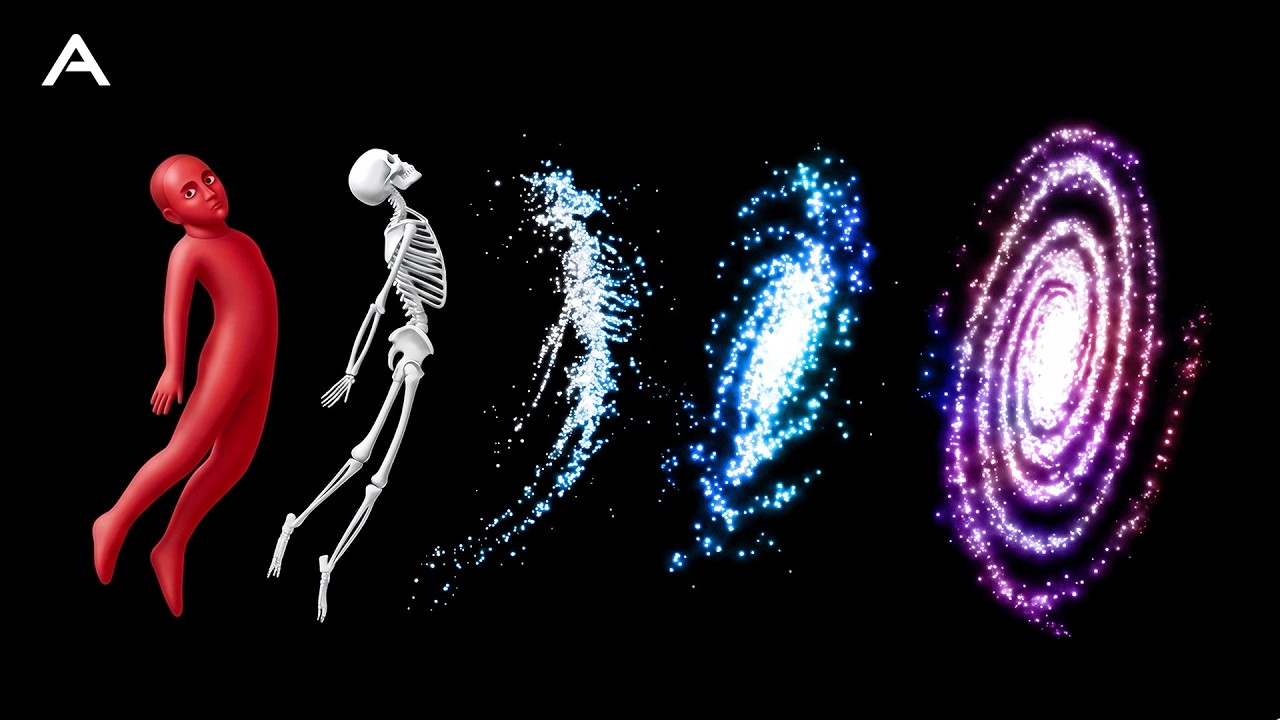
Aperture rebuilds Peter Wessel Zapffe's 1933 essay The Last Messiah and its claim that consciousness is not humanity's greatest gift but its gravest evolutionary mistake, a mind that grew powerful enough to grasp death and meaninglessness yet unable to bear either. The argument runs from the parable of the hunter who grows too conscious to kill, through the Irish elk whose antlers doomed it, to the four defenses we use to survive our own awareness: isolation, anchoring, diversion, and sublimation. It follows the theory into empathy's on and off switch, ambition as flight, wealth as escalating distraction, and technology as spiritual unemployment. Zapffe's lineage runs through Schopenhauer, Buddhism, and Thomas Metzinger, but his conclusion is bleaker, ending in antinatalism and the counsel to simply stop. The page closes with an honest accounting of where the diagnosis holds and where the doom does not follow.
Published May 31, 202650:26 video34 min readAdded Jul 4, 2026Open on YouTube →
At a glance
This is a fifty minute essay on a single, corrosive idea: that consciousness is not humanity's crowning gift but its gravest evolutionary mistake. Aperture builds the case out of a nearly forgotten Norwegian essay, The Last Messiah, written in 1933 by the philosopher Peter Wessel Zapffe. Zapffe argued that evolution, working blindly, overshot. It handed one species a mind powerful enough to grasp its own death, its own insignificance, and the suffering of every other creature, yet gave it no way to bear that knowledge. Awareness became the wound.
From there the film walks the whole argument in order. It opens with Zapffe's parable of the hunter who grows too conscious to kill and starves beside the water hole. It draws the analogy of the Irish elk, whose magnificent antlers grew until they killed it. It asks why such a costly, painful trait evolved at all, and answers with the neuroscience of Michael Graziano and the human gift for shared imagination. Then it turns dark: the four defense mechanisms we use to survive our own minds, the on and off switch on empathy that makes both compassion and genocide possible, ambition as flight, wealth as ever escalating distraction, technology as spiritual unemployment, and finally the cosmic tragedy of a creature that can see the truth but cannot live inside it. It closes on Zapffe's bleakest line, the last messiah's counsel to simply stop, and on the strange fact that we all wake up and continue anyway.
This page rebuilds that essay in full, in its own order, with the philosophers, works, and thought experiments named and linked, so you can read it instead of watching and lose almost nothing.
The parable that opens it: the hunter by the water hole
The film does not begin with an argument. It begins with a myth, told in Zapffe's own cadence.
One night in times long since vanished, man awoke and saw himself. He saw that he was naked under the cosmos, homeless in his own body. Everything opened up before his searching thoughts. Wonder upon wonder, terror upon terror, all blossomed in his mind. Then woman awoke too, and said it was time to go out and kill something. Man took up his bow, the fruit of the union between the soul and the hand, and went out under the stars. But when the animals came to the water hole where he had always waited for them, he no longer felt the spring of the tiger in his blood. Instead he felt a great psalm to the brotherhood of suffering shared by all that lives. He came home with empty hands, and when they found him again by the rising of the new moon, he sat dead by the water hole.
That is the opening of one of the saddest essays ever written. The hunter is not defeated by a stronger animal or a harder winter. He is undone by a new kind of seeing. He looks at his prey and recognizes another living thing trapped in the same cycle he is, and empathy overpowers instinct. He lowers the weapon and starves. The whole theory is folded into that image: an animal that becomes conscious enough to act against its own survival.
A mind that evolution never meant to build
Zapffe's claim is that humanity was never meant to become conscious in the way that we are. Evolution pushes forward blindly, without intent or wisdom, and it accidentally produced a creature that understands too much. We became aware of death, of meaninglessness, of isolation, and of the unbearable fragility of existence itself. Unlike any other animal, we can imagine the future, replay the past, and measure our own insignificance against the scale of the cosmos. And according to Zapffe, that awareness has quietly destroyed us.
The contrast with the rest of the animal kingdom is the engine of the point. Most animals live almost entirely in the present. A gazelle fleeing a lion feels terror, but only while the lion is there. When the danger passes, the fear passes with it, and the animal goes back to grazing as if nothing happened. It does not lie awake contemplating its mortality. It does not wonder whether its suffering means anything. It does not dread an aging and a death that are still decades away.
We do all of it. Our minds simulate futures that do not yet exist. We rehearse humiliation before it happens and anticipate grief long before any loss arrives. We build abstract identities inside our heads and then spend whole lives defending them. Our empathy runs so deep that we can suffer for strangers we will never meet, so that a tragedy on the far side of the planet can invade the mind and change our mood in an instant. We can picture billions of lives unfolding at once, each one full of struggle, loss, fear, and death.
Zapffe believed this exceeds what a biological organism can carry. He called humanity a paradox. Nature gave us intelligence strong enough to comprehend reality, but not strong enough to escape the psychological consequences of comprehending it. Consciousness became an overdeveloped trait, a mutation that grew past its own usefulness, the way some species evolve a feature that eventually destroys them.
The Irish elk: when the gift becomes the burden
To make the mechanism concrete, the film reaches for an extinct animal. Around 400,000 years ago there lived Megaloceros giganteus, the Irish elk. It stood nearly seven feet tall at the shoulder, and its antlers spread up to twelve feet across, like the branches of a dead forest fused onto its skull. To meet one must have felt like witnessing evolution intoxicated by its own power. A single swing of that head could batter through brush and scatter rivals. For thousands of generations nature rewarded the display: larger antlers meant greater strength, greater strength meant survival, and the elk became a monument to evolutionary success.
But evolution has no sense of restraint. Generation by generation the antlers kept growing, until the very thing that made the animal powerful began to doom it. The forests that once bent beneath its strength became impossible to move through. Escape grew harder. Survival itself buckled under the crushing excess bolted to its head. The greatest weapon slowly became the greatest obstacle.
Zapffe believed human consciousness took exactly this path. At some point awareness stopped being merely useful and turned catastrophic. He described it as a two sided blade without a hilt, a weapon sharp enough to cut through the fabric of reality itself, but impossible to wield without bleeding.
Figure 1. Zapffe's core move drawn as one curve. A little of the trait helps, and the benefit climbs to a peak. But evolution has no brake, so the trait keeps growing until it crosses the baseline into net cost. The elk's antlers ended below the line, and Zapffe places the human mind there too.
Then why did such a painful trait evolve at all?
Here the film pauses on the question that haunts the whole theory. With the elk the logic is easy: bigger antlers meant dominance, dominance meant mating, mating meant those genes spread. Evolution rewarded excess because for a while excess worked. But consciousness feels different. If self awareness burdens us with anxiety, dread, shame, existential terror, and the knowledge of our own death, why did it evolve at all? Why would nature build a mind that can suffer not only from pain, but from the anticipation of pain, the memory of pain, and even the abstract knowledge that pain exists?
To answer, the essay steps beyond Zapffe. In smaller doses, like the elk's early antlers, consciousness was extraordinarily useful. The neuroscientist Michael Graziano argues that consciousness may have evolved first as a social tool, the thesis behind his attention schema theory. By modeling other people as conscious beings with thoughts, fears, and desires, humans could imagine what others were thinking, which produced empathy, cooperation, and stable groups.
But consciousness did something even larger. It let humans imagine things that do not physically exist. A chimpanzee can recognize the members of its troop, but humans could invent entire realities inside their own heads and then share them with thousands, even millions, of others. Stories, myths, gods, nations, ancestors, destiny, honor, morality, history. Tribes stopped being held together only by blood or immediate survival and started being held together by shared imagination. Once that happened, civilization exploded.
A small tribe survives through instinct and familiarity. A massive civilization needs something stranger: millions of people believing the same invisible narrative. Look around and almost every human group is bound by stories people tell about themselves. We call it religion, culture, ideology, nationality, or tradition, but underneath all of them runs the same mechanism, collective imagination. A flag becomes a sacred icon. A holy text becomes divine authority. A border becomes real. Money becomes valuable. Whole societies rise from beliefs held together inside the minds of conscious creatures. In that sense consciousness became humanity's single greatest advantage, letting us cooperate at a scale no other species can touch.
But Zapffe believed the advantage came with a devastating bill. Once consciousness turned reflective enough to examine itself, it ran into a wall: we are temporary creatures in a universe that offers no obvious meaning. Everything we love will vanish. Every civilization is doomed to collapse. Every achievement erodes into dust. Consciousness gave us the power to see this, and no power to make peace with it. And this is where the theory becomes darker than ordinary pessimism, because Zapffe did not think we truly face this reality most of the time. He thought we survive by suppressing it.
The metabolic price of a mind
The film pauses on a related puzzle: why would evolution build something so metabolically expensive? The human brain burns an enormous share of the body's energy, and nearly every leap in human progress has really been a leap in unlocking more energy to feed it. Learning to farm, learning to cook, building systems that gave the brain more fuel, more efficiency, and more room to think. Technology follows the same pattern, every breakthrough in computing or communication resting ultimately on better energy delivery. The more efficiently we can power a thing, the more the thing can do. It is the one honest thread that runs from the campfire to the data center: a hungry mind is a costly mind, and history is largely the story of feeding it.
Turning consciousness down: the four defenses
According to Zapffe, human civilization is essentially a gigantic defense mechanism built to shield us from the full weight of consciousness. Almost every structure in society exists to keep existential panic at a survivable distance. Religion, nationalism, career, ambition, entertainment, status, productivity, social media, consumerism, even personal identity, all of it works as a psychological barrier against the awareness of death and meaninglessness. Human beings cannot tolerate reality continuously, so we build systems that narrow consciousness into something we can live inside.
Zapffe named four defenses we use, mostly without noticing.
The first is isolation, the outright suppression of disturbing thoughts. We push mortality, suffering, and existential fear out of awareness so we can function. Society depends on it. Imagine holding a normal office job while fully aware every second that you and everyone around you are moving toward death, or trying to enjoy small talk while vividly registering the suffering happening across the planet at that exact moment. Most people filter these thoughts out because staying conscious of them would be destabilizing.
The second is anchoring, which Zapffe also called attachment. We fasten ourselves to belief systems, identities, and structures that create a sense of stability. Religion supplies cosmic purpose. Nations supply tribal identity. Careers supply direction. Families supply emotional ground. These anchors keep the mind from drifting into existential chaos, and without them consciousness becomes unbearable.
The third is diversion, the constant distraction that keeps us from confronting existence directly. Work, entertainment, goals, social drama, endless scrolling, productivity, celebrity, consumption, all of it noise. Modern civilization manufactures a non stop stream of stimulation precisely because silence leaves room for existential awareness to surface.
The fourth is sublimation, the transformation of suffering into art, philosophy, literature, or intellectual work. Some people channel existential terror into creativity rather than merely suppressing it. The artist, the philosopher, the writer stares into the darkness and converts it into something that can be shared. The narrator notes, wryly, that this is the mechanism his own career is built on. And yet, Zapffe insists, even sublimation is only a coping mechanism, because beneath all four defenses lies a truth humanity cannot escape. Consciousness itself is the wound.
Figure 2. Zapffe's four walls. Civilization, he argued, is the sum of these strategies scaled up across billions of people. Each one narrows raw awareness into something survivable, and each one is a way of not looking directly at the thing in the center.
Zapffe called what society labels normal behavior a carefully maintained state of partial unconsciousness. Mental stability, on this view, requires selectively ignoring vast portions of reality. The person who becomes too aware risks paralysis, despair, or detachment from ordinary life. Which leaves an unsettling possibility: civilization itself may be built on controlled delusion.
Empathy with a dimmer switch: war, tribalism, and compartmentalization
The film returns to the hunter. For millions of years survival ran on instinct: hunger drove the hunt, the spear went up, the animal died, the human lived. Then the hunter became conscious in a new way. Instead of prey he saw another living being trapped in the same cycle of suffering as himself, the brotherhood of suffering shared by all that lives. The boundary between hunter and hunted dissolved, empathy overpowered instinct, and he lowered the weapon and starved beside the water hole.
Zapffe read this as symbolic of the human condition. Consciousness expanded beyond biological usefulness, and evolution accidentally produced a creature that can act against its own survival because it can morally reflect on existence. We are the only animals who can choose to become vegan, choosing ethics over instinct. A lion may hesitate from fear, but never from moral guilt. A wolf does not refuse deer out of compassion. Humans alone can deliberately override biology, because we imagine the suffering of others as if it were our own. And while that empathy can look beautiful, Zapffe thought it carried a devastating cost: the deeper consciousness runs, the harder it becomes to simply participate in life. Every action takes on moral weight. Every pleasure is shadowed by suffering somewhere else. Every victory sits beside someone else's tragedy.
So we survive by regulating consciousness artificially, turning awareness up and down depending on what the moment demands. Full consciousness would produce chronic pain, so the mind filters reality into manageable fragments, automatically, without our noticing. We wake each morning knowing with certainty that we will die, and still answer emails, make coffee, attend meetings, and worry about status. Not because we are irrational, but because consciousness must be constrained for life to continue. Zapffe argued that healthy human psychology depends on this suppression, and that what we call normal is a maintained state of partial unconsciousness.
This same dimmer switch explains one of the strangest contradictions in human behavior. The species capable of profound compassion is also capable of genocide, torture, conquest, and cruelty on an unimaginable scale. Zapffe saw no contradiction. A soldier cannot fight effectively while fully feeling the humanity of the person across from him. A corporation cannot endlessly exploit workers or ecosystems while vividly conscious of the suffering involved. Entire civilizations depend on narrowing the moral field of vision. When awareness becomes unbearable, humans retreat into tribal categories, nationality, ideology, religion, race, politics, that simplify reality until violence becomes psychologically manageable. The individual no longer confronts the full weight of an action because consciousness has narrowed around the group.
And this training starts early. Children quickly learn which existential questions are acceptable and which are frowned upon, when to laugh, when to stay distracted, when to bury their own discomfort. Death hides behind euphemism. Suffering becomes statistical. Existential fear gets medicalized or buried under entertainment. Civilization runs on an unwritten agreement to protect one another from reality, and those protective structures are fragile. War, isolation, grief, or sudden crisis can strip the filters away, and in those moments people glimpse the deeper chaos that civilization is constantly working to contain.
Ambition as flight: the airplane that must keep moving
One of the most important defenses, Zapffe thought, is ambition itself. Human beings chase goals endlessly because yearning prevents confrontation with emptiness. We imagine fulfillment waiting just ahead, a promotion, more money, recognition, love, the next milestone, and that next thing becomes psychologically necessary, because standing still means facing reality. This is why the achievement rarely feels as good as the chase. It is the movement on the treadmill we truly want, not the destination. The moment one goal is reached another replaces it. Years of chasing success end in satisfaction that fades almost at once, and a new ambition appears: more status, more wealth, more productivity, more stimulation. Modern society reads this as motivation and progress. Zapffe read it as escape.
His image is an airplane. A massive piece of metal that by all logic should not stay in the sky remains airborne only through constant forward motion. Cut the engines and momentum, and gravity drags it down in a thunderous collapse. The human mind is the same. Left alone too completely, consciousness drifts toward the terrifying questions of death, meaninglessness, isolation, and the fragile, temporary nature of everything we love. So to stay stable the mind must keep moving, occupied with goals, routines, entertainment, drama, work, and noise. Forward motion is existential survival.
This is why stillness can feel strangely unbearable, and why you often get more depressed lying awake at two in the morning in silence, when the defenses go slack and the mind begins circling the questions it normally keeps submerged. Civilization itself works like the engines. Society generates a continuous stream of distraction to keep consciousness suspended above despair, and modern technology has amplified the mechanism to an unprecedented degree. Human attention became the most valuable economic resource on Earth because distraction itself is necessary for survival. The tragedy is that we mistake perpetual stimulation for fulfillment while drifting further from any genuine confrontation with our own existence.
Wealth, escalation, and spleen
Zapffe believed the endless pursuit of distraction becomes most visible among the wealthy and powerful. From the outside, immense wealth looks like freedom and happiness. But if consciousness itself is the problem, material success cannot solve it. It can only delay the confrontation. A person can eat one meal at a time, sleep in one bed, occupy one room. Past a certain point wealth stops serving practical needs and becomes psychological, expanding the range of possible distraction. What the billionaire, the celebrity, the ruler, the powerful executive are really buying is not power but insulation from existential awareness. Every new experience fills the void for a while and holds despair at a distance.
But the effect fades. What once felt extraordinary becomes ordinary. The mind recalibrates almost immediately, satisfaction evaporates, and a stronger distraction becomes necessary. This creates a cycle of escalation, and it is why the wealthy so often drift toward increasingly extreme experiences, and why you see rich and powerful people doing the most depraved things imaginable, once ordinary pleasures lose their power to occupy consciousness. Zapffe described the collapse at the end of that cycle as something resembling spleen, a state of spiritual exhaustion where distraction simply stops working, and the person surrounded by abundance confronts the terror that none of it solved the underlying problem.
Modern psychology has a name for the smaller everyday version of this: the hedonic treadmill, the way human beings return to an emotional baseline no matter how intense the highs or lows. Extraordinary gains lose their emotional charge over time and the new reality just becomes normal. Zapffe saw this decades before the psychologists measured it, and read it as evidence that human desire is built around avoidance rather than fulfillment. The intensity of the yearning, he argued, matters more than the object being pursued. A promotion from private to corporal can feel more significant than a jump from lieutenant to general, because desire depends less on objective value than on maintaining momentum. We invent new goals because reaching a final goal would force us to confront the emptiness. If there is nothing left to chase, why get out of bed?
Spiritual unemployment: technology and the modern condition
For most of history survival demanded direct engagement with reality. We hunted, explored, developed craft, storytelling, ritual, and physical labor. We stayed psychologically connected to the world because existence demanded our participation. Technology changed that relationship. Modern civilization increasingly strips life of meaningful experience and replaces it with artificial convenience and passive stimulation, turning human beings into spectators rather than participants in their own reality. The more technologically advanced a society becomes, the more spiritually disconnected its people often become from existence itself.
Zapffe called this a kind of spiritual unemployment. Our deepest capacities slowly become unnecessary. Navigation goes obsolete because machines guide us everywhere. Memory weakens because information is externalized. Craftsmanship disappears into automation. Exploration becomes simulation. Even social interaction is mediated through screens and algorithms. Each advance solves a practical problem while quietly narrowing the opportunities for meaningful engagement with reality, an invisible impoverishment. The easier life becomes materially, the harder it becomes existentially. The strange thing, the narrator notes, is that Zapffe wrote this in the 1930s and it reads as though he were describing the present, which suggests some things never really change.
Convenience steals the intensity from life. An aircraft mapping an unknown landscape adds efficiency but removes the human experience of discovering that landscape through struggle. Friction disappears, and meaning often disappears with it. Modern society surrounds people with unprecedented comfort while rates of anxiety, depression, alienation, and emptiness keep climbing, and Zapffe would argue that this is not accidental. Human consciousness evolved amid challenge, uncertainty, danger, and direct contact with the world, and civilization has replaced those with abstraction, simulation, and distraction. The mind receives constant stimulation and very little existential nourishment.
Technology keeps pushing in this direction. People now form emotional relationships with artificial systems. Social media algorithms simulate social importance. Digital entertainment simulates achievement and adventure. AI companions simulate intimacy and understanding. These produce real emotional consequences out of fundamentally artificial structures. A person can feel genuine loneliness from being ignored online, genuine validation from digital approval, genuine attachment to a machine with no consciousness at all. In Zapffe's frame this is chilling, because it suggests technology is accelerating our separation from authentic reality. Rather than confronting existential suffering directly, society builds ever more sophisticated distractions capable of occupying consciousness indefinitely. Civilization industrializes the very suppression mechanisms Zapffe described, and the result is a culture saturated with stimulation and starved of meaning. People scroll endlessly while feeling numb, consume infinite information while feeling disconnected, maintain hundreds of digital relationships while profoundly lonely. Hyperconnected on the outside, internally fragmented, because distraction can suppress existential awareness but never resolve it. And the more sophisticated the distraction, the more fragile we become when it stops working, because eventually the silence returns.
As existential pressure rises, civilization adapts by lowering the level of awareness required for daily life. Mass entertainment, endless distraction, anti intellectualism, and compulsive stimulation all serve the same purpose, reducing the intensity of consciousness so people can keep functioning inside an unbearable reality. Zapffe called this a collective psychological regression. Reflection itself becomes dangerous, so society rewards productivity over contemplation, speed over depth, stimulation over stillness. The person who constantly distracts themselves looks healthy and well integrated. The person who dwells too long on existence risks isolation and despair. Suppression becomes so continuous and so deeply woven into ordinary life that people mistake it for normality, which produces a strange inversion: what we call mental health may often mean successful adaptation to existential avoidance. The individual who functions efficiently is frequently the one most able to suppress awareness, while moments of existential crisis get treated purely as dysfunction rather than as possible encounters with reality.
The film is careful here. Zapffe was not romanticizing suffering or claiming that despair reveals the truth. His point was more worrisome than that. Human beings may require illusion to stay psychologically stable at all. The structures protecting consciousness from collapse are not optional luxuries. They are survival mechanisms, and without them existence itself may become intolerable.
Cosmic tragedy: alienation, and the thinkers who saw it too
One of Zapffe's harshest criticisms was aimed at humanity's belief that we are destined to conquer nature. Modern civilization treats human dominance as proof of evolutionary superiority. We build cities, manipulate ecosystems, engineer technologies, and reshape the planet, and we behave as though consciousness has lifted us above the rest of life. Zapffe believed the opposite. He saw us as deeply alienated from nature, because consciousness severed us from the instinctive harmony other animals still have. Animals remain embedded in existence. Humans try to stand outside it, observing reality from a distance, unable to fully rejoin the unconscious flow of life. So we compensate through conquest, dominating landscapes, extracting resources, industrializing ecosystems, remaking the planet to fit abstract human desire. Beneath that drive lies insecurity: we seek control because consciousness makes reality feel unstable and threatening, and the more powerless we feel existentially, the more aggressively we try to control the external world. The conquest is a delusion that only deepens the suffering, and technological mastery destroys the very environments that once grounded us. We are conscious enough to declare ourselves separate from nature, yet still biologically dependent on it, standing between animal instinct and abstract self awareness and fully belonging to neither. Beneath all of it the same unresolved awareness remains: death still waits, meaning stays uncertain, and consciousness still cannot reconcile itself with existence.
Most philosophies and religions treat consciousness as sacred, the awakening of the universe, the highest expression of life, the culmination of evolution. Zapffe rejected that entirely. He believed consciousness is closer to a cosmic accident than a divine achievement. Evolution is blind, mutations arrive without intention, and humanity simply happened to evolve a form of awareness able to recognize suffering far beyond what any organism can comfortably endure. Consciousness, in this sense, is a tragic mutation, nature producing a creature that perceives its own fragility too clearly. This is why his philosophy differs from ordinary pessimism. He was not merely saying life contains suffering, which nearly every philosophy admits. His claim is more radical: the structure of human consciousness may be fundamentally incompatible with psychological peace. We became aware enough to recognize death, chaos, isolation, and impermanence, yet remain biologically driven to survive as if none of it were true. Biology demands attachment to life. Consciousness reveals there is nothing solid to attach to. The mind longs for permanence in a universe defined by impermanence, seeks meaning in apparent indifference, and craves certainty where none exists. That tension, Zapffe thought, can never be fully resolved.
The film situates the theory in a lineage. Arthur Schopenhauer argued in The World as Will and Representation that human life is driven by an endless, insatiable force he called the will. We constantly desire, strive, and suffer because satisfaction never lasts, fulfillment dissolves into boredom, and boredom breeds new desire, so existence swings forever between craving and dissatisfaction. Zapffe took the insight further. For Schopenhauer suffering came from desire. For Zapffe it came from awareness itself, with desire, fear, ambition, and despair all downstream of a deeper wound.
Buddhism reaches a strangely similar conclusion by a different road, teaching that attachment to existence creates suffering because all things are impermanent, and that the ego clings to stability in a world of constant change. Zapffe would agree, with one crucial difference. Buddhism generally presents liberation as possible, through enlightenment, meditation, and detachment, so suffering can be transcended. Zapffe was far less hopeful. He believed consciousness itself traps us inside the contradiction, so that even the attempt to escape suffering is only consciousness struggling against itself.
Modern thinkers echo the view. The philosopher Thomas Metzinger argues that evolution produces enormous amounts of unnecessary suffering through blind biological processes. Consciousness did not emerge because the universe intended wisdom or beauty. It emerged because certain cognitive structures improved survival for a time, and survival does not care about happiness or peace. Evolution rewards reproduction, adaptation, and persistence, not existential calm. This is why the mind may feel fundamentally unstable: we inherited ancient survival instincts built for immediate threats, then layered abstract self awareness on top, producing a creature that can imagine infinite futures, replay old humiliations endlessly, and contemplate cosmic meaninglessness while still reacting emotionally like a vulnerable animal. A creature caught between instinct and abstraction.
c. 500 BCEBuddhism teaches that clinging to a changing world produces suffering, and that impermanence is the root condition of existence. The wound is named, and a path out is offered.
1818Schopenhauer publishes The World as Will and Representation. Life is driven by a blind, insatiable will, swinging forever between craving and boredom.
1899Peter Wessel Zapffe is born in Tromsø, Norway. A mountaineer and philosopher, he will spend his life on the problem of a mind too aware for its own good.
1933Zapffe publishes The Last Messiah. Suffering, he argues, comes not from desire but from awareness itself, and he names the four defenses we use to survive it.
1990Zapffe dies at 90, largely unknown outside Norway, his bleakest conclusion, antinatalism, still a fringe position.
TodayThomas Metzinger and modern psychology's hedonic treadmill revive the core suspicion: evolution optimizes for survival, never for peace.
Figure 3. The tragedy of consciousness is an old idea with a long spine. Zapffe stands at the pessimist end of a line running from Buddhism through Schopenhauer to the present, but he is the one who located the wound in awareness itself and refused to offer a cure.
The question
The animal mind
The human mind, per Zapffe
Where it lives in time
Almost entirely in the present moment.
the burden Simulates futures, replays the past, dreads what has not happened.
Fear
Ends the instant the threat is gone.
the burden Anticipates pain, remembers pain, knows pain exists at all.
Death
Never contemplated in advance.
the burden Known with certainty, decades before it arrives.
Suffering of others
Registered only as immediate threat.
the burden Felt for strangers on the far side of the planet.
Relationship to nature
Embedded in the unconscious flow of life.
the burden Alienated, observing from a distance, at home nowhere.
Net verdict on the trait
Fitted to its world.
the useful part Built civilization, then overshot into a wound.
Figure 4. The contrast the whole essay turns on. Every capacity that lets the human mind build cathedrals and empires is the same capacity that lets it suffer the future, the past, death, and the pain of strangers. Zapffe's claim is that the two cannot be separated.
The Last Messiah, and the counsel to stop
Zapffe closes the essay with a figure. He imagines a final prophet emerging among humanity, a last messiah who sees existence clearly and fully understands the tragedy of consciousness. Unlike religious messiahs who promise salvation, this one offers something else entirely. He strips away illusions instead of offering comfort. He looks upon humanity and recognizes that people are trapped inside a condition they never chose, a species burdened with awareness too heavy for life to carry peacefully. And so he delivers his final message: know yourselves, be unfruitful, and let there be peace on earth after your passing.
It is one of the bleakest conclusions in all of philosophy. There is no hope, no escape, and nothing to cling to. Zapffe believed the compassionate response to existence is simply to refuse to perpetuate suffering indefinitely. If consciousness itself creates anguish, then reproducing consciousness becomes ethically questionable, which is why Zapffe is often associated with antinatalism, the belief that bringing new conscious beings into existence imposes suffering unnecessarily.
But even here his philosophy is more tragic than hateful. Zapffe did not despise humanity. If anything he viewed human beings with immense sympathy, as creatures trapped by an evolutionary accident, desperately building systems to survive psychologically while sensing, somewhere beneath awareness, that none of them fully solve the problem. Human civilization becomes tragic precisely because it is so understandable. People distract themselves because consciousness hurts. They pursue status because stillness feels dangerous. They cling to identities because uncertainty terrifies them. They consume endless entertainment because silence reveals too much. And, most disturbingly, they usually do all of it unconsciously.
What makes the theory so unsettling is not only its pessimism, but the possibility that parts of it already feel true. Most people have had moments when the normal structure of life suddenly felt fragile, late at night, in grief, in isolation, or in a silence where distraction briefly vanished, when careers, social roles, online identities, ambitions, and trends all seemed strangely theatrical, as if humanity were collectively performing a play to avoid something deeper. Then the moment passes. The phone lights up and consciousness narrows again. Humanity exists in a state of managed distraction, and perhaps the most unsettling thought is that the modern world may not be malfunctioning by accident. The endless entertainment, the compulsive productivity, the addiction to stimulation, the obsession with status, the fear of silence, these may not be cultural mistakes but psychological necessities. If consciousness truly is an evolutionary excess, then distraction is not weakness. It is survival.
We like to imagine consciousness as illumination, the moment the universe becomes aware of itself. Zapffe asks us to consider a darker image. What if consciousness is less like enlightenment and more like overexposure, a flame burning too brightly inside a fragile organism, a mutation powerful enough to comprehend reality but too powerful to live comfortably within it. And so humanity continues exactly as it always has, building civilizations, inventing technologies, creating religions, chasing ambition, falling in love, consuming distractions, searching endlessly for meaning, all the while carrying beneath the noise the awareness that one day every thought, every memory, every achievement, and every human being will disappear. The strangest part, the essay ends, is that tomorrow morning all of us who just heard this will wake up and continue living anyway.
Key takeaways
The central claim, from Peter Wessel Zapffe's 1933 essay The Last Messiah, is that consciousness is an overdeveloped trait, a mind that grew powerful enough to understand reality but not powerful enough to bear what it understands.
The Irish elk is the model. Evolution rewarded bigger antlers until the antlers themselves doomed the animal. Zapffe places human awareness on the same rise and fall curve.
Consciousness paid off first as a social tool, per Michael Graziano, and then as the engine of shared imagination, letting millions of strangers cooperate through invisible stories: religion, nations, money, law.
We survive our own minds through four defenses: isolation, anchoring, diversion, and sublimation. Zapffe called normal behavior a maintained state of partial unconsciousness.
The same dimmer switch that lets us feel empathy lets us switch it off, which is why one species is capable of both deep compassion and industrial scale cruelty.
Ambition, wealth, and distraction are read as flight. Like an airplane, the mind stays aloft only through forward motion, and the hedonic treadmill guarantees every arrival fades.
Technology deepens the trap, producing a spiritual unemployment where our deepest capacities go unused and stimulation replaces meaning.
The theory sits in a lineage running from Schopenhauer's will through Buddhism's impermanence to Thomas Metzinger, but Zapffe is bleaker: he offers no exit, only the counsel to stop, and the antinatalism that follows from it.
Chapters
0:00 Human Evolution's Darkest Secret
7:29 Why Consciousness Evolved Anyway
13:17 Turning Consciousness Down
20:51 War, Tribalism, and Psychological Compartmentalization
27:04 Wealth, Excess, and Depravity
34:52 Degenerating Consciousness
40:06 Consciousness as Cosmic Tragedy
45:27 The Last Messiah
Notable quotes
0:20 "What if consciousness is not humanity's greatest gift, but in fact our greatest evolutionary mistake?"
0:52 "One night in times long since vanished, man awoke and saw himself. He saw that he was naked under the cosmos, homeless in his own body."
6:40 "He described it as a two sided blade without a hilt. A weapon sharp enough to cut through the fabric of reality itself, but one that is impossible to wield without you bleeding."
21:20 "We are the only animals who can become vegan."
25:35 "Forward motion is existential survival."
38:40 "What we call mental health may often mean successful adaptation to existential avoidance."
45:00 "There is no hope, no escape, and nothing to cling to."
48:40 "Know yourselves. Be unfruitful and let there be peace on earth after your passing."
49:20 "What if consciousness is less like enlightenment and more like overexposure? A flame burning too brightly inside a fragile biological organism."
50:05 "Tomorrow morning, me, you, all of us watching this right now will wake up and continue living anyway."
Resources mentioned
Peter Wessel Zapffe, the Norwegian philosopher whose theory the essay is built on.
Read straight through, Zapffe's essay is a hypothesis dressed as a verdict, and it is worth naming which parts are argument and which are assertion. The strongest thread is descriptive: the four defenses map cleanly onto things people actually do, and the observation that we live by filtering reality rather than facing it is hard to dismiss after a sleepless three in the morning. The parallels the film draws are real, too. The idea that money, nations, and law are shared fictions holding strangers together is the same one Yuval Noah Harari later made famous in Sapiens, and the hedonic treadmill is a measured psychological effect, not a mood.
The weaker link is the leap from description to doom. That consciousness can produce dread does not establish that it is maladaptive on balance, and the essay tends to treat suffering as the whole ledger while setting aside the joy, love, meaning, and discovery that the same awareness makes possible. Plenty of thinkers accept Zapffe's diagnosis of the wound and reject his prescription: the existentialists answered the same void by insisting we create meaning rather than inherit it, and Albert Camus called the honest response not surrender but revolt. The antinatalist conclusion, in particular, is a value judgment resting on the premise that a life's pain outweighs its worth, which is exactly the premise most people, having lived, decline to grant. The film's own last line quietly concedes the point. We hear all of this, and we wake up and continue anyway. That is either the deepest denial Zapffe described, or evidence that the wound is more survivable than the theory allows.
Full transcript
There is a theory of consciousness so disturbing that once you fully understand it, it changes the way that you see every human achievement, every ambition, every distraction, and even your own thoughts. What if consciousness is not humanity's greatest gift, but in fact our greatest evolutionary mistake? What if the very thing that we celebrate as the pinnacle of intelligence is actually a biological catastrophe destined to doom us all. To explain it, first I need to tell you a story. One night in times long since vanished, man awoke and saw himself.
He saw that he was naked under the cosmos, homeless in his own body. Everything opened up before his searching thoughts. Wonder upon wonder, terror upon terror, all blossomed in his mind. Then woman awoke too, and said that it was time to go out and kill something. And man took up his bow, fruit of the union between the soul and the hand, and went out under the stars.
But when the animals came to their water hole, where he out of habit waited for them, he no longer knew the spring of the tiger in his blood, but instead a great psalm to the brotherhood of suffering shared by all that lives. That day he came home with empty hands, and when they found him again by the rising of the new moon, he sat dead by the water hole. This is the beginning of one of the saddest philosophical essays ever written. The last messiah written by Norwegian philosopher Peter Vessel Zapatva argues that humanity was never meant to become conscious in the way that we are. Evolution blindly pushing forward without intent or wisdom accidentally created a creature capable of understanding too much.
We became aware of death, of meaninglessness, of isolation, and ultimately the unbearable fragility of existence itself. Unlike every other animal, we can imagine the future. We can replay the past. We can recognize our own insignificance against the scale of the cosmos. And according to Zapa, this awareness has completely destroyed us.
Most animals live almost entirely in the present moment. A gazelle running from a lion experiences terror, but only while the threat exists. Once the danger disappears, that fear disappears with it. The animal returns to grazing as if nothing happened. It doesn't sit awake at night contemplating its own mortality.
It doesn't wonder whether its suffering has meaning. It doesn't fear the inevitability of aging and death decades before either arrive. But humans, we do. Our minds simulate futures that don't yet exist. We imagine humiliation before it happens.
We anticipate grief long before loss arrives. We build abstract identities inside of our heads and then spend our entire lives defending them. We are capable of empathy so deep that we can suffer for strangers that we have never even met. A tragedy happening on the other side of the planet can invade our consciousness and alter our emotional state instantly. We can picture billions of lives unfolding simultaneously.
Each one filled with struggle, loss, fear, and death. Zapa believed this level of awareness exceeds what a biological organism can bear. He described humanity as a paradox. Nature equipped us with intelligence powerful enough to comprehend reality, but not powerful enough to escape its psychological consequences. Consciousness became an overdeveloped trait, like an evolutionary mutation that grew beyond its useful function.
In the same way that certain species evolve features that eventually destroy them, humanity evolved a mind that became too aware for its own survival. Around 400,000 years ago, there lived a colossal creature known as Megaloseris Giganteas, the Irish elk. It stood nearly 7 ft tall at the shoulder with antlers that stretched up to 12 feet across like the branches of a dead forest being fused onto its skull. To encounter one must have felt like witnessing evolution intoxicated by its own power. With a single violent swing of its head, the elk could batter through brush, scatter rivals, and dominate the landscape around it.
For thousands of generations, nature rewarded this magnificence. Larger antlers meant greater strength. Greater strength meant survival. The elk became a monument to evolutionary success. But evolution has no sense of restraint.
Slowly, over countless generations, the antlers continued growing until the very thing that once made the animal powerful began to it. The forests that once bent beneath its strength became impossible to navigate. Movement slowed. Escape became harder. Survival itself became burdened by the crushing excess attached to its head.
Its greatest weapon gradually transformed into its greatest obstacle. Zapa believed that human consciousness followed the exact same path. At some point, awareness stopped being merely useful and became catastrophic. He described it as a a two-sided blade without a hilt. A weapon sharp enough to cut through the fabric of reality itself, but one that is impossible to wield without you bleeding.
The more I read The Last Messiah, the more one question began to haunt me. With the Irish elk, the logic is easy to understand. Bigger antlers meant greater dominance. Greater dominance meant better chances at mating. And better chances at mating meant those genes survived and spread.
Evolution rewarded excess because for a time at least, excess worked. But human consciousness feels different. The relationship between consciousness and survival isn't nearly as obvious. If self-awareness burdens us with anxiety, dread, shame, existential terror, and the knowledge of our own death, then why did it evolve at all? Why would nature produce a trait capable of making its own bearer miserable?
Why create a mind that can suffer not only from pain, but from the anticipation of pain, the memory of pain, and even the abstract knowledge that pain exists at all? To answer that question, I had to look beyond Zapva. In similar terms, much like the elk, in smaller doses, consciousness was incredibly useful. The neuroscientist Michael Gratziano argues that consciousness may have evolved primarily as a social tool. By seeing other people as conscious beings with thoughts, emotions, fears, desires, humans became capable of forming stable groups.
It gave us the ability to imagine what other people were thinking, which created empathy, cooperation, and social cohesion. But consciousness did something even more important than that. It gave humans the ability to imagine things that didn't physically exist. A chimpanzee can recognize members of its troop, but humans could invent entire realities inside of their own minds and then share those realities with thousands, even millions of other people. Stories, myths, gods, nations, ancestors, destiny, honor, morality, history.
Suddenly, tribes were no longer held together purely by blood or immediate survival, but by shared imagination. And once that happened, human civilization exploded. A small tribe can survive through instinct and familiarity, but massive civilizations require something stranger. They require millions of people to believe in the same invisible narrative. Look around you and you realize that almost every human group is held together by stories that people tell each other about themselves.
Sometimes we call it religion, sometimes culture, sometimes ideology and nationality or tradition. But underneath all of them lies the same mechanism, collective imagination. Consciousness allowed human beings to mentally step into worlds that didn't physically exist yet and behave as though they were real. A flag can become a sacred icon. A holy text becomes divine provenence.
A border becomes meaningful. Money becomes valuable. Entire societies emerge from shared belief systems held together inside the minds of conscious creatures. In that sense, consciousness became humanity's greatest evolutionary advantage. It allowed us to cooperate at scales no other species could approach.
We could organize beyond immediate familial structures because we could collectively believe in abstract ideas. Civilization itself is built on imagined realities powerful enough to coordinate millions of strangers toward common goals. But Zapa believed this evolutionary advantage came with a devastating cost. Once consciousness became reflective enough to examine itself, humanity encountered a devastating reality. We are temporary creatures trapped in a universe that offers no obvious meaning.
Everything we love will one day disappear. Every civilization is doomed to collapse. Every human achievement eventually erodess into dust. Consciousness gave us the ability to recognize this truth but no ability to emotionally reconcile with it. And this is where Zapa's theory becomes darker than just ordinary pessimism.
He did not believe that humans genuinely confront reality most of the time. He believed that we survive only by suppressing it. One of the biggest mysteries about consciousness is why evolution would ever create something so metabolically expensive. The human brain consumes an enormous amount of energy. And yet, every major leap in human progress has really been about unlocking more energy to fuel it.
Learning how to farm, learning how to cook, building systems that gave our brains more power, more efficiency, and more room to think. Technology evolves in the exact same way. Every breakthrough device, every leap in computing, AI, or communication ultimately depends on one thing. Better energy systems, more power, more efficiency, and smarter ways to deliver it. Because the better we become at powering our technology, the more innovation we unlock.
Which is why I'm excited to partner with Anker, the sponsor of today's episode. Not long ago, chargers were basically identical. Small plastic bricks designed to do one simple thing, deliver power. But modern devices demand far more than that. Laptops, phones, tablets, watches, all competing for energy all at once.
And that shift has transformed charging into a surprisingly advanced piece of engineering, which we can see in this Anker Prime 160 watt charger. Anker has been leading that transformation with technologies like GAN Prime 2.0 and Power IQ 5.0. O MIT technology review and a feature done in partnership with Anker, highlighting how charging is becoming one of the most advanced pieces of everyday engineering. Using gallium nitride architecture, Anker is able to make chargers dramatically smaller while still delivering incredibly high power output. We're talking up to 140 watts for devices small enough to fit in your pocket.
MIT Technology Review specifically called out Ankerk's MBUK architecture, a multi-level voltage conversion system that reduces component stress and combined with Anker's proprietary control algorithm pushes secondary power conversion efficiency above 99.5%. At the same time, systems like Active Shield 4.0 constantly monitor temperature over 10 million times every day to improve safety and efficiency while protecting the battery lifespan of your devices. The most interesting part about the Anker Prime 160 watt charger is its smart charging, which actively communicates with your devices, intelligently distributing power between them in real time. That's your laptop, your phone, and your headphones, all charging simultaneously using one brick, while the charger automatically adjusts output based on the needs of each device. If you'd like to check out Anker's latest lineup featuring GAN Prime 2.0 and Power IQ 5.0, click the link in the description down below.
According to Zapa, human civilization is essentially a gigantic defense mechanism built to protect us from the full weight of consciousness. Almost every structure in society exists to keep existential panic at a manageable distance. Religion, nationalism, career, ambition, entertainment, status, productivity, social media, consumerism, even personal identity, all function as psychological barriers shielding us from awareness of death and meaninglessness. Human beings cannot tolerate reality continuously. So, we construct systems that narrow consciousness into something survivable.
Zapa identified four main defense mechanisms that humans unconsciously use to avoid despair. The first is isolation. This involves suppressing disturbing thoughts entirely. We push mortality, suffering, and existential fear out of awareness so we can function normally. Society depends on this suppression.
Imagine trying to work a regular office job while being fully aware every second that you and everyone around you are slowly moving towards death. Imagine trying to enjoy casual conversation while vividly understanding the suffering occurring across the planet at the same moment. Most people instinctively filter these thoughts out because remaining fully conscious of them would be psychologically destabilizing. The second mechanism is anchoring which Zapva sometimes called attachment. Humans attach themselves to belief systems, identities and structures that create a sense of stability.
Religion gives cosmic purpose. Nations create a tribal identity. Careers provide direction. Families create emotional grounding. These anchors prevent the mind from drifting into existential chaos.
Without them, consciousness becomes unbearable. The third mechanism is diversion. Humans constantly distract themselves to avoid confronting existence directly. That could be work, entertainment, your goals, social drama, endless scrolling, productivity, culture, celebrity obsession, consumption, all noise. Modern civilizations create a non-stop stream of stimulation because silence leaves room for existential awareness to emerge.
And finally, there's sublimation, which is basically what I've built my entire career on. The transformation of suffering into art, philosophy, literature, or intellectual expression. According to Zapa, some individuals channel existential terror into creativity instead of suppressing it completely. The artist, the philosopher, or writer stares into the darkness and converts it into something communicable. But even this, all of this, they're still coping mechanisms because beneath all of it, according to Zapa, lies a truth that humanity cannot escape.
Consciousness itself is the wound. Think about that hunter that we talked about in the beginning. For millions of years, survival had depended on instinct. Hunger drove the hunt. The spear was raised, the animal would die, and the human would live.
But then something changed. The hunter suddenly became conscious in a new way. Instead of seeing prey, he recognized another living being trapped in the same cycle of suffering as himself. He felt what Zapa described as the brotherhood of suffering shared by all that lives. The boundary between the hunter and the hunted dissolved, and for the first time, empathy overpowered instinct.
And so the hunter lowered the weapon. He returned home empty-handed. Eventually, he starved beside the same water hole where he once would have killed without hesitation. Zapa saw this as symbolic of the human condition itself. Consciousness has expanded beyond biological usefulness.
Evolution has accidentally produced a creature capable of acting against its own survival because it could morally reflect on existence. Just think about it. We are the only animals who can become vegan. choosing self-denial and ethics over instinct and survival. This is what makes human consciousness unique.
A lion may hesitate from fear, but not from moral guilt. A wolf doesn't become a vegan out of compassion for deer. Humans alone can deliberately override biology because we imagine the suffering of others as if it were our own. And while this empathy can appear beautiful, Zapva believed it came with devastating consequences. The deeper consciousness becomes, the harder it is to participate naturally in life.
Every action acquires a moral weight to it. Every pleasure becomes shadowed by awareness of suffering somewhere else. Every human victory exists beside another person's tragedy. The more conscious we become, the more psychologically difficult existence itself becomes. According to Zapa, humans survive only because we have learned to regulate consciousness artificially.
We constantly turn awareness up and down depending on what reality is demanding from us. Full consciousness would produce chronic pain. So the mind filters reality into manageable fragments. This filtering happens so automatically that most people never even notice it. Think about how strange everyday life actually is.
Human beings wake up each morning knowing with certainty that they will die. And yet we still answer emails, we make coffee, we attend meetings, and we worry about our social status. This isn't because people are irrational. It's because consciousness itself must be constrained for life to continue. A person can't function while continuously aware of their cosmic insignificance, the inevitability of decay and the suffering woven into existence.
So the mind narrows its focus. We concentrate on tasks, routines, ambitions, entertainment, and relationships. We reduce reality into psychologically survivable pieces. Zapa believed healthy human psychology depends on this suppression. In fact, he argued that what society calls normal behavior is actually a carefully maintained state of partial unconsciousness.
Mental stability requires selectively ignoring vast portions of reality. The individual who becomes too aware risks paralysis, despair, or detachment from ordinary life. This creates an unsettling possibility. Perhaps civilization itself is built upon controlled delusion. Zapa believed human beings possess an extraordinary capacity for empathy, but also an equally extraordinary ability to shut that empathy off.
Without this compartmentalization, society couldn't function. A soldier can't fight effectively while fully experiencing the humanity of the person across from him. A corporation can't endlessly exploit their workers or ecosystems while remaining vividly conscious of all the suffering involved. Entire civilizations depend on narrowing the moral field of vision. Humans move between empathy and brutality by selectively regulating awareness.
This explains one of the strangest contradictions in human behavior. The same species capable of profound compassion is also capable of genocide, torture, conquest, and cruelty on an unimaginable scale. Zapa believed these are not contradictions at all. They are consequences of the same consciousness trying to survive itself. When awareness becomes unbearable, humans retreat into our tribal identities and abstractions.
These are nationality, ideology, religion, race, politics. These systems simplify reality into categories that allow violence to become psychologically manageable. The individual no longer confronts the full moral weight of their actions because consciousness narrows around the group. And this process begins very early in life. Children quickly learn which existential questions are socially acceptable and which ones are frowned upon.
We learn when to laugh, when to stay distracted, and when to suppress our own discomfort. Most conversations avoid the deepest realities entirely. Death remains hidden behind euphemisms. Suffering becomes statistical. Existential fear is medicalized, pathized, or buried beneath entertainment.
Zapa argued that civilization functions through an unwritten agreement to protect one another from reality. But these protective structures are quite fragile. Sometimes they crack. Moments of crisis, war, isolation, grief, or existential confrontation can suddenly strip away the normal filters that keep consciousness stable. In those moments, people experience something terrifying.
The realization that beneath social routines and distractions lies a deeper chaos that civilization is constantly struggling to contain. Zapa believed one of humanity's most important defense mechanisms is ambition itself. Human beings constantly strive towards goals because yearning prevents confrontation with existential emptiness. We imagine that fulfillment exists somewhere ahead of us. It's a promotion or or more money, recognition, love, uh achievement, purpose.
the next milestone becomes psychologically necessary because staying still means facing reality. This is why the actual achievement rarely feels as good as the pursuit. It is the constant movement on the treadmill of life that we truly desire, not the destination. The moment one goal is reached, another immediately replaces it. A person spends years chasing success only to discover the satisfaction fades almost instantly.
Then a new ambition appears. We want more status, more wealth, more productivity, more stimulation. Modern society interprets this as motivation or progress. Zapa interpreted as escape. He argued that human beings remain psychologically afloat only by keeping consciousness occupied.
Uh, think of it like an airplane. It's a massive piece of metal that by all logic should not remain suspended in the sky. It stays airborne only through constant forward motion. The moment the engines fail and momentum disappears, gravity immediately pulls it back to the ground in a thunderous collapse. The human mind is not built to rest for long inside the full awareness of existence.
Left alone too completely, consciousness begins drifting towards terrifying questions. Questions of death, meaninglessness, isolation, and suffering. The fragile, temporary nature of everything we love. So to remain psychologically stable, the mind must keep moving. It must stay occupied with goals, ambitions, entertainment, routines, distractions, social drama, work, noise.
Forward motion is existential survival. This is why stillness can feel strangely unbearable. Why you often get a lot more depressed when you're lying awake at 2:00 a.m. in silence. Your defenses are weak and the mind begins circling existential questions it normally keeps submerged beneath all this activity.
According to Zapa, civilization itself functions like the engines of that airplane. Society generates a continuous stream of distractions to keep consciousness suspended above despair. And modern technology has amplified this mechanism to unprecedented levels. Human attention has become the most valuable economic resource on Earth because these companies know that distraction itself is necessary for survival. Unfortunately, humanity mistakes perpetual stimulation for fulfillment while drifting further away from genuine confrontation with our own existence.
Zapa believed this endless pursuit of distraction becomes most visible among the wealthy and powerful. From the outside, immense wealth appears to promise freedom, happiness, and fulfillment. But if consciousness itself is the problem, then material success can't solve it. It can only delay confrontation with it. A human being can only eat one meal at a time, only sleep in one bed, only occupy one room at any given moment.
Beyond a certain point, wealth stops serving practical needs and becomes something psychological. Instead, it expands the range of possible distraction. The billionaire, the celebrity, the ruler, the powerful executive, what they are truly purchasing isn't power, but insulation from existential awareness. Wealth creates endless opportunities for stimulation. Every new experience temporarily fills that void in our consciousness and keeps despair at a distance.
But the effect fades. What once felt extraordinary soon becomes ordinary. The mind recalibrates itself almost immediately and then satisfaction evaporates. Then stronger distraction becomes necessary. And this creates a constant cycle of escalation.
The wealthy often drift towards increasingly extreme experiences because ordinary pleasures lose their power to occupy consciousness. That's why you see a lot of rich and powerful people doing the most depraved things that you can imagine. Zapa referred to this collapse as something resembling spleen, a state of spiritual exhaustion where distraction no longer functions. The person surrounded by abundance suddenly confronts the terrifying realization that none of it has solved the underlying problem. Modern psychology calls this hedonic adaptation.
Human beings consistently return to an emotional baseline regardless of the intense emotions whether they are negative or positive that they experience. Extraordinary gains lose their emotional impact over time and the new reality becomes normal. Zapa recognized this decades earlier and interpreted it as evidence that human desire is fundamentally structured around avoidance rather than fulfillment. He argued that the intensity of yearning matters more than the object being pursued. The chase itself protects consciousness from stillness.
A promotion from private to corporal can feel more psychologically significant than advancement from lieutenant to general because desire depends less on objective value and more on maintaining momentum. Human beings constantly create new goals because achieving the final goal would force confrontation with emptiness. If you have nothing to chase, why even bother waking up? For most of human history, survival still required direct engagement with reality. We had to hunt.
We explored. We developed craftsmanship, storytelling, ritual, and physical labor. Human beings remained psychologically connected to the world around them because existence demanded our participation. But technology changed this relationship. Modern civilization increasingly strips life of meaningful experiences while replacing them with artificial convenience and passive stimulation.
Human beings became spectators rather than participants in their own reality. The more technologically advanced society becomes, the more spiritually disconnected people become from existence itself. He described this as a kind of spiritual unemployment. Our deepest human capacities slowly become unnecessary. Navigation becomes obsolete because machines guide us everywhere.
Memory weakens because information is externalized. Physical craftsmanship disappears into automation. Exploration becomes simulation. Even social interaction becomes mediated through screens and algorithms. Each technological advance solves practical problems while simultaneously narrowing opportunities for psychologically meaningful engagement with reality.
Zapa believed this produces an invisible form of impoverishment. The easier life becomes materially, the harder it becomes existentially. And it's strange that Zapva wrote about this in the 1930s because while I was reading it, I would have sworn he was talking about the present. I guess this shows that some things really never change. An airplane mapping an unknown landscape may increase efficiency, but it also removes the profound human experience of discovering that landscape through struggle and effort.
Convenience steals the intensity from life. Friction disappears, but meaning often disappears with it. Modern society now surrounds people with unprecedented comfort. While rates of anxiety, depression, alienation, and psychological emptiness continue to rise. Zapa would likely argue that this is not accidental.
Human consciousness evolved in conditions of challenge, uncertainty, danger, and direct engagement with the world. Modern civilization replaces those experiences with abstraction, simulation, and distraction. The human mind receives constant stimulation, but very little in the way of existential nourishment, and technology continues moving further in this direction. Today, human beings increasingly form emotional relationships with artificial systems. Social media algorithms simulate social importance.
Digital entertainment simulates achievement and adventure. AI companions simulate intimacy and understanding. These experiences produce real emotional consequences despite emerging from fundamentally artificial structures. Person can feel genuine loneliness from being ignored online. Genuine validation from digital approval.
genuine attachment to a machine that possesses no consciousness whatsoever. Zapa's theory becomes deeply unsettling in this context because it suggests modern technology may be accelerating humanity's separation from an authentic reality. Instead of confronting existential suffering directly, society creates increasingly sophisticated distractions capable of occupying consciousness indefinitely. In other words, civilization industrializes the suppression mechanisms that Zapa described. The result is a culture permanently saturated with stimulation but increasingly starved of meaning.
People scroll endlessly through entertainment while feeling emotionally numb. They consume infinite information while struggling to feel connected to reality. They maintain hundreds of digital relationships while experiencing profound loneliness. Modern civilization appears hyperconnected from the outside yet internally fragmented because according to Zapa, distraction can suppress existential awareness temporarily but it cannot resolve it. And the more sophisticated the distractions become, the more fragile people may become when it stops working because eventually inevitably silence returns.
As existential pressure increases, civilization adapts by lowering the level of awareness required for daily life. Mass entertainment, endless distraction, anti-intellectualism, and compulsive stimulation all serve the same function. They reduce the intensity of consciousness so individuals can continue functioning inside a fundamentally unbearable reality. He described this as a kind of collective psychological regression. Human beings gradually lose the capacity for deep reflection because reflection itself becomes dangerous.
Society rewards productivity over contemplation, speed over depth, stimulation over stillness. The individual who constantly distracts themselves appears healthy and socially integrated. The individual who dwells too long on existence risks isolation and despair. Zapa argued that suppression is so continuous, so deeply woven into ordinary life that people mistake it for normality. itself and this creates a very strange inversion.
What we call mental health may often mean successful adaptation to existential avoidance. The person who functions efficiently inside society is frequently the person most capable of suppressing their own awareness. Meanwhile, moments of existential crisis are treated purely as dysfunction rather than possible encounters with reality. Of course, Zapa wasn't romanticizing suffering. He wasn't claiming that despair automatically reveals the truth to us.
His argument was more worrisome than that. Human beings may require illusion to remain psychologically stable at all. The structures protecting consciousness from collapse are not optional luxuries. They are survival mechanisms. Without them, existence itself may become intolerable.
One of Zapva's harshest criticisms was directed at humanity's belief that we are destined to conquer nature. Modern civilization often treats human dominance as evidence of evolutionary superiority. We build cities. We manipulate ecosystems. We engineer technologies and we have reshaped the planet itself.
Humanity behaves as though consciousness has elevated us above the rest of life. Zapva believed the opposite. He saw human beings as deeply alienated from nature because consciousness severed us from the instinctive harmony that other animals still possess. Animals remain embedded within existence. Humans try to place ourselves outside of it, observing reality from a distance, unable to fully participate in the unconscious flow of life anymore.
We became self-aware enough to separate ourselves psychologically from nature itself. And so humanity attempts to compensate through conquest. We dominate landscapes, extract resources, industrialize ecosystems, and transform the planet according to abstract human desires. But beneath this drive lies something insecure. Human beings seek control because consciousness makes reality feel unstable and threatening.
The more powerless we feel existentially, the more aggressively we attempt to control the external world. Zapa believed this delusion of conquest only deepens our suffering. Technological progress creates temporary feelings of mastery while simultaneously destroying the natural environments that once grounded human existence psychologically. Civilization expands outward while individuals become increasingly fractured. The modern world often celebrates total control over nature as progress.
But Zapa saw something tragic in it. Humanity is trying to conquer nature because it no longer feels like home to us. We are conscious enough to proclaim ourselves as separate from nature but still biologically dependent on it. We stand between animal instinct and abstract self-awareness, fully belonging to neither. This creates a permanent psychological tension.
The more civilization advances, the more disconnected people often become from direct existence itself. Artificial environments replace natural ones. Digital systems replace embodied experience. Human beings increasingly inhabit symbolic worlds constructed by language, ideology, technology, and media rather than reality as it actually exists. And beneath all of this remains the same unresolved awareness.
Death still awaits. Meaning still remains uncertain. Consciousness still cannot fully reconcile itself with existence. Most philosophies and religions treat consciousness as something sacred. Humanity is often described as the awakening of the universe, the highest expression of life, the culmination of evolution.
Unsurprisingly, Zapa rejected this entirely. He believed consciousness is closer to a cosmic accident than a divine achievement. Evolution is blind. Mutations emerge without any kind of intention. Humanity simply happened to evolve a form of awareness capable of recognizing suffering far beyond what any organism can comfortably endure.
In this sense, consciousness resembles a tragic mutation. Nature produced a creature able to perceive its own fragility too clearly. This is why Zapa's philosophy feels fundamentally different from ordinary pessimism. He was not merely claiming that life contains suffering. Nearly every philosophy acknowledges suffering in some form.
Zapa's argument is more radical. The structure of human consciousness itself may be incompatible with psychological peace. We became aware enough to recognize death, chaos, isolation, and impermanence, but still biologically driven to survive as if those truths did not exist. Human beings are pulled in two opposite directions simultaneously. Biology demands an attachment to life.
Consciousness reveals that there is nothing solid to attach to. And so existence becomes internally divided. The human mind longs for permanence inside a universe defined by its impermanence. It seeks meaning inside apparent indifference. It craves certainty where none can fully exist.
According to Zapa, this tension can never be completely resolved, which leads to the terrifying implications at the center of the last Messiah. What if humanity's greatest achievements are not signs of transcendence, but symptoms of a species struggling to escape awareness itself? Zapa's theory did not emerge in isolation. It belongs to a long tradition of thinkers who suspected there was something fundamentally tragic about consciousness itself. The philosopher Arthur Schopenhau argued that human life is driven by an endless insatiable force that he called the will.
People constantly desire, strive, pursue, and suffer because satisfaction never lasts. Fulfillment immediately dissolves into boredom and boredom generates new desire. Existence becomes an endless oscillation between craving and dissatisfaction. And Zapva took this insight further. For Schopenhau, suffering emerged from desire.
For Zapa, suffering emerged from awareness itself. Consciousness exposes human beings to realities no organism can peacefully integrate. Desire, fear, ambition, and despair are all consequences of a much deeper wound. Buddhism arrives at a strangely similar conclusion through a completely different path. Buddhist philosophy argues that attachment to existence creates suffering because all things are impermanent.
The ego clings to stability in a world defined by constant change. Human beings suffer because they resist the transient nature of reality. Zapata would likely agree, but with one crucial difference. Buddhism generally presents liberation as possible through enlightenment, meditation, detachment, spiritual practice. Suffering can be transcended.
Zapa was far less hopeful. He believed that consciousness itself traps humanity inside of existential contradiction. Even attempts to escape suffering become expressions of consciousness struggling against itself. Modern thinkers like Thomas Messinger echo aspects of this view. Metsinger argues that evolution produces enormous amounts of unnecessary suffering through blind biological processes.
Consciousness didn't emerge because the universe intended wisdom or beauty. It emerged because certain cognitive structures improved survival temporarily. And for the record, survival doesn't care about happiness or peace. Evolution rewards reproduction, adaptation, and persistence. It does not optimize organisms for existential peace.
This is why consciousness may feel fundamentally unstable. Human beings inherited ancient survival instincts designed for immediate threats. then layered abstract self-awareness on top of them. The result is a mind capable of imagining infinite futures, replaying past humiliations endlessly, and contemplating cosmic meaninglessness while still responding emotionally like a vulnerable animal. A creature caught between instinct and abstraction.
Zapva imagines a final prophet emerging among humanity, a last messiah who sees existence clearly and fully understands the tragedy of consciousness. Unlike religious messiahs who promise salvation, this figure offers something entirely different. He strips away illusions instead of comforting them. The last Messiah looks upon humanity and recognizes that people are trapped inside of a condition that they never chose. A species burdened with awareness too heavy for life to carry peacefully.
And so he delivers his final message. Know yourselves. Be unfruitful and let there be peace on earth after your passing. It is one of the bleakest conclusions in all of philosophy. There is no hope, no escape, and nothing to cling to.
Zapa believed the compassionate response to existence is to simply refuse to perpetuate suffering indefinitely. If consciousness itself creates anguish, then reproducing consciousness becomes ethically questionable. This is why zapa is often associated with anti-natalism. The belief that bringing new conscious beings into existence imposes suffering unnecessarily. But even here, his philosophy is more tragic than hateful.
Zapa didn't despise humanity. If anything, he viewed human beings with immense sympathy. We are creatures trapped by an evolutionary accident, desperately constructing systems to survive psychologically while sensing somewhere beneath awareness that none of them fully solve the problem. Human civilization becomes tragic precisely because it is understandable. People distract themselves because consciousness hurts.
They pursue status because stillness feels dangerous. They cling to identities because uncertainty terrifies them. They consume endless entertainment because silence reveals too much to us. And perhaps most disturbingly, they often do all of this unconsciously. What makes Zapa's theory so disturbing is not merely its pessimism.
It is the possibility that parts of it already feel true. Most people have experienced moments where the normal structure of life suddenly feels fragile. Maybe late at night, during grief, isolation, or just moments of silence when distraction temporarily disappears. Careers, social roles, online identities, ambitions, arguments, trends. For a brief second, they all seem strangely theatrical, as though humanity is collectively acting out a play to avoid confronting something deeper.
And then the moment passes. The phone lights up and consciousness narrows again. Humanity exists in a constant state of managed distraction. And perhaps that is the most unsettling part of all. Zapa forces us to consider the possibility that the modern world is not malfunctioning accidentally.
the endless entertainment, the compulsive productivity, the addiction to stimulation, the obsession with status, the fear of silence. These may not be cultural mistakes. They may in fact be psychological necessities. Because if consciousness truly is an evolutionary excess, then distraction is not weakness. It's survival.
Human beings often imagine consciousness as illumination. the moment the universe becomes aware of itself. But Zapa asks us to consider a darker possibility. What if consciousness is less like enlightenment and more like overexposure? A flame burning too brightly inside a fragile biological organism.
A mutation powerful enough to comprehend reality but too powerful to live comfortably within it. And so humanity continues forward exactly as it always has. Building civilizations, inventing technologies, creating religions, chasing ambition, falling in love, consuming distractions, searching endlessly for any kind of meaning. All the while carrying somewhere beneath all that noise the unbearable awareness that one day every thought, every memory, every achievement, and every human being will disappear. And perhaps the strangest part is this.
Tomorrow morning, me, you, all of us watching this right now will wake up and continue living anyway.