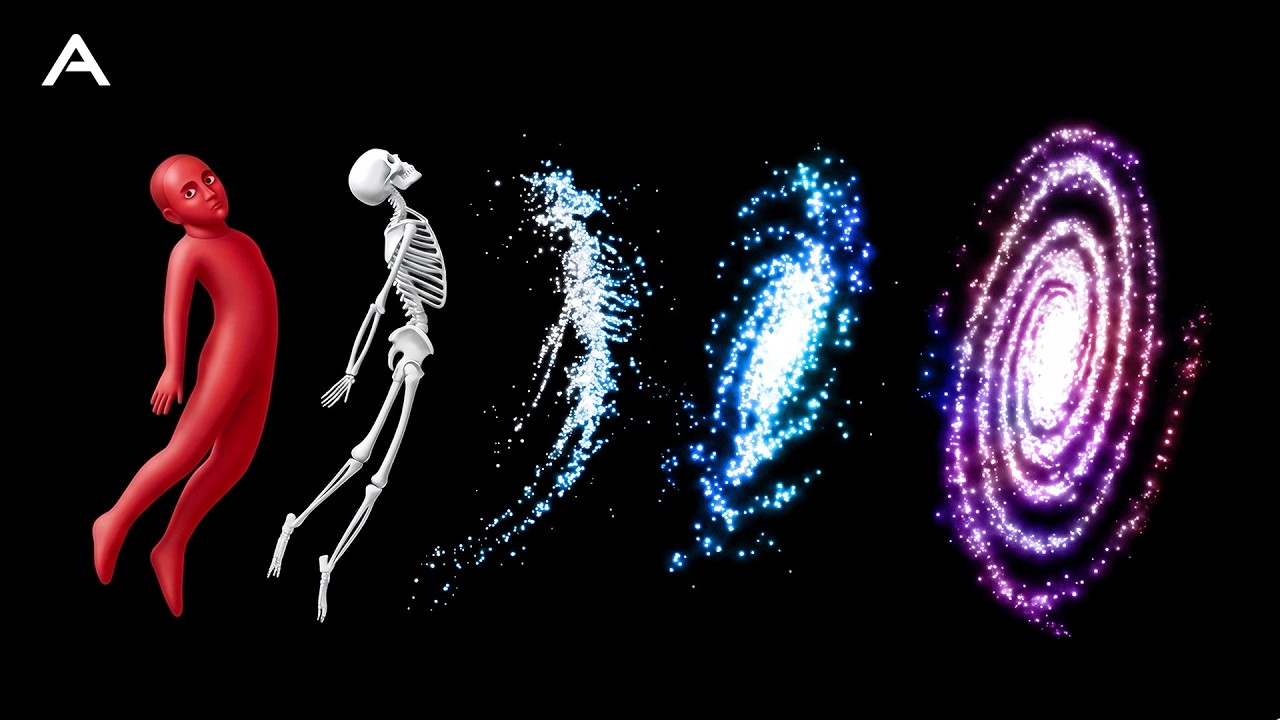
At a glance
This is a thirty four minute essay on impermanence delivered by a narrator who calls himself a melancholic with a camera and too many books. The thesis is blunt: everything you have ever loved will die, and the real problem is not death but our expensive, anxiety soaked denial of it. He argues that most of us die emotionally long before we stop breathing, that we have turned life into a waiting room for a "better" that never arrives, and that letting go is not surrender but the only way to actually experience the life you have. Along the way he hands the microphone to a small library of thinkers, Bukowski, Rilke, the Stoics, Heidegger, Alan Watts, Epicurus, Kübler-Ross, Becker, Zen, Camus, Dylan Thomas, and closes with five concrete practices for living like you already said goodbye.
This page is a remake of the whole essay, in his order, with the full argument, every thinker, every quote, and the ashtray story intact. You could skip the video and lose almost nothing but his voice.
The funeral you weren't invited to
He opens with an image. Have you ever woken up and felt like you were attending a funeral you were not invited to? Not a real funeral, those are at least honest: a body, bad coffee, a few crying relatives, and you know why you are there. He means the other feeling, the quiet awareness that everything you have ever loved will die. Your parents, your dog, your neighbor's dog, the restaurant from your third date, your body, your favorite pair of pants, eventually even your sense of humor. If you are lucky, he says, you go out with that last one still intact.
Then the hinge of the whole piece: most of us die long before we stop breathing, and that is the good news. He is careful to fence off what this is not. It is not one of those "death gives life meaning" TED talks delivered by a man with perfect teeth telling you to journal your gratitude in a yurt. He is not selling fake hope. He is offering perspective, which he describes as a rusty, heavy, uncomfortable gift you did not ask for but need, so you can stop screaming into the void every time Instagram serves you a targeted ad for emotional fulfillment.
The real enemy is denial, not death
The first argument is a reframe. The problem is not death. The problem is denial. He does not think we actually fear death itself; he thinks we fear knowing it is real while still having to do the mundane work of being alive, answering emails, filing taxes. We have built an entire society on pretending permanence exists. We act as if careers last, as if love is a contract, as if your face will stay the same after forty. We take selfies as though the internet will save us from decay. We marry like it is a guarantee, even though roughly half of marriages end in divorce. We upload our memories to cloud servers as if we could outsmart entropy with two factor authentication.
He names it precisely: expensive, credit card destroying denial steeped in anxiety. And underneath all of it most people are quietly panicking, because on some level you already know it is true. You just would rather not hear it from a melancholic on YouTube.
The deeper tragedy in his telling is not death at all. It is that we have turned life into a waiting room for something else, something we imagine is more grandiose and less disappointing, and we keep postponing our peace until things get better. But better never arrives. It dies like everything else. The conclusion lands as a turn rather than a lament: losing it all should make us live more fully, not hide better.
He brings in Charles Bukowski to seal the opening: we are all going to die, all of us, what a circus, and that alone should make us love each other, but it does not, because we are terrorized and flattened by trivialities, eaten up by nothing.
The ashtray: why a broken thing can break you
Here the essay drops from abstraction into one specific object, and it is the emotional anchor of the whole piece. He once owned an ugly chipped ashtray, bought at a garage sale back when he still smoked and thought irony was a personality. It had a cartoon duck on it and the word "quack" in comic sans. He loved it. It was not beautiful, but it was his, a relic of an idiosyncratic, unrepeatable version of himself.
One day it fell off the windowsill and shattered, and he stood there like a grieving widower in a discount robe staring at ceramic duck parts on the floor. Stupid and trivial, he admits, and also not, because the duck was a small reminder that nothing is guaranteed to stick around just because you like it a lot. That is why it mattered. That is why it hurt. That is why it was real. We live in a culture that tries to turn love into a receipt and death into a glitch, but the point, he says, is not to outwit the ending. The point is to feel it, all of it.
Rilke: let everything happen to you
The first formal teacher he calls is the poet Rainer Maria Rilke, with a line he says he has always loved: let everything happen to you, beauty and terror, just keep going, no feeling is final. He then unpacks it phrase by phrase, treating the poem as an instruction manual.
Life, he says, will kick you in the teeth, kiss you on the forehead, and light your house on fire, sometimes all in the same week. Try not to panic.
- Let everything happen to you is poetic, but it is also a dare. It means do not spend your life bubble wrapping your feelings, do not hide from grief or heartbreak, and crucially, do not cling to the good stuff like a hostage, because the good stuff leaves too. The universe, he says, is a bad landlord that eventually takes everything back.
- Just keep going means walk through the fire, and through the boredom, the awkward Tuesday afternoons when your soul feels like an old motel carpet. Standing still does not stop the storm. It just lets it drown you slower.
- No feeling is final is the punch line. Your misery is temporary and your joy is temporary; the point is not to hold either, but to realize life is a constant absurd parade and your job is to keep walking, without pretending you are above it and without pretending you are supposed to enjoy every minute.
Rilke, in his reading, gives you permission to stop controlling life like a playlist. Let it all play, skip nothing, because even the bad songs eventually end.
What we actually want, and why it makes us miserable
He gets honest about the wish underneath the fear. Almost nobody actually wants to die, but almost nobody truly wants to live forever either. What we really want is to not lose anything we love. We want to pause the good parts and fast forward the bad ones, as if life were a DVD we forgot to return to Blockbuster in 2003. That clinging, that desperate emotional hoarding, is the unhealthy attachment making us miserable. This sets up the contrast the rest of the essay develops: the difference between gripping and holding open. The diagram below lays out the two postures he keeps circling.
The Stoics: rehearse the loss before it arrives
His first practical tradition is Stoicism, and the tool is premeditatio malorum, the premeditation of evils, a Stoic exercise in imagining what might go wrong before it happens. At first glance it sounds bleak, pessimism dressed in a toga. But the purpose is not to wallow in worst cases. By rehearsing misfortune in the mind, the Stoics believed you strip it of its power, toughen your nerves, and meet real hardship with a steadier hand when it inevitably arrives.
He quotes Seneca: let us prepare our minds as if we have come to the very end of life, let us postpone nothing, let us balance life's books every day. In plain terms, live like you might not wake up tomorrow, because one day you will not. He acknowledges these can sound like platitudes, then insists they are as powerful as ever. Memento mori. You must die.
Heidegger, Watts, the Zen proverb: stop holding your breath
From there he runs a chain of thinkers, each landing the same blow from a different angle.
Heidegger, whom he calls basically the goth kid of philosophy, gave us being toward death: authenticity only shows up when we stop pretending we are immortal. We spend too much time on inauthentic living, jobs we hate, identities we outgrew a decade ago, relationships that feel like being slowly digested. The moment we truly accept mortality, everything clarifies. We stop chasing and start choosing.
Alan Watts, described with affection as a calm, mischievous, cosmic British soul, supplies the central metaphor: to resist change, to cling to life, is like holding your breath, and if you persist, you kill yourself. So, let go or suffocate. Breathe out, let it pass through, because the moment we cling, we drown.
Then the Zen proverb that gives the channel its mood: let go or be dragged. Most people, he says, do not realize you are not supposed to hold on. You are supposed to fall, ideally with grace and style.
Epicurus: scared of a party you weren't invited to
Epicurus had the audacity to claim death is not even worth fearing, because when death is here you are not, and when you are here death is not. To him death was a non issue, since we never actually experience it. We only experience the fear of it, which, the narrator notes, is like being scared of a party you are not even invited to. The honest correction follows: for most of us it is not being dead that worries us, it is the dying part.
He widens the lens here. Death is not only corpses and tombstones. It is change, loss, and the small deaths, the identity deaths, the death of who you thought you were going to be.
Kübler-Ross and Becker: grief is the system, not a glitch
Elizabeth Kübler-Ross mapped the five stages of grief, denial, anger, bargaining, depression, and finally acceptance. The part left off the Instagram grief quote, he notes, is that most of us get stuck in bargaining, trying to negotiate with reality: I will be good if you let me keep this, I will be eternally grateful if I do not lose that. But reality does not cut deals. It just takes. And that, he argues, is a mercy, because grief is not a glitch in the system. It is the system.
Ernest Becker, author of one of the most intense books he has read, The Denial of Death, supplies the brutal frame: the irony of man's condition is that the deepest need is to be free of the anxiety of death and annihilation, yet it is life itself that awakens it. The narrator translates: at some point humans became self aware enough to know they would die, and immediately invented religion, capitalism, narcissism, every other ism, legacy projects, Botox, anything to forget it again. We chase purpose not because we are noble but because we are scared, and we build monuments not from pride but from terror of being forgotten. And, he adds, it is amazing how quickly we are forgotten after we die.
The turn: acceptance is liberating
So what now, sit in the dirt and cry? Maybe for a minute, that part is healthy. But this is where it starts to get good. Once you actually accept the impermanence of everything, you stop wasting time trying to keep things permanent, and that is liberating. You stop hoarding people, moments, identities, clothes you have not worn since high school. You stop pretending you will live a thousand lives and start living this one. You start saying no without guilt and yes without needing a guarantee. You stop waiting for the perfect moment and start, in his image, dancing in the burning building like the nihilistic little gremlin you were born to be.
The Zen folks, he says, had it figured out: before enlightenment, chop wood carry water; after enlightenment, chop wood carry water. It does not get more glamorous. You do not get a crown, you get a broom, and then you sweep the same floor knowing one day you will not. That is the beauty of it. When we stop needing life to mean something, it becomes real, and when we stop demanding permanence, we can finally enjoy what is in front of us before it turns to smoke.
We do it because it doesn't last
What do we do with the knowledge that everything ends, everyone leaves, every beautiful thing will burn, decay, or become a sad Facebook memory no one wants to look at? We live anyway. We love and build anyway. Not because it is easy, he is clear it is not, but because, and this is the line the whole essay pivots on, we do not do any of it because it lasts. We do it because it does not.
He gets personal. There was a time he thought the point of life was to find something that could not be taken from him, a person, a relationship, a belief system, a purpose, something to cling to when everything got weird or meaningless, or when someone he loved got terminal cancer and the motivational posters stopped working. The older he gets, the more he thinks the point is not to find something eternal but to keep showing up for the temporary with your eyes and heart open and your hands not clenched into fists.
Maybe, he says, the point is to look the void in the face and say: okay, I see you, you win. But while I am here, while I still get to eat a peach or feel a lover's hand on the back of my neck, I am going to feel the hell out of this, even if it breaks me. And it will break you. Everything you love will break your heart eventually, or you will break someone else's. That is the price of admission for being an authentic human being.
The one that destroys you is the numb heart
Then the secret no one told you in school: you can survive a broken heart, but you cannot survive a numb one. Numbness is the death that comes before death. It is what happens when you decide feeling is too risky, caring too dangerous, connection too painful. But that is how you lose the whole plot, because you do not protect yourself from pain, you just end up lonely in a fortress of emotional concrete wondering why your skin feels like plastic.
His instruction is the opposite of armor. Let yourself be torn. Let your heart shatter. Let people matter. Let places haunt you. Fall in love with stupid ordinary things, the smell of your grandmother's house, the sound of someone laughing at your terrible jokes, the way certain songs destroy you in exactly the right way. Mourn the things that do not make sense to mourn, the city you never moved to, the version of yourself you never became, the dog you did not pet one day because you were in a rush. Grieve all of it, and then keep going, because none of it was ever going to last, and that is exactly what makes it yours.
Five things that help: the practice
He closes the argument with the only thing resembling advice, offered as things he has noticed while limping through life barefoot and slightly drunk on cosmic dread. The timeline below is his five steps in his order.
- One Get rid of the illusion of control. Stop thinking you can out plan loss, because you cannot. Make peace with being the passenger in this life, even lean your head out the window and enjoy the chaos, just keep an eye out for the mailboxes.
- Two Practice micro grieving. Do not wait for a funeral to grieve. Feel the ache of throwing away an old t-shirt you loved, of watching your kid grow out of a phase, of realizing someone does not love you. It does not have to be colossal or melodramatic, just honest.
- Three Make peace with the ending now, not only later. Live as if you have already said goodbye to everyone you love and now get one last weird, hopefully miraculous day with them. That changes everything.
- Four Create anyway. Write, paint, build, draw, sing. Do not do it to be remembered. Do it because it feels like leaving fingerprints on the inside of the cave before the torch goes out.
- Five Do not be too cool to care. Cynicism is armor; drop it sometimes and let yourself be vulnerable. Tell people you love them before they become someone you used to know. Cry at movies, hug somebody too long, be a human in all your beautifully dysfunctional glory.
The last note is Albert Camus, whom he calls an old friend: there is no sun without shadow, and it is essential to know the night. We do not have to love death, but we can respect it, and let it make us kinder, funnier, a little braver, and less full of it. He leaves you with Dylan Thomas: do not go gentle into that good night, rage, rage against the dying of the light.
Key takeaways
- The problem is not death, it is denial. Society runs on the expensive, anxiety soaked pretense that careers, faces, marriages, and cloud backups make things permanent. They do not.
- Most of us die emotionally long before we die physically. Numbness is the death that comes before death, and it is the only one you cannot survive.
- We treat life as a waiting room for a "better" that never arrives, postponing peace until conditions improve. Better dies like everything else.
- Grief is not a malfunction. It is the operating system of love. Bargaining is where most people get stuck; acceptance is the exit.
- Accepting impermanence is not pessimism. It is liberating, because you stop spending energy keeping temporary things permanently yours and start showing up for them.
- The Stoic move is to rehearse loss in advance (premeditatio malorum) so it cannot paralyze you. Seneca: balance life's books every day.
- We do not love and build because things last. We do it because they do not, and the impermanence is what gives them weight.
- The practice is concrete: release control, grieve small losses early, live as if you already said goodbye, create without needing legacy, and drop the cynical armor.
Chapters
Timestamps are clickable. Click one and the player jumps there and keeps playing while you read. This video ships no creator chapters, so these markers are estimated from position in the transcript.
- 0:00 The funeral you weren't invited to
- 2:20 Death isn't the problem, denial is
- 4:55 Bukowski and the ashtray that shattered
- 8:10 Rilke: let everything happen to you
- 12:30 What we actually want, and the hoarding that hurts
- 14:40 The Stoics: premeditatio malorum and Seneca
- 17:30 Heidegger, Alan Watts, and "let go or be dragged"
- 20:10 Epicurus and the small deaths
- 22:30 Kübler-Ross: stuck in bargaining
- 24:40 Becker and The Denial of Death
- 26:50 The turn: acceptance is liberating, chop wood carry water
- 29:30 We do it because it doesn't last
- 31:40 The broken heart versus the numb heart
- 33:00 Five things that help, Camus, and Dylan Thomas
Notable quotes
Immortality, it sounds wonderful until you realize it's just an infinite group chat you can't leave. narrator, 1:55
We keep postponing our peace for when things will supposedly be better. But better never really arrives. It just dies like everything else. narrator, 4:30
We're all going to die. All of us. What a circus. That alone should make us love each other, but it doesn't. Charles Bukowski, quoted at 4:55
Let everything happen to you. Beauty and terror. Just keep going. No feeling is final. Rainer Maria Rilke, quoted at 8:10
To resist change, to try to cling to life, is like holding your breath. If you persist, you kill yourself. Alan Watts, quoted at 18:10
Let go or be dragged. Zen proverb, quoted at 19:20
Grief isn't really a glitch in the system. It is the system. narrator, 23:40
We chase purpose not because we're noble, but because we're scared shitless. narrator, 25:30
Before enlightenment, chop wood carry water. After enlightenment, chop wood carry water. You don't get a crown. You just get a broom. narrator on a Zen koan, 27:30
We don't do any of this because it lasts. We do it because it doesn't. narrator, 29:20
You can survive a broken heart, but you can't survive a numb one. Numbness is the death that comes before death. narrator, 31:40
There is no sun without shadow, and it is essential to know the night. Albert Camus, quoted at 33:30
Resources mentioned
- The Denial of Death by Ernest Becker, the argument that civilization is a death denial project.
- Charles Bukowski, the "what a circus" passage on how mortality should make us love each other.
- Rainer Maria Rilke, the "let everything happen to you, no feeling is final" lines.
- Stoicism and the practice of premeditatio malorum, with Seneca on balancing life's books daily.
- Martin Heidegger and the concept of being toward death.
- Alan Watts on clinging as holding your breath.
- Epicurus on why death cannot be experienced and so should not be feared.
- Elizabeth Kübler-Ross and the five stages of grief.
- Zen Buddhism, the "let go or be dragged" proverb and the "chop wood, carry water" koan.
- Albert Camus on sun, shadow, and the night.
- Dylan Thomas, Do Not Go Gentle into That Good Night.
- The Functional Melancholic, the channel, which explores philosophical themes for educational purposes and notes it is not a substitute for professional mental health advice.
The one idea to walk away with
Permanence was never on offer, so building your life around protecting it is a losing trade that costs you the life itself. The alternative is not despair, it is the open hand. Let things matter precisely because they will not last, grieve the small losses while you still can, and refuse the one death you can actually choose, the numbness that arrives early and disguises itself as safety. Let go, the essay says, not because nothing matters, but because everything does, and only for a while.