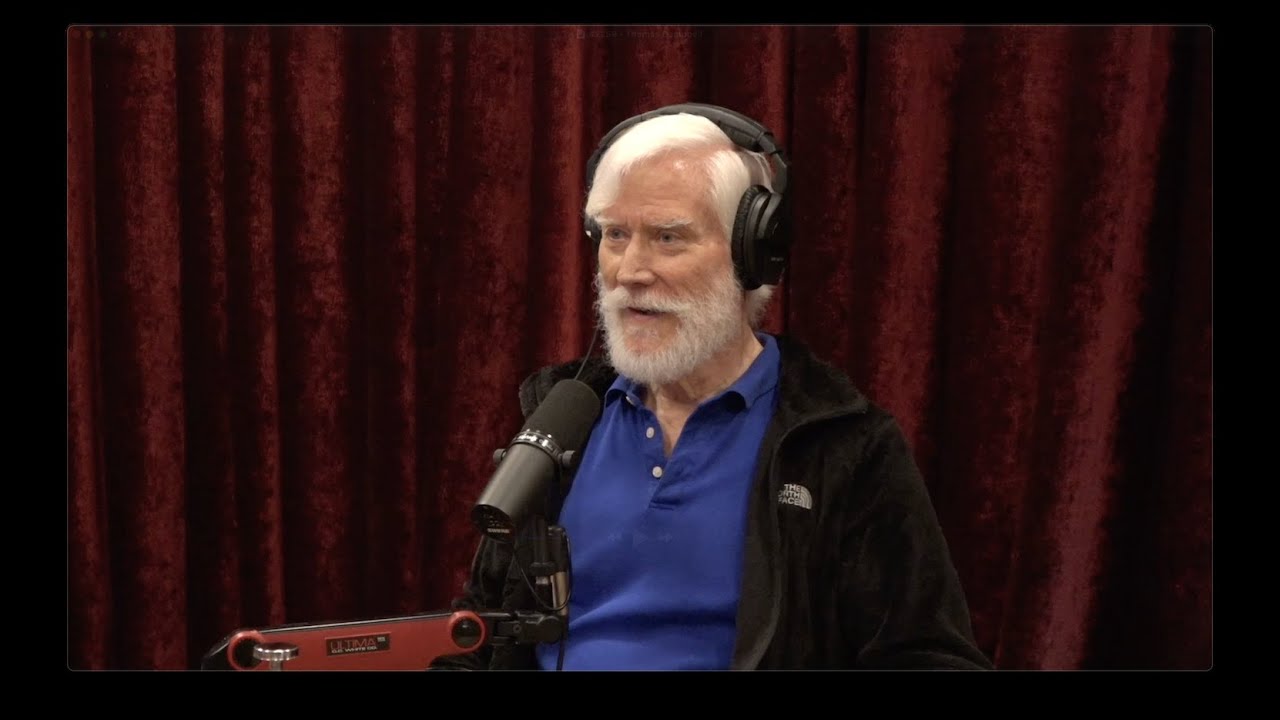
Joe Rogan talks for two and a half hours with Dean Radin, chief scientist at the Institute of Noetic Sciences, who has spent a 45 year career running controlled laboratory experiments on telepathy, precognition, and mind matter interaction. Radin traces his path from violinist to electrical engineer to the classified Stargate remote viewing program, and lays out the evidence he says is now strong: meta analyses of telepathy, the presentiment experiment where the body reacts before a random computer selects an emotional image, and a genetics study he reads as a fingerprint of the Inquisition pruning psychic talent. He reveals that his company Cognigenics is developing an intranasal RNA interference treatment for dementia that mimics psilocybin without the hallucinations, and that mice and monkeys show large memory gains. The back half opens into consciousness, idealism, quantum non locality, Jung, AI, the ultraterrestrial hypothesis, and what a world with no secrets would do to power.
Published Jun 11, 20262:37:55 video52 min readAdded Jun 17, 2026Open on YouTube →
At a glance
For two and a half hours, Joe Rogan sits with Dean Radin, the chief scientist at the Institute of Noetic Sciences and one of the few people who has spent a forty five year career running controlled laboratory experiments on telepathy, precognition, and mind matter interaction. Radin walks his own arc, from violin prodigy to electrical engineer to the classified military remote viewing program known as Stargate, then lays out the evidence he says is now strong: meta analyses showing telepathy replicates, the presentiment experiment where the body reacts to an emotional image one and a half seconds before a random computer even selects it, and a genetics study hunting for a psychic gene that turned up an unexpected fingerprint of the Inquisition. He brings a spoon he says he bent without force, describes the synchronicity that he calls being manifested into another lab, and reveals that his company Cognigenics is developing an intranasal RNA interference treatment for dementia that mimics psilocybin without the hallucinations. The back half opens out into consciousness, idealism, quantum non locality, the meaning of Carl Jung, and a long riff with Rogan on AI, the ultraterrestrial hypothesis, and what a world with no secrets would do to power.
A forty five year arc in three minutes
Radin offers to give the whole arc fast, and Rogan takes it. He started as a violinist, classical track, until halfway through college when he realized that being a working musician means being an athlete, because you make your living with your body. He could not do that. He has Gilbert syndrome, a mutation of a liver enzyme that leaves him with too much unconjugated bilirubin and almost no recovery time after exertion. The downside is fatigue; if he walks too fast or too hard he feels it for three or four days. The upside is that unconjugated bilirubin is one of the most powerful natural antioxidants, so at 74 his cardiac calcium score is zero (on a scale where zero is pristine and 100 means you are about to die) despite cholesterol his doctor calls off the charts. The same mutation, he says, brings longevity. Rogan, struck that Radin looks fifteen or twenty years younger than his age, suggests doing tiny doses of exercise through the day, two pushups every four hours, to keep bone mass.
A quick sidetrack on the difference between a violin and a fiddle (a violin is the career track toward concert classical; a fiddle is style, intonation, and the kind of music) leads to Radin admitting he transitioned to bluegrass fiddle and banjo and had to learn to play worse on purpose, because bluegrass sounds more authentic a little off tune. In graduate school he competed in the Illinois State Fiddler Contest against a teenage Alison Krauss and lost miserably; she was incredible even then. Rogan, who does not know who she is, lands on "The Devil Went Down to Georgia" by Charlie Daniels as his reference for fiddle in popular culture; Radin calls it good fiddling, a little bit like fiddle on steroids.
Back to the arc. Radin describes his life as a game show where he keeps choosing door number two. He switched into electrical engineering because he liked taking things apart, got a master's, did not want to be an engineer, and got a PhD in experimental psychology. As a senior in college he read about a new place called the Institute of Noetic Sciences, founded by Apollo 14 astronaut Edgar Mitchell, the sixth man on the Moon, who on the way home had a mystical experience of feeling literally one with the universe (an early articulation of what is now called the overview effect). Mitchell built an institute to study inner space the way NASA studies outer space, with the motto exploring the frontiers of consciousness. Radin filed it away as where he wanted to end up.
1951Born. Trains as a classical violinist, later switches to bluegrass fiddle and banjo for about 25 years total.
1970sReads about the new Institute of Noetic Sciences, founded by Apollo 14 astronaut Edgar Mitchell. Switches to electrical engineering, then a PhD in experimental psychology.
1980sWorks at Bell Labs in human factors, runs psychic side experiments, presents precognition work at the Parapsychological Association, and is recruited into the classified Stargate program at SRI International.
1985 to 1988Leads multidisciplinary consciousness research at Princeton alongside the PEAR lab. Begins using neural networks to identify people by their effect on random number generators.
1990sUniversity of Edinburgh (automated Ganzfeld telepathy), then UNLV funded by Robert Bigelow, where he develops the presentiment experiment and analyzes casino jackpot data.
2000Paul Allen's Interval Research in Silicon Valley wraps; Radin co founds the short lived Boundary Institute, the site of the SI Quest synchronicity.
2001 to nowJoins the Institute of Noetic Sciences, closing the circle from college. 25 years and counting as chief scientist.
Figure 1. Radin's career as he tells it, a sequence of door number two choices that kept circling back to one question: can the strange experiences people report be measured under controlled conditions.
What noetic means, and the weirdness everyone has felt
Rogan asks about the word noetic. Radin defines it as a feeling of intuition that carries a sense of certainty the intuition is correct. Intuition is knowing something without knowing how you know it; the noetic version arrives with conviction, and more often than not the conviction is right. People describe downloads in meditation; that is what they mean.
Rogan takes the baton and delivers the core case in his own voice: there is weirdness in the world that science has dismissed under the banner of being science people who want data, except there is data. The person you have not thought about in years who suddenly calls. The feeling not to do something, ignored, followed by something terrible, the "I knew I shouldn't have gone there" moment. The strange energy off someone who is angry but says nothing. We have a tiny set of senses, see, hear, feel, touch, smell, and it is not enough; there is probably stuff out there we lack the tools to measure but that affects us. Radin's reply is the thesis of his work: but we do have the tools to measure. A branch of science has studied exactly these phenomena since the late 1800s, and science is very good at taking even strange subjective experiences and asking, is that coincidence, or is it real.
He names the hidden assumption that traps young scientists: through twenty plus years of training in materialism (also called physicalism), nobody mentions that it is a set of assumptions, or teaches the philosophy of science that interrogates whether the assumptions are correct. Materialism explains the physical world beautifully and hands us our technologies, but it does not explain subjective experience at all, which Radin calls the number one existing mystery in science. That is why he wrote a book about magic; not stage magic, but the real magic we do not yet have a name for.
The 1800s: from thought transference to controlled telepathy
Radin says the early researchers were chasing the same things people report today: apparitions, telepathic connections, precognitions. They began building experimental methods to study these under controlled conditions, where control means you exclude coincidence by design and exclude leakage of information, so that the only thing left over, if telepathy is real, is the signal. They called it thought transference, and the early methods would not pass muster now (two kids claiming telepathy were often found to be using signals). Today people are strictly isolated, neither can know the target, and the work is replicated across many people. After 150 years, Radin says, we have very strong evidence that telepathy exists. He notes the skeptics' two modern responses: either there is no plausible flaw they can identify (because much time has been spent hunting for one), or, more recently, we are not even going to look at the evidence because we know it is impossible, which Radin calls no longer a scientific argument.
Rogan ties this to the remote viewing program: why would intelligence agencies spend enormous money and time on something with no evidence? He cites Hal Puthoff and others who derived actionable data. Rogan admits he tried it once on a TV show with a remote viewer who was off, but under camera duress, which is the wrong state of mind. Radin makes state of mind central: anxiety, fear, a jackhammer, a barking dog all interrupt it, and the brain has many measurable states, not a binary on and off like a toaster. To dismiss remote viewing, where people described submarines being built in the Soviet Union, is to be a fool; the only way to know is to study it, which requires intelligent people willing to look a little foolish.
Bell Labs, and the door to Stargate
After his doctorate Radin went to Bell Laboratories, the biggest lab in the world at the time, working in human factors (the seam between engineering and psychology). On the side he ran small psychic experiments in mind matter interaction and precognition. The thread back to Edgar Mitchell is direct: Mitchell gave the first money to SRI International for remote viewing studies under Puthoff and Russell Targ, and also brought Uri Geller to the United States, including to Bell Labs.
Radin got permission to present his precognition work, under the Bell Labs name, at the annual conference of the Parapsychological Association, which (many people do not know) is one of the roughly 200 affiliates of the American Association for the Advancement of Science, a legitimate scientific organization. In the audience were people who afterward asked if he would be interested in joining the Stargate program. That was an offer he could not refuse, because the existence of work at SRI was known but the classified portions were only rumor. He took a one year leave of absence; Hal Puthoff was his boss, and when Puthoff left in 1985, Edwin May took over as director for ten years.
The clearance was an education in itself: not just secret, but top secret, then top secret SCI, then top secret SCI special access program, meaning even with a top secret clearance you could not know about the place, and the code word itself was classified. Radin and his colleagues were the research side, not the operational military side. Their mission was the questions Rogan keeps asking: How does it work? Is it real? Yes, some people are very talented. What are the limits? Can you block it, shield it, camouflage it? And why is someone like superstar viewer Joe McMoneagle different from anyone else? When Radin first met McMoneagle, Ingo Swann, and the others, they were nothing like the Madame Zodiac stereotype; they were just guys and gals.
Every method (psychological, physiological, medical) failed to find a marker that distinguished talented viewers, which mattered because the Army wanted to select more people. The only two factors were talent (partly genetic) and openness (the psychological trait of being open to experience). Closed people block it, and block it well. Radin flags that the genetics of talent would come back later in the conversation, because they now have the genetic tools they lacked then.
Princeton, PEAR, and a machine that knows who you are
Back at Bell Labs, another door opened almost immediately: Princeton, home of the Princeton Engineering Anomalies Research laboratory (PEAR), run by the dean of the engineering school, which spent nearly 30 years on mind matter interaction and remote viewing. Radin's appointment was in the psych department but his job was to corral many departments (philosophy, psychology, civil engineering, PEAR) into multidisciplinary research, a job he was told on day one was impossible. Why? Because everything of value in academia lives inside your silo; even social and perceptual psychologists with adjacent offices do not talk. Rogan calls it insane, and Radin agrees while explaining it: becoming an expert takes twenty years, and keeping up consumes the rest, so people will not divert attention. He notes that whole new disciplines, like the neurosciences about 60 to 70 years ago, were created when a foundation threw enough money to force biologists and nervous system researchers together. His own field, consciousness studies, is only now becoming its own discipline.
At Princeton he did two things that mattered later. First, meta analysis, pooling many similar experiments statistically to ask whether independent people replicate the same effect and, if so, what the overall result is, treating it as one gigantic experiment. He wrote a book on it that nobody wanted to buy, so it sat. Second, because of his engineering background, he applied the era's cutting edge machine learning, neural networks, to PEAR data. The standard mind matter experiment uses a random number generator: a person is asked to make more one bits than zero bits, then more zeros, then to do nothing, three tasks in a session. Across many people, intention nudges the bits in the intended direction (aim high, it goes up; aim low, it goes down), but not everyone can do both; some get the opposite result, and each person has a kind of signature in how they interact with the machine. Radin trained a neural network to identify who was doing the task purely from how the random bits behaved, and it worked.
A technology of intention, and a vice president who would not look
Radin left Princeton after three years, exhausted by the impossible job of forcing collaboration, and took the neural network idea back into industry, telling interviewers plainly he wanted to build it. The vision was a machine that identifies who you are and your intention, like Neuralink except with no implant and nothing entering the brain, purely intention. At a company outside Washington DC he got to the edge of a patent because the device worked, and a retired general's admiral friend flagged Navy interest for an obvious reason: communicating with submarines. Then the company was bought, and the new owners said he would not work on it anymore. The vice president in charge of the lab did not believe it was possible and, of course, did not look at the data, a refrain that recurs. It was golden handcuffs, good money, work he no longer wanted. A 1992 recession laid off part of his department, including him.
That opened the next door. The Stargate program was quietly funding classified contracts elsewhere, including the University of Edinburgh, where a colleague was building an automated Ganzfeld telepathy system (everything automated, the human mostly out of the loop except the two participants). That colleague died, leaving the project unfinished, so Radin asked Ed May, then running Stargate, for permission to go finish it. He spent about a year at Edinburgh, completed the automated telepathy system (many people have since been run through it), and began developing the experiment that would define him.
Presentiment: the body reacting before the cause exists
Radin notes that Julia Mossbridge had recently been on the show discussing exactly this kind of experiment, the body reacting to an unanticipated future event. He was developing it around 1993. The intuition behind it is the everyday story: you drive the same route thousands of times, approach a green light you would normally accelerate through, and something tells you to slow down for no reason while cars behind you honk; you slow anyway, and a truck blasts the red light broadside through the intersection you would have entered. You just saved your life by listening to the little voice.
You cannot put people in real danger in a lab, but you can use emotion. You wire someone to measure skin conductance, pupil dilation, or brain waves, and record continuously. They press a button; five seconds later a true random number generator selects, after the press, whether to show a calm image or an emotional one, and emotional splits two ways (negative, like surgery or an explosion, or positive, like a smiling baby), the two valences. Nobody, including the experimenter, knows in advance what will appear.
At UNLV, funded by Robert Bigelow (best known for AAWSAP and Skinwalker Ranch work), Radin ran his own lab and ran this experiment. The result was not the usual small statistical effect; it was in your face. About one and a half seconds before the picture is even selected, if the upcoming image is emotional the body starts becoming emotional, and if it is calm the body stays calm. That pre stimulus difference is the presentiment effect: the body, or the unconscious, somehow knowing what it is about to see, the lab version of slowing for the truck.
Figure 2. The presentiment experiment as Radin describes it. The image is chosen by a true random generator only after the button press, yet the emotional trials (amber) show a measurable rise in arousal roughly one and a half seconds before selection, while calm trials (blue) stay flat. The lab analogue of the body slowing the car before the truck appears.
The fifth bullet: presentiment in real life
A colleague at the center told Radin a story more dramatic than a red light. The man went hunting with friends. His favorite gun was a six shot double action revolver. Cleaning it, he loaded bullets one, two, three, four, then picked up the fifth and got a feeling that something about this bullet was not right, so he left it out, set the hammer over the empty sixth chamber so it would not jostle, and they went hunting two weeks later. His pistol was never used. Afterward they did what you should not do, they drank, a fight broke out, and one drunk man picked up the friend's gun and pointed it point blank at someone's face. The friend watched in horror as the trigger pulled, the hammer drew back, the cylinder rotated from six to five, and he stepped in front of the gun; it went click on the empty fifth chamber. Had he loaded that bullet, someone would have been shot in the head. He said everyone has a bullet with their name on it, and his is in a safety deposit box where he knows exactly where it is. Rogan's deadpan: maybe also have the intuition not to go hunting and drinking with psychos willing to shoot someone over an argument. Radin's point stands: real life gives two weeks of warning; the lab can only reach for seconds, and stronger lab results would come if you could ethically recreate that stakes.
How remote viewing actually works
Rogan asks about the state of mind and protocol for remote viewing. It depends on natural talent. Ask Joe McMoneagle at breakfast what is in a hidden folder and he answers immediately while still eating; if he knows in the afternoon he will do a session, the information often arrives in the morning, bang, then he waits for it to play out. For the rest of us, training is required, and almost everyone can do it. The core discipline is not to name an impression, which is brutally hard. You have a target (somewhere in the world, a person, something in an envelope); you know there is a target to describe but not what it is. You start with little scribbles, then more complicated scribbles, adding feelings and senses, until it gels into a coherent image. The trap is naming: tell someone they will see a picture in 20 minutes, they imagine it, get a flash of yellow, instantly think bananas, and then cannot not think of bananas. So anything that arrives with a name attached is probably not it. It takes practice, but you can get there.
The most impressive thing Radin saw came in the briefing Hal Puthoff gave him after clearance, the same briefing given in SCIFs to members of Congress and presidents: picture after picture where McMoneagle and lesser known viewers produced near veridical drawings of targets elsewhere in the world, sealed in envelopes, in SCIFs, where nothing about the target was known. The protocol often used a five digit number as the only handle: I will show you this target in two hours, here is a random number that stands for it, describe what I am going to show you. And they do it. Rogan presses on the mechanism: just by attaching a random number to a target, a connection is made? Yes. How? Radin laughs: we do not know why. The theories require stepping away from materialism toward models that allow consciousness to have a non local quality, the same non locality seen in quantum entanglement, connections through space and through time. Push it hard enough and you land near the film Everything Everywhere All at Once: an aspect of reality, ordinarily unseen, connecting everything across space and time. If that were not so, precognition, telepathy, and remote viewing would not work, but they do.
Atrophied, not emerging: shamans, wolves, and the Australian minister
Rogan asks whether this is an emerging human quality or an atrophied one we had before written language and media quieted the silent communication people once shared, the way wolves coordinate attacks with specific roles. Radin thinks most animals, plants, maybe insects have consciousness in some form, and if it resembles ours it is non local. He frames it through evolution: humans were shaped not to attend to the there and then, because someone daydreaming about Pluto a million years ago would miss the tiger and be pruned from existence. The exceptions were shamans, valuable because they knew the food would be ten miles that way next week, but unable to care for themselves, so the tribe took care of them. Today, distracted by everything and lacking the need, the ability atrophies, except in some indigenous societies. He tells of giving a talk to the Australian government, full of ministers and military, after which a minister representing the indigenous people said simply, we have known this for thousands of years, and used it in the outback where there were no phones. No distractions, plus a real need, kept it alive. So remote viewing is partly relearning an old skill, and some people still carry the genetics from ancestors who had the ability.
The genetics of psychic talent, and the fingerprint of the Inquisition
Talent recurs: Joe McMoneagle did search and rescue behind enemy lines and always brought his team back alive, using intuition in the field to choose a different road. Recruiters later asked combat veterans, do you find you never get hit, and whether they had earlier experiences; McMoneagle did, and so did his sister, suggesting a familial genetic underpinning.
This sets up the genetics work, which Radin pursued with Garry Nolan, the Stanford immunologist, who asked whether anyone had looked at the genetics of highly talented people given the folklore of psychic families. They designed an experiment called Sai genes (looking for a psychic gene, more likely a polygenic trait). They recruited 3,000 self described psychics from psychic families over the internet, vetted them heavily including face to face interviews, and could only afford to sequence the DNA of 13. Comparing their genomes to matched controls produced a surprise: the psychics were all so called wild type with nothing unusual, while the controls showed a significant effect in an intron sequence. Of billions of base pairs, only about 50,000 produce proteins (the exome, the part that builds the body); the rest, once called junk DNA, is the epigenetic portion that turns genes on and off. The controls had a mutation in their intron sequence, turning something off; something about their makeup was suppressing psychic sensitivity.
Then a specialist in the genetics of societies found that countries exposed to Christianity, the longer the exposure, had more of this intron mutation. The interpretation Radin reaches is grim: the Inquisition systematically hunted people with these abilities over hundreds of years and killed them, a non evolutionary pruning of part of humanity, a eugenics in reverse that removed the talent rather than selecting for it, and you can see it in the genome. The targets were witches, healers, and people with precognition, plus many innocents; magic inside the church (a priest anointed in a certain way, the Eucharist itself a magical practice) was fine, but magic outside the church was not, a heavy handed way of keeping power in the church.
Levitating saints and hopping yogic flyers
Catholic saints, Radin notes, did very psychic things. Joseph of Cupertino was said to levitate, sometimes thirty feet, drifting into church rafters before astonished crowds and even Pope Urban VIII; lucky to already be a priest, he made a deal with the Inquisition to go somewhere remote and stop. Jamie pulls up Saint Teresa of Ávila, a Spanish mystic who recorded levitations during deep spiritual rapture, describing a violent force lifting her from beneath her feet, so embarrassing that she asked fellow nuns to physically hold her down. Rogan's recurring question: why can nobody do that now and film it on an iPhone? There are stories, Radin says, but nothing yet captured in the lab.
He brings up the Transcendental Meditation movement's "yogic flying." He went to a demonstration of the four best yogic flyers expecting flight and saw four young men in full lotus position hopping, about two and a half feet, impressive given the position but, as Rogan notes, plyometrics. Asked why no one was flying, the Maharishi's answer was that too many people think it is impossible, a sociological block. Radin will not say it is true, but believes skepticism can act as a block for others, which leads to why a Princeton and Bell Labs scientist writes about magic.
The spoon, and the strange motivation behind it
Radin says our understanding of psychic effects is in a box; experiments give relatively small effects needing statistics to see, not levitation, but he has had experiences telling him he does not know the limits. He produces a spoon (from 1961) that he says he bent without force at a spoon bending party. He went because Russell Targ had come back from one claiming to have bent a half inch rebar, which Radin privately thought impossible (some strongmen can, but it requires real strength). He heard a woman there could bend the bowl of a spoon by touching and moving it, and stood in front of her mimicking her grip, thumb and finger, to catch the trick. Nothing happened, until someone said look what you did: he had bent it 90 degrees with no indentation in his fingers, no force, and then bent it the rest of the way.
On the plane home, trying it with an identical spoon, he got a jolt of fear realizing he was in a metal tin can at 30,000 feet not knowing how he did it and not wanting the wings to suddenly soften. He knows the metallurgy now: hold it a certain way and apply 50 to 70 pounds of force suddenly, an impulse, and the lattice at the grain boundary momentarily softens, staying soft for about 20 seconds, long enough to squish it over with thumb and finger, after which it instantly tightens again; but there is no explanation for what caused the initial force, because he was not strong enough to produce it. He cannot do it on demand now. He demonstrates to Rogan how hard it is to bend the bowl (the shell shape resists), versus the easy neck that street performers bend as a trick.
The motivation matters. The party offered a button (a "certified warm former" pin, warm because the metal feels like warm putty) to anyone who bent a bowl without force. The next day, due to give a conference talk, Radin found himself in a bizarre, uncharacteristic state of ego need, feeling that if he did not get the button the universe would end, the kind of obsessive screaming at fire intensity. The moment he got the button it all vanished and the universe was fine again. This, he says, is how traditional magic is supposed to work: belief, motivation, imagination, the difference between wanting and needing, achieved either through long term meditation or through that screaming at fire urgency, which is very hard to manufacture in an experiment. He has since moved a quarter inch aircraft grade aluminum bar a fraction of a millimeter using the same approach but without the crazy motivation. He never filmed it; films of others usually show spoons simply breaking. There was real metallurgist and physicist research on this in the 1970s, with some becoming convinced it was real and some convinced it was not.
He frames the mechanism as similar to micro psychokinesis events: changing probabilistic structure at a very deep, atomic level, which could shift the grains across a target strip. Crucially, he did it without focusing on doing it, while too freaked out to be analytical; being analytical, he is sure, would have stopped it. Rogan generalizes: intuition is like that, think about it too much and you skew it, define it and you cannot see it. Radin sketches it loosely as left brain (analytical, maintaining our model of how the world works) versus right brain (form and function, where remote viewing and most psychic activity live), with the caveat that it is not literally that simple.
Sai genes, round two: 212 SNPs and a million to one hit
The second level of the Sai genes study (both are now published) needed thousands of cases and controls, the way schizophrenia genetics used tens of thousands, but funding was short. So they used exome data people already had from 23andMe and Ancestry, paired with a questionnaire about experiences, and asked whether genes correlate with reported psychic experiences. They found 212 SNPs (single nucleotide polymorphisms) correlated, one of them at odds of a million to one, which is probably a real signal; in the atlas, that SNP is involved with a range of processes in the brain. Radin's pitch to the audience: anyone with $10 million to spare can let them finish the story, because the technology now exists. Rogan: Elon, throw some cash at this.
Dual aspect monism, idealism, and a universe of we don't know
Rogan asks whether we are individual biological entities tapping into consciousness. Radin says yes and no, and points to his book's subtitle about how the mind weaves the fabric of reality: consciousness and the physical world are a tapestry, both necessary and woven together, our bodies and consciousness woven into the form we currently take. That is dual aspect monism: one underlying world we cannot fully name, from which two things, mind and matter, split out, so they are tightly correlated like two sides of one coin. Carl Jung called the one world the unus mundus, and thought it split because of meaning, though Jung never clearly defined meaning. Radin extends it: mind and matter are two aspects, but an infinite number of others could split out, into other worlds, universes, aliens, we do not know.
When Rogan flags how much "we don't know" that is, Radin owns it: at the leading edge, anywhere in science, we do not know, largely because science answers what and how, not why. Why does an electron have a certain charge? We do not know; that is just how it is. Science observes, builds theories, sometimes makes things, but at brass tacks most answers are we really do not know, and that is sharpest in quantum mechanics, superposition, spooky action at a distance, particles connected over vast distances. Radin reframes our intuition of weirdness as provincial: our experience is human centric at human time scales. A few thousand years ago you saw a few fuzzy smudges and were the center of the universe; now the James Webb telescope implies enormous numbers of galaxies and we sit in the middle of nowhere, cosmology changing day by day. Every new instrument that extends our senses opens whole realms of reality nobody imagined. Without consciousness we would be aware of nothing, so in some respect we are creating all of this, and things seem weird only because we lack the senses to experience them directly.
Pushed further, Radin notes that almost all the founders of quantum mechanics were idealists who held that ultimately everything is consciousness and the physical world emerges from it, which is odd given they built the most successful physical theory so far, and most were also mystics steeped in eastern philosophy, still true of some leading physicists today.
Figure 3. The metaphysics Radin leans on. In dual aspect monism a single source splits into mind and matter (and possibly other aspects), tightly correlated because they share one origin. In full idealism, the source simply is consciousness, and the physical world emerges from it; Radin notes most founders of quantum mechanics held that view.
Sadguru's warning, and why traditions say ignore the powers
Rogan asks whether there are ancient truths in the mystic traditions. Radin says yes, truth distorted by history and language, and notes the strange move where religion affirms that everything is magical and supernatural but tells you not to pay attention to it. He once asked the guru Sadhguru: as a scientist studying psychic phenomena, given that the yogic and nearly every spiritual tradition tells you not to pursue these powers (the siddhis) as a deflection, am I wasting my time? Sadhguru's analogy: riding in a car for the first time, you love the air on your arm, but it might rip your arm off near a tree. You are dealing with something so powerful you do not know what you are doing, so do not. Radin's reaction was that being told not to only made him want to figure it out more.
He separates two reasons traditions say ignore the powers. One is control: within Catholicism and Christianity it is written into the catechism, do not do this magic stuff, framed as demonic because it is not within the bounds of the church, which keeps the church the purveyor of knowledge. He notes JD Vance said he thinks UFOs are demons, and that many in government and the military hold the same belief, one reason UFOs and psychic topics get deflected. The second reason is real: the power is seductive and people are too weak, so within the yogic tradition you spend the first three to five years getting your ego in check before approaching the siddhis. As an aside he notes that western yoga's stretching and poses exist only to get you strong enough to sit in lotus for eight hours, because the real action in meditation is not physical. The reality is that given that kind of power over others, a large percentage of people will abuse it for personal gain or to set themselves up as godlike.
Cognigenics: a nasal spray that mimics psilocybin without the trip
Radin's interest in genetics led him and colleagues, seven years ago, to form a company called Cognigenics to test whether genetic engineering could enhance perception, cognition, and memory, getting people somewhere a monk reaches after thirty years in a cave, but quickly, via a genetic edit. Setting aside the ethics and the seduction of power, is it possible? They now think so, because they developed an intranasal delivery method for RNA interference: you snort it, it crosses into the brain, and it downregulates certain receptors. Because it is RNA it lasts a while and would need re upping months later, though it can be made a one time permanent edit.
The far future use is psychic enhancement, but what the company is doing now is addressing dementia, specifically short term memory loss, tied to the same receptors as psilocybin, the 5-HT2A receptor. They downregulate it, doing directly what the brain does after a psilocybin dose, without the hallucinations and for much longer. Jamie reads the case Rogan references, published in Frontiers in Neuroscience: an 80 year old Japanese American woman with Alzheimer's, declined over a decade to urinary incontinence, single syllables, and dependence for mobility, was given a 5 gram dose of psilocybin mushrooms. After an agitated, sweating, prolonged sleep phase, around hour 19 she began speaking in full sentences and recalling life events lost for years; in following days she regained continence, dressed herself, made eye contact, remembered social interactions, and held lucid conversations. A subsequent 3 gram dose brought more verbal expression, humor, and walking agility. The authors note the improvements were temporary and psilocybin did not reverse the disease, but show that some function thought irrevocably lost may merely be inaccessible.
Radin explains why his approach should work and work immediately: psilocybin is a 5-HT2A agonist that soups up the receptor (where hallucinations come from), then the brain compensates by suppressing it; if the benefit comes from reducing the hyperactivity involved in neurodegeneration, then starting directly with the downregulation skips the initial push. They have done mice and rats (100% improvement in memory in aged or normal animals, near 100% reduction in anxiety at the same time) and now monkeys, confirming with a radioactive tag and a PET scan that the compound gets out of the nose and into the limbic system and hippocampus where memory is encoded.
They do not yet know the effect on healthy people because they lack FDA permission for clinical trials, and Radin insists no one has secretly tried it. Two aggressive monkeys in the test became chill for two days after a single dose, the anxiolytic effect, prompting Rogan's joke about a nasal spray that makes everyone get along. Radin keeps thinking like a scientist: the brain always compensates, there is no biological free lunch, and the unintended consequences need mapping (he cites the inventor of trans fats who thought he was helping). It will likely never be over the counter and will require prescription and a special delivery system that shoots a stream all the way to the back of the nasal cleft, past the bone separating it from the brain, with the compound sized small enough to cross. His motivation is personal: his father, a man with five degrees including a law degree who made his living as a graphic artist, died of dementia, eventually unable to track a TV show or follow an audiobook. Radin says he would take this in a second if it started happening to him.
Pausing on telepathy, and why power needs the ego in check
Rogan asks: if you developed a compound that gave real, undeniable psychic ability, what would you do with it? Radin says he would pause, for the same reason Sadhguru gave. When Radin mentioned they might make people super telepathic, Sadhguru said that would be a bad idea, because telepathy is a two way street: you could not only receive thoughts but inject them and control people, a power too seductive for anyone without significant prior training, the monk's ego work. Radin connects this to why the noetic experience matters: a psilocybin or other transformation often produces a personality change like the positive side of PTSD, where the mind is blown and the person becomes prosocial, compassionate, service oriented, even if they were a jerk before, and it sticks in a flash. We know it happens; we do not know why, and that is worth understanding. Rogan ties it to ego death; Radin refines that you still need some ego because we are embodied systems, so it is better called recognition and control of the ego, an understanding that being angry does not mean acting on it, taught like mindful meditation and discipline.
A world with no secrets
This opens the conversation's big political turn. Radin notes the whole point of classification is to keep secrets, while his work showed that with the right talented people you cannot keep secrets, nothing can be shielded. He thinks one reason these topics keep a stigma and attract disinformation is fear of how society would work if there were no secrets. He compares it to the UFO and UAP world, which (like the psychic side) carries an enormous amount of government pushed misinformation meant to deflect. He knows Jacques Vallée and Garry Nolan well; these circles all know each other.
He tells the opening story of his book: at the Naval War College after a telepathy lecture, two submarine commanders independently told him the same story. Submerged under maneuvers at classified depth (at least 300 meters, where messages cannot reach), a crewman woke from a dream and told the commander something bad had happened at home; they could not surface until later, and when they did and called home, it was true. Both commanders had the same story, with no false positives, the event happening only once and being correct, which matters scientifically because submariners are selected to be psychologically extremely stable, not prone to fantasy or claustrophobia. The signal reached people who are unreachable by ordinary, electromagnetic means. Radin adds that senior officers, up to generals and admirals, are completely on board, because they live in life and death situations where these things surface and because they rose through the ranks by trusting intuition in decisions affecting others.
On the Bell Labs and Roswell reverse engineering folklore (that fiber optics and lasers came from a crashed craft), Radin has no direct knowledge; he notes there is an ordinary history of why someone would realize you can do certain things with glass, though whether the idea came from elsewhere he does not know. He confirms much of Stargate is now public in the four volume Stargate Archives, though the military operational side, involving people and methods, will likely never be released, and some research too. Working there meant a strange psychological dilemma: doing psychic work inside the building, then outside agreeing with everyone that it is all nonsense, never even able to say I cannot talk about it.
Carter, the lost bomber, and the map dowser
Radin gives an operational example admitted by President Jimmy Carter: a downed nuclear capable bomber that crashed somewhere in Africa, invisible from above under the canopy, carrying a bomb they did not want anyone else to get, its location unknown. They asked several remote viewers, one specializing in location, which is hard for remote viewing (putting a dot on a map is not easy even for viewers). This woman, named Fran, was a dowser, specifically a map dowser, working from a blank sheet of paper linked by association to an actual map so nothing is given away. Knowing nothing, she marked a spot, and they found the wreck within a couple of kilometers, confirmed by nearby people who reported something falling from the sky. Carter, asked publicly whether he ever encountered anything weird, used this example.
Rogan brings up Carter's UFO sighting and the folklore that Carter was briefed about alien life and wept. Radin has heard it and finds it could well be true; if he had to guess, given Carter's religiousness, it pushed against his religious beliefs. They touch the recent rumor of a White House disclosure with pastors briefed to prepare their flocks, which Radin again says could well be true.
AI, the lawyer, and disciplined thinking
Rogan pivots to technology eventually taking us toward a world with fewer secrets. Radin agrees but says it will not be Neuralink or brain computer hardware; it will be the real thing. He returns to AI through his own use: he uses Claude Code a lot, including in their genetic research, and it makes his work much easier because writing code that does what you want used to take skill and time. But he is a disciplined thinker, not a developing mind. When he asks AI to write something he immediately sees what it does not know, asks where it got information, and it admits it scraped the internet and missed parts, because the algorithms are built to work fast and pull the surface, which is usually but not always fine, and the source could be a troll Reddit post (Rogan: half of Wikipedia is written by teenagers). You need a knowledge base to challenge it.
Rogan recounts the lawyer who cited cases that did not exist because AI hallucinated them, structurally correct but not real, exposed by the judge. Radin connects it to the opacity problem he met with neural networks in the 1980s: the network learned relationships through weights and nodes but could not tell you how it learned, learning very well while remaining too complex to understand, the same dynamic now scaling up in AI. Rogan asks whether teaching people to think and learn for themselves could let them expand on AI rather than lean on it as a crutch; both agree they have not yet seen that happen. But Rogan points to the popularity of long form conversations as evidence that, despite the generalization that everyone has a short attention span, many people hunger for substance the way disciplined people choose eggs and vitamins over junk food while still wanting the junk food, the ability to override. Education, Rogan suggests, might move toward understanding your own psychology, the value of discipline and structure, and recognizing that AI gives data, not knowledge, which you still must assimilate into something actionable. Radin hopes so. Both note every technology, television included, brought the same fear of passive blobs staring at screens, while also expanding access to information.
Optimism, lost civilizations, and the ultraterrestrial hypothesis
Radin is optimistic because the species is extremely resilient; every person carries some percentage of mutations (he recalls roughly 11%), which is why we could survive an asteroid hit or a localized mistake. Rogan turns to deep history, the pyramids, where the builders went, whether an ice age or asteroid reset things, and the resistance to data suggesting people were more advanced 5,000 to 15,000 years ago than assumed, citing the roughly 2.3 million precisely cut stones aligned to true north, south, east, and west by a civilization that seemed to emerge from nowhere. Neither believes human progress is a clean linear line from caveman to now, since almost nothing in nature is linear. Rogan worries how long recovery would take after a nuclear war left 50,000 people, and whether a high technology society needs 100,000 years to build, while we are only 20 to 50 years into ours and already having problems.
This leads to the ultraterrestrial idea. Rather than UAP occupants being us from the future, Radin favors Hal Puthoff's notion that they are from the deep past, a civilization a million or 100,000 years more advanced, possibly always here. He grounds it in convergent evolution: at a UNLV ornithology museum, what he took for penguins were auks (great auks), shaped nearly identically by convergent evolution at opposite poles, even the color, though they fly and swim. So why do reported aliens look humanoid, even Nordic and Scandinavian, unless they come from an almost exactly Earth like planet or have been here a long time, shaped by Earth's evolution. They discuss elongated skulls found in places like Peru that lack the sagittal suture and have brain capacity around 30% larger than ours, distinct from the known practice of artificial cranial deformation (head flattening), with the question being whether the real practice arose to mimic an actual creature; Garry Nolan has discussed such skulls. Jamie pulls up examples, separating the disputed Atacama mummy and replicas from skulls described as genuinely different, including the rear placement of where the spinal column enters.
If a more advanced civilization could survive without biology, it could live at the bottom of the ocean with no oxygen, no longer dependent on environment, which would fit reports (Rogan cites former congressman Tim Burchett on five deep ocean locations of activity) and films like The Abyss. The transmedium craft that fly and enter water echo the auk that flies and swims. They riff on the Star Trekprime directive of non interference (which the show always violates), compared to humanity not visiting North Sentinel Island and its uncontacted tribe, letting them develop on their own. Radin says part of his personal mission was to make Star Trek real, including beaming people up, and notes that on the show the Vulcan, the most rational creature, was the one who could do the mind meld; an advanced species takes this stuff for granted.
Hive minds, Pluribus, and what no propaganda would do to power
The technology Radin is developing, projected 10, 20, 30 years out, points toward a different paradigm of human interaction. Rogan brings up the show Pluribus, illustrating a hive mind where everyone connected is suddenly fine and can have any skill (a surgeon's, say), versus the lone woman who gets drunk and yells at everyone because she is recognizably human, like us. They note the Borg in Star Trek portray hive mind as horrific because it drops the ego and seems to eliminate creativity, though they grant we do not actually know; a collective of creative people would all share that creativity. Instead of asking Perplexity a question, you would ask the collective how to fix a carburetor and simply know. From efficiency and peace, Radin thinks it would be great, while flagging the phone as the cautionary compensation, with teachers running scared as kids stop learning to write and lean on AI that is not perfect.
Rogan pushes the political consequence hard: imagine a real, scientifically validated cognitive enhancement spreading like GLP-1 drugs did (Ozempic, Wegovy, around 39 million Americans, a multi trillion dollar industry within a decade). If something genuinely connected people, the forms of control used by governments, mass media, and corporations, the propaganda and the agendas behind politicians, would evaporate and become useless. You would enter a cooperative society where parasites, psychopaths, and sociopaths are exposed, and be terrified to learn how many control institutions and how much of what you were told is false, how many nonprofits are scams. Justice, politics, economics, resources, everything would be totally different, which is why, both agree, you cannot do this overnight, and why some powerful people are actively uninterested and would not want you to have it, a real fear if a breakthrough threatened the powers that be (Rogan invokes the UAP linked scientists who turn up dead, now reportedly something even the White House says it must examine). Radin keeps himself and colleagues safe by publishing everything; nothing they do is secret.
The SI Quest synchronicity
Before ending, Radin tells one more story from the book, a synchronicity that again told him we do not know the limits. After Interval, he co founded the Boundary Institute in an office park in Los Altos, near enough to walk to work. He always walked one way; one day he walked differently and passed an office called Psi Quest Inc., an amusing coincidence given his Psi research, which they assumed meant Personnel Services Incorporated. Three weeks later, walking yet another way, he noticed a tiny sign right next to his own office reading Psi Quest Labs, with no one inside through the blinds. Determined to find out what a personnel services firm needed with a lab, he checked daily until he finally saw someone, knocked, and as the door opened the man's jaw dropped and, before Radin could speak, said "Dean Radin."
Radin had never seen him. The man was doing the same work, parapsychology, in a Silicon Valley lab no one in the tiny global field (about 40 people in five or six locations) had ever heard of. He had been trying to contact Radin to invite him onto his board of directors but did not know how to reach him. He had been doing yoga nidra, the yoga of sleep with a magical element, cycling three hours awake and three asleep over 24 hours, and while awake picturing that Radin would show up; so when Radin opened the door, the man had in a sense manifested him. Radin believes he had free will and freely chose that office, the walk, the door, yet apparently was being pulled. The man then gave a tour, and Radin's jaw dropped: on his own whiteboard adjacent to that very wall, Radin had been drawing the special chair, shielded room, and equipment he wanted, which was exactly what sat on the other side of that wall in the man's lab. A four part synchronicity: each drawing the other and the same setup into existence, pulled to the same location at the same time. Radin started studying yoga nidra's magical side, which is all about focused intention in a non ordinary state, a genuine magical practice from the yogic tradition, and another reason he writes about the science of magic, real magic that overlaps the science we know, even if it is not at the level of Harry Potter. They close with Radin handing Rogan a copy of the book and an open invitation to come back, maybe with the nose spray next time.
Key takeaways
Radin's central claim is that telepathy, precognition, and mind matter interaction have been studied with controlled experiments since the late 1800s, and meta analysis shows independent labs replicate the effects, so the evidence is strong even if the mechanism is unknown.
The presentiment experiment is his cleanest exhibit: the body shows measurable arousal roughly 1.5 seconds before a true random generator selects whether to show an emotional or calm image, a lab analogue of the gut feeling that makes you slow before an unseen truck.
Remote viewing, refined in the classified Stargate program, works through a non local quality of consciousness; talent plus openness are the only consistent predictors, and the core skill is learning not to name an impression.
The Sai genes studies found a surprise: psychics were genetically wild type while controls carried an intron mutation suppressing sensitivity, more common the longer a population was exposed to Christianity, which Radin reads as a genetic fingerprint of the Inquisition pruning the trait. A second study found 212 correlated SNPs, one at a million to one odds.
Cognigenics has built an intranasal RNA interference treatment that downregulates the 5-HT2A receptor to mimic psilocybin's benefit for dementia without hallucinations, with 100% memory improvement in rodents and confirmed brain uptake in monkeys, now awaiting FDA clearance for human trials.
Radin frames consciousness through dual aspect monism and idealism, noting most founders of quantum mechanics were idealists and mystics, and that consciousness appears to be non local the way quantum entanglement is.
The interview's largest theme is power: psychic ability is a two way street that could control people, so traditions demand ego work first, and a world with no secrets or with cooperative cognition would dismantle propaganda, politics, and institutional control, which is exactly why some would resist it.
Chapters
0:00:30 A 45 year arc: violinist, Gilbert syndrome, engineer, psychologist
0:04:30 Violin versus fiddle, bluegrass, and losing to Alison Krauss
0:07:00 Edgar Mitchell, the overview effect, and the Institute of Noetic Sciences
0:08:50 What noetic means; the weirdness everyone has felt
0:11:50 Materialism as an unexamined assumption
0:14:20 The 1800s: thought transference to controlled telepathy
0:16:30 Why intelligence agencies funded remote viewing; state of mind matters
0:18:30 Bell Labs, the Parapsychological Association, and the door to Stargate
0:21:00 Clearances, special access, and the research versus operational sides
0:23:00 Talent and openness; no other marker for viewers
0:24:30 Princeton, PEAR, and the silo problem
0:28:00 Meta analysis and neural networks that identify people by intention
0:31:00 A technology of intention and a VP who would not look at the data
0:34:00 Edinburgh, automated Ganzfeld, and the start of presentiment
0:36:30 The red light intuition and the presentiment design
0:40:00 The fifth bullet: presentiment in real life
0:43:00 How remote viewing works; not naming the target
0:46:00 The Carter briefing and near veridical drawings
0:48:00 Numbers as targets; consciousness as non local
0:51:00 Atrophied not emerging: shamans, wolves, the Australian minister
0:55:00 The genetics of talent; McMoneagle and his sister
0:57:00 Sai genes, the intron mutation, and the Inquisition fingerprint
1:03:00 Levitating saints: Joseph of Cupertino and Teresa of Ávila
1:06:00 Yogic flyers hopping; belief as a block
1:09:00 The spoon bent without force
1:18:00 The button, screaming at fire, and magical motivation
1:24:00 Sai genes round two: 212 SNPs and a million to one
1:28:00 Dual aspect monism, Jung, and a universe of we don't know
1:34:00 Idealism and the mystic founders of quantum mechanics
1:37:00 Sadhguru's warning and why traditions say ignore the powers
1:43:00 Cognigenics: intranasal RNA interference for dementia
1:50:00 The psilocybin Alzheimer's case study
1:56:00 Pausing on telepathy; ego and prosocial transformation
2:02:00 A world with no secrets; submarine commanders at depth
2:08:00 Carter, the lost bomber, and the map dowser Fran
2:12:00 AI, the lawyer who cited fake cases, and disciplined thinking
2:20:00 Optimism, lost civilizations, and linear progress doubts
2:24:00 The ultraterrestrial hypothesis, convergent evolution, and skulls
2:31:00 Hive minds, Pluribus, and propaganda made useless
2:36:00 The SI Quest synchronicity and yoga nidra
Notable quotes
"Noetic, so it is a feeling of intuition except that it carries a sense of certainty that the intuition is correct." (0:08:50) Radin
"We are science people. We want data. But there is data. That's what's weird." (0:09:50) Rogan
"We're now 150 years past that and we have very very strong evidence that telepathy does exist." (0:15:20) Radin
"The second response, which is more recent now, is we're not even going to look at the evidence because we know it's impossible, which is no longer a scientific argument." (0:16:00) Radin
"Everyone has a bullet with their name on it and mine is in a safety deposit box and I know exactly where it is and it's not coming out." (0:42:00) Radin, quoting his colleague
"Once that happens, you can't not think of bananas anymore. So that's what I mean by not naming." (0:44:30) Radin
"The Inquisition systematically looked for people over hundreds of years who had these abilities and then they killed them." (1:00:00) Radin
"I suddenly get a huge shock of fear because I'm in a metal tin can 30,000 ft up and I don't know how I did it and I don't want the wings to suddenly go." (1:14:00) Radin
"There's no biological free lunch." (2:00:00) Radin
"You could then inject thoughts, and control people." (1:58:00) Radin, on why super telepathy would be dangerous
"All propaganda would be completely useless. You would enter into a completely new cooperative society where all the parasites and psychopaths and sociopaths would literally be exposed." (2:06:00) Rogan
"He was trying to make me show up. So in a sense he manifested me." (2:38:00) Radin
Resources mentioned
Dean Radin, chief scientist at the Institute of Noetic Sciences and author of the book discussed, The Science of Magic
The Science of Magic (subtitle on how the mind weaves the fabric of reality), Dean Radin
Radin is a credentialed scientist describing a real research literature, and the most useful way to read this conversation is to keep two ledgers. On the established side, the experiments he describes are genuine and were genuinely funded; Stargate existed, the Parapsychological Association is a real AAAS affiliate, and the Ganzfeld and presentiment paradigms are published. Where mainstream science diverges sharply is on interpretation. Independent replication and the reliability of the meta analyses he cites remain contested; critics point to the file drawer problem, flexible analysis choices, and small pre stimulus effects that have not robustly survived pre registered, adversarial replication. Presentiment in particular has high quality replication attempts with mixed results, and there is no accepted physical mechanism, since the appeal to quantum non locality is widely regarded as a category error (entanglement does not permit faster than light or backward in time signaling of usable information).
The genetics claims are early and underpowered by the standards of modern genome wide association studies; a 13 person sequencing study and an exome correlation finding 212 SNPs would need large pre registered replication before the Inquisition interpretation could be treated as more than a provocative hypothesis. The Cognigenics work is the most conventional thread here: intranasal delivery, RNA interference, and 5-HT2A modulation are real areas of neuroscience, and the company's dementia program will rise or fall on ordinary FDA trials, independent of any psychic framing. The spoon, the levitating saints, and the synchronicity are presented honestly as anecdotes that shaped Radin's thinking, not as controlled results, and he says as much. The fair summary: this is a serious researcher making strong claims from a real but disputed body of work, candid about what is anecdote and what is data, whose interpretations sit well outside the current scientific consensus and would require the kind of large, pre registered, independently replicated evidence that the field has so far not consistently produced.
Full transcript
Joe Rogan podcast. Check it out.
>> The Joe Rogan Experience.
>> TRAIN BY DAY. JOE ROGAN PODCAST BY
NIGHT. All day.
>> Thank you for being here.
>> Good to be here.
>> I'm excited [music] to talk to you. Did
you maybe manifest this conversation
somehow?
>> Maybe. [laughter]
Um I've seen a bunch of your talks
online and um the first of all let's
start from the beginning like what what
is your background?
>> Uh I thought I'd give you a 40 45 year
arc.
>> Okay.
>> In about 3 minutes.
>> Perfect.
>> Because then there's a lot of places you
can get into it. So I started out as a
musician violin
uh up until about halfway through
college. And then I realized to be a
musician means you have to be an athlete
because you're making your living with
your body. No one told me that up
through until I finally decided I don't
think I want to make my living with my
body because I've never been very
strong. And more importantly, you also
need to have a lot of stamina and I
didn't have that.
>> And you weren't interested in gaining
it.
>> I I couldn't. I I have a genetic
mutation that that creates it uh like
most people when they exercise you feel
really good afterwards. I feel really
exhausted and I never understood why
until many years later I realized that I
have something called Jill Bear syndrome
which is a mutation of a liver enzyme
and you have no recovery time.
>> Whoa.
>> Yeah. So,
>> is there anything they can do for that
>> other than something like genetic
engineering, which I've never heard
anybody try yet? The answer is no.
>> I've never heard of that condition
before, I don't think.
>> Yeah, it's uh there's some missing
enzymes and more importantly the Billy
Rubin, which is unconjugated Billy
Rubin, you have way too much of it. So,
there's an upside and a downside. The
downside is that there you you can't
recover from exercise quickly, and so
there's a lot of fatigue
>> that happens. The upside is that
unconjugated Billy Rubin is an
antioxidant. It's one of the most
natural antioxidant. So, my
cardiovascular system is like a
20-year-old.
>> Oh. So, you got your pros and your cons
with this.
>> Yeah.
>> Have you ever tried exercising in very
small doses, like throughout the day?
>> Well, I I walk every day, so that's
that's my primary exercise.
>> That's always great exercise. If I walk
too fast, too hard, I will feel it for
the next three or four days.
>> Wow. Um, so too fast, too hard, too
long.
>> So, what if you do like two push-ups and
then just do two push-ups like four
hours later and then two push-ups like
four hours later?
>> I can do that. Yeah.
>> I can do seven push-ups.
>> Yeah, maybe that's the move. Maybe the
move is just make yourself do things
very lightly throughout the day just to
keep your bone mass and all that Yeah.
>> good stuff that we lose when we get
older.
>> You know, but it sounds like there's a
pro the cardiovascular benefits. Pretty
sweet.
>> Yeah. So, when you get to a certain age,
your your doctor says, "Let's take a uh
cardiac calcium scan to see what what
are your arteries doing." And the the
range is from zero, so they don't see
anything in there, up to 100 where
you're basically about to die. So I my
doctor did said, "Does do that because
your cholesterol is like off it. It's
way too high." And I have zero.
>> Oh wow.
>> And say, "Well, how how could you have
zero?" Because I'm 74. I should not be
zero, but I do. And it's because of
this.
>> You look really good for 74.
>> Thank you.
>> You do. you you look like maybe 15 20
years younger than you're supposed to
look.
>> Yeah. So that's the other advantage of
this particular mutation is longevity.
>> Damn, son.
>> Well, that's good. There's a positive to
>> So violinists Oh, can I ask you this?
Totally unrelated. What is the
difference between a violin and a
fiddle?
>> Well, a violin is a career track towards
concert violinist. So classical music.
>> So it's how you play it. It's partially
how you play it, but it's mostly about
the nature of the music that you're
playing.
>> So, is it just how it's referred in
different cultures? Like in southern
music, it would be a fiddle.
>> It's also style.
>> It's style and it's also the the
intonation. Like if you're if you're did
like I did, I transitioned from
classical violin when I knew I wasn't
going to do that as a career into
bluegrass fiddle and banjo.
>> Oh. So I actually ended up playing 25
years, the last five years being
bluegrass. And so there I actually had
to learn not to play that well. Like you
have you it sounds better for bluegrass
if you're a little bit off tune and
you're not you're not holding it right
and it's
>> authentic.
>> Yes.
>> Scratchy something to it.
>> So in fact in graduate school I uh I was
in the competition for the Illinois
State Fiddler Contest. And so I was
probably 25 or something at the time.
Uh, and Allison Krauss was like a like a
teenager and she was in the same
competition and I lost miserably and she
was incredible even at that time.
>> Who is she?
>> Allison Krauss.
>> I don't know who she is.
>> Sorry.
>> She she is a
>> Do you know who she is, Jamie?
>> Yeah. She's a very very well-known uh
somewhere between country singer, but
she plays the violin and the fiddle and
is a fantastic voice.
>> I'm out of the loop. I'm sorry.
>> Yeah. If you heard if you heard one of
her songs, I'm sure you would know it.
>> Yeah. If you made me name a fiddler, I
would say,
well,
the devil went down to Georgia was the
first time like America really
understood like popular culture like the
fiddle got introduced. Is that fair to
say?
>> Yeah. Yeah.
>> Like that for a lot of people that song,
that Charlie Daniels Jr. song, right?
That's that's the fiddle.
>> Yeah. That's like
>> Is that good?
>> Well, yeah, it's pretty good. It's a
little bit like fiddle on steroids, but
Yeah.
>> But I mean, like as a fiddler, do you
hear that or is it like only for the
unwashed masses to think that's good?
>> Oh, no. [clears throat] That it's good.
Good fiddling. Yeah.
>> Yeah. It's fiddling around.
>> It's a beautiful instrument. Sorry for
the sidetrack. So, um
>> Okay. So I I did that for for 20 years
or so and then in the middle of college
I decided I think I want to get a job
where I could use my mind instead of my
body. So I switched into electrical
engineering. Uh why? Because I like to
take stuff apart and I I used to make
things in high school. Uh so then I
didn't know what I wanted to do after I
got my degree. So I went on to get a
master's in electrical engineering and
then I didn't want to be an electrical
engineer anymore. So, I got a PhD in
experimental psychology.
And so, it it sounds like like flipping
back and forth between lots of different
things. And it kind of is, but you'll
see that my career is a little bit like
a game show and that uh you're presented
with this is what you could do like
forever. Or you can choose door number
two. And I almost always chose door
number two because like I I would do
this for a while and say I sort of
understand that now I want to do
something different. Door number two. So
in the as a senior in college uh I
learned about this place called the
Institute of Noetic Sciences which was
started by Apollo 14 astronaut Edgar
Mitchell who was the six man on the moon
and on the way back to the earth he had
a mystical experience and so today a lot
of people who go into space talk about
the overview effect and he was one of
the first to talk about it openly even
though all of the other astronauts had
it. It expresses itself in different
ways. So people generally will turn from
whatever they were, it's a
transformative experience and they
become different. And so in his way of
expressing that after the mystical
experience and thinking what in the
world is that because he felt one with
the universe literally
he decided to create this institute that
would study what he had been studying
for outer space but for inner space to
to explore inner space. So I remember in
college reading about this new institute
and their motto was uh the exploring the
frontiers of consciousness and I thought
that sounds like something I want to do
but there wasn't any place to do that
other than this one institute. So I
always had in the back of my mind that
that's that's where I want to end up.
>> Is that term noetic? I know I've heard
it before but I I never looked it up.
>> Noetic. So knowetic is
uh a feeling of intuition except that it
carries a sense of certainty that the
intuition is correct.
>> So intuition is knowing something
without knowing how you know it. It just
sort of arrives but it's knowing with
with certainty and more often than not
the certainty is correct. So people talk
about downloads in meditation and other
places that's what that is. This is a
subject that
up until I would say last couple decades
was pretty openly dismissed by rational
people. Right? There's there's almost
like um a desire to dismiss it like a
desire to define the world in much
clearer terms where you it's maybe
ego-driven. You're in control of your
own destiny and then there's certain
factors that are out of your control and
just this is how it is and this is life.
deal with it. And all this mystical woo
woo magic that people have been
talking about for some strange reason
for thousands of years that we just
dismiss and we dismiss it um under the
narrative of science. We're talking
about science. We're science people. We
want data. But there is data. That's
what's weird. And if you're willing to
look a little preposterous, which I
certainly am, uh I think it's a good
thing to do every now and then.
take a chance and try to figure
out if the world is exactly constructed
the way you've been told because it
might not be. There might be some
weirdness to it all. And it seems like
we all agree. We all agree there is some
weirdness. You could chalk it off to
coincidence when you think about a
person and you haven't thought about
them forever and all a sudden they call
you. There's there's some weirdness in
the world.
There's some weirdness in the world like
knowing not to do something and then
something happens.
And there's some weirdness in knowing
something's going to happen and you
ignore that feeling and then something
terrible happens. You're like, "Fuck, I
knew I shouldn't have gone there."
There's there's weirdness in the world.
And it's not necessarily just pattern
recognition and un understanding
scenarios because you've experienced
them before. There's something to that,
too. That's part of it, too. But there's
also something else. There's some weird
connection that people have. There's a
thing that when you know someone's mad
at you and they don't say anything,
you're like, "What is this weird
energy I'm getting off this guy?"
There's some stuff we're we're
experiencing in the world that you can't
put on a scale. You can't put a tape
measure to it. You know, you can't you
can't measure its density, but it's
there. There's something. And we have a
very limited amount of senses in terms
of our ability to see, feel, touch,
smell. It's not enough. there probably
some other stuff out there we don't have
the tools to measure but it impacts us
>> but we do have the tools to measure. So
that's what attracted me to the rest of
my career because exactly for the same
reason you just said that people have
experiences oftenimes they feel pretty
strange and so they start looking for
well what what is that? So if you go to
a uh like a conventional science
spokesperson, they will echo back
exactly what you were saying. It's
coincidence. It's a it's frailty of
memory, all of that stuff.
>> But I learned early on, even in college,
that there is a branch of science that
has studied these things. I mean, it's
been going on since the late 1800s, that
there scientists have been interested in
these kinds of phenomena. And science is
really really good at taking even
strange subjective experiences and
figuring out is that a coincidence or is
that what what is that? Is it real? That
attracted me. So and it it partially
came out of reading a lot of science
fiction. So your science fiction is
saturated with these kinds of stories
where the the element of the story is
revolving around some kind of psychic or
noetic thing.
>> The force.
the force uh in in Dune, the series
Frank Herbert's Dune series, the whole
thing about spice. Why did they have to
take spice? Because that's the only way
you can navigate when you're you're
jumping through wormholes. Like you
needed to know what you're about to
expect in the other side. It just
saturates novels and science fiction.
It's there. And generally if if you have
a topic that people are paying attention
to like that and are very popular, it's
because something is resonating like if
if if it was so strange that nobody even
had a way of thinking about it, it it
wouldn't be popular. But it is and it's
perennially popular. So So I took the
science fiction interest and as even a
younger kid about fairy tales, which is
saturated with these things, too, and I
thought, well, that I wonder if that's
real. But then you kind of get shuttled
into a scientific career. And one thing
that happens for fledgling engineers and
scientists and for a lot of other
academics is that you're being taught a
set of assumptions about the way that
the world works called materialism or
physicalism. And the thing is you're not
taught that that is a set of
assumptions. You take it for granted
after a while because after you go
through college for 20 plus years and no
one ever mentions that we're working
under a set of assumptions materialism
and no one ever talks about the
philosophy of science which is all about
studying the assumptions and are they
correct.
Once you do start studying the
philosophy of science you find out that
there's lots of different ways of
understanding reality. And so there's
the whole materialistic side which is
really really good at explaining aspects
of the physical world. It it gives us
these kinds of technologies,
but it doesn't explain subjective
experience at all. And so that's that's
like a existing number one mystery in
science today because you have to
challenge the idea that materialism is
all there is. And so people have weird
experiences. They're talking about a
more comprehensive way of understanding
reality. That's what's going on. And so
that's that's why I end up writing a
book like this. So the magic here is not
stage magic. It's it's the real magic
which we don't have a name for yet.
>> When they first started studying this in
the 1800s, what were they specifically
trying to isolate or figure out?
>> Well, just like today, people would see
apparitions. They would have the sense
that there were telepathic connections
between people. uh they'd have
precognitions. And there was the
beginning of figuring out ways of using
experimental science to be able to study
these things under controlled
conditions. And and the word control is
important because it means you exclude
coincidence by the design and you
exclude leakage of information. You
exclude all kinds of things. So the only
thing left over is if that telepathic
thing was real, then we'd be able to see
it in the lab. And the short story is
yeah, so we're now 150 years past that
and we have very very strong evidence
that telepathy does exist.
>> So what was the first evidence that they
they were able to get out of these
initial experiments?
>> They used to call it thought
transference. And so the methods they
were using then would not pass muster
today. They they would have like two
kids who said we we can we can do
telepathic transfer between us. And then
many times it would find that the kids
were using some kind of signal. And so
that that wouldn't work today. Today
people have to be strictly isolated. Uh
neither can know what the target is that
they're trying to transfer to the other
person. And we do lots and lots of
replications with lots of people. And so
that that then forms a body of evidence
where it becomes extremely difficult to
think of what the flaw might be. And in
fact, if you ask skeptics about it who
know the literature, their usual
response now is either uh there's no
plausible flaw that they can identify
because a lot of time has been spent to
figure out what might be a flaw.
>> And the second response, which is more
recent now, is we're not even going to
look at the evidence because we know
it's impossible, which is no longer a
scientific argument, but that's that's
the approach. We're not going to look at
the data.
>> That's silly.
>> Yeah. Well, it's really silly when you
consider the intelligence agencies have
spent an enormous amount of money and a
considerable amount of time studying
remote viewing. Like why why would they
invest that much time in nonsense? Why
would they invest that much time in
something where there's no evidence
whatsoever and they've never achieved
positive results? That doesn't seem to
be correct.
>> No. If you just if you listen to the
stories of the guys like Hal put off and
all these different people that have
been involved in these remote viewing
experiments, they had actionable data
that they they they derived specifically
from remote viewing. I don't understand
it. I can't I've never done it. I've
never attempted it. I don't know if I
can do it. I did it once. Uh we we had
an experiment on a television show that
I did where we had this guy who claimed
to be a remote viewer remote view this
area and it was he was off but it was
also under duress with cameras. Like is
that the state of mind that you want to
be in when you're trying to remote view?
No, that's not ideal at all. And that is
a factor a major factor in whether or
not you can understand intuition is
where where what is your state of mind.
Are you in a place of complete anxiety
and fear? Or are you totally relaxed and
focused on what you're doing? Is there
any distractions? Is there a jackhammer
nearby? Is there a dog barking? What is
there something that could interrupt
this state of mind that you're trying to
achieve? Because there's different
states of mind. We know this. We can
measure this. We can measure the brain
waves. We can we can we understand that
the state of mind, it's not a static
thing like a toaster, you know? It's not
on or off. There's a bunch of different
going on in your brain, in your
mind at any given time. And so the idea
that remote viewing, which is some very
bizarre connection that some people have
to reality that's nowhere near local,
they can describe things in detail, talk
about submarines that are being
constructed in the Soviet Union. Like
it's there's weird to that. And if
you dis if you just dismiss that, you're
being a fool. there's something there.
And the only way anybody figures out if
there's something there is if you study
it. If actually intelligent people are
willing to look a little foolish and
spend some time studying it. This
episode is brought to you by Visible.
How many of you are currently listening
to this podcast on your phone? If you
are chronically online, like most of us
are these days, your wireless network
should be too. With Visible, you get
unlimited 5G and unlimited hotspot. All
powered by Verizon's 5G network. The
perks of big wireless for half the cost.
Visible isn't just a wireless plan. It's
unlimited wireless designed to keep you
connected and no contract holding you
back. Switch today at visible.com.
plans start at just $25 a month. Or get
our premium Visible Plus Pro plan and
save $10 on your first month when you
use promo code Rogan, an exclusive offer
for podcast listeners.
>> Right. So that brings us to my next job.
So after I got my my doctorate, I
started working at Bell Laboratories.
>> So it was the biggest laboratory in the
world at the time. It was still a Bell
system. And because I was interested in
these kinds of things, for some of my
time at Bell Labs, I started doing
little psychic experiments involving
mind matter interaction and also
involving precognition.
So there there's a an ongoing link here
that goes back to the Institute of
Duetic Sciences in a strange way. Edgar
Mitchell was gave the first money to
SRRI International which is where
Halputo off and Russ Tar was to do
remote viewing studies. He also brought
Yuri Geller to the United States and
they brought SRI and a bunch of other
places including Bell Labs. So when I
was working at the labs I knew that
there had been people who had seen some
of the stuff that Geller did and I was
doing these little psychic things. So I
asked for permission to be able to
present some of the work I was doing at
a annual conference of the
parasychological association which is an
affiliate of the largest scientific
organization in the United States the
American association for the advancement
of science. So many people don't know
that the parasychological association is
one of the 200ome affiliates of the
tripleas. It's a legitimate scientific
organization. So I did this precognition
test. I asked for permission and I got
permission not only to give my
presentation at the conference but to
use the Bell Labs impremature. So I was
giving this as some guy from Bell Labs
talking to this audience.
Unbeknownst to me there were a few
people in the audience who came up
afterwards and one of them said uh if
there was an opening would be you be
interested in joining the Stargate
program.
>> And so that was an offer I couldn't
refuse. That's one of these cases of you
have this door or you have that door.
Well, that door looked really
interesting because it was known at the
time that there were people at SRRI
doing this sort of thing, but the
classified portions were a rumor. Like
nobody knew what was really going on,
>> right?
>> So, I took a leave of absence.
>> That must have been exciting.
>> You get that offer. Yeah. Stargate.
>> Yeah. Are you kidding?
>> Holy
>> So, I took a leave of absence for one
year from Bell Labs. And so I went to
SRI International.
Hal Putoff was my boss. And then uh Ed
May when Hal left in 1985, Ed May took
over. He's it may not be a name that is
known as well, but he was the director
for 10 years. Uh and so I worked on that
project and it took a long time to get
the clearances because first of all, I
didn't know anything about
classification or anything. But I
figured, well, maybe it's just secret.
No, it's just top secret. No, it's top
secret SEI. No, it's top secret SEI
special access program, which means
there's literally a book that you have
to sign and you can see all the other
people who have signed that book,
special access means even if you have a
top secret clearance, you cannot know
about this place. You cannot know about
the code word. You can't the code word
was classified. So I mean which seems
kind of odd because if you have a code
word it's not saying anything but
nevertheless that's how it worked.
>> Wow.
>> So we were the research side of people
who talk about Stargate. Mostly they're
talking about the military side, the
operational side. Well, we knew what
they were doing but our mission was
different. Our mission was figure out
those questions that you're asking. How
does this stuff work? Like is it real?
Yes. Some people are very talented. uh
what are the limits of it? Can you block
it? Can you shield it? Can you do
camouflage? And one of the main areas
was what's the difference between
someone like Joe McMonicle who's a
superstar in this area. Why is he any
different than anybody else? Because
like when I first met the Ingo Swan and
Joe and a bunch of other people, they
were the kind they were so different
than my stereotype of Madame Zodiac that
that they like I say, you got to be
kidding. these people are remote
viewers. They're just like guys and
gals.
And so every method was used to try to
figure out is it psychological
difference? Is it physiological? Is it
medical? What what is it? And the answer
was we couldn't find anything. Now there
may be some background about the people
themselves. But in terms of finding out
something that we could use to select
because the the army and others were
interested in getting lots of other
people who would be talented too.
>> So was there was no consistent factors?
>> No, there wasn't wasn't anything.
>> So
>> that seems crazy
>> except maybe talent. Two things talent
and openness. So talent is natural
talent. It's it did partially based on
genetics. And openness is a
psychological trait where you're simply
open to experience. So people who tend
to be to to have like a certain way of
thinking about things and not not open
to other stuff, they block it. They
could block it real good. People who are
open to experience and willing to try
new things, they in general tend to do
better. So that brings us to talent,
which I'll get to a little bit later,
especially about the genetics of talent.
So we didn't have the genetic tools at
the time. Now we do have the genetic
tools. And so we've done a couple of
studies looking for what we call the
syene. [clears throat] So we've we think
we're on to something. Okay. So so I
work on Stargate for a year. Uh the go
back to Bell Labs and almost immediately
get another invitation. It's one of
these doors open again. How would you
like to go to Princeton? Because at
Princeton at the time was the Princeton
engineering anomalies research
laboratory. It was the a lab doing cyber
research that was headed by the dean of
the school of engineering. And so that
lab went almost for 30 years doing mind
matter interaction doing remote viewing
and a bunch of other stuff at Princeton.
So my position was in the psych
department because that's where I had my
PhD, but to lead a program among many
departments, one of which was the pair
lab. And the idea was uh in order to
have any chance of beginning to
understand this stuff, you need to pull
in every discipline because it's way too
big. It's it's too complicated for a
single discipline. So we had the
philosophy department and the psychology
department and civil engineering and the
pair lab and a bunch of other
departments. My job is to sort of corral
it together to create multiddisciplinary
research projects and I was told in day
one that's impossible. You this is a job
you cannot do. Well why? I mean we had
the money for it and the answer is that
in the academic world you succeed within
silos. you know an enormous amount about
a very particular kind of topic. Like
even in the psych department there you
have cognitive psychologists, perceptual
psychologists, social psychologists and
on and on and on. They don't even talk
to each other because it's outside of
your discipline, outside the little
silo. My job was to sort of mash it
together and it was ridiculously
complicated.
>> Was there resistance?
>> Oh my god, resistance is not quite
strong enough. [laughter]
It's like uh each one of the departments
was getting money from this big grant
that we had. So they were willing to
play the game, but when it actually came
down to doing some kind of a cross
filtering
no
>> why didn't they want to collaborate?
>> Because everything of value in the
academic world is in your silo.
>> And so if you're trying to work across
silos, again, even within the same
department,
>> social psychology and perceptual
psychology might not even talk to each
other. and they their offices are right
next to each other. But that's simply
the way
>> insane.
>> Yeah. But it also it sort of makes sense
when you think about it to become an
expert in something takes 20 years from
from the university and then the rest of
your academic career just to keep up
with it. So it kind of makes sense that
you don't want to start turning your
attention off to something else because
you're not in that department anymore.
So it it's a problem and it's always
been there. It's not getting any better
either. Well, it seems like there should
be a way to fix that. The ultimate goal
should be whatever we're all working on
collectively should benefit mankind. And
if you're in the psychology industry,
which you are, if you're teaching
psychology, if you're working on
psychology, you should want to get
involved in this. The fact that they're
all siloed off like that seems insane.
>> Yeah. So the the approach that's
sometimes taken in the academic world is
to create a center center for the study
of fill-in- thelank that brings in
people from different disciplines and
then they're kind of forced together
>> but these people from dis different
disciplines probably are already working
on important stuff to them and this is
taking away from their time.
>> It it could be except that uh depending
on the nature of the work it may be
something that requires another
discipline. So you might have somebody
in computer science who's working on
that. And then you have somebody in
psychology who's interested in the human
side. Like how do you connect the
computer and the people
>> well there's a subdiscipline called
human factors. That's where I was
working in Bell Labs because I had
engineering and psychology. So you kind
of mash those two together and then you
could actually learn some new stuff
that's of value to both. And also you
that's how you create new disciplines.
That's how the discipline of
neuroscience began. So you go back now
it's more like 60 to 70 years ago.
Somebody noticed that you have all these
people in biology and all these people
looking at cells and people looking at
things having to do with with the
nervous system that were all different
disciplines. So a a large foundation
came along and said I think we need to
create a discipline of the
neurosciences.
and they threw enough money at it to
bring people together and that formed a
new discipline. So I work in the area of
consciousness studies which is only now
starting to become its own discipline.
>> Because before that it was maybe a few
philosophers interested in it and
anesthesiologists and that's it but it's
changing.
>> So when you were at Princeton what what
specifically did how did you start it?
Like what what specifically were you
working on initially?
Well, besides trying to get people to
talk to each other, which was
frustrating, a
>> big task.
>> Yeah. So, one of the things I did was
metaanalysis. So, this is a way of
taking results of individual experiments
that are similar to each other like
telepathy experiments and putting them
all together with a statistical method
to see whether independent people are
able to replicate the same thing. It's
called metaanalysis. Meta meaning it's
like an analysis of analyses. And so it
answers two questions. One is if this is
really real in a scientific sense, then
other independent people ought to be
able to do the same experiment and get
the same result. So that's one part. The
other part is if you do have a lot of
people doing the same experiment, then
what is the overall result? It's like
one gigantic experiment now. So I I did
a number of metaanalyses,
ended up writing a book on it that
nobody wanted to buy. So it just sat
there. uh and then I was doing
experiments on precognition as as part
of my job and because of my engineering
background I was using the ver the
latest version of machine learning at
the time which was neural networks and
applying it to the data from the pair
lab to see if uh you know when you do an
experiment involving mind matter
interaction usually use a random number
generator and you ask somebody this
thing is you tell them this is going to
push out a whole bunch of bits random
bits and I want you to make more one
bits than zero bits. That's your task.
So they press a button and they get some
kind of result. And now make more zero
bits and now don't do anything. So this
is a uh three different kinds of tasks
in one session. And so what what they
were finding was that in general if you
run a lot of people and this kind of
task, yes, their intention makes the
bits go in the direction that you want.
So you aim high, it goes up, aim low, it
goes down, so on. So the question then
is not everybody can do that. Some
people get the opposite result. So some
people get really good on making it go
high but they can't make it go low. So
the idea came about that there's s
something like a signature
that was from each person. People had a
way of interacting with the machine that
made it do certain things that was
unique to them but overall it worked
out. So I started using neural networks
to see if I could train a neural network
to tell who was doing the task based on
how the random bits were working. And it
turns out you can. So when I left
Princeton because it was getting way too
frustrating, I took that idea
>> just trying to get people to work
together
>> trying to to do this multidisciplinary
teams. It Yeah. And as I told you the
first day I was there for the job. I was
told by the way you have you have an
impossible job. It's necessary though
because this was part of the grant. What
you're doing is part of the grant. So
you have to do it anyway. And I I did it
for three years and then I decided I I
don't want to do that anymore.
But so I went back to to industry but I
I specifically told the people I was
interviewing with I want to pursue this
like this is the beginning of a
technology where that will have a
machine identify who you are and your
intention
kind of like neuralink except there's no
connection there's nothing going in the
brain it's purely intention so I did end
up working for a company outside of
Washington DC where part of my work was
doing exactly that we're using for
advanced neural networks with random
number generators and got to the point
where uh we're about to set a patent for
this device because it worked. And the
head of the organization at the time was
a retired general who had a buddy who
was an admiral and he said the the
Navy's interested in this for kind of
for obvious reasons. They want ways of
communicating with submarines.
So, uh, at that point, we're like right
on the edge of doing that and we get
bought by another company. And the new
company said, "You're not going to work
on that anymore." So, the wheels
internally started. It was like golden
handcuffs. A lot of money. Let's I mean,
it's a very good position, but I didn't
really want to do that anymore.
>> Did they have a re was it a profitable
issue?
>> The vice president in charge of the lab
did not believe that it was possible.
>> Oh god. He also didn't look at the data,
>> of course.
>> So, he said, "No, we're not going to do
that."
>> He doesn't want to be silly.
>> Yeah. So, I I mean, it's so frustrating.
You have that it worked. We have a thing
here. It's working. No, he just he
didn't want to do it.
>> Oh, that's so frustrating.
>> Yeah. So, few years goes by. I kept
doing all this stuff on the side now
outside of work because it was just too
interesting to drop. Uh my there was a
recession. This was 1992. There was a
recession. uh part of my department was
laid off, including myself. So,
unbeknownst to most people at the time
that the Stargate program uh and by the
way, it wasn't called Stargate then.
There's a lot of code words involved,
but it's just known as Stargate, so I'll
use that. That program was giving
classified contracts to other people
around the world, including at the
University of Edinburgh in Scotland. So,
we had a colleague at the University of
Edinburgh who was creating an automated
Gansfeld testing system. This is a
telepathy system where you press a
button and the people are involved and
everything is automated. It's kind of
getting the human out of the loop except
for the two people in the experiment.
Well, the man who was developing that
unfortunately died. And so, this was an
unfinished project. So, I went to Ed May
who was director of Cart Stargate at the
time and I said, "Well, can I go there
and finish the project?" Yeah, sure.
Okay. So, I went to the University of
Edinburgh for about a year and I worked
on this project to finish the automated
telepathy system and they've run many,
many, many people through that system by
now.
Um, and so while I was there, I finished
that pretty quickly. I was started to
develop the presentiment experiment and
you had Julia Mos on the show recently.
Mh.
>> So she was I think she was talking about
this experiment where you can see if
somebody's body is reacting to something
in the future that is unanticipated
that's random. Well, I I was developing
that at the time. This would have been
around 93 or so. And like uh and so let
me let me tell you a story about the
kind of effect that gave me the idea to
do this experiment.
So, the the usual way that people talk
about it is that you're you drive to
work the same way every every day,
thousands of times, and you have a a
traffic light that you're coming up to,
and it's green, and normally you start
accelerating towards it because you want
to get through the light. Something
tells you today there's something wrong.
I don't know what it is, but I'm going
to slow down. And you keep slowing down.
The cars behind you are beeping and
saying, "What? What's going on?"
You get almost up to the intersection
and a truck blast through their red
light and you would have been hit
broadside if you didn't slow down. So
you have this momentary shock of relief
realizing that you just saved your life
by paying attention to that little voice
inside your head. So I thought, okay,
let's simulate that in the laboratory.
Well, we can't put people in danger, but
we can do emotional tests like that. So
you wire somebody up looking at skin
conductance or pupil dilation or brain
waves all kinds of things in your
nervous system
and then you just record that
continually tell them press a button and
then they're going to see something on a
screen. So it could be a very calm
picture or it could be a very emotional
picture. So emotion can split in two
ways. It could be a very negative
picture like picture of surgery or an
explosion or something or it could be a
positive like a smiling baby. So the two
different veilances they're called and
you don't know which is going to come up
because a true random number generator
is a thing that decides after you press
the button then it decides what it's
going to show you. So nobody knows in
advance including the experimentter. So
I set up an experiment to do that. Uh
and by this time I already I'd left
Edinburgh. I had to make a decision then
again do you want to go back into
industry and I had an offer from Oakidge
National Labs which would have put me
back in the classified world or this
other opportunity which was to uh work
at at the University of Nevada funded by
Robert Bigalow who's probably best known
for the OAP.
>> He's been on here before.
>> Yeah. So Bigalow is very generously
said, "Yeah, I'll I'll pay for your way
to go into the university there." And I
was able to run my own lab. So one of
the very first things I set up then was
first of all, I want to continue working
on this neural network or machine
learning method for making a technology
of intention. That was one of the
things. But the other one was this
presentiment experiment. So I ran that
experiment and it was unbelievably good.
Like it's it's normally you have little
statistical effects. This is like in
your face. Holy smoke. This is a big
thing. Big big uh pre presentiment
effects. Like if skin conductance one
and a half seconds before you well you
press a button you wait 5 seconds then
it selects a picture. So one and a half
seconds before the picture is selected.
If it's emotional you start to become
emotional. If it's calm you remain calm.
So that difference beforehand we call
the presentiment effect. It's your body
somehow or unconscious knowing what
you're about to see. Just like
approaching a light and slowing down.
Something is telling you something.
So we did that experiment and I told
this to one of the guys at the at the
center I was working at and he told me a
story which is far more interesting than
than not going through a red light. So
the story is this.
So he used to go hunting with his
buddies and they had a whole bunch of
guns. His favorite gun was a sixshot
revolver, a double-action revolver. And
so the way that he he would take all the
bullets out, he'd clean the whole thing
out. And he put in 1, two, three, four,
five bullets and leave the hammer over
the empty chamber so it wouldn't get
jostled accidentally. So he he's
cleaning the gun, he's putting in bullet
1, two, three, four. where he picks up
the fifth bullet and he has that feeling
something about this bullet isn't right.
So, he didn't put it in, left it aside,
put the hammer over cylinder six and
then they went hunting. So, this is now
two weeks in advance. They they come
back from hunting. His pistol wasn't
used and a bunch of other guns weren't
used, but they do what you should not do
after you go hunting, which is starting
to drink. So, they're all getting a
little bit too tipsy and drinking too
much, and a fight breaks out between two
people there. One of them picks up my
friend's gun, points it point blank at
somebody else, like right in their face,
and my friend is now looking with horror
because the trigger's getting pulled.
The hammer's going back, the cylinder is
turning, and he's trying to intervene
now. He steps right in front of the gun,
and it goes click.
The hammer hit. It hit that fifth
chamber because it rotated from six to
five.
>> So he realized with horror at that
moment that if he had not taken out that
bullet, he would be shot in the head.
And so the afterwards he said, "Everyone
has a bullet with their name on it and
mine is in a safety deposit box and I
know exactly where it is and it's not
coming out."
>> So that's a real life version of this
which is two weeks in advance. In the
laboratory, we can only look seconds in
advance.
>> Also, you should have the intuition and
not go hunting and drinking with psychos
that are willing to shoot somebody in
the face over an argument.
>> Nevertheless, yeah. So, so what happens?
Uh yeah. So
>> that's crazy though.
>> So that but see this is this is where we
want to go in these kinds of
experiments. You need like real life
stuff that you can actually test in a
controlled way in the laboratory. But
there's all kinds of ethical reasons
obviously why you can't do that. But I'm
pretty sure that if we're able to do to
get something at that level in the
laboratory, we would have much much
stronger results than we currently do.
Now, when it comes to things like remote
viewing and being able to be open and
being able to actually pull it off and
actually
remote view things that you can prove,
wh what is the state of mind these
people are trying to achieve is and what
is the protocol for achieving that state
of mind?
>> It depends on whether you're naturally
talented or not. So, uh, Joe McMmonicle
and a few others that that I know, uh,
if if you, uh, were to ask them at, uh,
at breakfast, uh, [clears throat] could
you remove you what I have in I have a
hidden folder over here, they would
continue eating and tell you the answer
immediately. So, for them, it doesn't
take much at all. And in fact, what Joe
would say, and I I have I have some
pictures from what Joe had done. Joe
would say that uh if he knows in the
afternoon he's going to do a remote
viewing he'll get all the information in
the morning like instantly it'll just
it'll just be there and then he has to
wait until the you know the whole thing
plays out but it's like bang you got it
so it's a matter internally of simply
knowing I need to get this information
and it happens immediately for people
who don't have that natural talent you
go through training where and by by the
way almost everybody can do this but it
does require some training now So for a
an average person the training typically
is to not name an impression which is
really tough. So you have a target which
may which may be somewhere in the world
maybe a person somewhere maybe in an
envelope something like that.
You're taught uh the you will have
something come to mind. You know that
that's the target. You have no idea what
it is but you know that there is a
target you're going to have to describe.
So name the first thing that comes to
mind but not the without naming it. So
you start little scribbles and then you
have more complicated scribbles and you
start adding feelings and senses that
are associated with these scribbles.
Eventually you get to the point where
it's kind of all gels together and then
you get a a coherent image. The problem
is that if you tell somebody, I'm going
to show you a picture in 20 minutes that
you don't know what it is and you say,
"Okay, well, just imagine what you're
going to get and you get a flash of
yellow, you're instantly going to start
thinking of bananas." And once that
happens, you can't not think of bananas
anymore. So that's what I mean by not
naming.
>> So that's one of the very first things
that you learn is anything that comes to
mind that you have a name to is probably
not it. It takes practice, but you can
get there.
>> Wow. What was the most impressive thing
that you ever saw anybody achieve with
remote viewing?
>> After I got the clearances, uh, Hal gave
me the briefing that that everyone gets
like in in skiffs in Congress and
presidents, whatever. I got the same
briefing. So, uh, one picture after the
other of experiments
by Joe and by a bunch of other people
who are not as well known, they
basically give almost a veritical
drawing of the target. And these are
targets that are elsewhere in the world.
These are targets that are in envelopes.
These are targets that are in skiffs.
All of all different kinds of targets
where nothing about the target is known.
like I will tell you a five-digit number
which stands for the target and so all
you have is a five-digit number. Now
give me a description of what I'm going
to show you in two hours and they do it.
>> So you're putting the number to the
target. You're just saying like uh
Moscow is number 654.
>> A random number. Yes.
>> And just by you attributing that number
to whatever this target is, there's a
connection made.
>> Yep.
>> What's happening? How is that?
>> Yeah. [laughter] So
>> what's that?
>> Yeah, we we don't know why that is. Uh
there are theories about it and the
theory requires probably stepping away
from materialism as the only model of
reality. So there are other models which
allow for consciousness whatever that is
because we don't know that either. But
consciousness seems to have a non-local
quality. So it's the same kind of
non-locality that you talk about in
quantum mechanics. M
>> so quantum mechanics has entanglement
which are non-local connections between
things. Uh it is also through time. So
connections through space and time. So
we know that that's a real thing. That's
what the physical world allows. It is as
though consciousness whatever that is
also has that property. It is non-local.
So if you push it hard enough you end up
with something like the mo that movie uh
everything all at the same time. That's
basically what we're talking about.
There is an aspect of reality which we
don't ordinarily see but nevertheless
connects everything throughout space and
time. And so if it that were not true
then things like precognition wouldn't
work so well, telepathy wouldn't work,
remote viewing wouldn't work. None of
that would work. But nevertheless, it
does work. So that is like a more
comprehensive way of understanding what
reality is like. Do you think this is an
emerging quality in human beings or do
you think this is an atrophied quality
that we used to all have before the
development of written language, books,
media, all these different things that
sort of take away this quiet
communication that people probably had
with each other. We believe wolves have
that with each other. Wolves coordinate
somehow. They coordinate attacks on
animals. And it could be through learned
experience, but how do they how do they
remember it and know what to do? And how
do each one have specific roles? Like
one wolf will chase the elk into like a
certain corridor and the other wolves
will wait and be on like a higher ground
and come down and attack. They know that
they do weird stuff that somehow or
another requires some kind of
communication.
>> Yes. And they're way more intelligent
than we have usually thought.
>> Well, think about how intelligent some
dogs are.
>> Yeah. you know, like a Belgian malammoir
or something like that. One of those
dogs they use for military training.
Those those dogs are incredibly
intelligent and they need act. They need
activities. They need things to
stimulate them because their brain is
like firing all day long. Wolf is that
times 100.
>> Yeah. And so most animals, plants,
insects maybe are have consciousness in
some form. And if that consciousness is
similar to ours, it is non-local. Do you
think it's an emerging thing or do you
think it's a thing that we've always
had?
>> I I think that uh we are shaped as
humans by evolution to not pay attention
to the there and then because if we were
paying attention to there and then a lot
then you may not notice that there's a
tiger in front of you who's about to eat
you. And so if you like look over the
the long span of development of whatever
it is we are, people who are walking
around thinking about Pluto a million
years ago would have been pruned out of
existence. [laughter]
So only certain kinds of people
historically were able to do that. We
call them shaman. And the shaman as part
of a tribe were extremely important
because they knew the food would be 10
miles away that way next week. But the
shaman typically could not take care of
themselves very well. You know, their
their minds were off in Pluto and so the
tribe took care of them. And so today,
we don't have that very much. There are
we're distracted by everything. And we
don't have the same uh kinds of needs
that they would have had 10 20,000 years
ago
uh except in some indigenous societies.
So one time I gave a talk for the
Australian government. There was a whole
bunch of ministers there and people in
the military and I was talking about
this sort of stuff and unbeknownst to me
one of the ministers was representative
of the indigenous people there. So I
finished this long talk on telepathy
uh and and she came up afterwards and
said well we've known this stuff for
thousands of years. that's they they
would use it like in the outback there
was no phones but somehow they were in
communication part of the culture. So
they didn't have the distractions and
they had a need. So you can imagine a
more or less isolated culture for a long
period of time that didn't have tigers
immediately always trying to capture
them. They had the need to be able to
communicate that way. We don't have the
need anymore. So it atrophies.
>> Okay. So it atrophies and so with things
like remote viewing, do you think this
is almost like a relearning of a skill
that people had at one point in time?
>> Yeah. And there's still some people who
have some of the genetics because all of
this is basic is devolving back into
talent. Some people have that talent.
>> And you think that's a genetic thing?
>> I think a good chunk of it is genetic.
Yes. So, it's from people in their
ancient past that had that quality, had
that ability, and they've passed on that
trait.
>> This episode is sponsored by BetterHelp.
Summer is great, isn't it? It's the
perfect season for adventures, but it
can also be pretty exhausting, juggling
chaotic schedules and trying to make the
most of summer. That's why it's
important to take a moment for you. Go
out for a weekend without planning
anything and just have fun. Or relax at
home. Or if you're really struggling,
try therapy with Better Help. With a
network of over 30,000 quality
therapists, they can connect you with
the right one, just like they have for
millions already across the globe.
Together, you can work out what you need
and how you can enjoy summer to the
fullest. You don't have to say yes to
everything this summer. Find support in
therapy. Sign up and get 10% off at
betterhelp.com/jre.
That's betterh elp.com/jre.
>> So like in Joe McMonicle's case, he was
one of those guys who did search and
rescue behind enemy lines and he always
came back. His team always found their
guy and they always came back alive.
and and so well where did that come
from? Well, he used his intuition in the
field to decide uh let's not go down
that road, let's go over here and and he
was safe. So afterwards when asked when
there was recruiting for people who had
some abilities like this, they would ask
people like that, do you find like and
you're in combat, you never get hit?
Okay, let's talk. Uh the other thing of
course is did you ever have any
experiences beforehand that suggests
that maybe you had these experiences?
Well, Joe did and his sister did too. So
there suggests again some kind of a
familial genetic underpinning for why
people have these experiences.
So I will continue the story because I'm
going to intersect with this genetic
part in a minute. So I'm at UNLV
u doing all kinds of interesting stuff.
Uh somehow the uh the New York Times
learns about what I'm doing. They think
it's an interesting character story for
a parasychologist be working in Las
Vegas because Las Vegas is sometimes
called the the largest parasychology lab
in the world. You have a whole bunch of
people trying to mentally influence more
more or less random systems like they
are all the time.
>> So okay,
>> it's an interesting way to look at
Vegas.
>> Yeah. Well, it kind of is, right? you
toss the dice, you want a certain
result. Well, we do that in the
laboratory, except we don't have a lot
of money associated with it. Uh, I was
able to actually get data from one of
the casinos, the smaller casinos, and
because the general manager was
interested in what I was doing. So, I
said, "Well, could I get all the data,
as much as you have on jackpots for slot
machines and also the table games?" And
a miracle occurred. And she said,
"Yeah." So she gave us the data, was
able to analyze it and among other
things found that jackpots happen more
often and payouts happened were larger
and table games did better between one
one or plus or minus one day from the
full moon
which by the way matches magical lore. I
mean all kinds of things are are related
to when the full moon happens religious
effects and all kinds of things. So I
thought, well, that's interesting. More
jackpots happen plus or minus the day of
the full moon. And so I said to the
general manager, maybe this is something
you don't want to tell people because
they'll all start coming in the full
moon. She said, "Yeah, bring them in
because all you could do with this
information was lose a little bit slower
because everything is, you know, you
Vegas rigged."
>> Yeah. It Well, it's not rigged, but it's
set up in such a way that
>> the odds are against you. Yeah.
>> So, you would lose slower, but but
nevertheless, you'd see that in the
data. So, there's something interesting.
Okay. So, I get to the to the end of my
time at UNLV and a new door opens. And
partially because I because of the New
York Times piece, that book that I had
written at Princeton that nobody wanted
to buy, I suddenly had publishers
calling me and saying, "Do you ever
think about writing a book?" Yeah, I I
have one. So, I published that book.
that caught the attention of people at a
organization called Interval Research
which was funded by Paul Allen the the
co-founder of Microsoft.
So Paul Allen was interested in doing
what he called uh developing the wired
world. This was uh this would have been
started in 1990 as a 10-year project to
figure out given that the internet was
going to be a gigantic thing, what do we
do with it? So this was people that were
that were poached from Apple and from
Xerox Park and the MIT lab and all lots
of places. They brought a hundred people
together. And so I was invited to do a
SAI research program there with a budget
that was 10 times larger than I had at
UNLV and a salary that was three times
larger. So I thought, yeah, that's the
door that I want. So at interval
everything was proprietary because it
was all leading into patents that would
eventually create things and so some of
the things we take for granted now were
developed there. Uh I was there not so
much to develop a psychic technology but
because a small percentage of the
projects were considered blue sky. is
kind of to make sure that everybody in
the lab realize that we're trying to
push the envelope hard in developing new
things. And so it's always useful to
have a couple of speculative projects
around. So I worked on that and then uh
that the 10 years was over in 2000. So
this was all in Silicon Valley. So a
couple of us then left to create a
nonprofit
uh which which we called the boundary
institute which would continue the
research that we were doing and then
that lasted for about a year because
there was the dot crash and we couldn't
raise money to keep ourselves afloat. I
was invited then to join the Institute
of Noetic Sciences where I've been now
for the last 25 years. So the the the
circle here is here I am in college and
looking at this this place studying the
frontiers of consciousness and that's
where I end up and I've been there ever
since and no new doors have opened that
have attracted me. So I'm I'm there and
I've been having great fun at the
institute. I interrupted you when we
were talking about numbers being
associated with targets and you were
expanding on actionable data like real
like what what was the most impressive
thing to you that you saw that people
achieve with remote viewing?
>> Do you mean from an operational sense or
or
>> I mean just just for people listening
like what would be
the most spectacular example of
something that couldn't be achieved any
other way?
Well, one of the things was actually
admitted by President Carter way back
when when they found a a bomber, a
nuclear bomber that that landed
somewhere in Africa uh which could not
be seen from above because of the canopy
of of all the and and nobody knew where
it actually landed.
>> It crashed, right?
>> It crashed. There was a a bomb on board
that they did not want anybody else to
get.
Um, and so they asked one of the remote
viewers. In fact, this one they they
asked several of them, but one of them
specialized in location, which is very
difficult for remote viewing. Like if
you look at a map and you say, well, you
know, put a dot on the map of where it
is. That turns out to not be very easy
even for remote viewers. But this one
lady
was very, very good at that. She was a
dowser. In fact, she was a map dowser.
So you get a big piece of blank. You're
saying dows are like those people that
walk around with the the stick to find
water.
>> Yeah. Except map dowsing is you have a
blank sheet of paper which is linked by
association to an actual map somewhere.
You don't you know you don't want to
give anything away. So you don't use a
real map. Use a piece of paper which is
has little X's on it that map onto an
actual map.
>> So we asked this lady, her name was
Fran, uh put a mark on the map of where
this bomber landed. And of course, she
doesn't know it's Africa. She doesn't
know anything. She does her thing. She
puts a mark on the map. It says, "I I
think it's there." And so they go there
and they find it within a couple of
kilometers of that spot.
>> And so they they originally go to that
spot. They see natives nearby. So they
asked the natives, you know, was there
anything crashing out of the sky
recently? Said, "Yeah, something
happened over there. That's where it
was." Now, what did Carter say when he
when he spoke about this publicly?
>> Carter was asked a very similar question
that did you ever encounter anything
really weird? So, that's the example
that he used.
>> Didn't Carter have a UFO experience
before?
>> He had that as well. Yeah.
>> And Carter was the the folklore is that
Carter was briefed about something
having to do with alien life and he was
so upset that he he started weeping.
>> Yes, I've heard those stories. Yes.
>> What do you think about those stories?
>> It could well be true. Yeah. I mean, so
here there's actually
>> Did you ever hear a rumor of what he was
told?
>> Uh, no. I don't know what he was told.
If I had to guess, given that he was a
very religious person, it probably was
pushing against his religious beliefs.
>> Yeah,
>> that's what I would guess. Well, you
know, that was the the giant rumor that
was going around recently that there was
going to be some big disclosure by the
White House and that a bunch of pastors
had been briefed about this to try to
talk to their flock and and to, you
know, get ahead of it.
>> You heard that, right?
>> What did you think of that?
>> It could well be true. So, I I know
Jacqu Valet really well. Uh
>> he's a fascinating guy.
>> Yeah. And and I know Gary Nolan and
>> another fascinating
>> Yeah. I' I've I've wor circles where we
basically all known each other for a
long time. uh and the the UFO business
UAP is very similar in some respects to
the psychic side be both in that there's
an enormous amount of misinformation
that has been pushed by government by
other places to deflect attention
>> right
>> and so there there's lots of examples of
that um which I mean because of what we
know now about the UFO thing it's
relatively easy to see how that could
have happened for uh for the SAI
business as well. So just one example, I
I go to the Naval War College and I've
given a number of lectures and one of
them is on telepathy. How do we know
that telepathy actually exists? There's
a bunch of different ways of knowing
that. And so afterwards, two
subcommanders come up. In fact, that's
that's the story. That's the opening
story gambit in my book, The Science of
Magic. So, the two subcommanders come up
and they say, "Uh, well, we have a story
to tell you. These are two independent
subs." They're the commanders of two
subs. So, I'm telling them all
everything we know about telepathy. And
they say, "Well, one time in we're we're
submerged. We're under maneuvers. A
crewman wakes up from a dream and tell
goes to the commander and says, "We need
to surface because something bad has
happened at home."
Well, we can't. We're under maneuvers.
next time we can surface. Well, then you
can call home. So the next time they
surface, they call home. And sure
enough, when the sailor woke up from his
dream, there was indeed something bad
happening at home.
So I had So both of the commanders had
the same story. So I said, well, does
this happen like every Tuesday? No,
there were no false positives. It
happened once and both times it was it
was correct. That's very important to
know. Not simply that it happens, but it
is happening when the submarines are at
a classified depth, which means at least
300 meters, probably more below the
surface of the ocean where it's
extremely difficult to get any kind of
message there. So, it's not
electromagnetic. We don't know what that
would be.
>> What were the events at home that were
bad?
>> They didn't tell me the events at home,
but it was
>> personal events like some in someone's
family,
>> something in their family, something was
going wrong,
>> uh, which turned out to be correct. So,
so one thing is yes, it tells us
something that's important to know from
a scientific perspective because they
are not reachable by ordinary means.
That's the whole point about having a
submarine. Very difficult to know where
they are and get messages to them. The
other thing is that people who are
selected to be submariners are
psychologically extremely stable.
They're not prone to flights of fantasy.
They don't have claustrophobia. They
they don't have any kind of the neurosis
that you would imagine that somebody
would need that go into a submarine for
months submerged who knows where.
>> Right?
>> So it means that this happens to
ordinary people in this case in an
altered state of awareness namely in a
dream state but nevertheless they got it
and there were no false positives. So, I
was a little whenever I give a talk to a
new type of group, especially in the
military, always thinking these guys are
they think I'm nuts because I'm telling
them stuff that shouldn't exist by any
conventional perspective. It's exactly
the opposite. I'm mostly have talked to
officers like up to generals and
admirals and few levels below that. They
are all completely on board and I began
to understand why that not only are they
in in life and death situations and
that's where these things tend to bubble
up but also they had to trust their
intuition and making lots of decisions
that affect other people and they would
not have risen through the ranks unless
they were really really good at it. So
that that's why I was not getting the
kind of push back that I expected to
>> Interesting. The Bell Labs connection is
very interesting too. You know, Bell
Labs is a it's also the source of myth
and folklore about the Roswell crash
that they received things from the
Roswell craft and backgineered it. Do
you know that whole crazy?
>> I I know about those stories. I I don't
know any I don't have any direct
knowledge of anything.
>> Never heard anything when you were
there. There was a company called the
American Computer Company way back in
the day and they just would sell, you
know, Windows computers. You could you
pick out the hard drive and all this
jazz online. They'd build it for you.
>> And they had a whole page of their
website that was dedicated
>> to uh Bell Laboratories and Bell
Laboratories being close to a military
base, not because the military base was
really to protect New York City. It was
really to protect Bell Labs cuz they
were working all this top secret stuff
there and that they had back engineered
some stuff from the Roswell crash. This
is all like this.
>> Maybe
>> it's so fun. Why is that stuff so fun?
>> Yeah, maybe. I mean, after all, they
they invented the fiber optics and
lasers and everything in modern modern.
>> The fiber optics specifically was one of
the things that they discussed as being
something that they discovered. Well,
there is I mean, if you go to the to to
the ordinary history, you can figure out
why that happened. Not that it didn't
involve reverse engineering anything
that there's a long history about why
somebody would have gotten to the point
to realize that you can do certain
things with glass. That would be
interesting.
>> Mhm.
>> Whether the idea came from somewhere
else, that's that I don't know.
>> It's just interesting. It's just it's
it's fascinating when you find out that
there are these very limited access
programs that are beyond top secret that
even the president can't find out about
them.
>> Yeah. Yeah. And so one of the
disadvantage of a special access program
is that you could be working next to
somebody and are not allowed to talk
about what they're doing. And that that
was happening a lot.
>> So a lot of the Stargate program is now
public. There's like four volumes that
that go through great gory detail on
this called the Stargate Archives.
Not all of it has been released. So, a
lot of the military stuff won't will
never be released because it involves
people and methods and so on. Some of
the research side is not released
either. And so, I know about that
because I was I was in there. I also
just by virtue of hanging around other
people, you learn things that that they
talk about. So we knew about some of
those things too. And I know when you
talking to Halpoff and occasionally you
would ask him something and he say,
"Well, I can't talk about that." Well, I
can't talk about this.
>> Right. That's a problem. Does that
frustrate you that you can't openly
discuss some of these things?
>> Yes. It was especially frustrating when
I was working there because we go into
the building and we're doing all kinds
of interesting psychic things and you go
out of the building and it does not only
doesn't exist that if it ever comes up
in conversation, you don't say I can't
talk about it because that would mean
they know this, you have to go along
with the game and just agree with
everybody else that it's all nonsense.
>> So, it's nonsense out there and in here
we're working on it. So, that kind of
>> what a weird psychological dilemma.
Well, even worse,
the whole point about classification is
to keep secrets.
We were figuring out ways that you can't
keep secrets, right? I mean, the whole
thing about remote viewing and telepathy
and all that stuff, there are no secrets
with the right talented people. Nothing
can be shielded. Nothing
>> outside. Everything is all about
secrets. So one of the reasons I think
that these topics are still have a
stigma attached to them and why there's
disinformation
is because imagine how the society would
work if there were no secrets.
>> Do you don't you think that technology
is eventually taking us into that
direction?
>> Yes, but it's not going to be neurolink.
It's it's not going to be brain
computer stuff. It's going to be the
real thing. You so you think technology
will aid us in achieving the real thing?
>> How so?
>> Okay. So,
one day we're talking to Gary Nolan. Uh
Gary says, "Uh, have you ever looked at
the genetics of of highly talented
people? There's a lot of folklore out
there that there are people who are
psychic who come from psychic families
and then there are people who don't have
anything psychic and don't have anybody
talking about psychic stuff
that suggests genetics. So this was a
couple years ago. We decided to do an
experiment that we call side genes.
We're looking for the psychic gene. More
likely a polygenetic trait but
nevertheless something about genetics.
So, we do an experiment where we recruit
3,000 people using the internet who say
that they're psychic from psychic
families. And then we do all kinds of
vetting to make sure that they are who
they say they are and they have some
talent. And we get their DNA. Uh we only
had enough money to find out of the
3,000 people 13 because we also did
face-to-face interviews to make sure
they weren't nuts. So, we get their DNA.
Then we find match controls and we do
standard methods of comparing the two
the two sets of genomes. And so we found
something that we didn't expect which
was that the psychics were all so-called
wild type. They didn't have any unusual
things happening in their their DNA. The
controls had a significant effect in an
intron sequence. So when you you have
you have DNA, it's billions of base
pairs. Only about 50,000 of them produce
proteins. It's the e called the exo.
It's a portion that creates our body.
It's it's that stuff. All of the rest of
it used to be called junk DNA because
they didn't know what it it did. It's
the intron sequence. It's the thing
between the genes
that now we know is the epigenetic
portion. It's the portion of the DNA
that turns genes on and off. These
controls had a mutation in their intron
sequence. So they were turning something
off. We still don't know exactly what it
is, but something about their makeup was
turning off psychic sensitivity. And so
one of the people on our our project was
a specialist in the genetics of
societies. Different societies have
different genetic makeup. And he found
that to our surprise there too that
countries that were exposed to
Christianity, the longer they were
exposed, the more this intron sequence
was there, the mutation. We started
thinking, well, how does that make any
sense? Then suddenly we understood
the uh the Inquisition had
systematically looked for people over
hundreds of years who had these
abilities and then they killed them. And
so You think about this is a uh a none
evolutionary method but nevertheless a
pruning of a portion of humanity. So
they were getting rid of people who had
this and what were left over were people
who had this no psychic stuff at all.
>> yeah, so it's like a a eugenics in an
opposite direction where they weren't
trying to pull people for talent but get
rid of the talent. And you can see it in
the in the genome.
>> And this is directly connected the to
the Inquisition because so the
Inquisition
this is
what what were they like who were they
targeting specifically?
>> They were targeting witches. So the
witches were once I mean an awful lot of
innocent people were caught up in that
as well.
>> But people who were known as healers
were people who had precognition. And of
course, the the church at the time was
just concerned that somebody's going to
come along that's going to attract our
followers away from us. So magic was
okay within the church, within the
bounds of the church. If a priest is
anointed in a certain way, they can do
magic. The whole ceremony of the
Eucharist is a magical practice. It's
okay. Outside of the church, it was not
okay. And so it was a very heavy-handed
way of ensuring that the power would
remain in the church. So by enforcing
their Christian ideology, they
eliminated anybody that had any
alternative powers or visions or
anything weird, any other kind of
practices.
>> Yeah. And so the the case of the
Catholic saints is very interesting like
uh Joseph of Certino was said to have
levitated and also to do by location
very psychic things.
He was very he was lucky in a sense that
he was already a priest. Uh lots of
people thousands of people saw him
levitate and he made basically a deal
was made with the Inquisition that you
now need to go to this place out in the
middle of nowhere and don't show this
anymore to anybody because we don't. So
when you say he could levitate like how
high
>> there are stories of him levitating 30
feet
>> sometimes drifting into the rafters of
churches in front of astonished crowds
and even Pope Urban the eth
>> you could read more about it in his
extraordinary life through Franciscan
media
>> yeah St. Teresa live
>> the patron saint. Go back, please. The
uh often called the patron saint of air
travelers.
>> Yeah, why not? Right. We're all
levitating.
>> Well, that is cra the most famous
levitator in Catholic history. So,
there's other levitators.
>> Oh, yeah. Yeah. There there's a book
called
>> How come nobody could do that now?
>> Uh there were stories that people can do
it now, but so far in the laboratory, we
haven't been able to see this.
>> So, there's a book called
>> Stop. Stop. Please go back. Um
[clears throat] this one, St. Teresa of
Aila. Yeah. A Spanish mystic who
famously recorded that her levitations
occurred unexpectedly during states of
deep spiritual rapture. She described
the sensation as a violent force lifting
her up from beneath her feet and was so
embarrassed by it that she instructed
fellow nuns to physically hold her down.
>> Dozens. Dozens.
>> Francis of Aisi. But it's like do it
Why do you think people don't do it now
and film it on their iPhone?
>> Well, so the TM organization had a city
program, the city yogic powers
>> and and they had this whole thing for a
long time about yogic flyers. So one
time I went to the university where they
were going to show the four best yogic
flyers. They were all excited about that
and a few other people.
>> And so there are four young men who go
in full lotus position and then hop.
>> I've seen that.
>> Yeah. So, so we were like, you know,
right next to them and seeing hopping
and the hopping's pretty good because
you're in a full lotus position and you
hop around two and a half feet.
>> It's plyometrics though.
>> Yeah. Yeah,
>> it was hopping. So, I I asked them,
well, why why aren't anybody flowing?
Why why is the flying not happening?
There they go.
>> Right. But
>> yeah.
>> So, that's that takes you have to be
pretty strong to do that.
>> Yeah. But that's all that is.
>> Yeah. I know guys who can do that.
>> So, the Maharishi was asked why why
don't why isn't anybody flying? And his
response was there's too many people who
think it's impossible. So it's it
becomes like a sociological thing. So is
that true?
>> I don't know.
>> Do you think it's people are are more
closed-minded to the ideas than anything
outside the norm? Anything like that?
Levitation. It's nonsense. So it's like
it's permeated our our zeitgeists.
>> Yes. It it also I believe that it can
act as a block for other people. So what
one is so you haven't asked yet uh why
as a scientist who worked at Princeton
and Bell Labs why am I writing about
magic it's because of a couple of
experiences that told me that our
understanding of psychic effects now is
like in a box we we generally do
experiments we get relatively small
effects they're not gigantic effects
they're not levitation well maybe it's
the same thing somebody can make a
random number generator do something.
It's you need statistics to see it.
They're really small, but we don't know
the limits. So, I've had a few
experiences that told me I really don't
know what the limits are. And so, that
that brings up this. So, bending a bowl
of a spoon without force, which I did.
And so, I I brought you a spoon. This is
the same spoon from the It's from 1961.
It's this particular. So, I set up this
I I went to a a spoke spoon bending
party because
>> you bent that spoon with your brain or
your mind
>> or your consciousness or whatever it is
>> something.
>> I mentally did something but I'll show
you in a minute how we did this. So I
the reason I did this because I was at
interval and at the time Russ Tar was
working for me in EdMay too and Russ
came back from one of these parties and
he said he had bent a a rebar a half
inch rebar
which that I mean some musclemen can do
that but you have to be pretty strong to
bend a rebar and have it stay there. So
I was thinking that is ridiculous. I
didn't say that, but I was thinking
that's impossible. And the same thing
about this. If you bend the neck of a
spoon, which is what typically people
do, a person can do that just and it's
gone so fast that you you can't see it.
And then you hide it and you reveal it
and it looks like you bent it.
>> So I went to one of these parties and I
heard that there was a woman there who
was able to bend the bowl of the spoon
just by touching it.
>> Not by itself, but sort of touching it
and moving it over. And I said, "I want
to see that because it's ridiculous."
So, I'm standing in front of this woman
and she's holding it like this. She has
a a thumb there and a finger here
>> and and so she's I I'm waiting for her
to do it and I'm mimicking her because I
want to I want to see how she's doing
it. You know, is it a trick?
>> So, we're doing that and nothing is
happening. And then somebody says, "Look
what you did." And I'm looking, oh,
somebody did something. No, Dean, look
what you did. I had bent it 90 degrees
and immediately look at my fingers. Did
I do this by force? No. No. No
indication, no indentation or anything.
And so the person said, "Bend it all the
way." So it was halfway and I I
literally went and went all the way. So
I So now I have this spoon and I'm sort
of mindled by it because I know it
wasn't force. I'm not strong enough to
be able to do that. Very few people
would be able to do it. So, I have
another spoon just like it. And I'm on
the plane flying home and I'm I'm like
trying to do it with the spoon and I
suddenly get a huge shock of fear
because I'm in a metal tin can 30,000 ft
up and I don't know how I did it and I
don't want the wings to suddenly go
because I'm I'm
>> I still don't know exactly how, but I
know the metallergy now. So, it turns
out that if if you're holding it like
that and you can do between 50 and 70
pounds of force suddenly, like a like an
impulse, you will cause the the lattice
that that forms the grain boundary to
momentarily soften. And then for about
20 seconds, it will be really really
soft. And that that's and and at that
point, you can literally just take a
thumb and finger like this, which is
what I did, and squish it over.
Instantly tightens up again. But there's
no explanation for what caused the
initial force.
>> No, because I I was holding it like this
and I I I can't do that.
>> Can you do that now?
>> No, I don't I don't know how I did it. I
do know, however,
>> can I Is that the actual spoon you did
it with?
>> Yeah, this this is the spoon.
>> Can't feel it.
>> This is a regular spoon.
>> it's Yep.
>> I want to show you. It's pretty easy to
bend.
>> I want to show you this other part here.
>> This is the motivation.
So, I was told
Well, more importantly than that is to
take the full spoon that you have
because this this is what I was working,
>> right? This one was already weakened,
right?
>> No,
>> no, but but I mean now it is.
>> No, that that is the way it is. It's a
little spongy, but
>> that's what I'm saying. Like that I just
did that.
>> Yeah. You're
>> straight it out.
>> Yeah. And you have to apply a lot of
force to do it.
>> A lot. Yeah. I got to really strain.
>> Yeah. And I have fat thumbs.
But once it's like that, I could kind of
do that pretty.
>> Yeah. Well, now of course you you
smoothed it out. So now try to do it
without it being in that position
>> with just one finger. One hand.
>> No, just like like this. Hold hold it
like that.
>> Hold thumb underneath, finger on top.
Yeah. And and bend it down.
>> Not the neck. The neck. It's bending the
neck. Yeah.
>> The shell shape resists bending.
>> It's very hard to bend.
>> Yeah. And more importantly, don't hurt
your fingers on this.
>> Yeah, [clears throat] I can't do it.
Well, I I might be able to do it if it
was more stable, but it's very hard to
do. It's not something that's easy at
all.
>> With leverage, certainly you can do it.
But there there was
>> a clamp. Maybe I could do it.
>> Oh, yeah.
>> But I mean, I would want to use both
hands. I'd want to like get in there
with my No,
>> that's not what happened.
>> But to do it with a finger, that's very
hard to do. And you don't know how you
did it. Well, so I was in a very weird
state of motivation because we were told
that if you could do that without force
that you would get this button
[laughter]
>> certified warm former.
>> Yeah. So, so that was called warm warm
former because you're forming this as
though it became warm because it feels
like it feels like putty when it
>> that's what I had heard that people do
with like the necks of them.
>> Oh, yeah. No, the neck. I wasn't
interested in the necks. seen a guy do
that and he told me it was a trick. He
goes, "I'm not going to tell you how I
do it, but I'm not using magic.
>> You could just do it."
>> And he said he was like doing something
like rubbing it with his fingers and it
would like it was a specific type of
spoon or something like
>> But even with this spoon, I mean, you're
certainly strong enough to be able to
push it over. Yeah. At at the neck,
>> the shell shape is very difficult.
>> Yeah. I can't I can't do it.
>> So, I was told if if
>> I did it,
>> but look, [clears throat] I had to use
both hands.
>> Yeah. And you you apply leverage and
you're going to feel it tomorrow in your
fingers, too.
>> Nah, I'll be all right. But yeah, this
is um that's very hard to do.
>> So if you could do it, you get a button.
So the next day I was giving a talk to
this conference. This was held at a
conference and I imagined myself with my
suit on with the button and it was like
some kind of weird ego thing where I
felt I needed to demonstrate to the
people in the audience that I can do
this stuff. And it and it was so strange
because I I I'm not very egotistical and
and I'm not self argrandizing either,
but there was something about getting
the stupid button that put me in a
position where I felt if I don't do
this, the universe will end. I mean,
that kind of level of obsessiveness, I
needed the button
>> for no reason.
>> Well, I because I needed the button.
>> I know, but that's kind of crazy. I but
I I don't know how to
>> seem like something you would be
interested in knowing you for the brief
amount of time that I've known you.
>> Nevertheless, that is the ca that is the
the strange state I was in. And it's
it's relevant to the idea of of how
traditional magic is supposed to work.
There's a number of factors involved.
There's belief and motivation is very
important, imagination and a bunch of
other things. So it's very difficult in
an experiment to create that level of
motivation. this is not something I
want. This is something I need. I need
this to happen. So well, so I got the
button and the moment I I did that and
he gave me the button, it all vanished.
The whole thing about the need was
suddenly and then everything in the
universe was okay again. So that's when
you you know you look into how magic
works, you build up this sense and
there's two ways of doing it. One is
very long-term meditation where you can
gain certain skills and the other one I
call screaming at fire. So that the
image that that evokes you're screaming
at fire. It's that kind of motivation
which allows things to unfold that
otherwise wouldn't happen.
>> So this state, have you ever tried to
achieve this state again under any other
circumstances?
>> Well, yeah, in the airplane. And now I
don't do that in the airplane because
[laughter] I I don't know how I did it
in the first place. And yeah,
>> uh I have tried several times since with
a quarter inch aluminum bar. This is the
same kind of bar used in aircraft. It's
very strong, very stiff. And if you you
start with it flat and it doesn't rock
at all. And so I was able to make it go
so that it rocks a little bit. So it
moved it a probably a fraction of a
millimeter. Hm.
>> And using the same kind of thing, but
without that crazy motivation because I
didn't have a button.
>> Did you film yourself ever doing this?
>> No.
>> No. Has anybody ever filmed themselves
doing something like this?
>> There are some films of people doing
this. Generally, what you see is it
breaking like a spoon. A spoon will
break here and it goep.
But again, there there was a lot of
research on this in the 1970s by
metallurgists and physicists. Some came
became convinced that it's real and some
came convinced that it wasn't real.
>> So there's some kind of energy, some
unknown energy that you're transmitting
to that spoon.
>> I think what what's happening is very
similar to what's going on with these
micro PK events, microcysinetic events
that you're changing probabilistic
structure at a very deep level at the
atomic level. And that that would
actually do it here. If you're able to
to target a like a strip across here,
you can momentarily cause the the grains
to shift.
>> And the fact that you didn't know you
did it.
>> I didn't know how I did it. I just know
what I wanted to happen.
>> But did you recognize it was happening
while it was happening?
>> No. No. I was too freaked out.
>> That's what I'm saying. That's like So
the state of mind was so peculiar.
>> That you were doing it without even
focusing on the fact that you were doing
it. I'm pretty sure if I was being
analytical at the time, it would not
have happened. [sighs and gasps]
>> That's what's so weird about the whole
idea of intuition is that if you try it,
if you like really think about it too
much, then you get
by your own perceptions in some
way. Like you you skew the thing. You
start defining it and you can't see it
anymore. It's uh in a in a very general
sense it's right versus left brain. Our
left brains are analytical. It's it's
what allows us to do this sort of
communication. Uh it is maintaining
stability about the way that we think
the world works. The right brain isn't
interested in that stuff at all. It's
about form and function. That's where
remote viewing and most psychic stuff
takes place. And it's not simple as left
and right brain. It's but it's generally
a general idea. So the second level of
our side genes test so this they're both
published now. So the second one uh we
need thousands of cases and controls in
order to do this right like if you're if
you're studying schizophrenia what's the
genetic basis use tens of thousands of
cases and they do they know the genes
now as a result we we don't have money
to do that. So, we've got uh data from
23 and me and from uh Ancestry and those
kinds of places that give you your exo.
So, it's not the full genome, it's a
portion of it. And we had people fill
out a questionnaire of what kind of
experiences you had. And then we're able
to do an analysis. Is there a
correlation between the two? And the
answer is yes. We found 212 SNIPS. These
are single nucleot nucleotide
polymorphisms. So it's a piece of of the
genome 212 correlated with these psychic
experiences. One of which correlated
with a probability of a million to one.
So it pro that one's probably a real
thing. So what is that snip associated
with? You go into the atlas and you can
say well what portion of the body is
that involved in. And it's involved with
a whole bunch of different things
happening in the brain.
So we So anybody who's listening who has
$10 million to spare and [laughter] and
wants us to figure out uh what is the
rest of the story, we can we can do that
because we have the technology now.
>> Elon, you got some cash? Throw it at
this thing. Um, so do you when you think
of consciousness, do you think that we
as individual biological entities are
interacting with consciousness and with
different levels of achieving like
certain aspects of consciousness, some
of it being genetic, some of it being
life experience, education, training,
but that we're just these individual
biological entities that are tapping
into whatever consciousness is
>> uh yes and no. But you see the the uh
the subtitle how the mind weaves the
fabric of reality. So I'm I'm viewing
this as consciousness and the physical
world are like a tapestry. They're both
necessary for understanding of reality
and they're weaved together. They're
both part of it. You can't have just a
physical world. Maybe you can't just
have a consciousness world either.
They're they're working together. So we
are that our physical body our
consciousness are woven together into
the form that we currently take. So that
is essentially a philosophy called dual
aspect monism says there are two there's
one world of which we don't know what
that is but two things split out of it
mind and matter but they come out of
something that is uniform it's one thing
so Carl so Carl Young called it the unis
mundus the one world out of which things
split well why does it split his idea
was that it splits because of meaning.
So meaning is what caused this mind
matter split. And because they come out
of the same place, they're tightly
correlated. Like two sides of the same
coin.
>> But meaning being very subjective,
>> What is meaning?
>> Yeah, that's a good question because
Young did not clearly define what he
meant by meaning.
>> We we sort of know what that means, what
meaning means, but it's in that theory
at least or the philosophy, it's not
clearly defined. So when you get down to
this one thing that these two things
branch off, what is the one thing?
>> It's the one thing that that everything
comes from
and and also mind and matter are two
aspects that split. But there's an
infinite number of other aspects that
can split out of this one thing.
So maybe it splits into other worlds. It
splits in other universes. It splits we
don't know how. Splits into aliens. We
don't know.
>> That's a lot of we don't know.
>> Yeah. When it comes down to comes down
to anywhere in science,
we don't know the leading edge. We do
not know. And it's largely because
science doesn't answer why.
We don't know why. Why does an electron
have a certain charge on it? We don't
know. That's the way it is. Science
observes stuff and then tries to make
theories to explain it. And sometimes
we're really good. We can make stuff out
of it. But when it comes down to brass
tax, most of the answers are we really
don't know. And it gets down to the base
of the observable universe. You get to
like quantum mechanics and quantum
theory and particles being connected,
spooky action at a distance. You get you
get to the the weird stuff about quantum
the quantum world and you particles
being in superp position, moving and
still at the same time being connected
over vast distances. Like what? That's
magic. like whatever the hell that is
that doesn't seem to follow any of the
rules of reality that we like average
people exist in.
>> Yeah. But our average experience is
provincial.
>> It's it's human centric at human time
scales.
>> And so imagine a few thousand years ago
you'd look up at in the dark sky and see
a bunch of stars and a couple of them
look kind of fuzzy. Well, you didn't
know they were galaxies. Well, you take
the the James Webb telescope now and you
the estimate is at least 3,000 galaxies
in the observable universe. So imagine
how your cosmology changes between those
two. In one case, you're the center of
the universe and there's some smudgy
stars, a few of them, five of them
about. Now we know we are in the middle
of nowhere in some gigantic universe
with basically no understanding of the
rest of it. Cosmology is changing day by
day. So, I gave a talk on this recently
about how every time a new instrument
extends our senses, whole new realms of
reality open up that weren't even
imagined before. So,
the the reason why I'm I'm continuing to
be so interested in what is the nature
of consciousness, what is the frontier
is because without consciousness, we
wouldn't know anything. Quite literally,
we wouldn't be aware of anything. So in
some respects we are creating all of
this and so something seems weird
because we we don't have the senses yet
to be able to actually experience it
directly.
>> God is such a fascinating subject and
the the the concept of consciousness
interacting with things
>> less than yes interacting but more so
that it is everything is built of it.
It's like it's part of it. Right. So, so
if you're if you're
>> it's not just experiencing it.
>> It is it in a sense.
>> It is it.
>> Yeah. If you go all the way to
full-blown idealism, which is the
philosophy that everything is
consciousness, everything. The physical
world emerges out of consciousness.
That's idealism.
It turns out that almost all of the
founders of quantum mechanics were
idealists,
which is pretty odd when you think about
it. Yeah. The most successful physical
theory developed so far were people who
are idealists who felt that everything
ultimately was consciousness. Not only
that, most of them were also mystics.
They read very extensively in eastern
philosophy. They knew about uh
mysticism. They were deeply into it. And
that still is true for leading
physicists today. Do you think there's
ancient truths in all that all the
mystic traditions and all these
different things that have existed in
religious texts and
>> there there is truth there that has been
distorted by history and language. Yes.
And it doesn't help that uh the the not
and not going to pick on the Catholic
Church but but religion in general has
said of course there's magic like
everything is magic supernatural fill in
the blank. uh but don't pay too much
attention to it which is which is kind
of strange especially in the spiritual
traditions. So I had an opportunity to
talk to a famous guru called Sadguru and
I was on okay so I I asked Sadguru uh
I'm a scientist and I'm studying psychic
phenomena but within the yogic tradition
and virtually every other spiritual
tradition you're told not to do that
don't pay attention to these psychic
things for a deflection. So I said,
'Well, am I wasting my time as a
scientist? I mean, what what do I do
then? And also, why do the spiritual
traditions say that? And his answer was,
uh, imagine you're riding in a car and
you've never ridden in a car before and
you like the feeling of the air as it's
going against your arm. Well, it might
rip your arm off if you go near a tree.
So the underlying story is you're
dealing with something which is so
powerful you don't know what you're
doing and it's too powerful so don't do
it. To which I was saying thinking well
you're saying I shouldn't be doing this
but that only makes me want to do it
more [laughter] because like I we need
to figure out what this stuff is. Right.
>> Right. The idea that you should just
ignore it is ridiculous.
>> But that's what the spiritual traditions
do. They say ignore it.
>> Is that so they can maintain control?
Well,
>> so they can be the purveyors of
knowledge and no one goes outside of
that realm and questions the ideology.
>> Some of it is that. Yes, that certainly
within Catholicism, Christianity in
general. Yes. Don't do don't do that.
It's written into the catechism like
don't don't do this magic stuff
>> because it's demonic. I mean, that's
kind of beaten in into your head for a
long time.
>> Where did that come from? Why demonic?
>> Because the potential for it going
wrong?
>> Because it's not within the bounds of
the church. That's it.
>> Yep. Everything else is demonic and it
will get you.
>> And by the way, there's still a lot of
people in our own government and in the
military who believe that and that is
one of the reasons why UFOs has been
deflected.
>> Oh, JD Vance said he thinks they're
demons.
>> Yeah. [laughter]
Yeah. I mean, so
>> I can't wait to ask him about that
again.
>> The same is true for for psychic stuff
and UFOs, right? This is demonic people
like we shouldn't be doing this.
>> Yeah. So within spiritual traditions, uh
the other reason given is that the power
is seductive and people are too weak.
And so if you gain this power by one
means or the other, you're going to use
it badly. And and that probably is true.
That's why at least within the yogic
tradition, if you're going through
through the path where you're eventually
going to gain the cities,
you spend probably the first three to
five years not doing that. You learn how
to get your ego in check. And so that
that turns out to be an extremely
important aspect of the yogic training.
And the yoga by the way has very little
or nothing to do with with the whole
stretching and the maneuvers all of
that. All of the things that we think of
as yoga in the west are designed to get
you strong enough so you can sit in the
in a lotus position for eight hours
because that's where the action starts
in meditation.
It's not the physical side.
It is a a reality of the human condition
that if you give people that kind of
power and that kind of influence over
others,
a a large percentage will abuse it.
>> Or at least use it to their own for
their own personal gain to control
people. And
>> so
>> and to set themselves up as being
godlike or
>> so here's what I I told Sadguru. So one
of the projects because of our interest
in this side genes thing uh it's going
to be a very complicated series of genes
and probably intron sequence and so on
but nevertheless we have the tools we
can do it if we had enough money uh
setting aside issue about ethics about
whether or not it's a good thing to do
seven years ago a couple of colleagues
and I formed a company called cognenics
to see if we could use genetic
engineering methods to do something like
that. Could we significantly enhance
perception and cognition and memory and
all of that stuff so that you don't need
to be a monk going into a cave for 30
years, but you can take a genetic edit
and kind of get there quickly? So again,
setting aside for a moment the ethics
and the power seduction and all that. Is
it possible?
And we now think it's possible because
we've developed an interasal delivery
method for RNA interference. You shove
it up the nose, you snort it up the
nose, it gets into the brain, and it
downregulates certain receptors.
>> Is it a one-time treatment?
>> It's a multi-time treatment because it's
RNA. So, our RNA will last for a while
and then months later you'd have to
re-up it. You can do it as a one-time.
>> So, you could literally blast something
up your nose and it'll affect your
ability to do this stuff
>> in principle for psychic things. But but
we see that that's far in the future.
What we're doing now as a company is
addressing dementia. So we're looking
for ways of how do you how do you fix
memory loss, especially short-term
memory loss. It is related to certain
receptors. Turns out to be the same
receptors as in psilocybin 5HD2A.
We can downregulate them. You saw that
study where that where that um article
recently about a woman who was uh she I
believe she had dementia but she
couldn't speak anymore. She took five
grams of psilocybin mushrooms and all a
sudden she could talk.
>> Yeah. So this this is doing that without
the hallucinations
and much much longer. Psilocybin will
get in and out of your body pretty
quickly. the RNA interference will take
will will come up and then stay for
about a we think a couple of months and
then slowly begin to to decline. And so
you you would need to take this this
treatment a the uh intraasal treatment
probably every two or three months and
we don't know about the dosing yet.
We've done studies with mice and rats
and now with monkeys so we know it works
in a primate brain. The next couple of
steps
>> when they do the studies with monkeys,
what happens?
>> Well, they there are two things that you
look at. Well, first of all, you want to
make sure that actually gets into the
brain. So, you do a radioactive tag on
the compound itself and then use a PET
scan, a depositron emission tomography,
and you can then see does it actually
get out of the nose and go into the
brain. The answer is yes. We can track
where in the brain it's going. We mainly
want to it to get down to the lyic
system because that's that's where the
hippocampus is and where memory is
encoded. And we know from our studies
with mice and rats, you get a 100%
improvement in memory in mice and rats
that are either aged or normal. So
normal mouse will get 100% improvement
in memory exactly at the same time.
They'll get a almost 100% reduction in
anxiety. So as you think about a
treatment for dementia, dementia
patients get very anxious. So you want
to calm them down and improve their
memory. This does both in one shot.
>> And what does it do to regular people
>> with no no ailments?
>> We don't know yet.
>> No one's tried.
>> Well, we don't have permission from the
FDA to do clinical trials yet.
>> Wink wink. Uh if you ask the people if
you ask
>> someone must have done it.
>> No, [clears throat] we haven't tried it
yet.
>> Not not a single person has said shoot
it up my nose.
>> That would admit it. No.
>> Oh, that would admit it.
>> Um
>> that's my point.
>> Yeah. So, it actually has pretty much
the same effect as as psilocybin, but it
is only doing this one receptor because
when you take psilocybin, there's all
kinds of things going on, which is one
of the reasons you get hallucinogenics.
Uh so we wanted to do this for people
who probably wouldn't take hallucinogen.
Uh it would probably come on faster and
it would last a lot longer. And for some
cases like if somebody was terminal and
they're losing their memory, you can
make this a permanent edit as well.
>> I wonder what would happen if you
combine the two
whi which two
>> the RNA and psilocybin.
>> Uh well we once we get this approved
we'll have you do it and see what
happens.
>> Yeah. Let's find out. Yeah. Yeah. Well,
yeah.
>> I'll come back and quit the podcast
immediately. Like, I've got other things
to do.
>> Yeah. No, this would only last for a
while. I mean, we're specifically making
it temporary because if somebody had a
bad trip on it essentially,
>> right,
>> it'll it'll eventually go away and so
it's not a big deal.
>> But if you continue to do it, like
brushing your teeth.
>> Yeah. Well, so one one of our concerns
is that because this is going to improve
memory, if you if a normal person who
doesn't have dementia, would it be
something that that kids are going to
try to just snort all the time, right?
So like rolin,
uh, that would not be good. So this
would
>> or would it be awesome?
>> Let's put it this way. It probably will
not ever be OTC. It's not going you're
not going to be able to buy this at the
drugstore.
>> It's going to be have you'll have to be
prescribed. You have to be prescribed.
>> You have to find a dirty doctor in
Tijana. [laughter]
>> You also you will need uh you need a a
special kind of delivery system. So you
think of a nose spray. It's atomizing
the stuff. It gets down in the lower
nose. In order to get it into the brain,
you need to shoot a stream all the way
up to the back. It's like the cleft
right up here. And just beyond that is a
bone that separates it from the brain. A
compound gets through that bone. Whoa.
>> So, and it has all to do with how how
big is the is the compound,
>> So, similar to like if you snort
cocaine, it'll get in there. It gets in
your brain because it's a certain size.
>> But you can imagine if this just becomes
a performance-enhancing substance that
normal people take, you know,
>> that could very likely happen. Yeah.
>> Yeah. So, I mean, we're we're being very
careful at this point. We have people on
board who are ethicists to say because
we're talking about enhancing human
performance and human cognition and
perception. Can we enhance it all the
way out into extra sensory perception
ESP meaning psychic stuff? We don't
know. But as I said, once we find what
the polygenetic trait is the story of
the lady who did the mushrooms.
>> Yeah. So case study published in
Frontiers in Neuroscience. Researchers
focused on an 80-year-old Japanese
American woman with Alzheimer's. Her
condition had declined over the last
decade and was reduced to urinary
incontinents, speaking in single
syllables, and dependence on caregivers
for mobility and support. She was then
given a 5 g dose of magic mushrooms.
During the initial phase, she was
agitated, sweated profusely, and entered
a prolonged sleep state that suggested
unconsciousness. But around hour 19, she
began speaking in full sentences,
recalling life events she had been
unable to articulate for years. In the
days and weeks that followed, more
incredible changes emerged. She regained
urinary continence even in the evenings
and began dressing herself. She was able
to make and maintain eye contact,
remember social interactions,
emotionally respond to others, and hold
lucid conversations.
>> Right.
>> And that's one dose.
>> Yeah. So what is what happens when you
take this? When you take psilocybin,
the first effect is that it is a 5HD2A
agonist. It means it it's souping up
that particular receptor. But the brain
notices that and then it downregulates.
>> You see what it says here? A subsequent
3 g dose of psilocybin was given to the
patient and was followed by increased
verbal expression, humor, and greater
walking agility. Yep.
>> Miraculously, miraculous as the
mushrooms may seem, the study authors
note that the patients improvements were
temporary and psilocybin did not reverse
the disease as her neurodeeneration rema
remained. They did not specifically they
did not specify exactly how long the
improvements lasted. However, the
researchers the research does
demonstrate that some function believed
to be irrevocably lost to latestage
dementia may not be gone but merely
inaccessible and that a mushroom trip
has the potential to recover it albeit
briefly. But it sounds like this would
be even better at that.
>> Well, this has the hallucinatory
part in the beginning. The reason why we
think this works and the reason why
we're doing a down reggulation of 5HD2A
is because when you take psilocybin it
it soups it up. It's an agonist. It
makes makes it more expressed. That's
when all the hallucinations and stuff
happens. Then the brain compensates and
it starts pushing it back down. So it
starts suppressing 5HD2A.
We're doing that directly. So we would
guess then that if the reason why this
happened is because of the the reduction
of hyperactivity which is what involved
with neurodeeneration that it would
happen immediately. So you don't you
don't need that initial push that you
you're starting right from the get-go
with the reduction in this 5HD2A.
>> God that would be a phenomenal gamecher
for people that are suffering from this.
>> Yes. And also the same platform that we
use to deliver this particular uh
compound can be used with lots of other
compounds. So the more that psychiatry
learns about neurodeeneration and about
memory loss and all that, we can just
change the compound and change the
receptors. So yeah, we can do it now.
>> Yeah. So this this now links back into
the Institute of Noetic Sciences Sai
genes project which launched this thing.
So we're launching it in a very
pragmatic way which could help a lot of
people keeping in mind that we we can go
into a place where we're beginning to
enhance people. Uh that's going to take
a while to to get there and again we re
we think carefully about is this a good
thing or not.
>> I think it's
>> why of course why would it be a bad
thing?
>> I think it's a good thing. What would be
the bad part of it when you you know
tried to look at it in the worst case
scenario?
>> What I have in mind is every time a new
technology came along people think this
is the best thing ever. Like I met the
guy who developed trans fats who thought
he was going to help a lot of people
because then they wouldn't you know fat
wouldn't be so bad. Turned out to be
really bad.
>> And so unintended consequences when when
we're developing new things.
>> Are there side effects that have been
observed? Uh, not yet. It's partially
because when you do pre-clinical work,
there's only so many things you can
infer about what a mouse or a rat is
doing. Right
>> now that we're doing monkeys,
>> we do know that there were two monkeys
in our test that were very aggressive.
They you get clear near them, they'd
bear their teeth. They don't want you to
deal with them.
>> They took the compound and then they
were chill for two days afterwards
having the having a single dose. Those
two monkeys were no longer aggressive.
So that's the anzolytic effect.
>> We could pick society.
>> Yeah. Yeah. It's a nasal spray.
>> Can you imagine that?
>> Just give it to everybody and everyone
just gets along.
>> Well, I mean, you probably need
permission,
>> right? But I mean, if you just like told
people
>> that this is available and we we don't
no longer have to be in conflict with
each other.
>> That would be nice.
>> And we might be able to connect with
each other on some new realm.
>> That would be very nice. Yes.
>> Yeah. And so
>> it sounds like the the pluses way way
outweigh what potential negatives could
be.
>> We would need need to figure out first
what the unintended consequences are.
>> I like how you think like a real
scientist.
>> Yes. The the brain
>> I'm thinking like a person's like let's
go give it a shot.
>> No. The brain always compensates of
course
>> for any kind of drug. It compensates.
>> There's no biological free lunch.
>> No. So it's something would happen and
maybe good may be bad. We don't know
>> Right. particularly for people that
don't have a problem.
>> Right. Right.
>> Right. We're we're targeting people who
do have a problem and so far there's no
treatment for it. I mean, there's
there's a couple of of things that are
mostly stimulus stimulators and and they
don't work that well. My dad died of
dementia. I saw that happen. M
>> so I'm thinking if I can prevent that in
anybody else just to just to get
short-term memory back because he my dad
had five degrees including a law degree
made his living as a graphic artist. So
he was very intellectual but had a very
pragmatic kind of job. By the time he
had advanced dementia he could no longer
watch TV. And I said well well why not?
He couldn't track what was happening in
a show.
>> He couldn't listen to audiobooks. I mean
it that's not good.
>> That's a terrible thing for someone who
just relies on their mind.
>> So I rely on my mind.
>> I don't if I would take this stuff in a
second.
>> You would
>> if if something like that started to
happen. So yeah, I'm I'm thinking ahead.
>> U so if we have time I would I'd like to
explain one other um experience that I
had which led me into thinking more
about magic. Can I ask you one more
question about this?
>> Sure.
>> If you developed some sort of a compound
that
gave
real psychic ability, like some
something that was just undeniable. You
you could literally communicate with
and you found out that this is something
that you could give people as a
supplement or some sort of a medication.
What what would you do with that
information?
>> Would you pause?
>> Yeah. I would pause for the same reason
that Sadguru said this is not a good
idea
because like I I told him we were doing
this this research on telepathy. We
might be able to make people super
telepathic. He said that would be a bad
idea.
>> Why? Because we orly we kn nor normally
think of being telepathic as as
receiving other people's thoughts, but
it's actually a two-way street. You
could then inject thoughts,
>> and control people.
>> And he said that that would be that is
would be such a seductive power for most
people that unless they were had
significant training beforehand, you
don't want to do that.
>> Significant training like you were
talking about the monks.
>> Ego out of the way. Yeah. go through
meditation
and one of the things one of the reasons
why I'm interested in in the knowetic
sciences in general is that when
somebody has an experience whether it's
psilocybin or some other method
oftentimes there's a personality
transformation
the personality transformation is like
the positive side of PTSD like their
mind is blown they become pro-social
which is the fancy term meaning they
suddenly become compassionate they
become more interested in service they
want to help others. They could have
been a complete jerk beforehand,
>> Something changes and it changes in a
flash and it sticks.
Well, we probably ought to understand
why that happens. What is it about
simply getting an like a larger picture
of who and what we are and what the
nature of the universe is. That becomes
really really important to understand.
So, we know what happens. We don't know
why it happens.
>> Well, that's one of the most fascinating
aspects of the psychedelic experience is
the ego death.
>> Right. Right. Yeah. And so and but
>> so it's also like you you would have to
have the two of them together if you had
ego death induced by psychedelics along
with some sort of supplemental
medication that allowed you to achieve
like legitimate psychic ability.
>> Yeah. I see you you really want to do
>> I'm fascinated by it. Yeah. I would be
weird I I would be weirded out by it for
sure. I I mean I don't know how I would
function if I was the only one who had
it. That I don't think that would be a
fun place to be.
>> You would have to be prepared.
>> Yeah. I think it would be a real
struggle.
>> Yeah. I mean, think about in the old
days when there were mystery schools
like in ancient Greece and elsewhere.
So, everybody would get the drug. They
they'd have this opening,
>> Uh some people would be opened and more
more or less stay open. But there was
that drug experience that that did an
ego change. And so they so may you may
be right that you need to have some kind
of a knowetic whatever in order to push
the ego down far enough to realize that
we are all interconnected,
>> It's all one thing,
>> And so
>> well, I think that idea has to get out
there more. And I think it is more now
than ever before. It's it's more of a a
common discussion that we're all
connected. Uh I feel like over the last
few decades that's much more acceptable
to discuss this concept of us being all
connected without being dismissed as
being a kook.
>> Yeah. So this which is part of the whole
thing of like if you don't believe it,
if you're completely skeptical, you're
blocking it, right? And then we have to
kind of understand that there's real
evidence that we are all connected and
this biological
being that we live in that is you know
millions and millions of years of
evolution have led us to this position
and over the last you know 20,000 years
it's filled with barbaric acts and
tribalism. Like all this stuff is
encoded in us and we have to figure out
how to squash that and how to move past
it. move into whatever the next stage of
the human experience is.
>> Yeah, we had better do that.
>> And it better it better involve ego
death. It it had it can't just be the
psychic ability because then you're just
going to have manipulative psychopaths
that have the ability that other people
don't. And of course, all these crazy
people that want to control the world
and they're the one going to be the ones
that first have access to it.
>> Yeah. And I think it's not exactly ego
death. It's not not a complete right.
You still need some ego because we're
embodied systems. We need to operate
broad term.
>> It's it's more like a recognition of
like you teach a kid uh you're really
really angry. That doesn't mean you need
to act on it,
>> You recognize it and like mindful
meditation, you're learning that you
Yeah. You can call
>> control of the ego is a better term.
>> Recognition of it and control. Yeah.
>> Yeah. An understanding of it, having
like legitimate methods that you use to
keep it in check,
>> Yeah. And but it's also like
in sort of encoding in people the
discipline to be able to do that to to
because that's also involved in
controlling the ego,
>> But having that and we're it seems like
we're if all these things come to pass
and this this technology emerges and
this research continues to bear fruit,
you're you're looking at the potential
for a completely different way of human
beings interacting with each other,
right? completely different paradigm
like society moves into a totally
different realm
>> right not everybody will are interested
in that
>> a lot of people are very uninterested in
that in fact and it would with
their business
>> actively not interested like in we don't
want that
>> and we don't want you to have it either
>> well that's a fear that that's a fear
that like if you had some real
breakthroughs that were
somehow or another going to be a problem
for powers it be.
>> Yeah, that's a problem.
>> Like when you hear about these
scientists that all all involved with
the UAP story wind up dead or
disappearing and people say, "Well, the
statistically this can't be a
coincidence. This is a little too weird.
It's gotten to some weird number. Where
are you going? We have to look at this."
>> You know, so you hear the actual White
House is now talking about it. Like we
have to look into this. So the way I
keep myself safe and our other
colleagues,
we publish [clears throat] everything we
do, right? It's all it's all public
domain. So we're not doing anything
that's secret.
>> The and the long-term consequences most
people don't think about at all.
>> So So that too, I mean there all kinds
of technologies that are being developed
that may have bad consequences in the
future. Not that many people except
maybe professional ethicists are
thinking about is this a good thing or
not.
>> Well, just imagine a world where
something comes along like let's for
lack of a better example, let's use
GLP1s, right? GLP1s. Nobody heard about
Ompic and WGO just a decade ago. Right
now all of a sudden it's a multi-
trillion dollar industry. It's gigantic.
There's something like 39 million
Americans are on these GLP-1 drugs.
Imagine if something comes along that
is beneficial in I'm I'm sure it's
beneficial to obese people but
beneficial
in a cognitive way for people that you
have real science real science which
actually achieves a result this result
becomes a supplement and it becomes
something widely used and spread.
Imagine the forms of control that are
used by society, that are used by
governments, that are used by mass
media, that are used by corporations in
order to pass whatever regulations they
want. When when you see politicians
talking, when you see the real agenda
behind it, all of it would evaporate.
All the all propaganda would
be completely useless.
You would you would enter into a
completely new cooperative society where
all the parasites and psychopaths and
sociopaths would literally be exposed
>> and you'd have to deal with them. You'd
probably be terrified to realize how
many of them are in control of so many
institutions.
>> And how much of what you've been told is
complete horseshit.
>> How many nonprofits are a scam? How many
how many different things that are
happening are just happening in order to
maintain control.
That's why you can't do this overnight.
>> So the justice system would be totally
different.
>> Politics would be totally everything
would be totally different.
>> Economics, everything. Yes. Resources,
everything.
>> So the there is a TV show kind of with
this plot. Now the the one called
Plurabus.
>> Right. The science fiction show. Uh
which I think is doing a great job in
illustrating then that people
>> But it's a nightmare. Well, people who
are who are involved in the hive mind,
it's like suddenly everything is fine.
>> Yeah. I don't like it. I like the lady
that gets drunk and yells at everybody
>> because Yeah. Because it's a nice It's a
nice story. It's like
>> it's also it's more recognizable. It's
human.
>> That's that she's she's us. Yeah. But I
And of course there's stories like the
Borg in Star Trek and and the that the
way of hive mind is portrayed is
horrific, right?
>> Why? Because it's egodropping. That's
why
>> it also eliminates creativity,
individual expression. We don't know
that we don't know. When we think of it
in the in the show, it does. In the
show, everybody just becomes a worker.
>> Not no impurabus.
>> No, not a worker, but I mean they're all
connected. They're all like
everybody can have a skill of a surgeon.
>> Everybody, right? So, so you have a
bunch of of naturally creative people
out there. Well, they all have it now,
>> right? That's that's the glass half full
version of it, right?
>> Right. So would we collectively even be
more creative?
>> Right. If instead of, you know, asking
perplexity a question, you just ask the
universe a question.
>> You ask the collective.
>> You ask the collective how to fix a
carburetor.
>> Yeah. And then you know how to do it.
>> Yeah. So that's So I mean from a point
of view of efficiency and peace and all
that stuff, I think it'd be great.
>> Well, it's also people have to look at
it this way. just what you have now by
having a phone and being able to like I
said just ask perplex perp perplexity
any question on human history any
question on mathematics coding anything
it gives you all the available
information instantaneously in your
phone right
>> if you just said that to someone 30
years ago they would say you're
crazy you look at all the depictions in
science fiction about the future none of
them involve the internet none of them
involve phones none of them involve
devices that you carry around that have
24 hours of battery life that
can essentially do whatever you want.
Take pictures, make videos, record
audio,
download
movies, watch them instantaneously. You
could do anything in these
things,
>> And we're just accustomed to it. It's
just normal. [clears throat]
>> Imagine a society where this technology
that you're developing, imagine this.
You continue this research 10, 20, 30
years. What do we have? What what what
does this look like? What does you and
me even talking look like? One of the
reasons why I insist on doing these
things in person because I think it's a
very different experience. I just
intuitively it just feels different when
someone's in the room. When you're
having a conversation with someone in
the room, it's I've had great
conversations with people through Zoom
like with Edward Snowden when we do
podcasts. We have to do it that way for
obvious reasons. But there's something
missing.
People when you and I are talking right
now, there's something else going on.
We're we're we're
our minds are connecting and we're
connecting somehow with all the people
that are listening. There's this weird
thing that happens and it happens when
people in proximity to each other when
they're right in the same room with each
other. There's something to that,
>> right? So now think of the the downside
the the compensation for having phones
everywhere.
>> Oh yeah.
>> So you talk to teachers about it and
they are running scared.
>> Right. Kids don't know how to write
anything anymore.
and and not only that, if you start
relying on on Perplexity or any other
kind of AI, you're in serious trouble
because those things are not perfect.
>> Right. They have hallucinations. They
give you bad information.
>> I'm sure you saw this uh there was a a
gentleman who was recently um he was a
lawyer involved in a case and he was
citing these
>> You know that story? Yeah. So, he's
citing various cases that just didn't
exist.
>> And he had gotten them from AI. Yeah.
>> And
>> it probably looked structurally correct
except it wasn't actually real.
>> He thought he had it like beautiful. I
got this case wrapped up and the judge
was like none of these things you're
saying have happened. They're not true.
>> That's some other world.
>> Bizarre, right? Well, hopefully that'll
get ironed out. Right. But the point is
you're relying now on the device
>> to do all the thinking for you. Yeah.
And you're not you're not absorbing much
of that information. You're not
absorbing it the same way. I can say as
a scientist that AI is making my job
much much much easier. So I use claude
code a lot. We use it also in our
genetic research. Uh it it is making
things more efficient because basically
for coding up until things like claude
code it took a lot of skill and time to
be able to write something that did what
you wanted to do.
>> But you're already a disciplined
thinker. You're not a developing mind.
Well, not only that, but when I ask uh I
ask AI to help me write something, I
immediately see all kinds of things that
it doesn't know. You know, I say, "Well,
where did where did you even get that
information?" It it basically responds,
"Well, I scraped it off of the entire
internet." Well, you didn't scrape very
well because, you know, did you look at
this and did you look at this and that?
And it comes back immediately and says,
"Oh, I apologize. I I didn't I didn't
look at that part."
>> Because the algorithms are designed to
work fast,
>> right? And so it'll it'll pull like the
the surface off and usually that's okay.
>> It could be a troll Reddit post where
someone's just around.
>> Who knows what it is? Like half of
Wikipedia is written by teenagers,
>> So yeah. So you you need to already have
a a knowledge base so they can challenge
what it's telling you because sometimes
it's completely off.
>> Right. Well, this is in the beginning
stages of this application, right? If
you think about the beginning stages of
the printing press, most of the books
were like how to spot spot witches.
Yeah, it's true. So, one hopes that
things will well, of course, the the
danger at this point is the AI is
eventually right itself,
>> And it's already getting to that point
and then we completely lose what's going
on. We have no idea,
>> right? That gets weird.
>> Yeah, that that was already true with
the development of neural networks. So,
I was using neural networks back in the
80s when the first idea first came up.
And so you would you would learn that
this is related to that and it would do
it through the neural network training.
And then you say, well, what did you
learn?
You couldn't figure it out because you
have all of these these weights and
nodes inside the network that were
encoding the information, but you
couldn't then extract out from it to
say, well, what how do how did you learn
this?
It couldn't even tell you how it learned
it, but it did and it learned it really
well. So that's a lot of that is going
on in the AI world too that it's
learning things really really well but
it's too complex for us to understand
right but do you think if you emphasize
disciplined thinking and teach people
specifically how to think and how to
learn and how to do for themselves that
they could then expand upon that
knowledge with AI instead of using it as
a crutch.
>> Yes. Is that happening? I haven't seen
that yet.
>> Well, I haven't seen it either. But one
of the things that gives me pause is the
popularity of long- form conversations
like this because we have this concept
about today and about human beings in
general that we're losing our attention
span. But yet, what's one of the most
popular mediums? It's long form
podcasts. Yeah.
>> Right. Because I think there is still a
hunger from a lot of people and whether
it's people that grew up at a different
time where they did learn how to think
and now they're they're missing it and
then they could find it in long form
conversations or whether it's just
always going to be something that some
people intuitively gravitate towards
because they need more stimulation than
they're getting from these simple Tik
Tok videos and Instagram reels.
>> Yeah. I think there's like we we have
this generalization about the
perceptions of people and oh we've lost
all of our ability to concentrate like
we don't care everyone has a short
attention span I don't think everyone I
think a lot of people because it's easy
right if you leave junk food in front of
a lot of people they will eat it if you
leave healthy food in front of
disciplined people they will say I don't
want the junk food I'm going to have the
eggs and I'm going to eat healthy I'm
going to take vitamins I'm going to do
what I'm supposed to do because I know
the benefits of it because I'm a
thinking person,
>> You may still want the junk food, right?
>> But you're able to override that.
>> Yes. You'll discipline thinking, right?
So I think maybe education will move
into a realm of being able to understand
your own personal psychology, being able
to understand the value of discipline
and the value of having a structure to
the way you think and being able to
apply those things. And then also
recognizing that whatever this AI is
doing, it's just giving you information.
It doesn't make you smarter.
>> It's not giving you more knowledge. It's
just giving you data. And you have to
then learn how to assimilate that data
in an actionable way where you could use
it in life, right? And we could teach
people how to do that maybe.
>> I hope so.
>> Yeah. I mean, it seems possible, but
again, it's like every single technology
that comes around when television came
around, people were terrified that
people were just going to stare at the
TV all day. And a lot of them did. They
do.
>> A lot of them did. But also television
which led to the internet. Yeah. It's
definitely distracting people. Yeah.
Yeah. Yeah. But also we have more access
to information, more of an understanding
of so many different things than have
ever before. And you have the ability to
have a conversation like this.
>> A three-hour weird conversation about a
very esoteric subject.
>> It's not that weird.
>> No, I mean it's not weird. And it's
cool.
>> It's Yeah, it's different.
>> It's exciting. I mean, for the people
that are interested in this kind of
conversation, this is like food for
them. They're like, "Oh, exciting, you
know. I guarantee you a bunch of people
will see this and see the description of
it in Spotify and go, "Oo, this going to
be a good one."
>> You know, because there's a lot of
people that have a hunger for
interesting things. You know, I'm not a
dooms guy when it comes to technology. I
have a feeling we're going to sort it
out, but I think it's going to be a it's
going to be a bit of a battle, bit a bit
of a struggle. It's going to it's a new
thing and you're going to exceptional
people are always going to exist and
there's always going to be people that
aren't going to be willing to just give
in to whatever this thing is that gives
them this crutch and just become a blob
that just presses buttons to get
information instead of thinking. I think
people are always going to want to
think. It's part of what's fascinating
about being a person is learning new
things and expanding your understanding
of things and just pretending you do is
a it's it's a party trick. But the the
real people that the real fascination is
actually learning something that changes
your perceptions. I think people are
always going to want that.
>> Well, I'm optimistic because uh humanity
at least our species is extremely
resilient.
>> So all of us have some percentage of
mutations which is part of the
resilience. I forget exactly 11% or
something like that. Every every single
person even identical twins. Uh that's
why we can survive an asteroid hit or
that's why we can survive a mistake that
happened somewhere.
>> So ultimately I'm I'm optimistic about
>> I am too. But I mean I look back at
things like you know I mean there's been
moments in so like you look at the
pyramids you go okay what happened?
Where are those folks?
>> They took off. [laughter]
>> I don't know. What do you think
happened?
>> Uh an asteroid or or I don't know. I
mean, it could have been the Ice Age,
right? We we don't still don't know
exactly how old the pyramids are,
>> So, it may have been the Ice Age and now
they all moved to Africa and they're
Africans now.
Something something definitely happened.
Some strange shift. And that's the the
question is how many times has that
happened over the course of human
civilization. We want to think of it as
been this linear progression from
caveman to where we are now. It doesn't
seem to be accurate.
>> No, I don't think so. But there's a lot
of people along with the same type of
people that want to resist the idea even
if you have data. They don't want to
look at it because they think it's
nonsense. There's there's also a
perception of that like there's no way
people were more advanced 5,000 10,000
15,000 years ago than they are now.
That's not possible.
>> Like well it kind of is.
>> Kind of. It's not impossible. That's for
sure. And there seems to be some very
weird [clears throat] evidence in the
form of 2,300,000
perfectly cut stones that point to true
north, south, east, and west that were
put in place by the civilization that
just emerged out of nowhere with this
ability. Kind of weird. That's kind of
weird, too, to pretend it's not and just
write it off to, oh, people were smart.
Like, yeah. Yeah. That's it. That's it.
Seems like they knew some We don't
know. They they did something we can't
explain to this day.
>> Like uh I don't know if I would be so
confident as to be able to say that
there's a linear progression from
caveman to us. I don't think that's
true.
>> No. Hardly anything in in uh the natural
world is linear,
>> which just scares me. If we it all
up right now and we have a nuclear war
and there's only like 50,000 people
left, like how long before we get to
this position where we're trying to
almost get past this again?
>> Yeah. It's like it's rough adolescence.
>> And so it's true. How long do you need
to take is do you need a 100,000 years
of a high technology society? Maybe.
Well, where are we? Well, like 20 years,
50 years.
>> Into it. And we're Yeah, we're having a
problem. Well, that's where things get
really weird when people start talking
about UAPs and these whatever these
beings are, if they are real. Like, are
they us? Are they us from the future
that is coming back to make sure that we
don't it up and to sort of hold our
hand through this experiment and just
watch and observe on the outside in case
things go horribly wrong, but allow all
these mistakes to take place and allow
this progression to take place and just
wait it out. I'm a I'm a fan of
Halputoff's ultraterrestrial idea that
that these are not from the future.
They're from the past. They just happen
to be way more advanced than we thought.
>> The past?
>> Like how far in the past?
>> A million years more, 100,000, something
like that. Uh it's because you you think
about uh convergent evolution. So, one
when I was at UNLV, one of the places
nearby was a uh ornithology laboratory,
so birds. So, I would I would went to to
the museum and I said, "Oh, these are
very nice penguins here." And the
director said, "Those those aren't
penguins." Well, what is that? It looks
exactly like a penguin. No, those are
ox. So, there's different birds from the
North Pole and the South Pole because of
convergent evolution were shaped to be
like this bird. And so I mean they
looked absolutely identical to me
because I don't know that much about
penguins anyway. But I, you know, I said
looks like a penguin. It's not a
penguin.
>> Evolved independently in the Wow.
>> And so why is it that the aliens that
that we
>> That's not a penguin.
>> It's probably an O.
>> That's crazy.
>> I know. It's crazy.
>> Yeah. So yeah. So we had one of those
and had an actual a penguin next to each
other in in the museum. And I thought,
well, that, you know, what is that?
>> So, a lot of these aliens that people
talk about are basically like humans.
>> Ox can fly and swim and they're smaller.
>> Wow. But they're so similar. Even the
color.
>> Yeah. The color, the shape,
>> the color is crazy. Like, what is the
benefit of the the whole thing is very
odd.
>> So, why do we have so-called Nordic
aliens that look a lot like people in
Scandinavia,
But that would I mean they you think
either come from a planet that is almost
exactly Earthlike which is possible I
guess uh or they've already been here.
They've been here a long long time. And
the same for many of the other aliens
that people talk about. It's they're
they're humanoid. Well, humanoid is
shaped by evolution to be in a certain
place because like we're we're so well
shaped by evolution that we can go
outside on an average place and even
though there's only a couple of miles of
atmosphere, we're perfectly fine. Are
you aware of those examples of very
bizarre heads that they found, skulls
they found in places like Peru that
don't have the sagittal suture that have
a brain capacity that's 30% larger than
ours? There's some weird skeletons.
>> Yeah. So Gary Nolan talked about this, I
think. Yeah.
>> Mhm. Yeah. Um and there's real examples
of it. These aren't theoretical. Like
you can find these skulls that have a
larger brain capacity. And you know
they've attributed to a a real practice
of uh flattening heads of shaping
skulls. That's a real practice.
>> But the question has become was did that
real practice emerge to mimic
>> a type of creature that was already that
already existed.
>> The because these skulls see if you can
find one of them, Jamie.
>> They're very weird looking. Like they're
very weird. They're big. They're bigger
than a normal human skull. They have
more brain capacity and it's an
elongated shape. It's a different shape.
This is not like a science fiction
theory. This is not like an artist
rendition. This is an actual real skull
that doesn't have the sagittal suture.
No, no, no. That's the alien things.
These are that's uh that's those uh
those monstat. That's that thing that a
lot of people think is a fraud.
>> That's the skulls they were talking
about. No.
>> Yeah. Yeah. Yeah. But there's actually
elongated skulls that they found.
elongated sk just don't pull in tractal
mummy.
>> Um just put in uh elongated skull no
sagittal suture. There you go.
>> Like that. That one right there. Like
what the is that?
>> That does not look like a person. That
is a real skull.
>> Yeah. So some of that is shaping.
>> Some of it some of these are. But the
ones without the sagittal suture are
really weird.
>> Because that's a thing that all human
babies have because as your brain grows
and your head grows, your, you know,
your your brain your skull is kind of
malleable.
>> That doesn't have it. And some of these
that they found actually have more brain
capacity. So the shaping of it wouldn't
change the brain capacity. So some of
them do have that sagittal crest, that
sagittal suture. Um, but some of them
don't. And that one that you showed up
there, I I hope that's not AI. That one
doesn't. I think that's real.
>> Could just be hard to see.
>> Could be.
>> Could be. But it's been described by
people who have examined them as being
different. There's also the positioning
of where it connects with the spine is
>> Oh, Sarah, that goes right there. Where
the spinal column enters the bottom of
the skull is very much further back than
normal. a genetic adaptation or a
different kind of person.
>> A different kind of person that
coexisted. Like look at that one right
there, Jamie. The Eviron. Click on that.
That's crazy.
Like that is really crazy.
>> That's a replica.
>> Wild looking. That's a replica. So
what's the real one? The real one is the
one that you showed that has Instagram
on it. That's a real one.
>> Like that is kind of bananas. Yeah. And
if that's not done through forming of
the skull and pushing the skull into the
new shape, what is it? And were they
doing that because they were trying to
mimic something that was superior to
them?
>> And that's where it gets weird. Like
that those real elongated skulls in a
museum up there right above your cursor.
Yeah. To the left. Right there. That's
crazy looking, man. That's really crazy
looking. And again, that one doesn't
seem to have that sagittal suture.
Neither what does that one down there
that says 118. They're strange.
So if that was an actual different kind
of human being that existed along with
us,
God, that explains a lot.
>> Well, they're not here anymore,
>> And unless they're ultraterrestrials and
they're living in the bottom of the
ocean,
>> right? I don't know about that. But if
they are if that's them, who knows? I
mean,
you could get to a point where a
civilization becomes so advanced that
the biological entities aren't necessary
anymore. And then that would explain why
they why they could exist at the bottom
of the ocean, why they could exist with
no oxygen, why they could they no longer
become dependent upon their environment
to survive.
>> They might have creative environments,
>> Like the like the movie uh there was a
movie
I forget the name now.
>> What was the premise?
>> It was that the there's a ship and um
there's like a missing submarine and so
they they dive down to it, but then they
see lights coming up.
>> Oh, the abyss.
>> Yeah, that was a great movie.
>> that was a good one. Yeah. Well, there's
always been stories about I mean Tim
Bashett, the congressman, came on this
podcast and was talking about how
there's five different locations in the
deep ocean that they're aware of
activity that things have happened
there. They continue to happen.
>> But if you were going to study Earth, if
you if you had to be like local, like
where would you go? I mean, if you can
come here from another dimension or
another galaxy or wherever you're coming
from, you'd probably go in the ocean.
You you'd have trans I mean, they've
observed these transmedium crafts.
They're able to fly and go into the
>> Isn't that orc that orc thing? Isn't
that kind of trans medium? It flies,
swims.
>> Could be an alien. It's an alien form of
a of a penguin. [gasps]
>> But it just at a certain point in time,
you would imagine if we could get far
more advanced than we are now, and we
found out about a society that is at a
stage where we are currently, for sure,
we would go visit. For sure we would
observe and we would also probably try
to stop nuclear war.
>> It it is an interesting question because
the the prime directive in Star Trek is
you don't mess with them,
>> Right. But they always do.
>> Yeah. Yeah. Well, Star Trek is they
didn't even have the internet. They had
walkie-talkies. Kirk out. Remember
>> No, they had the communicator thing. So
we don't know.
>> I'm talking about the next generation.
>> Yeah. We don't know how that worked. But
>> yeah, I'm talking about the original.
>> Yeah. No, we were original is pretty
good though. really good. Yeah.
Especially when you think about it was
like the 19 what60s when it came out.
>> Yeah. So, part of my my personal mission
was to make Star Trek real. [laughter]
>> That's that's like it's
>> including beaming people up.
>> Oh, no. It's like uh the Vulcan, the
most rational creature on there was the
one who could do the mind melt.
>> That's why I was thinking, yeah, okay.
An advanced species. This stuff is taken
for granted,
>> right? That's that's where my vision is
seeing. Yeah. And so that advanced
species may be us might need a little
evolutionary push with genetics, but
yeah, we could do that too.
>> So in this concept of the
ultraterrestrial that these things have
come from the past like how are they
here?
>> They've always been here.
>> They've always been here. So they just
exist, but they exist in a different
way. Well, so imagine even given current
technology, if there was another ice age
coming and we may have a thousand years
to prepare, would we be smart enough to
do that? I don't know. Could we do it?
Yes, probably could.
>> Boy.
>> Yeah. And then so so another thousand
years passes and you're below ground
somewhere and then there the cavemen who
are beginning, well, do we interact with
them or not? Well, it's an interesting
question. like we we don't want to get
involved in all that mess because we
don't
>> sort of like how we don't visit North
Sentinel Island.
>> Maybe,
>> you know, like those people that live
the unconted tribe.
>> It's like
>> you're literally not allowed to go
there.
>> Let them develop the way they shall
develop. Yeah.
>> Yeah. I can I can I can accept that.
Well, there's if if it turns out that
there is some activity, that there are
some things that we can't explain that
are happening from deep in the ocean,
we're going to have to come up with some
sort of an explanation. If that is an
actual intelligent
species, an intelligent life form,
something, whatever it is,
there's got to be some explanation for
that. So, the ultraterrestrial one is
just as good.
>> Yeah, there's an explanation for
everything. The question is a are we
smart enough to figure it out and b how
long will it take? And and both of those
are complete unknowns.
But that's I mean that that's yet
another reason why I like the kind of
work that I do that you need to have
very high tolerance for ambiguity
>> of of which I do. Like I'm I'm okay with
not knowing a lot of basically
everything. I I know enough to be able
to be dangerous, but otherwise I I don't
mind that I don't know. Well, I am very
thankful that people like you are out
there because if you weren't out there
doing this work and you weren't out
there expanding on this, I mean, it it's
really fascinating when the if if
something like this does emerge, it
would change the human race. And think
about the small amount of people that
are involved in this research.
>> Tiny kind of kind of crazy.
>> it's a huge responsibility you have in a
lot of ways.
>> Well, fortunately, I also enjoy it. So,
I I mean, I'm I'm having fun while I'm
doing this. Uh because otherwise I I
think I would have chosen some other
door. I mean I had plenty of
opportunities to to work with golden
handcuffs somewhere but I I get bored
easily and this is the one area where I
have never gotten bored.
>> Well, I'm very thankful. Thank you for
being here too. And tell everybody where
they get Did you do an audio version of
this book?
>> Uh I have an actor do it because I don't
want anybody to have to suffer with 12
hours of my voice [laughter] because it
won't last that long. Yeah. So there
there's an actor that does it who's very
very good. Um and so yeah this is
there's one other story I want to say in
this that's in the book.
>> So this is a synchronicity which again
gave me the idea that we don't know the
limits of what we're dealing with but
it's important.
>> So I had mentioned that uh after
interval we started a nonprofit.
This was called boundary institute. It
was in Silicon Valley. Uh we found a an
office park uh in Los Altos which is
just outside of Silicon Valley. Um and
so we we found a space like we liked it.
We decided to get that. So that's where
our new place would be. So I were close
enough to where I live so I was able to
walk to work. I always walked a certain
way. One day I decided to walk a
different way and I go past another
office called Syquest Inc. PSI Quest,
Inc. And I thought that that's an
interesting coincidence because we're
doing SI research and now we have
Saiquest, Inc. We thought it was
Personnel Services Incorporated
something. We didn't know what it was.
We thought that was funny.
About three weeks go by and I decide to
walk you a different way to work. I'm
going through this office place
different ways and I notice that right
next to our office is something with a
tiny little sign that says Saiquest
Labs. And so now we're thinking, what
does a personnel services thing need
with a laboratory? So I look through the
mini blinds. There's nobody in there. So
now I'm determined to find out what what
are you guys doing? So every day over
the next couple of weeks, I go past that
place. I knock on the door and I'm
looking through the blinds. There's
nobody there. Finally, one day I see
somebody in there. Knock on the door and
I'm going to say, "Hello, my name is."
The door opens. The guy's jaw drops.
before I could say my name. And he says,
"Dean Raiden."
And then now I'm thinking, "Well, I have
never seen you before. I don't know who
you are. How do you know who I am?"
So he says,
who says his name? And I I said, "Well,
what do you what are you doing here?"
I'm doing what you're doing. What do you
think we're doing? Cyber search,
parasycchology, like what you're doing.
So I I had to sit down at that point
because we knew everybody in the world
who's doing this. There's only like 40
of us around the world in maybe five or
six different locations. Here is a SAI
research laboratory in Silicon Valley
that no one has ever heard about before.
And so I said, "Well, how did you know
who I was?" Even if you knew, you know,
we had nothing in our our door that said
it was Cyber Search. It said Boundary
Institute.
He said, "I was looking to contact you
because I want you to be on my board of
directors, but I didn't know where you
were and I didn't know how to contact
you." So, I opened the door and there I
am. So, I said, "Well, what what were
you doing?" He was doing an exercise
called the yoga nidra, which is the yoga
of sleep, but there's a magical element
to it as well. So over a course of 24
hours, for 3 hours he was awake, 3 hours
he sleeps back and forth over the course
of 24 hours. While awake he's picturing
that I show up
and so I opened the door and that's why
his jaw dropped because at that point he
was awake. He was walking around but I
showed up and he was trying to make me
show up. So in a sense he manifested me.
Now I think I have free will. Like we,
you know, we freely chose that office
next door. I freely went to the door. I
freely did everything. But apparently
was being pulled by him. So well that
was strange.
And so I said, "Well, so how are you
doing this? What are you doing?" And so
he gave me a tour of his laboratory.
That's when my jaw dropped because what
I had been doing adjacent wall next to
his without knowing what's going over
there on a whiteboard. I was drawing a
special kind of chair that we wanted and
a special shielded room and equipment
and everything on the whiteboard. That's
what he had. The other side of that wall
is what he had in his laboratory.
>> Yeah. So, it's like a four-part
synchronicity where I was drawing to me
what I wanted. I didn't know it was the
other side of the wall, but I was
drawing it into existence. He was in the
same time drawing me. So, we had the
same intentions, draw each other
essentially, and we literally got pulled
into the same location at the same time.
>> That's incredible.
>> Yeah. So it was so incredible that I I
told the other guys in in our institute
and in a sense they they understood what
was happening because they saw the same
laboratory and stuff.
After a while we never talked about it
again but I mean it was so bizarre that
and and so magical in a sense that we we
all thought we were doing things of our
own free will but apparently not. So I
started looking into yoga nidra the
magical side of it. It's all about
intention. It's focused intention and a
non-ordinary state. And it is it is
literally a magical practice out of the
yogic tradition. So yeah, another reason
why I'm writing about the science of
magic, the real magic, and showing how a
lot of the science that we know now
actually overlaps.
>> It's just it's not at the level of what
you would get in in Harry Potter. But
nevertheless, a lot of it is real.
>> Thank you for telling that story. That's
awesome.
>> Thank you for being here, too. This is
really exciting. I really enjoyed it
very much.
>> Um, so the book, The Science of Magic,
>> Y,
>> uh, available everywhere.
>> Was this for me?
>> Oh, I got a copy. All right. Thank you
very much. This is really, really,
really fun.
>> Uh, let's do it again. I'm I'm excited
to hear where you go with this stuff.
>> All right.
>> Maybe next time I'll bring that nose
spray.
>> Let's do it. [music] Bring it. All
right. Thank you. Bye, everybody.
[music]