At a glance
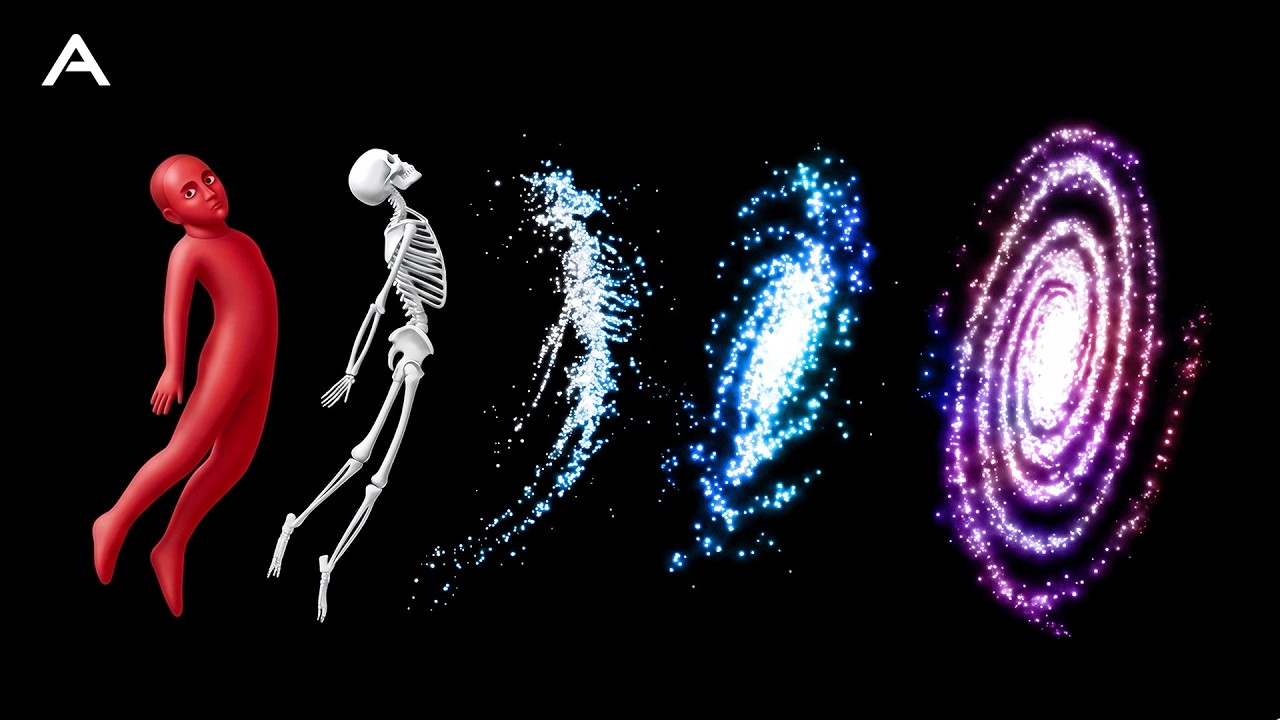
This is a thirty one minute essay from Aperture on a claim that starts as neuroscience and ends as philosophy: you have never once perceived the world. You have only ever perceived your brain's best guess about the world, and that guess is edited before it reaches you, by your biology and by everyone around you.
The film builds it in three layers. First the cultural layer, where perception is warped by other people: the shortcuts the brain takes to survive a firehose of input, the mirror neurons that make yawns and moods and beliefs contagious, and the 1518 dancing plague of Strasbourg, where four hundred people danced in the streets of a real town over a disease that did not exist, and roughly fifteen a day died of it anyway. Then the linguistic layer, from the sophist Gorgias to the modern finding that a German speaker calls a bridge elegant and a Spanish speaker calls the same bridge sturdy, because the two languages assign it different grammatical genders.
Then the biological layer, which is the part no amount of critical thinking can fix. Anil Seth's argument that the eyes send no pictures, only electricity. The measured gap between roughly a billion bits of sensory input per second and the ten bits per second we consciously experience. The saccades that punch holes in vision three to five times a second, and the subconscious that paints over the holes with what it expects to find. And a 1996 perception study whose finding is worse than filling in gaps: the brain will delete real information that it judges too improbable, even when the information is right in front of you.
The last third is what you do with that. The film lands on the self as the final hallucination, on the difference between a perfect simulation and a useful map, and on humility as the only honest response to living inside a model. This page rebuilds the whole essay in order, with every study, thinker, and incident named and linked.
Chapters
0:00 Why Everyone Around You Might Be Hallucinating Too 1:53 Cultural Perception 13:54 Biological Perception 22:07 A Post-Reality World
The question it opens with: where are you right now?
The essay does not begin with a theory. It begins with an instruction.
Where are you right now? Take a look around and take stock of your surroundings. What do you see? The inside of your car on the commute to work, an office cubicle, your bathroom floor, your bedroom ceiling.
Then it asks you to notice how you just described it to yourself. You may have been literal: a wooden wall, the smell of something cooking on a stove, a neighbor's dog barking, a picture frame, a desk, a tangle of cables. Or you may have reached for broader strokes: the interior of your room, a slice of blue sky, the traffic you are stuck in.
However you described it, the narrator points out, you just did something almost nobody thinks twice about. You observed the world outside yourself, you took in that data, and you trusted your mind to build an accurate picture of where you are.
But what if you got it wrong? What if you are not seeing the world as it is at all?
Then comes the thesis, delivered as a description of an antagonist:
What if there is a force that keeps you from experiencing the totality of what is around you. It keeps you blinkered. It narrows your attention to only what it wants you to see. It edits your perception in real time. It colors the world so you fit neatly in with the crowd. It uses half truths, recreations, and outright fabrications. It steers you through life while insisting, every step of the way, that what you are seeing is real.
And the turn at 1:43: you cannot escape it and you cannot outthink it, because it is not working against you from somewhere else. It is a part of you. It is you.
That is the setup. The rest of the film is the case.
Cultural perception: the brain cheats, and the cheat is the machine
The first move is to establish what the brain is actually doing every second you are awake. It does not have the time or the energy to carefully analyze every photon hitting your eyes or every sound wave reaching your ear. So, in the film's word at 2:26, it cheats. It takes shortcuts. It fills gaps with assumptions and decides in advance what is probably true based on what has worked before.
Then the line that reframes the whole thing:
That is not a flaw bolted onto an otherwise perfect machine. That is the machine.
The same shortcut that lets you recognize a friend's face in a crowded room in a fraction of a second, the same set of assumptions that lets you catch a ball without solving a single equation, are the exact mechanisms that can be hijacked, manipulated, or turned against you. The speed is the vulnerability. You cannot have one without the other.
The individual level failure mode is logical fallacies, the ready made shapes we lean on to dodge complicated thoughts or ideas that clash with what we already believe. But the film says it does not stop there. There is social pressure too, the pull to tow the line. We are social animals, and our own brains reward us for falling in step with the group. Psychologists call this groupthink: it is easy to go along with what everyone else believes, and to see what they are seeing, because that is what our brains want to do.
Mirror neurons: the hardware of going along
There are parts of the brain that actively drive this social cohesion, and the film names them at 3:41: mirror neurons, specialized cells first identified in the macaque premotor cortex by Giacomo Rizzolatti's group in Parma, which fire both when you perform an action and when you watch someone else perform it.
If you have ever wondered why yawning is contagious, the film says, you have your culprit. Your mirror neurons compel you to yawn when you see someone else yawn. And the reason contagious yawning exists at all, on this account, is to pass a message through a social group. The message is: things are quiet right now, but we should stay alert. When we yawn we keep our minds sharp at exactly the moment we might otherwise doze off. The comparison the film reaches for is meerkats. If everyone is alert, the whole group is far more likely to detect an incoming threat.
Mirror neurons are also credited with empathy. When someone stubs a toe, we cringe along with them even though our own toe is fine. The brain is stimulating empathy by simulating pain, and that shared experience pulls us closer to the people around us.
And on top of that, mirror neurons underwrite the ability to learn an action just by observing someone else perform it. In infancy we learn an enormous amount about how to relate to the world by watching our parents and other authority figures. It is in exactly this way, the film notes, that behavior is quietly passed down from one generation to the next.
Which sets up the pivot at 5:02: these same mirror neurons can also take us down strange and dark paths.
Before that turn, the film pauses on a related thought that will matter later. If perception itself is this unreliable, human memory is worse. Memory does not just fade. It gets rewritten a little every time you retell it, which is the finding modern neuroscience calls reconsolidation. The narrator admits he deals with this on two levels: the big metaphorical who am I really version, and the much more annoying day to day version of sitting through research calls, brainstorming sessions, and interviews and walking away with a notebook of half finished scribbles. That confession doubles as the handoff into the video's sponsor read for the Plaud Note Pro recorder, and it plants the seed for the essay's own conclusion about the self, twenty minutes later.
Strasbourg, 1518: four hundred people dancing over a disease that did not exist
In 1518, a craze swept the people of Strasbourg, a city that today sits in France. A woman the film calls Frau Troffea, along with her daughter, began to dance in the streets. There was no celebration planned for the day. There was no music playing.
Soon they were joined by others, some dancing with such single minded obsession that only death had the power to stop them. By mid August the affliction had affected up to four hundred people. The dancers moved spasmodically, bodies drenched with sweat. Many collapsed mid dance. Others wore through their shoes and stained the flagstones of their town with bloody footprints.
There are disagreements about the death toll, the film is careful to say, but historians estimate that on average fifteen people a day were dying at the peak of the incident, from hunger or acute heart attacks. Then, by September, it was over. The Strasbourg dancing epidemic came and went and left clergy, physicians, epidemiologists, and historians scratching their heads.
The incident is one of the earlier documented examples of what is now called mass psychogenic illness, an anxiety condition that spreads through tight knit communities. And the film makes the case that Strasbourg in 1518 was primed for it. By that year the city had come through a succession of famines, high grain prices, an outbreak of syphilis, and a recurrence of both leprosy and the plague. The people were, simply put, at their wits end, and tensions were high. With a population permanently in survival mode, mental health declined, and that produced a populace primed for a collective crash.
Stress, suggestibility, and the contagion of mood
The mechanism the film offers is that stress and cognitive load are linked to higher rates of suggestibility. And here it gets specific in a way anyone can check against their own life. If you have ever crammed for exams, or stayed up until the small hours finishing a paper due the same day, you know the feeling: stress starts taking over every part of you until it becomes harder and harder to think properly. Then, bam, you snap at everything and everyone. You stop reasoning through problems and you start taking shortcuts.
And it does not stay inside one skull. Maybe you have noticed that while you are in a stress hole trying to get the last piece of a project done, the people around you start to take on that pressure too. Or maybe you have been the other person, watching a loved one spiral further and further and feeling yourself get stressed just by standing near them. The mood is contagious. Soon enough everyone is having a terrible, terrible time.
Put the two together and Strasbourg stops being a mystery and becomes a mechanism. The people were exposed to extreme stress by their environment. They were neurologically susceptible to suggestion. Because of those two factors, an entire population shared the same collective hallucination: that there was a very real disease ravaging their town, forcing townsfolk to dance without end.
The film's flat statement at 10:17 is the hinge of the whole essay:
To be clear, there was no dancing plague. But for the people living in Strasbourg, it was very real.
Their perceptions and even their health were influenced by this social phantasm. They experienced something as though it were real. They suffered and died of a fake disease that in the moment felt as solid as the ground they were standing on.
The clowns of 2016
Strasbourg was not an isolated case. The film runs the same pattern forward to living memory, all the way up to and including the evil clown panic of 2016. Maybe you remember it too: rumors on the internet about people dressed as clowns attacking strangers in the street.
There may have been some isolated incidents here and there. But the coulrophobia, the fear of clowns, that resulted was everywhere for a time. The narrator's own memory is the best detail in the segment: he had friends warning him, without any sense of irony, to watch out for dangerous clowns. Weird times.
There were not any roving bands of clowns menacing people in the dead of night. But a shared social belief managed to prevail on otherwise rational people that there were clown masked assailants lurking in every corner.
On that note, the film adds a two sided observation about the internet. Technology has done a lot of heavy lifting in demystifying urban legends. At the same time, misinformation and disinformation have both been handed an extraordinarily powerful avenue to spread through a population and warp perception further away from reality.
Gorgias, and the world you can only reach through words
The scary part, as the film frames it, is that these perception warping empathic contagions are not limited to stressed out populations. Our language and our culture have a huge effect on our understanding of the world in ordinary, unremarkable conditions.
The film reaches back to the presocratic sophist Gorgias of Leontini, who argued that the physical world cannot be experienced except through language, and that the truth of existence as we know it is filtered through our sense of aesthetics. Gorgias claimed that only through language could we figure out the physical world at all, which makes the truth of reality a matter of cultural preference, or a functional consequence of our upbringing. His notorious three part argument in On Nature, or On the Non-Existent, which survives only through summaries in Sextus Empiricus, runs that nothing exists, that if anything did exist it could not be known, and that if it could be known it could not be communicated to anyone else. The reason for that third step is exactly the one the film cares about: words carry speech, not things, and every listener decodes them through their own sense experience. Language mediates reality rather than transmitting it.
Language, on this view, forms the bedrock of thought. Your experience of the world is shaped by the words you have access to.
Bridges, plates, and the grammar of blame
Then two concrete examples, both drawn from the research program known as linguistic relativity and most associated in its modern form with Lera Boroditsky.
The first is gender. In German, a bridge can be beautiful or elegant, because the German word for bridge, Brücke, is grammatically feminine. In Spanish the word for bridge, puente, is grammatically masculine, and so bridges tend to be described with masculine coded words: strong, sturdy, imposing. Same object. Same steel and stone. Two populations reaching for different adjectives, because the article in front of the noun has been quietly steering them since childhood.
The second is grammar, and it cuts deeper. When someone you know walks into an antique store and accidentally breaks a plate, an English speaker says: so and so broke a plate. In Japanese, you would say: the plate broke. This one has been tested directly. Fausey, Long, Inamori and Boroditsky ran English, Spanish, and Japanese speakers through accidental and intentional events and found the non agentive languages produced measurably different memory for who did it and different judgments about who should pay.
Notice, the film says, how one linguistic structure creates guilt even though the event was an accident, while the other simply recounts what happened without accusation. Two speakers watch the identical event and walk away with different facts about who is responsible.
The conclusion at 13:35 is blunt. Language determines your thought patterns by creating or removing avenues for you to interpret your experiences. Your thoughts and feelings themselves are limited by the words available to you.
Biological perception: the part you cannot think your way out of
The film draws a line under the first half and then erases the comfort of it. Culture, language, and social environment shape our hallucination of reality, yes. But with strong critical thinking skills, or weaker mirror neurons, we can decode and navigate situations that would otherwise have us throwing our lot in with the mob, dancing in the streets of Strasbourg, or checking under the bed for killer clowns.
Then, at 14:24: there is something no amount of rationality and no amount of reality checking can solve. Our physical brains are far more capable of leading us astray than any crowd is.
Anil Seth: the eyes send no pictures
The authority for the second half is Anil Seth, the British neuroscientist and professor of cognitive and computational neuroscience at the University of Sussex, who has spent his career mapping the processes that drive our brains and shape our perceptions, and who popularized the phrase the film is built around in his TED talk and his book Being You.
Seth's claim, as the film puts it at 15:05, is that the brain is not experiencing reality but interpreting it, and it holds up to scrutiny for a reason that is embarrassingly physical. Your eyes are not sending images to your brain. They are absorbing light using photoreceptors, which send electrical signals to the brain, which decodes that information, and only then do you see.
It is the same with every sense. We experience the world only insofar as our sensory organs are translating inputs into electricity that the brain then has to interpret.
The film makes the point structurally. Our brains are complex biological machines, and a delicate web of sensory devices lets them build a picture of the world. Sight, taste, hearing, touch, each one letting us navigate our surroundings with confidence. But the sensory organs, the eyes, the ears, the nose, the tongue, the mechanoreceptors, are not the brain. They are relay nodes. They take outside inputs and translate them into signals fed into the brain, and the brain does every bit of the heavy lifting from there, turning those signals into conscious experience.
The street lamp you did not see
Then a question, at 16:20. Have you ever been so absorbed in something that you lost track of your surroundings?
Odds are you have. It is a common enough human experience. Maybe you were walking down the street on your phone and at the last second swerved out of the way of a street lamp on the sidewalk. Or, let us be honest, you might have smacked straight into it. The narrator admits he does it more than he would like to admit. Afterwards you are either chewing yourself out for not being attentive enough or nursing an aching bump on your head.
But you, in the moment, were so absorbed in what you were doing that you could not see the pole. You only have enough attention to focus on so many things at once.
Just where is that limit?
One billion in, ten out
Here the film puts a number on it, and it is the number the whole second half turns on. According to a study by Jieyu Zheng and Markus Meister at Caltech, published as The Unbearable Slowness of Being, our brains take in a staggering one billion bits of information per second. That is everything encountered with all the senses at once: the sensation of sitting, of breathing, of seeing and hearing.
Of that one billion bits per second, we only consciously feel reality at ten bits per second.
So of the billion bits taken in, we experience ten, leaving something on the order of nine hundred and ninety nine million, nine hundred and ninety nine thousand, nine hundred and ninety bits that we are simply unaware of, every second of every day.
Where does it all go? If we really felt all of that input, the film says, we would be a mess. Constant overstimulation, all the time. We would not get anything done. But it is not as though the data disappears. One theory about where the staggering mass of it goes is that it is shuffled into the subconscious to be figured out later, which is the point where the film gestures at its own video on dreams and the subconscious.
The question the narrator is left with, at 18:35, is the good one. If we only feel a vanishingly small fraction of what our brains collect, what makes one piece of information more important than another? And how much of the world do we actually see, if so much of it is locked away where we cannot reach it?
Saccades and the Swiss cheese face
Then the film moves to the eyes themselves, and this is where the argument stops being about bandwidth and starts being about fabrication.
When you look at something, you feel as though your eyes are still. They are fixed on whatever you are looking at. But your eyes are moving the entire time. While you softly focus on the world around you, your eyes are twitching back and forth in rapid movements called saccades. These micro movements are hard to catch, but they drag the fovea over the key aspects of whatever you are looking at, three to five times a second, and it is thanks to them that you see in as much detail as you do.
But there is always a catch. Since focus is spread over three to five points every second, the information arriving in the occipital lobe is actually full of holes. Vision is also actively suppressed during the movement itself, an effect known as saccadic masking, so a real fraction of your waking visual life is simply missing.
That is not what you see. As the narrator puts it at 20:00, odds are that while you are watching this video, his face does not look like Swiss cheese. And if it ever does, please tell him. There is a good chance that what you are seeing is his entire face, a couch, some shelves. What you are not seeing are the gaps in your own vision.
Why don't you notice them?
According to Seth and many other neuroscientists, the subconscious fills the holes in perception with what it thinks should go in those spaces. This is the process vision science calls filling in, and the crucial detail is what it does not do. It does not take the time to assemble the full picture before feeding it back to you. It is not working harder to pull in extra information to cover the gaps.
It is guessing what lives in those empty spaces based on what it expects to see.
The film repeats it, because it is the hinge:
Our minds are seeing a fragment of a picture and then painting the rest in in real time. Then we experience that image and call it objective experience.
Your brain is hallucinating reality to fill in the gaps.
The 1996 study: the brain deletes what it finds implausible
And then it goes one step past filling in, to something worse. There is further information, the film says, suggesting that what the brain is imagining may not even resemble the outside world.
In 1996, a study on perception by Ilona Kovács and colleagues concluded that while we do take in all the details of an image we are looking at, our brains erase information they judge to be too improbable, even when that information is staring us right in the face. Kovács ran the experiment on binocular rivalry: each eye was shown a scrambled patchwork of two different pictures, and rather than reporting the patchwork, subjects reported seeing one coherent image, because the visual system had reassembled the plausible picture across both eyes and discarded the pieces that did not fit.
So the reality that we see, the film concludes at 21:43, is less empirical and more run on vibes than anything else. Shown to us because it makes sense to our subconscious, or discarded if it does not. Our brains have the capacity not only to fill in the blanks, but to omit or alter inputs that do not conform with their own internal logic.
A post-reality world
The final act starts by giving perception its due, which is the reason the essay does not read as nihilism.
Everything we are is built on perception. Without it we would be barely functional automata with no senses, our worlds confined to the space inside our heads with no language to interpret what little life goes on in our closed off minds. But our senses have helped us model the world and pierce the veil of ignorance. We have puzzled out rudimentary physics, time, mechanics, engineering. We have lifted ourselves from simple survival to empire building on a scale unmatched by any other life on this planet. And we did all of it on the back of the rules of reality that our senses relayed to us.
Then the turn at 22:59:
In spite of these soaring accomplishments, we are no more aware of reality than we ever have been.
Everything we take for granted is gated by the limits of our cognition and then shackled further by the filters of our language and our culture. Our confidence in the world around us is built on such a small amount of information that our grasp on reality looks less like a mighty fortress and more like a house of cards built on a shaky foundation.
We do not see the world as it is. We see how it looks after being filtered through our language, our culture, and our subconscious.
Plato's cave, restated in neurons
To some philosophical traditions focused on the nature of truth and our relationship to it, the film says, this looks like a death sentence. Our own biology hamstrings us from the very beginning, dooming us to a life where we cannot escape Plato's cave. It challenges our beloved ideas of truth, perception, identity, free will, and interpersonal understanding.
And the specific reason it is worse than the cave is the word the film chooses next. How well can we rely on our own knowledge when we understand that reality is not simply being reinterpreted in our minds, but that our minds are showing us the world based on a prediction of what they expect to see? Not what they are seeing. Not even a close guess. A prediction based on the brain's assumption of what makes sense, which is exactly the model of the brain that cognitive science calls predictive processing.
Plato's prisoners at least saw shadows cast by something real. On this account you are watching a rendering, and the renderer is optimizing for plausibility.
Nothing out there smells like anything
We assume perception is one to one with reality. But the more we learn about the brain, the less likely it seems that the assumption holds. We hear sounds, feel textures, smell aromas, and experience a myriad of sensations, and none of those experiences reflect the real world. They reflect an illusion created by the subconscious to improve our survival.
The example the film uses is the cleanest in the essay. Your favorite food smells and tastes delicious because your mind connects that food to the sustenance you need to stay alive. Garbage, waste, rotting food, and sewage translate in your mind to something revolting, because avoiding contact with those things improves your odds of avoiding illness.
Our perceptive models did not evolve to display reality as it really is. They evolved just far enough to give us exactly the right information to ensure continued survival, which is the same conclusion the cognitive scientist Donald Hoffman reaches from evolutionary game theory when he argues that fitness beats truth.
And then the sentence that lands hardest:
In the reality that lives outside of our perception, these things do not inherently smell good or bad. They do not even have a smell, per se.
The rot is not disgusting. The rot is molecules. The disgust is yours, manufactured, and manufactured for a reason that has nothing to do with truth.
The self is the last hallucination
If our brains are continuously generating reality instead of merely receiving it, then our relationship with the world is far more uncertain than common sense suggests. And that calls into doubt something closer to home than bridges and plates: identity, and the self.
Most people experience themselves as individuals existing independently of their sense of understanding. The belief is that you are the one wielding and shaping your understanding, not the other way around. You, the person, are doing the observing.
Yet neuroscience increasingly suggests the self is itself a construction, a self portrait produced by the senses turning inward. And by now we know how shaky that idea is. Your memories are not static, forever etched exactly as they were into the bedrock of your gray matter. Time, distance, and even your current emotional state alter them. If your image of you is based on your memories and your senses, then it gets harder and harder to justify that there is a concrete you to begin with.
So, at 27:07, the self becomes another controlled hallucination.
It is a concept your brain created out of your memories. A very useful structure, the film is careful to grant, one that enables coherent action and interaction with social groups. But usefulness does not make it real. A sense of self is an evolutionary boon, and perhaps that is all it is. It may not correspond to any fixed, essential essence of you.
Any sense of you is the result of a narrative constructed from a continuity of memories. Which produces the essay's best formulation, and the one that earns the whole detour into memory back at the five minute mark:
You are less so you, the entity, and more so you, the story.
And as with any story, there is always room for reinterpretation and retelling. But as these stories are retold, they begin to shift and morph like a photocopy of a photocopy. The story of you changes with each retelling. This is very close to what psychologists call narrative identity, and not far from David Hume's much older bundle theory, which held that when he looked inside for a self he only ever found perceptions.
| The question | What common sense assumes | What the film argues instead |
|---|---|---|
| What the eyes do | Send pictures of the world to the brain. | reversed Absorb light with photoreceptors and send electricity. The image is built downstream, in the occipital lobe. |
| How much you take in | Roughly what is in front of you. | reversed Ten bits a second out of a billion. Everything else is discarded or shelved in the subconscious. |
| The gaps in vision | There are no gaps. You see a continuous scene. | reversed Saccades punch holes three to five times a second and the brain paints over them with expectation. |
| Improbable input | Surprising things stand out most of all. | reversed Kovács 1996: input the brain judges implausible can be erased outright, even when it is right in front of you. |
| Smells, tastes, colors | Properties that belong to objects. | reversed Verdicts your brain assigns for survival. Outside perception, sewage has no smell at all. |
| Language | A neutral container you pour thoughts into. | reversed A filter that opens and closes avenues of interpretation, down to whether an accident produces guilt. |
| The self | A fixed observer sitting behind your eyes. | reversed A story assembled from memories that rewrite themselves on each retelling. |
| What follows from all this | Nothing can be trusted. | the film disagrees The model is constrained by reality. Not a perfect simulation, but a usable map. |
Liberating, and deeply unsettling
The film sits with the emotional weight of this instead of racing past it. It can be both incredibly liberating and deeply unsettling, and it names why. We do not enjoy having our sense of self called into question. We fear death because it is, at its core, the end of the experience of us.
But if identity is as wobbly as neuroscience suggests, then we are handed an incredible opportunity to transform and reimagine ourselves. We are not trapped by some immutable inner self. We are capable of growth, change, and even wholesale reimagination of our core identity.
The map is still useful
Then the first of two closing arguments, and the reason this essay does not end where a lesser one would.
Accepting the limitations of our senses, the narrator says at 28:48, should not lead to radical skepticism. Our brains evolved to make sense of an overwhelming amount of data and to prioritize survival and our ability to navigate our surroundings successfully. Even if the models the brain generates do not reflect reality, at the very least those models seem to be constrained by reality.
It becomes less a perfect simulation and more like a map. We lose confidence in the fine details, but the layout is still useful as a guide.
That is a real philosophical position stated in one sentence. The map is not the territory, but a map that gets you home was drawn by someone who had been to the territory.
Humility, and the case for grace
The second closing argument is the one the narrator says matters most to him, and it converts an epistemology into an ethic.
What this teaches us is humility. All of us are working with different pieces of the same puzzle. If our experience is a model instead of a true observation, then any kind of certainty becomes impossible to justify.
We assume that what we are seeing, hearing, and believing is the way things really are. And yet different cultures and different individuals all experience the world differently. What comes off as self evident to you may be invisible to someone else.
And that insight, the film argues, can foster empathy. When we accept that other people genuinely experience the world differently than we do, disagreement becomes less a matter of ignorance or malice and more a natural result of multiple individuals holding different mental models. The realization that perception is interpreted on the fly rather than delivered objectively should encourage both patience in our interactions with others and openness about our own experience.
Recognizing the constructed nature of perception reminds all of us that our understanding will never be perfect. We will never see the full picture. The same grace you would, and should, extend to yourself for operating with less than perfect information should absolutely be extended to others.
The last line, at 30:53:
Anyone who claims that they have the world figured out is fooling themselves.
The film then points the viewer at its companion video on quantum mechanics and the conscious mind, and ends.
Best quotes
- 1:43 "You can't escape it. You can't outthink it, because it isn't working against you from somewhere else. It's a part of you. It is you."
- 2:43 "That's not a flaw bolted onto an otherwise perfect machine. That is the machine."
- 10:17 "To be clear, there was no dancing plague. But for the people living in Strasbourg, it was very real."
- 10:36 "They suffered and died of a fake disease that in the moment felt as real as the ground they were standing on."
- 11:23 "There weren't any roving bands of clowns menacing people in the dead of night, but a shared social belief had managed to prevail on otherwise rational people that there were clown masked assailants lurking in every corner."
- 13:30 "In Japanese you would say, the plate broke. Notice how one linguistic structure creates guilt even though it was an accident, and the other simply recounts events without accusation."
- 20:00 "Odds are as you're watching this video, my face doesn't look like Swiss cheese. But if it ever does, please tell me."
- 20:51 "It is guessing what lives in those empty spaces based on what it expects to see."
- 21:01 "Our minds are seeing a fragment of a picture and then painting the rest in in real time. Then we experience that image and call it objective experience."
- 21:43 "So the reality that we see is less empirical and more run on vibes than anything else."
- 23:21 "Our grasp on reality looks less like a mighty fortress and more like a house of cards built on a shaky foundation."
- 25:05 "In the reality that lives outside of our perception, these things don't inherently smell good or bad. They don't even have a smell, per se."
- 27:07 "So the self becomes another controlled hallucination."
- 27:40 "You are less so you, the entity, and more so you, the story."
- 27:55 "As these stories are retold, they begin to shift and morph like a photocopy of a photocopy."
- 29:15 "It becomes less a perfect simulation and more like a map. We lose confidence in the fine details, but the layout is still useful as a guide."
- 29:38 "If our experience is a model instead of true observation, then any kind of certainty becomes impossible to justify."
- 30:53 "Anyone who claims that they have the world figured out is fooling themselves."
Where it stands
The spine of this essay is mainstream neuroscience, not a fringe position, and it is worth being clear about which parts are load bearing.
Well established: the eyes transduce light into electrical signals and the brain constructs the visual scene; saccadic masking really does suppress vision for the twenty to one hundred milliseconds of each eye movement, and it starts before the eye does, which means it is triggered centrally rather than caused by retinal blur; filling in is a demonstrable phenomenon you can prove on yourself with a blind spot test in thirty seconds; predictive processing is the dominant computational framework in perception research; and Anil Seth's "controlled hallucination" is his own phrase, defended at length in Being You. The one number to soften is the saccade rate. Three to five a second is a defensible rounded figure for reading, but during ordinary visual exploration the standard estimate is closer to two or three.
The dancing plague of 1518 is a documented historical event, and the start date is precise: 14 July 1518. Frau Troffea is named in four of the six surviving chronicles. Two details in the film are weaker than they sound. The peak headcount is reported across sources as anywhere from fifty to four hundred, and the fifteen deaths a day figure has no contemporary Strasbourg record behind it at all. It traces to the historian John Waller's synthesis of later chronicles, which the film half acknowledges when it says there are disagreements about the death toll. The episode ended after the authorities reversed course, banned public dancing, stopped the music, and sent the afflicted to the shrine of Saint Vitus. A competing explanation involving ergotism has never been fully ruled out, though most historians now favor the mass psychogenic illness reading the film uses.
Worth a footnote on the bandwidth numbers. Zheng and Meister are real, the paper ran in Neuron in December 2024, and both figures the film quotes are accurately theirs. But the paper is a Perspective piece framed as an open puzzle for cognitive scientists rather than a settled measurement, and the billion bits per second is an order of magnitude estimate of raw receptor throughput, not something anyone has metered. The film also gives the surviving fraction as 0.00001 percent, which is one order of magnitude off. Ten bits out of a billion is 0.000001 percent. The point survives the arithmetic intact.
Softer ground: the mirror neuron story. Mirror neurons are real, found by Rizzolatti's lab in area F5 of the macaque premotor cortex and first reported in 1992. But the leap from there to empathy, contagious yawning, cultural transmission, and groupthink is a popular science synthesis that a good number of researchers, Gregory Hickok most prominently, have argued is badly overextended. The contagious yawning link specifically is contested: imaging studies disagree about whether mirror regions activate at all during it, and yawn contagion does not reliably track empathy scores. The film also treats "weaker mirror neurons" as a dial on social susceptibility, which no evidence supports.
Likewise linguistic relativity. The bridge finding is from Boroditsky, Schmidt and Phillips, and it was published as a book chapter rather than a peer reviewed article, with mixed results on later replication. The agency finding is real and better supported, and the film's Japanese example is the right one: Fausey, Long, Inamori and Boroditsky compared English, Spanish, and Japanese blame judgments directly. But what these studies show are measurable nudges in description and memory, not the strong claim that "your thoughts and feelings are limited by the words available to you." The strong Sapir Whorf version has been out of favor for fifty years.
The 1996 study deserves the sharpest caveat of all. Kovács et al. is a genuine and elegant binocular rivalry result: it showed that when each eye receives a patchwork of two mixed images, perception reorganizes around global pattern coherence rather than which eye a fragment arrived in. That is a real demonstration that the visual system assembles a coherent percept out of incoherent input. It is not a demonstration that the brain "erases information it judges too improbable" during ordinary viewing, and the paper makes no such claim. The film's framing is the strongest version of a much narrower finding.
And on the philosophy: the move from "perception is constructed" to "there is no concrete you" is a jump, not a deduction. A constructed self can still be a real self, in the same way a hurricane is a real hurricane despite being nothing but a pattern in moving air. The film's own landing, that the model is constrained by reality and therefore usable as a map, is the more defensible position and the one it actually argues for. The last third of this video is better philosophy than the middle third is science, and the closing turn toward humility is the part most likely to still be true in fifty years.
Resources
- Aperture, the channel, and the original video, The terrifying shared hallucination theory nobody wants to be true. Also on Patreon and Discord.
- Anil Seth, professor of cognitive and computational neuroscience at the University of Sussex, his TED talk Your brain hallucinates your conscious reality, and his book Being You: A New Science of Consciousness.
- Jieyu Zheng and Markus Meister, The Unbearable Slowness of Being: Why Do We Live at 10 Bits/s?, the source of the billion in, ten out figure. Published in Neuron, December 2024; free preprint on arXiv.
- Ilona Kovács, Thomas Papathomas, Ming Yang and Ákos Fehér (1996), When the brain changes its mind: Interocular grouping during binocular rivalry, PNAS 93(26), the 1996 perception study. Also on PubMed.
- The dancing plague of 1518 in Strasbourg, and the diagnosis of mass psychogenic illness.
- The 2016 clown sightings and coulrophobia.
- Gorgias of Leontini, his Internet Encyclopedia of Philosophy entry, and the sophists in the Stanford Encyclopedia of Philosophy.
- Linguistic relativity, the work of Lera Boroditsky on grammatical gender, and Fausey, Long, Inamori and Boroditsky (2010) on agency in English, Spanish, and Japanese, the study behind the broken plate example.
- Mirror neurons, discovered by Giacomo Rizzolatti's group in Parma, yawning and its contagion, and groupthink.
- Saccades, saccadic masking, filling in, the blind spot, and the occipital lobe.
- Predictive coding, the computational framework behind the brain as a prediction engine.
- Plato's allegory of the cave, the oldest version of the argument.
- Donald Hoffman, whose interface theory of perception reaches the same conclusion from evolutionary game theory.
- Narrative identity, David Hume, and bundle theory, the philosophical lineage behind "you, the story".
- Memory reconsolidation, why a memory changes a little every time you retell it.
- Gregory Hickok, the most prominent critic of the broad mirror neuron story, and ergotism, the competing explanation for Strasbourg.
- Sextus Empiricus, through whom Gorgias's argument survives at all.
- Aperture's companion videos the film points at: The Quantum Theory of Dreams and Consciousness and Quantum Consciousness Theory.
- Plaud Note Pro, the recorder the video's sponsor segment covers.