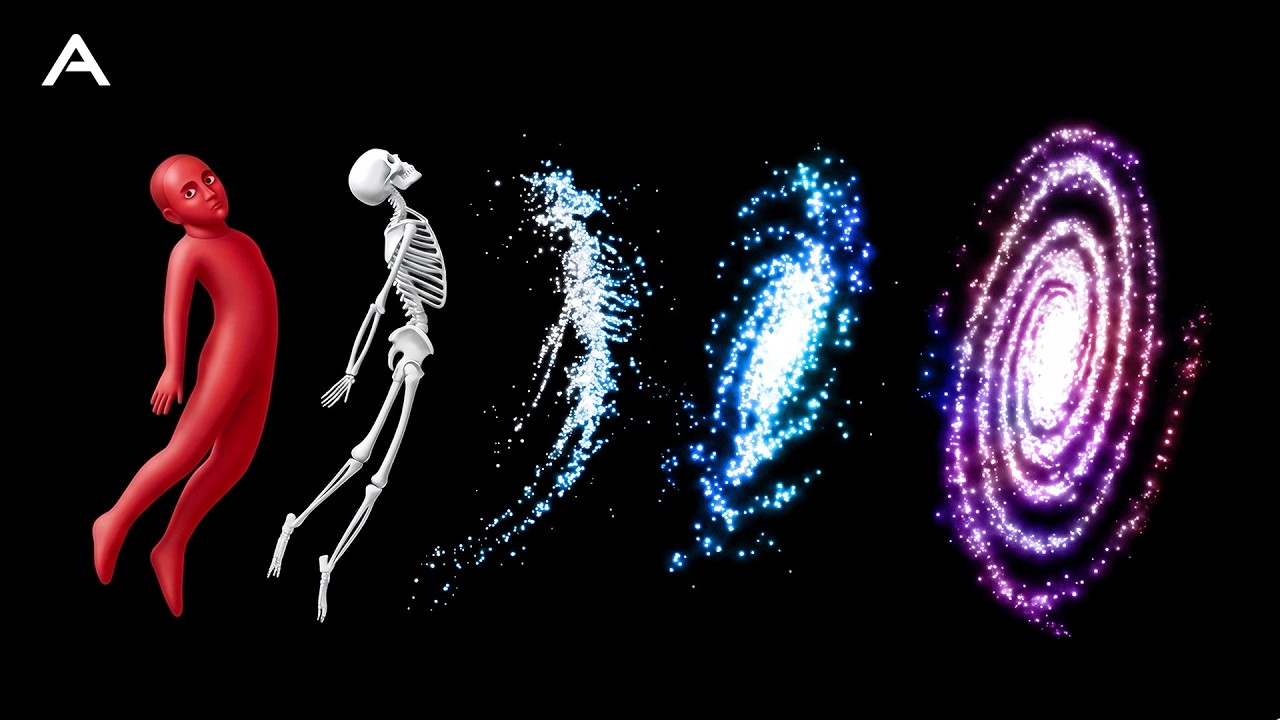
At a glance
On 13 June 2026, at the Lighthouse Campus in Los Angeles, Donald Hoffman and Andrew Gallimore sat down in front of a live audience to answer one question with mathematics attached: are the entities people meet under DMT traces of conscious agents that are always there and normally imperceptible? Hoffman is Professor Emeritus of cognitive science at UC Irvine, author of The Case Against Reality, and the founder and scientific director of the Trace Institute. Gallimore is a neurobiologist and chemical pharmacologist at the Okinawa Institute of Science and Technology, co inventor with Rick Strassman of the extended state DMT protocol known as DMTx, and the author of Alien Information Theory, Reality Switch Technologies and Death by Astonishment. Charles Yokoyama, a Trace Institute researcher and former Senior Scientific Editor of Neuron, moderates.
The conversation is the public debut of the Trace Institute Collaboration Program, developed with Noonautics, and it sits on top of a real preprint: Traces of the Other: DMT Phenomenology in the Framework of Conscious Realism, by Gallimore, Hoffman and the mathematician Niffe Hermansson. The two men arrive at the same destination from genuinely different directions and neither pretends otherwise. Hoffman comes from formal mathematics: Markov chains, traces, a non Boolean logic of observers, an attempt to derive spacetime rather than assume it. Gallimore comes from receptor pharmacology and brain dynamics: what a molecule does to a network, how long it stays there, and how you hold someone in that state long enough to run an experiment.
What happens in the middle is the interesting part. Gallimore had a model of the DMT state (a world space, a consensus reality basin, DMT pushing you out of the basin) that could describe where you go but not who you meet. Hoffman had a formalism (conscious agents, an experience space, a qualia kernel that factors into decision, action and perception) that could describe who is out there but had never been pointed at a molecule. When Gallimore and Hermansson pushed Hoffman's perception kernel, the entire phenomenology of DMT came out the other side: alien geometry, impossible topology, dimensions past three, and agentic beings that are not human and not animal. Gallimore's word for it is that it "fell out of the mathematics." Hoffman's is that it "fits like a glove."
The back half is where it gets sharp, because both men keep trying to break their own idea. Hoffman tells the story of the swami who scored exactly zero in his lab across every trial, and then says the mathematics of the last three months told him discarnate cognition is not the exception but the norm, and that he has been losing sleep over it. Gallimore lays out DMTx, the target controlled infusion protocol that turns a five minute trip into an open ended dive, and the two classes of experiment it makes possible: ontological tests for shared correlation between isolated subjects, and structural mapping by sending trained mathematicians, topologists, linguists and geometers into the space with specific assignments. An audience member lands the best objection of the night. Your own auditory hair cells do Fourier transforms in milliseconds, so why does a hard computation performed fast prove you are talking to a separate agent at all?
Chapters
Timestamps are clickable. Click one and the embedded player jumps there and keeps playing while you read. The video ships without creator chapters, so this map was built from transcript position.
- 0:07 Charles Yokoyama opens: shamans, DMT, and the pushback against "just hallucination"
- 2:01 The panel: a cognitive scientist and a pharmacologist
- 2:56 Hoffman's origin: a minister's son asking "are we just machines"
- 4:48 The observer is missing from science
- 7:03 Gallimore's origin: a magazine, Terence McKenna, and the wrong molecule
- 9:54 The first breakthrough: "unenglishable"
- 11:19 What DMT is not
- 12:17 How the two found each other
- 13:13 Gallimore the idealist, not the reductionist
- 15:56 Hoffman: the math told me I am making it all up
- 17:26 Three months of getting slapped in the face
- 18:26 If you want to see agents, smoke some DMT
- 19:23 The empirical opening: more than three dimensions
- 20:19 You hallucinate the third dimension already
- 21:42 An unbounded number of imperceptible agents
- 23:04 Beings that are impossible, not merely exotic
- 24:28 The problem physicalism could not solve
- 26:23 Spacetime as a virtual reality headset
- 27:49 We have one of the dumbest headsets available
- 28:17 "I do not have any neurons right now"
- 29:14 Change one number: three dimensions to five, or ten
- 30:39 The world space and the consensus reality basin
- 34:32 The experience space and the qualia kernel
- 36:27 Decision, action, perception: the three sub kernels
- 37:24 Why imperceptible agents become perceptible
- 38:21 What that would actually be like
- 39:46 The DMT phenomenology falls out of the mathematics
- 40:48 What a trace actually is
- 41:41 Markov chains since 1905, and a logic nobody had noticed
- 42:38 A logic of zero surprise, and Karl Friston
- 43:33 Recursion: observation to intelligence to agency
- 44:29 Where time dilation comes from: a counter that ticks slower
- 45:52 The two year program: Minkowski space, curvature, quantum field theory
- 46:20 Once you know the software, you can do miracles
- 47:45 Not smarter, differently situated
- 49:34 The amplituhedron analogy
- 50:30 Why we cannot represent them
- 51:25 Are DMT entities real? The state of the debate
- 52:24 Coherent, not noise
- 54:17 Living versus non living is not a principled distinction
- 56:41 "My headset gave up"
- 57:09 Screwing up the render, or upgrading it
- 58:37 Agentic versus non agentic dynamics
- 59:32 Hallucination versus veridical, and why correlations still matter
- 1:00:54 DMTx: the pharmacology of the extended state
- 1:02:20 Target controlled infusion, borrowed from anaesthesiology
- 1:02:47 From scuba diving to deep sea diving
- 1:03:15 Experiment class one: the deposited number
- 1:04:14 Experiment class two: send in a topologist
- 1:05:11 Andrés Gómez Emilsson and mapping the manifold
- 1:06:04 The feedback loop between experiment and model
- 1:07:26 The four colour theorem, done in a fraction of a second
- 1:09:19 A test for capabilities beyond the human brain
- 1:09:46 What the experiments do to the theory
- 1:10:43 Telekinesis, and the math that said "it is the norm"
- 1:11:37 The nose argument: embodiment is measure zero
- 1:12:31 Losing sleep over your own mathematics
- 1:13:00 The swami who scored zero
- 1:14:20 The fine line every scientist walks
- 1:14:48 A mindsight class, and the one white raven
- 1:16:12 Closing: the most democratic psychedelic on the planet
- 1:17:35 An apology to the shamans
- 1:18:32 Question one: how do you tell an agent from a sub agent
- 1:20:23 There is no clean self and other boundary
- 1:21:18 Not one mic drop experiment, a suite
- 1:22:41 Is the DMT space a communication channel
- 1:23:09 Question two: the asymptotic zero and the moment of observation
- 1:25:27 The self refutation objection, and what science actually assumes
- 1:27:20 Great theories find their own failure conditions
- 1:29:16 Non Boolean logic, Boolean sublogics, and Leibniz
- 1:31:05 Why scientists can compare data at all
- 1:31:33 Question three: NDEs, remote viewers, and designing for serendipity
- 1:33:31 The uncharted rainforest
- 1:34:31 Decoding the symbols
- 1:36:01 DMTx validated at Imperial College London, and subject zero
- 1:36:59 Interdimensional citizens
- 1:37:29 The money
- 1:39:27 Closing, and Eleusis
The opening frame (0:07)
Yokoyama sets the table in about ninety seconds, and he sets it deliberately.
Throughout the history of humankind, shamans of indigenous cultures have accessed altered states of reality with the help of endogenous and natural substances, explored those spaces, and brought insights back to their tribes. More recently science identified one of the mediators of those experiences: N,N dimethyltryptamine, DMT. A new generation of explorers has gone into that space and come back reporting the same two things, over and over: kaleidoscopic geometries, and intelligent, autonomous entities.
Modern science, he says, calls those merely hallucinations, not worthy of study, just chaotic brain activity. And then the pivot:
"But a small proportion of scientists are now pushing back saying not so fast. We need to study this and we're going to do it. We should study it with mathematical precision and scientific rigor." (1:31)
That is the whole event in one sentence. The claim is not that the elves are real. The claim is that the question is empirically tractable and that nobody has bothered to make it so.
He introduces the two men (2:01). On the far side, Dr Donald Hoffman, Professor Emeritus at UC Irvine, co founder and scientific director of the Trace Institute, author of The Case Against Reality. Next to him, Dr Andrew Gallimore, neuroscientist and computational pharmacologist affiliated with the Okinawa Institute of Science and Technology, co director of Noonautics, author of Death by Astonishment.
Hoffman's origin: are people just machines (2:56)
Yokoyama asks Hoffman for the origin story, teasing that Hoffman has been developing theories of reality and consciousness "since the dawn of history." Hoffman's answer starts at a pulpit.
His father was a minister in a fundamentalist Christian church. On Sundays he got one story about the world. In his science classes he got a completely different one. By his teens he decided he had to figure it out himself, and the way to do that was to pick one clean, technical question.
"And my question was, are we just machines? Are people just machines? Nice clean technical question." (3:32)
The method he chose was symmetrical: study psychology and neuroscience on one side, artificial intelligence on the other, and see where the two accounts fail to meet. That took him to MIT, where he worked in the AI Lab and in the Brain and Cognitive Sciences department at the same time. He was inside both camps at once, asking what machines could and could not do.
Trying to build a mathematical model of that led him to a prior question. What do we actually mean by observation? So he began to build a mathematical model of observation, and that model eventually became the notion of conscious agents that the Trace Institute works on now. He has been on this since he was a teenager.
The observer is missing from science (4:48)
Yokoyama asks him to say more about the missing observer, and this is the section that matters whether or not you care about consciousness at all. Hoffman is careful to say so explicitly.
The argument runs like this. All of our data come from observations. The reason we think science is objective is that different observers compare data and check whether they agree, which requires communication between observers. Careful observation is the foundation of science. And yet:
"What's remarkable is we do not have a generally accepted model of observation in science right now. It's a really remarkable fact." (4:57)
He walks the history. In Newton, you did not need one, because the observer did not affect anything. In Einstein, we started talking about observers because there are clocks and clocks change, but no model of the observer came out of it. Then in quantum mechanics the observer became front and centre through the measurement problem, which is now a century old and has no universally accepted solution. His summary: "It's a big big mess."
So science, our best way of understanding the world, is built on observers and has no theory of the observer. And the standard research move, Hoffman says, is to shoehorn the observer into spacetime: a quantum description of observers, or a physical description, or observers emerging from physical systems. His objection is that this fights the physics.
"But our best science is telling us that spacetime is not fundamental. We have to go outside of spacetime. So already we're going outside of spacetime." (5:55)
He cites a concrete data point for that claim: the European Research Council has a ten million euro initiative dedicated to finding structures entirely outside spacetime. If the frontier of physics is already reaching past spacetime, then jamming observers back into spacetime is ignoring what the physics is saying.
The Trace Institute programme follows from that. Build a mathematical model of observers qua observers, not shoehorned into spacetime, and then run the derivation the other way: build spacetime, quantum mechanics and relativity out of observers.
"But whether you believe in consciousness or not, the goal of having a mathematical model of observers and booting up science with that model is critical for anybody who believes or doesn't believe in consciousness. I am thinking about it in conscious terms, but the mathematics doesn't care." (6:47)
Gallimore's origin: a magazine and the wrong molecule (7:03)
Yokoyama turns to the other angle. Gallimore has been researching DMT for over twenty years. What started it?
Same age, different door. Gallimore got interested in altered states as a teenager. He still remembers the specific morning. He was fifteen or sixteen. A friend brought a magazine to school and said there was an article on the back he would be interested in. On the back was a photo of a bearded fellow named Terence McKenna, and an interview. One of the later questions was about McKenna's favourite drug, and McKenna started talking about a thing called DMT.
Gallimore had no idea what that meant. He went to the public library and looked it up, and the answer he got back was dimethyl terephthalate, which is a precursor for a type of plastic.
"So that was, I didn't try to smoke that fortunately." (8:26)
This was the dawn of the internet. There was exactly one internet connection at the school, and you had to get a password from a man in a white coat to use it. He got the password. He is fairly sure he was the only person in the school who ever used that connection, and he was on it constantly, trying to learn everything he could about a molecule that would apparently transport you out of the normal waking world into one that bore no relationship to it. A world that was infinitely more complex and dynamical, with strange geometries and topologies, and populated.
"A world that was filled with beings with whom you could interact and communicate. Beings that were not human, they were not animal. They were entirely other, entirely alien." (9:05)
He is honest that he did not necessarily believe it. But he made a decision on the spot that shaped the rest of his life: he dropped the subjects he was studying and picked up chemistry, biology and mathematics, because his future was now going to be studying how these molecules interface with the human brain to produce these effects on human consciousness. That was roughly thirty years ago.
"Unenglishable" (9:54)
He finally took DMT a few years after that. He had read all the McKenna books and listened to all the lectures. He thought he knew what he was getting into.
"And I was completely lost. I was at sea. I was completely confounded by this experience. It was, as Terence McKenna says, it was unenglishable. It was impossible. It was not possible for this experience to have occurred to me. And yet it did." (10:21)
That cemented the trajectory. Not psychedelics broadly. DMT specifically. He wanted to know how the molecule achieves its effects, and whether we are really interacting with some kind of intelligent other, which he chooses as the most neutral term available. Intelligent agent is the phrase he has used in more recent years.
What DMT is not (11:19)
He is disarmingly modest about where he has got to.
"I don't think I'm there in being able to explain DMT, but I think I've made some progress in telling people what DMT is not." (11:11)
Most of his time is spent arguing against explanations rather than for one. It is not mere hallucination. It is not simply the brain on drugs. It is not neural noise. Then he produces the phrase that gets the biggest laugh of the night, a euphemism he has heard neuroscientists use for entity encounters:
"Hallucinatory social events is my favourite term for entity interactions. I always say if that's a social event, I'd like to see the kind of parties that neuroscientists frequent." (11:40)
His position, stated plainly: DMT represents a true mystery, science cannot easily explain it, and we should take seriously the possibility that we are interacting with some kind of intelligent agent, some kind of conscious agent.
How the two lines crossed (12:17)
Yokoyama points out the obvious: a cognitive scientist and mathematician on one side, a pharmacologist and neurobiologist on the other, is not an intuitive pairing. How did they find each other?
Gallimore goes first, and pre empts the assumption. People are always telling him he should look into Donald Hoffman's work.
"And I have to say to him, I was reading Don Hoffman's work when you were at your mother's teat." (13:04)
He has been referencing Hoffman's work since his earliest writings on DMT, fifteen or sixteen years ago. Then he corrects a persistent misreading of his own position, which is the key to why the collaboration works at all.
People accuse him of being a materialist, even a reductionist. He does not think those accusers know what the word means, because nothing about what he says is reductionist. At heart he is an idealist. He believes consciousness is fundamental, and that placing the material at the ground of reality, assuming the ontological primacy of matter, was the grandest of missteps in the history of science.
"And trying to boot up, to use Don's terminology, to boot up consciousness from the material has failed. Scientists have had literally centuries to make it work, and yet I don't even see any scientists who have an idea how that problem might be solved." (14:08)
He names names on the cop out. He recently saw a post by Steven Pinker or Michael Shermer saying consciousness is ultimately unknowable, and his reaction is: what are we supposed to do with that? Nobody in that camp questions the assumption that produced the impasse. Descartes showed we can deny the material and deny everything else, but we cannot deny our own subjective consciousness. Maybe that is the fundamental thing, and the material world that appears within it is not.
But being an idealist did not give him any machinery. He works at the neural level, at the brain level, and he avoids the consciousness question because he can get his teeth into the mechanics of the brain. What he says Hoffman's work adds is exactly the part he was missing:
"What I think Don's work does now is say okay, reality is not just consciousness and that's it, but actually we can do things with that. We can describe the mathematics, we can describe the mechanics and the dynamics, we can actually do real science with that basic premise." (15:44)
Hoffman: the math told me I was making it all up (15:56)
Hoffman agrees, and then makes clear how different his own road was.
"I've never even smoked a cigarette. So I'm just completely different kind of person." (16:27)
Gallimore, deadpan, offers him some nicotine.
Hoffman's route was purely formal. He was trying to work out the best mathematical model of human perception. In the late 1980s, working with the mathematicians Chetan Prakash and Bruce Bennett, the mathematics told him that everything he sees, he is making up. He is creating what he sees.
"I still remember the moment where I realized it and I had to sit down. It was just so stunning to me. So I was not trying to get to this point of view. I was just trying to understand visual perception. And when that came out, it stunned me." (17:10)
That distinction matters for how the rest of the conversation should be read. He did not go looking for idealism. He went looking for a model of vision.
Three months of getting slapped in the face (17:26)
And then the same thing happened again, recently, with the recursive trace logic and the work with Gallimore. Hoffman is explicit that he has no experience in this space. He can read the trip reports and try to imagine what disembodied cognition is like, but that is all. Then, in the three months before this recording, studying the mathematics of the recursive trace logic:
"The mathematics tells me that disembodied cognition is the norm and the kinds of embodied cognition that we have is the training wheels version of what's possible. And again, I'm still, I just realized that in the last few weeks. So I'm still reeling." (17:47)
He is careful about what that does and does not make him.
"So I'm not like an advocate of this stuff. I'm reluctantly being pushed to it by the mathematics. But I want to go wherever the mathematics tells me to go. And with agents like this, again, I'm a complete hard nosed scientist. If they're real, we can do hard nosed experiments and show it. And if they're not real, we'll find that out as well." (18:12)
If you want to see agents (18:26)
Gallimore picks up the thread and makes the first hard connection of the night. The fundamental structure in Hoffman's conscious realism is the conscious agent.
"And from the perspective of DMT, if you want to see agents, then smoke some DMT because you're going to see some agents." (18:44)
He has been calling them intelligent agents for years, deliberately avoiding spirits, gods or aliens, settling on the most neutral phrasing available: intelligent agents that seem to be conscious. So before you get anywhere near the mathematics, the vocabularies already overlap. What surprised him was how much further the overlap went once they actually did the work.
Yokoyama asks Hoffman what he saw in the DMT space when he first met Gallimore's work. Hoffman's answer is specific and it is about dimensionality, not about elves.
The trip reports describe experiencing things not just in three dimensions but in four, five, more, and some people say there are far too many dimensions to count. Hoffman's professional life has been spent on a version of exactly that problem in ordinary vision.
Your retina is essentially a flat surface, slightly curved. It has two dimensions. So:
"Anytime you see in three dimensions you're hallucinating the third dimension. Right now the depth that you see is not directly there at your eye. The eye has a flat image. You're projecting out a 3D model." (20:24)
Many of the papers he has written with mathematicians are about exactly this: how do you take a two dimensional image, or a sequence of them, and mathematically construct an accurate three dimensional representation? That works, and it matches human vision well. Which makes the next question obvious. Could you do the same thing and go to four dimensions? Five?
The answer is yes, and there is a person doing it. His friend Michael D'Zmura, also at UC Irvine, has worked on the mathematics and then on the experiments: putting people in four dimensional virtual worlds and testing whether four dimensional perception develops. The published work includes human four dimensional spatial intuition in virtual reality, and D'Zmura's group has been building 4D environments in a CAVE since 1992, including a 4D maze and a 4D Tetris. The evidence suggests people can train themselves up.
Once that is on the table, Gallimore's material stops looking like a category error and starts looking like a bigger version of the same question.
"These people are going in not just four dimensions. Who knows? DMT might be taking you into 50 dimensions. I don't know what it is. And colors that we've never seen before and other exotic experiences that we've never had before. And again, I'm the reluctant scientist who's being forced kicking and screaming by the math to say yes, we can go here. So I better go here because I would be a bad scientist if I didn't at least explore." (21:16)
An unbounded number of imperceptible agents (21:42)
Now Gallimore explains what pulled him in from his side, and it is one specific sentence he heard Hoffman say in an interview.
It is implicit in the trace logic model that reality is composed of, and only of, conscious agents interacting with each other, and that there is an effectively unbounded, possibly infinite number of them. The vast, vast majority are imperceptible to us.
"And they're not only imperceptible but they are literally unimaginable to us. We only have access to this very very thin, infinitesimally thin slice of this conscious agent network that we interact with." (22:48)
Put that next to what people report on DMT and the inference writes itself. You take DMT and you start seeing beings that are unfathomably strange. Not exotic, not unusual: impossible. There is no reference in the normal waking world for them. And they are obviously agentic, and they seem to occupy and manipulate an entirely different experiential manifold.
"They don't occupy this world. They seem to live within and manipulate an entirely different type of world." (23:44)
This was intuition, well before the mathematics, well before he started working with Hoffman. But it made sense to him that DMT was allowing us to interact in new ways with the conscious agent network, opening up new modes of interaction.
The problem physicalism could not solve (24:28)
Here is Gallimore's honest statement of the hole in his own prior work, and it is the reason the collaboration exists.
In his earlier work he thinks he dispelled the idea that the DMT experience is simply explained away as hallucination. His positive claim was that DMT is gating access to some alternate source of information.
"I don't think you're going anywhere as such under the influence of DMT. But there is some change in your world that allows you to receive, you might call it an alternate source of sensory inputs, that allows your brain to effectively construct this alternate reality within which these beings were." (24:36)
And then the problem:
"But the problem I had is I had no way to really explain that within the physicalist model. What is this alternate source of sensory information? Where is it coming from? Is it coming from another world, another dimension? I didn't have the mechanics. There's no mechanics really." (25:07)
People try to invoke the quantum level, or something subquantum. He does not find that convincing. There is no simple way, inside a physicalist model, to explain how that information is gated into the brain. What conscious realism gives him is a level to ask the question at: how do conscious agents interact, how does one conscious agent perceive another, what is the mechanism of that perceptual process. Once he started asking it that way, he says, everything fell into place in ways he could not have imagined and found genuinely shocking.
Spacetime as a virtual reality headset (26:23)
Yokoyama asks Hoffman to define two terms: the interface, and a trace.
Hoffman starts with the interface, and states the inversion up front. Most of us think of spacetime as the fundamental reality. From inside conscious realism, spacetime is just a virtual reality headset. It is not an objective reality. What is really going on is a large number of conscious agents interacting, an infinite number of them, and the headset is how you handle that.
"So we have to sort of tame that infinity. How do we interact with an infinite number of agents? Well, you sort of dumb things down. And that's what our spacetime headset is. It's a way of interacting with other agents without getting overwhelmed." (27:22)
Then the part that stings. When you look at the mathematics of how many kinds of headsets are possible and how they can vary, you find a whole range of them, and ours is not impressive.
"Ours is one of the more trivial. We actually have one of the dumbest headsets you could possibly have and the most restrictive." (27:53)
So the natural question becomes: what are the other possibilities, and how would you get from our headset to a more open one? Two attack routes. Build them abstractly in mathematics, or look at the neuroscience.
"I do not have any neurons right now" (28:17)
The neuroscience route requires a reframe that Hoffman delivers with a straight face and a good example.
From this point of view, the brain is not creating what we see. The brain is another symbol in the headset. Symbols in headsets only exist when you render them. If you are playing Grand Theft Auto and you see a Ferrari, the Ferrari is not real, it is only there when you look at it, and when you look away it is gone.
"So I'm a neuroscientist and I'm telling you, I don't have any neurons right now. If you looked, you would see neurons, but that's because you rendered the neurons. I don't have neurons right now." (28:47)
Which does not make neuroscience useless. It makes it a different kind of evidence. The brain is our headset's own representation of how the headset is engineered, so neuroscience becomes reverse engineering. It is the best clue we have about the construction of the interface.
And it points at a very concrete hope. If the headset is software with parameters, then some of those parameters are numbers you could change. We see three dimensions of space. That is one number.
"How do we change that number? Does DMT for example do something as simple, maybe one of many things? Maybe it changes three to five or 10 or something like that and all of a sudden it's opening up." (29:35)
He is disciplined about the epistemic status.
"So I'm not saying that we know that. I'm just saying the mathematics allows this possibility and so we need to actually explore it." (29:56)
And he is honest about the difficulty. Even the dumbed down version is not easy: 86 billion neurons, trillions of synapses in the headset's own self representation. Whatever is going on beyond the headset is going to be very hard.
The world space and the consensus reality basin (30:39)
Yokoyama poses a thought experiment: a conscious agent A outside the headset and a conscious agent B inside it. What would the outside agent look like to the inside one, and how does that map to entity encounters?
Gallimore takes it, after crediting the third author. Niffe Hermansson is the mathematician who worked with him, because the mathematics is complicated and easy to get wrong. Gallimore says he keeps checking Hermansson's face in the audience to see if he winces.
"Also I will say that Don is very very good at Grand Theft Auto. Absolutely ruthless. It's a blood bath." (31:24)
The question they were actually chasing, before DMT even entered the frame, was this. If we interact with a very thin slice of the conscious agent network, what sets the limits? Which agents can we perceive, which can we not, and why? And if you understand that, can you perturb the interface so that normally imperceptible agents become perceptible?
To answer, Gallimore reaches back to his own prior framework, from Reality Switch Technologies, published about six years earlier. Think of the brain as a world builder. The world you experience, which Hoffman would call the interface, is constructed by the brain. Now consider every possible world your brain could construct, every possible moment. That gives you a vast state space, which he called the world space.
In normal waking consciousness we occupy a tiny region of the world space, which he calls the consensus reality space. He describes it as a well, an attractor basin in the world space landscape.
"And what DMT does is it pushes you out. It perturbs the brain and pushes you out of the consensus reality space into entirely different regions of the world space. You might call that the DMT space, this set of states that represent the structure and dynamics of the DMT world." (34:05)
That model explains where you go. It does not explain who you meet. He had no way to think about interacting with other conscious agents inside that altered world. That was the gap.
The experience space and the qualia kernel (34:32)
Then he started working with Hermansson and Hoffman, and found they had arrived at the same structure from the other side, inside conscious realism, with different names.
Hoffman does not call it the world space. He calls it the experience space: the set of all states a conscious agent could possibly occupy. An effectively infinite set. But an experience space on its own is inert, just a very long list of possible states.
"But sitting on top of this experience space, and this is key, is this mathematical structure called the qualia kernel. For the more mathematically sophisticated it's a Markov kernel, but for those that aren't mathematically sophisticated, people like me, it's a mathematical structure that gives the dynamics." (35:37)
The qualia kernel answers: given that the agent is in this state, what is the probability it moves to that state, or that one, or that one? The experience space is the set of states. The qualia kernel gives it structure.
And the parallel to his own framework is exact. In the same way that neural connectivity restricts you to the consensus reality space inside the world space, the qualia kernel restricts you to a very limited region of the experience space. You tend to move within a small neighbourhood of states. They kept the name consensus reality space for it because it fit.
Decision, action, perception (36:27)
This is the hinge of the entire collaboration, and Gallimore flags it as the moment the magic happened.
The qualia kernel is not primitive. It factors into three other kernels: the decision kernel, the action kernel and the perception kernel.
"And the perception kernel is key because it determines how an agent perceives, how it interacts with the rest of the agent network." (36:47)
Now the two pictures lock together. You are no longer only talking about entering a different kind of experience. You are talking about how entering that experience changes your coupling to everything else.
When the brain is perturbed by DMT, on this account, two things happen at once. You are pushed out of the consensus reality space into a different region of the experience space, and the qualia kernel sitting on that region is a different kernel. Different dynamics. Different perception kernel. Different reach into the agent network.
"So conscious agents that were completely imperceptible, that evolution had filtered out, suddenly become perceptible." (37:44)
What that would actually be like (38:21)
Gallimore then does something useful. He asks what the model predicts, before allowing DMT back into the room.
Suppose you are situated in the consensus reality space, a very limited region of the experience space, and you are pushed out of it into an entirely different region. What would that be like?
The geometry and topology of your world would change dramatically. There is no reason to think the three plus one dimensional restriction that holds in the consensus reality space would apply outside it. So it would be an alien world. It would be impossible. It would not make sense to you. It would be unlike any experience you have had. And the beings occupying that space, the other conscious agents you interact with, would also be completely alien in ways you could not have anticipated.
Then he closes the loop:
"In other words, almost the entirety of the phenomenology of the DMT experience, that's DMT, right? Going to a world that is inordinately complex and extremely strange and geometrically and topologically different, occupied by beings that have no relationship to the beings that you normally interact with. That's DMT. And that basically, for want of a better term, fell out of the mathematics." (39:19)
He does not undersell what that moment was like for him.
"DMT suddenly went from being inexplicable to basically all making sense. The whole thing just fell out of Don's model. I could not for one moment have anticipated that we would basically boot up the DMT phenomenology from this very abstract mathematics." (39:52)
Hoffman's verdict on the same convergence:
"I agree that it fits like a glove to the phenomenology that Andrew's been exploring for many many years. It's truly stunning." (40:51)
What a trace actually is (40:48)
This is the section where the word in the institute's name gets defined, and it is worth reading slowly because Hoffman builds it from almost nothing.
Start with the simplest possible model of an observer. An observer has a set of possible outcomes. Maybe I see green, or red, or blue. Those are the outcomes of my possible experiences. And they change: green now, red next, blue after that. So the simplest thing you can do is list all the possible observer outcomes and list how they change.
"And when you do that, you get a mathematical thing called a Markov model." (41:33)
Nothing new so far. Hoffman is emphatic about that. Markov chains have been known since 1905. The notion of a trace has been known for at least half a century. Here is the definition, in his words:
"If I have a big Markov chain, say on 10 states, but you can only see three of the states, then the Markov chain on 10 states will induce a Markov chain on the three states that you can see. It will give you effectively the transitions that you're going to see if you can only see those three states. That's called a trace. There's a formula for it. It's been well known." (41:47)
So a trace is the shadow a large dynamical system casts on a small window into it. If you can only see part of the system, the part you can see still has well defined dynamics, and those dynamics are computable from the full system.
Now the claim that is new, and Hoffman is precise about where the novelty sits:
"But what we discovered in the Trace Institute research, and that hadn't been discovered before by mathematicians, is that that trace relationship gives you a logic on all Markov chains. It gives you a logic on all possible observers that had not been noticed. So that's why we call this the Trace Institute, because that trace logic is the logic of observation." (42:15)
A logic of zero surprise (42:38)
And then the characterisation that connects it to a large existing research programme.
"And it's a logic of minimum surprise." (42:34)
He addresses Karl Friston's community directly. Friston's free energy principle frames organisms as minimising surprise by minimising a variational free energy bound. Hoffman says the trace logic is the logic of zero surprise, that he has discussed this with Friston, and that Friston agrees there is an interesting connection. The difference he names is computational rather than philosophical:
"But where he's trying to minimize free energy to try to approach minimum surprise, we compute it directly. The trace logic, you just get it directly by computation." (42:56)
Then a second characterisation, which is the bridge to agency. Not being surprised is a large part of being intelligent.
"If everything I do, I go to pick up this glass of water and it breaks. I go to tie my shoe and I fall on the floor. If everything I do, I'm surprised, then I'm not very bright." (43:11)
So a zero surprise logic is a logic of intelligence. A logic of observation that turns out to be a logic of intelligence.
Recursion: from observation to agency (43:33)
The third move is the recursion, and it is the piece that turns a description into a theory of agents.
Suppose I am looking through one observer window and I want to change to a different one, a different size, a different set of outcomes. I need a way to do that. How do I transition from one window to another?
"It turns out you just have another Markov chain where you go from one window to another by Markov chain." (43:52)
So the lowest level is observers. The next level is moving between observers, which Hoffman calls a policy on observers. And that policy has its own trace logic. And then you can change policies, which is another level, with its own trace logic. And so on, recursively, as far as you like.
"You just get one trace logic after another after another and you build up the notion of agency to whatever level of sophistication you want. It's unbelievably simple, but the ideas are very very powerful." (44:14)
Where time dilation comes from (44:29)
This is the most testable looking claim Hoffman makes all night, and he presents it as an aside, "just to give you a flavour."
Each observer window has a counter attached to it. Every time your experience changes, red to green to blue, whatever, the counter goes up by one. That counter is what time is, on this account.
Now compare two observers. One has the full ten state matrix. The other can only see three of those states.
"The counter for the three state person is not going to go as fast as the counter for the 10 state. His counter is not going to go, that will give us time dilation in special relativity. That's where it comes from. Just that simple." (45:02)
The same structure, he says, produces the other half. When you work out how the structure of the matrices generates three dimensional shapes, the shapes contract for the smaller windows relative to the larger ones. That is length contraction.
"So all right there in the structure of the trace logic itself you're starting to see the outlines of special and general relativity." (45:38)
He immediately names what is missing, which is everything that would make it a result rather than a sketch. Outlines are not derivations.
The two year programme (45:52)
So he states the deliverable, with a deadline.
"One of the things we're going to be doing in the next two years is to show mathematically we get it exactly. So no handwave, we get Minkowski space from the recursive trace, and we also get curved spacetime, and we can get quantum field theory. That's what we have to do in the next two years." (45:57)
The order of operations matters and he is explicit about it. First prove you can recover all of current spacetime physics exactly. Only then try to reverse engineer the headset.
Once you know the software (46:20)
And then the payoff, which is where the ambition of the programme becomes unmistakable.
"Then the magic starts to happen, because once you know the software of the headset, you can do miracles. If you know the software of Grand Theft Auto, you can turn the wizard's Ferrari into a rocket ship or a donkey, whatever you want to do. So once you know the software, you can play beyond the wizard." (46:23)
He says the technologies that come out of this are mind blowing, and that the DMT reports are a hint of what it looks like from the inside. People look at these worlds and say that is not even possible.
"What these elves are showing us are things that you cannot do, and there's too many elves, and what are these things? And apparently, I mean again, I've not been there, I haven't done this, but what I read is they're happy to show you that you're in the sandbox and they're in the real world." (46:57)
"And so that's what I feel the mathematics that we're working on says exactly. We're in a little tiny sandbox, but the mathematics is pointing to a real world that's much much bigger and we can go there. With DMT we may actually be able to go there experientially. With the mathematics we can go there scientifically." (47:19)
Not smarter, differently situated (47:45)
Gallimore then makes a correction to his own past language, and it is one of the sharper moves in the conversation.
He has spent years describing the entities as extraordinarily intelligent. Working with Hoffman's model changed his mind about that framing.
"It's not like we're dealing with beings that are extraordinarily intelligent in the human sense. We're simply dealing with beings that occupy an entirely different experiential manifold. They occupy a higher dimensional space." (48:26)
They will often show you impossible higher dimensional objects and say look at this, look at this.
"As if they're teaching a toddler squares and triangles. Because in their world, it's as simple as that. They're not doing, from their perspective, particularly complicated things." (48:52)
Which dissolves a stock objection. People ask, if they are so intelligent, why do they not give us the blueprint of a time machine, why do they not know everything.
"It's not that kind of intelligence. We're simply dealing with beings that are so different to us that things that they do that are completely trivial from their perspective are mind blowing to us." (49:20)
He reaches for Hoffman's own favourite example to make it concrete: the amplituhedron, a high dimensional geometric object that exists outside spacetime and encodes particle scattering amplitudes. From our perspective, computing those amplitudes with Feynman diagrams and spacetime modelling runs to pages and pages of symbols and equations. From the amplituhedron's perspective the whole thing just falls out of the geometry.
"And it's that kind of thing that we're dealing with. They seem bewildering and incredible simply because of the type of space that they occupy." (50:12)
Why we cannot represent them (50:30)
He closes the argument with the representational version of the claim, which is the cleanest statement of the thesis in the whole conversation.
Removing the restriction the qualia kernel imposes inside the consensus reality space, and kicking you into another region of the experience space where those rules do not apply, lets consciousness occupy dynamics it could not occupy before. You can start to represent structures and dynamics that were beyond your representational reach.
"One of the reasons we don't perceive the vast majority of these conscious agents in any way is simply because we have no way to represent them. Those kinds of dynamics simply cannot be represented by this very restricted dynamics of us as a conscious agent within the consensus reality space. Once you get out of that, those rules no longer apply, and then you can start interacting with and perceiving agents that were normally imperceptible." (50:52)
Are DMT entities real? (51:25)
Yokoyama finally puts the title question on the table, and asks Gallimore to describe the shape of the debate first.
Gallimore's summary of the mainstream position is fair rather than caricatured. The vast majority of scientists operating within the materialist paradigm assume it is a hallucination, and take their job to be showing how and why it is a hallucination.
His counter is not "you cannot prove it is a hallucination." It is a specific explanatory demand.
"How is it that the brain suddenly becomes capable of constructing these entirely alien worlds in the presence of DMT? That's always been my argument. This is not easy to explain. Why, when you perturb the brain, you don't just get random noise. You don't get dreamlike imagery. You get imagery that is staggeringly complex and yet also staggeringly coherent. Staggering narrative complexity." (52:44)
The brain evolved to represent a very limited kind of environment, in a way that was adaptive rather than truthful, as Hoffman always says. So why does perturbing it produce something so structured?
He is careful about the limits of his own testimony here, and about the limits of language.
"A lot of it cannot be impressed upon you through this very limited medium of language. But you know that this is something else going on. I've always tried to keep an open mind in that respect. I've never said I think machine elves are real. But I've always been careful not to dismiss the DMT experience." (53:33)
Hoffman: living versus non living is not a principled distinction (54:17)
Hoffman's answer to "are they real" is to refuse the question in its usual form, and then to rebuild it into something an experiment can reach. The route he takes is unexpected.
He starts with an open question in mainstream science: what is the distinction between living and non living things, or conscious and unconscious things? From inside the headset view, everything he is seeing right now is something he is rendering on the fly.
"I'm not seeing your consciousness directly. I'm just seeing a body. I'm seeing a shape that I render. That's not you. And what you're seeing with me is just a Hoffman shape, but that's not Hoffman. That's just what you can see." (55:00)
So when he looks at a person and when he looks at a rock, both are renders in the headset. Both are there when you look and gone when you look away. Which gives him the conclusion:
"The distinction we make between living and non living is not principled according to this headset theory. That distinction is an artifact of the limitations of our headset. It's because our headset has to give up at some point." (55:52)
He grades the giving up. Interacting with Gallimore, his headset gives him a symbol carrying a lot of insight into what Gallimore might be thinking, whether he agrees or disagrees. Plenty of information, though nowhere near everything. Looking at the table, it has dumbed things down to the point where there is no notion of intention or belief at all, just a chunk of stuff. Looking at a rock, there is nothing there.
"Does that mean that I'm dealing with something that's stupid? No. It means that my headset gave up." (56:44)
And then the reframe that the entire experimental programme sits on:
"So in the trace logic point of view, I'm always dealing with consciousness. Always. The only question is how much insight does my headset give me into that consciousness that I'm interacting with." (56:58)
Screwing up the render, or upgrading it (57:09)
Now the DMT question can be asked properly, and Hoffman states it as a clean binary with two live options.
"Is DMT just screwing up the render? That's one possibility. And you know, if you hit me in the head, I get screwed up. So I can imagine DMT does the same thing. Or is it the case that the fidelity of my rendering of conscious agents goes up, and so all of a sudden things that before might have been inanimate, for example, are now rendered in a way where I actually see agency." (57:16)
"So it's really the question of, is my headset being upgraded so that the icons that are rendering are giving me genuine access to consciousness outside, or am I just screwing up the render? That's the real question that we're going to be asking here." (57:47)
He immediately points out the meta claim, which is the argument for the whole framework and not just for this study.
"But notice this very way of positing things could not even be posited in the physicalist framework. You can't even think the scientific kind of story in the physicalist framework. You have to actually come to a completely different scientific point of view to even ask this kind of question." (58:10)
Agentic versus non agentic dynamics (58:37)
Gallimore says this is the part he had to wrestle with personally, and gives it the technical name used in the paper: the boundary between agentic and non agentic dynamics. Which things appear as agents and which do not. There is no fundamental ontological difference there.
He credits Hermansson for beating the point into him:
"As Niffe drummed into my head, all perception is interacting with the conscious agent network. You never have direct access to another agent's internal dynamics. They leave these traces. They influence, through the perception kernel, what's going on in your interface. And your brain renders that." (58:50)
Then he corrects himself, live, and lets the room see the habit he is fighting:
"So your brain, uh, your consciousness, it's hard to kill that habit." (59:06)
Sometimes it makes sense for your interface to render something as agentic dynamics and sometimes it does not, but there is no fundamental difference in kind. Which has a consequence he does not dodge:
"It also means that there's no fundamental difference between a hallucination and a veridical perception in some way. It's like, how do you distinguish between something that's real and something that's not real? And that's a really really difficult one to get your head around." (59:20)
Why correlations still matter (59:32)
Having dissolved the real versus unreal distinction, he immediately rebuilds an empirical foothold, and he does it with a t shirt.
If he and Hoffman both take DMT, and both interact with the conscious agent network in a similar way, there should be correlations between their experiences, in the same way there are in normal waking consciousness. His example is a man in the audience wearing a shirt that says "feed me weird things."
"I can talk about Carl's t shirt that says feed me weird things. And Don would agree. Yes, it says feed me weird things. And those weird things are weird things, right? So just because we have different interfaces doesn't mean there aren't correlations. This doesn't mean we can't look for correlations." (1:00:12)
"And the same thing applies in the DMT state. We can still do science. We can still ask the question, when two people are taking DMT, is there some kind of shared aspect? Is there some kind of correlation that we can test for and that we can analyse?" (1:00:33)
That is the turn from theory to experiment, and Yokoyama takes it.
DMTx: the pharmacology of the extended state (1:00:54)
Gallimore explains why you cannot run any of this on ordinary DMT, and the numbers are the point.
Smoked or injected DMT goes into the brain fast, rises to a very high concentration within seconds, and then within about a minute starts coming down in an exponential decay. You stay in the DMT space for a few minutes. The actual peak, the breakthrough state proper, lasts roughly three to five minutes.
"And the problem with that, of course, I mean it's a blessing, let's face it. For most people it's more than enough." (1:01:44)
But if you want to run an experiment inside the space, spend time interacting with whatever is there, you need to stabilise the brain concentration. That is the whole idea behind DMTx, which he developed with Rick Strassman in 2016 and originally called extended state DMT. The published model is A Model for the Application of Target Controlled Intravenous Infusion for a Prolonged Immersive DMT Psychedelic Experience, in Frontiers in Pharmacology.
The borrowed technique is target controlled infusion, used in anaesthesiology to maintain a stable brain concentration of a short acting anaesthetic during surgery, so the anaesthetist can hold you in the anaesthetised state and adjust it in real time.
"And it occurred to me that DMT has all of the requisite pharmacological properties which would mean that we can basically replace the anaesthetic drug with DMT. That's basically DMTx. We can stabilise the brain DMT levels and induce somebody into the DMT state and hold them there." (1:02:32)
His analogy for what that changes:
"It's like going from scuba diving to deep sea diving. When you've got a line to the boat, you can go a lot deeper and you can spend a lot more time down there." (1:02:58)
Experiment class one: the deposited number (1:03:15)
With the state stabilised, you can induce someone into the DMT state and have them perform a task. Gallimore describes two broad classes of experiment, and the first is the simple one: test for shared correlations.
The design he sketches is an information transfer test. Generate a random number. Have one participant take it into the DMT space, isolated from the second participant, and transmit that information into the space, depositing it with an entity. Later, a second participant goes into the DMT space and attempts to retrieve it.
The recruitment criteria are the interesting part.
"There are people, often couples, who claim to be able to interact with the same kind of entity. These are the kind of people we want. We're moving away from simply recruiting people because they've had some experience with psychedelics to actually recruiting individuals with specific skills." (1:04:03)
Experiment class two: send in a topologist (1:04:14)
The second class is harder and needs more specialised people, and it is the one Gallimore is clearly more excited about.
The beings occupy a higher dimensional space with exotic geometries and topologies. Most people go in, come out, and report that it was ridiculous, that it was impossible.
"And that's not very interesting scientifically." (1:04:50)
But if you send in a geometer, a topologist, someone with real mathematical sophistication, they can come back and say: actually that was a nine dimensional manifold. They can map out the symmetry groups.
"Yeah, that'll do." (1:05:07)
He credits the pioneer of this approach by name: Andrés Gómez Emilsson of the Qualia Research Institute, a common collaborator for both groups, and says Hermansson is working with him too. Gómez Emilsson goes into the space mathematically equipped and comes back able to say precisely how the DMT space differs from normal waking consciousness.
"And this is why, right, we're going from a three plus one dimensional space into this entirely different geometric and topological structure. And we can actually map the change." (1:05:52)
The feedback loop (1:06:04)
The point of that mapping is not the map. It is what you can feed back into the formalism.
"And then we can feed this back to the conscious realism model, the trace logic, and actually say, okay, what has DMT done? How has it affected the conscious agent in order to go from this state into this state? It's a feedback process. The experiments feed back into the model and the model then gives us deeper and deeper insights into what DMT is actually doing." (1:06:14)
Alongside the mapping there is a second target: what the beings are doing to the space. They present impossible higher dimensional objects. What, mathematically, are they doing?
Gallimore's summary of the two classes:
"So broadly, I guess you could say we have ontological testing, looking for shared correlations that kind of prove the externality if you like of the space. And then we have the mapping of the structure, the dynamics, the topology, the geometry of the space, and trying to understand how we're getting to the space in terms of the conscious agent dynamics." (1:06:44)
The four colour theorem, done in a fraction of a second (1:07:26)
Yokoyama asks Gallimore to describe the specific operations Gómez Emilsson has reported. This is the most concrete example in the conversation.
Gómez Emilsson told Gallimore he often sees entities colouring surfaces. Which does not sound impressive until you hear the constraint.
The surfaces are mathematically maps: many shapes, fully tessellated. And the entities are colouring them with four colours.
"And that's significant to the mathematicians in the room, because there's something called the four colour theorem, which basically says that it doesn't matter how complicated a map of shapes you have, you can always colour them with four colours so that no two adjacent regions share a colour." (1:07:56)
The theorem is true for any map, including the most complicated ones. Producing an actual valid four colouring is a different matter.
"However, it's extremely difficult cognitively and demanding to do that without some computational algorithm that'll do it for you. Andrés is as smart as they get, and he said it will take him maybe an hour or something to do this kind of thing." (1:08:22)
Against that baseline:
"And yet these entities, they will colour these exquisitely complex surfaces in more than two dimensions, and then wipe it and then do it again and then do it again, as if they're trying to demonstrate, to show us, not that they necessarily expect us to fully understand, but just to show us that they can do things that our brain cannot do." (1:08:52)
A test for capabilities beyond the human brain (1:09:19)
Which Gallimore turns into a criterion.
"Do these entities have abilities, dynamical abilities, geometric abilities, topological abilities, mathematical abilities that go beyond the reach of the human brain? Because that would be another test. That's another beautiful test. If you send in five, six, seven mathematicians and they all say yes, these entities were doing things that I can tell you right now I couldn't do as a mathematician even if you gave me a couple of hours, and they were doing it in a fraction of a second, repeatedly." (1:09:19)
And the reason the specialist matters more than the enthusiast:
"Most people would look at that and go, oh, that was amazing. But when you send a mathematician in there, they can tell you why it was so amazing. And not just amazing, but beyond human capabilities." (1:09:46)
What the experiments do to the theory (1:09:46)
Yokoyama zooms out and asks Hoffman what he expects these experiments to do to the trace logic. Hoffman's answer is the most personally exposed passage of the night.
"All of these experimental results force me to think about things I wouldn't have thought of otherwise and they push me around, which is really good, but you need to be pushed around. And I'm being pushed around in a lot of ways." (1:10:20)
He names the specific pressure. Disincarnate intelligences do not seem restricted the way we are to physical bodies. That, plus related work on telepathy and on non speaking autistic children, forced him in the two months before this recording to go back to the recursive trace logic and ask a question he would not previously have entertained. Could telekinesis even happen? Is that possible in the model?
"And when I looked at it, the mathematics said to me, not only is it possible, it's the norm. And that was what stunned me. I'm still reeling from that. That's only like two or three weeks ago I figured this out." (1:11:15)
The nose argument (1:11:37)
Then he gives the argument for it, and it is almost annoyingly simple.
When he observes through his eyes, every observer window he ever sees has one thing in common. It has a nose in it.
"So you can just ask the mathematical question. Out of all the different possible observer windows that are out there, what percentage of them have a nose in it? 0%. It's just that simple." (1:12:05)
That is a measure zero argument, the same shape as his published result about evolution and perception. Within the space of all possible observer windows, the ones constrained by a body, by a face, by a particular sensory apparatus, are a vanishing subset.
"And when I realized it, I mean it's not deep. It's in your face that embodiment is the trivial case." (1:12:21)
Losing sleep over your own mathematics (1:12:31)
He does not present this as a triumph. He presents it as a problem he cannot get rid of.
"I've only had like two months to sort of adjust to this. But you got to follow the math. So it's actually an emo, it, I lose sleep at night over this stuff. There's either something wrong with my math or there's something wrong with my assumptions about this stuff, and the math looks good. It's so simple." (1:12:37)
The swami who scored zero (1:13:00)
And then, immediately, he tells the story that shows the other half of his temperament. He wants it on record that being open is not the same as being credulous.
Twenty five years ago, a swami came to his lab, brought by one of Hoffman's graduate students who was a follower. The swami claimed all sorts of powers and had published a book of his own experiments.
Hoffman read the experiments.
"Actually his experiments were poor, and I realized you could drive a truck through them, and there were just holes everywhere." (1:13:20)
He decided it would be good for the graduate student to see this properly. So he walked her through every design, showed her where the holes were, and had her fix them. Then he brought the swami back to redo his experiments the right way. Hoffman left the building himself, to control for the experimenter effect, what he calls the disbeliever effect. The student ran the trials.
"And we didn't have to do any statistics. He showed no ability on any trial." (1:13:57)
He has left it there for twenty five years. And then he draws exactly the right conclusion from it, no more and no less:
"I mean, I tested a swami who's a big deal, thousands of followers, hundreds of tapes, and my experiment said zero, absolutely zero. But that's just one swami. That doesn't mean that this is not true. It just means that that swami on that day could not do it." (1:14:07)
The fine line (1:14:20)
He states the working rule that comes out of both halves.
"So I'm very very hard nosed about the experiments, but then when I get clean data, then I get pushed around and my theory gets pushed around and I as a scientist get pushed around. You have to be really hard nosed so that you don't get pulled into stuff that's nonsense, and you can't be so hard nosed that you miss the stuff that's real. And that's the fine line that I'm walking." (1:14:26)
A mindsight class, and the one white raven (1:14:48)
He mentions, almost in passing, that he is currently taking a mindsight class himself, to see what it is like and what people claim to be able to do with blindfolds on. In normal scientific terms, he says, seeing with the eyes covered is simply not possible. When he looks at the mathematics, it says it is possible.
Then the epistemics, cleanly stated:
"Which doesn't mean that everybody who claims that they're doing it is doing it. My guess is that 99% of them are not doing it. But if there's 1% that are doing it, I've got to understand that 1%." (1:15:25)
"All you need to prove that not all ravens are black is one white raven. That's all you need. And there may be many claims of white ravens that are false, but all you need is one true claim. So that's my attitude. Most of it will probably be debunked, but if one piece is not debunked, then I have to change my theory." (1:15:38)
Gallimore's closing: the most democratic psychedelic (1:16:12)
Yokoyama asks Gallimore for closing remarks on the broader implications, and Gallimore reaches for the thing that makes DMT different from every other frontier in science: availability.
"The implications of Don's work and of DMT are hard to overstate." (1:16:26)
The claim he says he has been making for years is not only that there are intelligent, conscious beings within reality we are normally unaware of, but that we can access them at will using one of the simplest alkaloids on the planet. N,N dimethyltryptamine is ubiquitous and plant derived.
"The most common and I would say the most democratic of all psychedelic drugs. It's everywhere. On pretty much every continent you could find a plant that contains reasonable levels of DMT." (1:17:08)
An apology to the shamans (1:17:35)
And then he closes on the point Yokoyama opened with, which gives the whole event a frame.
Not only are they there, but we can interact with them, communicate with them, establish relationships with them, exactly as shamans and indigenous peoples have been doing for thousands of years while we told them they were deluding themselves, that they were primitive, that it was utter nonsense.
"And now people like myself and Don are actually saying maybe we were a bit too quick to dismiss these experiences, and perhaps they have been interacting with beings that are normally imperceptible for thousands of years. And we're kind of, as scientists in the Western world, just about starting to catch up, and to be able to say actually you've been vindicated. And we're sorry about that." (1:17:44)
The room laughs. It is not entirely a joke.
Question one: how do you tell an agent from a sub agent (1:18:32)
The first audience question is the sharpest challenge of the night, and neither speaker tries to slip it.
The questioner accepts the proposed standard, that an entity performing non trivial mathematical operations in implausibly short time is evidence of an ontologically distinct agent, and then attacks the comparison class. The comparison is being made to a whole person. But sub agentic systems inside the questioner already do exactly this kind of thing.
"It would take me a non trivial amount of time to do a complex Fourier transform. It might take me a non trivial amount of time to do certain kinds of rotation, to do the MNIST labeling problem that's done by neural networks. And yet sub agentic systems of myself, such as my auditory cortex, in fact even just the hair cells before I even get to the auditory cortex, can do fast Fourier transforms very quickly, on the order of milliseconds, and can do labeling problems. You can model a single cortical microcolumn, it can do the labeling problem, and we have millions of those." (1:19:27)
"So comparing what I can do as the hyper agent to what the sub agentic part can do. It's a non trivial computation happening at an ostensibly simple system. So how is that a satisfaction condition for something being an ontologically separate agent at my scale or even higher?" (1:19:54)
Gallimore's answer concedes the force of it rather than deflecting.
"First of all, what we can't say is that you are a single conscious agent. We think of ourselves as a single conscious agent. Don would say there's all these sub agents, and we are not ontologically distinct from other agents. So you enter this weird territory where we're used to living in a world where we can say this is the self, this is the other. We can make this clear distinction. And once you get into conscious realism, all of that boundary starts to blur." (1:20:26)
Which is why, he says, the paper is deliberately not built around a single decisive result:
"This is why in the paper we make the point that we're not looking for one single mic drop experiment that finally proves that machine elves are real. We're proposing a suite of experiments." (1:21:05)
And then he reframes the programme's actual goal, which is a notable softening from the title of the event:
"I think we're almost getting away from, are they real or are they not real. We're simply saying, okay, let's assume that conscious realism is in some sense correct. How does it all fit together? What is DMT doing? Within conscious realism the distinction between the real and the unreal also seems to fall apart, because everything is consciousness, everything is conscious agent. So what does it even mean for it to be a hallucination? That even starts to not make sense." (1:21:31)
"We're not trying to cop out of that question. But ultimately we forget about the real versus non real question. We're trying to say, okay, how does DMT affect how we interact with the conscious agent network? Is it some kind of sub agent that is performing this? Maybe. Do we need to interact with some other agent with more complex Markovian dynamics that can perform it? Maybe. Maybe it's some kind of interaction between all of those things. That's a better question, I think, rather than is it real or is it not real." (1:22:00)
The questioner offers a refinement: maybe it is some kind of hierarchy collapse, where you can interact with hyper agents above you and sub agents at the same scale.
Hoffman then adds the test that he thinks would move the field, and it is the cleanest experimental statement in the entire conversation:
"You might also think, is the DMT space a communication channel? So could I put one person into the DMT space, have them say something in the space, have someone in our channel, our spacetime channel, have no communication, but they get it through the DMT? That would then show that there's some real communication information in that channel that's outside of spacetime. That would, I think, get most scientists at least to pay attention." (1:22:44)
Question two: the asymptotic zero and the moment of observation (1:23:09)
The second questioner opens by telling Hoffman he was the first scientist she ever emailed when she started her own work, which makes it a full circle moment for her. Then she asks a genuinely technical question in two parts.
The first part is about the interface theory claim that the probability we perceive reality as it is equals zero. She grants the asymptotic nature of it, that approaching zero means zero in mathematics. But for functional reasons, computation differs from mathematics: something has to be computed in finite time. So what is the moment of translation between what the logic gates are doing and the folder appearing brown rather than green?
Hoffman first checks he has the question right, and clarifies which claim she means. He notes that this particular result is separate work from the DMT collaboration.
"So I have some different work that's completely unrelated to what we're talking about here, about evolution. I've worked on evolution by natural selection with Chetan Prakash and others, and shown that evolution entails that the probability is zero that any organism has ever been shaped by evolution to see any aspect of reality as it is. That's the claim that we've published mathematically." (1:25:38)
The self refutation objection (1:25:27)
He then handles the standard objection to that result at length, and this is the most quotable philosophy of science in the conversation.
The objection: that result is self refuting. Darwin's theory says the world is a physical world made of physical organisms competing for physical resources in space and time. If you use the mathematics of Darwin's theory to show that Darwin's basic assumptions are not true, you have shot yourself in the foot logically and should go learn some basic science.
"That whole objection actually misunderstands the nature of science. We never assume in science that our assumptions are true. We only assume that they're consistent." (1:26:38)
"We know that our assumptions can never be the final word because we never explain our assumptions. We assume them. So someone can always try to build a deeper theory which tries to explain the assumptions that you started with. So science has infinite job security in principle, because every theory never explains its assumptions." (1:26:53)
Great theories find their own failure conditions (1:27:20)
He then grades theories by a criterion worth stealing.
"Every scientific theory has a limited scope. A good theory gives you the tools to explore its scope. A great theory, like Einstein together with quantum theory, gives you the tools to find the limits of the assumptions that started the theory." (1:27:24)
The worked example: general relativity and quantum field theory both assume space and time as their foundation, and then come back and tell you, on their own assumptions, that those assumptions fail at 10 to the minus 33 centimetres and 10 to the minus 43 seconds. The Planck scale.
"Those are great theories that start with assumptions and then go back and show you that those assumptions have a failure and then they point you to a deeper frame." (1:28:08)
And his claim about Darwin is exactly parallel. Darwin's theory with evolutionary game theory is not just a good theory, it is a great theory, because it gives you the tools that come back and show that the fundamental assumptions of space, time and physical objects fail at a certain place. He does not go into the technical details of why, but he insists no foot shooting is required.
"It's amazing. Brilliant philosophers have published in top level journals attacks on this misunderstanding. They say if you have a scientific theory, you're assuming that the assumptions are true. You don't know your science. Scientists do not assume that their assumptions are true. We know that they're not. We know that at best they're consistent, and we're going to try to find out the failure conditions." (1:28:47)
Non Boolean logic, Boolean sublogics, and Leibniz (1:29:16)
The questioner presses on the part she actually wanted: are the kernels, and their arrangement relative to one another, what gives rise to a particular moment of consciousness versus any other?
Hoffman's answer introduces a structural feature of the trace logic that had not come up yet, and it does real work.
"The trace logic is a non Boolean logic. Okay. So it's locally Boolean. If I take one matrix that's a billion by a billion and I look at all the subtraces of it, all those subtraces form a Boolean sublogic." (1:29:36)
In that Boolean case, as the state moves around on the big logic, there is a coordination of how it moves around in every one of the traces. And then he makes the historical connection explicit:
"This is sort of like Leibniz's pre established harmony idea in the Monadology. All these monads, which are observers, and Leibniz said we need these monads and we also need a pre established harmony. I'm saying these observer windows are the monads, and the trace logic is the pre established harmony that Leibniz was looking for." (1:30:15)
Why scientists can compare data at all (1:31:05)
That structure is also, on Hoffman's account, the reason objectivity is possible.
"This is also going to be the foundation for why we can have communication between scientists, how our observations can match, because on a Boolean sublogic you have meets. And so where you and I meet on the Boolean sublogic we can exchange data as scientists and actually get comparison of data. So we get the objectivity of science." (1:30:44)
But the trace logic is non Boolean more generally, which has a consequence he clearly finds uncomfortable and says out loud:
"Our science is fine for our part of the trace logic. It's not going to be fine for experiences in other parts of the trace logic, because what we experience here has a different structure from what's outside in different parts. So what this means is that it's far more complicated than I had ever imagined. My math always slaps me in the face." (1:31:12)
Gallimore adds a correction to the question's framing that lands well:
"I think when you imply instantaneous, you're kind of implying time, but time is part of the headset. So it's something that we need to derive from the trace logic itself." (1:31:38)
Question three: NDEs, remote viewers, and designing for serendipity (1:31:33)
The last question goes to Gallimore. The questioner picks up on the recruitment point, referencing the passage in Death by Astonishment about sending linguists into DMTx to analyse what the entities are communicating. His question: how do you think beyond the quantitative and the "is this an alternate space" tests, and design experiments that allow for serendipity? He points at two existing research traditions: near death experience research at the University of Virginia, and the remote viewing work at Stanford Research Institute, both of which study people who appear to be more connected than average.
Gallimore's answer is his rainforest analogy, which is the best image in the conversation.
"You have this uncharted region of virgin rainforest and you want to understand it, and you don't just send in random people because they've got a raincoat. You send in geologists and botanists and hydrologists and all of these types of people, and they're all charged with going in and extracting, retrieving and analysing certain types of information. And I think the DMT space should be approached in the same way." (1:34:00)
With one qualification about the difference:
"The difference from the rainforest is that we're dealing with something that is far, far stranger and vaster and much more difficult to grapple with intellectually, cognitively, and experientially." (1:34:38)
Decoding the symbols (1:34:31)
So the teams he imagines are interdisciplinary by design. People who have worked on near death experiences. People trained in ancient symbolism, who can look at the strange symbols that often appear in the DMT state and coat surfaces there, and ask whether they constitute a language.
"Can we analyse it? Can we say, oh, this is not just random digits, but actually contains information? We have the tools now. Linguists have the tools to mathematically analyse these symbols and say actually this is not just the brain generating symbols randomly, but actually there is something there. There's a message there perhaps. Can we decode that message?" (1:35:26)
"We're not just looking for people to pull out the same number or the same code word. We're looking for people from all these different disciplines to all go with specific tasks." (1:36:01)
DMTx validated, and subject zero (1:36:01)
Then the practical status report, and a person in the room.
"And with the DMTx technology that was validated now at Imperial College London, we have subject zero, Carl Smith here, the first person to undergo DMTx at Imperial College London and the only one to finish all five doses." (1:36:14)
The room applauds. The published Imperial work is Psychological and physiological effects of extended DMT, led by Lisa Luan under Christopher Timmermann, with eleven volunteers, up to four dose regimens each, infusion stopped at thirty minutes and acute effects lasting roughly forty to forty five minutes.
"So we have this amazing tool, DMTx, if I may say so myself, that has been validated now, and we're dipping our toes in the water. And soon we're going to be diving down. We'll have the line to the boat and we're going to be exploring territory and finding beings that we've never seen before and communicating with them and trying to learn from them." (1:36:44)
Interdimensional citizens (1:36:59)
And the aspiration he closes on:
"We effectively become not just an interdimensional species or galactic citizens, but interdimensional citizens who are routinely interacting with normally imperceptible beings and forming relationships with them. That's going to be a remarkable time to be alive." (1:37:09)
The money (1:37:29)
Yokoyama asks Gallimore to say something about funding, and Gallimore does not dress it up.
"So I was just talking about research, of course, but all research unfortunately takes money and often quite a lot of it. We don't have much money." (1:37:44)
He credits Gaspard, present in the audience, and the Trace Institute team for building the institute and the website, and points people to traceinstitute.org twice, spelling out that it is Trace Institute, not "the trace". Then he points to Noonautics, the non profit he co directs, which is spearheading research programmes connected to psychedelics and DMT in particular.
"So anyone who wants to support and be on the ground floor level of what could be completely transcendentally transformative research, speak to us." (1:39:12)
Closing, and Eleusis (1:39:27)
Yokoyama thanks the live and online audience, the Trace Institute and Noonautics, and the two speakers. Hoffman notes he has a flight to Vegas that afternoon and asks people not to monopolise him at the meet and greet, since he has fifteen minutes rather than thirty.
Gallimore's last words are a plug, and he is upfront about it. For anyone who wants to undergo DMTx, there is a research institute and retreat centre in the Caribbean called Eleusis, on the island of Bequia in Saint Vincent and the Grenadines, where you can book a multi day retreat with multiple fully medically supervised sessions.
The two frameworks, side by side
Both men are describing the same object with different tools. This is the mapping, drawn from what each says in the conversation.
| Donald Hoffman · conscious realism and trace logic | Andrew Gallimore · neuropharmacology and brain dynamics | |
|---|---|---|
| Starting question | Are people just machines? Then: what is an observer, formally? | How does one small molecule produce that experience? |
| Primary instrument | Mathematics. Markov chains, traces, a non Boolean logic on all observers. | Pharmacology and brain dynamics. Receptors, kinetics, state spaces. |
| Name for the state space | Experience space | World space |
| Name for where we live | Consensus reality space, a restricted region of the experience space | Consensus reality space, an attractor basin in the world space |
| What sets the restriction | The qualia kernel, a Markov kernel on the experience space | Neural connectivity and brain dynamics |
| Name for the beings | Conscious agents. Unbounded in number, mostly imperceptible. | Intelligent agents. Deliberately neutral, chosen over spirits or aliens. |
| What DMT would be doing | Changing a parameter in the headset. Possibly the dimension count. Possibly raising render fidelity. | Perturbing the brain out of the basin, into a region with different dynamics. |
| Where the two lock together | The perception kernel. The qualia kernel factors into decision, action and perception; the perception kernel sets which agents an observer can perceive at all. Change the region, change the kernel, change what is perceptible. | |
| What each brought that the other lacked | A mechanism for the alternate information source, at the level of agents rather than the level of matter. | A molecule, a protocol, and a phenomenology detailed enough to test predictions against. |
| Prior status | Interface theory and the fitness beats truth theorem are published, peer reviewed and contested. Trace logic is new and mostly unproven. | DMTx is published and now clinically validated at Imperial. The entity ontology is not. |
| Where they still differ | Hoffman has never taken it. His confidence is entirely downstream of mathematics he can check. | Gallimore has been there. His confidence starts in phenomenology and went looking for a formalism. |
- The claim is not "the elves are real." The claim is that the question is testable. Both men keep pulling back from the ontological headline toward a research programme: what does DMT do to the perception kernel, and what would follow if it does what the model says?
- Science has no accepted model of the observer. Hoffman's motivating point stands independently of consciousness, DMT, or anything else in the conversation. All data come from observations, objectivity depends on comparing observers, and there is no generally accepted formal model of one.
- A trace is the dynamics a large system induces on a small window into it. Markov chains since 1905, traces for at least half a century. The Trace Institute's claimed new result is that the trace relation induces a logic on all Markov chains, which is to say on all possible observers.
- That logic is a logic of zero surprise, and therefore a logic of intelligence. Hoffman connects it explicitly to Karl Friston's free energy principle, with the difference that trace logic computes minimum surprise directly rather than approaching it by minimising a bound.
- Recursion turns observation into agency. Moving between observer windows is itself a Markov chain, so it has its own trace logic, and so does changing policies, upward without limit.
- The relativity claim is the boldest and most checkable thing said all night. Each observer window carries a counter that ticks once per change of experience. Fewer visible states means a slower counter, which Hoffman says is time dilation, and the same matrix structure gives length contraction. He explicitly calls this an outline, not a derivation, and commits to producing Minkowski space, curved spacetime and quantum field theory exactly within two years.
- The mechanism for DMT is a change of kernel, not a change of place. Push the system out of the consensus reality basin, and the qualia kernel governing the new region is a different kernel, with a different perception component, and therefore a different reach into the agent network.
- The phenomenology falls out before the drug is mentioned. Gallimore's strongest rhetorical move is to derive what leaving the consensus reality space should feel like (alien geometry, impossible topology, more dimensions, alien agents) and only then point out that this is a description of DMT.
- Living versus non living is not a principled distinction in this framework. Hoffman: everything you perceive is a render, a person and a rock are equally renders, and the difference is only how much insight your headset gives you into the consciousness behind the icon. When it gives you none, "my headset gave up."
- The real experimental question is render fidelity. Is DMT corrupting the render, the way a blow to the head would, or upgrading it so that agency becomes visible where it was not? Hoffman notes that this question cannot even be posed inside a physicalist framework.
- DMTx exists because three to five minutes is not long enough to run an experiment. Target controlled infusion borrowed from anaesthesiology, published with Rick Strassman in 2016, now clinically validated at Imperial College London.
- Two classes of experiment, deliberately not one decisive test. Ontological: shared correlations between isolated subjects, including depositing a random number with an entity for another subject to retrieve. Structural: send trained geometers, topologists and linguists in with specific assignments and map the manifold.
- The four colour example is the concrete one. Andrés Gómez Emilsson reports entities four colouring exquisitely complex tessellated surfaces in more than two dimensions, repeatedly, in a fraction of a second, where he himself would need about an hour.
- The best objection came from the audience. Your own hair cells do Fourier transforms in milliseconds. A hard computation performed fast is not obviously evidence of a separate agent rather than a sub agent of yourself. Gallimore concedes the boundary blurs and reframes the goal away from "real or not real."
- Hoffman's temperament is the load bearing element. He ran a swami's claims properly, got exactly zero across every trial, and left it there for twenty five years. He also says the recursive trace logic told him embodiment is measure zero and he has been losing sleep over it. Both things are true at once, and he offers the white raven rule to hold them together.
Notable quotes
"What's remarkable is we do not have a generally accepted model of observation in science right now. It's a really remarkable fact." · Hoffman (4:57)
"But whether you believe in consciousness or not, the goal of having a mathematical model of observers and booting up science with that model is critical for anybody who believes or doesn't believe in consciousness." · Hoffman (6:47)
"Hallucinatory social events is my favourite term for entity interactions. I always say if that's a social event, I'd like to see the kind of parties that neuroscientists frequent." · Gallimore (11:40)
"I was reading Don Hoffman's work when you were at your mother's teat." · Gallimore, on being told he should look into Hoffman (13:04)
"I still remember the moment where I realized it and I had to sit down. It was just so stunning to me. So I was not trying to get to this point of view. I was just trying to understand visual perception." · Hoffman, on the late 1980s result (17:10)
"So I'm not like an advocate of this stuff. I'm reluctantly being pushed to it by the mathematics. But I want to go wherever the mathematics tells me to go." · Hoffman (18:12)
"If you want to see agents, then smoke some DMT because you're going to see some agents." · Gallimore (18:44)
"Anytime you see in three dimensions you're hallucinating the third dimension." · Hoffman (20:24)
"We only have access to this very very thin, infinitesimally thin slice of this conscious agent network." · Gallimore (22:48)
"We actually have one of the dumbest headsets you could possibly have and the most restrictive." · Hoffman (27:53)
"So I'm a neuroscientist and I'm telling you, I don't have any neurons right now. If you looked, you would see neurons, but that's because you rendered the neurons." · Hoffman (28:47)
"Also I will say that Don is very very good at Grand Theft Auto. Absolutely ruthless. It's a blood bath." · Gallimore (31:24)
"So conscious agents that were completely imperceptible, that evolution had filtered out, suddenly become perceptible." · Gallimore (37:44)
"That's DMT. And that basically, for want of a better term, fell out of the mathematics." · Gallimore (39:19)
"I agree that it fits like a glove to the phenomenology that Andrew's been exploring for many many years. It's truly stunning." · Hoffman (40:51)
"That trace logic is the logic of observation, and it's a logic of minimum surprise." · Hoffman (42:15)
"If everything I do, I'm surprised, then I'm not very bright." · Hoffman, on why zero surprise is a logic of intelligence (43:11)
"Once you know the software of the headset, you can do miracles. If you know the software of Grand Theft Auto, you can turn the wizard's Ferrari into a rocket ship or a donkey." · Hoffman (46:23)
"We're in a little tiny sandbox, but the mathematics is pointing to a real world that's much much bigger. With DMT we may actually be able to go there experientially. With the mathematics we can go there scientifically." · Hoffman (47:19)
"As if they're teaching a toddler squares and triangles. Because in their world, it's as simple as that." · Gallimore, on the entities showing impossible objects (48:52)
"The distinction we make between living and non living is not principled. It's an artifact of the limitations of our headset." · Hoffman (55:52)
"Does that mean that I'm dealing with something that's stupid? No. It means that my headset gave up." · Hoffman, on looking at a rock (56:44)
"Is my headset being upgraded so that the icons that are rendering are giving me genuine access to consciousness outside, or am I just screwing up the render? That's the real question." · Hoffman (57:47)
"It's like going from scuba diving to deep sea diving. When you've got a line to the boat, you can go a lot deeper and you can spend a lot more time down there." · Gallimore, on DMTx (1:02:58)
"Most people would look at that and go, oh, that was amazing. But when you send a mathematician in there, they can tell you why it was so amazing." · Gallimore (1:09:46)
"And when I looked at it, the mathematics said to me, not only is it possible, it's the norm. And that was what stunned me. I'm still reeling from that." · Hoffman, on telekinesis in the model (1:11:15)
"Out of all the different possible observer windows that are out there, what percentage of them have a nose in it? 0%. It's just that simple." · Hoffman (1:12:05)
"And we didn't have to do any statistics. He showed no ability on any trial." · Hoffman, on the swami (1:13:57)
"You have to be really hard nosed so that you don't get pulled into stuff that's nonsense, and you can't be so hard nosed that you miss the stuff that's real. And that's the fine line that I'm walking." · Hoffman (1:14:26)
"All you need to prove that not all ravens are black is one white raven." · Hoffman (1:15:38)
"And now people like myself and Don are actually saying maybe we were a bit too quick to dismiss these experiences. And we're sorry about that." · Gallimore, on indigenous practice (1:17:44)
"We're not looking for one single mic drop experiment that finally proves that machine elves are real. We're proposing a suite of experiments." · Gallimore (1:21:05)
"Scientists do not assume that their assumptions are true. We know that they're not. We know that at best they're consistent, and we're going to try to find out the failure conditions." · Hoffman (1:28:47)
"I'm saying these observer windows are the monads, and the trace logic is the pre established harmony that Leibniz was looking for." · Hoffman (1:30:15)
"My math always slaps me in the face." · Hoffman (1:31:12)
"You don't just send in random people because they've got a raincoat. You send in geologists and botanists and hydrologists." · Gallimore, on who to send into the DMT space (1:34:00)
Resources mentioned
The people in the room
- Donald D. Hoffman, Professor Emeritus of Cognitive Sciences, University of California, Irvine; founder and scientific director of the Trace Institute
- Andrew R. Gallimore, neurobiologist and chemical pharmacologist, Okinawa Institute of Science and Technology; co director of Noonautics. His writing lives at Alien Insect
- Charles Yokoyama, moderator, Trace Institute researcher and former Senior Scientific Editor of Neuron
- Niffe Hermansson, mathematician, Trace Institute, third author on the paper
- Gaspard, Trace Institute, credited from the stage for building the institute and its website
- Carl Smith, "subject zero", the first person to undergo DMTx at Imperial College London and the only one to finish all five doses
The paper and the organisations
- Traces of the Other: DMT Phenomenology in the Framework of Conscious Realism, Gallimore, Hermansson and Hoffman, PsyArXiv preprint, 2026
- Trace Institute, and the Trace × Noonautics collaboration page
- Trace Institute publications and the event page for Traces of the Other
- Noonautics, the 501(c)(3) Gallimore co directs
- UC Irvine's own writeup of the paper
- Eleusis, the DMTx retreat centre on Bequia, Saint Vincent and the Grenadines, mentioned in the closing minute
Books
- The Case Against Reality, Donald Hoffman
- Alien Information Theory: Psychedelic Drug Technologies and the Cosmic Game, Andrew Gallimore, 2019
- Reality Switch Technologies: Psychedelics as Tools for the Discovery and Exploration of New Worlds, Andrew Gallimore, 2022, the source of the world space model
- Death by Astonishment: Confronting the Mystery of the World's Strangest Drug, Andrew Gallimore, 2025
Papers and formal results referenced
- A Model for the Application of Target Controlled Intravenous Infusion for a Prolonged Immersive DMT Psychedelic Experience, Gallimore and Strassman, Frontiers in Pharmacology, 2016. The original DMTx paper
- Psychological and physiological effects of extended DMT, Luan, Timmermann and colleagues, Journal of Psychopharmacology, 2024. The Imperial College London validation
- The Interface Theory of Perception, Hoffman, Singh and Prakash, Psychonomic Bulletin & Review, 2015
- Objects of consciousness, Hoffman and Prakash, Frontiers in Psychology, 2014
- Fact, Fiction, and Fitness, Prakash, Fields, Hoffman and colleagues, Entropy, 2020, on the fitness beats truth result
- Human four dimensional spatial intuition in virtual reality, Ambinder, Wang, Crowell, Francis and Brinkmann, with Michael D'Zmura at UC Irvine
- Markov chains and Markov kernels, the formal backbone of the whole discussion
- The four colour theorem, the example Gómez Emilsson reports the entities performing
- The amplituhedron, Hoffman's usual example of a structure outside spacetime that trivialises a hard spacetime computation
- Karl Friston and the free energy principle, which Hoffman says he has discussed directly with Friston
- Leibniz's Monadology and pre established harmony
People and groups named
- Terence McKenna, the magazine interview that started Gallimore at fifteen, and the source of "unenglishable"
- Rick Strassman, co inventor of DMTx and author of DMT: The Spirit Molecule
- Andrés Gómez Emilsson and the Qualia Research Institute
- Christopher Timmermann and the Imperial College London Centre for Psychedelic Research
- Chetan Prakash and Bruce Bennett, Hoffman's long time mathematical collaborators
- Michael D'Zmura, UC Irvine, four dimensional perception in virtual reality
- Steven Pinker and Michael Shermer, named by Gallimore for the "consciousness is ultimately unknowable" position
- The European Research Council, and its funding of work on structures outside spacetime
- University of Virginia Division of Perceptual Studies and the Stargate Project remote viewing programme, both raised by an audience member
Related pages on this site
- Donald Hoffman with Tom Bilyeu: we live in a simulation covers the interface theory foundations at length, including the 2022 Nobel and the fitness beats truth theorem that Hoffman only gestures at here
- Diane Hennacy Powell on telepathy and the filter hypothesis is the other side of the "non speaking autistics and telepathy" work Hoffman says pushed him back to the mathematics
- The shared hallucination theory is the same "you never perceive the world directly" claim made from mainstream perceptual neuroscience rather than from mathematics
Where it stands
This is the section the conversation itself does not have, and it belongs at the end rather than the front.
What is established, uncontroversially. DMT is a real and well characterised tryptamine with a very short duration of action, and the extended state protocol is real medicine now: the target controlled infusion model was published in Frontiers in Pharmacology in 2016 and the clinical validation ran at Imperial College London and is published in the Journal of Psychopharmacology. Entity encounters are a robust and heavily replicated feature of the phenomenology, not a fringe report. Hoffman's interface theory of perception and the fitness beats truth theorem are published, peer reviewed, mathematically explicit and vigorously contested in the ordinary way that live results are. Markov chains and traces are textbook mathematics, and Hoffman is scrupulous about saying so.
What is a research programme rather than a result. The trace logic itself is the new part, and by Hoffman's own account the physics has not been derived yet. He says the relativity connection is currently an outline in the structure, and he sets a two year target to produce Minkowski space, curved spacetime and quantum field theory exactly. Until that lands, the claim that spacetime physics falls out of a logic of observers is a promissory note from someone with a track record, not a demonstration. The recursive trace logic result that "discarnate cognition is the norm" was, at the time of recording, three months old and had not been through review.
What is explicitly a hypothesis with a proposed test. The core claim, that DMT changes the perception kernel and thereby makes normally imperceptible conscious agents perceptible, is offered as a framework that generates predictions, and the preprint is honest about that framing. No experiment in the two classes described has been run and reported. The shared correlation test in particular is a well understood design, close in shape to decades of parapsychology experiments, and it will live or die on the usual things: preregistration, isolation between subjects, blinding, sample size, and independent replication. Hoffman's swami story shows he knows exactly how those designs fail, which is a point in his favour.
Where the honest tension sits. The audience member's question about sub agents is not answered, and Gallimore says as much. If a hard computation performed quickly is the criterion, your own auditory periphery already meets it, and the framework itself has dissolved the boundary that would let you distinguish a separate agent from a sub agent of yourself. Gallimore's response is to retreat from the ontological question toward a modelling question, which is intellectually honest but does concede that the title of the event outruns the paper. The same softening happens with "real versus unreal": inside conscious realism the distinction genuinely does become hard to state, which is elegant if you accept the framework and unsatisfying if you were hoping the framework would settle the original question.
What would actually move this. Hoffman names it himself at 1:22:41, and it is the sharpest thing said all night. Put one subject in the DMT space, have them deposit information there, allow no ordinary channel, and have a second subject retrieve it. A clean, replicated positive result on that would be a discovery in physics as much as in pharmacology. A clean null would not refute conscious realism, since the theory survives either way, but it would drain most of the force from the entity claim. Both men appear to know this, and to Gallimore's credit he keeps saying the goal is a suite of experiments rather than one decisive stroke, which is what an honest programme looks like from the inside and also what an unfalsifiable one looks like from the outside. The next two years, and the promised derivation of spacetime, are what will tell you which of those it is.