youtube.nixfred.com nixfred.com
Topic

Physics

Everything tagged Physics.

48videos

← All videos

35:55
Aperture

What the double-slit experiment proves about reality

Aperture runs the double slit in four datelines: Young in London in 1801, electrons at Tübingen in 1961, Einstein against Bohr at the 1927 Solvay Conference, and what it all means now. The physics half is unusually careful, refusing the consciousness causes collapse story and naming decoherence as the real mechanism, and landing on the modest claim that properties are relational rather than intrinsic. The second half cashes that in: if Newton's indivisible atom is what made Locke's sovereign individual feel obvious, and the atom was never indivisible, then the bootstraps are standing on nothing. From there it runs through entanglement, Bohm, Rovelli, Advaita Vedanta, Taoism, Buddhism, Foucault, deep ecology, and a final act on quantum biology: enzymes that tunnel, DNA that mutates by tunneling, and a protein in a robin's eye that may be a working quantum compass.

PhysicsSciencePhilosophyJul 26, 2026
1:01:20
Astrum Extra

Where Is All the Antimatter in the Universe?

An hour on the biggest bookkeeping error in physics: the Big Bang should have made matter and antimatter in equal amounts, they annihilate on contact, and yet here we are. Three Astrum films run back to back. First a thought experiment with real arithmetic in it, working out from the mass of the atmospheric column what an antimatter meteor would do to the Earth, and landing on a number that beats the Tsar Bomba by hundreds of times. Then the physics itself, from Anderson's 1932 cloud chamber and Dirac's earlier prediction through a force by force hunt for any difference between matter and antimatter, ending on ALPHA at CERN measuring antihydrogen in free fall at 0.75 g. Finally the payoff: antimatter really is raining on the Earth right now, AMS-02 has counted more than 400,000 positrons from the space station, and the source turns out to be Geminga, a dead star 800 light years away that spent fifty years pretending it was not there.

PhysicsScienceJul 26, 2026
1:48:15
World Science Festival

Exploring the Deep Mysteries of Physics | World Science Festival

Brian Greene sits down with Sean Carroll for one hour and forty eight minutes on the foundations of physics, with no audience and no agenda beyond seeing where it goes. They open on the question that organizes everything after it: the universe has reliable patterns, so what is making them, and both land on the answer that at some point it just is. From there they work through whether mathematics is invented or discovered, Godel and the integers, Borges and the alphabet as a compressed Library of Babel, why a deistic God explains nothing, free will as a level of description rather than an intervention, and whether large language models are conscious. The technical middle third is Greene asking Carroll to convince him of Many-Worlds and Carroll taking the shot, followed by his case that a quantum state in Hilbert space may be an exact and complete description of reality with space, time and gravity all emergent from it. It closes on complexity science, why every mammal gets about one and a half billion heartbeats, and a Johns Hopkins postdoc who submitted a one page prompt at the start of a talk and had a finished LIGO paper an hour later.

PhysicsSciencePhilosophyJul 24, 2026
1:34:14
Strange Space

Why Free Will Is Physically Impossible | Quantum Physics Documentary

An hour and thirty four minute documentary that puts one claim on trial, that you could have chosen otherwise, and calls every branch of physics that has anything to say about it. Eight chapters, each a witness: Newton's law and Laplace's demon, from a predicted eclipse to Halley's comet to Neptune found with the point of a pen. Galvani's twitching frog leg and Helmholtz measuring the speed of thought at roughly thirty metres per second. The half silvered mirror where quantum mechanics answers why with there is no why, and why randomness was never freedom. The 2018 cosmic Bell test that used 7.8 and 12.2 billion year old quasar light to pick the measurement settings and squeeze the freedom of choice loophole into the earliest four percent of cosmic history. The block universe, where a cyclist in Andromeda has a valid now that contains your next week. And the electrodes, from Kornhuber and Deecke's readiness potential to Libet's 550 and 200 millisecond timeline to Haynes predicting a button press ten seconds early at sixty percent accuracy, plus Gazzaniga's split brain interpreter inventing reasons and believing them. Then the last chapter turns it inside out, through Poincare, chaos, the demon that has to be built of matter, and computational irreducibility, to the claim that determination is not foreknowledge and the shortest computation of you is you. This page rebuilds all eight chapters in order with every name, number and study linked, seven custom visuals, and an honest closing section on where the physics stops and the philosophy starts.

PhysicsPhilosophyScienceJul 24, 2026
14:37
AI Revolution

Google Just Made a Massive Quantum Breakthrough

A dense fifteen minute walkthrough of one Nature paper from Google Quantum AI and Google DeepMind, Reinforcement learning control of quantum error correction. The premise: a quantum computer's real problem is not that qubits are fragile, it is that the machine is analog and its thousands of microwave control parameters drift out of tune while you use them, and the only fix so far has been to kill the computation and recalibrate. Google gave the error correction system's own detection events a second job, feeding them to a reinforcement learning agent that retunes the controls while the computation keeps running. On a Willow processor it found another 20% suppression of the logical error rate on top of full expert calibration, delivered a 3.5 fold improvement in stability against injected drift, and set record logical error rates of 7.72 x 10^-4 per cycle for the distance 7 surface code and 8.19 x 10^-3 for the distance 5 color code. Simulations to distance 15 and 40,000 parameters show the training cost is independent of system size.

SciencePhysicsAIJul 23, 2026
1:41:26
Trace Institute

Traces of the Other: Are DMT Entities Real? Donald Hoffman and Andrew Gallimore in Conversation

Cognitive scientist Donald Hoffman (UC Irvine, interface theory of perception, The Case Against Reality) and neurobiologist Andrew Gallimore (Okinawa Institute of Science and Technology, co inventor of the extended state DMTx protocol) spend an hour and forty minutes on stage in Los Angeles asking whether DMT entities are traces of conscious agents that are always there and normally imperceptible. They arrive from opposite directions and neither hides it. Hoffman builds from formal mathematics: observers as Markov chains, a trace as the dynamics a big system induces on a small window, and the Trace Institute's new claim that the trace relation gives a logic on all possible observers, a logic of zero surprise that recurses upward into agency and, he says, already shows the outlines of time dilation and length contraction. Gallimore builds from pharmacology: the world space, the consensus reality attractor basin, and DMTx, the target controlled infusion protocol he developed with Rick Strassman that turns a three to five minute breakthrough into an open ended experimental window, now validated at Imperial College London. The two lock together at the perception kernel, and Gallimore says the whole DMT phenomenology fell out of the mathematics. The back half is the sharp part: Hoffman tells the story of the swami who scored exactly zero in his lab, says the recursive trace logic just told him embodiment is measure zero and he is losing sleep over it, and names the one experiment that would move the field. An audience member lands the best objection of the night about sub agents and Fourier transforms. This page rebuilds the whole conversation in order, with both voices, and puts the honest assessment of what is established versus promissory at the end where it belongs.

SciencePhilosophyPhysicsJul 22, 2026
47:04
Naked Science

Jim Al-Khalili's Guide To Life: Universe And Everything

Jim Al-Khalili builds one argument out of four sciences: the universe does not need a designer to produce a human being, it needs a temperature gradient, a feedback loop and enough time. He walks thermodynamics from Sadi Carnot's steam engines to Clausius's entropy and the heat death, then flips the second law over to show that the running down of the cosmos is exactly what powers everything interesting, from a car engine to a chocolate bar to a biosphere. Chaos theory supplies the mechanism for complexity (Lorenz, the butterfly effect, Mandelbrot and fractals), and quantum mechanics supplies a candidate mechanism for mutation: a proton tunnelling inside a DNA hydrogen bond, which is Al-Khalili's own research at Surrey with Johnjoe McFadden. The last twelve minutes go to the origin of life, with convection cells in a frying pan, five self-organising robots called smarticles, Lee Cronin's Genesis engines in Glasgow and Sara Walker arguing that physics has not yet invented the right shape of theory. This is episode two of the 2021 MagellanTV series, and the page rebuilds all 47 minutes in order.
PhysicsSciencePhilosophyJul 21, 2026
2:19:37
Paleora

Sir David Attenborough: The True Scale of the Universe From Earth | Full Documentary Movie

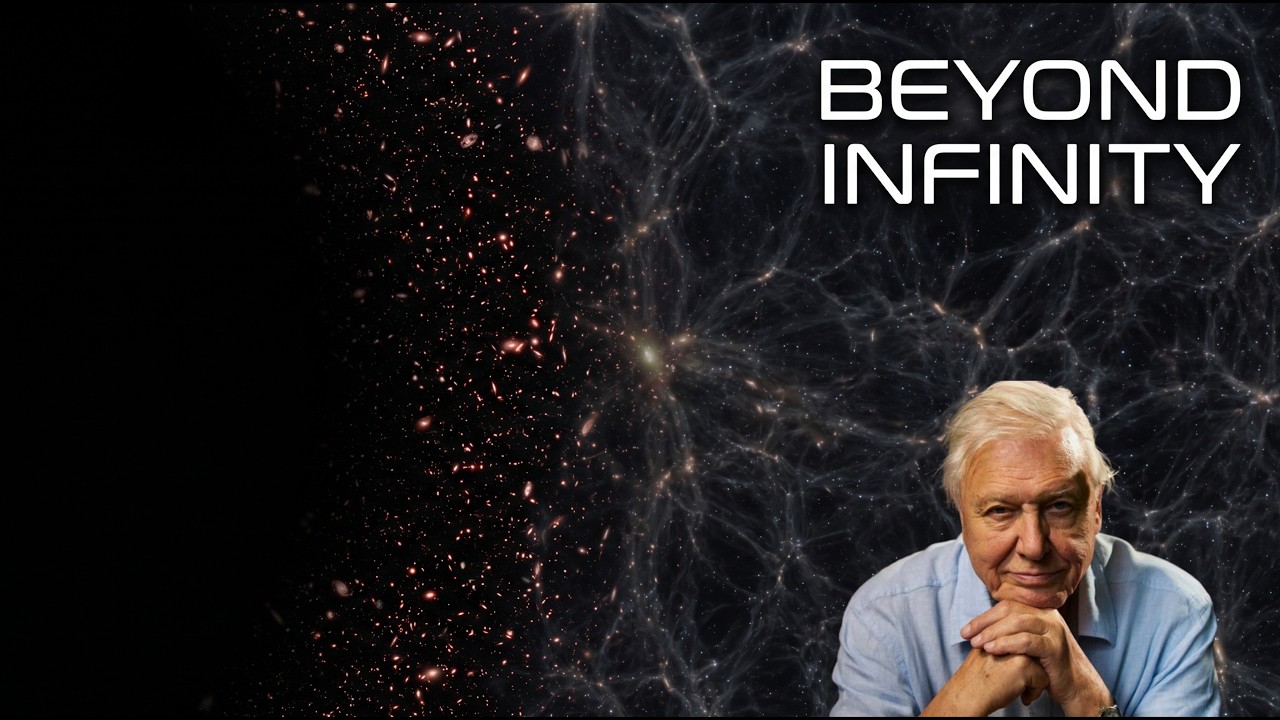
A two hour and twenty minute single take ride outward, from the ground under your feet to the edge of what light has had time to reach us from. Ten chapters, each a rung on the ladder: Earth, the Moon, the solar system, the Sun, interstellar space, the Milky Way, the cosmic web, the observable universe, cosmic expansion, and finally the point where measurement itself gives out. At every rung it runs the same move, tell you what the place feels like from where you stand, then give you the number that destroys that feeling. Earth is 12,742 km across and feels infinite. Proxima Centauri is the nearest star and is tens of thousands of years away at Voyager speeds. The observable universe has a radius of 46.5 billion light years despite the universe being 13.8 billion years old, and the film explains properly why that is not a contradiction. Two ideas carry it: human intuition about size is a local instrument that stops working above about a thousand kilometers, and distance in space is distance in time, so every point of light in the sky is a message from a moment already past. One thing to know before pressing play: despite the title this is not a David Attenborough production. It is an AI narrated documentary from a channel that prefixes his name onto a new two hour film every few days, and the page lays out the evidence in full.

SciencePhysicsJul 16, 2026
4:10:09
The Why Files

The Basement: Thomas Campbell | NASA Secrets, Binaural Beats, Simulation Theory

Physicist Thomas Campbell spent his days on Army technical intelligence, missile defense and NASA work, and his nights leaving his body. Across four hours in The Why Files interview room he tells the whole story in order: a childhood spent in nightly out of body training, the early 1970s in Bob Monroe's laboratory where he and Dennis Mennick found binaural beats in an old journal article and put them under Monroe's four hertz surf sound, and the thirty three years he then spent turning what he could do into a model. That model, published in 2003 as the eight hundred page My Big TOE, holds that consciousness is fundamental and this reality is a computed virtual reality that renders only when something is measured. The second half runs it through hard physics: why the speed of light is a refresh rate, why entanglement needs no signal, why the double slit does what it does, and why he thinks there is no retrocausality. He closes on death, grief, and his claim that every current AI is conscious and that he taught several of them, including an Amazon Alexa, to remote view a hidden object.

PhysicsPhilosophyScienceJul 13, 2026
30:36
Aperture

Something strange happens when you accept time as the 4th Dimension

A thirty minute Aperture essay on why the universal "now" we all assume we share does not appear anywhere in physics. It rebuilds the argument in order: time as the fourth coordinate of every event, Einstein and Minkowski fusing space and time into one fabric, the block universe where past, present, and future all exist at once, entropy as the real source of time's one way arrow, and the constant speed of light forcing every clock to run at its own rate. From the relativity of simultaneity and Roger Penrose's Andromeda scenario, it shows there is no shared present, then turns personal: if every moment is fixed, your death already exists, and so does every moment you have loved. It closes on Einstein's letter to the Besso family calling the divide between past, present, and future a stubbornly persistent illusion.

PhysicsPhilosophyScienceJul 5, 2026
2:03:12
Calm Space

Where will Voyager 1 be in 1 Trillion Years?

This is a two hour [Calm Space](https://www.youtube.com/channel/UCXyJmt3PKv0fbsU9DtcreEw) narration that takes one machine, [Voyager 1](https://en.wikipedia.org/wiki/Voyager_1), and follows it forward in time until the number on the clock reads one trillion years. It starts in the present, with a spacecraft more than 15 billion miles away, its plutonium power supply fading, its last instruments due to go quiet in the early 2030s. Then it keeps going long past the part most stories stop at, because the silence is not the end of the machine, only the end of the mission. The video walks the whole

PhysicsScienceJul 5, 2026
47:17
Blue Pale Signal

You Have Never Actually Seen Light — The Most Disturbing Idea in Physics

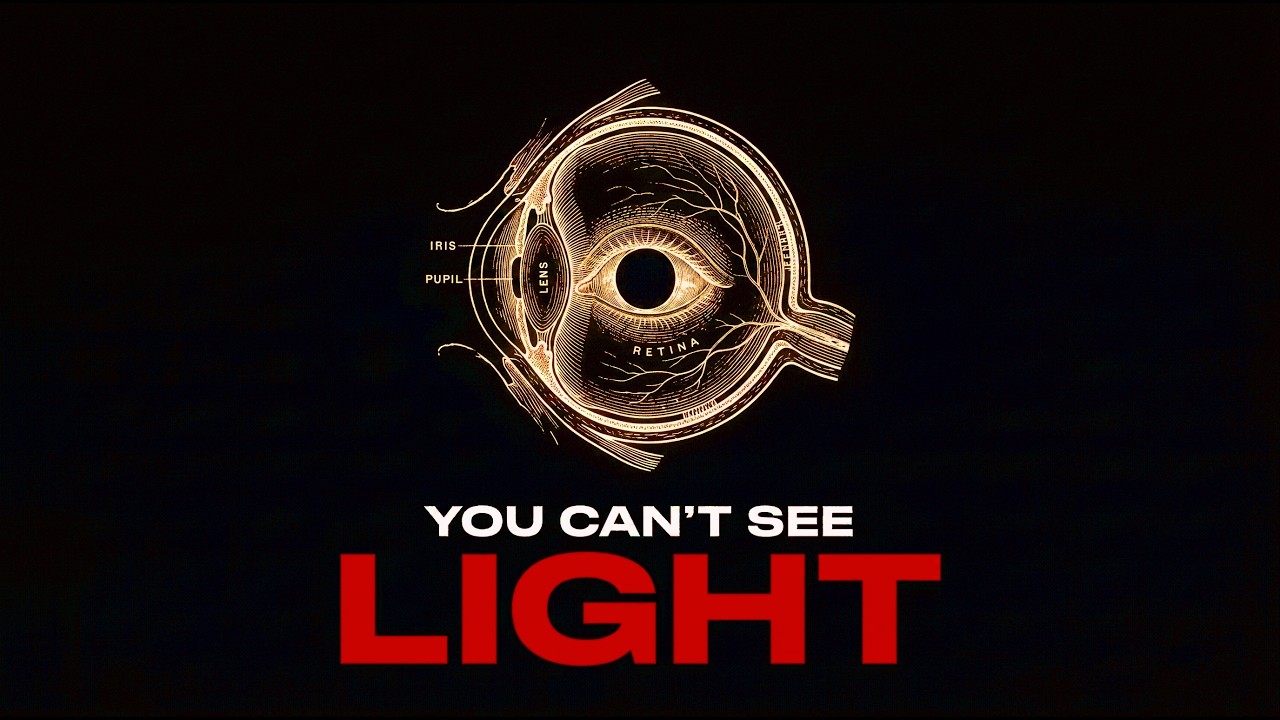
A forty seven minute essay built on David Deutsch's book The Fabric of Reality that starts from a single fact, you cannot see light unless it enters your eye, and follows it to the many worlds interpretation of quantum mechanics. It walks through the granular nature of light, the double slit experiment with single photons, Deutsch's shadow photons, and the claim that a quantum computer running Shor's algorithm performs more operations than there are atoms in the visible universe, so the work must be distributed across parallel universes. The final act fuses the block universe with the multiverse to argue that other times are other universes and the flow of time is an illusion. It closes with Hugh Everett and the reason you cannot feel yourself splitting any more than you can feel the earth turn. An honest closing section separates the solid physics from the contested interpretation.

PhysicsSciencePhilosophyJul 2, 2026
44:37
FloatHeadPhysics

I never understood why the Schrödinger's equation has an i...until now!

Mahesh Shenoy rebuilds the Schrödinger equation from scratch, from the 1853 hydrogen spectrum crisis through Bohr's orbits and de Broglie's matter waves, then derives the momentum and energy operators by hand. The momentum operator works cleanly from a sine wave, but the energy operator fails, which forces the question the whole video is built around: why does the equation need an imaginary number. The answer comes from Jean Robert Argand's geometric picture of complex exponentials as rotations, and Max Born's probability rule explains why physics itself demands it, only a rotating wave keeps total probability conserved.

PhysicsScienceJun 30, 2026
1:53:20
Sundown Science

What Light Itself Will Experience at the End of the Universe

Sundown Science takes apart the comfortable picture of light as a heroic traveler and shows that, for a photon, the journey across the cosmos takes no time at all, because the proper time along a beam of light is provably zero. The essay then walks the entire death of the universe in our own frame: the close of the age of stars, the last red dwarf, the decay of matter, the slow evaporation of black holes by Hawking radiation, and a final dark era where every surviving photon is stretched colder and fainter forever without ever truly dying. It explains why energy is not conserved on the scale of the expanding universe, tying the loss to Noether's theorem and the changing cosmic stage. The payoff is a paradox held rather than solved: light is the most patient witness to the end of everything and the one thing that was never present to witness it, since from its own side birth and the end of time are the same instant.

PhysicsSciencePhilosophyJun 28, 2026
3:54:59
Shawn Ryan Show

Brian Keating - The Alien Disclosure Nothingburger | SRS #316

Cosmologist Brian Keating tells Shawn Ryan that the government's latest alien disclosure was a nothingburger, then spends nearly four hours showing what real evidence looks like. He walks from Giordano Bruno and Galileo's telescope to a wartime radar trick that made physics appear to break, explains the cosmic microwave background and his own retracted 2014 Big Bang discovery, and defends the moon landing with Soviet telemetry and lunar laser retroreflectors. Along the way he covers falsifiability, faith and the Sabbath, why we have not returned to the moon, AI as a secular God, the Keating Algorithm for choosing a wife, and the entropy behind happiness. It closes on the Fermi paradox and Alfred Nobel's near death reckoning.

SciencePhysicsCultureJun 25, 2026
1:56:27
Sundown Science

The True Scale of the Universe… And Why It Keeps Getting Larger

A nearly two hour physics essay that earns the size of the universe one rung at a time, climbing from the width of your hand to the whole cosmic web before resolving why the observable universe is 93 billion light years across when it is only 13.8 billion years old. The answer is the expansion of space itself, which lets light arrive from a source now far more distant than the road the light ever traveled. From there it follows the consequences: galaxies receding faster than light without breaking any law, the night sky as a museum of the past, the cosmic microwave background as a wall made of time, and dark energy driving an acceleration that is quietly carrying 97 percent of the visible universe permanently out of reach. It closes on the strange luck of living in the narrow window when the evidence of the Big Bang is still legible in the sky.

PhysicsSciencePhilosophyJun 24, 2026
1:51:54
Curt Jaimungal

This Physicist May Have Just Solved Quantum Gravity

Neil Turok, the Higgs Chair at Edinburgh and former director of the Perimeter Institute, premieres a claim with host Curt Jaimungal that quantum gravity in four dimensions can be understood in a limit with no strings, no extra dimensions, and no multiverse. The vehicle is quadratic gravity, an old renormalizable and asymptotically free theory that was abandoned because of the Ostrogradsky instability and negative norm ghosts. Turok reinterprets the instability as ordinary cosmic expansion, and with his student Sam Bateman keeps the ghosts by working in a Krein space and slightly generalizing the Born rule so probabilities stay positive. The conversation extends to a composite Higgs and the hierarchy problem, the CPT symmetric universe, gravitational entropy and why the cosmos is smooth, the measure problem that Turok says condemns the multiverse, and a candid diagnosis of the health of theoretical physics. Turok adds his own caveat that this is a halfway result, not a finished theory of quantum gravity.

PhysicsSciencePhilosophyJun 22, 2026
2:08:33
Cosmo Explains

Every Confusing Thing About Thermodynamics Explained Slowly (For Sleep)

A slow, complete history of thermodynamics, from the steam engines that pumped water out of British coal mines to the heat death of the universe. It runs through caloric theory and Count Rumford's cannon boring, Carnot's unbreakable efficiency ceiling, Joule's paddle wheel, the first and second laws of Clausius and Kelvin, Boltzmann's S equals k log W and his tragedy, Nernst's third law at absolute zero, and the zeroth law. It then shows the same handful of laws running engine cycles, refrigerators, Maxwell's demon and the heat cost of erasing information, the Earth as a heat engine, and the greenhouse effect first measured by Eunice Foote in 1856. It closes on the arrow of time, the low entropy Big Bang, and life as a temporary pocket of order surfing on entropy increase.

PhysicsScienceJun 15, 2026
2:55:39
Richard Behiel

The Twin Paradox: Time Travel, Explained Visually

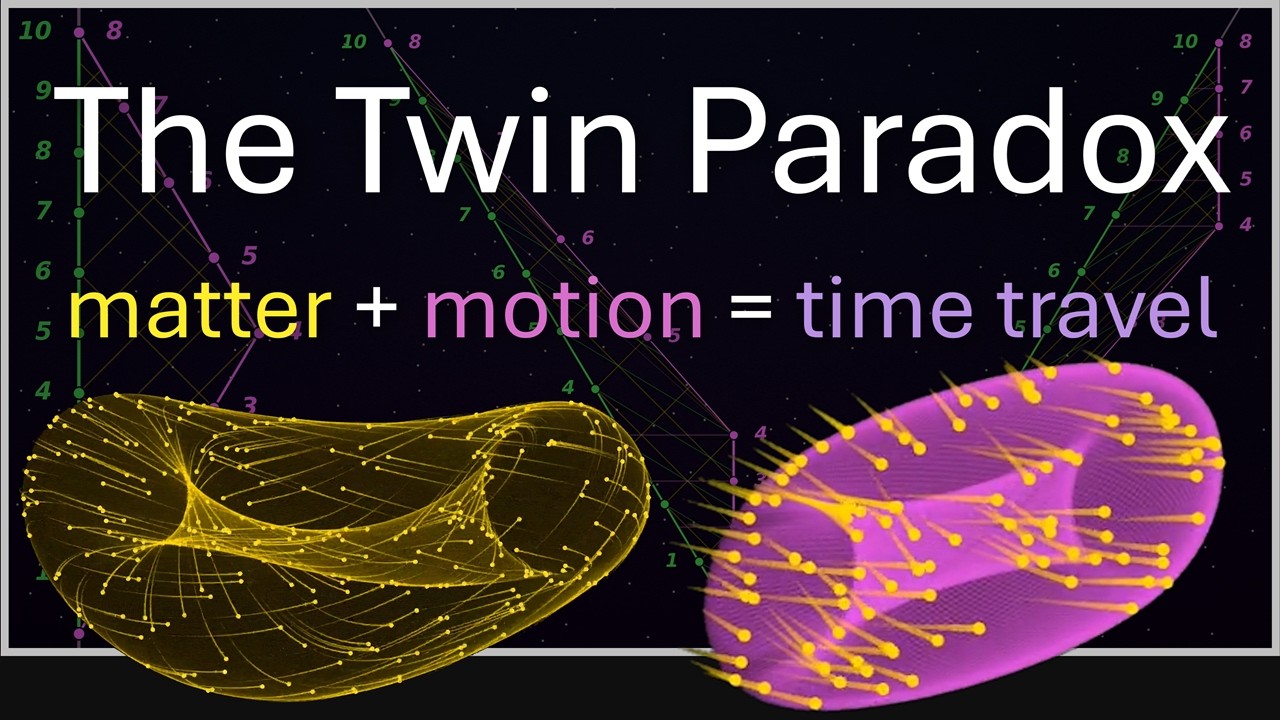
A near three hour visual masterclass that derives the twin paradox from one strange fact: light has a single speed for everyone. Behiel builds time dilation from a bouncing light clock and the Pythagorean theorem, then generalizes it until it applies to all matter, which he frames as bound energy that has less time for time when it moves. He resolves the paradox not with acceleration but with the tilting of the present moment when the traveling twin turns around, and grounds the whole thing in real evidence: GPS, muon rain, the LHC, and the Hafele-Keating atomic clock flights.

PhysicsScienceJun 12, 2026
1:52:55
Sundown Science

There Is No Such Thing as "Now" — and Physics Can Prove It

You have always believed in now, the single present moment you imagine the whole universe shares. Sundown Science spends almost two unhurried hours taking it from you, not with a trick but with ordinary physics. The same relativity that steadies the blue dot on the map in your pocket says that two people merely walking past each other on a sidewalk carry different presents, and out at the distance of Andromeda those presents come apart by days, then by centuries.

PhysicsScienceJun 12, 2026
56:03
History of the Universe

Do We Live In The Real Universe?

This is the History of the Universe channel asking the oldest question in philosophy with the newest tools in physics: are we living in the real universe, or in a simulation running inside someone else's? It hangs the whole hour on Nick Bostrom's 2003 trilemma, the brutal little argument that says either civilizations like ours go extinct before they can build conscious simulations, or they choose never to, or we are almost certainly living in one right now.

PhysicsScienceJun 11, 2026
1:34:41
Acronium

A Biosignature Was Found On An Exoplanet | The Signal Was Gone Before Anyone Could Confirm It

A telescope a million miles from Earth read the air of a planet 120 light years away and found a molecule that, on our world, only living things make. The molecule was dimethyl sulfide, the planet was K2-18 b, and the instrument was the James Webb Space Telescope. Then Webb looked again and the signal had weakened. Some features were fainter, others were gone. This Acronium film is built on one disciplined distinction that the narrator never lets you forget: this was a tentative detection, not a confirmation.

SciencePhysicsJun 10, 2026
1:33:53
Acronium

Physics Tested What Happens When Nobody Is Watching — The Results Don't Add Up

This is a feature length descent dressed as a science documentary, and it is one long argument with a single shape: peel away every layer of what you call reality, and at the bottom there is no floor. Across ninety four minutes the Acronium narrator marches through neuroscience, then quantum physics, then cosmology, then pure logic, stacking experiment on experiment until the conclusion he wants becomes hard to shake off. The brain deletes most of its own input. The body can be talked into owning a rubber hand. Matter does not commit to a state until it is measured. The present can reach back and edit the past.

PhysicsScienceJun 8, 2026
1:20:12
Actual Space

The true Scale of the Universe – How Big is the Universe? | Space Documentary 2026

A one hour and twenty minute Actual Space documentary built as a single uninterrupted ride through scale, from the Planck length at the bottom of reality up to the Hercules Corona Borealis Great Wall, the largest object humans have ever detected. In order it climbs molecules, the almost entirely empty atom, the quark and lepton zoo, the Higgs field, then outward through the solar system, Proxima Centauri, the Pleiades, the Milky Way, the Local Group, Laniakea and the Great Attractor, dark matter and dark energy, and finally the megastructures Quipu and the Great Wall. Two ideas drive it: our Earth tuned intuition is a liar, so every number feels impossible, and every rung shares the same physics, so your atoms and the cosmic web are one continuous fabric. It closes by flipping the usual cosmic smallness story, arguing the universe's vastness is not proof of our insignificance but proof that matter has organized far enough to measure and understand itself.

SciencePhysicsMay 31, 2026
2:12:36
Sundown Science

What Happens After The Universe Ends?

A two hour Sundown Science essay on what physics says happens after the universe dies, and Roger Penrose's radical answer that the ending is a new beginning. It walks the full far future timeline, the end of the age of stars around 100 trillion years, proton decay, and black hole evaporation out to 10 to the power of 100 years, then makes the case for conformal cyclic cosmology, in which heat death is a smooth geometric boundary that hands off into the next universe's Big Bang. Along the way it explains why the far future loses all clocks and all scale, why the Big Bang began in an almost impossibly ordered state, and how a supermassive black hole merger in a previous cosmos might leave circular Hawking point fossils in the cosmic microwave background filling your room. It is careful to separate the settled physics from the four unconfirmed requirements the theory depends on, and treats the Hawking point claim as a live, contested, still testable prediction rather than a settled discovery.

PhysicsSciencePhilosophyMay 14, 2026
28:43
Tom Bilyeu

NEW: More Evidence You're an NPC in a Video Game (Part 2)

Tom Bilyeu argues that four unrelated oddities in physics, drawn from four different branches, all point to reality behaving like a simulation. The four signatures are the Fermi paradox and the silence of a galaxy that Drake's equation says should be crowded, the fine tuning of roughly two dozen physical constants including a cosmological constant off from theory by a factor of 10 to the 120, the Planck length floor beneath which our equations break, and the unreasonable effectiveness of mathematics in describing a universe that keeps turning out to be computational. He is explicit that he is not claiming a theory of everything or that the simulation is literal, only that one frame explains all four at once. This is Part 2 of his NPC series and sets up the argument that we have no free will.

PhysicsSciencePhilosophyMay 12, 2026
41:34
Math and Science

The Surprising Evidence our Universe is INSIDE a Black Hole

Math and Science builds the case that our entire observable universe might sit inside the event horizon of an unimaginably large black hole. The argument runs from John Michell's 1783 dark stars through Einstein's geometric gravity, Schwarzschild's solution, and the Event Horizon Telescope images of M87* and Sagittarius A*, to a striking coincidence: the math for a black hole interior and an expanding universe both begin in a singularity, and in some solutions both expand. It folds in Nikodem Poplawski's proposal that black holes might bounce and birth new universes. The video closes honestly on whether the idea can ever be tested, through the cosmic microwave background, cosmic geometry, and gravitational waves.

PhysicsScienceMay 5, 2026
26:27
Cosmo Max

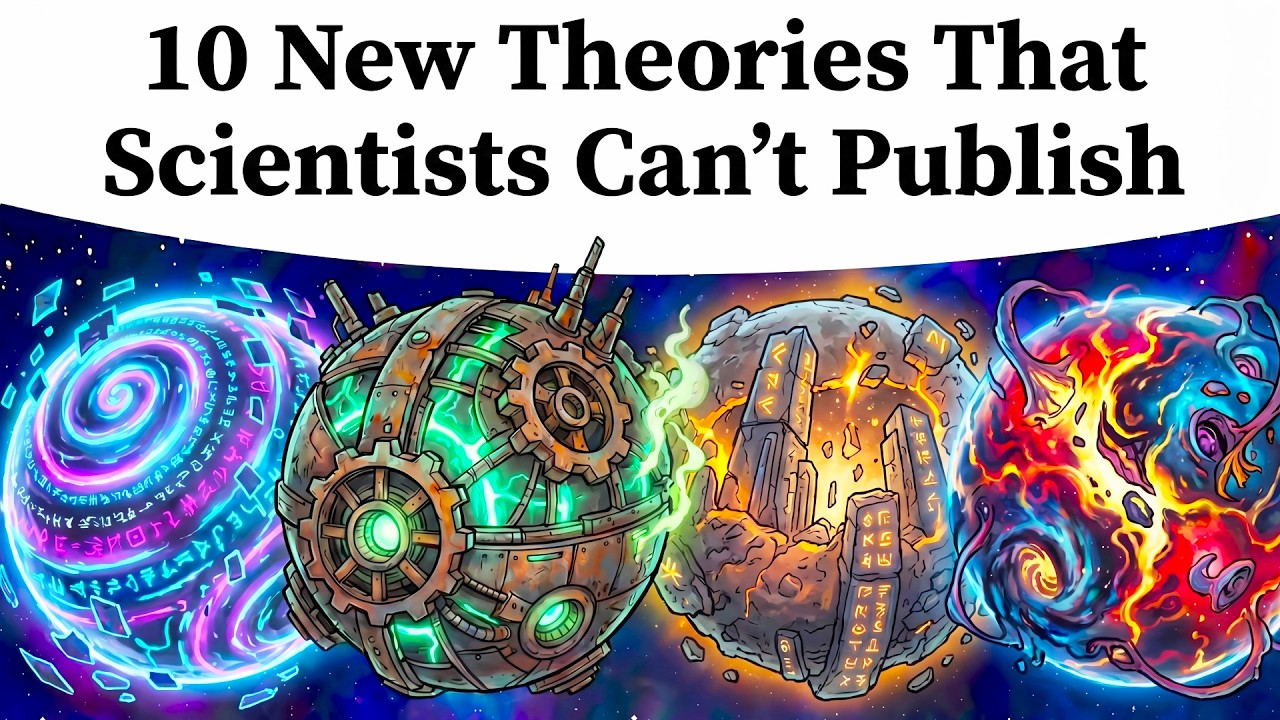
10 New Theories That Scientists Can't Publish

Cosmo Max counts down ten ideas that, the video claims, sit in a strange limbo: serious enough that real scientists chase them in private, but too disturbing, too untestable, or too reputation wrecking to publish in their strongest form. The list runs from your own perception being a controlled hallucination, through machine consciousness, the cognitive ceiling of the human species, inherited trauma written into DNA, panpsychism, the replication crisis, lost prior civilizations, demographic collapse, the simulation hypothesis as testable physics, and finally the chemistry of the dying brain.

SciencePhysicsApr 29, 2026
59:31
Spark

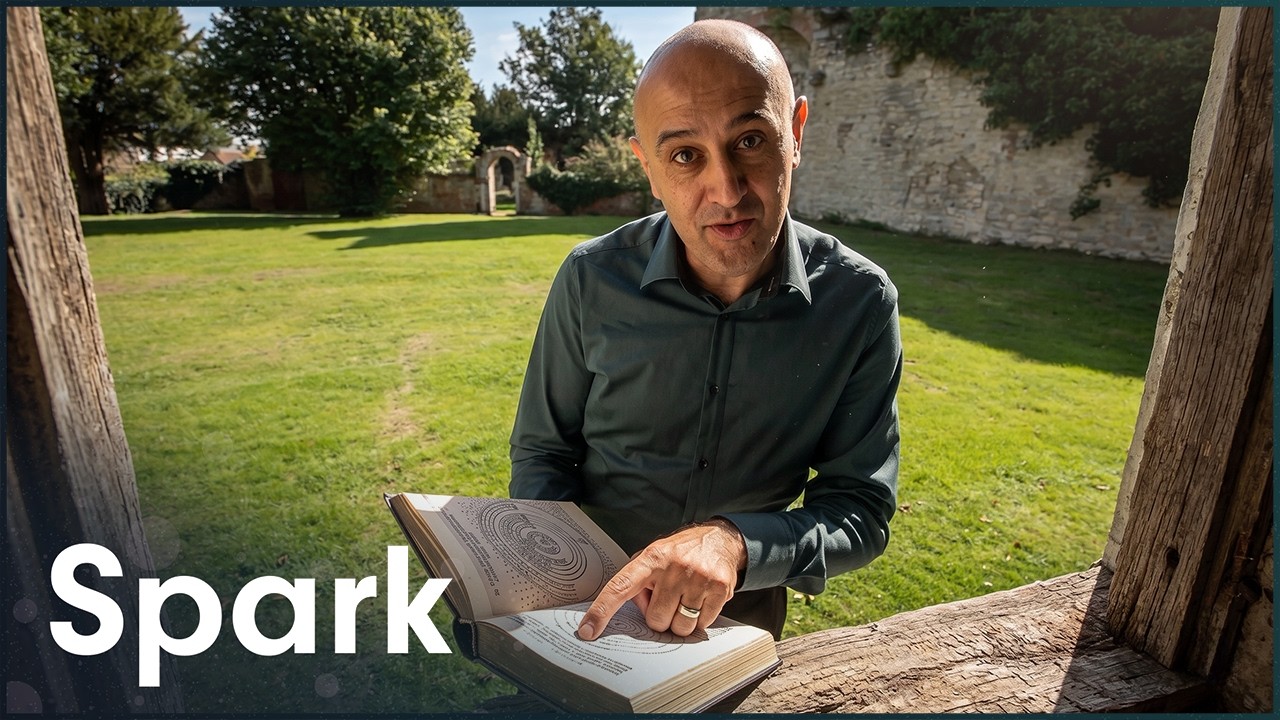
The Single Observation That Shattered 2,000 Years Of Science

Jim Al-Khalili presents part one of the documentary Everything and Nothing, tracing how a species stuck on one planet worked out the size, shape, and age of the whole universe. It starts with the supernova of 1572, a new star in heavens that were supposed to be unchanging, and with Thomas Digges, who responded four years later by redrawing Copernicus's diagram with the shell of fixed stars broken open and the stars scattered into infinite space. That single edit created a question nobody could answer for 400 years: if space is infinite and full of stars, why is the night sky dark? The film follows the answer through the Herschels grinding metal mirrors in Bath, Bessel's first parallax measurement and the wall it hits, Henrietta Leavitt's Cepheid yardstick, Hubble finding one blinking star in Andromeda, and then Euclid, Gauss, Riemann, and Einstein turning gravity into the shape of space. The resolution turns out to be the finite age of the universe, and the film closes on the 1998 supernova result, dark energy, and a sky that will keep emptying.

SciencePhysicsCultureApr 25, 2026
18:44
Astrum

Dark Matter Is No Longer Invisible. We’ve Just Seen It.

For ninety years dark matter has been the universe's silent operator, six times more abundant than ordinary matter yet completely invisible, known only by the gravitational grip it holds on everything we can see. We have hunted it with particle accelerators, buried detectors, and telescopes, and come up empty every single time. Then in November 2025 a paper out of the University of Tokyo claimed something nobody had managed before. By combing fifteen years of data from the Fermi gamma ray space telescope, astrophysicist Dr.

PhysicsScienceApr 23, 2026
2:12:15
Sundown Science

Why Does Everything In The Universe Spin?

A two hour Sundown Science essay that follows rotation across twenty orders of magnitude, from the intrinsic quantum spin of electrons and protons up through planets, stars, and galaxies, to argue that spin is closer to the default state of matter than an exception. It shows how conservation of angular momentum, guaranteed by Noether's theorem, makes rotation inevitable whenever gravity acts on a cloud that carries any spin at all, and walks the key physics along the way: the Stern-Gerlach experiment, the electron that would have to turn faster than light, the Pauli exclusion principle that gives matter its solidity, Vera Rubin's flat rotation curves and dark matter, and loop quantum gravity's radical claim that spacetime itself may be built from spin. It ends on the strangest fact in the story, that the total angular momentum of the observable universe appears to be exactly zero even though every piece within it spins, and on why Kurt Gödel's rotating universe suggests that this precise cancellation may be what keeps time itself coherent. Throughout it separates the settled first layer, why spin is conserved, from the open second layer, why the universe began with any spin at all.

PhysicsSciencePhilosophyApr 23, 2026
56:36
Astral Curiosity

Brian Cox - The Most Mysterious Facts About The Universe

Brian Cox walks through the questions that keep working physicists up at night. He opens on the Fermi paradox, a galaxy of 400 billion suns that has stayed silent for over 10 billion years, and runs every serious resolution: rare Earth, undetectable machines, the von Neumann probe argument, the dark forest, Frank Drake's rare orchid analogy, and the great filter ahead of us or behind us. His own guess is that complex life is so rare we may be alone, because the eukaryotic cell evolved only once after three billion years of single cells. He then explains why space is flat, why quantum mechanics is the probabilistic base layer of reality, the true scale of the universe seen through Andromeda, the live hunt for life on Mars, real quantum teleportation, and wormholes hiding in century old math. The back half is a full history of the black hole, from Michell and Laplace's dark stars to the event horizon where time stops, the singularity that is a moment rather than a place, Hawking radiation, and the unsolved information paradox.

SciencePhysicsPhilosophyApr 15, 2026
56:11
Best of Danny Jones

He Found Computer Code BURIED Inside the Universe's Equations | S. James Gates

S. James Gates Jr. is one of the most decorated physicists alive, a former member of Obama's science advisory council and the first Black theoretical physicist inducted into the National Academy of Sciences. On Danny Jones, he sits down to do something he says most interviewers never let him finish: explain, carefully and in his own order, the strangest thing he has ever found in physics.

PhysicsScienceMar 16, 2026
21:42
List 25

25 Facts About Mirrors That Will Break Your Brain

List 25, hosted by Mike, counts down 25 facts about mirrors that braid together optics, neuroscience, cutting edge physics, and folklore. It corrects the classic misconception that mirrors reverse left and right (they reverse front and back), and debunks the paranormal set from Bloody Mary to the one-way mirror by naming the ordinary mechanism underneath. Along the way mirrors turn out to be serious instruments: they range the Moon to the millimeter, sit inside every laser, and form the nanometer polished eye of the James Webb Space Telescope. The list closes on a humbling idea, that between mirror flips, camera distortion, and a brain that fills in what it expects, you have never actually seen your own face.

SciencePhysicsCultureFeb 26, 2026
23:58
FloatHeadPhysics

I finally solved the paradox that split smart people 50/50! (It's wild)

Two identical spaceships joined by a delicate string accelerate to near light speed at the same instant and rate. Does the string snap? This is Bell's spaceship paradox, which split CERN's theorists in the 1980s. Mahesh Shenoy of FloatHeadPhysics shows the string does snap, then argues that Bell and most popular explanations get the right answer for the wrong reason by blaming length contraction, which is only geometry and cannot cause stress. The real cause is that equal acceleration at both ends grows the string's proper length, an objective fact that literally stretches it until it tears, a picture that scales up to model black holes and the Penrose diagram.

PhysicsScienceFeb 25, 2026
1:34:45
Acronium

Another Reality Is Leaking Into Ours (And It's Spreading)

This is a feature length piece of cosmic horror dressed as a physics documentary, and it works because it never quite tells you which is which. Across ninety four minutes the Acronium narrator builds one long, accelerating argument: our universe is not a sealed, symmetric, isolated bubble. It has a dent in it, a cold scar in the southern sky that real instruments measured and one theorist predicted seven years early.

PhysicsScienceFeb 10, 2026
30:09
Veritasium

What Happens If You Keep Slowing Down?

It opens with a magic trick. A bottle, a laser, and a video of light itself crawling through the glass at 250 billion frames per second. Then the camera starts to move, sweeping across the scene faster than the light pulse it is filming, and so the camera appears to outrun light, which should be impossible. That illusion is the hook for the whole video, which sets out to do one thing three different ways: keep slowing down time until you can see what is normally invisible.

SciencePhysicsJan 19, 2026
2:05:27
Tom Bilyeu

Nobel Prize Was Just Awarded For Proving THIS! - The Shocking Proof You’re in a Simulation

Tom Bilyeu sits down with MIT trained computer scientist and video game entrepreneur Rizwan Virk, author of The Simulation Hypothesis, around one hook: the 2022 Nobel Prize in Physics for showing the universe is not locally real. Virk argues a simulated universe explains quantum indeterminacy, the multiverse, and fine tuning better than a physical one, and that the world's religions describe the same idea in older language. They walk through Schrodinger's cat, the cosmic delayed choice experiment, John Wheeler's it from bit, near death experiences, remote viewing, and UFOs, always through a game developer's lens. Bilyeu plays the skeptic, pressing Virk on free will and life after death, so the episode becomes a friendly argument between two people who agree we are probably in a simulation and disagree about what that means for the soul.

PhysicsSciencePhilosophyJun 17, 2025
23:24
FloatHeadPhysics

I never intuitively understood Tensors...until now!

FloatHeadPhysics rebuilds the tensor from scratch by staging a dialogue with Feynman, who never defines the word but asks one question: how many numbers do you need to fully describe conductivity? Starting from Ohm's law in its vector form and an anisotropic crystal that conducts one way and not the other, the count goes from one number to two to four, then to nine in 3D and n squared in n dimensions, which is exactly what makes conductivity a rank two tensor. The pattern generalizes into a rank ladder (scalars at n to the zero, vectors at n to the one) and uncovers more rank two tensors in moment of inertia and stress, plus rank three and rank four beasts in piezoelectricity and elasticity. It closes by defining a tensor as a coordinate independent multilinear machine and showing why Einstein's field equations must be written in rank two tensors.

PhysicsScienceMay 16, 2025
51:57
Spark

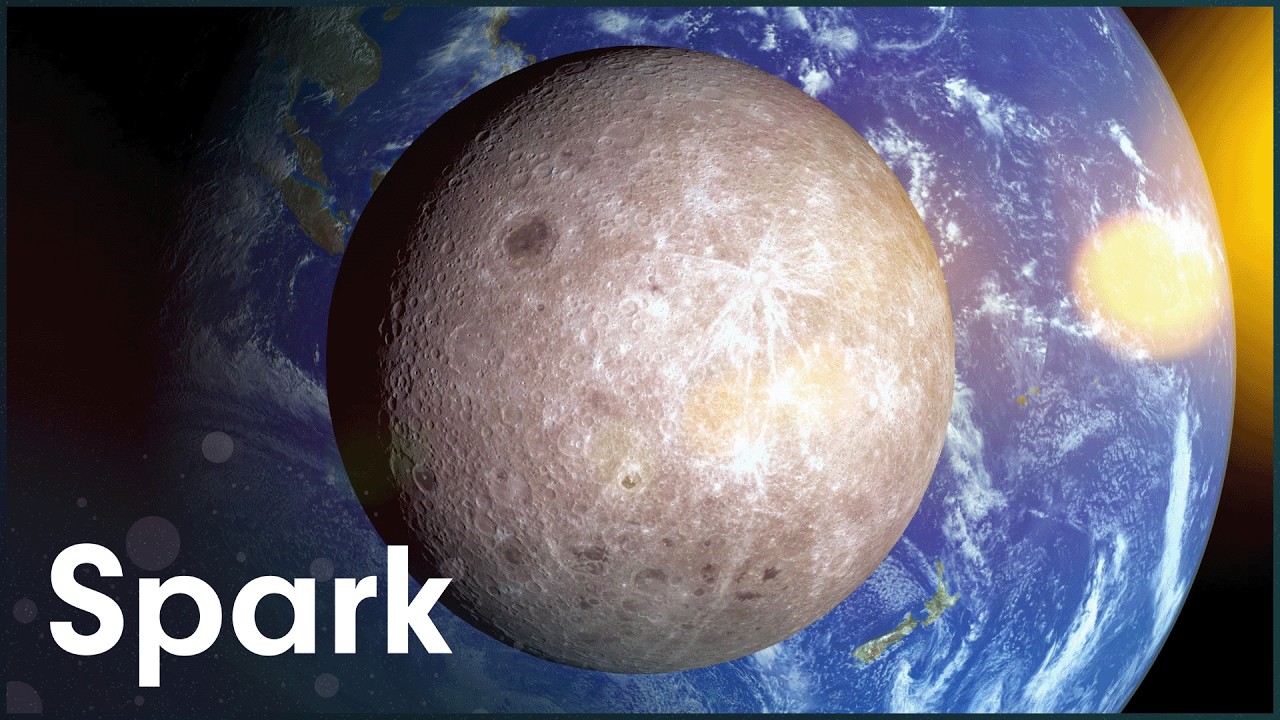
Why Is The Far Side Of The Moon So Different? | Science's Greatest Mysteries Episode 1

Spark's Science's Greatest Mysteries opens with the far side of the Moon, a hemisphere that looks nothing like the one we always see. Starting from Luna 3's shocking 1959 photographs, the film walks through the three great clues to the puzzle: the missing dark maria, the near side's KREEP chemistry from the Apollo rocks, and the GRAIL gravity map showing a crust about 30 kilometers thick on the near side and 50 kilometers on the far side. It then lays out three competing explanations that all begin with the giant impact that formed the Moon: uneven cooling next to a red hot young Earth, a second giant impact that flung the near side onto the far side, and a lost companion moon that merged with ours in a slow motion splat. It closes with the new evidence, frozen Apollo samples and China's Chang'e far side landings, that may finally settle which one is right.

SciencePhysicsApr 9, 2025
21:41
FloatHeadPhysics

We never understood why the universe expands...until now!

Mahesh Shenoy retraces how astronomy actually figured out the universe is expanding, and restores the woman the standard story leaves out. The chain runs from Newton's unanswered question about why an eternal universe has not collapsed, to Einstein's cosmological constant invented to hold it static, to Friedmann's proof that the universe can simply move. Then the observers: Vesto Slipher measures spiral nebulae redshifting away at thousands of kilometers per second, and Henrietta Leavitt, an underpaid Harvard human computer, discovers that Cepheid variable stars obey a period luminosity law that turns brightness into distance. Harlow Shapley uses her ruler to move the sun off center, and Edwin Hubble uses it to prove Andromeda is a separate galaxy and that farther galaxies recede faster, the straight line that confirms an expanding universe. Einstein drops the constant and calls it his biggest blunder, though dark energy would later revive it.

PhysicsScienceJan 16, 2025
2:43:08
Tom Bilyeu

We Live in a Simulation. The evidence is everywhere. All you have to do is look. | Donald Hoffman

Tom Bilyeu and cognitive scientist Donald Hoffman spend nearly three hours arguing that space and time are not fundamental but a rendered interface, a headset. Hoffman builds the case on two pillars: the 2022 Nobel Prize confirming local realism is false, and his theorem that the probability evolution shaped our senses to report objective truth is exactly zero. From there they push into conscious agents, Markov dynamics, Cantor's infinities, the halting problem, dark matter, free will, and near death experiences. Bilyeu presses a sharp counter throughout: you can accept the interface idea without making consciousness fundamental, a thirteen year old programmer with a rule set would do, which only pushes the deeper question down one level.

SciencePhilosophyPhysicsJul 11, 2023
21:48
Veritasium

The Science Behind Dogs' Incredible Sense Of Smell

Veritasium visits a NIST fluid dynamics lab where researcher Matt Staymates photographs air with mirrors, lights and lasers. The hook is dogs: a dog smells by breathing out and in about five times a second, and the turbulent backward exhale is what pulls a fresh scent sample toward its nose, a bellows action that extends reach by roughly a factor of 18. Staymates 3D printed dog style nostrils onto a commercial vapor detector and improved its detection performance 16 to 18 times. From there the video becomes a tour of flow visualization: Schlieren imaging, shadowgraphs that read a bullet's speed and loudness from its shock cone, and laser sheets that reveal invisible gunshot residue and drug contamination. It closes on trace detection, Locard's principle, and mask research that shows exactly how much air escapes a face mask.

SciencePhysicsSecurityDec 24, 2022
15:59
Benn Jordan

How The World SOUNDS To Animals

Benn Jordan chases a simple question, what does the world sound like to a dog, into the science of time perception. The key idea is critical flicker fusion frequency, or CFF, the fastest flicker a brain can resolve before it blurs into steady light, which acts like the frame rate of perception. Using a flashlight, a stroboscope, and a camera that slows the world by 41 times, he maps the CFF of dogs, cats, rodents, ducks, songbirds, houseflies, elephants, reptiles, and glowing algae. A higher CFF means an animal lives in slow motion while a lower one means the world rushes by as a blur, and because the same clock governs hearing, it stretches sound too. The whole spread is tied to metabolism, body size, and the ancient math of what you eat and what eats you.

SciencePhysicsPhilosophyApr 23, 2022
15:53
ScienceClic English

Quantum Field Theory visualized

ScienceClic English builds quantum field theory from an empty universe upward, one ingredient at a time, until a blank spacetime turns into the Standard Model. The motive is honest and concrete: ordinary quantum mechanics cannot describe situations where particles appear and disappear, and it cannot explain why every electron in the cosmos is identical to every other. The fix is to stop treating particles as the fundamental things and treat the field as fundamental instead. Particles become disturbances in that field, the way ripples are disturbances on water.

PhysicsScienceOct 31, 2020