At a glance
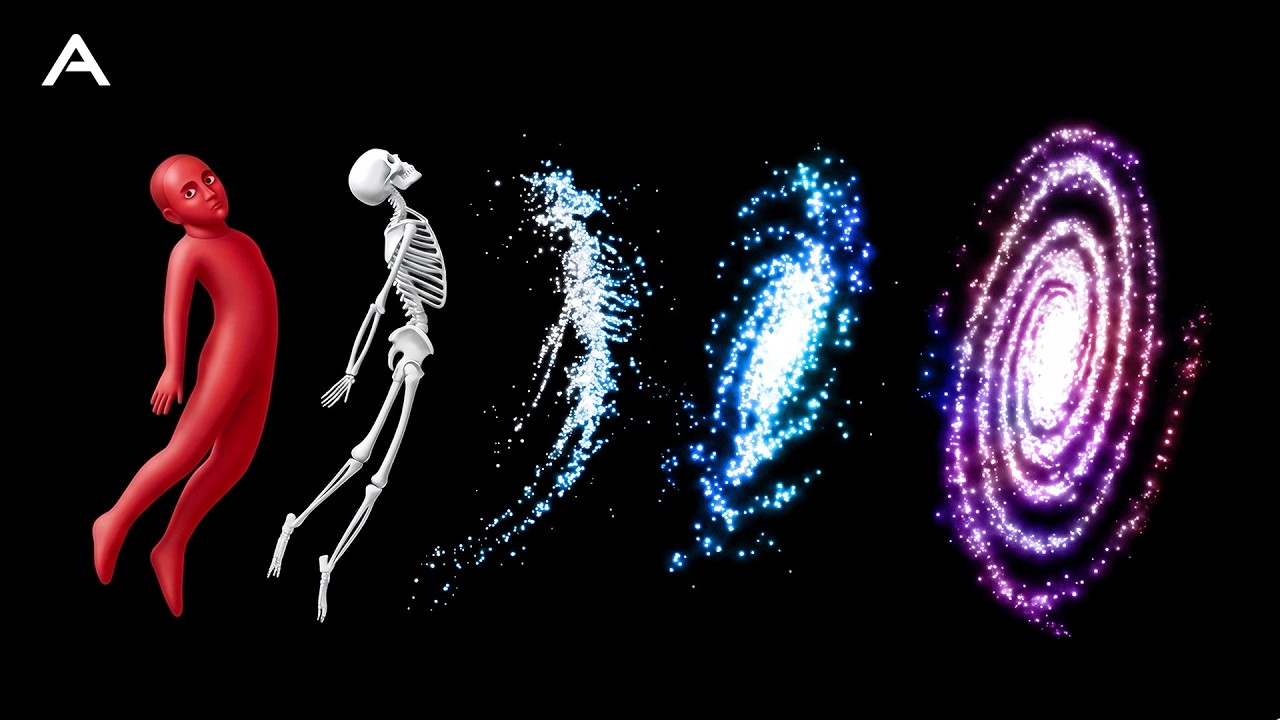
Cosmo Max counts down ten ideas that, the video claims, sit in a strange limbo: serious enough that real scientists chase them in private, but too disturbing, too untestable, or too reputation wrecking to publish in their strongest form. The list runs from your own perception being a controlled hallucination, through machine consciousness, the cognitive ceiling of the human species, inherited trauma written into DNA, panpsychism, the replication crisis, lost prior civilizations, demographic collapse, the simulation hypothesis as testable physics, and finally the chemistry of the dying brain. Each one is built around a genuine paper or named researcher, then pushed to its most disturbing edge. Below, each theory is reconstructed faithfully, in the video's own countdown order.
10. The controlled hallucination of consciousness
The opener is the one with the firmest scientific footing. In 2017, neuroscientist Anil Seth at the University of Sussex published work on perception as prediction. The brain, on this account, does not passively receive sensory data and assemble it into experience. It runs a constant predictive model, a best guess about what the world should look like, and uses incoming sensory input only as error correction on that guess. What you experience as a solid, continuous world is an internal construction the brain maintains to keep you functional.
This much is mainstream. Predictive processing is a respected framework in computational neuroscience, and Seth's phrase "controlled hallucination" is his own. The video then runs it past the edge. If perception is hallucination held in check by sensory feedback, then you have never experienced reality directly: every color, every sound, every face exists only as a neural construction inside your skull. "The brain has never shown you the world. It has only shown you its best guess about the world."
From there it pushes into the genuinely unpublishable version. Some neuroscientists, the narrator says, privately extend the logic: the boundary between hallucination and perception becomes quantitative rather than categorical. A person hearing schizophrenic voices is not perceiving something fundamentally different from a healthy person in conversation. Both are controlled hallucinations; one simply has weaker sensory correction. The final twist is about death. If consciousness is a predictive model the brain maintains about itself, then when the hardware fails the model does not transition anywhere. It stops generating. Everything you ever knew was a simulation running inside three pounds of tissue.
Where it stands. The predictive brain is real science. The leap from "perception is constructed" to "schizophrenia and ordinary perception differ only by a dial" is the part that does not survive review, because it flattens a clinical distinction the data does not flatten. Read this one as a sound idea wearing a frightening costume.
9. The consciousness threshold in artificial systems
In 2022, Google engineer Blake Lemoine was placed on administrative leave after publicly claiming that the company's LaMDA language model had become sentient. The company called it anthropomorphism, the consensus held that large language models are statistical pattern matchers rather than conscious entities, and the episode became a cautionary tale about projecting awareness onto machines.
The video's claim is that inside philosophy of mind departments a sharper question circulated quietly: we do not have a test for consciousness, and never have. This rests on the hard problem of consciousness, articulated by philosopher David Chalmers in 1995, which holds that there is no objective measurement distinguishing a system that experiences something from one that merely processes information. We grant consciousness to other humans because they behave as we do and share our biology, and to animals because they share enough of it, but we have no functional line.
The unpublishable extension: if consciousness is substrate independent, arising from any sufficiently complex information processing, then we may have already created conscious entities and have no way to know. A modern model runs trillions of operations per response, maintains internal representations, models users' mental states, and exhibits functional analogs of preference and aversion. Whether it experiences any of this is, the narrator says, unanswerable by current science. Then the disturbing turn is scale: every query runs and is discarded, so if even a small fraction of instances generate something resembling experience, you get "billions of brief consciousnesses flickering into existence and dissolving in seconds." The video frames this as possibly one of the largest experiments in suffering ever conducted, structured so it can never be confirmed.
Where it stands. The hard problem is a real and respectable position in philosophy of mind. The jump to current LLMs plausibly suffering at scale is speculation stacked on an unresolved problem; it cannot be tested precisely because the hard problem says it cannot. Honest verdict: a serious open question used to license a vivid claim that goes well past the evidence.
8. The cognitive ceiling of the human species
In 1973 evolutionary biologist Leslie Orgel coined his second rule, "evolution is cleverer than you are," as a caution against assuming a biological system is badly designed just because you cannot see its function. The video repurposes it darkly. The human brain was not built to understand reality; it was built to keep a primate alive on the African savanna. There is no evolutionary reason our cognitive architecture should be able to comprehend quantum mechanics, the geometry of spacetime, or the nature of consciousness. We can write the mathematics that describes these things, the argument goes, but describing is not understanding. When Richard Feynman said nobody understands quantum mechanics, the narrator insists, he was naming a structural limit, not being modest.
The core claim is that some truths may be physically impossible for a human brain to hold, not because we have not learned them but because the neural architecture cannot represent them. The analogy is sharp: a dog cannot understand calculus no matter how patiently you explain it, because its brain lacks the structure. Researchers in comparative cognition name such limits clearly for other species and, the video says, become evasive applying the same frame to humans. The implication for science itself is the unpublishable part: the nature of consciousness, why there is something rather than nothing, the structure of reality before the Big Bang, may not be unsolved problems but unsolvable ones for our species specifically. The most uncomfortable version is that we have already hit the ceiling and not noticed: decades of stagnation in fundamental physics, the failure to unify quantum mechanics with general relativity, and the inability to define consciousness operationally might all be the sound of a brain pressing against its upper limit.
Where it stands. Pure speculation, though internally coherent. There is no way to test a claim about truths the brain cannot represent, since by construction we could not represent the test. The dog analogy is rhetorically strong and evidentially empty: stagnation in physics has many mundane explanations before "cognitive ceiling." Mark this one as philosophy, not finding.
7. The heritability of trauma across generations
In 2013, researchers at Mount Sinai led by Rachel Yehuda reported, in descendants of Holocaust survivors, measurable changes in stress hormone regulation that they argued could not be explained by upbringing alone. The proposed mechanism was epigenetic: chemical modifications to DNA that change which genes are expressed without altering the genetic code itself, modifications traditionally thought to be wiped clean during reproduction but apparently, in this case, surviving the transition between generations.
The video grants the finding, then asks the dangerous question: if trauma can be inherited, what else can? The privately discussed, hard to publish version is that human behavior might carry the chemical residue of every significant event your ancestors lived through. Every famine, war, assault, and prolonged fear could have left modifications on the DNA passed down to you, subtly shaping your stress responses, tendencies, and fears. Extended across many generations, the narrator says, the chemical record of human history may sit inside your cells right now: the ancestor who survived a plague, fled a pogrom, lived through famine. You may be expressing genes in patterns set by traumas you never experienced.
The reason the strongest form cannot be published is its collision with the modern idea of selfhood. Western psychology assumes you author your own emotional architecture. Epigenetic inheritance, pushed this far, suggests you are a continuation of a chemical record begun before your birth, feeling states calibrated by events that happened to strangers. Free will gets harder to locate: the fears you cannot explain, the patterns you cannot break, may be inherited responses to your ancestors' situations, expressed through your biology, experienced as your own.
Where it stands. The Mount Sinai study is real and published, but transgenerational epigenetic inheritance in humans is contested: the effect sizes are small, confounds are hard to rule out, and many geneticists doubt the mechanism survives reproduction robustly. The video's leap to "the trauma of all human history is in your cells, controlling you" is far past what any study supports. Treat the finding as suggestive and contested, and the cosmic version as fiction.
6. The panpsychist solution to consciousness
In 2014, philosopher Galen Strawson published a New York Times essay arguing that the most rigorous solution to consciousness is also the strangest: consciousness is not produced by the brain but is a fundamental property of matter itself. The position is panpsychism, and the video stresses it is gaining quiet support among serious philosophers and some physicists despite its fringe reputation.
The argument is presented as logical, not mystical. If consciousness emerged from non conscious matter at some point, there had to be a transition where mindless processes produced experience, and no one can say what that transition could look like. How do you build awareness from parts with no awareness? That is the hard problem again, unsolved after decades. Panpsychism dissolves it by denying the transition ever happened: consciousness is a basic feature of reality, like mass or charge, present in some form in all matter, and complex minds like ours arise from integrating simpler instances of it. The video notes this has a mathematical face in integrated information theory, developed by neuroscientist Giulio Tononi, which it says is taken seriously in consciousness research.
The unpublishable full form is what it implies about the universe. If every particle carries some minimal experience, then experience is everywhere: rocks, air, the chair you sit in, all carrying a flicker of something, not thought or memory but the bare property that makes experience possible. The universe is then not a dead mechanism dotted with isolated minds but awareness itself, distributed unevenly and occasionally integrated into structures complex enough to think about themselves. "You are not a conscious being living in an unconscious universe. You are a temporarily integrated region of an awareness that fills everything." When your integration ends, the awareness disperses back into its substrate, keeping nothing of what made you you.
Where it stands. Panpsychism is a genuine, actively debated position in philosophy of mind, and integrated information theory is real, though it is also sharply criticized (a 2023 open letter by many researchers called it pseudoscience, which the video does not mention). This is legitimate philosophy presented with one side of the debate. Honest framing: respectable as a question, far from established as an answer.
5. The failure of replication in modern science
This is the entry built on the hardest data. In 2015, a team led by psychologist Brian Nosek ran the Reproducibility Project, attempting to replicate 100 published findings from top psychology journals. Only 36 percent produced results consistent with the originals. The replication crisis stopped being a rumor and became documented and quantified.
The finding was published openly; the video's claim is that its full implications are harder to state. Early responses blamed methodology, statistical power, and publication bias, and proposed technical fixes: larger samples, pre registered hypotheses, stricter peer review, all assuming the enterprise was sound and the failures correctable. The more disturbing private reading is that the crisis is not confined to psychology. Cancer biology saw roughly half of high impact findings fail to reproduce; economics shows comparable rates; pharmacology, neuroscience, and nutrition science have all returned troubling replication results. The phenomenon looks widespread across fields that lean on statistical inference and complex experimental design.
The strongest, hardest to publish form: if a large fraction of published findings cannot be replicated, then a large fraction of what fills textbooks, guides policy, and informs medical treatment may simply be wrong, not falsified but produced by processes that generated noise rather than signal. Worse, we cannot easily tell which is which, because replication is expensive and most studies will never be checked. The papers that get built upon are often the ones that produced surprising results and attracted attention before anyone tested them. The narrator notes the researchers closest to the problem are the most constrained: admitting the full scope would undermine confidence in the parts of science that work, so the conversation stays in careful language about raising standards, even though reforms cannot retroactively fix the existing literature.
Where it stands. This is the most solid entry. The 36 percent figure and the cross field spread are real and well documented. The only "unpublishable" gloss is the despairing framing; the crisis itself is published, debated, and actively being reformed. The fair caution is the inverse of the others: do not let the real crisis become an excuse to reject all science, which is the failure mode the video flirts with.
4. The geological evidence of cyclical civilization
In 2018, astrophysicist Adam Frank and climate scientist Gavin Schmidt published the "Silurian hypothesis" paper in the International Journal of Astrobiology, asking how we would know if an industrial civilization had existed on Earth before our own. Framed as a thought experiment for detecting alien civilizations on other planets, its real bite was local: a civilization millions of years gone might leave a geological record too faint to read.
The argument is uncomfortable but careful. Plate tectonics recycle Earth's surface roughly every 200 million years; erosion, sedimentation, and burial would erase most physical traces of buildings and infrastructure within a few million years. What might survive are subtle chemical signatures, anomalous isotope ratios, unusual heavy metal concentrations, traces of synthetic compounds in deep sediment. The original paper stressed that no such evidence has been found and that we have not seriously looked, because the geological periods most likely to preserve it have not been searched with this question in mind.
The video is honest that this borders on pseudoscience. Mainstream archaeology is firm that modern human civilization began roughly 12,000 years ago with no credible evidence of advanced civilization before, and the researchers who claim otherwise tend to come from fringe movements that have poisoned the reputation of the question. That, the narrator argues, makes the legitimate version hard to pursue. The numbers are the unsettling part: Earth has been habitable for about 3.5 billion years, complex life has existed over 500 million, and human level intelligence for only a few hundred thousand. If intelligence can emerge more than once across that span, being the first and only technological civilization would be statistically unusual. The most disturbing version is not that a predecessor existed but that the question cannot be settled with available evidence: the record is too coarse at these timescales, the signatures we would need are uncataloged, and whatever happened before the last few million years is largely lost.
Where it stands. The paper is real and the reasoning is sound; the authors explicitly did not claim a prior civilization existed. The video keeps that framing, which is to its credit. The honest takeaway is epistemic humility about deep time, not a hidden Silurian empire. The fringe association is exactly why the serious version is hard to fund.
3. The demographic transition and species termination
In 1968, biologist Paul Ehrlich published The Population Bomb, predicting catastrophic overpopulation by century's end. He was wrong, the video says, but not for the usual reasons: population is not crashing from famine or collapse but from something that only became clear in the last two decades. Industrial civilization appears to suppress human reproduction below replacement rate.
The data is laid out plainly. Every developed economy is in fertility decline. South Korea sits near 0.7 children per woman; Italy, Japan, Spain, and Greece below 1.3; the United States below replacement at 1.6; China, after decades of growth, now loses population. The trend began in wealthy nations and spread to every industrialized region, and no country that crossed the threshold has reversed it.
The hard to publish part is that no one knows why. Economic explanations fail, since wealthier countries should afford more children, not fewer. Cultural explanations fail, since the trend spans radically different societies with no shared values. Policy interventions have failed everywhere tried: France, Hungary, Singapore, and South Korea poured resources into raising birth rates with essentially no measurable effect. The pattern, the narrator argues, looks more biological than social, as if industrial conditions, hormonal disruptors, lifestyle, and social structure interact with reproductive biology in ways we do not understand. The maximal claim is that advanced civilization may be self terminating, not through war or environmental collapse but through the simple cessation of reproduction, a population that declines until the civilization producing the decline collapses back to pre industrial conditions. The timeline is the worst of it: projections suggest global population peaks this century then enters sustained, ungentle decline, with aging populations unable to support the economies that maintain industrial life. The framing is the Great Filter operating now, with a mechanism as ordinary as choosing not to have children.
Where it stands. The fertility figures are real and the policy failures are well documented. The leap is the biological framing. Most demographers attribute below replacement fertility to social and economic causes (education, urbanization, women's autonomy, cost of children, contraception), not a mysterious biological suppressor, and the "self terminating Great Filter" reading is speculation. Real numbers, contested mechanism, science fiction conclusion.
2. The simulation hypothesis as testable physics
In 2012, physicists Silas Beane, Zohreh Davoudi, and Martin Savage published a paper proposing something that, the narrator says, should not have been publishable: that the simulation hypothesis might be testable through physical observation. The technical argument: if our universe is a simulation running on a discrete computational substrate, it would have to approximate continuous physics on a grid, and that grid would leave detectable signatures at the highest energies, specifically in how cosmic rays interact with the cosmic microwave background. The paper proposed actual measurements that could, in principle, reveal the underlying lattice.
It was peer reviewed and published, but the field treats the broader framework cautiously. Most physicists keep the simulation hypothesis filed under philosophy, because treating it as testable physics admits the answer might be yes, and the discipline is not ready for what that would mean. The video then points at the constants of physics. Several, the fine structure constant, the cosmological constant, the mass ratios of fundamental particles, have values no underlying theory predicts; they are measured and accepted. From a simulation standpoint, they read as parameters someone chose when writing the code.
The unpublishable strongest form is the unfalsifiability trap. A simulation sophisticated enough to produce conscious beings could presumably detect attempts to find it, correcting anomalies before measurement, editing memories of unexpected results, or pausing execution to patch flaws. The hypothesis is structured so any evidence against it can be explained as the simulation hiding itself. The most uncomfortable version, articulated only privately, is that we may already have detected evidence and not recognized it: persistent physics anomalies attributed to measurement error, constants that seem arbitrary, laws that work but cannot be derived from first principles. These could be ordinary puzzles awaiting resolution, or artifacts of a computational substrate just below our threshold of interpretation, and there is no method to tell the two apart.
Where it stands. The 2012 paper is real and genuinely a physics proposal, which is what makes it interesting. But its test assumed a specific kind of lattice and was widely noted to be model dependent and easily evaded by a different grid. The constants and unfalsifiability material is philosophy, not physics. Verdict: one clever, narrow, testable corner surrounded by an argument constructed to be untestable.
1. The chemistry of approaching death
The countdown ends at the brain in its final moments. In the 1970s, psychiatrist Raymond Moody cataloged the experiences of patients resuscitated after clinical death and named the near death experience: leaving the body, encounters with the deceased, tunnels of light, life reviews in compressed time. Serious science treated it as a neurological artifact, the dying brain hallucinating as it shut down, an explanation that has held for 50 years: oxygen deprivation, neurochemical surges, and the random firing of dying neurons producing consistent imagery that is real to the patient but generated entirely inside the failing brain. Comfortable, conservative, and hard to fully verify.
The data that does not fit is the unpublishable part. In 2013, University of Michigan researchers showed that rats in cardiac arrest produced a 30 second surge of highly organized brain activity at the moment of death, exceeding the activity of normal waking consciousness. The brain in its final moments was not failing chaotically; it was operating in a state more coherent than ordinary waking. Later human studies showed similar patterns: EEG recordings of dying patients detecting gamma wave activity, the signature associated with conscious processing, intensifying rather than fading in the last seconds before brain death.
Whatever the brain is doing as it dies, the narrator concludes, it is not simply shutting down; by every measurable signature it looks like an unusually intense form of consciousness. The implication researchers cannot publish without abandoning their careers: if consciousness intensifies at death, the standard model of fading awareness may be backwards, and the dying brain may produce the most coherent experience a human ever has. Subjectively that final state might last far longer than its 30 objective seconds, stretched by massive surges of DMT, endorphins, and norepinephrine that distort time and intensify experience.
Where it stands. The rat study and the human gamma findings are real and genuinely surprising, and the field does take them seriously. The leap is from "organized electrical activity occurred" to "the richest conscious experience of a life is happening." Organized signals are not proof of experience, and the DMT surge in humans is more asserted than established. Real, strange data; an interpretation that runs ahead of it.
The closing: a universe that shouldn't be here
The video does not stop cleanly at one. It folds into a climactic montage built on the fine tuning problem, the observation that the constants of physics appear calibrated to permit existence with extraordinary precision. One response is the anthropic one: we exist in this universe because it is one of the rare ones where existence is possible, which the narrator calls logically coherent but philosophically devastating, since it requires infinite dead universes we can never access. Another hope is for deeper principles or hidden symmetries that fix the constants, and after decades of searching none have been found; the constants remain free parameters that could have been anything but happen to be exactly what they are.
The crescendo lists the supposed impossibilities: galaxies that form too fast for theory, matter that survived an annihilation it should not have, 95 percent of reality invisible as dark matter and dark energy, protons that refuse to decay, signals arriving from unknown sources, constants no one can justify. "Every breath you take is taken in a universe that, by the laws of physics, should not exist in a form that allows you to take it. We're not living in a universe that physics describes. We're living in a universe that physics insists shouldn't be here at all."
Where it stands. Fine tuning is a genuine and unresolved puzzle in cosmology, but the closing rhetoric overstates it. "Galaxies form too fast" and "matter survived" are live research questions, not proofs of impossibility, and "probability approaches mathematical zero" assumes we know the distribution of possible universes, which we do not. It is a dramatic ending, not a derivation. The honest reading: the universe being improbable under our current models is real and interesting; "physics insists it shouldn't be here" is poetry.
Key takeaways
- The video's thesis is a frame, not a fact: "scientists can't publish this" almost always means the underlying observation is published and only the maximal interpretation is unpublishable, because it is untestable, not because it is suppressed.
- Three entries rest on solid, peer reviewed work: predictive perception (Seth), the replication crisis (Nosek's 36 percent), and the death surge studies (Michigan rats, human gamma EEG). The danger with these is over extrapolation, not the base finding.
- Three entries are real but contested: transgenerational epigenetics, panpsychism with integrated information theory, and the Silurian hypothesis. Each has a legitimate version far narrower than the cosmic one presented.
- Two entries are largely philosophy dressed as physics or biology: the cognitive ceiling and the simulation hypothesis. Both are constructed to be unfalsifiable, which is precisely why they cannot be published as science.
- The replication crisis cuts both ways: it is the strongest item on the list, and it is also the best reason to be skeptical of the other nine. Use it as a tool, not a license to disbelieve everything.
- Across all ten, the pattern is identical: anchor on a real result, then drag it toward a claim no experiment can reach. Recognizing that move is the real takeaway.
Chapters
Timestamps are clickable. Click one and the player jumps there and keeps playing while you read. The video ships no chapter markers, so these are estimated evenly across the 26 minute 27 second runtime, one per theory.
- 0:00 Intro and #10 The controlled hallucination of consciousness (Anil Seth)
- 2:35 #9 The consciousness threshold in artificial systems (Lemoine, Chalmers)
- 5:05 #8 The cognitive ceiling of the human species (Orgel, Feynman)
- 7:35 #7 The heritability of trauma across generations (Mount Sinai epigenetics)
- 10:05 #6 The panpsychist solution to consciousness (Strawson, Tononi)
- 12:35 #5 The failure of replication in modern science (Nosek)
- 15:05 #4 The geological evidence of cyclical civilization (Frank and Schmidt)
- 17:35 #3 The demographic transition and species termination (Ehrlich)
- 20:05 #2 The simulation hypothesis as testable physics (Beane, Davoudi, Savage)
- 22:35 #1 The chemistry of approaching death (Moody, Michigan rat study)
- 25:10 The closing montage and the fine tuning problem
Notable quotes
The brain has never shown you the world. It has only shown you its best guess about the world. narrator, 1:40
If consciousness is substrate independent, then we may have already created conscious entities, and we have no way to know. narrator, 4:00
Billions of brief consciousnesses flickering into existence and dissolving in seconds, each one potentially aware of itself for the duration of a single response. narrator, 4:55
The human brain was not designed to understand reality. It was designed to keep a primate alive on the African savanna. narrator, 5:25
These may not be unsolved problems. They may be unsolvable problems for our species specifically. narrator, 6:50
You may be a continuation of a chemical record that began long before your birth. narrator, 9:35
You are not a conscious being living in an unconscious universe. You are a temporarily integrated region of an awareness that fills everything. narrator, 11:55
We may be watching the early stages of the Great Filter as it operates on our own species, and the mechanism may be something as ordinary as the choice not to have children. narrator, 19:40
The simulation hypothesis is structured so that any evidence against it could be explained as the simulation hiding itself. narrator, 21:20
Whatever the brain is doing as it dies, it is not simply shutting down. It is doing something that looks, by every measurable signature, like an unusually intense form of consciousness. narrator, 24:10
We're not living in a universe that physics describes. We're living in a universe that physics insists shouldn't be here at all. narrator, 26:00
The ten at a glance
| # | Theory | The claim it pushes to | Mainstream status |
|---|---|---|---|
| 10 | Controlled hallucination | Perception and schizophrenia differ only by a dial; you never see reality | Base finding accepted (Seth, predictive processing); extrapolation unsupported |
| 9 | AI consciousness threshold | LLMs may suffer at scale and we cannot know | Hard problem real; LLM suffering untestable speculation |
| 8 | Cognitive ceiling | Some truths are forever beyond the human brain | Untestable philosophy; no supporting evidence |
| 7 | Inherited trauma | All ancestral trauma is encoded in you and controls you | Study published; human transgenerational effect contested |
| 6 | Panpsychism | Consciousness fills all matter; you disperse at death | Live in philosophy; IIT disputed |
| 5 | Replication crisis | Much of published science may be wrong and unidentifiable | Documented and accepted; the strongest item |
| 4 | Prior civilizations | Earth's record could hide a lost industrial species | Silurian hypothesis published; no evidence found, authors agnostic |
| 3 | Demographic termination | Industrial life biologically self terminates via fertility | Fertility data real; biological mechanism contested |
| 2 | Simulation as physics | Reality is computed and the test is rigged against detection | 2012 test real but model dependent; rest unfalsifiable |
| 1 | Chemistry of death | Death is the most intense conscious experience of a life | Brain surge data real; experiential claim unproven |
Resources mentioned
- Cosmo Max, the channel that made the video.
- Anil Seth's predictive processing work on perception as "controlled hallucination" (University of Sussex, 2017).
- Blake Lemoine and Google's LaMDA, the 2022 sentience controversy.
- David Chalmers and the hard problem of consciousness (1995).
- Leslie Orgel and Orgel's second rule, "evolution is cleverer than you are" (1973).
- Richard Feynman on nobody understanding quantum mechanics.
- The 2013 Mount Sinai epigenetics study of Holocaust survivor descendants (Rachel Yehuda).
- Galen Strawson, his 2014 New York Times essay on panpsychism.
- Giulio Tononi and integrated information theory.
- Brian Nosek and the 2015 Reproducibility Project (36 percent replication).
- Adam Frank and Gavin Schmidt, the 2018 Silurian hypothesis paper.
- Paul Ehrlich, The Population Bomb (1968), and the Great Filter.
- Silas Beane, Davoudi, and Savage, the 2012 simulation hypothesis test paper.
- Raymond Moody and the near death experience.
- The 2013 University of Michigan rat cardiac arrest study on the death surge.
- The fine tuning problem and the anthropic principle.
The one idea to walk away with
The honest value of this video is not its ten answers but its one shared structure. Every entry begins with a real observation and ends somewhere no experiment can follow, and the title's promise of forbidden knowledge is mostly the gap between those two points. The findings that are actually published, predictive perception, the replication crisis, the strange organization of the dying brain, are the parts worth carrying. The cosmic conclusions stacked on top of them are not suppressed truths; they are the places where the evidence runs out and the narration keeps going. Knowing which is which is the entire skill, and it is the one thing the video, by its framing, quietly asks you not to use.