At a glance
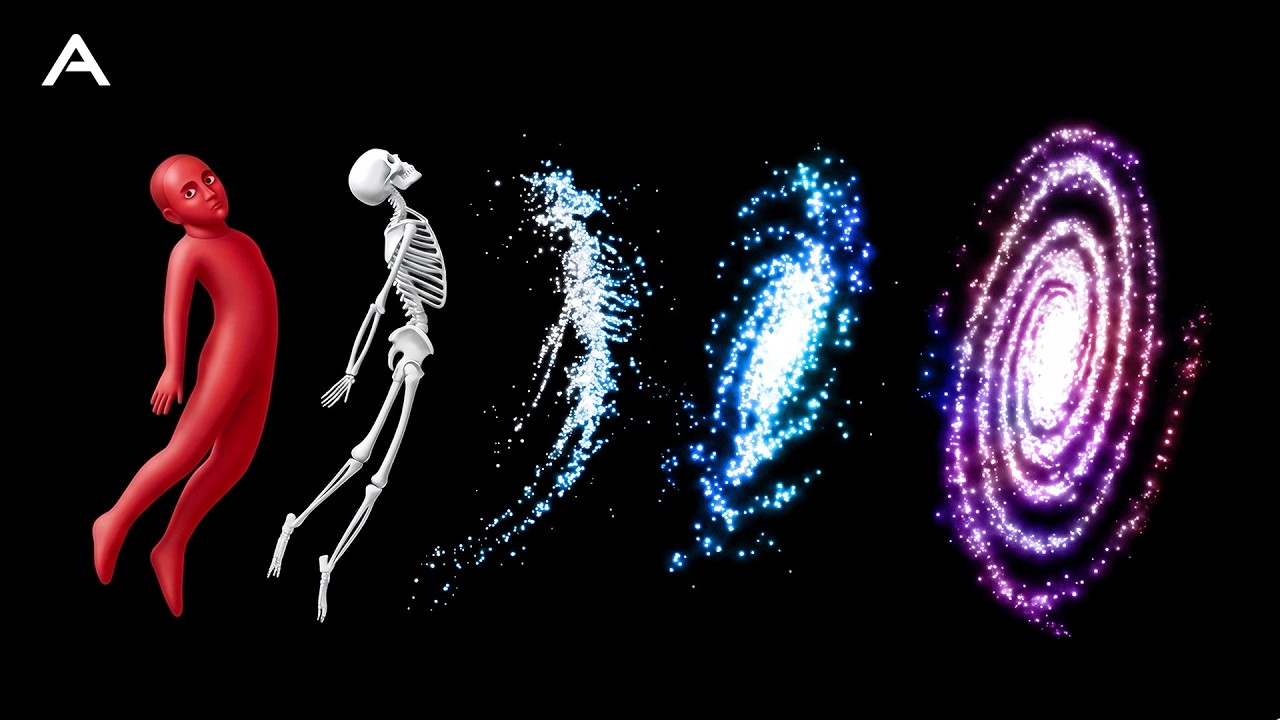
This is a thirty minute essay from Aperture about the one dimension nobody thinks to question: time. It starts from a feeling everyone shares, that there is a single universal "now" we all stand inside together, a whole planet counting down to midnight at the same instant. Then it shows, step by step, that physicists went looking for that shared present in the most complete description of reality we have and could not find it anywhere. There is no variable for the present in any equation.
The film rebuilds the physics that leads there in order. Time is the fourth coordinate every event needs. Einstein and Hermann Minkowski fused space and time into one fabric, which many physicists read as a block universe where past, present, and future all exist at once. Entropy explains why time feels like it flows one way even though the laws do not care about direction. The constant speed of light forces every clock to run at its own rate, proven by the NASA Twins Study. And the relativity of simultaneity means two people passing on a sidewalk can disagree about "now" by days once you view them from the Andromeda galaxy.
The essay ends where the physics gets personal. If every moment is equally real and fixed, then your death already exists at its own address on the map, and so does every moment you have ever loved. This page reconstructs the whole argument, section by section, with every thinker, experiment, and idea named and linked, so you can read it and keep almost everything the video delivers.
The assumption nobody questions
The essay opens not with an equation but with a scene. Somewhere tonight, two people stand in a kitchen watching a clock tick toward midnight. They have decided this is the moment, an anniversary, a birthday, a new beginning, and they are holding on to the idea that when the clock strikes twelve, something real will shift and they will cross a threshold together, at the same instant.
They are not alone. All over the planet, millions of people are counting on the same invisible agreement: that there is a "now," and that it is universal. That the present moment is the one thing we can all point to and say, this is where we are, together.
Then comes the turn that the whole video hangs on. Physicists went looking for that moment and could not find it. Not in the laws of physics, not in any equation, not anywhere in the most complete description of reality that human science has ever built. The present, the one thing you are more certain of than anything else, simply does not appear in the physics. Which leaves two questions the essay spends the next half hour chasing. If time has no "now," why do you feel it so completely? And if that feeling is something your mind is making up rather than something the universe is handing you, what exactly are we all living in?
Dimensions and events: what the fourth number is for
To get at time, the narrator first rebuilds what a dimension even is, and hands the explanation to a clip of his own past self. A dimension is just a direction you can move in. Stand on a straight line and you can only go forward or backward, one independent direction, a one dimensional world. Put yourself on a flat sheet of paper and you gain left and right, two dimensions. Add one more and you have space itself: forward, backward, left, right, up, down, three independent directions, the world we live in. A dimension is simply a new way to move that is not just a combination of the others.
Then the essay does something quietly clever. The narrator points out that the past self in the clip still exists somewhere, because he remembers filming it, and that the version of him speaking today might be saying things that only make sense once future context arrives. The gag is also the thesis in miniature. He is treating his own past and future selves as real places, not vanished ones.
Three dimensions, he notes, are only useful for locating a place, not an event. And event here does not mean a party. It means, literally, a thing that happens. His example is a chicken in the freezer. Your mom leaves for work and tells you to take the chicken out. You instantly understand there is a timeline hidden in that instruction. If she is back by 6:00 p.m., you have a two to three hour window. Three dimensions tell you where the chicken is, in the freezer. They say nothing about when to act. Take it out too early and it spoils. Too late and you get a tongue lashing. The specific valid moment to act is the whole point of the fourth dimension. The moment.
So every real event needs four numbers to make complete sense: three for where it happens and one for when. That fourth number is time.
Einstein and Minkowski: space and time become one fabric
For most of human history, the essay says, space was space and time was time, two different things running alongside each other but never touching. Space was the stage, time was the clock on the wall, completely separate. Then Einstein arrived and quietly dismantled that separation. His theory of special relativity showed that space and time do not merely coexist, they trade off against each other. Move faster through space and time slows down for you. Slow down in space and time speeds up. They are not two separate measurements, they are two sides of the same measurement.
A few years later the mathematician Hermann Minkowski took Einstein's equations and made the implication impossible to ignore. What we experience as space and what we experience as time, he showed, are just different angles on a single four dimensional fabric he called spacetime. If every event carries a fixed four number address, then you can picture them all laid out together as one complete grid, each event sitting on its own permanent coordinate no matter how small or insignificant. Your birth has a four number address. Your first day of school has one. So does your graduation, and every other moment you have ever experienced.
The block universe: every moment already exists
Here the essay states its central move. Those past events are memorable and set behind you, but they have not disappeared from existence. We like to think of time as a movie, each new frame replacing the last, so there is always a clear "current" frame. But unlike a movie, every point in reality sits like a point on a map. There is no current frame, no page being turned. Many physicists favor this reading and have a name for it: the block universe. Past, present, and future are all laid out at once, every moment as real and as permanent as any other.
But the block universe creates an immediate problem, and the essay names it right away. If every moment is equally real, if the map just sits there with no preferred direction, then where does the feeling of forward come from? Why does time only ever seem to move one way?
Before answering, the film pauses on a reflection that doubles as its sponsor read. It notes that the fragility of existence, the kind of fragility exposed by ideas like false vacuum decay, makes it remarkable that matter became alive and life became conscious at all, and argues that this rarity gives us a responsibility to reduce suffering where we can. That leads to the sponsor, Animal Charity Evaluators, a nonprofit that uses evidence and reason to find the animal charities that help the most animals per donation, and its Movement Grants program, which was running a dollar for dollar match up to $300,000 through July 10th, 2026. Then the essay returns to its real question.
Time's arrow: why everything feels like it moves forward
Here is what makes the direction of time strange. The laws of physics do not actually have a direction. Watch two pool balls collide, then run the clip backward. It looks perfectly normal. Nothing in the equations objects to either version. At the level of fundamental physics, time is completely reversible.
Now watch a cup shatter on the floor. That is totally different. You knew instantly it could not be reversed. You will never see the shards leap up and seal themselves back into a cup. Same with a scrambled egg, or an ice cube melting. The direction is obvious, instinctive, and absolute. So here is the contradiction sitting at the heart of reality: the laws of the universe have no preferred direction, yet every single thing you experience does. If nothing in physics points one way, why does everything in life feel like it moves forward and never back?
The answer is entropy, and the essay is careful to strip it of its usual mystique.
Entropy: order is rare, disorder has the numbers
The basic idea is this. At any given moment, there are vastly more ways for things to be disordered than ordered, and the universe drifts toward disorder simply because disorder is more likely. Think about what it takes to be a cup: a specific shape, a minimum volume to hold liquid, walls sturdy enough to carry, a form you can drink from without spilling. The requirements are strict and the window is narrow. Now think about a shattered cup. There are no requirements for the shards. They can be large or small enough to embed in your foot weeks later, jagged or smooth, scattered or piled in a corner. There is no wrong way for a cup to be broken. The number of possible shattered states is almost infinite, while the number of possible cup states is vanishingly small by comparison.
That is what entropy actually means. Not chaos for its own sake, but simple counting. When there are far more ways to be disordered than ordered, disorder becomes the overwhelming statistical favorite, not because the universe prefers it or some force pushes toward chaos, but because a random draw from all possible outcomes almost certainly lands somewhere messier. An unscrambled egg or a reassembled cup is not forbidden by any law. It is just so astronomically improbable that it may never happen once in the entire lifetime of a finite universe.
Thanks to entropy we have a model for the difference between past and future. The past just means a more ordered world. The future is harder to pin down because it holds unfathomably more possibilities. You can see it in memory itself. Think of the past and you can name exactly what you ate for breakfast, recall lottery numbers, sports scores, election results. Think of the future and it looks like disorder: no numbers to predict, no guarantees. The only thing separating past from future for us is an increase in entropy. The direction of time is not in the laws of the universe. It only feels that way because reality is a slope and we live on the downhill side of it. That rush toward the future is not the universe moving, it is you sliding down the slope of entropy.
And that quietly implies something. If the direction of time emerges from probability rather than law, it is not woven into the fabric of the universe the way we assumed. It is a side effect of where we happen to sit on the slope. Which raises a question the essay admits it had been glossing over. We have been talking about sliding down the slope as if everyone does it the same way, at one universal speed for every person, every clock, every corner of the universe. What if your slope runs faster than mine?
Your personal clock: light, and the trade between space and time
The whole concept of time, the essay says, rests on one strange fact about light, and to see why it is strange we start somewhere ordinary. Stand on a platform as a train speeds past. Someone on board rolls a ball forward. To them it moves at rolling speed. To you on the platform it moves at rolling speed plus the train's speed. The two speeds stack. That is how motion works, the most intuitive thing in the world.
Now swap the ball for a beam of light. Common sense says the light should pick up the train's speed on top of its own, just like the ball. It does not. You on the platform and the passenger on board both measure that beam moving at exactly the same speed. Not approximately, exactly. It does not matter if you run toward it, race away from it, or chase it on the fastest rocket ever built. Light always clocks in at around 300,000 km per second. No exceptions, no adjustments, no stacking.
That single fact breaks everything comfortable about time. Speed is just distance divided by time. If light measures the same for everyone no matter how they move, then their distances and their times cannot match. Something has to give, and what gives is space and time themselves. The universe would rather warp your ruler and slow your clock than let light travel at any other speed. Space and time are not fixed neutral containers that everything happens inside of. They bend, stretch, and run at different rates depending on how you move through them.
The essay frames this as a budget. When you are sitting still, you are not moving through space at all, so all of your motion is spent moving through time. In effect you are racing toward the future at maximum speed while standing physically still. Start moving through space and some of that budget diverts into your speed through space. You trade speed through space for speed through time and back. This is time dilation, and the narrator is honest about the limit of the metaphor: you cannot run out of the resource and you cannot choose how to spend it. You are always spending the full amount. The only thing that changes is how much goes into moving through space and how much is left over for moving through time.
The NASA twins: relativity, measured
To prove this is real and not a thought experiment, the essay reaches for actual astronauts. Scott Kelly spent nearly a year aboard the International Space Station while his identical twin Mark stayed on Earth. The NASA Twins Study measured how a year in orbit changed Scott's body down to his genes, and found that moving at a much greater speed than his twin left Scott roughly 5 milliseconds younger than his brother.
Five milliseconds is not the stark, hair whitening drama of Christopher Nolan's Interstellar. But the point is not the size of the gap. The point is that the effect is factually proven, with no measurement error and no illusion. Everyone's clock really is running at its own rate. You are sliding down the universe's slope of entropy at a pace only you possess.
Now is the time: whose present is real?
This is where the personal clocks turn into a genuine dilemma. Go back to the couple holding hands, vowing to cross into new beginnings together at midnight. They believe time is the one thing they can count on in a chaotic world. They are both wrong. We exalt the clock as the thing that keeps us relative to one another, yet we have lived in different states of motion our whole lives. Our clocks have always disagreed. And if they cannot agree on how fast time runs, a worse question waits: can they even agree on what is happening right now?
"Now," by definition, is supposed to be a universal moment. But according to relativity it is unique to whoever experiences it. Your "now" is a slice through the grid of spacetime that connects everything happening at once, and which slice counts depends on your motion. Move differently and your slice tilts. Because no one's motion is the true motion, no one's slice is the real "now" either. Physicists call this the relativity of simultaneity.
The Andromeda paradox: a step on the sidewalk shifts "now" by days
The reason nobody notices is that the differences are usually far too subtle to feel. But add distance and the tilt becomes enormous. The essay borrows a scenario from the physicist Roger Penrose. Two people pass each other on a sidewalk, strolling in opposite directions at a normal walking pace. Here on Earth their slices of "now" look identical. But the Andromeda galaxy is 2 and a half million light years away, and from that distance the tiny difference between two walking speeds fans out into a huge gap. For the person walking one way, the "now" slice cutting through Andromeda includes one set of events. For the person walking the other way, it includes events days apart. Two directions, two perspectives, wildly different times across the scale of the universe. This is the heart of the Rietdijk Putnam argument: if there is no shared "now," the future events one observer already counts as real are as fixed as the past.
The weirdest part, the essay stresses, is that there is no canon event to point to, no master clock the universe keeps in a back room to settle who is right. And this is not a limit of our instruments. We will never invent a better clock that finally syncs everyone up. The fix is impossible because there is nothing to fix. Reality genuinely has no fact about whose "now" is the real one, because there is no real one. Billions of versions of this moment exist, all equally true, and nothing anywhere decides between them.
The universe is not doing this to confuse us. If anything, the essay says, we have overrated our own influence over reality. We deluded ourselves into thinking that because we share experiences, a universal present must be guiding us forward. We were wrong. The universe refuses to have a present. The shared "now" you always imagined, a whole planet counting down to midnight, every living person standing in the same instant, was never something the universe held for you. It feels special, but the reason is mundane: we are all riding one big blue spaceship drifting through the cosmos, so of course our slices of "now" seem to coincide. That agreement is a local accident, not a cosmic fact, a consequence of sharing the same rock at the same speed in the same tiny corner of an indifferent universe. Stretch past that bubble and the agreement dissolves. From the universe's perspective, there is no now, and there never was.
| The question | The flowing present (presentism) | The block universe (eternalism) |
|---|---|---|
| What is real? | Only the present moment. The past is gone, the future not yet born. | every moment Past, present, and future all sit on the map as fixed coordinates. |
| What moves? | The present sweeps forward, one frame replacing the last, like a movie. | nothing flows The map never changes. The sense of motion is you, sliding down entropy. |
| Is "now" universal? | Assumes one shared cosmic present that everyone stands inside together. | no shared now Each observer's slice tilts with motion, so simultaneity is relative. |
| What is your death? | An event still to come, somewhere up ahead down the road. | already fixed A permanent address on the map, as real as this moment. |
| Does physics need a "present"? | Yes, it is the most certain thing we know. | math works without it No equation contains a variable that flags one moment as current. |
The missing bookmark: the one thing physics cannot hold
And yet, here you are, feeling it completely. That, the essay says, is the part physics has no answer for. Not the direction of time, entropy handles that. Not the relativity of clocks, special relativity handles that. The thing physics cannot account for is the one thing you are most certain of: the feeling that something is happening, that this is now, that you are inside it rather than watching from outside.
Physics is the most complete description of reality our species has ever built. Every moment is accounted for, every coordinate in spacetime mapped and described. And yet nowhere in any equation is there a variable for the present, no term that says this moment, specifically this one, is the one that is real. The math works perfectly without it. The universe apparently does not need it.
The essay lands this with its best image. Think about a book. Every page is already printed before you open it. The story is fixed, finished, complete. But nothing in the book marks one page as the one being read right now. The book does not know or care where you are in it. You know where you are. You create the bookmark, but never the book. The knowledge of the present lives in the reader, not the text. Physics is that book. It describes every page of reality with extraordinary precision, every moment, every coordinate, every event across the whole history of spacetime. But it contains no bookmark. There is no mechanism in the laws of reality for flagging one moment as current, no equation that reaches out and says, right here, this one, this is now, we have settled it. If physics has no arrow to direct us and no now to ground us, then where do we really belong?
Death already exists
Here the question stops being abstract and gets personal fast. If every moment is equally real, if nothing gives the present special status over the past or future, then your death already exists. It is not approaching you. It is not waiting somewhere up ahead just down the road. It is already real, already fixed, sitting at its own address on the map the same way this moment is. Think of the person you would never want to lose, a parent, a partner, whoever that is for you. The day you lose them is not coming. It is already there, finished and permanent, as real as the moment you are living in now, whether you have reached it or not.
We tell ourselves that dreaded day is coming, and, strange as it is to admit, there is comfort in that. Coming means maybe later, maybe never, maybe you will manage it on your own terms, maybe you will be ready. But the block universe does not bend like that. Death is not in an Uber arriving soon. It is already there, and there is no version of the timeline without it. You are like someone tracing a route across a map with a finger. The map does not change when you trace it. You move toward things you would give anything to avoid, and not a single line shifts. You are reading a finished book, mistaking yourself for the writer and the page you are on for the page being written. But the page was already there before you opened it, and so are all the ones after it, right up to the very last.
Then the essay turns the same fact into consolation, and insists this is a truth worth holding on to. If the worst day is permanent, so is the best one. The day you were happiest is still there, finished and intact, exactly as it was, and nobody you have lost is gone. They are not erased. They are elsewhere on the map, in the moments you shared, exactly where you left them.
To close, the film reaches for Einstein himself. After the death of his lifelong friend Michele Besso in 1955, Einstein wrote a letter of condolence to Besso's grieving family. In it he said that for those who accept physics, the separation between past, present, and future is only a stubbornly persistent illusion. A month after writing it, Einstein died too. Intended for a grieving family, that line also cuts straight into how time works. To Einstein, Besso was never truly gone. The moments they shared still existed, and still do. The block universe takes something from you. But it also gives something back, and what it gives back is permanent in exactly the same way the loss is.
- 1905Einstein publishes special relativity. The speed of light is the same for every observer, so space and time must warp to keep it constant, and moving clocks run slow.
- 1908Hermann Minkowski unifies them. "Henceforth space by itself, and time by itself, are doomed to fade into mere shadows." He fuses the two into a single four dimensional spacetime.
- 1955Einstein writes to the Besso family. The divide between past, present, and future, he tells them, is "only a stubbornly persistent illusion." He dies roughly a month later.
- 1989Roger Penrose sharpens the paradox. In The Emperor's New Mind he shows two people passing on a sidewalk can disagree about what is happening "now" at Andromeda by days.
- 2015 to 2016The NASA Twins Study measures it. Scott Kelly returns from a year in orbit about 5 milliseconds younger than his identical twin Mark. Relativity, confirmed in human tissue.
Key takeaways
- Every real event needs four numbers to be located: three for where and one for when. Time is the fourth dimension, the coordinate that turns a place into an event.
- Einstein's special relativity showed space and time trade off, and Minkowski fused them into one spacetime fabric. Read literally, that gives the block universe where every moment already exists.
- The laws of physics are reversible and have no built in direction. The one way flow of time comes from entropy: there are astronomically more disordered states than ordered ones, so reality slides toward disorder, and we call that slide "forward."
- Because the speed of light is the same for everyone, every clock runs at its own rate. The NASA Twins Study measured it: Scott Kelly came home about 5 milliseconds younger than his twin.
- The relativity of simultaneity means "now" is not universal. Roger Penrose's Andromeda galaxy scenario shows two walkers can disagree about the present by days across cosmic distance.
- Physics maps every event yet has no variable for "now." Like a printed book with no bookmark, it describes every page but never marks the one being read. The present lives in the reader.
- If the block universe is right, your death already exists at a fixed address, and so does every moment you have loved. As Einstein wrote to the Besso family, the divide between past, present, and future is a stubbornly persistent illusion.
Chapters
0:00 The terrifying secrets of the time dimension 2:00 Dimensions and Events 10:47 Time's Arrow 16:11 Your Personal Clock 21:09 Now is The time 25:14 The Missing Bookmark 27:15 Death Already Exists
Notable quotes
- 0:24 "The assumption is this, that right now is something every one of us shares."
- 1:38 "The present, though, the one thing you are more certain of than anything else, simply doesn't exist."
- 9:40 "Past, present, and future are all laid out at once, every moment as real and as permanent as any other."
- 15:20 "That rush you feel moving towards the future isn't the universe moving, it's you sliding down the slope of entropy."
- 18:20 "The universe would rather warp your ruler and slow your clock than allow light to travel at any other speed."
- 21:40 "Our clocks have always disagreed. And if they can't agree on how fast time runs, there's a worse question waiting for us. Can they even agree on what's happening right now?"
- 24:30 "From the universe's perspective, there is no now, and there never was. We just never had a reason to look far enough to notice."
- 26:40 "You know where you are, you create the bookmark, but never the book. The knowledge of the present lives in the reader and not the text."
- 27:20 "Your death already exists. It's not approaching you. It's not waiting somewhere up ahead just down the road."
- 30:00 "The block universe takes something from you. But it also gives something back. And what it gives back is permanent in exactly the same way loss is."
Resources mentioned
- Aperture, the channel, and the original video, Something strange happens when you accept time as the 4th Dimension.
- Albert Einstein and his theory of special relativity.
- Hermann Minkowski and the unification of space and time into spacetime.
- The block universe, the eternalist reading of time, set against presentism.
- Entropy, the arrow of time, and the counting of microstates.
- The speed of light and time dilation.
- The NASA Twins Study with astronauts Scott Kelly and Mark Kelly aboard the International Space Station.
- Christopher Nolan's film Interstellar.
- The relativity of simultaneity, Roger Penrose's Andromeda galaxy scenario, and the Rietdijk Putnam argument.
- Michele Besso and Einstein's 1955 letter of condolence to his family.
- False vacuum decay, referenced in the reflection on the fragility of life.
- Animal Charity Evaluators, the sponsor, and its Movement Grants program.
Where it stands
Read straight through, the essay is careful physics wrapped around one contested interpretation, and it is worth separating the two. The physics is not in dispute. Special relativity, time dilation, and the relativity of simultaneity are among the most tested ideas in science, the Twins Study is real, and the Andromeda paradox follows directly from the math. Where the film makes a choice is in reading the block universe as the literal truth of reality rather than as one interpretation among several. Eternalism is genuinely popular among physicists, but it is not settled. Presentism and the growing block view still have serious defenders, and some physicists, including proponents of certain approaches to quantum gravity, argue the flow of time may be more fundamental than relativity alone suggests.
The honest gap the film itself names is the hardest one: even granting the block universe, the vivid feeling of a present moment is left completely unexplained. That is not a small footnote. It is close to the hard problem of consciousness, and pointing out that physics has no term for "now" does not tell you whether the present is an illusion the brain manufactures or something real that our physics is simply missing. The essay is at its strongest when it stays descriptive and at its most speculative when it turns the block universe into consolation about death. That the moments you loved are "still there" on the map is a beautiful thought, but it rests on the same interpretation still being argued over. Taken as a tour of what relativity actually implies, the video is accurate and unusually clear. Taken as a verdict on whether the present is real, it is one honest reading of the evidence, offered with more warmth than most.