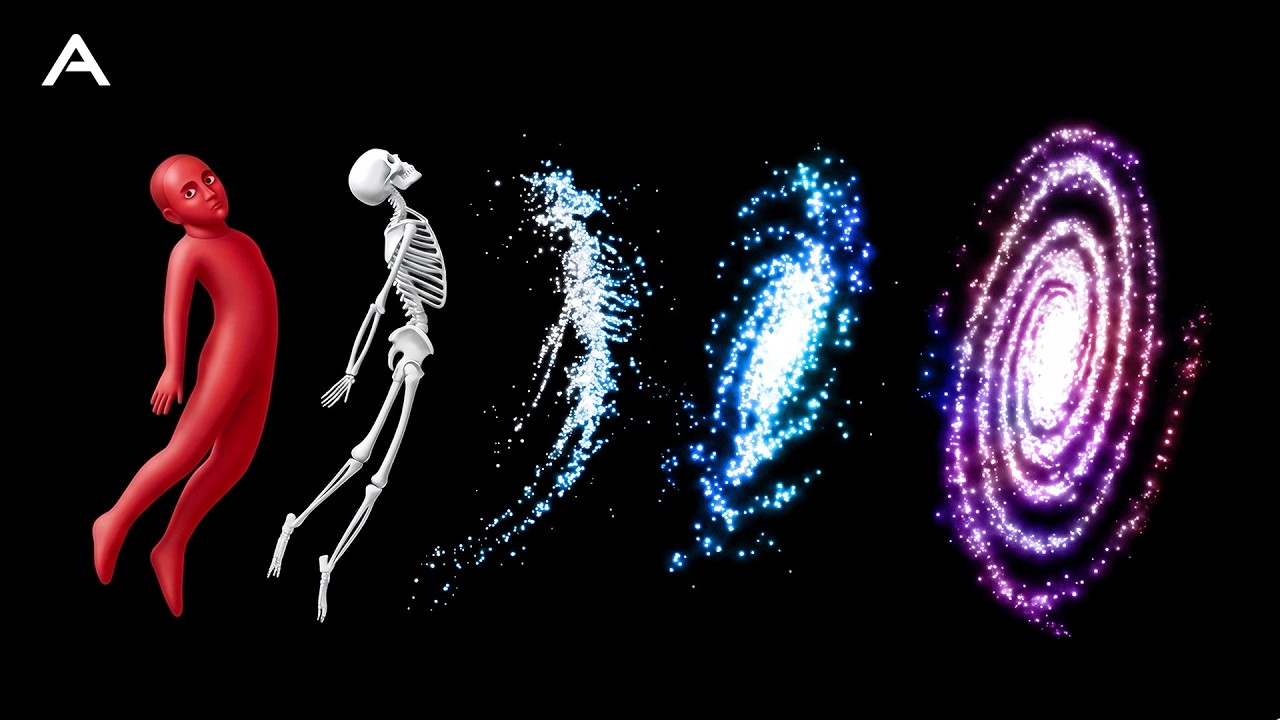
Why Traveling at Light Speed Would Destroy You Before You Even Arrive
A two hour Calm Space night documentary that dismantles science fiction's favorite assumption: that light speed travel is a technology problem waiting on a better engine. Working entirely from established physics, it shows the barrier is an asymptote, not a wall. Time dilation severs travelers from home, the interstellar medium becomes a relativistic particle beam, the cosmic microwave background blueshifts into hard X-rays on the bow, and even a perfect antimatter rocket needs propellant quantities 21 orders of magnitude beyond world production. The conclusion is quietly optimistic anyway: the speed of light is the speed of causality, the stars remain reachable at perhaps 10% of light speed, and the realistic path runs through slow unmanned probes and a civilization patient enough to wait.
Published Jul 21, 20262:13:16 video81 min readAdded Aug 21, 2026Open on YouTube →
At a glance
This is a two hour thirteen minute Calm Space night documentary that takes the most seductive idea in science fiction, traveling at the speed of light, and walks through everything the physics actually says about the attempt. The verdict arrives in the first minute and the rest of the video earns it: even if every technical barrier vanished overnight, the journey itself would destroy you before you arrived anywhere. The argument is a cascade, not a single obstacle. Time dilation severs you from home, the Lorentz factor makes each additional bit of speed cost more than the last without limit, the near vacuum between stars turns into a relativistic particle beam aimed at your hull, the gentle cosmic microwave background blueshifts into hard X-rays, and the propellant arithmetic lands twenty one orders of magnitude beyond anything civilization can produce.
What makes the video better than the usual debunk is the destination it actually reaches. The speed of light is not a record waiting to fall; it is the speed of causality, the structural reason cause precedes effect and chemistry and minds can exist at all. The stars stay reachable, just slowly, at perhaps 10% of light speed, on civilizational timescales, by probes before people. This page rebuilds the whole narration in order, keeping every number, derivation, thought experiment, and consequence, so you can take the entire journey without the 2 hour 13 minute runtime.
The deep explanation
The dream, and the sentence that ends it
The video opens the way Calm Space always does, quietly, at night, with a single idea placed on the table: the dream that someday we will travel at the speed of light. Fire the engines, pierce the darkness between star systems, and arrive somewhere new, somewhere extraordinary, in days or weeks rather than lifetimes. It is the silent assumption underneath almost every science fiction story ever written.
And then the sentence that the next two hours will spend earning. Even if every technical barrier vanished overnight, even if you had the ship, the fuel, the energy, all of it, even if you somehow reached the speed of light, the journey itself would destroy you before you arrived anywhere. Because the same physics that makes light speed the fastest possible thing in the universe is also what makes the attempt to reach it so destructive. By the end, the narrator promises, you will understand why light speed travel is not the escape from distance it is made out to be, and why the universe fights back harder the closer you get.
The number: 299,792,458 meters per second
The speed of light in a vacuum is 299,792,458 meters per second. In miles per hour, about 670 million. It is the absolute speed limit of the known universe. Not a record waiting to be broken. Not a ceiling assembled from some material that has not been discovered yet. A structural feature of reality, encoded into the mathematics that describes space, time, mass, and energy.
Nothing with mass has ever reached it. Nothing with mass ever will. And the reason is not a failure of engineering. It is a consequence of what mass is, what space and time are, and how the three are locked together at high velocities. To understand why light speed travel destroys you, you first have to understand what happens as you approach it, because the approach alone is already catastrophic.
Bern, 1905: the patent clerk who believed the experiment
Albert Einstein published his special theory of relativity in 1905. He was 26 years old, working as a patent clerk in Bern, Switzerland, and in his spare time he was thinking about light. Physicists of the era were wrestling with a genuine inconsistency. James Clerk Maxwell's equations, formulated in the 1860s, described electromagnetism and predicted that light travels at a fixed speed. But classical Newtonian mechanics said speeds should add and subtract the way common sense demands. Stand on a moving train, throw a ball forward at 30 miles per hour, and relative to the ground the ball moves at your throwing speed plus the train's speed. Simple addition.
Except every experiment that tried to detect the expected variation in the speed of light, based on the motion of the measuring equipment, returned the same answer. Light always arrived at the same speed. It did not add. It did not subtract. It appeared entirely indifferent to how fast the observer was moving. Most physicists of the era assumed the experiments were imperfect, or that some subtle unaccounted effect was masking the true variation. Einstein did something different. He accepted the experimental result as a fact about the universe rather than an artifact of flawed measurement, and asked the question that follows from taking it seriously: if the speed of light is genuinely the same for all observers, regardless of their motion, what must be true about space and time?
The answer shattered every common sense assumption about how the universe works. The answer was special relativity.
Two postulates, and a universe that bends to keep them
Special relativity rests on two postulates. First, the laws of physics are identical for all observers moving at constant velocity relative to each other. Second, the speed of light in a vacuum is the same for all observers, regardless of the motion of the source or the observer.
That second postulate sounds contained. It is not. If light always moves at the same speed from every perspective, then space and time cannot behave the way Newton assumed. They cannot be fixed, universal, absolute. They must bend and flex and distort in exactly the ways needed to preserve the constant speed of light from every frame of reference. This is not a figure of speech. It is a measurable, testable, experimentally confirmed feature of the physical universe.
The video stacks the receipts early. GPS satellites must account for relativistic effects in their time calculations or their position readings drift by miles per day. Particle accelerators confirm that particles gain effective mass as they approach light speed, exactly as the equations predict. Muons produced by cosmic ray interactions in the upper atmosphere should decay before reaching the ground based on their rest frame lifetimes; they reach it anyway, because time dilation extends their apparent lifetime as measured from Earth. The framework is correct to extraordinary precision. And what the framework says about a traveler approaching light speed is clear, specific, and deeply unfriendly to anything biological.
The first consequence: time dilation
Time does not pass at the same rate for everyone. This is not a perception or a psychological effect. It is the actual behavior of time as a physical dimension. A clock moving relative to you ticks slower than a clock at rest relative to you. Not because of vibration or interference or any mechanical effect. Because time itself is passing more slowly for that clock. Every physical process inside a moving frame runs more slowly as measured by someone not moving with that frame.
The amount of slowing depends on velocity, and the mathematical relationship involves what physicists call the Lorentz factor, traditionally written as the Greek letter gamma: gamma equals 1 divided by the square root of 1 minus velocity squared over c squared, where c is the speed of light. At low velocities the Lorentz factor is essentially one and time passes at the same rate everywhere. As velocity climbs toward c, gamma grows, and the video walks the ladder rung by rung:
At 10% of light speed, gamma is about 1.005. A clock moving that fast ticks at about 99.5% the rate of a clock at rest. Barely noticeable.
At 50% of light speed, gamma is about 1.155. Time passes at about 87% the rest rate.
At 90%, gamma is about 2.3. Time passes at about 44% the rest rate.
At 99%, gamma is about 7.1. Time passes at about 14%.
At 99.9%, gamma is about 22.4. Time passes at less than 5% the rate it passes for someone at rest.
As velocity approaches exactly the speed of light, the Lorentz factor approaches infinity. For something moving at exactly light speed, no time would pass at all. From the photon's frame of reference, if we could speak of one, it is born at its source and arrives at its destination simultaneously. There is no journey. There is no duration.
For a massive traveler pushing toward light speed, this seems at first like a solution to the interstellar travel problem. If time moves slowly for the traveler, you could in principle traverse enormous distances in a short subjective experience. At 99% of light speed toward a star 40 light years away, the crew experiences about five and a half years while the outside universe experiences just over 40. At 99.9%, the crew experiences less than 2 years. Science fiction loves this. It is the part of relativity that seems to help. The problem is everything that comes with it.
Figure 1. The Lorentz factor against speed, plotted from the video's own numbers. Everything relativistic scales with this curve: how slowly your clock runs, how much your effective mass grows, how much energy the next increment of speed costs. The curve is flat for most of the range, then goes vertical. That shape is the entire story of why 90% of light speed is hard, 99% is brutal, and 100% is not a bigger number but an infinity.
The second consequence: length contraction
From the perspective of something moving at relativistic speed, space in the direction of travel compresses. The actual physical distance that must be crossed shrinks. Not on a map, not as a subjective illusion; actually shorter, as measured by instruments aboard the moving ship. At 50% of light speed, distances in the direction of travel are about 87% of their rest values. At 90%, about 44%. At 99%, about 14%.
The compression factor is the same as the time dilation factor, and this is not a coincidence. Space and time are not independent. They are two aspects of a single four dimensional structure called spacetime. Moving through spacetime redistributes the four dimensional interval between its spatial and temporal components. Moving fast through space means time moves slowly for you. Moving slowly through space means time moves at the standard rate. The total four dimensional interval is conserved. You cannot have both large spatial distances and fast time simultaneously. The universe trades one against the other, and the trade is described exactly by the Lorentz factor.
For the observer at rest watching the traveler go past, the traveler appears compressed in the direction of motion and the traveler's clocks appear to run slow. For the traveler, the space ahead appears compressed and time appears normal while outside time races ahead. Both are real. Both are consistent. Neither observer is privileged. Both are measuring a universe where space and time are not absolute, and both are correct.
The third consequence: the asymptote
The third consequence is the one that establishes the absolute ceiling on speed, and it is the one that begins the process of destruction. As an object accelerates, it gains kinetic energy. At relativistic speeds, that kinetic energy does not just increase the object's speed. It increases the object's effective mass. This is a direct consequence of E = mc². Mass and energy are not different substances. They are the same thing expressed in different forms. A joule of kinetic energy added to a moving object is equivalent to a tiny increment of additional mass.
At everyday velocities this contribution is unmeasurably small. As you approach the speed of light, kinetic energy grows enormously, and so does the effective mass. The relativistic mass of an object equals the rest mass times the Lorentz factor. At 10% of light speed, about half a percent higher than the rest mass. Negligible. At 50%, about 15% higher. At 90%, about 130% higher, more than double. At 99%, about 600% higher, seven times the rest mass. At 99.9%, more than 21 times the rest mass.
A heavier object requires more force to accelerate further. More force requires more energy. More energy contributes more mass. More mass requires more energy still. The cycle compounds without exit. The energy required to reach any given fraction of light speed equals the rest mass energy times the Lorentz factor minus one, and as the Lorentz factor approaches infinity, the required energy approaches infinity. To reach exactly light speed you would need infinite energy. Not a large amount. Not a number we cannot currently produce but might someday. Infinite. Without limit. The universe does not provide infinite energy.
This is why mass cannot reach the speed of light. Not because the engines are not powerful enough yet, but because the mathematics of spacetime, verified to extraordinary precision for over a century, prohibits it structurally. The video lands the line that frames everything that follows: the barrier is not a wall to be broken. It is an asymptote. You can approach it forever. You cannot reach it.
And now, the narrator says, hold all of that in mind. Because even before you reach light speed, even on the way toward it, the universe begins a cascade of physical processes that no ship, no crew, no technology we can imagine has any answer to. And it starts with something so basic it is easy to underestimate.
Interstellar space is not empty
Space between stars is not empty. It looks empty from Earth. The night sky appears to be darkness with scattered points of light, and the distances between those points seem like pure void. They are not void. The interstellar medium is the name physicists give to the material filling the space between stars, and it contains gas, dust, charged particles, and radiation in quantities that are individually tiny but collectively devastating at the right velocities.
The average density of the interstellar medium in the plane of the Milky Way is roughly one hydrogen atom per cubic centimeter. In some regions, near molecular clouds and stellar nurseries, the density is thousands or millions of times higher. In the hot rarefied bubbles carved by supernova shock waves it drops to nearly nothing. But for a typical path between nearby stars, one atom per cubic centimeter is a reasonable working estimate. There is also helium, making up about 8 to 10% of the gas by number. Heavier elements in traces. Dust grains ranging from large complex molecules to solid particles roughly a fraction of a micron across. Free electrons and ions from stellar radiation and cosmic ray interactions. And electromagnetic radiation at every wavelength.
At the velocities humans have ever traveled, none of this registers as a meaningful obstacle. A spacecraft moving at a few tens of miles per second sweeps through a negligible volume of interstellar space per second, and each atom it encounters imparts essentially no energy to the hull. As velocity climbs toward relativistic values, everything changes.
Three quadrillion impacts per second
At 10% of light speed, a ship with a frontal cross section of 100 square meters sweeps through approximately 3 billion cubic meters of space per second. At one hydrogen atom per cubic centimeter, that is roughly three quadrillion hydrogen atoms per second striking the front of the ship. Three quadrillion. Every second.
Each hydrogen atom striking the hull at 10% of light speed carries kinetic energy of roughly 7.5 × 10⁻¹³ joules in the ship's reference frame. A tiny number per atom. Multiply by three quadrillion atoms per second per square meter of frontal area and the deposited power becomes significant. Not immediately lethal at 10% of light speed, but significant enough to erode materials over time, to deposit heat in the leading surfaces, to produce secondary radiation that penetrates further into the ship.
Then the scaling laws take over, and the video states them plainly. The rate of particle encounters scales linearly with speed. The kinetic energy per encounter scales with the square of speed. The total power deposited in the hull scales with the cube of speed. Push to 50% of light speed and the arithmetic becomes brutal. At 90% of light speed, those hydrogen atoms are not a nuisance anymore. In the ship's reference frame they are approaching at 90% of light speed. They are cosmic rays: high energy protons slamming into the leading face of the hull with energies that ionize material, produce secondary radiation, and physically remove atoms from the surface.
That removal process is called sputtering. It is well understood from experimental physics and from decades of studying how spacecraft surfaces degrade in Earth orbit, where cosmic ray and solar wind particle fluxes at far lower energies still measurably erode surfaces over years. At relativistic speeds, sputtering becomes catastrophic erosion. The leading face of the hull would be continuously removed, atom by atom and cluster by cluster, at a rate no replenishment mechanism could match. There is no alloy, no ceramic, no composite material that has ever been tested or theorized that survives indefinite exposure to this flux at relativistic velocities. The engineering problem is not finding a stronger material. It is confronting a process that consumes any material, by the laws of physics that govern particle and matter interactions.
Dust grains: a detonation every twelve seconds
The dust makes the problem categorically worse. Interstellar dust particles are rare by number compared to atoms, but at relativistic speeds even a single encounter is a catastrophic event. A typical interstellar dust grain is a fraction of a micron across, with a mass of roughly 10⁻¹⁸ kilograms, one femtogram.
At 10% of light speed, that grain carries kinetic energy of roughly 4.5 × 10⁻⁴ joules when it strikes the hull. Less than half a millijoule, which sounds like nothing, except it is delivered into an impact area measured in square microns. The local energy density is enormous. The grain vaporizes. The surrounding hull material vaporizes. A tiny crater forms, and the encounter produces a brief burst of plasma and secondary radiation. The diffuse interstellar medium contains roughly one dust grain per several hundred billion cubic meters in typical regions between stars, so at 10% of light speed with a 100 square meter frontal cross section, the ship encounters one grain every 100 seconds or so. A tiny explosion on the leading face roughly every 2 minutes, over years of travel. Manageable, perhaps, if the hull is thick enough.
Push to 90% of light speed and the same grain carries roughly 0.1 joules at impact, delivered into square microns, still enough to vaporize material and throw off plasma and secondary radiation, and the encounter rate is nine times higher. A small explosion on the hull every 12 to 15 seconds, on average, over months, over years. The cumulative damage is not an engineering challenge to be managed with thicker shielding. It is a continuous process of destruction with no steady state. Whatever mass is added to the leading face as shielding is removed, grain by grain, at a rate that scales with the velocity squared. The faster you go, the faster the destruction, and there is no velocity at which the process stops.
Figure 2. The leading face of a relativistic ship is not a structural element, it is a collision zone. Hydrogen atoms arrive as a continuous cosmic ray beam, dust grains arrive as micro detonations, and the gentlest radiation field in the universe arrives as X-rays. All three scale up together as velocity rises, and shielding against any of them adds mass that makes the ship harder to push.
The gentlest light in the universe becomes an X-ray gun
The electromagnetic radiation environment adds a third category of assault, and this one operates independently of any particles in space. Even if you could strip every atom and dust grain from the path between stars, the photons would remain. The universe is filled with electromagnetic radiation, from every direction, at all times. Visible light from nearby and distant stars. Infrared from warm dust clouds and stellar remnants. Radio waves from pulsars, hydrogen clouds, and interacting star systems. X-rays from stellar coronae, hot gas in galaxy clusters, and compact objects. Gamma rays from neutron star magnetospheres, supernova remnants, and matter falling into black holes. And underlying all of it, the cosmic microwave background.
The CMB is the remnant glow of the early universe. In the first few hundred thousand years after the Big Bang, the universe was hot enough that electrons and protons were separate. It was opaque; photons could not travel freely. Then, as the universe expanded and cooled to a few thousand Kelvin, electrons combined with protons to form neutral hydrogen, the universe became transparent, and the photons that had been bouncing around inside the opaque plasma were suddenly free. They have been traveling ever since. As the universe expanded, those photons stretched with it. Their wavelengths grew longer, their energies dropped, and what started as the glow of a plasma at thousands of Kelvin is now a whisper of microwave radiation at about 2.7 Kelvin, peak wavelength about 1.9 millimeters, photon energies roughly 6 × 10⁻⁴ electron volts. At rest, or at ordinary velocities, the CMB is harmless. It took dedicated, sensitive instruments to detect it at all. It is the quietest, most pervasive radiation field in the universe. It is also completely inescapable.
And at relativistic speeds, it becomes something else entirely. A ship moving toward a source of electromagnetic radiation experiences those photons Doppler shifted to higher frequencies, the same way a siren sounds higher pitched as it approaches. For photons arriving from directly ahead, the energy shift factor equals the square root of (1 + v/c) divided by (1 − v/c). The video runs the ladder again:
At 10% of light speed the factor is about 1.1. CMB photons from ahead appear 10% more energetic. Still microwave. Still harmless.
At 50%, about 1.73. The microwaves now arrive as infrared. Still not dangerous.
At 90%, about 4.4. The CMB from ahead arrives as visible light and near ultraviolet.
At 99%, about 14. Ultraviolet to soft X-ray.
At 99.9%, about 44. The cosmic microwave background photons arriving from directly ahead are now hard X-rays.
The gentlest radiation field in the universe has been transformed, by the ship's velocity alone, into an X-ray source aimed at the front of the ship. And there is a second effect stacked on top. The flux of photons from ahead is also enhanced: the ship is moving into the radiation field, so more photons arrive per second from the forward hemisphere, and the total forward radiation flux scales as the Lorentz factor squared. At 99% of light speed the forward flux is roughly 50 times more intense than at rest, and each photon carries about 14 times more energy. The combined radiation power on the leading face is roughly 700 times what a stationary object at the same location would receive. Seven hundred times the X-ray dosage, with no practical shielding that stops high energy X-rays without simultaneously adding so much mass that the energy requirements to accelerate become impossibly higher.
Speed
Lorentz factor
Crew clock rate
Distance ahead
Effective mass
The CMB from dead ahead
10% of c
1.005
99.5%
99.5%
+0.5%
Microwave (×1.1), harmless
50% of c
1.155
87%
87%
+15%
Infrared (×1.73), harmless
90% of c
2.3
44%
44%
2.3× rest mass
Visible to near ultraviolet (×4.4)
99% of c
7.1
14%
14%
7× rest mass
UV to soft X-ray (×14), ~700× power
99.9% of c
22.4
under 5%
under 5%
21× rest mass
Hard X-rays (×44)
100% of c
infinite
frozen
zero
infinite
Requires infinite energy: forbidden
Figure 3. The relativistic ledger, assembled from the video's numbers. Every column is the same Lorentz factor wearing a different costume. The time dilation that science fiction loves and the mass growth and radiation blueshift that kill the trip are not separate effects; they are one geometric fact about spacetime, and you cannot take the first without the rest.
The trap: every fix makes another problem worse
This is the trap, and the video names it precisely. Every solution to one problem makes another worse. Thicker shielding stops more radiation but adds mass. More mass requires more energy to accelerate. More energy means more relativistic mass increase. More relativistic mass requires more energy still. The problems are coupled. Pulling on any one thread tightens the knot.
The body was built for Earth
The people inside the ship are not insulated from any of this. Even in the hypothetical scenario where the hull is somehow indestructible and all external radiation is perfectly blocked, the crew is still being destroyed from within, by the same physics that makes extended deep space travel hostile to all biological life.
The human body evolved on Earth, calibrated to a specific environment. One standard gravity. A nitrogen and oxygen atmosphere at a specific pressure. An electromagnetic radiation environment filtered by a thick atmosphere and a planetary magnetic field. A microbiome, a set of social relationships, a sleep cycle tied to a 24 hour rotation. The body is not a general purpose machine that can adapt to any environment. It is a highly specialized system optimized for exactly the conditions in which it developed. Remove those conditions and the body adapts, but the adaptation is not always beneficial.
Begin with gravity. In a spacecraft under sustained thrust at one gravity, the crew feels normal weight. But between the acceleration and deceleration phases, during cruise, the ship is coasting. No net force, no simulated gravity unless the ship rotates. And rotation has its own physiological price. A rotating section has a gradient: zero effective gravity at the center of rotation, full effect at the rim, and any crew member moving between areas experiences that gradient continuously. The vestibular system, the inner ear's balance and motion detection apparatus, is exquisitely sensitive to rotation, and the Coriolis effect inside a rotating frame produces what feels like a force deflecting motion sideways. At the rotation rates needed to generate meaningful simulated gravity in a realistically sized spacecraft, the Coriolis effect is noticeable and disorienting. The minimum radius at which most people can tolerate rotation without severe motion sickness is thought to be around 150 to 200 meters, and a spacecraft with a rotating section that size is an enormous structure, enormously expensive to build and launch, adding straight onto the mass problem.
Extended weightlessness, when it occurs, causes changes that compound over time. Bone density falls at roughly 1 to 2% per month in the most affected areas, the spine and lower limbs, in crew members aboard the International Space Station, and even with dedicated exercise regimens the degradation continues. After a year in weightlessness, bone loss in some areas approaches 15 to 20% of original density, and fracture risk on return to gravity is substantially elevated. The cardiovascular system restructures: the heart remodels toward a more spherical shape, cardiac output during exercise decreases, and the fluid shift toward the upper body triggers compensatory mechanisms that reduce overall blood volume, because the body reads the shift as excess fluid and eliminates it. When gravity is restored, the reduced blood volume means the heart must work harder than before, and some cardiovascular changes appear to persist even after extended rehabilitation.
The eyes change too. Fluid pressure in the skull increases in weightlessness, because fluid that normally pools in the lower body accumulates in the head. The increased intracranial pressure flattens the back of the eye and alters the optic disc, a condition now called spaceflight associated neuro ocular syndrome, one of the most worrying long term health effects of spaceflight. Documented changes in returning astronauts include farsightedness that was not present before the mission, structural changes visible on imaging, and some alterations that do not fully reverse even after years back on Earth. The mechanism is not entirely understood, but the effect is real, documented, and occurs in a substantial fraction of crew members on long duration missions.
After years aboard a relativistic spacecraft, these effects would be far more advanced than anything observed in six month ISS rotations. A crew arriving at a destination star system would arrive with compromised bone density, altered cardiovascular function, and potentially degraded vision, needing months or years of rehabilitation before being physically capable of the surface exploration that was presumably the point of the mission.
Galactic cosmic rays: a bullet track through the brain
The radiation environment in deep space, independent of any relativistic blueshifting, is already a serious problem. Galactic cosmic rays are atomic nuclei, mostly protons but also helium nuclei and heavier elements up to and including iron, accelerated to relativistic velocities by the most violent events in the galaxy: supernova shocks, neutron star magnetospheres, pulsar wind nebulae, and the acceleration regions near active galactic nuclei. Once accelerated, they wander the galaxy for millions to hundreds of millions of years, scattered by magnetic fields, before some of them reach our solar system, where Earth's magnetic field deflects the lower energy ones and Earth's atmosphere absorbs the rest.
At the surface, the galactic cosmic ray flux is a small fraction of what exists in open space. In Earth orbit, still inside the magnetosphere, astronauts receive radiation doses roughly 100 to 200 times higher than people on the ground, and a six month stint on the ISS causes a measurable increase in lifetime cancer risk. Beyond the magnetic field, in deep space, the flux is higher still. A hypothetical crewed mission to Mars lasting 18 months to 3 years would expose crew members to doses that NASA estimates increase lifetime cancer risk by roughly 5%, considered near the acceptable limit for a mission of exceptional scientific value. A journey to even the nearest star, lasting years of subjective crew time in deep space, accumulates radiation exposure that exceeds any established safety standard by factors of 10 to 100.
And the biological damage is qualitatively different from ordinary ionizing radiation. A medical X-ray spreads a dose of relatively low energy photons through tissue; cells are damaged individually, scattered across the irradiated volume, and the body's DNA repair machinery handles that kind of scattered, low density damage reasonably well. A galactic cosmic ray, particularly a heavy nucleus like iron moving at a substantial fraction of light speed, passes through tissue differently. It leaves a dense track of ionization along its entire path. Atoms in its way are ionized and physically disrupted. Molecular bonds break. DNA strands are shattered and cross linked in complex patterns. The damage is not scattered; it is concentrated along a track that may be millimeters to centimeters long, and secondary particles called delta rays fan outward from the primary track, extending the damage zone. A single iron cosmic ray can pass through dozens of cells and affect their neighbors on the way. Misrepair creates chromosomal abnormalities. Failed repair leaves double strand breaks. Both raise cancer risk and can kill cells outright, and in the brain, where mature neurons do not regenerate, cell death is permanent.
The neurological threat stopped being theoretical in the early 21st century, when animal studies, primarily mice exposed to accelerated heavy ion beams simulating the galactic cosmic ray environment, showed consistent results: neuroinflammation, reduced neurogenesis in brain regions that normally generate new neurons including the hippocampus, impaired performance on tests of learning, memory, and problem solving, altered anxiety related behavior, and changes to synaptic structure that persisted for the lifetime of the animals. These effects appeared at doses consistent with what a crew would receive on multi year interstellar journeys. A crew member completing a decades long voyage to a nearby star would arrive with measurable cognitive impairment, elevated cancer risk, advanced bone loss, and cardiovascular changes of uncertain severity. The video puts it without cushioning: they would not arrive as the healthy, capable adults who departed. They would arrive as people who had been through something the human body was not designed to survive.
The energy problem
The energy problem is perhaps the most fundamental, because it underlies every other challenge. The relativistic kinetic energy of an object equals the rest mass energy times the Lorentz factor minus one: KE = mc² × (gamma − 1). At non relativistic speeds this reduces to the familiar ½mv². At relativistic speeds, the Lorentz correction makes the required energy far greater than the classical estimate.
The video builds a concrete ship to run the numbers on: a spacecraft with a dry mass of 1 million kilograms, 1,000 tons. That is not large by the standards of anything that must keep humans alive for years or decades. The International Space Station masses about 420 tons and cannot keep people alive indefinitely without resupply. A real crewed interstellar vehicle needs life support that recycles air and water for years, food production or storage for decades, radiation shielding measured in tons, medical facilities, spare parts for every critical system, structural integrity across the whole ship, and the propulsion system itself. One million kilograms is an optimistic lower bound.
The rest mass energy of 1 million kilograms is 9 × 10²² joules. That is the total energy output of the Sun over approximately 4 minutes. Now the ladder of kinetic energies:
To 10% of light speed: roughly 4.5 × 10²⁰ joules, about 30 times the annual electricity consumption of the entire United States.
To 50%: about 1.4 × 10²² joules.
To 90%: about 1.2 × 10²³ joules.
To 99%: about 5.5 × 10²³ joules, roughly six times the rest mass energy of the ship itself.
The rocket equation compounds
But the propellant that produces this energy must itself be accelerated. The propellant has mass. That mass requires energy to accelerate, which requires more propellant. The rocket equation, formulated in its classical form by Konstantin Tsiolkovsky in 1903 and extended to relativistic velocities by later physicists, describes this compounding relationship.
For a perfectly efficient antimatter drive, the theoretical maximum for any propulsion system that carries its fuel, the mass ratio required to reach 90% of light speed is about 5 to 1: five kilograms of initial vehicle, fuel included, for every one kilogram that reaches the target speed. Four fifths of the departing mass is propellant. To also decelerate at the destination, you need another factor of five, so the combined mass ratio for a one way trip that includes stopping is about 25 to 1. For every kilogram of spacecraft stopped at the destination, 24 kilograms of propellant at departure. For the 1 million kilogram ship, that is 24 million kilograms of propellant, and for an antimatter drive that means equal masses of matter and antimatter: 12 million kilograms of antihydrogen.
Current global production of antihydrogen, at the world's most advanced particle physics facilities, is roughly 10 nanograms per year. A nanogram is a billionth of a gram. The gap between what we can produce and what we would need is roughly 21 orders of magnitude. Ten to the twenty first. One sextillion. The video is explicit about what kind of number that is: this gap is not an engineering challenge, not the kind of problem decades of incremental progress can close. It puts interstellar travel by conventional antimatter rocket beyond anything we can reasonably project on any timeline. And antimatter is the theoretical best case. Every other proposed technology that carries its fuel, fusion rockets, fission drives, nuclear pulse propulsion, falls below that limit and needs more propellant, not less.
Requirement
The number
For scale
Ship (crewed, optimistic)
1,000,000 kg dry mass
The ISS is ~420 tons and needs constant resupply
Kinetic energy to 10% of c
4.5 × 10²⁰ J
~30 years of total US electricity
Kinetic energy to 99% of c
5.5 × 10²³ J
~6× the ship's own rest mass energy
Antimatter mass ratio, 90% of c, flyby
5 : 1
Four fifths of departure mass is fuel
One way trip that stops
25 : 1
24 kg of propellant per kg delivered
Round trip that stops both ways
~600 : 1
599 kg of propellant per kg returned
Antihydrogen needed (one way)
12,000,000 kg
vs current production of ~10 nanograms per year
Production gap
~21 orders of magnitude
One sextillion times short
Round trip production time
~10²³ years
13 orders of magnitude longer than the universe has existed
Figure 4. The energy and propellant ledger for the video's reference ship, using its best case assumption of a perfectly efficient antimatter drive, the theoretical ceiling for any rocket that carries fuel. Fusion, fission, and nuclear pulse drives all sit below this line and need more, not less. In the video's words, these numbers are not engineering constraints. They are statements about the structure of reality.
The quantum vacuum is not empty either
There is a further complication that rarely appears in popular discussions of light speed travel, and it concerns the behavior of the quantum vacuum at relativistic velocities. Classical physics says a perfect vacuum contains nothing. Quantum mechanics says otherwise. Even empty space is filled with quantum fluctuations, virtual particle pairs that spontaneously appear and disappear on timescales so brief they are consistent with the Heisenberg uncertainty principle. From the perspective of an observer at rest, the vacuum looks calm. The virtual particles cancel out, no net energy or momentum reaches any instrument, and the vacuum appears truly empty.
But from the perspective of an accelerating observer, something changes. William Unruh, a Canadian physicist, showed in 1976 that an accelerating observer experiences a thermal bath of real particles where a non accelerating observer sees vacuum. This is the Unruh effect, and its temperature is proportional to the acceleration. At one standard gravity, the Unruh temperature is approximately 4 × 10⁻²⁰ Kelvin. The coldest temperatures ever achieved in a laboratory are about 10⁻¹⁰ Kelvin, which makes the Unruh bath at normal accelerations more than two billion times colder than the coldest thing humans have ever made: completely unmeasurable and irrelevant at everyday accelerations. But the temperature scales linearly with acceleration, the principle is real, and it has been experimentally supported through analogous effects in other physical systems. For a spacecraft trying to reach relativistic speed quickly, the accelerations during certain phases of the journey could approach regimes where the effect becomes physically significant.
More immediately, the same mathematical structure that produces the Unruh effect also predicts that horizons generate radiation. Any boundary that separates regions of spacetime in ways analogous to a black hole horizon should, by the same physics that produces Hawking radiation, generate a thermal radiation field. A ship moving at high velocity creates a kind of Rindler horizon, a boundary behind the ship beyond which signals can no longer catch up. The physics of quantum fields around this structure is not fully resolved for relativistic spacecraft, but the direction the mathematics points is not encouraging. Hawking radiation from real black holes is faint because black holes are large and the temperature scales inversely with horizon radius; structures with smaller effective horizons are hotter, and a sufficiently relativistic spacecraft creates causal structure at much smaller scales than any astrophysical black hole. The exact magnitudes are not calculable with current theory, because the relevant questions require a complete theory of quantum gravity, which does not yet exist. But the existence of these effects is not speculative; they follow from the same framework verified in other contexts. The universe generates radiation wherever causal structure changes. A relativistic spacecraft creates causal structure. What it generates as a result is an open question. That it generates something is not.
The asymmetric river of time
The time dilation that shortens the crew's experience of the journey also creates an asymmetry that is easy to overlook until its full implications sink in. A crew traveling at 99% of light speed toward a star 40 light years away, and then returning, arrives back at Earth having experienced about 11 years of travel. Earth has experienced 80. A crew member departing at age 30 returns at biological age 41, to a world that has moved 80 years without them.
The world they left is unrecognizable. Everyone they said goodbye to at departure is either very elderly or gone. Their children, if they had children, are as old as they are, or older. Their professional field has evolved through 80 years of additional progress. Their cultural context has been replaced by three or four generations of change. The civilization that funded the mission and waited for the results is not the civilization that exists now. This is not a flaw in the mission design. It is a feature of the physics. You cannot turn off time dilation, and you cannot opt out of its social consequences. Every year of subjective time saved by the traveler is a year of real time that passed without them on Earth. At some extreme velocity where the crew experiences only a year of travel, decades or centuries pass outside, and they would return to a world with no living connection to the one they left. No one who remembers them young, no cultural reference point they recognize, no institution they belonged to still existing in the same form. This is not a human problem to be solved with better psychological preparation. It is the physical geometry of relativistic spacetime applied to human lives.
Figure 5. The asymmetry science fiction treats as a perk. Time dilation delivers the shorter journey exactly as advertised, and the price is every living connection to home. The crew banks 69 years they never experience; Earth spends them without the crew in it.
Messages that chase the ship
The communicational isolation makes it worse. Radio signals travel at the speed of light, but a ship moving away at 90% of light speed means any message sent from Earth must close a widening gap at only 10% of light speed. A message gains on the ship slowly. A ship that has traveled 0.9 light years in its first year takes 9 additional years for a message sent at that point to catch it. By year five, the message lag is 45 years. Real time coordination is impossible within weeks of departure. Real time conversation is gone within months. What remains is transmission of information across a one way time gap that grows throughout the mission: the crew sends updates, Earth responds with guidance or personal messages, and both parties are corresponding with a version of the other that existed years ago. The ship and its home planet become, over the course of a relativistic journey, effectively separate civilizations.
Every significant choice made en route must be made autonomously by the crew. Every emergency must be handled with what is on board. There is no help coming, and no expert consultation whose answer arrives in time to matter. The crew is, in every practical sense, alone.
The psychology of a sealed world
The social and psychological dimensions of that isolation are not soft considerations. They are operational necessities. Human beings evolved as social animals in small groups; our cognitive architecture, emotional needs, and mental health were shaped by close social bonds, varied environments, regular change, and the possibility of leaving situations that become intolerable. None of those features exist on a relativistic spacecraft. The same small group of people. The same enclosed environment. The same routines imposed by the requirements of keeping the ship functioning. No possibility of leaving, of taking a vacation, of escaping a conflict, of seeking new company. For years. For decades.
Research on isolated, confined environments, from Antarctic research stations to submarine crews to long duration spaceflight simulations, consistently shows psychological health deteriorating over time in ways that are difficult to prevent with known interventions. Interpersonal conflicts escalate. Leadership challenges emerge. Motivation declines. Sleep disrupts. Cognitive performance degrades, even without the cosmic ray contribution. Depression and anxiety are common, and in extreme cases psychotic episodes have occurred in isolated environments. In a spacecraft years from any possible rescue, a psychological crisis among the crew is not just a personal tragedy; it is an operational risk to the entire mission. The person in crisis cannot be helped by specialists or removed from the situation. They must be managed by people under the same isolation stress, with whatever medical and pharmaceutical resources were loaded at departure.
The closest analogues we have, long duration Antarctic expeditions, the Biosphere 2 experiment of the early 1990s, various isolation studies, all showed the social and psychological challenges to be at least as operationally significant as the technical ones. Some ended in serious interpersonal conflict, team breakdown, or individual psychological crisis. None lasted more than 2 years. A crewed mission to the nearest star, even at speeds we cannot currently achieve, would last years of subjective crew time at minimum. The social architecture of the crew, the leadership structure, the conflict resolution mechanisms, the psychological support systems: these are not afterthoughts. They may be the decisive factor in mission success or failure.
Why the limit exists: the speed of causality
Underlying all of these specific problems is a more general truth that the dream of light speed travel tends to obscure. The reason the speed of light is the maximum speed for massive objects is not arbitrary. It is not a coincidence, and not a rule that could have been different. The speed of light is the maximum propagation speed for causal influences in a universe structured the way ours is.
Causality, the principle that causes precede their effects, is not just a convenient assumption. It is the operational basis for the entire framework of physics. Chemistry works because reactions happen in a specific order. Biology works because molecular processes occur in causal sequences. Minds work because information is integrated and responded to across time in a consistent direction. If faster than light travel were possible, then according to the mathematics of special relativity, observers in different states of motion would disagree about the order of events. What one observer sees as a message sent before it was received, another would see as a message received before it was sent. What one sees as a cause, another would see as an effect. The consistent time ordering that makes physics coherent, chemistry predictable, and life possible breaks down.
This is not a hypothetical concern. The Lorentz transformations, derived directly from the postulates of special relativity, show explicitly that if faster than light communication is possible, causal paradoxes are possible. Messages can be sent back in time. Effects can precede causes. The framework loses internal consistency. Physics resolves this by making faster than light travel for massive objects impossible, not by decree but by the structure of the equations. Every solution to Einstein's field equations that appears to allow faster than light travel, warp drives, traversable wormholes, tachyonic motion, turns out on closer examination to require exotic matter with properties that may not exist, to generate lethal radiation effects, or to produce the very causal paradoxes physics works to prevent. The universe is not being arbitrary. It is being consistent. And consistency, it turns out, requires that nothing with mass travels at the speed of light. That particular rule, annoying as it is for the dream of interstellar travel, is a consequence of the universe being the kind of place where chemistry and biology and minds are possible at all.
The workarounds, honestly examined
There are proposals for getting around these problems, and the video gives each an honest hearing.
The Bussard ramjet. Proposed by Robert Bussard in 1960, the ramjet imagines a spacecraft with a vast electromagnetic scoop ahead of it, hundreds of miles across, collecting interstellar hydrogen as fuel, funneling it into a fusion reactor, and burning it for thrust. No need to carry propellant; the interstellar medium itself becomes the fuel supply, and the faster you go, the more hydrogen you collect, potentially allowing continuous acceleration without an onboard fuel limit. It is a beautiful concept, and the physics is not supportive. Proton proton fusion, the fusion of ordinary hydrogen nuclei, is extraordinarily difficult to sustain in a compact reactor; the Sun achieves it at the scale of an entire solar mass, under pressures and temperatures achievable only in stellar interiors, and even the Sun's core fuses surprisingly slowly per unit volume. A paper by T. A. Heppenheimer in 1978 found that the energy lost compressing protons to fusion densities, radiated away as bremsstrahlung, would exceed the power produced by fusion by a factor of roughly one billion. You would be slowing yourself down. Later proposals swapped in different fusion reactions or repurposed the scoop as a brake at the destination, which reduces the elegance of the original concept and introduces new problems without solving the fundamental ones.
The laser light sail. This one has genuine partial merit. A laser array on Earth or in orbit fires a sustained beam at a reflective sail; light carries momentum, the sail is pushed forward, and no propellant rides aboard the ship. Breakthrough Starshot, funded by a group including the late physicist Stephen Hawking, proposed exactly this to push gram scale probes to 20% of light speed, and for tiny probes the physics works. For a crewed spacecraft, the scaling is ruinous. A sail large enough to push a crewed ship requires laser array powers that tax even the most optimistic projections of future energy infrastructure, and the aiming precision needed to hold the beam on the sail across light minutes or light hours of distance is unprecedented. And at the destination there are no lasers. The ship cannot stop. It flashes through the target system at full speed, takes measurements in the hours it has, and continues into the darkness. A crew, if there were one, would arrive without the ability to stop, to orbit, or to return. That is not exploration in any meaningful sense.
The Alcubierre warp drive. Derived from Einstein's field equations in 1994 by physicist Miguel Alcubierre, the warp drive describes a spacetime geometry in which a bubble of flat spacetime moves through the universe faster than light. The object inside the bubble does not move through space; the space itself moves. It is mathematically valid as a solution to Einstein's equations, and the problems are severe. The original design requires exotic matter with negative energy density, which is not known to exist in the required quantities; small quantum effects like the Casimir effect between closely spaced metal plates produce tiny amounts, but scaling them to a macroscopic warp bubble appears physically impossible under current theory. Superluminal warp bubbles also generate Hawking radiation at the leading edge of the bubble, in a process formally analogous to black hole evaporation, and calculations suggest this radiation would be lethal to any crew inside. Worse, it is generated between the crew and the front wall of the bubble, so you cannot shield against it: the shielding would disrupt the bubble geometry and collapse the drive. Recent work has shown warp drives without exotic matter are theoretically possible for subluminal designs, but subluminal means slower than light, which is not a solution to the interstellar distance problem even if it offers other advantages.
Every route toward faster than light travel runs into its own wall. The walls look different from different angles. They are all made of the same material: the structure of spacetime itself.
The honest picture, and the door left open
The honest picture, stripped of optimistic framing, is this. The speed of light cannot be reached by any object with mass. Approaching it creates an environment of particle bombardment, blueshifted radiation, and energetic erosion that destroys any ship and ends any crew faster than they can arrive anywhere. The energy requirements are so far beyond any achievable propulsion technology that no engineering roadmap leads there. The biology of extended deep space travel is severe even without the relativistic effects. And the time dilation that shortens the journey simultaneously severs travelers permanently from the social context that makes life meaningful. The dream in its popular form, jumping aboard a starship and arriving at another world in a few weeks, is not waiting for better technology. It is in contradiction with the structure of the universe.
And yet the stars remain. Hundreds of billions in our galaxy alone. Planets around most of them, perhaps. Chemistry on some. Complexity on some. Maybe minds. The universe is almost certainly not empty of things worth knowing about; we just cannot reach them at light speed. What we can do, in principle, is reach them slowly, at something like 10% of light speed, a goal within the theoretical reach of advanced fusion propulsion though still far beyond current capability. The nearest star becomes a 43 year journey. A human career, stretched, but enough for a dedicated crew who departed young. The challenges are real and immense: the radiation, the physical deterioration, the isolation, the social dynamics, the engineering reliability across multi decade timescales. None of these are solved. But none of them are forbidden by the structure of spacetime. They are engineering problems, the hardest in the history of the species, but not impossible ones.
The light speed barrier is the one genuinely closed door, the door marked infinite energy required, hull eroded by particle flux, crew irradiated by blueshifted background radiation, propellant requirements twenty orders of magnitude beyond any production capability, causality itself threatened by the attempt. Everything else is a door not yet opened. Hard, forbidding, not yet reachable, but not locked by the laws of physics.
Impossible then, impossible now: the difference
The video pauses on the obvious objection. We have a long history of declaring things impossible and then achieving them. Flight was impossible until it was not. Nuclear energy was impossible until it was not. The vaccines and medicines that ended diseases which once carved through entire civilizations were impossible until they were not. The pattern is real; our categories of impossible and possible shift as understanding deepens.
But there is a crucial difference between the impossibilities that gave way and this one. The impossibility of heavier than air flight was a failure of engineering intuition; no physical law prohibited it. The impossibility of controlled nuclear fission was a failure of materials science and theoretical understanding; no law prohibited it. The impossibility of light speed travel for massive objects is different. It is a derived consequence of the most precisely tested physical framework in history. Special relativity is confirmed to one part in 10¹⁷ by atomic clocks and GPS systems. The constancy of the speed of light is verified to better than one part in 10²² in all directions. The relativistic mass increase is directly observed in every particle accelerator on Earth. These are not approximations awaiting correction; they are the most precisely measured relationships in the history of science. Overturning them would not be a revision of physics. It would require a revolution so complete that every experiment ever done would need reinterpretation. That cannot be ruled out with absolute certainty, science has produced revolutions before, but the sheer weight of confirmed evidence makes it the least likely scenario we can rationally entertain.
The more productive approach is to take special relativity seriously, accept what it says, and build from there. What it says is: not at light speed. What it does not say is: not ever, not at any speed, not to any star. "Not at light speed" is a real constraint. The others are targets. The next serious step toward the stars will probably not be a human crew in a relativistic spacecraft. It will probably be an unmanned probe at a fraction of a percent of light speed, taking centuries, sending back data that arrives years or decades after transmission. We will not be there to see it in person. We will be the civilization that built the thing and trusted the physics and waited. After that, smaller steps compound: faster unmanned probes, larger ones, designs with increasingly capable onboard autonomy. The history of how humanity extended its reach, from the first stone tools to the surface of the Moon, suggests the process is not sudden. It is a long sequence of steps, each enabled by the previous ones. The journey to the stars is that process extended across civilizational timescales. It does not require finding a way around the speed of light. It requires everything else to go right first.
Stopping is as hard as starting
The problem of stopping is as severe as the problem of getting up to speed, and it is routinely ignored in popular discussions of interstellar travel. Physics is symmetric. Deceleration requires the same energy as acceleration. The kinetic energy you added on the way up must be removed on the way down; every unit of momentum gained through thrust must be shed through thrust before you can stop at the destination.
You cannot deploy a parachute in the interstellar medium; the density is far too low to provide meaningful braking at any reasonable hull size. You cannot turn off the engines and drift to a stop; there is no friction, and an object moving at 90% of light speed will still be moving at 90% of light speed a million years from now unless something acts on it. The only practical option is thrust: burn propellant in the opposite direction and slow down the same way you sped up. Which means carrying the deceleration fuel the entire journey, and carrying the fuel to accelerate that fuel, with the rocket equation compounding in both directions.
For the perfect antimatter drive, the one way trip that stops is the 25 to 1 ratio from earlier. Now consider a round trip. Returning requires fuel to depart the destination system and fuel to decelerate at Earth, another factor of roughly 25 applied to the mass that arrived. The round trip mass ratio at 90% of light speed is roughly 25 squared: about 600 to 1. For every kilogram of crew and equipment that makes the round trip, roughly 599 kilograms of propellant. For the 1 million kilogram ship, a departure mass of about 600 million kilograms, 600,000 tons of matter and antimatter, several hundred thousand tons of it antimatter. At current production rates, all of human civilization running all existing facilities continuously would produce that much antihydrogen in roughly 10²³ years. The universe is about 13.8 billion years old, about 10¹⁰ years. The production time exceeds the age of the universe by 13 orders of magnitude. The video's summary line is the coldest in the whole two hours: the numbers are not engineering constraints. They are statements about the structure of reality.
No material survives
Consider what the hull of a relativistic spacecraft would actually have to be made of, and why no material that exists satisfies the requirements. At relativistic speeds the leading face is not a passive structural element. It is an active collision zone, continuously eroded by hypervelocity impacts. The physics is well studied from spacecraft protection research, meteor crater formation, and ballistic armor science. At impact velocities of a few miles per second, the regime of typical orbital debris, a projectile striking a metal plate creates a crater several times its own diameter; the projectile partially vaporizes, a shock wave propagates through the plate, material is ejected. At tens of miles per second, the impactor and the surrounding material both vaporize explosively; the impact is better described as a localized detonation than a collision. At the velocities relevant to relativistic flight, where the interstellar medium approaches at a significant fraction of light speed in the ship's frame, even individual hydrogen atoms carry enough energy to produce X-ray radiation on impact. And the material response in this regime is not well characterized experimentally, because no ground based facility can accelerate macroscopic objects to a significant fraction of light speed.
What theory and extrapolation say is uniform in direction. Metals suffer radiation damage: energetic particles knock atoms out of the crystal lattice, and with enough displacements the crystal structure goes amorphous, voids form where displaced atoms cluster, the metal grows brittle, and its thermal and electrical properties drift. Ceramics tolerate higher displacement doses before catastrophic failure but are brittle to begin with, and any crack from thermal stress or mechanical load becomes critical faster than in a ductile metal. Carbon fiber composites, aerospace favorites for their strength to weight ratio, are particularly vulnerable: energetic particles readily break the carbon bonds in the polymer matrix, the matrix degrades, load transfer between fibers fails, and the composite loses both stiffness and strength. Diamond, the hardest natural material with excellent radiation tolerance in some respects, cannot be produced in the shapes and sizes spacecraft structures need. Novel materials built on nanotubes or graphene exist in laboratories in small quantities, and their tolerance under sustained relativistic bombardment is simply unknown, because nothing can test them under those conditions.
The general principle holds regardless of the specific material: anything exposed to continuous high energy particle bombardment degrades over time. The rate depends on the material and the flux. The direction is universal. A relativistic spacecraft would carry the most intense particle bombardment any human built structure has ever experienced, for the longest continuous period any human built structure has ever operated. The intersection of those two facts leaves no known candidate material intact at the end of the journey.
Navigating a galaxy in motion
The navigation problem is a puzzle most discussions of interstellar travel skip, and it is not trivial. Stars are not stationary. The entire galaxy is in motion; every star, including our own Sun, orbits the galactic center at roughly half a million miles per hour, each at its own speed and direction. From Earth, nearby stars drift slowly across the sky over decades, a proper motion that reflects their true movement through space relative to us. Proxima Centauri, the nearest star, has a proper motion of about 3.85 arcseconds per year, which works out to roughly 16 miles per second relative to the Sun. A spacecraft aimed at Proxima Centauri's current position would miss it. The star will have moved. Navigation requires predicting where the target star will be when the spacecraft arrives, not where it is at departure, and for a journey lasting decades that difference is a substantial distance.
The calculation is not trivially simple. The ship is also moving. Both the star and the ship feel gravitational influences from other masses; the galactic potential well shapes both trajectories, and nearby stars, even ones well off the direct path, tug measurably over decades. The trajectory needs continuous updating, and measurement at relativistic speeds has its own complications. The light from stars ahead is blueshifted; stars behind are redshifted. The visual appearance of the sky, the map the crew navigates by, is continuously distorted in ways that depend on the ship's current velocity, so an Earth star chart is not directly applicable and the corrections depend on knowing the ship's velocity precisely, which is itself measured from Doppler shifts of reference stars. The measurements and the corrections are coupled. At 10% of light speed the effects are modest and tractable. At higher fractions, the stars ahead visibly cluster together through relativistic aberration, stars behind spread out, and the entire celestial sphere is warped relative to every chart you left with.
Maintaining a trajectory toward a moving star, while yourself moving at relativistic speed through a galaxy in motion, while correcting for a sky that looks nothing like your charts, is a navigation problem that exceeds anything in human experience. And errors are not free. A small deviation in heading at departure becomes a large positional error at arrival; the ship might reach the vicinity of the target system but miss the inner system where the planets are. Course corrections from light weeks out cost time and propellant, and every kilogram of correction propellant was carried the whole way. Navigation errors have mass costs.
Waste heat with nowhere to go
The thermal management challenge is equally understated. A relativistic ship generates heat through multiple mechanisms, and all of it must be rejected to the outside. The engines produce waste heat; no propulsion system converts fuel to thrust perfectly, and the inefficiency manifests as heat. On Earth, waste heat sinks into the atmosphere, water, and ground. In space the only mechanism is radiation: heat leaves a spacecraft solely as infrared photons. The Stefan Boltzmann law says radiated power scales with the fourth power of the radiator's temperature and with its surface area, so shedding large heat loads demands either very high temperatures, which push materials to their limits and accelerate failure, or very large radiator areas, which add mass, which adds fuel, which adds mass.
For antimatter engines at the power levels relativistic flight requires, even 99% efficiency, far beyond anything achievable today, leaves 1% of an enormous number as waste heat. The radiator panels to shed it would be huge. And the radiators are themselves exposed to the relativistic particle flux; the same bombardment eroding the leading hull erodes them. They must face away from the direction of travel as much as possible, but even side facing surfaces catch scattered radiation, and as radiator surfaces degrade, their emissivity drops, heat rejection falls, internal temperatures rise, and every other system feels the stress. The thermal subsystem and the radiation protection subsystem interact until neither can be designed without the other. The ship is not a collection of independent systems. It is a coupled system in which every component affects every other, and making any single component more robust typically places higher demands on its neighbors. This coupling is why systems engineering is hard even for Mars orbiters. For a relativistic interstellar spacecraft, the number of strongly coupled subsystems and the extremity of the environment create a design challenge with no parallel in engineering practice.
A civilization project, not a technology project
Beyond the physical challenges sits a structural question: what kind of civilization could actually commit to this? An interstellar mission at sublight speeds, even the fastest plausibly achievable, runs on timescales that exceed any institutional structure in human history. A 43 year journey at 10% of light speed is longer than most human careers. The engineers who design the ship retire before it arrives. The mission controllers retire. The scientists who defined the goals retire. The governments that funded it change hands several times. The cultural values that motivated it may shift, and the technical context will advance, perhaps to the point where the original design looks obsolete mid flight.
All of that must be designed for. Mission control systems that function across personnel changes spanning generations. Software and communication protocols that can be updated en route to stay compatible with whatever Earth is using on arrival day. Crew selection and training for a journey some may not live to complete. A legal and institutional framework that maintains responsibility and authority across a mission where no person alive at departure is alive at arrival. These are not technical problems. They are civilizational ones. Human institutions, companies, governments, universities, rarely sustain focus on a specific goal across decades; the Apollo program, one of the most focused sustained technical achievements in history, lasted about a decade before political support waned. A mission requiring 43 years of sustained commitment, with nothing deliverable for the first 43 years, would test any institutional structure in ways with no historical precedent. This is not an argument against trying. It is an argument for understanding what trying actually means. An interstellar mission is not a technology project. It is a civilization project, requiring not just the engineering of a ship but the engineering of the social, institutional, and cultural structures that can sustain a multigenerational commitment to a goal with no intermediate payoff.
From Rømer to Einstein: 350 years of the limit
The history of how we came to understand the speed of light is itself a story that matters. We have known the speed of light is finite since the 17th century. In 1676 the Danish astronomer Ole Rømer noticed that the timing of the eclipses of Jupiter's moons varied depending on whether Earth was moving toward or away from Jupiter, and correctly attributed the variation to the finite travel time of light. His estimate came out around 137,000 miles per second, about 25% too slow by modern measurements but qualitatively correct.
For more than two centuries after that, the speed of light was known to be large but finite, understood as the fastest thing observed but not yet as the absolute maximum speed of anything. That understanding came only with Einstein in 1905. Before special relativity there was no theoretical reason a particle with enough energy could not outrun light: Maxwell's equations predicted light's speed, but Newtonian mechanics did not forbid exceeding it. Einstein's insight was that the inconsistency was not in Maxwell's equations. It was in the Newtonian assumption that space and time are absolute.
The 120 years since have been a continuous deepening of what the limit actually means. We now understand it is not just the speed of light propagation. It is the speed of causality propagation: the maximum rate at which any influence can travel from any cause to any effect, the enforcement mechanism for the arrow of time, the structural reason the universe has a consistent past and future rather than a jumble of causally disconnected events. That understanding has been hard won through experiment, theory, and the slow reconciliation of relativity with quantum mechanics, and it has survived every test. Every attempt to find a faster than light signal, from quantum entanglement to exotic matter proposals to wormhole shortcuts, has either failed or turned out on closer examination not to actually transmit information faster than light. The universe is consistent. It enforces its own rules at every level, and its rules at the level relevant to starship design say: not at light speed. That is the most precisely tested statement in physics. It is as close to certainty as human knowledge gets.
Solar particle events: the acute emergency
There is another physical effect that strikes specifically at the crew's ability to function, and most discussions treat it only superficially. Solar particle events, sudden releases of charged particles from stellar eruptions, are hazardous in ways beyond the gradual accumulation of cosmic ray damage. Our own Sun produces them regularly: solar flares, sudden releases of electromagnetic energy and accelerated particles; coronal mass ejections, massive eruptions of plasma and magnetic field from the corona; and solar energetic particle events that can bathe the inner solar system in high energy protons within hours of a large flare. During the Apollo missions, astronauts in transit to and from the Moon were outside Earth's magnetosphere, and a large event during a mission could have been catastrophic. They were fortunate that none occurred during any lunar stay.
A single large solar energetic particle event can deliver doses of several sieverts in a matter of hours. Above one sievert in a short period, acute radiation syndrome begins: nausea, vomiting, fatigue. Above about 3 to 4 sieverts without treatment there is a significant probability of death within weeks from bone marrow failure. Above 6, survival is unlikely even with intensive medical intervention. A relativistic crew is exposed to the galactic cosmic ray background continuously, and is also at risk from any stellar energetic particle event it passes near en route, because every magnetically active star produces them. The path between stars is not uniform, not a featureless void; it is a region traversed by the outflows of multiple stars, the remnants of stellar winds, and variations in the local magnetic field that modulate cosmic ray flux. An unlucky passage through a region of elevated particle density, or bad timing against a nearby star's eruption, could deliver acute doses that overwhelm even good shielding, inside a spacecraft whose shielding is already compromised by years of hull erosion.
And acute radiation syndrome aboard is not just a medical emergency. It is an operational crisis. Treatment requires blood transfusions, bone marrow stimulating factors, and weeks of intensive supportive care, from a medical inventory loaded years earlier. The crew is small, every member is needed, and small crews have no redundancy: there is no backup person waiting to fill a critical role, and any event that removes even one person from full functionality threatens the mission more the longer the journey runs.
Circadian collapse
The biological rhythm disruption of deep space travel is subtler than bone loss or radiation, and it compounds everything else. Human biology runs on circadian rhythms, roughly 24 hour cycles synchronizing dozens of physiological processes: cortisol, melatonin, body temperature, heart rate and blood pressure, immune function, sleep architecture. All are entrained by environmental cues, primarily light, but also social interaction, activity patterns, and temperature variation. On a starship every one of those cues is artificial. The lighting system can simulate Earth's day and night, but the programming is only as good as the understanding of what the crew needs, and what they need drifts as their bodies adapt to the artificial environment.
Circadian disruption has documented costs. Shift workers who chronically violate their rhythms show elevated rates of cancer, metabolic syndrome, cardiovascular disease, and cognitive impairment, through disrupted repair processes that normally run during sleep, altered immune function, and dysregulated metabolic hormones. Aboard ship, light can be controlled but other cues resist: a rotating gravity section imposes its own temporal pattern, meal timing bends to operations rather than biology, and the social schedule of a small crew running a complex vehicle conflicts with optimal alignment. Over months and years the misalignment stacks onto everything else: circadian immune suppression compounds radiation's immune effects and isolation stress; the cognitive cost of bad sleep compounds cosmic ray damage to the brain; metabolic dysfunction compounds cardiovascular remodeling from weightlessness. None of these interactions are simple, and none are fully understood even in low Earth orbit, where missions are shorter and the environment better controlled. The crew of a relativistic spacecraft would be navigating a biological minefield with incomplete maps.
A closed system with no lifeline
One more consideration, and it concerns what happens when something goes wrong inside the ship rather than outside it. A relativistic spacecraft is not a replacement for Earth. It is a closed ecological system of finite size and finite resources, isolated from resupply, on a trajectory that cannot easily change once underway. Every kilogram of water must be recycled, because there is no new water. Every kilogram of food must be grown aboard or stored at departure. Every breath of oxygen must be produced by life support from the carbon dioxide the crew exhales. If the water recycler fails beyond repair, the crew has however many days the backup tanks hold. If oxygen generation fails, however many hours of reserve air remain. If food production fails, however many months of emergency rations were loaded.
These are not hypotheticals. Systems fail; all systems fail eventually, given enough time. A multi decade mission must be designed around failure: every critical system needs redundancy, every redundant system needs maintenance, every maintenance regime consumes crew time and spare parts carried from day one. The spares are themselves a mass burden: spares for every critical system, more for the failure prone ones, spare spares for the first set, because there is no resupply, and when the last spare is used and the system fails again, the crew improvises with whatever is aboard. The history of long duration spaceflight, even in low Earth orbit with resupply days away, is full of unexpected failures needing creative fixes: clogged filters, failed pumps, degraded batteries, malfunctioning computers, leaking seals, all resolved on the International Space Station because resupply existed, ground specialists could be consulted in real time, and more crew or equipment could be launched. On an interstellar ship none of those lifelines exist. What they brought is what they have, and the improvisational capacity that survival depends on must be maintained across a journey that systematically degrades the physical and cognitive capabilities of everyone aboard.
The fading link
The communication picture deserves one more pass for what it means operationally. At the speed of light, a signal takes 4.24 years to travel from Earth to Proxima Centauri. A ship headed there at 90% of light speed hears from home on a lengthening delay: a message sent one year in chases the ship at a closing speed of 10% of light speed, and the temporal bookkeeping gets stranger from the crew's side, because Earth is composing messages across decades of its time that the crew receives compressed into subjective months. The communication is not just delayed. It is temporally jumbled.
Bandwidth decays along with timeliness. A transmitter of fixed power produces a signal that spreads with the inverse square of distance: double the distance and the received strength drops to a quarter. At Proxima's distance even a high power transmitter through a large dish produces a whisper, and the ship's receiving antenna is capped by mass constraints. By mid journey the link may carry only compressed summaries rather than full telemetry; by arrival, barely enough for brief messages. Any situation requiring Earth's expertise cannot wait four plus years for a round trip answer, so the crew must make every significant decision alone, with the knowledge, skills, judgment, and documentation they carried. That drives crew selection hard: every member capable beyond their primary specialty, no critical knowledge resident in a single person who might be incapacitated, cross training and redundancy of expertise as operational necessities, all of it maintained for decades without external support.
Orion, Daedalus, Starshot: the sober lineage
What does the actual research timeline look like, and where does it leave us? The 20th century saw enormous growth in understanding what deep space travel really involves. In the 1940s and 50s, early space planning was dominated by what the video charitably calls optimism unconstrained by physics: documents speaking of crewed flights to the nearest stars within a few generations, numbers never checked carefully against what propulsion could deliver. The 1960s brought sober accounting. The rocket equation was applied honestly to interstellar distances, and the conclusions were sobering. Nuclear propulsion, seriously studied under Project Orion, which proposed spacecraft propelled by nuclear bomb detonations, could potentially reach a few percent of light speed, which still means over a century to the nearest star. The Orion engineering was sound and the physics worked; the social and political requirement of detonating thousands of nuclear weapons in or near Earth's neighborhood made it a non starter outside the most extreme circumstances.
In the 1970s the British Interplanetary Society produced Project Daedalus, a serious, detailed engineering analysis of a fusion powered unmanned probe that could reach Barnard's Star, about six light years away, in roughly 50 years. Barnard's Star was chosen because it was then believed to host planets, a claim later disputed. Daedalus would burn helium 3 and deuterium in a two stage vehicle with a total initial mass around 54,000 tons, delivering a scientific payload of about 450 tons. Less than 1% of the departure mass; the rest was fuel. The conclusion was a milestone in honesty: the mission was achievable in principle, the barriers practical rather than fundamental. The helium 3 is rare on Earth but abundant on the Moon and in the outer solar system, requiring a space industry far beyond the 1970s, and the controlled fusion the drive needed had not been achieved even in stationary power plants. Daedalus demonstrated that interstellar travel is not prohibited by physics, while describing exactly what making it real would require.
The modern entry is Breakthrough Starshot, announced in 2016 by a group including the late Stephen Hawking and funded by Yuri Milner: gram scale probes pushed to 20% of light speed by ground based laser arrays, flying through the Alpha Centauri system rather than stopping, transmitting data home at light speed. About 20 years in flight plus 4.2 years for the data to return: roughly 25 years from launch to first results. The engineering challenges are real, a laser array of unprecedented power, a sail that survives the acceleration without melting or tearing, gram scale electronics that live through 20 years of relativistic radiation, but none violate fundamental physics. They are engineering problems. Starshot is the most serious current proposal for reaching another star with a physical object. No crew, limited data, no permanent presence, but it would prove the path is real: that an object built on Earth can cross the void to another star and report back. That milestone has never been reached. The furthest human built objects, the Voyager probes, have only just crossed into interstellar space after nearly 50 years and are still less than a single light day from Earth.
After Starshot, if it succeeds, the steps become clearer: larger unmanned probes, probes that can decelerate and orbit, more sophisticated instruments, increasingly capable onboard autonomy, and eventually, on timescales no one alive can specify with confidence, the question of crewed interstellar travel. Not at light speed. Not in comfort. Not quickly. But not never.
1676Ole Rømer reads the speed of light off the eclipse timings of Jupiter's moons: ~137,000 miles per second, 25% slow, qualitatively right. Light has a speed.
1860sMaxwell's equations predict a fixed speed for light, planting the contradiction with Newtonian velocity addition that will take four decades to detonate.
1903Tsiolkovsky publishes the rocket equation, the compounding arithmetic that will eventually price every starship design.
1905Einstein, 26, a Bern patent clerk, accepts the experiments at face value and publishes special relativity. The speed of light becomes the speed limit of causality.
1950sProject Orion designs a nuclear pulse ship: a few percent of light speed, physics sound, thousands of bomb detonations politically impossible.
1960Robert Bussard proposes the interstellar ramjet: scoop the medium, fuse it, never carry fuel.
1976William Unruh shows an accelerating observer sees a thermal bath where an inertial observer sees vacuum. Even nothingness has terms and conditions.
1970sProject Daedalus (British Interplanetary Society): a fusion probe to Barnard's Star in ~50 years. 54,000 tons departs, 450 tons arrives. Possible in principle, staggering in practice.
1978Heppenheimer runs the ramjet numbers: bremsstrahlung losses beat fusion gains by a factor of a billion. The scoop is a brake.
1994Miguel Alcubierre derives the warp bubble from Einstein's field equations. It needs negative energy that may not exist and cooks its crew in Hawking radiation.
2016Breakthrough Starshot (Hawking, Milner): gram scale sails at 20% of light speed to Alpha Centauri. No crew, no stopping, but the first credible plan to touch another star.
Figure 6. Three and a half centuries of the limit, from Rømer's first measurement to the present. The pattern the video draws from this history: every serious attempt to design around the speed of light has ended by confirming it, and the proposals that survive scrutiny are the slow ones that obey it.
The cascade, not the wall
The closing minutes gather everything into a single frame. Across the physics of time dilation and length contraction and relativistic mass, across the particle flux and the blueshifted radiation and the cosmic ray bombardment and the cascading engineering failures, what you have seen is the honest answer to why light speed travel would destroy you before you arrived anywhere. It is not a story about a single obstacle. It is a story about a cascade, each problem enabling others, each solution making neighboring problems worse. The interstellar medium that becomes a particle beam. The cosmic background that becomes a gamma ray wall. The Lorentz factor that makes every kilogram of ship harder and harder, and eventually infinitely hard, to push faster. The crew simultaneously eroded by radiation, weakened by weightlessness, cognitively impaired by cosmic ray bombardment, and severed from everyone they knew by an asymmetric river of time. The propellant requirements that exceed everything civilization has ever produced by orders of magnitude.
This is what light speed travel actually is. Not an adventure, not a threshold waiting to be crossed: a physical reality the universe enforces through every mechanism available to it. The speed of light is not a record. It is not a barrier that will fall to a better engine. It is the speed at which the universe itself propagates information, the speed of cause and effect, the enforcer of the arrow of time, the reason complex structures, chemistry, life, and minds can exist at all.
And the next time you look up at the stars, the narrator says, at those patient ancient lights hanging overhead, understand what you are seeing. Not destinations waiting to be visited on a casual afternoon. Not a universe that is on your side. A universe that is what it is, structured by laws it enforces without exception, offering travel among the stars at a price far higher than the dream ever acknowledged. Slow, costly, dangerous, demanding, and ultimately, for those willing to pay the price honestly, possible. Just not at the speed of light. Never at the speed of light. The cosmos is patient. It has been here for 13.8 billion years. It will be here long after any individual attempt to cross it. Good night.
Key takeaways
The speed of light, 299,792,458 meters per second, is not a record to be broken but a structural feature of reality. The barrier is an asymptote, not a wall: approachable forever, reachable never, because the energy required diverges to infinity.
Every relativistic effect is the same Lorentz factor in a different costume. At 99.9% of light speed your clock runs at under 5% of Earth's rate, distances ahead compress to under 5%, your effective mass is 21 times your rest mass, and the CMB hits your bow as hard X-rays.
Interstellar space at one hydrogen atom per cubic centimeter becomes, at relativistic speed, a continuous cosmic ray beam: three quadrillion impacts per second on a 100 square meter bow at just 10% of light speed, with deposited power scaling as the cube of velocity, plus femtogram dust grains arriving as vaporizing micro detonations every 12 to 15 seconds at 90% of light speed.
The cosmic microwave background, the gentlest radiation field in existence, blueshifts into an X-ray source aimed at the ship: roughly 700 times the radiation power on the leading face at 99% of light speed. There is no shielding answer that does not add mass, and every added kilogram makes acceleration harder. The problems are coupled; pulling any thread tightens the knot.
Even a perfect antimatter rocket, the theoretical ceiling for anything that carries fuel, needs a 25 to 1 mass ratio for a one way trip that stops and about 600 to 1 for a round trip at 90% of light speed. The antihydrogen required exceeds current world production by 21 orders of magnitude; producing the round trip quantity would take about 10²³ years, 13 orders of magnitude longer than the universe has existed.
The crew is destroyed independently of the ship: bone loss of 1 to 2% per month, cardiac remodeling, spaceflight associated vision damage, cosmic ray nuclei carving permanent ionization tracks through non regenerating neurons, isolation psychology with no exit, and circadian collapse compounding all of it.
Time dilation is a one way severance, not a travel perk: an 11 subjective year round trip at 99% of light speed costs 80 years on Earth. Communication decays into a temporally jumbled, bandwidth starved whisper, and the crew becomes a separate civilization making every decision alone.
The limit exists because causality exists. Faster than light travel would let effects precede causes, and every mathematically valid workaround (ramjet, laser sail, Alcubierre bubble) fails on its own physics: billion fold bremsstrahlung losses, no way to stop, exotic matter plus lethal Hawking radiation.
The stars are not closed, just slow. Ten percent of light speed and a 43 year crossing to the nearest star breaks no physical law; it is the hardest engineering and civilizational project imaginable, but a door not yet opened rather than a door locked. The likely path runs through unmanned probes: Starshot style sails first, then bigger, then smarter.
Where it stands
The physics here is genuinely solid, which makes this video an outlier in a genre that often trades rigor for wonder. Time dilation, length contraction, the energy divergence, the blueshifted CMB, the interstellar medium arithmetic, the rocket equation ratios, the Heppenheimer ramjet result, the Alcubierre drive's exotic matter and horizon radiation problems: all of it matches the mainstream literature, and the numbers spot check correctly. Two framing choices deserve a footnote. The video leans on "relativistic mass," a pedagogical device most modern physicists have retired in favor of talking about energy and momentum growing with the Lorentz factor; the predictions are identical, but a physicist would phrase the third consequence differently. And the quantum vacuum section is honestly labeled speculation at the edges: the Unruh effect is standard theory with supporting analogue experiments but no direct detection, and what a relativistic ship's causal structure actually radiates is, as the video itself admits, an open question awaiting quantum gravity. One nuance the sweep flattens: a constant velocity ship has no true horizon, so the Rindler argument applies to the acceleration phases rather than cruise. None of this dents the thesis. The conclusion, that light speed is structurally unreachable while slow interstellar travel is merely monstrously hard, is exactly where the professional literature sits.
Chapters
Timestamps estimated from transcript position; the video has no creator chapters.
0:00 The dream, and the sentence that ends it
1:35 The absolute speed limit
2:45 Bern, 1905: Einstein and the constant
6:30 Time dilation, rung by rung
9:35 Length contraction and the spacetime trade
11:40 Relativistic mass and the infinite energy asymptote
14:55 Interstellar space is not empty
16:35 Three quadrillion hydrogen impacts per second
20:05 Dust grains: detonations on the hull
23:10 The CMB blueshifts into an X-ray gun
29:05 The trap: every fix makes another problem worse
29:35 The body was built for Earth
35:40 Galactic cosmic rays and the brain
41:55 The energy problem: a million kilogram ship
44:30 The rocket equation and the antimatter gap
47:00 The quantum vacuum: Unruh effect and Rindler horizons
52:20 The asymmetric river of time
54:40 Messages that chase the ship
56:25 The psychology of a sealed world
1:00:30 Why the limit exists: the speed of causality
1:03:55 The Bussard ramjet
1:05:55 The laser light sail and Starshot's trade
1:07:35 The Alcubierre warp drive
1:10:00 The honest picture, and the door left open
1:13:30 Impossible then vs impossible now
1:16:25 Probes, patience, and the civilization that waits
1:18:55 Stopping is as hard as starting: the 600 to 1 round trip
1:22:55 No material survives the bow
1:28:15 Navigating a galaxy in motion
1:33:40 Waste heat with nowhere to go
1:37:25 A civilization project, not a technology project
1:41:05 From Rømer to Einstein: 350 years of the limit
1:44:15 Solar particle events and acute radiation syndrome
1:48:35 Circadian collapse
1:52:25 A closed system with no lifeline
1:56:30 The fading link to Earth
2:01:20 Orion, Daedalus, Starshot: the sober lineage
2:09:50 The cascade, not the wall
Notable quotes
"Even if you somehow reached the speed of light, the journey itself would destroy you before you arrived anywhere." (0:00)
"Not a record waiting to be broken. Not a ceiling assembled from some material that hasn't been discovered yet. A structural feature of reality." (1:45)
"The barrier is not a wall to be broken. It is an asymptote. You can approach it forever. You cannot reach it." (14:20)
"The gentlest radiation field in the universe has been transformed by the ship's velocity alone into an X-ray source aimed at the front of the ship." (27:50)
"This is the trap. Every solution to one problem makes another worse... The problems are coupled. Pulling on any one thread tightens the knot." (29:05)
"They would not arrive as the healthy, capable adults who departed. They would arrive as people who had been through something the human body was not designed to survive." (41:40)
"The universe is not being arbitrary. It is being consistent." (1:03:30)
"What it says is not at light speed. What it does not say is not ever, not at any speed, not to any star. Not at light speed is a real constraint. The others are targets." (1:16:10)
"We will not be there to see it in person. We will be the civilization that built the thing and trusted the physics and waited." (1:16:55)
"The numbers are not engineering constraints. They are statements about the structure of reality." (1:22:45)
"An interstellar mission is not a technology project. It is a civilization project." (1:40:30)
"It is not a door that will eventually open with the right key. It is a wall that is part of the architecture." (2:08:50)
"The speed of light is not a record. It is not a barrier that will fall to a better engine. It is the speed at which the universe itself propagates information. The speed of cause and effect." (2:11:30)
"Slow, costly, dangerous, demanding, and ultimately, for those willing to pay the price honestly, possible. Just not at the speed of light. Never at the speed of light." (2:12:30)
"The cosmos is patient. It has been here for 13.8 billion years. It will be here long after any individual attempt to cross it. Good night." (2:13:00)
Tonight, we're going to confront one of
the most seductive ideas in the [music]
history of human imagination.
The dream that someday we will travel at
the speed of light. That we'll fire the
engines, pierce the darkness between
star systems, and arrive somewhere new,
somewhere extraordinary in days or weeks
rather than lifetimes.
It is the silent assumption underneath
almost every science fiction story ever
written. But here's what those stories
almost never tell you. Even if every
technical barrier vanished overnight,
even if you had the ship, the fuel, the
energy, all of it, even if you somehow
reached the speed of light, the journey
itself would destroy you before you
arrived anywhere.
Because the same physics that makes
light speed the fastest possible thing
in the universe is also what makes the
attempt to reach it so destructive.
By the end of tonight, you're going to
understand why light speeded travel
isn't the escape from distance it's made
out to be, and why the universe fights
back harder the closer you get to it.
Before we get started, if you love
exploring the depths of space as much as
we do, take a second to like the video
or subscribe. It's a simple action, but
it helps this channel reach more curious
minds like yours. Now, let's begin. The
speed of light in a vacuum is
299,792,458
m/s.
in miles hour. That's about 670 million.
It is the absolute speed limit of the
known universe.
Not a record waiting to be broken. Not a
ceiling assembled from some material
that hasn't been discovered yet. A
structural feature of reality encoded
into the mathematics that describes
space, time, mass, and energy. Nothing
with mass has ever reached it.
Nothing with mass ever will. And the
reason for that is not a failure of
engineering. It is a consequence of what
mass is, what space and time are, and
how the three are locked together at
high velocities.
To understand why lighteed travel
destroys you, you first have to
understand what happens as you approach
it. Because the approach alone is
already catastrophic.
Albert Einstein published his special
theory of relativity in 1905.
He was 26 years old working as a patent
cler in burn Switzerland. In his spare
time he was thinking about light. At the
time physicists were wrestling with a
genuine inconsistency.
James Clerk Maxwell's equations
formulated in the 1860s
described electromagnetism
and predicted that light travels at a
fixed speed. But classical Newtonian
mechanics said speeds should add and
subtract the way common sense demands.
Stand on a moving train. Throw a ball
forward at 30 mph and relative to the
ground, the ball moves at your throwing
speed plus the train speed. Simple
addition. But every experiment that
tried to detect the expected variation
in the speed of light based on the
motion of the measuring equipment
returned the same answer. Light always
arrived at the same speed. It didn't
add. It didn't subtract.
It appeared entirely indifferent to how
fast the observer was moving. Most
physicists of the era assumed the
experiments were imperfect or that some
subtle unaccounted effect was masking
the true variation. Einstein did
something different. He accepted the
experimental result as a fact about the
universe rather than an artifact of
flawed measurement. He asked, "If the
speed of light is genuinely the same for
all observers, regardless of their
motion, what must be true about space
and time?" The answer shattered every
common sense assumption about how the
universe works. And the answer was
special relativity.
Special relativity rests on two
postulates.
First, the laws of physics are identical
for all observers moving at constant
velocity relative to each other. Second,
the speed of light in a vacuum is the
same for all observers regardless of the
motion of the source or the observer.
That second postulate sounds contained.
It is not. If light always moves at the
same speed from every perspective, then
space and time cannot behave the way
Newton assumed. They cannot be fixed,
universal, absolute. They must bend and
flex and distort in ways that preserve
the constant speed of light from every
frame of reference. This is not a figure
of speech. It is a measurable, testable,
experimentally confirmed feature of the
physical universe.
GPS satellites must account for
relativistic effects in their time
calculations or their position readings
drift by miles per day. Particle
accelerators confirm that particles gain
effective mass as they approach light
speed exactly as the equations predict.
Muons produced by cosmic ray
interactions in the upper atmosphere
should decay before reaching the ground
based on their rest frame lifetimes.
They don't because time dilation extends
their apparent lifetime as measured by
observers on Earth. The framework is
correct to extraordinary precision. And
what the framework says about a traveler
approaching light speed is clear,
specific, and deeply unfriendly to
anything biological.
The first major consequence is time
dilation. Time does not pass at the same
rate for everyone. This is not a
perception or a psychological effect. It
is the actual behavior of time as a
physical dimension. A clock moving
relative to you ticks slower than a
clock at rest relative to you. Not
because of vibration, interference or
any mechanical effect. Because time
itself is passing more slowly for that
clock. Every physical process inside a
moving frame runs more slowly as
measured by someone not moving with that
frame. The amount of slowing depends on
velocity and the mathematical
relationship involves what physicists
call the Lorent factor. The Lorent
factor traditionally written as the
Greek letter gamma equals 1 / the
square<unk> of 1us velocity squared / c^
2 where c is the speed of light. At low
velocities, the Lorent factor is
essentially one. Time passes at the same
rate everywhere. As velocity increases
towards C, the Lorent factor grows. At
10% of light speed, gamma is about
1.005.
A clock moving that fast ticks at about
99 12% the rate of a clock at rest.
Barely noticeable. At 50% of light
speed, gamma is about 1.155.
Time passes at about 87% the rest rate.
At 90% of light speed, gamma is about
2.3.
Time passes at about 44% the rest rate.
At 99%,
gamma is about 7.1.
Time passes at about 14%.
At 99.9%
gamma is about 22.4.
Time passes at less than 5% the rate it
passes for someone at rest. As velocity
approaches exactly the speed of light,
the Lorent factor approaches infinity.
For something moving at exactly light
speed, no time would pass at all. From
the photon's frame of reference, if we
could speak of one, it is born at its
source and arrives at its destination
simultaneously.
There is no journey. There is no
duration. For a massive traveler pushing
toward light speed, time dilation
becomes more and more extreme. This
seems at first like a solution to the
interstellar travel problem. If time
moves slowly for the traveler, you could
in principle traverse enormous distances
in a short subjective experience.
At 99% of light speed toward a star 40
light years away, the crew experiences
about 5 1/2 years. The outside universe
experiences just over 40. At 99.9%,
the crew experiences less than 2 years.
Science fiction loves this. It is the
part of relativity that seems to help.
The problem is everything that comes
with it. The second consequence is
length contraction. From the perspective
of something moving at relativistic
speed. Space in the direction of travel
compresses. The actual physical distance
that must be crossed shrinks. Not on a
map, not as a subjective illusion.
actually shorter as measured by
instruments aboard the moving ship. At
50% of light speed, distances in the
direction of travel are about 87% of
their rest values. At 90% about 44%.
At 99%
about 14%.
The compression factor is the same as
the time dilation factor. This is not a
coincidence.
Space and time are not independent.
They are two aspects of a single
four-dimensional structure called
spacetime.
Moving through spaceime redistributes
the fourdimensional interval between its
spatial and temporal components.
Moving fast through space means time
moves slowly for you. Moving slowly
through space means time moves at the
standard rate. The total fourdimensional
interval is conserved.
You cannot have both large spatial
distances and fast time simultaneously.
The universe trades one against the
other and the trade is described exactly
by the Lorren factor. for the observer
at rest watching the traveler go past.
The traveler appears compressed in the
direction of motion and the traveler's
clocks appear to run slow. For the
traveler, the space ahead appears
compressed and time appears normal while
outside time races ahead. Both are real.
Both are consistent.
Neither observer is privileged.
Both are measuring a universe where
space and time are not absolute and both
are correct.
The third consequence is the one that
establishes the absolute ceiling on
speed and it is the one that begins the
process of destruction.
As an object accelerates, it gains
kinetic energy.
At relativistic speeds, that kinetic
energy doesn't just increase the
object's speed.
It increases the object's effective
mass. This is a direct consequence of E=
M C².
Mass and energy are not different
substances.
They are the same thing expressed in
different forms.
A jewel of kinetic energy added to a
moving object is equivalent to a tiny
increment of additional mass. At
everyday velocities, this contribution
is so small as to be unmeasurable.
But as you approach the speed of light,
kinetic energy grows enormously. And so
does the effective mass. The
relativistic mass of an object equals
the rest mass times the Lorent factor.
At 10% of light speed, the relativistic
mass is about half a percent higher than
the rest mass. negligible.
At 50% of light speed, about 15% higher
at 90%, about 130% higher, more than
double the rest mass at 99%
about 600%.
7 times the rest mass. At 99.9%,
more than 21 times the rest mass.
A heavier object requires more force to
accelerate further.
More force requires more energy.
More energy contributes more mass.
More mass requires more energy. Still,
the cycle compounds without exit. The
energy required to reach any given
fraction of light speed equals the rest
mass energy times the Lorent factor
minus one. As the Lorent factor
approaches infinity, the required energy
approaches infinity.
To reach exactly light speed, you would
need infinite energy. Not a large
amount, not a number we can't currently
produce, but might someday. Infinite
without limit. The universe does not
provide infinite energy.
This is why mass cannot reach the speed
of light. Not because the engines aren't
powerful enough yet. Because the
mathematics of spacetime verified to
extraordinary precision for over a
century prohibits it structurally.
The barrier is not a wall to be broken.
It is an asmtote.
You can approach it forever. You cannot
reach it. Now hold all of that in mind
because even before you reach light
speed, even on the way toward it, the
universe begins a cascade of physical
processes that no ship, no crew, no
technology we can imagine has any answer
to. And it starts with something so
basic it's easy to underestimate.
Space between stars is not empty. It
looks empty from Earth.
The night sky appears to be darkness
with scattered points of light. And the
distances between those points seem like
pure void. But they are not void.
The interstellar medium is the name
physicists give to the material filling
the space between stars.
It contains gas, dust, charged
particles, and radiation in quantities
that are individually tiny, but
collectively devastating at the right
velocities.
The average density of the interstellar
medium in the plane of the Milky Way is
roughly one hydrogen atom per cm.
In some regions near molecular clouds
and stellar nurseries, the density is
thousands or millions of times higher.
In the hot rarified bubbles carved by
supernova shock waves, it drops to
nearly nothing.
But for a typical path between nearby
stars, one atom per cubic cm is a
reasonable working estimate.
There is also helium making up about 8
to 10% of the gas by number. Heavier
elements in traces.
Dust grains ranging from large complex
molecules to solid particles roughly a
fraction of a micron across.
Free electrons and ions from the effects
of stellar radiation and cosmic ray
interactions
and electromagnetic radiation at every
wavelength
at the velocities humans have ever
traveled. None of this registers as a
meaningful obstacle.
A spacecraft moving at a few tens of
miles/s sweeps through a negligible
volume of interstellar space per second.
And each atom it encounters imparts
essentially no energy to the hull. As
velocity climbs toward relativistic
values, everything changes.
At 10% of light speed, a ship with a
frontal cross-section of 100 square
meters sweeps through approximately 3
billion cubic meters of space per
second. At one hydrogen atom per cm,
that is roughly three quadrillion
hydrogen atoms per second striking the
front of the ship. Three quadrillion
every second. Each hydrogen atom
striking the front of a ship at 10% of
light speed carries kinetic energy of
roughly 7.5 * 10 to the -13 Jew in the
ship's reference frame
per atom. That is a tiny number.
Multiply by three quadrillion atoms per
second per square meter of frontal area
and the deposited power becomes
significant.
Not immediately lethal at 10% of light
speed, but significant enough to erode
materials over time to deposit heat in
the leading surfaces to produce
secondary radiation that penetrates
further into the ship. Push to 50% of
light speed and the arithmetic becomes
brutal. The rate of particle encounters
scales linearly with speed.
The kinetic energy per encounter scales
with the square of speed. The total
power deposited in the hull scales with
the cube of speed.
At 90% of light speed, those hydrogen
atoms are not a nuisance.
In the ship's reference frame, they are
approaching at 90% of light speed. They
are cosmic rays,
high energy protons slamming into the
leading face of the hull with energies
that ionize material, produce secondary
radiation, and physically remove atoms
from the surface.
This process is called sputtering.
It is well understood from both
experimental physics and from decades of
studying how spacecraft surfaces degrade
in Earth orbit where cosmic ray and
solar wind particle fluxes
at far lower energies still measurably
erode surfaces over years.
At relativistic speeds, sputtering
becomes catastrophic erosion. The
leading face of the hull would be
continuously removed atom by atom and
cluster by cluster at a rate that no
replenishment mechanism could match.
There is no alloy, no ceramic, no
composite material that has ever been
tested or theorized that survives
indefinite exposure to this flux at
relativistic velocities.
The engineering problem is not finding a
stronger material.
It is confronting a process that
consumes any material by the laws of
physics that govern particle matter
interactions.
The dust grains make the problem
categorically worse.
Interstellar dust particles are rare by
number compared to atoms.
But at relativistic speeds, even a
single encounter is a catastrophic
event. A typical interstellar dust grain
is a fraction of a micron across.
Its mass is roughly 10 to the -18 kg or
1 phto.
At 10% of light speed, that grain
carries kinetic energy of roughly 4.5 *
10 to the -4 jewels when [music] it
strikes the hull.
less than half a milligle.
Delivered in an impact area measured in
square microns. The local energy density
is enormous. The grain vaporizes.
The surrounding hull material vaporizes.
A tiny crater forms. The encounter
produces a brief burst [music] of plasma
and secondary radiation.
At 10% of light speed, the consequences
of individual grain impacts are
manageable if they are infrequent
enough. The diffuse interstellar medium
contains roughly one dust grain per
several hundred billion cub meters
[music] in typical regions between
stars.
At 10% of light speed with a 100 square
meter frontal cross-section, the ship
encounters one grain every 100 seconds
or so on average. Roughly once every 2
minutes,
a tiny explosion on the leading face
every 2 minutes
over years of travel, manageable perhaps
if the hull is thick enough, but pushed
to 90% of light speed. The same grain
carries kinetic energy of roughly 0.1
jewels at impact.
That sounds small. Delivered at a grain-
sized impact point measuring in square
microns,
the local energy density at 90% of light
speed is still enough to vaporize
material and produce a burst of plasma
and secondary radiation.
And the rate of encounters is nine times
higher than at 10% of light speed. A
small explosion on the hull every 12 to
15 seconds on average over months
over years.
The cumulative damage is not an
engineering challenge to be managed with
thicker shielding. It is a continuous
process of destruction with no steady
state.
Whatever mass is added to the leading
face as shielding is removed grain by
grain at a rate that scales with exactly
the velocity squared. The faster you go,
the faster the destruction and there is
no velocity at which the [music] process
stops.
The electromagnetic radiation
environment adds a third category of
assault. And this one operates
independently of any particles in space.
Even if you could strip every atom and
dust grain from the path between stars,
the photons would remain. The universe
is filled with electromagnetic
radiation.
From every direction at all times,
photons are arriving. Visible light from
nearby and distant stars. Infrared from
warm dust clouds and stellar remnants.
Radio waves from pulsars. Hydrogen
clouds and interacting star systems.
X-rays from stellar coroni. Hot gas in
galaxy clusters and compact objects.
Gamma rays from neutron star
magnetospheres.
supernova remnants and matter falling
into black holes.
And underlying all of it, the cosmic
microwave background. The cosmic
microwave background is the remnant glow
from the early universe.
In the first few hundred,000 years after
the Big Bang, the universe was hot
enough that electrons and protons were
separate. It was opaque.
Photons could not travel freely.
Then, as the universe expanded and
cooled to a few thousand Kelvin,
electrons combined with protons to form
neutral hydrogen.
The universe became transparent.
The photons that had been bouncing
around in the opaque plasma were
suddenly free to travel. They have been
traveling ever since.
As the universe expanded, those photons
were stretched by the expansion.
Their wavelengths grew longer. Their
energies dropped. What started as the
glow of a hot plasma temperature in the
thousands of Kelvin is now a whisper of
microwave radiation at a temperature of
about 2.7 Kelvin.
The peak wavelength is about 1.9 mm.
deep microwave.
The photon energies are tiny, roughly 6
* 10 to the -4 electron volts per
photon.
At rest relative to this background or
moving at ordinary velocities, the
cosmic microwave background is harmless.
It took dedicated, sensitive instruments
to detect it at all. It is the quietest,
most pervasive radiation field in the
universe.
It is also completely inescapable
and at relativistic speeds, it becomes
something else entirely.
A ship moving toward a source of
electromagnetic radiation experiences
those photons.
Doppler shifted to higher frequencies.
Just as a siren sounds higher pitched as
a vehicle approaches you, photons coming
from directly ahead appear more
energetic to a moving observer. The
shift in frequency and therefore in
energy is given by the relativistic
Doppler formula. For photons arriving
from directly ahead, the energy shift
factor equals the square root of the
quantity 1 + v / c divided by 1 minus v
/ c. At 10% of light speed, this factor
is about 1.1.
Cosmic microwave background photons from
directly ahead appear 10% more
energetic.
Still in the microwave range, still
harmless.
At 50% of light speed, the shift factor
is about 1.73.
Those microwave photons now appear as
infrared radiation.
Still not dangerous.
At 90% of light speed, the shift factor
from directly ahead is about 4.4.
The cosmic microwave background photons
arriving from ahead now appear as
visible light and near ultraviolet.
At 99% the shift factor is about 14.
Those photons are now in the ultraviolet
to soft X-ray range.
At 99.9%
of light speed, the shift factor is
about 44.
The cosmic microwave background photons
arriving from directly ahead are now
hard X-rays.
The gentlest radiation field in the
universe has been transformed by the
ship's velocity alone into an X-ray
source aimed at the front of the ship.
And there is a second effect stacked on
top of this. The flux of photons
arriving from ahead is also enhanced.
Not only does each photon carry more
energy, but more photons arrive per
second from the forward hemisphere.
The ship is moving into the radiation
field. The total forward radiation flux
scales as the Lorent factor squared.
At 99% of light speed, the forward
radiation flux is roughly 50 times more
intense than at rest. And each photon
carries about 14 times more energy. The
combined radiation power arriving at the
leading face of the ship is roughly 700
times higher than what a stationary
object in the same location would
receive.
700 times the X-ray dosage
with no practical shielding that stops
high energy X-rays and doesn't
simultaneously add so much mass that the
energy requirements to accelerate become
impossibly higher.
This is the trap. Every solution to one
problem makes another worse. Thicker
shielding stops more radiation but adds
mass. More mass requires more energy to
accelerate.
More energy means more relativistic mass
increase. More relativistic mass
requires more energy. Still, the
problems are coupled.
Pulling on any one thread tightens the
knot. The people inside the ship are not
insulated from any of this. Even in the
hypothetical scenario where the hull is
somehow indestructible and all external
radiation is perfectly blocked, the crew
is still being destroyed from within by
the same physics that makes extended
deep space travel hostile to all
biological life. The human body evolved
on Earth calibrated to a specific
environment.
One standard gravity, a nitrogen oxygen
atmosphere at a specific pressure, an
electromagnetic radiation environment
filtered by a thick atmosphere and a
planetary magnetic field. A microbiome,
a set of social relationships, a sleep
cycle tied to a 24-hour rotation.
The body is not a generalpurpose machine
that can adapt to any environment.
It is a highly specialized system
optimized for exactly the conditions in
which it developed. Remove those
conditions and the body adapts. But the
adaptation is not always beneficial.
Begin with gravity.
In a spacecraft under sustained thrust
at one gravity, the crew feels a normal
weight. That's good. But between
acceleration and deceleration phases
during cruise, the ship is coasting.
No net force.
No simulated gravity unless the ship
rotates.
Even with rotation to simulate gravity,
the rotating section has a gradient. The
effective gravity at the center of
rotation is zero. The effective gravity
at the rim is what the rotation
provides.
Any crew member moving between areas
experiences this gradient continuously.
And rotation has its own physiological
challenges.
The vestibular system, the inner ears
balance and motion detection apparatus
is exquisitly sensitive to rotation.
The corololis effect, which appears when
a body moves within a rotating reference
frame, produces what feels like a force
deflecting motion sideways.
At the rotation rates needed to generate
meaningful simulated gravity in a
realistically sized spacecraft, the
corololis effect is noticeable and
disorienting.
The minimum radius at which most people
can tolerate rotation without severe
motion sickness is thought to be around
150 to 200 m.
A spacecraft with that kind of rotating
section is an enormous structure.
Enormous structures are enormously
expensive to build and launch and they
add to the mass problem. Extended
weightlessness when it occurs causes
changes that compound over time. Bone
density falls at roughly 1 to 2% per
month in the most affected areas, the
spine and lower limbs. in crew members
aboard the International Space Station.
Even with dedicated exercise regimens
designed to slow this loss, the
degradation continues.
After a year in weightlessness, the bone
loss in some areas approaches 15 to 20%
of original density.
The fracture risk on return to a gravity
environment is substantially elevated.
The cardiovascular system restructures.
The heart remodels toward a more
spherical shape in weightlessness. And
cardiac output during exercise
decreases.
The blood volume redistribution toward
the upper body triggers compensatory
mechanisms that reduce overall blood
volume. The body interprets the fluid
shift as excess fluid and eliminates it.
When gravity is restored, the reduced
blood volume means the heart must work
harder than before to pump blood through
the full body.
Some cardiovascular changes appear to
persist even after extended
rehabilitation.
The eyes change.
Fluid pressure in the skull increases in
weightlessness because fluid that
normally pools in the lower body in
gravity now accumulates in the upper
body and head. This increased
intraraanial pressure flattens the back
of the eye and causes changes to the
optic disc. The condition is now called
spaceflight associated neuroccular
syndrome and it is one of the most
worrying long-term health effects of
space flight.
Vision changes documented in returning
astronauts include far-sightedness that
was not present before the mission,
structural changes visible on imaging,
some alterations that do not fully
reverse even after years back on Earth.
The mechanism is not entirely
understood, but the effect is real,
documented, and occurs in a substantial
fraction of crew members on long
duration missions.
After years aboard a relativistic
spacecraft, these effects would be far
more advanced than anything observed in
six month ISS rotations.
The crew arriving at a destination star
system would be doing so with
compromised bone density, altered
cardiovascular function, and potentially
degraded vision. They would need months
or years of rehabilitation before being
physically capable of the surface
exploration that would presumably be the
point of the mission. The radiation
environment in deep space, independent
of any relativistic blue shifting of
background photons, is already a serious
problem. Galactic cosmic rays are atomic
nuclei, mostly protons, but also helium
nuclei and heavier elements up to and
including iron,
accelerated to relativistic velocities
by the most violent events in the
galaxy. They originate in supernova
shocks, neutron star magnetospheres,
pulsar wind nebula, and the acceleration
regions near active galactic nuclei.
Once accelerated, they travel through
the galaxy for millions to hundreds of
millions of years, scattered by magnetic
fields,
losing energy gradually through
interactions with photons and other
particles.
When they finally reach our solar
system, Earth's magnetic field deflects
the lower energy ones. Earth's
atmosphere absorbs the rest, producing
cascades of secondary particles that
spread through the air before losing
energy entirely.
At the surface, the galactic cosmic ray
flux is a small fraction of what exists
in open space.
[snorts] In Earth orbit, still within
the magnetosphere,
astronauts receive radiation doses
roughly 100 to 200 times higher than
people on the ground. A six-month stint
on the International Space Station
causes a measurable increase in lifetime
cancer risk.
Beyond Earth's magnetic field in deep
space, the galactic cosmic ray flux is
higher. a hypothetical crude mission to
Mars lasting somewhere between 18 months
and 3 years. It would expose crew
members to radiation doses that NASA
estimates increase lifetime cancer risk
by roughly 5%.
That's considered near the acceptable
limit for a mission of exceptional
scientific value. A journey to even the
nearest star lasting years of subjective
crew time in deep space.
accumulates radiation exposure that
exceeds any established safety standard
by factors of 10 to 100. The biological
damage from galactic cosmic rays is also
qualitatively different from ordinary
ionizing radiation.
A medical X-ray spreads a dose of
relatively low energy photons through
tissue.
Cells are damaged individually scattered
across the irradiated volume.
The body's DNA repair mechanisms can
handle this kind of scattered low
density damage reasonably well. A
galactic cosmic ray, particularly a
heavy nucleus like iron, moving at a
substantial fraction of light speed,
passes through biological tissue
differently. It leaves a dense track of
ionization damage along its entire path.
The nuclei it passes by are ionized and
physically disrupted. Molecular bonds
are broken.
DNA strands are shattered and cross-
linked in complex patterns.
The damage is not scattered. It is
concentrated along a track that may be
millime to cm long depending on the
particle energy and tissue type.
Secondary particles called delta rays
fan out from the primary track,
extending the damage zone outward.
A single iron cosmic ray can pass
through dozens of cells along its track
and affect neighboring cells through
delta ray ionization.
The body's DNA repair machinery evolved
to handle the scattered damage of
background radiation struggles [music]
with this kind of dense structurally
complex damage. Misrep creates
chromosomeal abnormalities.
Failed repair leaves double strand
breaks. Both outcomes increase cancer
risk and can lead to cell death. In the
brain and nervous system, where mature
neurons do not regenerate, cell death is
permanent.
The neurological impact of extended
galactic cosmic ray exposure in deep
space was not just theoretical concern
until studies in the early 21st century
began quantifying it. Animal studies,
primarily using mice exposed to
accelerated heavy ion beams, simulating
the galactic cosmic ray environment,
showed consistent results.
Neuroinflammation,
reduced rates of neurogenesis in brain
regions that normally generate new
neurons, including the hippocampus.
impaired performance on cognitive tests,
measuring learning, memory, and problem
solving, altered anxiety related
behavior, changes to synaptic structure
that persisted for the lifetime of the
animals studied.
These effects appeared at radiation
doses, consistent with what a crew would
receive on multi-year interstellar
journeys.
A crew member completing a decadel long
voyage to a nearby star would arrive
with measurable cognitive impairment.
Elevated cancer risk from both galactic
cosmic rays and any blue-shifted
background radiation that penetrated the
shielding. Advanced bone density loss
and cardiovascular changes of uncertain
severity. They would not arrive as the
healthy, capable adults who departed.
They would arrive as people who had been
through something the human body was not
designed to survive.
The energy problem is perhaps the most
fundamental because it underlies every
other challenge.
To accelerate a spacecraft to a
significant fraction of light speed
requires enormous energy.
The relativistic kinetic energy of an
object equals the rest mass energy time
the lorren factor minus1.
In symbols kinetic energy equals mc^ 2 *
the quantity gamma minus1.
At non-relativistic speeds this reduces
to the familiar 1/2 mv^ 2. At
relativistic speeds, the Lorent factor
correction makes the required energy far
greater than the classical estimate.
Consider a spacecraft with a dry mass of
1 million kg,
1,000 tons. This is not large by the
standards of anything that needs to keep
humans alive for years or decades.
The International Space Station masses
about 420 tons and cannot keep people
alive indefinitely without resupply.
A real crude interstellar vehicle would
need life support capable of recycling
air and water for years. Food production
or storage for decades. Radiation
shielding measured in tons. Medical
facilities. Spare parts for every
critical system. Structural integrity
across the entire ship and the
propulsion system itself.
1 million kg is an optimistic lower
bound. The rest mass energy of 1 million
kg is 9 * 10 22nd jew.
That is the total energy output of the
sun over approximately 4 minutes.
To accelerate this spacecraft to 10% of
light speed, the required kinetic energy
is roughly 4.5*
10 to the 20th jewels.
About 30 times the annual electricity
consumption of the entire United States
to 50% of light speed about 1.4 * 10 to
the 22nd jewels
to 90%
about 1.2 2 * 10 23rd jew and to 99% of
light speed about 5.5 * 10 23rd jew.
That last number is about six times the
rest mass energy of the ship itself.
But the propellant that produces this
energy must also be accelerated.
The propellant has mass.
That mass requires energy to accelerate
which requires more propellant.
The rocket equation formulated in its
classical form by Constantine Siokovski
in 1903 and extended to relativistic
velocities by subsequent physicists
describes this compounding relationship.
For a perfectly efficient antimatter
drive, the theoretical maximum
efficiency for a conventional propulsion
system.
The mass ratio required to reach 90% of
light speed is about 5:1.
5 kg of initial vehicle including fuel
for every 1 kilogram that reaches the
target speed.
4 fifths of the initial mass is
propellant.
To also decelerate at the destination,
you need another factor of five. The
combined mass ratio for a one-way trip
that includes stopping is about 25:1.
For every kilogram of spacecraft stopped
at the destination, you need 24 kg of
propellant at departure.
For our 1 million kg spacecraft, that's
24 million kg of propellant. For a
perfectly efficient antimatter drive,
that propellant is equal masses of
matter and antimatter, 12 million kg
each. 12 million kg of antihydrogen.
Current global production of
antihydrogen at the world's most
advanced particle physics facilities is
roughly 10 nanogs per year. A nanog is a
billionth of a gram. The gap between
what we can produce and what we would
need is roughly 21 orders of magnitude.
That is 10 to the 21st.
One sexillion.
This gap is not an engineering
challenge. It is not the kind of problem
that decades of incremental progress can
close. It is a difference so vast that
it puts interstellar travel by
conventional antimatter rocket beyond
the reach of anything we can reasonably
project in any timeline. And antimatter
is the theoretical maximum for a
propulsion system that carries its fuel.
Every other proposed technology, fusion
rockets, fision drives, nuclear pulse
propulsion, falls below this theoretical
limit. They require more propellant, not
less. The mass ratio problem compounds
in their favor even more unfavorably.
There is a further complication that
rarely appears in popular discussions of
light speeded travel and it concerns the
behavior of the quantum vacuum at
relativistic velocities.
The quantum vacuum is not empty.
Classical physics says a perfect vacuum
contains nothing. Quantum mechanics says
otherwise.
Even empty space is filled with quantum
fluctuations.
virtual particle pairs that
spontaneously appear and disappear on
time scales so brief they are consistent
with the Heisenberg uncertainty
principle.
These virtual particles do not persist.
They appear separate briefly and
annihilate each other in times shorter
than any direct measurement can resolve.
From the perspective of an observer at
rest, the vacuum looks calm. The virtual
particles cancel out. No net energy or
momentum is transferred to any
measurement device and the vacuum
appears truly empty.
But from the perspective of an
accelerating observer, something
changes.
William Enrew, a Canadian physicist,
showed in 1976
that an accelerating observer
experiences a thermal bath of real
particles where a non-acelerating
observer sees vacuum. This is now called
the UNR effect. The temperature of this
thermal bath, the unrew temperature is
proportional to the acceleration.
At ordinary accelerations, the unrrew
temperature is immeasurably small. At
one standard gravity of acceleration,
the unroot temperature is approximately
4 * 10 to the -20 Kelvin.
The coldest temperatures achieved in any
laboratory are about 10 to the -10
Kelvin.
The unrude temperature at normal
accelerations is more than two billion
times colder than the coldest thing
humans have ever made. Completely
unmeasurable and irrelevant at everyday
accelerations.
But the UNR effect becomes relevant at
extreme accelerations.
The temperature scales linearly with
acceleration.
10,000 times the acceleration of gravity
produces an unrude temperature 10,000
times higher. Still tiny in absolute
terms, but the principle is real and has
been experimentally supported through
analogous effects in other physical
systems.
For a spacecraft attempting to reach
relativistic speeds quickly, the
required accelerations during certain
phases of the journey could approach
regimes where the UNR effect becomes
physically significant.
More immediately, the same mathematical
structure that produces the unrue effect
also predicts that horizons generate
radiation.
Any boundary that separates regions of
spaceime in ways analogous to a black
hole horizon
should by the same physics that produces
Hawking radiation from black holes
generate a thermal radiation field.
A ship moving at high velocity through
space creates a kind of Rindler horizon,
a boundary behind the ship beyond which
accelerated away signals cannot catch
up. The physics of quantum fields in the
vicinity of this structure is not fully
resolved for relativistic spacecraft,
but the direction the mathematics points
is not encouraging.
Hawking radiation from actual black
holes is faint because black holes are
large and radiation temperature scales
inversely with the horizon radius.
But structures with smaller effective
horizon radi are hotter. A sufficiently
relativistic spacecraft creates a causal
structure with horizonlike features at
much smaller scales than astrophysical
black holes.
The quantum radiation effects associated
with those features are in principle
more intense.
The exact magnitudes are not calculable
with current theory because the relevant
questions about quantum fields in
extreme spacetimes require a complete
theory of quantum gravity which does not
yet exist. But the existence of these
effects is not speculative.
They follow from the same physical
framework that has been verified in
other contexts.
The universe generates radiation
wherever causal structure changes.
A relativistic spacecraft creates causal
structure. What it generates as a result
is an open question.
The fact that it generates something is
not the time dilation that shortens the
crew's experience of the journey also
creates an asymmetry that is easy to
overlook until its full implications
sink in. A crew traveling at 99% of
light speed toward a star 40 light years
away and then returning arrives back at
Earth having experienced about 11 years
of travel. Earth has experienced 80
years.
A crew member departing at age 30
returns at biological age 41.
80 years have passed on Earth. The world
they left is unrecognizable.
Everyone they said goodbye to at their
departure is either very elderly or
gone. Their children, if they had
children, are as old as they are or
older.
Their professional field has evolved
through 80 years of additional progress.
Their cultural context has been replaced
[music] by three or four generations of
change.
The civilization that funded the mission
and waited for the results is not the
civilization that exists now. This is
not a flaw in the mission design. It is
a feature of the physics.
You cannot turn off time dilation.
You cannot opt out of its social
consequences.
Every year of subjective time saved by
the traveler is a year of real time that
passed without them on Earth. The faster
you go, the more disconnected from your
departure point you become. at some
extreme velocity where the crew
experiences only a year of travel,
decades or centuries may pass outside.
They would return to a world with no
living connection to the one they left.
No one who remembers them as young, no
cultural reference point they recognize,
no institution they once belong to that
still exists in the same form.
This is not a human problem to be solved
by better psychological preparation or
improved communication technology.
It is the physical geometry [music] of
relativistic spacetime applied to human
lives. The communicational isolation
makes it worse.
Radio signals travel at the speed of
light. But a ship moving away at 90% of
light speed means any message sent from
Earth must close a widening gap at only
10% of light speed. A message gains on
the ship slowly.
By the time the ship reaches one
lightyear out, a message sent then takes
10 years to catch up. After the ship
travels several light years, exchanging
a question and answer takes decades.
Realtime coordination is impossible
within weeks of departure.
Realtime conversation is gone within
months.
What remains is the transmission of
information across a one-way time gap
that grows throughout the mission. The
crew sends updates about conditions
aboard the ship. Earth responds with
technical guidance or personal messages.
Both parties are corresponding with a
version of the other that existed years
ago. The ship and its home planet become
over the course of a relativistic
journey, effectively separate
civilizations, communicating across a
time delay that makes shared
decision-making impossible.
Every significant choice made on route
must be made autonomously by the crew.
Every emergency must be handled with
what is on board. There is no help
coming. There is no expert available for
consultation whose answer will arrive in
time to matter. The crew is in every
practical sense alone. The social and
psychological dimensions of this
isolation are not soft considerations.
They are operational necessities that
any realistic assessment must account
for. Human beings evolved as social
animals in small groups. Our cognitive
architecture, our emotional needs, our
mental health. All of it was shaped by a
context of close social bonds, varied
environments, regular change, and the
possibility of leaving situations that
become intolerable.
None of those features exist on a
relativistic spacecraft.
The same small group of people, the same
enclosed environment,
the same routines imposed by the
requirements of keeping the ship
functioning.
No possibility of leaving, of taking a
vacation, of escaping a conflict, of
seeking new company. For years,
for decades,
research on isolated, confined
environments, from Antarctic research
stations to submarine crews to long
duration spaceflight simulations,
consistently shows that psychological
health deteriorates [music]
over time in ways that are difficult to
prevent with known interventions.
Interpersonal conflicts escalate.
Leadership challenges emerge.
Motivation declines.
Sleep disrupts.
Cognitive performance degrades even
without the cosmic ray contribution to
neurological damage.
Depression and anxiety are common. In
extreme cases, psychotic episodes have
occurred in isolated environments.
In a spacecraft years from any possible
rescue, a psychological crisis among one
or more crew members is not just a
personal tragedy.
It is an operational risk to the entire
mission and everyone aboard.
The person experiencing the crisis
cannot be helped by specialists.
They cannot be removed from the
situation.
They must be managed by the people
around them who are themselves under the
same isolation stress with whatever
medical and pharmaceutical resources
were loaded at departure.
The social dynamics among a small group
of people sealed in an enclosed
environment for years are poorly
understood because humans have never
done anything exactly like this before.
Spaceflight analoges give us
information, but none matches the true
scale of what a relativistic
interstellar mission would impose. The
closest analoges long duration Antarctic
expeditions the biosphere to experiment
of the early 1990s. Various isolation
studies
all showed that the social and
psychological challenges were at least
as operationally significant as the
technical ones.
Some ended in serious interpersonal
conflict, team breakdown or individual
psychological crisis.
None lasted more than 2 years. A crude
mission to the nearest star, even at
speeds we cannot currently achieve,
would last years of crew subjective time
at minimum and likely much longer. The
social architecture of the crew, the
leadership structure, the conflict
resolution mechanisms, the psychological
support systems are not afterthoughts.
They may be the decisive factor in
mission success or failure.
Underlying all of these specific
problems is a more general issue that
the dream of light speeded travel tends
to obscure.
The reason the speed of light is the
maximum speed for massive objects is not
arbitrary.
It is not a coincidence.
It is not a rule that could have been
different.
The speed of light is the maximum
propagation speed for causal influences
in a universe structured the way ours
is. Causality, the principle that causes
preede their effects, is not just a
convenient assumption.
It is the operational basis for the
entire framework of physics.
Chemistry works because reactions happen
in a specific order. Biology works
because molecular processes occur in
causal sequences.
Minds work because information is
integrated and responded to across time
in a consistent direction. If faster
than light travel were possible, then
according to the mathematics of special
relativity, observers in different
states of motion would disagree about
the order of events.
What one observer sees as a message sent
before it was received, another observer
would see as a message received before
it was sent.
What one sees as a cause, another would
see as an effect. The consistent time
ordering that makes physics coherent,
that makes chemistry predictable, that
makes life possible, breaks down.
This is not a hypothetical concern. The
mathematics is explicit and has been
verified.
The Lorent transformations derived
directly from the postulates of special
relativity
show that if faster than light
communication is possible, then causal
paradoxes are possible.
Messages can be sent back in time,
effects can precede causes.
The framework loses internal
consistency.
Physics resolves this by making faster
than light travel for massive objects
impossible. Not by decree, but by the
structure of the equations.
Every solution to Einstein's field
equations that appears to allow faster
than light travel, warp drives,
traversible wormholes, tachionic motion.
Turns out on closer examination to
require exotic matter with properties
that may not exist to generate lethal
radiation effects
or to produce the very causal paradoxes
that physics works to prevent. The
universe is not being arbitrary. It is
being consistent.
And consistency, it turns out, requires
that nothing with mass travels at the
speed of light. That particular rule,
annoying as it is for the dream of
interstellar travel, is a consequence of
the universe being the kind of place
where chemistry and biology and minds
are possible at all. There are proposals
for getting around these problems and
they deserve honest examination.
The Busousard ramjet proposed by Robert
Bousard in 1960 imagined a spacecraft
with a vast electromagnetic scoop ahead
of it hundreds of miles across.
The scoop would collect interstellar
hydrogen as fuel, funnel it into a
fusion reactor, and burn it for thrust.
No need to carry propellant.
The interstellar medium itself becomes
the fuel supply.
The faster you go, the more hydrogen you
collect per second, potentially allowing
continuous acceleration without an
onboard fuel limit.
It's a beautiful concept. The physics is
not supportive. Proton proton fusion,
the fusion of ordinary hydrogen nuclei
is extraordinarily difficult to sustain
in a compact reactor. The sun achieves
it at the scale of the entire solar mass
under pressures and temperatures
achievable only in stellar interiors.
The rate of proton proton fusion in even
the sun's core is surprisingly slow per
unit volume. A paper by TA Henheimimer
in 1978 found that the energy losses
from compressing protons to fusion
densities in the form of Bremstar lung
radiation
would exceed the power produced by
fusion by a factor of roughly 1 billion.
You would be slowing yourself down.
Later proposals modified the design to
use different fusion reactions or to use
the scoop for braking at the destination
rather than for propulsion throughout.
These modifications reduce the elegance
of the original concept and introduce
their own problems without solving the
fundamental issues of the journey. The
laser light sail is another approach
with genuine partial merit. A laser
array based on Earth or in orbit fires a
sustained beam at a reflective sail
attached to the spacecraft.
Light carries momentum.
The sail reflects the beam and is pushed
forward.
No propellant required aboard the ship.
The breakthrough starshot initiative
funded by the late physicist Steven
Hawking among others proposed using this
approach to push grams scale probes to
20% of light speed. The physics works
for tiny probes.
For a crude spacecraft, the scaling is
ruinous.
A sail large enough to push a crude ship
requires laser array powers that tax
even the most optimistic projections of
future energy infrastructure.
The aiming precision required to keep
the laser on the sail across light
minutes or light hours of distance is
unprecedented.
And at the destination, there are no
lasers.
The ship cannot stop. It flashes through
at full speed. [music] takes
measurements in the hours it has and
continues into the darkness.
The crew, if there were one, would
arrive at the target system without the
ability to stop, without the ability to
orbit, without any prospect of return.
That is not exploration in any
meaningful sense.
The Alcubier warp drive derived from
Einstein's field equations in 1994 by
physicist Miguel Alubier
describes a space-time geometry in which
a bubble of flat spacetime moves through
the universe faster than light. The
object inside the bubble doesn't move
through space. The space itself moves.
It's mathematically valid as a solution
to Einstein's equations.
The problems are severe. The original
design requires exotic matter with
negative energy density.
Negative energy density is not known to
exist in the universe in the required
quantities.
Small quantum effects like the Casemir
effect between closely spaced metal
plates produce tiny amounts of negative
energy.
But scaling these effects to the
quantities required for a macroscopic
warp bubble appears physically
impossible under current theory.
Super lumininal variants of the warp
bubble also generate Hawking radiation
at the leading edge of the bubble in a
process formally analogous to black hole
evaporation.
Calculations suggest this radiation
would be lethal to any crew inside the
bubble. The radiation is generated
between the crew and the front wall of
the bubble. You cannot shield against it
by putting material between the crew and
the leading edge because the shielding
would disrupt the bubble geometry and
collapse the drive.
Recent work has shown that warp drives
without exotic matter are theoretically
possible for subluminal designs.
But subluminal means slower than light.
A subluminal warp drive is not a
solution to the interstellar distance
problem, even if it offers other
advantages like reducing crew
experienced acceleration forces.
Every route toward faster than light
travel runs into its own wall. The walls
look different from different angles.
They are all made of the same material,
the structure of spacetime itself. The
honest picture stripped of optimistic
framing is this. The speed of light
cannot be reached by any object with
mass.
Approaching it creates an environment of
particle bombardment, blueshifted
radiation and energetic erosion that
destroys any ship and ends any crew
faster than they can arrive anywhere.
The energy requirements for relativistic
travel are so far beyond any achievable
propulsion technology [music] that no
engineering road map currently leads
there. The biological effects of
extended deep space travel even without
the relativistic effects are severe and
only partially mitigated by current and
foreseeable technology.
The time dilation that allows
subjectively shorter journeys
simultaneously severs travelers
permanently from the social context that
makes life meaningful.
The dream in its popular form of jumping
aboard a starship and arriving at
another world in a few weeks is not
waiting for better technology.
It is in contradiction with the
structure of the universe.
And yet the stars remain.
There are hundreds of billions of them
in our galaxy alone. There may be
planets around most of them. There may
be chemistry on some of those planets.
There may be complexity on some of those
planets.
There may be minds.
The universe is almost certainly not
empty of things worth knowing about. We
just cannot reach them at light speed.
What we can do in principle is reach
them slowly at 10% of light speed, a
goal within the theoretical reach of
advanced fusion propulsion, though still
far beyond our current capability.
The nearest star is a 43-year journey, a
human career, stretched
enough for a dedicated crew who departed
young. The challenges are real and
immense. the radiation, the physical
deterioration, the isolation, the social
dynamics, the engineering reliability
requirements over multi-deade time
scales.
None of these are solved.
But none of them are forbidden by the
structure of spaceime.
They are engineering problems.
The hardest engineering problems in the
history of the species,
but not impossible ones. The light
speeded barrier is the one genuinely
closed door.
The door marked infinite energy
required. Hull eroded by particle flux
at relativistic speeds. Crew irradiated
by blue shifted background radiation.
Propellant requirements 20 orders of
magnitude beyond any production
capability. Causality itself threatened
by the attempt. Everything else is a
door not yet opened,
hard forbidding
not yet reachable, but not locked by the
laws of physics.
What the full honest reckoning with
light speeded travel teaches us is
something about the relationship between
human ambition and physical reality. We
have a long history of declaring things
impossible and then achieving them.
Flight was impossible until it wasn't.
Nuclear energy was impossible until it
wasn't. The vaccines and medicines that
ended diseases that once carved through
entire civilizations were impossible
until they weren't. The pattern is real.
Our categories of impossible and
possible shift as understanding deepens.
But there is an important difference
between the impossibilities that gave
way and the one we're discussing now.
The impossibility of heavier than air
flight was a failure of engineering
intuition, not a fundamental structural
feature of the universe. No physical law
prohibited it.
The impossibility of controlled nuclear
fision was a failure of materials,
science, and theoretical understanding,
not a fundamental structural feature of
the universe. No law prohibited it. The
impossibility of lighteed travel for
massive objects is different.
It is not a failure of engineering or
understanding.
It is a derived consequence of the most
precisely tested physical framework in
history. Special relativity confirmed to
one part in 10 to the 17th by atomic
clocks and GPS systems.
The constancy of the speed of light
verified to better than one part in 10
to the 22nd in all directions.
the relativistic mass increase directly
observed in every particle accelerator
on Earth. These are not approximations
awaiting correction. They are the most
precisely measured relationships in the
history of science.
Overturning them would not be a revision
of physics.
It would require a revolution so
complete that every experiment ever done
would need reinterpretation.
that cannot be ruled out with absolute
certainty.
Science has produced revolutions before,
but the sheer weight of confirmed
evidence makes it the least likely
scenario we can rationally entertain.
The more productive approach is to take
special relativity seriously, accept
what it says about lighteed travel and
build from there.
What it says is not at light speed. What
it does not say is not ever, not at any
speed, not to any star. Not at light
speed is a real constraint.
The others are targets. The next serious
step toward the stars will probably not
be a human crew in a relativistic
spacecraft.
It will probably be an unmanned probe
sent at a fraction of a percent of light
speed using the best propulsion
technology we can build at that time.
Taking centuries to reach the nearest
stars, sending back data that arrives
years or decades after transmission.
We will not be there to see it in
person. We will be the civilization that
built the thing and trusted the physics
and waited.
After that, there may be small unmanned
probes at higher velocities,
then larger ones, then designs with
increasingly capable onboard autonomy.
The history of how humanity has extended
its reach from the first stone tools to
the surface of the moon suggests that
the process is not sudden. It is not a
single breakthrough. It is a long
sequence of steps, each enabled by the
previous ones, each opening new problems
that the next step must solve. The
journey to the stars is that process
extended across civilizational time
scales. It does not require finding a
way around the speed of light. It
requires everything else to go right
first.
the propulsion, the radiation
protection, the life support, the social
architecture,
the sheer sustained commitment of a
civilization to a goal that will not pay
off within any individual human
lifetime.
All of that is harder than it sounds.
None of it is prohibited by physics.
And that is the real conclusion of the
story. Not that the stars are
unreachable,
that they are reachable but not quickly.
Not at the speed of light, which would
destroy you before you arrived, but at
the speeds that are actually available,
which will take much longer and cost
much more. The universe did not make
this easy, but it did not make it
impossible.
The difference matters.
The problem of stopping is as severe as
the problem of getting up to speed and
it is routinely ignored in popular
discussions of interstellar travel.
Getting to relativistic speed requires
enormous energy expenditure over an
extended period. But physics is
symmetric.
Deceleration
requires the same energy as
acceleration.
The kinetic energy you added on the way
up must be removed on the way down.
Every unit of momentum you gained
through thrust must be shed through
thrust before you can stop at the
destination. This is not a clever
engineering puzzle with an elegant
solution. It is a fundamental
consequence of how kinetic energy works.
You cannot simply deploy a parachute in
the interstellar medium. The density of
the medium is far too low to provide
meaningful aerodynamic braking at any
reasonable hull size. You cannot simply
turn off the engines and drift to a
stop. There is no friction. An object in
space moving at 90% of light speed will
still be moving at 90% of light speed a
million years from now unless something
acts on it.
The only practical option is thrust.
Burn propellant in the opposite
direction.
Slow down the same way you sped up. This
means carrying the deceleration fuel
along for the entire journey. The fuel
needed to stop at the destination must
be accelerated from Earth along with
everything else. The fuel needed to
accelerate that deceleration fuel must
also be brought.
The compounding of the rocket equation
applies in both directions.
For a perfectly efficient antimatter
drive, as noted earlier, the combined
mass ratio for a one-way trip that
includes stopping at the destination is
roughly 25 to1.
But now consider a round trip. To return
from the destination, the crew needs
fuel for the departure from the
destination system and fuel for the
deceleration back at Earth. This is
another factor of roughly 25 applied to
the mass arriving at the destination.
For a round trip at 90% of light speed,
the mass ratio from Earth departure to
Earth arrival is roughly 25 squared,
about 600 to1.
For every kilogram of crew and equipment
that makes the round trip, you need
roughly 599
kg of propellant.
For a crew vehicle with a dry mass of 1
million kg, the departure mass is
approximately 600 million kg.
600,000
tons
of antimatter and matter propellant.
The quantity of antimatter alone would
be several hundred,000 tons.
The entire global production of
anti-hydrogen across all human
civilization running all current
facilities continuously
would produce this amount in roughly 10
to the 23 years. The universe is about
13.8
billion years old. That is about 10 to
the 10 years.
The production time required exceeds the
age of the universe by 13 orders of
magnitude.
The numbers are not engineering
constraints.
They are statements about the structure
of reality.
Consider what the hull of a relativistic
spacecraft would actually have to be
made of and why no material that exists
satisfies the requirements.
At relativistic speeds, the leading face
of the hull is not a passive structural
element. It is an active collision zone
being continuously eroded by
hypervelocity particle impacts. The
physics of hypervelocity impact is
wellstudied from research into
spacecraft protection, meteor crater
formation, and ballistic armor science.
At impact velocities of a few miles/s,
which is the regime of typical orbital
debris, a projectile striking a metal
plate creates a crater several times its
own diameter. The projectile partially
vaporizes.
A shock wave propagates through the
plate. Material is ejected from the
impact point. At impact velocities of
tens of miles per second, the behavior
changes. The impactor and the
surrounding material both vaporize
explosively.
The impact is better described as a
localized detonation than a physical
collision. At the impact velocities
relevant to relativistic spacecraft
[music]
where the interstellar medium is
approaching at a significant fraction of
the speed of light in the ship's
reference frame.
Even individual hydrogen atoms carry
enough energy to produce X-ray radiation
upon impact. The material response in
this regime is not well characterized
experimentally because no groundbased
facility can accelerate macroscopic
objects to a significant fraction of
light speed.
Theoretical models and extrapolations
from available data suggest that no
conventional engineering material
withstands continuous exposure to this
flux.
Metals experience a process called
radiation damage.
Individual atom displacements in the
crystal latice occur when energetic
particles pass through, knocking atoms
from their equilibrium positions.
Enough displacements and the crystal
structure becomes amorphous.
Voids form where clusters of displaced
atoms accumulate. The mechanical
properties degrade.
The material becomes brittle. The
thermal conductivity changes. The
electrical properties change. Ceramics,
which have less regular crystal
structure than metals, behave somewhat
differently under radiation. They can
tolerate higher displacement doses
before catastrophic failure, but they
are brittle to begin with, and any
cracking from thermal stress or
mechanical loading becomes critical
faster than it would in a ductile metal.
Carbon fiber composites which are used
extensively in aerospace applications
for their high strengthtoe ratio are
particularly vulnerable to radiation.
The carbonarbon bonds in the polymer
matrix are readily broken by energetic
particles.
The matrix degrades.
The load transfer between fibers is
impaired.
The composite loses both stiffness and
strength over time. Diamond, which is
the hardest naturally occurring material
and has excellent radiation tolerance in
some respects, cannot be produced in the
shapes and sizes needed for spacecraft
structures. Novel materials based on
nano tubes, graphine or other engineered
structures at the nano scale have been
studied theoretically and in small
quantities in laboratories.
Their radiation tolerance under
sustained relativistic [music]
velocity particle bombardment is unknown
because no facility can test them under
those conditions.
The general principle holds regardless
of the specific material. Any material
exposed to continuous high energy
particle bombardment will degrade over
time. The rate depends on the material
and the flux. The direction is
universal.
There is no known material that is
immune to radiation damage under
sufficiently intense conditions.
A relativistic spacecraft would carry
the most intense particle bombardment
any human-built structure has ever
experienced for the longest continuous
period any human-built structure has
ever operated.
The intersection of those two facts
leaves no known candidate material
intact at the end of the journey. The
navigation problem for a relativistic
spacecraft is a puzzle that most
discussions of interstellar travel skip.
And it is not trivial. Stars are not
stationary. The entire galaxy is in
motion.
Every star, including our own sun, is
orbiting the galactic center at roughly
half a million miles per hour. Each star
orbits at a different speed and in a
slightly different direction.
depending on its position and the
gravitational influences it experiences.
From Earth, nearby stars appear to move
slowly across the sky over decades.
This proper motion, the apparent shift
in a stars position against the
background of more distant stars,
reflects the actual motion of the star
through space relative to us. Proxima
Centauri, the nearest star, has a proper
motion of about 3.85 arcse seconds per
year. In absolute terms, it is moving
roughly 16 m/s
relative to the sun. A spacecraft aimed
at Proxima Centuri's current position
would miss it. The star will have moved.
Navigation to a relativistic
spacecraft's destination requires
predicting where the target star will be
when the spacecraft arrives, not where
it is when the spacecraft departs. For a
journey lasting decades, a star moving
at 16 m/s
relative to the ship's reference point
will have moved by a substantial
distance.
The calculation is not trivially simple.
The ship is also moving. Both the star
and the ship are subject to
gravitational influences from other
masses.
The galactic potential well affects both
trajectories.
Nearby stars, even ones well off the
direct path, exert gravitational tugs
over decades of travel. The calculation
requires continuous updating throughout
the journey.
Measurements must be taken regularly to
verify that the ship is on the correct
trajectory and to make adjustments as
needed. But measurement at relativistic
speeds has its own complications.
The light from stars ahead of the ship
is blueshifted.
Stars behind are redshifted.
The visual appearance of the sky, the
map the crew would use to navigate, is
continuously distorted in ways that
depend on the ship's current velocity.
A star chart made for Earth observers is
not directly applicable.
Corrections must be applied.
The corrections depend on knowing the
ship's velocity to high precision. The
ship's velocity is itself measured using
Doppler shifts of reference stars.
The measurements and corrections are
coupled.
At 10% of light speed, the Doppler
effects are modest and the navigation
corrections, while necessary, are
tractable.
At higher fractions of light speed, the
sky looks increasingly different from
Earth-based charts.
The stars ahead cluster together in a
phenomenon called relativistic
aberration.
Ahead of the ship, the apparent density
of stars is higher than Earth-based
observers see. Behind the ship, stars
appear spread out. The entire celestial
sphere is distorted in ways that must be
accounted for in navigation, maintaining
a trajectory toward a star that is
moving relative to you. while yourself
moving at relativistic speed through a
galaxy in motion while correcting for a
sky that looks nothing like the charts
you started with is a navigation problem
that exceeds anything in human
experience.
It requires continuous accurate
measurement, sophisticated computation
and small trajectory corrections using
propellant that must be budgeted in
advance.
Any error in the initial trajectory
compounds over the years of the journey.
A small deviation in heading at
departure becomes a large positional
error at arrival. The ship might arrive
in the vicinity of the target star
system but miss the specific inner
system where any planets and points of
interest are located.
A course correction from a distance of
light weeks from the star requires time
and propellant. Time spent approaching
at the wrong angle is time that must be
corrected. Propellant for corrections is
propellant that was carried the entire
journey. It is mass that was part of the
initial fuel budget.
Navigation errors have mass costs. The
thermal management challenge for a
relativistic spacecraft is equally
understated in popular discussions.
A ship moving at relativistic speed
generates heat through multiple
mechanisms that must all be rejected to
the external environment.
The engines, whatever form they take,
produce waste heat. No propulsion system
converts fuel into thrust with perfect
efficiency.
The inefficiency [music] manifests as
heat. On Earth, waste heat is rejected
to the atmosphere, to water, to the
ground. In space, the only mechanism for
heat rejection is radiation.
Heat can only leave a spacecraft by
being radiated away as infrared photons.
The rate of heat rejection depends on
the temperature of the radiating surface
and the surface area.
Stefan Boltzman's law tells us that
radiated power scales with temperature
to the fourth power and with surface
area. To reject large amounts of waste
heat, you need either very high
temperatures or very large surface
areas.
Large surface areas mean large mass,
which means more fuel required for
acceleration.
High temperatures mean materials
operating near their limits, which means
faster degradation and higher risk of
failure. For a spacecraft running
antimatter engines at the power levels
needed for relativistic flight, the
waste heat problem is severe. Even a
system with 99% efficiency, [music]
which is far better than anything
achievable today, would produce 1% of
engine output as waste heat.
At the power levels required for
relativistic acceleration of a million
kg spacecraft, 1% is still an enormous
heat load. The radiator panels required
to shed this heat without overheating
the ship would be enormous. But the
radiators would also be exposed to the
relativistic particle flux. The same
particle bombardment that erodess the
leading hull also erodess the radiators.
The radiators must face away from the
direction of travel as much as possible.
But even side-facing surfaces receive
scattered radiation.
The degradation of radiator surfaces
reduces their emissivity over time.
Reduced emissivity means reduced heat
rejection which means higher internal
temperatures which means stress on all
other systems.
The thermal management subsystem and the
radiation protection subsystem interact
in ways that make the design of either
one dependent on the other. The ship is
not a collection of independent systems.
It is a coupled system in which every
component affects every other. Making
any single component more robust
typically places higher demands on
neighboring components. This coupling is
why systems engineering for complex
spacecraft is enormously difficult even
for relatively simple missions like Mars
orbiters.
For a relativistic interstellar
spacecraft,
the number of strongly coupled
subsystems and the extremity of the
operating environment create a design
challenge that has no parallel in
existing engineering practice. Beyond
all the physical challenges, there is a
structural question about what kind of
civilization could actually commit to an
interstellar mission. An interstellar
mission at sublight speeds, even the
fastest plausibly achievable, is a
project on time scales that exceed any
institutional structure in human
history.
A 43-year journey at 10% of light speed,
if that were ever achievable, is still
longer than most human careers.
The engineers who designed the ship will
retire before it arrives.
The mission controllers who track it
will retire. The scientists who defined
the mission's scientific goals will
retire. The political entities that
funded it will have changed governments
several times. The cultural values that
motivated it may have shifted. The
technical context in which the mission
was designed will have advanced perhaps
to the point where the mission's
original design looks obsolete.
All of this has to be accounted for in
how the mission is structured.
The spacecraft must be designed not just
for the 43 years of travel but for the
possibility that the technological and
organizational context on Earth will
change significantly during that time.
Mission control systems that can
function across personnel changes of
multiple generations.
software and communication protocols
that can be updated during the journey
to remain compatible with whatever
systems Earth is using when the ship
arrives.
A crew selection and training process
that prepares people for a journey they
may not live to complete. A legal and
institutional framework that maintains
responsibility and authority across a
journey where no person alive at
departure is alive at arrival. These are
not technical problems.
They are civilizational ones.
Human institutions, companies,
governments, universities rarely sustain
focus on specific goals across decades.
The Apollo program, one of the most
focused sustained technical achievements
in history, lasted about a decade before
political support waned. A mission
requiring 43 years of sustained
commitment with no results deliverable
for the first 43 years would test the
durability of any institutional
structure in ways that have no
historical precedent.
This is not an argument against trying.
It is an argument for understanding the
full scope of what trying actually
means. An interstellar mission is not a
technology project.
It is a civilization project. It
requires not just the engineering of a
ship, but the engineering of the social,
institutional,
and cultural structures that can sustain
a multigenerational commitment to a goal
with no intermediate payoff.
The technical challenges of relativistic
travel are formidable.
The civilizational challenges of any
interstellar travel may be comparable.
The history of human understanding of
the speed of light is itself a story
that matters. We have known the speed of
light is finite since the 17th century.
In 1676,
the Danish astronomer Ole Roma noticed
that the timing of Jupiter's moon's
eclipses varied depending on whether
Earth was moving toward or away from
Jupiter. He correctly attributed the
variation to the finite travel time of
light. His estimate of the speed of
light was about 137,000 m/s,
about 25% too slow by modern
measurements, but qualitatively correct.
For more than two centuries after that,
the speed of light was known to be large
but finite.
It was understood to be the fastest
thing observed.
But it was not yet understood to be the
absolute maximum speed of anything. That
understanding came only with Einstein in
1905.
Before special relativity, there was no
theoretical reason why a particle with
enough energy couldn't go faster than
light. Maxwell's equations predicted the
speed of light, but Newtonian mechanics
didn't forbid exceeding it. The
resolution of this tension was
Einstein's insight that the
inconsistency wasn't in Maxwell's
equations.
It was in the Newtonian assumption that
space and time are absolute.
The 120 years since then have been a
continuous process of deeper
understanding of what the speed of light
as an absolute limit actually means.
We now understand it is not just the
speed of light propagation.
It is the speed of causality
propagation.
The maximum rate at which any influence
can travel from any cause to any effect.
the enforcement mechanism for the arrow
of time. The structural reason the
universe has a consistent past and
future rather than a jumble of causally
disconnected events.
This understanding has been hard one
through experiment theory and the slow
reconciliation of relativity with
quantum mechanics.
It has survived every test.
Every attempt to find a faster than
light signal, from quantum entanglement
to exotic matter proposals to wormhole
shortcuts,
has either failed or turned out on
closer examination not to actually
transmit information faster than light.
The universe is consistent.
It enforces its own rules at every level
and its rules at the level relevant to
Starship design say not at light speed.
That is the most precisely tested
statement in physics. It is as close to
a certainty as human knowledge can get.
There is another physical effect that
strikes specifically at the crew's
ability to function, and it's one that
most discussions of interstellar travel
treat only superficially.
Solar particle events, the sudden
releases of charged particles from
stellar eruptions, are hazardous in ways
that extend beyond the gradual
accumulation of cosmic ray damage. Our
own sun produces these events regularly.
Solar flares, sudden releases of
electromagnetic energy and accelerated
particles,
coronal mass ejections, massive
eruptions of plasma and magnetic field
from the solar corona.
Solar energetic particle events which
can bathe the inner solar system in high
energy protons within hours of a large
flare.
During the Apollo missions, astronauts
were outside Earth's magnetosphere
during transit to and from the moon. A
large solar particle event during an
Apollo mission could have been
catastrophic.
They were fortunate that no major events
occurred during any of the lunar surface
stays.
A single large solar energetic particle
event can deliver radiation doses of
several severs in a matter of hours.
Above one sever in a short period acute
radiation syndrome begins.
Nausea vomiting fatigue.
Above about 3 to four severs without
treatment, there is significant
probability of being gone within weeks
from bone marrow failure. Above six
severs, survival is unlikely even with
intensive medical intervention.
Astronauts on a relativistic journey
would be exposed to the galactic cosmic
ray background continuously.
They would also be at risk from any
stellar energetic particle events they
pass near on route. The sun's particle
events are generated by magnetic
reconnection in the solar corona.
Every star that produces magnetic
activity produces similar events.
The path between stars is not uniform.
It is not a featureless void. It is a
region traversed by the outflows of
multiple stars, by the remnants of
stellar winds, by variations in the
local magnetic field that influence
cosmic ray flux.
An unlucky passage through a region with
elevated particle density or timing an
encounter with a stellar energetic
particle event from a nearby star could
deliver acute radiation doses that
overwhelm even the best shielding
inside a spacecraft whose shielding is
already compromised by years of hull
erosion. The consequences could be
severe.
The medical resources to treat acute
radiation syndrome, which requires blood
transfusions, bone marrow stimulating
factors, and intensive supportive care
over weeks, may be severely limited on a
spacecraft that has been traveling for
years. And acute radiation syndrome in a
crew member represents not just a human
medical emergency.
It is an operational crisis.
The crew is small. Every member is
needed. The loss of any individual to
incapacitation degrades the mission's
ability to manage emergencies, maintain
critical systems, and make sound
decisions.
Small crews have no redundancy.
There is no backup person waiting to
fill a critical role. The mission
architecture depends on every crew
member remaining functional.
Any event that removes even one person
from full functionality threatens the
mission in ways that become worse as the
journey lengthens.
The biological rhythm disruption that
comes with extended deep space travel is
more subtle than bone loss or radiation
damage, but it compounds the other
problems. Human biology runs on
circadian rhythms, roughly 24-hour
cycles that synchronize dozens of
physiological processes.
Cortisol levels,
melatonin production,
body temperature, heart rate and blood
pressure,
immune function,
sleep architecture. All of these follow
daily cycles that are entrained by
environmental cues, primarily light, but
also social interaction, activity
patterns, and temperature variation.
In a spacecraft traveling between stars,
the environmental cues for circadian
rhythm maintenance are artificial.
The light cycle is provided by the
ship's lighting system, which can be
programmed to simulate Earth's dayight
pattern.
But the programming is only as good as
the understanding of what the crew needs
[music] and what they need drifts over
time as the body adapts to the
artificial environment.
Circadian disruption has documented
effects on health.
Shift workers who chronically violate
their circadian rhythms have elevated
rates of cancer, metabolic syndrome,
cardiovascular disease, and cognitive
impairment compared to day workers. The
mechanisms involve disrupted repair
processes that normally occur during
sleep, altered immune function, and
disregulation of the metabolic hormones
that govern energy use. On a spacecraft,
the light environment can be controlled,
but other circadian cues are harder to
manage. The gravitational environment,
if the ship is rotating for simulated
gravity, may have its own temporal
pattern due to the structure of the
ship. Meal timing, which is a strong
circadian cue, may be governed by
operational necessities rather than
biological needs.
The social schedule of a small crew
managing a complex ship may impose
patterns that conflict with optimal
circadian alignment over months and
years. The cumulative effect of
imperfect circadian alignment adds
[music] to the other biological
stresses. The immune suppression
associated with circadian disruption
compounds the immune effects of
radiation exposure and the psychological
stress of isolation.
The cognitive impairment associated with
poor sleep which is itself associated
with disrupted circadian rhythm
compounds the neurological damage from
cosmic ray exposure.
The metabolic dysfunction associated
with chronic circadian disruption adds
to the cardiovascular remodeling from
weightlessness.
None of these interactions are simple.
None of them are fully understood even
from studying astronauts in low Earth
orbit where the missions are shorter and
the environmental control is better
understood.
The crew of a relativistic spacecraft
would be navigating a biological
minefield with incomplete maps.
There is one more consideration that has
not been discussed and it concerns what
happens if something goes wrong inside
the ship rather than outside it. A
relativistic spacecraft is not a
replacement for Earth. It is a closed
ecological system of finite size and
finite resources, isolated from any
resupply on a trajectory that cannot be
easily changed once underway.
Every kilogram of water aboard must be
recycled because there is no source of
new water.
Every kilogram of food must either be
grown aboard or stored at departure
because there is no resupply.
Every breath of oxygen must be produced
by the life support systems because
there is no source of new oxygen beyond
what is cycled from the carbon dioxide
the crew exhales.
If the water recycling system fails and
cannot be repaired with available parts,
the crew has however many days of
reserve water exist in the backup tanks.
If the oxygen generation system fails
and cannot be repaired, the crew has
however many hours of reserve air
remain.
If the food production systems fail, the
crew has however many months of
emergency rations were loaded at
departure.
These are not hypothetical concerns.
They are engineering realities.
Systems fail.
All systems fail eventually given enough
time. A spacecraft designed for a
multi-deade mission must be designed
with failure modes in mind.
Every critical system needs redundancy.
Every redundant system needs its own
maintenance regime. Every maintenance
regime requires crew time, consumables,
and spare parts that must be carried
from the beginning. The spare parts for
a multi-deade mission are themselves a
significant mass burden.
Spare parts for every critical system.
more spare parts for the systems most
likely to fail.
Spare spare parts for the first set of
spares.
Because there is no resupply
when the last spare for a critical
system is used and the system fails
again, the crew must improvise a
solution with whatever is available.
The history of long duration space
flight, even in low Earth orbit, where
resupply missions can arrive in days, is
full of examples of systems failing
unexpectedly and requiring creative
solutions.
Clogged filters,
failed pumps,
degraded batteries,
malfunctioning computers,
leaking seals.
All of these have occurred on the
International Space Station. All were
resolved because resupply was available,
because specialists on the ground could
be consulted in real time, because
additional crew members and equipment
could be launched if needed. On a
relativistic interstellar spacecraft,
none of those lifelines exist.
The crew is self-contained.
What they brought is what they have.
Their ability to improvise, to repair,
to juryrig solutions to unexpected
failures is not just a nice quality. It
is a survival requirement.
And it is a quality that must be
maintained not just at departure, but
throughout a journey that systematically
degrades the physical and cognitive
capabilities of everyone aboard.
The question of communication with
Earth, already touched on briefly,
deserves deeper examination for what it
means operationally.
At the speed of light, a signal takes
4.24 years to travel from Earth to the
nearest star, Proxima Centuri.
A ship traveling to Proxima Centauri at
90% of light speed would from Earth's
perspective
be sending back signals that take
progressively longer to arrive as the
distance increases.
A message sent from Earth one year into
the mission must travel to wherever the
ship then is and then keep traveling to
catch the ship which is still moving
away at 90% of light speed.
The message gains on the ship at only
10% of the speed of light. A ship that
has traveled 0.9 light years in one year
takes 9 years of additional travel time
for a message sent at that point to
catch it. By year five, the message lag
is [music] 45 years.
By the time the ship nears Proxima
Centuri, a message sent from Earth will
take decades to arrive. and a reply will
take decades more for the crew who
experience compressed subjective time.
The delays in Earth's side of
communication grow even more confusing.
Messages sent by Earth during the early
mission arrive at the ship during the
crew's early voyage.
Messages sent by Earth during years when
the crew is experiencing
only months arrive at the ship. weeks of
crew time after the Earthtime messages
were composed.
The communication is not just delayed.
It is temporarily jumbled from the
crew's perspective.
Earth is sending messages across decades
of its time that the crew receives
compressed into subjective months.
The bandwidth of the communication link
already limited by the power of the
transmitters and the area of the
receiving antenna decreases as distance
increases.
A transmitter of fixed power produces a
signal that spreads in area as the
inverse square of distance.
Double the distance and the signal
strength at the receiver drops to one
quarter. At the distance of Proxima
Centuri, even a high power transmitter
using a large dish antenna produces a
signal that requires a large receiving
antenna to detect. The ship's receiving
antenna is limited in size by mass
constraints.
As the distance grows throughout the
journey, the signal weakens and the
effective data rate of the communication
link drops.
By the time the ship is midjourney, the
link may be capable of transmitting only
compressed summaries, not full
telemetry.
By the time of arrival, the link may be
barely sufficient for brief messages.
Mission critical decisions, any
situation that requires input from Earth
expertise, cannot wait for a four plus
year roundtrip communication time. The
crew must make all significant decisions
on their own. They must have the
knowledge, skills, and judgment to
handle any situation that arises without
consultation.
They must maintain documentation and
institutional knowledge aboard the ship
sufficient to inform those decisions
without any direct contact with Earth's
expertise.
This places extraordinary demands on
crew selection and training.
Every crew member must be capable of
performing roles beyond their primary
specialty.
The mission cannot succeed if any
critical knowledge resides only in a
single person who might be
incapacitated.
Crossraining, redundancy of expertise
and thorough documentation of every
system and procedure are operational
necessities.
All of this preparation must be carried
out and then maintained across years or
decades of use without external support.
The crew of a relativistic spacecraft is
not supported by Earth. It is in every
practical sense on its own. What does
the actual timeline of research on these
questions look like and where does it
leave us now? The 20th century saw an
enormous growth in understanding of what
deep space travel actually involves.
In the 1940s and50s, early space program
planning was dominated by what might
charitably be called optimism
unconstrained by physics. Documents from
those years speak of manned flights to
the nearest stars within a few
generations.
The numbers were not checked carefully
against what propulsion technology could
actually deliver. They were more
aspirational than analytical.
The 1960s brought sober accounting.
The rocket equation was applied honestly
to interstellar distances.
The conclusions were sobering.
Nuclear propulsion, which had been
seriously studied under programs like
Project Orion, which proposed spacecraft
propelled by nuclear bomb detonations,
could potentially reach a few% of light
speed. A few% of light speed to the
nearest star is still a journey of over
a century. The project Orion engineering
was sound. The physics worked. The
social and political challenges,
specifically the requirement to detonate
thousands of nuclear weapons in space or
near Earth, made it a non-starter
outside of the most extreme
circumstances.
Later in the 1960s and 70s, the British
Interplanetary Society produced the
project Dadeless study. This was a
serious detailed engineering analysis of
a fusion-powered unmanned probe that
could reach Barnard's star about six
light years from Earth in roughly 50
years. Barnard's star was chosen because
it was at the time believed to have a
planetary system, though this was later
disputed.
Project Datalus used helium 3 and
dutyium fusion as its propellant. It
proposed a two-stage vehicle with a
total initial mass of about 54,000 tons.
The payload at the destination, the
scientific instruments and communication
system, would mass about 450 tons,
less than 1% of the total departure
mass. The rest was fuel. The engineering
was detailed. The conclusions were
sound. The mission was achievable in
principle. The barriers were practical
rather than fundamental.
The required helium 3, the fusion fuel,
is extremely rare on Earth, but abundant
on the moon and in the outer solar
system. Obtaining it in sufficient
quantities would require a space
industry far beyond what existed in the
1970s.
The controlled fusion reactions needed
for the drive had not been achieved even
in stationary power plants.
Project Dalus was a demonstration that
interstellar travel was not prohibited
by physics, but a description of what
making it real would actually require.
More recent proposals have extended and
refined this kind of thinking.
Breakthrough Starshot announced in 2016
by a group including the late Steven
Hawking and funded by Yuri Milner
proposed sending Graham scale probes to
Alpha Centuri at 20% of light speed
using groundbased laser arrays. The
probes would carry minimal
instrumentation.
They would fly through the system rather
than stopping. They would transmit data
back at the speed of light. The mission
would take about 20 years for the probe
to arrive plus 4.2 years for the data to
return. Total delay from launch to first
data roughly 25 years.
The engineering challenges are real.
Building a laser array capable of
delivering the required power to a small
sail at interstellar distances.
Constructing a sail that can survive the
acceleration phase without melting or
tearing. Designing electronics small
enough and light enough to fit in a
grams scale package while surviving the
radiation environment of a 20-year
journey at relativistic speed. None of
these are solved, but none of them
violate fundamental physics. They are
engineering problems.
Starshot represents the most serious
current proposal for actually reaching
another star system with a physical
object. It has no crew. It would provide
limited scientific data compared to a
crude mission. It would not establish
any permanent presence.
But it would prove that interstellar
transit is achievable,
that a physical object built on Earth
can cross the void to another star and
send back information.
That milestone, modest as it sounds, has
never been reached.
The furthest humanbuilt objects, the
Voyager probes, have only just crossed
into interstellar space after nearly 50
years of travel and are still less than
a single light day from Earth. Reaching
the nearest star with a physical object
in a human relevant time scale would be
a milestone with no precedent.
It would be the first step, not the
destination.
But the first step is always the one
that proves the path is real. After
starshot, if it succeeds, the next steps
become clearer. Larger unmanned probes.
Probes with the ability to orbit or
decelerate at the destination.
Probes with more sophisticated
instrumentation.
eventually probes with the ability to
transmit not just data but processed
information about what they find and
eventually over time scales that no one
alive today can specify with confidence
the question of crude interstellar
travel. Not at light speed, not in
comfort, not quickly, but not never.
The history of the speed of light as a
fundamental limit from Roma's first
measurement in 1676 to Einstein's
theoretical unification to a century of
experimental confirmation
is a history of increasing precision and
increasing understanding.
We know more about what the limit means
now than we did in 1905.
We understand its connection to
causality, to the structure of spaceime,
to the behavior of quantum fields in the
vicinity of horizons
in ways that were not accessible to
Einstein himself.
That understanding does not change the
limit, but it deepens the appreciation
of why it exists and it makes clear that
lighteed travel is not a door that will
eventually open with the right key. It
is a wall that is part of the
architecture.
What's behind the wall is not a faster
universe.
It is a universe with a different
structure. And that universe does not
contain us or anything else we
recognize.
The universe we have with its speed
limits and its causality and its
patience across billions of years
contains everything we are and
everything we might someday reach at the
speeds it allows. on the time scales it
demands with the costs it imposes.
That is the deal. And understanding the
full terms of that deal, every physical
detail of why light speeded travel would
destroy you before you arrived anywhere
is the beginning of engaging honestly
with what reaching the stars would
actually require. Not the dream version,
the real one. Tonight, across the
physics of time dilation and length
contraction and relativistic [music]
mass, across the particle flux and the
blue shifted radiation and the cosmic
ray bombardment and the cascading
engineering failures,
what you've seen is the honest answer to
why lighteed travel would destroy you
before you arrived anywhere. It's not a
story about a single obstacle. It's a
story about a cascade.
Each problem enabling others.
Each solution making neighboring
problems worse. The interstellar medium
that becomes a particle beam. The cosmic
background that becomes a gamma ray
wall. The Lorent factor that makes every
kilogram of ship harder and harder and
eventually infinitely hard to push
faster. The crew being simultaneously
eroded by radiation, weakened by
weightlessness, cognitively impaired by
cosmic ray bombardment,
and severed from everyone they knew by
an asymmetric river of time. The
propellant requirements that exceed
everything civilization has ever
produced by orders of magnitude.
This is what lighteed travel actually
is.
Not an adventure, not a threshold
waiting to be crossed, a physical
reality that the universe enforces
through every mechanism available to it.
The speed of light is not a record. It
is not a barrier that will fall to a
better engine. It is the speed at which
the universe itself propagates
information.
the speed of cause and effect. The
enforcer of the arrow of time, the
reason complex structures, chemistry,
life, and minds can exist at all. And
the next time you look up at the stars,
at those patient ancient lights hanging
overhead, understand what you're seeing.
Not destinations waiting to be visited
on a casual afternoon.
Not a universe that's on your side. A
universe that is what it is. Structured
by laws it enforces without exception.
Offering travel among the stars at a
price far higher than the dream ever
acknowledged.
Slow costly dangerous demanding and
ultimately for those willing to pay the
price honestly possible.
Just not at the speed of light. Never at
the speed of light. If this changed how
you think about the distance between
here and the nearest star, about what
physics is actually telling us when we
look up at the night sky, take a second
to like the video or subscribe.
It helps us keep making these honest,
unsparing dives into what the universe
actually is.
The cosmos is patient.
It has been here for 13.8 billion years.
It will be here long after any
individual attempt to cross it. Good
night.