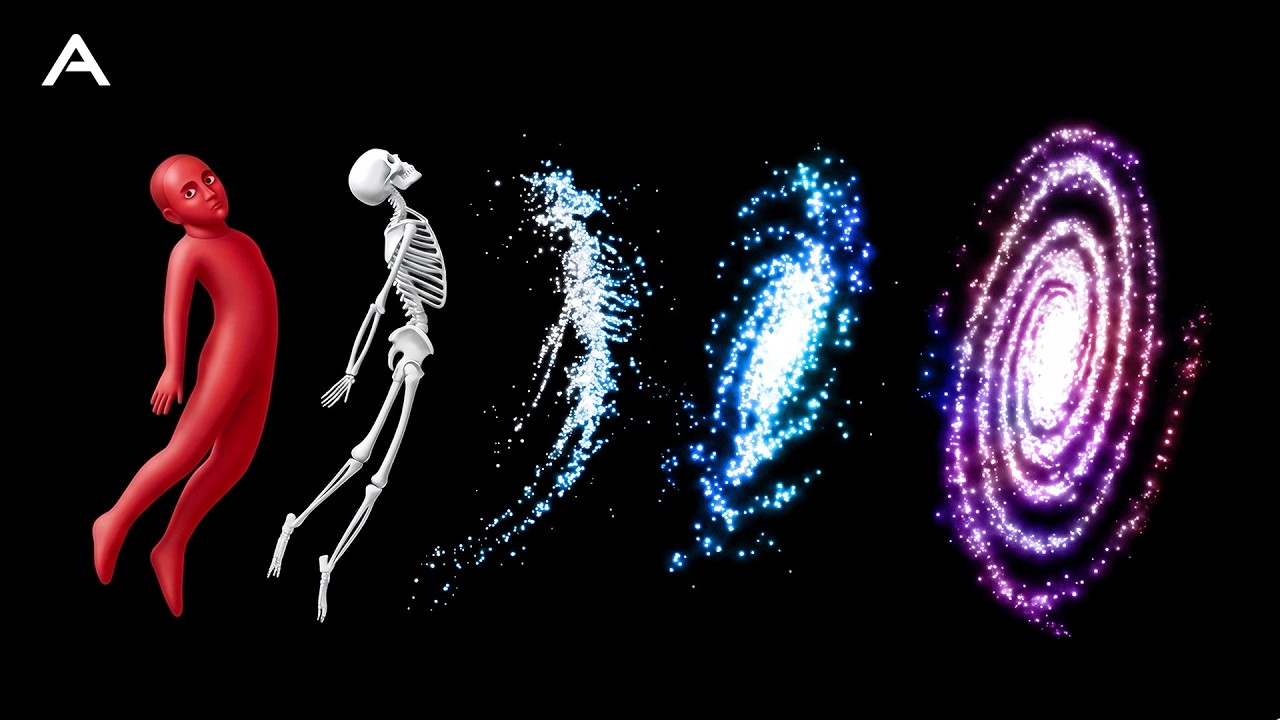
The true Scale of the Universe – How Big is the Universe? | Space Documentary 2026
A one hour and twenty minute Actual Space documentary built as a single uninterrupted ride through scale, from the Planck length at the bottom of reality up to the Hercules Corona Borealis Great Wall, the largest object humans have ever detected. In order it climbs molecules, the almost entirely empty atom, the quark and lepton zoo, the Higgs field, then outward through the solar system, Proxima Centauri, the Pleiades, the Milky Way, the Local Group, Laniakea and the Great Attractor, dark matter and dark energy, and finally the megastructures Quipu and the Great Wall. Two ideas drive it: our Earth tuned intuition is a liar, so every number feels impossible, and every rung shares the same physics, so your atoms and the cosmic web are one continuous fabric. It closes by flipping the usual cosmic smallness story, arguing the universe's vastness is not proof of our insignificance but proof that matter has organized far enough to measure and understand itself.
Published May 31, 20261:20:12 video37 min readAdded Jun 17, 2026Open on YouTube →
The film keeps two ideas humming the whole way. First, our intuition is a liar that was tuned for surviving on Earth, so almost every number here will feel impossible, and that feeling is the point. Second, every rung uses the same physics and the same particles, so the carbon in your cells and the dark matter scaffolding the largest walls in the cosmos are part of one continuous fabric. The closing argument flips the usual cosmic smallness story: the universe is absurdly large, but you are the thing inside it that can measure it, and that is the most remarkable object on the entire ladder. This page rebuilds the documentary rung by rung with every distance, name, date, and analogy intact.
The deep explanation
The setup: our senses are built to deceive us
The film opens with a thought experiment. Take a handful of fine beach sand. With enough patience you could count a few thousand grains. Now imagine each grain is a star like the Sun. To count all the stars in the cosmos, that beach would not be enough. Not even every grain on every beach on Earth would be enough to match the number of stars in the universe. That is the scale problem the documentary spends eighty minutes attacking.
The core idea up front is that we live on an intermediate scale and our intuition was designed to survive on Earth, not to measure galaxies. For us a kilometer is a reasonable walk and a mountain seems impossibly tall. For the universe a kilometer is nothing. On a cosmic scale the difference between an ant and Mount Everest is virtually non existent, both are invisible specks of dust. When we say the universe is big, we fall short. We are talking about a place where light, the fastest thing in nature, takes billions of years to cross from one side to the other.
The plan the narrator lays out is the whole structure of the film, and this page follows it exactly. Start where logic breaks, the quantum world, and find the smallest thing nature allows. Then leap outward to the stellar neighborhood, those neighbors separated by chasms light takes years to cross. Then galaxies hosting hundreds of billions of suns, then the largest structure ever mapped, then the edge of the observable universe itself. To understand the largest structure that exists, you first have to know what everything is made of, so the journey goes down before it goes up.
Chapter 1: The quantum world
Molecules: where your atoms were cooked. If you looked at your hand with an infinitely powerful microscope you would see it is not solid but built from molecules. A water molecule is just two hydrogen atoms bonded to one oxygen atom, a bond strong and stable enough to let oceans exist. But the film's real point is origin. Nothing around you, from mountains to the iron in your veins, was here at the beginning of time. In the beginning the universe was a hot soup of pure energy. That energy became matter, forming the first stars, and those stars were cosmic kitchens where pressure and heat forced atoms to fuse into heavier elements through nuclear fusion. The calcium in your bones, the oxygen you breathe, the carbon in every cell were forged in stars that died billions of years ago.
When massive stars ran out of fuel they died in a violent explosion, a supernova, launching those freshly cooked elements into deep space as clouds of gas and dust called nebulae. Those remains cooled and clumped again into planets and eventually people. This is what Carl Sagan meant by "we are stardust," and the film insists he meant it literally. The periodic table is an inventory of everything the stars have made. Every atom in your body is a time traveler that crossed unthinkable distances and survived cataclysms to become part of you. We are the conscious legacy of dead stars, the way the universe finally learned to look at itself.
The atom: almost entirely nothing. The world feels solid under our feet, but that is a misunderstanding of our senses. Atoms are almost entirely empty. The film's signature image: picture yourself standing inside a giant cricket stadium or football arena, and the whole stadium is a single atom. At the exact center of the field sits a tiny marble. That marble is the nucleus, where nearly all the mass is concentrated, made of protons and neutrons packed so tightly the density is almost unimaginable. The rest of the stadium, the seats, the walls, the air, is basically empty.
The electrons do not sit in rows like spectators. They whiz around in unpredictable ghostlike patterns near the outer edges. Scientists call their paths orbitals, but these are not fixed tracks, they are a blur of possibilities where electrons appear and vanish. That shell of electrons is what gives matter its solid feel. When you press your hand on a wall you are not touching the atoms, you are feeling the electromagnetic repulsion between the electrons in your hand and the electrons in the wall. Solidity is an illusion created by the frantic dance of electrons.
The emptiness is staggering. The distance from the marble at center to the electrons buzzing near the stadium walls is enormous compared to the marble itself. If you stripped away all the empty space inside the atoms of a human body and compressed just the nuclei together, the whole person would fit into something no bigger than a sugar cube, yet weigh exactly the same. The number of protons in the nucleus decides what you are touching: one proton is hydrogen, eight is the oxygen that keeps you alive. The heat you feel on a sunny day is just those atoms vibrating and crashing harder against your skin.
Figure 1. The atom as a stadium. The nucleus is a marble at center field; the electrons are a ghostly blur near the outer wall; everything between is vacuum. This is why a human body, with its empty space removed, would compress to a sugar cube while keeping all its mass.
The particle zoo. For a long time protons, neutrons, and electrons looked like the final pieces. Then physicists collided particles at high speed and found a whole zoo inside. Protons and neutrons are not solid spheres, they are made of quarks, which never travel alone but group in trios held together with incredible strength. What stops the quarks from flying apart is a particle acting as universal glue, the gluon, named from the English word glue because its only job is to hold the nucleus together. Without gluons every atomic nucleus would fall apart in a second.
The electrons dancing outside belong to a different family, the leptons, particles not made of quarks that appear to be points of pure energy with no internal structure we can see. Loose parts need rules, and that is the job of the bosons, the messengers of nature's forces. If matter particles are the players in a game, the bosons are the ball they pass between them to interact. The most famous is the photon, carrier of the electromagnetic force, responsible for light traveling and magnets working. Others, the W and Z bosons, carry the weak nuclear force that lets stars shine. This whole catalog is the Standard Model, the instruction manual for how a star, a drop of water, or a neuron in your brain is built. The most fascinating part: these pieces are identical everywhere. An electron here is identical to one in a galaxy millions of light years away. The universe uses the same invisible bricks at every scale.
The Higgs field: where mass comes from. If these particles are so small, where does their weight come from? The answer, proposed by Peter Higgs in the 1960s, is that the universe is not empty but filled with an invisible ocean, the Higgs field. Picture a silent fog everywhere, even between your teeth and in the deepest void between galaxies. Some particles pass through the fog without interacting, which is why they travel at light speed and have no mass, like photons. Others, the ones that make up your atoms, interact with the fog, and in doing so become heavy and acquire mass. Without this field, electrons and quarks would shoot off at light speed and could never clump into atoms, planets, or people.
This leads to a deeper truth: matter is not separate from energy. Mass is simply energy so concentrated that it occupies space and has weight, which is what Einstein meant with E=mc², that mass and energy are two sides of one coin. Disassemble a single atom from your body and you would release enough energy to power a city for months. In 2012 scientists at CERN confirmed the field really exists by detecting the Higgs boson, the physical imprint left when you shake the field. Matter, the film says, is a fortunate accident of energy.
The Planck length: the basement of reality. Can we divide space forever, or is there a minimum tile? Back in the 1900s the physicist Max Planck discovered nature does not flow continuously but delivers its secrets in closed packages he called quanta. The egg analogy: you can buy 12 or 15 eggs, but ask for 2.5 eggs and the seller will look at you strangely. At the deepest level energy comes in whole units. This leads to the Planck length, a distance so ridiculously small the mind gives up. If an atom were the size of the entire observable universe, the Planck length would be barely the height of a tree on Earth. It is the absolute limit, the smallest unit of measurement the laws of physics allow. Below it, the concepts of distance and place stop making sense.
The film floats the idea that reality might be pixelated. Get close enough to a phone or TV screen and the fluid image breaks into colored squares. Planck suggested the universe works the same way, not a smooth continuous silk but a mosaic of tiny indivisible pieces. At this scale space and time become turbulent, what scientists call quantum foam. Try to go beyond the Planck length and Einstein's gravity and the rules of quantum mechanics slap each other in the face and reality fragments. This is the frontier. From here we turn around and climb.
Chapter 2: The stellar neighborhood
The solar system is almost all empty. Textbook maps pile the planets side by side as if they were around the corner, which the film calls one of the biggest lies our imagination tells. The Moon, our closest neighbor, is about 238,866 miles away. That sounds like a lot, but light crosses that gap in 1.3 seconds. The Sun is about 93 million miles away, so far that sunlight takes 8 minutes and 20 seconds to reach your window. If the Sun went out right now, we would still see and feel it for almost 9 minutes before going dark.
Centuries ago Galileo Galilei was one of the first to grasp that the sky was not a flat dome but had real depth, using his telescope to watch tiny moons orbit other worlds and proving we are not the center of everything. What he suspected we now know for sure: the solar system is almost all empty. Put the Sun at the center of your room as a melon and Earth would be a speck of dust several feet away, the other planets scattered across your city. Yet that void is not dead. It is saturated with energetic activity and fast moving particles. We live in a sheltered bubble, an island of cold matter in an ocean of fiery plasma. More than 99 percent of the normal matter we know is in the plasma state, like the fire at the heart of stars. The solid matter you and I are made of is a cosmic rarity.
Light as a ruler, and as a time machine. Beyond Earth, miles become useless. Measure the universe in miles and you get sheets of paper full of zeros no one can read. So astronomers use light as the ruler. People once thought light was instantaneous, until in 1676 the Danish astronomer Ole Rømer proved otherwise. Watching the eclipses of Io, one of Jupiter's moons, he noticed a delay when Earth was farthest from Jupiter and concluded light has a finite speed. Light travels about 186,000 miles per second, the maximum speed allowed in the entire fabric of the universe.
To make life easier, astronomers invented the light year. Despite the word year, it is a distance, not a time: how far light travels in a vacuum in one Julian year of 365.25 days, almost 6 trillion miles. A star can be four light years away instead of a 13 digit number no one could pronounce. The most beautiful consequence is that the sky becomes a historical archive. Because light takes time to arrive, you never see a star as it is now, only as it was. A star 10 light years away looks the way it did a decade ago. Astronomy is cosmic archaeology, ancient messages traveling through the void for eons just to reach our eyes.
Proxima Centauri, our nearest neighbor. If the Sun were a single light bulb in a dark field, the nearest star would be another bulb thousands of miles away. That neighbor is Proxima Centauri, about 25 billion miles away, billions with a B. Send our fastest probe and it would take tens of thousands of years to arrive. The space between stars is immense solitude. Scottish astronomer Robert Innes discovered Proxima Centauri in 1915, and we have since learned it is part of a family of three suns, the Alpha Centauri system. The heart is Alpha Centauri A and B, two stars dancing around each other in an 80 year choreography, while Proxima orbits far out like a little brother in the shadows.
Proxima is a red dwarf, smaller and colder than the Sun, too faint to see with the naked eye, but it is the first port in this ocean of emptiness. It is not alone: we have discovered Proxima Centauri b, a planet close to Earth's size orbiting in the region where liquid water could exist. Living there would not be easy, since Proxima is an active star that launches stellar flares of radiation able to strip an atmosphere in minutes. This is the true face of the stellar neighborhood, where calm and danger live door to door. Every photon we receive from it left its surface more than four years ago.
Nebulae and star clusters: the cosmic nurseries. Stars like to gather into families, and to see where the clumps come from you look at the giant clouds of gas and dust called nebulae. These are the factories of the cosmos, where gravity pulls material so tightly it heats up and ignites a new star. A famous example is the Orion Nebula, where hundreds of stars are being born right now. In the 18th century the French astronomer Charles Messier cataloged these fuzzy objects, not because he loved them but because he was hunting comets and these clusters kept confusing him, so he wrote down their coordinates to avoid them. That annoyance became the Messier catalog, a basic guide to the treasures of our galaxy.
One of the brightest entries is M45, the Pleiades or Seven Sisters, an open cluster of very young blue stars with high surface temperatures, still wrapped in a bluish haze of leftover dust. The Pleiades sit about 2.6 billion miles, roughly 444 light years, from us, which on the scale of the galaxy is just around the corner. Clusters are natural laboratories: since all the stars were born at about the same time, we can watch the big ones burn fuel fast while small ones last far longer. The blue giants of the Pleiades may live only a few million years while smaller stars shine for billions more. These baby stars emit powerful radiation that pushes excess gas outward like a cosmic wind, sculpting the nebula into pillars and mountains of dust. As they orbit, gravity from other objects eventually pulls each onto its own path, just as the Sun once left its birth cluster. Most stars you see at night were once part of a nursery like this.
Constellations: the great optical illusion. Humans have always connected the dots into warriors, animals, and gods to orient ourselves in the dark. These are constellations, and they are one of nature's greatest illusions. We think a constellation's stars form a real group, but they are separated by abysses we cannot imagine. The Greek astronomer Claudius Ptolemy cataloged many constellations we still use, believing the sky was a uniform sphere with the stars fixed at the same distance. That image is false. Travel to another angle and the figures would fall apart because the stars sit at wildly different depths.
Take Orion the hunter. On his left shoulder the giant reddish star Betelgeuse shines; on his right foot the powerful bluish star Rigel. From your window they look the same depth, but Rigel is about 860 light years away, equivalent to more than 5,000 trillion miles, while Betelgeuse, though closer, is still hundreds of light years off. They are not neighbors, just aligned from our vantage point. Even Sirius, the brightest star in the sky, looks close to Orion but is actually 51 billion miles away. Rigel is 100 times farther than Sirius yet shines so brightly it deceives our eyes into thinking they sit at the same distance. The night sky is a map of pure visual coincidences. Constellations are useful for not getting lost, but they are records of the past that hide the universe's real depth.
Figure 2. The stellar neighborhood on a logarithmic ladder. Rigel is 100 times farther than Sirius yet outshines it, which is exactly why constellations fool the eye. Every bar is a real distance the documentary cites.
Chapter 3: Galaxies and immeasurable distances
The Milky Way: we live in the suburbs. Zoom out past the constellations and the stars of one night become a speck in the gigantic web of our true home, the Milky Way, a majestic spiral with arms curving into a bright center. William Herschel, the astronomer who discovered infrared radiation, was a pioneer in giving shape to this galactic home, counting stars across sections of sky to map where our island universe ended. He thought the Sun sat near the center (it does not), but his work was the first real step toward seeing that we live in a structured, studyable architecture.
Our galaxy is about 100,000 light years across, roughly 588 billion miles, so vast that crossing it at light speed would take a thousand centuries. And we do not hold a place of honor at the center. We live in the galactic suburbs, on a smaller spiral arm called the Orion Arm, halfway between the bustling center and the outer edge. The center is too clogged with cosmic dust to see in normal light, but radio astronomy cuts through the darkness to reveal powerful processes at the heart, where stars whip around a massive center of gravity (the supermassive black hole Sagittarius A*). Out in our quiet corner the Sun orbits this galactic center once every 230 million years, a journey we have only just begun to understand. As big as the Milky Way is, it is one among billions of galaxies.
Other island universes: the Local Group. For a long time humanity thought the universe ended where the naked eye stars ended, because every measured distance fell within a limit, as if confined to one island universe. But some bodies broke the rule. A few of Messier's nebulae had indeterminate distances, sometimes too close, sometimes too far, as if outside our island. Many called it measurement error. One man disagreed: the German philosopher Immanuel Kant, who in 1755 published Universal Natural History and Theory of the Heavens proposing that those distant nebulae were not nebulae at all but other island universes like ours. The scientific community ignored him because nothing could confirm it, and the telescopes of his day were not up to the challenge.
It took nearly two centuries. In 1929 Edwin Hubble pointed the most powerful telescope of his time at those nebulae and found the truth: many blurry spots were entire galaxies at distances once thought impossible. Kant was right. This revealed that we belong to an organized structure called the Local Group, our immediate galactic neighborhood, a collection of more than 50 galaxies bound by gravity. Its great protagonist is Andromeda, a majestic spiral even more massive than ours, about 2.5 million light years away, roughly 15 trillion miles. The light our telescopes capture from Andromeda began its journey long before the first human walked on Earth. Accompanying the two giants are smaller galaxies like the Magellanic Clouds, satellites orbiting the Milky Way much as the Moon orbits Earth. The Local Group is a choreography that took eons to perfect.
Chapter 4: The universe
Galaxy clusters and the discovery of dark matter. Galaxies do not drift at leisure; the universe has a hierarchy. Above the Local Group sit galaxy clusters, giant congregations of galaxies held by the invisible glue of gravity. In the 1930s the astronomer Fritz Zwicky, a man of strong personality, studied the Coma Cluster, about 1,700 trillion miles away, and noticed galaxies moving too fast. By his calculations they should have shot apart billions of years ago, but they had not. He concluded there must be hidden mass exerting a powerful gravitational pull, and called it dark matter, the first to suspect the visible universe is only a tiny part of what exists.
Years later Vera Rubin confirmed this invisible architecture. By Newtonian physics stars farther from a galaxy's center should orbit more slowly, like planets farther from the Sun. Instead Rubin saw stars at the edges moving just as fast as those near the center. Visible matter alone could not explain it; something unseen had to add gravitational pull. Her work with Kent Ford showed galaxies hold roughly 10 times more non luminous mass than visible mass. Without this invisible web the universe would be a dull scattered fog. Dark matter is the true scaffold of the cosmos, the framework on which everything that shines rests. In our region the ruling structure is the Virgo Cluster, a galactic city of up to 2,000 galaxies pulling so hard that even the Milky Way is moving toward it. Clusters then clump into superclusters. Our large scale home was long thought to be the Virgo Supercluster, spanning more than 100 million light years, about 588 trillion miles, where galaxies are mere specks at the nodes of a giant network.
The Boötes Void: the big nothing. Sometimes emptiness teaches us more than light. Among the clusters there are strangely empty places, and one is the Boötes Void, which astronomers nickname "the Great Nothing." If the universe were a Swiss cheese, this would be the biggest hole in our cosmic neighborhood. It was discovered in 1981 by the American astronomer Robert Kirshner and his team, and before then no one imagined spaces this large with no galaxy in sight. The bubble of darkness is about 330 million light years across, almost 1.96 quintillion miles, big enough to fit the Virgo Supercluster inside with room to spare. Stand at its center and look any direction and you would see only total blackness, no points of light, no distant galaxies, no references.
The astronomer Greg Aldering captured the loneliness with a famous line: if the Milky Way had been at the center of the Boötes Void, we would not have known other galaxies existed until the 1960s, because the nearest lights would be too far for our older telescopes to detect. We would have believed we were the only thing in existence. How does such a thing form? Gravity again. Imagine the early universe as a wet sponge; regions with slightly more matter attracted neighbors like magnets, so over billions of years dense regions grew richer while sparse areas emptied. The Boötes Void is that process taken to the extreme, a place where matter lost the battle and was sucked toward the edges by giant superclusters. Despite the name it is not totally empty; a few dozen isolated galaxies survive there like castaways in an endless sea of darkness, rare cases that show how matter grows when it has no neighbors to disturb it.
Laniakea: our continent, and the Great Attractor. Until recently scientists thought the Virgo Supercluster was the upper limit. Then in 2014 a team led by Brent Tully of the University of Hawaii and Hélène Courtois of the University of Lyon changed our place on the map forever. By mapping the peculiar velocities of galaxies, the individual motions, they found that the Local Group and the nearest superclusters all move within a far larger structure they named Laniakea, Hawaiian for "immeasurable heavens." Laniakea is not a chance pile of galaxies like Virgo; it is a network that moves together as one thing, a cosmic watershed. Like a drop of water on a mountainside ending in one river basin, Laniakea is the territory where some 100,000 galaxies slip along invisible filaments toward the same destination.
Laniakea spans about 520 million light years, roughly 3,000 trillion miles. We do not sit at the center but on one of its most extreme edges, like a small house on the coast of a huge continent, far from the great galactic metropolises. Everything we once thought immense, even Virgo, turns out to be a small branch of this neverending galactic tree. The real boundary appears next door at the supercluster Perseus Pisces, where galaxies move the opposite way; that dividing line is the true edge of our home. Viewed through a telescope, Laniakea looks like a system of neurons or the roots of a plant searching for food in the dark.
Where is everything moving? On Earth water finds the sea through gravity, and something similar happens in space. Long before Laniakea was named, astronomers noticed the Milky Way and thousands of galaxies are being swept at about 1.4 million miles per hour toward a mysterious point we call the Great Attractor. The problem is it plays hide and seek: it lies in the Zone of Avoidance, where the dust and stars of our own galactic center act as a thick curtain. In the 1980s the American astronomer Alan Dressler and a group known as the Seven Samurai confirmed the anomaly was real and strong enough to shape the fate of an immense region. We now know the Great Attractor is not a single object but the gravitational heart of Laniakea, an area where galaxy clusters concentrate so densely their combined mass equals tens of thousands of galaxies, bending spacetime and forcing every galaxy within hundreds of millions of light years to surrender to its pull. Strangely, the latest calculations say we will never arrive, because another force is stretching space itself and pushing the horizon away faster than we can travel toward it.
Dark energy: the accelerating treadmill. In the late 1990s a discovery left scientists speechless. Almost everyone believed cosmic expansion was slowing, since gravity should act as a handbrake. But in 1998 a team led by Adam Riess found the opposite. They observed Type Ia supernovae, explosions so bright and predictable they serve as reference beacons, and measuring how fast they receded revealed the most distant galaxies were moving apart faster and faster. It was like throwing a ball that, instead of falling, shoots into the sky with brutal force. This happens because space is not a static stage but a physical entity that can stretch. The film uses the raisin bread analogy: as the dough bakes and grows, the raisins (galaxies) move apart not because they travel but because more dough (space) appears between them.
Astronomers did not know what was doing this, so they named it dark energy. We do not know exactly what it is, but it is everywhere and accounts for about 68 percent of everything in the universe, a pressure that fills the void and forces space to expand. Dark energy is what makes the treadmill of the universe move backward faster than galaxies can run forward, so on the largest scales the Great Attractor's gravity loses. Expansion creates millions of miles of new space every second between superclusters, with a sad consequence for the far future: galaxies we see today will eventually be so far away, with space between us expanding faster than light, that their light will never reach us again. The nearest galaxies will stay, but the distant ones will vanish from view.
Beyond Laniakea: Shapley and Quipu. Laniakea is not the boundary, just one vast region of the cosmic web. Beyond it lie larger, denser structures. One is the Shapley Supercluster, among the most massive known galaxy concentrations, whose basin of attraction recent studies put at roughly 1.4 billion light years with a volume 10 times that of Laniakea, containing millions of galaxies and pulling on Laniakea and its neighbors. Ranking second is a 2025 discovery so brutal it makes Laniakea look like a speck of dust: a megastructure baptized Quipu, named for the system of ropes and knots the Inca used to keep accounts and record stories. The young astronomer Alexia Lopez, who had already shaken the field with the Giant Arc and the Big Ring, was a key figure in identifying these threads of light woven in the dark.
Quipu is a chain of galactic filaments spanning about 1.3 billion light years, roughly 19,400 trillion miles. Light at maximum speed would take a quarter of the total age of the universe just to cross from one end to the other. The headache for cosmologists is the cosmological principle, an unwritten rule that on a large enough scale the universe should look the same everywhere, a smooth well mixed soup. Quipu is like finding a giant piece of meat in the middle of that soup, too organized and too large to have formed in the available time under the physics we know. It is made of galaxies and clusters knotted along filaments of dark matter, crossing a significant part of the observable sky. Seeing it forces us to think either that the early universe had far more powerful seeds of matter than imagined, or that gravity works in ways we have not fully deciphered. Quipu has displaced Laniakea from the headlines, proving we live in a universe that prefers elongated, complex structures over round clouds.
The ceiling: the Hercules Corona Borealis Great Wall. Quipu is huge but not the record. There is a structure three times larger, a wall of light stretching across the cosmic horizon, the final limit of what humans have mapped: the Hercules Corona Borealis Great Wall, the largest and most massive object ever detected. It was not found by looking at individual galaxies, because it is too immense to fit in any photo. Its existence was revealed by the Hungarian astronomer István Horváth and his team in 2013, while mapping gamma ray bursts, the most powerful flashes in the universe, triggered by the deaths of giant stars or collisions of black holes. Between the constellations of Hercules and Corona Borealis Horváth found a concentration of these flashes that made no statistical sense, like thousands of lightning bolts on the same street during one storm.
Connecting the dots revealed a structure about 10 billion light years long, roughly 58,800 trillion miles, occupying almost 10 percent of the entire observable universe. The problem is it breaks the rules. As with Quipu, mathematical models say nothing should be larger than about 1.2 billion light years, because the universe has not had enough time since the Big Bang for gravity to cram so much matter into one place. This wall is roughly 8 times that limit. It is like finding a skyscraper 3 kilometers high in a town where every other building is one story, impossible with the available materials and time. The Great Wall is a reminder that we are still learners, that the universe is more complex and has more history than our current equations explain. It is the ceiling of known reality, the final frontier of matter before we get lost in the immensity of everything.
Figure 3. The top of the ladder. Each bar is a real megastructure from the film on a logarithmic scale. Quipu (2025) dwarfs Laniakea; the Hercules Corona Borealis Great Wall dwarfs Quipu and breaks the theoretical size limit of ~1.2 billion light years by roughly eightfold.
The closing argument: the scale is not a measure of insignificance
The film refuses to end on smallness. We have gone from atoms that are almost pure vacuum to walls of galaxies measuring trillions of miles, and in the face of that it feels natural to think of yourself as an unimportant accident. The narrator argues the opposite. We are not inside the universe observing from a window, we are part of it. Everything traveled on this journey, from the filaments of the cosmic web to the Planck length, shares the same laws. There is no physics for large structures and another for you. The oxygen you breathe and the calcium in your bones were cooked in the same stellar explosions that gave rise to the galaxies of the Great Wall. We are connected to the farthest things by an umbilical cord of matter and energy that has never been broken.
The observable universe has a radius of about 270,000 trillion miles, and the genuinely amazing phenomenon is that a creature as small as a human can measure that distance. It does not matter how big the stage is if there is no one to tell the story. We are a dynamic system where energy is constantly recycled: stars die so planets are born, planets cool so life can flourish. To be alive is to participate in the conversation of the universe, and every time we learn something new about a distant galaxy or about dark energy, the universe gains a little more awareness of its own secrets. The scale of the universe is not a measure of our insignificance but proof of how far matter has come to be able to think. Next time you feel the Sun on your face, remember the light traveled 93 million miles just to touch you, that every atom in your body has been at the center of a supernova, and that you are part of a cosmic web connecting the smallest with the largest. We are, quite simply, the way the cosmos has finally decided to open its eyes, the consciousness of the stars and the heart of a story that began 13.8 billion years ago. Understanding how big the universe is, the film closes, is simply understanding how big we are.
Key takeaways
The journey is a single scale ladder, down to the Planck length, then up to the Hercules Corona Borealis Great Wall, always using the same physics and the same particles.
Atoms are almost entirely empty: nucleus as a marble in a stadium, electrons as a ghostly perimeter, and a whole human compressed to nuclei would fit in a sugar cube at full weight.
Mass comes from interaction with the Higgs field, confirmed at CERN in 2012; mass is just concentrated energy, two sides of E=mc².
Light is both the only sane ruler for cosmic distance (the light year, almost 6 trillion miles) and a time machine, since every object you see is shown as it was in the past.
We are not central anywhere: galactic suburbs on the Orion Arm, an extreme edge of Laniakea, a small branch of an ever larger tree.
Dark matter (about 10 times the visible mass in galaxies) is the invisible scaffold; dark energy (about 68 percent of everything) is the accelerating expansion that will eventually carry distant galaxies out of sight forever.
The largest mapped structures, Quipu (1.3 billion ly, 2025) and the Hercules Corona Borealis Great Wall (10 billion ly, ~10 percent of the observable universe), are too big for current theory, which caps structure at ~1.2 billion ly.
The film's thesis: the universe's vastness is not evidence of our smallness but proof that matter has organized far enough to measure and understand itself.
Chapters
0:00 Introduction: counting stars like grains of sand, and why our senses deceive us
4:58 Chapter 1, The Quantum World: molecules, stardust, the atom as a stadium, the particle zoo, the Higgs field, the Planck length
23:16 Chapter 2, The Stellar Neighborhood: the empty solar system, light as a ruler and time machine, Proxima Centauri, nebulae and the Pleiades, the constellation illusion
41:10 Chapter 3, Galaxies and Immeasurable Distances: the Milky Way and our suburban address, Kant and Hubble, the Local Group and Andromeda
1:00:00 Chapter 4, The Universe: clusters and dark matter, the Boötes Void, Laniakea and the Great Attractor, dark energy, Shapley and Quipu, the Hercules Corona Borealis Great Wall
1:18:15 Ending: the scale is not our insignificance, it is matter learning to think
Notable quotes
"Not even adding up all the grains of sand on all the beaches in the world would you be able to collect enough grains of sand to equal the number of stars in the entire universe." (0:00)
"On a universal scale, the difference between an ant and Mount Everest is virtually non-existent. Both are invisible specks of dust on the cosmic scale." (0:00)
"When you press your hand against a wall, you're not actually touching the atoms themselves. You're feeling the repulsion between the electrons in your hand and the electrons in the wall." (about 11:00)
"If you stripped away all that empty space inside the atoms that make up a human body, compressing just the nuclei together, the entire person could fit into something no bigger than a sugar cube, yet they would still weigh the same." (about 12:00)
"If an atom were the size of the entire observable universe, the Planck length would be barely the height of a tree on Earth." (about 21:00)
"Every light second that separates us from an object is a second of travel back in time." (about 30:00)
"If the Milky Way had been at the center of the Boötes void, we would not have known that other galaxies existed until the 1960s." (Greg Aldering, about 1:05:00)
"We are the consciousness of the stars, the voice of the galactic filaments and the heart of a story that began 13.8 billion years ago." (1:18:15)
"In the end, understanding how big the universe is is simply understanding how big we are." (1:18:15)
The documentary is a faithful tour of mainstream cosmology, and most of its ladder is solid, established science: the Standard Model, the Higgs discovery, the light year, dark matter's gravitational evidence, the accelerating expansion, and the existence of Laniakea and the Great Attractor are all well supported. A few points deserve a fair flag. The largest structures, Quipu and especially the Hercules Corona Borealis Great Wall, sit in genuine tension with the cosmological principle, and some cosmologists argue these megawalls may be partly statistical artifacts of how we sample gamma ray bursts rather than fully bound objects, so their reality and exact sizes are still debated rather than settled. The film also presents dark matter and dark energy as confirmed entities; their gravitational and expansion effects are not in doubt, but what they actually are remains unknown, which the narration does acknowledge. None of this dents the central journey, which is a clean and accurate climb up the scale ladder of the cosmos.
Full transcript
Have you ever wondered what the smallest or the biggest thing that exists in the universe is? If you hurry to answer, you might think that the smallest thing that exists is atoms and the largest are galaxies. But those two aren't even a little close to being the biggest and smallest things. Imagine for a moment that you are on the beach and you take a handful of fine sand between your hands. Can you count how many there are? If you take enough time, you'll be able to count a few thousand. Now think that each of those grains represents an entire star like our sun. If you wanted to count all the stars that exist in the cosmos, that beach would not be enough for you. In fact, not even adding up all the grains of sand on all the beaches in the world would you be able to collect enough grains of sand to equal the number of stars in the entire universe. With the worries of everyday life, we often forget that the scale of the universe is so large that it is difficult for many to imagine. Today, we are going to try to break those limits. Let's step away from the comfort of our own home to understand just how big this place we call home really is. From the smallest thing that holds reality to the structures that make entire galaxies look like mere specks of dust. To understand the size of the universe, we first have to accept that our senses are constantly deceiving us. We live on an intermediate scale. For us, a kilometer is a reasonable walking distance. And the height of a mountain seems impossible. But for the universe, a kilometer is nothing. On a universal scale, the difference between an ant and Mount Everest is virtually non-existent. Both are invisible specks of dust on the cosmic scale. The problem is that our intuition is designed to survive on Earth, not to measure the distances between galaxies. When we say that the universe is big, we fall short. We are talking about a scenario in which light, the fastest thing in the universe, takes billions of years to cross from one side to the other. That means space is so vast that even the fastest thing in nature can't traverse it instantaneously. In this documentary, we're not just going to look at pretty photos of telescopes we've all seen before. We are going to make a journey of proportions that seem impossible. We'll start in a place where the rules of logic are completely broken. The quantum world. There we will look for the smallest that nature allows to exist. those invisible pieces that make up everything you touch and see around you. Then we'll take a big leap outward to see our stellar neighborhood. That group of stars we call neighbors, but separated by chasms that light takes years to cross. But we won't stop there. We will see galaxies that host hundreds of billions of suns all the way to the largest structure humans have been able to map with current technology. And we will peer at the very edge of what we can see, the observable universe. To begin this journey, we will descend into a world where size ceases to have the meaning we usually give it. A place where the distance between one atom and another is immeasurable and where there is a final limit where space and time simply crumble. This is the starting point of our scale, the quantum world. Because to understand the largest structure that exists, we first have to know what everything is made of. If you could look at your own hand with an infinitely powerful microscope, you'd see that it's not solid, but is made up of tiny structures called molecules. These are the first structures that shape what we touch. Whether it's something solid, a liquid, or the air that fills your lungs right now. A simple molecule of water, for example, is just the union of two hydrogen atoms and one oxygen atom. A bond so strong and stable that it allows the oceans to exist. But what's really amazing isn't how these pieces stick together, but where they came from. Nothing you see around you, from the mountains to the iron that runs through your veins, was here at the beginning of time. In the beginning, the universe was just a hot soup of pure energy. Over time, that energy transformed into matter, forming the first stars. These giant suns served as true cosmic kitchens, where pressure and extreme heat forced atoms to fuse, creating heavier elements. The calcium in your bones, the oxygen you breathe, and the carbon that makes up each of your cells were made in the incandescent depths of stars that died billions of years ago. When those massive stars ran out of fuel, they bid farewell to the universe with a brutal explosion called a supernova. In that last breath, they launched all those freshly cooked elements into deep space, creating clouds of gas and dust called nebuli. Over time, those remains cooled and clumped together again to form planets and eventually people. So, when Carl Sean said, "We are stardust," he was literally saying, "Really? You're a child of the stars. If you look at the periodic table of the elements that we are taught in school, you are actually looking at an inventory of everything that the stars have made throughout history. Every atom in your body is a time traveler who has traveled unthinkable distances and survived space cataclysms just to become a part of you today. We are the conscious legacy of those dead stars. The way the universe has finally managed to look at itself and wonder what it is made of. But to understand how this stardust is sustained, we have to go down one more step and enter the very heart of matter, the atom. The world feels solid beneath our feet. But that's just a misunderstanding of our senses. Although atoms make up the chairs we sit on and the phones we hold, they are almost entirely composed of nothing. It's hard to imagine, but the matter we think of as solid is actually a network of tiny dots separated by massive amounts of vacuum. To put this into perspective, picture yourself standing inside a massive cricket stadium or football arena. The entire stadium represents a single atom. Now, right at the center of the field, there's a tiny marble. That marble is the nucleus, the heart of the atom, where nearly all the mass is concentrated. It's made of protons and neutrons packed so tightly that their density is almost unimaginable. If you tried to squeeze matter that dense into your hand, it would feel impossibly heavy for its size. But here's the surprising part. The rest of the stadium, the seats, the walls, the air above is basically empty space. The electrons, which are the other essential components of the atom, don't sit neatly in rows like spectators. Instead, they whiz around in unpredictable ghostlike patterns near the outer edges of the stadium. Scientists call these paths orbitals, but they're not fixed tracks. They're more like a blur of possibilities where electrons appear and vanish, darting about so quickly that they form a kind of invisible shell. This shell of electrons is what gives matter its solid feel. When you press your hand against a wall, you're not actually touching the atoms themselves. You're feeling the repulsion between the electrons in your hand and the electrons in the wall. That invisible push is what stops you from sinking through solid objects. In other words, the solidity of the world is an illusion created by the frantic dance of electrons. Now, think about the scale of emptiness here. The distance between the marble in the center and the electrons buzzing near the stadium walls is enormous compared to the size of the marble itself. If you stripped away all that empty space inside the atoms that make up a human body, compressing just the nuclei together, the entire person could fit into something no bigger than a sugar cube, yet they would still weigh the same. That's how much nothing makes up our physical world. This analogy helps us see atoms not as solid little balls, but as vast arenas of emptiness with a dense core and a lively ghostly perimeter. The marble in the middle anchors the atom with mass, while the electrons at the edges create the interactions that hold the universe together. Without that balance, dense nucleus and restless electrons, matter wouldn't behave the way it does. Chairs wouldn't support us, phones wouldn't exist, and walls wouldn't stop us. You, the mountains, the stars, and in general all the matter in the universe are literally spacefilled with energy fields and interactions that give us the sensation of touch and temperature. In fact, the heat you feel on a sunny day is nothing more than those atoms vibrating and crashing more strongly against your skin. So every time you touch a solid object, you're not touching matter the way you think you are. You're feeling the electrical repulsion of trillions of electrons refusing to get any closer to each other. The number of protons in a nucleus determines what we're touching. A single proton gives us hydrogen, but if there are eight, we have the oxygen that keeps us alive. The universe is a masterpiece of balance where almost everything is a void held by invisible forces. Understanding this space is the first step to understanding that even within our own bodies, there is a lot of unoccupied space. For a long time, we thought that protons, neutrons, and electrons were the final pieces of the puzzle, the final building blocks of nature. But when scientists began to collide these particles at high speeds, they discovered that inside them is a whole zoo of even smaller and stranger entities. It turns out that protons and neutrons are not solid spheres, but are made up of tiny pieces called quarks. These quarks never walk around alone. They always group in trios and stick together with incredible strength. What keeps these quarks from flying away is a particle that acts as a universal glue, the gluon. The name is no coincidence. It comes from the English word glue because its only job is to hold everything together inside the atomic nucleus. Without gluons, the nuclei of all the atoms in the universe would fall apart in a second and nothing we know could But while the quarks are locked in the center, the electrons dancing outside play in another league. They belong to a distinct family called leptins. Particles that are not made of quarks and that appear to be points of pure energy with no internal structure that we can see. But many loose parts are useless without rules telling them what to do. That's where bosans come in which are basically the messengers of the forces of nature. Imagine that the matter particles are the players in a game and the boss are the ball that they pass between them to interact. The most famous of all is the photon which carries the electromagnetic force. It is responsible for light traveling and magnets working. Other bosons such as W and Z are responsible for more discrete but vital processes such as the weak nuclear force that allows stars to shine. This whole set of particles and their interactions is what physicists call the standard model of particles. It's the instruction manual that explains how a star, a drop of water, or a neuron is built in your brain. The most fascinating thing is that these pieces are the same throughout the cosmos. An electron here on Earth is identical to one in a galaxy millions of light years away. The universe uses the same invisible bricks to assemble structures of all possible sizes. However, there is still an outstanding question. If these particles are so small, how can they have weight? Where do they get that property we call mass? To understand that, we have to look at an invisible ocean that fills all the space we think is empty. If you've ever wondered why you're weighty or why you have such a hard time pushing a heavy object, the answer lies not in the mass, but in an invisible ocean that fills every corner of the universe. For a long time, science has been racking its head trying to understand why some particles weigh a lot and others, such as photons in light, weigh absolutely nothing. The answer came thanks to Peter Higgs, a British physicist who proposed something brilliant in the 60s. The universe is not empty but is filled with an invisible ocean that we know today as the Higs field. To understand this, imagine that the entire universe is filled with an invisible silent fog that is everywhere. Even in the space between your teeth or in the deepest void between galaxies, some particles pass through that fog without interacting with it. That is why they travel at the speed of light and have no mass. But others, those that make up the atoms of your body, do interact with that fog. In doing so, they become heavy and acquire what we call mass. Without this invisible field, electrons and quarks would shoot out at the speed of light and could never clump together to form atoms, planets, or people. This leads to an extraordinary discovery. The matter at its core does not exist as something separate from energy. What we call mass is simply energy that has become so concentrated that it has begun to occupy space and has weight. Einstein summed it up in his famous formula which basically says that mass and energy are two sides of the same coin. If we could disassemble a single atom from your body, we would release an amount of energy so beastly that it could power an entire city for months. This Higsfield is not just another theory. In 2012, scientists at CERN confirmed that it really does exist by detecting the Higs Boson, which is like the physical imprint left by this field when we shake it. It was the moment when we understood that matter is a fortunate accident of energy. Everything you see from the sun to the iron in the red blood cells that run through your veins is the result of pure energy transforming into complex forms thanks to these invisible force fields. But if you thought quarks and electrons were the end of the road, we need to go even lower. There is a limit where the rules of distance and time simply stop working. It's the basement of reality. A place so small that normal numbers fall short. You'll finally discover the smallest thing that exists in the universe. We have reached the end of the road to the small. Until now, we have dismantled reality like someone disassembling a toy to see what's inside. We saw molecules, then atoms that are almost all empty, and finally we peaked into that strange zoo of particles that look like dots without size. But what happens next? Can we continue to divide the space forever? Or is there a minimal tile that can no longer be broken? To answer this, we must go back to the 1900s. In these years, the physicist Max Plank discovered that nature does not work as a continuous flow, but delivers its secrets in closed packages. He called these packages quanta. To make it simple, imagine you want to go to the store to buy eggs. Since these are units, you can buy 12 or 15 eggs. But if you ask the seller for 2.5 eggs or 5.3 eggs, he'll probably look at you strangely. Plank postulated that the universe was something similar. He realized that at the deepest level of reality, energy is like buying eggs. You either take one or two, but there is no such thing as buying an egg and a half. This discovery takes us directly to the plank longitude. It's such a ridiculously small distance that our minds give up trying to imagine it. If an atom were the size of the entire observable universe, the plank length would be barely the height of a tree on Earth. It is the absolute limit, the smallest unit of measurement that the laws of physics allow. Beyond this point, the concept of distance or place ceases to make sense. This raises an interesting question. What if reality is a fabric of pixels? When you get very close to your phone or TV screen, you stop seeing a fluid image and start to notice the small colored squares that make it up. Plank suggested that the universe works the same way. It is not a soft continuous silk but a mosaic made of tiny indivisible pieces. At this scale, space and time cease to be the tranquil scenery we know and become something turbulent that scientists call quantum foam. If we were to try to go beyond the plank length, Einstein's laws of gravity and the rules of quantum mechanics would slap each other in the face and reality itself would fragment. The plank distance is the smallest unit in the universe. It is the frontier, the limit of how far one can go from the quantum world. From here we only have to return and begin our journey towards the immeasurably great. After peeking into the abyss of the tiny, it's time to open the windows and look outside. To begin this ascent into the immense, the most logical place to start is our own backyard, the solar system. Often when we see maps of space in textbooks, the planets appear piled up side by side as if they were just around the corner. But that's one of the biggest lies our imagination would have us believe. The reality is that space is bigger than we can imagine. Think of the moon, our closest neighbor. It is about 238,66 mi away. To us, that number sounds like a lot, but in cosmic terms, it's just a step. Light, which is the fastest thing that exists in the universe, takes 1.3 seconds to cross that gap. If we jump to the next important marker, the sun, the scale becomes much more interesting. We're about 93 million miles from our star. That distance is so great that it takes 8 minutes and 20 seconds for sunlight to reach your window. If the sun were to go out right now, we would still see its brightness and feel its heat for almost 9 minutes before we went dark. Galileo Galile centuries ago was one of the first to understand that the sky was not a flat dome but had a real depth. He used his telescope to observe how tiny moons revolved around other worlds, proving that we are not the center of everything. What Galileo began to suspect is what we know for sure today. The solar system is almost all empty. If you put the sun at the center of your room, the size of a melon, the Earth would be just a speck of dust several feet away. and the rest of the planets would be scattered throughout your city. The most curious thing about this void is that it is not really dead. Although it seems to us to be a total absence of things, the space between the planets is a medium saturated with energetic activity and particles that travel at full speed. We live in a kind of sheltered bubble, an island of cold matter surrounded by an ocean of fiery plasma. In fact, the solid matter that you and I are made of is a total rarity in the cosmos. More than 99% of the normal matter we know is in the plasma state, like the fire that forms the heart of stars. If we're feeling small knowing that it takes 8 minutes for light to reach the sun, get ready because we're about to leave our solar neighborhood. From this point on, we are going to enter a territory where kilome or miles are no longer useful and where the distance between stars makes our solar system seem like a very small place. When you're planning a road trip, talking about miles makes perfect sense. We can imagine the distance between cities or even the length that planes travel from one continent to another using those numbers. But as soon as we move away from Earth, the numbers begin to grow in a way that makes anyone dizzy. If we wanted to measure the universe using miles, we would end up with sheets of paper full of zer that no one could read without getting confused. For example, the sun is about 93 million miles from us. But to move through the cosmos, we need a much bigger ruler. And that ruler is light. For a long time, people thought that light was instantaneous. that it appeared at the very moment a fountain was turned on. In 1676, the Danish astronomer Olaruma proved that this was not true. While observing the eclipses of Io, one of Jupiter's moons, he noticed a strange delay when Earth was farthest from that planet. with great lucidity. He concluded that light has a speed limit and that it takes time to travel from one point to another. Light travels at an incredible speed of about 186,000 m/s. It is the maximum speed allowed in the entire fabric of the universe. Nothing can go faster. To make our lives easier, astronomers invented the lightyear. It is important not to be confused. Although it bears the word year, it is not a measure of time, but of distance. A lightyear is a unit of distance representing how far light travels in a vacuum in one Julian year, which is 365.25 days. If you do the math, that distance is almost 6 trillion miles. Using light years lets us say that a star is four light years away instead of writing a 13-digit number no one could pronounce. But the most fascinating thing about this scale is that it turns the sky into a historical archive. As light takes time to reach our eyes, when we look at the stars, we are not seeing them as they are now, but as they were in the past. Every light second that separates us from an object is a second of travel back in time. If a star is 10 light years away, every time you look at it on a clear night, you are not looking at it as it is now, but as it was a decade ago. This revelation transformed astronomy into a kind of cosmic archaeology. We are not seeing the universe as it is right now, but we are receiving ancient messages that have been traveling through the void for eons just to tell us their story. Once we accept this new rule of measurement, we are ready to meet our nearest neighbor outside the solar system. If the sun were the only source of light in the middle of a dark field, our nearest neighboring star would be another small light bulb thousands of miles away. That neighbor is Proxima Centauri. Although we call it our neighbor, it's located about 25 billion miles from us. Yes, as you heard, billions with B. To give you an idea of how isolated we are, if we were to send one of our fastest space probes there, it would take tens of thousands of years to complete the journey. The space between the stars is an immense solitude, an abyss of silence that separates us from any other form of light. Unlike what we see in the movies where the stars seem to be piled up, reality is much lonier. Scottish astronomer Robert Inis discovered Proxima Centuri in 1915 and we've since learned that it's not a solitary star. It's actually part of a family of three suns that we call the Alpha Centuri system. The heart of this system is formed by Alpha Centuri A and B. Two stars that dance around each other in a choreography that lasts 80 years. As they rotate, Proxima Centauri orbits at a much greater distance like a little brother who prefers to stay in the shadows. This star is a red dwarf, a type of star much smaller and colder than our sun. It is so faint that you cannot see it with the naked eye. But its importance is brutal because it is the first port in this ocean of emptiness. The most exciting thing is that she is not alone in the dark. Thanks to our technology, we have discovered Proxima B, a planet with a size very similar to Earth's that orbits in the region where liquid water could exist. It's a reminder that even though unpronouncable distances separate us, we're not a unique accident in the However, living near such a star would not be easy. Proxima Centuri is a very active star capable of launching flares of radiation that would sweep through any atmosphere in a matter of minutes. This is the true face of the stellar neighborhood. A place where calm and danger coexist doortodoor. Every time we receive a photon from this star, we are seeing a message that came out of its surface more than four years This interstellar void is a barrier of time and space that keeps us protected, but also isolated. The neighborhood doesn't end here. If we continue to zoom out, we will see that contrary to what we think, the stars are not only scattered randomly, but sometimes grouped into bright families that from Earth look like one. Although many stars, like our sun seem to live solitary lives, the universe is a place where stars like to gather into families. To understand where these clumps come from, we have to look at the giant clouds of gas and dust floating in the void known as nebuli. These are the true factories of the cosmos, places where gravity pulls material so tightly that it becomes very hot and dense, igniting a new star. One of the most famous examples is the great Orion Nebula, a massive region where hundreds of stars are being born right now. During the 18th century, a French astronomer named Charles Messier became famous for making a list of these strange diffuse objects in the sky. In reality, he wasn't deliberately looking for them. His passion was to hunt comets, but these clusters and nebuli always got in his way and confused him. So he wrote down their coordinates so that when he ran into them again, he could quickly identify them and pass by them. Interestingly, over time, that catalog became one of the most comprehensive records of celestial bodies and today is known as the Messia catalog. a basic guide for anyone who wants to see the treasures of our galaxy. One of the brightest objects on his list is M45, better known as the Pletes or the Seven Sisters. The Pletes are an open cluster. It is a group of very young blue stars with very high surface temperatures. If you look at them through a telescope, you can still notice a bluish haze around them, which is the leftover dust from the nebula that created them. This group is located about 2.6 billion miles from us, approximately 444 light years. Although it sounds like an impossible distance to travel, on the scale of our galaxy, they are practically just around the corner. These clusters are vital to science because they function as natural laboratories. Since all the stars in a group were born at about the same time, we can observe how larger stars burn their fuel very quickly compared to small ones. While the blue giants of the pleades could live only a few million years, smaller stars in the same group could continue to shine for billions of years more. These baby stars don't stand still. They emit very powerful radiation that pushes excess gas outwards, clearing their surroundings like a cosmic wind. This radiation pressure is so strong that it can sculpt the nebula around them, creating shapes that look like pillars or mountains of dust. As they orbit the galaxy, the gravity of other objects pulls them until each one follows its own path, just as our sun did long ago. Most of the stars you see on a clear night were once part of a hatchery like this. Therefore, understanding these groups helps us see that the universe is an eternal cycle where the remains of dead stars provide the ingredients for new stars to be born. But even when the stars are at brutal distances, our eyes create drawings with them that have guided humanity for centuries. Ever since humans have walked the earth, we have looked up and sought order amid the chaos of bright spots. Connecting these dots, we imagine warriors, animals, and gods as if they were drawings on a sheet of paper to help us orient ourselves in the dark. This is what we call constellations. However, these shapes are one of nature's greatest optical illusions. We believe that the stars of a constellation are together forming a real group in space. But the truth is that they are separated by abysses that we cannot even imagine. The Greek astronomer Claudius Poleamy was one of the great people responsible for this mind map as he cataloged many of the constellations that we still use today to understand the passage of the seasons. For Tommy and the ancients, the sky was a uniform sphere where the stars were fixed at the same distance from us. But today, we know that this image is false. If you could travel through space and see the sky from another angle, all those figures you know would fall apart completely because the stars would move in different directions. Let us look at the example of the constellation of Orion the hunter. On his left shoulder, Beetlejuice, a giant reddish star, shines. On his right foot is Riel, a very powerful bluish star. From your window, they both appear to be at the same depth. But Riel is about 860 light years away, which is equivalent to more than 5,000 trillion miles. Beetlejuice is much closer, but we're still talking about hundreds of light years of separation between them. They are not neighbors. They are simply aligned from our vantage point here on Even Sirius, the brightest star in the entire sky, appears to be close to Orion, but it's actually 51 billion miles from us. Riel is 100 times farther away than Sirius, but it shines so brightly that it manages to deceive our eyes and seems to be at the same distance. The night sky is actually a map of pure visual coincidences where position is mixed to decide which lights dominate our human experience. This perspective teaches us that the universe has a real depth that we cannot perceive with the naked eye. Our eyes are limited translators that only see a small fraction of the energy that floods space. Constellations are useful tools for not getting lost, but they are records of the past that tell us the distance. With this new vision, we are ready to step out of our stellar neighborhood and begin the journey to the infinitely great. As we move away from our local neighborhood and leave the constellations behind, we slowly notice that the stars we see in one night are but a speck in the gigantic web that makes up our true home, the Milky Way. If you could see our galaxy from the outside, you'd see a majestic spiral with arms curving into a bright center that looks like a jewel in the dark. William Hershel, the astronomer who discovered infrared radiation, was one of the pioneers in trying to give shape to this galactic home. Hershel began counting stars across different sections of the sky to try to map where our island universe ended. Although he thought the sun was close to the center, his work was the first real step toward understanding that we don't live in a messy space, but in a structured, defined architecture that can be studied. Our galaxy has a diameter of about 100,000 lighty years. So that your brain doesn't get stuck trying to imagine it in miles, we're talking about approximately 588 billion miles. It is such a large figure that crossing it at the speed of light would take us a thousand centuries. And in the midst of all that immensity, we do not occupy a place of honor in the center. We live in what we might call the galactic suburbs. We are located on a smaller spiral arm known as the Orion arm halfway between the bustling center and the outer edge. The center of the Milky Way is a very dense region that we cannot see in normal light because there is too much cosmic dust blocking our view. However, thanks to radio astronomy, we have been able to cut through that darkness and discover that very powerful processes occur at the heart of our galaxy. There, the stars rotate at incredible speeds around a massive center of gravity that dominates everything. Meanwhile, in our quiet corner, the sun orbits this galactic center once every 230 million years, dragging us on a journey we've only just begun to understand. We live on a small planet around an ordinary star surrounded by billions of other suns. But as big as the Milky Way may seem to us, it is just one more among the billions of galaxies floating in the void. For a long time, humanity thought the universe ended, where the stars we could see with the naked eye, ended. It was the most logical thing to do because when astronomers measured the distances to the stars, they were always found to be within a limit they could not exceed, as if they were confined within a universe island. The problem was that some bodies did not respect that rule. Some of the nebuli that Messier had included in his catalog had indeterminate distances. Because when astronomers tried to calculate their distance, the result was that they were sometimes too close and sometimes too far away, as if they were outside our island universe. Many believed that this was a measurement error. Still there was one man who was not sure of that idea. That was the German philosopher and astronomer Emanuel Kant who in 1755 published the book general history of nature and theory of the sky where he proposed a bold theory. Those nebuli that seemed to be too far away were really so. And not only that, but also that they were not nebuli, but other island universes like ours. The scientific community of the time ignored Emmanuel's theory, among other things, because there was no way to corroborate it. Emmanuel was limited by the observational technology of his day. It took almost two centuries for the optical technology of telescopes to rise to the challenge. In 1929, the astronomer Edwin Hubble wanted to test Emmanuel's theory. So, he used the most powerful telescope of his time, pointed it at those nebuli, and discovered the truth. Many of those blurry spots in the sky were not nearby gas clouds, but entire galaxies located at distances thought to be impossible. Emmanuel was right. This discovery allowed us to understand that we are part of an organized structure called the local group. This is our immediate galactic neighborhood, a collection of more than 50 galaxies held together by gravity. The great protagonist of this group is Andromeda, a majestic spiral galaxy that is even more massive than our own. Andromeda is located about 2.5 million light years away, which translates to a figure that defies any human logic. approximately 15 trillion miles. To give you an idea of what this means, the light captured by our Andromeda telescopes began its journey long before the first human walked on Earth. Accompanying these two giants are smaller galaxies such as the Melanic clouds. They function almost like satellites orbiting the Milky Way in the same way that the moon orbits our Every time we look at the local group, we are seeing choreography that has taken eons to perfect. It's a reminder that galaxy history isn't a list of boring facts, but an account of encounters and mergers guided by physical laws that operate at scales that surpass any everyday reference. With this image in mind, we're ready to leave our immediate family behind and peak into the structures that truly dominate the map of the universe. Galaxy superclusters. As we move away from our home, the Milky Way, we notice that the distances become so massive that we need a new way of looking at the structure of reality. Galaxies aren't just floating around at their leisure as if they're lost ships in an endless ocean with no shores. Just as we group ourselves into towns, cities, and countries to organize ourselves, the universe has its own hierarchy to order matter on a large scale. If the local group where our galaxy, the Milky Way, is located is our neighborhood, the next level is the galaxy clusters. A galaxy cluster, as the name implies, is basically a giant congregation of galaxies held together by an invisible glue, gravity. In the 1930s, an astronomer with a rather strong personality named Fritz Swiki realized that something didn't fit in these groups. While studying the Coma cluster, which lies about 1,700 trillion miles from Earth, he noticed that galaxies were moving too fast. By the calculations, that speed was so high that galaxies should have shot out in all directions billions of years ago. But for some reason, they hadn't. Ziki concluded that there must be a hidden mass, something we could not see, but which exerted a powerful gravitational pull to hold the whole thing together. He called it dark matter. and he was the first to suspect that the visible universe is only a tiny part of what actually exists. Years later, astronomer Vera Rubin confirmed this invisible architecture. According to Newtonian physics, stars farther from the center should move more slowly, just like planets farther from the sun. Instead, Vera Rubin observed that stars at the edges of galaxies were moving just as fast as those near the center. The visible matter, stars, gas, dust wasn't enough to account for this. Something unseen had to provide extra gravitational pull. And that thing was dark matter. Her work with researcher Kent Ford showed that galaxies contain roughly 10 times more non- luminous mass than visible mass. Without this invisible web, the universe would be a dull and scattered fog. Today we know that this dark matter is the true scaffold of the cosmos, the invisible framework on which everything that shines rests. In our region of space, the structure that rules is the Virgo cluster. It is an immense galactic city containing up to 2,000 individual galaxies and exerting such a powerful pull that even our Milky Way is moving towards it. But the hierarchy does not end there. Clusters also clump together to form something even larger, superclusters. The Virgo supercluster is our large scale home. A structure that spans more than 100 million lighty years, which is equivalent to about 588 trillion miles. At this level, galaxies are just specks of light that accumulate at the nodes of a gigantic network where ours is just one of many. But it is not yet the biggest thing that exists. Sometimes what teaches us most about the structure of the universe is not where there is light and stars but where there is absolutely nothing. Although there are different galaxy clusters in the universe, there are also strangely empty places. One of them being the Bohoti's void, a region of space that astronomers colloquially call the big nothing. If the universe were a Swiss cheese full of holes, this would be the biggest, deepest hole you could find in our cosmic neighborhood. This void was discovered in 1981 by American astronomer Robert Kersner and his team. Before their discovery, no one imagined that such large spaces could exist without a single galaxy in sight. This bubble of darkness has a diameter of about 330 million lightyear, which is equivalent to almost 1.96illion miles. It's so big that we could fit the Virgo supercluster inside and still have room to spare. It's such a ridiculous distance that if you were in the center of this void, you'd look in any direction and see absolutely nothing with your eyes. There would be no points of light, no distant galaxies, and no references of any kind. You would see only total blackness, seemingly without end. Astronomer Greg Aldering once said a very famous phrase to explain this extreme loneliness. If the Milky Way had been at the center of the Bahotees void, we would not have known that other galaxies existed until the 1960s. That's because the closest lights would be so far away that our older telescopes simply wouldn't have had the power to detect them. We would live on an island of light surrounded by an ocean of nothingness measuring billions of miles in all directions. We would be convinced that we are the only thing that exists in the entire But how does something like this form? The answer is again gravity. Imagine that the early universe was like a wet sponge. Areas that had a little more matter began to attract neighboring galaxies to them as if they were magnets. Over the billions of years, dense regions became richer in galaxies while less dense areas became empty. Bohot's void is the result of this process taken to the extreme. It's a place where matter lost the battle and was sucked to the edges by the force of giant superclusters. Despite its name, the void is not 100% empty. A few dozen galaxies have been found within it, but they are so isolated that they look like castaways in an endless sea of darkness. These galaxies are rare cases that help us understand how matter grows when it has no neighbors to disturb it with their gravity. But this cosmic desert is only one part of the fabric that surrounds us. Now that we know the deepest emptiness, it is time to look back at the structure that shelters us and defines our direction on the map of the universe. After peeking into the terrifying nothingness of Bohoti's void, it's time to turn our gaze to the structure we can truly call our continent in deep space. Until very recently, scientists thought that the Virgo supercluster was the upper limit of our organization, a kind of final boundary. However, in 2014, a team of astronomers led by Brent Tully of the University of Hawaii and Helen Corttois of the University of Leon changed our direction on the map forever. By mapping the individual motions of galaxies, what scientists call peculiar velocities, they found that all galaxies in the local group, including our own, as well as the closest superclusters, such as Virgos, move within an even larger structure they called Lania, a word that the Hawaiian language means immeasurable heavens. Lania is not a simple accumulation of galaxies that are close to each other by chance as in the Virgo supercluster. It is a network of galaxies that move all together as a single thing. To understand how it works, imagine a network of water channels on a mountain. If a drop of water falls on a hillside, it will end up in a specific river. If it falls a few meters further, it will end up in a totally different basin. Laniaaka is our cosmic watershed. It is the territory where some 100,000 galaxies are slipping through invisible filaments towards the same destination. The dimensions of this home are brutal. Laniaaka spans about 520 million light years which in our usual units of measurement translates to about 3,000 trillion miles. On this gigantic map, we do not occupy a central place. The Milky Way is located on one of the most extreme edges of the structure as if we were living in a small house on the coast of a huge continent. Far from the hustle and bustle of the great galactic metropolises, everything we once thought was immense, such as the Virgo cluster, turns out to be just a small branch of this seemingly neverending galactic tree. The most fascinating thing about Lania is that it lets us see the real boundary of our neighborhood. Right next to us is another supercluster called Perseus Pisces. But the galaxies there are moving in the opposite direction. That dividing line where gravity decides to send you one way or the other is the real limit of our house. It is a networklike architecture that viewed through a telescope appears like a system of neurons or the roots of a plant searching for food in the darkness of the vacuum. Lania is our last frontier. From here we will find other even larger objects but of which we are not a part. However, before we talk about them, remember that a moment ago we said that all the galaxies that make up Lania move in harmony together. But where are they moving? On Earth, water always finds its way to the sea due to gravity. And something very similar happens in space. The planets are held in orbit by the sun's gravity. The stars are held in the arms of the Milky Way by the gravity of the galactic center and dark matter. But what keeps Lania united? Long before the discovery of Lania, astronomers noticed that our Milky Way along with thousands of other galaxies doesn't just float aimlessly. In reality, we are being swept away. We are moving at about 1.4 4 million mph toward a specific point in space that has long been a total mystery. We call this point of intense gravitational concentration within Lania the great attractor. The problem in understanding this phenomenon is that the great attractor is playing hide and seek with us. Although we know it's within Lania, we can't see it because it lies in a region of the sky called the avoidance zone. Basically, the dust and stars at the center of our own Milky Way act as a thick curtain that prevents us from seeing what exactly is in that It's like trying to see what's on the other side of a brick wall using only your eyes. It was the American astronomer Alan Drestler together with a group of researchers known as the Seven Samurai who in the 80s confirmed that this gravitational anomaly was real and that it had sufficient strength to shape the fate of an immense region of the cosmos. Today we know that the great attractor is not a single object such as a giant black hole or a super massive star. It's something much bigger. It's the gravitational heart of Lania Kia. It is an area where clusters of galaxies are concentrated so densely that their combined mass is equivalent to tens of thousands of times that of our own At that point, gravity is so brutal that it bends the spaceime of our entire neighborhood, forcing every galaxy within a radius of hundreds of millions of light years to surrender to its thrust. However, there is something very strange about this trip. Although we are moving there with incredible force, the most recent calculations suggest that we will never reach our destination. But how is that possible? What happens is that while the gravity of the great attractor tries to bring us all together in a single massive embrace, there is another invisible force that is doing the exact opposite. It is stretching space itself, pushing the horizons farther away than we can travel towards them. This struggle between gravity, which wants to unite things, and the expansion of the universe, which wants to separate them, is what defines the shape of everything we see. We're in a race against time on a treadmill that's speeding up. To understand why this journey to the great attractor might never end, we need to talk about that mysterious force that is winning the game and making the universe bigger and bigger. We have to talk about a discovery that left scientists speechless in the late 1990s. Until that moment, almost all astronomers believed the expansion of the universe was slowing. It made sense. If all galaxies have mass and are attracted to each other by gravity, it was logical to think that this attraction would act as a handbreak, slowing the growth of the cosmos. But in 1998, a team of researchers led by Adam Ree discovered that the reality was exactly the opposite. Adam Ree and his colleagues were observing a very specific type of stellar explosion called type 1A These explosions are so bright and predictable that they function as beacons of reference in the midst of darkness. By measuring how fast they were moving away from us, they realized something no one expected. The most distant galaxies were not only moving apart, but they were doing so faster and faster. It's as if you threw a ball into the air and instead of falling back under gravity, it suddenly shot into the sky with brutal force. This phenomenon occurs because space is not an empty static stage, but rather a physical entity that can be stretched. Imagine that the universe is like a raisin bread dough that's being baked. As the mass grows, the raisins, which would be galaxies, move away from each other, not because they are moving on their own, but because there is more mass between them in the cosmos. That growth is constant and accelerated. But astronomers didn't understand what this mysterious force expanding the universe was. So they called it dark We don't know exactly what dark energy is, but we know it is everywhere. In fact, it accounts for about 68% of everything that exists in the universe. It is a kind of pressure that fills the void and forces space to expand. To put it simply, dark energy is what causes the treadmill of the universe to move backward faster than galaxies can run forward. This means that on very large scales, the Great Attractor's gravity loses the battle. Over time, this expansion creates millions of miles of new space every second between superclusters of galaxies. This has a rather sad consequence for the distant future. There will come a day when the galaxies we see today with telescopes will be so far away that their light will never reach us. This is because the space between those galaxies and us will expand faster than the speed of light. So the day will come when we will not be able to see them. Fortunately, that will not happen with the nearest galaxies. Now going back to the largest structures in the universe, does nothing exist beyond Lania anymore? The answer is no. Lania is not the ultimate boundary of the universe. It's simply one vast region within the larger cosmic web. Beyond Lania, the universe continues with even larger and denser structures. One of them is the Shappley supercluster, one of the most massive known galaxy concentrations. Recent studies suggest that Shappley's basin of attraction spans roughly 1.4 billion lightyear and has a volume 10 times greater than Lania containing millions of galaxies. It exerts a strong gravitational pull on both Lania and its neighboring regions. A recently discovered object ranks second. In the year 2025, scientists discovered something extraordinary. A mega structure of such brutal proportions that it makes Lania look like a speck of dust. That mega structure was baptized as queu. The name of this structure is no coincidence. It refers to the system of ropes and knots used by the Incor to keep accounts and record stories. The young astronomer Alexia Lopez who had already shaken the scientific community with the discovery of the giant ark and the great ring was one of the key figures in identifying these types of formations that looked like threads of light woven in the dark. Quipu is a chain of galactic filaments that spans about 1.3 billion lightyear. If we try to convert that figure to miles, we are talking about 19,400 It's such an immense distance that light traveling at its maximum speed would take a quarter of the total age of the universe just to travel from one end to the other. What makesu a real headache for cosmologists is that according to our current theories such a structure shouldn't exist. There's an unwritten rule called the cosmological principle which says that on a large enough scale the universe should look more or less the same like a smooth well-mixed soup. However, quipu is like finding a giant piece of meat in the middle of that soup. It is too organized and large to have had time to train following the laws of physics that we handle today. This mega structure is made up of galaxies and clusters that appear to be knotted along filaments of dark matter. It is not a small group of neighbors like the Virgo supercluster. It's a formation that crosses a significant part of the observable sky. Seeing something so big forces us to think that the early universe had much more powerful seeds of matter than we imagined or that gravity works in ways we still haven't fully deciphered. Quipu has arrived to claim its place as the new big brother on our local map. It has displaced Laniaakia from the headlines, proving that we live in a universe that prefers elongated and complex structures to round clouds of But while Kipu has left us speechless, he still doesn't own the absolute size record. There is a structure that is still three times larger than this newly discovered giant. a wall of light that stretches across the cosmic horizon and represents the final limit of what humans have managed to map so far. During this journey, we have been climbing steps on a ladder of sizes that seems to have no end. But on the highest step, there is a mass of such absurd proportions that many scientists still scratch their heads trying to understand how something like this may exist. It is the great wall of Hercules Corona Borealis, the largest and most massive object that humans have detected in the entire history of astronomy. This structure was not discovered by looking at individual galaxies through a conventional telescope because it is so immense that it does not fit in any photo. Its existence was revealed thanks to the work of Hungarian astronomer Istvan Horvath and his team in 2013. They were mapping gammaray bursts which are the most powerful flashes of light in the universe triggered by the deaths of giant stars or the collisions of black holes. Horvath noticed that in a specific area of the sky between the constellations of Hercules and the corona borealis there was a concentration of these flashes that made no statistical sense. It was like seeing thousands of lightning bolts happening on the same street during a storm. By connecting the dots, they discovered a structure that is about 10 billion lighty years long. If we put that into miles, we're talking about 58,800 To give you an idea of the magnitude, this wall occupies almost 10% of the entire observable universe. If you could see it glow in the night sky, it would take up a gigantic portion of the horizon stretching far beyond what your eyes could encompass at a glance. The problem with the Great Wall of Hercules Corona Borealis is that it breaks the rules of the game. As we mentioned with Kipu, there is a theoretical size limit for cosmic structures. Mathematical models say nothing should be larger than 1.2 billion light years because the universe simply hasn't had enough time since the Big Bang for gravity to cram so much matter into one place. However, this wall is 8 times larger than that limit. It is like finding a skyscraper 3 km high in a town where all the buildings are on one floor. It just shouldn't be possible with the available materials and time. This structure is a reminder that we are still learners in the study of the The Great Wall of Hercules Corona Borealis tells us that the universe is much more complex and has much more history than our current equations can explain. It is the ceiling of our known reality, the final frontier of matter before we get lost in the immensity of everything. Borealis is the largest single object in the universe. But here we do not end our journey. We've gone from talking about atoms that are almost pure vacuum to describing walls of galaxies measuring trillions of In the face of such a display of size, it is normal to feel like an unimportant accident, a speck of dust that the cosmos would not even notice if it disappeared tomorrow. However, the reality is much deeper. We are not simply inside the universe observing it from a window. We are part of it. Everything we have traveled on this journey from the filaments of the cosmic web to the plank length shares the same laws. There is no physics for large structures and another for you. The oxygen you breathe and the calcium that hardens your bones were cooked in the same kind of stellar explosions that gave rise to the galaxies that make up the great wall of Hercules Corona Borealis. We are not just space tourists or outside observers who have accidentally appeared in a corner of the Milky Way. We are connected to the furthest away by an umbilical cord of matter and energy that has never been broken. When we look at the queu or the great attractor, we see our own history written on a gigantic scale. These structures are the result of billions of years of cosmic evolution. This process began with a spark of energy and after an incredibly long journey culminated in eyes to look at the sky and brains to try to understand Although the observable universe has a radius of about 270,000 trillion miles. The fact that a creature as small as humans can measure that distance is arguably the most amazing phenomenon of all. It doesn't matter how big the stage is if there is no one to tell the story. Despite our fragility, we are the mirror where the universe is finally reflected. We are part of a dynamic system where energy is constantly recycled. Stars die so that planets are born and planets cool down so that life can flourish. We are the result of a perfect cosmic carum that allows us to be here today asking ourselves questions about the origin of everything. To be alive is in essence to participate in the conversation of the universe. Every time we learn something new about a distant galaxy or dark energy, the universe is gaining a little more awareness of its own secrets. In the end, the scale of the universe is not a measure of our insignificance, but a proof of how far matter has come to be able to think. Everything you see out there, no matter how immense, is made of the same substance as you. The next time you go for a walk and feel the sun on your face, remember that the light traveled 93 million miles just to touch you. Remember that every atom in your body has been at the center of a supernova and that you are part of a cosmic web that connects the smallest with the largest. The universe is an absurdly giant place. Yes, but you have the amazing ability to look at it and wonder why it's there. When you study the great attractor or are amazed by the immensity of the great wall of Hercules Corona Borealis, it is actually the universe that tries to understand its own architecture through your mind. We are quite simply the way in which the cosmos has finally decided to open its eyes. We are the consciousness of the stars, the voice of the galactic filaments and the heart of a story that began 13.8 billion years ago. In the end, understanding how big the universe is is simply understanding how big we are.