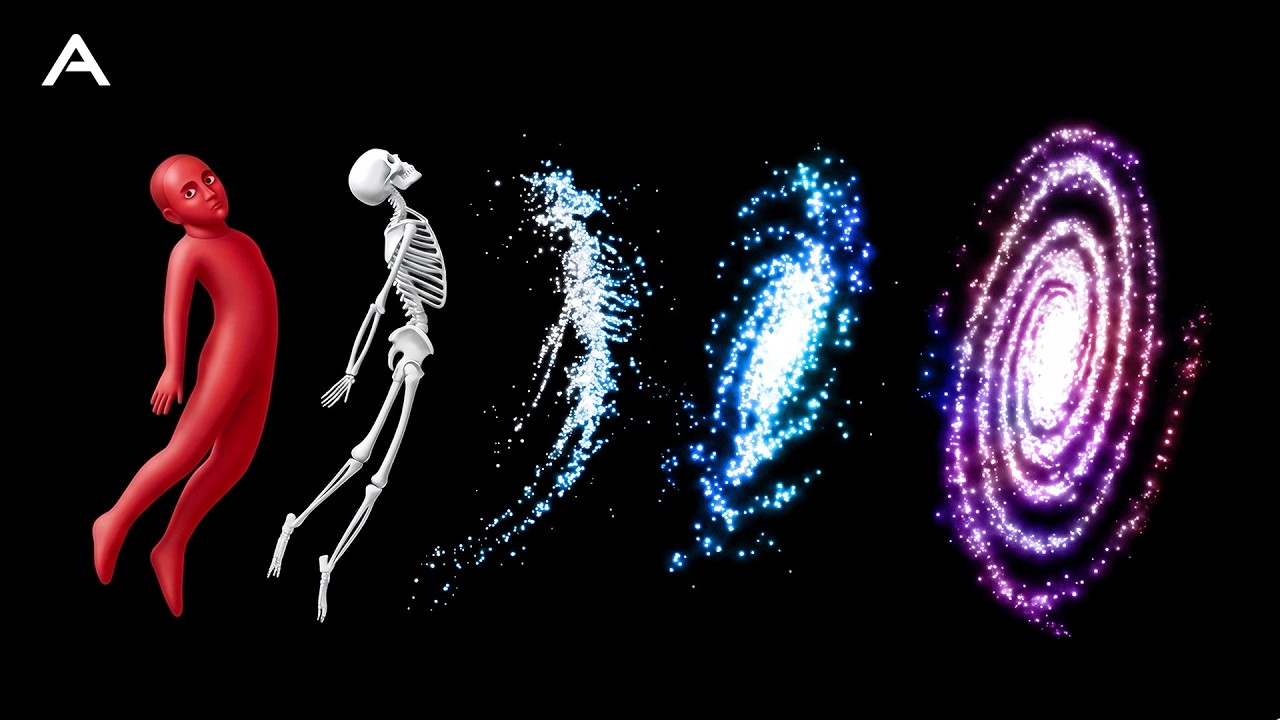
Every Confusing Thing About Thermodynamics Explained Slowly (For Sleep)
A slow, complete history of thermodynamics, from the steam engines that pumped water out of British coal mines to the heat death of the universe. It runs through caloric theory and Count Rumford's cannon boring, Carnot's unbreakable efficiency ceiling, Joule's paddle wheel, the first and second laws of Clausius and Kelvin, Boltzmann's S equals k log W and his tragedy, Nernst's third law at absolute zero, and the zeroth law. It then shows the same handful of laws running engine cycles, refrigerators, Maxwell's demon and the heat cost of erasing information, the Earth as a heat engine, and the greenhouse effect first measured by Eunice Foote in 1856. It closes on the arrow of time, the low entropy Big Bang, and life as a temporary pocket of order surfing on entropy increase.
Published Jun 15, 20262:08:33 video62 min readAdded Jun 16, 2026Open on YouTube →
At a glance
This is the whole story of thermodynamics, told slowly and in order, from the first steam engines pumping water out of British coal mines to the heat death of the universe. Cosmo Explains starts with a claim that sounds like flattery and turns out to be the thesis: you already understand thermodynamics in your bones, because you have always lived in a world where cocoa goes cold, you cannot unscramble an egg, and pedaling uphill is harder. The four laws are just those lived rules written down. Einstein called it the one physical theory of universal content he was sure would never be overthrown.
The narrative is a chain of people. Thomas Savery and Thomas Newcomen build engines nobody understands, caloric theory misreads heat as an invisible fluid, Count Rumford bores cannon and notices the heat never runs out, Sadi Carnot finds the unbreakable efficiency ceiling, James Joule the brewer measures the price of heat in mechanical work, Rudolf Clausius and William Thomson state the first two laws and name entropy, Ludwig Boltzmann explains entropy with atoms and dies before the world admits he was right, and Walther Nernst anchors the bottom of the scale with the third law.
Then the same handful of laws is shown running everything: the Otto, Diesel and Brayton cycles inside cars and jet engines, the refrigerator as a heat engine run backward, Maxwell's demon and the discovery that erasing information costs heat, the Earth as a heat engine between the hot Sun and cold space, the greenhouse effect that Eunice Foote found in 1856, and finally the arrow of time and life itself as a temporary low entropy pocket surfing on entropy increase. The page below walks that same path, with the numbers, names, and equations kept intact.
You already know thermodynamics
The opening reframe sets the tone. You understood thermodynamics as a child, the video says, not in the textbook sense with state variables and partial derivatives, but in a deep intuitive way. You knew a hot cup of cocoa left on the counter would get cold. You knew you had to push harder to pedal uphill. You knew you could not unscramble an egg. Nobody taught you those things. You lived in a universe where they were true and your brain filed them as the rules of the game.
That, stripped of the Greek letters, is all thermodynamics is: the study of the rules about heat, energy, and work, and why things change in the directions they do and never in reverse. It is the science of why things happen this way and not that way. And the rules are so universal that Einstein said thermodynamics was the only physical theory of universal content he was convinced would never be overthrown. The rest of the video earns that line.
Fire, mines, and engines nobody understood
The story starts, as so many do, with fire. For most of human history fire was useful magic that nobody understood. You burned wood and got heat. Why and how nobody knew, and for thousands of years nobody needed to know. Blacksmiths forged iron without combustion chemistry. Cooks roasted meat without a theory of heat transfer.
Then in the late 1600s and 1700s, Britain got very interested in one concrete question: how to pump water out of mines. The country ran on coal, and the deeper you dig, the more groundwater seeps in. If you cannot get the water out, you cannot get the coal out. Teams of horses walking in circles turning pumps worked, but horses are slow, expensive, and need food and rest.
Thomas Savery, an English military engineer, patented a device he called the miner's friend around 1698. You heat water in a sealed vessel until it turns to steam, then cool the chamber by pouring cold water over it. The steam condenses, and because liquid water takes up roughly 1,600 times less volume than steam, that condensation creates a partial vacuum that sucks water up from the mine below. Savery was using the atmosphere itself as a muscle: the weight of all the air above us, about 14.7 pounds per square inch, pushing water up into the vacuum. The trouble was the vacuum could only lift water about 30 feet, the limit of what atmospheric pressure supports, a column roughly 33 feet tall. Mines were deeper. Savery tried pressurized steam to push the rest of the way, but the boilers of his era could not hold high pressure safely. They leaked, burst, and failed at the joints.
Thomas Newcomen, an iron monger from Dartmouth who sold tools to miners, solved it around 1712. Same principle of steam, condensation, vacuum, but with a crucial mechanical change: instead of using the vacuum to suck water directly, Newcomen used it to drive a piston in a cylinder. Steam fills the cylinder and pushes the piston up, a jet of cold water condenses the steam to make a vacuum below the piston, and the atmosphere pushes the piston back down. That piston connected through a big rocking beam to a pump down in the mine. About 12 strokes a minute, the great beam nodding like a giant breathing, loud and inefficient and devouring coal. But it worked reliably, and because the mine sat on top of its own fuel supply, the inefficiency hardly mattered. Newcomen engines spread across Britain and Europe, hundreds of them by the mid 1700s.
Here is the tension at the heart of early thermodynamics: the practice was ahead of the theory. Nobody who built or ran these engines understood why they worked beyond the mechanics. What is heat actually? What happens to the energy when steam condenses? Why does it take so much coal to do so little useful work? Those questions were wide open.
Caloric: heat as an invisible fluid
To see why theory was slow, you have to appreciate how confused people were about heat. Today we take for granted that heat is a form of energy related to the motion of atoms, and that temperature measures the average kinetic energy of those particles. In the 1700s none of that was established. Atoms were still speculative. The dominant theory was caloric theory: heat was an actual physical substance, a weightless invisible fluid called caloric that flowed from hot objects to cold ones.
It is not a crazy idea. Heat really does seem to flow: put a hot iron next to a cold one and the hot cools while the cold warms, as if something pours between them. The French chemist Antoine Lavoisier, the same man who figured out oxygen and later lost his head to the guillotine, thought caloric was a real element, just weightless and hard to detect. Caloric explained a lot: heat flows downhill from hot to cold like water from high to low, compressing a gas heats it (maybe you are squeezing the caloric out), mixing hot and cold water gives warm water (the caloric distributing itself evenly). It seemed to hang together.
But there were cracks, and the most famous came from Benjamin Thompson, later Count Rumford, an American born British loyalist, adventurer, spy, and self promoter with one of the most colorful lives of the 18th century: born in Massachusetts, spied for the British during the American Revolution, fled to England, was knighted, reorganized the Bavarian army, invented a more efficient fireplace, and founded the Royal Institution in London. Around 1798 in Munich he was overseeing the boring of brass cannons, drilling out the barrels, a process that generated enormous heat through friction. Everything was so hot they kept pouring water over it.
Under caloric theory that heat was supposed to be caloric squeezed out of the brass. But Thompson noticed the heat just kept coming. As long as the tool turned, heat kept being produced, no matter how much brass had been removed. Even a dull tool barely cutting metal produced enormous heat. If caloric were a substance stored in the brass, it should run out like water from a sponge. It never ran out. The supply seemed inexhaustible as long as you kept doing mechanical work. Thompson concluded heat could not be a material substance. It had to be something related to motion. He was fundamentally right, and almost nobody listened, because caloric was too entrenched and Thompson had poked a hole in the old idea without fully building the new one.
Carnot and the ceiling nobody can break
The first truly decisive step came from an improbable source: a young French military engineer who published one slim book, was largely ignored in his lifetime, and died of cholera at 36. Sadi Carnot, born in 1796 in revolutionary France, was the son of Lazare Carnot, mathematician and military strategist, the man called the organizer of victory. Sadi attended the École Polytechnique, then military engineering, and by his mid twenties found himself on half pay, sidelined by the political upheaval after Napoleon's fall. Instead of languishing, he threw himself at one question. He saw Britain pulling ahead of France economically and understood that much of the advantage came down to the steam engine, refined by British engineers like James Watt. Carnot did not just want a better engine. He wanted to know, at the deepest level, what governs how much useful work you can extract from heat, for any engine ever built.
In 1824, at 28, he published Reflections on the Motive Power of Fire, one of the most remarkable documents in the history of science. He abstracts away from pistons and boilers and fuel and asks a pure question. He imagines an idealized engine with no friction, no heat leaking, no wasted motion, and asks whether even this perfect engine has a maximum efficiency, and whether you can ever turn all the heat into work.
Ironically, Carnot used caloric theory to get there. He imagined heat as a fluid flowing from a hot body to a cold body, and reasoned by analogy with a water wheel. The work you get from a water wheel depends on two things: the amount of water and the height it falls. Water dropping 10 feet does more work than water dropping 2 feet. He applied the same logic to heat: the motive power of a heat engine depends on the amount of heat flowing and the temperature difference it flows across. Heat falling from high temperature to low temperature is like water falling from a height, and that fall is where the work comes from.
Then the crucial insight. The efficiency of an ideal engine depends only on the temperatures of the hot source and the cold sink. Not the working substance, not steam versus air, not the mechanical details. Just the temperatures. And no real engine can ever beat this ideal engine running between the same two temperatures. That is a hard, absolute, unbreakable ceiling, a law of nature rather than an engineering limit. The kicker: the only way to reach 100% efficiency would be a cold reservoir at absolute zero, which is unattainable. So every real heat engine must waste some energy. Some heat must always flow to the cold side without doing work. Always. Not because we are not clever enough, but because the universe will not allow it.
Figure 1. Carnot's engine in one picture. Heat falls from a hot reservoir to a cold one, and the engine skims off work along the way like a water wheel takes work from falling water. The first law forces the books to balance, Q in equals work plus waste heat. The second law forces some waste heat, always, because the only way to reach perfect efficiency is a cold sink at absolute zero, which nature forbids.
Carnot published this and it caused no sensation. The book sold poorly, most physicists and engineers never read it, and Carnot held no prestigious post. In 1832, during a cholera epidemic in Paris, he caught the disease and was gone at 36. Most of his papers were burned, standard practice then to stop the spread of infection. We lost almost everything he wrote. In the surviving notes there are hints that before he died Carnot had abandoned caloric theory and come close to the idea that heat is a form of motion convertible to work, even estimating what we now call the mechanical equivalent of heat. None of it was published. The foundational insight was in that 1824 book, but the world was not ready and the man who might have pushed the science forward by decades was gone.
The person who rescued the work from obscurity was the French engineer Émile Clapeyron, whose 1834 paper restated Carnot's ideas in rigorous mathematics with elegant diagrams, including what we now draw as the Carnot cycle on a pressure volume diagram. Through Clapeyron, Carnot's ideas reached the two men who would build the formal edifice: William Thomson, the future Lord Kelvin, and Rudolf Clausius.
Figure 2. The Carnot cycle Clapeyron drew for the world. Two isothermal legs (heat in at the hot temperature, heat out at the cold) bracket two adiabatic legs where no heat crosses and the gas simply heats or cools as it is compressed or expanded. The loop is closed, so the gas returns to where it started, and the area inside the loop is the net work the engine delivers each cycle. Its efficiency depends only on the two temperatures, never on the gas inside.
Joule, the brewer who weighed heat
Thermodynamics did not come from one direction. While Carnot thought about efficiency in France, others circled a related question: what exactly is the relationship between heat and mechanical work, and can you put a number on it? Enter James Prescott Joule, and one of the best stories in science, because he was not a professional scientist. He was a brewer. His family owned a brewery near Manchester, and Joule became obsessed with measuring things precisely. He wanted to know exactly how much mechanical work it took to raise the temperature of water by one degree. If heat is truly a form of energy, there should be a fixed, universal conversion rate: one unit of mechanical work should always make the same amount of heat, however you do it.
His most famous experiment used a falling weight connected by a string and pulley to a paddle wheel submerged in an insulated container of water. The weight falls, the paddle turns, the stirring heats the water by friction. Joule measured the distance the weight fell and the tiny temperature rise, fractions of a degree Fahrenheit, with extraordinary precision, over and over. He tried other methods too: squeezing air, forcing water through narrow tubes, even electrical currents, and every method gave essentially the same conversion factor. A specific amount of mechanical work always produced the same amount of heat. He presented results more definitively in 1845 and 1847.
Like Carnot, he was ignored at first. A brewer from Manchester with homemade apparatus, claiming to have found a fundamental law of nature? When he presented his paddle wheel results at the British Association for the Advancement of Science in 1847, the chairman reportedly suggested he give a brief verbal summary so they could move on. But one person was paying attention: a 23 year old named William Thomson, the future Lord Kelvin, who had recently read Clapeyron's paper on Carnot. He sensed that the two threads, Carnot's limit on efficiency and Joule's proof that heat and work are interconvertible, were connected, and yet seemed to contradict each other. Carnot, framed in caloric theory, assumed heat was conserved, flowing through the engine like water through a wheel, doing work but not used up. Joule showed heat could be created from work and, by implication, destroyed, turned entirely into work. Both could not be right. Or could they? This apparent contradiction is exactly where thermodynamics cracked open.
Clausius, Kelvin, and the first two laws
The man who resolved it was Rudolf Clausius, born 1822 in Köslin in Prussian Pomerania, son of a pastor, the kind of mind that could hold ideas in tension without flinching. In 1850 he published a paper whose title translates roughly as "On the moving force of heat and the laws which may be deduced therefrom." In it he said, in effect: Carnot was right about the efficiency limit, Joule was right about the interconvertibility of heat and work, and caloric theory is wrong, and all three can be true at once.
The key insight: Carnot had shown you cannot convert heat into work without a temperature difference, and the efficiency depends on that gap. That part was correct and did not actually require caloric theory. What caloric added unnecessarily was the claim that the total heat was conserved, the heat in equal to the heat out, like water through a mill. Clausius said no. Some of the heat from the hot source is genuinely converted into work and does not come out the other side. The heat coming out the cold end is less than what went in, and the difference is exactly the work the engine performed. So Carnot's ceiling still holds, but the reason is not that heat is a conserved fluid. The reason is something deeper about the directionality of how heat moves. In doing so Clausius stated, in clear general form, what we now call the first law of thermodynamics: energy is conserved. It can change forms, heat into work, work into heat, but the total energy in a closed system stays the same. It sounds too simple, yet getting there took decades of confusion and experiment.
William Thomson in Glasgow was working on the same ideas at almost the same time, and by 1851 published his own dynamical theory of heat, independent of Clausius and in some ways more physically intuitive. He emphasized the directionality of heat flow: heat naturally flows from hot to cold, never the other way without external work. You know this. Your coffee cools, it never spontaneously heats up by absorbing energy from cooler air. A warm room never develops a hot corner and a cold corner on its own. That would not violate conservation of energy, so something else is going on, some principle beyond energy bookkeeping. This is the second law of thermodynamics, where thermodynamics turns almost philosophical. The first law tells you what is possible in energy accounting. The second tells you which way processes actually go.
Clausius stated it one way: heat cannot of itself pass from a colder body to a warmer one. Thomson stated it differently: it is impossible to build a device that operates in a cycle and produces no effect other than extracting heat from a single reservoir and performing an equivalent amount of work. They sound different but are equivalent; violate one and you violate the other. Thomson's version connects straight back to engines. You cannot take heat from a single source, say the ocean with its enormous thermal energy, and turn all of it into useful work with nothing left over. There must always be waste heat dumped into a cooler reservoir. Always, not from friction, but from law. Even Carnot's ideal engine still rejects heat to the cold sink. So there is an inescapable tax on every energy conversion. The first law says you cannot win, you cannot create energy from nothing. The second says you cannot even break even, every conversion has a cost. Together they describe a universe where energy is conserved but its usefulness is constantly degrading.
The two men make a study in contrast. Thomson, Lord Kelvin as he became, was charismatic and well connected, a professor at Glasgow at 22, who helped lay the first transatlantic telegraph cable, developed the absolute temperature scale that bears his name, was knighted, raised to the peerage, and on his death in 1907 buried in Westminster Abbey next to Isaac Newton. Clausius was quieter and more methodical, less publicly famous, but in the theory he arguably went deeper, because he kept asking what exactly is the quantity that determines the direction of natural processes, the mathematical thing that always increases.
Entropy: the quantity that only goes up
That question leads to entropy, probably the most misunderstood and most important concept in thermodynamics. Clausius did not arrive at it all at once. From 1850 to 1865, fifteen years of refinement, he spoke at first of the clunky "equivalence value of transformations," trying to capture the idea that when heat flows hot to cold, or work turns into heat, a transformation happens with a natural direction, and these transformations accumulate. In 1865 he coined the word entropy, choosing the Greek root for transformation or turning to echo the word energy, so the two would feel like siblings. Energy tells you how much. Entropy tells you which way. He summarized the two laws in what may be the most elegant pair of sentences in physics: the energy of the universe is constant, the entropy of the universe tends toward a maximum. Energy is shuffled but never created or destroyed. Entropy is a one way ratchet built into reality.
What does entropy actually mean physically? This is where textbooks fail, the video says. You often hear entropy described as disorder, which is not completely wrong but misleading enough to cause real problems. A better frame: entropy is a measure of energy dispersal, how spread out the energy in a system is among all the ways it could be arranged. When energy is concentrated, like a hot object in a cold room, that is a low entropy state, a big temperature difference, a potential to do work. As the hot object cools and the room warms, the energy spreads more evenly, the temperature difference shrinks, entropy increases. When everything reaches the same temperature, entropy is at its maximum and no more work can be extracted. The energy is still there, the first law guarantees it, but it is useless now, spread too evenly to have any gradient to exploit.
Think of water. A lake on a mountain and a valley below: the height difference means water can flow down and turn a turbine, useful energy. Once the water reaches the valley and spreads into a flat still pond, the energy of its elevated position is gone, the molecules still there but no height difference left to extract work from. Entropy measures how much of that leveling out has happened. And Clausius showed something beautiful: for any reversible, idealized, perfectly efficient process like Carnot's ideal engine, the total entropy change is zero, nothing gained or lost. For any real, irreversible process, which is every actual process in the world, entropy increases always, without exception. Friction generates entropy. Heat flowing across a temperature difference generates entropy. Mixing two gases generates entropy. Every real thing pushes the universe's entropy a little higher. That is why Carnot's ideal engine matters even though it can never be built: it is the boundary between possible and impossible. Any real engine makes more entropy than Carnot's ideal and is less efficient. You can approach the limit with better engineering, but never reach it and never surpass it.
Figure 3. The second law as a curve you live with daily. As a hot object cools in a cold room, the temperature difference (blue) decays toward zero while the entropy (amber) climbs and saturates. The instant the two temperatures meet, entropy hits its maximum for that system and the energy, though fully conserved, becomes useless: there is no gradient left to drive anything. Every cooling cup of coffee traces this shape.
Boltzmann: entropy is counting, and the price of being right
While Clausius and Thomson worked out grand principles in the 1850s and 1860s, a young Austrian physicist, Ludwig Boltzmann, born in Vienna in 1844, asked an innocent sounding, explosive question. If matter is made of atoms bouncing around by the laws of mechanics, then what is heat really, what is temperature really, and what is entropy in terms of what the atoms are actually doing? Thermodynamics had been built as a macroscopic theory of bulk properties, temperature, pressure, volume, heat flow, without saying what matter was made of. You did not need to believe in atoms to use it, and many prominent scientists in the late 19th century did not. Ernst Mach, the influential Austrian physicist and philosopher, was openly hostile, considering atoms a convenient fiction with no place in rigorous science.
Boltzmann disagreed profoundly, and his attempt to ground thermodynamics in the mechanics of atoms led to one of the most beautiful and most contested ideas in physics. He earned his doctorate at 22 and went straight to the kinetic theory of gases: a gas is a vast swarm of tiny particles in constant chaotic motion, and everything we observe, pressure, temperature, behavior under heating or compression, emerges from the collective statistics of those particles. The idea was not entirely new. Daniel Bernoulli sketched it in 1738, suggesting pressure comes from particles smacking the container walls. James Clerk Maxwell took it much further in the 1860s, showing that molecular speeds follow a specific statistical distribution, the Maxwell distribution: not all molecules move at the same speed, some crawl, some zip, most are in the middle, and the exact mathematical shape matched experiments beautifully.
Boltzmann pushed further than anyone dared. He wanted to take entropy, the abstract quantity Clausius defined, and explain it in terms of atoms, not just describe that it increases but explain why by looking at what the atoms do. Imagine a box of gas, a few trillion molecules bouncing and colliding. At any instant each molecule has a specific position and velocity. If you could freeze time and write all of them down, you would have a microstate, the complete microscopic truth of the system at one moment. You can never actually do this, but conceptually it is well defined. When you measure something macroscopic, temperature, pressure, volume, you are not measuring the microstate, you are measuring a macrostate defined by bulk properties.
The clever part: many, many different microstates correspond to the same macrostate. If the gas has a certain temperature and pressure, there are trillions of ways the individual molecules could be arranged, different positions and velocities, that all give the same temperature and pressure when measured. Swap two molecules, or speed one up while another slows by the same amount, and the macroscopic properties do not change. All those rearrangements are different microstates that look identical from outside. So Boltzmann defined a quantity, call it W, counting the number of microstates that correspond to a given macrostate, and made his great claim: entropy is proportional to the logarithm of W. More microstates, higher entropy. Fewer microstates, lower entropy. The equation is S = k log W, where S is entropy, k is the constant now called Boltzmann's constant, and W is the number of microstates. It is carved on his tombstone in Vienna's Zentralfriedhof.
This is powerful because it explains the second law not as a cosmic decree but as pure statistics. If a system can be in any microstate with roughly equal probability, a reasonable assumption for systems in equilibrium, then it is overwhelmingly more likely to be found in a macrostate corresponding to a huge number of microstates than a tiny number, and the macrostates with the most microstates are the highest entropy ones. The system evolves toward higher entropy simply because there are vastly more ways to be in a high entropy state. It is not forbidden to decrease entropy. It is just astronomically improbable, so improbable you would wait longer than the age of the universe to see a significant spontaneous decrease. Think of a deck of cards perfectly sorted, one arrangement, very low entropy. Shuffle it and after ten shuffles it is thoroughly mixed, enormously higher entropy because billions of arrangements look random and only one looks sorted. In principle it could shuffle back to order, but the number of shuffles you would need is so staggering it effectively never happens. The second law, Boltzmann style, is not a law of impossibility but a law of overwhelming probability.
This framing brought fierce opposition from three directions. First, Mach and the energeticists like Wilhelm Ostwald simply did not accept atoms; you cannot count microstates of particles you think are not real. Mach held that science should deal only with observable quantities, and atoms were not observable, so to him they were metaphysics, and Boltzmann's statistical mechanics was a castle on imaginary foundations. Second, the reversibility paradox, raised by Boltzmann's friend Josef Loschmidt: the laws of mechanics are time reversible, so film billiard balls colliding and play it backward and the reversed motion still obeys Newton's laws perfectly. Nothing in the microscopic equations distinguishes past from future. How can you derive an irreversible law, entropy always increases, from reversible physics? Boltzmann's answer was subtle and ahead of its time: the second law is not a mechanical law but a statistical one. Individual trajectories are reversible, but with astronomical numbers of particles, and a single breath of air contains something like 10 to the 22nd power molecules, the statistics become so one sided that a macroscopic decrease in entropy is effectively impossible. It is not about what must happen but what almost certainly will. Third, the recurrence paradox, raised by Ernst Zermelo from a theorem of Henri Poincaré: any mechanical system confined to a finite region will, given enough time, return arbitrarily close to its initial state, so a system that goes from low to high entropy should eventually return to low. Boltzmann's answer was essentially yes, recurrence is real, but the time scales are so incomprehensibly vast, far longer than the age of the universe, that they have no practical relevance.
These debates raged through the 1890s and took a real toll. Boltzmann was passionate and emotional, generous with students, prone to self doubt, describing himself as in constant battle. The opposition felt personal, Mach's criticism carried institutional weight, Ostwald's energetics gained followers, and Boltzmann felt the whole establishment turning against the atomic hypothesis, against his life's work. He suffered what we would now recognize as severe depression, worsening over the years. In 1906, on vacation with his family in Duino near Trieste, Boltzmann took his own life, at 62. It is one of the most heartbreaking stories in science, because within a few years the tide turned completely. Einstein's 1905 paper on Brownian motion gave compelling evidence for atoms, Jean Perrin's experiments confirmed the predictions quantitatively, and by 1910 even Ostwald had conceded atoms were real. Boltzmann had been right all along and did not live to see it. His equation did not just survive the controversy, it became a cornerstone of modern physics, connecting the microscopic and macroscopic worlds.
Boltzmann's picture also opened something else. If entropy is about counting microstates, then entropy is fundamentally about information, about what you know and do not know. If you knew the exact microstate, every position and velocity, entropy would be zero for you, only one arrangement consistent with your knowledge. If you only know the macroscopic properties, entropy reflects your ignorance of the microscopic details. That connection would be made rigorous by Claude Shannon in 1948, a thread the video returns to.
The third law and the floor at absolute zero
By the early 20th century thermodynamics had three pillars: the first law, energy is conserved; the second law, entropy never decreases and in practice always increases; and Boltzmann's statistical interpretation of why. But one more law was waiting, about the nature of absolute zero. A German chemist, Walther Nernst, born 1864 in West Prussia, brilliant, ambitious, and comically confident, wrestled with it. His obsession was practical: predicting whether a chemical reaction would happen spontaneously. That depends on the free energy of the system. The Gibbs free energy, worked out by Josiah Willard Gibbs in the 1870s, says a reaction proceeds spontaneously if it decreases the free energy, and free energy combines the total energy (first law territory) and the entropy (second law territory): Gibbs free energy equals the enthalpy minus the temperature times the entropy. To predict whether a reaction goes, you need both the energy change and the entropy change.
The trouble: by the early 1900s chemists could measure energy changes well via calorimetry, but entropy changes were much harder, especially at low temperatures, and the connecting equations had an annoying integration constant, an unknown number you could not determine from the existing laws. The first and second laws together could tell you about changes in entropy, but not the starting point. So in 1906, the same year Boltzmann died, a poignant coincidence, Nernst proposed his heat theorem: as the temperature of a system approaches absolute zero, the entropy change associated with any process approaches zero. At the bottom of the temperature scale, entropy differences between states vanish. That gives a fixed reference point, a sea level for entropy. Before Nernst, entropy was always relative; you could talk about how much it changed but not what it actually was. His theorem anchored the scale. Later Max Planck extended it: the entropy of a perfect crystal at absolute zero is exactly zero, not just that changes vanish. This is the textbook third law. A perfect crystal at absolute zero has only one way to arrange it, one microstate, and by Boltzmann's S = k log W, if W equals 1 then log 1 is zero and the entropy is zero. It fits together beautifully.
Absolute zero is 0 kelvin, which is minus 273.15 degrees Celsius, about minus 459.67 Fahrenheit, the temperature at which, classically, all molecular motion ceases. Quantum mechanics complicates this with zero point energy: particles keep a tiny residual energy even at absolute zero because Heisenberg's uncertainty principle will not let them be perfectly still and perfectly located at once. But the classical picture gives the right intuition: absolute zero is the floor, you cannot go below it. And the third law tells you that you can never actually reach it. No finite number of cooling steps brings a system all the way to zero. You can get astonishingly close, modern labs to within a billionth of a degree, but each cooling step removes less and less entropy and the closer you get the harder it becomes, like an asymptote you approach forever but never touch. Every refrigerator, air conditioner, and cryogenic system fights this. They move heat from cold to warm, which the second law says does not happen spontaneously, so you must do work, and the colder you want to go the more work it takes per degree, growing exponentially. This is why cryogenics is so specialized and expensive. Cooling a superconducting magnet for an MRI machine to a few kelvin needs liquid helium, elaborate insulation, and pumps, and even then you sit a few degrees above the floor.
Nernst was also an inventor and entrepreneur. He developed the Nernst lamp, an early incandescent light using a ceramic filament instead of carbon, more efficient than Edison's bulbs in some respects, and sold the patent to AEG for a million marks, buying a country estate. He loved cars, owned several, was among the first in Berlin to drive an automobile, and once tried to use waste heat from his car's exhaust to warm the interior, a very thermodynamic solution. He won the Nobel Prize in Chemistry for 1920 for his heat theorem. Life took darker turns: he lost two sons in the First World War, and although not Jewish himself he opposed the Nazi persecution of his many Jewish colleagues and students, which isolated him. He retired to his estate and died in 1941, largely forgotten by the regime that had dismantled German science. His third law endured.
The fourth law that came first: the zeroth law
The framework also includes the zeroth law, the simplest one, formalized last, which is why it has that odd name. Stated explicitly by Ralph Fowler in the 1930s though assumed implicitly for a century, it says: if two systems are each in thermal equilibrium with a third, they are in thermal equilibrium with each other. It sounds trivially obvious, but it is the statement that makes temperature a meaningful transitive property. Without it the whole concept of measurement falls apart. Every thermometer relies on it: the thermometer reaches equilibrium with your body, you read it, and you trust the reading tells you your body's temperature, a chain that only works if thermal equilibrium is transitive. They called it the zeroth law because it logically comes before the first, even though historically it was recognized after.
So the full architecture of classical thermodynamics by the mid 20th century: the zeroth law gives you temperature, the first law gives you energy conservation, the second law gives you entropy and the arrow of time, the third law gives you the absolute reference point and the unattainability of absolute zero, and underneath all of it Boltzmann's statistical mechanics explains why entropy behaves as it does.
Law
What it says
What it gives you
Zeroth
If A and B are each in equilibrium with C, they are in equilibrium with each other
Temperature as a real, measurable property
First
Energy is conserved; it changes form but the total stays constant
You cannot win (no energy from nothing)
Second
Entropy of an isolated system never decreases; heat flows hot to cold
You cannot break even; the arrow of time
Third
Entropy of a perfect crystal approaches zero as temperature approaches absolute zero
Absolute zero is unreachable; a sea level for entropy
Figure 4. The four laws as the video lines them up, in the order they govern a system: first you need temperature to mean anything (zeroth), then you account for energy (first), then you learn which way things go and that there is always a tax (second), then you find the floor of the temperature scale and an anchor for entropy (third). Boltzmann's S = k log W sits beneath the second and third, explaining them with atoms.
The same laws, running everything: engine cycles
Once the framework is in place, you start seeing thermodynamics at work everywhere. The 20th century was not about discovering new laws but using the existing ones with extraordinary precision. Take the engine in a car. You burn gasoline, a hydrocarbon, and combustion releases energy as heat that raises the temperature and pressure of the gases in the cylinder, pushing a piston, turning a crankshaft, turning the wheels. It is a heat engine, and Carnot's limit applies as ruthlessly as it did to 1820s steam engines. The maximum efficiency depends on the temperature difference between the hot combustion gases and the cooler exhaust. A typical gasoline engine runs combustion temperatures around 2500 degrees and exhaust around 600 degrees, giving a theoretical Carnot efficiency of maybe 60 to 70%. Real engines fall well short because of friction, heat losses through the block, incomplete combustion, and a dozen other imperfections. A typical car engine turns maybe 25 to 30% of the fuel's energy into useful work, the rest waste heat. That is not a design flaw, it is thermodynamics: the second law sets a ceiling and real engineering brings you below it.
The differences between engines come down to thermodynamic cycles, specific sequences of compression, heating, expansion, and cooling. Nicolaus Otto developed the four stroke cycle most gasoline engines still use, patented in 1876. Rudolf Diesel, who had studied thermodynamics under Carl von Linde in Munich, was obsessed with getting closer to Carnot's limit. He reasoned that compressing air to a much higher pressure before igniting fuel gives a higher temperature difference and better efficiency. His diesel engine, patented and demonstrated by 1897, did exactly that, and diesel engines remain more efficient than gasoline ones to this day, typically converting 35 to 45% of fuel energy into work. Diesel himself had a tragic end, disappearing from a steamer crossing the English Channel in 1913, his body found days later; whether suicide, murder, or accident has never been settled. He was under enormous financial pressure and nearly bankrupt despite his engine's success, and on his way to London to discuss fitting diesel engines to British submarines, which has fed speculation about foul play. The engine he left changed the world: container ships, freight trains, heavy trucks, generators, agricultural equipment.
The differences between the cycles are different strategies for the same constraints. In the Otto cycle you compress a fuel air mixture and ignite it all at once with a spark plug, roughly a constant volume combustion: the fuel burns so fast the piston barely moves, so volume stays about the same while pressure and temperature spike. In the Diesel cycle you compress just air to very high pressure and temperature, then inject fuel gradually so it burns more slowly as the piston already moves outward, closer to a constant pressure process. Each idealized cycle has a different efficiency formula relating compression ratio to thermal efficiency. The diesel cycle can use higher compression ratios because you only compress air, not a mixture that might detonate early, and higher compression means higher temperatures, a bigger gap between source and sink, and Carnot's ghost again, better theoretical efficiency. A gasoline engine might run 10 to 1, a diesel 20 to 1 or higher, and that difference translates directly into miles per gallon and into how much carbon dioxide goes into the atmosphere per kilometer. It is the reason a diesel truck can haul 40 tons across a continent on less fuel per ton mile than almost any other land transport.
One more cycle takes us into the sky. The Brayton cycle, named after the American engineer George Brayton who built an early constant pressure engine in the 1870s, describes how gas turbines and jet engines work. You take in air, compress it, add heat by burning fuel in the compressed air, then let the hot gas expand through a turbine that extracts work; the exhaust gives thrust in a jet, or spins a generator in a power plant. Its efficiency depends, again, on the pressure ratio and the temperature difference. Modern jet engines run turbine inlet temperatures above 1500 degrees, and achieving that without melting the blades is one of the great materials challenges of our time. The blades are single crystal nickel superalloys with internal cooling channels and thermal barrier coatings, operating in gas hotter than the metal's own melting point, surviving only because cool air bled from the compressor flows through tiny passages inside the blade. Thermodynamics, materials science, and fluid dynamics at the edge of the possible.
Refrigerators, Maxwell's demon, and the cost of information
A refrigerator is a heat engine running in reverse. Instead of letting heat flow hot to cold and skimming work, you put work in to pump heat from cold to hot, moving it the way it does not naturally want to go. The second law lets you do it but charges you. The coefficient of performance, the ratio of heat removed to work input, is bounded by limits that are basically Carnot efficiency flipped upside down. Practical refrigeration in the late 19th and early 20th centuries transformed civilization. Before it, food preservation meant salting, smoking, drying, or natural ice; keeping things cold on demand changed agriculture, medicine, and where people could live. Carl von Linde, the same professor who taught Diesel, pioneered industrial refrigeration with ammonia compression refrigerators in the 1870s and 1880s. There is a lovely symmetry there: the same intellectual tradition produced better engines and better refrigerators, because they are the same thermodynamic problem viewed from opposite directions.
That brings back the dangling thread between entropy and information, and one of the quietly brilliant people of the 20th century, Claude Shannon. At Bell Labs in the 1940s, Shannon was not thinking about steam engines but about the fundamental limits of communication, how much information you can send through a noisy channel. In his landmark 1948 paper, A Mathematical Theory of Communication, he defined a quantity measuring the uncertainty or information content of a message and needed a name. The story, possibly apocryphal but too good not to tell, is that he asked John von Neumann what to call it, and von Neumann said call it entropy, because the formula is the same as in statistical mechanics, and because nobody really understands entropy so in a debate you will always have the advantage. Shannon's entropy formula looks almost identical to Boltzmann's, both sums over possible states weighted by probabilities with a logarithm, and that is no coincidence. High thermodynamic entropy means many microscopic arrangements look the same from outside, so you have little information about which microstate the system is in. High Shannon entropy means messages are unpredictable, each symbol carrying a lot of information because you could not have guessed it. In both cases entropy measures your uncertainty. A perfectly ordered crystal at absolute zero has zero thermodynamic entropy, one microstate, you know exactly what is going on. A completely predictable message has zero Shannon entropy, no surprise, no new information.
This is more than analogy. Take the famous thought experiment of Maxwell's demon, proposed by Maxwell in 1867, where a tiny creature sits at a trapdoor between two gas chambers and sorts fast molecules to one side and slow to the other, apparently decreasing entropy without doing work, violating the second law. For over a century physicists argued about what was wrong, and the resolution, worked out by Leó Szilárd in 1929 and made rigorous by Rolf Landauer at IBM in 1961, comes down to information. The demon must observe each molecule, store that information, and eventually erase it. Landauer's principle showed that erasing one bit of information necessarily dissipates a minimum amount of energy as heat, specifically k T times the natural log of 2, where k is Boltzmann's constant and T the temperature. That tiny heat is enough to save the second law: the entropy decrease from sorting is exactly compensated by the entropy increase from the demon's information processing. Information is not free; it has a thermodynamic cost. The principle has been experimentally verified; in 2012 a team in France measured the heat from erasing a single bit and matched Landauer's prediction. This has real consequences for the computers in your pocket. Every time a computer erases or overwrites a bit, a minimum heat must be generated. Modern computers run far above this floor, the heat from your laptop mostly electrical resistance, but as circuits shrink and computing grows more efficient, that fundamental floor gets closer, and it sets the ultimate limit on how much calculation you can do with a given amount of energy.
The Earth as a heat engine, and the greenhouse effect
There is one more enormous arena, and it may be the most consequential application in human history: the Earth's energy balance and climate. The Earth receives energy from the Sun, mostly visible light, photons crossing 93 million miles of vacuum. Some bounces back off clouds, ice, and deserts; much is absorbed by oceans, land, and atmosphere. The Earth does not accumulate that energy forever, or it would heat without limit, which has not happened over four and a half billion years. Instead it radiates energy back into space, but differently from how it received it. The incoming energy is mostly high frequency visible light because the Sun's surface is about 5700 kelvin. The outgoing energy is mostly infrared radiation, lower frequency and longer wavelength, because the Earth's surface is only around 288 kelvin, roughly 15 degrees on average. In thermodynamic terms the Earth sits between a hot reservoir, the Sun, and a cold reservoir, the deep cold of space at about 2.7 kelvin thanks to the cosmic microwave background. Energy flows in from the hot source, passes through, and flows out to the cold sink. That is a heat engine. The Earth is, in a very real sense, a heat engine, and like any heat engine it is the temperature difference between source and sink that drives everything interesting: all the weather, the ocean currents, the convection in the atmosphere, the evaporation and precipitation. Carnot would recognize the setup instantly.
But the atmosphere is not perfectly transparent to all wavelengths. Visible light passes through easily, which is why daylight reaches the ground, but the infrared the warm Earth emits does not pass as easily. Certain gases, water vapor, carbon dioxide, methane, nitrous oxide, absorb infrared photons and radiate them in all directions, including back down. This is the greenhouse effect, not a modern invention or controversial theory but straightforward thermodynamics, first described quantitatively by a remarkable person most people have never heard of: Eunice Newton Foote, in 1856, three years before Darwin published On the Origin of Species and nine years before Clausius coined the word entropy. Foote filled glass cylinders with different gases, placed them in sunlight, and measured how much each heated up. A cylinder of carbon dioxide got significantly hotter than ordinary air and stayed hot longer after being removed from sunlight. She presented her findings at the annual meeting of the American Association for the Advancement of Science, her paper read aloud by the male colleague Joseph Henry because of the conventions of the time, and her conclusion was prescient: an atmosphere rich in carbon dioxide would give the Earth a higher temperature. That was 1856.
Three years later the Irish physicist John Tyndall ran more detailed laboratory experiments on the absorption of infrared by various gases, with more sophisticated equipment, showing precisely which gases were strong absorbers. Water vapor turned out to be the most powerful greenhouse gas by volume, carbon dioxide also significant, and he understood the implication immediately: these gases act like a partial blanket, trapping outgoing heat that would otherwise escape. Without any greenhouse effect the Earth's average surface temperature would be about minus 18 degrees Celsius, below freezing everywhere on average; the natural greenhouse effect from water vapor and carbon dioxide warms the planet by roughly 33 degrees, making it habitable. The greenhouse effect itself is not the problem; it is what makes life possible. The question is what happens when you change the composition of that atmospheric blanket.
Here a Swedish chemist, Svante Arrhenius, enters. In 1896 he did an extraordinary calculation, wanting to understand what had caused the ice ages and suspecting changes in atmospheric carbon dioxide. By hand, using data from Tyndall and from the astronomer Samuel Langley's measurements of lunar infrared radiation, he calculated how the Earth's temperature would change if you doubled or halved the carbon dioxide. It took over a year of arithmetic, thousands of calculations by pencil, working through the radiation balance for different latitudes and seasons, and his result was remarkably close to modern estimates: doubling carbon dioxide would raise the global average temperature by about 5 to 6 degrees. Modern climate models on supercomputers put the climate sensitivity at somewhere between 2.5 and 4 degrees for a doubling. Arrhenius was in the right ballpark with nothing but a pencil. As a curious footnote, living in chilly Sweden, he thought a warmer world might be pleasant and imagined the warming would take thousands of years; he was wrong about the timeline, but his physics was sound.
Thermodynamically, the Earth's energy budget must balance: energy in from the Sun has to equal energy out to space, on average. Add more greenhouse gases and you make it harder for infrared to escape, like adding a layer to a blanket. The immediate effect is that less energy gets out than comes in, a net imbalance, and a system absorbing more than it releases warms up. As temperature rises, the Earth radiates more intensely, because the Stefan Boltzmann law says radiated power goes as the fourth power of temperature, so the planet warms until it radiates enough to restore balance, but at a higher temperature than before. It is the same logic as a pot of water reaching a steady temperature on a stove, the rate of heat loss rising with temperature until it matches the input. The complexity comes from feedbacks. Warming melts ice, exposing darker ocean or land that absorbs more sunlight, causing more warming, a positive feedback. Warmer air holds more water vapor, described precisely by the Clausius Clapeyron relation named partly for our old friend Clausius, and since water vapor is itself a greenhouse gas, more vapor means more warming, another positive feedback. On the other hand more water vapor may mean more clouds, which reflect sunlight and cool, a negative feedback. The net of all these interacting feedbacks is what makes prediction hard and why climate scientists build enormously complex models. But the underlying thermodynamics, the energy balance, the radiation physics, the second law driving heat from warm to cold, that has been settled since Joseph Fourier first thought about planetary temperatures in the 1820s.
The connection runs all the way back to those early steam engines. The reason we are adding carbon dioxide is that we burn fossil fuels, coal, oil, natural gas, to power heat engines, cars, power plants, turbines, furnaces. We are running Carnot cycles, Rankine cycles, Otto cycles, Diesel cycles, Brayton cycles on a civilization wide scale, and every one of them, by the second law, must reject waste heat and produce exhaust. When the fuel is carbon based, that exhaust includes carbon dioxide. The very efficiency limits Carnot identified in 1824 mean we can never convert all the chemical energy in fossil fuels into useful work; some must always be wasted as heat, and the combustion products must go somewhere. For two centuries they have gone into the atmosphere, raising the concentration from about 280 parts per million before the industrial revolution to over 420 today. Hurricanes, the video notes, are literally heat engines, pulling energy from warm ocean surfaces and exhausting it in the cold upper atmosphere. And carbon dioxide has a strong absorption band around 15 micrometers, right in the middle of the range where Earth emits most of its thermal radiation, not bad luck but molecular physics, which is statistical thermodynamics at the quantum level.
The same science points toward solutions, and they too are bound by the laws. To remove carbon dioxide from the air you must do thermodynamic work to separate and concentrate it, and the minimum energy is set by the entropy of mixing; at 420 parts per million it is not trivial. Engineers working on direct air capture are essentially fighting entropy, unmixing a very dilute gas from a vast ocean of air. This is also why renewables matter thermodynamically: solar panels and wind turbines do not burn anything, they intercept energy flows already happening, sunlight and wind driven by differential solar heating, and convert some to electricity without adding new carbon dioxide. They still face efficiency limits, a single junction solar cell has a theoretical maximum, the Shockley Queisser limit, of about 33%, again from thermodynamics and quantum mechanics together. But the waste heat from a solar panel was going to become heat anyway when the sunlight hit the ground; you are not adding new energy the way fossil fuels do. Heat pumps can deliver three or four units of heat per unit of electricity, which seems like magic until you realize it is just the second law working in your favor for once.
The arrow of time, heat death, and life
The deepest place all this leads is the nature of time itself. Almost every fundamental law of physics works in both directions of time: Newton's laws, Maxwell's equations, even quantum mechanics at its most basic level. Film a process governed by those laws, play it backward, and the reversed version is a perfectly valid physical process. A ball thrown up and coming down looks reasonable in reverse. Two billiard balls colliding obey the same equations forward or backward. Time at the level of fundamental physics has no preferred direction. And yet you know from every moment of experience that time absolutely does have a direction. Ice melts in warm water, it never spontaneously unmelts. A cup falls and shatters, the shards never leap up and reassemble. You get older. Smoke disperses. Perfume spreads through a room. These happen only one way. There is an arrow of time and you feel it in your bones. So where does it come from, if the microscopic laws are time symmetric?
The best answer comes from Boltzmann. Entropy is the number of microstates consistent with a macrostate. A low entropy state, all the gas crammed into one corner of a room, has very few microstates that produce it. A high entropy state, gas spread evenly, has an astronomically larger number. Start in a low entropy state and let the system evolve, and it is overwhelmingly likely to move toward higher entropy, simply because there are so many more ways to be high entropy. The laws do not forbid the gas from rushing back into the corner; it is just that the probability is so vanishingly small, numbers like 1 over 10 raised to the power of 10 to the 23rd, that you could wait the entire age of the universe multiplied by itself a billion times and never see it. That is the arrow of time. It is statistical, not baked into the equations, emerging from the mathematics of large numbers. Which is both satisfying and unsettling, because it means the arrow of time is not fundamental but emergent, arising because we live in a universe that, for reasons we do not fully understand, started in a state of remarkably low entropy. The fact that your coffee cools, that you age, that yesterday differs from tomorrow, all traces back to the initial conditions of the universe. The Big Bang, roughly 13.8 billion years ago, produced a cosmos in an extraordinarily low entropy state, matter distributed with astonishing uniformity, the cosmic microwave background uniform to about one part in 100,000. From that smooth, hot, dense beginning, gravity has been pulling matter into clumps, stars, galaxies, planets, while radiation spreads out and entropy climbs. The whole history of the universe, thermodynamically, is the story of entropy increasing from that improbable start. The British astrophysicist Arthur Eddington coined the phrase "the arrow of time" in 1927 and held that the second law occupied the supreme position among the laws of nature, writing that if your theory is found to be against the second law of thermodynamics there is nothing for it but to collapse in deepest humiliation.
If entropy has been increasing since the Big Bang and continues, where does it lead? In the late 19th century physicists contemplated the heat death of the universe. If entropy always increases, eventually the universe reaches maximum entropy, thermodynamic equilibrium. Every temperature gradient smoothed out, every star burned through its fuel, every black hole evaporated through Hawking radiation, itself a deeply thermodynamic process, leaving a vast cold uniform expanse where nothing interesting can ever happen again because there are no gradients left to drive any process. No hot and cold, no high and low, just equilibrium forever. Lord Kelvin was among the first to articulate this in the 1850s, and it genuinely troubled people, the idea that the universe has an expiration date, not a dramatic explosion but a slow quiet fade into uniformity.
But here is what is easy to miss in the cosmic gloom: we are not at heat death, not even close. We live in the interesting part, the long slow glorious middle stretch where entropy is increasing but where that very increase makes complexity possible. It sounds paradoxical, since entropy is supposed to be about disorder and things falling apart, but local decreases in entropy are not only permitted by the second law, they are expected, as long as they are paid for by even larger increases elsewhere. That is exactly what life does. You, lying there listening, are a spectacularly low entropy structure, maintaining precise temperature, chemical, and electrical gradients, your cells organized with extraordinary specificity, proteins folded into exact shapes, DNA encoding billions of base pairs in precise sequence. All that order is maintained by a continuous flow of energy: you eat food, low entropy organized chemical energy, and radiate waste heat, high entropy thermal energy, into your surroundings. You are, thermodynamically, a dissipative structure, maintaining your internal order by exporting entropy to the environment. The energy driving the whole chain, sunlight growing the plants that fed the animals that became your dinner, ultimately comes from the Sun, a hot object radiating into the cold of space, and that temperature difference makes everything go. The quantum mechanics pioneer Erwin Schrödinger explored this in his 1944 book What Is Life?, arguing that living organisms feed on what he called negative entropy, drawing order from their environment to maintain their own organization, a remarkable insight that anticipated much of what we now understand about the thermodynamics of biology. Life does not violate the second law. It surfs on it, riding the wave of entropy increase, carving out temporary pockets of order along the way.
And the same framework that Carnot built for steam engines in 1824, that Clausius formalized, that Boltzmann grounded in statistics, that Nernst extended to absolute zero, also explains why you are alive, why anything is alive, why stars shine and rivers flow and hurricanes spin and crystals grow. It is all energy flowing from concentrated forms to dispersed forms, and the variety of things that can happen along the way.
Coming home
The journey closes where it began, with the engines. Newcomen's clunky atmospheric engine pumped water out of coal mines so miners could dig deeper for more coal, which was burned to power the engine that dug up more coal, which was burned in other engines to drive factories, railways, and steamships that transformed civilization. All that burning released carbon dioxide molecule by molecule, decade by decade, until the concentration climbed from about 280 parts per million to over 420 today, and that extra carbon dioxide, through the greenhouse effect Foote first noticed and Arrhenius first calculated, is warming the planet. The story of thermodynamics is also the story of how we got into our climate predicament: the same science that enabled the industrial revolution explains why its byproducts are changing Earth's energy balance. A deep irony, or maybe just consequence, because the second law does not care about irony. It just is. But that same science points toward solutions: better heat engines, solar cells, heat pumps, every principle of the night put to work designing systems that can sustain civilization without destabilizing the climate. The tools are thermodynamic. They always have been.
And maybe that is the most comforting thought to drift off with. Thermodynamics can sound intimidating, all those laws and entropy and the spectre of heat death, but at its heart it is the most practical, most grounded branch of physics there is. Every time you feel warmth from a cup of tea you experience the zeroth law. Every time you pay an electricity bill you reckon with the first. Every time your coffee gets cold but never spontaneously hot you witness the second. And every time scientists push toward colder temperatures, approaching but never reaching absolute zero, that is the third. These laws were figured out by real, brilliant, stubborn, sometimes tragic people over about 200 years: Carnot, who died young and whose work was almost lost; Joule, the brewer's son with his thermometers and paddle wheels; Clausius, careful and precise; Boltzmann, visionary and tormented, who saw deeper than almost anyone of his era and paid a terrible price for being ahead of his time; Nernst, competitive and clever. All of them wrestling with the same questions: what is heat, what is energy, why do things change, and what are the limits of what we can do. Those questions turned out to be connected to everything, to the engines that power civilization, to the air you breathe, to the climate that sustains life, to the arrow of time that carries you from one moment to the next, to the very fact that you exist as an ordered structure in a universe trending toward disorder. The universe is winding down over time scales so vast they make human history look like the blink of an eye, but right now energy is flowing, gradients are driving beautiful complexity into existence, and you, a temporary magnificent pocket of low entropy, are here to wonder about it all. That is not a bad place to be.
Key takeaways
Thermodynamics is the study of heat, energy, and work, and of why processes run one way and not the reverse. Einstein thought it the one physical theory of universal content that would never be overthrown.
The science trailed the technology. Savery and Newcomen built working steam engines a century before anyone understood why they worked, while caloric theory wrongly treated heat as a conserved fluid until Rumford's cannon boring showed heat was inexhaustible and tied to motion.
Carnot in 1824 found the unbreakable ceiling: an ideal engine's efficiency depends only on the hot and cold temperatures, and 100% would require a cold sink at absolute zero, so every real engine must waste heat.
Entropy, named by Clausius in 1865, measures energy dispersal and only ever increases overall. Boltzmann explained it as statistics with S = k log W, counting microstates, dying before the world accepted the atoms his whole argument rested on.
The third law (Nernst, Planck) anchors entropy at zero for a perfect crystal at absolute zero and makes absolute zero unreachable; the zeroth law (Fowler) makes temperature itself meaningful.
The same laws run the Otto, Diesel and Brayton cycles, refrigerators, and Landauer's result that erasing one bit of information must dissipate heat, tying entropy to information via Shannon.
Timestamps are clickable. Click one and the player jumps there and keeps playing while you read. This video has no creator set chapters, so these are estimated from position in the talk.
0:00 You already know thermodynamics
2:30 Fire, mines, and Savery's miner's friend
7:00 Newcomen's engine and practice ahead of theory
10:30 Caloric theory and Lavoisier
12:50 Rumford bores cannon, heat that never runs out
16:00 Sadi Carnot and the efficiency ceiling
21:30 The water wheel analogy and the hard limit
24:00 Carnot's death and Clapeyron's rescue
27:30 Joule the brewer and the mechanical equivalent of heat
32:00 The Carnot versus Joule contradiction
33:30 Clausius states the first law
38:00 Kelvin, directionality, and the second law
43:00 Kelvin and Clausius compared
45:30 Entropy, the quantity that only goes up
51:00 Boltzmann, atoms, and S = k log W
1:00:00 The reversibility and recurrence paradoxes
1:06:00 Boltzmann's tragedy and vindication
1:11:00 Entropy and information foreshadowed
1:13:00 The third law and Nernst at absolute zero
1:23:00 Quantum zero point energy and unreachable zero
1:54:00 The greenhouse effect: Foote, Tyndall, Arrhenius
2:04:00 Fossil fuels, waste heat, and climate
2:08:00 Renewables, heat pumps, and the limits on solutions
2:12:00 The arrow of time and the low entropy Big Bang
2:18:00 Heat death and life as a dissipative structure
2:24:00 Coming home: tea, electricity bills, and cold coffee
Notable quotes
You already understand thermodynamics, not in the textbook sense, not with the equations and the state variables and all that formalism, but in a deep intuitive bone level way. You've understood it since you were a child.
Cosmo Explains, 0:10
Einstein himself once said that thermodynamics is the only physical theory of universal content that he was convinced would never be overthrown.
Cosmo Explains, 0:45
The practice was ahead of the theory. The machines existed before the science that explained them.
Cosmo Explains, 3:40
What Carnot is saying is that the universe itself imposes a limit on how well you can convert heat into work. It's not an engineering limitation. It's a law of nature.
Cosmo Explains, 20:00
The first law says you can't create energy from nothing. You can't win. The second law says you can't even break even. Every conversion has a cost.
Cosmo Explains, 41:00
The energy of the universe is constant. The entropy of the universe tends toward a maximum.
Rudolf Clausius, quoted by Cosmo Explains, 48:00
S equals k log W, where S is entropy, k is a constant now called Boltzmann's constant, and W is the number of microstates. This equation is so important that it's literally carved on Boltzmann's tombstone in Vienna.
Cosmo Explains, 54:00
Call it entropy. In the first place, the mathematical formula is the same as in statistical mechanics, and in the second place, nobody really understands entropy. So, in a debate, you'll always have the advantage.
John von Neumann to Claude Shannon, quoted by Cosmo Explains, 1:11:00
The Earth is, in a very real thermodynamic sense, a heat engine.
Cosmo Explains, 1:52:00
Life doesn't violate the second law. It surfs on it. It rides the wave of entropy increase, carving out temporary pockets of order along the way.
Cosmo Explains, 2:22:00
You, a temporary, magnificent pocket of low entropy, are here to wonder about it all. That's not a bad place to be.
Cosmo Explains, 2:27:00
This is a teaching video built for sleep, and on the physics it is careful and accurate. The history is well told and the people are real: Carnot's 1824 priority, Joule's measurements, the Clausius and Kelvin formulations, Boltzmann's statistical mechanics and his suicide in 1906, Nernst's heat theorem and 1920 Nobel, all hold up. A few numbers are round or idealized for narration, the Carnot efficiency figures for a car engine are illustrative rather than exact, and the "you already understand thermodynamics" framing is rhetorical, but nothing here is misleading.
Two honest notes. First, calling entropy "disorder" is the cliché the video itself warns against, and its "energy dispersal" and microstate framing is the better one; the deck of cards and the cooling coffee are standard, defensible analogies. Second, the leap from steam engines to the arrow of time, heat death, and life as a dissipative structure is genuine physics, but the claim that the arrow of time is purely statistical and traces to the low entropy Big Bang is the leading view, not a closed question; why the early universe had such low entropy is still open. None of that dents the reconstruction. It is a clean, complete, and unusually humane tour of the one branch of physics you have been living inside your whole life.
Full transcript
So here's something that might seem a little strange to start with. You already understand thermodynamics, not in the textbook sense, not with the equations and the state variables and all that formalism, but in a deep intuitive bone level way. You've understood it since you were a child. You knew that a hot cup of cocoa left on the counter would eventually get cold. You knew that you had to push harder to pedal your bike uphill. You knew somehow that you couldn't unscramble an egg. Nobody taught you those things explicitly. You just lived in a universe where they were true and your brain quietly filed them away as the rules of the game. And that's really all thermodynamics is. When you strip away the Greek letters and the partial derivatives and the intimidating diagrams, it's the study of those rules, the rules about heat and energy and work and why things change in the directions they do and never in reverse. It's the science of why things happen. Not just how, not just when, but why this way and not that way. And the fact that those rules turn out to be so universal, so unbreakable that Einstein himself once said that thermodynamics is the only physical theory of universal content that he was convinced would never be overthrown. Well, that tells you something about the kind of territory we're wandering into tonight. But let's not get ahead of ourselves. Let's go back way back because the story of how humans figured out thermodynamics is one of the great intellectual adventures in history. And it starts like so many things do with fire. For most of human history, fire was basically magic. Useful magic, essential magic, but magic all the same. You burned wood and got heat. You burned coal and got more heat. Why? How? What was actually happening when something burned? Nobody really knew. And for thousands of years, nobody really needed to know. Fire worked. That was enough. Blacksmiths could forge iron without understanding combustion chemistry. Cooks could roast meat without a theory of heat transfer. The practical knowledge was there, passed down through apprenticeships and tradition. and it served people perfectly well. But then something changed. Sometime in the late 1600s and into the 1700s, people in Europe, particularly in Britain, started getting very very interested in a specific practical question. Not what is fire in some abstract philosophical sense, but something much more concrete. They wanted to know how to pump water out of mines. Now that might sound mundane, but think about what was happening in Britain at that time. The country was running on coal. Coal heated homes. Coal powered early industries and the demand for it was growing fast. But here's the problem. The deeper you dig a mine, the more groundwater seeps in. And if you can't get the water out, you can't get the coal out. And if you can't get the coal out, everything grinds to a halt. So mine drainage wasn't just an engineering nuisance. It was an economic crisis in slow motion. For a while, they used horses. Teams of horses walking in circles, turning pumps, lifting water bucket by bucket. It worked sort of, but it was expensive, slow, and the horses had an annoying habit of needing food and rest. What people really wanted was a machine, something that could pump water tirelessly day and night without eating oats. And this is where a guy named Thomas Savory enters the picture. Savory was an English military engineer, an inventor, a tinkerer, the kind of person who was always fiddling with something. Around 1698, he patented a device he called the miner's friend. The basic idea was clever. You'd heat water in a sealed vessel until it turned to steam, filling the chamber. Then you'd cool the chamber down by pouring cold water over it. the steam would condense back into liquid water. And since liquid water takes up vastly less space than steam, we're talking something like 1,600 times less volume, that condensation would create a partial vacuum inside the chamber. And that vacuum would suck water up from the mine below. Think about that for a second. Savory was using the atmosphere itself as his muscle. the weight of all that air above us pressing down on everything about 14 12 lbs on every square inch. That air pressure would push water up into the vacuum that the condensing steam left behind. It's a beautiful idea. Nature abhores a vacuum, as the old saying goes, and Savory figured out how to make nature do useful work because of it. But here's the thing. Savory's engine had serious problems. The vacuum could only lift water about 30 ft or so because that's the limit of what atmospheric pressure can support. A column of water about 33 ft tall, give or take. Mines were often much deeper than that. So Savory tried using pressurized steam to push water the rest of the way up, but the boilers and vessels of his era couldn't handle high pressures safely. They leaked. They burst. The soldered joints failed. It was dangerous and it was unreliable. And while Savory deserves credit for the concept, his engine never really solved the mind drainage problem at scale. The person who did solve it, or at least got a lot closer, was Thomas Nukeman. Nukeman was a different kind of character. He wasn't a gentleman inventor or a military engineer. He was an iron monger from Dartmouth, a hardware dealer who sold tools to the mining industry. He knew miners. He knew their problems. And sometime around 1712, after years of quiet development, he built an engine that actually worked. Newman's engine used the same basic principle as Savory's steam, condensation, vacuum, but with a crucial mechanical improvement. Instead of using the vacuum directly to suck up water, Newman used it to drive a piston inside a cylinder. The steam would fill the cylinder, pushing the piston up. Then a jet of cold water would spray into the cylinder, condensing the steam and creating a vacuum below the piston. The atmosphere would then push the piston back down. And that piston was connected through a big rocking beam to a pump down in the mine. Up, down, up, down. About 12 strokes a minute. slow and ponderous, the great beam rocking back and forth like a giant breathing. It was loud. It was inefficient. It consumed enormous quantities of coal. But it worked. It actually reliably continuously pumped water out of mines. And because the mines had coal right there, you were literally sitting on top of the fuel supply. The inefficiency didn't matter as much as you might think. What mattered was that the water came out and the miners could keep digging. Newman engines spread across Britain and then across Europe. By the middle of the 1700s, there were hundreds of them, nodding away at mine heads, and they became one of the defining technologies of the early industrial age. But here's what's fascinating from our perspective. Nobody who built or operated these engines really understood why they worked. I mean, they understood the mechanics. Steam goes in, cold water condenses it, piston goes down. But the deeper questions, what is heat actually? What's happening to the energy when steam condenses? Why does it take so much coal to do so little useful work? Those questions were still wide open. And this is the beautiful tension at the heart of early thermodynamics. The practice was ahead of the theory. The machines existed before the science that explained them. People were harnessing the power of heat and steam through trial and error through intuition and craftsmanship, and the theoretical framework was scrambling to catch up. Now, to understand why the theory was so slow in coming, you need to appreciate just how confused people were about heat itself. And I mean genuinely deeply confused. Today we take it for granted that heat is a form of energy, that it's related to the motion of atoms and molecules, that temperature measures the average kinetic energy of those tiny particles. But in the 1700s, none of that was established. Atoms were still a speculative idea. The dominant theory of heat was something called caloric theory. And it held that heat was an actual physical substance, a weightless invisible fluid called caloric that flowed from hot objects to cold ones. And honestly, if you think about it, caloric theory isn't a crazy idea. It really does seem like heat flows. You put a hot iron next to a cold one and the hot one cools down while the cold one warms up as if something is literally pouring from one to the other. You can even do experiments that seem to support it. The French chemist Antoine Lavoisier, the same Lavoisier who figured out what oxygen was and who lost his head to the guillotine during the French Revolution. Lavoisier was a big proponent of caloric theory. He thought caloric was a real element as real as oxygen or hydrogen, just harder to detect because it was weightless. The caloric theory could explain a lot of everyday observations pretty well. Heat flows downhill from hot to cold, just like water flows downhill from high to low. When you compress a gas, it gets hotter. Well, maybe you're squeezing the caloric out of it. When you mix hot and cold water, you get warm water. The caloric is just distributing itself evenly. It all seemed to hang together. But there were cracks. There were observations that didn't quite fit. And one of the most famous came from a truly unlikely source. an American-born British loyalist, adventurer, spy, and self-promoter named Benjamin Thompson, who later became Count Rumford. Thompson had one of the most colorful lives of the 18th century. Born in Massachusetts, he spied for the British during the American Revolution, fled to England, was kned, moved to Bavaria, reorganized the Bavarian army, invented a more efficient fireplace, founded the Royal Institution in London, and somehow in between all of that made a crucial observation about the nature of heat. It happened in Munich around 1798. Thompson was overseeing the boring of brass cannons at the military arsenal. Boring as in drilling out the barrel, a process that generated enormous amounts of heat through friction. The brass shavings were hot. The cannon was hot. Everything was hot. And they had to keep pouring water over the whole apparatus to keep it cool. Now, under caloric theory, this heat was supposed to be caloric fluid being squeezed out of the brass as it was cut and ground away. But Thompson noticed something that didn't add up. The heat just kept coming. As long as the boring tool kept turning, heat kept being produced. It didn't matter how much brass had been removed. Even a dull tool, one that was barely cutting any metal at all, produced enormous amounts of heat. If caloric were a substance contained in the brass, you'd expect it to run out eventually, like squeezing water from a sponge, but it never ran out. The supply of heat seemed inexhaustible as long as you kept doing mechanical work. Thompson concluded that heat could not be a material substance. It had to be something else, something related to motion. He wrote it up and published it. And his paper is one of those landmark documents in the history of science. He was right, fundamentally right, that heat is related to motion rather than being a fluid. But here's the thing. Almost nobody listened. Not right away. caloric theory was too entrenched, too useful, too elegant in its own way. And Thompson himself, brilliant as he was, didn't provide a complete alternative theory. He poked a hole in the old idea without fully building the new one. So, as the 1700s turned into the 1800s, the situation was this. There were these incredible machines, steam engines, transforming the world, pumping water, and soon they'd be driving factories and locomotives and ships. And there was this deep, unresolved question about what heat actually was and how it related to mechanical work. The practical engineers kept building bigger and better engines. The natural philosophers kept arguing about caloric and somewhere in the gap between those two worlds, the science of thermodynamics was waiting to be born. The person who would take the first truly decisive step toward that science was improbably a young French military engineer who published one slim book was largely ignored during his lifetime and died of chalera at the age of 36. His name was Sadi Carnau and his father was one of the most powerful men in Napoleonic France. And the question that consumed him was deceptively simple. He wanted to know, is there a limit to how efficient a steam engine can be? Is there some theoretical maximum, some ceiling that no amount of clever engineering can ever break through? And the answer he found would would change everything. Not just for steam engines, but for our entire understanding of the physical universe. Saudi Carnau was born in 1796 right in the thick of revolutionary France. His father Lazar Carnau was a mathematician, a military strategist, and a political figure of enormous influence. the man sometimes called the organizer of victory for his role in directing the French revolutionary armies. So young Saudi grew up in a household where intellectual rigor and strategic thinking were just the air you breathed. Attended the aol polytenique in Paris which was essentially the most elite technical school in the world at that time and then he went on to military engineering training. But here's the thing about Carnau. By the time he was in his mid20s, he found himself on half pay, essentially sidelined from active military duty because of the political upheavalss following Napoleon's fall. And instead of languishing, he threw himself into the question that fascinated him most. He looked across the English Channel and saw Britain pulling ahead of France economically. And he understood that a huge part of that advantage came down to one technology, the steam engine. British engineers, people like James Watt, who we'll get to, had refined the steam engine into something genuinely powerful and relatively reliable. France was behind. And Carnau, with his engineers mind and his mathematicians instincts, didn't just want to build a better engine. He wanted to understand at the deepest possible level what governed how much useful work you could extract from heat. Not for any particular engine, but for any engine ever. So in 1824 when he was just 28 years old, he published a book called Reflections on the Motive Power of Fire. And this book, this slim, unassuming little volume, is one of the most remarkable documents in the history of science. It's beautifully written, actually, clear, logical, almost conversational in places. And what Carno does in it is something no one had done before. He abstracts away from the messy details of any specific engine, the pistons, the boilers, the condensers, the particular fuel, and asks a pure question. He imagines an idealized engine, a perfect engine with no friction, no heat leaking where it shouldn't, no wasted motion. And he asks, "Even for this perfect engine, is there a maximum efficiency? Can you ever convert all the heat into work? Now, here's what's fascinating and a little ironic. Carnau actually used caloric theory to develop his arguments. Remember caloric, that imaginary fluid of heat that Lavoisier championed and that Rumford had poked holes in. Carnau worked within that framework. He imagined heat as a substance flowing from a hot body to a cold body like water flowing downhill. And he reasoned by analogy with water wheels. Think about a waterhe. The amount of work you can get from a waterhe depends on two things. The amount of water flowing and the height it falls. A water wheel where water drops 10 ft does more work than one where water drops 2 feet. All else being equal. Cara applied the same logic to heat engines. He said the motive power of a heat engine depends on the amount of heat flowing and the temperature difference it flows across. Heat falling from a high temperature to a low temperature is like water falling from a height. That's where the work comes from. And then he arrived at his crucial insight. He showed that the efficiency of an ideal engine depends only on the temperatures of the hot source and the cold sink. That's it. Not on the working substance, not on whether you use steam or air or anything else. Not on the mechanical details, just the temperatures. And no real engine can ever be more efficient than this ideal engine operating between those same two That's a ceiling. A hard, absolute, unbreakable ceiling. Let that sink in for a moment because it's genuinely profound. What Carno is saying is that the universe itself imposes a limit on how well you can convert heat into work. You can be clever. You can be brilliantly inventive. You can minimize every source of friction and waste, but you will never ever exceed the carot efficiency. It's not an engineering limitation. It's a law of nature. And here's the kicker. The only way to reach 100% efficiency would be to have your cold reservoir at absolute zero, the lowest temperature theoretically possible. Since that's unattainable, perfect efficiency is impossible. Every real heat engine must waste some energy. Some heat must always flow to the cold side without doing work. Always. It's not that we haven't been clever enough. It's that the universe won't allow it. Now, Carnau published this and you might expect it to have caused a sensation. It didn't. The book sold poorly. Most physicists and engineers didn't read it. Carnau was not a famous figure. He was a young semi-retired military engineer without a prestigious academic position, and the book's arguments, while brilliant, were embedded in caloric theory, which made some natural philosophers uneasy, even as others still clung to it. So the work sat there mostly unread for over a decade and then Carno died. In 1832 during a chalera epidemic in Paris he contracted the disease and was gone at 36. Most of his papers were burned as was standard practice at the time to prevent the spread of infection. Think about that. We lost almost everything this man ever wrote. What survived was the published book and a few scattered notes. And in those surviving notes, there are tantalizing hints that Caro, before he died, had actually abandoned caloric theory. He'd come around to something very close to the idea that heat is a form of motion, that it's convertible to work, and vice versa. He may have even estimated what we now call the mechanical equivalent of heat, the precise conversion factor between thermal energy and mechanical energy. But none of that was published. It was lost to chalera and fire. So the story of thermodynamics has this bittersweet quality right at its origin. The foundational insight was there in that 1824 book, but the world wasn't ready for it. And the person who might have pushed the science forward by decades was gone before he could. The person who rescued Carno's work from obscurity was a French engineer and physicist named Emil Clapperon. In 1834, Clapyon published a paper that restated Carno's ideas in more rigorous mathematical language with elegant diagrams, including what we now call the Carno cycle shown as a loop on a pressure volume diagram. Clapiran made Carnau's arguments accessible to the broader scientific community. And it was through Clapyon's paper that Carnau's ideas eventually reached the two men who would build the formal edifice of thermodynamics. William Thompson, who became Lord Kelvin, and Rudolph Clausius. But before we get to them, we need to talk about what was happening on a parallel track because thermodynamics didn't come from just one direction. While Carno was thinking about engine efficiency in France, other people in other places were circling around a different but deeply related question. What exactly is the relationship between heat and mechanical work? Can you measure it? Can you put a number on it? This is where we meet James Prescott Juel. And his story is one of my favorites in all of science because he was not a professional scientist. He was a brewer. His family owned a brewery in Salford near Manchester, England. And Juel became obsessed, truly obsessed with measuring things precisely. He wanted to know exactly how much mechanical work it took to raise the temperature of water by one degree. Think about what that question means. If heat is truly a form of energy, then there should be a fixed universal conversion rate. One unit of mechanical work should always produce the same amount of heat, no matter how you do it. Jules set out to prove this, and he did it through a series of experiments that are almost comically painstaking. The most famous one involved a falling weight connected by a string and pulley to a paddle wheel submerged in an insulated container of water. The weight falls, the paddle turns, the water gets stirred, and the friction of the stirring heats the water. Juel measured the distance the weight fell and the tiny temperature increase in the water with extraordinary precision. We're talking fractions of a degree Fahrenheit. He did this over and over and over. He tried different methods, too. Squeezing air, forcing water through narrow tubes, even using electrical currents, and every method gave him essentially the same conversion factor. A specific amount of mechanical work always produced the same amount of heat. He first presented his results in and again more definitively in 1845 and 1847. And like Carno before him, he was largely ignored at first. The scientific establishment was skeptical. Here was this brewer from Manchester, not a university man, claiming to have established a fundamental law of nature with homemade apparatus. When he presented his paddlehe results at a meeting of the British Association for the Advancement of Science in 1847, the chairman reportedly suggested he give just a brief verbal summary so they could move on to other business. But someone in that audience was paying attention. A young man just 23 years old named William Thompson, the future Lord Kelvin. Thompson was intrigued by Jules's results, partly because he'd recently been reading Clapyon's paper on Carnau's work, and he could sense that these two threads, Carnut's theoretical limit on engine efficiency and Jules's experimental proof that heat and work are interconvertible, were connected. But they also seemed to contradict each other in a troubling way. Carno's analysis, at least as it was framed in caloric theory, assumed that heat was conserved, that it flowed through the engine like water through a water wheel, doing work but not being used up. Jules experiments showed that heat could be created from work and by implication destroyed, converted entirely into work. Both couldn't be right. Or could they? This tension, this apparent contradiction between Carno and Juel is exactly where thermodynamics was about to crack open. And the person who would resolve it, who would see how both men could be essentially correct while caloric theory was wrong, was working in Germany, thinking very carefully about what it really means when heat flows from hot to cold. His name was Rudolph Clausius and he was about to introduce an idea so subtle and so powerful that we're still wrestling with it today. Rudolph Clausius born in 1822 in Koslin, a small town in what was then the Prussian province of Pomerania. He was the son of a pastor and school principal, one of many children in a large family. And from early on he showed that particular kind of mind that could hold multiple ideas in tension without flinching. He studied at the University of Berlin, worked under some of the best physicists in Germany, and by his late 20s, he was quietly assembling a picture of heat and energy that would reshape everything. Here's what Clausius did in 1850 and it's one of those moves in the history of science that looks almost surgical in hindsight. He published a paper. Its title translates roughly as on the moving force of heat and the laws which may be deduced there from in it he essentially said Carnot was right about the efficiency limit. Juel was right about the interconvertability of heat and work and caloric theory is wrong. All three of those things can be true at the same time. And here's how. The key insight was this. Cara had shown that you can't convert heat into work without having a temperature difference. You need a hot source and a cold sink and the efficiency depends on that temperature gap. That part was correct and didn't actually require caloric theory at all. What caloric theory added unnecessarily was the claim that the total amount of heat was conserved, that the heat flowing into the engine equaled the heat flowing out like water through a mill. Claussius said, "No, some of the heat that flows in from the hot source is genuinely converted into work. It doesn't come out the other side. The heat that does come out at the cold end is less than what went in. And the difference is exactly the work the engine performed. So Carno's limit still holds. You still can't beat that maximum efficiency set by the temperatures. But the reason isn't that heat is a conserved fluid. The reason is something deeper. something about the fundamental directionality of how heat moves in the universe. Think about what that means. Clausius kept the baby and threw out the bath water, if you'll forgive the expression. He preserved Carnau's most important result while replacing the underlying theory with something that was consistent with Jules's experiments. And in doing so he essentially stated what we now call the first law of thermodynamics in a clear general form. Energy is conserved. It can change forms. Heat can become work. Work can become heat. But the total amount of energy in a closed system stays the same. That's it. That's the first law. It sounds almost too simple, doesn't it? But getting to that simple statement required decades of confusion, argument, and painstaking experiment. Now, William Thompson over in Glasgow was working on very similar ideas at almost exactly the same time, and there's a bit of a priority question here that historians have debated. Thompson had been wrestling with the Carno jewel contradiction since that 1847 meeting and by 1851 he published his own paper laying out what he called the dynamical theory of heat. His formulation was independent of Clausius's and in some ways it was more physically intuitive. Thompson emphasized something that Clausius had also noticed but hadn't yet made the centerpiece of his thinking. The idea that there's a directionality to heat flow. Heat naturally flows from hot to cold, never the other way around without some external work being done. You know this intuitively. Your coffee cools down. It never spontaneously heats up by absorbing energy from the cooler air around it. A warm room doesn't suddenly develop a hot spot in one corner and a cold spot in another. Even though that wouldn't violate conservation of energy, something else is going on. Some other principle beyond just energy bookkeeping. And this is where the second law of thermodynamics enters the picture. And honestly, this is where thermodynamics goes from being a useful engineering tool to being something almost philosophical. The first law tells you what's possible in terms of energy accounting. The second law tells you what's possible in terms of direction. It tells you which way processes actually go. And it's one of those ideas that seems straightforward when you first hear it, but gets more and more profound the longer you sit with it. Claussius stated it one way. Heat cannot of itself pass from a colder body to a warmer one. Thompson stated it differently. It is impossible to construct a device that operates in a cycle and produces no effect other than the extraction of heat from a single reservoir and the performance of an equivalent amount of work. These sound like they're saying different things, but they're actually equivalent. You can prove that if one is violated, the other must be too. They're two faces of the same deep truth about the universe. Let's unpack Thompson's version for a second because it's really clever and it connects directly back to engines. What he's saying is you cannot build a perfect engine. You cannot take heat from a single source, say the ocean, which contains an enormous amount of thermal energy, and convert all of it into useful work with nothing left over. There must always be some waste heat dumped into a cooler reservoir. Always. Not because of friction, not because of engineering limitations, but because of a fundamental law of nature. Even Carnau's ideal engine, the most perfect engine conceivable, still has to reject some heat to the cold sink. The only way to get 100% efficiency would be to have a cold reservoir at absolute zero, which is itself impossible to reach. So there's this inescapable tax that nature imposes on every energy conversion process. You can never break even. You always lose something. Here's the thing that makes this so fascinating. The first law says you can't create energy from nothing. you can't win. The second law says you can't even break even. Every conversion has a cost. Together they paint a picture of a universe where energy is conserved. But its usefulness is constantly degrading. And that word usefulness is doing a lot of heavy lifting there because it points towards something Clausius was going to spend the next 15 years trying to quantify. But let me step back and tell you a little more about these two men, Clausius and Thompson, because their parallel work on the second law is one of those fascinating episodes where two brilliant minds are circling the same truth from different directions. Thompson, Lord Kelvin, as he'd later become, was in many ways the more publicly prominent figure. He was charismatic, well-connected, a professor at the University of Glasgow at the absurdly young age of 22. He would go on to have an extraordinary career. He was instrumental in laying the first transatlantic telegraph cable. He developed the absolute temperature scale that bears his name. He became one of the most celebrated scientists in the British Empire. He was kned then raised to the puridge. When he died in 1907, he was buried in Westminster Abbey next to Isaac Newton. Clausius, by contrast, was quieter, more methodical, less flashy. He spent most of his career at various German and Swiss universities. And while he was respected, he never achieved the kind of public fame that Thompson enjoyed. But in terms of the actual theoretical development of thermodynamics, Claussius arguably went deeper. He was the one who kept pushing, kept asking, "What exactly is this quantity that determines the direction of natural processes? What is the mathematical thing that always increases? And this is where we get to entropy, which is probably the most misunderstood and most important concept in all of thermodynamics. Claussius didn't arrive at it all at once. It took him from 1850 to 1865, 15 years of careful thinking and refinement to fully articulate what he meant. In those early papers, he talked about what he called the equivalence value of transformations, a clunky phrase that he knew wasn't quite right. He was trying to capture the idea that when heat flows from hot to cold or when work is converted to heat, there's a kind of transformation happening. And these transformations have a natural direction. They accumulate. And the mathematical quantity that tracks this accumulation needed a name. In 1865, Claussius coined the word entropy, deliberately choosing a Greek root trope meaning transformation or turning to echo the word energy. He wanted the two concepts to feel like siblings, which in a sense they are. Energy tells you how much, entropy tells you which way. and he summarized the two laws of thermodynamics in what might be the most elegant pair of sentences in all of physics. The energy of the universe is constant. The entropy of the universe tends toward a maximum. Let that sink in for a moment. The energy of the universe is constant. Nothing is being created or destroyed, just shuffled around, converted from one form to another. But the entropy, this measure of transformation, of dispersal, of things spreading out and evening out, that only goes up. It's like a one-way ratchet built into the fabric of reality. Now, what does entropy actually mean in physical terms? This is where people get confused, and honestly, it's where a lot of textbooks do a poor job. You'll often hear entropy described as disorder. And while that's not completely wrong, it's misleading enough to cause real problems. Let me try a different approach. Think about entropy as a measure of energy dispersal. How spread out the energy in a system is among all the possible ways it could be arranged. When energy is concentrated, like in a hot object sitting in a cold room, that's a low entropy state, there's a big temperature difference. And that difference represents a potential to do work, to drive a process. As the hot object cools down and the room warms up slightly, the energy spreads out more evenly. The temperature difference shrinks, the entropy increases. And when everything reaches the same temperature, the entropy is at its maximum for that system. And no more work can be extracted. The energy is still there. First law. Remember, it's conserved. But it's useless now. It's spread out so evenly that there's no gradient, no difference to exploit. Think of it like water. If you have a lake on top of a mountain and a valley below, the height difference means the water can flow downhill and turn a turbine on the way. That's useful energy. But once the water reaches the valley and spreads out into a flat, still pond, the energy of its elevated position is gone. The water molecules are still there. They still have mass. But you can't extract any more work from the height difference because there is no height difference anymore. Entropy is like the measure of how much of that leveling out has happened. And here's what's really beautiful about Claussius's formulation. He showed that for any reversible process, any idealized perfectly efficient process like Carno's ideal engine, the total entropy change is zero. Nothing is gained, nothing is lost. But for any real process, any irreversible process, which is to say every actual process that happens in the real world, entropy increases always without exception. Friction generates entropy. Heat flowing across a temperature difference generates entropy. Mixing two gases generates entropy. Every real thing that happens pushes the universe's entropy a little higher. This is why Carnau's ideal engine was so important. Even though it can never actually be built, it represents the boundary, the theoretical line between possible and impossible. Any real engine will produce more entropy than Carno's ideal, which means it will be less efficient. You can approach Carno's limit, get closer and closer with better engineering, but you can never reach it, and you can certainly never surpass it. Nature draws a line, and no amount of cleverness can cross it. Now, while Claussius and Thompson were working out these grand principles in the 1850s and 1860s, something else was happening that would eventually transform thermodynamics from the inside out. Over in Austria, a young physicist named Ludvig Boltzman was growing up and he was about to ask a question that sounds innocent but turns out to be explosive. If matter is made of atoms, tiny particles bouncing around according to the laws of mechanics, then what is heat really? What is temperature really? And what is this strange quantity called entropy in terms of what the atoms are actually doing? Because here's the thing that was nagging at people. Clausius and Thompson had built thermodynamics as a macroscopic theory. It dealt with bulk properties. temperature, pressure, volume, heat flow without saying anything about what matter was made of at the microscopic level. You didn't need to believe in atoms to use thermodynamics. In fact, many prominent scientists in the late 19th century didn't believe in atoms. Ernst Mach, the influential Austrian physicist and philosopher, was openly hostile to the idea. He considered Adams a convenient fiction, a mental crutch that had no place in rigorous science. And he wasn't alone. Boltzman disagreed profoundly. And his attempt to ground thermodynamics in the mechanical behavior of atoms and molecules would lead to one of the most beautiful and most contested ideas in the history of physics. It would also tragically contribute to a personal crisis that would cast a long shadow over his life. Boltzman was born in Vienna in 1844, right in the middle of that extraordinary period when Juel was nailing down the mechanical equivalent of heat. And Clausius was about to resolve the carnojul tension. He grew up in a world where thermodynamics was being assembled in real time. and he came of age just as the first and second laws were settling into their mature forms. He studied physics at the University of Vienna, earned his doctorate at 22, and almost immediately began working on the kinetic theory of gases. The idea that a gas is just a vast swarm of tiny particles in constant chaotic motion and that everything we observe about gases at the macroscopic level, their pressure, their temperature, their behavior when heated or compressed emerges from the collective statistics of those particles. Now, the kinetic theory wasn't entirely new. Daniel Bernoli had sketched out the basic idea way back in 1738, suggesting that gas pressure comes from particles smacking into the walls of a container. James Clerk Maxwell, the great Scottish physicist, had taken this much further in the 1860s, showing that the speeds of gas molecules follow a specific statistical distribution, what we now call the Maxwell distribution. Not all molecules in a gas move at the same speed. Some are crawling, some are zipping along at tremendous velocity, and most are somewhere in the middle. Maxwell worked out the exact mathematical shape of this distribution, and it matched experimental observations beautifully. So, the kinetic picture was gaining traction. But here's where Boltzman enters and pushes everything further than anyone had dared. What Boltzman wanted to do was take entropy, that mysterious, somewhat abstract quantity Clausius had defined, and explain it in terms of atoms. Not just describe it macroscopically, not just say entropy increases, but explain why it increases by looking at what the atoms are doing. And the answer he arrived at after years of painstaking work through the 1870s and into the 1880s is one of the most elegant ideas in all of science. Let me try to explain it the way he saw it. Imagine you have a box and inside that box is a gas. Let's say a few trillion molecules of air bouncing around, colliding with each other and with the walls. At any given instant, each molecule has a specific position and a specific velocity. If you could somehow freeze time and write down the exact position and velocity of every single molecule, you'd have what physicists call a micro state, a complete exhaustive description of the system at the atomic level. Now, you can never actually do this. There are far too many particles. But conceptually, the micro state is perfectly well defined. It's the full microscopic truth of the system at one moment. Here's the key insight. When you measure something macroscopic, like the temperature of the gas or its pressure or its volume, you're not measuring the microate. You're measuring what's called a macro state. A macro state is defined by those bulk properties, temperature, pressure, volume, energy. And here's what's really clever about Boltzman's thinking. Many, many different microates can correspond to the same macro state. Think about it. If the gas has a certain temperature and pressure, there are trillions upon different ways the individual molecules could be arranged. Different positions, different velocities that would all give you the same temperature and pressure when you measure them. The macroscopic properties don't change if you swap two molecules or if one molecule speeds up slightly while another slows down by the same amount. All of those rearrangements are different microates, but they look the same from the outside. So, Boltzman defined a quantity, call it W, that counts the number of microates corresponding to a given macro state. And then he made his great claim. Entropy is proportional to the logarithm of W. More microates means higher entropy. Fewer microates means lower entropy. That's it. That's the whole idea at its core. S= K log W where S is entropy. K is a constant now called Boltzman's constant and W is the number of microates. This equation is so important that it's literally carved on Boltzman's tombstone in Vienna. If you ever visit the central Friedhoff, the great central cemetery there, you can see it. Now let's unpack why this is so powerful because it does something remarkable. It explains the second law of Entropy always increases not as some mysterious cosmic decree but as pure statistics. Think about it this way. If a system can be in any micro state with roughly equal probability, and this is a key assumption, but a reasonable one for systems in equilibrium, then the system is overwhelmingly more likely to be found in a macro state that corresponds to a huge number of microates than in one that corresponds to a tiny number. And the macroates with the most microates are the ones with the highest entropy. So the system naturally evolves toward higher entropy simply because there are vastly more ways to be in a high entropy state than a low entropy one. It's not that the system is forbidden from decreasing its entropy. It's that the probability of a significant spontaneous decrease is so astronomically small that you'd have to wait longer than the age of the universe to see it happen. Let me give you an analogy. Imagine you have a deck of cards perfectly sorted. All the hearts in order, then all the diamonds, then clubs, then spades. That's a very low entropy state. There's essentially one arrangement that looks like that. Now, shuffle the deck. After one shuffle, it's probably a little disordered. After 10 shuffles, it's thoroughly mixed. The mixed state has enormously higher entropy because there are billions of possible arrangements that look random and only one that looks perfectly sorted. If you keep shuffling, will the deck ever return to perfect order? In principle, yes, it's not impossible. But the number of shuffles you'd need on average is so staggeringly large that it's effectively never going to happen. That's the second law according to Boltzman. It's not a law of impossibility. It's a law of overwhelming probability. And this is where the trouble started because the moment Boltzman framed the second law as statistical rather than absolute, he ran into fierce opposition from multiple directions. The first objection came from people like Mach and the energeticists. Wilhelm Ostvald being another prominent figure who simply didn't accept atoms. If you don't believe atoms exist, then the entire foundation of Boltzman's argument collapses. You can't count microates of particles you don't think are real. Mach was particularly cutting. He was a towering intellectual figure, a philosopher physicist whose ideas about the nature of scientific knowledge would later influence Einstein. And Mock's position was that science should deal only with observable quantities. Atoms were not observable. Therefore, atoms were metaphysics, not physics. Boltzman's statistical mechanics was in Mach's view building an elaborate theoretical castle on imaginary foundations. The second objection was more technical and came from within the physics community itself. It's called the reversibility paradox and it was raised most sharply by Ysef Lashmid who was actually Boltzman's friend and colleague in Vienna. Here's the problem. The laws of mechanics, Newton's laws, the equations governing how particles move and collide are time reversible. If you filmed a bunch of billiard balls colliding and then played the film backward, the reversed motion would also obey Newton's laws perfectly. There's nothing in the microscopic equations that distinguishes past from future. Every collision can happen in reverse. So, how can you derive an irreversible law? Entropy always increases. Time has a direction from reversible microscopic physics. It seems like a contradiction. You're trying to get a one-way arrow out of equations that work equally well in both directions. This bothered Boltzman deeply, and he spent years refining his arguments to address it. His response was subtle and honestly ahead of its time. He argued that the second law is not a mechanical law but a statistical one. The microscopic equations are indeed reversible. Any individual trajectory can be reversed. But when you're dealing with astronomical numbers of particles and remember a single breath of air contains something like 10 the 22nd power molecules. the statistics become so overwhelmingly one-sided that the probability of observing a macroscopic decrease in entropy is effectively zero. The reversibility paradox isn't really a paradox, Boltzman insisted. It just shows that the second law has a different character than Newton's laws. It's not about what must happen. It's about what almost certainly will happen. And for any system with a realistic number of particles, almost certainly is so close to certainly that you could never tell the difference. There was a third objection too called the recurrence paradox raised by Ernst Zermelo based on a theorem by Enri Plankare. had proved that any mechanical system confined to a finite region of space will if you wait long enough return arbitrarily close to its initial state. So if you start with low entropy and the system evolves to high entropy eventually given enough time it should return to low entropy. Doesn't that violate the second law? Boltzman's answer was essentially yes. recurrence is real, but the time scales involved are so incomprehensibly vast, far longer than the age of the universe that they have no practical relevance whatsoever. The second law holds for any time scale that any observer could ever actually experience. These debates raged through the 1890s, and they took a real toll on Boltzman. He was a passionate, emotional man, large in stature, generous with students, prone to self-doubt. He described himself as being in constant battle. The opposition wasn't just intellectual, it felt personal. Mock's criticism carried enormous institutional weight. Oswald's energetics program was gaining followers, and Boltzman sometimes felt that the entire physics establishment was turning against the atomic hypothesis, against his life's work. He suffered from what we would now recognize as severe depression with episodes that worsened over the years. In 1906, while on vacation with his family in Duino near Trieste, Ludvig Boltzman took his own life. He was 62 years old. It's one of the most heartbreaking stories in the history of science because within just a few years of his death, the tide turned completely. Einstein's 1905 paper on Brownie in motion provided compelling theoretical evidence for atoms. Jean Pan's experiments in the years that followed confirmed Einstein's predictions quantitatively. By 1910, even Ostwald had conceded that atoms were real. Boltzman had been right all along. He just didn't live to see it. And here's what makes it even more poignant. That equation on his tombstone s= k log w didn't just survive the controversy. It became one of the cornerstones of modern physics. It connects the microscopic world to the macroscopic world. It tells you that entropy isn't some mysterious fluid or abstract bookkeeping device. It's a measure of how many ways the microscopic pieces of a system can be rearranged without changing what you see from the outside. High entropy means lots of possible arrangements. Low entropy means few. And nature left to itself moves from few to many, from ordered to disordered, from special to typical simply because typical arrangements are overwhelmingly more numerous. Now, I want to sit with that idea for a moment because it reshapes how you think about the second law in everyday life. When you leave a hot cup of coffee on the counter and it cools down, the heat energy from the coffee is spreading out into the surrounding air. The energy isn't being destroyed, first law, conservation, but it's being dispersed among a vastly larger number of air molecules. The number of microates available to the system increases enormously as the energy spreads. That's entropy increasing. And the reverse process, all those air molecules spontaneously conspiring to dump their energy back into the coffee and reheat it would require an astronomically specific coordination of molecular motions. It's not forbidden by any law of mechanics. Every individual molecular collision involved in reheating the coffee is perfectly allowed by Newton's laws. But the probability of all of them happening in just the right way at just the right time is so vanishingly small that it might as well be zero. That's the second law, Boltzman style. And this statistical understanding opens up something else, something that would become increasingly important in the 20th century. If entropy is about counting microates, then entropy is fundamentally about information, about what you know and what you don't know about a system. If you know the exact micro state, every particle's position and velocity, then in a sense, the entropy is zero for you because there's only one arrangement consistent with your knowledge. But if you only know the macroscopic properties, the entropy reflects your ignorance of the microscopic details. This connection between entropy and information would eventually be made rigorous by Claude Shannon in 1948 when he developed information theory and found that the mathematical formula for information entropy is essentially identical to Boltzman's formula. That's a thread we'll come back to. But for now, what matters is that Boltzman had cracked open something far deeper than he probably realized. He'd shown that the second law of thermodynamics is at its heart a statement about probability and information, not about energy or heat in isolation. So by the early 20th century, thermodynamics had three pillars firmly in place. The first law, energy is conserved. You can't create or destroy it. The second law, entropy of an isolated system never decreases and in practice always increases. And Boltzman's statistical interpretation, which explained why the second law works the way it does. But there was still one more law waiting to be formalized, and it concerned something that Caro had actually hinted at decades earlier. The nature of absolute zero. What happens when you try to cool something down to the lowest possible temperature? Is there a lowest possible temperature? And what does entropy do as you approach it? A German chemist named Walter Nerst was about to wrestle with exactly these questions. And what he found would become the third law of thermodynamics, the final pillar and in some ways the strangest one. Nerst is a fascinating character. Born in 1864 in Breezen, West Prussia, which is now part of Poland. He was one of those scientists who was brilliant, ambitious, and almost comically confident. He had a sharp mind and an even sharper tongue. Colleagues described him as short, round, energetic, and absolutely certain he was the smartest person in any room he walked into, which to be fair, he often was. He studied under some of the great names in physics and chemistry, bounced between universities, and by the turn of the 20th century had landed at the University of Berlin, where he built one of the most productive physical chemistry laboratories in the world. Now, Nerst's main obsession wasn't thermodynamics in the abstract. He was a practical man. He wanted to be able to predict chemical reactions. Specifically, he wanted to know whether a given reaction would happen spontaneously or not. And this is where thermodynamics comes in because the answer to that question depends on something called the free energy of the system. You might have heard the term Gibbs free energy if you ever took a chemistry class. The idea which Josiah Willard Gibbs had worked out in the 1870s is that a chemical reaction will proceed spontaneously if it decreases the free energy of the system. Free energy combines two things you already know about the total energy which is the first law territory and the entropy which is second law territory. Specifically the Gibbs free energy equals the enthalpy minus the temperature times the entropy. Don't worry about memorizing that. The point is that to predict whether a reaction will go, you need to know both the energy change and the entropy change. Here's the problem Nerst ran into. By the early 1900s, chemists could measure energy changes in reactions pretty well. Calorimetry had gotten quite good. But entropy changes, those were much harder to pin down experimentally, especially at low temperatures. And the equations that connected everything had an annoying integration constant. Basically, an unknown number that you couldn't determine from the existing laws of thermodynamics alone. It was like having a perfectly good equation with one blank you couldn't fill in. The first and second laws together weren't enough to give you absolute values of entropy. They could tell you about changes in entropy but not the starting point. So Nerst set out to solve this problem. And in 1906, the same year Boltzman died, which is a poignant coincidence, he proposed what he called his heat theorem. The idea stated simply is this. As the temperature of a system approaches absolute zero, the entropy change associated with any process approaches zero. Let that sink in for a moment. He was saying that at the very bottom of the temperature scale, entropy differences between states vanish. Everything converges. Now, why would that be useful? Think about it this way. If you know that entropy changes go to zero at absolute zero that gives you a fixed reference point it's like having a sea level for entropy before nerst entropy was always relative you could talk about how much entropy changed but you couldn't say what the entropy actually was nerst's theorem effectively anchored the scale later max plank extended this idea and proposed that the entropy of a perfect crystal at absolute zero is exactly zero. Not just that entropy changes vanish, but that entropy itself reaches zero. This is the version of the third law you'll find in most textbooks today. A perfect crystal at absolute zero has zero entropy because there's only one way to arrange it. One micro state. Remember Boltzman's formula S= K log W. If W equals 1, one single microate, then log of 1 is zero and the entropy is zero. It fits together beautifully. But let's slow down and think about what absolute zero really means because it's one of those concepts that sounds simple but gets stranger the more you examine it. Absolute 0 is 0 Kelvin, which is -273.15° or about -459.67 F. It's the temperature at which classically speaking, all molecular motion would cease. Everything stops. No vibration, no rotation, no translation, complete stillness. Now, quantum mechanics complicates this picture a bit. There's something called 0 point energy, which means particles retain a tiny residual energy even at absolute zero because Heisenberg's uncertainty principle won't allow them to be perfectly still and perfectly located at the same time. But the classical picture gives you the right intuition. Absolute zero is the floor. You can't go below it. And here's what's really interesting about the third law in practice. It tells you that you can never actually reach absolute zero. This is sometimes stated as a separate formulation of the third law. No finite number of cooling steps can bring a system all the way to 0. You can get astonishingly close. Modern laboratories have cooled materials to within billionth of a degree of absolute zero. But you can't get there. Each successive step of cooling removes less and less entropy. And the closer you get, the harder it becomes. It's like an asytote. You approach it forever but never touch Think about what that means practically. Every refrigerator, every air conditioner, every cryogenic system in the world is fighting this battle. They're all trying to move heat from a cold place to a warm place, which the second law says doesn't happen spontaneously. You have to do work to make it happen. And the colder you want to go, the more work it takes per degree. The effort doesn't scale linearly. It gets exponentially harder as you approach absolute zero. This is why cryogenics is such a specialized and expensive field. Cooling a superconducting magnet for an MRI machine down to a few Kelvin above absolute zero requires liquid helium and elaborate insulation and pumps and a whole engineering infrastructure and even then you're still a few degrees above the floor. Nerst by the way didn't just contribute to pure science. He was also an inventor and entrepreneur. He developed the Nerst lamp, an early type of incandescent light that used a ceramic filament instead of a carbon one. It was more efficient than Edison's bulbs in some respects, and he sold the patent to the German company AEG for a million marks, an enormous sum at the He used the money to buy a country estate and lived very comfortably. He also loved cars, owned several, and was one of the first people in Berlin to drive an automobile. There are stories of him tinkering with engines and once trying to use the waste heat from his car's exhaust to warm the interior, a very thermodynamic solution to a very practical problem. He won the Nobel Prize in Chemistry in 1920 for his heat theorem, though the award was actually for 1920, but presented in 1921 due to the committee's deliberations, and his life took darker turns after that. He lost two sons in the First World War, which devastated him. He continued working, but the rise of the Nazi regime in Germany was catastrophic for the scientific community he'd helped build. Many of his colleagues and students were Jewish, and Nerst, though not Jewish himself, was deeply opposed to the Nazis persecution of scientists. He spoke out against it, which took courage, but also isolated him. He retired to his country estate and died in 1941, largely forgotten by the regime that had dismantled so much of German science. But his third law endured and it completed the framework. So now you have the full set. The zeroth law, which we haven't really talked about yet, and it's worth a quick aside. The zeroth law is actually the simplest one, and it was formalized last, which is why it has that odd name. It was stated explicitly by Ralph Fowler in the 1930s, though the principle had been assumed implicitly for over a century. It simply says, if two systems are each in thermal equilibrium with a third system, then they're in thermal equilibrium with each other. That sounds almost trivially obvious, right? If object A is the same temperature as object C and object B is the same temperature as object C, then A and B are the same temperature as each other. But this is actually the foundational statement that makes temperature a meaningful transitive property. Without it, the whole concept of temperature measurement falls apart. Every thermometer you've ever used relies on the zeroth law. The thermometer reaches equilibrium with your body and then you read the thermometer and you trust that the reading tells you something about your body's temperature. That chain of reasoning only works if thermal equilibrium is transitive. So they called it the zeroth law because it logically comes before the first even though historically it was recognized after. So the full architecture of classical thermodynamics as it stood by the midentth century looks like this. The zeroth law gives you temperature. The first law gives you energy conservation. The second law gives you entropy and the arrow of time. The third law gives you the absolute reference point and the unattainability of absolute zero. And underneath all of it, Boltzman's statistical mechanics explains why entropy behaves the way it does because of the overwhelming probability of high entropy states. Now, I want to take you somewhere that might seem like a detour, but it's really not. Because once you have this framework in place, once you understand energy, entropy, temperature, and absolute zero, you can start to see thermodynamics at work in places you might not expect. And one of the most dramatic arenas where thermodynamics shaped the modern world wasn't in a laboratory or a university lecture hall. It was in the development of engines. Not the old steam engines of Nukeman and Watt, but the internal combustion engines and the power plants and the refrigeration systems that defined the 20th century. Think about the engine in a car. What's actually happening in there? You're burning fuel, gasoline, which is a hydrocarbon, and the combustion releases energy as heat. That heat raises the temperature and pressure of the gases in the cylinder which pushes a piston which turns a crankshaft which eventually turns the wheels. It's a heat engine just like Carno described. And Carno's efficiency limit applies to it just as ruthlessly as it applied to the steam engines of the 1820s. The maximum efficiency depends on the temperature difference between the hot combustion gases and the cooler exhaust. A typical gasoline engine operates with combustion temperatures around 2500° and exhaust temperatures around 600° which gives a theoretical carnod efficiency of maybe 60 or 70%. But real engines fall well short of that because of friction, heat losses through the engine block, incomplete combustion, and a dozen other practical imperfections. A typical car engine converts maybe 25 to 30% of the fuel's energy into useful work. The rest is waste heat. That's not a design flaw. It's thermodynamics. The second law sets a ceiling. And real world engineering brings you somewhere below it. And this is where a German engineer named Nicolas Otto and a French engineer named Etien Lenoir and later Rudolph Diesel all enter the story because they were each trying to build better heat engines and the differences between their approaches come down to thermodynamic cycles. specific sequences of compression, heating, expansion, and cooling that determine how efficiently the engine converts heat into work. Otto developed the four-stroke cycle that most gasoline engines still use today, patenting it in 1876. Diesel, who had actually studied thermodynamics under Carl von Linde in Munich, was obsessed with getting closer to Carno's theoretical limit. He reasoned that if you could compress air to a much higher pressure before igniting the fuel, you'd get a higher temperature difference and therefore better efficiency. His diesel engine, which he patented in and demonstrated in 1897, did exactly that. And diesel engines remain more efficient than gasoline engines to this day, typically converting 35 to 45% of fuel energy into Diesel himself had a tragic end. He disappeared from a steamer crossing the English Channel in 1913 and his body was found days later. Whether it was suicide, murder, or an accident has never been definitively settled. Some historians lean toward suicide. Diesel was under enormous financial pressure at the time, and there's evidence he was nearly bankrupt despite the success of his engine. Others have speculated about foul play, noting that he was on his way to London to negotiate with the British Admiral T about fitting diesel engines to submarines and that both German and British intelligence services might have had reasons to want those negotiations to fail. The truth is, we just don't know. What we do know is that the engine he left behind changed the world. Container ships, freight trains, heavy trucks, power generators, agricultural equipment, diesel engines are everywhere, quietly converting fuel into work at efficiencies that would have made Carnau nod with something like approval. But here's the thing about thermodynamic cycles, and this is worth sitting with for a moment. The differences between the auto cycle and the diesel cycle aren't just engineering trivia. They're different strategies for navigating the same fundamental constraints. In the auto cycle, you compress a fuel air mixture and then ignite it all at once with a spark plug. That's roughly a constant volume combustion process. The fuel burns so fast that the piston barely moves during ignition. So the volume stays approximately the same while the pressure and temperature spike. In the diesel cycle, you compress just air to a very high pressure and temperature, then inject fuel gradually so it burns more slowly as the piston is already moving outward. That's closer to a constant pressure process. The pressure stays roughly steady while the volume increases during combustion. And each of these idealized cycles has a different efficiency formula, a different relationship between compression ratio and thermal efficiency. The diesel cycle can use higher compression ratios because you're only compressing air, not a fuel air mixture that might detonate prematurely. Higher compression ratios mean higher temperatures, which means a bigger source and the cold sink, which means, and here's Carno's ghost again, better theoretical efficiency. You can see this playing out in modern engineering. A typical gasoline engine has a compression ratio of maybe 10:1. A diesel engine might run at 20:1 or even higher. And that difference, which sounds like just a number, translates directly into fuel savings, into miles per gallon, into how much carbon dioxide goes into the atmosphere per km driven. Thermodynamics isn't abstract when you frame it that way. It's the reason a diesel truck can haul 40 tons of freight across a continent on less fuel per ton mile than almost any other form of land transport. Now, there's another cycle worth mentioning here because it takes us from roads and railways into the sky and it shows just how versatile these thermodynamic ideas are. The Brighton cycle, named after George Brighton, an American engineer who built an early constant pressure engine in the 1870s, is the cycle that describes how gas turbines and jet engines work. The idea is beautifully simple in principle. You take in air, compress it, add heat by burning fuel in the compressed air, and then let the hot gas expand through a turbine that extracts work. The exhaust comes out the back, and in a jet engine, that exhaust provides thrust. In a power plant gas turbine, the expanding gas spins the turbine, which turns a generator. Same thermodynamic cycle, different applications. And the efficiency of the braen cycle depends on, you guessed it, the pressure ratio and the temperature difference. Modern jet engines operate with turbine inlet temperatures that can exceed 1,500°. And achieving those temperatures without melting the turbine blades is one of the great materials engineering challenges of our time. The blades in a modern jet engine are single crystal nickel super alloys with internal cooling channels and thermal barrier coatings and they operate in gas that's actually hotter than the melting point of the metal itself. They survive because of that internal cooling. Cool air bled from the compressor flows through tiny passages inside the blade keeping the metal just below its limits. It's thermodynamics and materials science and fluid dynamics all working together at the edge of what's physically possible. And this brings us to something important about how thermodynamics matured in the 20th century. The basic laws were in place by the early 1900s. The zeroth, first, second, and third laws, that whole framework we've been building, it was essentially complete. But what happened next was that engineers and physicists started applying those laws to increasingly complex and sophisticated systems, pushing the boundaries of efficiency, miniaturization, and scale. The 20th century wasn't really about discovering new laws of thermodynamics. It was about learning to use the existing laws with extraordinary precision and creativity. Take refrigeration for instance. We've been talking mostly about heat engines, devices that convert heat into work. But a refrigerator is a heat engine running in reverse. Instead of letting heat flow from hot to cold and extracting work along the way, you put work in to pump heat from cold to hot. You're moving heat in the direction it doesn't naturally want to go. And the second law says you can do that, but it'll cost you. The coefficient of performance of a refrigerator which is the ratio of heat removed to work input is bounded by thermodynamic limits that are basically the carno efficiency flipped upside down. And the development of practical refrigeration in the late 19th and early 20th centuries transformed human civilization in ways that are easy to overlook. Before mechanical refrigeration, food preservation meant salting, smoking, drying, or using natural ice. The ability to keep things cold on demand changed agriculture, changed medicine, changed where people could live and what they could eat. Carl von Linda, the same professor who taught Rudolph diesel thermodynamics in Munich, was one of the pioneers of industrial refrigeration. He developed ammonia compression refrigerators in the 1870s and 1880s that made largecale cold storage practical for the first time. There's a lovely symmetry there, the same intellectual tradition producing both better engines and better refrigerators because they're really the same thermodynamic problem viewed from opposite directions. And speaking of viewing things from opposite directions, let's talk about something that connects back to a thread we left dangling earlier. The connection between entropy and information. Remember when we talked about Boltzman's statistical interpretation of entropy, how it's related to the number of microates consistent with a given macro state, and I mentioned that this idea would eventually connect to information theory. Well, this is where that thread picks up, and it involves one of the most quietly brilliant people of the 20th century, Claude Shannon. Shannon was working at Bell Labs in the 1940s, and his problem had nothing to do with steam engines or heat. He was trying to figure out the fundamental limits of communication, how much information you can send through a noisy telephone line or radio channel. And in his landmark 1948 paper, a mathematical theory of communication, he defined a quantity that measures the uncertainty or information content of a message. He needed a name for this quantity. And the story, which may be slightly apocryphal, but is too good not to tell, is that he asked John Vonoyman what to call it. Fonomanyman supposedly said, "Call it entropy." In the first place, the mathematical formula is the same as in statistical mechanics, and in the second place, nobody really understands entropy. So, in a debate, you'll always have the advantage. Whether or not that conversation happened exactly that way, the mathematical parallel is real and deep. Shannon's entropy formula looks almost identical to Boltzman's. Both are sums over possible states weighted by probabilities with a logarithm involved. And this isn't a coincidence. It reflects something profound about the nature of information and disorder. Think about it this way. When you say a system has high entropy in the thermodynamic sense, you're saying there are many possible microscopic arrangements that would look the same from the outside. You have very little information about which specific microate the system is in. When Shannon says a message source has high entropy, he means the messages are unpredictable. Each new symbol carries a lot of information because you couldn't have guessed it in advance. In both cases, entropy measures your uncertainty. Your lack of knowledge about the precise state of things. A perfectly ordered crystal at absolute zero has zero thermodynamic entropy. There's only one microate. You know exactly what's going on. A completely predictable message has zero Shannon entropy. There's no surprise, no new information. This connection between thermodynamics and information theory has turned out to be far more than a cute analogy. It's led to real practical insights. There's a famous thought experiment called Maxwell's demon. James Clerk. Maxwell proposed it back in 1867 where an imaginary tiny creature sits at a trap door between two gas chambers and sorts fast molecules to one side and slow molecules to the other. Apparently decreasing entropy without doing any work which would violate the second law. For over a century, physicists argued about what was wrong with this scenario. And the resolution worked out by Leo Sillard in 1929 and made rigorous by Ralph Landau at IBM in 1961 comes down to information. The demon has to observe each molecule, store that information, and eventually erase it. Landau showed that erasing one bit of information necessarily dissipates a minimum amount of energy as heat. specifically KT * the natural log of 2, where K is Boltzman's constant and T is the temperature. That tiny amount of heat generation is enough to save the second law. The entropy decrease from sorting the molecules is exactly compensated by the entropy increase from the demon's information processing. Information isn't free. It has a thermodynamic cost. And this principle, Landau's principle has been experimentally verified. In 2012, a team in France actually measured the heat generated by erasing a single bit of information in a carefully controlled experiment and the result matched Landau's prediction. This has real consequences for the computers in your pocket and on your desk. Every time a computer erases or overwrites a bit of data, there's a minimum amount of heat that must be generated. Modern computers operate far above this theoretical minimum. The heat from your laptop is mostly due to electrical resistance and other practical losses, not land hours limit. But as circuits shrink and computing becomes more energyefficient, that fundamental thermodynamic floor gets closer and closer. Some researchers think about this when they imagine the ultimate limits of computation. How much calculation can you do with a given amount of energy? And the answer ultimately is set by thermodynamics. So here we are in a world where the laws that Carnau and Clausius and Boltzman laid down are woven into everything from the jet engine overhead to the phone on your nightstand to the data centers that power the internet. And there's one more enormous arena where thermodynamics plays a starring role. One that affects every person on the planet. And it's worth talking about slowly because it might be the most consequential application of thermodynamics in human history. The Earth's energy balance, climate, the way our planet manages heat. And the beautiful thing is you already have every tool you need to understand it. Everything we've been building, from Carnau's heat engines to Clausius's entropy to Boltzman's statistical mechanics, it all converges here on this pale blue dot spinning in space, absorbing sunlight and radiating heat into the void. So, let's think about it simply. The Earth receives energy from the sun, mostly visible light, photons streaming across 93 million miles of vacuum. Some of that energy bounces right back off into space, reflected by clouds, ice, deserts. But a good portion of it gets absorbed by oceans, by land, by the atmosphere itself. And here's the thing, the Earth doesn't just keep accumulating that energy forever. If it did, the planet would heat up without limit, which obviously hasn't happened over 4 1/2 billion years. Instead, the Earth radiates energy back out into space, but it radiates it differently from how it received it. The incoming energy is mostly high frequency visible light because the sun's surface is about 5700 Kelvin. The outgoing energy is mostly infrared radiation, lower frequency, longer wavelength. Because the Earth's surface is only around 288 Kelvin, roughly 15° on average. Now, think about what that means in thermodynamic terms. The Earth is a system sitting between a hot reservoir, the Sun, and a cold reservoir, the deep cold of outer space, which is about 2.7 Kelvin, barely above zero. Thanks to the cosmic microwave background, energy flows in from the hot source, passes through the system, and flows out to the cold sink. That's a heat engine. The Earth is in a very real thermodynamic sense a heat engine. And like any heat engine, it's the temperature difference between the hot source and the cold sink that drives everything interesting. All the weather, all the ocean currents, all the convection in the atmosphere, all the evaporation and precipitation. Caro would recognize this setup instantly. But here's where it gets really interesting and where a concept from the 1860s becomes urgently relevant in the 21st century. The atmosphere isn't perfectly transparent to all wavelengths of radiation. Visible light from the sun passes through the atmosphere pretty easily. That's why you can see the sun while daylight reaches the ground. But infrared radiation, the kind the warm Earth emits back upward, doesn't pass through as easily. Certain gases in the atmosphere, water vapor, carbon dioxide, methane, nitrous oxide, a few others, absorb infrared photons. They catch that outgoing heat and radiate it in all directions, including back down toward the surface. This is the greenhouse effect and it's not some modern invention or controversial theory. It's straightforward thermodynamics and it was first described quantitatively by a remarkable person most people have never heard of Ununice Newtonfoot in 1856 3 years before Darwin published on the origin of species 9 years before Clausius coined the word entropy. Foot conducted a simple but elegant experiment. She filled glass cylinders with different gases, placed them in sunlight, and measured how much each one heated up. She found that a cylinder filled with carbon dioxide got significantly hotter than one filled with ordinary air, and it stayed hot longer after being removed from sunlight. She presented her findings at the annual meeting of the American Association for the Advancement of Science. Though her paper was actually read aloud by a male colleague, Joseph Henry, because of the conventions of the time. Her conclusion was direct and preient. She noted that an atmosphere rich in carbon dioxide would give the Earth a higher temperature. That's 1856. Think about that. Three years later, the Irish physicist John Tindle conducted more detailed laboratory experiments on the absorption of infrared radiation by various gases. Tindel had more sophisticated equipment and was able to show precisely which gases were strong absorbers of radiant heat. Water vapor turned out to be the most powerful greenhouse gas by volume, but carbon dioxide was also significant. Tindle understood the implication immediately. These gases act like a partial blanket around the Earth, trapping some of the outgoing heat that would otherwise escape to space. Without any greenhouse effect at all, the Earth's average surface temperature would be something like -8 C, well below freezing everywhere on average. The natural greenhouse effect, mostly from water vapor and carbon dioxide that's been in the atmosphere for eons, warms the planet by roughly 33°, making it habitable. So, the greenhouse effect itself isn't the problem. It's what makes life possible. The question, the thermodynamic question, is what happens when you change the composition of that atmospheric blanket? And this is where a Swedish chemist named Svante Arinius enters the story. In 1896, Arinius sat down and did an extraordinary calculation. He wanted to understand what had caused the ice ages, what could make the Earth cool enough to cover huge swaths of the northern hemisphere in glaciers. He suspected changes in atmospheric carbon dioxide might be responsible. So he calculated by hand using data from TIDLE and from the astronomer Samuel Langley's measurements of lunar infrared radiation how the Earth's temperature would change if you doubled or haved the concentration of carbon dioxide in the atmosphere. It took him over a year of painstaking arithmetic, thousands of calculations done with pencil and paper, working through the radiation balance for different latitudes and seasons. and his result was remarkably close to modern estimates. He found that doubling atmospheric carbon dioxide would raise the global average temperature by about 5 to 6°. Modern climate models running on supercomputers with vastly more data and physics estimate the number called climate sensitivity at somewhere between 2 and a half and 4° for a doubling of CO2. Arinius was in the right ballpark with nothing but a pencil. And here's a curious footnote. Arinius living in Chile, Sweden, actually thought a warmer world might be pleasant. He didn't foresee the scale of fossil fuel burning that the 20th century would bring. And he imagined the warming would take thousands of years. He was wrong about the timeline, but his physics was sound. So what's actually happening thermodynamically? You can think of it this way. The Earth's energy budget has to balance. Energy in from the sun has to equal energy out radiated to space, at least on average over time. If you add more greenhouse gases to the atmosphere, you're making it harder for infrared radiation to escape. It's like adding another layer to a blanket. The immediate effect is that less energy gets out than is coming in. The system is out of equilibrium. There's a net energy imbalance. And what does a system do when it's absorbing more energy than it's releasing. It warms up. The temperature rises. And as the temperature rises, the Earth radiates more intensely. Remember the Stefan Boltzman law says radiated power goes as the fourth power of temperature. So the planet warms until it's radiating enough to restore the balance but at a higher temperature than This is pure thermodynamics. It's the same logic as why a pot of water on a stove reaches a steady temperature. The rate of heat loss increases with temperature until it matches the rate of heat input. The Earth is doing the same thing just on a planetary scale with a more complicated set of feedbacks. And those feedbacks, this is where the complexity explodes. Warming melts ice, which exposes darker ocean or land underneath, which absorbs more sunlight instead of reflecting it, which causes more warming. That's a positive feedback loop. Warmer air holds more water vapor. The Claussius Claparin relation named partly for our old friend Rudolph Claussius describes this precisely. And since water vapor is itself a greenhouse gas, more water vapor means more warming, which means more water vapor. Another positive feedback. On the other hand, more water vapor might mean more clouds and clouds reflect sunlight back to space, which is a negative feedback. a cooling effect. The net result of all these interacting feedbacks is what makes climate prediction so challenging and it's why climate scientists build enormously complex models. But the underlying thermodynamics, the energy balance, the radiation physics, the second law driving heat from warm to cold, that part is settled. It's been settled since Forier first thought about planetary temperatures in the 1820s, since Foot and Tindle did their experiments in the 1850s, since Arinius did his calculations in the 1890s. What's remarkable is how directly this connects to everything we've talked about. The efficiency limits Carnau discovered tell you something about how much useful work you can extract from temperature differences in the atmosphere. And those temperature differences drive hurricanes which are literally heat engines pulling energy from warm ocean surfaces and exhausting it in the cold upper atmosphere. The entropy that Claussius defined governs the irreversible mixing of greenhouse gases once they're released. Boltzman's statistical framework underpins the quantum mechanics of how gas molecules absorb and remit infrared photons. Each molecule has specific vibrational modes, specific energy levels, and it's the transitions between those levels that determine which wavelengths of infrared light get absorbed. Carbon dioxide, for instance, has a strong absorption band around 15 micrometers wavelength, right in the middle of the range where Earth emits most of its thermal radiation. That's not a coincidence or bad luck. It's molecular physics, which is statistical thermodynamics at the quantum level. And here's something that ties it all the way back to the very beginning of our story, back to those early steam engines. The reason we're adding carbon dioxide to the atmosphere in the first place is because we're burning fossil fuels, coal, oil, natural gas to power heat engines, cars, power plants, jet turbines, industrial furnaces. We are running carnot cycles, rancine cycles, auto cycles, diesel cycles, braen cycles, all the thermodynamic cycles we talked about on a massive civilizationwide scale. And every single one of them by the second law must reject waste heat. Every single one of them produces exhaust. And when the fuel is carbon based, that exhaust includes carbon dioxide. The very efficiency limits that Carnau identified in 1824 mean that we can never convert all the chemical energy and fossil fuels into useful work. Some energy must always be wasted as heat and the combustion products must go somewhere. For two centuries, they've been going into the atmosphere. So thermodynamics giveth and thermodynamics taketh away. It gave us the industrial revolution, modern transportation, electricity, computing, and the same laws, the same inescapable universal laws now describe the planetary consequences of all that activity. There's a deep poetic symmetry there if you think about it. Carnau was trying to understand the limits of steam engines in post-Napoleonic France. And the framework he built now helps us understand why the planet is warming and what the physical constraints on our response might be. Because those constraints are real. You can't just wish away the second law. If you want to remove carbon dioxide from the atmosphere, you have to do work, thermodynamic work, to separate it from the other gases and concentrate it. That work requires energy. And if that energy comes from burning more fossil fuels, you haven't gained much. The minimum energy required to separate CO2 from air is set by thermodynamics. It's related to the entropy of mixing. And at current atmospheric concentrations of about 420 parts per million, it's not trivial. Engineers working on direct air capture technology are essentially fighting against entropy, trying to unmix a very dilute gas from a vast ocean of air. And every step of that process is governed by the same principles Clausius and Boltzman laid down. This is also why renewable energy sources matter from a thermodynamic perspective. Solar panels and wind turbines don't burn anything. They intercept energy flows that are already happening. Sunlight hitting the ground, wind driven by differential solar heating and convert some of that energy into electricity without adding new carbon dioxide to the atmosphere. They're still subject to efficiency limits. Of course, a solar cell has a theoretical maximum efficiency called the Shockley quisair limit about 33% for a single junction cell. And that limit comes from, you guessed it, thermodynamics and quantum mechanics working together. But the crucial difference is that the waste heat from a solar panel was going to become heat anyway when the sunlight hit the ground. You're not adding new energy to the system the way burning fossil fuels does. And all of this connects to something even larger. Something that takes us beyond engineering and into the deepest questions about the nature of time itself. Because here's something that might keep you up at night or well gently lull you to sleep while your mind chews on it. Almost every fundamental law of physics works perfectly well in both directions of time. Newton's laws, Maxwell's equations, even quantum mechanics at its most basic level. If you filmed a process governed by those laws and played the film backward, the reversed version would also be a perfectly valid physical process. A ball thrown upward and coming back down looks just as reasonable in reverse. Two billiard balls colliding and bouncing apart reverse the film and they collide and bounce apart in a way that obeys all the same equations. Time at the level of fundamental physics doesn't seem to have a preferred direction. And yet and yet you know from every moment of your lived experience that time absolutely does have a direction. Ice melts in warm water. It never spontaneously unmelts. A cup falls off a table and shatters. The shards never leap back up and reassemble themselves into a cup. You get older. Smoke disperses. Perfume spreads through a room. These things only happen one way. There is an arrow to time and you feel it in your bones. So where does that arrow come from? If the microscopic laws of physics are time symmetric, why is the macroscopic world so stubbornly asymmetric? This was one of the great puzzles of 19th century physics. And the answer, or at least the best answer we have, comes directly from the work we've been talking about all night. It comes from From Boltzman. Think back to what Boltzman showed us. Entropy is about the number of microates consistent with a given macro state. A low entropy state, like all the gas molecules crammed into one corner of a room, has very few microates that could produce it. A high entropy state, gas spread evenly throughout the room, has an astronomically larger number of microates. So if you start in a low entropy state and let the system evolve according to the laws of physics, it's overwhelmingly likely to move toward higher entropy simply because there are so many more ways to be high entropy than low It's not that the laws of physics forbid the gas from spontaneously rushing back into the corner. It's that the probability of that happening is so vanishingly small. We're talking numbers like 1 / 10 raised to the power of 10 raised to the power of 23 that you could wait for the entire age of the universe multiplied by itself a billion times and still never expect to see it. That's the arrow of time. It's statistical. It's not baked into the fundamental equations. It emerges from the sheer mathematics of large numbers. And that's both deeply satisfying and a little unsettling because it means the arrow of time is in some sense not fundamental. It's emergent. It arises because we live in a universe that for reasons we don't fully understand started in a state of remarkably low entropy. And that's worth sitting with for a moment. The fact that your coffee cools down, that you age, that yesterday is different from tomorrow. All of that traces back to the initial conditions of the universe. The Big Bang, roughly 13.8 billion years ago, produced a cosmos in an extraordinarily low entropy state. Matter was distributed with astonishing uniformity. The cosmic microwave background radiation, that faint afterglow of the early universe, is uniform to about one part in a 100,000. And from that smooth, hot, dense beginning, gravity has been pulling matter together into clumps, stars, galaxies, planets, while radiation spreads out and entropy climbs. The entire history of the universe in a thermodynamic sense is the story of entropy increasing from that improbable starting point. This idea was explored beautifully by a number of physicists. But one who put it most vividly was Arthur Eddington, the British astrophysicist who in 1927 coined the phrase the arrow of time. Edington wrote that the second law of thermodynamics holds he believed the supreme position among the laws of nature. He said, and I'm paraphrasing slightly, that if your theory is found to be against the second law of thermodynamics, there is nothing for it but to collapse in deepest humiliation. He took it that seriously and he was right too because the second law isn't just about engines and refrigerators. It's about the fundamental directionality of everything that happens. Now, here's where it gets cosmologically interesting. If entropy has been increasing since the Big Bang, and if it continues to increase, where does that lead? Well, in the late 19th century, physicists began contemplating what they called the heat death of the universe. The idea is straightforward. If melancholy, if entropy always increases, then eventually the universe will reach a state of maximum entropy, thermodynamic equilibrium. Every temperature gradient will have smoothed out. Every star will have burned through its fuel. Every black hole will have evaporated through Hawking radiation, a process that itself is deeply thermodynamic. And what's left is a vast cold uniform expanse where nothing interesting can ever happen again because there are no gradients left to drive any process. No hot and cold, no high and low, just equilibrium forever. Lord Kelvin was one of the first to articulate this vision back in the 1850s and it genuinely troubled people. It still troubles people if they think about it long enough. The idea that the universe has an expiration date, not a dramatic explosion, but a slow quiet fade into absolute uniformity is one of the most profound consequences of thermodynamics. It's the second law extrapolated to the largest possible scale. But here's the thing that's easy to miss in all that cosmic gloom. We're not at heat death. We're not even close. We live in the interesting part. The long, slow, glorious middle stretch where entropy is increasing. Yes, but where that very increase is what makes complexity possible. Think about that. It sounds paradoxical, doesn't it? Entropy is supposed to be about disorder, about things falling apart. How can increasing entropy create complexity? The answer is that local decreases in entropy are not only permitted by the second law, they're expected as long as they're paid for by even larger increases elsewhere. And that's exactly what life does. You right now lying there listening to this are a spectacularly low entropy structure. Your body maintains precise temperature gradients, chemical gradients, electrical gradients. Your cells are organized with extraordinary specificity. Proteins folded into exact shapes. DNA encoding billions of base pairs in precise sequence. All of that order, all of that low entropy is maintained by a continuous flow of energy. You eat food, low entropy, organized chemical energy and you radiate waste heat, high entropy thermal energy into your surroundings. You are thermodynamically speaking a dissipative structure. You maintain your internal order by exporting entropy to the environment. And the energy that drives the whole chain, the sunlight that grew the plants that fed the animals that became your dinner, that energy ultimately comes from the sun, which is a hot object radiating into the cold of space. And that temperature difference is what makes everything go. Irvin Schroinger, the quantum mechanics pioneer, explored this beautifully in a little book called What is Life? Published in 1944. He argued that living organisms feed on what he called negative entropy or negentropy, drawing order from their environment to maintain their own internal organization. It was a remarkable insight for its time and it anticipated much of what we now understand about the thermodynamics of biological systems. Life doesn't violate the second law. It surfs on it. It rides the wave of entropy increase, carving out temporary pockets of order along the way. And here's what's really beautiful about that. The same framework, the same thermodynamic principles that Saudi Carnau developed to understand steam engines in 1824 that Claussius formalized that Boltzman grounded in statistics that Nerst extended to absolute zero. That same framework explains why you're alive, why anything is alive, why stars shine and rivers flow and hurricanes spin and crystals grow. It's all thermodynamics. It's all about energy flowing from concentrated forms to dispersed forms and the incredible variety of things that can happen along the way. Let's come back to Earth for a moment because there's something poetic about where this whole journey has taken us. We started with steam engines with Nukeman's clunky, inefficient atmospheric engine pumping water out of coal mines in early 18th century England. That engine existed because miners needed to dig deeper to get more coal. The coal was burned to power the engine that dug up more coal. And the coal was burned in other engines to drive the industrial revolution, factories, railways, steamship that transformed human civilization. And all of that burning released carbon dioxide into the atmosphere molecule by molecule, year by year, decade by decade, until the concentration climbed from about 280 parts per million before the industrial revolution to over 420 today. And that additional carbon dioxide through the greenhouse effect that Ununis Foot first noticed and Arinius first calculated is warming the planet. So the story of thermodynamics is also the story of how we got into our current climate predicament. The very science that enabled the industrial revolution, the understanding of heat, work, and efficiency, is also the science that explains why that revolution's byproducts are changing Earth's energy balance. There's a deep irony there. Or maybe it's not irony at all. Maybe it's just consequence. The second law doesn't care about irony. It just is. But that same science also points towards solutions. Better heat engines that extract more work from less fuel. Solar cells that harvest energy without combustion. Heat pumps that move thermal energy with remarkable efficiency. Three or four units of heat delivered for every unit of electricity consumed, which seems like magic until you realize it's just the second law working in your favor for once. Engineers today are using every principle we've talked about tonight. Carnot efficiency, entropy minimization, phase transitions, statistical mechanics to design systems that can sustain human civilization without destabilizing the climate. The tools are thermodynamic. They always have been. And maybe that's the most comforting thought to drift off with. Thermodynamics can sound intimidating. All those laws, all that entropy, the spectre of heat death. But at its heart, it's the most practical, most grounded, most deeply connected to everyday life branch of physics there is. Every time you feel warmth from a cup of tea, you're experiencing the zeroth law. Every time you pay an electricity bill, you're reckoning with the first. Every time you notice that your coffee got cold but never saw it spontaneously get hot, you're witnessing the second. And every time you hear about scientists pushing toward colder and colder temperatures, approaching but never quite reaching absolute zero. That's the third. These laws were figured out by real people, brilliant, stubborn, sometimes tragic people over the course of about 200 years. Carot, who died young and whose work was almost lost. Jewel, the brewer's son with his thermometers and paddle wheels. Clausius, careful and precise. Boltsman, visionary and tormented, who saw deeper into the nature of matter than almost anyone of his era, and paid a terrible price for being ahead of his time. Nurtsted, competitive, and clever. All of them wrestling with the same basic questions. What is heat? What is energy? Why do things change? And what are the limits of what we can do? Those questions turned out to be connected to everything. To the engines that power civilization, to the air you breathe, to the climate that sustains life, to the arrow of time that carries you from one moment to the next, to the very fact that you exist at all as an ordered structure in a universe trending toward disorder. Thermodynamics is the thread that runs through all of it, quiet and constant, like a low hum beneath everything. So let that thought settle. Let it be a gentle, steady thing in the back of your mind as you drift. The universe is winding down slowly over time scales so vast they make human history look like the blink of an eye. But right now in this moment, energy is flowing. Gradients are driving beautiful complexity into existence. And you, a temporary, magnificent pocket of low entropy, are here to wonder about it all. That's not a bad place to be. Not a bad place at all. Let your breathing slow. Let the ideas soften and blur at the edges. They'll be there in the morning if you want them. For now, just