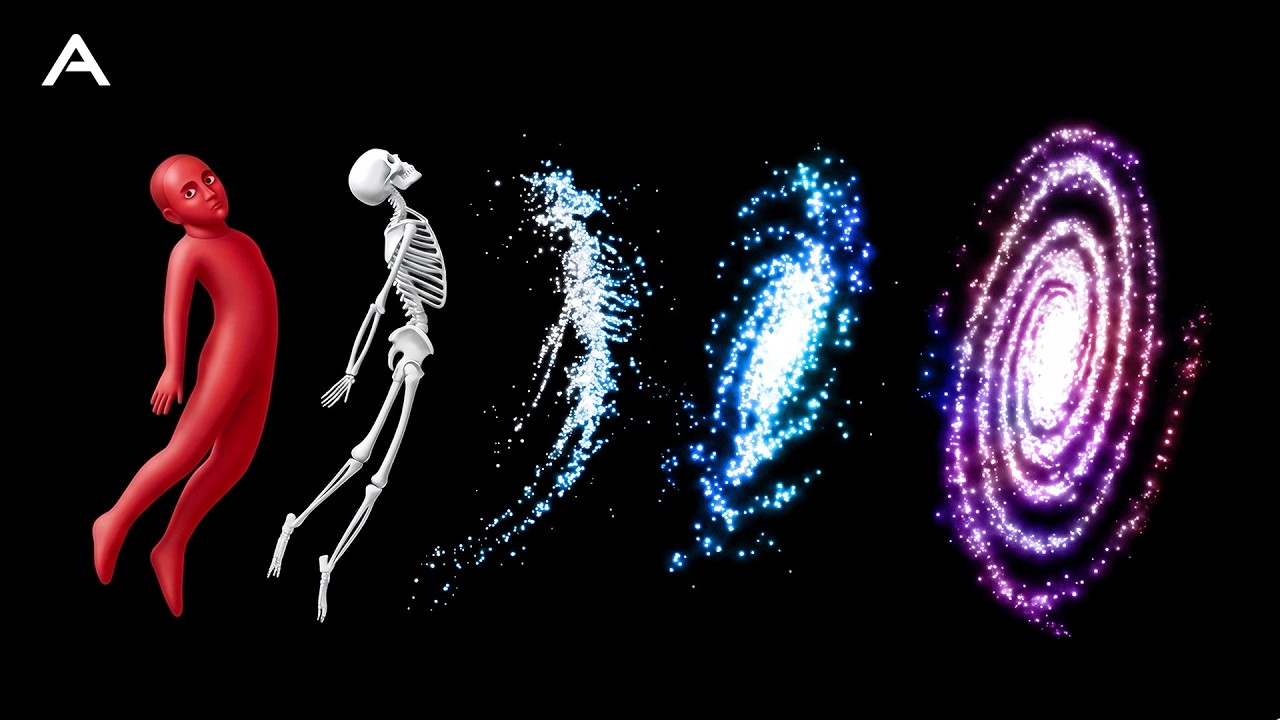
You Have Never Actually Seen Light — The Most Disturbing Idea in Physics
A forty seven minute essay built on David Deutsch's book The Fabric of Reality that starts from a single fact, you cannot see light unless it enters your eye, and follows it to the many worlds interpretation of quantum mechanics. It walks through the granular nature of light, the double slit experiment with single photons, Deutsch's shadow photons, and the claim that a quantum computer running Shor's algorithm performs more operations than there are atoms in the visible universe, so the work must be distributed across parallel universes. The final act fuses the block universe with the multiverse to argue that other times are other universes and the flow of time is an illusion. It closes with Hugh Everett and the reason you cannot feel yourself splitting any more than you can feel the earth turn. An honest closing section separates the solid physics from the contested interpretation.
Published Jul 2, 202647:17 video33 min readAdded Jul 5, 2026Open on YouTube →
At a glance
This is a forty seven minute essay that starts with a party trick and ends somewhere that will keep you up at night. The trick: put a flashlight in a perfectly empty room and you would see nothing, because you cannot see light unless it happens to travel straight into your eye. From that one fact the Blue Pale Signal narrator builds a single chain of reasoning, link by link, drawn almost entirely from David Deutsch's book The Fabric of Reality: light is granular, the double slit experiment shows single photons interfering with nothing, the thing interfering must be real, and if it is real then it is matter you cannot touch, organized into whole parallel universes.
The narrator does not ask you to believe it. He asks you to find the mistake, and says that after a long time looking, he cannot. The hardest evidence he puts on the table is not philosophy but a machine: a quantum computer running Shor's algorithm performs on the order of ten to the five hundredth operations to factor a large number, and the visible universe holds only about ten to the eightieth atoms to do them with, so where did the arithmetic physically happen? In the last act he turns the same argument on time, fusing the block universe with the multiverse, and closes with the true story of Hugh Everett and the reason you cannot feel yourself splitting any more than you can feel the earth turn.
The flashlight in the infinite dark room
Picture an infinite room, completely empty. No dust, no air, no objects, no light. Total darkness in every direction, forever. Now set a single flashlight in the middle and switch it on. You expect a cone of brightness, a beam cutting through the black. What you would actually see is nothing. Standing a few feet to the side of that beam, you would see absolutely nothing: not the flashlight, not the cone, not even a faint glow. The beam is screaming past you at 300,000 kilometers per second, close enough to touch, and you have no idea it is there.
That is the fact the narrator wants you to sit with: you have never, in your entire life, seen light. You have only ever seen light that happened to be traveling directly into your eye. A beam crossing the air inches in front of your face is invisible to you unless some of it scatters off dust or smoke or moisture and gets redirected into your pupil.
Figure 1. Why the beam is invisible. On the left, in a clean vacuum, the flashlight beam crosses in front of the eye and none of it changes direction, so nothing reaches the pupil and the viewer perceives total dark. On the right, dust motes sit in the beam and scatter a little light sideways into the eye. What you then see is the lit dust, not the beam. The gorgeous shafts of sunlight through a window are dust doing exactly this. Two beams can even cross straight through each other untouched, because light does not interact with light.
The narrator asks you to file this away, because that single fact is the first link in a chain that ends at a conclusion most people spend their lives assuming is science fiction. He is not going to ask you to believe the conclusion. He is going to ask you to find the mistake.
The credentials: who David Deutsch is
Before the chain runs, the narrator plants a stake in the ground about his source, so you cannot wave it off as a fringe theory. David Deutsch is the person who, more than anyone else alive, invented the field of quantum computing. He wrote the foundational papers. He is a fellow of the Royal Society, the most prestigious scientific club on earth, the one Newton once ran. He works at Oxford. The machines that Google and IBM are now spending billions to build trace their theoretical blueprint in large part to his head.
What this extremely credentialed man argues is hard to accept: the universe you live in is not the universe. It is one impossibly thin slice of something unimaginably larger. And the strangeness, he insists, is not in his theory. It is already sitting inside the physics your phone and your GPS depend on every second. We just were trained not to look at it. The narrator warns, honestly, that the road ahead gets genuinely disorienting by the end.
Light is not smooth, it is granular
Back to the flashlight. Your eye needs a minimum amount of light to register anything, so as the flashlight moves away the beam fades and, at some distance (Deutsch guesses roughly 10,000 kilometers, though the exact figure does not matter), your eye gives up and sees black. Common sense says the light dimmed continuously, like a dial turned slowly down until it slipped below your threshold. A smooth fade to black.
So test it. Swap your eye for a better one. Frogs have astonishingly sensitive eyes, tuned for the faintest movement in near darkness, so imagine frog eyes, or better yet the most sensitive light detector physics permits. Point it down the beam and keep walking the flashlight away: 10,000 kilometers, 100,000, a million. The light does not fade smoothly. It begins to flicker. A flash, then darkness, then a flash again. The flashes get rarer the farther the source goes, but here is the part that should bother you: each individual flash is exactly as bright as the last. The light never gets dimmer. It gets less frequent.
Figure 2. The first crack. Common sense predicts the amber curve: brightness slides continuously down until it drops below what the eye can detect. The most sensitive detector shows the blue bars instead. Every detected flash is the same height, the same brightness, and only the gaps between them widen with distance. You are not receiving a dimming stream. You are receiving discrete identical packets one at a time, with pure darkness in between.
Each flash is a single photon, one indivisible unit of light. There is no such thing as half a photon. The smooth continuous beam pouring from every lamp in your house is an illusion created by the sheer number of these packets, trillions upon trillions a second, so densely packed your brain smears them into something that looks continuous. Reality is not smooth. Reality is granular. The word for one of those grains is a quantum, and that is where the whole field gets its name.
The most important experiment in physics
Fine, light comes in packets, you may have learned that in school. Here is where the floor begins to tilt. There is one experiment Richard Feynman called the container of the entire mystery of quantum mechanics: the double slit experiment. The narrator refuses the hand waving version where someone says wave particle duality and you nod, because that phrase explained nothing. It just named the mystery so people would stop asking.
Done properly: take a wall with two narrow vertical slits, shine light at it, and some passes through onto a screen behind. You do not get two bright stripes behind the two slits. You get a whole series of stripes, bright, dark, bright, dark, fanning across the screen. This is an interference pattern, and for two centuries it was taken as proof that light is a wave. Waves do exactly this: where two crests meet they add and brighten, where a crest meets a trough they cancel to darkness. Drop two stones in a pond and watch the ripples cross.
Now the detail the textbook skips, the one that does the damage. Give the wall four slits. Take a spot on the screen that was bright when only two slits were open, then open a third slit. You added a light source, gave the photons another door, and that spot gets darker. Read that back: you added light and a region of the screen lost light. The only way that makes sense is if something coming through the new slit arrives at that spot and cancels what was already getting there. If light is a wave, fine, waves cancel. But remember the flicker. Light is not a smooth wave. Light is indivisible packets. So what is doing the cancelling?
Firing photons one at a time
Physicists turned the packets all the way down. They built a source so faint it emits photons one at a time. One photon leaves, travels to the wall, passes through somehow, hits the screen, and makes one tiny dot. Then the next photon, another dot. They are fired like individual bullets, one every few seconds, the apparatus empty except for one lonely photon crossing it.
Common sense makes a clean prediction: a single indivisible photon has to go through one slit or the other, not both, any more than you can walk through two doors at once. With only one photon in the machine there is nothing for it to interfere with, so you should just get two simple stripes built up dot by dot. What you actually get, after thousands of isolated single photons, is the full interference pattern. Bright, dark, bright, dark. The same striped pattern a wave makes, built one dot at a time by photons that crossed the machine completely alone.
Each photon, by itself, lands where it would land if it had interfered with something, and there was nothing there to interfere with. The machine was empty. We checked. And if you place a detector at the slits to catch which one each photon uses, the interference vanishes instantly and you get two boring stripes. The moment you look, the magic stops. The moment you stop looking, it returns. So the experiment puts a gun to your head and asks: when a single photon crosses alone, what is interfering with it?
The measurement problem and "don't ask"
The standard answer, the one the narrator and probably you were taught, is essentially: do not ask. The photon is a wave of probability. It goes through both slits as a smear of potential, interferes with itself, and the question of where it really was is meaningless until you measure. This is the Copenhagen interpretation, and it deserves fairness: it gives the right numbers, the math is flawless, you can build a laser and a transistor with it.
But Deutsch's whole career is a refusal to accept do not ask. Physics, he says, is not supposed to merely predict what the dial reads. It is supposed to explain why, which he calls the difference between prophecy and understanding. Do not ask is not an explanation. It is a refusal to give one, dressed in mathematics so intimidating nobody noticed it was a refusal.
Deutsch's answer: shadow photons
So what does Deutsch say is interfering with the lonely photon? Other photons. Photons that are really there, every bit as real as the one you see, obeying the same laws, carrying the same energy, pushing on the same mirrors, but which you cannot detect directly. You detect them only by their effects: by the way they shove your photon around, by the stripes they leave on the screen. Deutsch calls them shadow photons. And there are not a few of them. The interference only works out mathematically if for every tangible photon you can see there is an enormous host of shadow photons. Not one, not ten, vast numbers. They are what comes through the other slits when you open them, and what cancels a bright spot into darkness when you open a third.
This is the point where you should get angry and say: you invented an army of invisible undetectable particles to explain a stripe pattern, that is a ghost story with equations. The narrator had exactly that reaction, maximally hostile. Then he had to back down, and here is why. The shadow photons are not undetectable. The interference pattern is the detection. Something is reaching across the apparatus, pushing the tangible photon into the bright regions and away from the dark ones, doing physical work you can measure to absurd precision. Deutsch's argument is brutally simple: if something has measurable physical effects on the real world, on what grounds do you call it unreal? We do not call the wind unreal just because we only see it by what it moves. The shadow photons move things. They are real by the only definition science has ever used.
Shadow matter and parallel universes
Then he pushes the knife deeper. Shadow photons can be blocked. Put a solid barrier where a shadow photon would have gone and the interference pattern changes, exactly as it would if you blocked a real photon. They bounce off barriers, pass through slits, and not through walls. But sit with that. If a shadow photon is stopped by a solid object made of real atoms, while the tangible photon we can see sails right past that same spot, then the barrier that stopped the shadow photon cannot be the barrier we can see. The shadow photon hit a shadow barrier, a shadow version of the atoms. Shadow matter.
And if there are shadow atoms, there are shadow molecules, shadow objects, shadow walls and tables and detectors and rooms, an entire shadow environment sitting right where you are, interpenetrating everything, made of matter you cannot touch but which can block light you cannot see. Deutsch did the accounting and found the shadow particles do not slosh around as one undifferentiated fog. They organize into groups. Within each group the shadow particles interact with each other normally, a shadow atom bumping another shadow atom, light scattering off shadow dust, exactly the way tangible particles interact in our world. Each group is internally complete, internally as solid and ordinary as the world you are sitting in. Each of those groups is a parallel universe.
And this is not a manner of speaking. Deutsch means it with full physical literalness. The interference of a single photon is the faint leaked through shadow of that photon's counterparts in a stupefying number of parallel universes, brushing against ours just enough to leave stripes on a screen.
The machine on the bench: where does the computation happen?
Here the narrator anticipates the obvious objection to himself. When he first hit this claim, his reaction was that no sane person accepts a near infinity of unseen worlds to explain some stripes. It is the single most expensive hypothesis he ever heard, and Occam's razor, the rule that you should not multiply entities beyond necessity, should be screaming. Then he learned about the machine, and the machine took the floor out from under him. Because the machine is not a thought experiment. It is being built right now in laboratories you could drive to.
There is an algorithm for quantum computers called Shor's algorithm, discovered by the mathematician Peter Shor in 1994. It does something classical computers are catastrophically bad at: it finds the prime factors of enormous numbers. This is not abstract. The security of the internet, your bank, your messages, your government's secrets, currently rests on the fact that factoring a large enough number is so hard that every ordinary computer on earth working together for longer than the universe has existed could not crack it. A quantum computer running Shor's algorithm could, in principle, crack it in an afternoon.
Take a number with about 250 digits. To factor it, a quantum computer following Shor's algorithm has to carry out, in effect, a number of distinct computational steps happening in parallel on the order of ten to the five hundredth power, a one with 500 zeros after it. To feel that, here is the contrast. The number of atoms in the entire observable universe, every atom in every star in every galaxy all the way to the edge, is roughly ten to the eightieth power, a one with 80 zeros. The calculation needs about ten to the 500 operations. The visible universe contains only ten to the 80 atoms to do them with.
Figure 3. The gap that broke the narrator's skepticism. The axis is already logarithmic, so each tick is another factor of ten. Every atom in the observable universe gets you to the short blue bar at ten to the eightieth. The arithmetic a quantum computer actually performs to factor a 250 digit number runs to the amber bar at ten to the five hundredth. If you turned every atom in the cosmos into a processor and ran them in parallel since the beginning of time, you would not get one millionth of one percent through the work the machine on the bench does while you fetch a coffee. And the machine returns the correct answer.
So here is Deutsch's challenge, issued more or less verbatim to the whole physics community and never satisfactorily answered. The machine performed ten to the 500 operations. Those operations are real. The factored number is sitting on the screen, and you can check it by multiplying the factors back together. The work got done. Physics does not let you get something for nothing. So where, physically, did it happen? In what space were those operations performed, when the universe you can see does not contain remotely enough stuff to perform them? To those who insist there is only one universe, Deutsch says he would like them to explain how this machine works, and in thirty years not one has given an account that does not, when you push on it, quietly smuggle the other universes back in under a different name.
His answer is the obvious one given everything built up so far. The calculation was distributed across the multiverse. The shadow photons, shadow atoms, and parallel slices are not a metaphysical luxury you shave off with Occam's razor. They are the workspace. They are where the arithmetic ran. A quantum computer, in his flat description, is a device that borrows computational resources from its counterparts in other universes and shares the answer.
Occam's razor, inverted
That inverts the razor, which is the part that finally got the narrator. He thought the multiverse was the expensive hypothesis. But the expensive hypothesis is the single universe. To keep one universe you must explain away the interference, explain away the computation, and explain away a dozen other experiments with an ever growing pile of special rules and do not ask. Whereas if you simply accept that the equations mean what they say, that every term in them describes something really there, everything clicks at once. The many worlds picture is not the baroque option. It is the simple one, what you get when you stop adding epicycles to protect common sense and read the theory literally.
Deutsch's accusation against a century of mainstream physics is essentially cowardice. The equations were always telling us this. We could not stand to believe them, so we invented elaborate ways not to. It sounds like nonsense, the narrator admits, and it sounded like nonsense to him, but he keeps coming back to the machine on the bench getting the right answer, and the question nobody can answer about where the work was done.
The puzzle
Keep one universe
Accept many worlds (Deutsch)
A lone photon interferes
Do not ask. It is a wave of probability that interferes with itself; where it really was is meaningless.
Real shadow photons from neighboring slices interfere with it.
Open a third slit, a bright spot goes dark
Add a rule about probability amplitudes cancelling.
A flood of shadow photons arrives out of step and wipes the tangible ones out.
A quantum computer factors a huge number
No account of where ten to the 500 steps physically ran.
The work is distributed across parallel slices; they are the workspace.
The delayed choice eraser
One definite photon, plus delicate footwork about what is knowable.
Both outcomes are real; each slice is self consistent and nothing reaches back.
The felt flow of time
A genuine moving present sweeping the timeline.
An illusion from near identical adjacent slices matching up.
Cost by Occam's razor
Cheap in worlds, expensive in rules and exceptions.
One rule read literally, many worlds for free.
Figure 4. The ledger the narrator builds. The right column keeps a single explanatory principle (take the equations literally) and pays for it in extra worlds. The left column keeps a single world and pays for it in an accumulating pile of special rules, exceptions, and refusals to answer. Deutsch's claim is that once you count honestly, the many worlds column is the cheaper one.
Turning the argument on time
Take a breath, because the video now becomes a video about something much closer to home. So far it has been a story about space: other worlds, other places sitting alongside ours, which you can hold at arm's length. Deutsch makes one more move and takes the arm's length away. He points the whole apparatus at time.
We treat space and time completely differently without noticing. In space you have no trouble believing other places are as real as here. Right now there is a city on the far side of the planet, say Tokyo. You are not in Tokyo, but you would never say Tokyo is therefore less real than your living room. It exists in full detail, with people living their whole lives in it, indifferent to your absence. Here is just the word you use for wherever you happen to be standing. It is a label for your position, not a statement about what exists.
Now do the same with time. There is a moment, say your tenth birthday. You are not in your tenth birthday, and from where you sit it is not now. And here everybody automatically says what they would never say about Tokyo: of course it is not now, because it is gone. It used to be real and now it is not. The past does not exist anymore, the future not yet, only now is real, and now moves forward like a spotlight sweeping a timeline, the only real moment the one currently lit. Deutsch says: stop. Look at what you just did. You treated now exactly the way you would refuse to treat here. You said the only real place is where I am standing and everywhere else is unreal, except you said it about time. Because everyone does it, nobody notices how strange it is.
The block universe meets the multiverse
What if now is just like here, nothing more than a label for the moment you happen to be located at, and all the other moments (your tenth birthday, the day you die, this Tuesday) are every bit as real as this one, sitting in the structure of reality, fully detailed, indifferent to where your attention is? This is an old idea older than Deutsch, called the block universe, and it follows fairly directly from Einstein's relativity, which says there is no universal now anyway: observers moving at different speeds genuinely disagree about which events are simultaneous, which only makes sense if all the events are simply there, laid out, and now is a local point of view rather than a cosmic fact.
Figure 5. The symmetry Deutsch forces you to see. In space you happily accept that Tokyo is as real as your room and that here just marks where you stand. Do the same to time and every moment of your life is a frame in a fixed strip, each as real as the others, with now merely labeling the frame you occupy. The spotlight present, the sense that only this instant exists and is sliding forward, is the intuition the argument dismantles.
Deutsch fuses the block universe with the multiverse, and that is where it turns genuinely vertiginous. If the other moments are real, just other locations in the structure, what are they? Other times are other universes. The past is not gone. It is a parallel universe structurally almost identical to this one, differing only slightly the way a film frame differs from the one before it. The future is not yet to come. It is another parallel universe sitting right there, almost identical, differing in the small ways we call change. And the total, inescapable feeling that time is flowing, that you are carried forward moment to moment, is an illusion produced by the fact that adjacent slices are so similar: your memory in this slice contains a record that matches the slice a second ago, and that structural matching between near identical worlds is what you experience as the river of time.
The multiverse does not move through time. There is no master clock ticking outside it. Time exists inside the structure, a relationship between slices, not something the structure floats along. We always say the universe unfolds in time; Deutsch says it is the other way around. Time unfolds in the multiverse. Time is a feature of the map, not the territory the map sits in. When the narrator followed that to the end he had to put the book down and walk, because if it is right then nothing is ever lost. Every moment you have lived is still there, fully real, because there is no there for it to have gone to. The version of you reading this is one slice among countless slices of you, none more real than any other. He does not know whether that is horrifying or the most comforting thing he ever heard. He thinks it might have to be both.
The delayed choice quantum eraser, honestly
There is one more experiment, and the narrator is careful because it is the most overhyped experiment in all of popular physics and he refuses to lie about it. It is the delayed choice quantum eraser, and the breathless internet version claims it proves the future can reach back and change the past. That is clickbait.
The careful version: run the double slit again, but pair each photon you fire with an entangled twin whose fate is tied to the first. Send one of the pair to the screen as usual and send the twin on a longer path to a separate set of detectors, where you can choose, crucially after the first photon has already hit the screen, whether or not to measure which slit the original went through. The unnerving result: the photons on the screen seem to already know what you will decide about their twins. Preserve the which slit information and they show no interference. Erase it and they show interference. The pattern seems to depend on a choice made later, the future dictating the past.
Now the honest narrator, not the hype merchant. You cannot use this to send a message back in time or win the lottery. The spooky pattern only appears when you go back and sort the screen data according to what happened to the twins. Looked at on its own, without that sorting, the screen shows a meaningless blur with no pattern at all. The information about the future is, in a precise mathematical sense, locked away until the future arrives and you correlate the two data sets. So the mainstream, correct thing to say is that there is no retrocausation here. Nothing travels backward. The no signaling theorems forbid it.
But notice what you must do to make the puzzle vanish in the standard picture. You keep insisting there was one definite photon that did one definite thing, then perform increasingly delicate footwork to explain why it looks for all the world like it was waiting on a decision not yet made. In the many worlds picture there is nothing to explain. There was never one outcome waiting to be determined. Both outcomes are real: the slice where you erased the information and the slice where you preserved it both exist, and in each one the screen shows exactly what is consistent with that slice. Nothing reached backward because nothing needed to. There was no single thread of cause running from a fixed past to an open future, because the future is not open and the past is not fixed the way intuition demands. There is only a vast static structure of correlated slices, and what we call cause and effect is the pattern of correlation between them. Past and future do not cause each other. They simply match, the way two adjacent film frames match because they are part of one continuous thing. The flow of time, the openness of the future, the loss of the past, the chain of cause and effect: Deutsch's claim is that every one of those is a feature of your perspective, a consequence of being an information processing structure with memories that point one direction, not a feature of reality itself. Reality just is all of it at once, already.
Hugh Everett and the objection everyone has
The narrator ends with a story, because it does what explanation cannot. Many worlds did not begin with Deutsch. It began in 1957 with a young physicist named Hugh Everett, who as a graduate student wrote a thesis arguing essentially this whole video: that the equations of quantum mechanics should be taken literally, that there is no special magic moment of measurement, that all outcomes simply happen, each in its own branch. The establishment found it so absurd that Everett was more or less driven out of academic physics. He went to work for the Defense Department doing classified nuclear weapons calculations and largely abandoned the field. For decades the idea sat dead.
But not everyone dismissed it. The physicist Bryce DeWitt, who would later popularize it and give it the name many worlds, wrote to Everett with the objection everyone has, the one you probably had somewhere around the shadow photons: I cannot accept this, because if reality were constantly splitting into countless copies of me, I would feel it, I would feel myself splitting, and I do not. I feel like one continuous person in one continuous world, so it cannot be true.
Everett wrote back with a single question. He asked DeWitt whether he could feel the earth moving. Because Copernicus had faced exactly this objection four centuries earlier. If the earth is really hurtling around the sun, spinning at a thousand miles an hour, surely we would feel it, be flung off, feel the wind, sense the motion in our bones. And we do not. We feel perfectly still, the ground solid, the sun rising and setting. Every instinct screams that we are stationary and the heavens turn around us, and every one of those instincts is wrong. We do not feel the earth turn, not because it is not turning, but because we are part of the system that is turning. The motion is too total for there to be anything to feel it against. That was Everett's entire reply. You do not feel yourself splitting for exactly the same reason you do not feel the earth rotate. The absence of the feeling is not evidence of anything. It is precisely what the theory predicts you would experience from the inside.
So here is where the narrator leaves you. We began with a flashlight in a dark room and the small strange fact that you cannot see light, that the beam is there, real, racing past your face, and you have no organ that can perceive it. We end somewhere much larger, but it is the same fact wearing different clothes. You cannot feel the earth rotate. You cannot see the light that fills the room. And if Deutsch is right, and the narrator still cannot find where he is wrong, you cannot feel the countless other versions of this moment layered all around you, stretching both directions of a time that does not actually flow. You have been moving through parallel universes since you started watching, branching slice by slice into futures that all exist, leaving behind a past that never went anywhere. You felt none of it. You felt like one person in one world with one steadily ticking clock, for the same reason you cannot feel the earth turn, for the same reason you cannot see the light.
Where it stands
Kept out of the way until here, on purpose, because the video earns the right to be heard on its own terms first. The physics the essay leans on is real and correctly described: light is quantized, single photons build an interference pattern one dot at a time, watching the slits destroys it, quantum computers really do run Shor's algorithm, and the block universe really does fall out of relativity. Where the video presents a strong reading as the plain reading is in the interpretation. The many worlds interpretation is a serious, respected view held by real physicists, but it is one of several that fit the same experiments equally well, alongside Copenhagen, the fully deterministic pilot wave theory, and information first readings like QBism. None has yet been singled out by any experiment.
Deutsch's quantum computing argument, that the machine's power is proof of parallel universes doing the work, is genuinely his and genuinely contested. Many physicists, including quantum computing researchers, hold that decoherence and the mathematics of amplitude interference account for the speedup without committing to literal worlds, and that "where did the computation happen" is a question about interpretation rather than a knockout result. The fusion of the block universe with the multiverse, so that other times literally are other universes, is Deutsch's own move and goes beyond what relativity alone requires. And the delayed choice eraser, exactly as the narrator says, permits no message backward in time. In short: the experiments are solid and astonishing, the many worlds reading is one honest way to make sense of them, and the confidence that it is the only way is where the essay leans on the scale.
Key takeaways
You never see light itself, only light that enters your eye. A beam in a vacuum is invisible; the shafts of sunlight you admire are lit dust.
Light is granular. Turn a source faint enough and the most sensitive detector receives discrete identical photons, arriving less often but never dimmer, not a smooth fade.
In the double slit experiment single photons fired one at a time still build a full interference pattern, as if each interfered with something that was not there. Detecting which slit is used destroys the pattern.
Deutsch's answer is shadow photons: real, undetectable except by their effects, blockable by shadow matter, organized into whole parallel universes that make up a multiverse.
His hardest evidence is the quantum computer. Factoring a 250 digit number takes about ten to the 500 operations while the visible universe has only ten to the 80 atoms, so he asks where the work physically happened.
He argues Occam's razor is inverted: one universe needs an ever growing pile of special rules, while many worlds is what you get by reading the equations literally.
Turning the argument on time, he fuses the block universe with the multiverse: other moments are other universes, the flow of time is an illusion of near identical adjacent slices, and nothing is ever lost.
The delayed choice quantum eraser is real but sends no message backward in time. Everett's reply to the splitting objection is that you cannot feel yourself split for the same reason you cannot feel the earth turn.
Chapters
Timestamps are clickable. Click one and the embedded player jumps there and keeps playing while you read. These are the creator's own chapters.
0:00 A flashlight in an infinite dark room
1:06 You have never actually seen light
2:55 Who is David Deutsch?
4:51 Light comes in packets: the quantum
8:16 The most important experiment in physics
11:36 Firing photons one at a time
13:46 The measurement problem and "don't ask"
15:26 Deutsch's answer: shadow photons
19:00 Shadow matter and parallel universes
23:18 The machine: quantum computing and Shor's algorithm
28:45 Occam's razor, inverted
30:24 Turning the argument on time
33:52 The block universe meets the multiverse
37:41 The delayed choice quantum eraser
42:52 Hugh Everett and the objection everyone has
45:54 Why you can't feel the earth turn
Notable quotes
You have never, in your entire life, seen light. You have only ever seen light that happened to be traveling directly into your eye.
narrator, 1:20
Reality is not smooth. Reality is granular. And the word for one of those grains is a quantum.
narrator, 7:50
The moment you look, the magic stops. The moment you stop looking, it comes back.
narrator, 13:05
Don't ask is not an explanation. It is a refusal to give one, dressed up in mathematics so intimidating that nobody noticed it was a refusal.
narrator, 14:45
If something has measurable physical effects on the real world, then on what grounds do you get to call it unreal? We don't call the wind unreal just because we only see it by what it moves.
narrator, 17:05
So where did it happen? In what physical space were those ten to the 500 operations performed, when the universe you can see does not contain remotely enough stuff to perform them?
narrator, 26:40
A quantum computer is a device that borrows computational resources from its counterparts in other universes and shares the answer.
narrator, 27:55
Time unfolds in the multiverse. Time is a feature of the map, not the territory the map sits in.
narrator, 35:00
You don't feel yourself splitting, for exactly the same reason you don't feel the earth rotate.
narrator, 45:10
Imagine an infinite room, completely empty, no dust, no air, no objects of any kind, and no light. Total darkness in every direction, forever. Now I want you to place a single flashlight in the middle of this room and turn it on. You expect to see something like this, a cone of brightness, a beam cutting through the black. But here is what you would actually see. Nothing.
If you were standing off to the side, even a few feet away from that beam, you would see absolutely nothing. Not the flashlight, not the cone of light, not the faint glow you are picturing right now. The beam would be screaming past you at 300,000 kilometers per second, close enough to touch, and you would have no idea it was there. Because here is a fact about light that quietly breaks most people the first time they really understand it: you cannot see light.
Let me say that again, because it sounds wrong, and I need you to sit with how wrong it sounds before I show you that it is true. You have never, in your entire life, seen light. You have only ever seen light that happened to be traveling directly into your eye. A beam crossing the space in front of your face, right there, inches away, is completely invisible to you, unless some of it scatters off dust or smoke or moisture and gets redirected into your pupil.
In the movies, when you see those gorgeous shafts of sunlight coming through a window, you are not seeing the light. You are seeing dust. Take the dust away, put that same beam in a perfect vacuum, and it vanishes. Two beams can cross straight through each other as though neither one exists. Light, it turns out, does not interact with light.
I want you to remember this. Genuinely, file it away somewhere, because that single fact, that you cannot see light, is the first link in a chain of reasoning that is going to drag you, step by careful step, to a conclusion most people spend their entire lives assuming is science fiction. And by the time we get there, I am not going to ask you to believe it. I am going to ask you to find the mistake, because I have been looking for the mistake for a long time now, and I cannot find it.
This whole video is built on a book by a physicist named David Deutsch. And before you write him off as some fringe figure, some guy with a YouTube channel and a theory, let me be very clear about who this man is. Deutsch is the person who, more than anyone else alive, invented the field of quantum computing. He wrote the foundational papers. He is a fellow of the Royal Society, which is roughly the most prestigious scientific club on earth, the one Newton ran. He works at Oxford. The machines that companies like Google and IBM are now spending billions of dollars trying to build, the theoretical blueprint for those machines came in large part out of his head.
And what this extremely serious, extremely credentialed man argues in this book is, frankly, difficult to accept. He argues that the universe you are living in is not the universe. That it is one slice, one impossibly thin slice, of something almost unimaginably larger. And that the strangeness is not in his theory. The strangeness is already sitting inside the physics that your phone, your GPS, your entire technological civilization depends on every single second. We just don't look at it. We were trained not to look at it. So let's look at it. I have to warn you though, this one goes to some genuinely disorienting places by the end. That's not me selling you intrigue. That's me being honest about where the door we are about to walk through actually leads.
Okay, back to the flashlight in the infinite room. Here's the thing about that beam disappearing. Your eye is not a perfect instrument. It needs a certain amount of light to register anything at all. So as you move that flashlight farther and farther away, the light reaching you gets fainter and fainter. And at some point, Deutsch puts it at something like 10,000 kilometers, but the exact number doesn't matter, your eye simply gives up. The beam fades to nothing. Dark.
Now, common sense tells you something very specific about what is happening here. Common sense says the light is getting continuously dimmer, like a dial being slowly turned down until it crosses below the threshold your eye can detect. Smooth, gradual, a fade to black. So let's test that. Let's replace your eye with a better one. Frogs, as it happens, have astonishingly sensitive eyes, built for catching the faintest movement in near total darkness. So imagine we give you a frog's eyes, or better yet, imagine the most sensitive light detector that physics will allow us to build. And we point it down that beam and we keep walking the flashlight away. 10,000 kilometers, 100,000, a million.
And here is where the first crack appears. The light does not fade smoothly to black. Instead, at some point, the beam starts to flicker. You get a flash, then darkness, then a moment later, another flash. The flashes get rarer and rarer the farther away the source goes. But, and this is the part that should bother you, each individual flash is exactly as bright as the last one. The light never gets dimmer, it gets less frequent. You are no longer receiving a smooth stream of brightness. You are receiving discrete identical packets, arriving one at a time, with gaps of pure darkness in between.
Each one of those flashes is a single photon hitting your detector. One indivisible unit of light. There is no such thing as half a photon. The smooth, continuous beam you imagined at the start, the one pouring out of every lamp in your house right now, is an illusion created by the sheer number of these packets arriving every second. Trillions upon trillions of them, so densely packed that your brain smears them into something that looks continuous. Reality is not smooth. Reality is granular. And the word for one of those grains is a quantum. That is where the entire field gets its name.
Now, you might be thinking, fine, light comes in little packets, I think I learned that in school, what's the big deal? Pay close attention to this next part, because this is where the floor begins to tilt. There is an experiment. You have probably heard of it. It is, without exaggeration, the most important experiment in the history of physics. And Richard Feynman, another genuinely serious person, said that it contains the entire mystery of quantum mechanics. The double slit experiment. But I don't want to give you the usual version of it, the one where someone waves their hands and says, wave particle duality, and you nod and pretend that explains something. Because it didn't. It explained nothing. It just gave the mystery a name so people would stop asking about it.
Let's do it properly. You take a wall with two narrow vertical slits cut into it. You shine light at the wall. Some light goes through the slits and lands on a screen behind. And what you get on that screen is not two bright stripes, one behind each slit, which is what you'd naively expect. You get a whole series of stripes. Bright, dark, bright, dark, fanning out across the screen. This is called an interference pattern. And for a couple of centuries, it was taken as proof that light is a wave. Because waves do exactly this. Two waves overlap and where two crests meet, they add up and get brighter. And where a crest meets a trough, they cancel out and you get darkness. Drop two stones in a pond and watch the ripples cross. Same thing. So far, so reasonable.
But now I want to add something the textbook version usually skips, because it's the detail that does the damage. Let me give you a version with more than two slits. Imagine the wall has four slits. And here is the devastating part. You can take a spot on that screen, a particular point that was nice and bright when only two slits were open, and you open a third slit. You add more light. You give the photons another door to come through. And that spot gets darker. Read that back. You added a light source and a region of the screen lost light. You open a door and fewer things arrived. The only way that makes any sense at all is if something coming through the new slit is arriving at that spot and cancelling out something that was already getting there, interfering with it, destroying it. And again, if light is a wave, fine. No problem. Waves cancel. We know this.
But remember the frog. Remember the flicker. We just established with the most sensitive detector physics allows that light is not a smooth wave. Light is packets. Indivisible photons. So now we have a problem. And the problem is about to become the whole rest of this video. Because we can do this experiment with the packets turned down. Way down. Here is what physicists actually did. They built a light source so faint that it emits photons one at a time. One single photon leaves the source. It travels to the wall with the slits. It passes through somehow. And it hits the screen. And it makes a single tiny dot. One photon. One dot. Then the next photon. Another dot. We are now firing them like individual bullets. One every few seconds with nothing else in the apparatus. The experiment is empty except for one lonely photon at a time crossing it.
Common sense, and at this point, I'd forgive you for losing faith in common sense, but let's give it one more shot. Common sense says this. A single photon is one indivisible thing. It has to go through one slit or the other. It cannot go through both, any more than you can walk through two doors at once. So with single photons, there is nothing for each photon to interfere with. There's only one of them in the whole machine. We should just get two simple stripes. One behind each slit. Slowly built up dot by dot.
And what we actually get, after we have fired thousands of these lonely, isolated, one at a time photons, is the full interference pattern. Bright, dark, bright, dark. The exact same striped pattern you'd get from a wave. Built up one single dot at a time by photons that cross the apparatus completely alone with nothing else in there with them. I'll give you a few seconds to feel how insane that is. Each photon, by itself, lands in a place that is consistent with having interfered with something. But there was nothing for it to interfere with. We checked. The machine was empty.
And if you put a detector at the slits to catch the photon in the act of going through one of them, to settle the question of which door it used, the interference pattern vanishes instantly. You get the two boring stripes. The moment you look, the magic stops. The moment you stop looking, it comes back. So here is the question that this experiment puts a gun to your head and forces you to answer. When a single photon goes through that apparatus alone, what is interfering with it?
The standard physics answer, the one I was taught, the one that probably half of you were taught, is essentially, don't ask. The photon is a wave of probability. It goes through both slits as a smear of potential. It interferes with itself. And the question of where it really was is meaningless until you measure it. This is called the Copenhagen interpretation. And I want to be fair to it. It gives you the right numbers. The math works perfectly. You can build a laser with it. You can build a transistor. But Deutsch's entire career is a refusal to accept don't ask as an answer. He argues that physics is not supposed to just predict what the dial will read. Physics is supposed to explain why. What he calls the difference between prophecy and understanding. And don't ask, he says, is not an explanation. It is a refusal to give one, dressed up in mathematics so intimidating that nobody noticed it was a refusal.
So what is his answer? What does Deutsch say is interfering with that single lonely photon? Brace yourself. Other photons. Photons that are really there, that are every bit as real as the one you can see, that obey the same laws, carry the same energy, push on the same mirrors, but which you cannot detect directly. You can only ever detect them by their effects. By the way they shove your photon around. By the stripes they leave on the screen. Deutsch calls them shadow photons.
And there are not just a few of them. The interference pattern only works out mathematically if for every photon you can see, every tangible photon in his language, there is an enormous host of shadow photons accompanying it. Not one. Not ten. Vast numbers. They fill in the entire structure of the interference. They're what comes through the other slits when you open them. They're what gets cancelled when a spot goes dark. The reason you open a third slit and a bright spot went dark is that you let in a flood of shadow photons that arrived perfectly out of step with the tangible ones and wiped them out.
Now, this is exactly the point where you should be getting angry at me. This is the point where you stop me and say, hang on. You've just invented an army of invisible, undetectable particles to explain a stripe pattern. That is not science. That is a ghost story with equations. You can't just conjure up things that by definition can't be detected and call it an explanation. I had that exact reaction. I was, I think, maximally hostile when I first read this. It felt like a cheat.
So let me steel man my own objection and then tell you why I had to back down. The thing is, the shadow photons are not undetectable. That's the whole point. We just detected them. The interference pattern is the detection. Something is reaching across the apparatus and pushing the tangible photon into striped regions and away from dark ones. That something is doing physical work. It has effects you can measure to absurd precision. Deutsch's argument is brutally simple. If something has measurable physical effects on the real world, then on what grounds do you get to call it unreal? We don't call the wind unreal just because we only see it by what it moves. The shadow photons move things. They are real by the only definition of real that science has ever actually used.
And he pushes the knife in deeper. The shadow photons can be blocked. If you put a solid barrier in the path of where a shadow photon would have gone, the interference pattern changes. The same way it would change if you blocked a real photon. The shadow photons bounce off barriers. They go through slits and not through walls. But wait. Sit with that. If a shadow photon is stopped by a barrier, by a real solid object made of real atoms, but the tangible photon, the one we can see, sails right past that same spot, then the barrier that stopped the shadow photon cannot be the same barrier we can see. The shadow photon must be hitting a shadow barrier, a shadow version of the atoms. Shadow matter.
And if there are shadow atoms, then there are shadow molecules and shadow objects. Shadow walls, shadow detectors, shadow tables, shadow rooms, an entire shadow environment, sitting right where you are, interpenetrating everything. Made of matter you cannot touch, but which can block light you cannot see. This is the moment the thing stops being a physics curiosity and becomes something else. Because Deutsch did the accounting and the shadow particles do not just slosh around as one undifferentiated fog. They organize. They fall into groups. And within each group, the shadow particles interact with each other normally. A shadow atom bumps into another shadow atom. Light scatters off shadow dust. Exactly the way the tangible particles in our world interact with each other. Each group is internally consistent, internally complete, internally just as solid and ordinary seeming as the world you are sitting in right now. Each of those groups is a parallel universe.
And we are no longer speaking in metaphor. This is not a manner of speaking. Deutsch means it with full physical literalness. The interference of a single photon is, in his reading, the faint leaked through shadow of that photon's counterparts in a stupefying number of parallel universes, brushing against ours just enough to leave stripes on a screen. And if ideas like this are the sort of thing that keep you awake at two in the morning staring at the ceiling, then sticking around here is probably a good move, because I promise you where this goes next is stranger than where we are now. This little corner of the internet exists because a certain kind of person decided to stay and keep following the thread. If that's you, you know what to do. Because we have not even gotten to the part that genuinely scares me yet.
Let me try to land just how violent a claim this is. And then let me give you the reason I could not dismiss it. The reason that turned me from a skeptic into someone who lies awake about this. The claim is that reality is not the universe. The claim is that the thing physicists call the universe, the entire observable cosmos, every galaxy, every star, all the way out to the edge of what light has had time to reach us from, is one of these groups, one slice, and that the full structure, the thing Deutsch calls the multiverse, contains an unfathomable number of these slices layered together, mostly going about their business independently, occasionally at the quantum scale, leaking into one another just enough to produce the effects we call quantum mechanics.
When I first hit this, my reaction was that no sane person would accept such an extravagant claim on the basis of some stripes on a screen. It's the single most expensive hypothesis I have ever heard. You are postulating a near-infinity of unseen worlds to explain a pattern of light and dark bands. Occam's razor, the principle that you should not multiply entities beyond necessity, should be screaming. It felt obscene. And then I learned about the machine, and the machine is the thing that took the floor out from under me. Because the machine is not a thought experiment, the machine is being built right now, in laboratories you could drive to.
Here is the conceptual turn this whole story has been walking toward, and once you see it, you cannot unsee it. We have been talking about the multiverse as if the only evidence for it is a delicate, fussy, easy to dismiss pattern of stripes. As if it were a matter of interpretation, a philosophy you could take or leave. It is not. Because we are now building computers that perform calculations, and the calculations are getting done, and the only honest question Deutsch puts on the table is one that has never been answered. Where, physically, are those calculations happening?
Let me build this carefully, because it is the most important thing in the video, and I want you to feel the weight of the numbers, not just hear them. There is an algorithm designed for quantum computers, called Shor's algorithm. It was discovered by a mathematician named Peter Shor in 1994, and it does something that classical computers are catastrophically bad at. It finds the prime factors of enormous numbers. This is not abstract. The entire security of the internet, your bank, your messages, your government secrets, currently rests on the fact that finding the prime factors of a large enough number is so hard that all the ordinary computers on Earth, working together for longer than the universe has existed, could not crack it. A quantum computer running Shor's algorithm could, in principle, crack it in an afternoon.
Now, take a number with about 250 digits. To factor that number, a quantum computer following Shor's algorithm has to, in effect, carry out a number of distinct computational steps, distinct pieces of arithmetic, happening in parallel. That is something on the order of 10 to the 500th power. That is a one with 500 zeros after it. I need you to understand how big that number is, because the words 10 to the 500 slide right off the brain. So here is the contrast. The number of atoms in the entire observable universe, every atom in every star in every galaxy that we can see, all the way to the edge, is roughly 10 to the 80th power, a one with 80 zeros. So the calculation requires something like 10 to the 500 separate operations. And the entire visible universe contains only 10 to the 80 atoms to do them with.
The gap between those two numbers is not large. Large is the wrong word. There is no word. If you took the entire universe and used every single atom in it as a tiny processor and ran them all in parallel, flat out, since the beginning of time, you would not make a dent. You would not get one millionth of one percent of the way through the work that this little machine sitting on a lab bench does in the time it takes you to get a coffee. And the machine gets the right answer.
So here is Deutsch's challenge. He has issued it more or less verbatim to the entire physics community. And it has never been satisfactorily answered. The machine performed 10 to the 500 operations. Those operations are real. They happened. The factored number is sitting on the screen. You can check it. Multiply the factors back together. It's correct. So the work got done. The arithmetic got carried out. Physics does not let you get something for nothing. So where did it happen? In what physical space were those 10 to the 500 operations performed, when the universe you can see does not contain remotely enough stuff to perform them?
To those who insist there is only one universe, Deutsch says, I would like them to explain how this machine works. Where the calculation was done. And not one of them in 30 years has been able to give an account that does not, when you push on it, quietly smuggle the other universes back in under a different name. His answer, of course, is the obvious one given everything we've built up to. The calculation was distributed across the multiverse. The shadow photons, the shadow atoms, the parallel slices. They are not a metaphysical luxury you can shave off with Occam's razor. They are the workspace. They are where the arithmetic ran. A quantum computer is, in Deutsch's flat and unflinching description, a device that borrows computational resources from its counterparts in other universes and shares the answer.
And that completely inverts Occam's razor, which is the part that finally got me. I thought the multiverse was the expensive hypothesis. But the expensive hypothesis is the single universe. Because to keep the single universe, you have to explain away the interference. And explain away the computation. And explain away a dozen other experiments with an ever growing pile of special rules and don't ask. Whereas if you simply accept that the equations mean what they say, that all the terms in them describe things that are really there, then everything clicks into place at once. The many worlds picture is not the baroque option. It is the simple one. It is what you get when you stop adding epicycles to protect your common sense and just read the theory literally.
Deutsch's accusation against mainstream physics for the last century is essentially cowardice. The equations were always telling us this. We just couldn't stand to believe them. So we invented elaborate ways to not have to. Sounds like nonsense, I know. It sounded like nonsense to me too. But I keep coming back to the machine on the bench, getting the right answer, and the question nobody can answer about where the work was done.
Okay, take a breath. Because we are now going to do the thing I warned you about, where the video you thought you were watching turns out to be a video about something much larger and much closer to home. Up to now, this has been a story about space, about other worlds, other places, other slices of reality sitting alongside ours. That's unsettling, but it's also a little abstract. Parallel universes are out there somewhere. You can hold them at arm's length. I'm now going to take the arm's length away, because Deutsch makes one more move, and it is the move that for me turned this from a fascinating physics story into something I have not been able to stop thinking about for years. He turns the whole apparatus around and points it at time.
Here is the setup. We treat space and time very differently in everyday life, and we almost never notice that we're doing it. In space, you have no trouble at all believing that other places are just as real as here. Right now, there is a city on the other side of the planet. Let's say Tokyo. You are not in Tokyo. From where you sit, Tokyo is not here, but you would never dream of saying that Tokyo is therefore less real than your living room. It exists fully in every detail, with people in it living their full lives, completely indifferent to the fact that you are not among them. Here is just the word you use for wherever you happen to be standing. It is a label for your position. It is not a statement about what exists.
Now do the same thing with time. There is a moment. Let's say your 10th birthday. You are not in your 10th birthday. From where you sit, it is not now. And here is where everybody, automatically, says something they would never say about Tokyo. Everybody says, well of course it isn't now, because it's gone. It used to be real, and now it isn't. The past doesn't exist anymore. The future doesn't exist yet. Only now is real, and now is moving forward, like a spotlight sweeping along a timeline, and the only real moment is the one currently lit.
Deutsch says, stop. Look at what you just did. You treated now exactly the way you would refuse to treat here. You said the only real place is where I am standing, and everywhere else is unreal. Except you said it about time instead of space. And because everyone does it, nobody notices how strange it is. What if now is just like here? What if now is nothing more than a label for the particular moment you happen to be located at? And all the other moments, your 10th birthday, the day you die, this Tuesday, are every bit as real as this one, sitting there in the structure of reality, fully detailed, fully populated, completely indifferent to the fact that your attention is not currently on them.
This is an old idea in physics, older than Deutsch. It's called the block universe. And it follows pretty directly from Einstein's relativity, which tells us that there is no universal now anyway, that different observers moving at different speeds genuinely disagree about which events are simultaneous, which only makes sense if all the events are simply there, laid out, and now is a local point of view rather than a cosmic fact.
But Deutsch fuses the block universe with the multiverse, and that's where it becomes something new and genuinely vertiginous, because if the other moments are real, if they're just other locations in the structure, then what are they? And his answer is the one the whole video has been training you to accept. Other times are other universes. The past is not gone. It is a parallel universe, one that is structurally almost identical to this one, differing only slightly in the way that a film frame differs slightly from the frame before it. The future is not yet to come. It is another parallel universe, sitting right there, structurally almost identical to this one, but differing in the small ways that we call change.
And the overwhelming, total, inescapable feeling you have that time is flowing, that you are being carried forward from moment to moment, is, Deutsch argues, an illusion, a trick produced by the fact that adjacent slices of the multiverse are so similar to one another. Your memory in this slice contains a record that matches the slice we call a second ago. And that structural matching, that resonance between near identical worlds, is what you experience as the river of time. The multiverse does not move through time. There is no master clock ticking somewhere outside it. Time is something that exists inside the structure, a relationship between slices, not something the structure floats along.
Let me try to say it as sharply as I can. We always say that the universe unfolds in time. Deutsch is saying it's the other way around. Time unfolds in the multiverse. Time is a feature of the map, not the territory the map sits in. When I first followed that argument through to the end, I genuinely had to put the book down and go for a walk. Because if it's right, and again, I cannot find the flaw, then nothing is ever lost. Every moment you have ever lived is still there, fully real, fully detailed, sitting in the structure exactly as it was. Because there is no there for it to have gone to. And the version of you reading these words is one slice, among countless slices of you. None of them more real than any other. The whole staggering procession of your life laid out at once and not going anywhere, because there is no time outside of you for it to go anywhere in. I don't know whether to find that horrifying or the most comforting thing I have ever heard. I think it might be both. I think it might have to be both.
There is one more experiment I have to tell you about. And I want to be careful and honest about it. Because it is the most overhyped experiment in all of popular physics. And I refuse to lie to you about what it does and does not show. It is called the delayed choice quantum eraser. And the breathless version you'll find all over the internet says it proves that the future can reach back and change the past. That's the clickbait.
Here is the more careful version. You set up the double slit experiment again, but you arrange things so that each photon you fire is paired with a partner, an entangled twin, a second photon whose fate is tied to the first. You send one of the pair to the screen as usual. You send the twin off on a longer path to a separate set of detectors where you can choose, and crucially you can make this choice after the first photon has already hit the screen, whether or not to measure which slit the original went through. And here is the unnerving result. When you later examine the data, the photons that hit the screen seem to already know what you are going to decide about their twins. If you chose after the fact to preserve the which slit information, those photons show no interference. If you chose after the fact to erase it, they show interference. The pattern on the screen seems to depend on a choice made later. The future apparently dictating the past.
Now here is where I have to be the honest narrator and not the hype merchant. You cannot actually use this to send a message back in time. You cannot win the lottery with it. The reason is that the spooky pattern only appears when you go back and sort the screen data according to what happened to the twins. Looked at on its own without that sorting, the screen just shows a meaningless blur with no pattern at all. The information about the future is, in a precise mathematical sense, locked away until the future actually arrives and you correlate the two data sets. So the mainstream, careful, correct thing to say is there is no real retrocausation here. Nothing actually travels backward in time. Physicists who study this will tell you, rightly, that the no signaling theorems forbid it.
But, and this is why Deutsch's framework is so quietly powerful, notice what you have to do to make that puzzle go away in the standard picture. You have to keep insisting that there was one definite photon that did one definite thing and then perform increasingly delicate footwork to explain why it looks for all the world like it was waiting on a decision that hadn't been made yet. In the many worlds picture, there's simply nothing to explain. There was never one outcome waiting to be determined. All the outcomes are real. The slice of the multiverse where you erased the information and the slice where you preserved it both exist, and in each one the screen shows exactly what is consistent with that slice. Nothing reached backward. Nothing needed to. There was no single thread of cause running from a fixed past to an open future, because the future is not open and the past is not fixed in the way our intuition demands. There is only a vast static structure of correlated slices, and what we call cause and effect is the pattern of correlation between them.
Past and future do not cause each other. They simply match. The way two adjacent frames of a film match because they are part of one continuous thing. The flow of time, the openness of the future, the loss of the past, the chain of cause leading to effect. Deutsch's claim is that every single one of those is a feature of your perspective. A consequence of being a particular kind of information processing structure embedded in one region of the multiverse, equipped with memories that point one direction and not the other. None of them is a feature of reality itself. Reality just is all of it at once, already.
I want to end with a story, because I think it does what no amount of my explaining can. The whole many worlds idea did not begin with Deutsch. It began in 1957 with a young physicist named Hugh Everett who, as a graduate student, wrote a thesis arguing essentially what we've spent this whole video on, that the equations of quantum mechanics should be taken literally, that there is no special magic moment of measurement, that all the outcomes simply happen, each in its own branch of reality. The physics establishment of the day found this so absurd that Everett was more or less driven out of academic physics altogether. He went to work for the Defense Department, doing classified nuclear weapons calculations, and largely abandoned the field. For decades his idea sat dead.
But not everyone dismissed it. A physicist named Bryce DeWitt, who would later be the one to popularize it and give it the name many worlds, wrote to Everett with the objection that everyone has, the objection that you probably had somewhere around the shadow photons and that I certainly had. DeWitt wrote, in effect, I cannot accept this because if reality were constantly splitting into countless copies of me, I would feel it, I would feel myself splitting, and I don't. I feel like one continuous person in one continuous world, so it can't be true.
And Everett wrote back with a single question. He asked DeWitt whether he could feel the earth moving. Because of course Copernicus had faced exactly the same objection four centuries earlier. If the earth is really hurtling around the sun, spinning at a thousand miles an hour, then surely we'd feel it, surely we'd be flung off or feel the wind or sense the motion in our bones. And we don't. We feel perfectly still. The ground is solid, the sun rises and sets. Every instinct we have screams that we are stationary and the heavens move around us, and every one of those instincts is wrong. We do not feel the earth turn, not because it isn't turning, but because we are part of the system that's turning. The motion is too total, too all encompassing, for there to be anything to feel it against. That was Everett's entire reply. You don't feel yourself splitting, for exactly the same reason you don't feel the earth rotate. The absence of the feeling is not evidence of anything. It is precisely what the theory predicts you would experience from the inside.
So here is where I leave you. We began with a flashlight in a dark room, and the small, strange fact that you cannot see light, that the beam is there, real, racing past your face, and you have no organ capable of perceiving it. We end somewhere much larger, but it's the same fact, wearing different clothes. You cannot feel the earth rotate. You cannot see the light that fills the room, and if Deutsch's right, and I still cannot find where he's wrong, you cannot feel the countless other versions of this moment. This room, this you, layered all around you and stretching out in both directions of a time that does not actually flow. You have been moving through parallel universes since the moment you started watching this. Branching, slice by slice, into futures that all exist, leaving behind a past that never went anywhere. You felt none of it. You felt like one person in one world with one steadily ticking clock. For the same reason you can't feel the earth turn. For the same reason you can't see the light.