At a glance
Start with the thing the title does not tell you: Richard Feynman is not in this video. Across all 42 minutes and roughly 4,800 words of speech, the name "Feynman" is never spoken once, no archival Feynman audio appears, and not a single sentence is quoted from him. What you actually get is one unnamed narrator, in a first person voice that occasionally says "we physicists" and "let me tell you how this feels to a physicist," reading a modern script over stock cosmology footage. The channel's own description gives the game away in hedged marketing language: the video is "inspired by the curiosity and scientific thinking associated with legendary physicist Richard Feynman." Associated with. That is the whole connection.
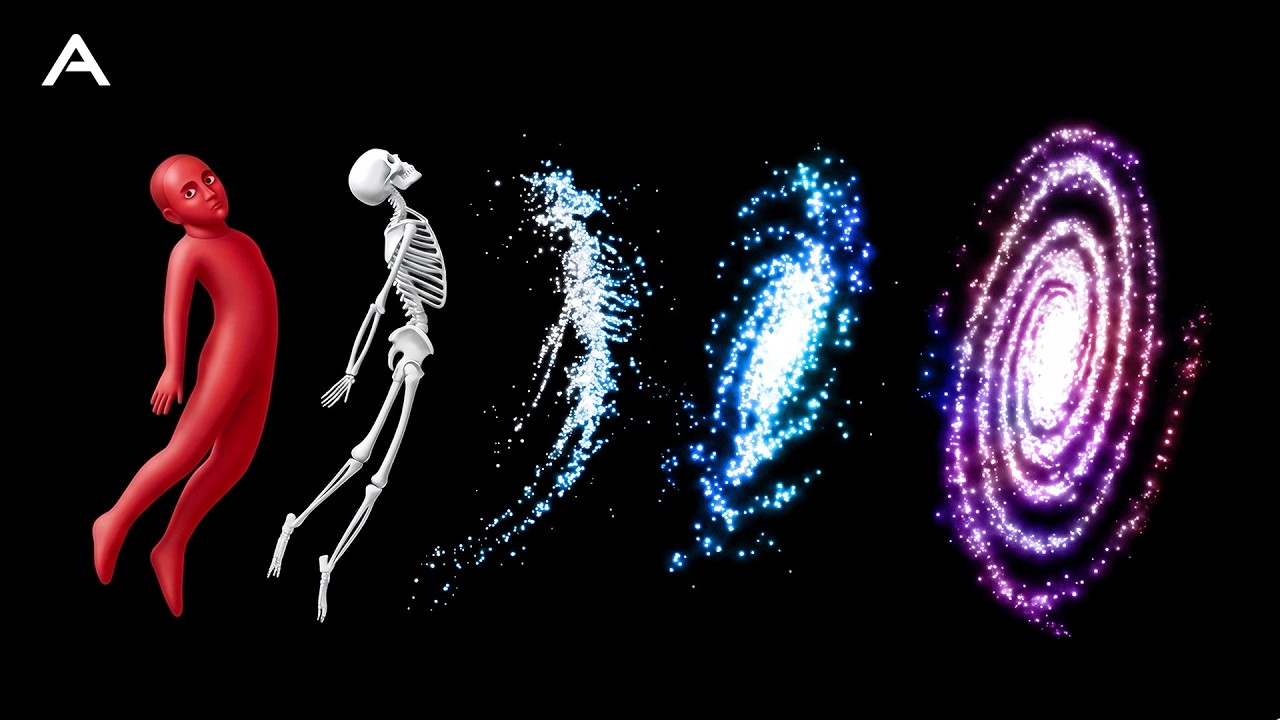
What the script actually delivers is a competent, well paced, entirely unattributed tour of the standard fine tuning argument and its two most famous escape hatches. It runs a clean chain: the observable universe is enormous, the size is a direct consequence of the time needed to cook heavy elements in stars, the expansion rate and the fundamental constants look absurdly well tuned for that to have happened, therefore either a designer set the dials, or a deeper law fixes them, or there are so many universes that one of them had to come out right. It then picks door three, follows eternal inflation into the multiverse, walks straight into the Boltzmann brain paradox that the multiverse creates, and escapes it with an entropy argument. The rhetorical payoff is the title's answer: the two trillion galaxies are not waste, they are the receipt that proves your reality is not a one second hallucination.
The reasoning is largely sound and the analogies are genuinely good. What the video strips out is every name. Boltzmann, Carter, Guth, Linde, Vilenkin, Leslie, Susskind, Conselice: all of their ideas are here, none of their names are. This page puts them back, rebuilds the argument in full, and flags the two numbers that are looser than the narrator lets on.
The grain of sand and the number that starts everything 0:00
The video opens on the naked eye. On a clear dark night, away from city light, you see a few thousand stars, and if you are lucky a faint cloudy band across the dark. That is the Milky Way. And, the narrator says, "for a long time, we thought that was it. We thought our little island of stars was the entire universe."
Then the image that anchors the whole video. Take a grain of sand. Hold it at arm's length against the sky. Look through it at one of the dark, apparently empty patches between the stars. For years the assumption was that there was nothing there. Then we pointed our best telescopes at that speck of blackness and stared at it for days.
In that single piece of sky, the size of a grain of sand, there were thousands of entire galaxies. Not stars. Galaxies.
Run the arithmetic across the whole sky, the narrator says, and you land on at least two trillion galaxies in the observable universe, each holding hundreds of billions of stars.
That number is the hinge of the entire video, and it immediately becomes a question rather than a fact. If the universe was designed for us, if human consciousness is the point of the exercise, then why is the stage this ludicrously oversized? Why would God, or nature, or the fundamental laws of physics bother with two trillion galaxies?
The narrator states the thesis at 2:03 and then spends forty minutes earning it: "It feels like a massive waste of space. But I am going to show you exactly why it is not a waste at all. The vastness is not a mistake. It is a physical necessity."
What a galaxy actually is: the drop of water 2:34
Before the argument can start, the narrator wants the word "galaxy" to stop being an abstraction. It is easy to throw around big numbers and lose the physical reality behind them.
So: think about a single drop of water. It looks calm, a tiny bead of liquid, a still surface. Zoom to the atomic level and you find billions upon billions of water molecules violently bouncing off each other. The calm surface is an illusion of scale.
Now flip the perspective and look up. A galaxy is that drop of water on a cosmic scale: a swirling, unimaginably massive city of stars, gas and dust, held together by the relentless pull of gravity. Our home is one of those cities, and the narrator gives it the only unit that matters. The Milky Way is so wide that a beam of light travelling at 300,000 kilometres per second takes 100,000 years to cross from one side to the other.
Space and time are the same thing, so a telescope is a time machine 4:05
To understand why there are two trillion of these cities, the video says, you first have to accept a fundamental rule: space and time are the same thing, and you cannot have one without the other.
The demonstration is deliberately physical. Walk outside and feel the warmth of the Sun on your face. You are not feeling the Sun as it is right now. You are feeling the Sun as it was eight minutes ago, because that is how long the light took to cross the space between you. Look at Sirius, the brightest star in the night sky, and you are seeing light that left it over eight years ago.
You are always looking into the past.
Which reframes the instrument. A telescope is not a magnifying glass. It is a literal time machine. When astronomers point one at those tiny dark patches and find galaxies, they are catching light that has been in transit for billions of years. Distance is age. That equivalence is what lets the rest of the argument work, because it means you cannot ask about the size of the universe without also asking about its age.
Your body is the evidence: where the heavy elements came from 5:38
Having established that size and age are the same question, the narrator turns the telescope around and points it at you.
Look at your hand. The veins, the skin, the bone. You are made of complex elements: carbon, oxygen, nitrogen, iron in your blood, calcium in your bones. Where did they come from?
Not from the beginning. In the very beginning, right after everything expanded from a single point, there was only hydrogen and a little helium. Simple, basic gas. You cannot build a human being out of hydrogen gas. You cannot build a planet like Earth out of it either.
So the universe had to manufacture the heavy stuff, and the video is precise about the only available factory:
- Gravity crushes hydrogen until it ignites. The only places in the universe hot enough and dense enough to forge carbon and iron are the cores of stars.
- The star cooks, for millions of years, turning lighter elements into heavier ones.
- The star has to die. The elements are trapped inside it. For them to become planets and people, the star must blow itself apart in a supernova, scattering the heavy elements across space.
- New solar systems form from the debris, now enriched with the elements that were not there at the start.
That whole cycle, the birth, life and explosive death of generations of stars, takes an enormous amount of time. Billions and billions of years.
The trick of physics: age forces size 7:41
Here is where the video closes its first loop, and it is the cleanest argument in the whole 42 minutes.
The universe has been expanding ever since it began. It is stretching. So for the universe to be old enough to have cooked the carbon in your cells and the iron in your blood, it has to have been expanding for nearly 14 billion years. And:
A universe that is 14 billion years old must, by the laws of physics, be tens of billions of light years across. The vastness is not a waste. The vastness is a direct measurement of the time required to create you.
That is the title question answered once, at the eight minute mark. The scale is not a design choice, it is a clock reading. You cannot have a small universe old enough to contain you, because age and size are the same quantity seen from two directions.
But the answer immediately generates a harder question, which is what the remaining 34 minutes are about. If the vastness is required for us to exist, why did the expansion happen in exactly the way that permits it? Why did it not collapse back in on itself, or tear itself apart before stars could form?
The cosmic tug of war: the baseball, the cannon, and the rocket 8:44
The video's model for the expansion is a throw upward from your backyard.
- Throw a baseball straight up by hand. Gravity pulls, it slows, it falls back into your hand.
- Fire it from a cannon. It goes much higher. Gravity is relentless. It still comes crashing down.
- Strap a rocket to it and blast it upward at over 11 kilometres per second. Now it breaks free. It overcomes the downward pull of Earth and drifts into the blackness of space forever.
The birth of the universe, the narrator says, was a lot like that throw. All the matter and energy was thrown outward with unimaginable force, and at the exact same moment all the mass in the universe was pulling back inward through gravity. A tug of war started immediately, and the outcome depended entirely on the ratio of the two.
The two failure modes are laid out symmetrically:
Push too weak. Gravity wins early. The universe expands for a while, slows, stops, and collapses back in on itself in a fiery crunch. No time for stars to form, no time to cook carbon, no time for us.
Push too strong. Matter flies apart so fast that gravity can never pull the hydrogen gas back into clumps. No clumps, so no stars ever ignite. The universe is "a rapidly expanding, dark, empty freezer."
It did neither. It expanded at exactly the rate that let stars form, let two trillion galaxies clump together, and let the whole arrangement stay stable for 14 billion years.
And then the narrator sharpens what "exactly" means, because this is the point where the argument stops being about astronomy and starts being about probability:
When I say exactly the right rate, I am not talking about getting it right within a few percentage points. It is like taking a single dart, throwing it from across the entire observable universe, and hitting a target the size of a single atom.
The hidden dials: the analog radio 12:22
The expansion rate turns out not to be a special case. As the narrator puts it, "as we physicists dug deeper, we found that this mysterious balancing act is everywhere." Nature has a set of hidden dials: numbers that set how strong gravity is, how heavy an electron is, how tightly atoms are bound together.
The analogy is an old analog radio. To find a clear station you have to turn the dial incredibly carefully. Miss by a millimetre and all you get is static. The fundamental constants, the video says, are exactly like that dial.
The worked example is the strong nuclear force, the glue holding the centre of atoms together:
- 2 percent stronger and the universe would have burned through all its hydrogen almost immediately. No water, and no fuel for long lived stars like the Sun.
- 5 percent weaker and atoms could not hold together at all. Nothing but loose particles flying around. No carbon, no biology, no you.
The pattern the video draws from this runs across every scale it has covered: "everywhere we look, from the massive scale of 2 trillion galaxies down to the microscopic scale of a single electron, the dials are tuned perfectly for life to eventually emerge."
At 14:29 it names the discomfort honestly. "This is where physics starts to feel like philosophy. We have the data, we have the measurements, but the numbers feel too perfect. And when things look too perfect in science, it usually means we are missing a much deeper, much stranger truth."
The firing squad 14:59
This is the best passage in the video, and it is a borrowed one. Note that the published chapter covering this stretch is titled "Richard Feynman's View of Curiosity and Nature." No such view is discussed. What actually happens is the firing squad thought experiment, which comes from the philosopher John Leslie's work on fine tuning, not from Feynman.
The setup: you are blindfolded and placed in front of a thick brick wall. Fifty expert marksmen line up, raise their rifles, and aim directly at you. You hear the countdown. You hear the deafening roar of fifty guns firing at exactly the same time.
You feel nothing. You open your eyes. You are completely unharmed. And on the brick wall behind you is a perfect outline of your body, drawn in bullet holes. Every single bullet missed you by a fraction of an inch.
Now, how do you react?
You could say: well, if they had not missed, I would be dead, and I would not be here to think about it. Since I am standing here thinking about it, I should not be surprised that they missed.
The narrator rejects this flatly, and the rejection is the load bearing move of the entire video:
That is a completely absurd way to think. You would be overwhelmingly surprised. You would demand to know how it happened. Was the firing squad bribed? Was it a trick? Were the guns rigged? You would know with absolute certainty that 50 expert marksmen do not miss their target by pure chance.
And the mapping is exact. We are standing in front of the wall, perfectly outlined by the laws of physics, completely unharmed. We look at the strength of gravity, the mass of the electron, the expansion rate of space, and we realise that fifty rifles just missed us by a millimetre. Change any one of those numbers slightly and we do not exist.
The anthropic principle, and why it is not an answer 17:36
The "I should not be surprised I survived" response has a formal name, and the video gives it: the anthropic principle. The universe must be the way it is, because if it were any different there would be no observers around to ask the question. We can only observe a universe capable of creating observers.
The narrator concedes it is logically true and then refuses to accept it as an explanation:
While that is logically true, it is completely unsatisfying. It is just like the guy in front of the firing squad saying he should not be surprised he is alive. It is a true statement but it does not explain the mechanism.
A selection effect tells you why you cannot observe the alternatives. It does not tell you why the dials were set the way they were. That gap is what forces the three options.
Three uncomfortable options 18:39
Option one: the dials were set on purpose. A grand designer, a creator, tuned the universe specifically so that you and I could be here talking about it. The narrator is careful and not dismissive here, calling it "a beautiful and comforting thought" for a lot of people. The objection is methodological rather than theological: "in science, we cannot simply throw our hands in the air and say it is magic or divine intervention. Our job is to keep pulling the thread, to keep asking how the machinery actually works."
Option two: there is a deeper law we have not found yet. A single elegant mathematical equation that explains why the numbers must be what they are. The illustration is π. The distance around a circle divided by the distance across it is always the same number, and it cannot be anything else, because it is a geometric necessity. Perhaps the mass of a proton or the strength of gravity are like that, and we simply do not have the complete mathematical picture yet.
Option three: the lottery. The odds of buying one ticket and winning the grand prize are essentially zero. But if someone buys a trillion tickets, or every possible combination of numbers, winning stops being a miracle and becomes a mathematical guarantee.
What if nature bought a trillion lottery tickets? What if our universe, with its perfect laws, 14 billion years of history, and its two trillion galaxies, is not the only universe out there?
| The question | Human centred reading | What the video answers |
|---|---|---|
| Why is the universe so big? | It is not, really. The extra space is decoration, or a display of power. | Size is a clock. 14 billion years of expansion forces a diameter of tens of billions of light years. You cannot have a small universe old enough to contain carbon. |
| Why two trillion galaxies and not one? | Excess. A stage far larger than the drama being performed on it. | Heavy elements need generations of stars living and dying. That needs an enormous population and enormous time. The count is a byproduct of the chemistry. |
| Why are the constants so precise? | Precision implies a hand on the dial. | Three live options, and the video declines to call option one science: designer, undiscovered deeper law, or selection out of an enormous ensemble. |
| Are we the point of it all? | Yes. Consciousness is the purpose the machinery was built to serve. | No. We are "the winners of a cosmic lottery that printed an infinite number of tickets," and our whole cosmos is "less than a grain of sand on an endless beach." |
| Then is any of it wasted? | The dead space is waste by definition. | No. "The infinite vastness of dead universes out there is the exact physical price that had to be paid to get the machinery right just once." |
| How do you know your reality is real? | Self evident. You are experiencing it. | Not self evident at all. The answer has to be earned with entropy, and the two trillion galaxies are the proof. |
The boiling pot: eternal inflation 21:15
Option three needs a mechanism, and the video gives it one with a pot of water.
Put a pot on the stove and turn the heat all the way up. At first nothing happens, the water is perfectly still. As it absorbs heat you start to see tiny energetic bubbles forming at the very bottom. They expand, they rise, they pop at the surface.
Now change what the water is. Imagine the water is the fundamental fabric of space itself, and the heat underneath the pot is an immense repulsive energy driving everything to expand at a violent, unimaginable speed.
The historical claim is dated: "in the 1980s, physicists studying the Big Bang realized something profoundly disturbing." The initial expansion of space did not happen once and stop. The mathematics say that the rapid stretching, a process called inflation, is eternal. It is happening everywhere, all the time, forever into the past and forever into the future.
But, exactly like the boiling pot, little pockets of space occasionally cool down. They lose their explosive energy and stop expanding so violently. When one of those pockets cools, a bubble forms. The rapid expansion halts inside the bubble, and the leftover energy transforms into particles, into light, into matter.
And then the narrator stops and tells you to brace:
I want you to listen to me very carefully right now because this is the exact moment where your brain is going to try to reject what I am telling you. Our entire observable universe, every single star you have ever seen in the night sky, every planet we have discovered, all 14 billion years of cosmic history, and all two trillion galaxies we talked about earlier, is just the inside of one of those microscopic bubbles.
Sealed inside the bubble 24:18
Outside our bubble the eternal violent expansion continues, making more bubbles. Billions of them. Trillions of them. An infinite number of separate, completely isolated universes being born every second. That ensemble is the multiverse.
The video is careful about why this is not a testable neighbourhood. The space between our bubble and the next is expanding far faster than the speed of light, which means light from another universe can never reach us. Not with better instruments, not ever.
You could fly in a spaceship for a trillion years and you would never hit the edge of our bubble, let alone cross over into the next one. We are permanently sealed inside our own pocket of reality.
Spinning the dials at random 25:20
Now the payoff for the firing squad. If nature is a boiling pot endlessly creating an infinite number of bubbles, then every bubble gets a totally different set of laws. The physics dials are spun at random every time a universe is born.
The video walks the failures concretely:
- Bubble one. Gravity is a little too strong. The universe is born and immediately crushes itself back down into a microscopic black hole. Dead.
- Bubble two. The strong nuclear force is too weak. Protons and neutrons cannot stick together. A lifeless, freezing soup of lonely particles. Dead.
- Bubble after bubble. Universe after universe born completely sterile. Billions upon billions of entire cosmoses empty, "devoid of chemistry, devoid of light, devoid of absolutely anyone to look up and ask why they exist."
But roll the cosmic dice an infinite number of times and eventually, by pure mathematical necessity, you get a bubble where the dials align. Gravity is just right. Electrons have the exact right mass. Stars ignite. Carbon cooks in their cores.
We are not living in a universe that was magically tuned just for us. We are simply the winners of a cosmic lottery that printed an infinite number of tickets.
The scale reversal at 27:23 is the video's most vertiginous moment, and it deliberately recycles the opening image. "When I first really understood this, it shook me, because it means the sheer scale of reality is so far beyond human comprehension that our massive 2 trillion galaxy home is literally less than a grain of sand on an endless beach." The grain of sand you held up at arm's length in minute one has become everything you can see.
And with that, the title question gets its second and stronger answer: "God, or nature, did not waste space. The infinite vastness of dead universes out there is the exact physical price that had to be paid to get the machinery right just once."
The deck of cards: what infinity guarantees 28:24
The narrator does not let you enjoy it. "Do not get too comfortable. Because if this boiling ocean of universes is real, it creates a new terrible problem. We have traded one mystery for a much darker one."
The setup is a deck of playing cards. Shuffle it, it is a mess. Shuffle again, still a mess. The chance of a shuffle landing in perfect order, all four suits lined up ace to king, is practically zero. You could shuffle once a second for the entire 14 billion year history of the universe and almost certainly never see it.
But what if you had infinite time? Sit in a room shuffling forever and pure statistics guarantees the cards will eventually land in perfect order.
It is not magic, it is just the brutal math of infinity. Given infinite time, anything that can happen will happen.
Quantum fluctuations in the dead universes 29:58
Now apply that rule to the boiling ocean. Most of the universes out there are dead: cold, empty voids where the dials were tuned wrong. But empty space is never truly empty. At the subatomic level the fabric of space is jittery. Particles constantly pop into existence out of nowhere, exist for a fraction of a second, and vanish. Those are quantum fluctuations, and the video is explicit that this is not speculation: "it sounds like science fiction, but we can actually measure this happening in the laboratory right now."
So you have dead, empty universes sitting there for infinite time, with random fluctuations happening endlessly. Most of the time a couple of particles pop up and immediately disappear. But given infinite time, eventually those random particles will accidentally arrange themselves into something more complex.
Wait long enough in a dead universe and quantum particles will spontaneously assemble into a rock. Wait longer and they will spontaneously assemble into a chair.
The two scenarios, and the Boltzmann brain 31:32
Then the question that turns the video: what does it take to make you?
Your entire consciousness, your personality, your memories, your experience of reading this exact sentence right now. All of it lives inside your brain. And your brain is nothing more than a highly specific complex arrangement of atoms.
So weigh two ways of producing that arrangement.
Scenario one. A universe begins with a massive explosion. It expands perfectly for 14 billion years. It creates two trillion galaxies. It forges heavy elements in the cores of dying stars. It forms a solar system. A planet sustains billions of years of biological evolution. All of it just to produce the exact arrangement of atoms in your brain today.
Scenario two. In a cold, dead, empty universe, an infinite amount of time passes. Eventually random quantum particles accidentally pop together for a single second to form a fully functioning human brain floating in the void.
Which one is easier? Which one is mathematically more likely?
The video names it: the Boltzmann brain paradox. And it does not soften the verdict.
It is infinitely more likely for a lone brain to spontaneously pop into existence in a void, hallucinate a life for a single second, and then dissolve back into nothing, than it is for our massive 2 trillion galaxies universe to actually exist.
By the cold laws of probability, if the multiverse is real, the overwhelming majority of conscious observers out there are random momentary hallucinations floating in empty space.
And the memory defence does not work. You think you remember waking up this morning. You think you remember your childhood. But those are chemical pathways in your brain, and a randomly assembled brain would have those exact same pathways built into it by accident. "The illusion of a past would be absolutely flawless."
How do you know that the stars, the galaxies, the floor beneath your feet, and the body you think you inhabit are actually real? What if the universe is not 2 trillion galaxies wide at all? What if reality is exactly the size of your skull, and it just popped into existence half a second ago?
The escape: entropy and the coffee mug 35:41
The narrator acknowledges what he has just done to you ("I know exactly what you are feeling right now") and then delivers the way out, which he says is the reason he does not lose sleep over it.
Drop a coffee mug on a hard tile floor. It shatters into a hundred pieces. Now stare at the shards and wait for them to spontaneously leap back up, assemble themselves perfectly, and fill back up with hot coffee.
You know instinctively that will never happen. The reason has a name: entropy. The universe always moves from order to disorder. Things break down. They do not spontaneously put themselves together.
Creating a Boltzmann brain, a fully formed conscious mind popping out of random quantum noise, requires a massive spontaneous decrease in entropy. It is the coffee mug jumping back together, but a trillion times more unlikely.
Which does not settle it on its own, and the video is honest about that: with infinite time, even that impossible thing eventually happens. So the argument has to be comparative rather than absolute, and it turns on what you would expect to see.
Why we are not those brains: look out the window 37:15
If you were a momentary hallucination doing the absolute bare minimum to experience consciousness for a second, then the universe you hallucinate should be highly chaotic. The bare minimum requirement for you to exist is just your brain. Nothing else needs to be real. A fluctuation that also builds a consistent 93 billion light year cosmos around the brain is doing vastly more work than it needs to, and is therefore vastly less likely.
So look around. Look out the window. Better yet, look through a telescope.
When we look into the deep cosmos, we do not see a tiny localized bubble of order surrounded by chaotic quantum nonsense. We see an incredibly rich, perfectly structured universe. We see physics behaving perfectly consistently everywhere we look, in every direction.
The climax: two trillion galaxies as the receipt 38:48
And that is the answer to the question in the title, arrived at from the far side of a forty minute detour through the multiverse.
Those two trillion galaxies are the ultimate proof of our reality. They are the cosmic receipt that proves we are not a statistical accident, because producing an entire universe filled with two trillion galaxies requires an infinitely lower starting entropy than producing a single random brain in a void.
A universe this massive, this old, and this perfectly structured cannot be faked by a momentary quantum glitch. The overwhelming vastness of the cosmos is exactly what proves your reality is genuine.
The mechanism underneath it, stated plainly: "We exist because 14 billion years ago the universe began in a state of ultimate perfect order. And it has been slowly winding down, expanding, building the necessary machinery to forge the elements that make you. The vastness is not a waste. It is the undeniable physical footprint of a real historical process."
The pitch, and the closing turn 40:21
At 40:21 the video breaks frame for a "super thanks" appeal, pitched as keeping the mission alive "without compromising on the depth or the truth of the science."
Then the emotional landing at 40:53, which reverses the opening framing completely. When you realise what it actually took to put you here, the universe stops feeling like a massive empty terrifying void. It stops feeling like a waste of space.
Every single one of those two trillion galaxies becomes a testament to your existence. They had to be there. The universe had to be exactly this wide, exactly this old, and exactly this massive, just so you could have the luxury of opening your eyes and wondering why it is all here.
And then the video simply stops, mid thought, on an unanswered question: "But this leaves us with one final deeply personal realization. What do we do with this information? How are we supposed to live our daily lives knowing the unfathomable scale of the machinery that created us?" No answer follows. The transcript ends there at 41:55, which reads either as a deliberate hook for a sequel or as a script that ran out of runway.
- 1895 Ludwig Boltzmann publishes the fluctuation hypothesis, suggesting the ordered universe we see could be a rare statistical excursion out of equilibrium. Every "Boltzmann brain" argument descends from this, including the one at 33:06.
- 1929 Edwin Hubble publishes the velocity distance relation. Expansion becomes an observation rather than a solution to an equation, which is what makes the tug of war at 8:44 a real physics problem.
- 1961 Robert Dicke argues in Nature that the apparent coincidences in cosmology follow from the fact that observers require stars and heavy elements. This is the "age forces size" argument the video makes at 7:41, forty years earlier.
- 1974 Brandon Carter coins the term anthropic principle at the Kraków symposium marking Copernicus's 500th birthday. The video uses the term at 17:36 without naming him.
- 1980 to 1981 Alan Guth proposes cosmic inflation, solving the flatness and horizon problems that the "dart across the universe" precision at 11:50 is describing.
- 1983 Alexander Vilenkin and Andrei Linde develop eternal inflation: inflation never fully stops, and pocket universes bubble out of it forever. This is the boiling pot at 21:15, and the video's "in the 1980s" is accurate.
- 1989 John Leslie publishes Universes, which popularises the firing squad analogy for fine tuning. That is the 14:59 passage, sitting under a chapter titled "Richard Feynman's View of Curiosity and Nature."
- 1995 The Hubble Deep Field: 10 days of exposure on an apparently empty patch of sky returns roughly 3,000 galaxies. The grain of sand story at 0:32 starts here.
- 2002 Dyson, Kleban and Susskind publish "Disturbing Implications of a Cosmological Constant," turning Boltzmann's old idea into a live modern problem for any eternally inflating cosmology. The 33:06 paradox in its current form.
- 2012 The Hubble eXtreme Deep Field: about 5,500 galaxies in 2.3 square arcminutes, the deepest optical image taken at the time.
- 2016 Christopher Conselice and colleagues publish the estimate of at least two trillion galaxies, obtained by extrapolating galaxy mass functions below the detection limit. The video's headline number.
- 2021 Tod Lauer and colleagues use New Horizons out past Pluto to measure the cosmic optical background directly and find it too faint for two trillion galaxies, pointing back toward a few hundred billion.
Key takeaways
- Feynman is a thumbnail, not a source. No Feynman audio, no Feynman quotation, no mention of his name in 42 minutes of narration. The channel's own description says only that the video is "inspired by the curiosity and scientific thinking associated with" him.
- The strongest argument arrives at minute eight and is genuinely good. Heavy elements require generations of stars living and dying, that requires billions of years, and in an expanding universe billions of years of age forces tens of billions of light years of size. The vastness is a clock reading.
- Fine tuning is presented in its sharpest form and its weakest defence is rejected. The firing squad thought experiment is used to argue that the anthropic principle, while logically true, explains nothing about mechanism.
- The video commits to the multiverse and then pays the bill for it. Rather than stopping at "eternal inflation solves fine tuning," it follows through to the Boltzmann brain problem that an infinite ensemble creates, which is intellectually honest and rare in this genre.
- The escape from Boltzmann brains is an entropy and expectation argument, not a proof. A minimal fluctuation would produce a brain surrounded by chaos. We observe a consistent, structured cosmos in every direction, which is exactly what a fluctuation would not bother to build.
- "Two trillion" is the largest of three defensible estimates, presented as a floor. It comes from a 2016 model dependent extrapolation, and a 2021 direct measurement of background starlight points an order of magnitude lower.
- The published chapter titles do not match the content. The chapter labelled "Richard Feynman's View of Curiosity and Nature" contains the firing squad analogy from John Leslie and no view of Feynman's at all.
Chapters
- 0:00:00 Introduction: The Question That Changes Everything
- 0:02:45 The Universe Beyond Human Imagination
- 0:06:10 Why Are There So Many Galaxies?
- 0:10:25 The Incredible Scale of Cosmic Creation
- 0:14:40 Richard Feynman's View of Curiosity and Nature
- 0:18:55 Physics: The Hidden Rules of the Universe
- 0:23:10 Humanity's Place in the Cosmos
- 0:27:35 Science, God, and the Mystery of Creation
- 0:32:20 Why Would God Create Such a Vast Universe?
- 0:37:15 The Deeper Meaning Behind the Stars
- 0:40:30 Final Thoughts: Our Connection to the Universe
Notable quotes
Every line below is spoken by the video's unnamed narrator. None is attributable to Richard Feynman, who does not speak in this video and is never named in it.
"In that single piece of sky, the size of a grain of sand, there were thousands of entire galaxies. Not stars. Galaxies." Narrator, 1:03
"It feels like a massive waste of space. But I am going to show you exactly why it is not a waste at all. The vastness is not a mistake. It is a physical necessity." Narrator, 2:03
"You are always looking into the past. So a telescope is not just a magnifying glass. It is a literal time machine." Narrator, 5:08
"A universe that is 14 billion years old must, by the laws of physics, be tens of billions of light years across. The vastness is not a waste. The vastness is a direct measurement of the time required to create you." Narrator, 8:13
"It is like taking a single dart, throwing it from across the entire observable universe, and hitting a target the size of a single atom. That is how finely balanced the initial expansion had to be." Narrator, 11:50
"You would know with absolute certainty that 50 expert marksmen do not miss their target by pure chance." Narrator, 16:34, on the firing squad
"While that is logically true, it is completely unsatisfying. It is a true statement but it does not explain the mechanism." Narrator, 18:08, on the anthropic principle
"In science, we cannot simply throw our hands in the air and say it is magic or divine intervention. Our job is to keep pulling the thread, to keep asking how the machinery actually works." Narrator, 19:11
"What if nature bought a trillion lottery tickets?" Narrator, 20:44
"Our entire observable universe, every single star you have ever seen in the night sky, every planet we have discovered, all 14 billion years of cosmic history, and all two trillion galaxies we talked about earlier, is just the inside of one of those microscopic bubbles." Narrator, 23:17
"We are not living in a universe that was magically tuned just for us. We are simply the winners of a cosmic lottery that printed an infinite number of tickets." Narrator, 26:53
"Our massive 2 trillion galaxy home is literally less than a grain of sand on an endless beach." Narrator, 27:23
"It is not magic, it is just the brutal math of infinity. Given infinite time, anything that can happen will happen." Narrator, 29:27
"It is infinitely more likely for a lone brain to spontaneously pop into existence in a void, hallucinate a life for a single second, and then dissolve back into nothing, than it is for our massive 2 trillion galaxies universe to actually exist." Narrator, 33:38, on the Boltzmann brain paradox
"What if reality is exactly the size of your skull, and it just popped into existence half a second ago?" Narrator, 35:11
"Those two trillion galaxies are the ultimate proof of our reality. They are the cosmic receipt that proves we are not a statistical accident." Narrator, 38:48
"The universe had to be exactly this wide, exactly this old, and exactly this massive, just so you could have the luxury of opening your eyes and wondering why it is all here." Narrator, 41:25
Resources mentioned
The video itself cites nothing. Every item below is the actual source of an idea, number or analogy the narrator uses without attribution, plus the Feynman material the title gestures at.
The person in the title, and what he actually said
- Richard Feynman: the physicist named in the title, who does not appear in this video.
- The Pleasure of Finding Things Out (BBC Horizon, 1981): the interview most often mined by channels repackaging Feynman, and the source of "I can live with doubt and uncertainty and not knowing." Not the source of this video's audio.
- "The Relation of Science and Religion" (Feynman, Engineering and Science, 1956): the essay where Feynman actually addresses this video's title question, and where the line "the stage is too big for the drama" appears. His conclusion runs opposite to this video's comforting ending.
- The Feynman Lectures on Physics (free online, Caltech): the primary Feynman text on the physics the video gestures at.
The observations behind the numbers
- Hubble Deep Field (1995): the original grain of sand image.
- Hubble eXtreme Deep Field (2012): about 5,500 galaxies in 2.3 square arcminutes.
- Conselice et al. 2016, "The Evolution of Galaxy Number Density at z < 8 and Its Implications": the paper the "two trillion galaxies" figure comes from.
- Lauer et al. 2021, "New Horizons Observations of the Cosmic Optical Background": the direct background light measurement that argues the number is closer to hundreds of billions.
- Planck 2018 cosmological parameters: the source of the 13.8 billion year age the video rounds to "nearly 14 billion."
- Observable universe: the 93 billion light year comoving diameter used in Figure 1.
The ideas, and who they belong to
- Stellar nucleosynthesis and the B2FH paper (1957): where "the only factories hot enough are the cores of stars" comes from.
- Big Bang nucleosynthesis: why the early universe held only hydrogen and helium.
- Fine tuned universe: the general argument the middle of the video runs.
- The anthropic principle: named by Brandon Carter in 1974, discussed by the video at 17:36 without attribution.
- Robert Dicke's 1961 Nature paper, "Dirac's Cosmology and Mach's Principle": the original "the universe must be old enough to have made observers" argument.
- John Leslie, Universes (1989): the source of the firing squad analogy used at 14:59.
- Alan Guth's 1981 inflation paper: cosmic inflation.
- Eternal inflation, from Alexander Vilenkin and Andrei Linde: the boiling pot at 21:15.
- The multiverse: the bubble ensemble the video commits to at 24:18.
- Boltzmann brain: traced to Ludwig Boltzmann's 1895 fluctuation hypothesis.
- Dyson, Kleban and Susskind, "Disturbing Implications of a Cosmological Constant" (2002): the modern statement of the paradox at 33:06.
- The second law of thermodynamics and the past hypothesis: the entropy escape hatch at 36:42.
- Quantum fluctuation and the Casimir effect: the laboratory measurement the narrator alludes to at 30:29.
- Escape velocity: the 11.2 km/s figure behind the rocket analogy at 9:45.
- Strong nuclear force and the diproton argument: the 2 percent and 5 percent claims at 13:26, and the paper that disputes them.
- Sirius: 8.6 light years away, the video's "over 8 years ago."
- Jane Goodall Nature (the channel): the publisher.
Where it stands
On provenance, which is the important part. This is not archival Feynman. It is not the 1981 BBC Horizon interview, it is not the Messenger Lectures, and it is not a mix of Feynman audio with narration. It is a single modern narrator reading a script, with clear synthetic speech artefacts in the transcript ("uh traveling at 300,000 km per second," "the temperature temperature and the pressure," "How did it get so obvious question? How is it that"). Those stumbles are characteristic of text to speech or of an unedited single take, not of a broadcast interview. The narrator adopts a physicist's first person voice at several points ("as we physicists dug deeper," "let me tell you how this realization feels to a physicist"), which is the closest the video comes to implying it is Feynman speaking, and it never actually says so. The title and thumbnail do the work that the script carefully avoids doing. Treat every line here as the work of an anonymous scriptwriter.
The channel name deserves the same note. "Jane Goodall Nature" publishes cosmology essays with a famous name attached; Jane Goodall is a primatologist and does not appear here either.
On the two trillion figure. The narrator says "at least two trillion," which frames the largest available estimate as a lower bound. It is not. The figure is from Conselice et al. 2016 and is a model dependent extrapolation: it takes measured galaxy mass functions out to redshift 8 and then integrates far below any telescope's detection limit to include a huge inferred population of faint dwarf galaxies. The naive version of the video's own grain of sand arithmetic, taking the eXtreme Deep Field count and scaling to the full sky, gives roughly 3.5 × 10¹¹, about a factor of six lower. And in 2021 Lauer and colleagues used New Horizons, far enough out to escape the zodiacal dust that ruins this measurement from Earth orbit, to weigh the total cosmic optical background directly. The sky is not bright enough for two trillion. The honest statement is "hundreds of billions of galaxies bright enough to detect, with the total possibly running into the trillions if very faint dwarfs are as abundant as one 2016 extrapolation suggests." That is less punchy than the title, which is presumably why it is not the title.
On the fine tuning numbers. The strong force claim at 13:26 (2 percent stronger burns all the hydrogen, 5 percent weaker and atoms fall apart) is quoted from the fine tuning literature at its most dramatic, and it is disputed. The "2 percent stronger" version rests on the diproton being bound, and subsequent work has argued that the tolerance is far wider than the popular accounts claim, possibly tens of percent, before stellar nucleosynthesis genuinely fails. The dart across the observable universe hitting an atom is a vivid rendering of the flatness problem, but the video presents it as a raw improbability rather than as a fine tuning of initial conditions that inflation was specifically invented to remove. That is a real tension in the script: it uses the flatness precision as evidence for design or multiverse at 11:50, then introduces inflation at 22:17 as an unrelated mechanism, without noting that inflation is the standard explanation for the very precision it just called miraculous.
On the argument itself. The chain is better than the packaging. The age forces size argument is correct and well made. The refusal to let the anthropic principle stand as an explanation is a legitimate philosophical position. Following eternal inflation all the way to Boltzmann brains, rather than stopping at the comfortable answer, is more intellectually honest than most content in this genre manages. The entropy escape is a real argument in the literature, though the video states it more confidently than cosmologists do; whether the Boltzmann brain problem is actually solved remains open, and for many working cosmologists a theory that predicts you are probably a fluctuation is taken as evidence against the theory rather than as a settled result.
On the ending. The last two minutes turn a conclusion that radically demotes humanity ("we are simply the winners of a cosmic lottery," "less than a grain of sand on an endless beach") into an affirming one ("every single one of those two trillion galaxies becomes a testament to your existence"). Those are not the same claim. The galaxies are evidence that your reality is genuine, which is not the same as their being there for you. The video slides from the first to the second in the final thirty seconds because the second feels better to end on. And the actual final line asks a question the video never answers before cutting off.
Worth your 42 minutes? As a clear, well analogised tour of fine tuning, eternal inflation and the Boltzmann brain paradox, yes, it is genuinely good. As Richard Feynman, no. He is not in it.