At a glance
An hour and thirty four minutes of narrated documentary that runs a single prosecution from start to finish: take the claim that you could have chosen otherwise, put it in front of every branch of physics that has anything to say about it, and see what survives. Strange Space builds the case in eight chapters, and the structure is the argument. Each chapter is a witness. Each witness is asked the same question. None of them gives the answer folklore wants.
The witnesses, in order: the equations that predicted an eclipse, kept a dead man's appointment with a comet, and found Neptune with the point of a pen. The frog leg that kicked when a scalpel touched a nerve, and the nerve signal that turned out to have a speed limit. The half silvered mirror where quantum mechanics answers "why this photon and not that one" with "there is no why". The quasar light, 12.2 billion years old, that was used in 2018 to pick the settings on a Bell test and push any cosmic conspiracy back past the halfway mark of cosmic time. The geometry of special relativity, which refuses to draw a line between your settled past and your open future, and which turns a stranger on a bicycle in Andromeda into a threat. And the electrodes in Benjamin Libet's lab that caught the feeling of deciding arriving late to its own event.
Then, in the last fourteen minutes, the documentary turns itself inside out. It goes back to Henri Poincaré recalling a prize winning manuscript because he found his own mistake in it, to the discovery that a universe can obey exact laws and still be unforecastable, to the problem that any predicting demon has to be built out of the matter it is trying to predict, and to the possibility that some systems have no shortcut: to know what they do, you have to run them. If your brain is one of those, then the shortest computation of you is you, and your deliberation is not theater performed over a result computed somewhere else. It is where the result gets computed. That is the case for compatibilism, and the film ends on it.
This page rebuilds all eight chapters in the film's own order, keeps every name, date, number and experiment, links every study and every person to a real source, and draws out seven of the things the documentary describes but never shows you properly: the demon's winning streak, the causal rewind from a cup of tea to the first morning of the universe, the two box trap, the cosmic Bell test's reach into deep time, the tilting slices of now, Libet's and Haynes's timelines side by side, and the ledger of what physics actually took away.
Chapters
Click any timestamp and the floating player jumps there and keeps playing. These are the creator's own chapter markers.
- 0:00 The Question You Were Born Asking
- 4:00 The Clockwork Universe: Newton and Laplace's Demon
- 15:44 You Are Made of Matter: The Brain as Machinery
- 28:33 Quantum Mechanics: Do the Dice Set You Free?
- 40:39 The Cosmic Bell Test: Quasar Light and Superdeterminism
- 55:15 The Block Universe: Is the Future Already There?
- 1:07:16 Your Brain Decides Before You Do: The Libet Experiment
- 1:20:00 The Demon's Blind Spot: Chaos, Computation and Real Freedom
Part 1: the question you were born asking (0:00)
The film opens on the thing you are doing right now. You believe you are choosing to watch this. You could pause it, close it, walk away. The decision feels weightless.
Physics is not so sure. At 0:35 the narration lays out the whole problem in one move: the same equations that steer galaxies, ignite stars and hold every atom of your body together make no exception for the matter inside your skull. And if those equations tell the whole story, then the next thought you have was never truly open. Not influenced. Not nudged. Fixed.
Then the cold open sketches the five chapters of evidence that are coming, and it does not soften any of them.
Two centuries ago a French mathematician imagined a mind that could see every particle in the universe at once, and realized that for such a mind the future would not be a mystery. At 1:16: "It would be a memory." Every war, every love, every choice you will ever make, readable in advance from the arrangement of matter on the day the universe began.
Scientists hoped quantum mechanics would break that machine. It found randomness at the heart of reality, and randomness surely means the future is open. But look closer, the narration says, and the escape route crumbles, because a random choice is not a free one.
When physicists set out to test whether nature could be hiding a script, they used light from quasars that began its journey billions of years before the Earth existed. They pushed any possible conspiracy billions of years into the cosmic past without ever ruling it out. A controversial idea called superdeterminism still stands: the possibility that every decision was locked in at the big bang. Most physicists reject it. Some, including Nobel laureate Gerard 't Hooft, take it seriously (2:27).
The trail does not end in deep space. Einstein's relativity hints that your future choices may already exist, written into spacetime, as real as your past. And in laboratories on Earth, neuroscientists have detected patterns of brain activity that can predict simple decisions before people report making them.
The closing line of the cold open is the question the whole film hangs on. If every choice you will ever make was already written into the universe, could you ever have chosen differently?
Part 2: the clockwork universe (4:00)
A battlefield, an eclipse, and a man who called it in advance
The documentary does not start with physics. It starts with two armies on the banks of a river in what is now Turkey. The Lydians and the Medes have been at war for five brutal years, and the fighting is at its peak (4:06).
Then the sun begins to disappear. Not behind a cloud, not below the horizon. It is being eaten, in a clear sky, in the middle of the day. Darkness pours across the battlefield. Stars appear where stars should be impossible. On both sides of the river soldiers lower their weapons and stare upward, because every one of them draws the same conclusion. The gods are watching, and the gods are furious.
The battle stops. The war ends right there. Kings who had spent five years trying to destroy each other sign a peace treaty because the sky told them to. This is what the heavens were for almost all of human history: not a place, a power. An eclipse was rage. A comet was an omen of plague, of famine, of the death of kings. At 5:35 the narration lands the point: the one thing everyone knew, the one thing that was obvious, was that the sky answers to no one.
And then the detail that should stop you cold. According to the historian Herodotus, that eclipse had been predicted. A Greek philosopher named Thales had announced in advance the year the sun would vanish (5:50). How Thales did it, even whether he truly did it, historians still debate, and the film says so plainly rather than dressing it up. (The event is conventionally the Eclipse of Thales, and the battle it interrupted is known as the Battle of the Eclipse.)
For two thousand years that question waited. Astronomers in Babylon, in China, in Baghdad kept records, centuries of observations tracking every wandering light. They found patterns and cycles. The sky, it turned out, kept schedules. But nobody knew why.
Newton erases the border
Until one man, working alone while a plague shut down his university, found the answer, and it was much stranger than magic. Isaac Newton discovered that the force pulling an apple toward the ground and the force holding the moon in the sky are the same force. One force, one law, written as a single line of mathematics.
The film insists that almost everyone misses what that actually meant. Before Newton there were two worlds. Down here, the ordinary world of falling objects and rolling stones. Up there, the divine world of the heavens, running on rules of its own if it had rules at all. Newton erased the border. The same equation governs a cannonball and a comet, a raindrop and a ringed planet. The heavens are not another realm. They are just more matter obeying the same law.
And that law made a promise no religion had ever dared to make (7:47):
Give me the present and I will hand you the future.
Tell me where the planets are tonight, their positions, their speeds, and the equations will tell you where they must be tomorrow. Not where they might be. Where they must be. No choice, no mood, no mercy.
Three trials the universe lost
It sounded like arrogance, so the universe was put on trial. The documentary runs three tests, in order, and each one raises the stakes.
The comet (8:18). In 1705 Newton's friend Edmond Halley studied the records of a bright comet, the ancient omen of doom itself, and noticed it had visited before. The same object returning again and again on a roughly 76 year orbit. So Halley did something no human had ever done. He looked at the most feared apparition in the sky and gave it an appointment. The comet, he announced, would return around 1758. Understand what a prediction like that costs: he was promising a rendezvous with the heavens that he could not possibly live to see. He died in 1742, sixteen years short. On Christmas night 1758 a German farmer and amateur astronomer named Johann Georg Palitzsch pointed his telescope at the sky, and the comet was there, rising out of the darkness, essentially as a dead man's mathematics said it must. Its arrival shifted only slightly by the tug of the giant planets, a delay astronomers had themselves calculated. The terror of ancient kings reduced to a train arriving on schedule.
The missing planet (10:06). By the 1840s astronomers had a problem. Uranus was misbehaving, drifting off course, wandering from the path Newton's equations demanded. Here at the edge of the map the old idea should have won. This is where the gods should have lived. Instead a French mathematician named Urbain Le Verrier made an assumption so bold it borders on madness. The law is not wrong, he said. The universe is hiding something. If the equations say Uranus is being pulled, then something must be pulling it. And from nothing but the wobble he calculated the ghost: its mass, its orbit, its position. A world no human eye had ever seen, conjured out of pure mathematics. He mailed the coordinates to an observatory in Berlin. On the night of 23 September 1846 an astronomer named Johann Gottfried Galle aimed his telescope at the exact patch of sky the letter described. Neptune was waiting there, less than one degree from where the pen said it would be (10:57).
The narration stops to make sure you feel it. A man discovered a planet, an entire world four and a half billion kilometres away, without looking. At 11:20: the universe had stopped merely obeying our equations. It was taking orders from them. And it has never stopped.
Today (11:38). This is the part that is not history, it is your daily life. We do not wonder about eclipses anymore, we publish their schedules mapped to the second for the next thousand years. When engineers fired the Voyager probes across the solar system they threaded them through the moons of Jupiter and Saturn using slingshot maneuvers plotted years in advance, and after billions of kilometres the spacecraft arrived within moments of the timetable. Ancient kings begged the sky for mercy. We send it instructions.
- 585 BCE The sun goes out over a battlefield on the river Halys. Two armies stop fighting and sign a treaty. Herodotus reports that Thales had named the year in advance. Whether he really did is still argued.
- 1687 Newton publishes the law of universal gravitation. One equation covers the apple and the moon. The border between the earthly and the heavenly is deleted.
- 1705 Halley reads the records of a recurring comet, works out a roughly 76 year orbit, and books an appointment for a date he will not live to see.
- 1742 Halley dies, sixteen years short of his own prediction.
- 1758 On Christmas night, Johann Georg Palitzsch, a farmer with a telescope, finds the comet exactly where a dead man's mathematics said it would be. The delay caused by Jupiter and Saturn had itself been calculated in advance.
- 1814 Laplace publishes the thought experiment. A mind that knew every particle and every force would see the future the way we see the past.
- 1846 Le Verrier computes an unseen planet from the wobble of Uranus and posts the coordinates to Berlin. On 23 September Galle points a telescope at that spot and Neptune is there, less than one degree off.
- 1977 to 1989 The Voyager probes fly a gravity assist tour of the outer solar system, plotted years ahead, and arrive within moments of the timetable after billions of kilometres.
- Now Eclipse schedules are published to the second, a thousand years out. The method has never lost a rematch with the sky.
Laplace says the quiet part out loud
Which brings the film to Paris in 1814 and to the man brave enough, or reckless enough, to say it. Pierre Simon Laplace was the greatest expert on celestial mechanics alive, the man who had taken Newton's law and shown that the solar system runs on it like clockwork with no divine adjustments needed. When Napoleon asked why his great book on the heavens never mentioned God, Laplace is said to have replied with seven of the most fearless words in the history of science (12:39):
I had no need of that hypothesis.
But Laplace saw something in the equations that almost no one else was willing to face. The mathematics that finds Neptune does not care what it is aimed at. It never asks whether the matter is large or small, distant or near, dead or alive.
So he imagined the ultimate astronomer: a mind vast beyond imagining that could see the position of every particle in the universe and every force acting upon it, all at once. For that mind, Laplace realized, the equations would do what they always do. They would take the present and hand over everything else. Nothing would be uncertain. The future, just like the past, would be present before its eyes. The passage comes from A Philosophical Essay on Probabilities, and we call the thought experiment Laplace's demon.
And before you dismiss it as philosophy, the film says, remember what you have just watched it do. The demon's method, measure the present and compute the future, is not a theory about reality. It is the single most successful strategy the human race has ever discovered. It ended the terror of eclipses. It kept a dead man's appointment with a comet. It found a world with the point of a pen. At 14:14: every time we have aimed it at the sky, the sky has surrendered.
But the demon's gaze does not stop at the sky, because if Newton taught us anything it is that there is no border, no line where the law of the heavens ends and some other rule book begins. The equations apply to all matter. The distant, the near, the matter reading the coordinates, the matter holding the pen.
And right now, roughly one and a half metres above the surface of a spinning planet, there is a small warm collection of particles, about ten trillion trillion of them, that has listened to this entire story while quietly assuming it was about something else (14:54). Comets. Planets. Distant lights.
It was never about the lights. That collection of particles is you. And the question the demon has been patiently waiting to ask is whether the mathematics that found Neptune in the dark has already found your next thought.
Part 3: you are made of matter (15:44)
One and a half kilograms, twenty watts
Come back from the sky. Now come all the way in. Past the planet, past the clouds, through the roof of the room you are sitting in, into the dark behind your forehead, into the one and a half kilograms of matter that is right now deciding to keep watching this.
It does not look like much. A soft folded object, mostly water, running on about 20 watts, less power than the bulb in your refrigerator (16:20). But inside it at this very second is a storm unlike anything else we have ever found: 86 billion neurons, trillions upon trillions of connections, an electrical and chemical tempest of almost unimaginable complexity (16:33). (The 86 billion figure is the modern count from Suzana Herculano-Houzel's lab, which replaced the older textbook estimate of 100 billion.)
And somewhere inside it, tonight's decisions are forming. What to eat, when to sleep, whether to finish this video. The question Laplace's demon left us with is brutally simple: is that storm exempt? When the equations swallowed the comets and the planets, is there a line drawn at the skull, a border where the mathematics stops and something else, something free, takes over?
For most of history the answer was obvious. Of course there is a line. Matter is one thing, mind is another. A body was just clay, and something else, something immaterial, moved it. A spirit, a spark, a ghost in the machine. Nearly every culture on Earth agreed on this, and the film is generous about why: look at the evidence they had. A living hand moves because you want it to. A dead hand, identical in every visible way, moves for no one. Something clearly leaves. Something that was not matter. The formal version of this is substance dualism, and it was the default position of the human species.
The frog leg that kicked
The first crack in that wall appeared in the strangest possible place. A dead frog.
Bologna, Italy, in the 1780s (18:17). An anatomist named Luigi Galvani is dissecting frogs near one of the new electrical machines when his metal scalpel touches a bare nerve in a severed leg at the very moment the machine sparks.
The dead leg kicks.
No spirit, no soul, no frog in any meaningful sense. Just a leftover piece of biological machinery. And yet, given a spark, it moves like a living thing. What Galvani's experiments began to reveal, through years of dispute and refinement and argument, was that the machinery connecting nerve to muscle was not beyond physics. Electricity was part of the message.
The discovery detonated through Europe. Showmen electrified corpses for horrified audiences. A young writer named Mary Shelley turned the nightmare into Frankenstein (19:21). But beneath the theater a serious and unsettling idea was taking shape. If the command to move travels as something physical, then the ghost had just lost one of its jobs.
Helmholtz measures the speed of thought
Still, surely the will itself was untouchable. The spark of intention. That at least must be instantaneous, immaterial, beyond measurement.
Then in 1850 a German physiologist named Hermann von Helmholtz did something his own colleagues considered almost blasphemous (19:56). He measured the speed of thought.
The experiment was beautifully simple. Stimulate a nerve at two different points along a frog's leg. Time the muscle's response from each. If the command of the will travels like spirit, the difference should be zero. Spirit does not commute.
Helmholtz found a delay. Small but real and perfectly measurable. The signal crawled along the nerve at roughly 30 metres per second (20:32). Slower than sound, slower than a diving falcon. Your commands, the orders of your will, travel through your body like traffic. (Helmholtz's own frog measurements came out on the order of 27 metres per second, and modern figures for nerve conduction velocity in different fibre types run from about 1 to 120 metres per second. His teacher Johannes Müller had declared the measurement impossible.)
Sit with how strange that is. When you decide to move your finger, the instruction takes a measurable fraction of a second to arrive, because it is a physical pulse of charged atoms shuffling through membranes, obeying the same laws as everything else. The will has a speed limit. Ghosts do not.
Four forces, and only one of them is you
That discovery points at something modern physics has made astonishingly precise, because physics has done something remarkable. It has taken a complete inventory of the known forces of nature. There are four (21:27):
- Gravity, which sculpts galaxies.
- The strong force, which welds atomic nuclei.
- The weak force, which lets stars burn.
- Electromagnetism: light, chemistry, electricity, everything else.
And of those four, almost everything your brain does at the scale of neurons, molecules and chemistry is governed by one. Electromagnetism.
Every neuron that fires tonight fires because charged particles, sodium, potassium, calcium, surge across a membrane. That is electromagnetism, and it is called an action potential. Every memory you have is stored in the strengths of connections built by molecules, and chemistry is electromagnetism. Every emotion is a chemical tide. Every thought you have ever had, every love, every regret, every act of what you call choosing, is at the level of physics the same force that powers a bolt of lightning, paints the aurora across the poles of Earth, and carries starlight across billions of years of empty space to reach your eye.
At 22:56: the storm in your skull is not a different kind of storm. It is the same fire as the sky, folded small.
And here is the quiet, devastating result of two centuries of looking. Physics has found no special force that switches on when matter begins to think. No new interaction appears at the boundary of the skull. As far as any experiment can tell, the particles inside a brain obey the same physical laws as particles everywhere else. At 23:32: no known exemption, no border at the skull.
The rewind
So now the demon closes in, and the film follows the logic where it goes. Take one decision. Say later tonight you reach for tea instead of coffee. It feels spontaneous, free, yours.
But rewind the tape. You chose tea because a particular pattern of neurons won a competition in your brain. That pattern won because of the precise state of your synapses tonight. And that state was set by this morning, by yesterday, by how you slept, what you ate, who you spoke to.
Keep rewinding. Those synapses were sculpted by years you barely remember, by a childhood you did not design, by a language you did not select, by a brain whose wiring diagram was drafted by genes you did not pick, handed to you by two people you did not choose, who met by circumstances no one controlled.
Keep going. Before the genes, a planet assembled from a cloud of dust that collapsed four and a half billion years ago because of density ripples it inherited from something earlier.
The chain does not stop. That is the whole horror of it. Every link is caused by the link before, and the recession only ends at the beginning of everything, at the arrangement of matter and energy on the first morning of the universe.
Now state the problem plainly, the film says, because it deserves to be said plainly. You did not choose your genes. You did not choose your childhood. You did not choose the state your brain was in one second ago. And in the classical picture we have followed so far, the physics of Newton and Laplace, genes, history, environment and the physical state of your brain are enough to carry the chain forward on their own. Nowhere in that machinery is there an obvious gap labelled you, some extra lever standing outside cause and effect, waiting to get first say.
At 26:02: the you that feels like it is deciding arrives at the end of the process, not the beginning.
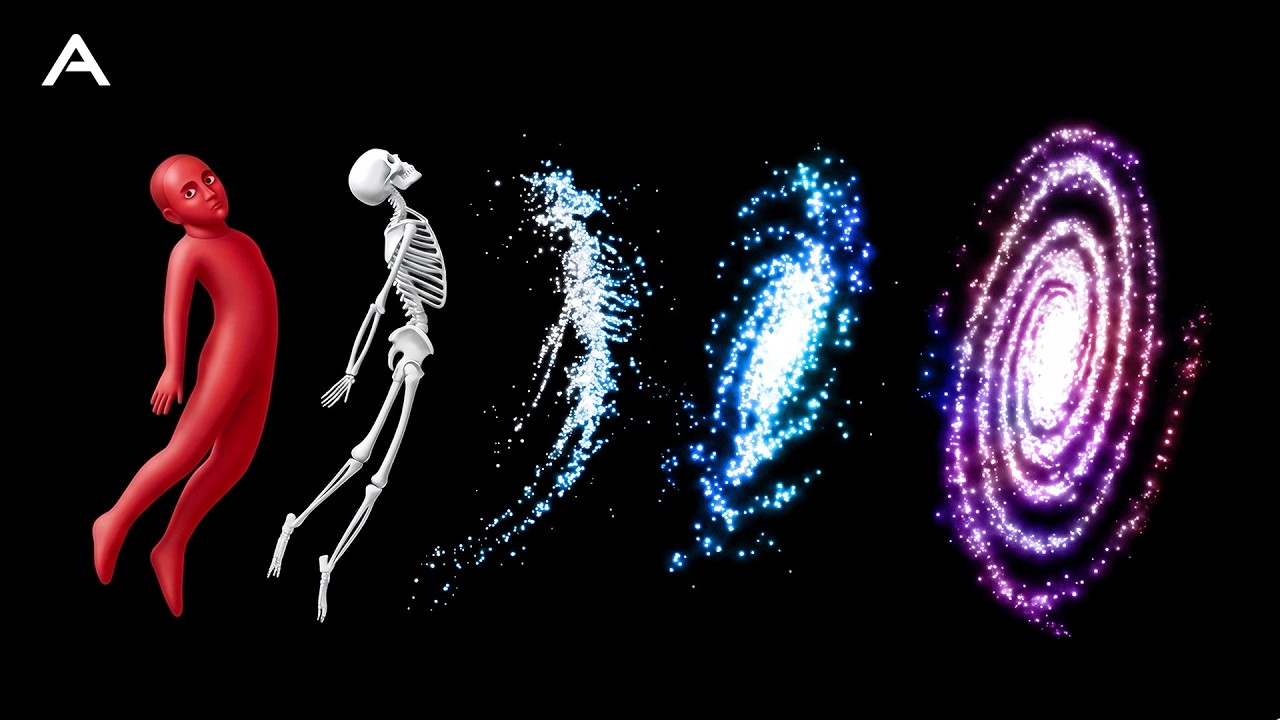
This is what Laplace's demon sees when it finally turns its gaze from the comets to the skull. Not a mystery, not a mind. Just more matter, configured exquisitely, folded into the most complex object we have ever found, but matter, obeying like everything has always obeyed. To predict your next thought the demon does not need to understand hope or fear or tea. It only needs the particles, and the particles have never once said no.
Case closed. The sky surrendered. The frog surrendered. The neuron surrendered. Freedom was a beautiful rumor and Newton had killed it two centuries early.
Except for one problem (27:04). Newton was wrong. Not about the planets, not about gravity, his equations still fly our spacecraft today, but about the deepest assumption beneath Laplace's demon: that matter, at bottom, runs on rails.
Part 4: quantum mechanics, and whether the dice set you free (28:33)
Twenty nine people, seventeen Nobel Prizes, one war
In the first decades of the twentieth century, physicists digging into the atom made the most shocking discovery in the history of science: the universe does not keep perfect appointments. At the deepest level we have ever reached, beneath the neuron, beneath the molecule, down where your brain dissolves into particles, the clockwork comes apart. Nature at bottom appears to roll dice.
The film sets the scene with the photograph. Twenty nine people are gathering outside a scientific institute. They look ordinary: dark coats, stiff collars, a few uncomfortable smiles. They are not ordinary. Seventeen of them have won or will win the Nobel Prize (29:02). Einstein sits front and center. Marie Curie is beside him. Behind them stand Bohr, Heisenberg, Schrödinger, Dirac, Pauli. Nearly every mind that built the modern picture of the atom, collected in a single frame. It is the 1927 Solvay Conference, probably the greatest concentration of genius ever captured in one photograph.
And they are in the middle of a war. Not over money or priority or fame. Over whether the universe at its foundation makes sense.
The half silvered mirror
The theory these people have just finished building works magnificently. It predicts the outcomes of experiments with accuracy no theory has ever approached. But it has a strange, scandalous hole in its heart, and you can see the hole in a device simple enough to sit on a desk.
Take a piece of glass, half mirrored, so that light has a 50/50 chance of passing through or reflecting away. That is a beam splitter. Now send photons at it, single particles of light, one at a time. Each photon reaches the glass, and each photon chooses. Through or back. Left or right.
Ask the deepest theory in science why this photon went left when the last one went right. Identical photons, identical glass, identical everything. And quantum mechanics gives an answer that would have made Newton physically ill (30:49):
There is no why.
At least none that standard quantum mechanics gives us. The theory predicts the probabilities with breathtaking precision, through the Born rule, but for the individual outcome, this photon, this moment, it offers no deeper cause. At 31:15 the film is precise about the claim: as far as the standard theory is concerned, the 50/50 is not merely our ignorance of hidden machinery. It is where prediction ends.
And this is not just philosophy. Machines built on quantum processes like these are already used to generate random numbers for cryptography, numbers designed to be fundamentally unpredictable according to everything the standard theory says.
Einstein hated it. Hated it with his whole soul. His protest became the most famous sentence in twentieth century physics (31:48):
God does not play dice with the universe.
For thirty years he hunted for the hidden clockwork beneath the randomness and never found it. Laplace's demon, meanwhile, quietly died.
Think about what this does to everything built in the previous two chapters. The demon's power rested on one promise: that the present fully contains the future. Measure everything now, compute everything later. But if no information in the present, accessible even in principle, uniquely determines which outcome comes next, the prophecy fails. Not because the demon is weak. Because the future, at the deepest level, is not fully written in the present. At 32:43: the demon, at least in its classical form, was dead. The chain of cause and effect that ran from the big bang through your genes into your next thought had a broken link.
You can imagine the relief, and it was not just newspapers and philosophers celebrating. Serious scientists, among them Nobel laureate Arthur Compton and the great astronomer Arthur Eddington, argued openly in the 1930s that quantum uncertainty had reopened the door to human freedom (33:06). The clockwork universe was dead. The future was loose. Surely, in the gap where causes used to be, the will could finally live.
It is one of the most seductive ideas of the modern age. Now watch it fall apart.
The dice throw you
The film takes the escape route completely seriously and follows it. Suppose your decisions really are wired to quantum events. Tonight, choosing between tea and coffee, imagine the deciding vote deep in your brain comes down to one genuinely random quantum flicker. Through or back, tea or coffee. The universe rolls. The dice land. Tea.
Here is the question that kills the celebration: in what sense was that your choice?
You did not cause the flicker. If the standard theory is right, nothing caused the flicker. It did not consult your values, your memories, your hopes. It did not consult anything. It was an accident. A perfect, pristine accident that happened to occur inside your skull. If your arm shot out and knocked over a stranger's cup because of a random neural spasm, no one on Earth would call that an act of free will. They would call it a twitch.
At 34:59: randomness does not give you the dice. It just means the dice throw you.
And the film has a lovely piece of equipment ready for the point. A Geiger counter sits beside a radioactive sample, clicking at genuinely unpredictable moments. The purest randomness known to nature, right there on the table. Nobody has ever suggested the Geiger counter has free will. Adding more clicks does not add more freedom. So why would a brain be different just because its randomness is wetter?
The two box trap
And now the trap closes. This is the philosophical core of the documentary, the thing the whole hour and a half was built around, and it is worth being precise about what is being trapped.
If free will means this, that in exactly the same physical universe, atom for atom, you could genuinely have chosen otherwise, then look at what has been done. The universe offers exactly two kinds of event, and both have now been examined.
- If an event is determined, locked in by prior causes, then it was fixed before you arrived and you could not have done otherwise.
- If an event is undetermined, genuinely random, then it came from nothing, answers to nothing, and it was not you doing the choosing.
At 36:22: determined or random, caused or uncaused. And neither box holds the third thing this kind of freedom demands: an action not fixed by the past, not produced by chance, yet still somehow authored by you. In four hundred years of looking, through telescopes, through microscopes, through equations of magnificent precision, physics has never found that third box (36:51).
Then the film does something that pays off spectacularly forty minutes later. It asks whether that third box must exist for freedom to mean anything, and it says: hold that thought, it returns at the very end of this story with a twist.
The honest footnote the film puts here, not at the end
There is a final irony in this chapter and the narration says honesty demands including it. Even the assumption just granted, that delicate quantum events directly steer decisions in the brain, is itself deeply controversial.
The brain is warm, wet, and relentlessly interacting with everything around it, conditions under which long lived quantum coherence is in general extraordinarily hard to maintain. And at the scale where neurons actually fire and networks actually compute, neuroscience has so far needed no quantum magic to explain what brains do.
A few serious thinkers push back. The Nobel laureate Roger Penrose, together with anesthesiologist Stuart Hameroff, has proposed a controversial model in which quantum processes inside structures called microtubules play a role in consciousness (37:49). It is known as orchestrated objective reduction. Most neuroscientists remain unconvinced. The question is not fully settled.
But notice, the film says, that it does not need to be. Even if some quantum event does influence a decision, the philosophical problem stands exactly where it stood. Replacing a determined cause with an unpredictable one does not create an author. At 38:32:
Dice, no matter where you hide them, do not add up to a self.
So the great quantum escape fails twice over. Probably too fragile to matter, and even if it matters, randomness was never freedom to begin with. The twentieth century's most shocking discovery broke Laplace's chain and offered nothing to put in its place. Determinism says your choices were inevitable. Quantum randomness says some of them were accidents. At 39:14: neither says they were yours.
And there the story might have ended, a clean and bleak verdict, if not for one assumption sitting so deep beneath everything that for fifty years almost nobody thought to say it out loud.
We have been assuming the dice are honest.
Part 5: the cosmic Bell test (40:39)
A photon that left home before the Earth
What if the randomness is a performance, and the outcomes were quietly coordinated long ago, behind the curtain, before any laboratory and before any Earth? It sounds like paranoia, and perhaps untestable. But physicists realized they could do something extraordinary. They could make the conspiracy work for its secrecy. If some hidden common cause was coordinating both the particles and the experimental choices, they could force that coordination backward. Not years, not centuries, but billions of years into the cosmic past.
To do it they needed an experiment whose crucial ingredient had begun its journey long before the Earth existed. So in a laboratory in Vienna, and then on a mountaintop, they reached across the observable cosmos and borrowed light from the edge of time.
Twelve billion years ago, before the Earth, before the sun, before a single grain of the dust that would one day become you, a particle of light left home. Its birthplace was a quasar, the blazing heart of a young galaxy where a supermassive black hole tears matter apart and lights it brighter than a trillion suns (41:23). The photon escaped that furnace and fell into the dark, and then it did the only thing light can do. It traveled.
While it traveled, the universe grew up around it. Galaxies collided and merged. Generations of stars were born, burned and detonated. A quiet yellow star ignited in an unremarkable spiral arm. Planets condensed around it. On the third one, oceans formed, life crawled out of them, and a species appeared that told stories about the sky. Empires rose. Newton wrote his law. Laplace imagined his demon. And still the photon traveled, twelve billion years without touching anything at all, until one night in January 2018, on a mountaintop in the Canary Islands, it fell into the mirror of a telescope built by a species that had not existed for 99.99 percent of its journey.
That photon was not caught for astronomy. It was caught to answer a question. Is the universe hiding a script?
John Bell finds a test for the untestable
To understand why anyone would ask, the film goes back to 1964 and to a soft spoken physicist from Belfast named John Stewart Bell (42:53). Bell worked at CERN designing particle accelerators. That was the day job. His obsession was the thing Einstein had gone to his grave unsatisfied about: whether quantum randomness was truly random, or whether hidden machinery, invisible instructions carried inside particles, decided every outcome in advance.
For decades that debate had been dismissed as philosophy. Untestable. Career poison. Bell found a test, and the narration gives the essence with no mathematics at all.
Quantum mechanics says you can create two particles, two photons say, bound together in a single state, then send them far apart. That is entanglement. Measure one here, one there, and the results are correlated. Ask why, and the common sense answer is the one Einstein favored: the particles left home carrying matching instructions, like a pair of gloves separated into two boxes and mailed across the world. Open one box, find a left glove, and you instantly know the other is a right. No mystery, no magic. The answers were written down at the start.
What Bell discovered, in a short paper published in an obscure journal that folded soon after, is that this common sense picture has a breaking point. He proved that if the particles carry locally pre written instructions, answers packed into each particle at the start, with no influence reaching between the distant measurements, then the correlations can only reach a certain strength. A hard mathematical ceiling. And quantum mechanics predicts that entangled particles smash through it. That is Bell's theorem, and the ceiling in its most used form is the CHSH inequality.
Suddenly philosophy had become an experiment. Prepare entangled pairs. Measure. Count. If the correlations stay under Bell's ceiling, Einstein was right and there is a local script. If they break it, no such script can exist.
The experiments began in 1972 and grew more airtight for fifty years, culminating in the loophole closing tests of 2015 and a Nobel Prize in 2022 (45:29). The verdict, repeated in laboratory after laboratory on every continent, is one of the most confirmed results in modern science. Again and again, the ceiling breaks (45:55).
The film is careful about what this does and does not mean. No message passes between the particles. You cannot use entanglement to send a signal, and nothing usable travels faster than light. But the gloves in boxes explanation, the ordinary local set of instructions Einstein hoped for, cannot explain what the experiments see. Whatever nature is doing, it is not that.
The assumption buried in the proof
Except. Buried in Bell's beautiful proof there is an assumption, so obvious and so seemingly innocent that it went almost unexamined for decades. Bell himself knew it was there and said so plainly (46:43):
The proof assumes the experimenters are free.
Every Bell test works like a cross examination. To catch the particles without a script you must question them unpredictably, choosing at random at the last instant which property to measure. The logic only holds if those choices are genuinely independent of the particles, if there is no connection between what the particles carry and which questions the physicists happen to ask.
But what if there is? Follow the thought, uncomfortable as it is. The measurement choices are made by machines and brains. Machines and brains are matter. You sat through part two, the narration says. You know this. And every piece of matter in that laboratory, the random number generators, the photons, the physicists, their breakfast, their childhoods, shares a common past. Rewind far enough and everything in the room descends from the same early universe. If some correlation planted in that shared past quietly links the particles' behavior to the choices that will one day be made about them, then Bell's ceiling means nothing. The particles are not beating a fair test. At 48:03: they know the questions in advance. This is the freedom of choice loophole.
Take that possibility all the way, that the particles and the choices of what to measure were never statistically independent, not once, anywhere in cosmic history, and you arrive at the territory physicists call superdeterminism. Not just that your tea versus coffee choice is caused, but that the very questions scientists ask of nature are correlated from the beginning of time with the things they ask about. At 48:37: the dice are not just determined, they are loaded, and so is the hand that rolls them.
Letting the universe choose
An idea like that is extraordinarily hard to test. But a team of physicists from Vienna and MIT realized you could do something remarkable. You could measure exactly how deep such a conspiracy would have to run.
Their reasoning was surgical. The choice of measurement must be made by something. Whatever makes it shares a causal past with the lab, unless you find a decision maker whose past barely overlaps with Earth at all. So do not let the choice be made on Earth. Let the universe make it.
That is why on the night of 11 January 2018, two telescopes on a Spanish mountaintop, the William Herschel Telescope and the Telescopio Nazionale Galileo on La Palma, were aimed at two quasars on opposite sides of the sky. One whose light had traveled 7.8 billion years, and the other, the photon whose journey opened this chapter, 12.2 billion (49:37).
Between the two measurement stations a source generated pairs of entangled photons. And here is the beautiful, audacious mechanism: for every single pair, the measured color of the quasar light arriving at that instant, slightly redder or slightly bluer, dictated which measurement each detector performed. Within microseconds of hitting the mirror, ancient light was deciding the questions.
Think about what that means. The free choice in this experiment was delegated to the measured colors of photons whose journeys had begun billions of years before the experimenters existed, before the Earth, before the sun, before the Milky Way looked anything like it does tonight. If something coordinated these choices with these particles, it did not happen in the lab, or in the physicists' brains, or anywhere in the recent past.
The detectors counted. The film gives roughly 17,000 entangled pairs in one run and 30,000 in another (50:53). The published paper, Rauch and colleagues in Physical Review Letters 121, 080403, reports 17,663 pairs in the first run and 12,420 in the second, more than thirty thousand across the two, with Bell violations of 9.3 and 11.6 standard deviations. The lead authors include Anton Zeilinger, who would take the 2022 Nobel, along with David Kaiser and Alan Guth at MIT.
The ceiling broke again. The correlations held at full quantum strength, which forces any hidden coordination back and back and back.
Then the team did the accounting, and this is the number that makes the experiment famous. For a local conspiracy of this kind to explain their data, it would have to have been arranged at least 7.8 billion years ago, excluding such an explanation from roughly 96 percent of the spacetime volume of the experiment's own causal past (51:22).
In plain language, any conspiracy exploiting this loophole would have to reach unimaginably deep into cosmic history, committing to its rigging before half of cosmic time had passed, storing the script in the light of quasars, waiting for a species to evolve, build telescopes and ask. For most physicists that settles it (52:03). A conspiracy that patient, that vast, that flawless is not an explanation. It is a horror story. They move on.
The minority who do not move on
But not all of them. Gerard 't Hooft, Nobel laureate and one of the architects of modern particle physics, takes superdeterminism seriously and has spent years building models of a fully deterministic layer beneath quantum mechanics, published as The Cellular Automaton Interpretation of Quantum Mechanics (52:16). The physicist Sabine Hossenfelder has argued publicly, in Rethinking Superdeterminism with Tim Palmer, that the idea is unfairly dismissed (52:32). They are a small minority, and the film says so plainly.
But here is what should give you pause. The broad loophole they point to cannot be closed simply by finding a more distant, more ancient, more ingenious source of randomness, because every experiment designed to test nature must choose what to measure, and superdeterminism questions the independence of that choice itself. Moving the choice farther away, even to the edge of the observable universe, does not by itself escape that circle.
And that exposes something almost never said aloud. Science itself runs on the assumption the film has been questioning for four chapters. At 53:26: every experiment ever performed assumed the experimenter could have asked differently. If the strongest version of superdeterminism were true, the unsettling possibility is not merely that our theories are incomplete. It is that the universe fed us our own answers.
Most physicists refuse to walk through that door, and the film adds, without sarcasm, that they may well be right to refuse.
So let us grant it, the narration says. Set the conspiracy aside. Assume the dice are honest, the choices independent, the cosmos innocent. Because Einstein, who started this whole war over the dice, left behind a second and entirely separate challenge to your freedom, one that has nothing to do with quantum mechanics. No entanglement, no hidden scripts. It needs only the speed of light and the geometry of space and time, the most tested and least disputed physics we own.
Part 6: the block universe (55:15)
The belief you never thought to say out loud
There is a belief you hold so deeply that you have never once thought to say it. You believe in now.
Right now, as you watch this, you feel that a single universal present moment is unfolding everywhere. Right now, somewhere in the Andromeda galaxy, something is happening. You cannot see it, Andromeda's light takes two and a half million years to reach us, but surely at this very instant something is happening there (55:39). The universe, you assume, is a vast stage where one moment, this one, is briefly and blazingly real. The past is gone. The future does not exist yet. Reality is the thin glowing edge in between, sweeping forward like the tip of a pen across a page.
Every decision you have ever made rests on that picture. Choosing feels like standing at the pen's tip, at the exact place where the unwritten becomes written.
In 1905 a young patent clerk quietly took that picture away.
Einstein's reasoning began with a single measured fact: light always travels at the same speed for every observer, no matter how they move. It sounds harmless. It is not. Follow it carefully, as he did in the 1905 papers, and something extraordinary falls out of the mathematics. Observers moving differently through the universe cannot agree on what is happening now.
For two events separated so widely that no signal, not even light, could travel between them in time, different observers can disagree about which happened first, or whether they happened together. And here is the crucial part: none of them is wrong. There is no master clock hiding behind the universe, no cosmic control room where the true now is kept. Each observer's now is sliced at a slightly different angle through reality, and every slice is equally legitimate physics. This is the relativity of simultaneity.
For events close together the disagreement is trivial. Nanoseconds. Stretch the distance and the slices begin to swing wide.
The stranger on a bicycle
Which brings us to the stranger and the bicycle (57:58). Picture someone, or something, in the Andromeda galaxy, two and a half million light years away. It does not need advanced technology for what it is about to do to you. It needs a bicycle.
When it sits still, its now slice through the universe crosses Earth on a particular day. Say your today. But when it pedals gently in Earth's direction, at nothing more than cycling speed, its slice of what is happening now on Earth tilts. And because the lever arm is two and a half million light years long, that tiny tilt sweeps across weeks of Earth's timeline (58:32). Pedal away from Earth and the slice swings weeks into what you call your past. Pedal toward Earth and it swings weeks into what you call your future.
The film is precise about what this is not. The cyclist cannot see that future, cannot know it, touch it, or send a single bit of information back from it. This is not time travel, and no telescope in Andromeda will ever show them next week's Earth. It is something quieter and stranger: a disagreement permitted by the laws of physics about which distant events count as happening now.
And yet the quiet version is unsettling enough, because depending on which way that cyclist happens to be rolling, its perfectly valid now includes a version of you from last month, or a version of you dated next week, on the far side of the decision you are currently agonizing over.
Penrose sharpens it into a knife
Roger Penrose, the same Penrose from part four, sharpened this into one of the most unsettling thought experiments in relativity (59:52). It is usually called the Andromeda paradox, or the Rietdijk and Putnam argument.
Imagine an alien civilization in Andromeda debating whether to launch a fleet toward Earth. Two people walk past each other on an ordinary street, one strolling toward Andromeda, one away. Because of their motion, their equally valid now slices differ, out at that distance, by days. For one walker the alien council has not yet decided. For the other the decision is made and the fleet is already in flight. Two humans passing on a sidewalk, and relativity refuses to say which of them is right, because within the physics both are.
Now run the argument, because you can feel where it is pointing. If someone's perfectly legitimate now already contains the aliens' decision, in what sense was that decision still open? And the aliens are not special. Swap the roles. Out there at cosmic distances, ordinary observers moving at ordinary speeds have valid now slices that pass through your next week, your next year.
Follow that reasoning to its end and you arrive at one of the most powerful ways of interpreting relativity, a picture physicists call the block universe.
Take every event that has ever happened or ever will, every star's birth, every raindrop, every human choice, and lay them out in four dimensions. Three of space, one of time. In this picture, that entire block is the real object. Your life is not a dot moving along a line. It is the whole line, a strand woven through spacetime, from cradle to grave, all of it equally present in the geometry. The choice you will make next Tuesday sits at its coordinates the way Neptune sat at its coordinates before any telescope looked.
And what you call now appears nowhere in the equations. At 1:02:19: it is not a place in physics. It is a feeling. Something brains do. A spotlight your consciousness carries, not a property the universe has.
Einstein himself was deeply sympathetic to this view. When his oldest friend Michele Besso died months before his own death, Einstein wrote to the grieving family (1:02:50):
For those of us who believe in physics, the distinction between past, present and future is only a stubbornly persistent illusion.
If the past still exists back there and the future already exists up ahead, then your choices do not create anything new. At 1:03:04: the pen is not writing the page. The page was never blank. You do not make decisions. You encounter them, one by one, in the order your consciousness moves along your strand, each one feeling perfectly fresh, perfectly open, at the moment you reach it.
A hard, honest pause
And then the film does something documentaries almost never do. It stops and refuses to overclaim, in the middle of its own strongest chapter.
What you have just heard, the narration says, is an argument, not a measurement. The relativity is rock solid. The slicing of now genuinely is observer dependent, that has been tested beyond reasonable doubt, and no physicist disputes it. The contested move is the step from "the slices disagree" to "therefore the future is already fixed."
Philosophers and physicists have pushed back for a century. Some argue that simultaneity across millions of light years, where no signal can connect the events, is partly a bookkeeping convention rather than a fact about what exists. Others defend pictures where the past is real but the future genuinely is not, a block still under construction, growing at its edge. And whether quantum mechanics, with its unresolved randomness, breaks the frozen block or fits neatly inside it is exactly the kind of question that keeps physicists arguing at three in the morning. The whole debate has its own encyclopedia entry.
So no. Relativity has not proven that your future exists.
But notice what it has done, because this is the part that survives every objection. It has removed the support. That intuitive picture you have carried your whole life, the moving edge of now, the open future condensing into fact at the moment of choice, appears nowhere in the physics. Nothing in the equations flows. Nothing in the mathematics marks tonight as the present. The equations simply do not draw the boundary you feel so vividly, the line between a settled past and an open future. If that openness is real, it is invisible to the most precisely confirmed theory of space and time we have ever possessed. At 1:05:41:
The openness of your future is not something physics shows us. It is something we keep insisting on from the inside.
And that phrase, from the inside, is where the investigation must finally go. Four chapters have been spent outside, among comets and equations, photons and quasars, geometry and light, and none of those witnesses has given us the freedom we went looking for. Now there is only one witness left: the room where the feeling of choosing actually lives.
Part 7: your brain decides before you do (1:07:16)
Two frustrated men in a Freiburg cafe
While physicists were interrogating the cosmos, another group of scientists went looking for free will in the one place everyone assumed it was safe: inside the human skull, in the warm dark where you decide. They wired brains with electrodes. They watched decisions being born. And they found something that neither Newton nor Einstein nor the quantum pioneers ever predicted. They found that by the time you feel yourself choose, your brain may have already begun.
Freiburg, Germany, 1964 (1:07:24). Two young neuroscientists, Hans Helmut Kornhuber and Lüder Deecke, are sitting in a cafe, frustrated. The great questions about the brain, will, intention, the origin of action, are considered untouchable. Unmeasurable. Philosophy's territory, not science's.
Over coffee they decide to try anyway, with the crude tools of their time. They will record the brain's electrical whisper, through electrodes on the scalp, at the exact moment a person freely decides to move.
The signal they are hunting is buried in noise a thousand times louder. So they do something clever (1:08:07). They ask volunteers to flex a finger again and again, thousands of times, whenever the urge strikes. Then they align all those recordings at the instant of movement, stack them, and average, letting the random noise cancel itself out.
What emerges from the noise is a slow rising electrical wave in the brain. It begins almost a full second before the movement. They name it the Bereitschaftspotential, the readiness potential (1:08:41), and publish it in 1965.
And at first it seems merely interesting. Of course the brain prepares before acting. Preparation takes time. Nobody yet sees the trap coiled inside the discovery.
Libet puts a clock on the will
It takes almost twenty years and one American physiologist to spring it. Benjamin Libet's question sounds innocent. The brain's preparation begins about a second before the movement. Fine. But where in that second is the decision? Where is the moment you would swear is the origin of the whole thing, the moment you choose?
Everyone knows the obvious answer. First you decide, then the brain prepares, then the finger moves. Conscious will starts the chain. That is what it means to be the author of your actions. So Libet built an experiment to timestamp the will itself.
San Francisco, 1983. A volunteer sits watching a dot sweep around a clock face like a fast second hand. The instructions are simple: whenever you feel like it, entirely up to you, flick your wrist, and note precisely where the dot was at the moment you first felt the urge to move. Electrodes on the scalp capture the readiness potential. The clock captures the feeling. For the first time in history the brain's preparation and the experience of deciding can be laid on the same timeline. The paper ran in Brain in 1983.
Here is what the timeline showed (1:10:22). The readiness potential began rising roughly 550 milliseconds before the movement. The reported feeling of deciding arrived at roughly 200 milliseconds before the movement.
Look at the order. The brain's preparation was already underway, about a third of a second underway, before the moment the volunteers experienced as the birth of their decision. At 1:10:53: the feeling you would stake your life on, "I just decided to move", showed up late. Not at the start of the chain. Partway down it.
Libet himself was shaken. He spent the rest of his career wrestling with his own result. And when the finding detonated through science and philosophy, the headline version traveled around the world (1:11:13): the brain decides before you do. Free will is dead by electrode.
But this documentary has earned the right to be more careful than the headlines, the narration says. So let us see how far the evidence actually goes. And it goes far enough to be deeply uncomfortable without any exaggeration at all.
The effect got bigger
First, the effect did not go away. It got bigger.
In 2008 a team led by John Dylan Haynes in Berlin put volunteers in an fMRI scanner with a button in each hand (1:11:44). Press left or right whenever you wish. Reading patterns of activity in the frontal and parietal cortex, their computers could predict which button a person would press seconds before the person reported deciding. In some analyses the predictive information appeared as much as seven to ten seconds early (1:12:10). The paper ran in Nature Neuroscience.
And here, the film says, the honest number matters more than the dramatic one. The predictions ran around 60 percent accurate. Not 90. Not perfect prophecy. At 1:12:29: a loaded coin, not a script.
But pause on what even that means. Ten seconds before you experience the pristine, weightless feeling of freely choosing left, a machine reading your cortex already had information, weak, imperfect, but real, quietly tilting the odds toward the answer you would eventually give. Whatever conscious choice is, its story seems to begin earlier than the moment you become aware of it.
The press office
And there is a second line of evidence, stranger and in its way more unsettling, about what that feeling of deciding actually is.
Some patients with severe epilepsy once underwent a radical surgery severing the corpus callosum, the great cable connecting the brain's two hemispheres (1:13:17). The seizures stopped. The patients lived normal lives. But in the laboratory, neuroscientist Michael Gazzaniga could now do something impossible in an ordinary brain: show information to one hemisphere and hide it from the other. The split brain work began with Roger Sperry, who took a Nobel for it.
The speaking half of the brain, almost always the left, could be kept entirely in the dark about why the right half had just made the body act.
In one famous session, a patient's right hemisphere was shown a snow scene, and his left hand, which the right hemisphere controls, correctly picked a shovel from a set of objects (1:13:55). His left hemisphere, the talking one, had seen only a chicken's claw. Asked why the shovel, the speaking brain did not hesitate, and it did not say "I don't know." It said:
The shovel is for cleaning out the chicken shed.
A fluent, confident, instant explanation, and a complete fabrication. The talking mind had no access to the real cause of the action, so it wrote a story in which it did, and crucially, it believed the story. Gazzaniga called this left hemisphere system the interpreter, and its existence reveals something unsettling: the human brain is capable of generating a sincere, seamless feeling of "this action was mine, done for my reasons" after the fact, about actions it did not consciously originate. It is confabulation, and it feels from the inside exactly like knowing.
At 1:15:07: the feeling of willing, at least sometimes, is not the engine. It is the press office.
The counterattack
Now the counterattack, because this is a live scientific battlefield and, the narration says, you deserve to see both armies.
Libet's own defence. Libet never accepted the death of freedom. He pointed out that in his window between brain preparation and action there was still time, perhaps 150 milliseconds, for consciousness to veto the movement. We may not initiate freely, he argued, but we can cancel freely. At 1:15:45: not free will, but free won't.
The timing objection. Others attacked the experiment's foundations. Reporting the position of a moving dot at the instant of an inner feeling is exactly the kind of timing judgment brains are bad at.
The accumulator model. And in 2012 the neuroscientist Aaron Schurger offered the deepest challenge of all (1:16:00). Perhaps the readiness potential is not a decision signal at all. Neural activity constantly drifts and fluctuates like weather. Perhaps the brain simply acts when background activity happens to crest past a threshold, and Libet's method, averaging thousands of trials aligned to the movement, could produce the appearance of a smooth rising wave out of those fluctuations. The paper ran in PNAS. On Schurger's reading, at 1:16:40, the famous ramp is not the brain deciding early. It is just the tide coming in.
The scale objection. And beyond all that stands the largest objection. Flicking a wrist is not choosing a career, a partner, a life. No electrode has ever timestamped a decision that took years of deliberation. At 1:17:01: the lab has only ever caught the smallest fish.
So be honest about the scoreboard, the film says. Neuroscience has not proven that your brain settles everything before you are aware of it. The experiments are contested. The interpretations are at war. The field is genuinely unresolved.
What every version of the debate leaves untouched
But now stand back, all the way back, and notice something that every version of this debate leaves alone.
Libet's readiness potential is a brain process. The veto he proposed, another brain process. Schurger's drifting fluctuations, brain processes. The interpreter spinning its stories. The slow deliberation that unfolds over years. All of it happens inside the physical machinery we met in part three, built by genes and history that no one chose.
In seventy years of watching decisions being born, through electrodes, scanners and split brains, neuroscience has found competitions, thresholds, cascades, memories, predictions and narrators. What it has not found is a boundary. A place where physical causation stops and an independent author steps in from somewhere outside the chain.
Inside the skull, the chain continues.
And with that the investigation is complete. Five chapters of testimony: the equations that found Neptune, the dice that answer to nothing, the quasar light that pushed the conspiracy loophole billions of years into the past, the geometry that will not draw a line between your settled past and your open future, and now the electrodes catching the feeling of choosing arriving late to its own event.
The verdict writes itself. Case closed, for real this time.
Except for one thing. One fact quietly ignored since the very first chapter, sitting in plain sight underneath every equation and every experiment. A fact about what it would actually take to compute you.
Part 8: the demon's blind spot (1:20:00)
A king, a prize, and a mistake worth more than the prize money
The king of Sweden announces a prize (1:20:23). Oscar II, a monarch with a genuine love of mathematics, will reward the greatest unsolved problem of the age. And the problem he chooses is the oldest one in this documentary: the clockwork sky itself.
Newton's equations can handle two bodies, a planet and its star, with perfect elegance. But add just one more. Three bodies pulling on each other all at once, and the mathematics becomes a nightmare no one has ever tamed. The king's challenge: prove the solar system is stable. Prove the clockwork runs forever.
The greatest mathematician alive takes the bait. Henri Poincaré works for years, submits a brilliant manuscript, and wins the prize (1:21:07). The memoir goes to press. And then, while checking a final detail, Poincaré finds a mistake in his own work (1:21:20). Not a small one. A crack that opens onto an abyss.
He telegraphs the printers in a panic. Nearly every copy is recalled and destroyed, and Poincaré pays the printing costs himself, more than the prize money, to bury the error. What he publishes instead, after months of feverish repair, is not the proof the king asked for. It is the discovery that the proof is impossible.
Poincaré found that in the three body problem there are configurations where the tiniest change in the starting positions, a difference too small to measure, too small to name, grows and grows and keeps growing, relentlessly, exponentially, until two systems that began almost identically are doing completely different things.
The equations remain perfectly deterministic. Nothing rolls dice. And yet forecasting collapses, because any uncertainty in the present, however microscopic, eventually swallows the future whole.
We now call this chaos, and in the twentieth century it turned up everywhere we looked: in weather, where it sets the hard horizon on every forecast; in rivers, in heartbeats, in dripping taps.
And, in the great irony of the story, in the sky itself. Modern computations show the orbits of the planets are chaotic on long time scales. Push the clock a few hundred million years forward and the tiny uncertainties in today's best measurements swell until the planets' positions become uncomputable in practice. Simulations even find a small but real chance that Mercury's orbit unravels over the coming billions of years (1:23:33). (Laskar and Gastineau's 2009 paper in Nature ran 2,501 solutions over five billion years and found about a one percent chance of Mercury's eccentricity climbing high enough for a collision with Venus or the Sun. The Lyapunov time of the inner solar system is roughly five million years.)
Read that again slowly. The clockwork sky, the very machine that taught Laplace to believe in his demon, lies beyond the reach of any forecast we could ever actually make.
Determinism is not predictability
The film is careful here, and it is the most useful distinction in the whole hour and a half. Understand precisely what chaos revealed, because it is subtler and more interesting than a dead demon.
Laplace's demon, as defined, with perfect knowledge exact to infinitely many decimal places, could still in principle run its prophecy. Chaos does not touch the fantasy.
What chaos destroyed was something else: the assumption that determinism and predictability are the same thing. They are not. A universe can obey exact laws top to bottom while remaining forever out of reach of any observer who knows its state only approximately, and approximately is the only way anything real has ever known anything.
And our universe raises the bar further still, because it is not classical. Quantum mechanics, as we saw in part four, places fundamental limits on what can even be jointly specified in the way Laplace imagined. Whatever demon you try to rebuild for the real world has to survive quantum theory too.
The demon has to be made of something
And the demon's troubles may run deeper than measurement, because think about what the demon actually is. To be more than a fantasy, it must exist physically, somewhere, made of matter, inside the universe it wants to predict.
Now the arguments turn strange and beautiful.
The map and the territory. A simulation of the universe in perfect detail must store the state of every particle in memory built from particles. At 1:25:47: the map presses up against the size of the territory.
The hall of mirrors. Stranger still, prediction changes character when the thing being predicted can hear the prediction. The announcement itself becomes a new physical event, a fresh cause feeding back into the very future it describes. A demon working from inside reality would have to include in its calculation itself, its prediction, and your reaction to receiving it. At 1:26:21, a hall of mirrors that has fascinated logicians and physicists for a century. (It is a cousin of the halting problem, which is why the film reaches for logicians and not only physicists.)
No shortcut. And there may be a final limit, quieter than all the others. Some systems seem to offer no shortcut between their present and their future. No compressed formula, no skipping ahead. To learn what they will do, you must let them run. The idea is sometimes called computational irreducibility, and it comes out of Stephen Wolfram's work on cellular automata. Whether the human brain is such a system, no one has proven. But if it is, then at 1:26:59:
The shortest computation of you is you.
Determination is not foreknowledge
Let that reframe everything, carefully and honestly.
For six chapters, "your choices are determined" quietly felt like "your choices are already known". Somewhere the answer sheet exists and you are just the last to see it. But look closely. That never followed. A future can flow completely from the past without existing anywhere as a finished prediction. Without a cosmic ledger. Without an answer sheet. Without a single mind or machine in all of reality holding a copy of your next thought.
At 1:27:45: determination is not the same as foreknowledge.
And if there truly is no shortcut through the storm behind your forehead, then your deliberation is not theater performed over a result computed elsewhere. Your deliberation may be the computation itself (1:28:02).
The third box, reopened
And this is the moment to reopen the question left hanging in part four. Remember the trap. Determined is not free. Random is not free. And physics offers no third box. The film asked quietly whether freedom actually needs one, and here at the end is the case that it does not.
Ask what you truly wanted free will to mean. Did you want your choices to come from nowhere, uncaused, unconnected to everything you are? Look closely at that wish. A choice untouched by your memories, your values, your loves, your scars would not feel like freedom. At 1:28:57:
It would feel like possession.
What you actually want, what you have always wanted, is for your choices to come from you. From your reasons, your history, your character, weighing a future only you can weigh. And that determinism never took away.
The causal chain does not bypass you. It runs through you. It does not puppet your deliberation. At 1:29:29: your deliberation is one of its working parts. A real cause with real effects, as legitimate as gravity. When you chose tea, the choosing was not fake. A competition of values and memories genuinely happened, and its winner genuinely moved your hand.
At 1:29:55: you are not a passenger inside the machine watching. You are a segment of the machine. The segment that remembers, imagines futures, compares them, and cares about the difference.
Philosophers call this view compatibilism: freedom as self governance rather than self creation (1:30:06). And it stands today as one of the dominant positions in contemporary philosophy. At 1:30:18: not a consolation prize. A redefinition of what the prize always was.
| The question | The freedom of folklore | The freedom the film says survives |
|---|---|---|
| What it claims | In an atom for atom identical universe, you could genuinely have done otherwise. | The decision could not have happened without your memories, your reasons, your deliberation. |
| Where it lives in physics | The third box. Not fixed by the past, not produced by chance, still authored by you. | Inside the causal chain, as one of its working parts. No exemption needed. |
| What physics found | no clear trace, and much of the evidence pushes hard against it | untouched by anything in the previous seven chapters |
| Determinism | Kills it. If the chain is fixed, you never had an alternative. | Does not touch it. The chain runs through your deliberation rather than around it. |
| Quantum randomness | Does not rescue it. A random flicker is not an author. | Does not threaten it either. It was never the point. |
| The block universe | If next Tuesday already sits at its coordinates, nothing is open. | Your strand through spacetime still passes through the deliberation. It is where the choosing happens. |
| Libet and Haynes | Fatal, if the feeling of willing is supposed to be the uncaused start of the chain. | Survivable. Preparation before awareness is still your brain preparing, on your history. |
| What it would feel like | A choice from nowhere, unconnected to your values. The film's word for it: possession. | A choice that came out of who you are. The film's phrase: self governance rather than self creation. |
| Responsibility | Cosmic bookkeeping. Desert, earned from outside the chain. | One of the causes that shapes what brains do next. Praise and blame work because brains respond to reasons. |
What it does to how we judge each other
Does it change how we judge each other? It should, a little. A person's cruelty has causes. So does their kindness. And no one anywhere assembled their own starting conditions. Understanding that should make us slower to hate, the way we do not hate an avalanche (1:30:46).
But notice, the film adds immediately, that we still build barriers against avalanches. And human brains, unlike avalanches, are precisely the kind of machinery that responds to reasons, to consequences, to praise, to being held to account. At 1:31:06: responsibility survives, not as cosmic bookkeeping, but as one of the causes that shapes what brains do next.
So after the comets and the frog, the dice and the quasars, the geometry and the electrodes, where does the verdict land? Honestly, like this.
The freedom of folklore, the ghost outside the chain, the self that could have done otherwise in an atom for atom identical universe: physics has found no clear trace of it, and much of what we have seen pushes hard against it.
But the freedom that matters, a decision that cannot happen without your memories, your reasons, your deliberation, a future that flows through your thinking rather than around it, that one is untouched. At 1:32:10: better than untouched. It may turn out to be the only kind that was ever on offer, and the only kind you ever actually needed.
Epilogue (1:32:17)
One more thing, the last one.
13.8 billion years ago, everything there is erupted from a beginning we still do not understand. Hydrogen cooled and gathered. Stars ignited, forged carbon and iron, and died to scatter them. A yellow sun caught fire. A wet rock cooled. Chemistry learned to copy itself, and copies that sensed the world outlived copies that did not. Until, on one branch of one lineage, matter folded into an object complex enough to look up.
And tonight, that object, a temporary arrangement of stardust wired by a history it never chose, sat in the dark and asked whether it is free.
If everything in this documentary is right, then that question was inevitable. Your watching was inevitable. This wonder you are feeling right now, inevitable. All of it seeded in the initial conditions of the cosmos before the first star burned.
The universe did not just make your choices. Using you, your eyes, your storm of neurons, this very night, at 1:33:38: the universe chose to ask whether it is free.
And perhaps there is no shortcut to what happens next. No demon standing outside the universe with the answer already in hand. No finished copy waiting for you to catch up. The decision happens here, through the only process in existence that has your memories, your reasons, your fears, your hopes.
The last line of the film, at 1:34:04:
So go on, decide something. Whatever it turns out to be, in the entire history of the universe, you will be the first to know.
Best quotes
It would be a memory. (1:16, on what the future looks like to Laplace's demon)
The sky answers to no one. (5:35, on what every human being knew for most of history)
Give me the present and I will hand you the future. (7:47, on the promise in Newton's law)
I had no need of that hypothesis. (12:39, Laplace to Napoleon)
The universe had stopped merely obeying our equations. It was taking orders from them. (11:20, on the night Neptune was found where a letter said it would be)
Ancient kings begged the sky for mercy. We send it instructions. (11:38, on Voyager)
The storm in your skull is not a different kind of storm. It's the same fire as the sky, folded small. (22:56)
No known exemption. No border at the skull. (23:32, the result of two centuries of looking for a special force that switches on when matter thinks)
The you that feels like it's deciding arrives at the end of the process, not the beginning. (26:02)
There is no why. (30:49, what quantum mechanics answers when you ask why this photon went left)
God does not play dice with the universe. (31:48, Einstein)
Randomness doesn't give you the dice. It just means the dice throw you. (34:59)
Determined or random, caused or uncaused. (36:22, the two boxes)
Dice, no matter where you hide them, do not add up to a self. (38:32)
Neither says they were yours. (39:14, on determinism and quantum randomness)
The proof assumes the experimenters are free. (46:43, on the assumption Bell himself flagged)
They know the questions in advance. (48:03, the freedom of choice loophole in one line)
The dice aren't just determined, they're loaded, and so is the hand that rolls them. (48:37, superdeterminism)
A conspiracy that patient, that vast, that flawless is not an explanation. It's a horror story. (52:03)
Every experiment ever performed assumed the experimenter could have asked differently. (53:26)
It is not a place in physics. It is a feeling. Something brains do. A spotlight your consciousness carries, not a property the universe has. (1:02:19, on now)
For those of us who believe in physics, the distinction between past, present, and future is only a stubbornly persistent illusion. (1:02:50, Einstein to the Besso family)
The pen isn't writing the page. The page was never blank. (1:03:04)
The openness of your future is not something physics shows us. It is something we keep insisting on from the inside. (1:05:41)
The feeling you would stake your life on, "I just decided to move", showed up late. (1:10:53)
A loaded coin, not a script. (1:12:29, on the 60 percent accuracy in the Haynes fMRI study)
The feeling of willing, at least sometimes, is not the engine. It's the press office. (1:15:07, on Gazzaniga's interpreter)
Not free will, but free won't. (1:15:45, Libet's veto)
It's just the tide coming in. (1:16:40, Schurger's reading of the readiness potential)
The lab has only ever caught the smallest fish. (1:17:01)
The map presses up against the size of the territory. (1:25:47)
The shortest computation of you is you. (1:26:59)
Determination is not the same as foreknowledge. (1:27:45)
It would feel like possession. (1:28:57, on a choice untouched by your memories, values and scars)
You are not a passenger inside the machine watching. You are a segment of the machine. The segment that remembers, imagines futures, compares them, and cares about the difference. (1:29:55)
Not a consolation prize. A redefinition of what the prize always was. (1:30:18, on compatibilism)
Understanding that should make us slower to hate, the way we don't hate an avalanche. But notice we still build barriers against avalanches. (1:30:46)
The universe chose to ask whether it is free. (1:33:38)
So go on, decide something. Whatever it turns out to be, in the entire history of the universe, you will be the first to know. (1:34:04, the last line)
Where it stands
The documentary is unusually careful for the genre, and it earns most of its conclusions. But the hour and a half mixes three different kinds of claim, and it is worth separating them, because the film does not always flag the seam.
Things that are settled physics. Newton's law and its predictive record. The measured speed of nerve conduction. The four fundamental interactions, and the absence of any fifth one that switches on inside a skull. The relativity of simultaneity and its observer dependence. Bell inequality violations, confirmed for fifty years, loophole closed in 2015, Nobel in 2022. The cosmic Bell test result and its 7.8 billion year figure. Chaos and the distinction between determinism and predictability. None of this is contested by anyone in the field, and the film reports it accurately.
Things that are live science. Whether the readiness potential is a decision signal or an artifact of trial averaging is a genuinely open fight, and the film gives Schurger his due at 1:16:00 rather than burying him. The Haynes 60 percent number is stated honestly and is the single most responsible thing in that chapter, since almost every popular retelling of that study drops it. Whether quantum effects matter at all for cognition is unresolved and leans strongly against Penrose and Hameroff, which the film says. Superdeterminism is a real minority position held by real physicists, and describing t Hooft and Hossenfelder as a small minority is the correct characterization.
Things that are philosophy wearing a lab coat. The block universe is the big one, and to the film's credit it stops and says so at 1:05:00: relativity has not proven the future exists, the contested move is from "the slices disagree" to "the future is fixed", and growing block and presentist pictures are still defended. That pause is the best two minutes in the documentary. The two box trap is likewise a philosophical argument, not a measurement, and a libertarian about free will would say the whole framing begs the question: agent causation was never supposed to be a third type of physical event, so "physics never found it in either box" does not refute it so much as decline to look for it in the right place.
A caveat the film skips: interpretation dependence. Part 4 says that as far as the standard theory is concerned, the 50/50 at the beam splitter is where prediction ends. That is accurate for textbook quantum mechanics, but there are fully worked interpretations in which the underlying dynamics is deterministic, Bohmian mechanics and Many Worlds among them. In those pictures the "dice" chapter dissolves and the argument collapses back to pure determinism, which the film treats as the harder case anyway, so the conclusion does not change. But "nature at bottom rolls dice" is a claim about one interpretation, not a measured fact, and the film states it more flatly than it should.
Two numbers worth correcting. The film gives the cosmic Bell test as roughly 17,000 pairs in one run and 30,000 in another. The paper reports 17,663 pairs in the first run and 12,420 in the second, a bit over thirty thousand across both, with violations of 9.3 and 11.6 standard deviations. And the Solvay photograph is usually described as seventeen of the twenty nine attendees being Nobel laureates, which is right, though the count depends on whether you include Marie Curie's two prizes as one person or two.
Where compatibilists would push back on the film's own rescue. This is the interesting one, and it is where this documentary genuinely diverges from other treatments on this site. The film's escape route runs through unpredictability: chaos, the map and the territory, the self referential demon, and above all computational irreducibility. Its punchline is that your deliberation may be the computation itself, so no answer sheet exists anywhere. That is genuinely lovely, and it is also load bearing in a way that should make a compatibilist nervous, because it makes the value of your freedom contingent on an unproven computer science conjecture about brains. If it turned out tomorrow that a brain is compressible, that some machine could print your next thought a second early, the film's rhetoric would seem to hand the freedom back.
Compare Sean Carroll's version of the same landing, talking to Brian Greene on this site. Carroll does not need irreducibility at all. His move is that free will lives at a higher level of description, that levels relate by consistency and never by intervention, and that the sentence "I cannot intervene to change what the particles are doing" is a grammatical mistake, because the "I" is not a thing at the particle level to begin with. On that account a perfectly predictive demon would change nothing: predictability was never what freedom was about. The documentary and Carroll agree on the destination, compatibilism, and disagree about the road. The documentary's road is more emotionally satisfying. Carroll's is sturdier, because it does not depend on a fact about computation that nobody has proven.
And where hard incompatibilists would reject the landing entirely. Derk Pereboom and, more loudly, Robert Sapolsky in Determined, argue that the compatibilist redefinition changes the subject: what people mean by free will is precisely the thing the film says physics never found, and calling self governance "freedom" is a relabeling that quietly preserves practices of blame it should be dismantling. The film's paragraph on responsibility, that we do not hate avalanches but we still build barriers against them, is the standard consequentialist reply, and it is a good one, but it is a position in a live argument rather than the end of it. Compatibilism is the most common view among professional philosophers, at around 59 percent in the 2020 PhilPapers survey, which makes it dominant, not settled.
The title is "Why Free Will Is Physically Impossible". By the end the film has argued something narrower and more defensible: that one specific and very popular definition of free will has no home in physics, and that a different definition, the one you probably wanted all along, was never in danger. That is a better film than the title promises.
Resources
The video
People named in the film
- Thales of Miletus and Herodotus, the source for the predicted eclipse
- Isaac Newton
- Edmond Halley and Johann Georg Palitzsch
- Urbain Le Verrier and Johann Gottfried Galle
- Pierre Simon Laplace and Napoleon
- Luigi Galvani and Mary Shelley
- Hermann von Helmholtz
- Albert Einstein, Marie Curie, Niels Bohr, Werner Heisenberg, Erwin Schrödinger, Paul Dirac, Wolfgang Pauli
- Arthur Compton and Arthur Eddington
- Roger Penrose and Stuart Hameroff
- John Stewart Bell
- Anton Zeilinger, David Kaiser, Alan Guth
- Gerard 't Hooft and Sabine Hossenfelder
- Michele Besso
- Hans Helmut Kornhuber and Lüder Deecke
- Benjamin Libet
- John Dylan Haynes
- Michael Gazzaniga and Roger Sperry
- Aaron Schurger
- Henri Poincaré and King Oscar II of Sweden
- Stephen Wolfram
- Not in the film, but named in the assessment below: Derk Pereboom, Robert Sapolsky and Sean Carroll
Primary papers and sources
- Bell, On the Einstein Podolsky Rosen Paradox, Physics Physique Fizika 1, 195 (1964)
- Freedman and Clauser, Experimental Test of Local Hidden Variable Theories, Physical Review Letters 28, 938 (1972)
- Hensen et al., Loophole free Bell inequality violation using electron spins separated by 1.3 kilometres, Nature 526, 682 (2015)
- Rauch et al., Cosmic Bell Test Using Random Measurement Settings from High Redshift Quasars, Physical Review Letters 121, 080403 (2018). Publisher version, and MIT's write up
- 't Hooft, The Cellular Automaton Interpretation of Quantum Mechanics (2014)
- Hossenfelder and Palmer, Rethinking Superdeterminism (2019)
- Penrose and Hameroff, Consciousness in the universe: a review of the Orch OR theory, Physics of Life Reviews (2014)
- Kornhuber and Deecke, the 1965 readiness potential paper, Pflügers Archiv 284, 1
- Libet et al., Time of conscious intention to act in relation to onset of cerebral activity, Brain 106, 623 (1983)
- Soon, Brass, Heinze and Haynes, Unconscious determinants of free decisions in the human brain, Nature Neuroscience 11, 543 (2008)
- Schurger, Sitt and Dehaene, An accumulator model for spontaneous neural activity prior to self initiated movement, PNAS 109, E2904 (2012)
- Laskar and Gastineau, Existence of collisional trajectories of Mercury, Mars and Venus with the Earth, Nature 459, 817 (2009)
- Azevedo et al., the neuron count that replaced 100 billion with 86 billion, Journal of Comparative Neurology (2009)
- Laplace, A Philosophical Essay on Probabilities (1814), where the demon appears
- Herodotus, Histories 1.74, on the eclipse that stopped the battle
Concepts, if you want to go further
- Laplace's demon and determinism
- Bell's theorem, the CHSH inequality, local hidden variable theories and the loopholes
- Superdeterminism
- Relativity of simultaneity, the Rietdijk and Putnam argument, eternalism, the growing block, and the Stanford Encyclopedia on being and becoming in modern physics
- The Bereitschaftspotential, the neuroscience of free will, free won't, split brain research and confabulation
- Chaos theory, the three body problem, Lyapunov time, and the stability of the solar system
- Computational irreducibility and the halting problem
- Compatibilism, the free will entry, arguments for incompatibilism, libertarianism about free will and hard incompatibilism
- Bohmian mechanics and Many Worlds, the deterministic readings of quantum theory the film does not mention
On this site
- Brian Greene and Sean Carroll on the deep mysteries of physics, where Carroll makes the levels of explanation case for compatibilism without ever appealing to unpredictability