At a glance
On the 7th of October 1959 a small Soviet probe called Luna 3 swung around the back of the Moon and photographed a face no human being had ever seen. The pictures were so unlike the familiar side that some people in the United States accused the Russians of faking them. This first episode of Spark's Science's Greatest Mysteries follows the shock of that moment forward through 65 years of hard science, because the far side really is a different world. It is rugged where the near side is flat. It has almost none of the dark volcanic plains that give the near side its familiar face. Its crust is around 20 kilometers thicker. And its rocks are missing a radioactive chemical signature that soaks the near side.
The film builds the case in order, one discovery at a time. Luna 3 reveals the two faces. The Apollo rocks reveal the chemistry. NASA's GRAIL gravity mission reveals the lopsided crust. Then it lays out how the Moon was born, the giant impact hypothesis, and hands the microphone to three scientists who each think they can explain why that birth left the Moon so divided: a molten Moon baked unevenly by a red hot young Earth, a second giant impact that flung the near side onto the far side, and a long lost companion moon that merged with ours in a slow motion splat. None of them has won yet. The last act is about the evidence that could settle it, the frozen Apollo vaults, China's Chang'e landings on the far side, and the seismometers a future far side base might finally plant in the ground. By the end you have the whole case file, and a clear sense of why one grey rock in the sky is the best crime scene in the solar system.
Luna 3 and the photograph that shocked the world
The story opens with a machine and a date. On the 7th of October 1959 the Soviet probe Luna 3 passed over the lunar surface and its onboard camera took a series of pictures of a place no one had ever laid eyes on. When the images were beamed back to Earth, they crossed every border at once. As one scientist puts it, anything we know is there but cannot see always pulls at our curiosity, and here at last was the answer to the oldest of all lunar questions: what is on the other side.
The answer was a surprise. The photograph looked almost nothing like the front of the Moon. There were even people in the United States who suggested the Russians had faked it, that this could not be the back of the Moon because it did not resemble the front. But it was real, and scientists grasped very quickly just how different the far side was from the near side. That difference has never been fully explained. The far side, the narrator says, is one of science's greatest mysteries, and the scientists in the film do not disagree. One calls it the holy grail of planetary science. Another, Erik Asphaug, frames it as the opposite, one of the low hanging fruits, an accessible problem you could actually hope to crack in a single lifetime.
The episode signals from the start that we are living in a special window for this question. NASA locked away some of its most precious Moon rocks half a century ago and is only now releasing them, armed with instruments that did not exist in 1972. China has landed on the far side for the first time in history. In the next 10 to 20 years, everyone in the film agrees, our whole picture of the Moon is going to change.
Why we only ever see one face
Before you can ask why the two sides differ, you have to understand why there even are two fixed sides. The Moon, like most large satellites in the solar system, is tidally locked: it keeps one hemisphere turned toward its planet at all times. So there is a near side that is always near and a far side that is always far. For as long as humans have looked up, that far side stayed hidden, and the mind rushes to fill a hidden place with stories.
Some of those stories were wonderfully strange. There were tales that the Germans had built a base on the back of the Moon during the Second World War. Isaac Asimov wrote an amusing short story in which the first astronauts to round the far side discover it is nothing but stage props. The far side was a blank screen, and people projected onto it, right up until Luna 3 developed its film and replaced imagination with data.
Maria and a rugged far side
For a planetary scientist like Bill Hartmann, the Luna 3 picture was completely unexpected. Hold up the near side, he explains, and the eye goes straight to the big dark patches. Those are the lunar maria, vast plains of lava that erupted onto the surface and froze into smooth dark basalt. Something like a third of the near side is covered by these lava plains. They are the face we grew up with, the outline that reads as a man or a rabbit in the Moon.
The far side has almost none of them. The single most striking thing about the Russian photograph was that the dark patches were mostly gone. And there was more. The far side was hillier and more rugged, a battered highland terrain, in sharp contrast to the flatter, darker near side. Every lunar mission since has only confirmed the split in finer and finer detail. Two hemispheres, one Moon, wearing two completely different faces, and no one could say why.
Apollo 1969: 382 kilograms of Moon
Pictures from orbit can only take you so far. As the film notes, we learn a lot from a spacecraft circling a world, but we learn far more when we can carry a piece of it home and put it under our instruments. In 1969 that finally happened. Across the Apollo missions, astronauts brought back 382 kilograms of lunar material: soils, rocks, and drilled core samples. Half a century later those samples are still working. Cosmochemist Jess Barnes is one of the few scientists on Earth studying them, and she stresses that they are under constant fresh study because our analytical techniques keep improving. Every new tool lets the same rock answer a question it could not answer before.
The KREEP anomaly
When the Apollo rocks were analyzed, they delivered a second surprise to sit beside the visual one. The two sides are not just shaped differently. They are made of different stuff. A large fraction of the returned samples carry a chemical fingerprint enriched in potassium, in rare earth elements, in phosphorus, and in radioactive elements. Scientists have a name for that exact cocktail: KREEP, from potassium (K), the Rare Earth Elements (REE), and phosphorus (P). Crucially, every sample that carries it comes from the near side.
We have never landed on the far side to collect and return rocks, so for the far side the film relies on random samplings delivered by meteorites knocked off the Moon. Compare the two and the contrast is stark. The KREEP signature is all over the near side and simply is not found on the far side. As Barnes says, this is not just a mystery of appearance. It is a geochemical anomaly on the near side that the far side does not share. Whatever divided the Moon divided its chemistry too.
GRAIL maps the invisible gravity field
The next clue came not from a camera or a rock hammer but from gravity. A few decades after Luna 3 and Apollo, NASA launched a mission to map something you can never photograph: the Moon's gravitational field. That field is worth mapping because it reads the interior. The way gravity varies from place to place tells you how mass is distributed below the surface, which is one of the only ways to see down into the crust and ask how thick it is. Earlier spacecraft had measured lunar gravity, but at hopelessly coarse resolution, and scientists realized that answering the big questions would need a far sharper map.
That map was GRAIL, the Gravity Recovery and Interior Laboratory. Mark Wieczorek was one of its lead scientists, and he calls it one of the highlights of his career. The goal was the most precise gravity map of the Moon ever made, and for the first time a good map of the far side, which had been very poorly constrained. GRAIL did it with two spacecraft flying in formation, playfully named Ebb and Flow. As they circled the Moon, tiny changes in the Moon's gravity tugged one satellite slightly ahead of or behind the other, and by measuring the minute fluctuations in the distance between the two, scientists reconstructed the field in extraordinary detail. Wieczorek says that after just the first month of data the map was already better than he had hoped to have at the very end of the mission, roughly 10 times better than anything before it.
A lopsided crust, 30 km against 50 km
Turn that gravity map into a map of crust thickness and the far side mystery gets a new and physical dimension. On GRAIL's color scale, blue marks a thin crust close to zero and red marks a thick one near 60 kilometers. The pattern is unmistakable. The near side crust averages around 30 kilometers. The far side crust averages around 50 kilometers. The presence of rugged highlands on the far side had already hinted the crust would be thicker there, but the precision of GRAIL turned a hunch into a hard number: a difference of more than 20 kilometers between the two hemispheres, with no explanation for why. As Wieczorek puts it, the signal was so strong you could not miss it. It was right in front of your face.
Three separate lines of evidence now pointed the same way. The Moon was not just two faced in appearance. Its two sides were chemically different, and its crust was lopsided. The cause of all of it was a single unsolved puzzle, and to solve it, scientists first had to answer an even older question: how did the Moon get here at all?
The giant impact hypothesis and the Hawaii conference
Bill Hartmann has been painting the solar system since he was a boy, and he offers the film its best working motto: a strange sentence popped into his head one day, that if you cannot draw it, you probably do not understand it. His life's work has been drawing the Moon well enough to understand it. He starts from what makes ours so odd. Most satellites are tiny next to their planets. Ours is about a quarter the size of Earth. However the Moon formed, it was clearly an unusual process.
As a young astronomer, Hartmann and his colleagues began to read the Moon's surface as a record of violence. The recognition of a huge impact basin helped settle a long argument, showing that the great crater like features are not volcanic but carved by big impacts. Interplanetary debris was hammering the Moon constantly. That reframing led Hartmann to tie the Moon's history to Earth's own. He proposed that as Earth was forming, a second smaller planet, later nicknamed Theia, formed in a similar orbit around the Sun. As the two circled the star their paths eventually crossed, with catastrophic consequences. The collision blew an enormous cloud of gas and dust into orbit around Earth. That superheated debris gathered, formed a molten body, and slowly cooled into the Moon.
In the early 1980s a conference was called to see whether the field could agree on a single origin story, and someone made the inspired choice to hold it in Hawaii. Everyone came, in flower leis and, Hartmann jokes, an astonishing number of beards. Having worked out the details with his colleague Don Davis at the Planetary Science Institute, Hartmann put the idea up for tough scrutiny at what has been called one of the most significant meetings in the history of planetary science. The field went through many competing theories, and the giant impact idea, in Hartmann's words, got the A+. It still reigns as the go to explanation for how the Moon was born, because it fits so much of what we know about the solar system.
But it has a blind spot. The sheer volume of debris from such a collision neatly explains the Moon's unusual size. It says nothing about why the radioactive KREEP elements cluster on the near side today, nor why the far side crust is so much thicker, nor why the two faces look so different. The giant impact tells you where the Moon came from. It does not tell you why the Moon is divided. That is where three modern theories pick up the thread, and where they part company.
Three theories, one shared beginning
All three of the leading explanations start from the same giant impact. They agree the Moon was born molten and battered out of a collision with Earth. They disagree entirely about what happened next to leave it with two such different sides.
Theory one: the near side heating theory
For Mark Wieczorek, the answer lies in the Moon's earliest, hottest moments. The collision liberated so much energy that the young Moon began in a very hot, most likely completely molten state, effectively a global ocean of magma. As it cooled it started to crystallize and grow a solid crust. Here is the key idea: if for some reason the far side crystallized faster than the near side, it would build its crust more quickly, and that crust could end up thicker. The observed asymmetry falls out of an asymmetry in cooling.
But why would the far side cool faster than the side that always faces us? Wieczorek's answer is Earth itself, acting as a second sun. Picture a still glowing, molten Earth hanging in the Moon's sky. It would bathe the near side hemisphere in heat while the far side, turned away, radiated its warmth into cold space. The near side stays molten longer; the far side freezes first and grows the thicker crust.
There is an obvious objection, and the film raises it honestly. At the Moon's present average distance of about 380,000 kilometers, even a red hot Earth could not deliver enough heat to matter. The rescue comes from a beautiful, well established measurement. Observatories on Earth fire powerful lasers at the Moon and time how long the pulse takes to bounce back, a technique called lunar laser ranging. Decades of these measurements show the Moon is drifting away from us at roughly 3.8 centimeters per year. It sounds trivial, but run the clock backward and it describes a completely different early system. Just after the giant impact the Moon sat only a couple of Earth diameters away, roughly 18,000 kilometers, more than 20 times closer than it is now. At that range a molten Earth really would pour enough energy onto the near side to keep it soft while the far side hardened. Some scientists extend the idea to the maria too: a thinner near side crust would fracture more easily under impacts and quakes, opening the way for the later volcanic eruptions that flooded the near side with dark lava. Wieczorek thinks the heat theory is plausible, and is careful to add that it needs much more research. On paper it is elegant, explaining both the thicker far side crust and the darker near side face with a single mechanism.
Theory two: the second impact
On the other side of the world, a very different kind of scientist attacks the same problem. The film introduces him as Meng Hua Zhu, a computer scientist who has been fascinated by the near side and far side divide for a decade and who tackles it with heavy numerical simulations. The Moon was not always his subject. In 2006 he was working happily at a computer company, and it was watching the news of China's early lunar missions that redirected his whole life. At 20 he started learning lunar science; he has now studied the Moon for about 15 years. His wife jokes that the Moon might as well be his second wife.
Zhu's idea is a second collision. His simulations show that in the Moon's earliest days there was a high probability of a large impact striking it. He proposes that such an impact hit the near side and excavated an enormous amount of material. Long after the giant impact that made the Moon, another big object came dangerously close to Earth and this time slammed into the Moon's near side, blasting a vast quantity of surface material outward. That debris rained back down and settled onto the far side, building up the highlands and the thicker crust we see there, while the scarred near side is consistent with what remote sensing shows. Zhu is scrupulous about uncertainty: he cannot say the scenario is correct until there is evidence, and he cannot rule out the others. But like the heat theory it fits the facts on the table. The relocated debris builds the far side's rugged, thick crust, and the violence of the impact could melt and churn the near side, accounting for its distinct KREEP chemistry.
Theory three: two moons and the big splat
In Arizona, a third detective comes at the mystery sideways. Erik Asphaug describes his method as looking at things everyone considers solved and hunting for the fly in the ointment. It does not win popularity contests, he admits, but the far side is exactly his kind of problem, a low hanging fruit you might crack in a lifetime. He arrived at his answer, fittingly, by not aiming at it. He and his colleagues had been studying asteroids and comets, many of which have a lumpy, piled up shape, plainly one body that crashed gently onto another, and they wondered whether the same trick could shape the Moon.
His theory again builds on the giant impact, but with a twist. That impact, he stresses, does not just make the Moon; it makes a whole disc of debris around Earth. So what if that disc formed not one moon but two? Asphaug proposes a smaller companion moon sharing our Moon's orbit. Two moons circling Earth in the same lane is an unstable arrangement, and eventually they are doomed to collide. The nature of that collision is everything. Fast collisions shatter and scatter; the Earth races around the Sun at about 30 kilometers per second, and typical impacts run at 10 to 20 kilometers per second. But two bodies already trapped in orbit around the same planet can only close on each other slowly. Asphaug's analogy is two race cars circling a track and gently nudging into each other. In his model the two moons meet at only about 2.5 kilometers per second, and at that speed they do not destroy each other, they merge. One simply splatters onto the other.
That slow splat spreads the smaller moon's material across one hemisphere, building the far side's extra crust and rugged highlands. And when Asphaug added a magma ocean beneath the crust to his model, it explained even more. As the companion plated its material onto the far side, it squeezed the underlying ocean of molten rock around to the near side. That displaced magma, rich in exactly the incompatible elements KREEP is made of, would leave its chemical stamp on the near side. In one stroke the big splat accounts for the far side's thick highlands and the near side's chemistry. Like the others, what it now needs is proof.
| Theory | What happened after the giant impact | What it explains | The catch |
|---|---|---|---|
| Near side heating (Wieczorek) | A molten Moon, only 18,000 km from a red hot Earth, cools unevenly. The far side freezes first and grows a thicker crust; the softer near side later erupts as maria. | fits thicker far crust and the darker near side face from one mechanism. | weak spot hard to deliver enough heat; a Moon that close tends to spiral in and crash. |
| Second impact (Zhu) | A later large object slams the near side, excavating surface material that flies over and piles onto the far side. | fits the thick rugged far side, plus a churned near side chemistry. | weak spot we see no preserved giant near side scar; a hot young Moon would not keep one. |
| Two moons, big splat (Asphaug) | A second, smaller moon shares the orbit, goes unstable, and merges at ~2.5 km/s, plating the far side and squeezing the magma ocean to the near side. | fits thick far highlands and the near side KREEP layer at once. | weak spot needs two moons of near identical composition, which many find implausible. |
The skeptics answer back
The film is careful to let each theory take its punches, because that is how the science actually runs. Against the heat theory, the sharpest objection is the energy budget: how do you get enough heat to do the job? Push the Moon close enough to Earth to bake the near side and you push it so close that it tends to spiral inward and crash. Against the second impact theory, the problem is a missing scar. We do not easily see a big near side impact basin, and if the collision happened very early, while the Moon was still hot and soft, there is no reason such a basin would have been preserved. Against the two moons theory, Wieczorek names two doubts: the model asks the two moons to have nearly identical compositions, which he finds a little implausible, and it is not obvious it is plausible to have two moons in orbit in the first place.
Hartmann sums up the state of play with a baseball line. All these theories are on the table, but none of them has hit a home run. It is a genuine scientific battle, he says, and that is exactly what drives science: he will stand by his idea, others will try to pull it down, and in the end we will know who was right.
The Moon as a solar system time capsule
Why pour so much effort into one grey rock? Because, the scientists explain, the Moon is the best preserved evidence in the neighborhood. Planetary geologists think of themselves as detectives, using the clues around them to reconstruct the history of the solar system, and they treat the Moon as a crime scene: we have the finished product but not the story of how it got that way, so they read rocks the way a forensic team reads DNA and fingerprints.
The trouble with reading that history on Earth is that Earth erases its own past. Our planet has plate tectonics, a crust that constantly renews itself, and so almost no rocks survive from 4.5 billion years ago, the age of the solar system. The Moon is the opposite. It has no plate tectonics, so its surface has stayed essentially unchanged for billions of years, preserving, as Barnes puts it, a treasure trove or time capsule of everything that has happened since it formed. That makes it a record not only of itself but of Mars, Mercury, Venus, and the early Earth. Geologist Katie Joy, one of NASA's lead sample investigators, calls the Apollo rocks the gift that keeps on giving, because every new technique lets us put fresh questions to the same old stones. There is a catch, though. Every sample we have was collected from a geologically narrow patch of the near side. To truly understand the far side, we have to go back and gather rocks from a much more diverse region.
Artemis and the frozen Apollo vaults
Two paths lead to that new evidence, and the film follows both. The first is a return to the Moon with people. NASA's Artemis program aims to put humans back on the lunar surface in the coming years, and Jess Barnes is already preparing for the harvest. Before we go, she says, we have to work out how to curate and preserve samples so precisely that we lose none of that DNA and fingerprint level evidence for future generations.
To get ready, NASA has begun opening evidence it deliberately sealed away. After Apollo 17, scientists had the foresight to lock some samples in special storage for 50 years, betting that future tools would ask better questions, a program now known as the Apollo Next Generation Sample Analysis effort. That half century is up, and Barnes is one of the handful of people chosen to study these pristine rocks with methods that were impossible in 1972. One example: her team uses a particle accelerator to measure the oxidation state of sulfur in the samples, a genuinely forensic technique applied to lunar material only in the last few years. It has already surfaced a puzzle. Samples prepared 50 years ago hold noticeably more sulfur than samples that were kept frozen for those same 50 years. No one is sure why yet, but the answer matters enormously, because it tells us how to store the rocks we are about to bring back so that they do not quietly change before we can read them.
Chang'e lands on the far side
The second path is robotic, and it is being blazed by China. On the 2nd of January 2019, the China National Space Administration achieved what no one ever had: Chang'e 4 set its lander and rover down safely on the far side of the Moon. Zhu describes watching the television every minute, every second. It was a pure technological milestone, proof the thing could be done, and it opened a firehose of data from ground no spacecraft had ever touched. Zhu is one of the scientists analyzing it. Every month the Chinese agency releases images, radar returns, mineral spectra, and orbiter data, letting researchers derive the shallow subsurface structure of the landing site and begin to understand how those far side features formed.
The Chang'e program did not stop there. Chang'e 5 brought home about 1.7 kilograms of fresh rock, though from the near side, now being studied by Chinese lunar scientists. And the film points ahead to Chang'e 6, the mission meant to return the first samples ever collected from the far side, which Zhu hopes could finally settle the question of the Moon's two sides. Whatever the individual result, the momentum is unmistakable. As one scientist says, there has never been a better time to study the Moon; the gap is closing, and in the next 5 to 10 years we may answer these questions for real.
- 1959 Luna 3. The Soviet probe photographs the far side for the first time. It looks nothing like the near side, and the mystery is born.
- 1969 to 1972 Apollo. Astronauts return 382 kilograms of soil, rock, and core. Later analysis finds the near side is enriched in KREEP, a signature absent from the far side.
- 1984 The Kona conference. In Hawaii, the field weighs rival origin stories and the giant impact hypothesis gets, in Hartmann's words, the A+.
- 2011 The big splat, published. Asphaug and colleagues propose a second, smaller moon that merged with ours in a slow collision, thickening the far side.
- 2011 to 2012 GRAIL. The twin satellites Ebb and Flow map lunar gravity 10 times more sharply than ever, revealing a crust about 30 km thick on the near side and 50 km on the far side.
- 2019 Chang'e 4. China lands the first spacecraft on the far side and begins returning radar and mineral data from untouched terrain.
- 2020 Chang'e 5. About 1.7 kilograms of fresh near side rock come home for study.
- 2024 Chang'e 6. The first samples ever gathered from the far side are carried back to Earth, exactly the evidence the theories have been waiting for.
- soon Artemis and a far side base. Crewed landings, the opening of Apollo samples frozen since the 1970s, and the dream of seismometers planted on the far side to listen for the answer.
A base on the far side, and listening for the seam
The film's last movement looks forward to a human presence on the Moon, and to the experiments that presence could finally run. Mahesh Anand argues the far side is worth going to precisely because we know so little about it, and imagines a protected shelter that works like an Antarctic research outpost, visited by astronauts from time to time. Getting there starts from orbit. Yang Gao shows off a CubeSat, a tiny craft packed with cutting edge instruments; her team wants to fly laser based tools to measure water content and map the quantity of useful materials, the reconnaissance that precedes any base.
Once resources are located, the trick is using them in place rather than hauling everything from Earth. Anand demonstrates an instrument that detects and measures water locked inside a lunar sample, water that future crews could tap. For the base itself the answer may be underfoot, in regolith, the fine dust that blankets the Moon. Real Moon dust is too precious to experiment with, so Anand works with a NASA developed synthetic simulant based on the Apollo samples, and he has managed to melt it into solid brick with nothing more than a household style microwave in a few minutes, a building material for a permanent outpost. Thinking outside the box, he says, is how you break new ground, and he is optimistic that within 10 to 20 years humans will be living and working on the Moon for extended stretches.
A far side base would do more than plant a flag. It could carry the one instrument that might crack the case: a seismometer. Understanding the Moon's interior almost demands one, and it is far easier for a human than a robot to set it precisely on the surface. Each theorist knows exactly what a seismic network could reveal. Asphaug is hunting for a specific echo: a reflective boundary about 30 kilometers deep on the far side, the buried seam where his two moons fused together. Zhu wants seismic data to test whether a giant near side impact really flung material across to build the far side. Wieczorek is the most sober of the three; his heat theory describes events so early in lunar history that most of the evidence has been wiped from the surface, so it may be very hard to prove either way. He is optimistic that in 20 years we will understand far more, though whether we ever truly solve it, he is honestly not sure.
Where it stands
Everything the film treats as established really is. The two hemispheres genuinely differ in appearance, in maria coverage, in crust thickness, and in near side KREEP chemistry, and those observations are not in dispute. What remains open is the cause. The giant impact hypothesis for the Moon's origin is the mainstream consensus, but the near side and far side asymmetry, often called the lunar dichotomy, has no agreed answer. The three explanations in the film are real, published, competing hypotheses, and the film is right that none has won. A reader should hold them as live candidates, not settled fact.
One honest update on the film's own timeline is worth adding. The episode speaks of Chang'e 6 as a mission still due to fly. In reality Chang'e 6 launched in May 2024 and returned the first far side samples that June, so the very evidence the scientists were waiting for is already on Earth and under study. Early results are refining, not overturning, the picture the film draws. The far side is still a mystery, but for the first time in history we are reading it from rocks we carried home from its surface, exactly as everyone in this film hoped.
Key takeaways
- The Moon keeps one face turned to Earth forever because it is tidally locked, so there is a permanent near side and a permanent far side.
- Luna 3 photographed the far side in 1959 and revealed it is rugged and nearly free of the dark maria that cover about a third of the near side.
- The Apollo rocks showed the near side is chemically enriched in KREEP, potassium, rare earth elements, and phosphorus, a signature missing from the far side.
- GRAIL mapped the Moon's gravity with the twin Ebb and Flow satellites and found the crust averages about 30 kilometers on the near side and 50 kilometers on the far side.
- All three leading theories accept the giant impact hypothesis of the Moon's birth and disagree only about what divided it afterward.
- Theory one: a molten Moon, once only about 18,000 kilometers from a red hot Earth, cooled unevenly, freezing the far side crust thicker.
- Theory two: a later giant impact struck the near side and threw material onto the far side, building its highlands.
- Theory three: a second smaller moon merged with ours in a slow 2.5 kilometer per second splat, plating the far side and squeezing the magma ocean toward the near side.
- The Moon has no plate tectonics, so it preserves a 4.5 billion year record that Earth's own surface has erased, making it a time capsule for the whole solar system.
- Fresh evidence is arriving from newly opened frozen Apollo samples and from China's Chang'e far side landings; a seismometer on the far side may be the instrument that finally settles the case.
Chapters
00:00 Luna 3 and the photograph that shocked the world 03:00 Why we only ever see one face 05:20 Maria and a rugged far side 08:00 Apollo 1969, 382 kilograms of Moon 10:30 The KREEP chemistry anomaly 13:00 GRAIL maps the invisible gravity field 16:20 A lopsided crust, 30 km against 50 km 18:40 The giant impact hypothesis and the Hawaii conference 23:20 Three theories, one shared beginning 24:20 Theory one, the near side heating theory 28:30 A receding Moon and a much closer past 31:00 Theory two, the second impact 35:00 Theory three, two moons and the big splat 39:40 The skeptics answer back 42:20 The Moon as a solar system time capsule 44:40 Artemis and the frozen Apollo vaults 47:20 Chang'e lands on the far side 49:40 A base on the far side, and listening for the seam 51:00 The testing ground for everything beyond
Notable quotes
"For me, it's one of these low hanging fruits, these accessible problems that you could hope to solve in your lifetime." (00:45, Erik Asphaug on why the far side is worth a career)
"That photograph was kind of strange to everybody because it didn't look much at all like the front side of the moon." (05:05, Bill Hartmann on the Luna 3 image)
"We see a geochemical anomaly on the near side that we don't see on the far side of the moon." (12:05, Jess Barnes on the KREEP signature)
"You could not miss the signal. It was just right in front of your face." (16:35, Mark Wieczorek on the GRAIL crust map)
"If you can't draw it, you probably don't understand it." (18:50, Bill Hartmann on how he works)
"A good analogy is two race cars racing around doing the laps and they bump into each other. That bump is quite slow." (37:20, Erik Asphaug on a slow motion lunar collision)
"None of them have hit a home run." (40:10, Bill Hartmann on the three competing theories)
"You can think of the moon as kind of like a crime scene. We have the end product, but we don't really know how it got to where it is today." (41:05, on reading the Moon like a forensic detective)
"If you can't go to the far side of the moon, you'll never go to Mars." (51:10, Erik Asphaug on the far side as a testing ground)
Resources mentioned
- Spark, Science's Greatest Mysteries, Episode 1, the source documentary on the Spark channel.
- Luna 3, the 1959 Soviet probe that first photographed the far side.
- The Apollo program and Apollo 17, source of the 382 kilograms of returned lunar samples.
- GRAIL, NASA's Gravity Recovery and Interior Laboratory, with its twin Ebb and Flow satellites.
- Chang'e 4, Chang'e 5, and Chang'e 6, China's far side landing and sample return missions.
- NASA's Artemis program, the crewed return to the lunar surface.
- The Apollo Next Generation Sample Analysis program, opening samples frozen since the 1970s.
- The giant impact hypothesis and the proposed impactor Theia.
- KREEP, the potassium, rare earth element, and phosphorus signature concentrated on the near side.
- Lunar maria, the dark volcanic plains, and the far side's largest impact structure, the South Pole to Aitken basin.
- Tidal locking and lunar laser ranging, which shows the Moon receding at 3.8 centimeters per year.
- The lunar magma ocean and plate tectonics, the process that erased Earth's oldest rocks.
- Lunar regolith and CubeSats, the raw material and the scout craft for a future base.
- William K. Hartmann and Don Davis of the Planetary Science Institute, authors of the giant impact hypothesis.
- Erik Asphaug, whose companion moon big splat theory was published in 2011.
- Mark Wieczorek, GRAIL scientist and author of the near side heating theory.
- Meng Hua Zhu, whose simulations propose a second near side impact.
- Jess Barnes and Katie Joy, sample scientists studying the Apollo collection.
- Mahesh Anand and Yang Gao, working on lunar water, resources, and base construction.
- Isaac Asimov, whose short story imagined stage props on the far side.
Full transcript
 59:31
59:31The Single Observation That Shattered 2,000 Years Of Science
Jim Al-Khalili presents part one of the documentary Everything and Nothing, tracing how a species stuck on one planet worked out the size, shape, and age of the whole universe. It starts with the supernova of 1572, a new star in heavens that were supposed to be unchanging, and with Thomas Digges, who responded four years later by redrawing Copernicus's diagram with the shell of fixed stars broken open and the stars scattered into infinite space. That single edit created a question nobody could answer for 400 years: if space is infinite and full of stars, why is the night sky dark? The film follows the answer through the Herschels grinding metal mirrors in Bath, Bessel's first parallax measurement and the wall it hits, Henrietta Leavitt's Cepheid yardstick, Hubble finding one blinking star in Andromeda, and then Euclid, Gauss, Riemann, and Einstein turning gravity into the shape of space. The resolution turns out to be the finite age of the universe, and the film closes on the 1998 supernova result, dark energy, and a sky that will keep emptying.
 48:39
48:39You are the Universe Experiencing Itself | Spinoza's God
Aperture's 48 minute portrait of Baruch Spinoza, the excommunicated lens grinder who argued that God and Nature are one and the same thing, and that you are the cosmos briefly waking up to look at itself. It moves from the stardust in your bones and Einstein's famous telegram through Deus sive Natura, the impersonal God who neither listens nor judges, the illusion of free will, and the strange peace of the intellectual love of God. On this page it is read alongside Fred's own cosmology at god.nixfred.com, with an honest accounting of where Fred and Spinoza agree and where Fred keeps walking past him.
 2:55:39
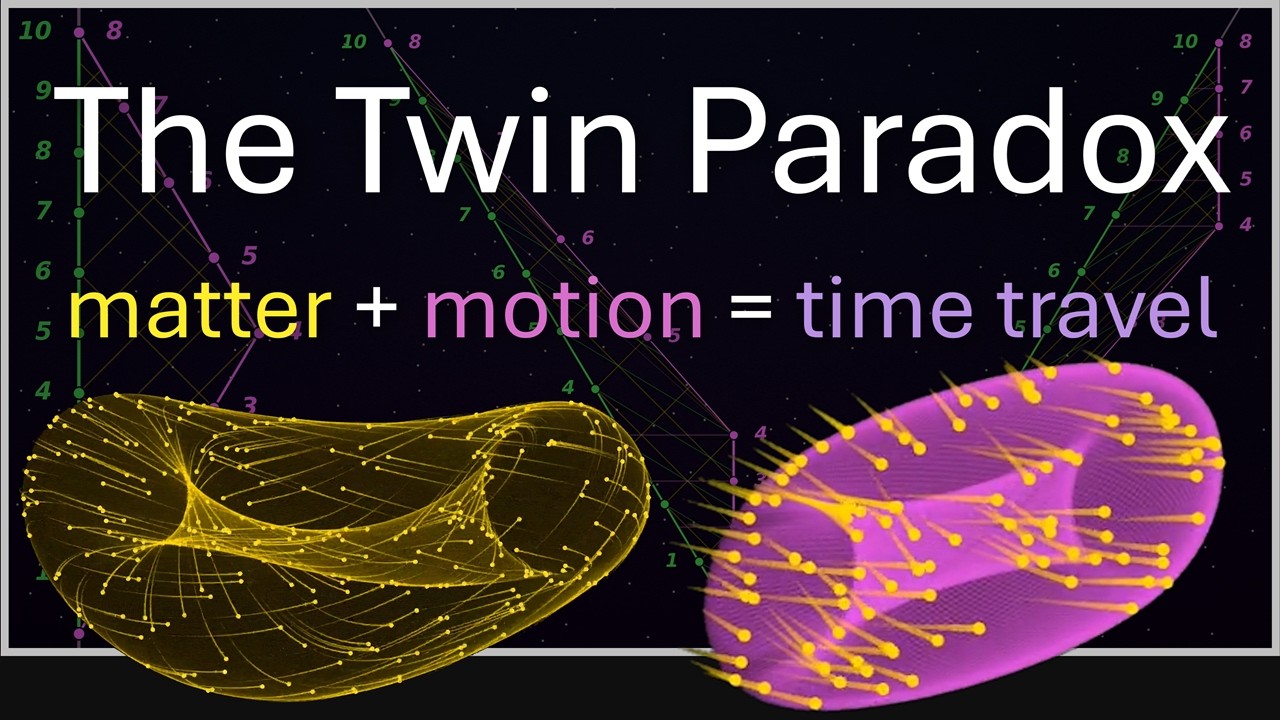
The Twin Paradox: Time Travel, Explained Visually
A near three hour visual masterclass that derives the twin paradox from one strange fact: light has a single speed for everyone. Behiel builds time dilation from a bouncing light clock and the Pythagorean theorem, then generalizes it until it applies to all matter, which he frames as bound energy that has less time for time when it moves. He resolves the paradox not with acceleration but with the tilting of the present moment when the traveling twin turns around, and grounds the whole thing in real evidence: GPS, muon rain, the LHC, and the Hafele-Keating atomic clock flights.