At a glance
Two hours and thirteen minutes on a question that sounds like a riddle and turns out to be a real accounting problem: if energy can never be created, then nothing in the universe was ever made, and something still had to start the chain. Calm Science takes the chain seriously and walks it all the way down, from a ball hitting a floor back through your muscles, your food, photosynthesis, sunlight, nuclear fusion in the sun's core, and the hydrogen assembled in the first minutes after the Big Bang, and at no step in that chain was a single joule manufactured. The answer physics currently offers, stated plainly and defended carefully, is that the total energy of the universe may be exactly zero: the positive energy locked in every gram of matter balanced against the negative energy of the gravitational field, which is why Alan Guth called the universe the ultimate free lunch. Along the way the video rebuilds the whole supporting structure: Emmy Noether proving in 1915 that energy is conserved because the laws of physics do not change with time, Rumford boring cannon barrels in Munich, Joule measuring the mechanical equivalent of heat with falling weights, the sun turning 4 million metric tons of mass into 3.8 × 10²⁶ joules every second, Hawking radiation taking 10⁶⁷ years to return a black hole to the universe, and Pauli inventing the neutrino in 1930 rather than let the books fail to balance. It ends where honest physics ends, at the edge where general relativity and quantum mechanics stop agreeing, with the answer that energy did not come from anywhere because there is no anywhere outside the universe for it to have come from.
The chain that runs back 13.8 billion years (0:40)
The video begins with the most ordinary event it can find. You pick up a ball, hold it at arm's length, and let go. It falls, hits the floor, makes a sound.
That sound is energy. Pressure waves moving through air, created in the moment the ball struck the ground. So where did it come from?
It came from the ball's motion as it fell. And where did the motion come from? From gravity pulling the ball downward. And where did gravity get the energy to do that?
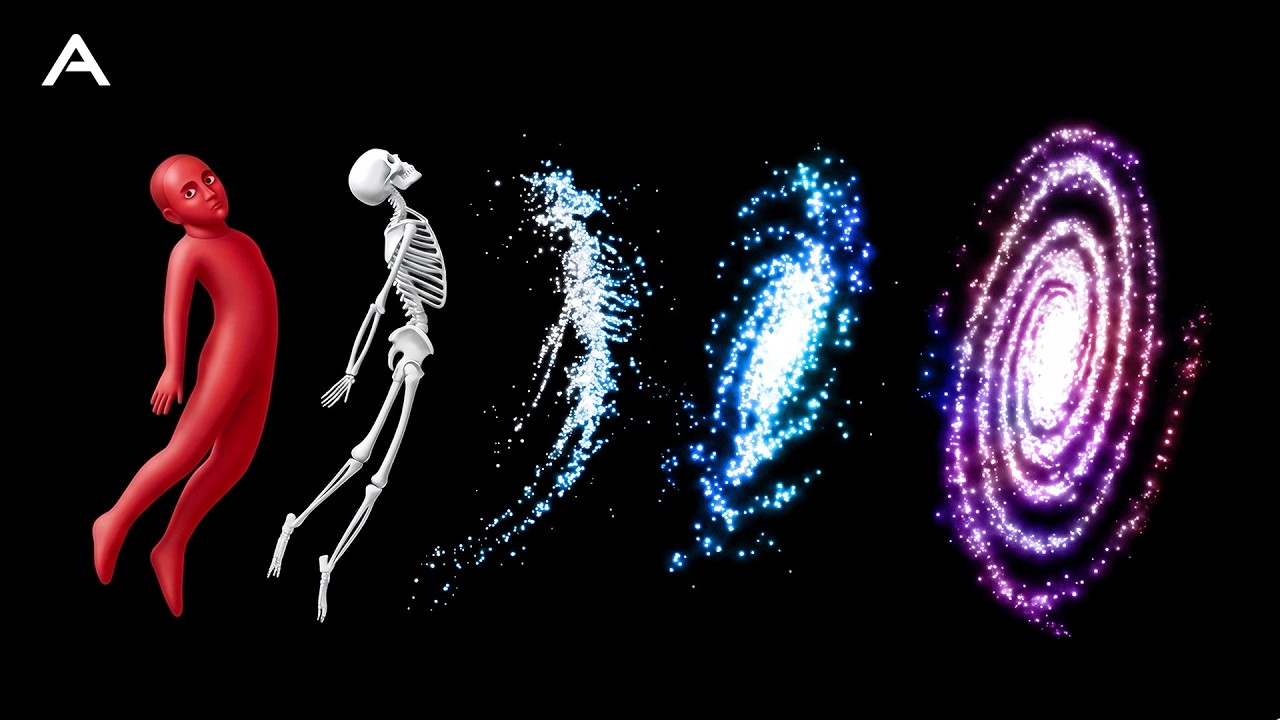
This is the point where the question stops being trivial. Gravity did not create anything. What happened was a conversion. When you held the ball up, it had potential energy stored in its position relative to the ground. That potential energy was built up when you lifted it, using chemical energy in your muscles. That chemical energy came from food you ate. The food got its energy from sunlight, from plants converting photons into sugars through photosynthesis. The sunlight came from the sun. The sun got its energy from nuclear fusion in its core, fusing hydrogen into helium and releasing a fraction of its mass as pure energy. And the hydrogen in the sun was assembled in the first few minutes after the Big Bang, when the universe was a hot, dense soup of particles cooling fast enough for protons to stick together and form the lightest elements.
At every single step in that chain, nothing was created. It was converted. Form to form to form. The ball hitting your floor is, in some sense, the tail end of a chain of transformations that traces back 13.8 billion years.
That is the thesis of the entire video, stated in the first two minutes with a falling ball, and everything that follows is the work of making it precise, checking it against the evidence, and then pushing on it until it breaks at the only place it can break, which is the beginning of time itself.
The framing matters. The video is not asking where energy is stored or how it is generated. Nothing generates energy. Power plants do not generate it, the sun does not generate it, your body does not generate it. Every device humanity has ever built is a converter sitting in a river that was already flowing. As the video puts it much later, we are not producers of energy, we are managers of transformations.
The one law nobody has ever caught breaking (2:41)
This is what physicists mean when they say energy is conserved. The first law of thermodynamics states it plainly: energy cannot be created or destroyed, only transformed from one form to another. The total amount of energy in a closed system stays constant, always, without exception.
It is one of the very few things in physics that nobody in the entire history of experimental science has ever observed being violated. Not once. Not even a little.
The video pauses on how unusual that is. Most laws of physics are approximations. They work under certain conditions, break down under others, and get refined as better instruments reveal finer detail. Newtonian gravity is superb until you need the orbit of Mercury. The ideal gas law is superb until the gas is dense. Almost everything in the physicist's toolkit comes with a regime of validity stamped on the side.
Conservation of energy has held up under every test ever devised. Drop a ball. Run a nuclear reactor. Collide particles at the Large Hadron Collider at energies of 13.6 trillion electron volts. Observe a black hole swallowing a star. Count the energy going in, count the energy coming out. They always balance.
Which sharpens the original question instead of answering it. If energy cannot be created, where did the energy that exists in the universe come from? Something had to start the chain. There had to be a first link.
And here the video does something that earns it a lot of credit early: it says out loud that this is where we have to be honest about what we know and where our understanding genuinely runs out.
The answer physics currently offers: the total may be zero (4:43)
The answer on the table is that the total energy of the universe may be exactly zero.
That is not a joke, and it is not a metaphor. It is a serious, mathematically grounded proposition that some of the most rigorous physicists of the 20th and 21st centuries have explored and defended.
The argument runs in two halves.
The positive half. Every piece of matter has positive energy locked up in its mass, according to Einstein's E = mc². That equation says mass and energy are the same thing measured in different units. A single kilogram of matter contains about 90 quadrillion joules of energy. Every gram of hydrogen in the universe, every proton, every electron carries this stored energy. Add it up across the observable universe and the total positive energy in the form of matter and radiation is a number so large that stating it barely conveys anything.
The negative half. Gravity is different. Gravitational potential energy is negative. When two masses are separated by a great distance they have more energy than when they are close together. Bringing them together releases energy, which means the state of being close together is a state of lower, more negative energy. The gravitational field of the universe, the sum of all the gravitational interactions between every object in existence, contributes an enormous negative term to the energy budget.
Some physicists, most notably Alan Guth, who developed the theory of cosmic inflation in 1980, have argued that when you add the positive energy of all matter and radiation to the negative energy of the gravitational field, the sum is exactly zero, or very close to it.
If that is correct, the universe did not require energy to exist. It emerged from a zero energy state without violating conservation, because the net energy of the total system was nothing.
This is sometimes described as the universe being the ultimate free lunch, which, as the video notes, is either deeply satisfying or deeply unsettling depending on your temperament.
What energy actually is, and why nobody can define it (7:27)
Before going further back toward the beginning, the video stops to ask a question most people think they can already answer: what is energy?
Ask a physicist and the answer is surprising. There is no clean, intuitive definition.
Richard Feynman, one of the greatest physicists of the 20th century, addressed this directly in his famous lectures on physics. He noted that there is a numerical quantity which does not change when something happens, and we call this energy, but that it is a most abstract idea because it is fundamentally a mathematical principle, not a description of any tangible substance.
Notice what that means. Energy is not a thing. It is a number that stays constant. It is defined by the fact that it is conserved, not by any deeper substance or essence. We cannot say what energy is in the way we might say what a rock is or what a flame is. We can only say what it does. It persists. It transforms. It never appears from nothing and never vanishes into nothing.
The video is candid that the circularity bothers some people, and equally candid that it is honest. Physics is built on a foundation of mathematical relationships that work, not metaphysical explanations of why they work. The honest scientist admits what they do not know.
So: energy is conserved. It takes many forms, kinetic, potential, thermal, chemical, electromagnetic, nuclear. These forms convert into one another constantly in every process that happens anywhere in the universe. The total never changes.
And the question of where the energy originally came from is really a question about the origin of the universe itself. Which leads, inevitably, to a mathematician in Göttingen.
Emmy Noether and the reason energy is conserved at all (9:28)
In 1915, a German mathematician named Emmy Noether proved one of the most important theorems in the history of physics. The video is blunt that it is not nearly as famous as it should be. Most people have never heard of it. Physicists consider it foundational.
Noether's theorem says this: every continuous symmetry of the laws of physics corresponds to a conservation law.
That sentence deserves unpacking, and the video unpacks it slowly. A symmetry, in this context, means that the laws of physics look the same from different perspectives or at different times. The laws do not change depending on when you run the experiment. Perform a physics experiment today. Perform the identical experiment tomorrow. The results will be the same.
That symmetry, that sameness of physics across time, is what Noether proved gives rise to conservation of energy.
Read that again, because it inverts the usual telling. Energy is conserved because the laws of physics do not change with time. Full stop. Not because of some mystical property of energy itself. Not because some force is maintaining the balance. Because of a deep mathematical symmetry at the heart of physical law. If the laws of physics changed from one moment to the next, energy would not be conserved. But they do not. And so it is.
The theorem was so important that Albert Einstein wrote to the mathematician David Hilbert about it and described Noether's work as the most significant creative mathematical genius thus far produced.
And yet she spent much of her career fighting to be allowed to teach at a university at all, because she was a woman in a world that had not caught up to what she was doing. She was initially not permitted to lecture under her own name at the University of Göttingen. She had to lecture under a male colleague's name.
The video lands the line without embellishment: the woman who explained why energy is conserved was, for a time, not allowed to take credit for her own lectures. Physics is strange. History is stranger.
Much later in the video, at 39:24, it returns to Noether to complete the picture, and it is worth pulling that forward here because the three results belong together. The same theorem explains conservation of momentum: the laws of physics are the same regardless of where in space you run your experiment. Perform it here, or perform it a thousand kilometres away, and the same laws apply. That spatial symmetry gives rise to conservation of momentum. Objects keep moving in the same direction unless something pushes them, because the laws governing them are identical at every point in space. And rotational symmetry, the fact that the laws of physics work the same regardless of which direction you define as up, gives rise to conservation of angular momentum. Spin is preserved because the universe does not have a preferred direction.
Three conservation laws. Three symmetries. Not independent facts about nature, but consequences of three deep structural features of physical law.
How we actually know: the experimental record (12:14)
There is a separate question sitting underneath all of this. How do we know energy is conserved?
The answer is not that someone proved it mathematically and everyone agreed. It is that every experiment ever conducted has confirmed it and no experiment has ever contradicted it.
Science works by testing ideas against reality. Conservation of energy is an idea that has been tested millions of times in every domain of physics, from particle accelerators to cosmological observations, and it has never failed.
The video is careful about what that does and does not buy you. It does not make conservation of energy unquestionably true forever. It makes it the best confirmed principle in all of science. Those are different claims, and the difference is the whole methodology.
The long road to the first law (12:55)
The history of how we arrived at this understanding is itself a remarkable story, and the video gives it real space rather than a sentence of throat clearing.
For most of human history the concept of energy did not exist in any precise form. Ancient philosophers spoke of forces and substances and essences. Aristotle believed that fire, water, earth and air were fundamental elements, each with a natural place in the cosmos, and that objects moved toward their natural places. This was not physics in any modern sense. It was classification without measurement.
The scientific revolution of the 17th century changed the terms of the conversation. Galileo showed that falling objects accelerate uniformly and worked out the mathematical relationship between distance, time and speed. Newton built on this to develop the laws of motion and universal gravitation, a framework that could predict where planets would be to extraordinary precision.
But Newton's framework did not explicitly include what we now call energy. He worked with forces and accelerations.
Vis viva against momentum
The concept of kinetic energy, the energy of motion, emerged more clearly in the work of Gottfried Wilhelm Leibniz, Newton's contemporary and rival. Leibniz argued for a quantity he called vis viva, living force, which was proportional to mass times the square of velocity. Newton and his followers argued for a different quantity, momentum, proportional to mass times velocity to the first power.
There was a significant and often acrimonious debate about which quantity was the true measure of a body's motion.
The resolution, when it came, was that both quantities are conserved, but in different situations. Momentum is conserved in all collisions. Kinetic energy is conserved only in perfectly elastic collisions where nothing deforms or heats up. In most real collisions, some kinetic energy is converted to heat, sound and deformation. The total energy is still conserved, but the form changes.
That is a small lesson with a large shadow over the rest of the video: a conservation law that appears to fail is almost always a conservation law whose accounting is incomplete.
Heat is not a substance
The broader concept of energy, encompassing all its forms, took longer to emerge. The key insight was that heat is not a substance.
This was not obvious. For much of the 18th century, heat was thought to be a material fluid called caloric. The caloric theory held that heat flowed from hot objects to cold ones because caloric fluid flowed from regions of higher concentration to lower concentration. It explained many observations tolerably well.
It ran into trouble with experiments in the 1790s conducted by an American born physicist named Benjamin Thompson, who later became Count Rumford. While supervising the boring of cannon barrels in Munich, Rumford noticed that the amount of heat generated seemed to be limitless, as long as you kept boring. If heat were a finite fluid being squeezed out of the metal, it should run out eventually. It did not.
Rumford argued, correctly, that the heat was being generated by the mechanical work of boring. Mechanical motion was being converted to heat. This was the first clear experimental evidence that heat and mechanical energy are interconvertible, that they are different forms of the same thing.
Joule, and putting a number on it
The person who made this quantitative was James Prescott Joule, a British brewer and physicist who spent much of the 1840s conducting meticulous experiments measuring the relationship between mechanical work and heat.
Joule built an apparatus in which falling weights caused paddles to rotate inside a container of water, stirring it and causing it to warm slightly. By carefully measuring how far the weights fell and how much the water warmed, he was able to determine the mechanical equivalent of heat: how much mechanical work produces how much heat. His measurements were astonishing in their precision given the equipment available.
The unit of energy, the joule, is named after him.
Joule's work, along with parallel contributions from Hermann von Helmholtz in Germany and Julius Robert Mayer, who actually stated the conservation principle clearly earlier but was initially ignored, led to the formal statement of the first law of thermodynamics by the 1850s. Energy is conserved. All its forms are interconvertible. The total never changes.
The video calls this one of the great unifications in the history of science, and it is right to. Heat, mechanical energy, light and chemical energy were all brought under a single principle.
- 1790s Rumford bores cannon barrels in Munich and finds the heat is limitless. Caloric theory starts to fail.
- 1824 Sadi Carnot derives the maximum possible efficiency of any heat engine from the temperatures alone.
- 1840s Joule measures the mechanical equivalent of heat with falling weights and paddles in water. Mayer and Helmholtz arrive in parallel.
- 1850s The first law of thermodynamics is formally stated. All forms of energy are interconvertible; the total never changes.
- 1860s Maxwell unifies electricity and magnetism, shows light is an electromagnetic wave, and predicts its speed.
- 1895 Röntgen discovers X-rays.
- 1896 Becquerel discovers radioactivity.
- 1900 Planck introduces quantization to explain the radiation spectrum of hot objects, believing it a mathematical trick.
- 1903 / 1911 Marie Curie wins the Nobel Prize in physics with Pierre and Becquerel, then the Nobel Prize in chemistry alone. Polonium and radium; she coins "radioactivity".
- 1905 Einstein explains the photoelectric effect with light quanta, and publishes special relativity. E = mc² makes mass a form of energy.
- 1909 Rutherford, with Geiger and Marsden, fires alpha particles at gold foil. Some bounce back. The nucleus is found.
- 1915 Emmy Noether proves that every continuous symmetry corresponds to a conservation law. Energy conservation gets its reason.
- 1917 Einstein introduces the cosmological constant to allow a static universe, then abandons it as his greatest blunder.
- 1921 Einstein receives the Nobel Prize in physics for the photoelectric effect.
- 1930 Pauli refuses to accept that beta decay breaks conservation and postulates an undetected particle: the neutrino.
- 1932 Chadwick discovers the neutron.
- 1938 to 39 Hahn, Strassmann, Meitner and Frisch work out nuclear fission. The missing mass appears as energy, exactly as E = mc² predicted.
- 1948 Hendrik Casimir predicts an attraction between uncharged plates in vacuum, driven by quantum fluctuations.
- 1956 Cowan and Reines detect the neutrino, 26 years after Pauli called it.
- 1974 Hawking shows black holes radiate, and therefore eventually evaporate.
- 1980 Alan Guth develops cosmic inflation, and with it the zero energy universe argument.
- 1997 The Casimir effect is measured experimentally.
- 1998 Perlmutter, Schmidt and Riess find the expansion is accelerating. Dark energy enters the budget.
- 2015 LIGO records its first gravitational wave: two black holes of about 30 solar masses each, merging over a billion years ago.
- 2020 Roger Penrose shares the Nobel Prize in physics. His argument that the low entropy of the Big Bang is the deepest problem in physics stands.
- 2023 Euclid launches. Pulsar timing arrays including NANOGrav report strong evidence for a gravitational wave background.
Maxwell, Einstein, and the pattern behind every unification (18:23)
The other great unification in the story of energy came from James Clerk Maxwell in the 1860s.
Maxwell unified electricity and magnetism into a single theory of electromagnetism. He showed that light is an electromagnetic wave, a self propagating oscillation of electric and magnetic fields. That meant the energy carried by light, which had previously been a somewhat mysterious category of its own, was the energy of electric and magnetic fields oscillating together through space. And it meant that the electromagnetic spectrum, from radio waves at very long wavelengths to X-rays and gamma rays at very short ones, was all the same phenomenon. Different wavelengths, different energies, same fundamental nature.
Maxwell's equations predicted that electromagnetic waves travel at a specific speed, which turned out to be exactly the speed of light. The video calls this one of the most important predictions in the history of physics, and the reason is what it set in motion: it showed that light has a fixed speed, a fact that would eventually lead Einstein to the special theory of relativity.
Einstein's relativity then revealed that energy and mass are equivalent, connected by E = mc², completing the unification of the energy concept. Mass became a form of energy. The last holdout, the last category that seemed to be something other than energy, turned out to be energy too.
The shape of the pattern
The video then does something more interesting than listing the unifications. It points at the shape they share.
Joule's demonstration that heat and mechanical energy are the same. Maxwell's demonstration that light is electromagnetic energy. Einstein's demonstration that mass is energy. Each of these is a profound achievement on its own. But each one takes two things that seem distinct and reveals them to be expressions of the same underlying reality.
Energy is the quantity that names that underlying reality. It is what all these different phenomena share. And conservation of energy is the statement that this quantity persists through all its transformations.
There is something philosophically interesting in the direction that takes us. As our understanding deepens, the concept of energy becomes at once more powerful and more abstract. In ordinary life energy feels concrete. You feel it when you lift something heavy. You see it when a fire burns. You experience its absence when you are tired.
But as physics digs deeper, energy becomes increasingly mathematical. It becomes a number that stays constant, a conserved quantity associated with time translation symmetry, defined not by what it is but by what it does.
The video refuses to treat that as a loss. It is not a retreat from reality, it says, it is a refinement of our description of reality. The most fundamental things, the things that are most deeply true about the universe, tend to be abstract. The force you feel when you push against something is, at the deepest level, the electromagnetic repulsion between electron clouds in the surface molecules of your hand and the object. What you experience as solid, hard and resistant is fundamentally the mathematical expression of quantum mechanical wave functions interacting.
The world is not less real for being mathematical at its foundations. It is more coherent, more unified, more describable.
Sixty orders of magnitude and the same law at both ends (22:25)
The description we have built is genuinely extraordinary, and the video puts a number on how extraordinary.
The laws of physics, the equations that describe how energy flows and transforms, have been tested across scales that differ by 60 or more orders of magnitude. From the Planck length, the smallest meaningful distance, to the size of the observable universe. From the energy of a radio wave photon to the energy of the most powerful cosmic rays ever detected.
Across that entire range, energy is conserved. Not approximately. Precisely. Every measurement, every experiment, every observation confirms it.
The universe is not arbitrary. It runs on principles, and those principles have held since the first fraction of a second after the Big Bang. The same laws that govern a falling ball in a laboratory also govern the rotation of distant galaxies. The same conservation principle that applies to a chemical reaction in a cell also applies to the merger of two black holes releasing gravitational waves.
The universe is not different in different places. It does not operate by different rules in different epochs. The laws are universal, and energy is conserved in all of them, always, without exception.
As the video puts it, this is either a profound coincidence or a deep truth about the nature of reality. Most physicists believe it is the latter.
Radiation, redshift, and the photon that lost energy to nobody (24:26)
There is a form of energy that deserves its own careful attention, and it is the one that has been travelling longest.
Electromagnetic radiation carries energy across the universe in a way nothing else does. From the moment the universe became transparent, about 380,000 years after the Big Bang, photons have been travelling through space carrying energy from their sources to wherever they eventually arrive.
The light from the most distant galaxies we can observe left them over 13 billion years ago, when the universe was less than a billion years old. That light has been travelling for longer than the Earth has existed.
During that journey, the universe has expanded, and the light has been stretched along with space. Its wavelength has increased. Its energy has decreased.
This cosmological redshift is one of the key pieces of evidence for the expansion of the universe. When we observe a galaxy and find its light shifted toward the red end of the spectrum, we know the universe was smaller when that light was emitted. The ratio of the observed wavelength to the emitted wavelength tells us how much the universe has expanded since the light was emitted. The most distant galaxies have redshifts so large that their ultraviolet light has been stretched into the infrared by the time it reaches us.
Then comes the sentence that sets up the next twenty minutes of the video.
The stretching is real. The energy of those photons has genuinely decreased during the journey.
Where did that energy go?
Nothing absorbed it. No recipient got warmer. There is no third party in the transaction. The photon simply arrives carrying less energy than it left with, and the difference is not sitting anywhere.
Where conservation stops being globally defined (26:30)
This is the most technically careful passage in the whole video, and it is worth following exactly.
In general relativity, the framework we use to describe the expanding universe, energy conservation takes a more subtle form than in ordinary physics. It is conserved in every small region of space. But globally, across the expanding universe as a whole, it is not straightforwardly conserved in the way Noether's theorem describes.
This is not a violation of physics. It is a consequence of the dynamic nature of spacetime itself.
The universe is not a rigid container in which energy sloshes around. The container is growing. And in a growing container, the rules are different.
Noether's theorem requires what physicists call a Killing vector field associated with time translation. In a static spacetime, this exists. In an expanding spacetime, it does not exist globally. So global energy is not conserved in the simple sense.
Go back to Figure 2 and the top row of the diagram. Energy conservation was never a free standing law. It was a consequence of a symmetry. Take the symmetry away and the consequence goes with it. That is not physics breaking; it is physics being consistent about its own logic.
The video acknowledges that some people find this deeply unsatisfying. They want energy conservation to hold everywhere, always, absolutely. But the universe does not owe us that comfort.
What we can say is that locally, in every region small enough that the expansion does not matter, energy is conserved precisely. And that is the region in which all of chemistry, biology, engineering, and most of physics takes place.
| Setting | Is energy conserved? | Why, in the video's terms |
|---|---|---|
| A ball falling in a room | Yes, exactly | Potential to kinetic to sound and heat. Every joule accounted for, every time. |
| Collisions at the LHC (13.6 TeV) | Yes, exactly | Count what goes in, count what comes out. They always balance. |
| Beta decay of a neutron | Yes, once the neutrino is counted | The 1930 shortfall was incomplete accounting, not a broken law. Pauli was right. |
| Matter falling into a black hole | Yes | The hole's mass rises by exactly the amount E = mc² dictates, and its field strengthens to match. |
| A black hole evaporating by Hawking radiation | Yes, over 10⁶⁷ years | Everything that fell in is eventually returned to the universe as radiation. |
| Virtual particles in the vacuum | Yes, properly accounted | Borrowed energy is repaid inside the window the uncertainty principle allows. |
| A photon redshifted across 13 billion years | Energy is lost with no recipient | Space stretched, the wavelength stretched with it, and nothing absorbed the difference. |
| Dark energy as new space appears | The total grows | A constant energy density that does not dilute means more space equals more dark energy. |
| The expanding universe as a whole | Not globally defined | No global time translation symmetry, so no global Killing vector field, so Noether's theorem does not deliver a global conserved energy. |
Dark matter, dark energy, and the worst prediction in the history of physics (27:50)
If we are auditing the energy of the universe, we should know what is actually in it. The video takes the two largest line items in turn.
Dark matter
Dark matter is matter that does not interact with light but does interact via gravity. We infer its existence from the way galaxies rotate. The outer parts of galaxies rotate faster than they should if the only mass present were the visible stars and gas. Something extra is there, providing gravitational pull.
It makes up about 27% of the total energy density of the universe.
We do not know what it is. Candidates include weakly interacting massive particles, axions, and various other hypothetical particles that have not been directly detected. It does not emit, absorb or reflect light. It does not undergo chemical reactions. It just gravitates.
But it is mass, and mass is energy. The dark matter in the universe is a vast reservoir of energy locked up in an unknown form. Whatever it turns out to be, it is already on the balance sheet.
Dark energy
Dark energy is stranger. It is about 68% of the total energy density of the universe, and it appears to be a property of space itself: a constant energy density that does not dilute as the universe expands.
This is the cosmological constant, lambda, that Einstein introduced in 1917 to allow for a static universe, and then abandoned when Hubble discovered the expansion. He called it his greatest blunder.
But it turns out there is something there. Not because the universe is static, which it is not, but because space does have an intrinsic energy density.
The 120 orders of magnitude problem
What is dark energy physically? This is one of the biggest open questions in physics, and the video does not soften it.
The vacuum energy of quantum field theory predicts an energy density for empty space that is roughly 120 orders of magnitude larger than the observed dark energy density.
That discrepancy between the quantum field theory prediction and the observed value is sometimes called the worst prediction in the history of physics. It suggests that something is cancelling the quantum vacuum energy almost perfectly, leaving only a tiny residual, and we have no idea what that something is.
Take the size of that number seriously for a moment. It is not a factor of ten out, or a factor of a million. It is a factor of one followed by 120 zeros. Two calculations of the same quantity, both from theories that work superbly elsewhere, disagreeing by more than the ratio between the size of the observable universe and the size of a proton, several times over.
Some physicists think dark energy is truly a constant, the cosmological constant, with a value that is simply a fundamental parameter of the universe. Others think it might vary over time, a dynamical field called quintessence.
Future observations may be able to distinguish between these possibilities. The Euclid satellite, launched in 2023, and the Nancy Grace Roman Space Telescope, expected within the decade, are specifically designed to measure how the expansion of the universe has changed over time. If dark energy is constant, the expansion accelerates at a specific predictable rate. If it is dynamical, the rate will vary in characteristic ways.
Either result will be profoundly important, because understanding dark energy is understanding the dominant form of energy in the universe.
What "the universe has zero energy" actually claims (31:55)
Now a question that sits right at the heart of all of this, and the video does not dodge it.
If the total energy of the universe might be zero, if positive matter energy balances negative gravitational energy, then what does it even mean to say the universe has energy?
The statement that the universe's total energy is zero is a specific technical claim that requires careful definition. In general relativity, energy is not globally defined in the simple way it is in Newtonian physics. Different ways of defining what counts as the total energy give different answers. Some definitions do suggest the total is zero. Others are ambiguous.
The physicist and cosmologist Sean Carroll has argued that this question is genuinely ill posed without additional context, and that the statement "the universe has zero energy" is a somewhat informal way of saying something more technically precise.
What we can say without ambiguity is threefold:
- Locally, at every point in space and time, energy is conserved.
- Locally, matter and radiation obey strict accounting.
- The universe's expansion introduces subtleties at cosmological scales that require general relativity to handle properly.
The philosophical point that some physicists want to make, that the universe could have arisen from nothing without violating energy conservation, is at least not obviously wrong. It may be true. It requires a specific definition of nothing, a specific accounting of energy, and the application of general relativity in a regime we cannot directly test.
But it is not physically excluded. And, as the video argues, it is more honest than the alternative of simply saying we do not know and leaving it there. We do not know. But we have specific, mathematically rigorous proposals that are internally consistent. That is where the frontier of understanding currently sits.
The story of decreasing usability (33:58)
There is another way to tell the whole story of energy in the universe, and it is not a story about quantity at all. It is a story about usability.
The Big Bang, or whatever preceded it, was a state of extraordinarily high energy density and extraordinarily low entropy. It was as organized as it could be. From there, everything has been flowing toward greater disorder, greater entropy, more dispersed forms of energy.
But the flow is not uniform and it is not smooth. In certain places, under certain conditions, energy pools. It concentrates. It organizes.
Gravity pulls matter together, converting gravitational potential energy into kinetic energy and heat. That heat powers nuclear fusion. Fusion produces the heavy elements and the radiation that make the chemistry of planets and life possible. Life concentrates energy from diffuse sources into the highly structured chemistry of living cells. Intelligence concentrates information and uses it to direct the flow of energy with increasing precision.
Each of these is a local decrease in entropy, a local creation of order, powered by a larger increase in entropy somewhere else. The sun increases in entropy as it fuses hydrogen. Earth exports entropy to space as it radiates heat. Life increases the entropy of its food as it converts chemical energy to heat and mechanical work. Civilization increases the entropy of fossil fuels as it converts them to heat and motion and light.
And through all of this, the total entropy of the universe increases inexorably, following the second law with absolute fidelity. The law does not know about us. It does not care. It just runs, in every particle, in every interaction, everywhere, always.
Nothing required any of this to be interesting
Then comes the passage where the narration allows itself an opinion, and it is the best paragraph in the first hour.
The universe did not have to make anything interesting on its way to maximum entropy. There is no thermodynamic requirement for stars, for planets, for chemistry, for biology, for consciousness. The universe could have dispersed its energy uniformly long ago and reached equilibrium without any of the structure we observe.
Why it did not is partly a question of time scales. The processes by which energy concentrates and disperses take time, and the universe is finite in age. It is partly a question of initial conditions: the low entropy Big Bang set up a situation where gravity could pull matter into dense regions before thermal equilibrium was reached.
But the result, the improbable, detailed, astonishing result, is a universe full of structure. Full of stars burning for billions of years. Full of planets with chemistry. Full of organisms that think. Full of beings who have been around for a cosmically negligible amount of time and have already managed to trace the chain of energy transformations back to the first fractions of a second of time.
That is what we have done. That is where we are: standing in the flow, temporarily organized out of the same matter and energy that has been here since the beginning, aware of our own existence, able to ask the question.
Energy didn't come from anywhere (38:03)
At the 38 minute mark, roughly a third of the way in, the video gives its answer in full. Not as a teaser, not as a cliffhanger. It states the conclusion and then spends the remaining ninety minutes earning it.
Energy did not come from anywhere. It was always here.
The universe did not receive its energy from outside itself, because there is no outside. The universe is everything: space, time, matter, energy, the laws of physics, all of it came with the universe, or more precisely, all of it is the universe.
Before the Big Bang, to the extent that "before" has any meaning at all, there was no energy, because there was no time for energy to exist in. At the Big Bang, time and space and energy came together. They are not separate things that came from separate places. They are different aspects of the same thing.
And the energy that is in the universe has been here ever since, transforming, flowing, always conserved, never made, never destroyed. Just here, like it always was, like it always will be.
What enforces the symmetry? (41:28)
Having explained conservation by way of symmetry, the video immediately asks the next question rather than letting the reader ask it.
If energy is conserved because the laws of physics do not change with time, what keeps the laws of physics from changing from one second to the next? What enforces the symmetry?
The answer is that we do not know. We have no deeper explanation. The symmetry is simply there. It is part of the structure of reality, as far as we can determine.
Physics describes the universe with extraordinary precision. It does not explain why the universe has the structure it does.
That question may be answerable, or it may require a framework we have not invented yet. Both are serious possibilities, and the video says neither is dispiriting if you are willing to accept that the frontier of knowledge is where the most interesting things are.
It also spells out the stakes if any of the three symmetries were to fail. Chemistry would fail. Orbits would be unstable. Machines would not work. The universe would be qualitatively different at every scale. These are not decorative regularities. They are the reason there is anything stable enough to be called a thing.
The sun, in numbers (42:09)
The abstract can only carry you so far before you need to feel the weight of it in something real. So the video turns to the sun, and does the arithmetic on camera.
Every second, the sun converts about 600 million metric tons of hydrogen into helium through nuclear fusion.
In that process, about 4 million metric tons of mass are converted directly into energy. Not released as chemical energy the way a fire releases it. Not transferred from some reservoir somewhere. Actually converted. Mass becomes energy.
The relationship that makes this possible is E = mc², where c is the speed of light, about 300 million metres per second. The speed of light squared is an enormous number, about 90 quadrillion metres squared per second squared.
Take 4 million metric tons of mass, which is 4 billion kilograms. Multiply by that number. You get roughly 3.8 × 10²⁶ joules per second.
That is the sun's luminosity. The total power output of our star, measured and confirmed every second, without pause, for the last 4.6 billion years. And for roughly another 5 billion years to come.
None of that energy was created. All of it was already there, locked up in the mass of hydrogen atoms since those atoms formed in the aftermath of the Big Bang.
Nuclear fusion is not a source of energy in the sense of making energy appear. It is a converter. It unlocks energy that was always there, sealed inside matter, waiting.
And matter, according to E = mc², is nothing but extremely concentrated energy. There is no fundamental distinction between mass and energy. They are the same thing. What we call matter is energy in a form that stays put. What we call radiation, light and heat is energy in a form that moves. Converting matter into radiation, as happens in the core of the sun and in every star that has ever burned, is just releasing energy from one form into another.
The total never changes.
Everything you see is made of energy (44:52)
This brings up something the video says surprises most people, and it takes care to say it is not being poetic.
Everything you see is made of energy. Not metaphorically. Not as a philosophical statement.
The chair you are sitting on. The floor beneath it. The air you are breathing. The neurons firing in your brain right now as you process this sentence. All of it is energy in various forms.
The protons and neutrons in atomic nuclei have mass, and mass is energy. The electrons orbiting those nuclei are bound in place by electromagnetic forces, and those forces carry energy. The chemical bonds holding your molecules together are energy. The thermal motion of atoms vibrating constantly is kinetic energy.
Even empty space, the quantum vacuum, contains energy. Measurable, real energy in the form of quantum fluctuations that flicker in and out of existence at every point in the universe.
There is no level, from the largest galaxy cluster to the smallest subatomic particle, where energy is absent. It is not a substance that fills things. It is the fundamental currency of everything that exists.
The universe's real energy budget: 68, 27, 5 (46:13)
To understand how that currency flows, it helps to know what form it mostly takes, and the answer is not the one anyone would guess by looking up at night.
Most of the energy in the observable universe is not in stars. It is not in gas clouds. It is not in black holes or planets or radiation.
- About 68% of the total energy content of the universe is dark energy.
- About 27% is dark matter.
- About 5% is everything else: the atoms, the stars, the galaxies, the planets, you, everything we can directly see and touch and measure.
We do not know what dark energy is. We know it exists because the universe's expansion is accelerating.
That acceleration was discovered in 1998 by two independent teams studying distant supernovae. Saul Perlmutter, Brian Schmidt and Adam Riess expected the expansion to be slowing down, pulled back by gravity. Instead they found it was speeding up.
Something is pushing the universe apart with increasing force, and that something carries enormous energy. We call it dark energy, but as the video says plainly, the name is a label for our ignorance, not an explanation.
The leading candidate is the cosmological constant: a fixed energy density that fills all of space uniformly and does not dilute as the universe expands. If that is correct, dark energy is truly a property of space itself, a baseline energy that empty space simply has.
And here is the consequence that ties directly back to the redshift problem. As the universe expands, as more space comes into existence, the total amount of dark energy grows. Which is yet another place where our intuitions about conservation get complicated at cosmological scales.
The 5% is worth holding onto too. Everything humanity has ever seen, touched, measured, mined, burned, eaten or been made of is a rounding error in the energy budget of the universe. And the video's line about it is one of its best: the 5% we understand is the part that tells most of the story worth telling.
The nucleus: where the energy density lives (48:57)
There is another angle on this that most people do not think about: the energy locked inside an atomic nucleus. This is a form of energy that is extraordinary in its density, and the video builds up to a comparison that reframes what "a lot of energy" means.
The nucleus of an atom is held together by the strong nuclear force. This is the strongest of the four fundamental forces of nature, about a hundred times stronger than electromagnetism at nuclear scales.
The protons inside a nucleus all carry positive electric charge, and positive charges repel each other. Without something holding them together, the nucleus would fly apart instantly. The strong nuclear force does that work. It binds protons and neutrons together, and the binding energy, the energy that holds them there, is enormous.
To give a sense of the scale: the binding energy per nucleon in a typical atomic nucleus is measured in millions of electron volts. For comparison, the energy in a typical chemical bond, the kind that holds atoms together in molecules, is measured in a few electron volts.
Nuclear energies are millions of times larger than chemical energies per particle involved. That is why nuclear reactions release so much more energy than chemical ones, and the video makes it concrete with three numbers per kilogram:
- Burning a kilogram of coal releases about 30 megajoules.
- Fissioning a kilogram of uranium 235 releases about 80 trillion joules. That is about 2.5 million times more energy from the same mass.
- A pure matter antimatter annihilation, where all the mass becomes energy according to E = mc², would release about 90 quadrillion joules per kilogram, more than a billion times the energy in burning coal.
And note that fission, the middle number, only converts a fraction of the mass to energy.
The video's summary of that chart is the sentence to keep: the difference between chemistry and nuclear physics is not a difference in principle. It is a difference in how deeply you unlock the energy in matter.
Chemical reactions rearrange electrons between atoms. Nuclear reactions rearrange protons and neutrons within nuclei. Matter antimatter annihilation converts protons and electrons themselves to energy. Each level goes deeper. Each level accesses more of the energy locked up in the mass.
How we found out: from Röntgen to the chain reaction (51:40)
The discovery of nuclear energy was one of the most significant moments in the history of civilization, and the video argues it matters not just for its obvious applications but because it revealed how much energy was locked up in ordinary matter all along.
The experiments that led to this understanding stretch back to the late 19th century.
In 1895, Wilhelm Röntgen discovered X-rays.
In 1896, Henri Becquerel discovered radioactivity, the spontaneous emission of radiation from certain heavy elements.
Marie Curie, working with her husband Pierre in Paris, systematically investigated radioactive substances and discovered two new elements, polonium and radium. She coined the term radioactivity. She won the Nobel Prize in physics in 1903, shared with Pierre and Becquerel, and the Nobel Prize in chemistry in 1911. She is the only person to have won Nobel Prizes in two different sciences.
Ernest Rutherford, working in Manchester and later Cambridge, performed the experiments that revealed the structure of the atom. In 1909, along with Hans Geiger and Ernest Marsden, he fired alpha particles at a thin gold foil and found that some bounced back. This was only possible if most of the mass of the atom was concentrated in a tiny, dense nucleus. The nuclear atom was discovered.
In 1932, James Chadwick discovered the neutron, the electrically neutral particle that shares the nucleus with protons. This completed the basic picture: atoms have a nucleus of protons and neutrons surrounded by electrons.
1938, and the missing mass
In 1938 and 1939, Otto Hahn, Fritz Strassmann, Lise Meitner and Otto Frisch worked out that uranium nuclei could be split in two by a neutron, a process called fission, and that the products would have less total mass than the original nucleus.
The missing mass would appear as energy, exactly as E = mc² predicted.
And if each fission released more neutrons, those neutrons could split more uranium nuclei, releasing more neutrons, creating a chain reaction. A chain reaction with an enormously high energy density.
This was the principle behind both nuclear reactors, where the chain reaction is controlled to produce steady heat, and nuclear weapons, where it is allowed to proceed exponentially.
The video's framing of what that means for conservation is worth quoting almost exactly: the energy released in a nuclear explosion is not coming from nowhere. It is the binding energy of the nucleus, the energy stored in the strong nuclear force, being converted into kinetic energy, heat and radiation. The total energy is conserved. The conversion is simply far more energetic per unit mass than anything chemistry can achieve.
The proton-proton chain, step by step (55:05)
Then the video turns the same lens on fusion, and this is where it does its most careful worked example.
When two hydrogen nuclei, protons, come close enough to be within range of the strong nuclear force, they can fuse. In the sun's core, where temperatures reach about 15 million kelvin, protons are moving fast enough that quantum tunnelling allows them to overcome their electromagnetic repulsion. They fuse.
The initial step is called the proton-proton chain, and the video walks all of it:
- Two protons fuse to form deuterium, a nucleus with one proton and one neutron. This also produces a positron, the antimatter counterpart of an electron, and a neutrino.
- The positron immediately annihilates with an electron, converting both to gamma ray photons.
- The neutrino escapes essentially immediately, since it barely interacts with matter.
- The gamma ray photons begin their long random walk to the surface. (The video comes back to that walk at 1:25:48, and it takes tens of thousands of years.)
- The deuterium nucleus fuses with another proton to form helium 3, a nucleus with two protons and one neutron.
- Two helium 3 nuclei fuse to form helium 4, the most common form of helium, with two protons and two neutrons, and release two protons back into the plasma.
Net result: four protons have become one helium 4 nucleus.
The 0.7%
Here is the number that runs the sun.
The helium 4 nucleus is slightly less massive than the four protons that made it. That missing mass, about 0.7% of the original, has been converted to energy. That is the source of the sun's light.
The video then does the arithmetic in full, which is exactly the kind of thing that separates a physics essay from a physics vibe:
- Four protons weigh about 6.6 × 10⁻²⁷ kg.
- 0.7% of that is about 4.6 × 10⁻²⁹ kg.
- Multiplied by the speed of light squared, that gives about 4 × 10⁻¹² joules per reaction.
A tiny amount. Roughly the energy of a mosquito's wingbeat divided many times over, per reaction.
But the sun is enormous. In its core, something like 9 × 10³⁷ proton-proton chain reactions occur every second.
Multiply those together and the product is the sun's 4 million metric tons per second, and the 3.8 × 10²⁶ joules per second we started with at 42:09. The two ends of the calculation meet, and they meet because the video actually did the work rather than gesturing at it.
As the narration says, the scale at which nature runs this reaction continuously, without pause, is breathtaking.
The constants had to be what they are (57:52)
There is a precision in all of this that the video says should not go unremarked.
The fact that the strong nuclear force is exactly as strong as it is matters enormously.
- If it were slightly weaker, protons would not bind into stable nuclei. Hydrogen would be the only element. No carbon, no oxygen, no iron, no chemistry, no planets, no life.
- If it were slightly stronger, all the hydrogen in the early universe would have fused into helium before stars could form. No hydrogen left to fuel the slow, steady fusion of main sequence stars. No long lived stable stars. No energy source running for billions of years.
The electromagnetic force, which governs chemistry and determines the structure of atoms, is also very precisely calibrated. If it were slightly different, the periodic table would look completely different. Chemical bonds would have different energies. The specific chemistry of life as we know it would not work.
These observations lead to what is sometimes called the fine tuning problem, or in its more philosophical form, the anthropic principle. The physical constants of nature seem to be set at values that allow complex structures to exist, that allow stars to burn for billions of years, that allow chemistry to be rich enough for life.
Whether this is a profound coincidence, the result of a selection effect in a vast multiverse of universes with different constants, or evidence of something else entirely, is a question physics alone cannot currently answer.
What physics can say is narrower and firmer: the constants are what they are, they have been the same as far as we can determine throughout the observable universe and throughout its history, and the energy transformations that make our existence possible depend on those constants having the values they have.
Black holes, and the slowest bookkeeping in the universe (1:00:34)
Now the video goes to the extreme environments to see whether the accounting survives them.
Black holes are the most dramatic example. A black hole forms when a massive object collapses to such high density that its gravitational field is strong enough to trap light. The boundary beyond which nothing can escape is the event horizon. Inside, spacetime is so curved that all possible futures point toward the singularity at the centre.
When matter falls into a black hole, its energy does not vanish. The mass of the black hole increases by exactly the amount that energy dictates it should, via E = mc². The black hole's gravitational field grows correspondingly stronger. Energy is conserved.
But something interesting happens at the edge.
Hawking radiation
In 1974, Stephen Hawking showed that quantum mechanics, applied near the event horizon, predicts that black holes should emit a very slow, very faint thermal radiation.
The mechanism is subtle. The quantum vacuum, even near a black hole, is full of virtual particle pairs popping in and out of existence. Near the event horizon, one particle of a pair can fall inside while the other escapes. The escaping particle becomes real, carrying away energy. The black hole, which provided the energy to make the pair from its own gravitational field, loses mass slightly.
Over an extremely long time, a black hole radiates all its mass as Hawking radiation and eventually evaporates completely.
The numbers the video attaches to this are the point:
- For a stellar mass black hole, the Hawking temperature is about 60 nanokelvin per solar mass. Far too cold to detect against the cosmic microwave background.
- The evaporation timescale is proportional to the cube of the mass.
- A stellar mass black hole would take roughly 2 × 10⁶⁷ years to evaporate.
- The age of the universe is about 13.8 billion years, roughly 1.4 × 10¹⁰ years.
- 2 × 10⁶⁷ years is 57 orders of magnitude longer.
Black holes are not going anywhere soon. But they will eventually evaporate. And when they do, all the energy that fell into them will have been returned to the universe as radiation.
Energy conserved. Transformed from matter and kinetic energy into Hawking radiation, over timescales that make even the heat death scenario look brief.
The information paradox and the holographic principle (1:03:17)
There is a related problem, and the video is right that it connects to energy more deeply than it first appears.
When matter falls into a black hole and the black hole eventually evaporates as Hawking radiation, is the information about the matter that fell in preserved?
In quantum mechanics, information is conserved. The quantum state of a system can change, but it cannot simply be erased. The evolution of quantum states is reversible in principle. If information could truly be destroyed, this would violate quantum mechanical unitarity.
The black hole information paradox asks what happens to that information when the hole evaporates. Hawking originally argued that the information was simply lost, destroyed. But that would violate quantum mechanics.
The resolution of this paradox is one of the major open problems in theoretical physics. The current best understanding, developed by many physicists over decades including Jacob Bekenstein, John Preskill and Don Page, is that the information is not destroyed. It is encoded in the correlations between Hawking radiation photons in a subtle and complex way.
The information gets out. But extracting it from the Hawking radiation would require a computational effort that is, for all practical purposes, impossible.
This resolution was significantly advanced by work on black hole entropy and the holographic principle. Bekenstein showed in the 1970s that a black hole has entropy proportional to the area of its event horizon.
That was strange, because entropy is usually an extensive property proportional to volume, not area. But black holes are not usual. They encode information on their surface, not in their volume.
This led to the holographic principle, the idea that all the information in a region of space can be encoded on its boundary. In some formulations of string theory, this principle becomes mathematically precise.
The paradox is not fully resolved, but the direction of the resolution points toward information and energy being conserved together, as quantum mechanics demands. Black holes are not exceptions to conservation laws. They are just very strange environments in which those laws look different than they do in everyday physics.
Energy comes in chunks (1:06:42)
At the other extreme of scale, the smallest possible scales, quantum mechanics tells us something remarkable about energy: it is not continuous. It comes in discrete chunks called quanta.
The energy of a photon is proportional to its frequency: E = h × f, where h is Planck's constant, about 6.6 × 10⁻³⁴ joule seconds, and f is the frequency of the light in hertz.
Higher frequency means higher energy. A photon of ultraviolet light has more energy than a photon of infrared light. A photon of X-ray light has more energy than a photon of ultraviolet light.
This quantization was one of the founding discoveries of quantum mechanics. Max Planck introduced it in 1900 to explain the spectrum of radiation from hot objects. He initially thought it was a mathematical trick, not a physical reality.
Einstein then used it in 1905 to explain the photoelectric effect, the way light knocks electrons out of metal surfaces. He showed that the energy transfer happened in discrete quanta, photons, not continuously. This won Einstein the Nobel Prize in physics in 1921, and it established that light and all electromagnetic radiation is both wave and particle. The wave nature gives it frequency and wavelength. The particle nature gives it discrete energy quanta.
What quantization buys the universe
The implications extend far beyond light.
Electrons in atoms can only occupy specific energy levels. They can jump between levels by absorbing or emitting photons of exactly the right energy. The colours of light emitted by heated elements, the spectral lines, are a direct consequence of these quantized levels. Every element has a unique set of energy levels, like a fingerprint.
Astronomers use these spectral fingerprints to identify elements in distant stars and nebulae, to measure their temperatures and compositions, and to determine how fast they are moving toward or away from us. The universe's chemical composition has been mapped across billions of light years using the quantized energy levels of atoms.
Then comes the payoff, and it is a good one. Quantization is not a complication or an approximation. It is a fundamental feature of reality, and it is perfectly consistent with conservation of energy. Quantized energy levels are stable precisely because you cannot add a fraction of an energy quantum. You add a whole quantum or nothing.
The discreteness of energy is what makes atoms stable. Without it, electrons in atoms would radiate energy continuously, spiralling into the nucleus in a fraction of a nanosecond. Matter would not be stable. Nothing would exist.
The quantization of energy is part of why the universe can have structure at all.
Energy, time, and the uncertainty principle (1:10:08)
The relationship between energy and time, expressed in the Heisenberg uncertainty principle, is one of the stranger features of quantum mechanics.
The principle is usually stated for position and momentum: the more precisely you know where a particle is, the less precisely you can know how fast it is moving, and vice versa.
But there is an analogous relationship for energy and time. The more precisely you know the energy of a quantum state, the more uncertain the time associated with that state. Or equivalently, a quantum state that lasts for a short time cannot have a precisely defined energy. A precisely defined energy requires an infinitely long time to establish.
This is not a limitation of measurement. It is a fundamental feature of quantum reality.
Virtual particles, the quantum fluctuations that briefly appear and disappear in the vacuum, obey this relationship. They borrow energy from the vacuum for very short times. The more energy they borrow, the shorter the time for which they can exist. This is why the Casimir effect, driven by virtual particle fluctuations between metal plates, is real. The fluctuations are real. Their effects are measurable. And the energy time uncertainty relation governs their behaviour.
The misreading
The video then heads off the most common misuse of this, and it is worth having in writing.
Some people use the energy time uncertainty relation to argue that energy is not conserved at the quantum level, that particles can borrow energy and not pay it back.
This is a misreading. Energy is still conserved in quantum mechanics. The apparent violation is always resolved when you do the accounting properly, including all parts of the quantum system. Virtual particles that borrow energy must give it back within the time allowed by the uncertainty principle.
They are not exceptions to conservation. They are manifestations of the quantum nature of fields.
The forms of energy are physically distinct (1:12:50)
One more piece of the puzzle needs addressing, and it is a corrective to the loose way people talk about energy after learning that it is all one thing.
The different forms of energy are not just different labels for the same thing. They reflect different physical structures.
Kinetic energy is the energy of motion. Objects that are moving have it, and the faster they move the more they have. At speeds approaching the speed of light, the relationship between kinetic energy and speed is not linear. It is given by the full relativistic expression, in which kinetic energy approaches infinity as the speed approaches the speed of light. This is why nothing with mass can reach the speed of light. It would require infinite energy.
Light itself can travel at the speed of light because photons have zero rest mass. They are pure energy.
For a massive particle, the minimum energy it can have, even at rest, is its rest mass energy, m × c². That is the energy that would be released if the particle were annihilated with its antiparticle.
Potential energy is stored in arrangements:
- A weight held at height has gravitational potential energy stored in the arrangement of the weight and Earth.
- A compressed spring has elastic potential energy stored in the deformation of its structure.
- A chemical bond has chemical potential energy stored in the arrangement of electrons around nuclei.
- A nucleus has nuclear potential energy stored in the arrangement of protons and neutrons bound by the strong force.
All of these become kinetic energy or heat when the arrangement changes. When the weight falls, potential becomes kinetic. When the spring releases, elastic becomes kinetic. When fuel burns, chemical becomes heat. When a nucleus splits or fuses, nuclear becomes kinetic becomes heat.
The conversions are real physical processes. The forms are physically distinct. But the total is always conserved.
The energy of the field itself (1:14:50)
And then there is the energy of the electromagnetic field itself.
Light carries energy. It carries momentum. It carries angular momentum. These are not mathematical conveniences. They are real, measurable properties.
A solar sail works because photons carry momentum. When photons strike the sail and are reflected, they transfer momentum to the sail, pushing it. The radiation pressure from the sun is enough to accelerate a well designed solar sail to significant speeds over time.
The energy and momentum in an electromagnetic wave are related to the amplitudes of the electric and magnetic fields. Stronger fields carry more energy. And those fields propagate through space at the speed of light, even in the absence of any medium.
Unlike sound, which requires air or some other medium, light requires nothing. It is a disturbance in the electromagnetic field itself, which permeates all of space.
The video closes this section with the cleanest description of light production it offers anywhere. When an electron in a star's core is accelerated, it disturbs the electromagnetic field. That disturbance propagates outward at the speed of light. A photon. The energy of that photon came from the kinetic energy of the electron. The electron slowed down. The field gained energy. The total was conserved.
This is how all light is produced. Accelerated charges disturb the field, and the field carries the energy away.
Stars: the path from the Big Bang to you (1:16:52)
The 5% of the universe we understand is the part that tells most of the story worth telling, and that story runs through stars. Stars are where the energy transformations that shape everything in our experience take place. The path from the Big Bang to you passes directly through stellar cores.
The video runs that path in chronological order.
380,000 years after the Big Bang, matter and radiation decoupled. Electrons bound to protons to form neutral hydrogen and helium atoms. The universe became transparent. The light released in that moment is still travelling, stretched by the expansion of space into microwave radiation, and it is what we call the cosmic microwave background.
The cosmic dark ages. After decoupling, there were no stars. There was no light. Just clouds of hydrogen and helium gas drifting in the expanding universe, slowly being pulled together by gravity into denser and denser regions.
About 100 to 200 million years after the Big Bang, the first stars ignited.
Population III
These first stars were extraordinary objects. Astronomers call them population III stars. They formed from pure hydrogen and helium with no heavier elements at all, because heavier elements had not been made yet.
With no heavy elements to act as cooling agents in the collapsing gas clouds, these stars may have been enormously massive, perhaps hundreds of times the mass of the sun. They burned extraordinarily bright and extraordinarily hot. And because of their mass, they did not last long. A few million years at most.
When they ran out of hydrogen, they fused heavier and heavier elements in sequence: helium to carbon, carbon to oxygen, oxygen to neon, to silicon, to iron.
Iron is the end point. When a star's core becomes iron, fusion can no longer release energy. Iron fusion consumes energy rather than producing it.
The collapse, in under a second
What follows is the most violent accounting event in the universe, and the video gives it real numbers.
The core, deprived of the outward pressure from fusion, collapses under its own gravity in less than one second. What was a core roughly the size of Earth becomes a sphere about 20 km across, compressed to the density of an atomic nucleus.
The infalling outer layers crash into this suddenly rigid core and rebound. The shockwave that results is a core collapse supernova, one of the most energetic events in the universe.
In those first population III supernovae, heavy elements were forged for the first time. Elements heavier than iron, which cannot be made by normal fusion, were created in the intense neutron flux of the explosion. Gold, platinum, uranium, iodine, the selenium in your enzymes. All of it.
This enriched material scattered into the surrounding gas. The next generation of stars formed from that slightly richer mixture. They created more heavy elements and scattered them when they ended. Generation after generation, each cycle enriching the interstellar medium further.
When the sun formed 4.6 billion years ago, it formed from gas that had already been processed through multiple stellar generations. The Earth, which formed from the leftover material around the young sun, contained all the heavy elements that had been accumulating in the galaxy for billions of years before the sun was born.
The iron in Earth's core. The calcium in your bones. The carbon in every organic molecule in your body. All of it was made in stars that no longer exist.
You are made of star stuff. But the video sharpens the cliché into something more precise: more exactly, you are made of the energy that was locked up in those stars, that was liberated when those stars ended, and that was reorganized over billions of years by gravity and chemistry and evolution. The energy that moves your muscles right now was, in some sense, inside a stellar core billions of years before Earth existed.
The sun's own ending (1:21:41)
Our star is about halfway through its life on what astronomers call the main sequence, the stable phase when it is fusing hydrogen into helium in its core. The sun is about 4.6 billion years old and has roughly 5 billion years left before it exhausts its hydrogen supply.
When that happens:
- The core will contract. The outer layers will expand and the sun will become a red giant, swelling to perhaps 100 to 200 times its current radius.
- At that point it will engulf the inner planets. Mercury will be gone. Venus will be gone. Earth will very likely be gone.
- Eventually the sun will shed its outer layers as a planetary nebula, and the core will remain as a white dwarf: a dense sphere roughly the size of Earth, composed mostly of carbon and oxygen, no longer fusing, just slowly radiating away its stored thermal energy over billions of years.
- After an incomprehensibly long time it will cool to the temperature of its surroundings and become a black dwarf, a cold, dark remnant.
The energy it has been releasing for 10 billion years of active life will have dispersed into the universe, mostly as infrared radiation spreading in all directions, eventually too dilute to be useful to anything.
Not destroyed. Dispersed. The video flags that distinction as the second law arriving, and promises to come back to it properly, which it does at 1:32:38.
Ten thousand years in the sun, eight minutes in space (1:23:47)
While the sun is still burning, while it is still concentrating fusion energy into photons and sending them outward in all directions at 300,000 km per second, almost all life on Earth is running on those photons. And the connection is not loose or metaphorical. It is direct.
A leaf captures a photon from the sun. The energy in that photon drives a series of chemical reactions in chloroplasts, protein structures inside plant cells that are among the most sophisticated molecular machines ever evolved. Those reactions take carbon dioxide from the air and water from the soil, and use the photon's energy to assemble them into glucose.
Glucose is a sugar, a molecule with chemical bonds that store energy. When that plant is eaten, those bonds are broken in the eater's cells. The stored energy is released and used to power the eater's metabolism, movement, and thought. When an animal is eaten, the same release happens one level up.
At every step, energy is degraded. Some is lost as heat. The fraction that remains in a useful form decreases. But the chain holds. Every link in it connects back to that photon, which came from the sun, which released it when four hydrogen nuclei fused into one helium nucleus in the sun's core.
The energy did not originate in the plant, or in the animal, or at the sun's surface. It originated in the mass of the hydrogen, which originated in the Big Bang.
The random walk
Then the video adds the detail that makes this section memorable.
The photon that eventually powers a thought in your brain may have begun its journey inside the sun tens of thousands of years ago.
The core of the sun is so dense, so opaque, that a photon produced by fusion cannot travel in a straight line to the surface. It bounces, is absorbed, re-emitted, absorbed again, scattered endlessly through the dense plasma of the solar interior.
The average time for a photon to random walk from the sun's core to its surface, a journey of about 700,000 km, is estimated at somewhere between 10,000 and 170,000 years, depending on the assumptions in the calculation.
The photons now arriving at Earth and powering photosynthesis in a leaf may have been generated by fusion reactions that occurred deep in the sun's interior tens of thousands of years before Homo sapiens existed.
Once they reach the sun's surface, they cross the 150 million kilometres to Earth in about 8 minutes and 20 seconds.
Ten thousand years in the sun. Eight minutes in space. Then into a leaf, then into you.
Ancient sunlight, and the four exceptions (1:27:11)
The ocean of energy our civilization taps into is almost entirely this ancient sunlight, and the video is careful about how ancient.
Fossil fuels are compressed ancient biomass: organisms that captured sunlight through photosynthesis hundreds of millions of years ago, during periods like the Carboniferous, when vast forests covered much of the land and their remains were buried and compressed over geological time into coal, oil and natural gas.
When we burn them, we are releasing the chemical energy that was originally solar energy, stored for hundreds of millions of years and released in a geological eye blink.
In a very real sense, industrial civilization is a mechanism for converting ancient sunlight into motion, heat and electricity, on a timescale far faster than it was deposited. We have been doing this for about 250 years, since the beginning of the Industrial Revolution in the 18th century.
We are burning in centuries what took hundreds of millions of years to accumulate. We are drawing down a finite store of stored solar energy that accumulated over a period roughly one million times longer than the period over which we are using it.
The video is explicit about what kind of claim that is: that is not a political statement. It is a thermodynamic one.
Current sunlight
Not all of it is ancient. Hydroelectric power is current sunlight.
The sun evaporates water from oceans and lakes, driving it up into the atmosphere as water vapour. That vapour rises, cools, condenses into clouds, and falls as rain and snow, preferentially over elevated terrain. Rivers form as water flows downhill. The potential energy of water at altitude, which came from the sun's heat, is converted by turbines into electricity.
Wind turbines capture the kinetic energy of air masses moving in response to pressure differences driven by uneven solar heating of Earth's surface. Solar panels capture photons directly.
Each of these is a different window into the same river: the river of energy flowing from the sun through the Earth system and eventually radiating away to space as heat.
The exceptions
The exceptions to solar power on Earth are few but important, and the video traces every one of them back to a star anyway.
Nuclear fission reactors run on uranium and thorium, heavy elements formed in ancient supernova explosions and neutron star mergers billions of years ago. These heavy nuclei are radioactively unstable. They decay slowly, releasing energy as they do. Fission reactors accelerate this process by inducing controlled chain reactions, splitting heavy nuclei and releasing the nuclear binding energy stored in their protons and neutrons. That energy is not solar. It is stellar in the broader sense. It was forged in the end of a star that no longer exists.
Geothermal energy taps into the heat inside Earth. About half of that heat comes from the radioactive decay of elements like uranium, thorium and potassium 40. The other half is the primordial heat of Earth's formation: the energy released when countless small rocky bodies collided and stuck together under gravity over tens of millions of years. Both of these sources trace to events before the sun formed, to the supernova explosions and neutron star mergers that enriched the cloud of gas from which the solar system eventually condensed.
Tidal energy, derived from the gravitational interaction of Earth and the moon, taps into the rotational energy of the Earth and Moon system. The tides pull against Earth's rotation, slowing it imperceptibly. Earth's day is getting longer by roughly 2 milliseconds per century, and the moon is slowly spiralling outward as a result of this angular momentum transfer. That rotational energy was stored in the solar system when it formed, when the collapse of the solar nebula under gravity concentrated angular momentum into the orbiting and spinning bodies we see today.
It originated, like everything else, in the initial conditions of the universe.
All of these different sources, solar, nuclear, geothermal and tidal, are different windows into the same underlying reality. Energy has been here since the beginning. It has been flowing, transforming, concentrating and dispersing for 13.8 billion years.
We are not producers of energy. We are managers of transformations.
The second law, and the arrow it points (1:32:38)
Now the second law, because it changes everything.
The first law tells you energy is conserved. The second law tells you energy tends to become less useful.
Together these two laws define the arrow of time. They explain why the past is different from the future. They explain why machines wear out, why food goes cold, why stars eventually burn out, and why the universe, despite containing the same total energy it always has, is in some deep sense running down.
The second law of thermodynamics says that in any isolated system, entropy tends to increase. Entropy is a measure of how disordered, how spread out, how many microscopic configurations are available to a system.
A concentrated, structured form of energy, like the heat in the core of a star, has low entropy. A diffuse, spread out form, like infrared radiation dispersed across billions of cubic light years of space, has high entropy.
Energy flows spontaneously from low entropy to high entropy states. Heat flows from hot to cold. Gas expands from compressed to dispersed. Order becomes disorder.
Local reversals, paid for elsewhere
You can temporarily reverse this in a local region. Create structure. Decrease local entropy. But only by increasing entropy elsewhere.
A refrigerator cools its interior, decreasing entropy inside, but does so by exhausting heat to the room, increasing entropy outside by more than it decreased it inside.
Every biological organism maintains its internal order at the cost of increasing disorder in its environment. We eat low entropy food and excrete high entropy waste. We breathe in oxygen and exhale carbon dioxide. Life is a local, temporary decrease in entropy powered by a larger increase in entropy somewhere else.
In our case, the somewhere else is the sun.
The entropy gap that life runs on
This is the passage where the video's central image lands, and it is a good one.
The sun has low entropy because it is hot and concentrated. It pours out photons at high energy and low entropy. Earth absorbs those photons and re-radiates the energy at lower temperature and higher entropy, in the form of infrared radiation spread across a much wider range of frequencies.
Earth re-radiates roughly as much energy as it receives from the sun, maintaining a more or less stable temperature. But the entropy of the outgoing radiation is much higher than the entropy of the incoming radiation.
That entropy gap is what life runs on. In the space between the concentrated photons coming in and the dispersed heat going out, there is room for complexity, for chemistry, for evolution, for thought.
Life is an entropy gradient machine. We are the universe's way of creating local order at the cost of global disorder. Every living thing is a temporary pattern in the flow.
And the video adds, correctly, that this is not meant as a diminishment. It is the most precise description of what we are.
The heat death (1:36:02)
The long term future of the universe's energy is called the heat death, though the term is somewhat misleading because it implies warmth.
In a very long time, on timescales so vast they make the current age of the universe look negligible, the universe will approach a state of maximum entropy.
- Every star will have burned out.
- Every black hole will have evaporated through Hawking radiation.
- Even if protons are unstable, as some theories predict, they will long since have decayed.
The universe will become a cold, dark, nearly uniform expanse. Energy will still exist, but it will be so uniformly distributed that no process can extract work from it. No temperature gradient anywhere. No pressure difference anywhere. Nothing to drive any transformation.
This is thermodynamic equilibrium, the state where entropy is at its maximum. Energy persists, but it becomes permanently, irreversibly useless.
Not for a long time. For a time so long that calling it long barely means anything. The current age of the universe, 13.8 billion years, is a brief moment compared to the timescales involved in the heat death scenario.
Which is the note the video wants you to leave the section on: we are early. The stars are still burning. The entropy gradient is still steep. Structure still forms. Life still exists. The universe is still very much in its youth.
Why the beginning had to be so ordered (1:38:04)
But there is an earlier point in this story that deserves more attention, and it is the one that turns the second law into a question about the beginning of everything.
The fact that entropy can increase at all, the fact that there is somewhere for it to go, means the universe must have started in an extraordinarily low entropy state.
If it had started at maximum entropy, in a state of maximum disorder, there would be no direction for entropy to increase. There would be no arrow of time. There would be no stars, no galaxies, no structure of any kind.
The fact that entropy has been increasing since the Big Bang means the Big Bang itself must have been extraordinarily ordered. Extraordinarily low entropy.
And this is one of the most puzzling facts in cosmology. Why was the universe so ordered at the beginning?
Penrose's number
The physicist and mathematician Roger Penrose, who shared the Nobel Prize in physics in 2020, has argued that the low entropy of the Big Bang is the most profound mystery in physics.
Using his own framework of gravitational entropy, he has calculated that the initial state of the universe was so special, so extraordinarily improbable in a configuration space of possible universes, that the odds of it occurring by chance are inconceivably small.
He writes about numbers like 10 to the power of 10 to the power of 123 to represent how unlikely the initial state was. A number so large that the universe does not contain enough room to write it out fully.
The video is scrupulous about where the consensus sits. Most physicists do not dispute that the initial state was extraordinarily ordered. They dispute whether Penrose's specific quantification is the right way to think about it.
But the underlying observation stands. The arrow of time, the relentless increase of entropy we experience, the reason eggs break and do not unbreak, the reason heat flows one way and not the other, traces back to the extraordinary initial conditions of the Big Bang.
We experience time moving forward because entropy is increasing. Entropy is increasing because the universe started in a state of very low entropy. And why it started in a state of very low entropy is an open question, one of the deepest in all of science.
Inflation, reheating, and the question pushed one step back (1:40:47)
Inflationary cosmology, the framework developed by Alan Guth in 1980 and refined since by many physicists, attempts to address some of these questions.
In this picture, the very early universe underwent a period of exponentially rapid expansion. In an incredibly brief interval, far shorter than any unit of time we deal with in everyday physics, the universe expanded by a factor of perhaps 10²⁶ or more.
This expansion did two things at once:
- It smoothed out large scale irregularities, which is why the universe looks very nearly uniform on the largest scales.
- It amplified tiny quantum fluctuations into the density variations that would eventually become galaxies.
During inflation, a field called the inflaton field had an enormous energy density. As inflation ended, that energy was converted into the hot plasma of particles and radiation that became the observable universe.
This conversion, called reheating, was where the energy that would eventually become stars and galaxies and planets and people came from.
So in the inflationary picture, the energy we see in the universe today traces back to the energy stored in the inflaton field before the expansion we call the Big Bang.
And where did the inflaton field come from?
Inflation does not answer that. It pushes the question one step back, and the video says so plainly rather than letting the reader believe the problem has been solved.
Some theories, like eternal inflation, suggest the inflaton field has no beginning, that it has always existed and will always exist, with bubble universes like ours perpetually budding off from it. In that picture our universe is one of a potentially infinite number of bubble universes, each with its own physical constants, its own structure, its own history.
We cannot observe other bubble universes. We cannot test whether they exist. This puts eternal inflation in a difficult place epistemologically. It may be true. It may never be confirmable.
Other approaches, like cyclic cosmologies, propose that our universe is one phase in an endless cycle of expansions and contractions, with energy persisting through the bounces.
String theory and related approaches invoke extra dimensions and additional structures at the Planck scale, the smallest physically meaningful length, about 1.6 × 10⁻³⁵ m. At these scales, the familiar concepts of space and time may not apply. Quantum gravity effects dominate, and we do not have a confirmed theory of quantum gravity.
General relativity, our best description of gravity, is incompatible with quantum mechanics in their current forms. The regimes where both need to be applied simultaneously, like the singularity at the Big Bang, are precisely where neither theory works well alone. A theory that unifies them is one of the major unsolved problems in physics.
Until we have it, the question of what happened at and before the Big Bang, and what provided the initial energy, remains genuinely open.
The gravitational window into the first fraction of a second (1:44:51)
There is, though, a window into the very early universe that we may eventually be able to use: gravitational waves.
In the same way that electromagnetic radiation carries information about the sources that produced it, gravitational waves carry information about the events that generated them. Merging black holes, merging neutron stars, supernova explosions, all of these produce gravitational waves that travel through the universe at the speed of light.
Detectors like LIGO, the Laser Interferometer Gravitational Wave Observatory, have been detecting gravitational waves from merging compact objects since 2015. In September of that year, LIGO recorded its first detection: the merger of two black holes about 30 times the mass of the sun each, in an event that occurred over a billion years ago.
But gravitational waves produced during inflation, if they exist, would have wavelengths far longer than anything LIGO can currently detect. They would form a background of gravitational radiation filling the entire universe. A faint gravitational hum from the Big Bang itself.
Detecting this primordial gravitational wave background would give us direct information about conditions in the universe during inflation, less than a fraction of a second after the Big Bang.
Pulsar timing arrays, which use the extremely regular radio pulses from rotating neutron stars as cosmic clocks, may have already detected a background gravitational wave signal from the early universe. In 2023, multiple pulsar timing array collaborations, including NANOGrav, which uses the North American Nanohertz Observatory for Gravitational Waves, reported strong evidence for a gravitational wave background.
Whether that signal comes from supermassive black hole mergers, from the early universe, or from something else, is still being analysed. But the possibility that we are, for the first time, directly hearing the gravitational echo of the early universe is extraordinary.
Future space based detectors like LISA, the Laser Interferometer Space Antenna, planned for the 2030s, may be sensitive enough to detect the primordial gravitational wave background from inflation directly.
If they do, the video says, it will be one of the most significant scientific discoveries in human history: a direct window into the epoch when the energy of the universe was being poured into the hot plasma that would become everything.
Efficiency: what the second law charges you (1:47:32)
Then the video comes back to the practical, because there is a concept about energy that matters for everything from designing power plants to understanding why you get tired, and most people have an incomplete picture of it.
When energy transforms from one form to another, not all of it can be converted into useful work. Some fraction is always lost to heat, which disperses into the environment and becomes unavailable.
This is not a problem of poor engineering. It is a constraint imposed by the second law of thermodynamics.
Carnot, 1824
The theoretical maximum efficiency of any heat engine, any machine that converts a temperature difference into work, was worked out by the French engineer Sadi Carnot in 1824.
He derived what is now called the Carnot efficiency. It depends only on the temperatures of the hot and cold reservoirs between which the engine operates: one minus the ratio of the cold temperature to the hot temperature, both measured in kelvin.
A perfectly designed engine operating between a hot reservoir at 1,000 K and a cold reservoir at 300 K would have a maximum theoretical efficiency of 70%. No engine can do better, no matter how well designed, because thermodynamics will not allow it.
In practice, real engines do worse:
- A modern coal fired power plant might achieve 30 to 40% efficiency.
- A modern gas turbine might reach 50 to 60%.
The rest of the energy content of the fuel exits as heat into cooling water, into the air, into whatever heat sink is available. Not lost in the sense of destroyed, but lost in the sense of useless, dispersed into a form too low grade to do further work.
Why renewables are thermodynamically different
This is why renewable energy matters thermodynamically, not just politically, and the video makes the argument on physics grounds only.
- Solar panels convert sunlight to electricity with efficiencies of 15 to 25% for commercial silicon panels, with some advanced multi junction cells reaching over 40% in laboratory conditions.
- Wind turbines operate close to the Betz limit, the theoretical maximum fraction of wind energy that can be extracted by any turbine, which is about 59%. In practice, good wind turbines achieve 40 to 50%.
These are fundamentally different from heat engines. They do not rely on temperature differences. They convert kinetic and electromagnetic energy directly. The thermodynamic constraints are different, and the theoretical maximum efficiencies are higher.
The body as a heat engine (1:50:59)
The human body is also a heat engine of sorts, but a very sophisticated one.
Your cells convert chemical energy in the form of glucose into mechanical energy and electrical signals. The process runs through a molecule called adenosine triphosphate, usually abbreviated ATP.
ATP is the energy currency of the cell. When you need energy for a muscle contraction, a nerve impulse or a chemical synthesis, ATP is hydrolysed, broken apart, releasing the energy stored in its phosphate bonds. That energy is used to do work. The ATP becomes adenosine diphosphate with one phosphate group removed. It is then recharged back to ATP using energy from food.
The central pathway for this recharging is cellular respiration, which occurs in the mitochondria. Mitochondria are organelles, small structures within cells, that take glucose and oxygen and use them to produce ATP.
The process is remarkably efficient by biological standards. Cellular respiration can extract about 30 to 38 ATP molecules from a single molecule of glucose. The theoretical maximum, the amount available if every bit of glucose's chemical energy could be captured, is much higher. The body captures about 30 to 40% of the available energy as ATP.
The rest is released as heat, which is partly why you get warm when you exercise. Your body is quite literally a heat engine running at an efficiency comparable to a small combustion engine.
The heat you produce is not a malfunction. It is the cost of doing anything at all.
Free energy, and what it means for an organism to stop (1:53:03)
There is a concept in physics called free energy, and the video is careful to separate it from the colloquial misuse of the phrase.
In thermodynamics, free energy refers to the energy available to do useful work in a given system at a given temperature. It takes into account not just the total energy but also the entropy. The two most commonly used forms are the Helmholtz free energy and the Gibbs free energy.
Chemical reactions are spontaneous, they happen on their own, when they decrease the Gibbs free energy of the system. That means when they release energy into a form that entropy will spread, or when they increase the disorder of the system in a way that outweighs any energy cost.
A fire is spontaneous. Burning wood decreases the Gibbs free energy because the combustion products, carbon dioxide and water vapour, have much higher entropy than the original wood and oxygen.
Living organisms maintain themselves far from thermodynamic equilibrium by constantly consuming free energy from the environment and using it to maintain their internal order.
Stop that supply and the organism moves toward equilibrium. That is what it means for a biological system to cease functioning. It is not that something mysterious disappears. It is that the flow of free energy stops, and without it, entropy increases, order degrades, structure dissolves.
The physics is very clear on this, the video says, and it does not need any additional explanation.
Fluctuations, the Casimir effect, and the free lunch argument (1:55:06)
Now the question lurking under all of this gets addressed directly. If energy cannot be created, and if the laws of physics are conserved because of symmetries, what exactly do those laws say about the very first moment?
Quantum mechanics, which governs behaviour at the smallest scales, allows for quantum tunnelling. A particle can cross a barrier that classical physics says it cannot cross, purely because of the quantum uncertainty in its position and energy. This is not a loophole in energy conservation. The energy is conserved at every step.
But quantum mechanics also allows for a vacuum fluctuation. Even in a perfectly empty quantum vacuum, the uncertainty principle means energy can fluctuate on extremely short timescales. The more energetic the fluctuation, the shorter the time for which it can exist. This is sometimes described as virtual particles popping in and out of existence.
The Casimir effect, the attraction between two uncharged metal plates placed very close together in a vacuum, is a measurable consequence of these vacuum fluctuations. It was predicted by the Dutch physicist Hendrik Casimir in 1948, and first measured experimentally in 1997.
The universe as a fluctuation
Some physicists, including Stephen Hawking and Lawrence Krauss, have argued that the universe itself might have arisen from a quantum fluctuation: a spontaneous fluctuation in the vacuum of some deeper spacetime that gave rise to the inflation event we call the Big Bang.
In this picture the universe has zero net energy, the positive energy of matter balanced by the negative energy of gravity, and therefore costs nothing to create. It was a free fluctuation.
This is where Figure 1 pays off. The zero energy ledger is not a curiosity. It is the load bearing premise of the entire "universe from nothing" argument, because a universe that costs nothing is a universe that a fluctuation can afford.
The pushback
Others, including physicists like David Albert and philosophers who study the metaphysics of physics, have pushed back.
They point out that quantum mechanics requires a pre-existing structure to fluctuate in: laws of quantum mechanics, a quantum vacuum with specific properties. Saying the universe arose from a quantum vacuum does not explain where the quantum vacuum came from or why the laws of quantum mechanics apply. It pushes the question back one level.
The video is precise about the character of that disagreement, and it is one of the most honest things in the whole two hours: this is a genuine debate, not between cranks and scientists, but between serious physicists and philosophers of science about the limits of physical explanation.
Physics can trace the chain of energy transformations back to the Big Bang. It can describe the conditions at the Big Bang with impressive precision. What it cannot currently do is explain why there is a universe at all rather than nothing.
That question sits at the boundary between physics and metaphysics. It may be permanently beyond physics. It may require physics we have not developed. It may not have an answer in any familiar sense. All of these remain on the table.
What this means for you (1:58:28)
Having taken the argument to the edge of what physics can say, the video comes back down to the smallest scale it has: the person listening.
Standing at this particular moment in the history of the universe, you are a configuration of energy that has been organizing and reorganizing for 4.6 billion years.
The carbon atoms in your cells were forged in the nuclear fires of stars that ended their lives billions of years before Earth existed. The hydrogen atoms in your body, which make up most of the water in your cells, are even older. They formed in the first 3 minutes after the Big Bang. They have been drifting through space, incorporated into molecular clouds, into new stars, dispersed again, collected again, for almost the entire age of the universe.
You are genuinely stardust. But you are also the current expression of a process that has been running since the beginning. Energy flowing, transforming, concentrating, organizing. And in you, and in every conscious organism, it has done something extraordinary. It has organized into a structure that can reflect on itself, that can ask where all this comes from, that can trace the chain back through the sun, back through the galaxy, back through the Big Bang, back to the edge of what we currently know.
The energy that powers your neurons as you think about this question is the same energy that has been flowing through the universe since the beginning. It came from somewhere we do not fully understand. It has always been here. It always will be, in one form or another, transformed but never destroyed, conserved across every second of 13.8 billion years.
And in the small patch of it that is you, it has discovered something remarkable: itself.
The thread running through everything (2:00:30)
There is a thread running through this whole story that is easy to miss if you are looking for dramatic moments, and the video names it explicitly.
The universe does not create energy dramatically. The Big Bang was not a factory starting up. The sun is not generating power from scratch. A leaf is not manufacturing energy.
What all of these things are doing is transforming energy from a less useful form to a more useful one, or from a more concentrated form to a more dispersed one.
The entire history of the universe is a story of that transformation. From the hot, dense, extraordinarily low entropy state of the Big Bang, through 13.8 billion years of stars forming and burning out, of galaxies spinning and colliding, of planets forming and cooling, of chemicals assembling into biology, of biology evolving into minds, the energy flows. Always in the direction of increasing entropy overall. Always conserved. Always the same total.
But the forms it takes become more varied, more complex, more structured in local pockets, even as the universe as a whole grows more uniform and disordered.
That tension between local complexity and global disorder is the tension that makes everything interesting. It is the tension that made you possible.
And the answer to where the energy came from is, in the end, deeply simple and deeply strange at the same time. It was always there. It could not have come from somewhere, because "somewhere" requires space, and space itself came with the universe. It could not have come from some time before, because "before" requires time, and time itself began at the Big Bang as far as our physics can say.
The energy of the universe is not a consequence of the universe. It is, in some sense, what the universe is.
And whatever it was at the very beginning, in a state our physics cannot yet fully describe, it has been transforming ever since. Through stars. Through you. Through every process that has ever happened. Changing form. Always conserved. Always here.
Where the energy goes when something stops (2:03:11)
Then, having reached the summit, the video walks back down to something that sounds simple and is deeply strange: where does the energy go when something comes to rest?
Slide a book across a table. It slows down and stops. The kinetic energy it had is gone. Where did it go?
It went into heat. The friction between the book and the table caused the molecules at the surfaces to vibrate more vigorously. The kinetic energy of the whole book became thermal energy of the molecules in the book and the table, spread among billions of molecules, and now unrecoverable in any useful form.
The second law guaranteed this. Once the energy was dispersed among so many molecules moving in random directions, it could no longer drive the book in any particular direction.
The energy is still there. Every joule of it. But it is useless.
This is happening constantly, everywhere. Every sound wave that fades. Every moving thing that slows. Every hot object that cools. Energy is spreading, dispersing, becoming less useful. Not being destroyed. Just becoming increasingly unavailable.
Local order, bought honestly (2:05:14)
And yet, given a source of low entropy energy like the sun, you can locally reverse this. You can concentrate energy, create order, maintain structure.
Every living organism does this. Every cell in your body is doing it right now, extracting energy from food in a highly ordered chemical form and using it to maintain the extraordinarily detailed molecular architecture of a cell. And doing so without violating any thermodynamic law, by increasing the entropy of the environment more than it decreases entropy locally.
The line the video lands on here is one of its best: life is thermodynamically coherent. It makes sense in the language of physics. It is not magic. It is not outside the laws. It is an expression of them, working in an extreme and intricate and beautiful way.
ATP: your own body weight, every day (2:05:54)
The chemical energy in your food is ultimately solar energy, but the path from sunlight to your cells runs through a molecular machine of extraordinary elegance.
ATP is the molecule that shuttles energy through living cells. It has three phosphate groups attached to an adenosine molecule, and the bonds connecting those phosphate groups store energy.
When ATP is hydrolysed in a cell, one phosphate group is removed and the energy stored in that bond is released. Roughly 30.5 kilojoules per mole.
That energy drives everything:
- Muscle contractions.
- Ion pumps that maintain the electrical gradients across nerve cell membranes.
- The synthesis of proteins from amino acids.
- The replication of DNA.
Every active process in every living cell runs on ATP.
And then the number that makes the section stick. A human at rest produces and consumes something close to their own body weight in ATP every day, anywhere from 40 to 70 kg depending on size and activity level.
This sounds impossible until you see why it is not: the same molecules are recycled continuously. The ATP is hydrolysed, the energy is used, and the resulting ADP is recharged back to ATP using energy from food. This cycle runs billions of times per second in every cell.
The energy that keeps it running comes, ultimately, from the chemical bonds in glucose and fats, which came from photosynthesis, which came from sunlight, which came from the sun's fusion of hydrogen, which came from mass, from the Big Bang.
Every time you take a breath, you are pulling oxygen into your lungs that will be used in mitochondria to convert food energy to ATP. Every breath out releases carbon dioxide, the waste product of that conversion.
You are a machine running on the same energy that has been flowing through the universe since before the Earth existed. And, as the video puts it, your awareness of this fact is part of the energy flow. The electrical impulses in your neurons that produce consciousness are driven by ion gradients across cell membranes. Those ion gradients are maintained by ATP powered pumps. The ATP came from food. The food came from the sun.
You are sunlight organized into complexity, temporarily, for a cosmically negligible interval. And then the organization disperses, the atoms return to the environment, and the energy continues flowing. Conserved. Always.
Pauli's bet, and the law that predicted a particle (2:09:17)
The video saves its best single anecdote for last, and it is the strongest argument in the whole two hours for taking conservation seriously.
The principle of conservation of energy has guided physics for over 150 years. Every time someone thought they had found a violation, every time an experiment seemed to show energy appearing from nowhere or vanishing without a trace, the violation turned out to be an error or an incomplete accounting.
In 1930, a physicist named Wolfgang Pauli famously postulated the existence of a new, never before seen particle entirely on the basis of conservation of energy.
The decay of a neutron into a proton and an electron, a process called beta decay, seemed to violate conservation of energy. The electron produced in beta decay did not have enough energy. Some energy seemed to be missing.
Pauli refused to believe energy was not conserved. He proposed that there must be a third particle being produced in beta decay, one too weakly interacting to have been detected. He called it a neutrino.
He was right.
The neutrino, which barely interacts with matter at all, was detected experimentally in 1956 by Clyde Cowan and Frederick Reines, 26 years after Pauli predicted it. When they sent a telegram to Pauli with the news, he reportedly wrote back that he was glad that he had bet and won.
Conservation of energy had predicted a new particle.
This is an extraordinary example of what a fundamental law can do. The law was so well established, so thoroughly confirmed, that apparent violations of it were taken as evidence that something new must exist, rather than evidence that the law was wrong.
And the law turned out to be right. The neutrino exists. Energy is conserved.
The books have always balanced (2:11:22)
The closing passage is the video at its most confident, and it earns the register by having done the arithmetic for two hours first.
The story of where energy comes from is, in the deepest sense, the story of the universe. The universe has been converting its initial endowment of energy from form to form for 13.8 billion years. Every star that has ever burned, every planet that has ever formed, every molecule that has ever assembled, every organism that has ever lived, every thought that has ever occurred, is part of that conversion.
None of it creates energy. None of it destroys it. All of it transforms it.
And through all of these transformations, through the end of stars and the formation of new ones, through the slow building of complexity over billions of years, through the emergence of life and minds and civilizations and science, the books have always balanced. The total is always the same.
The universe has been running this calculation since the very beginning, and it has never made an arithmetic error. Not once. In 13.8 billion years. In every corner of the observable universe. In every process we have ever studied. The same law. The same result.
Energy is neither created nor destroyed. It is transformed. And everything that has ever existed, and everything that will ever exist, is part of that transformation. Including you. Including this moment. Including the neurons that are firing right now as you consider it.
All of it energy. All of it conserved. All of it here.
Then, at 2:13:24, the sign off this channel always uses: Good night.
Key takeaways
- Nothing in the universe was ever made. Every joule you have ever used is a conversion of something that was already here. The chain from a ball hitting a floor runs back through muscles, food, photosynthesis, sunlight, fusion and hydrogen assembled minutes after the Big Bang, and at no link was energy created.
- Conservation is not a brute fact, it is a consequence. Noether proved in 1915 that energy is conserved because the laws of physics do not change with time. Spatial symmetry gives momentum; rotational symmetry gives angular momentum. Take the symmetry away and the conservation law goes with it.
- The total energy of the universe may be exactly zero. Positive energy in all matter and radiation (E = mc², about 9 × 10¹⁶ joules per kilogram) against the negative energy of the gravitational field. If they cancel, a universe costs nothing, which is why Guth called it the ultimate free lunch.
- Global conservation is not defined in an expanding universe. Noether's theorem needs a time translation symmetry that does not exist globally in expanding spacetime. Locally, in every region where anyone will ever do an experiment, conservation is exact.
- A redshifted photon really does lose energy, to nobody. Space stretched, the wavelength stretched with it, and there is no recipient. That is general relativity behaving consistently, not physics breaking.
- The energy budget is 68% dark energy, 27% dark matter, 5% everything else. The quantum field theory prediction for the vacuum energy is 120 orders of magnitude too large, which is the worst prediction in the history of physics.
- The sun converts 600 million tons of hydrogen per second, of which 4 million tons becomes energy, giving 3.8 × 10²⁶ watts, from 9 × 10³⁷ proton-proton reactions per second, each liberating 0.7% of the mass of four protons.
- Chemistry and nuclear physics differ only in how deeply you unlock the mass. Coal 3 × 10⁷ J/kg, uranium fission 8 × 10¹³ J/kg, annihilation 9 × 10¹⁶ J/kg.
- The second law, not the first, is what runs down. Energy is conserved but becomes less useful. Life is an entropy gradient machine living in the gap between the concentrated photons Earth receives and the dispersed infrared it radiates away.
- The arrow of time traces to the improbably ordered Big Bang. Penrose puts the improbability at 10^(10^123). Most physicists accept the observation and argue about the quantification.
- Inflation explains a great deal and does not close the question. It moves the origin of energy to the inflaton field and reheating, and then has to admit it does not know where the inflaton field came from.
- Conservation is so well confirmed that it has been used as a detector. Pauli invented the neutrino in 1930 rather than accept a shortfall in beta decay, and was proved right 26 years later.
Chapters
- 0:00 The question: if energy cannot be created, where did it come from?
- 0:40 A falling ball, and the chain back 13.8 billion years
- 2:41 The first law, and a principle nobody has ever caught breaking
- 4:43 The answer on the table: total energy may be exactly zero
- 6:06 Why gravitational potential energy is negative
- 7:27 What energy actually is, and Feynman's honest non-answer
- 9:28 Emmy Noether: every continuous symmetry gives a conservation law
- 11:32 Lecturing under a colleague's name at Göttingen
- 12:14 How we actually know: the experimental record
- 12:55 Aristotle, Galileo, Newton, and physics without energy
- 14:15 Leibniz, vis viva, and the fight over the true measure of motion
- 15:36 Caloric theory and Rumford boring cannon barrels in Munich
- 17:00 Joule, falling weights, and the mechanical equivalent of heat
- 18:23 Maxwell unifies electricity, magnetism and light
- 20:24 The pattern behind every great unification
- 22:25 Energy becomes abstract, and why that is a gain
- 23:05 Sixty orders of magnitude, one law
- 24:26 Radiation, redshift, and a photon that loses energy to nobody
- 26:30 Where global conservation stops being defined
- 27:50 Dark matter: 27% of the energy density, composition unknown
- 29:11 Dark energy, lambda, and Einstein's greatest blunder
- 30:32 The worst prediction in the history of physics
- 31:55 What "the universe has zero energy" actually claims
- 33:58 The story of decreasing usability
- 36:41 Nothing required the universe to be interesting
- 38:03 Energy did not come from anywhere. It was always here
- 39:24 Momentum, angular momentum, and the other two symmetries
- 41:28 What enforces the symmetry? We do not know
- 42:09 The sun in numbers: 600 million tons a second
- 44:52 Everything you see is made of energy, literally
- 46:13 The energy budget: 68, 27, 5
- 47:34 1998: the expansion is accelerating
- 48:57 Inside the nucleus: the strong force and binding energy
- 50:19 Coal, uranium and antimatter, per kilogram
- 51:40 Röntgen, Becquerel, and the Curies
- 53:02 Rutherford's gold foil, Chadwick's neutron
- 53:43 Fission, the missing mass, and the chain reaction
- 55:05 The proton-proton chain, step by step
- 57:10 The 0.7% that runs the sun, and 9 × 10³⁷ reactions a second
- 57:52 The constants had to be what they are
- 1:00:34 Black holes: matter falls in, energy is conserved
- 1:01:14 Hawking radiation, 60 nanokelvin, and 10⁶⁷ years
- 1:03:17 The black hole information paradox
- 1:05:21 Bekenstein, black hole entropy, and the holographic principle
- 1:06:42 Energy comes in chunks: E = hf and Planck's constant
- 1:08:44 Spectral fingerprints and why atoms are stable at all
- 1:10:08 Energy, time, and the uncertainty principle
- 1:12:10 The virtual particle misreading, corrected
- 1:12:50 The forms of energy are physically distinct
- 1:14:50 The energy of the electromagnetic field itself
- 1:16:52 The path from the Big Bang runs through stellar cores
- 1:18:14 Population III stars and the first light
- 1:19:37 Iron, and a core collapsing in under a second
- 1:20:59 The sun forms from gas already processed by generations
- 1:21:41 The sun's ending: red giant, white dwarf, black dwarf
- 1:23:47 A photon, a leaf, and you
- 1:25:48 Ten thousand years in the sun, eight minutes in space
- 1:27:11 Fossil fuels as ancient sunlight burned a million times faster
- 1:28:33 Hydro, wind and solar as windows on the same river
- 1:29:54 The exceptions: nuclear, geothermal, tidal
- 1:32:38 The second law, and the arrow of time
- 1:34:38 Life as an entropy gradient machine
- 1:36:02 The heat death, and why we are early
- 1:38:04 Why the beginning had to be extraordinarily ordered
- 1:38:44 Penrose, gravitational entropy, and 10^(10^123)
- 1:40:47 Inflation, the inflaton field, and reheating
- 1:42:09 Where did the inflaton field come from?
- 1:44:51 Gravitational waves as a window into inflation
- 1:46:11 NANOGrav in 2023, and LISA in the 2030s
- 1:47:32 Efficiency and the Carnot limit
- 1:50:18 Solar panels, the Betz limit, and why renewables differ
- 1:50:59 The body as a heat engine, running on ATP
- 1:53:03 Free energy, Gibbs, and what it means for an organism to stop
- 1:55:06 Vacuum fluctuations and the Casimir effect
- 1:56:26 A universe from a fluctuation, and the pushback
- 1:58:28 What all of this means for you
- 2:00:30 The thread running through everything
- 2:03:11 Where the energy goes when something comes to rest
- 2:05:14 Local order, bought honestly
- 2:05:54 ATP: your own body weight, every day
- 2:09:17 Pauli's bet and the invention of the neutrino
- 2:11:22 The books have always balanced
- 2:13:24 Good night
Notable quotes
"If energy can't be created, where did the energy in the universe come from? Something had to start the chain." (0:00)
"At every single step in that chain, no energy was created. It was converted. Form to form to form. The ball hitting your floor is, in some sense, the tail end of a chain of transformations that traces back 13.8 billion years." (2:41)
"It is one of the few things in physics that nobody in the entire history of experimental science has ever observed being violated. Not once. Not even a little." (3:21)
"The total energy of the universe may be exactly zero. That is not a joke. It is not a metaphor." (4:43)
"This is sometimes described as the universe being the ultimate free lunch, which is either deeply satisfying or deeply unsettling, depending on your temperament." (6:46)
"Energy is not a thing. It is a number that stays constant. It is defined by the fact that it is conserved, not by any deeper substance or essence." (8:07)
"Energy is conserved because the laws of physics don't change with time. Full stop." (10:50)
"The woman who explained why energy is conserved was, for a time, not allowed to take credit for her own lectures. Physics is strange. History is stranger." (11:32)
"That doesn't make it unquestionably true forever. It makes it the best confirmed principle in all of science." (12:14)
"The universe is not a rigid container in which energy sloshes around. The container is growing. And in a growing container, the rules are different." (27:10)
"Some people find this deeply unsatisfying. They want energy conservation to hold everywhere, always, absolutely. But the universe doesn't owe us that comfort." (27:50)
"We call it dark energy, but the name is a label for our ignorance, not an explanation." (47:34)
"The universe didn't have to make anything interesting on its way to maximum entropy. There is no thermodynamic requirement for stars, for planets, for chemistry, for biology, for consciousness." (36:41)
"Energy didn't come from anywhere. It was always here. The universe did not receive its energy from outside itself because there is no outside." (38:03)
"Nuclear fusion is not a source of energy in the sense of making energy appear. It is a converter. It unlocks energy that was always there, sealed inside matter, waiting." (44:11)
"The difference between chemistry and nuclear physics is not a difference in principle. It's a difference in how deeply you unlock the energy in matter." (51:00)
"Black holes are not exceptions to conservation laws. They are just very strange environments in which those laws look different than they do in everyday physics." (1:06:02)
"The discreteness of energy is what makes atoms stable. Without it, electrons in atoms would radiate energy continuously, spiraling into the nucleus in a fraction of a nanosecond. Matter would not be stable. Nothing would exist." (1:10:08)
"That entropy gap is what life runs on. In the space between the concentrated photons coming in and the dispersed heat going out, there is room for complexity, for chemistry, for evolution, for thought." (1:35:19)
"Life is an entropy gradient machine. We are the universe's way of creating local order at the cost of global disorder. Every living thing is a temporary pattern in the flow. And that's not meant as a diminishment. It's the most precise description of what we are." (1:36:02)
"We are early. The stars are still burning. The entropy gradient is still steep." (1:38:04)
"We are not producers of energy. We are managers of transformations." (1:32:38)
"This is a genuine debate, not between cranks and scientists, but between serious physicists and philosophers of science about the limits of physical explanation." (1:57:48)
"You are sunlight organized into complexity temporarily for a cosmically negligible interval." (2:08:37)
"The universe has been running this calculation since the very beginning, and it has never made an arithmetic error. Not once. In 13.8 billion years." (2:12:02)
Resources mentioned
The source video and channel
- If Energy Can't Be Created… Where Did It Come From?, the video this page rebuilds
- Calm Science, the channel
People named in the video
- Emmy Noether and Noether's theorem (1915)
- Richard Feynman, and the Feynman Lectures on Physics chapter on conservation of energy
- Albert Einstein and David Hilbert
- Alan Guth, author of cosmic inflation (1980)
- Sean Carroll, on why "the universe has zero energy" is ill posed without context
- Roger Penrose, Nobel Prize in physics 2020, on the low entropy of the Big Bang
- Stephen Hawking and Hawking radiation (1974)
- Lawrence Krauss, on a universe from a quantum fluctuation
- David Albert, on what a fluctuation still presupposes
- Wolfgang Pauli, who postulated the neutrino in 1930
- Clyde Cowan and Frederick Reines, who detected it in 1956
- Aristotle, Galileo Galilei, Isaac Newton, Gottfried Wilhelm Leibniz
- Benjamin Thompson, Count Rumford, on heat from boring cannon
- James Prescott Joule, Hermann von Helmholtz, Julius Robert Mayer
- James Clerk Maxwell and Maxwell's equations
- Sadi Carnot and the Carnot cycle (1824)
- Wilhelm Röntgen (1895), Henri Becquerel (1896)
- Marie Curie and Pierre Curie, discoverers of polonium and radium
- Ernest Rutherford, Hans Geiger, Ernest Marsden (1909)
- James Chadwick (1932)
- Otto Hahn, Fritz Strassmann, Lise Meitner, Otto Frisch (1938 to 1939)
- Max Planck (1900)
- Hendrik Casimir (1948)
- Jacob Bekenstein, John Preskill, Don Page
- Saul Perlmutter, Brian Schmidt, Adam Riess (1998)
- Edwin Hubble
Concepts, laws and effects
- First law of thermodynamics and second law of thermodynamics
- Mass energy equivalence, E = mc²
- Conservation of momentum and conservation of angular momentum
- Killing vector field, the symmetry that an expanding spacetime lacks globally
- Cosmological redshift and the expansion of the universe
- Cosmological constant and the cosmological constant problem
- Dark matter, WIMPs, axions
- Dark energy and quintessence
- Caloric theory and the mechanical equivalent of heat
- Vis viva
- Nuclear binding energy, fission, chain reaction
- Proton-proton chain and quantum tunnelling
- Fine tuned universe and the anthropic principle
- Event horizon, black hole information paradox, holographic principle
- Planck constant, the photoelectric effect, spectral lines
- Uncertainty principle, virtual particles, Casimir effect
- Cosmic microwave background and population III stars
- Core collapse supernova, red giant, white dwarf, black dwarf
- Entropy, the arrow of time, the heat death of the universe
- Inflation, the inflaton, reheating, eternal inflation, cyclic models
- Planck length and quantum gravity
- Carnot efficiency, the Betz limit, multi junction solar cells
- ATP, ADP, cellular respiration, mitochondria
- Gibbs free energy and Helmholtz free energy
- Beta decay
Instruments and missions
- Large Hadron Collider, running at 13.6 TeV
- LIGO, first detection September 2015
- NANOGrav, the North American Nanohertz Observatory for Gravitational Waves
- LISA, the Laser Interferometer Space Antenna, planned for the 2030s
- Euclid, launched 2023
- Nancy Grace Roman Space Telescope
Where it stands
Almost everything in this video is settled physics, and it is worth being clear about which parts are which.
Established beyond serious dispute. The first and second laws. Noether's theorem and the symmetry origin of the conservation laws. E = mc² and the mass to energy accounting in the sun. The proton-proton chain and its 0.7% mass deficit. Nuclear binding energies and the coal to uranium to antimatter ladder. Quantization, the photoelectric effect, spectral lines. Carnot efficiency and the Betz limit. ATP and cellular respiration. The neutrino story, which is history. The measured 68 / 27 / 5 energy budget and the 1998 supernova result. Hawking radiation is theoretically robust and, at 60 nanokelvin per solar mass, entirely undetected, which the video says.
Mainstream but genuinely open. What dark matter is made of. What dark energy is, constant or dynamical. The resolution of the information paradox, where the video correctly reports a direction of travel rather than a finished answer. Whether the pulsar timing array signal is cosmological or comes from supermassive black hole mergers. Whether inflation's specific model is right, even though inflation as a framework is the standard picture.
The genuinely contested part is the zero energy claim, and the video handles it better than most treatments of the same material. It states the argument in Guth's strong form early, and then, twenty five minutes later, comes back and undercuts its own simplicity: energy is not globally defined in general relativity, different definitions give different answers, and Sean Carroll's position that the question is ill posed without further context is given room. That is the right shape for the argument. A viewer who only heard the first pass would come away overconfident; a viewer who watches the whole thing gets the qualification.
Two small notes for the pedantic. Penrose's 10^(10^123) is a claim about gravitational entropy in his own framework, and the video says explicitly that most physicists accept the observation of an improbably ordered start while disputing that particular quantification. And the "universe from nothing" argument is presented as a live debate with David Albert's objection stated fairly, rather than as a settled result, which is the honest way to leave it.
What the video does not do, and this is a strength, is pretend the frontier is closer than it is. It says three times, in three different contexts, that we do not know: what enforces the symmetry, why the initial entropy was so low, and why there is a universe at all rather than nothing. Two hours of confident arithmetic and then a clean admission at the boundary is a good trade.