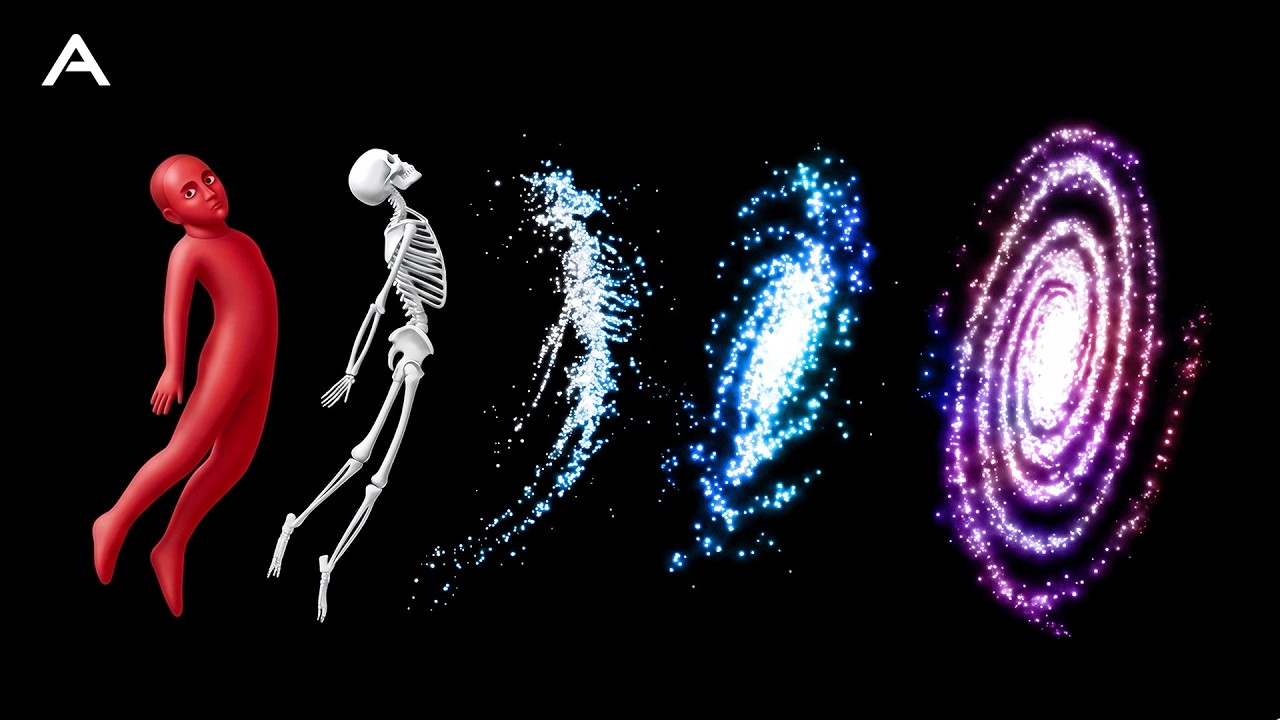
The Surprising Evidence our Universe is INSIDE a Black Hole
Math and Science builds the case that our entire observable universe might sit inside the event horizon of an unimaginably large black hole. The argument runs from John Michell's 1783 dark stars through Einstein's geometric gravity, Schwarzschild's solution, and the Event Horizon Telescope images of M87* and Sagittarius A*, to a striking coincidence: the math for a black hole interior and an expanding universe both begin in a singularity, and in some solutions both expand. It folds in Nikodem Poplawski's proposal that black holes might bounce and birth new universes. The video closes honestly on whether the idea can ever be tested, through the cosmic microwave background, cosmic geometry, and gravitational waves.
Published May 5, 202641:34 video23 min readAdded Jun 16, 2026Open on YouTube →
At a glance
Math and Science takes one of the strangest claims in cosmology, that our entire observable universe might be sitting inside the event horizon of an unimaginably large black hole, and builds the case for it from the ground up. The argument is not handed to you as a finished slogan. It is assembled, brick by brick, starting from what a black hole actually is and ending at the testable edge of where the idea could be confirmed or killed.
The spine of the case is a single coincidence that physicists keep tripping over: the math describing the inside of a black hole and the math describing an expanding universe look strikingly alike. Both begin (or end) at a singularity where the equations blow up to infinity. Both involve space itself stretching rather than matter merely moving. From the outside an observer sees a black hole; from the inside, the host argues, that same object could look exactly like a Big Bang followed by an expanding cosmos. Wrapped into that is the work of physicist Nikodem Poplawski, who proposed that collapsing black holes might "bounce" and spawn whole new universes on the far side.
The video walks the full path: John Michell's 1783 dark stars, Einstein's geometric gravity, Schwarzschild's exact solution, the Event Horizon Telescope images of M87* and Sagittarius A*, the singularity at the heart of both black holes and the Big Bang, and finally the experiments that might one day distinguish a black hole origin from an ordinary one. This page rebuilds all of it, in order, with the numbers and names intact.
Dark stars: the idea before the name (John Michell, 1783)
The story does not start with Einstein. It starts in the 18th century with a British clergyman and natural philosopher named John Michell. In 1783, more than a century before anyone had a modern theory of gravity to lean on, Michell proposed that if a star were massive enough and compact enough, its gravitational pull would be so strong that nothing could escape it, not even light. He called these hypothetical objects dark stars. The host wishes the name had stuck, and admits it sounds cooler than "black hole."
The point Math and Science wants you to hold onto is how far ahead of its time this was. Michell reasoned his way to the core of the black hole concept, an object so dense that light cannot leave, using nothing but Newtonian gravity and an escape velocity argument, more than 130 years before the physics that would make it rigorous even existed.
Einstein's gravity: geometry, not force (1915)
Fast forward to 1915, when Albert Einstein published his general theory of relativity. The radical move was to stop describing gravity as a force pulling between two objects and to describe it instead as the curvature of a unified structure called spacetime.
The host is careful about what that means. The three spatial coordinates X, Y, and Z are the familiar ones you picture on a graph. But the time coordinate is not an independent ticking clock running off on its own. It is a fourth coordinate stitched to the spatial ones. And mass and energy, in Einstein's theory, change the relationship between all four coordinates. That change in coordinate relationships is exactly what "bending" or "warping" spacetime means.
The standard picture is the bowling ball on a stretched rubber sheet, and the host uses it, but he is honest about its flaw. When you bend a flat two dimensional sheet, you bend it into a third dimension that does not live on the sheet. Our four dimensional spacetime has no extra dimension lying around to bend into that we can picture. So the warping is not literally a dip into some visible "down." It is the coordinate relationships between space and time shifting in the neighborhood of matter and energy. We cannot see that directly. What we see is the consequence: objects passing through appear to follow curved paths from the outside, even though in their own frame they are traveling in the straightest possible line through a curved spacetime.
The Earth analogy lands the idea. Walk across the planet putting one foot in front of the other and you feel like you are going perfectly straight. Locally you are. But the whole surface is curved, so over a long enough distance your "straight" path bends, not because a force shoves you, but because the geometry itself is curved on a scale you cannot perceive from the ground. You would only notice from an airplane. As the saying goes, matter tells spacetime how to curve, and spacetime tells matter how to move.
Figure 1. Gravity as geometry. The presence of the star changes the coordinate relationships between space and time. A passing object follows the straightest available path through that curved geometry, which we, watching from outside, read as a deflected, "attracted" trajectory. No force is required, only curvature.
Schwarzschild's solution and the event horizon
Just months after Einstein published the field equations, a German physicist named Karl Schwarzschild found an exact solution to them, the Schwarzschild metric, which described what we now call a black hole. The host stresses how hard this was. We are used to equations from algebra or calculus that you can write down and solve. The Einstein field equations are so difficult, and live in so many dimensions, that solving them exactly is often impossible. Schwarzschild found one of the rare exact solutions, and back then it came with zero observational evidence. It was pure prediction from a set of equations.
What the solution showed: compress enough mass into a small enough radius and the density climbs, spacetime curves more and more steeply, until you reach a point of no return, a boundary we now call the event horizon. Cross it, and the curvature is so extreme that every path leading away curves back toward the object. Nothing escapes, no matter how fast, not even light. That is literally why black holes are black. Light does not leave the interior, so the object emits nothing and looks like darkness.
The critical radius has a clean formula. The Schwarzschild radius is the size to which you would have to crush a given mass for it to become a black hole, and it scales in direct proportion to that mass. The Sun would have to be squeezed to a radius of about 3 kilometers. The Earth, to about 9 millimeters, the size of a marble. The chart below rebuilds that relationship and marks where real objects in the video land.
Figure 2. The Schwarzschild radius scales linearly with mass. Crush the Earth to a marble or the Sun to a 3 kilometer ball and either becomes a black hole. Scale the mass up to the supermassive monsters at galactic centers and the horizon balloons accordingly. The same straight line, run far enough, reaches a black hole whose interior could be the size of a universe.
Seeing the unseeable: accretion discs and the Event Horizon Telescope
If black holes emit no light, how do we see them at all? The answer is that we do not see the black hole. We see the brilliant chaos just outside the event horizon. Matter spiraling toward a black hole, pulled even harder than it would be toward an ordinary star because the object is so dense, swirls into a flattened ring called an accretion disc. Friction, rubbing, and compression heat that infalling gas and dust to millions of degrees, and the superheated material blazes across the electromagnetic spectrum, from radio waves to X-rays. It becomes a luminous beacon ringing the central darkness.
The host frames this as a prediction that preceded the observation. Take a piece of iron, drop it in a fire, and it glows. Gas compressed and accelerated into a black hole does the same, only it glows in X-rays and radio waves too. So the theory said: you will see a glowing disc around a pitch black center. And then we did.
In 2019, the Event Horizon Telescope, a planet sized array of radio telescopes working in concert across the globe to synthesize one enormous aperture, captured the first direct image of a black hole's shadow. The target was M87*, the supermassive black hole at the center of the galaxy M87, about 55 million light years away. The image showed a glowing orange ring around a pitch black circular shadow. The shadow is the black hole. The ring is the accretion disc and the photon sphere, the region where light orbits before either escaping or falling in.
There was a tell in the picture: the bottom of the ring is brighter than the top. That is relativistic beaming, the material rotating toward us appears brighter because of the extreme speeds involved.
Then comes the fact the host wants you to sit down for. Nearly every large galaxy, maybe all of them, has a supermassive black hole at its center. Our own Milky Way, a decent sized but not record breaking galaxy, hosts Sagittarius A*, a black hole roughly 4 million times the mass of the Sun. And the Sun is just an average star. In 2022 the same telescope imaged Sagittarius A* directly, confirming these monsters are not rare exceptions but fundamental components of galactic structure, possibly central to how galaxies formed and evolved.
Why image a black hole 55 million light years away before the one in our own backyard? Because looking toward our galactic center means looking through thick rings of dust that obscure the view. An external galaxy offered a cleaner line of sight, so M87* came first, and Sagittarius A* followed three years later.
The wild turn: are we inside one?
Here the video pivots to its real subject. We have looked at black holes from the outside. What if we are on the inside of one, a black hole so vast it is the size of the universe? Is there any evidence that our entire observable universe sits within an event horizon?
The host concedes up front that the idea sounds crazy, then argues it is less crazy than it first sounds, because it grows out of genuinely puzzling features of our universe that we have measured with real instruments.
Clue one: the universe is expanding from a singularity
Standard Big Bang cosmology says the universe began as an infinitely dense, infinitely hot singularity that started expanding about 13.8 billion years ago. Everywhere we look, galaxies are rushing away from us. And it is not that we are special: an observer in any other galaxy would see the same thing, everything fleeing from them too.
So where is the center? Where did the Big Bang happen? The host answers with the classic balloon analogy. Before the Big Bang there was no space and no time at all, the space he gestures through did not exist. So the right picture is not an explosion inside a pre existing room. It is the surface of an inflating balloon. Dot the balloon with marker and blow it up, and every dot recedes from every other dot. Stand on any dot and all the others flee from you. There is no center on the surface, because the center of the expansion is everywhere and nowhere. That is exactly what we observe: no matter where you look, everything is rushing away.
The host is careful to flag this as setup, not proof. The takeaway he wants banked: the universe is expanding, and it began in a singularity of rapid expansion long ago.
Clue two: both ends are singularities
Here is the hinge. Black holes also contain singularities at their centers, just as the early universe was a singularity. A singularity is a point where the density of matter or energy becomes infinite and our laws of physics break down. So: the Big Bang has a singularity, black holes have a singularity. Could they be related? The host is honest that this is a "gee whiz" observation rather than evidence, but it is a suggestive one. What if our singularity, the Big Bang, is just what a black hole's interior looks like from inside, the natural product of some cycle playing out on scales of size and time we cannot fathom?
And there is a second resonance. The event horizon is a boundary: inside it everything is trapped, and outside it you can never observe. When we peer into the deep universe with bigger and bigger telescopes, we hit a cosmic boundary, the edge of the observable universe, past which we cannot see. What if that boundary is us, on the inside of a black hole, looking out toward an event horizon we can never see beyond? If so, everything is sealed inside one horizon and we have no way to probe anything outside it.
What a singularity actually is
The host pauses to define the term properly, because it carries the whole argument. Start with Newtonian gravity: force equals G times mass one times mass two divided by R squared, where R is the distance between the objects. Push the two masses closer and R shrinks, so you divide by a smaller and smaller number, and the force climbs. Push them infinitely close and R approaches zero, and you are dividing by zero. Your calculator returns an error, because you cannot divide by nothing.
Does that mean gravity truly becomes infinite when two protons touch? No. It means the Newtonian theory breaks down in that extreme. When an equation spits out infinity, that is usually a sign the theory has left its valid range, not that nature actually reaches infinity. The same thing happens in Einstein's equations: plug the Schwarzschild solution into the very center of a black hole and everything blows up to infinity. We do not believe the curvature of spacetime is literally infinite there. We believe our current theories stop applying. A singularity, then, is the place where the math blows up to infinity and the physics is no longer trustworthy, and crucially, we cannot run experiments at those scales to fix it. You cannot build a black hole in a lab.
Clue three: the interiors expand, like the cosmos
This is the strongest thread. When you work through the equations for the interior of a black hole in general relativity, something unexpected appears: space inside the event horizon is expanding. It is not merely that matter falls in. In some solutions, spacetime itself stretches inside the horizon. The host underlines how rarely this is mentioned. We talk endlessly about the outside of black holes, the accretion disc, time dilation, things being ripped apart as they fall. We almost never talk about the interior, and the interior, in some solutions of the field equations, is stretching.
Now compare. When we look out at our own universe, we see space expanding, galaxies carried apart with new space appearing between them, and a singularity if you rewind the clock far enough. The mathematical structure of an expanding universe and the mathematical structure of a black hole interior share striking similarities. The host's provocation: what if the laws of physics we study, the way atoms are structured, the way photons behave, the rules whose origin we genuinely do not understand, are simply how spacetime behaves inside the event horizon of a black hole? We could never check by visiting a neighboring black hole, because nothing comes back out.
Figure 3. Black hole cosmology, nested. Our universe is one black hole interior inside a larger parent reality we can never reach. The billions of black holes at galactic centers inside our universe may each contain their own expanding universes, complete with their own galaxies and their own black holes. Cosmic recycling, all the way down.
Poplawski's bounce: black holes as cosmic wombs
The host now names the physicist behind the serious version of this idea: Nikodem Poplawski, who proposed that black holes might act as cosmic wombs, giving birth to new universes. The mechanism is a bounce. When matter collapses into a black hole, instead of crushing all the way down to a true infinite singularity, it might reach some critical density and rebound, and that bounce could trigger an expanding universe on the other side, completely disconnected from the parent universe where the collapse happened.
The host slows down to restate the whole arc, because the idea is large. A century and a half ago, Edwin Hubble and others looked at the redshift of galaxies and saw that everything is moving away from us, in every direction, which told us we are not the center and that the universe is expanding. Run that backward and you reach a singularity of infinite density. That picture matches the data extraordinarily well, which is why the Big Bang theory is so well supported, even though it is incomplete.
The evidence for the Big Bang, and the question it cannot answer
To be fair to the standard model, the host lays out its supporting evidence. The strongest is the cosmic microwave background (CMB), faint microwave radiation coming from every direction in the sky, a fingerprint of the early universe that has nothing to do with the stars. His analogy: imagine living inside an oven heated to 1,000 degrees, then switched off and left to cool. Look at any wall and you see roughly the same equilibrium temperature everywhere, with tiny hot and cold variations. That is the CMB, which sits a few degrees Kelvin above absolute zero. The energetic radiation released roughly 13.8 billion years ago has had its wavelength stretched as space expanded, cooling it exactly to the temperature we now measure. The match between prediction and observation is precise. The Big Bang model also correctly predicts the cosmic ratios of light atoms and isotopes through Big Bang nucleosynthesis.
But one question stays unanswered, for the host and for every scientist: where did the singularity come from? Rewind the clock and you reach an infinite point of matter and energy. Who or what put it there? What process could pack infinite density into a point that then expands into everything? The black hole bounce is one possible answer: maybe the singularity that started our universe was a black hole collapsing in a prior universe, its collapse triggering the expansion we call our Big Bang. Maybe there is a metaverse of black holes constantly birthing baby universes.
Higher dimensions and the boiling pot
The host grounds the "where does the bounce go" question in physics that is taken seriously. We know we have three dimensions of space and one of time, but theories like string theory and loop quantum gravity propose extra dimensions we do not directly interact with but that may form the deep structure of spacetime. When a singularity forms, it might trigger an expansion into one of those other dimensions, and whatever evolves there would only ever see its own local reality, never knowing what came before.
He closes the speculation with a vivid analogy: a pot of water heating on a stove. Before a full boil, hundreds of tiny bubbles cling to the bottom and sides of the pan, growing slowly. Tap the side of the pot from outside and the shock jiggles some bubbles loose; they detach and rocket to the surface, bubbling vigorously as they rise. A creature living inside one of those bubbles would see itself moving through its own space, surrounded by other bubbles all receding, with no clue about the pot, the fire, or the external tap that set it free. Maybe our Big Bang, our inflation, our whole cosmos, is one such bubble, formed by a process we have no way to interact with, with no access to whatever lies outside our local pocket.
The bow on the package: from the outside, an observer would see a black hole. From the inside, that same object would look like a Big Bang followed by an expanding universe. Cosmic recycling, where every black hole might contain its own universe, and our universe might be the interior of some mega black hole in a larger parent cosmos.
Where it stands
The host states plainly that this is still totally theoretical, with no definitive experimental evidence that we are inside a black hole, and that the scientific consensus treats these ideas as intriguing but speculative.
Established physics
Speculative leap
Black holes exist
Imaged directly: M87* in 2019, Sagittarius A* in 2022
That our whole universe is one
The universe is expanding
Hubble redshift, confirmed for a century
That the expansion is a black hole interior stretching
The CMB
Measured, matches Big Bang prediction precisely
That a bounce left a detectable imprint on it
Singularities appear in the math
Both Big Bang and black hole solutions blow up
That they are physically the same kind of object
Poplawski's bounce
A published, serious hypothesis
Unconfirmed; the mechanism is untested
So can it be tested? This is where it gets genuinely hard. By definition, if we are inside a black hole, no energy reaches us from outside, so we cannot directly confirm a parent universe. But there might, the host stresses might, be indirect probes:
The cosmic microwave background. If our universe bounced inside a larger black hole rather than emerging from a true singularity, it might leave subtle imprints in the CMB that differ from standard predictions. Physicists are searching Planck satellite data right now for anomalies that hint at a non standard origin.
Geometry and topology.General relativity allows different overall shapes of the universe, and some black hole universe models predict specific geometric properties measurable through precise observation of distant galaxies and the background radiation.
Gravitational waves. The LIGO and Virgo detectors already sense ripples in spacetime from colliding black holes and neutron stars. As they grow more sensitive and new ones come online, they might one day detect signatures that distinguish between cosmological models.
The honest bottom line the host lands on: we may never prove or disprove this. Being inside a black hole and starting from an ordinary Big Bang might produce observationally indistinguishable results, mathematically equivalent or so close that no measurement can separate them. We might simply never be able to tell which reality we are in.
Key takeaways
A black hole is a region where mass is compressed inside its Schwarzschild radius, curving spacetime so steeply that nothing, not even light, can escape the event horizon. The Sun would have to shrink to about 3 km, the Earth to about 9 mm.
We never see the black hole itself, only the superheated accretion disc outside the horizon. The Event Horizon Telescope imaged M87* in 2019 and Sagittarius A* (about 4 million solar masses) in 2022.
The core argument rests on a mathematical resemblance: both the Big Bang and a black hole begin or end in a singularity, and in some solutions, spacetime inside a black hole's horizon is expanding, exactly like the cosmos we observe.
A singularity is where the equations divide by zero and blow up to infinity. It signals that our theories break down, not that nature truly reaches infinity.
Nikodem Poplawski proposed black holes might "bounce" rather than fully collapse, birthing disconnected baby universes, which would make every galactic black hole a potential cradle for another cosmos.
The idea is real and seriously considered, but unproven. Tests using the CMB, cosmic geometry, and gravitational waves are being explored, yet a black hole origin and a plain Big Bang may be observationally indistinguishable.
Chapters
0:00 What if our universe is inside a black hole
1:10 What a black hole is: John Michell's 1783 dark stars
2:30 Einstein's general relativity: gravity as curved spacetime
6:00 Schwarzschild's solution and the event horizon
9:30 Why black holes are black, and the accretion disc
11:40 The Event Horizon Telescope images M87* (2019)
14:20 Supermassive black holes everywhere: Sagittarius A* and the 2022 image
17:00 The wild turn: could we be inside one?
18:30 Clue one: the expanding universe and the balloon analogy
22:00 Clue two: singularities at both ends, and the observable boundary
24:30 What a singularity actually is: dividing by zero
28:00 Clue three: black hole interiors expand like the cosmos
31:00 Poplawski's bounce: black holes as cosmic wombs
33:00 Evidence for the Big Bang: the cosmic microwave background
36:00 Higher dimensions and the boiling pot analogy
38:30 Cosmic recycling: black hole outside, Big Bang inside
40:00 Can we test it? CMB anomalies, geometry, gravitational waves
41:00 Closing: you might be looking around the inside of a black hole
Notable quotes
"Right now, as you watch this, you could be sitting comfortably within the event horizon, inside the event horizon of the most massive black hole imaginable, and you'd have absolutely no way of knowing it." (0:30)
"He actually called these hypothetical objects dark stars. And to be honest, I wish the name stuck because I think it sounds way cooler than black hole." (1:40)
"Matter tells spacetime how to curve and spacetime tells matter how to move." (2:00)
"If you cross that boundary and go inside that event horizon, the curvature of spacetime is actually so extreme that all paths trying to get away from the thing curve back around and take you back to the object." (6:40)
"That shadow is the black hole itself. We can't see anything in there because no light can come out of there." (12:20)
"The mathematical structure of an expanding universe and the interior of a black hole share really striking similarities." (29:40)
"We might be inside of an enormous parent black hole. And inside of this parent black hole, which we call the universe, is little baby black holes everywhere at the center of all these galaxies." (30:40)
"From our perspective inside our universe, observers from the outside would just see a black hole, but from the inside we would see like a Big Bang happening." (38:40)
"We may never be able to definitively prove this or disprove this hypothesis. It's possible that being inside of a black hole and being in a universe that started with a Big Bang produce observationally indistinguishable results." (40:40)
What if I told you that everything you've ever known, every star you've ever seen, every galaxy scattered across the dark night sky in the cosmos, and even the very fabric of space and time might exist inside of a black hole. Not orbiting a black hole, not near a black hole, but actually inside a black hole. Right now, as you watch this, you could be sitting comfortably within the event horizon, inside the event horizon of the most massive black hole imaginable, and you'd have absolutely no way of knowing it. Now, as crazy as this sounds, it's actually not science fiction. It's a legitimate scientific hypothesis that some physicists have seriously considered and put forward. And today, what I'd like to do is talk about the evidence and the reasoning behind this crazy sounding idea. And I think truly it will fundamentally change how you think about reality itself.
Now before we can understand how it's possible that we might actually be living inside a gigantic black hole, we first need to understand what exactly a black hole is. Now this story I think is actually fascinating and it actually begins in the 18th century with a British clergyman and natural philosopher named John Michell. Now, way back in 1783, Michell proposed that if a star were massive enough and compact enough, its gravitational pull would be so strong that nothing could escape, not even light could escape. Now, he actually called these hypothetical objects dark stars. And to be honest, I wish the name stuck because I think it sounds way cooler than black hole. Now, this was actually an amazing idea because it was more than a century before Einstein actually revolutionized our understanding of gravity and space and time.
Now, let's fast forward from the 1700s all the way to 1915 when Albert Einstein published his general theory of relativity which described gravity not as the force between two objects but as the curvature of space and time which is unified under a common structure called space-time. So the spatial coordinates XYZ are coordinates you might be thinking of in your mind when you visualize a coordinate system. But the time coordinate actually is not an independent ticking separate from everything else. It is a coordinate attached to the spatial coordinates. And it turns out that mass and energy in Einstein's theory actually can change the relationship between the coordinates. That's what we call bending or warping of space-time. So whereas gravity previously was described as a force that existed across space, now it's considered in that framework the curvature of space and time itself.
Now these massive objects like planets and stars, they bend this coordinate relationship between space and time kind of like a bowling ball placed on a stretched rubber sheet might depress and bend the nature of the sheet. That's not a perfect analogy because when a sheet, which is a two-dimensional flat surface, is bent, that sheet is bent into another dimension that doesn't exist on the sheet, the third dimension. And so it's very hard for us to visualize in our mind how a four-dimensional space-time XYZ and time could be bent. But really what's happening is the coordinate relationships between XYZ and time basically change in the vicinity of matter and energy. So whereas we can't see it with our eyes, the manifestation of that is that objects traveling through appear to be bent from our outside perspective. Even though on their own trajectories, they're actually following a straight line or the straightest line that they can follow in a curved space-time. To us, it appears to be a curved path even though they are traveling in a relative straight line in their own frame of reference. We perceive that as a force acting from the outside but actually it's not a force. It's just a geometric effect of matter traveling through a curved space-time. Basically there's an old saying: matter tells space-time how to curve and space-time tells matter how to move.
So if this is a star in an otherwise undisturbed space-time, the presence of the matter actually changes the relative coordinate relationships between space and time. That's what we call bending of space and time. So matter, in this case a star, tells space-time how to curve. Now when a separate piece of matter comes in the vicinity of this curvature, space-time tells matter how to move. That's the second part of it. And basically this object here as it's traveling near the gravitational well of this thing, in its own frame of reference is trying to take the shortest path through space-time. But much like when you walk on the surface of the earth, you might be walking one foot after another. And to you, you're traveling in a straight line because locally when you look down at the surface of the earth, you're traveling with one foot in front of the other. But globally, the entire surface of the earth is curved. So locally you're traveling in a straight line, but globally when you look at it over a large distance, you're actually traveling in a curved path. But it's not because of a force pushing you around. It's because the actual geometry of the space is curved on a scale that you don't perceive unless you get in an airplane and can somehow see it from far away.
Now, what happened is Einstein published this monumental theory describing gravity as a geometric effect of space-time. And just months after he published that famous theory, a German physicist named Karl Schwarzschild found an exact solution to Einstein's equations that described what we now call a black hole. You see, when we think of equations, a lot of us, we think of what you learned in algebra or maybe calculus or something. And usually you can write them down and solve them. But when Einstein published his equations, they're so difficult and they're in so many multiple dimensions that it's very hard, actually impossible in a lot of cases, to actually solve them and write down a solution. So people like Karl Schwarzschild, they spent a long time taking the equations that Einstein put forward and finding solutions to the space-time curvature in certain situations. And that's what happened. He basically figured out the solution to the Einstein field equations that lead to the structure that we now call a black hole. But of course back then they had no observational evidence for this. It was just a solution to a set of equations that predicted something.
Now what Schwarzschild discovered was that if you compress enough mass into a small enough radius, what happens is the density gets higher and higher and you curve space-time so much that you can create kind of a point of no return, so to speak, a boundary. We now call it the event horizon, which is what you've probably heard. Now, if you cross that boundary and go inside that event horizon, the curvature of space-time is actually so extreme that all paths trying to get away from the thing curve back around and take you back to the object. So, there's no escape for anything, no matter how fast you're going, not even light. Now, this is actually why black holes are black. They don't emit light because the light is trapped inside the event horizon. There's a little bit of a caveat I'll come back to, but what I've said so far is accurate.
Now, how do we see black holes in the sky if they're black? And the answer is we don't actually see the black hole itself. What we observe is the brilliant chaos just outside the event horizon. That's what we can actually see. So what happens is as matter is sucked into this black hole just like it would be attracted to a star but it's more dense so it's pulling it with more force, as it comes in it starts to swirl into the black hole and it forms a disc around the object that's called an accretion disc. It's a swirling disc and plume of gas and dust that actually gets heated up to millions of degrees as it falls in due to friction, rubbing and compression of the material as it comes into the black hole at a high rate of speed. Now this superheated material actually emits intense radiation in various directions in the electromagnetic spectrum, from radio waves to X-rays and beyond, and it creates kind of a luminous beacon around the darkness which is at the very center of the black hole.
So, it's true that any photon from the surface of the black hole, if it tries to escape, it can't because the gravity is so strong and the space-time curvature just bends the trajectory back down essentially into the object. So, if they're glowing or not, we don't know because any photons just come right back and we can't see the actual black hole itself. But what we do see and what we have seen is actually this accretion disc. So what the theory predicted ahead of time before any observations is that as matter gets swirling in and coming into that black hole, it's being compressed as it's basically sucked in and accelerating and crashing into each other almost like shock waves in the gas as it gets in there. Now what happens to things when they heat up? I mean if you take a piece of iron, put it in a fire, it heats up and it starts to glow. The gas behaves the same way. The compression heats it up. It starts to glow. But not just visible light. It glows in X-rays and radio waves and all this stuff. So we can actually see the glowing accretion disc surrounding a pitch black center.
Now in 2019, humanity achieved something absolutely extraordinary. Something called the Event Horizon Telescope (cool name, by the way) is a planet-sized array of radio telescopes working in concert all around the world, effectively giving it a very large aperture. And it captured the first direct image of a black hole's event horizon. Now, the target for that first image, which I'm sure you've seen, was the super massive black hole at the center of a galaxy called M87. That's about 55 million light years away. Now with that image, what we saw was breathtaking. What we see is a glowing orange ring of light surrounding a pitch black circular dark shadow in the center. That shadow is the black hole itself. We can't see anything in there because no light can come out of there. Basically there's a photon sphere where light orbits the black hole before either escaping or falling in. Inside the event horizon, we can't see anything at all. But what we do see is the glowing photons coming from the matter that's being compressed as it falls in from the outside. Now this glowing ring is the accretion disc we talked about and as gas spirals in it accelerates to a very high rate of speed crashing, compressing, releasing photons and that's what we see. So we don't see the black hole itself. We see the material just outside the event horizon radiating light.
Now the image actually showed something else that's pretty remarkable. The bottom half of the ring appears to be brighter than the top part. This is due to something called relativistic beaming, where the material moving towards us appears brighter because of the extreme speeds involved.
Now, sit down for a second because I have a truly mindblowing fact I want you to internalize because it's crazy. At the center of most large galaxies, maybe even all galaxies, they appear to all have super massive black holes at the center of the galaxies we can observe. Our own Milky Way galaxy, which is a pretty large, not the largest, but a pretty good-sized galaxy, hosts a black hole. It's called Sagittarius A*. It's a black hole with a mass of about 4 million times that of our sun. Now, it's really easy to overlook these big numbers. Think about that. Think of the sun in the sky. We think of it as this giant star. Actually, it's just an average-sized star, but we think of it as a big star. And Earth is tiny. Right now, this black hole in the center of our galaxy is about 4 million times the mass of our sun. And our galaxy is not even like the biggest galaxy around. There's plenty of galaxies bigger than ours. So, the size of these black holes are truly incomprehensible.
Now, you might say, why don't we take a picture of the black hole at the center of our galaxy? Why are we looking so far out? Well, in 2022, the same telescope captured an image of the black hole at the center of our own galaxy, confirming that these cosmic monsters are not rare, but actually fundamental components to galactic structure. They may have even played a crucial role in the formation and evolution of galaxies throughout cosmic history. And by the way, why didn't they try to take a picture of this fairly close black hole first instead of the one 55 million light-years away and center of another galaxy? It's because looking toward the center of our galaxy, there's lots of dust in the way, lots of rings of dust, and it kind of obscures what's happening in the center of our galaxy. They eventually got the picture, but they first trained the telescope on an external galaxy that is not blocked as much by dust, so we could get a good image of that. And then they subsequently took a picture of the black hole much closer to us.
So now that we talked a little bit about black holes from the outside looking in, here's the truly wild part, the core of what I really want to talk about. What if, or is it possible, that we're on the inside of one of these black holes bigger than we can even comprehend, as big as the universe? What evidence exists, if there is any evidence, that our entire observable universe might actually be inside of a black hole? Now, this idea, it sounds crazy, right? But actually, it is not quite as crazy as it first sounds. And it stems from some really puzzling observations about our universe that we've measured with instruments over the years.
First, let's talk about the Big Bang, right? The standard cosmology Big Bang. It tells us that the universe began from an infinitely dense, infinitely hot singularity that suddenly began expanding about 13.8 billion years ago. Right? Everywhere we look in the sky, we see everything rushing away from us. And we know from how the universe is constructed that if we lived in another galaxy, we would look everywhere from there and we would see everything rushing away from us there. No matter where you are in the universe, everything is rushing away from you. So the common question is where is the center of the universe? Where did the Big Bang happen? Well that's not really the way it worked because before the Big Bang there was no time and there was no space. The thing that you call space, the thing I'm raising my arms in, that did not exist before the Big Bang happened according to the Big Bang model of the universe.
And so that means it's closer to the surface of a balloon. If you take a balloon and it's very small and you start blowing it up, if you put dots all over that balloon, like little dots with a marker and blow it up, then as the balloon inflates, the dots are going to get farther and farther apart from each other. That is what you would guess. Now, if you lived on one of those dots on the surface of that balloon, looking in all directions on the surface of that balloon, and you see a dot way over there, and a dot over there, and a dot way over there, as the universe were inflating, you would look in your perspective, and all the other dots around you would appear to be moving away. But what if you didn't live there? What if you lived on the other side of the balloon on a different dot? You see, the whole universe is expanding in space which in this analogy is the surface of the balloon. It's being created as the thing expands. So if I live on the other side of the balloon on another dot I would be looking at all the other dots in my vicinity and I would see them all moving away from me. So the center of the universe is everywhere because no matter where you are, everywhere you look, everything is rushing away.
So, I wouldn't really call it evidence, but I just want you to remember that we know the universe is expanding. And we know that it started from some sort of singularity event of rapid expansion a long, long time ago. But here's the thing. Black holes also contain singularities at their center, much as we posit that the early universe was a singularity as well. And these singularities, what they are is points where the density of whatever matter or energy becomes infinite and our current laws of physics break down. In other words, could the Big Bang singularity and a black hole singularity be somehow related? Some physicists might think there could be a connection. Now, admittedly, again, this is not really evidence. It's just more like, huh, check it out. Big Bang has something called a singularity. Black holes have something called a singularity. Hmm. What if we're inside one of these things and our singularity, what we call the Big Bang, where did it come from? Maybe that's a natural cycle that happens on black holes over enormous time scales that we can't fathom and enormous sizes as well.
Is it possible that the observable boundary of the universe is us looking out towards the event horizon? Remember we said things that are inside the event horizon can never escape. And the event horizon is like a boundary inside of which everything is stuck and outside of which you can never observe. As we peer into the distant universe, we can see earlier and earlier galaxies. But there is a cosmic boundary to that which we can see looking back in time. As we use bigger and bigger telescopes to look out into the universe, is the boundary of what we can see, what we call the observable universe, is that really us on the inside of a black hole looking out towards the event horizon beyond which we can't see? Again, it's not proof of anything. It's just like, wow, could that be the case? If that's the case, then everything in the universe is inside some event horizon, and we would have no way to probe anything on the outside to check any of it.
Let me stop for a second and talk about singularity. What am I talking about? All right. So when you learn about gravity, you learn that the force of gravity (I'm talking about Newtonian gravity, not relativity theory) is a gravitational constant G times the mass of one object times the mass of another object divided by R squared. R is the distance between the objects. And what that means is the farther objects are away, the weaker the gravity is. But the closer the objects are together, if you make R the radius or the distance between them go smaller and smaller, then you're dividing by R squared. You're dividing by a smaller number. That makes the gravitational force go up and up and up. But what happens if you could take two pieces of matter and put them right on top of each other or infinitely close to each other? Then R would approach zero. And you're dividing by zero. You know what happens when you try to divide by zero in your calculator or your computer? Basically, you can't do it. It says error because you can't divide by nothing, right?
Now, does this mean that it's a real singularity where the force of gravity goes literally to infinity when we take two protons and put them on top of each other? Well, really what it means is our theories of gravity, that Newtonian theory of gravity, breaks down when we bring things too close together, because we get an infinity. Generally, if an equation gives us infinity for an answer, then we suspect probably something is not quite correct. Like maybe it's really good at describing most situations. But in this extreme situation, when we bring things on top of each other, maybe it breaks down and it's not a good representation of what's going on. But in any case, that's what a singularity is. It's when your mathematical result blows up to infinity because you're dividing by zero. Now for Newton's gravity it's when you bring two things very close together and make the radius equal to zero. Well in Einstein's field equations when you look at Schwarzschild's solution for a black hole you're going to find out that when you go to the very center of the thing all of the equations blow up to infinity. So that means it's probably not quite right. We don't really think that the curvature of space-time becomes literally infinite. Usually things don't ever really and truly go all the way to infinity, but we have no way to experiment on those scales. So, we can't probe it or come up with a new theory because it's not like we can build a black hole in the lab and study it. So, what we know is that there's some kind of singularity there where our current theories of physics and equations don't really apply or break down.
So one of the strongest pieces of evidence from this connection of looking at black holes and looking at the Big Bang is basically looking at the mathematical similarity between the singularity you get in a black hole and the singularity you get in the Big Bang model of the universe. And when we look at the equations describing the interior of a black hole in general relativity, what we find is that space inside the event horizon is expanding. And it's not just matter falling in. We're saying that inside the singularity of a black hole, space-time itself is actually stretching. Now, let me ask you a question. Does that sound familiar? That's exactly what we observe when we look out into the universe. Everything rushing away, expanding. Space itself is expanding. We observe this. It's factual. And we see that the galaxies are being carried away from each other, getting farther and farther apart with new space in between. The mathematical structure of an expanding universe and the interior of a black hole share really striking similarities.
Now, sometimes when you make a point, you have to really talk about the point because otherwise you could just mow over it and you don't even realize how important it is. Think about that for a second. What we're saying is not only in our theories of black holes, from the Einstein field equations, we see singularities, right? Infinities basically. And when we study the Big Bang model, we have infinities at the beginning of the Big Bang, right? So that's pretty similar. But in general also, when you actually dive into the details of that Schwarzschild solution of what a black hole is inside the event horizon, we don't have a good understanding of what's happening because the equations may not totally be accurate when space is extremely warped like that. But the current equations actually show in some solutions space-time expanding inside the event horizon of a black hole. Now that's something that we don't usually talk about when we talk about black holes. You talk about stuff falling in from the outside. What happens as you fall in: time slowing down near a black hole due to time dilation and other things. We talk about the heating up and the compressing and the accretion disc, but normally we don't talk about what's happening inside the event horizon. But the solutions of Einstein field equations say that space-time inside the black hole in some solutions could be expanding.
Now we have no way to test it because we can't go inside a black hole and do an experiment. But wait, if we look out in our universe, we actually see space expanding. We see everything rushing away from each other. And if you wind the clock backwards all the way when things were closer together, there is a singularity there. So that is again not proof but it is an interesting thing to think about because normally we think about things falling into a black hole being ripped apart and all of this stuff, but actually what if the way atoms are structured, what if the way chemistry happens, what if the way photons work, what if the laws of the universe that we really don't know where they come from but we study them, what if it's possible that they are the way they are because that is how space-time behaves inside an event horizon of a black hole? I mean, after all, how would we know? We can't go into the black hole of some neighboring black hole somewhere.
So, in other words, we might be inside of an enormous parent black hole. And inside of this parent black hole, which we call the universe, is little baby black holes everywhere at the center of all these galaxies. And all of the laws of physics that we have (inertia, Newton's laws, gravitation, time dilation, space-time, all that stuff that we're like, gee, where did all that come from?) maybe that's how space-time behaves inside an event horizon of a black hole. Maybe it's how it exists inside the event horizon of a black hole that's at the center of our galaxy, but we can't travel there and go inside to check it out. Maybe the laws of physics have their own unique set of circumstances. Maybe it depends on how the black hole was formed or other variables we just can't interact with. So we don't know. But it's possible that all of these laws of physics are just the way they are inside black holes. And don't forget we see black holes literally everywhere in this universe. We think every galaxy, of which there are billions and billions of galaxies, have a black hole at the center. And there could be rogue black holes all over the place that are not at the center of a galaxy as well. They're hard to detect and we can only now, as of a few years ago, even image these gigantic monster black holes that are nearby.
Now I want to introduce you to the work of a physicist by the name of Nikodem Poplawski who proposed that black holes might act as cosmic wombs, so to speak, giving birth to new universes. So when matter collapses into a black hole, this physicist Poplawski suggested that it might not just crush into a singularity, which is kind of what we think of when a black hole forms. But actually it could instead undergo a bounce, so to speak, when it goes in there maybe bouncing or having some other interaction at the moment of the formation of that singularity, creating an expanding universe on the other side completely disconnected from the parent universe where the singularity formed.
Again. Some ideas are so big that we have to just put the brakes on, stop and rephrase it again. What we're basically saying is, a couple hundred years ago, 150 years ago, people look up at the sky, Hubble and other people, and they look at the red shift of galaxies everywhere, and they're like, "Huh, all of the light from the galaxies are redshifted. That means they're moving away from us." And no matter where we look in the sky, everything's moving away from us. We're certainly not the center of the universe. So, why is everything moving away from us? Well, maybe there's this Big Bang where everything is formed. Space and time is being created. And if you rewind the clock back back back, then this singularity of infinite density of mass and energy was there and suddenly it had some event happen and rapid expansion happens. And that theory very much agrees with what we see in the universe. There's lots of evidence for the Big Bang theory of the universe. We know it's not complete but there's lots of evidence.
For instance, when we also look at the cold dark reaches of space, again in every direction, we see microwave background radiation. It's everywhere. And it's like a fingerprint of whatever happened a long time ago. It's in between the stars. Has nothing to do with the stars. It's everywhere no matter where you look. It's kind of like if you lived inside of an oven and I turn the oven up to 1,000 degrees, but then I turn the oven off and it cools down, right? And then suddenly some planet of life is in the center of this oven. And then eventually little creatures start to look around. They look at all of the walls of the oven, down, up, left, right, everywhere. And they see it always at a certain equilibrium temperature no matter where they look. There's little variations hotter and colder as they scan the whole sky, which is what we see when we look at the cosmic microwave background, but more or less it's all a few degrees Kelvin above absolute zero in terms of the temperature of what you're looking at. And it turns out that the radiation released from the Big Bang, which is very energetic 13 and some odd billion years ago, as it gets stretched out and cools off as space and time stretch pulling the electromagnetic radiation from the formation of the Big Bang, stretching the wavelength, and you fast forward the clock 13 billion years, we've calculated that whatever energetic energy was there, the wavelength should be stretched. So it's much much colder now. And the temperature of the radiation that we would expect to see if it's basically cooling off of radiation from the Big Bang exactly matches what we actually see when we look in the night sky. So there's lots of evidence for the Big Bang theory of the universe. And there's more beyond this. It predicts the ratios of different atoms and isotopes that we see in the universe. It predicts lots of things.
But there's still one nagging question that everybody has, including me and including every scientist, about the Big Bang model of the universe. Where did the singularity come from? In other words, you rewind the clock back and everything gets to an infinite singularity point, infinite density of matter and energy. So the first question is, well, who put that there? You know, maybe your beliefs mean you think somebody put that there. Or if you don't believe that, maybe you think, how did that come to be? Where did that come from? What process could possibly put infinite matter and density into a point which then starts to expand and go everywhere and make everything, right?
Well, maybe, just an idea, according to this physicist, that maybe when a black hole forms (after all, remember our theories of space and time break down because it's infinite matter and density, so we know that infinite matter and density are not real, so what it really means is the physics that's going on at the moment of the formation of a singularity is not understood by us, we can't do experiments to probe it). So possibly when something collapses into what we call the singularity, maybe it doesn't go to infinite matter and energy, maybe what happens is some sort of bounce occurs, or it gets to some critical density approaching a singularity. And when that happens, it triggers a singularity and an expansion in another dimension outside of the current universe. And maybe, again, it's just an idea, but maybe the singularity that happened to start our universe was from some black hole collapsing into a singularity before this one happened, before this universe happened. And when that collapse happened, it created a singularity which then rapidly expanded into this. So maybe there's a metaverse way beyond what we can imagine where these black holes or whatever you want to call them are forming and producing baby universes all the time.
Now I know this sounds like Star Trek stuff, right? But here's the thing. We know how big the universe is. That is fact. We know how stars form. That is fact. We know that black holes form. That is fact. We cannot probe inside of a black hole because we'll never be able to come out. And also they're all really far away. We can't travel there and really see with our material bodies what's inside of there. But we have theories of physics. We know they break down inside. We have no way of making better theories at least yet because we can't really do experiments with that. Now, we know that higher dimensionality exists. We know that we have three dimensions of space and one of time. But there are many theories of physics that propose higher dimensionality, in string theory and loop quantum gravity and other theories as well, that have higher dimensionality that we don't directly interact with but do form the fundamental structure of our space-time. And it's possible that when a singularity forms, it triggers something in one of these other dimensions and whatever evolves in that other dimension would only see what they have locally and they would never know what came before.
I'll leave you with one analogy. Again, it's just an analogy. Imagine a pot of water on the stove and you put some water in it and then you turn the fire on underneath the pot. Now, let's say that after some time, you start to see a little shimmering, little heat happening in there. But eventually on the bottom of the pan, you're going to see a bunch of little bubbles which are attached to the bottom before boiling happens. And these bubbles are going to start microscopic, but then they're going to get a little bit bigger, a couple millimeters, and there's going to be hundreds of them all on the bottom of the pan. Now, if you keep going with the fire, eventually one of them will detach and float up like this, another one, and so on. But what if you didn't actually let the fire go that long? What if you just kind of watched it right when the bubbles were all attached to the sides and to the bottom of this pan? And what if you, just as an external entity, walked over and kind of tapped the side of the pan? You would send a shock wave through the metal. It would jiggle the bottom and some of these bubbles would detach because of the force that you impart on the pot, right? And then as it floats up, it's going to start to vigorously bubble and so on. Maybe the formation of our universe in terms of a Big Bang and inflation and all the things that happen to create everything we see, maybe it's kind of like that. Maybe we live in some gigantic pot of water (not really, but I'm just saying as an analogy) where baby universes can be formed all the time through processes that we have no way of interacting with. And once one of them detaches from the bottom, they are on a rocket ship straight up to the top. And from their point of view, if they lived on a planet inside of that bubble, they'd be like, "Wow, we're moving through our space-time and we're looking at all these bubbles everywhere and they're all moving away from us." But they would have no idea about the pot. They would have no idea about the fire. They would have no idea that some force kind of tapped it from the outside to start it. Much like if we are living inside of a black hole, we would have no idea about some prior black hole before, or whatever structure it is collapsing and triggering this space-time to do whatever it did at the beginning of our universe. We would have no way to interact with anything outside of our local bubble. Just like those bubbles in the pot would have no way to travel between universes if they were living inside of that pocket of water vapor.
I know these ideas sound crazy and weird, but I do want you to give them serious consideration and thought because the similarities between black holes and the Big Bang are actually pretty striking. So to wrap it all up in a bow, from our perspective inside our universe when we would see the Big Bang or observe everything, from the outside observers would just see a black hole, but from the inside we would see like a Big Bang happening. That's what we see when we look out. It's kind of like cosmic recycling where every black hole might contain its own universe and our universe might be the interior of some mega black hole in some larger parent universe, unfortunately, that we can't really interact with.
But I want to be clear, this is still totally theoretical. There's really no definitive experimental evidence proving that we're inside of a black hole. It's just an interesting idea and like, hmm, are there any experiments we can do to try to prove or disprove this? Now the scientific consensus remains that while these are really intriguing they're totally speculative.
So that brings us to the following point. Is there any way to test this? Can we prove or disprove this idea once and for all that we're living inside of some kind of mega black hole structure? Now, this is where things get actually pretty challenging because the fundamental problem is that if we're inside of a black hole, we can't actually see beyond the event horizon from our perspective looking out by definition. No energy can reach us from the outside by definition because it gets destroyed as it enters into the black hole. Everything gets ripped apart and all the entropy goes up and everything gets destroyed, right? So, we have no way of directly confirming the existence of a parent universe if we're on the inside looking out.
However, there might, and I do stress might, be indirect ways to at least test these ideas. One approach is actually looking for signatures in that cosmic microwave background energy that we talked about just a second ago, the afterglow, so to speak, of the Big Bang. Looking for signatures in that radiation which surrounds us in all directions. And the idea here is if our universe underwent some kind of a bounce inside of some larger black hole rather than emerging from a true singularity, this might leave subtle imprints in the cosmic microwave background that differ from the standard predictions that we have in the regular model. And there's actually physicists looking into this right now. They're looking at that cosmic microwave background data from satellites such as the Planck satellite, searching for anomalies or fingerprints in the cosmic microwave background that might hint at non-standard origins. In other words, we posit the Big Bang as some singularity. Are there differences in how one of these bounce situations would happen that would leave a certain kind of imprint on that microwave background radiation? Could we look at that and would it differ from the standard model enough to maybe say it could be true?
Now, another test involves the universe's overall geometry and topology. Now, general relativity allows for different possible shapes of the universe. And some black hole universe models predict specific geometric properties that we could potentially measure in our universe right now through precise observation of very distant galaxies and that background radiation. We also have gravitational wave observatories and they might provide clues as well. The LIGO and Virgo detectors, those are gravity wave detectors that we actually have, opened a new universe on detecting ripples in space-time from colliding black holes in our universe and also neutron stars. Now, as these detectors become more and more sensitive and as new ones actually come online with newer technology, we might be able to detect (and I do say might be able to detect) gravitational wave signatures that could help distinguish between cosmological models.
But I got to be honest here. We may never be able to definitively prove this or disprove this hypothesis. It's possible that being inside of a black hole and being in a universe that started with a Big Bang produce observationally indistinguishable results. In other words, we may not have anything we can look at to help us determine which path we're actually on and what our origins actually were. The two scenarios might be mathematically equivalent or so close that we can't tell the difference. And so, we won't be able to really tell potentially which reality we're actually in.
Now, as we reach the end of this cosmic journey, I want you to take a moment and let all of this stuff sink in because there's some big ideas here. You might be living inside a black hole right now. Everything you see, everything that exists in our observable universe might, and I do say might, be contained within an event horizon of a black hole of incomprehensibly massive size in some larger reality that we can never probe, experiment on, or really observe. And if that actually is true, then every black hole we've ever observed, from stellar mass black holes formed by collapsing stars to the super massive giant black holes at the center of galaxies that we see when we look out there, they might contain their own universes complete with their own galaxies, their own stars, planets, maybe even their own civilizations pondering the same questions that we're pondering right now. So the next time you look up at the night sky, I want you to remember you might not just be looking out at the universe. You might be looking around at the interior of the most magnificent black hole ever conceived. And somewhere in some parent universe that we can't directly interact with, our entire cosmos might be nothing more than a point of darkness against their starry sky.
So, I want to close by saying thanks for hanging out with me today. These are big ideas and I really want to know what you think and what you feel about all of this stuff. So, please drop me a line. Let me know what you think. Do you think we're living inside of a black hole? What would it mean to you if we actually were? And as you ponder this and all other mysteries in nature, I want you to always remember to stay curious. Learn anything at mathandscience.com.