At a glance
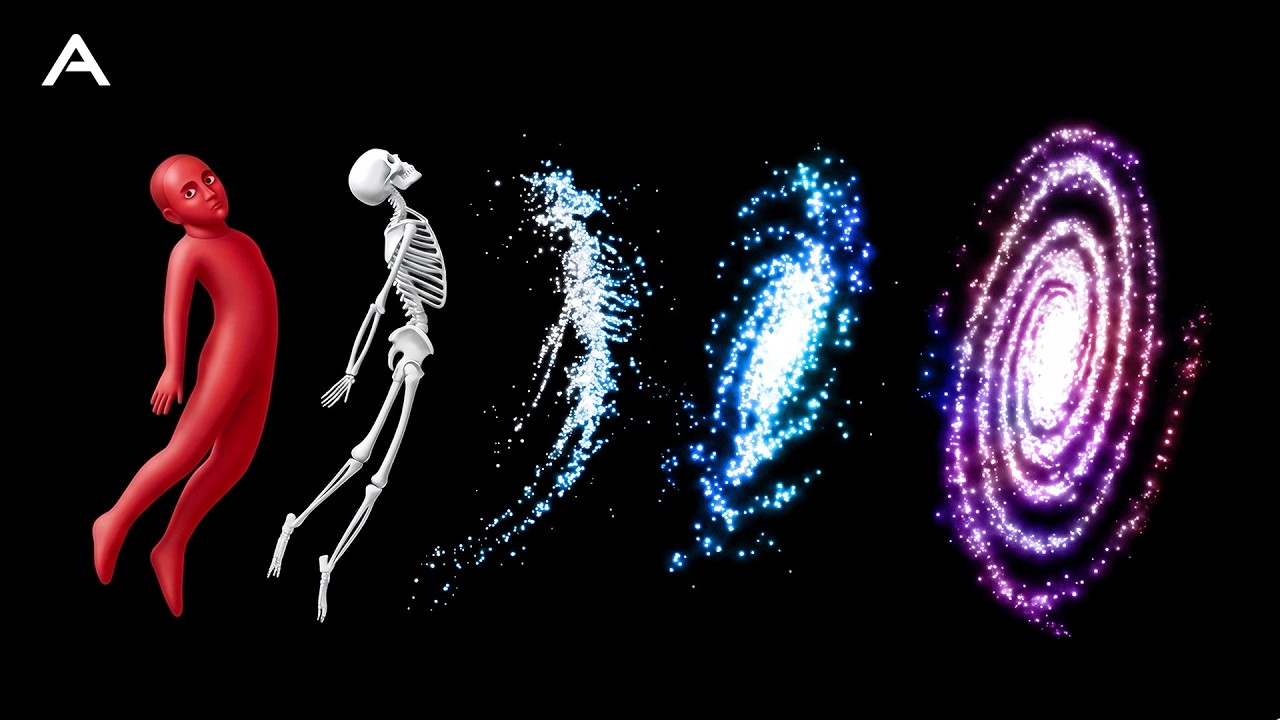
For ninety years dark matter has been the universe's silent operator, six times more abundant than ordinary matter yet completely invisible, known only by the gravitational grip it holds on everything we can see. We have hunted it with particle accelerators, buried detectors, and telescopes, and come up empty every single time. Then in November 2025 a paper out of the University of Tokyo claimed something nobody had managed before. By combing fifteen years of data from the Fermi gamma ray space telescope, astrophysicist Dr. Tomonori Totani found a faint, structured glow of gamma rays shaped exactly like the dark matter halo that is supposed to wrap around our galaxy, and peaking at an energy of 20 giga electron volts, right where the annihilation of a WIMP, one of the two leading dark matter candidates, would put it.
Alex McColgan walks through the whole case in this Astrum video: the 1933 discovery of the missing mass, why dark matter is invisible, what a WIMP is and how annihilation would betray it, the painstaking source by source subtraction that revealed the halo shaped signal, and the serious reasons to stay skeptical. This page rebuilds that argument in full, in order, with every number, every name, and every caveat. The honest verdict is that this is the most exciting observational lead in decades and still not proof. The case is not closed.
A ninety year old cold case
The video opens like a detective story, because that is exactly what dark matter is. There is a silent operator lurking in the shadows of the universe, something that does not emit light, does not reflect it, and cannot be seen by any telescope we own, despite there being roughly six times more of it than there is of the regular matter that makes up you, me, and every star. It is fundamental to our models of the cosmos, and we still do not have a clue what it is. Physicists everywhere have thrown state of the art particle accelerators, deep underground laboratories, and telescopes at the problem, all chasing direct evidence, all coming back with nothing.
Then November 2025 broke that streak, or seemed to. A paper landed that rocked the community. While trawling all the data from the Fermi telescope, a researcher may have captured a glimpse, a telltale signature coming from inside the Milky Way itself. The question Alex sets up front, and the one the whole video is built to answer, is whether we can be sure dark matter produced this signal, and whether it will finally tell us what dark matter actually is.
What I'm talking about, of course, is dark matter. It's fundamental to our models of the universe. And yet, we still don't have a clue what it is. Alex McColgan, 0:42
The discovery: Zwicky and the Coma cluster
The father of dark matter is Fritz Zwicky, a Swiss astronomer born in 1898 who spent most of his life at the California Institute of Technology. He arrived at Caltech inside a group studying the physics of crystal structure and was swept up into the newly emerging field of cosmology, which became his passion. He was famously eccentric, but his legacy is his discoveries. His work on the origin of cosmic rays led him to coin the term supernova. He cataloged tens of thousands of galaxies and published hundreds of papers across astronomy. None of it is what he is remembered for.
In 1933, aged 35, Zwicky was measuring the red shift of galaxies with the Mount Wilson telescope, the very instrument Edwin Hubble had used a few years earlier to prove the universe is expanding. Red shift is the stretching of light on its journey from source to observer: the more it stretches, the longer the wavelength and the redder the light, which tells you the source is moving away from you. Zwicky zeroed in on a small patch of sky in the Coma Berenices constellation, near the Milky Way's north pole, and saw something impossible. Galaxies inside the Coma cluster were moving at speeds the accepted laws of physics could not explain.
Sitting at his desk, he computed the spread in velocities across eight of those galaxies. It came to more than 2,000 kilometers per second. At those speeds the cluster should have torn itself limb from limb long ago. To reconcile what he saw with the numbers on the page, Zwicky calculated the cluster's mass and realized the gravity of the visible stars and gas was nowhere near enough to keep the galaxies bound. He found the system needed roughly ten times more mass than had ever been observed, just to hold together. Something more had to be at work, something dark enough to stay hidden, lurking inside the cluster, anchoring the galaxies in orbit. He had no idea what it was. Neither, ninety years later, do we.
What is dark matter, and why is it invisible
Dark matter's identity has plagued cosmologists ever since the Coma study. The name is literal. This is a substance that does not interact with light, and that is a deep problem, because light is the primary tool we use to probe the universe from the smallest scales to the largest. Dark matter does not emit light. It does not reflect light. It does not even absorb light to cast a shadow. It is, Alex stresses, truly invisible. So, exactly like Zwicky, we cannot look at it directly. We can only watch its ghostly gravitational effect on the visible things around it and infer that it is there.
We know it is there, and we know it pulls gravitationally on ordinary matter. We do not know what it is made of. The two leading theories the video names are WIMPs and axions, and we have found no hard evidence for either, right up until November 2025, when the news erupted from the University of Tokyo. Astrophysicist Dr. Tomonori Totani had found a signal never identified before, emanating from the Milky Way, and it carried the properties you would expect if WIMPs had produced it. The obvious, electric question: is this the first observational evidence of dark matter?
Dark matter doesn't emit light nor reflect it. And it doesn't even absorb light to cast a shadow. So it is truly invisible. Alex McColgan, 4:50
WIMPs: the prime suspect
To weigh the claim you have to understand the suspect. WIMP stands for Weakly Interacting Massive Particle, and no, Alex jokes, we do not think they are shy or cowardly, though they have been spectacularly good at evading detection. They are a class of particle predicted by an extension of the standard model of particle physics called supersymmetry. Being weakly interacting, WIMPs neither absorb nor emit light, and they almost never interact with other particles except through gravity. That checks an unsettling number of the boxes on the dark matter wanted poster: massive, gravitationally active, and invisible. Those same traits make them brutally hard to observe.
But there is one loophole, one process that should let a WIMP give itself away. That process is annihilation.
Annihilation: how a WIMP would betray itself
In the standard model every particle has an antiparticle partner. The proton has the antiproton, identical in mass but with the opposite electric charge. The negatively charged electron is paired with the positively charged positron. Antimatter, Alex notes, is not exotic or far away; it is everywhere, even emitted by an ordinary banana. When a particle meets its antiparticle, the two cancel out and annihilate, releasing a signature burst of radiation, often as photons and gamma rays. Crucially, the energy profile of those gamma rays can be measured, and it is tied to the mass of the particles that produced them.
This is where the WIMP mass matters, and where the first real uncertainty creeps in. We believe a WIMP's mass to lie somewhere between 10 and thousands of times the mass of a proton, which, as Alex admits, is quite the range. Whatever the mass, the annihilation gamma rays carry a corresponding energy signature. And if Albert Einstein, another eccentric physicist, springs to mind here, you are right to make the connection. His E equals MC squared says mass and energy are interchangeable, and the annihilation of a particle pair is the most beautiful and fundamental example of that equation in action: mass converting directly into the energy of light.
The gamma ray haystack, and a painstaking way through it
Gamma rays are gold for astronomers. Like fingerprints at a crime scene, they mark where something energetic has happened and where it is worth looking closer. But, exactly like fingerprints, they can be left by countless different culprits, and that is the serious complication. Gamma rays pour out of all sorts of astrophysical processes, from the searing hot accretion discs around black holes to the death throes of dying stars. So how do you pick out the true signal of dark matter, the annihilation of WIMPs, from inside that maelstrom? Alex's answer: a new and honestly quite painstaking approach.
In early 2024 Dr. Totani began dredging through the back catalog of the Fermi telescope, a remarkable instrument built to spot gamma ray bursts in distant galaxies. (The video pauses here for its sponsor, the Dwarf mini telescope, which auto tracks targets and stacks photos to your phone; Alex shows off his own shot of Bode's galaxy M81 and the neighboring cigar galaxy M82, captured on a clear night during northern hemisphere galaxy season, with the code ASTRUM5 for 5% off.)
The geometry of our own galaxy is the key to Totani's method. The Milky Way is a flat, wide spiral, and its gravitational geography concentrates the visible matter in the galactic plane: the spiral arms, the densely packed center, the stars, the planets, and the behemoth supermassive black hole Sagittarius A star. So the loud, bright sources of gamma rays sit in that plane too. But dark matter has a different shape. When we watch how stars and gas move around the galaxy, the inferred dark matter is not flattened into the plane at all. It extends around the whole Milky Way as a sphere, a structure called the halo. That shape mismatch is the whole game.
Totani scraped fifteen years of Fermi data, deliberately blocked out the blindingly gamma ray rich galactic center, and then went through the rest source by source, diligently removing every known astrophysical producer of gamma rays from the background. What survived the subtraction floored the scientific community, and Alex himself. A unique pattern of gamma rays in the ghostly shape of the Milky Way's predicted dark matter halo.
A unique pattern of gamma rays in the ghostly shape of the Milky Way's predicted dark matter halo. Alex McColgan, 11:40
The 20 GeV peak
Then Totani's result went one decisive step further. The leftover gamma rays did not just fall into the right shape and structure for a dark matter halo. They also carried an energy spectrum that peaked at 20 giga electron volts. And that peak sits squarely in the range you would expect from WIMP annihilation. Shape plus energy, both pointing the same way. If this gamma ray signal really is from WIMPs, Alex says, it cannot be overstated: this observation will have changed the face of physics forever.
That is the high water mark of the case for the prosecution. The signal looks like the halo, and it glows at the energy a WIMP should produce. But, Alex insists, before we can be absolutely sure, there are still a few puzzling parts of this case to solve.
What we still don't know
The video is admirably honest about the holes in the case, and they are real ones.
First, the WIMP mass. We still do not know it precisely, and the mass sets the expected annihilation energy. WIMPs remain theoretical particles. Particle accelerators around the world keep tightening the constraints, but for now we are stuck working with that very wide 10 to thousands of proton masses window, which makes any energy match softer than it sounds.
Second, and more troubling, the density. The signal looks like it would require a much denser collection of WIMPs than current evidence says should be possible. WIMPs are relics, created from particles that were present at the big bang. By studying the early universe, especially the cosmic microwave background, we have a solid handle on how many of each particle should populate the universe today. Totani's signal implies far more WIMPs packed together than those numbers and our particle physics models comfortably allow. That is a genuine tension, not a footnote.
Even so, this is a field that cannot afford to ignore a new lead. Right now WIMP annihilation, and therefore dark matter, is a strong contender for the source of this gamma ray glow. Some argue it is the strongest. But given that nobody has ever actually seen a WIMP, many researchers are erring hard on the side of caution. Professor Carlos Frenk, a lifetime dark matter researcher and one of the originators of the leading cold dark matter theory that includes WIMPs, has compared finding the true source of dark matter, in significance to humanity, to Charles Darwin's theory of evolution. That is not a discovery you claim unless you are genuinely sure.
So scientists are working to pin down exactly which factors are at play in Totani's signal, to untangle the snags and reach a more definitive answer. As Alex frames it, the more we probe at the Rubicon between the microworld of quantum and particle physics and the vast expanse of cosmology and general relativity, the closer we get to the biggest prize of all: unifying the two.
It's not something you claim to have found unless you really are sure. Alex McColgan, 14:50
What's next: the Vera Rubin Observatory
Is this enough to close the cold case? Not yet. It is brilliant new evidence and a badly needed jolt of energy into a search that had gone relatively stale, but there is more work before we can shut the file on WIMPs. The clean test, Alex notes, is that if WIMPs are really doing this, we should see similar gamma ray signals coming from our dwarf galaxy neighbors and beyond.
The newest investigator on the scene is the Vera C. Rubin Observatory in Chile. Its namesake, Vera Rubin, was a prolific dark matter researcher who in the 1970s measured the effect of dark matter on the velocities of individual star populations across more than 60 galaxies. It was Rubin's careful cataloging of those effects that first brought the scientific community to take dark matter seriously, a pivotal moment that turned it from oddity into a real and valuable thing to study. The observatory carrying her name came online in June 2025, and the first scheduled observing runs are expected to release data in 2026.
The scale is staggering. Rubin takes hundreds of images of the southern hemisphere sky every single night, amounting to 20 terabytes of data, which Alex gauges as the equivalent of 78 standard iPhone 17s, nightly. Over its first ten year survey the raw image data is expected to top 60 petabytes, 60 million gigabytes, a monster effort to drag the secrets of the universe into the light and uncover objects never before seen.
| Investigator | Era | Method | What it established |
|---|---|---|---|
| Fritz Zwicky | 1933 | Red shift velocities of 8 galaxies in the Coma cluster, Mount Wilson | Coined the missing mass; cluster needs ~10x more mass than seen |
| Vera Rubin | 1970s | Rotation and star velocities across 60+ galaxies | Made the scientific community take dark matter seriously |
| Tomonori Totani | 2024 to 2025 | 15 years of Fermi gamma ray data, sources subtracted one by one | Halo shaped signal peaking at 20 GeV; suggestive, not yet proof |
| Vera Rubin Observatory | 2025 onward | 20 TB of southern sky imaging per night, 60+ PB over 10 years | First data due 2026; the test bed for confirming or killing the lead |
Why it matters
Dark matter makes up more than 80% of all the matter we know, and it is woven into the very fabric of our existence. Its gravity is what let the first baby stars and galaxies coalesce at the cosmic dawn. It sculpted the cosmos into the shape we see today, and it will keep shaping the fate of the universe to come. So a credible first sign of WIMPs inside our own galaxy is, in Alex's words, the most exciting development in the observational search for dark matter in decades.
From Switzerland to South Dakota, from Chile to low Earth orbit, human minds are on the case to find the true nature of dark matter, elusive WIMPs or not. The cold case is not closed, but for the first time in a long while there is a fresh, hot lead. As Alex signs off, we might just be on the cusp of a dark revolution, and it is a genuine thrill to watch it unfold.
Key takeaways
- Dark matter is roughly six times more abundant than ordinary matter and makes up more than 80% of all matter, yet it emits, reflects, and absorbs no light, so it is completely invisible and known only through its gravity.
- Fritz Zwicky first inferred it in 1933 from the Coma cluster, where eight galaxies moving at more than 2,000 km/s implied the cluster needed about ten times more mass than was visible to avoid flying apart.
- WIMPs (Weakly Interacting Massive Particles), predicted by supersymmetry, are a leading candidate, with axions the other. A WIMP's mass is thought to be 10 to thousands of times a proton's, a wide and uncomfortable range.
- The one way a WIMP betrays itself is annihilation with its antiparticle, converting mass to gamma rays via E equals MC squared, with an energy fingerprint set by the WIMP mass.
- Dr. Tomonori Totani subtracted known gamma ray sources from 15 years of Fermi data, masked the galactic center, and found a residual signal shaped like the spherical dark matter halo and peaking at 20 GeV, consistent with WIMP annihilation.
- It is the strongest observational lead in decades, not proof. The required WIMP density looks too high for cosmic microwave background expectations, the WIMP mass is still loosely constrained, and confirmation needs matching signals from dwarf galaxies.
- The Vera Rubin Observatory in Chile, online since June 2025 and named for the 1970s dark matter pioneer, will image the southern sky at 20 TB per night and is the next great test of the claim.
Chapters
Timestamps are clickable. Click one and the player jumps there and keeps playing while you read.
- 0:00 Dark Matter
- 1:39 Discovery of Dark Matter
- 4:31 What Is Dark Matter?
- 5:59 WIMPs
- 6:50 Annihilation
- 8:21 Gamma Ray Signals
- 12:40 What We Still Don't Know
- 15:16 What's Next?
Notable quotes
One that doesn't emit light or reflect it. One that our telescopes can't see despite the fact that there is six times more of it than there is of the regular matter that makes up you and me. Alex McColgan, 0:20
He concluded that something more must be at work, something dark, enough to be concealed from view, lurking deep within the cluster to anchor these galaxies in orbit. Alex McColgan, 3:35
No, we don't think they are particularly shy or cowardly creatures, but they have been highly successful in evading our detection so far. Alex McColgan, 6:00
The annihilation of a pair of particles is the most beautiful and fundamental example of this formula in action. Alex McColgan, 7:55
If this gamma ray signal is from WIMPs, it cannot be underestimated. This observation will have changed the face of physics forever. Alex McColgan, 12:10
We might just be on the cusp of a dark revolution. And isn't it a thrill to watch it unfold? Alex McColgan, 16:40
Resources mentioned
- Astrum, Alex McColgan's space documentary channel, and this video, Dark Matter Is No Longer Invisible. We've Just Seen It.
- The study at the heart of the video: "20 GeV Halo-Like Excess of the Galactic Diffuse Emission" by Dr. Tomonori Totani, via arXiv.
- "Fritz Zwicky and the Discovery of Dark Matter", via the American Museum of Natural History.
- Zwicky's foundational paper, "The Redshift of Extragalactic Nebulae", via Caltech.
- "Review of Particle Physics: Dark Matter", the reference on WIMPs and axions, via APS.
- "Dark Matter Overview", via NASA Science.
- "Supersymmetry at CERN", via home.cern.
- "Dark Matter Remains in Shadows", via Koc University.
- "Dark Matter Gamma Rays Excess", via CBC.
- "The Milky Way's Dark Matter Halo Reappears", via CERN Courier.
- "Biography of Vera Rubin", via the National Women's History Museum.
- The Fermi Gamma-ray Space Telescope, NASA's gamma ray observatory whose 15 year archive Totani mined.
- The Vera C. Rubin Observatory in Chile, online since June 2025, the next test of the WIMP signal.
- People named: Fritz Zwicky, Edwin Hubble, Albert Einstein, Dr. Tomonori Totani of the University of Tokyo, Professor Carlos Frenk, and Vera Rubin.
- Sponsor: the Dwarf mini telescope from DwarfLab (code ASTRUM5 for 5% off).
The one idea to walk away with
For ninety years dark matter has only ever shown up secondhand, as the gravity tugging on things we can see. Totani's gamma ray glow, halo shaped and peaking at 20 GeV, is the first time the universe may have let us watch dark matter doing something itself, annihilating and shining, rather than merely pulling on its neighbors. It is not yet proof, and the density problem is a real thorn, but it is the most concrete lead in decades. The ghost may finally have left a fingerprint of its own.