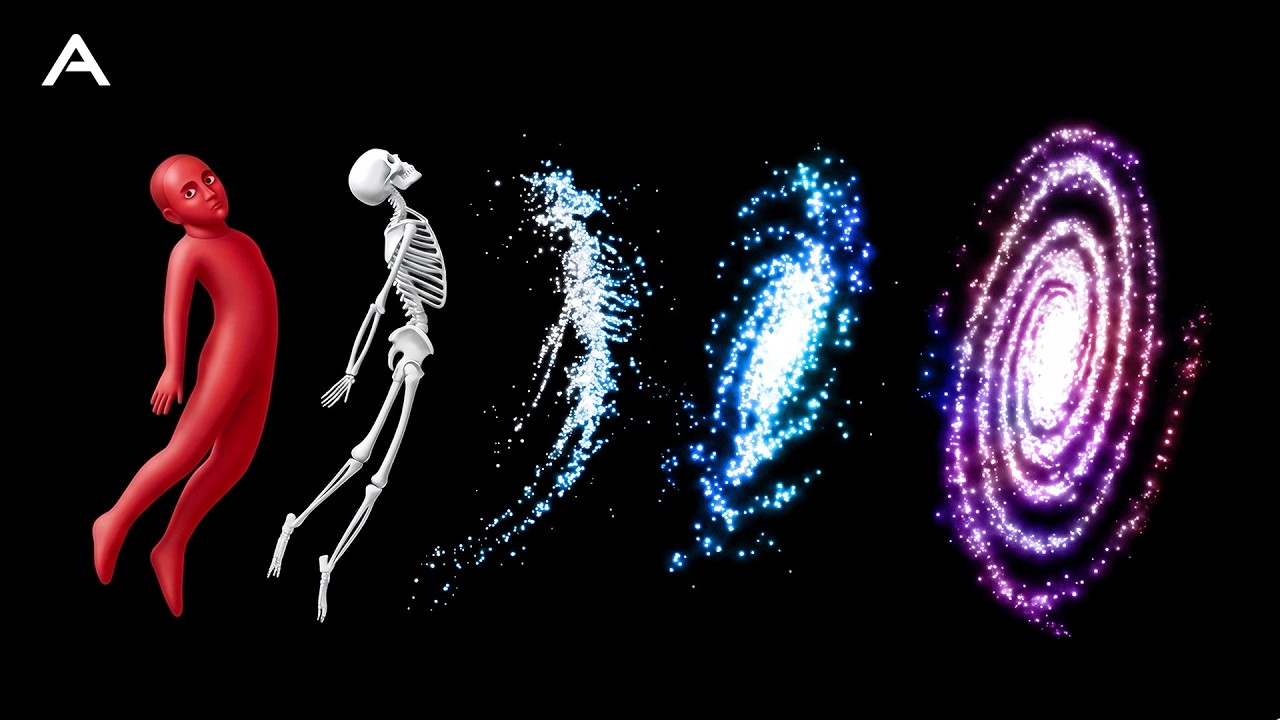
A Biosignature Was Found On An Exoplanet | The Signal Was Gone Before Anyone Could Confirm It
A telescope a million miles from Earth read the air of a planet 120 light years away and found a molecule that, on our world, only living things make. The molecule was dimethyl sulfide, the planet was K2-18 b, and the instrument was the James Webb Space Telescope. Then Webb looked again and the signal had weakened. Some features were fainter, others were gone. This Acronium film is built on one disciplined distinction that the narrator never lets you forget: this was a tentative detection, not a confirmation.
Published Jun 10, 20261:34:41 video55 min readAdded Jun 14, 2026Open on YouTube →
At a glance
A telescope a million miles from Earth read the air of a planet 120 light years away and found a molecule that, on our world, only living things make. The molecule was dimethyl sulfide, the planet was K2-18 b, and the instrument was the James Webb Space Telescope. Then Webb looked again and the signal had weakened. Some features were fainter, others were gone. This Acronium film is built on one disciplined distinction that the narrator never lets you forget: this was a tentative detection, not a confirmation. The team that found it spent weeks trying to make it disappear and could not, but the follow up neither confirmed nor cleanly killed it.
From that single fading trace the film walks the entire chain, in order, from the physics that makes the detection possible to its darkest implication. It starts with Fraunhofer and the dark lines in sunlight, builds spectroscopy and the transit method, engineers Webb and its 344 single points of failure, lays out the K2-18 b detection and the silence that followed, then asks why nearly every promising world comes back bare. The answer runs through red dwarf flares, photoevaporation, tidal locking, dead dynamos, abiotic oxygen and methane that fake biosignatures, the cliff between dead chemistry and the first cell, gamma ray bursts, a supernova recorded in Pacific mud, dark energy closing the cosmic horizon, heat death, the Drake equation with real numbers, and finally Nick Bostrom's inversion: every trace of life we find may be the worst possible news. This is the whole film rebuilt, every method, number, and caveat, in the order it was argued.
Light learned to talk before we learned to listen
The film opens on a haunting frame. Something out there was breathing, the narrator says, not in metaphor and not in a guess. A machine a million miles from Earth caught light that had passed through the atmosphere of a world no human will ever visit, and in that light sat a molecule that has no business existing without biology. On Earth only living organisms make it. Ocean microbes release it as part of their metabolism. No known volcanic process generates it, no known photochemistry explains it. It showed up around a dim star 120 light years away, and the team that found it spent weeks trying to make it go away. They reran the models, tested for instrument error, checked for pipeline contamination. The molecule stayed. Then the telescope looked again and the signal had weakened. The planet had not moved. The telescope had not changed. Something in that world's air was different.
The narrator is careful to frame the stakes correctly from the first minute. This is not a story about whether aliens exist. It is a story about a signal that appeared, a signal that vanished, and the question of what kind of universe produces life and then erases it before anyone can be sure it was there. To understand it, you have to start with light, because light has been talking for a very long time and we only recently learned how to listen.
In 1814 a Bavarian lens maker named Joseph Fraunhofer built a prism sharper than anything before it. He was not studying the sun, he was testing his own glass for defects and needed a steady source. He expected a smooth band of color. He got dark lines instead, thin gaps where specific colors were missing. Not one or two, hundreds. He counted 574 before he stopped. He changed the prism and the lines stayed. He waited until afternoon and they stayed. They were not flaws in the glass, they were features of the sunlight itself. He labeled the strongest lines with letters, published, and died 12 years later without ever knowing what the gaps meant.
The explanation, when it came, was the foundation of everything that follows. Every atom absorbs specific colors, not random ones. Hydrogen grabs one set, sodium a different set, iron another. Each element has a signature as unique and permanent as a fingerprint. Light leaves the sun's interior as a full spectrum, then on its way out it passes through clouds of hydrogen, helium, iron, and calcium that each eat their own wavelengths. What emerges still looks white, but split it with a prism and you see the marks. Sunlight, the narrator says, is not just energy. It is a message stamped with the identity of every atom it touched.
Reading the message: Bunsen, Kirchhoff, and a new element on the sun
For 45 years nobody could connect those dark gaps to actual elements. The answer came from a chemist with a burner and a physicist with a prism. In Heidelberg, Robert Bunsen built a flame so clean it added no color of its own, so that when you dropped in an element it glowed with its own light, sodium yellow, lithium red, potassium violet. Gustav Kirchhoff next door passed that glow through a prism and got bright lines at fixed positions, and those positions matched Fraunhofer's dark lines exactly.
The logic locked. When an element burns it emits at specific wavelengths, bright lines. When the same element sits between you and a brighter source, it absorbs those same wavelengths, dark lines. Same atom, same frequencies, one mechanism running in two directions. Fraunhofer's gaps were the shadows of specific elements in the sun's outer atmosphere. From then on you did not need to hold a substance to know what it was made of. You needed only its light, and light carries that trace across any distance.
The narrator delivers the punchline of the era in 1868, when two astronomers pointed spectroscopes at the sun during an eclipse and found a bright line matching no known element. They named it helium, from the Greek for sun. Nobody found it on Earth for another 27 years. We identified an element on a star 93 million miles away a full generation before we knew it existed under our feet.
Figure 1. The transit method. When a planet crosses in front of its star, a thin ring of its atmosphere is backlit. Gases in that ring eat their own wavelengths out of the starlight before it reaches the telescope. Subtract the spectrum of the star alone from the spectrum taken during transit and what is left is the chemical shadow of the planet's air. You never see the planet, you read what its atmosphere absorbed.
How you read a planet, not just a star
Every star Kirchhoff's method had ever read was a bright object pouring light in all directions. A planet is the opposite: dim, tiny, drowned in its star's glare. The film's elegant move is that you do not fight the glare, you use it. Every planet orbits a star, and some orbits, seen from our angle, carry the planet directly between its star and us. When that happens two things change. The total brightness drops by a tiny fraction, less than a hundredth of a percent for an Earth sized world, because the planet blocks a small disc of the star. And a thin ring of the planet's atmosphere is backlit. Starlight grazing through that ring loses its own wavelengths to whatever gases float there, exactly as Kirchhoff described 60 years earlier. Take the spectrum during transit, take the spectrum of the star alone, subtract, and the remainder is the air.
The narrator credits Otto Struve with proposing the idea in 1952 and is honest that it sounded too fragile to work. The atmospheric signal sits on top of a brightness dip already less than a hundredth of a percent. A whisper buried inside a whisper. For half a century no instrument could pull it out. Then in 1999 David Charbonneau and Timothy Brown proved it on a gas giant called HD 209458 b, 150 light years away, when the star dimmed by exactly the predicted amount. A few years later, using Hubble, they pulled sodium from its atmosphere, the first chemical element identified in the air of another world.
What in an atmosphere says "alive"? Lovelock's contradiction
The next question is harder: what pattern in an atmosphere tells you something down there is living? The answer came from a man not trying to study exoplanets at all. In 1965 NASA wanted to detect life on Mars without landing, and hired British chemist James Lovelock to figure out how. His answer was about Earth, not Mars. Our air, he noticed, is impossible. Oxygen and methane coexist, yet they react with each other; sealed in a container the oxygen would destroy the methane within a few thousand years. They both persist only because life constantly resupplies both, plants and photosynthetic bacteria pumping out oxygen, microbes in wetlands and oceans pumping out methane. Take biology away and within a few thousand years the methane is gone, within a few million the oxygen thins, and the atmosphere settles into a dead equilibrium, stable and boring, like Mars, like Venus.
Lovelock's insight reframes the whole search. Life does not leave a specific chemical behind. It leaves a mess, a chemical imbalance that should not exist but does because something actively maintains it. You do not look for a molecule, you look for a contradiction: two gases that should destroy each other coexisting right now. That is a biosignature, a violation of equilibrium, not an ingredient. An atmosphere in equilibrium is a dead planet. One that contradicts itself has something forcing the contradiction, and the most likely mechanism is biology. The narrator flags, honestly, that other mechanisms can fake the same contradiction, and promises to return to them. But first there had to be a machine sensitive enough to see any of it, and building that machine nearly killed the project before it flew.
Building the impossible telescope
The telescope that became James Webb was first proposed in 1996, the narrator notes, when Bill Clinton was president and most of the internet ran on dialup. Original budget, one billion dollars. Original launch date, 2007. Neither number survived contact with reality, and the reason was physics. Methane, carbon dioxide, and water vapor barely show up in visible light; they absorb in the infrared, longer than the eye can see. So Webb had to see infrared, and infrared astronomy has a brutal requirement: everything warm glows in it. Your body glows in infrared, a cup of coffee glows in infrared. A warm telescope blinds its own detectors. You are trying to catch the faintest whisper from a planet 100 light years away while the instrument screams in the same frequency. The telescope had to be colder than almost anything in the solar system.
The engineering answer was a sunshield the size of a tennis court, five layers of coated polymer each thinner than a human hair. The sun hits one side, the other drops to minus 233 degrees Celsius, 40 Kelvin, cold enough that the telescope's own thermal emission effectively vanishes. But you cannot launch a tennis court. The shield had to fold inside a 5 meter rocket fairing and then unfold perfectly in vacuum with nobody close enough to free a stuck hinge. The mirror, 6.5 meters across, faced the same problem, so it was built as 18 hexagonal segments that folded for launch and then aligned themselves to a tolerance of one ten thousandth the width of a human hair. In all, 344 individual mechanisms had to deploy in sequence. If any one jammed, the telescope was dead. No repair mission, no second attempt.
Why no rescue? Because the same isolation that made it cold made it unreachable. Hubble orbits at 540 km, close enough that astronauts visited five times to swap broken parts, but Hubble was never cold enough for infrared from small rocky worlds. To get cold, Webb had to leave Earth's neighborhood. The narrator reaches back to 1772, when Joseph Louis Lagrange calculated with pen and paper that in any two body system there are five points where a smaller object holds a stable position. L2, 1.5 million km behind Earth as seen from the sun, lets an object drift along with our planet without burning fuel. Two and a half centuries later the most expensive scientific instrument in history sits exactly where his equation said. At L2 the sun, Earth, and moon all sit on one side, the sunshield blocks all three, and what faces the other way is permanent deep space, permanent darkness, permanent cold. The cost is that nothing can reach it to fix it.
On December 25, 2021, an Ariane 5 launched from French Guiana with the telescope folded inside. Over two weeks, 344 mechanisms fired in sequence. Sunshield deployed, mirror segments unfolded, secondary mirror extended on its boom. Not one failed. The instruments cooled to 40 Kelvin, and in the summer of 2022 faint light that had traveled for centuries finally reached a detector cold enough to read it.
Figure 2. A schematic of what Webb saw at K2-18 b, not real depths. Methane and carbon dioxide register as clear absorption dips, the kind of pair expected for a hydrogen rich world with a possible ocean beneath. Dimethyl sulfide sits as a shallow dip hovering near the noise floor, which is exactly why the team published it as a tentative finding pending confirmation rather than a detection. The shape of the claim is in the depth of the dip.
First a dead world, to prove the machine
Before pointing at anything that might be alive, the team pointed Webb at something they knew was dead: WASP-39 b, a hot gas giant about Saturn's mass orbiting so close its atmosphere bakes above 900 degrees Celsius. Nobody expected biosignatures; the point was to test the instrument. Webb broke the transit starlight into wavelengths, the data came back in August 2022, and in that spectrum the team identified carbon dioxide, the first time anyone had directly detected CO2 in the atmosphere of a planet outside our solar system. The narrator anticipates the shrug, CO2 is what you exhale and WASP-39 b has no surface and no chance of life, but the detection mattered for what it proved about the machine. If Webb could pick out a single molecular species around a world 700 light years away on its first try using a fraction of its designed sensitivity, it could do the far harder thing: read smaller, cooler, rocky planets in the habitable zones of their stars, where chemistry might tip from dead to alive.
K2-18 b: the most debated data set in exoplanet science
The first such target had already been flagged: K2-18 b, orbiting a red dwarf 120 light years away, the planet from the opening. The narrator is precise about the result, and about its caveats. Nikku Madhusudhan and his team at Cambridge pulled a spectrum from its atmosphere and published in September 2023. The spectrum showed methane and carbon dioxide together, expected for a hydrogen rich atmosphere with a possible ocean beneath. But buried in the data was a dip at a wavelength matching dimethyl sulfide.
Dimethyl sulfide is not common and does not form easily without biology. On Earth it is produced almost exclusively by phytoplankton in the ocean; marine algae release it as a byproduct of sulfur metabolism. That sharp salty slightly rotten smell of the sea is partly dimethyl sulfide, billions of tiny organisms breathing it out. It is one of the most reliable indicators of a living ocean that atmospheric chemistry offers. And it appeared in the spectrum of a planet 120 light years away.
Here the film's discipline is most important. Madhusudhan was careful. The signal was faint, at the edge of what the instrument could reliably detect, and he published it not as a detection but as a tentative finding pending confirmation. The paper said other explanations were still possible, while also noting that no known abiotic process on a world like K2-18 b could easily produce the molecule. If the data were right, something on that planet was making it, and on Earth only living things do that. The reaction split immediately. Some called it the most significant result in the history of exoplanet science; others called it premature, arguing a signal this weak on a planet this poorly understood could be an artifact of the data processing pipeline. Both sides agreed on one thing: the telescope had to look again.
The signal was gone before anyone could confirm it
It looked again, and what it found was closer to silence. Not confirmation, but not a clean rejection either. The follow up used a different instrument, NIRSpec, where the first detection had leaned on MIRI. If dimethyl sulfide was real, both should see it. They did not agree. Some features showed up weaker, others were absent. The team could neither retract the finding nor strengthen it.
The narrator lays out the two readings, and refuses to choose, because the film's honesty depends on holding both. The first is instrument noise: different instruments have different sensitivities and blind spots, and a feature at the edge of detection in one can drop below threshold in another. Under this reading the molecule could still be there and we simply need cleaner data, longer exposures, a third pass; the silence between results is just a machine reaching its limits. The second reading is harder to sit with: the molecule was there the first time and not the second, not because the instrument missed it but because the source changed, the process producing dimethyl sulfide slowing or stopping between observations. Under that reading we are not looking at a stable atmosphere with a permanent signature, we are looking at a process that was active and is no longer. One reading means we caught an instrument at the edge of what it can do; the other means we caught a planet in the act of losing something. Both remain open. Either way, K2-18 b gave no clear answer.
The pattern of bare worlds: TRAPPIST-1 and LHS 1140 b
Webb was already pointing elsewhere, and the next results deepened the unease. The most anticipated target was TRAPPIST-1, seven rocky planets around a small red star 40 light years away, announced in 2017 by Belgian astronomer Michael Gillon. Three sit in the habitable zone, all transit from our angle, all close enough for Webb. For six years they topped every priority list. Nobody expected all seven to have air, but surely at least one. The first results came back in 2023. TRAPPIST-1 b, the innermost planet, flat spectrum, bare rock. TRAPPIST-1 c, the same, flat, no molecular absorption, no gas thick enough to register. Two of seven stripped clean. The habitable zone planets e, f, and g are still being observed, with harder, smaller signals, but the pattern from the inner worlds is hard to ignore. These planets orbit closer than Mercury orbits our sun, and the two measured so far have nothing on them, not thin atmospheres, not remnants, nothing. Something took the air off them and left no trace.
One more world earns a look before the film asks what is doing this: LHS 1140 b, around a red dwarf 49 light years away. In 2024 a team led by Charles Cadieux published JWST data suggesting it might have a nitrogen rich atmosphere and possibly a liquid water ocean, the closest thing to a candidate not already ruled out. But it is tidally locked: one hemisphere permanently faces the star, the other permanent darkness, dayside baking, night side freezing, no sunrise, no rotation to spread heat. If an atmosphere exists, global winds must carry warmth to the dark side fast enough to keep the air from freezing onto the night surface as frost. Models say this works in a narrow window: too much CO2 and the dayside runs away into a greenhouse, too little and the night side freezes the atmosphere solid. Life there, if it exists, survives not across a world but in a strip, a band along the terminator between fire and ice. The best remaining candidate is a margin, not a planet.
Three systems, three outcomes: a fading signal on K2-18 b, nothing on TRAPPIST-1, a marginal maybe on LHS 1140 b. The question that connects them is the same. What is stripping the air off these worlds before life can hold on? To answer, look at the star.
World
Host star
Distance
What Webb found
Status of the claim
WASP-39 b
Sunlike
700 ly
Carbon dioxide, the first ever outside our system
Confirmed, but a dead gas giant, a machine test
K2-18 b
Red dwarf
120 ly
Methane and CO2, plus a faint dip matching dimethyl sulfide
Tentative, weakened on the second look
TRAPPIST-1 b
Red dwarf
40 ly
Flat spectrum, no molecular absorption
Bare rock, air bled into space
TRAPPIST-1 c
Red dwarf
40 ly
Flat spectrum, same as its neighbor
Bare rock, stripped clean
LHS 1140 b
Red dwarf
49 ly
Hints of nitrogen, possibly a liquid water ocean
Marginal, tidally locked, a habitable strip at best
Figure 3. The ledger of Webb's rocky and habitable zone targets in the film. The only clean, confirmed molecular detection is on a world nobody thinks is alive. Every candidate that could matter is tentative, bare, or marginal, and four of the five orbit red dwarfs. The pattern, not any single result, is what drives the rest of the documentary.
The red dwarf trap
Nearly three of every four stars in the Milky Way are red dwarfs, small and dim, burning their fuel so slowly they last trillions of years instead of billions. Because they are dim, a planet that wants liquid water must orbit extremely close, close enough that its year lasts days or hours. That is where most habitable zone exoplanets are, confirmed by Kepler and TESS, hugging dim red stars closer than Mercury. For years this sounded like good news, because red dwarfs are stable and never swell into red giants to swallow their inner planets, giving life trillions of years. But every world in the film orbits a red dwarf, and on every one something has gone wrong. The pattern points to the star, because red dwarfs only look calm. Their magnetic fields are unstable in a way our sun's is not.
The proof is the nearest star to us. Proxima Centauri, a red dwarf 4.2 light years away, has a planet in its habitable zone, Proxima b, found in 2016 and briefly the most exciting planet in astronomy. Then in March 2018 Meredith MacGregor and her team caught Proxima Centauri mid superflare. In roughly 10 seconds the star's brightness rose by a factor of a thousand, not in visible light but in ultraviolet and X-ray, so intense the instruments had to be recalibrated afterward. The flare lasted about two minutes, and in those two minutes the star released more energy than the worst solar storm in recorded human history by a factor of several hundred. Proxima b orbits at one twentieth Earth's distance from its star; at that range the surface dose during the flare was not survivable by anything with a cell membrane. The UV alone would shred DNA, the X-rays would ionize the upper atmosphere and launch chain reactions that tear apart complex chemistry. And this is not rare. Major flares come every few days, smaller ones every few hours. The planet is hit again before it can recover. One flare is a sunburn; a thousand a year for a billion years is a slow erasing.
How a star peels off an atmosphere
Every flare carries more than radiation, it carries matter, streams of protons and electrons ejected at hundreds of kilometers per second. On Earth this is the solar wind, mild and steady; red dwarfs produce something closer to a fire hose. When a charged particle hits a planet's upper atmosphere it transfers energy to a gas molecule and kicks it upward, and if the kick is hard enough the molecule reaches escape velocity and leaves. One molecule is nothing. You could lose a billion per second and not notice for a century, but you would notice over a hundred million years. This is photoevaporation, undramatic, no explosion, the atmosphere bleeding away molecule by molecule from the top, too slow for any instrument to watch in real time. The narrator points to models by Chuanfei Dong and colleagues at Princeton, published in 2017, calculating the loss rate across TRAPPIST-1. For the inner planets the result was total loss, complete stripping of any Earth like atmosphere within a few hundred million years. Not thinning, removal. That is why TRAPPIST-1 b and c read flat: Webb caught them after their air had bled into space over a span longer than complex life has existed on Earth.
But Earth faces the solar wind too and keeps its air. The difference is a shield, and almost none of the planets in the film have one. A planet near a red dwarf is caught in a grip that does not let go. Gravity is not uniform; the side facing the star is pulled harder than the far side, creating a tidal force that stretches the planet slightly out of round. Over millions of years that force brakes the planet's rotation until one hemisphere permanently faces the star. This is tidal locking, the same reason the moon shows Earth only one face, and every close in red dwarf planet is locked. The real damage is internal. A planet generates a magnetic field through the dynamo effect, a churning ocean of liquid iron in the outer core driven by heat from the inner core, its motion generating currents and those currents a field strong enough to deflect the solar wind. No dynamo, no shield; no shield, no defense against photoevaporation. The dynamo requires rotation, and a tidally locked planet has effectively stopped rotating, so the convective flows never organize into the patterns that sustain a field.
The narrator names this the trap, and the cascade is worth quoting in its logic: close to the star means habitable zone, close means tidally locked, locked means no rotation, no rotation means no dynamo, no dynamo means no shield, no shield means the atmosphere is stripped. The very proximity that creates the habitable zone destroys the conditions for life inside it. What remains is bare rock and silence.
Figure 4. The red dwarf trap as the film states it. The same closeness that puts a planet in the liquid water zone of a dim star is what locks its rotation, kills its core dynamo, drops its magnetic shield, and lets the stellar wind peel the atmosphere away molecule by molecule. The chain is not bad luck on one world. It is the default outcome for the most common habitable zone real estate in the galaxy.
What makes Earth different runs to the center of the planet
Earth has a shield and is not tidally locked. Why? The answer is the dynamo, and the film treats it as a machine running beneath your feet for over four billion years with no off switch you can reach. Below the mantle is an ocean of liquid iron larger than Mars, hot enough to glow white, churning in slow convective currents driven by the inner core. Its motion generates currents, the currents a field reaching thousands of kilometers above the surface. Joseph Larmor first proposed the mechanism in 1919, Walter Elsasser formalized it in 1946, and between them they explained both why Earth has a shield and why that shield is not guaranteed. It works only because the iron is liquid, the planet rotates, and core heat drives the convection. Remove any one and the dynamo slows, the field weakens, charged particles reach the upper air, and the atmosphere bleeds out exactly as it did on TRAPPIST-1 b.
This is not hypothetical, because it already happened next door. Mars had water, carved into Valles Marineris, into dried river beds branching across the southern highlands, into mineral deposits the Curiosity rover found that only form in liquid water. Mars also had a magnetic field; crustal rock in the southern hemisphere still carries remnant magnetism frozen in when the minerals solidified billions of years ago. The rock remembers the field even though the field is gone. Around four billion years ago the Martian core cooled below the threshold for convective flow, the dynamo stopped, the field collapsed. In 2014 NASA's MAVEN spacecraft arrived specifically to measure what happens to a planet that loses its shield. Bruce Jakosky and his team tracked the rate at which the solar wind strips ions from the upper atmosphere: about 100 grams per second, less than you lose exhaling a single breath, but running for four billion years it adds up to the entire atmosphere. Nothing blasted the air away in one stroke; the sun simply leaned on it gently and constantly. MAVEN is measuring the loss right now. Mars is still bleeding, and the only reason Earth is not is that our dynamo has not stopped yet.
You might think Mars was just unlucky, a core too small that cooled too fast. Then consider Venus, almost Earth's size and mass, with no field at all. The reason is rotation: Venus turns once every 243 Earth days, too slow to organize its core's convection into the spiraling flows a dynamo needs. Venus is Earth's twin from outside and defenseless against exactly the process that stripped Mars.
In 2003 David Stevenson at Caltech published the framework for what a planet needs to generate a field, four conditions that must all hold at once: sufficient mass to retain a large metallic core, a core at least partially liquid, fast enough rotation, and active interior heat flow, usually driven by plate tectonics, to sustain the convection. Earth meets all four. Venus fails on rotation, Mars fails on heat flow and possibly mass, and most rocky exoplanets fail on at least one. Each condition is common alone; having all four at once may be extraordinarily rare. The magnetic shield is not a default feature like gravity, it is a fluke of internal engineering, and the thing keeping your air attached to your planet right now is an anomaly. Most worlds have already lost this fight silently, with no one watching.
Bigger planets do not save you
If the problem is mass and rotation, surely a larger planet solves it: more mass, bigger core, stronger gravity holding air even without a perfect field. Super-Earths, two to ten times Earth's mass, are the most common rocky world in the galaxy, the rule and not the exception. But in 2007 Diana Valencia and colleagues at Harvard modeled what happens inside as you scale up the mass, and the results were not what anyone wanted. As mass increases, gravity compresses the interior until the mantle becomes too stiff to flow. On Earth the mantle is soft enough that slabs of crust sink into it and recycle, which is plate tectonics, pulling carbon underground, processing it, releasing it through volcanoes, and regulating the atmosphere over billions of years. Without it CO2 either accumulates until the planet cooks itself or gets locked in rock until the air thins to nothing. On a super-Earth the lithosphere is too thick to crack, the plates do not move, the carbon cycle breaks, and interior heat gets trapped under a rigid lid. The planet does not breathe. It is sealed, a thermos that holds heat beautifully, warm inside and dead outside, locked shut from the moment it formed.
The film closes the survey grimly. Red dwarfs strip atmospheres, tidal locking kills fields, small planets lose their cores, large planets seal themselves shut. Every path leads to the same result. And yet, when we point the telescope at some of these worlds, we still see gases, which raises a question worse than all the others. Can we trust what we are seeing?
The instruments can lie: abiotic oxygen and methane
You trust oxygen. We are taught since childhood that oxygen means life, and most educated adults told a telescope found oxygen on a distant planet would assume something is alive there. It can be faked. In 2015 Rodrigo Luger and Rory Barnes at the University of Washington published a model where a planet fills its atmosphere with oxygen without a single living cell. Ultraviolet from the star splits water vapor in the upper atmosphere; the lighter hydrogen escapes to space, the heavier oxygen stays, and over hundreds of millions of years the atmosphere becomes oxygen rich. A spectrum would show O2 exactly where it should be at exactly the right depth, every test would say life, and behind the signal nothing is breathing. The narrator drives home the cruel twist: this needs intense UV and a lot of upper atmosphere water vapor, and red dwarfs produce far more UV relative to their visible light than our sun, with habitable zone planets close enough to take it at full strength. The very stars where we hunt for life are the ones most likely to manufacture this false positive. The tool we trust most fails precisely where we need it most.
Methane is the backup, and Lovelock's proof was methane and oxygen together. But methane holds, the narrator says, like a second lock on a door with a broken frame. On Earth most atmospheric methane is biological, from microbes in wetlands, animal guts, lake mud, and when Curiosity detected it on Mars the announcement made global news. Yet geochemists have long known you do not need life to make methane, only water and the right rock. The process is serpentinization: when olivine, a common mantle mineral, meets liquid water at the right heat and pressure, methane forms as a byproduct, no organisms, just rock and water and time. In 2023 Nicholas Wogan and colleagues mapped the full range of abiotic methane: serpentinization, asteroid impacts shocking it out of minerals, volcanic outgassing, hydrothermal vents. The early Earth was drenched in methane for hundreds of millions of years before the first organism. Point a telescope at Earth four billion years ago and you would have seen methane and concluded life, and you would have been wrong by half a billion years. Both pillars of Lovelock's test can each appear without biology. Both can lie.
A web of evidence, and a window we cannot read
The narrator does not conclude the search is pointless. One gas alone means nothing, but a combination set against the full context of a planet might still work. Victoria Meadows at the NASA Astrobiology Institute spent years building a biosignature assessment framework on exactly that idea: stop relying on any single molecule, because a single molecule is a clue, not a conviction. Build a case the way you would when the stakes are absolute, a web of evidence where each strand supports the others. You need the star, what UV it produces and how much energy hits the air. You need the planet, its mass, surface, water, and crustal minerals. You need to model every abiotic pathway that could produce the gases you see, and only after exhausting every nonbiological explanation can you begin to consider biology as the remaining answer. The footprint in the mud means little alone, but next to a campfire ring, discarded tools, and a trail to a river, the case changes.
The framework is elegant and honest about its limit: to apply it you need data we do not have. JWST gives a thin slice, a handful of molecular features from a single instrument looking at a planet it cannot resolve. We are reading one sentence from the middle of a book, trying to tell whether the author is still alive or whether these are the fading words of someone already gone. The framework exists; the data do not.
The afterglow problem: a dead world reads exactly like a living one
Even with perfect data, the film argues, the reading can be flawless and the conclusion still wrong. Imagine a planet where life took full hold, not a marginal case, a complete biosphere flooding the atmosphere with oxygen and pumping out methane and nitrous oxide, running for 500 million years, long enough that every spectrograph in the galaxy would flag it as alive. Then the magnetic field fails, or the star enters sustained flaring, or a gamma ray burst strips the ozone in hours. The biosphere collapses, every cell dies, every metabolic process maintaining the balance stops at once. But the gases do not stop at once. Oxygen with nothing left to consume it accumulates, ozone keeps forming as long as oxygen is present, water vapor stays. The atmosphere holds the shape of a living world for millions of years after the last organism dies, the way a warm room holds heat after the furnace shuts off. Point Webb at it inside that window and you see the perfect signal, run Meadows's framework, eliminate every abiotic pathway, and the conclusion comes back biology. Every test passed, and behind it nothing breathes. You are not reading a living planet, you are reading its afterglow. A living world and a recently dead world produce the same spectrum. The light carries no time stamp. Every trace could be a sign of life; every trace could be an echo of something already gone, and we have no way to know which.
How hard is it for life to start? The cliff before the first cell
The film turns to the deeper question: how hard is it for life to begin at all? Seventy years of chemistry say nearly impossible, but not untested. In 1953 a 23 year old graduate student, Stanley Miller at the University of Chicago, sealed methane, ammonia, hydrogen, and water vapor in a flask to mimic early Earth and ran electrical sparks through it for a week to simulate lightning. He opened it to find amino acids, the building blocks of proteins, made from scratch with no organisms, just gas, water, and electricity. It made front page news and seemed to imply life is easy: the universe is full of gas, water, and energy, so give it time and the building blocks appear, and cells follow as a matter of patience.
That was 70 years ago. We have the building blocks and have never made the next step. Amino acids are letters; a living cell is a novel. Miller showed the universe can scatter letters across a table, but nobody has shown how those letters arrange themselves into a sentence, let alone a self copying organism. The gap is not a step, it is a cliff, and 70 years of the best chemistry has not found a bridge. And the problem is not complexity, it is that the chemistry fights itself, because of water. The leading hypothesis is the RNA world, proposed by Walter Gilbert at Harvard in 1986: before DNA and proteins, RNA could both store information and catalyze reactions, and a self replicating RNA molecule could have been the seed of all life. The idea is elegant and the chemistry is hostile. Building RNA needs nucleotides, each a complex assembly of sugar, phosphate, and base, and these do not spontaneously snap together under natural conditions. They degrade. Sugars break down faster than they form, bases react with the wrong partners, and the bonds linking nucleotides are fragile in water, which is the only solvent that makes the rest of the chemistry possible. You need water to run the reactions; the water destroys the product. Jack Szostak's lab at Harvard has spent decades on this and made real progress on partial replication of short strands, but only under controlled conditions, meaning a human chemist adding reagents on schedule, removing waste, adjusting temperature and pH. The real question is whether RNA can replicate on a rock, in a tide pool, under UV, with no one managing it. The universe has no chemist, only time, volume, and probability, and the odds of a self replicating strand assembling by chance are small the way a specific novel assembling itself from alphabet soup is small.
Beneath the RNA problem is one most people never hear: chirality. Every amino acid in every living organism on Earth is left-handed, structurally, the molecule curving one specific way. The mirror image is chemically identical, same atoms, bonds, and weight, just curving the other way. Synthesize amino acids in a lab and you get a perfect 50/50 mix; Miller's experiment produced both, every known abiotic process produces both, and there is no chemical reason to prefer one. Yet every living cell uses only the left-handed form, and mixing in even a small fraction of right-handed amino acids makes proteins misfold and enzymes fail. Something very early broke the symmetry, before the first organism, before the first self replicating molecule. Louis Pasteur first observed the asymmetry in 1848 and failed to explain it; in the 178 years since, dozens of hypotheses, polarized light from neutron stars, preferential destruction by cosmic radiation, amplification of a random imbalance, none confirmed. In the foundation of all life lies a choice no one can explain, with no surviving trace of the mechanism that made it.
You might expect the first organism to have been simple. LUCA, the last universal common ancestor of everything alive, was not. In 2018 Madeline Weiss and colleagues at the University of Dusseldorf reconstructed LUCA's probable gene set by comparing bacteria and archaea, the two deepest branches of life. They found not a fragile protocell but DNA replication, ribosomal machinery for building proteins, and chemiosmosis, a nanoscale turbine generating energy by pumping protons across a membrane. Not a simple organism, a machine. LUCA lived roughly 3.8 billion years ago on a 4.5 billion year old Earth, so the window between stabilized conditions and a full cell is somewhere between 200 and 500 million years, and the distance between a pool of organic molecules and a cell that replicates DNA through ribosomes is not crossed in steps. No known intermediates, no confirmed pathway, the fossil record blank. A cliff: dead chemistry at the bottom, a staggering machine at the top, nothing between. Life on Earth did not climb a ladder, it appeared already complex.
The great filter, and where the wall sits
These problems look like separate puzzles, but in 1996 economist Robin Hanson saw a single argument. Between a dead planet and a galactic civilization runs a chain: chemistry becomes cells, cells become organisms, organisms develop intelligence, intelligence develops technology. Each step has a probability, and if all were reasonably high the galaxy would be full of signals. The galaxy is silent. So somewhere in the chain at least one step has a probability so near zero that almost nothing gets through. Hanson called it the great filter, not a specific disaster but a statistical wall, and the question that determines our future is where it sits. If behind us, we already cleared it, abiogenesis or the jump to complex cells was nearly impossible and we made it, so we are rare but safe. If ahead of us, something between here and a galactic civilization is nearly impossible to survive, something every species at our level has hit, and the silence means they all failed. You stand on one side of a door not knowing whether the lock is behind you or in front. Every dead signal and fading trace from JWST is evidence, and it leans in an uncomfortable direction.
The killers: gamma ray bursts and a supernova in the mud
If the filter is a wall, gamma ray bursts are the bulldozer. In 2014 Tsvi Piran at the Hebrew University of Jerusalem and Raul Jimenez at the University of Barcelona reframed galactic habitability, asking where in the Milky Way life can survive long enough to matter. A gamma ray burst is the most violent event in the known universe, from a massive star collapsing into a black hole or two neutron stars merging, producing a jet so focused and intense that in seconds it releases more energy than the sun will in its entire 10 billion year life. The beam is narrow, but what it hits, it sterilizes. Piran and Jimenez modeled the rate across the galaxy: in the dense central zones, where massive stars form and die often, every habitable planet within thousands of light years gets hit at least once every few hundred million years, resetting the clock before complexity develops. The inner galaxy is empty not because life never began but because it keeps getting erased. The safe zone is a ring in the outer disc, not too close to the frequent bursts of the center, not too far out where heavy elements for rocky planets grow scarce. Earth sits near the inner edge of that ring, on the margin, and the model was calculating averages; a single burst from an unusual source could reach us from a direction it did not predict.
Has it happened? Roughly 450 million years ago something killed 85% of all marine species, the Ordovician-Silurian extinction, the second largest in Earth's history, in two pulses about a million years apart, the first coinciding with sudden severe glaciation and the second with the glaciation ending, both devastating shallow water life while deep ocean species fared better. The standard explanation was climate change from volcanism or ocean circulation, which fit most of the data but not all. In 2004 Adrian Melott and Brian Thomas showed a gamma ray burst at roughly 6,000 light years reproduces the pattern better than any geological model: 10 seconds of radiation, 30 to 50% of the ozone destroyed, UV reaching the surface at full strength, shallow water organisms dying first while deep species shielded by water survive, the UV triggering nitrogen dioxide that blocks sunlight and cools the planet into glaciation, then a second pulse when the haze clears. No single geological model predicts all four features; the GRB model predicts all four. Not proof, the evidence is circumstantial, but if they are right the filter already fired at us once and we survived because we were ocean creatures. Next time we might not be in the ocean.
Then a different kind of evidence, not a model but a physical object: atoms from outside the solar system embedded in our ocean floor with a readable time stamp. A team led by Klaus Knie at the Technical University of Munich found it in 2004 in Pacific sediment cores, hunting an isotope that does not belong here, iron-60, radioactive with a half-life of 2.6 million years. That half-life is the key: any iron-60 present when Earth formed has long decayed to nothing, so fresh iron-60 in terrestrial rock came from outside, and the only known source capable of producing it in quantity is a supernova. Knie found a clear spike in layers dating to roughly 2.2 million years ago, and in 2016 Anton Wallner and colleagues at the Australian National University confirmed it with more cores, extending the signal across 1.5 to 3.2 million years ago, consistent with one or possibly two supernovae within 100 to 300 light years of Earth. Atoms forged in a dying star, blasted out, drifting for thousands of years, sinking into Pacific mud that human hands pulled up. At 100 to 300 light years the dose was survivable, the ozone thinned and cosmic ray flux rose but the planet held. Move the supernova closer: at 25 light years the ozone strips entirely, at 10 the blast wave disturbs the upper atmosphere. The line between a dusting and an extinction is a matter of distance, and distance in a galaxy where stars move and die on scales we cannot predict is a matter of luck. We do not live in a quiet universe; we live in the pores between detonations.
The geography is shrinking: dark energy and the closing horizon
Every threat so far has an address, a star too close, a burst sweeping a sector, a dwarf flaring on its nearest planet. Local killers, in principle escapable by moving to a quiet corner. If the threats are local, survival is a geography problem. In 1998 three teams discovered the geography is shrinking. Saul Perlmutter at Berkeley, Brian Schmidt at Mount Stromlo, and Adam Riess at Johns Hopkins independently measured distances to type 1a supernovae, standard candles whose known brightness lets you compute distance. Every model predicted the expansion should be slowing as gravity pulls matter together; the only question was how fast. All three measured the opposite. The distant supernovae were dimmer and farther than they should be. The expansion was speeding up, something pushing space apart faster than gravity could pull it together, with more power than the combined gravity of every atom in the observable universe. Three teams, three data sets, same result, firm enough that the 2011 Nobel went to it.
The force has a name and no explanation: dark energy, roughly 68% of the total energy content of the universe, distinct from dark matter. The Planck satellite measured its proportion in 2018, the DESI collaboration refined it in 2024, and after decades we know its magnitude to several decimals and almost nothing else, not what it is, where it comes from, or why it has the value it has. Einstein introduced a cosmological constant, lambda, in 1917 to keep the universe static, removed it when Hubble showed expansion, reportedly calling it his greatest mistake, and 80 years later lambda came back as the dominant force in the cosmos, the thing he threw away more powerful than everything he kept. The consequences are physical and permanent, because the acceleration determines how much of the universe you can ever see or reach, and that boundary is closing.
In 2004 Tamara Davis and Charles Lineweaver clarified what accelerating expansion does to the universe you can access. Galaxies beyond a certain distance already recede from us faster than light, not moving through space superluminally but because the space between is stretching, new space created faster than light can cross it. A photon emitted today from one of them will never reach us, not in a billion years, not ever. The observable universe is shrinking, not the universe but the part of it from which light can still reach you. Every second galaxies visible last year slip past the boundary; they do not vanish, they simply become unreachable. If there is life beyond that horizon we will never detect it; civilizations, signals, echoes of biology in distant spectra are already gone from our perspective, not destroyed, disconnected. The universe is not just killing life on individual planets, it is sealing off entire regions permanently. You are in a room and the walls are closing at the speed of light.
Space is only half the prison; the other half is time. Every process converts useful energy into waste heat, heat flows from hot to cold and never back, and once energy is evenly spread no work can be done, no reaction can proceed, no information can be processed. William Thomson pointed this out in 1852 and his colleagues found it so disturbing many refused to engage; he called it the heat death of the universe. In 1997 Fred Adams and Greg Laughlin at the University of Michigan mapped the full timeline. We are in the Stelliferous era, the age of stars, lasting another 100 trillion years, then the fuel runs out, the last red dwarfs go dark, white dwarfs cool, dead matter crumbles, black holes feed and then evaporate through Hawking radiation over 10 to the power of 100 years, leaving a thin cold soup of photons with wavelengths longer than the observable universe, no structure, no gradient, no distinction between here and there. Not a bang, a slow permanent forgetting. Every signal JWST captures is a message from a window between the first stars and the last, read in the only era when it can be read. What we are doing right now can only happen once in the entire history of the universe.
Running the numbers, and the inversion
Which leaves one question: what does all of this mean for us? Put numbers on it. In 1961 Frank Drake wrote a question on a chalkboard at the Green Bank Observatory, breaking the count of galactic civilizations into seven factors multiplied together: star formation rate, fraction with planets, fraction in habitable zones, fraction where life develops, fraction with intelligence, fraction with technology, and how long such a civilization survives. In 1961 every factor but the first was a guess, with hopeful estimates giving thousands and conservative ones giving one. Sixty years later Kepler filled in the second and third: roughly one in five sunlike stars has an Earth sized planet in the habitable zone, trillions of candidates. But the film feeds in what it has shown. The fraction holding an atmosphere is small because 73% orbit red dwarfs that strip their air. The fraction with a magnetic field is smaller because the dynamo needs four conditions and most planets fail. The fraction where chemistry is not faking a biosignature is unknown, but every mechanism examined produces false positives. The fraction where life starts is unknown, but the cliff to LUCA suggests vanishingly small. Start with trillions, multiply by a small fraction, then a smaller, then a smaller, and the number lands near one, maybe exactly one. The math does not say we are alone; it says that if we are not, the other survivors are so rare and far apart that the expanding universe may have sealed them off. The Drake equation, written as a conversation starter, has become a quiet argument for solitude.
You might find comfort there. If the number is near one and we are the one, we passed the filters, we have the right star, distance, core, field, chemistry, the right look, we are the anomaly, and anomalies are rare but real. In 2000 Peter Ward and Donald Brownlee published Rare Earth, arguing not that life is rare, simple microbes might be common, but that complex long lasting life, the kind that fills an atmosphere with oxygen and builds a readable signal, requires a chain of conditions so specific that Earth might be the only place all of them meet. You have walked the chain: the moon stabilizing Earth's axial tilt against chaotic drift that would sterilize the surface, Jupiter deflecting comets and asteroids that would otherwise reset complex life, plate tectonics recycling carbon to regulate the atmosphere over billions of years, the magnetic field holding air against the solar wind, galactic position keeping us far from gamma ray bursts and close enough to the heavy elements rocky planets need. Each factor alone is common; all coinciding on one world in the right sequence for long enough is small fractions multiplied into something very small. We are not typical. We might be the only time it worked.
That should be the good news. In 2008 philosopher Nick Bostrom at Oxford published the argument that turns the comfort inside out. He disputes neither the data nor the filters; he accepts all of it and draws a conclusion most people refuse to believe. If we are the anomaly, life is hard to start and the great filter is behind us, some early step nearly impossible and cleared, the galaxy silent because almost nothing gets past. That is the hopeful reading, and it depends on one assumption: that life is rare. But JWST is finding traces, fading signals, ambiguous spectra. If those traces are real, if even a fraction are genuine remnants of biology, then life is not rare, life starts easily, and if life starts easily the filter is not abiogenesis but somewhere later, between where those organisms were and where a galactic civilization would be, still in front of us. Every trace of life JWST finds is evidence the filter is ahead. Every dead signal, every fading biosignature, every stripped atmosphere that once held oxygen says the same thing: life started there too, life is not the hard part, something else is, and that something is still ahead of us. The more traces we find, the worse the news. A galaxy full of dead biosignatures is not one where life is rare and we got lucky; it is one where life is common and something kills it every time.
You are not an afterglow
The film ends where it began, on a photon from a world 120 light years away carrying a molecule that should not exist without biology, a molecule that faded, a signal that went quiet. Now you know what the silence might mean, not that we are alone but that we are next. That is the math, the logic, what the data say if you follow every chain to its end: filters ahead, silence behind, a universe that produces life and erases it with the regularity of a machine that does not know what it is grinding.
But the narrator wants to say something else, and it is not about filters or telescopes. You are made of atoms forged inside a star that exploded before the sun existed, drifting for millions of years, collapsing into the disc that became this solar system, landing on a planet with the right mass, distance, core, moon, field, and galactic position, where through a process no one can explain dead chemistry became alive and survived asteroid impacts, supernovae, ice ages, and mass extinctions for four billion years. At the end of that chain, here you are reading about it. You are not a spectator watching the universe from outside, you are the universe looking at itself, the only known arrangement of matter aware that the cosmos exists, not the only possible one, the only confirmed one. Every other trace we have found is a fading signal, an ambiguous line, an afterglow of something already gone. You are not an afterglow. You are still here. The filters, the threats, and the silence are real, and none of it changes the fact that tomorrow you will wake on the single most unlikely planet in the observable universe, breathing air that should not exist, under a field most worlds never develop, on the one known rock where dead matter figured out how to think. That is the most improbable thing that has ever happened, and it is happening to you on an ordinary Tuesday.
The telescope is still running. A million miles away a mirror the size of a tennis court cools in the permanent shadow of a sunshield thinner than a hair, pointing at a star you will never see, its light passing through the atmosphere of a world you will never visit, some of it absorbed by molecules that may or may not have been put there by something alive, the data streaming back at the speed of light to a team that is waiting. We do not know what they will find, whether the next spectrum confirms life or erases the possibility, whether the signal will be stronger or faded to nothing, whether we are reading the first page of a story or the last. But we are reading, and for the first time in this planet's history we have the instrument to do it. The improbable thing is you sitting here wondering about it, on a planet that should not have air, in a window that will not stay open, in a universe that does not owe you an explanation. It gave you one anyway.
Key takeaways
Detection is not confirmation, and the film insists on the gap. Dimethyl sulfide on K2-18 b was published by Madhusudhan in September 2023 as a tentative finding pending confirmation, at the edge of detection. The follow up with a different instrument neither confirmed it nor cleanly killed it. Treat it as an open question, not an announcement of life.
The whole method rides on absorption lines. Fraunhofer's dark gaps, explained by Bunsen and Kirchhoff, mean every element leaves a fingerprint in light. The transit method reads a planet's air by subtracting the spectrum of the star alone from the spectrum taken while the planet crosses it.
Webb is an engineering miracle with no margin. 344 deployments at L2, a tennis court sunshield, a 6.5 m segmented mirror aligned to one ten thousandth of a hair, all cooled to 40 Kelvin, with no possible repair. It proved itself first by detecting CO2 on the dead gas giant WASP-39 b.
Most promising worlds come back bare for structural reasons. Red dwarf flares and photoevaporation strip atmospheres; tidal locking kills the rotation a dynamo needs; small planets lose their core heat (Mars); slow rotators get no field (Venus); super-Earths seal shut. The magnetic shield is an anomaly, not a default.
The two best biosignatures can both lie. Abiotic oxygen forms when UV splits water and hydrogen escapes; abiotic methane forms by serpentinization. Worse, a recently dead world holds the spectrum of a living one for millions of years. Light carries no time stamp.
Life starting may be the rarest step, or not. The cliff from amino acids to LUCA, the hostile RNA chemistry in water, and the unexplained left-handed chirality all argue abiogenesis is nearly impossible. Whether the great filter is behind us or ahead is the question that decides our future.
Bostrom's inversion is the film's gut punch. If JWST keeps finding traces, life is common, which means the filter is not behind us but ahead. The more dead biosignatures we find, the worse our odds.
Chapters
Timestamps are clickable. Click one and the player jumps there and keeps playing while you read. This video has no creator set chapters, so these are estimated from position in the transcript.
0:00 The breathing world: a signal that appeared and faded
4:30 Light talks: Fraunhofer's dark lines (1814)
11:00 Bunsen, Kirchhoff, and helium found on the sun first
17:30 Reading a planet: the transit method and HD 209458 b
24:00 Lovelock's contradiction: a biosignature is a mess, not a molecule
29:30 Building Webb: infrared, the sunshield, 344 single points of failure
37:30 L2, launch, and CO2 on WASP-39 b as the proof of concept
43:30 K2-18 b: dimethyl sulfide, tentative, then the signal weakens
51:30 The pattern of bare worlds: TRAPPIST-1 flat, LHS 1140 b a margin
58:00 The red dwarf trap: superflares, photoevaporation, tidal locking
1:06:00 Earth's dynamo, the death of Mars, the failure of Venus, super-Earths
1:16:00 The instruments can lie: abiotic oxygen, abiotic methane, the afterglow
1:26:00 The cliff: Miller-Urey, RNA in water, chirality, LUCA was a machine
1:34:00 The great filter, gamma ray bursts, the supernova in Pacific mud
1:42:00 Dark energy, the closing horizon, heat death
1:48:00 The Drake equation, Rare Earth, and Bostrom's inversion
1:32:00 You are not an afterglow: the telescope is still running
Notable quotes
Something out there was breathing. Not long ago, not in a metaphor, not in a guess.
narrator, 0:00
This is not a story about whether aliens exist. This is a story about a signal that appeared, a signal that vanished, and the question of what kind of universe produces life and then erases it before anyone can be sure it was there.
narrator, 2:30
Sunlight is not just energy. It is a message stamped with the identity of every atom it touched on the way out.
narrator, 7:00
You do not look for a molecule. You look for a contradiction.
narrator, 26:00
He published it not as a detection, but as a tentative finding, pending confirmation.
narrator, 46:00
The telescope looked again. What it found was not confirmation. It was something closer to silence.
narrator, 49:00
A living world and a recently dead world produce the same spectrum. The light carries no time stamp.
narrator, 1:24:00
Amino acids are letters. A living cell is a novel.
narrator, 1:27:00
Every trace of life JWST finds is evidence the filter is ahead.
narrator, 1:50:00
You are not an afterglow. You are still here.
narrator, 1:33:00
The film is built around a single discipline: separating what we detected from what we confirmed. We detected a molecule on K2-18 b that on Earth only life makes, and then the signal faded before anyone could be sure. Everything downstream follows from holding that gap open. A spectrum cannot tell a living world from a recently dead one, the most common worlds in the galaxy strip themselves bare, life may be nearly impossible to start, and if it is not, then the thing that kills it is still ahead of us. The fading trace at K2-18 b is not proof of aliens and not proof of their absence. It is a question mark 120 light years wide, and the most improbable thing in the whole story is that there is anyone here to read it.
Full transcript
Something out there was breathing. Not long ago, not in a metaphor, not in a guess, a telescope a million miles from Earth caught light that had passed through the atmosphere of a world no human will ever visit. And in that light was a molecule that has no business existing without biology. On Earth, only living organisms produce it. Ocean microbes release it as part of their metabolism. No known volcanic process generates it. No known photochemistry explains it. It showed up in the data from a planet orbiting a dim star 120 light years away. And the team that found it spent weeks trying to make it go away. They reran the models. They tested for instrument error. They checked for contamination in the pipeline. The molecule stayed. Then the telescope looked again. The signal had weakened.
Some features from the first observation were barely visible the second time. Others were gone. The planet had not moved. The telescope had not changed. But something in the atmosphere of that world was different. Whatever process had been producing that molecule had slowed down or stopped entirely. Think about what that means. We built a machine that can read the air of a planet a thousand trillion km away. We pointed it at a world we will never touch. And in the air of that world, we found a chemical trace of something that on Earth only comes from life. We looked again. The trace was fading. This is not a story about whether aliens exist. This is a story about a signal that appeared, a signal that vanished, and the question of what kind of universe produces life and then erases it before anyone can be sure it was there.
To understand what we found, how we found it, and why it might already be gone, we need to start with something much simpler. We need to start with light. Because light does something that most people never think about. It talks, and it has been talking for a very long time. We just did not know how to listen.
You have lived under sunlight your entire life. It hits your skin. It warms the ground. It grows the food you eat. You think of it as one thing, a single steady stream of energy pouring out of a star. But sunlight is not one thing. If you pass it through a piece of glass at the right angle, it splits into every color between red and violet. You know this. You have seen a rainbow. What you have probably never been told is that the rainbow has holes in it.
In 1814, a Bavarian lens maker named Joseph Fraunhofer built a prism sharper than anything that existed before him. He was not studying the sun. He was testing his own glass for defects and needed a steady light source. He aimed sunlight through the prism and expected to see a smooth, unbroken band of color. What he saw instead were dark lines, thin gaps where specific colors were missing. Not one or two, hundreds. He counted 574 before he stopped. Each line locked to a precise position in the spectrum. He changed the prism. The lines stayed. He waited until afternoon. The lines stayed. They were not flaws in his equipment. They were features of the sunlight itself. Fraunhofer had no explanation. He labeled the strongest lines with letters, published his observations, and died 12 years later without ever learning what the gaps meant.
You might think the lines were artifacts, flaws in the measurement, tricks of the atmosphere, quirks of the glass. They were not. Every physicist who pointed a good enough instrument at the sun saw the same pattern in the same positions. But here is what was happening inside that beam of light. Every atom absorbs specific colors, not random ones. Hydrogen grabs one set and lets the rest pass through. Sodium grabs a different set. Iron grabs another. Each element has its own signature as unique and as permanent as a fingerprint. Which means that if a beam of light passes through a cloud of hydrogen on its way to you, the hydrogen leaves a mark. Light starts deep inside the sun as a full spectrum. Every color present. As it pushes outward through the outer layers, it passes through clouds of hydrogen, helium, iron, calcium. Each element grabs its own wavelengths out of the beam and swallows them. What comes out the other side still looks white to your eye. But if you split it with a prism, you see the marks. Dark lines where specific colors were eaten. Sunlight is not just energy. It is a message stamped with the identity of every atom it touched on the way out. A record of what it passed through, left behind in the light itself. The question was whether anyone could learn to read it.
For 45 years, nobody could crack it. Physicists across Europe stared at Fraunhofer's dark lines and could not explain them. They could see that the pattern was precise, that it repeated every time, that it clearly meant something. But the connection between those dark gaps and the actual elements inside the sun remained invisible. The answer came from a chemist with a burner and a physicist with a prism. Robert Bunsen in Heidelberg had built a flame so clean that it added no color of its own. When you dropped a sample of an element into that flame, the element glowed. Sodium burned yellow, lithium burned red, potassium burned violet, each one emitting its own specific color. Gustav Kirchhoff, who worked in the lab next door, took that glow and passed it through a prism. Out came a pattern of bright lines at fixed positions, and the positions matched Fraunhofer's dark lines exactly. The logic locked into place. When an element burns, it emits light at specific wavelengths. Bright lines. When the same element sits between you and a brighter source, it absorbs those wavelengths instead. Dark lines, same atom, same frequencies, one mechanism running in two directions. Fraunhofer's dark gaps were not mysteries. They were the shadows of specific elements in the outer atmosphere of the sun. Each one absorbing its own color out of the light passing through. From that point forward, you did not need to hold a substance in your hand to know what it was made of. You just needed its light. Every element left a trace, and light carried that trace across any distance.
Nine years later in 1868, two astronomers independently pointed their spectroscopes at the sun during an eclipse and found a bright line that matched nothing. Not hydrogen, not sodium, not iron, not any element in any laboratory on any continent. They named it helium from the Greek word for sun. Nobody found it on Earth for another 27 years. Think about that. We identified a chemical element on a star 93 million miles away an entire generation before we knew it existed under our own feet.
You might wonder whether this only works on stars, on objects bright enough to flood a spectrograph with signal. This method, refined over 160 years, now sits inside a telescope parked a million miles from Earth. But every star it has ever read was a bright, massive object pouring light in every direction. A planet is something else. Dim, tiny, drowned in the glare of the star next to it. Reading a star was the easy part. How do you read a planet?
You do not fight the glare. You use it. Every planet in the universe orbits a star. Some of those orbits, seen from our angle, carry the planet directly between its star and us. When that happens, two things change in the starlight. First, the total brightness drops by a tiny fraction because the planet blocks a small disc of the star's surface. Second, and this is the part that changes everything, a thin ring of the planet's atmosphere is backlit. Starlight passes through that ring on its way to our telescope, and whatever gases are floating in that air grab their own wavelengths out of the beam exactly the way Kirchhoff described 60 years ago. You take the spectrum of the star while the planet is in front of it. You take the spectrum of the star alone. You subtract one from the other. What is left is the atmosphere. You are not seeing the planet. You are reading the chemical shadow of its air, a faint trace left in starlight by gases you will never touch.
An astronomer named Otto Struve proposed this idea in 1952. You might think it sounds too fragile to work. The dip in brightness caused by an Earth-sized planet crossing a star is less than a hundredth of a percent. The atmospheric signal sits on top of that. A whisper buried inside a whisper. For half a century, no instrument could pull it out. Then in 1999, David Charbonneau and Timothy Brown proved it works. A gas giant called HD 209458 b, 150 light years away. The star dimmed by exactly the predicted amount. A few years later, using Hubble, they pulled sodium from its atmosphere, the first chemical element identified in the air of another world. By reading starlight that had grazed through a thin shell of alien air on its way to Earth, we could read what a planet's air was made of using nothing but starlight and an instrument sensitive enough to catch the shadow.
Now the question shifted. What pattern in an atmosphere tells you something down there is alive? The answer came from a man who was not trying to study exoplanets. He was trying to detect life on Mars without leaving Earth.
NASA wanted to find life on Mars without landing, no scooping soil, no touching anything, no physical contact with the surface, just observation from orbit. In 1965, they hired a British chemist named James Lovelock to figure out how. His answer had nothing to do with Mars. It had to do with Earth. He looked at our own atmosphere and noticed something that should have been obvious, but that nobody had framed this way before. Earth's air is impossible. Oxygen and methane exist in it simultaneously. These two gases react with each other. Left alone in a sealed container, the oxygen would destroy the methane within a few thousand years. The only reason both are present at the same time is that something is constantly producing them. Plants and photosynthetic bacteria pump out oxygen. Microbes in wetlands and oceans pump out methane. The supply never stops. So the balance never collapses. Take the biology away. Every organism on Earth dies tomorrow. Within a few thousand years, the methane is gone. Within a few million, the oxygen thins out. The atmosphere settles into a dead equilibrium. Stable, boring, predictable. Just like Mars, just like Venus.
Lovelock realized that life does not leave a specific chemical behind. It leaves a mess. A chemical imbalance that should not exist but does because something is actively maintaining it. You do not look for a molecule. You look for a contradiction. Two gases that should destroy each other coexisting in the same air. That is a biosignature, not an ingredient. A violation of equilibrium happening right now. If you point a telescope at a distant planet and find an atmosphere in equilibrium, the planet is dead. If you find one that contradicts itself, something is forcing the contradiction. The most likely mechanism is biology. You might ask whether there are other mechanisms that could fake the same contradiction. There are. We will get to them. But first, we needed a machine sensitive enough to see any of this at all. What we did not have in 1965, or for decades after, was that machine. Building it would take longer than anyone expected. Building that machine nearly killed the project before it flew.
The telescope that became James Webb was first proposed in 1996, when Bill Clinton was president and most of the internet ran on dialup. Original budget, 1 billion dollars. Original launch date, 2007. Neither number survived contact with reality. The problem was physics. A reasonable person might think a bigger version of Hubble would do the job. Hubble reads visible light, but methane, carbon dioxide, and water vapor do not show up well in visible light. They absorb infrared wavelengths longer than what your eye can see. So the telescope had to see infrared. And infrared astronomy has a brutal requirement. Everything that is warm glows in infrared. Your body glows in infrared. A cup of coffee glows in infrared. If the telescope itself is warm, its own heat blinds the detectors. You are trying to catch the faintest whisper from a planet 100 light years away while the instrument is screaming in the same frequency. So the telescope has to be cold. Colder than almost anything in the solar system.
The engineering team designed a sunshield the size of a tennis court. Five layers of coated polymer, each thinner than a human hair, stretched high in the vacuum of space. The sun hits one side, the other side drops to minus 233 degrees C, 40 Kelvin, cold enough that the telescope's own thermal emission effectively vanishes. But you cannot launch a tennis court into space. The shield had to be folded inside a rocket fairing 5 m wide and then unfold itself perfectly in the vacuum with no one anywhere close enough to fix a stuck hinge. The mirror had the same problem, 6.5 m across, too big for any rocket. So they built it in 18 hexagonal segments that folded together for launch and had to align themselves after deployment to a tolerance of one ten-thousandth the width of a human hair. 344 individual mechanisms had to deploy in sequence. If any single one jammed, the telescope was dead. No repair mission. No second attempt. No one would know whether it worked until the machine was already a million miles from the nearest human hand.
No one could fix it because no one could reach it. And no one could reach it because that was the whole point. Every previous space telescope orbited Earth. Hubble circles at 540 km, close enough that astronauts visited five times to swap out broken parts. But Hubble was never cold enough to read infrared from small rocky planets. To get cold enough, the telescope had to go somewhere darker. It had to leave the neighborhood of Earth entirely. In the 18th century, the mathematician Joseph Louis Lagrange calculated that in any system of two massive bodies, there are five points where a smaller object can hold a stable position. L2 is one of them. A point 1.5 million km behind Earth as seen from the sun. An object placed there drifts along with our planet without burning fuel. Lagrange worked this out with pen and paper in 1772. Two and a half centuries later, the most expensive scientific instrument in history sits exactly where his equation said it should. At L2, sun, Earth, and moon all sit on the same side of the telescope. The sunshield blocks all three. What faces the other way is permanent deep space, permanent darkness, permanent cold. That is the advantage. The cost is that nothing can reach the telescope to fix it. No shuttle, no robotic arm. Every component must work the first time. If a mechanism fails, it fails forever.
On December 25th, 2021, an Ariane 5 rocket launched from French Guiana carrying the telescope folded inside its fairing. Over the next 2 weeks, 344 mechanisms fired in sequence. Sunshield deployed. Mirror segments unfolded. Secondary mirror extended on its boom. Not one failed. The instruments cooled to 40 Kelvin. In the summer of 2022, faint traces of light that had traveled for centuries arrived at a detector that was finally cold enough to read them.
Before pointing the telescope at anything that might be alive, they pointed it at something they knew was dead. WASP-39 b, a hot gas giant roughly the mass of Saturn, orbiting so close to its star that its atmosphere bakes at over 900 degrees C. No one expected biosignatures. The point was to test the instrument. The telescope caught starlight passing through WASP-39 b's atmosphere and broke it into its component wavelengths. The data came back in August 2022. And in that spectrum, the team identified carbon dioxide. It was the first time in the history of astronomy that anyone had directly detected CO2 in the atmosphere of a planet outside our solar system. You might shrug at that. Carbon dioxide is not exotic. You exhale it. It comes out of car engines and factory chimneys. And WASP-39 b is a scalding gas giant with no surface and no possibility of life. But the detection mattered because of what it proved about the machine. If the telescope could pick out a single molecular species in the atmosphere of a world 700 light years away on its first attempt using a fraction of its designed sensitivity, then it could do something far harder. It could read the atmospheres of smaller planets, cooler planets, rocky planets sitting in the habitable zones of their stars, where liquid water might pool and chemistry might tip from dead to alive. The door opened, and the targets waiting on the other side were worlds that astronomers had been watching for years, cataloging their orbits, measuring their sizes, calculating their temperatures, and wondering whether any of them had air.
The first of those worlds had already been flagged. A planet called K2-18 b orbiting a red dwarf 120 light years away. The same planet from the beginning of this story. The one with the molecule that should not have been there. The results from that observation would become the most debated data set in exoplanet science. Not because the data were bad, because the trace they carried could mean everything or nothing.
What the data meant was this. Nikku Madhusudhan and his team at Cambridge had pointed the telescope at K2-18 b and pulled a spectrum from its atmosphere. In September 2023, they published the results. The spectrum showed methane and carbon dioxide in combination, which was expected for a world with a hydrogen-rich atmosphere and a possible ocean beneath it. But buried in the data was something else, a dip at a wavelength that matched dimethyl sulfide. Dimethyl sulfide is not a common molecule. It does not form easily in the absence of biology. On Earth, it is produced almost exclusively by phytoplankton in the ocean. Marine algae release it as a byproduct of their sulfur metabolism. When you stand on a beach and smell that sharp, salty, slightly rotten smell of the sea, part of what you are inhaling is dimethyl sulfide, billions of tiny organisms breathing it out into the air. It is one of the most reliable indicators of a living ocean that atmospheric chemistry can offer. And it appeared in the spectrum of a planet 120 light years away.
Madhusudhan was careful. The signal was faint, sitting at the edge of what the instrument could reliably detect. He published it not as a detection, but as a tentative finding, pending confirmation. The paper said other explanations were still possible, but it also said that no known abiotic process on a world like K2-18 b could easily produce this molecule. If the data were right, something on that planet was making it. And on Earth, only living things do that. The reaction was immediate and split. Some researchers called it the most significant result in the history of exoplanet science. Others called it premature, arguing that a signal this weak on a planet this poorly understood could be an artifact of the data processing pipeline. Both sides agreed on one thing. The telescope needed to look again. A second observation with a different instrument mode would either confirm the feature or kill it.
The telescope looked again. What it found was not confirmation. It was something closer to silence. Not confirmation, but not a clean rejection either. The follow-up used a different instrument, NIRSpec. The first time, MIRI the second. If dimethyl sulfide was real, both should see it. They did not agree. Some features showed up weaker, others were absent. The team could not retract the finding, but they could not strengthen it either. There are two ways to read this, and neither is comfortable. One is instrument noise. Different instruments have different sensitivities, different blind spots. A feature that sits at the edge of detection in one may drop below the threshold in another. Under this reading, the molecule could still be there. We just need cleaner data, longer exposures, a third pass. The silence between the two results is not meaningful. It is just the sound of a machine reaching its limits. The other reading is harder to sit with. The molecule was there the first time. It was not there the second. Not because the instrument missed it, but because the source changed. Whatever process was producing dimethyl sulfide slowed down between the two observations or stopped. Under this reading, we are not looking at a stable atmosphere with a permanent chemical signature. We are looking at a process that was active and is no longer active, something that was producing a trace of itself and then went quiet. Both readings remain open. One of them means we caught a planet in the act of losing something. The other means we caught an instrument at the edge of what it can do. Either way, K2-18 b was not giving us a clear answer.
The telescope was already pointing at other worlds. The most anticipated target was seven planets orbiting a small red star 40 light years away. TRAPPIST-1 was supposed to be the answer. In 2017, a Belgian astronomer named Michael Gillon announced the discovery of seven rocky planets orbiting a single red dwarf star. Three of them sat inside the habitable zone, the distance from a star where liquid water can survive on the surface. Seven planets, three chances, all passing in front of their star from our angle, all close enough for Webb to read. No other known system offered anything close to this. For 6 years, the TRAPPIST-1 planets topped every priority list, which meant the models came first. Would the planets have thick nitrogen atmospheres, thin layers of CO2, clouds of steam, or nothing at all? Nobody expected all seven to have air, but at least one. At least one of these worlds would show something in its spectrum. The first results came back in 2023. TRAPPIST-1 b, the innermost planet, flat spectrum, bare rock. Then TRAPPIST-1 c. Same result, flat. No molecular absorption. No sign of gas thick enough to register. Two of the seven stripped clean. The habitable zone planets e, f, and g are still being observed. The data are harder because the signals are smaller and the orbits are longer. But the pattern from the inner planets carries a weight that is difficult to ignore. These worlds orbit close to their star, closer than Mercury orbits our sun. And the two we have measured so far have nothing on them. Not thin atmospheres, not remnant atmospheres, nothing. Something took the air off these planets. Whatever it was left no trace behind.
There is one more world worth looking at before we ask what is doing this. A planet called LHS 1140 b orbiting a red dwarf 49 light years from Earth. In 2024, a team led by Charles Cadieux published JWST data suggesting this world might have a nitrogen-rich atmosphere and possibly a liquid water ocean. Of all the rocky exoplanets studied so far, LHS 1140 b is the closest thing to a candidate that has not already been ruled out. But the planet has a problem that no amount of good chemistry can fix. It is tidally locked. One hemisphere permanently faces the star. The other faces permanent darkness. Dayside bakes under constant radiation. Night side freezes. There is no sunrise. There is no rotation to distribute heat. The atmosphere, if it exists, has to do all the work. Global wind patterns must carry warmth from the bright side to the dark side fast enough to prevent the air itself from freezing out and collapsing onto the night surface as frost. Models suggest this works under certain conditions. A thick enough atmosphere with enough greenhouse gas can circulate heat, but the window is narrow. A little too much CO2 and the dayside triggers a runaway greenhouse. A little too little and the night side freezes the atmosphere solid. Life on this planet, if it exists, does not spread across continents and oceans the way it does here. It survives in a strip, a band along the terminator, the permanent boundary between day and night, where temperatures might stay within a range that liquid water can tolerate. Think about what that means. The best remaining candidate for a living world with an atmosphere is a planet where biology, if it exists, is confined to a thin line between fire and ice. Not a world, a margin.
We have three results. A fading signal on K2-18 b. Nothing on TRAPPIST-1. A marginal possibility on LHS 1140 b. Three different systems, three different outcomes, and none of them look like what we hoped for. The question that connects all three is the same. What is stripping the air off these planets? What is killing the conditions for life before life has time to hold on? To answer that, we need to look at the star.
Nearly three out of every four stars in the Milky Way are red dwarfs. They are small and dim, which means they burn through their fuel slowly, which means they last for trillions of years instead of billions. Because they are so dim, a planet that wants liquid water on its surface has to orbit close in, extremely close. Close enough that its year lasts a matter of days, sometimes hours. This is where most of the exoplanets in habitable zones are. Not around bright yellow stars like ours, around red dwarfs. The Kepler space telescope confirmed this. So did TESS. The planets we are most likely to find with the right temperature for water are the ones hugging dim red stars at a distance closer than Mercury orbits the sun. For years, this sounded like good news. Red dwarfs are stable. They do not swell into red giants and swallow their inner planets. They burn for so long that life would have trillions of years to develop instead of billions. Patient, dependable, everywhere. If you were picking a host star for life, a red dwarf looks ideal. But K2-18 b orbits a red dwarf. Every TRAPPIST-1 planet orbits a red dwarf. LHS 1140 b orbits a red dwarf. And on all of them, something has gone wrong. Atmospheres missing, signals fading, the best candidates either bare or marginal. This pattern does not point to bad luck. It points to the star itself. Red dwarfs are not calm. They look calm because they are dim. But their magnetic fields are unstable in a way that our sun's is not. And that instability produces something that a planet in a close orbit cannot survive. To understand what it is, you only need to look at the nearest star to our solar system. Because in March of 2018, it did something that rewrote the conversation about habitability overnight.
Proxima Centauri is the closest star to Earth, a red dwarf, 4.2 light years away. Because it is so close, its planets are easier to study than almost anything else in the sky. And in 2016, astronomers found one sitting in its habitable zone, Proxima b. For a brief period, it was the most exciting planet in astronomy. A rocky world at the right temperature orbiting the nearest star close enough that future telescopes might actually study it directly. Then in March 2018, Meredith MacGregor and her team in Colorado caught Proxima Centauri in the middle of a superflare. In roughly 10 seconds, the star's brightness increased by a factor of a thousand, not in visible light, in ultraviolet and X-ray. A burst of high energy radiation so intense that the instruments had to be recalibrated after the event. The flare lasted about 2 minutes. In those 2 minutes, Proxima Centauri released more energy than the worst solar storm in recorded human history by a factor of several hundred. Proxima b orbits at one twentieth the distance from its star that Earth orbits from ours. At that range, the radiation dose on the planet's surface during the flare was not survivable. Not by known biology, not by anything with a cell membrane. The UV flux alone would have shredded DNA. The X-ray component would have ionized the upper atmosphere, stripping electrons from molecules and launching chain reactions that break apart whatever complex chemistry was trying to hold itself together. And this was not a rare event. Follow-up monitoring showed that Proxima Centauri produces major flares roughly every few days. Smaller flares every few hours. The planet is not hit once and left to recover. It is hit again before the recovery begins. Again, while the chemistry is still scrambled, again while the upper atmosphere is still ionized. One flare is a sunburn. A thousand flares a year, every year for a billion years is not a sunburn. It is a slow erasing.
What does it do to the air? Every flare carries more than radiation. It carries matter. Streams of charged particles, protons, and electrons ejected from the star's surface at hundreds of kilometers per second. On Earth, these streams are called the solar wind. Our sun produces a mild steady version of it. The red dwarfs produce something closer to a fire hose. When a charged particle hits the upper atmosphere of a planet, it transfers its energy to a gas molecule. Nitrogen, oxygen, carbon dioxide, whatever is up there. That energy kicks the molecule upward. If the kick is hard enough, the molecule reaches escape velocity and leaves the planet entirely. One molecule lost to space. It is nothing. It is less than nothing. You could lose a billion molecules per second and not notice for a century, but you would notice over a 100 million years. This process is called photoevaporation. It is not dramatic. No explosion, no visible change from year to year. The atmosphere bleeds out molecule by molecule from the top so slowly that no instrument could watch it happen in real time. Run the numbers on TRAPPIST-1 b. Models by Chuanfei Dong and colleagues at Princeton published in 2017 calculated the loss rate for planets in the system. For the inner planets, the result was total loss. Complete stripping of any Earth-like atmosphere within a few hundred million years. Not thinning, removal. This is why TRAPPIST-1 b and c showed flat spectra. The telescope caught them after their air had been bled into space, one molecule at a time, over a span longer than complex life has existed on Earth. Whatever atmosphere they once had is gone.
But if charged particles are the problem, there is an obvious solution. Earth faces the solar wind, too. Earth holds onto its air. The reason is a shield, an invisible structure generated deep inside the planet. Almost none of the planets we have been looking at have one. The question is why? A planet near a red dwarf is caught in a grip that does not let go. Gravity is not uniform. The side of the planet facing the star is pulled harder than the side facing away. This difference creates a tidal force, a stretching effect that tugs the planet slightly out of round. Over millions of years, that tidal force acts as a brake on the planet's rotation. The planet slows down. It slows and slows until one hemisphere permanently faces the star and the other permanently faces away. This is called tidal locking. The moon is tidally locked to Earth, which is why you only ever see one face of it. Every close-in planet around a red dwarf is tidally locked to its star. The consequences go far beyond temperature. Yes, one side bakes and the other freezes. But the real damage is internal. A planet generates a magnetic field through the dynamo effect. Deep inside Earth, the outer core is a churning ocean of liquid iron driven by heat from the inner core. That motion generates electric currents, and those currents produce a magnetic field strong enough to deflect the solar wind. No dynamo, no shield. No shield, no defense against photoevaporation. The dynamo requires rotation. A tidally locked planet has effectively stopped rotating. The core may still be liquid. But without rotation, the convective flows do not organize into the patterns that sustain the field. The field does not form. This is the trap. Close to the star means habitable zone. Close means tidally locked. Locked means no rotation. No rotation means no dynamo. No dynamo means no shield. No shield means the atmosphere is stripped. The proximity that creates the habitable zone destroys the conditions for life within it. What remains is bare rock and silence. Every step causes the next. The question that follows is simple. Earth has a shield. Earth is not tidally locked. What makes us different? The answer runs all the way to the center of the planet.
You are standing on a planet right now that should not have air. Not because Earth is special in some mystical sense, but because the default condition of a rocky planet in this galaxy is to be naked. Bare rock, no atmosphere, no buffer between the surface and the vacuum. What you are breathing exists only because somewhere beneath your feet, a machine is running. It has been running for over 4 billion years, and it has no off switch you can reach. Deep inside the Earth, below the mantle, there is an ocean of liquid iron. Not a metaphor. A real ocean larger than Mars, hot enough to glow white, churning in slow convective currents driven by the heat of the inner core. As this liquid iron moves, it generates electric currents. Those currents produce a magnetic field that extends thousands of kilometers above the surface, wrapping the entire planet in an invisible shell. This is the dynamo effect. Joseph Larmor first proposed the mechanism in 1919. Walter Elsasser formalized it in 1946. Between them, they explained why Earth has a shield and why that shield is not a guarantee. The shield works because the iron is liquid, because the planet rotates, and because heat from the core drives the convection that keeps the iron moving. Remove any one of those conditions and the dynamo slows down. The field weakens. The charged particles from the sun begin to reach the upper atmosphere. What happens next is exactly what happened to TRAPPIST-1 b. Molecule by molecule, the air bleeds out until nothing remains but a silent rock. You might assume this is stable. Earth has had a magnetic field for billions of years. Why would it stop? The answer is that it already stopped somewhere else. A planet you can see in the night sky with your bare eyes. A planet that used to have rivers, rain, and possibly an ocean. A planet that lost its shield and then lost everything else.
Mars had water. This is not a hypothesis. The evidence is carved into the surface. Valles Marineris, a canyon system that stretches nearly a quarter of the way around the planet, shows features shaped by flowing liquid. Olympus Mons, the largest volcano in the solar system, erupted through a crust that once recycled heat the way Earth's does now. Dried river beds branch across the southern highlands in patterns that match drainage networks on Earth. The Curiosity rover found mineral deposits that only form in the presence of liquid water. Something was flowing there for a long time. Mars also had a magnetic field. Crustal rock in the southern hemisphere still carries a remnant magnetism frozen into the minerals when they solidified billions of years ago. The rock remembers the field even though the field is gone. Sometime around 4 billion years ago, the core of Mars cooled below the threshold needed to sustain convective flow. The dynamo stopped. The field collapsed. In 2014, NASA's MAVEN spacecraft arrived at Mars specifically to measure what happens to a planet that loses its shield. Bruce Jakosky and his team began tracking the rate at which the solar wind was stripping ions from the upper atmosphere. The numbers came back. About 100 g of charged particles escape into space every second. That sounds like nothing. You lose more weight exhaling in a single breath. But that rate has been running for 4 billion years. Add it up and you get the entire atmosphere. Mars did not explode. Nothing hit it hard enough to blast the air away in one stroke. The sun just leaned on it gently, constantly, for longer than complex life has existed on Earth, and the air left particle by particle so slowly that if you had been standing on the surface you would not have noticed for a million years. This is not ancient history. MAVEN is measuring the loss right now. The process is still running. Mars is still bleeding. The only reason Earth is not doing the same thing is that our dynamo has not stopped yet.
You might look at Mars and think it was unlucky. A core that cooled too fast. A planet that was slightly too small, an accident of formation, not a pattern. If that is what you are thinking, consider Venus. Venus is almost the same size as Earth, almost the same mass, close enough to the sun that for decades scientists assumed it would have a similar internal structure, a liquid iron core, convection, a dynamo, a field. It has none of these. The reason is rotation. Venus rotates once every 243 Earth days. That crawling rotation is too slow to organize the convection in its core into the spiraling flows that a dynamo requires. No rotation, no dynamo. No dynamo, no field. Venus is Earth's twin in everything that looks important from the outside. And it is defenseless against exactly the process that stripped Mars.
In 2003, David Stevenson at Caltech published a framework for what a planet needs to generate a magnetic field. Four conditions, all of which must be met simultaneously. First, sufficient mass to retain a large metallic core. Second, that core must be at least partially liquid. Third, the planet must rotate fast enough. Fourth, there must be an active heat flow from the interior, usually driven by plate tectonics, to sustain the convection. Earth meets all four. Venus fails on rotation. Mars fails on heat flow and possibly mass. Most rocky exoplanets, by every model we have, fail on at least one. Think about what Stevenson's framework means for the thousands of planets Kepler discovered in habitable zones. You need the right distance from the star for liquid water on the surface. You need the right mass, the right core composition, the right rotation speed, the right interior heat budget. Each condition is common on its own. Having all four at once is not common. It may be extraordinarily rare. The magnetic shield is not a standard feature. It is not something planets get by default the way they get gravity. It is a fluke of internal engineering that requires a precise combination of properties, and most planets do not have it. The thing keeping your atmosphere attached to your planet right now is not normal. It is an anomaly. Most worlds have already lost this fight silently without anyone watching.
So what about the big ones? If the problem is mass and rotation and core dynamics, then surely a planet larger than Earth would solve it. More mass means a bigger core. More gravity means the atmosphere is harder to strip even without a perfect magnetic field. Super-Earths, planets between 2 and 10 times the mass of Earth, are the most common type of rocky world in the galaxy. Kepler found them everywhere. They are not the exception. They are the rule. You might expect these worlds to be Earth but better. Thicker air, deeper oceans, stronger shields, the obvious upgrade. But in 2007, Diana Valencia and her colleagues at Harvard published models of what actually happens inside a planet as you scale up the mass. The results were not what anyone wanted to hear. As mass increases, gravity compresses the interior until the mantle becomes too stiff to flow. On Earth, the mantle is soft enough that large slabs of crust can sink into it and recycle. This is plate tectonics. Carbon gets pulled underground, processed by heat and pressure, and released through volcanoes. The cycle regulates the atmosphere over billions of years. Without it, CO2 accumulates until the planet cooks itself or gets locked in rock until the atmosphere thins to nothing. On a super-Earth, the lithosphere is too thick to crack. The plates do not move. The carbon cycle breaks. Heat from the interior gets trapped under a rigid lid. The planet does not breathe. It is sealed. Imagine a thermos. It holds heat beautifully. Nothing gets in, nothing gets out. Now imagine living inside it. The most common type of rocky planet in the galaxy may be a thermos. Warm inside, dead outside, locked shut from the moment it formed.
We have traced the problem from the star to the planet's surface to its interior. Red dwarfs strip atmospheres. Tidal locking kills magnetic fields. Small planets lose their cores. Large planets seal themselves shut. Every path leads to the same result. And yet, when we point the telescope at some of these worlds, we still see gases, which raises a question worse than all the others. Can we trust what we are seeing?
You trust oxygen. You have been taught, probably since childhood, that oxygen means life. Forests produce it. Oceans produce it. Photosynthesis is the first word most people associate with it. If you told a room full of educated adults that a telescope found oxygen in the atmosphere of a distant planet, most of them would assume something is alive there. It is the most intuitive biosignature we have. It can be faked. In 2015, Rodrigo Luger and Rory Barnes at the University of Washington published a model showing how a planet can fill its atmosphere with oxygen without a single living cell. The mechanism is simple. Ultraviolet radiation from the star hits water vapor in the upper atmosphere. The UV is energetic enough to split the water molecule apart. Hydrogen, the lighter component, escapes into space. Oxygen, heavier, stays behind. Over hundreds of millions of years, the oxygen accumulates. The atmosphere becomes oxygen rich. If you took a spectrum of this planet, you would see the signature of O2 exactly where it should be at exactly the right depth. Every test would say life. And behind that signal, nothing is breathing. The oxygen was manufactured by starlight hitting water, a purely physical process with no biology at any stage. A perfect ghost of life where life has never been. You might argue this is a narrow edge case. A planet would need intense UV and a lot of water vapor in the upper atmosphere. But red dwarfs produce far more UV relative to their visible light than our sun does. And the planets in their habitable zones sit close enough to receive that UV at full strength. The very stars where we are looking for life are the stars most likely to produce this false positive. The tool we trust the most fails precisely where we need it the most.
If oxygen cannot be trusted alone, there is a second molecule we lean on. Methane. On Earth, methane and oxygen together were Lovelock's proof. The combination that should not exist without biology maintaining both. If oxygen has fallen, surely methane still holds. Methane holds the same way a second lock holds on a door with a broken frame. On Earth, the vast majority of atmospheric methane comes from biology. Microbes in wetlands, in the guts of animals, in the mud at the bottom of lakes. Methane is so tightly linked to life that when Curiosity detected it on Mars, the announcement made global news. But the excitement masked a problem that geochemists had known about for decades. You do not need life to make methane. You need water and the right kind of rock. The process is called serpentinization. When olivine, a common mantle mineral, contacts liquid water under the right heat and pressure, methane forms as a byproduct. No organisms, just rock and water and time. In 2023, Nicholas Wogan and colleagues mapped the full range of abiotic methane sources. Serpentinization, asteroid impacts shocking methane out of minerals, volcanic outgassing, hydrothermal vents. The early Earth was drenched in methane for hundreds of millions of years before the first organism. If you had pointed a telescope at Earth 4 billion years ago, you would have seen methane and concluded life. You would have been wrong by half a billion years. Oxygen can be produced by starlight splitting water. Methane can be produced by rock meeting water. The two pillars of Lovelock's test can each appear through processes that have nothing to do with life. Both of them can lie. Both can leave traces that look alive and mean nothing.
You might think this makes the search pointless. The answer is that one gas alone means nothing. But a combination set against the full context of the planet might still work. Victoria Meadows spent years at the NASA Astrobiology Institute developing what she called a biosignature assessment framework. The idea was straightforward. Stop relying on any single molecule. A single molecule is a clue, not a conviction. Start building a case the way you would build any case where the stakes are absolute. Not one piece of evidence, a web of evidence where each strand supports the others and no strand alone is enough. To assess a biosignature, you need the star. What kind of UV does it produce? How much energy hits the atmosphere? You need the planet. Mass, surface, water, crustal minerals. You need to model every abiotic pathway that could produce the gases you see. Only after exhausting every non-biological explanation can you begin to consider biology as the remaining answer. Imagine you find a footprint in the mud. Alone it could be natural. But next to a campfire ring, next to discarded tools, next to a trail leading to a river, the case changes. No single piece is proof. Together they point in one direction. Meadows's framework was elegant and honest about its limitation. To apply it, you need data we do not have. JWST gives us a thin slice. A handful of molecular features from a single instrument looking at a planet it cannot resolve. We are reading one sentence from the middle of a book and trying to determine whether the author is still alive or whether these are the fading words of someone already gone. The framework exists. The data do not.
But even if we had the data, even if we could read every molecule with certainty, there is a scenario where the reading is flawless and the conclusion is still wrong. Imagine a planet where life took hold. Not a marginal case, not a borderline signal. A world with a full biosphere. Organisms that split carbon dioxide and flood the atmosphere with oxygen. Microbes in the soil that pump out methane and nitrous oxide. A living world that ran for 500 million years, long enough to leave a chemical signature so deep in the atmosphere that every spectrograph in the galaxy would flag it as alive. Then the magnetic field fails, or the star enters a period of sustained flaring, or a gamma-ray burst strips the ozone layer in a matter of hours. It does not matter which. The biosphere collapses. Every cell dies. Every food chain breaks. Every metabolic process that was actively maintaining the atmospheric balance stops at once. But the gases do not stop at once. Oxygen, with nothing left to consume it, accumulates. Ozone continues forming as long as oxygen is there. Water vapor stays. The atmosphere holds the shape of a living world for millions of years after the last organism dies. If you point the James Webb Space Telescope at this planet within that window, you see the perfect signal. Oxygen, ozone, water. You run Meadows's framework. You eliminate every abiotic pathway. And the conclusion comes back. Biology. Every test passed, every marker in place. And behind it, nothing breathes, nothing grows, nothing moves. The atmosphere is holding the shape of something that used to be alive. The way a warm room holds heat after the furnace shuts off. You are not reading a living planet. You are reading its afterglow. A living world and a recently dead world produce the same spectrum. The light carries no time stamp. Every trace we find could be a sign of life. Every trace could be an echo of something already gone. And we have no way to know which.
This brings us back to the question from the beginning. What kind of universe produces life and then erases it? We have looked at the ways it kills atmospheres and blinds our instruments. But we have not yet asked the deeper question. How hard is it for life to start in the first place? The evidence from the last 70 years of chemistry says nearly impossible. Nearly impossible, but not untested. A 23-year-old graduate student sealed a mixture of gases inside a glass flask. Methane, ammonia, hydrogen, and water vapor. The mixture was meant to simulate the atmosphere of early Earth. Stanley Miller, working at the University of Chicago in 1953, ran electrical sparks through the gas to simulate lightning. He let the experiment run for a week. Then he opened the flask and analyzed what was inside. Amino acids, the building blocks of proteins, the raw material of every living thing on Earth, produced from scratch in a glass container on a lab bench. No organisms involved. No biological template, just gas, water, and electricity. The result made front page news. The implication seemed enormous. If the basic components of life could assemble themselves from simple chemistry in a week, then life might be easy. The universe is full of gas, water, and energy. Give it enough time and the building blocks appear on their own. From building blocks to simple cells seemed like a matter of patience. A few hundred million years of chemistry and life would emerge wherever conditions allowed. That was 70 years ago. We have the building blocks. We have never made the next step. The letters scattered across the table have not arranged themselves into a single word. And no trace of a pathway from one to the other has been found. Amino acids are letters. A living cell is a novel. Miller showed that the universe can scatter letters across a table. Nobody has shown how those letters arrange themselves into a sentence, let alone a paragraph, let alone a functioning organism that can copy itself. The gap between amino acids and the simplest possible living cell is not a step. It is a cliff. And 70 years of the best chemistry on Earth has not found a bridge across it.
You might assume the gap is just a matter of complexity. More time, more reactions, more attempts. Somewhere in the chaos of early Earth, the right combination clicked. But when you look at the specific chemistry required, the problem is not complexity. The problem is that the chemistry fights itself. It fights itself because of water. The leading hypothesis for how life started is called the RNA world. In 1986, Walter Gilbert at Harvard proposed that before DNA and proteins existed, there was an earlier, simpler molecule that could do both jobs at once, RNA. It can store genetic information the way DNA does, and it can catalyze chemical reactions the way proteins do. If a self-replicating RNA molecule ever formed spontaneously, it could have been the seed from which all life descended. One molecule that copies itself. Errors in the copies create variation. Natural selection begins. Evolution takes over. The idea is elegant. The chemistry is hostile. To build an RNA molecule, you need nucleotides. Four specific types linked in a precise sequence. Each nucleotide is itself a complex molecule assembled from a sugar, a phosphate group, and a base. These components do not spontaneously snap together under natural conditions. They degrade. Sugars break down faster than they form. Bases react with the wrong partners. Bonds linking nucleotides into a chain are fragile in water, and water is the only solvent that makes the rest of the chemistry possible. You need water to run the reactions. The water destroys the product. Jack Szostak's laboratory at Harvard has spent decades trying to close this loop. They have made progress. They have demonstrated partial replication of short RNA strands under controlled conditions. But controlled conditions means a human chemist standing over the experiment, adding reagents at the right time, removing waste products, adjusting temperature and pH. You might think that is just an engineering problem. Given enough time and enough volume, the right combination will assemble somewhere. But the question is not whether RNA can replicate in a lab. The question is whether it can replicate on a rock, in a tide pool, under a sky full of ultraviolet radiation with no one managing the process. Every failed attempt leaves no trace. Only the one success matters, and we have never seen it happen. The universe does not have a chemist. It has time and volume and probability. And the probability of a self-replicating RNA strand assembling by chance is not small in the way that winning a lottery is small. It is small in the way that a specific novel assembling itself letter by letter from a bowl of alphabet soup is small. The letters are there. The words are possible. The book has never been written by accident.
There is another problem underneath the RNA problem, one that most people have never heard of and that no one has solved. Pick up any biology textbook and look at the molecular diagrams of amino acids. Every amino acid used by every living organism on Earth is left-handed. Not metaphorically, structurally. The molecule has a three-dimensional shape and it curves in one specific direction. The mirror image of that molecule, the right-handed version, is chemically identical. Same atoms, same bonds, same weight, but it curves the other way. When you synthesize amino acids in a lab, you get a perfect 50/50 mix. Half left, half right. Miller's experiment produced both. Every known abiotic process produces both. There is no chemical reason to prefer one over the other. And yet every living cell on Earth without exception uses only the left-handed form. Every protein, every enzyme, every structure that makes biology work is built from a single chirality. Mix in even a small percentage of right-handed amino acids and the proteins misfold. The enzymes fail. The chemistry collapses. Something very early in the history of life broke the symmetry, before the first organism, before the first self-replicating molecule. Something selected one mirror image and discarded the other. Louis Pasteur first observed this asymmetry in 1848 and spent years trying to explain it. He failed. In the 178 years since, dozens of hypotheses have been proposed. Polarized light from neutron stars. Preferential destruction by cosmic radiation. Amplification of a random imbalance through autocatalytic cycles. None confirmed. You might think this is a minor detail, a quirk of molecular geometry that evolution smoothed out later. But remove the asymmetry and nothing in biology works. In the foundation of all life on Earth lies a choice that no one can explain. And no trace of the mechanism that made it has survived.
Given everything we have just covered, the chemical hostility of RNA assembly, the unexplained chirality problem, the 70-year gap between amino acids and a living cell, you might expect the first organism on Earth to have been simple. A barely functional packet of chemistry. A few molecules held together by luck. Something so primitive that the jump from non-living matter to living matter was short, even if improbable. LUCA was not simple. LUCA stands for last universal common ancestor. It is the organism from which every living thing on Earth descends. In 2018, Madeline Weiss and colleagues at the University of Dusseldorf reconstructed LUCA's probable gene set by comparing the genomes of bacteria and archaea, the two deepest branches of the tree of life. What they found was not a fragile protocell. LUCA had DNA replication, ribosomal machinery for building proteins, and chemiosmosis, a mechanism that generates energy by pumping protons across a membrane, a nanoscale turbine driven by an electrochemical gradient. This was not a simple organism. This was a machine. LUCA lived roughly 3.8 billion years ago. Earth is 4.5 billion years old. The window between conditions stabilizing and LUCA already existing is somewhere between 200 and 500 million years. And the distance between a pool of organic molecules and a cell that replicates DNA through ribosomes is not a distance you cross in steps. There are no known intermediate forms, no confirmed pathway. The fossil record of this transition is blank. You are looking at a cliff. At the bottom, non-living chemistry. At the top, a machine of staggering complexity. Between them, nothing. Life on Earth did not climb a ladder. It appeared already complex. Already equipped with tools that modern engineers struggle to understand. If life is this hard to start, then every trace of it on another world carries a value we cannot calculate. Every dead trace carries a loss we cannot measure. Something crossed the cliff. Something erased it before anyone could confirm it was there.
All of these problems, the hostile chemistry, the impossibility of RNA, the unexplained chirality, the cliff between dead matter and LUCA, might seem like separate puzzles, a collection of hard questions that science has not yet answered. But in 1996, an economist named Robin Hanson looked at them from a completely different angle and saw not a collection of puzzles, but a single argument. Hanson's reasoning was simple. Between a dead planet and a galactic civilization, there is a chain of steps. Chemistry becomes cells. Cells become organisms. Organisms develop intelligence. Intelligence develops technology. Each step has a probability. If all those probabilities were reasonably high, the galaxy would be full of civilizations, signals everywhere, traffic everywhere. The galaxy is silent. Somewhere in the chain, at least one step has a probability so close to zero that almost nothing gets through. Hanson called it the great filter. Not a specific disaster, a statistical wall. The question that determines everything about our future is where that wall sits. If behind us, we already passed it. Abiogenesis or the jump to complex cells was nearly impossible and we cleared it. We are rare but safe. If ahead of us, something between where we are now and where a galactic civilization would be is nearly impossible to survive. Something that every species that reached our level has hit. The silence means they all failed. You are standing on one side of a door. You do not know if the lock is behind you or in front of you. The data from JWST, every dead signal, every fading trace, is evidence. It leans in a direction that is not comfortable.
If the great filter is a wall, gamma-ray bursts are the bulldozer that builds it. In 2014, Tsvi Piran at the Hebrew University of Jerusalem and Raul Jimenez at the University of Barcelona published a paper that reframed the entire question of galactic habitability. They were not looking at planets. They were not looking at stars. They were looking at the galaxy as a whole, asking a question that sounds simple and has an answer that is not. Where in the Milky Way can life survive long enough to matter? A gamma-ray burst is the most violent event in the known universe. It happens when a massive star collapses into a black hole or when two neutron stars spiral into each other and merge. The collapse or merger produces a jet of high energy radiation so focused and so intense that in a few seconds it releases more energy than the sun will produce in its entire 10 billion year lifetime. The beam is narrow. It does not hit everything. But what it hits, it sterilizes. Piran and Jimenez modeled the rate of gamma-ray bursts across different regions of the galaxy. In the dense central zones where stars are packed close together and massive stars form and die frequently, the rate is high enough that every habitable planet within thousands of light years gets hit at least once every few hundred million years. Life might start there. It does not last. The clock resets before complexity has time to develop. The inner galaxy is not empty because life never began. It is empty because life keeps getting erased before it can leave a lasting trace. The safe zone is a ring in the outer disc. Not too close to the center where the bursts are frequent. Not too far out where the heavy elements needed for rocky planets are scarce. Earth sits near the inner edge of this ring. Not in the center of safety, on the margin. You might think this is comfortable enough. Near the edge is still inside. But Piran and Jimenez were calculating averages. A single burst from an unusual source. A hypernova in the wrong place. A neutron star merger at the wrong angle could reach us from a direction the model did not predict.
Has it ever happened before? Roughly 450 million years ago, something killed 85% of all marine species on Earth. The Ordovician-Silurian extinction is the second largest mass extinction in the planet's history. It happened in two pulses separated by about a million years. The first pulse coincided with a sudden severe glaciation. The second coincided with the glaciation ending. Both events devastated shallow water ecosystems while deep ocean species survived at higher rates. For decades, the standard explanation was climate change driven by volcanic activity or shifts in ocean circulation. The story made sense. It fit most of the data, but not all of it. In 2004, Adrian Melott and Brian Thomas published a model showing that a gamma-ray burst at roughly 6,000 light years could reproduce the extinction pattern better than any geological explanation. 10 seconds of radiation, 30 to 50% of the ozone destroyed. Without ozone, UV reaches the surface at full strength. Shallow water organisms die first. Deep water species shielded by hundreds of meters of water survive. The UV triggers nitrogen dioxide production, blocking sunlight, cooling the planet. Glaciation. When the haze clears, UV returns. Second pulse. The pattern matches. No single geological model predicts all four features of the extinction. The GRB model predicts all four. This is not proof. The evidence is circumstantial. But if Melott and Thomas are right, the filter already fired at us once. We survived because we were ocean creatures. Next time we might not be in the ocean. Next time the silence after the flash might be permanent.
But there is a different kind of evidence. Not a model, a physical object. Atoms from outside the solar system embedded in the floor of our ocean with a time stamp we can read. Deep sea sediment cores from the Pacific Ocean contained something that should not exist on Earth. A team led by Klaus Knie at the Technical University of Munich found it in 2004. They were not looking for biology. They were not studying climate. They were hunting for an isotope that does not belong here. Iron-60, a radioactive isotope of iron with a half-life of 2.6 million years. That half-life is the key. Earth is 4.5 billion years old. Any iron-60 that was present when the planet formed has long since decayed to nothing. If you find fresh iron-60 in terrestrial rock, it did not come from here. It came from outside. The only known source capable of producing iron-60 in significant quantities is a supernova. The explosive death of a massive star. Knie found it, a clear spike of iron-60 in sediment layers dating to roughly 2.2 million years ago. In 2016, Anton Wallner and colleagues at the Australian National University confirmed the finding with additional cores and extended the timeline. The iron-60 signal spans a period from about 1.5 to 3.2 million years ago, consistent with one or possibly two supernovae occurring within 100 to 300 light years of Earth. Think about what you are holding when you hold that sediment. Atoms forged inside a dying star, blasted into space, traveling across interstellar space for thousands of years, drifting through the solar system, sinking to the bottom of the Pacific Ocean, and embedding themselves in mud that human hands pulled up from the seafloor. Not data points, physical remains of a star that exploded close enough to dust our planet with its debris. At 100 to 300 light years, the dose was survivable. The ozone thinned. Cosmic ray flux increased, but the planet held. Now move that supernova closer. At 25 light years, the ozone strips entirely. At 10, the blast wave disturbs the upper atmosphere. The line between a dusting and an extinction is a matter of distance. And distance in a galaxy where stars move and die on time scales we cannot predict is a matter of luck. We are not living in a quiet universe. We are living in the pores between detonations. The evidence is sitting in the mud at the bottom of our ocean.
Supernovae, gamma-ray bursts, stellar flares, atmospheric stripping. Every threat we have looked at so far has an address. A star that explodes too close. A burst that sweeps a sector. A dwarf that flares on its nearest planet. These are local killers. Violent, yes, but local. You could, in principle, escape them. Move to a different system. Find a quiet corner where the traces of old explosions have faded and nothing nearby is likely to detonate. If the threats are local, then survival is a geography problem. In 1998, three teams of astronomers discovered that the geography is shrinking. Saul Perlmutter at Berkeley, Brian Schmidt at Mount Stromlo, and Adam Riess at Johns Hopkins were all doing the same experiment independently. They were measuring distances to type 1a supernovae, a specific kind of stellar explosion that always produces roughly the same peak brightness. If you know how bright something actually is and you measure how bright it looks from here, you can calculate how far away it is. Standard candles. The method is old. The result was not. Every model of the universe predicted that expansion should be slowing down. Gravity pulls matter together. Over time, gravity decelerates the expansion. Nobody questioned whether the universe was slowing. They only asked how fast. All three teams expected to measure a deceleration. All three measured the opposite. The distant supernovae were dimmer than predicted, farther away than they should have been. The expansion was not slowing down. It was speeding up. Something was pushing space apart faster than gravity could pull it together. Something with more power than the combined gravitational attraction of every atom in the observable universe. The obvious response is to call it a measurement error. Three separate teams, three separate data sets, three separate analyses, same result. It held up so firmly that in 2011, the Nobel Committee awarded the prize for it. The universe is not coasting. It is accelerating. Whatever is pushing it has been getting stronger for billions of years.
The force has a name and no explanation. Dark energy. It accounts for roughly 68% of the total energy content of the universe, not dark matter, which is a different mystery. Dark energy is the thing that drives the acceleration. The Planck satellite measured its proportion in 2018. The DESI collaboration refined the number in 2024. And after decades of measurement, we know its magnitude to several decimal places. We know almost nothing else. We do not know what it is. We do not know where it comes from. We do not know why it has the value it has. Albert Einstein introduced a term into his equations in 1917, a cosmological constant he called lambda, to keep the universe static. When Edwin Hubble showed the universe was expanding, Einstein removed it, reportedly calling it his greatest mistake. 80 years later, lambda came back, not as a theoretical convenience, but as the dominant force in the cosmos. The thing Einstein threw away turned out to be more powerful than everything he kept. Think about what this means for you. 70% of everything that exists is something we cannot see, cannot touch, cannot detect directly, and cannot explain. You are living inside a process driven by a force that has no known source and no known mechanism. It is like discovering that the house you live in has been slowly sliding downhill your entire life. And the force moving it is not gravity, not water, not erosion, but something no engineer has ever encountered. And the house is sliding faster every year. Not by much. Not enough to feel from one decade to the next. But the math is clear. The acceleration compounds. Its consequences are not abstract. They are physical, measurable, and permanent. Because the acceleration does not just move galaxies apart. It determines how much of the universe you will ever be able to see, reach, or know about. That boundary is closing. Every signal beyond it is already lost to us, fading into a distance we can never cross.
Right now, if you look up on a clear night, you can see roughly 5,000 stars with your bare eyes. With a good telescope, you can see galaxies billions of light years away. Roughly 2 trillion galaxies fill the observable universe. That number is incomprehensible. Your instinct is to treat it as infinite. The difference matters. In 2004, Tamara Davis and Charles Lineweaver published a paper clarifying what the accelerating expansion actually does to the universe you can access. The result is not intuitive. Galaxies beyond a certain distance are already receding from us faster than the speed of light. Not because they are moving through space at superluminal speeds, because the space between us and them is stretching. New space is being created faster than light can cross it. A photon emitted today from one of those galaxies will never reach us. Not in a billion years. Not in a trillion. Not ever. The galaxy exists. The light exists. But the expanding space between us is a wall that grows faster than anything can cross it. This means the observable universe is shrinking. Not the universe itself. The part of it that is observable. The volume from which light can reach you before the expansion carries it beyond the horizon. Every second, galaxies that were visible last year slip past the boundary. They do not explode. They do not vanish. They simply become unreachable. The light they are emitting right now will wander through expanding space forever and never arrive anywhere. If there is life beyond that horizon, we will never detect it. If there are civilizations, signals, traces, echoes of biology written in the spectra of distant atmospheres, they are already gone from our perspective, not destroyed, disconnected. The universe is not just killing life on individual planets. It is sealing off entire regions from each other permanently. You are not in an open field. You are in a room and the walls are closing in and the room is getting smaller at the speed of light.
But space is only half the prison. The other half is time. Every physical process in the universe converts useful energy into waste heat. Heat flows from hot to cold. Never the reverse. And once energy is spread out evenly, once everything reaches the same temperature, no further work can be done. No engine can run. No reaction can proceed. No information can be processed. William Thomson pointed this out in 1852, and the physicists of his era were so disturbed that many refused to engage with it. Thomson called it the heat death of the universe. His colleagues called it depressing. The math called it inevitable. In 1997, Fred Adams and Greg Laughlin at the University of Michigan mapped out the full timeline. We are in the Stelliferous era, the age of stars. It lasts another 100 trillion years. Then the fuel runs out. The last red dwarfs go dark. What follows is a long decay. White dwarfs cool. Dead matter crumbles. Black holes feed on whatever drifts close enough, then evaporate through Hawking radiation over time scales of 10 to the power of 100 years. What remains is a thin cold soup of photons with wavelengths longer than the observable universe. No structure, no gradient, no distinction between here and there. Not a bang, not a collapse, a slow, permanent forgetting. The universe will not die the way a star dies. It will simply lose the ability to tell one thing from another. Every signal JWST has captured is a message from a window. A brief window between the first stars and the last. We are reading these signals in the only era when they can be read. What we are doing right now, pointing a telescope at the fading traces of other worlds, can only happen once in the entire history of the universe.
Which leaves one question. If the filters are real, the stars hostile, the chemistry dishonest, the universe expanding beyond reach and cooling towards silence, what does any of this mean for us? There is one way to find out. Put numbers on it. How many civilizations are there in the galaxy right now? That was the question an astronomer named Frank Drake wrote on a chalkboard at the Green Bank Observatory in 1961. Not a calculation, a question. He broke it into seven factors multiplied together. Star formation rate, fraction with planets, fraction in habitable zones, fraction where life develops, fraction with intelligence, fraction with technology, and how long such a civilization survives. In 1961, every factor except the first was a guess. Hopeful estimates gave thousands of civilizations. Conservative estimates gave one. 60 years later, Kepler filled in the second and third factors. Roughly one in five sunlike stars has an Earth-sized planet in the habitable zone. Trillions of candidates. But now feed in what you have learned. The fraction that hold an atmosphere. Small, because 73% orbit red dwarfs that strip their air. The fraction with a magnetic field. Smaller, because the dynamo requires four conditions. Most planets fail. The fraction where chemistry is not faking a biosignature. Unknown, but every mechanism we examine produces false positives. The fraction where life starts. Unknown, but the cliff between dead chemistry and LUCA suggests vanishingly small. You start with trillions. You multiply by a small fraction. Then a smaller one, then a smaller one. The number lands somewhere near one, maybe exactly one. The math does not say we are alone. It says that if we are not, the other survivors are so rare and so far apart that the expanding universe may have sealed them off permanently. Drake's equation, written as a conversation starter, has become a quiet argument for solitude.
You might read that result and look for comfort in it. If the number is close to one and we are the one, then we made it. We passed the filters. We are the planet with the right star, the right distance, the right core, the right field, the right chemistry, the right look. We are the anomaly. And anomalies by definition are rare but real. In 2000, Peter Ward and Donald Brownlee published a book called Rare Earth. Their argument was not that life is rare. Simple microbial life might be common. Their argument was that complex, long-lasting life, the kind that fills an atmosphere with oxygen and builds a signal you can read from 120 light years away, requires a chain of conditions so specific that Earth might be the only place in the galaxy where all of them are met. You already know the chain. You have walked through every link. The moon stabilizes Earth's axial tilt, and without it, the tilt would drift chaotically, swinging the climate between extremes that sterilize the surface every few million years. Jupiter deflects comets and asteroids that would otherwise pummel the inner solar system, and without it, the impact rate would reset complex life before it had time to diversify. Plate tectonics recycles carbon through the crust, regulating the atmosphere over billions of years, and without it, the planet either cooks or freezes. The magnetic field holds the atmosphere against the solar wind, and without it, every molecule of air bleeds into space the way it bled off Mars. Galactic position keeps us far enough from gamma-ray bursts, close enough to the heavy elements that rocky planets need. Each factor alone is common. All of them coinciding on a single world in the right sequence for long enough is a product of small fractions multiplied together. The result is very small. We are not typical. We might be the only time it worked. Every other attempt may have ended in silence.
That should be the good news. We are the anomaly. We are the one. The filters are real, but we pass them. The universe is hostile, but we are still here. The story should end with a celebration. In 2008, the philosopher Nick Bostrom at the University of Oxford published an argument that turns this comfort inside out. He did not dispute the data. He did not challenge the filters. He accepted all of it and drew a conclusion that most people, when they first encounter it, refuse to believe. If we are the anomaly, then life is hard to start. The great filter is behind us. Abiogenesis or the jump to complex cells or the development of multicellular life. Some early step was nearly impossible and we cleared it. The galaxy is silent because almost nothing gets past that step. This is the hopeful reading, and it depends on one assumption, that life is rare. But JWST is finding traces, fading signals, ambiguous spectra. If those traces are real, if even a fraction turn out to be genuine remnants of biology, then life is not rare. Life starts easily. And if life starts easily, the filter is not abiogenesis. It is somewhere later, somewhere between where those organisms were and where a galactic civilization would be. This is Bostrom's argument. Every trace of life JWST finds is evidence the filter is ahead. Every dead signal, every fading biosignature, every stripped atmosphere that once held oxygen says the same thing. Life started there, too. Life is not the hard part. Something else is, and that something else is still in front of us. The more traces we find, the worse the news. A galaxy full of dead biosignatures is not one where life is rare and we were lucky. It is one where life is common and something kills it every time.
You are sitting at the end of a chain of evidence that started with a photon from a planet 120 light years away. That photon carried a molecule that should not exist without biology. The molecule faded. The signal went quiet. And now you know what that silence might mean. Not that we are alone, but that we are next. That is the math. That is the logic. That is what the data say. If you follow every chain to its end, filters ahead, silence behind, a universe that produces life and erases it with the regularity of a machine that does not know what it is grinding.
But I want to tell you something else now, and it is not about filters or telescopes or the half-life of oxygen in a dead atmosphere. You are made of atoms that were forged inside a star that exploded before the sun existed. Those atoms drifted through interstellar space for millions of years. They collapsed into a disc of gas and dust that became this solar system. They ended up on a planet that happened to have the right mass, the right distance, the right core, the right moon, the right magnetic field, the right position in the galaxy. On that planet, through a process that no one can explain, dead chemistry became alive. That life survived asteroid impacts, supernovae, ice ages, mass extinctions, and 4 billion years of everything the universe could throw at it. And at the end of that chain, here you are reading about it. You are not a spectator watching the universe from outside. You are the universe looking at itself. You are the only known arrangement of matter in the cosmos that is aware the cosmos exists. Not the only possible one, the only confirmed one. Every other trace we have found is a fading signal, an ambiguous line in a spectrum, an afterglow of something that is already gone. You are not an afterglow. You are still here. The filters are real. The threats are real. The silence is real. And none of it changes the fact that tomorrow morning you will wake up on the single most unlikely planet in the observable universe. Breathing air that should not exist, under a magnetic field that most worlds never develop, on the one known rock where dead matter figured out how to think. That is not a small thing. That is the most improbable thing that has ever happened. And it is happening to you right now, today, on an ordinary Tuesday. And if that does not make an ordinary Tuesday feel different, nothing will.
The telescope is still running. Right now, a million miles from here, a mirror the size of a tennis court is cooling in the permanent shadow of a sunshield thinner than a human hair. It is pointing at a star you will never see with your eyes. Light from that star is passing through the atmosphere of a world you will never visit. Some of that light is being absorbed by molecules that may or may not have been put there by something alive. The data are streaming back to Earth at the speed of light. A team of scientists is waiting. We do not know what they will find. We do not know if the next spectrum will confirm life or erase the possibility. We do not know if the signal will be stronger this time or if it will have faded to nothing. We do not know if we are reading the first page of a story or the last. But we are reading. And for the first time in the history of this planet, we have the instrument to do it. Whatever is out there, whether it is alive or dead or something we do not yet have a word for, the fact that we can ask the question at all is the most improbable thing in this story. Not the telescope, not the molecule, not the filter or the burst or the silence. The improbable thing is you sitting here wondering about it, on a planet that should not have air, in a window that will not stay open, in a universe that does not owe you an explanation. It gave you one anyway.