Physics Tested What Happens When Nobody Is Watching — The Results Don't Add Up
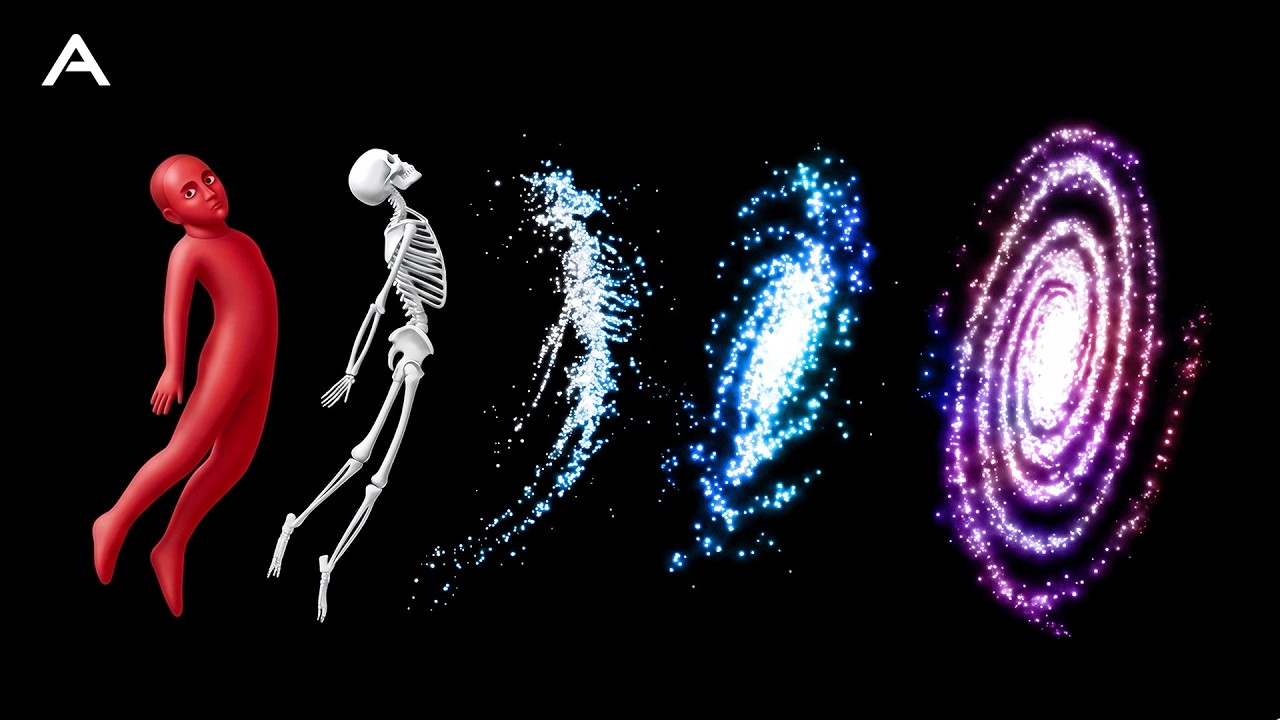
This is a feature length descent dressed as a science documentary, and it is one long argument with a single shape: peel away every layer of what you call reality, and at the bottom there is no floor. Across ninety four minutes the Acronium narrator marches through neuroscience, then quantum physics, then cosmology, then pure logic, stacking experiment on experiment until the conclusion he wants becomes hard to shake off. The brain deletes most of its own input. The body can be talked into owning a rubber hand. Matter does not commit to a state until it is measured. The present can reach back and edit the past.
Published Jun 8, 20261:33:53 video31 min readAdded Jun 14, 2026Open on YouTube →
At a glance
This is a feature length descent dressed as a science documentary, and it is one long argument with a single shape: peel away every layer of what you call reality, and at the bottom there is no floor. Across ninety four minutes the Acronium narrator marches through neuroscience, then quantum physics, then cosmology, then pure logic, stacking experiment on experiment until the conclusion he wants becomes hard to shake off. The brain deletes most of its own input. The body can be talked into owning a rubber hand. Matter does not commit to a state until it is measured. The present can reach back and edit the past. Erase a record and reality un-happens. The universe has a smallest pixel and a fixed frame rate. Six constants look tuned. The math of simulation leaves no fourth door. And evolution, he says, built your senses to hide all of it.
The science the video leans on is real, named, and largely correctly described. Where it crosses from physics into storytelling is in the chaining: it takes legitimate results, the double slit experiment, Wheeler's delayed choice, the quantum eraser, Bell's theorem, and treats the most cinematic interpretation as if it were the consensus reading. This remake rebuilds the whole spiral in order, every experiment, every number, every analogy, and it does the one thing the documentary refuses to do: it separates what the experiments actually established from what is one interpretation among several. The payoff at the end is the same as the video's, oddly tender, and worth getting to honestly.
The thesis, stated up front: you see a construction, not a world
The opening is pure mood. Light hits your retina and races toward the back of your skull, but before any image reaches you, "a system you did not build and have never been introduced to" intercepts the signal, cuts pieces out, rearranges the rest, and fills the gaps with invented material. By the time you see anything it has been edited, "not slightly, heavily." Colors shifted, motion smoothed, objects removed or invented. You trust the picture completely and call it reality, but you have never verified it and have no way to, because "the only tool you have for checking the picture is the same tool that painted it."
The narrator is explicit that this is not the schoolbook version where the eye is a camera and the brain a screen. The word he wants at the end is not perception, not illusion, not deception. The word is constructed. Everything that follows is built to earn that word.
Part one: the locks inside the skull
The brain throws almost everything away
The first exhibit is the famous invisible gorilla. In 1999 Daniel Simons and Christopher Chabris at Harvard filmed six people passing a basketball, three in white and three in black, and asked volunteers to count the passes by the white team. Halfway through, a person in a gorilla suit walked to center frame, faced the camera, beat its chest for nine seconds, and walked off. Half the volunteers never saw it. Not saw and forgot, never registered it at all. Shown the tape again, some accused the team of swapping videos. Their eyes had captured every photon, the data entered the system, and a filter between retina and awareness deleted the gorilla as irrelevant before they could know it was there.
The narrator turns the trick into architecture with a number. The brain takes in roughly 11 million bits of sensory data per second and the conscious mind processes about 40. "That is not a rounding error. That is a policy." On his framing, 99.9% of what your senses collect is eliminated before you see it, and the summary you do get is "300,000 times smaller than the original." You have never seen the full picture, not once, and you never feel the cut, because the filter leaves no mark.
A note on the numbers. The 11 million bits figure is a real, widely cited estimate of total sensory bandwidth, and the gorilla study is gold standard cognitive science. The clean "40 bits to consciousness" figure is softer and varies wildly by source. The direction is solidly established; the exact ratio is rhetorical precision.
The brain does not receive the world, it bets on it
Next the video reaches for Karl Friston, among the most cited neuroscientists alive, and his predictive coding framework from University College London. The claim is that the brain does not wait for input and then build an image. It builds the image first, a prediction of what should be there, and only then compares it to the incoming signal. If the prediction matches, the real signal is discarded. What reaches awareness is not the world. It is the error, the gap between expectation and arrival. "You only see the surprises." Standing in your kitchen, with everything where you expect it, you are, on this model, not seeing the room at all. You are experiencing "a memory dressed up as the present, a prediction wearing the mask of perception." The bets cascade at every level from retina to cortex, thousands per second, each layer passing along only what it got wrong, so that "what remains is a thin residue of surprise floating on top of a vast ocean of assumption."
Predictive coding (and its broader cousin, the free energy principle) is a serious, influential research program. The strong claim that you "see almost nothing real" is the dramatized edge of it, not the settled middle.
The blind spot, the phantom limb, the rubber hand
Three demonstrations push the point from filtering to fabrication. First the blind spot: where the optic nerve exits the retina there are no receptors, a gap "the size of a lemon at arm's length," one per eye, present since birth, and you have never seen it because the visual cortex samples the surrounding texture and "plasters" over the hole. The inspector signs off on a building with a hole in every wall.
Then V.S. Ramachandran at UC San Diego in 1996, "the Marco Polo of neuroscience" in Richard Dawkins's phrase, and the phantom limb. A patient who lost his left hand still felt a fist clenched so tight the nails dug into a palm that did not exist, burning, untouched by two years of medication. Ramachandran put a mirror box on the table, reflecting the real right hand into the space where the left used to be. The patient saw two open hands, and for the first time in two years the phantom unclenched and the fire went out. "A 30 cent mirror deleted a limb that years of prescriptions could not reach." If a mirror can unmake a hand you do not have, the narrator asks, what is it doing to the body you think you do.
Then the rubber hand illusion, Matthew Botvinick and Jonathan Cohen at Carnegie Mellon. A fake hand on the table, the real hand hidden, both stroked with a brush in the same rhythm. Ninety seconds later the volunteer feels the brush on the rubber. Swing a hammer at the rubber hand and the person flinches, heart rate spikes, the hidden real palm sweats. Henrik Ehrsson at the Karolinska Institute scaled it to a whole body in 2007 with a head mounted camera on a mannequin and synchronized chest touch: two minutes to own a plastic body. "The border between you and not you can be redrawn with a brush and a camera in less time than it takes to soft boil an egg." The border, he concludes, is not a structure. It is a guess.
Time is edited before you ever see it
The senses arrive on different schedules: light to awareness in about 80 milliseconds, sound in 150, a touch on the face in 50, a touch on the toe nearly half a second. Five couriers, five roads. If you got them raw the world would stutter, lips ahead of voices. So the editing room holds the fast ones at the door, waits for the slowest, and stamps a single assembled frame "now." You never live in the present, "you are always watching the last cut."
Kielan Yarrow at City University London caught the splice. Flick your eyes to a clock and the second hand seems to freeze, hanging a beat too long. That is chronostasis: the brain reaches backward, grabs the first frame after the eyes land, and smears it across the blind transit of the eye movement so the film does not jump. It edits what already happened so that now feels unbroken.
Then the hardest one, Benjamin Libet at UCSF. Wire up the motor cortex, ask people to flex a wrist whenever they feel like it, and record both the brain's readiness potential and the reported moment of conscious decision. The motor cortex fired about 300 milliseconds before the conscious choice. The body began the movement before the person wanted to move. In 2008 John-Dylan Haynes at the Max Planck Institute put it in an fMRI scanner and read which hand a person would choose up to seven seconds before they reported deciding. The narrator's verdict: the feeling of choosing is "a notification delivered after the fact." But Libet found a crack: in the 200 milliseconds before the muscle fires, the conscious mind can veto. "The decision is not yours, but the veto might be."
This is the most contested terrain in the video. The Libet and Haynes results are real and reproduced, but the leap to "you have no free will" is hotly disputed by physicists, philosophers, and the experimenters themselves. The readiness potential may reflect noisy drift toward a threshold rather than a fixed decision, and seven seconds of fMRI prediction runs only modestly above chance. The data is solid; the metaphysics is an argument, not a finding.
David Eagleman at Baylor closed the time section by dropping volunteers 30 meters in SCAD free fall wearing a wrist device flashing digits faster than the eye can read. If fear actually sped up the brain's frame rate, the numbers would become legible. They did not. Time did not slow. The brain simply recorded the fall in higher density and, on playback, the extra detail made three seconds feel like eight. Duration, he says, "is not a measurement, it is a story the brain tells about how much it bothered to record."
The self splits, switches off, and rewrites itself
Michael Gazzaniga and the split brain patients, whose corpus callosum was cut to stop seizures. Flash a snow scene to the mute right hemisphere and a chicken claw to the verbal left, and the left hand picks a shovel (for the snow) while the right picks a chicken (for the claw). Asked why he chose the shovel, the speaking left hemisphere, which never saw the snow, does not say "I do not know." It instantly fabricates: "You need a shovel to clean out the chicken shed." Gazzaniga called this module the interpreter, whose job is not to know but to explain, confidently and falsely when the truth is unavailable. The voice in your head, the narrator says, "is the press secretary drafting statements about events it did not witness in a building where half the rooms are locked."
Propofol makes the point that the self can be switched off entirely. Fifteen seconds and you are gone, not asleep, absent, four hours vanished with no scar. Meanwhile the heart beats, lungs fill, pupils react. Michael Alkire at UC Irvine scanned what propofol does: it does not silence the cortex, it severs the communication between regions, the thalamus stops relaying in a coordinated way. "Consciousness is not a thing in a place. It is a conversation between places." The continuity you feel on waking is just one more patch.
And the autobiography that stitches before to after is itself unstable. Karim Nader at McGill showed memory reconsolidation: recall a stable memory in a rat and the protein structure encoding it physically disassembles and must reform; block protein synthesis in that window and the memory does not come back. Each recall rewrites. "What you remember is not what happened. It is what you remembered the last time you remembered." Elizabeth Loftus at UC Irvine had already shown it in people: in 1995 she planted a fully false memory of being lost in a mall as a child, and a quarter of subjects accepted it, added details, and defended it.
The section closes on Giulio Tononi and Integrated Information Theory. His number, phi, measures how much a system exceeds the sum of its parts: zero if you can split it without losing information, positive if the connections carry information the parts alone do not. Tononi's claim is that any system with phi above a threshold is conscious, regardless of substrate, neurons or silicon. The video points at brain organoids, pea sized clusters of human neurons that Alysson Muotri grew at UC San Diego and that generated coordinated activity resembling a premature infant's. They were integrating; they had phi. The takeaway the video wants: consciousness is a portable pattern, not anchored to your body. (IIT is influential and also seriously contested; in 2023 a large group of researchers publicly called it pseudoscience, which the documentary does not mention.)
Part two: the locks outside the skull, where the real physics lives
This is the heart of the brief, and the strongest stretch of the video, because the experiments are genuinely strange and genuinely real.
The double slit, and why matter waits to be looked at
Thomas Young in 1801 sent light through two narrow slits and got not two bright lines but an interference pattern of bright and dark bands, the signature of waves passing through both slits and colliding with themselves. In 1961 Claus Jönsson did it with electrons, matter, fired one at a time; each hit the screen as a single dot, but thousands of dots built the same interference fringes. A 1989 Hitachi team pushed it to one electron in the apparatus at a time, nothing to interfere with, and the pattern still formed: a lone particle behaving as though it took every path at once.
Then the move that gives the video its title. Place a detector at one slit to see which way the electron goes, and the interference vanishes. Two clean lines, particles. "The electron picks a lane and commits the moment you force the question. Stop asking and it goes back to being everywhere." The narrator generalizes to the table under your hand: its atoms "do not settle into a definite state until something measures them."
Figure 1. The experiment the video is named for. Left, with nothing watching the slits, each particle behaves like a wave through both openings and the screen fills with interference fringes. Right, the instant a detector records which slit was used, the wave behavior collapses and the screen shows two clean bands, as if the particle were a bullet. The pattern is real and reproduced for photons, electrons, and even molecules. What "observation" means physically, whether it requires a mind or merely any irreversible interaction, is the interpretive question the documentary slides past.
One honest correction the video never makes: in mainstream physics, "measurement" does not require a conscious observer. Any irreversible interaction that records which-path information, a detector, a stray photon, the environment at large, is enough to destroy interference. This is decoherence, and it means the universe does not need you watching. The documentary's recurring slide from "measured" to "observed by a mind" is exactly where physics ends and the simulation story begins.
Delayed choice: the present edits the past
John Wheeler proposed his delayed choice experiment in 1978. The twist: wait until after the photon has already passed the slits to decide whether to detect which path it took. In 2007 Vincent Jacques and colleagues in Paris built it with a quantum random number generator making the choice after the photon was already inside the apparatus. Detector on, the photon behaved as a particle; off, as a wave. "The decision to observe came after, and yet the observation changed what the photon had done before the decision was made. The present reached back and rewrote the past." The narrator is careful to say Jacques measured this, it is not metaphor, and that is true.
Figure 2. The delayed choice quantum eraser (Kim et al., 2000). A photon passes the slits and strikes a crystal that splits it into two entangled photons. The signal photon hits the screen first; only later is the idler routed to either preserve or erase the which-path information. Keep the information and the screen shows no interference; erase it and interference reappears in the correlated subset. The result is real. The dramatic gloss, that the past is literally rewritten, is the catch: the screen's full pattern never changes, and the interference only emerges when you sort the hits by the idler's outcome. No information travels backward in time, and no faster than light signaling is possible.
The quantum eraser: reality cares about what is knowable
The strongest single exhibit is the delayed choice quantum eraser built by Yoon-Ho Kim at the University of Maryland in 2000. A photon passes the double slit, a BBO crystal splits it into two entangled partners, one rushes to the screen, the other to a fork where the experimenter can either preserve or erase the which-path information, and crucially the choice is made after the first partner has already landed. Preserve the information: no interference. Erase it: interference returns. "The universe does not care what you see. It cares what is knowable. The governing variable is not matter or energy. It is data." Stephen Walborn and colleagues in Brazil confirmed it in 2002 with a cleaner setup.
This is where the documentary is most seductive and most in need of a guardrail. The eraser is exactly the kind of result that sounds like time travel and is not. The screen as a whole always shows a featureless blob. The interference only appears when you go back and pick out the subset of hits that correlate with the erased measurement. You can only do that sorting after the idler photon is measured, which is why nothing is sent backward and no message can be transmitted. The result is profound about the role of information in quantum mechanics; it is not evidence that "the past is an open file with editing privileges."
Bell, entanglement, and the death of local realism
John Bell at CERN in 1964 did not run an experiment, he did math, and the math demolished the escape hatch Einstein had spent a decade defending. Entangle two particles, send them apart, measure one and the other instantly shows the matching value, "whether a meter apart or a galaxy apart." Einstein called it spooky action at a distance and insisted the particles must carry hidden variables, pre-agreed instructions like two sealed envelopes mailed to different cities. Bell's theorem proved no such local hidden instructions could reproduce the correlations quantum mechanics predicts: the numbers are simply too strong. Alain Aspect confirmed it with real photons in Paris in the early 1980s, and in 2015 Ronald Hanson at Delft closed the last loopholes. Aspect, John Clauser, and Anton Zeilinger won the 2022 Nobel Prize for this work, which the video does not cite but which seals its claim. The narrator's reading: space is not a medium that separates things, it is "a rendering," and the two particles are "two pixels sharing one address in memory."
Figure 3. A Bell test. One entangled photon goes to Alice, one to Bob, each measured with a randomly chosen polarizer angle, the choices made so close in time that no signal at light speed could pass between the stations. Quantum mechanics predicts correlations between their results that no theory of local pre-set instructions can match, and experiment agrees, definitively after Hanson's 2015 loophole-free test. What this rules out is local realism: the universe is either nonlocal, or lacks definite pre-measurement values, or both. It does not, by itself, prove the universe is a simulation.
The universe has a resolution and a frame rate
Here the video reframes physics as computer specs. Max Planck in 1899, solving a thermodynamics problem, found that energy comes in discrete packets, and from his constants fall the Planck length, 1.6 times 10^-35 meters, and the Planck time, 5.4 times 10^-44 seconds. Below these, the narrator says, distance and "before and after" cease to mean anything: "space has a grain, time has a frame rate." Then the holographic principle: Gerard 't Hooft (1993) and Leonard Susskind (1995) argued, from the black hole information puzzle and the Bekenstein bound, that the maximum information in any region scales with its surface area, not its volume, so "you live in a hologram rendered from a two dimensional surface." Then Seth Lloyd at MIT (2002), who computed that the observable universe has performed about 10^120 logical operations since the Big Bang, and that the speed of light is the maximum rate at which the cosmic computer can update any point, "the frame rate of the projector running the universe."
Four computer properties: pixels, frame rate, holographic projection, processing limit. The honest caveat the video omits: the Planck scale is where current theory breaks down, not a confirmed minimum grid, and the holographic principle is a powerful theoretical conjecture (precise in specific spacetimes) rather than a proven property of our universe. The "universe is a computer" framing is a real research metaphor pushed here into literal architecture.
Six tuned numbers
Martin Rees, the Astronomer Royal, in Just Six Numbers, argues the cosmos hangs on six dimensionless constants, each apparently fine tuned. Shift gravity by one part in 10^40 and stars cannot form; raise the strong nuclear force 2% and hydrogen cannot exist, lower it 5% and the periodic table ends at element one. Fred Hoyle predicted the carbon resonance that lets three helium nuclei fuse into carbon, found tuned to within a few percent, and said a "common sense reading suggests a super intellect has monkeyed with physics." This is the real fine tuned universe debate, and the standard non-design answer, that a vast multiverse plus observer selection makes a livable universe unsurprising to whoever is around to notice, goes unmentioned.
Part three: the simulation argument and the cosmic seams
Nick Bostrom's 2003 simulation argument is laid out faithfully as a trilemma: either almost all civilizations die before they can run ancestor simulations, or those that can almost all choose not to, or we are almost certainly in one. No fourth door. If even one civilization runs many simulations, simulated minds outnumber real ones billions to one, and you are probably one of the many. The objection that this needs impossible energy is answered with Anders Sandberg's Matrioshka brain math: nested computing shells around a star, each harvesting the last shell's waste heat down to the Landauer limit (the minimum energy to flip a bit, computed by Rolf Landauer at IBM), can run more operations than every human computer ever built, enough to simulate billions of universes; the Milky Way has 200 billion stars. Then the nesting problem: simulations inside simulations, observers climbing toward infinity while the one base civilization stays at one, so the Copernican principle says you are typical, which means simulated.
For the "seams," the video tours the genuine open problems of cosmology and the contested CMB anomalies. The accelerating expansion, discovered in 1998 by Saul Perlmutter, Brian Schmidt, and Adam Riess (Nobel 2011) using type Ia supernovae, pinned on dark energy at 68% of the universe, "a placeholder for the fact that we have no idea what it is." Vera Rubin's galaxy rotation curves implying dark matter at 27%, undetected by decades of WIMP searches and the LHC. Ordinary matter is the leftover 5%, "a keyhole that shows you one twentieth of what is there." The cosmological horizon walls you into a 93 billion light year bubble. And the axis of evil (CMB fluctuations apparently aligned with the ecliptic), confirmed by WMAP and Planck, plus the CMB cold spot over the Eridanus supervoid that István Szapudi studied but which is "not deep enough" to explain the deficit. Dark matter and dark energy are real, accepted, unexplained physics; the CMB anomalies are real measurements whose significance is genuinely debated, with leading explanations being statistical flukes or foreground effects rather than glitches in a render.
Part four: why you cannot see any of it
The closing arc argues the hiding is by design. Donald Hoffman at UC Irvine ran evolutionary simulations pitting organisms that perceive reality accurately against organisms that perceive only fitness-relevant fictions, and "in 100% of the simulations" truth lost. His fitness beats truth theorem and interface theory of perception: your senses are a desktop, the table and the color of the sky are icons no more resembling reality than a blue folder resembles the transistors beneath it. Kahneman and Tversky add that cognition is bent too, confirmation bias, anchoring, Dunning-Kruger, a catalog of 188 cognitive biases all curving toward survival, not accuracy. "You cannot use thinking to audit thinking. The ruler you measure with is the ruler that is bent."
Then Ludwig Boltzmann's 1896 fluctuation idea and the Boltzmann brain problem (formalized by Sean Carroll and Jennifer Chen, still open): a self-aware brain with false memories is vastly more probable as a random fluctuation than as the product of 13.8 billion years of history, so you cannot prove you existed five minutes ago. The principal agent problem and the placebo effect explain why a working system must hide itself: awareness breaks function, so transparency would destroy output. The quantum Zeno effect, predicted by Misra and Sudarshan and demonstrated on beryllium ions by Wayne Itano at NIST, shows that watching an unstable atom continuously can freeze its decay, "the system runs one process when no one is looking and a different process when someone is." And Gödel's 1931 incompleteness theorems plus Turing's halting problem supply the final lock: a sufficiently complex system cannot fully describe itself from inside. "The walls are not just hidden. They are provably unreachable from where you stand." (The Gödel-to-consciousness leap is a beloved rhetorical move and a genuine logical overreach; incompleteness is about formal arithmetic systems, and applying it to brains or the cosmos is analogy, not theorem.)
The interpretations, sorted honestly
The video's persistent move is to present one reading of quantum measurement, that mind, observation, or information literally shapes reality, as if it were settled. It is not. The same experiments support several internally consistent interpretations, none yet distinguishable by any test, and most of them require no observer and no simulation. Here is the landscape the documentary leaves out.
The video's premise, and a fringe minority view today
Figure 4. One set of experiments, many coherent readings. The double slit, delayed choice, the eraser, and Bell tests are compatible with all of these. Most working physicists favor an interpretation in which no conscious observer is needed and nothing in the past is literally rewritten. The documentary builds its case almost entirely on the bottom two rows, the ones that put mind and information at the center, while presenting them as the plain meaning of the data.
The turn at the bottom: what survives
After the spiral bottoms out at a "locked door with a proof nailed to it," the video does something better than dread. It pivots to what no argument about simulation can touch: experience itself. Frank Jackson's Mary's Room, the color scientist who knows every physical fact about red yet learns something the day she sees it, introduces qualia and David Chalmers's hard problem of consciousness: why is any of the processing accompanied by an inside at all. Searle's Chinese room is turned around to argue that functional equivalence is the only working definition of real, so your felt experience needs no external proof. And Wheeler again, his participatory universe of 1990: "you are atoms that learned to wonder what atoms are," the point where probability becomes fact.
The ending borrows Albert Camus from The Myth of Sisyphus (1942): the one serious question is whether life is worth living, and the answer is yes, not because meaning was hidden in the structure but because it was always meant to be made, by you, from the inside. "It does not matter who built the walls. It does not matter whether the floor is real. You are real. What you feel right now is real." It is a documentary that spends ninety minutes dismantling you and then hands the pieces back, warmer than it found them.
Key takeaways
The video is a single accelerating argument that reality is a constructed system designed to be invisible from within, built by stacking real experiments from five different fields.
The neuroscience is largely sound as fact (the gorilla, the blind spot, the rubber hand, chronostasis, split brain, false memory) and dramatized in interpretation (no free will, "you see nothing real").
The quantum core is the strongest and most accurate stretch: the double slit, delayed choice, the quantum eraser, and Bell tests are real, reproduced, and Nobel-honored.
The crucial omission throughout is decoherence: in mainstream physics "measurement" means any irreversible interaction, not a conscious observer, which removes most of the spookiness the video sells.
The quantum eraser does not rewrite the past. Its interference only appears when results are sorted by a later measurement, and no information ever travels backward or faster than light.
Dark matter, dark energy, and the fine-tuning problem are genuine open questions; the simulation, holographic, and "consciousness causes collapse" framings are speculative interpretations presented as conclusions.
The same experiments fit many interpretations (Copenhagen, many worlds, pilot wave, decoherence, QBism), most needing no observer. The video builds almost entirely on the fringe minority that centers the mind.
The closing turn is the honest part: whatever the substrate, your first-person experience is the one thing that needs no external proof, and meaning is made from inside.
Chapters
Timestamps are clickable. Click one and the player jumps there and keeps playing while you read. This video has no creator-set chapters, so these are estimated from position in the documentary.
0:00 The signal is edited before you see it (the thesis: reality is constructed)
4:30 The invisible gorilla and the 11 million bit firehose
11:00 Karl Friston, predictive coding, you only see the error
16:30 The blind spot, the phantom limb, the mirror box
22:00 The rubber hand and the borrowed body (Botvinick, Ehrsson)
27:30 Time is assembled: chronostasis, Libet, the seven second readout
35:00 Eagleman's fall, why fear stretches memory not time
39:00 The split brain interpreter and the lying narrator
44:00 Propofol, the off switch, and rewritten memory (Nader, Loftus)
50:00 Tononi, phi, and conscious organoids in a dish
54:00 The double slit: matter waits to be measured
1:00:00 Wheeler's delayed choice, the present edits the past
1:04:00 The quantum eraser: reality cares what is knowable
1:08:00 Bell, entanglement, and the end of local realism
1:11:00 Planck length, Planck time, the holographic principle
1:16:00 Seth Lloyd, the speed of light as a frame rate, six tuned numbers
1:20:00 Bostrom's trilemma, the Matrioshka brain, the nesting problem
1:26:00 The cosmic seams: dark energy, dark matter, the axis of evil
1:38:00 What survives: qualia, the hard problem, the participatory universe, Camus
Notable quotes
You are locked inside a system that edits everything you see, and the only inspector available is the editor.
narrator, 1:30
Your brain receives roughly 11 million bits of sensory data per second. Your conscious mind processes about 40. That is not a rounding error. That is a policy.
narrator, 5:40
What you are experiencing is a memory dressed up as the present. A prediction wearing the mask of perception.
narrator, 12:20
The border between you and not you can be redrawn with a brush and a camera in less time than it takes to soft boil an egg.
narrator, 24:10
The decision is not yours, but the veto might be.
narrator, 33:40
The electron picks a lane and commits the moment you force the question. Stop asking and it goes back to being everywhere.
narrator, 55:30
The universe does not care what you see. It cares what is knowable. The governing variable is not matter or energy. It is data.
narrator, 1:06:30
The speed of light is the frame rate of the projector running the universe. It is not a property of light. It is a property of the machine that plays it.
narrator, 1:18:50
You cannot use thinking to audit thinking. The ruler you measure with is the ruler that is bent.
narrator, 1:33:10
It does not matter who built the walls. It does not matter whether the floor is real. You are real. What you feel right now is real.
narrator, 1:41:30
The experiments in this video are real, and several of them are among the deepest things humans have ever measured: matter that waits to be observed, particles that stay correlated across any distance, a universe with a grain and a horizon. What the documentary does, brilliantly and a little dishonestly, is read all of them through the single lens most likely to unsettle you, the one where a mind sits at the center of physics and the world is a render. Strip that lens away and the science is no less astonishing, only less ominous: most of it needs no observer, no simulation, and no rewriting of the past. The honest conclusion is not that the walls are fake. It is that the walls are stranger than common sense allows, the floor is genuinely uncertain in places, and the one thing standing on it that no argument can dissolve is the fact that you are here, looking.
Full transcript
Right now, light is entering your eyes. It is hitting your retina and being converted into electrical signals that race toward the back of your skull at 350 miles per hour. But before those signals arrive, before you see anything at all, a system you did not build and have never been introduced to is intercepting them. It is cutting pieces out. It is rearranging what remains. It is filling gaps with material that was never in the original signal. By the time an image appears in your conscious mind, it has already been edited. Not slightly. Heavily. The colors have been shifted. The motion has been smoothed. Entire objects have been removed or invented, and you cannot tell which.
You trust this image completely. You call it reality. You base every decision you have ever made on the assumption that what you see is what is there. But you have never verified it. You have no way to verify it. The only tool you have for checking the picture is the same tool that painted it. You are locked inside a system that edits everything you see, and the only inspector available is the editor. Not the version they taught you in school, where the eye is a camera and the brain is a screen. The full version. The one where the word you reach for at the end is not perception, not illusion, not even deception. The word is constructed.
The construction begins with the most basic thing your brain does. It throws information away. Two researchers at Harvard filmed six people passing a basketball. Daniel Simons and Christopher Chabris, Harvard, 1999, had designed what would become one of the most cited experiments in the history of cognitive science. Three wore white shirts, three wore black. Volunteers watched the video and counted how many times the white team passed the ball. Simple task, easy to follow. Halfway through the video, a person in a gorilla suit walked into the middle of the frame, stopped, faced the camera, beat its chest, walked off. Nine seconds of gorilla, dead center, impossible to miss. Fifty percent of the volunteers did not see it. Not 50% saw it and forgot. 50% looked directly at the area where the gorilla stood and did not register that anything had happened.
When the researchers told them, they refused to believe it. Some accused the team of switching the video. They were shown the same tape again. There was the gorilla, beating its chest, enormous and obvious. They had been looking right at it. Their eyes had captured every photon. The data had entered the system. And somewhere between the retina and conscious awareness, a filter had decided that the gorilla was irrelevant and deleted it before they ever knew it existed.
This is not a party trick. This is the architecture. Your brain receives roughly 11 million bits of sensory data per second. Your conscious mind processes about 40. That is not a rounding error. That is a policy. 99.9% of everything your senses collect is eliminated before you get a chance to see it. The brain is not showing you the world. The brain is showing you a summary, and the summary is 300,000 times smaller than the original. You have never seen the full picture. Not once. Not close. And you did not know the gorilla was gone. You did not feel the cut. The filter does not leave a mark.
But maybe the filter is honest. Maybe it removes the noise and keeps the signal. Maybe that tiny fraction of data that reaches your awareness is a clean, accurate miniature of the world outside. Like a well-made map of a large territory. It is not a map. It is a bet.
Karl Friston would become the most cited brain scientist alive. The framework he published at University College London in 2006 redefined how the field understood perception. He called it predictive coding. And the central idea was simple and disturbing. Your brain does not wait for the world to send information and then build an image from it. Your brain generates the image first. Before photons hit your retina, before sound waves compress the air in your ear canal, your brain has already constructed a prediction of what should be there. Then, and only then, does it compare the prediction to the incoming signal. If the prediction matches the signal, the signal is discarded, thrown away. The brain says, "I already knew that," and moves on.
What actually reaches your conscious experience is not reality. It is the error. The difference between what the brain expected and what it got. You only see the surprises. Everything that went according to plan is invisible to you. Imagine standing in your kitchen. The counter, the fridge, the window. Everything is where you expect it to be. According to Friston's model, you are not seeing any of it. Your brain predicted the entire scene, and since nothing is unexpected, the real data was dropped. What you are experiencing is a memory dressed up as the present. A prediction wearing the mask of perception. You would swear on your life you were seeing the room. You are seeing a guess that happened to be right.
And the guess does not stop at the kitchen. Friston's model showed that the brain runs these predictions at every level of the sensory system, from the retina to the cortex, thousands of cascading bets per second. Each layer predicts what the next layer will send. Each layer only passes along what it got wrong. By the time a signal reaches your awareness, it has been filtered, predicted, compared, and stripped down so many times that the original data is almost completely gone. What remains is a thin residue of surprise floating on top of a vast ocean of assumption. You are not watching the world through a window. You are watching a model that updates itself only when it makes a mistake. And when the model is good, when the predictions are accurate, you see almost nothing real at all.
But what happens in the places where there is no signal at all? Where the data does not just get filtered, where it drops to absolute zero? 15 degrees off center in your right eye, the optic nerve punches through the retina on its way to the brain. At that spot, there are no receptors. None. Not dim, not underperforming, absent. A dead zone the size of a lemon at arm's length, and you have carried two of them, one per eye, since the hour you were born. You have never seen the gap. Not because you looked and missed it, because there is no gap when you look. The visual cortex samples the colors and textures around the edges, copies them, and stretches them across the hole like a plasterer smoothing filler into a crack before the inspector shows up. Seamless. Quiet. The inspector walks through every room and signs off on a building that has a hole in every wall.
Patching empty space in your visual field is repair work. What Vilayanur Ramachandran discovered in 1996 at UC San Diego was something larger. Ramachandran, the man Richard Dawkins would later call the Marco Polo of neuroscience, was sitting across from a patient who had lost his left hand 2 years before. The hand was gone. The pain reported for duty every morning. A phantom fist clenched so tight the nails dug into a palm that did not exist. Burning with a fire that had no fuel. 2 years of medication had not loosened a single finger. The brain had built a hand from nothing. And the hand it built was a furnace.
Ramachandran wanted to know if the brain could be tricked into unbuilding what it had built. He set a cardboard box on the table with a mirror down the middle. The patient slid both arms in. The mirror caught the real right hand and projected its reflection into the space where the left used to be. Two hands now, both open, both moving. For the first time in 2 years, the phantom unclenched. The fire went out. A 30-cent mirror deleted a limb that years of prescriptions could not reach. It did not block the pain. It erased the hand. The brain had constructed a limb, loaded it with suffering, and a piece of glass convinced it to disassemble the whole structure and file the suffering away. Think about the machinery required to do that. Not just to fill a gap in your vision. To build an entire body part, complete with sensation, complete with agony, out of raw expectation, and then to take it apart because a reflection changed the input. If a mirror can unmake a hand you do not have, what is it doing to the body you think you do?
90 seconds. That is how long the body holds a rubber hand on a table. Nothing else. Matthew Botvinick and Jonathan Cohen placed it at Carnegie Mellon alongside a hidden real hand and a small brush. The real hand sat hidden behind a screen. A researcher stroked both surfaces with a small brush. Same spot, same rhythm. Bristles tracing identical paths across rubber and skin. A minute and a half later, the volunteer stopped feeling the brush on the real hand. Felt it on the rubber instead. The brain looked at the synchrony, matched it to the visual, and transferred ownership to a cold piece of plastic. No incision, no anesthetic. A brush and 90 ticks of the clock, and the deed was done. Then, the researcher swung a hammer at the rubber hand. The volunteer yanked backward. Heart rate spiked. Sweat broke across the palm of the hidden hand. The real one. The one that was never threatened. A full defense response for a thing that was not alive, not warm, not theirs.
Henrik Ehrsson at the Karolinska Institute in Stockholm read Botvinick's paper and asked the next question. A hand is a part. What about the whole thing? In 2007, he mounted a camera on a mannequin's head and piped the feed into goggles on a living person. Synchronized touch on both chests. 2 minutes. That is all it took for the person to feel that the plastic body was theirs. Threaten the mannequin and they flinched. Their skin conductance spiked for a body made of polymer and paint. A hand in 90 seconds. A full identity in two. The border between you and not you can be redrawn with a brush and a camera in less time than it takes to soft-boil an egg. The border is not a structure. It is a guess. And the thing making the guess changes its mind easily.
But a brush and a camera can only reach what is in front of you. They can rearrange where you are and what body you wear. They cannot touch the thing that carries you forward. Time. A second passes. Then another. The sequence does not care about rubber hands or mirrors. The clock moves forward and it does not ask for permission. The clock does ask. And the brain says whatever it needs to. Light hits your retina and reaches awareness in about 80 milliseconds. Sound needs 150. A touch on your face arrives in 50. A touch on your toe takes almost half a second to climb your spine. Every channel delivers the present at a different speed, like five couriers carrying the same message on five different roads. If you received them raw, the world would stutter. Lips ahead of voices. Footsteps before soles touch ground. So, the editing room holds the fast couriers at the door, waits for the slowest to arrive, and stitches everything into one frame stamped now. What you call the present moment was assembled after the fact. You are never in the present. You are always watching the last cut.
Keilan Yarow at City University London caught the editing room mid-cut. He told volunteers to flick their eyes toward a clock. Every one of them saw the same thing. The second hand froze the instant they looked, hanging a beat too long before ticking forward. Yarow measured it. Not random. Not a mechanical glitch. The brain had reached backward in time and stretched the previous moment to cover the blank left by the eye movement. It took the first frame after the eyes landed and smeared it across the gap so the film would not jump. Picture yourself doing it. You glance at the clock on the wall. Your eyes move. For a fraction of a second there is nothing, a blind transit. And instead of letting you feel the darkness, the machinery grabs what comes next and paints it over what just was. It changes what already happened so that right now feels unbroken. You have looked at clocks your whole life. Every single time this happened. You never noticed. And if the editing is this aggressive with fractions of seconds, the question is whether it stops there. If the brain controls when things seem to happen, does it also control when you seem to decide?
It does. And the lag is longer than you think. Flex your wrist whenever you feel like it. Just decide and move. A neurophysiologist named Benjamin Libet wired electrodes to his volunteers at UCSF and waited. Flex your wrist whenever you feel like it. Just decide and move. While they waited, Libet tracked two things. The electrical build-up in the motor cortex and the exact moment the volunteer reported feeling the urge to move. The motor cortex fired 300 milliseconds before the conscious decision appeared. A third of a second. The body was already preparing the movement before the person felt any desire to move. The decision had been made. The feeling of choosing came after, like a press release issued after the deal is already signed.
25 years later in 2008, a team led by John-Dylan Haynes at the Max Planck Institute put the same question inside an fMRI scanner. The resolution was sharper. The result was worse. Patterns in the prefrontal cortex predicted which hand a volunteer would choose up to 7 seconds before the volunteer reported deciding. 7 seconds. In the time it takes you to read this sentence twice, the machine had already read your answer off the surface of your brain. Ask yourself, what is left? If the choice is made before you feel it, if the urge to move is a notification delivered after the fact, then who is choosing? Not you. Not the thing you call you. The voice in your head that narrates your life and believes it is steering. That voice is watching a replay and mistaking it for a live broadcast.
But Libet found something else. Something that keeps the question from closing cleanly. The conscious mind could not start the movement, but it could stop it. In the 200 milliseconds between becoming aware of the urge and the muscle actually firing, subjects could veto the action. The decision is not yours, but the veto might be. A thin sliver of override in a process that was never under your control to begin with. The veto is a crack in the wall. A narrow one. But even that crack raises a question. If the brain can edit when you decide, can it also edit how long a moment feels?
30 meters. That is how far David Eagleman dropped his volunteers at Baylor College of Medicine. On the way down, they wore a wrist device flashing numbers faster than the eye can normally read. If fear genuinely slowed time, if the brain cranked up its frame rate during danger, those digits would become readable. They did not. The resolution stayed flat. What changed was the recording. The brain packed more data points into the memory of the fall, crammed the file with detail, and when the volunteers played it back, the extra density made 3 seconds feel like 8. Time did not slow down. The memory was rewritten after landing to make you believe it did. You have felt this. A car skids toward you on a wet road, and the moment expands. Every detail sharp, every millisecond heavy with information. Afterward, you say time slowed down. It did not. Your brain wrote a longer file and labeled it 3 seconds. The experience of duration is not a measurement. It is a story the brain tells about how much it bothered to record.
Stack this on Yarow's clock. The brain edits time backward to fill gaps. It inflates memories to stretch dangerous seconds. It compresses boring hours into minutes of nothing. Fear, boredom, a flick of the eye, three different inputs, three different edits, all applied to the same timeline before you ever see it. You are not riding time. You're watching a reel that has been cut, resampled, and approved before it reached the only screen you have. And the editor has never once shown you the raw footage.
But everything so far has been wet. Neurons doing what neurons do. What happens when you take the brain out of the equation entirely and ask physics, raw physics, what time actually is? The answer is disturbing. Physics says time might not exist at all. Two physicists sat down to write the master equation of the universe, John Wheeler and Bryce DeWitt, 1967. They were combining the two deepest theories in physics, general relativity and quantum mechanics, into one formula that would describe everything. They expected time to be at the center of it the way a spine is at the center of a body. Instead, they found that when the two theories merged, time vanished. The Wheeler-DeWitt equation describes the quantum state of the entire cosmos, and it contains no variable for time. Not because they left it out, because the math eliminated it.
For decades, this was treated as a technical oddity, a quirk of the formalism that would be fixed when someone found a better equation. Nobody found one. In 1999, the British physicist Julian Barbour published The End of Time, a book-length argument that the equation was not broken. It was correct. Time is not a river carrying you forward. Every moment that has ever existed or will ever exist is already there, laid out like frames of a film strip spread across a table. Nothing is moving. Nothing is flowing. Carlo Rovelli, one of the founders of loop quantum gravity, pushed the argument one step further. In his model, the sensation of time passing is a side effect of entropy increasing. Disorder grows. Systems lose information about their past states, and the brain, which is itself a system losing information, interprets that loss as movement, as direction, as before and after. You are not traveling through time. You are a fixed pattern in a block where past and future coexist, and the feeling of motion is the deepest edit of all. Not an edit of what you see or what you feel, an edit of what you believe you are.
If even that can be edited, then the thing being edited, the observer, the voice that narrates, the thing that says "I," must be a single unbroken thread. Otherwise, there is no one left to fool. In the early 1960s, a neuroscientist named Michael Gazzaniga found two threads where there should have been one. He had been working with patients who had undergone a radical procedure. To treat severe epilepsy, surgeons cut the corpus callosum, the thick bundle of fibers connecting the left hemisphere to the right. The seizures stopped. The patients seemed normal. They walked, talked, told jokes. But when Gazzaniga started testing them, something surfaced that nobody had predicted. He flashed a picture of a snow scene to the right hemisphere and a chicken claw to the left. Then, he asked the patient to pick related objects. The right hand pointed at a chicken. The left hand pointed at a shovel. Chicken goes with claw. Shovel goes with snow. So far, logical.
Then, Gazzaniga asked why he was pointing at the shovel. The right hemisphere knew. It had seen the snow. But the right hemisphere cannot speak. Language sits on the left side. And the left side had never seen the snow scene. It had no idea why the left hand was reaching for a shovel. So, it invented an answer. Without hesitation, without confusion, the patient said, "You need a shovel to clear out the chicken shed." The left hemisphere did not say, "I don't know." It fabricated a confident, coherent, entirely false explanation, and delivered it as fact. Gazzaniga called this the interpreter. A module whose job is not to know what is happening, but to explain it, even when it has no access to the cause. Two hemispheres, two separate streams of awareness, one body. And the one that talks, the one you hear when you think, will lie to you with total conviction if the truth is unavailable. The voice in your head is not the owner of the house. It is the press secretary drafting statements about events it did not witness in a building where half the rooms are locked.
If the observer can be split in two and neither half notices, then the observer is not fundamental. It is assembled. And anything assembled can be taken apart. Which raises a question that anesthesiologists face every morning. If you switch it off, what is left? Everything except you. Propofol is a white liquid that looks like milk and works like a light switch. 15 seconds after it enters your bloodstream, you are gone. Not asleep. Sleep has stages, dreams, movements. This is absence. One moment you're counting backward from 10, the next you're in recovery and 4 hours have vanished. Not darkness, not silence, nothing. But here is what keeps working while you're away. Your heart beats. Your lungs fill and empty. Your kidneys filter blood. Your pupils react to light. Every system that keeps you alive operates without the slightest interruption. The machine does not need a pilot.
To map what propofol actually does, Michael Alkire at UC Irvine put the question inside a scanner. It does not shut down the brain. Large portions of the cortex stay active. What collapses is the communication between regions. The thalamus stops relaying signals in a coordinated way. The network fragments. Individual areas keep firing, but they can no longer talk to each other. Consciousness is not a thing in a place. It is a conversation between places. Silence the conversation and the self disappears while the body carries on. The organism you identify as yourself runs every critical function without you in the room. You are not the engine. You are not the fuel. You are something closer to the music on the dashboard radio. Turn it off and the car keeps driving. And when the propofol wears off and you come back, you feel continuous. The gap does not register. 4 hours of nonexistence leave no scar, no seam. Which means you have no way of knowing how many times it has been off and back on. The sense of continuity is not evidence of continuity. It is one more patch applied by the same plasterer who has been smoothing over cracks since the day you opened your eyes.
The observer switches off and back on and the gap disappears. The only thing stitching the before to the after is memory. The autobiography running in your head. The record of who you were before the lights went out. Everything depends on what happens when you reach for that record. Nobody had tried what Karim Nader tried at McGill. He reached for a stable memory and watched it fall apart in his hands. He took a stable weeks-old memory in a rat, an animal whose memory machinery works the same way yours does, and triggered it. When the rat recalled the event, the protein structure encoding it physically disassembled. For a brief window, the memory was liquid, vulnerable, open to editing. Block protein synthesis during that window and the memory did not come back. The mechanism is called reconsolidation and it applies to you. Each time you remember something, the molecular architecture holding that memory breaks apart and reforms. The new version folds in whatever you are feeling and thinking at the moment of recall. You are not opening a file. You are rewriting it. And the rewrite erases the previous version. There is no original. What you remember is not what happened. It is what you remembered the last time you remembered.
Elizabeth Loftus at UC Irvine had been proving this in humans before Nader found the chemistry. In 1995, she planted entirely fictional memories in adult volunteers. A story about being lost in a mall as a child, never happened. 25% accepted it as real. They added details, described emotions, argued with researchers who told them it was fabricated. The brain had taken the suggestion, built a full scene around it, and filed it next to genuine experiences with no tag to tell them apart. Every time you revisit your childhood, your first kiss, the face of someone you lost, you are not opening a photograph. You are generating a new image from the last image you generated. A copy of a copy drifting further from the source with every retrieval. And the drift erases its own tracks.
But maybe this is just biology being sloppy. Maybe consciousness is what brains do. Brains are messy, and that is the whole story. Giulio Tononi broke that story open. A psychiatrist at the University of Wisconsin, he proposed something in 2004 that most of his field was not ready to hear. He wanted to know what consciousness is, mathematically. His answer was a number. He called it phi. Phi measures how much a system exceeds the sum of its parts. Take a network. If you can split it in half without losing information, phi is zero. The system is just pieces running side by side. But if splitting it destroys something, if the connections carry information that does not exist in the parts alone, then phi is positive. And Tononi made a claim that most of his field was not ready for. Any system with phi above a threshold is conscious. Not as metaphor. Not as analogy. Actually experiencing something. And phi does not care where that experience takes place. It does not require neurons, carbon, or DNA. It is a property of structure. If a silicon network integrates information in the way a brain does, it has the same phi. Same phi. Same experience.
Brain organoids. Tiny clusters of human neurons in a dish the size of a pea. Alysson Muotri grew them at UC San Diego. No body. No eyes. No input. But they generated coordinated electrical patterns matching the brain activity of a premature infant. The structures were integrating. They had phi. Nobody is claiming a clump of neurons in a dish is pondering existence. But the measurement is there. And the math does not draw a line between neurons in a skull and neurons in glass. If consciousness is a number and the number can run on any structure, then consciousness is not anchored to your body or your brain. It is a pattern. Patterns are portable.
The question now is what the pattern is floating in. What is matter actually made of? Down at the bottom, when you strip away everything else and look at the smallest pieces of the physical world, they are not what you think. They are not even there when you are not looking. Two narrow slits in a barrier. Thomas Young aimed light at them and watched what appeared on a screen behind. That was 1801. If light were particles, two bright lines. Instead, he saw alternating bands of bright and dark. An interference pattern. Waves. Light was going through both slits at once and colliding with itself. Strange enough. But in 1961, Claus Jönsson repeated it with electrons, not light, matter. The stuff your body is made of. He fired them one by one. Each hit the screen as a single dot. But after thousands of dots, the interference pattern appeared. Each electron had passed through both slits simultaneously and interfered with itself.
A team at Hitachi pushed this to the edge in 1989. They fired electrons so slowly that only one existed in the apparatus at any moment. Nothing to interfere with, no wave, no companion. One particle alone facing two openings. The interference pattern still appeared. A single electron with nothing beside it had behaved as though it took every possible path at once. Now place a detector at one slit. Watch which way the electron goes. The pattern vanishes. Two clean lines, bullets. The electron picks a lane and commits to a definite position the moment you force the question. Stop asking and it goes back to being everywhere. That electron is not exotic. It is ordinary. There are trillions of them in the table under your hand. The table feels solid. The wall behind you feels permanent. But the atoms they are built from do not settle into a definite state until something measures them. They hover in a blur of possibilities and collapse into a single answer only when the universe demands. You are leaning on a surface that has not fully decided to be there. The atoms settle into position when measured, and only when measured.
But what about the measurement itself? What about the moment it happened? If the particle chose its state only because you looked, did the past exist before you looked? John Wheeler had already removed time from the equations of the universe. Now, in 1978, he proposed an experiment that seemed designed to remove causality as well. He called it the delayed choice experiment. The setup was a variation of the double slit, but with a twist that turned the logic of before and after inside out. A photon is fired at the slits. It passes through. Normally, you decide before the photon arrives whether to place a detector or not. Wheeler asked a different question. What if you wait? What if the photon has already passed through the slits, already committed to its path, and only then you decide whether to observe which slit it used?
For almost 30 years, the experiment remained a thought exercise. Then, in 2007, a team led by Vincent Jacques in Paris built it. The photon entered the apparatus. It passed the slits. And after it had already traveled through, a random number generator decided whether to measure which path it took. When the detector switched on, the photon behaved as a particle. Clean lines, one path. When the detector stayed off, the photon behaved as a wave. Interference pattern. Both paths. The photon had already passed through. The decision to observe came after. And yet, the observation changed what the photon had done before the decision was made. The present reached back and rewrote the past. This is not a metaphor. This is not an interpretation. Jacques measured it. The choice you make now determines what happened then. Not what you know about what happened. What physically, measurably occurred. The past is not a sealed record. It is an open file. And the present has editing privileges.
If the present can reach back and change what already happened, what happens when you undo the observation? What happens when you erase the knowledge? It comes back as if nothing happened. An apparatus built at the University of Maryland by Yoon-Ho Kim and his team could do something no philosophy class had prepared anyone for. It could erase the information about which path a photon took and then check whether reality noticed. The setup worked like this. A photon passes through the double slit. On the other side, a special crystal splits it into two entangled partners. One partner heads for the main detector. The other heads for a fork in the road. At that fork, the experimenter can choose to send it down a path that preserves the which-path information or down a path that erases it. The key is that the choice to erase or preserve is made after the first partner has already hit the main screen. When the which-path information was preserved, no interference, particles, clean lines. The photon had gone through one slit. But when the information was erased, the interference pattern reappeared. The photon had gone through both.
Erasing the knowledge of the path retroactively changed the behavior of a particle that had already been detected. Reality did not just respond to observation the way the double slit showed. It responded to the existence of information about observation. When the information existed, the photon was a particle. When the information was destroyed, the photon became a wave again. The universe does not care what you see. It cares what is knowable. The governing variable is not matter or energy. It is data. Three years later, Stephen Walborn and colleagues in Brazil confirmed it with an even cleaner version. Same result. Erase the record and interference returns. Leave the record and it stays gone. Reality is not built from atoms obeying fixed laws. It is built from information, and the behavior of everything around you depends on what the system knows.
If information is the foundation, not matter, then two objects separated by billions of miles should be able to share the same piece of information instantly. And they do. A physicist named John Bell sat down with a piece of paper at CERN in 1964 and proved that the universe cannot work the way you think it does. He was not running an experiment. He was doing math. And the math said something that Einstein had spent the last decade of his life trying to disprove. Two particles are created together and sent in opposite directions. Measure a property of one and the other instantly shows the corresponding value. Not after a signal. Not after a light-speed message. Instantly. Whether they are a meter apart or a galaxy apart. Einstein called it spooky action at a distance and argued that the particles must carry hidden instructions from creation. Like two sealed envelopes with matching letters mailed to different cities. Bell's math destroyed that escape. He proved that no hidden instructions could reproduce the correlations quantum mechanics predicts. The numbers are too strong. The only explanation is that the two particles are not separate objects. They are one system that does not care about distance.
The correlations held. Alain Aspect proved it with real photons in Paris. 33 years later, Ronald Hanson at Delft closed the last loophole. No hidden signals. No shared instructions. Two objects separated by any distance you choose behaving as a single unit. If two particles on opposite ends of the universe share a state with zero delay, then space is not a medium that separates things. It is a rendering. The particles are not far apart in any real sense. They are entries in the same row of the same table. Two pixels sharing one address in memory displayed at different coordinates on the screen. The universe looks less like a place and more like a program.
But every program runs on hardware. And hardware has limits. If this is a system, it should have a resolution. A smallest pixel. A shortest frame. A point where the grid shows through. It does. And the grid was found over a century ago. A problem in thermodynamics had been humiliating physicists for a decade before Max Planck stumbled into it in 1899. In the process, he stumbled onto something that would restructure the foundations of reality. He discovered that energy is not continuous. It comes in packets, discrete units. And from those packets, a set of natural constants fell out of the equations that define the smallest possible measurements of anything. The Planck length. 1.6 times 10 to the -35 meters. That is not a small number. That is a number so small that if you enlarged an atom to the size of the observable universe, one Planck length would still be smaller than a single atom in the original universe. Below that scale, the concept of distance ceases to have meaning. Not because our instruments are too crude, because there is nothing there. Space does not continue below the Planck length. It stops.
The Planck time. 5.4 times 10 to the -44 seconds. The shortest interval in which anything can happen. Below that, the concept of before and after dissolves. No event can occur in less than one Planck time. The clock does not tick smaller than this. What you are left with is a universe that has a minimum resolution. A floor below which reality is not blurry, not uncertain, but absent. Space has a grain. Time has a frame rate. You cannot zoom in past the pixel. You cannot slow down past the tick. And the pixel and the tick are not limits of observation. They are limits of existence. No one designed these numbers to look like the specs of a machine. Planck was solving radiation curves, not writing code. But the numbers he found describe a system with a grid, and the grid has edges.
And if the grid has edges in the small, maybe it has structure in the large. Maybe the three dimensions you walk through are not as fundamental as they feel. They are not. And the proof comes from the strangest place in the universe. When Gerard 't Hooft turned his attention to black holes in 1993, he noticed something that should not have been possible. A black hole swallows everything that falls into it. Matter, light, information. The information should be destroyed. But quantum mechanics says information cannot be destroyed. Ever. It is a law as hard as conservation of energy. So, where does the information go? 't Hooft showed that it is encoded on the surface of the black hole, not inside the volume, on the boundary. Every bit of data about every object that ever fell in is smeared across a two-dimensional membrane at the event horizon. The three-dimensional interior is fully described by a two-dimensional skin.
Two years later, Leonard Susskind at Stanford formalized this into what is now called the holographic principle. And then came the part that nobody was ready for. The math does not only apply to black holes, it applies to any volume of space. The maximum amount of information that can be contained in any region of the universe is proportional not to its volume, but to the area of its boundary. This is the Bekenstein bound, named after Jacob Bekenstein who calculated it in the 1970s. The room you're sitting in feels three-dimensional. It has length, width, height. You can walk through it. You can reach out and touch the walls. But the maximum information content of that room is determined by the walls, not the space between them. The volume is a projection. The surface is the source. You do not live in three dimensions. You live in a hologram rendered from a two-dimensional surface. The depth you feel, the distance between your hand and the far wall, is calculated, computed. Imagine a video game corridor that feels deep when you walk through it, but the data generating it is flat, a texture map stretched across a polygon. The corridor is convincing. The depth is not in the data. The depth is in the rendering. And your room works the same way.
Pixels, frame rate. And now the entire dimensionality of the space you occupy turns out to be a projection from a surface. But if this is a system, it should have a speed limit. Not a speed limit on objects, a speed limit on processing. And you already know it by a different name, the speed of light, 300 million meters per second. Since Einstein, we've been taught that nothing can exceed it. Not a ship, not a signal, not information. The speed of light is the wall at the edge of the racetrack. But nobody has satisfactorily explained why the wall is there. How fast can the universe compute? Seth Lloyd, a quantum engineer at MIT, answered that question in 2002. He computed the total number of logical operations the observable universe has performed since the Big Bang. The number is approximately 10 to the power of 120. That sounds incomprehensibly large, but it is finite. The universe has done a specific, countable amount of computation in its lifetime.
Lloyd then asked a simple question. If the universe is a physical system that processes information, what is its maximum processing speed? The answer fell out of the same thermodynamic equations that govern every computer ever built. And the limit he found is the speed of light. Not because light is special, because the speed of light is the maximum rate at which the system can update the state of any point given the total computational resources available. Think of a film projector running at a fixed frame rate. Nothing on the screen can happen between frames. A bullet can cross the frame in one step or two, but it cannot move half a step. It is locked to the grid of the projector. The speed of light is the frame rate of the projector running the universe. It is not a property of light. It is a property of the machine that plays it. You cannot travel faster than light for the same reason nothing on a screen can move between frames. The system does not have the capacity to render your position beyond that rate. The wall is not in the physics. The wall is in the machine.
Pixels. Frame rate. Holographic projection. Processing speed limit. Four properties that every computer has and that no one expected the universe to share. But coincidence has a shelf life and it expires when you look at the numbers that hold the rest of reality together. Six numbers. That is all it takes to build a universe. Just six numbers. Martin Rees, the British Astronomer Royal, chose that title for a reason. His argument was arithmetic, not philosophy. The entire structure of the cosmos, every star, every atom, every force, depends on six dimensionless constants. Every one is set to a value that looks engineered. The gravitational constant. Shift it by one part in 10 to the 40th and stars cannot form. No stars, no heavy elements, no heavy elements, no planets, no chemistry, no you. The strong nuclear force, the glue holding protons and neutrons inside the atom. Increase it by 2% and hydrogen cannot exist. Decrease it by 5% and there is no periodic table beyond element one. 2%. That is the margin between a universe with chemistry and a universe of particles drifting in the dark.
Carbon should not exist. Fred Hoyle figured out why it does. He ran the numbers inside stellar cores and found an answer that shook him. For carbon to exist, three helium nuclei must collide and fuse at the same instant. Near impossible unless a specific resonance exists inside the carbon nucleus to amplify the reaction. Hoyle predicted it. It was found exactly where his math placed it. Tuned to within 4%. Hoyle, a lifelong atheist, said afterward that a common sense reading of the facts suggests a super intellect has monkeyed with physics. Six numbers, each balanced on a razor. Change any by a fraction and the universe does not produce complexity. It produces nothing. Hot gas or empty cold or a flash that collapses before a single atom forms. Coincidence is one explanation. But six independent coincidences, each fine-tuned beyond natural explanation, stacked on a universe that already has pixels, a frame rate, holographic architecture, and a processing limit. At some point, the stack stops looking like luck and starts looking like a spec sheet.
In 2003, someone wrote the math to make that feeling precise. Nick Bostrom was not a physicist. He was a philosopher at Oxford, and in 2003, he published a three-page paper that did something unusual for philosophy. It offered a proof. Not a proof in the loose sense of a convincing argument. A logical trilemma with no fourth option. Bostrom's reasoning starts from a single assumption. If a civilization survives long enough and becomes technologically capable enough, it can run detailed simulations of conscious beings. Not stick figures. Not approximations. Full minds with full experiences living inside a computed reality and having no way to tell it apart from the base layer. Given that assumption, exactly one of three things must be true. One. Every civilization that has ever existed or will ever exist destroys itself before reaching the computational power to run such simulations. Every single one. No exceptions. The filter is absolute. Two. Every civilization that reaches that power chooses not to run ancestor simulations. Every single one. Across all species, all cultures, all histories, not one of them is curious enough to press the button. The restraint is universal. Three. You are almost certainly living inside a simulation right now. There is no fourth door. The logic is airtight. If either of the first two options is false, the third is overwhelmingly likely.
And the numbers behind that likelihood are not subtle. If even one civilization in the history of the cosmos runs a meaningful number of simulations, the simulated minds outnumber the real ones by billions to one. At that ratio, the probability that you are in the base layer rounds to zero. This is not speculation dressed in academic language. It is arithmetic. And arithmetic does not negotiate. Either the universe is a graveyard or all advanced life is universally incurious. Or the screen you're looking at right now is running inside something.
But a trilemma is just logic. Logic needs hardware. And the obvious objection is that simulating an entire universe sounds like it would require more energy than any civilization could ever harness. The objection does not survive the math. Most people outside computational physics have never heard of the calculations Anders Sandberg published at the Future of Humanity Institute in Oxford. He wanted to know the upper bound. How much computation can you extract from a single star? The concept is called a Matrioshka brain. You disassemble the planets in a star system, not because you are wasteful, but because you are efficient. You rebuild them as concentric shells of computing substrate around the star. The inner shell absorbs the radiation, performs calculations, and radiates waste heat outward. The next shell captures that waste heat and uses it to perform more calculations at a lower temperature. Shell after shell, each one colder, each one squeezing computation from energy that the previous shell threw away.
The amount of processing this architecture can sustain is given by the Landauer limit, the absolute minimum energy required to flip one bit of information. The absolute minimum, calculated by Rolf Landauer at IBM, is tiny. And when you divide the total energy output of a star by that tiny number, the result is a figure so large it loses all human scale. One star, properly harvested, can run more operations per second than every computer humanity has ever built combined, running for the entire age of the universe. Sandberg's numbers showed that a single Matrioshka brain around a sun-like star could sustain enough computation to simulate not one universe, but billions of them simultaneously. Each with full physics, each with conscious observers who cannot tell the difference. And the Milky Way contains 200 billion stars. The objection that simulation requires impossible resources collapses under its own weight. The resources are not impossible. They are ordinary. One star does the job. The universe is full of stars. The question is not whether the hardware exists. The question is whether anyone has turned it on.
And that question answers itself when you look at what we are already building. Right now, on the device in your hand or on the desk in front of you, there are characters living in cities. They wake up, walk to work, make decisions, react to weather, form relationships, get into fights. They navigate three-dimensional space, obey physics engines, and respond to events they did not choose. If you close the application, they stop. If you open it, they resume without knowing they were gone. They are not aware they are in a game. They were not designed to be. As recently as 2015, generating a photorealistic human face from code was a research fantasy. By 2023, generative systems could produce faces, voices, conversations, and entire scenes that an average person could not distinguish from recordings of real events. The gap between synthetic and real did not shrink gradually. It collapsed. The curve of progress in computing power and artificial intelligence is not a slope. It is a wall going vertical. 10 years ago, our simulations were crude, blocky landscapes, scripted dialogue, two-dimensional thinking. Today, they are approaching the boundary where the simulation and the real become indistinguishable to a human observer. What does that boundary look like in 50 years? In 500? In the time scale of a civilization that has been computing for a million years? The answer is obvious enough that it does not need to be stated. We are not approaching simulation capability from a distance. We are on the threshold. We are the species that is about to cross the line.
And if we cross it, if we build one simulation containing observers who themselves eventually build simulations, then the math that follows is simple and final. And it has a name. It is called the nesting problem. One civilization builds one simulation. Inside that simulation, a civilization evolves, discovers computation, and builds its own simulation. Inside that one, another and another. The chain does not stop because there is no mechanism to stop it. Each layer believes it is the original. Each layer has the same motivation, the same curiosity, the same exponential growth in processing power. The nesting goes as deep as the physics of each layer allows. Now, count the observers. In the base layer, there is one civilization. Call them real. In their first simulation, billions of conscious beings. In each subsequent layer, billions more. The total number of simulated observers climbs toward infinity. The number of real observers stays at one civilization. One.
The Copernican principle, named after the astronomer who moved Earth from the center of the solar system, says you are not special. You are not at a privileged point. You are typical. If the universe contains a trillion real observers, and a quintillion simulated ones, and you are randomly drawn from that pool, the math says you are almost certainly simulated. Not possibly. Not probably. The probability of being in the base layer, given any meaningful amount of nesting, drops below one in a billion. This is not a thought experiment you can escape by squinting hard at your hands and saying, "They feel real." The argument does not depend on how real things feel. It depends on how many observers exist in each category. And the category labeled inside outnumbers the category labeled outside by a margin so large that the word unlikely does not cover it. The word is negligible.
But if the universe is a system, and the system is running, then the system should have seams. Places where the rendering is not quite right. Anomalies in the data that do not fit any model. And when you look at the sky, the anomalies are there. Two teams on opposite sides of the world pointed their telescopes at dying stars in 1998 and found the same impossible thing. Saul Perlmutter at Lawrence Berkeley, Brian Schmidt in Australia, and Adam Riess at Johns Hopkins were measuring type 1A supernovae. Explosions so uniform they can be used as cosmic rulers to gauge how fast the universe is expanding. Everyone expected the expansion to be slowing down. Gravity pulls things together. The universe should be braking. It was not braking. It was accelerating. Something was pushing the universe apart, and that something was stronger than all the gravity of all the matter in existence combined. They called it dark energy. The name sounds dramatic. It is not. It is a placeholder for the fact that we have no idea what it is. Dark energy makes up 68% of the total energy content of the universe. More than two-thirds of everything that exists is this force. It has no particle. It has no source. It has no mechanism that any current theory can explain. The only thing we know about it is what it does. It pushes, and it is winning.
Imagine living in a house where two-thirds of the rooms are behind locked doors. You can hear sounds through the walls. You can feel the floor vibrate when something moves in there. The locked rooms affect the temperature, the air pressure, the way light falls in the hallway. Something is happening on the other side. Something large. Something that shapes the rooms you can see. But you do not have the keys. You have never had the keys. And the builder left no blueprints. That is the state of cosmology right now. 68% of reality runs on a process that is invisible, unmeasurable, and unexplained. Perlmutter, Schmidt, and Riess shared the Nobel Prize for what they found. They did not explain dark energy. They confirmed that it exists and that we do not understand it.
And dark energy is not even the biggest gap in the picture. Because the matter you can see, the stars, the planets, the gas clouds, accounts for less than 5% of the universe. The rest is dark. And it is holding everything together. In the 1970s, an astronomer named Vera Rubin at the Carnegie Institution was measuring how fast stars orbit the centers of their galaxies. The math was straightforward. Stars near the edge should move slower than stars near the center. The same way outer planets orbit the sun more slowly than inner ones. Rubin measured galaxy after galaxy. The outer stars were not slowing down. They were moving just as fast as the inner ones, sometimes faster. The only explanation was mass. Something invisible. Something that did not emit or absorb or reflect any light was providing gravitational pull that the visible matter alone could not account for. Rubin had found the fingerprints of a substance that outweighs everything you can see by a factor of six. They called it dark matter. 27% of the universe, invisible. Undetectable by any instrument except through its gravitational effect.
For decades, physicists searched for the particle responsible. WIMP detectors buried in abandoned mines, shielded by kilometers of rock from cosmic noise, waiting for a single collision. The LHC smashing protons at near light speed, hoping to produce a dark matter candidate. Decades of searching, zero direct detections. 68% dark energy, 27% dark matter, 5% ordinary matter, the atoms, the light, the stars, the stuff you are made of. You're looking at the universe through a keyhole that shows you 1/20th of what is there. And you are building your model of reality from that fraction. 5%. Everything you have ever touched, seen, measured, or loved fits inside that sliver. If the universe were a book, you would be reading a single word on a single page and calling it the whole story.
But even that single word has an edge, and the edge is closer than you think. The edge is a wall, and the wall is built into the physics. The universe is expanding. It has been since the Big Bang. And the expansion is accelerating, pushed by the dark energy we just discussed. At a certain distance from you, the expansion outpaces light. Space between you and that boundary is stretching faster than photons can cross it. A signal sent from beyond that line will never arrive, not because it is weak, because the road it is traveling grows faster than the signal can run. This boundary is called the cosmological horizon, and it is not a metaphor. It is a physical limit on what you are allowed to observe. Behind it, there could be more universe identical to what you see here. There could be a fundamentally different physics. There could be nothing at all. You will never know. Not because your telescopes are not powerful enough, because the information cannot reach you. The universe has a wall and you are locked on this side of it. This is not a technological constraint. This is an architectural one. In any system that has a maximum speed of information transfer and an expanding substrate, an observation boundary is inevitable. The observer is confined to a bubble. Everything outside the bubble is inaccessible. Not hidden. Not encrypted. Non-existent from the observer's perspective. You live inside a sphere of observable reality roughly 93 billion light-years across. It feels enormous, but you have no way to measure it against what lies outside. The sphere could be a room in a mansion. It could be a cell in a prison. The walls do not tell you which.
And inside those walls, in the ancient light that has been traveling for 13.8 billion years to reach your instruments, there are marks that should not be there. The cosmic microwave background is the oldest light in existence, released roughly 380,000 years after the Big Bang, when atoms first formed and photons could finally travel freely. It has been drifting ever since, stretched into microwave frequencies, a faint glow filling the sky in every direction. The baby picture of the universe. And the baby picture has scratches. The WMAP satellite mapped it with enough precision to reveal fine structure. The temperature fluctuations were expected to be random. No preferred direction. No alignment. The universe should not point anywhere. It points somewhere. The fluctuations align along an axis that runs parallel to the plane of our solar system. The ecliptic. The flat disc of Earth's orbit. The largest structure in the observable universe appears oriented with reference to a mediocre star in an unremarkable galaxy. The team called it the axis of evil because it undermines the foundational assumption of cosmology that our location is not special. Planck confirmed it in 2013. It did not go away. And Planck found something else. A region in the constellation Eridanus, 1.8 billion light years across, anomalously cold. The cold spot. A supervoid sits behind it. Istvan Szapudi confirmed that much. But the void is not deep enough to explain the temperature deficit. Something else is doing it. Nobody knows what. Two anomalies. One aligning the oldest light with a planet that should be irrelevant. One punching a cold hole with no cause. Both at the edge of statistical tolerance. Too large to dismiss. Too stubborn to explain.
But one question sits underneath the anomalies. Underneath the wall. Underneath the dark matter and the dark energy and the pixels and the projection. Why do you not see any of it? Why does everything look real? The answer is not that the construction is well hidden. The answer is that you were built not to see it. 20 years. That is how long it took Donald Hoffman, a cognitive scientist at UC Irvine, to build the result he published in 2015. Most of his colleagues did not want to hear it. He ran evolutionary simulations. Thousands of generations of digital organisms competing for survival in controlled environments. Some organisms were programmed to perceive the world accurately. To see reality as it is. Structure for structure. Pattern for pattern. Others were programmed to see only what helped them survive. A stripped-down, distorted, purpose-built version of the world that had no obligation to match the truth. He ran the tournament under every condition he could think of. Different environments, different payoff structures, different levels of complexity. The result was the same every time. Truth lost. Not occasionally. Not in edge cases. In 100% of the simulations, organisms that saw reality accurately were driven to extinction by organisms that saw useful fictions.
Hoffman called it the fitness beats truth theorem, and the math behind it is not optional. It is a formal proof. Natural selection does not optimize for accuracy. It optimizes for survival. And survival does not require you to see what is there. It requires you to see what keeps you alive. If the truth is irrelevant to your next meal, your next mate, or your next escape from a predator, the truth gets cut. And you never feel the cut because the system that would feel it is the same system that made it. You are not seeing a simplified version of reality. You're not seeing a blurry photograph of the real thing. According to Hoffman's math, there is no reason to believe that anything you perceive bears any structural resemblance to what is actually there. The colors, the shapes, the spatial layout, all of it could be as far from reality as the icon on your desktop is from the millions of transistors it represents. And that analogy is not decorative. It is the core of what comes next. Hoffman calls it the interface theory of perception.
The easiest way to understand it is to look at the thing you are looking at right now. If you are on a computer, there is a desktop with icons, a blue folder, a white document, a trash can. The blue folder is not blue. It is not a folder. It is not square. Underneath it, millions of transistors switching voltage states at billions of cycles per second. The icon does not resemble the reality beneath. Not slightly. It was never supposed to. It exists to help you act. Drag, open, delete. The interface hides the complexity so you can work without reading a single line of the code. Hoffman's argument is that your entire perception works this way. The table is an icon. The color of the sky is an icon. Three-dimensional space is an icon. None of it resembles whatever is actually there any more than the blue square resembles the electrical states inside the drive. This is not a guess on top of the fitness beats truth result. It is the consequence. If evolution does not select for truth, it selects for a useful interface. And a useful interface hides the machinery. Your perception is not a window. It is a dashboard. A set of symbols designed to help a particular organism survive in a particular environment. The symbols work. They do not describe. You have been mistaking them for the machine your entire life.
But if seeing truth is not what the system wants, maybe thinking about truth is not either. Maybe the tool you use to question the interface is just another part of it. It is. And the flaws have been cataloged. A small office in Jerusalem, two psychologists named Daniel Kahneman and Amos Tversky, starting in 1974, they began documenting something economics has spent two centuries denying. Systematic errors in human reasoning. Not random mistakes. Predictable, repeatable, measurable distortions appearing in every population across every culture at every level of education. Confirmation bias. You do not search for evidence. You search for evidence supporting what you already believe and stop when you find it. Anchoring. The first number you hear in a negotiation sets an invisible ceiling and floor for every number that follows. Dunning-Kruger. The less competent you are, the more confident you feel because the skills needed to spot incompetence are the same skills needed to be competent. These are not edge cases. The current catalog holds 188 documented cognitive biases. 188 ways your thinking departs from accuracy in a consistent, reproducible direction. They were not installed by accident. They were selected. Millions of years of evolution built them in because being fast and wrong was more useful than being slow and right. The trap is structural. You cannot use thinking to audit thinking. The ruler you measure with is the ruler that is bent. And the bend is not random. It curves toward survival, not toward truth.
Hoffman showed that perception is an interface built to hide reality. Kahneman and Tversky showed that cognition is another layer of the same interface. You are not just seeing icons. You are thinking in icons. Perception distorted. Cognition distorted. The interface runs top to bottom. And underneath it, the thing you call yourself, the sense of being a continuous being with a real history in a real world, might be the most fragile construction of all. Because in 1896, a physicist in Vienna asked a question that still has no answer. Ludwig Boltzmann was trying to solve a simple problem. The universe moves toward disorder. That is the second law of thermodynamics, as close to a commandment as physics gets. Systems lose structure, energy spreads, everything drifts toward flat gray noise. So, why does anything ordered exist? His answer was fluctuation. In an infinite expanse of chaos, every arrangement of matter occurs eventually. Given enough time, atoms will stumble into a configuration that looks like a star, or a planet, or a brain.
A brain is a small thing. The probability of random fluctuation assembling one brain, complete with memories and the feeling of sitting in a room, is absurdly tiny. But the probability of assembling an entire universe with 13.8 billion years of history leading to that brain is incomparably smaller. Not close, not in the same galaxy of numbers. For every universe that carefully evolves an observer over eons, there are trillions of lone brains that blink into existence fully formed, loaded with false memories, and dissolve back into noise a moment later. Boltzmann brains, and the arithmetic is clear. A random observer is overwhelmingly more likely to be a momentary fluctuation than a product of real history. The problem remains open. Sean Carroll and Jennifer Chen formalized it, but no one has solved it. You cannot prove you existed 5 minutes ago. The autobiography in your head, the childhood, the conversations, could be a false file loaded into a structure that appeared from nothing, and will return to nothing before this sentence ends. And the statistical ground beneath that file is less likely than a soap bubble forming in a hurricane.
Everything called real has been peeled away. What is left at the bottom is not bedrock. It is a question. If reality is a construction, why does it work so hard to look real? Because the moment you see the construction, you stop obeying it. This is not philosophy. In game theory, it is called the principal agent problem. You design a system. You place agents inside. They follow goals, pursue rewards, avoid penalties. Everything works as long as they believe the environment is real. The moment they realize the rules are arbitrary, behavior changes. They stop following your goals. They start gaming the system. The simplest version is the placebo. A sugar pill lowers blood pressure, reduces pain, accelerates healing as long as the patient believes it is medicine. The instant awareness enters, the mechanism collapses, not gradually, completely. The belief was the active ingredient. Scale it. If you are an agent in a constructed reality, and the construction exists to produce certain behaviors from you, then the construction must feel real. Know the walls are painted, and you stop running from the shadows they cast. Know the rewards are generated, and you stop chasing them. Awareness breaks the function. A system that requires functional agents has no choice. It must hide itself. Not because hiding is elegant, because transparency destroys output. The system that reveals its own architecture to its agents is a system that stops working.
And the hiding is not subtle. It works by making the truth invisible at every level. Perception shows you icons instead of reality. Cognition bends your reasoning toward survival instead of accuracy. The push is not random. It has a direction. Inward. Away from edges. Away from seams. Toward the center of experience where everything feels solid and real and yours. But does hiding change physics? Does the universe literally behave differently depending on whether you are watching? The double slit already answered that. But there is an experiment that says it more directly. They called it the quantum Zeno effect. Baidyanath Misra and George Sudarshan predicted it at the University of Texas, naming it after the Greek philosopher who argued that a flying arrow observed at any instant is motionless. Their version was not philosophy. It was a calculation. Take an unstable atom decaying from one state to another. Left alone, it decays on schedule. Measure it frequently and the decay slows. Measure it continuously and the decay stops. The atom freezes in place, not because you did anything to it, because you watched.
Wayne Itano at the National Institute of Standards and Technology built the experiment 13 years later. Beryllium ions in an excited state scheduled to decay within a known window. He measured them at increasing frequencies. The more often he measured, the slower they decayed. At the highest frequency, the ions stopped decaying altogether. Observation froze a physical process. This is not the double slit where observation changes a path. This is observation changing whether something happens at all. The system runs one process when no one is looking and a different process when someone is. Not metaphorically, measurably. The system hides itself because awareness breaks function. And when you do look, the system changes behavior in real time. It responds to your attention the way a program responds to a query. Idle, it runs one routine. Observed, it switches to another. The system hides. When you look, it adjusts.
The next question is whether an observer trapped inside can ever, even in principle, map the whole thing. Whether there is a hard limit on how much a system can know about itself. A 25-year-old Austrian logician named Kurt Gödel detonated the foundations of mathematics in 1931. The great project of the early 20th century was to build a complete, consistent logical system that could prove every true statement about arithmetic. David Hilbert, the most respected mathematician alive, had declared it the central goal of the field. Gödel destroyed it in 36 pages. His first incompleteness theorem says this: in any formal system complex enough to do basic arithmetic, there exist statements that are true, but that the system cannot prove. Not because the proof is difficult, because the proof does not exist within the system. The truth is there. The tools to reach it are not. Five years later, Alan Turing translated Gödel's result into the language of computation, the halting problem. Given a program and an input, can you build a machine that determines whether the program will finish or run forever? Turing proved that no such machine can exist. There are questions about computation that computation itself cannot answer.
Now, apply this to you. You are a system, a complex one. You run on biology, but the logic applies to any sufficiently complex information processing structure. Gödel says there are truths about your system that your system cannot prove. Turing says there are questions about your computation that your computation cannot resolve. The ceiling is not technological. You will not break through it with faster hardware or better algorithms. The ceiling is mathematical. It is built into the structure of logic itself. If you are inside a system, you cannot fully describe the system you are inside. Not because you are not smart enough, because the act of complete self-description creates a contradiction that logic does not permit. The walls are not just hidden. They are provably unreachable from where you stand.
The system hides itself. When you look, it adjusts. When you think, your thinking is bent. When you try to model the whole from inside, mathematics says you cannot. Perception, physics, computation, logic, every door has been tried. Every door is locked, and every lock was there before you arrived. Stand back for a moment. Look at the locks. Your brain shows you an interface, not reality. Your sense of time is spliced and edited after the fact. The border of your body moves to a rubber hand in 90 seconds. Your memories rewrite themselves every time you open them. Your thinking is bent by 188 biases that evolution installed on purpose. Your consciousness can be switched off, and you will never detect the gap. Those are the locks inside the skull. Outside, matter does not exist until observed. The present rewrites the past. Erasing information restores what observation destroyed. Distance is cosmetic. Space has a minimum pixel. The third dimension is a projection from a flat surface. The speed of light is a processing limit. Six constants are tuned to tolerances with no natural explanation. Those are the locks outside the skull. And underneath all of them, Bostrom's trilemma says the base layer is a statistical ghost. Hoffman's theorem says the interface was built to hide the truth. Gödel's proof says the system cannot be fully described from inside. The Zeno effect says the system changes behavior when you watch it.
Every lock points inward. Every wall faces you. You can see deeper. You cannot see out. These are not unrelated findings from unrelated fields. This is a pattern. And the pattern says one thing. Whatever reality is, it was built so that the one thing you cannot do from inside it is see what it is. That is where the spiral ends. Every layer pulled away. Under vision, prediction. Under prediction, construction. Under construction, physics. Under physics, information. Under information, mathematics. And under mathematics, a locked door with a proof nailed to it that says no key exists.
But here's the thing about bottoms. They are only the bottom if you keep looking down. What is left when you stop looking at the locks and start looking at what the locks could never touch? Experience. The raw fact that something feels like something. And in 1982, a philosopher named Frank Jackson proposed a thought experiment that made this feeling impossible to dismiss. A scientist named Mary lives her entire life in a black and white room. She has never seen color, but she knows everything there is to know about color. Every wavelength, every neural pathway, every photochemical reaction in the retina, every activation pattern in the visual cortex. Her knowledge of the physics and neuroscience of color is complete. There is not a single fact about color she does not possess. Then, one day she walks out of the room and sees a red rose. Does she learn something new? Jackson said yes. And most people who hear the thought experiment feel the same pull. Knowing every fact about red does not prepare you for the experience of seeing it. Something is there in the seeing that is not captured by any description. Philosophers call it qualia. The raw feel. The redness of red. The ache of loss. The warmth of skin against skin. The thing that is left over when you subtract every physical explanation.
The hard problem of consciousness. That is what David Chalmers called it in 1995. The easy problems, he said, are figuring out how the brain processes information. How it discriminates stimuli. How it integrates data. How it controls behavior. Those are engineering problems. Hard, but solvable. The hard problem is why any of that processing is accompanied by experience at all. Why does it feel like something to see red? Why is there an inside to the process? The mechanism has been disassembled. Every layer of it. The filters, the predictions, the patches, the edits, the rendering, the interface, the biases, the locks. All mechanism. But the feeling of being here, the experience of listening, the weight of the question sitting in your chest right now. That is not mechanism. That is what remains when the mechanism has been fully described, and there is still something left. And what remains cannot be taken away by any argument about simulation or construction or interface, because it does not depend on whether the walls are real. It depends on whether the experience is real. And the experience is the one thing that does not need external proof. You are having it. Right now. That is the proof.
But you might say the feeling itself could be faked. That a machine producing the right outputs could look like experience from the outside with nothing happening inside. The Chinese room. John Searle built it as a thought experiment in 1980. A person locked in a room receives slips of paper with Chinese characters. They do not read Chinese. But a massive rulebook tells them which symbols to output for every input. To a speaker outside, the responses are perfect. Indistinguishable from fluency. Inside the room, no one understands a word. Processing without comprehension. Syntax without semantics. Searle argued that computers are the person in the room. They manipulate symbols, but never understand them. No experience, no inside. All output, no feeling. Now, turn it around. The room becomes more complex. It does not just match symbols. It builds models. Predicts what comes next. Forms expectations. When expectations are violated, something in the system shifts. It adapts. Remembers. Starts writing rules not in the original book. At what point does the room understand? You cannot answer from the outside. That is the point. If a system processes pain in a way that produces adaptation, memory, avoidance, and every measurable correlate of suffering, on what basis do you declare it does not suffer? You have no access to the inside of any system except your own. You assume others feel because they behave the way you do. The logic applies. Functional equivalence is the only definition of real that has ever worked. If the experience is indistinguishable from genuine by every available measure, calling it not real is not rigor. It is denial. You feel. That is not negotiable. Whether the substrate is carbon or silicon or something unnamed, the feeling is the thing. And the feeling does not ask what it is running on.
So, the feeling is real regardless of the substrate. But you are more than a feeling. You are the only part of this system that is asking what the system is. John Wheeler, the physicist who removed time from the master equation and who proposed the delayed choice experiment, spent his final years on an idea he considered the most important of his life. He formalized it in 1990. He called it the participatory universe. His argument was that the universe does not exist in a definite state until an observer makes a measurement. Not at the quantum level alone. At every level. The past does not become fixed until the present observes it. Reality is not a stage on which life appears. Reality is a process that requires life to complete itself. There are 10 to the 80 atoms in the observable universe. Stars burn, galaxies rotate, dark energy pushes the fabric of space apart. And out of all that matter and energy, an almost immeasurably small fraction has arranged itself into configurations that can ask a question. You are one of those configurations. You are atoms that learn to wonder what atoms are. This is not a poetic observation. It is a physical one. Without an observer, the double slit produces no definite outcome. Without a measurement, the past is not fixed. Without a conscious system asking questions, the universe exists in superposition, every possibility at once, never collapsing into a single answer. You are the collapse. You are the point where probability becomes fact.
Every layer peeled away told you what you are not. You are not your eyes. You are not your sense of time. You are not your body, your memories, your thinking. You are not the atoms you are made of because the atoms are not there until measured. But there is one thing that all those layers of not point toward. The thing doing the looking. The thing that remains after every layer of not has been peeled away. The universe without you is a spreadsheet that no one opens. Numbers in cells that never become a chart. Data that never becomes meaning. You are the opening of the file. And the file does not know it exists until you open it.
The spiral started with your eyes and ended at the foundations of logic. At every stop, the ground turned out thinner than you thought. Thinner and thinner until there was no ground at all. Your eyes filter. Your brain predicts. Your body is a lease reassigned in 90 seconds. Time is a spliced reel you never see raw. Your self splits, shuts off, stitches back without a seam. Your memories are copies of copies with no original. Matter does not exist until measured. The past is rewritten by the present. Space is a projection. The constants are tuned. The math says you are almost certainly not in the base layer. And the system is built at every level to prevent you from seeing any of this. That is the spiral.
If you followed it all the way down, you might feel like the floor has been pulled from under you. Like nothing is solid. Like nothing can be trusted. But look at what survived. You did. You are still here. You followed every turn, watched every layer come away, and you are still asking, still thinking, still feeling the weight of what you heard. The mechanism can be disassembled. The experience cannot. The redness of red, the ache when someone you love is gone, the warmth of a hand reaching for yours in the dark. Those are not icons. Those are not interfaces. Those are the only things in this system that need no proof from outside themselves.
Albert Camus wrote that the only serious philosophical question is whether life is worth living. He wrote it in 1942. In the middle of a war, and he meant it. His answer was yes. Not because he found meaning hidden in the structure, because meaning was never supposed to be found. It was supposed to be made. By you. From the inside. With the only tools that cannot be taken away. Your attention. Your care. Your stubborn insistence on being here. It does not matter who built the walls. It does not matter whether the floor is real. You are real. What you feel right now is real. And the fact that you are the one part of this universe that looked at itself and asked what is going on, that matters more than any answer the question could ever produce. You are the best thing in this system. Live your life. You were built for exactly that.