At a glance
ScienceClic English builds quantum field theory from an empty universe upward, one ingredient at a time, until a blank spacetime turns into the Standard Model. The motive is honest and concrete: ordinary quantum mechanics cannot describe situations where particles appear and disappear, and it cannot explain why every electron in the cosmos is identical to every other. The fix is to stop treating particles as the fundamental things and treat the field as fundamental instead. Particles become disturbances in that field, the way ripples are disturbances on water.
From there Alessandro Roussel lays the bricks in order: a field is a fluid filling spacetime, special relativity restricts which mathematical objects are allowed and sorts them by spin, each symmetry buys a conserved quantity, quantizing the field forces its energy into discrete rungs that we call particles, and finally letting fields interact reproduces forces themselves. The whole thing is a constructive recipe, not a list of facts to memorize. This page rebuilds the construction step by step, every concept, every analogy, and the open question it ends on.
Why ordinary quantum mechanics is not enough
The video opens by drawing the line it intends to cross. A marble has a definite position. A particle, at the microscopic scale, does not. Its presence is smeared throughout space with more or less probability, and that description of a particle as a wave of probability is exactly what quantum mechanics is. Quantum mechanics is very good at one job: tracking the evolution of a particle over time.
But it fails two tests that nature keeps setting. First, the particle count is not allowed to change. Quantum mechanics describes one particle, or a fixed number of particles, evolving. Yet in the real world particles appear and vanish constantly. The canonical example given is a photon absorbed by an electron inside an atom: the photon was there, then it is gone, and the electron carries its energy. The bookkeeping of standard quantum mechanics has no slot for that.
Second, quantum mechanics treats each particle as its own independent object. But every electron behaves identically. Roussel poses the question that the rest of the video exists to answer: how is it that an electron arriving from the far reaches of the cosmos has exactly the same mass and charge as an electron sitting in an apple on your table? Independent objects have no reason to match so perfectly. The hint is that they are not independent objects at all. They look like local manifestations of one underlying thing that fills the entire universe. That thing is a field. To take both problems seriously we need a framework that reconciles quantum mechanics with special relativity, and that framework is quantum field theory.
Start from nothing: spacetime and a field
The construction begins with an empty universe. Relativity tells us the fabric of that universe is spacetime, and to keep the pictures tractable the video shows only two dimensions of space plus one of time. Now we want to put content into it, matter.
The move is to add a field. In mathematics a field is like a fluid that fills all of spacetime, where every single point is populated by a mathematical object. That object can be a number, a vector, or something more exotic. The image to hold is not a few particles scattered in a void but a quantity defined everywhere at once, a value attached to every point of the spacetime grid. Particles will come later, and they will come out of this fabric rather than being dropped onto it.
Spin: which objects relativity allows
A field cannot be made of just any mathematical object. Special relativity imposes restrictions, because the field has to respect the symmetries built into the geometry of spacetime: symmetry under translation, under rotation, and under changing your frame of reference. Only certain objects transform correctly under all of those, and the parameter that sorts the survivors is spin.
The simplest allowed object is a plain number. It gets spin zero, because when you rotate space around a number, the number does not change at all. A vector is the next case. A vector points in a direction, so its appearance depends on the orientation from which you view it. It gets spin one, because when you rotate space through a full turn, the vector also sweeps through a full turn and returns to itself. Then relativity permits stranger objects, the spinors, which carry spin one half. The defining oddity of a spinor, stated plainly in the video, is that you have to turn it through two full revolutions, 720 degrees, before it returns to its initial state. One turn is not enough.
These objects feel abstract, and some are genuinely hard to picture, but the point is structural: every one of them obeys the symmetries of relativity, so every one is a legitimate candidate to fill the universe. Spin is not yet about spinning particles; it is the label for how a field object responds to rotating the world around it.
Symmetries and conserved quantities
Spacetime symmetries do more than restrict which objects are allowed; they also constrain how those objects are allowed to behave inside the field. The deep statement, Noether's theorem in spirit, is that each symmetry forces the field to conserve a certain quantity over time. To obey relativity, the field must respect conservation of energy, conservation of momentum, conservation of angular momentum, and conservation of the velocity of the centre of mass. These are not extra rules bolted on. They fall out of the geometry.
There is a second, subtler layer. The mathematical objects can carry symmetries of their own, internal symmetries that have nothing to do with spacetime. The example used is a field built from complex numbers. A complex number has an internal symmetry, you can rotate its phase, and that internal symmetry implies the conservation of yet another quantity, one tied to the very nature of complex numbers: electric charge. This is the video's first quiet payoff. Electric charge is not assumed; it appears as the conserved quantity that a complex field is forced to carry. Forces and charges are going to keep emerging this way, out of symmetry, rather than being inserted by hand.
Turning the field quantum
At this stage we have a spacetime filled with a classical field obeying every relativistic restriction. But the goal is the quantum world, so the field has to be made quantum. The recipe mirrors ordinary quantum mechanics exactly. To make a classical object quantum, you let it occupy several positions at once, each with some probability. To make a classical field quantum, you let it adopt several configurations at once, many possible ways to evolve, each weighted with more or less importance. The field then evolves as a superposition of all possible scenarios at the same time.
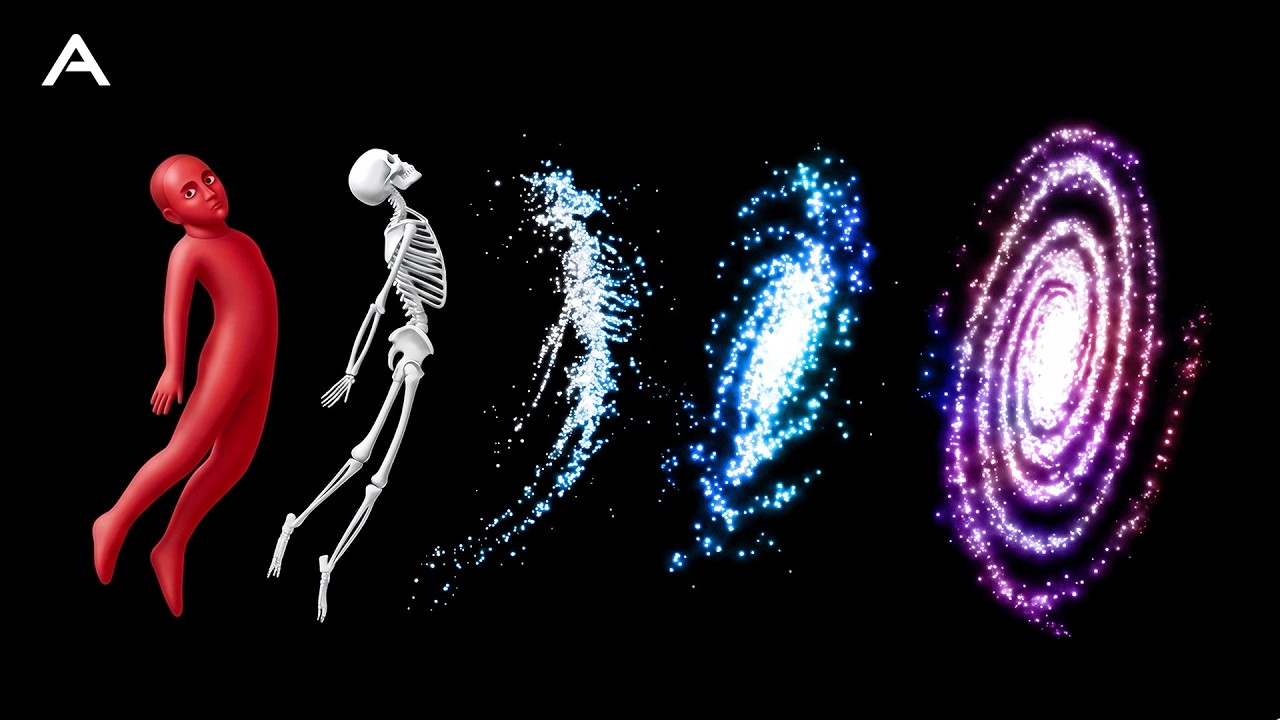
Quantizing produces one strikingly interesting property. Just as an electron bound in an atom is restricted to well-defined energy levels, a quantum field also has energy levels. It cannot hold an arbitrary amount of disturbance. It can only contain an integer number of disturbances, whole quanta of energy that can appear or disappear. These quanta are the particles. This is the heart of the whole theory: a particle is simply a disturbance that propagates within the field, exactly like a wave moving across the surface of water. The water is primary; the wave is a pattern in it. The field is primary; the particle is a pattern in it. This is why every electron is identical to every other. They are all the same kind of ripple in one and the same electron field, which answers the question the video opened with.
Quantizing also stirs the vacuum. A quantum field is never perfectly still even when it holds no real particles; it is agitated by fluctuations that keep popping in and out of existence. These are the virtual particles, and they exist so briefly that it is strictly impossible to observe them directly. They are real to the mathematics, invisible to any detector. Step by step the model universe is now closer to reality: a spacetime filled with fields, inside which move disturbances we call particles, all swimming in a soup of virtual fluctuations.
The Standard Model: a roster of fields
In our universe many fields coexist, and each one constitutes a family of particles. The video sorts them exactly by the spin classification it built earlier.
The vector fields, spin one, contain the force carriers: the photon, the Z and W bosons, and the gluons. The spinor fields, spin one half, contain the fermions that make up matter: quarks, electrons, muons, tau particles, and neutrinos. And there is exactly one field of spin zero, the Higgs field. Every fundamental field in nature falls into one of those three spin buckets.
Most of these fields carry internal symmetries, and each internal symmetry hands the field a conserved quantity, a charge that splits its particles into versions. The complex-number symmetry already discussed gives a field its electric charge, and that one symmetry distinguishes two versions of a particle, one positively charged and one negatively charged. This is the origin of antimatter: the antiparticle is, in a precise sense, the complex conjugate of the ordinary particle. Antimatter is not exotic stuff smuggled in; it is what the field's internal symmetry forces to exist alongside the ordinary particle.
Other fields carry more exotic symmetries. The quark fields, for instance, have a symmetry that grants them another charge entirely, the colour charge, which must also be conserved over time, and which separates quarks into three versions labelled red, green, and blue. The complete collection of all these fields, with their spins and their internal symmetries, is the Standard Model of particle physics, to this day the most successful description we have of the universe on the microscopic scale.
And yet the model is still not realistic. With everything assembled but inert, the symmetries of spacetime force every particle to travel in a straight line forever, completely independent of every other. Nothing pushes, nothing pulls, nothing ever happens. One ingredient is missing.
Interactions: where forces come from
The final ingredient is to let the fields interact with each other. The video studies the simplest possible case, the coupling between the photon field and the electron field. The single allowed rule is this: an electron may emit or absorb a virtual photon, and vice versa. That one little permission has drastic consequences.
Set up two electrons sitting motionless, and let time carry them forward into the future. Naively they should just sit there forever. But that ignores the fact that the electrons are constantly immersed in the photon field they are now allowed to touch, and that a quantum field realizes all possible evolutions at once. Each evolution is a scenario, and in some scenarios the electrons interact with the photon field rather than ignoring it.
In one scenario the first electron emits a virtual photon that carries away part of its momentum, and a moment later the second electron absorbs that photon. In another scenario the two electrons trade two photons instead of one. In a third, more elaborate scenario the emitted virtual photon converts into a virtual electron and positron pair, which annihilate back into a virtual photon, which is finally absorbed by the second electron. Each of these is a Feynman diagram, a single term in the sum over all the ways momentum can be passed back and forth. By exchanging momentum through these virtual carriers, the electrons drift closer in some scenarios and further apart in others.
To make the summing intuitive, the video reaches for a guitar. A string can vibrate at many different frequencies, each a pure tone. When you pluck it, it does not pick one; it vibrates in a superposition of all of them with various amplitudes, and the total sound you hear is the synthesis of all those pure tones together. A quantum field is the same. It evolves according to every possible scenario with more or less amplitude, and the real, observed evolution of the system is the synthesis of all those scenarios at once.
Carry out that synthesis for the two electrons and a clear result emerges: overall they are deflected more and more, pushed apart, feeling a repulsive force built entirely out of the exchanges of virtual photons. That repulsion is the electromagnetic force. Swap one electron for a positron of opposite charge and the amplitudes of the scenarios change, and the synthesis now yields an overall attraction instead. Opposite charges attract and like charges repel, not as a postulate but as the output of summing scenarios. By letting particles interact and trade momentum, quantum field theory explains how forces arise from the simple symmetries of the fields that make up the universe.
What it gets right, and the one thing it cannot
The closing framing is that quantum field theory is, in the end, a mathematical recipe for building a model universe. Start with empty spacetime. Fill it with quantum fields that satisfy the symmetries of special relativity. Allow those fields to interact. The result is a quantum description of the universe that respects relativity and predicts the phenomena governing the microscopic world with astounding precision. Reality, in this picture, evolves as the synthesis of all possible scenarios happening at the same time.
But the recipe is incomplete, and the video is candid about it. Quantum field theory satisfies special relativity, yet it cannot be unified with general relativity, which describes gravity as the curvature of spacetime. Some results can already be computed in fixed curved spacetimes, most famously Hawking's prediction that black holes slowly evaporate over time. But a fully unified theory, one that would explain microscopically why spacetime curves in the first place and reconcile the infinitely large with the infinitely small, gravity with the quantum, a theory of everything, is still missing. That is where the search stands.
Key takeaways
- The field is fundamental, the particle is derivative. A particle is a disturbance propagating in a field, like a ripple on water, which is why all electrons are perfectly identical.
- Ordinary quantum mechanics breaks on two fronts QFT fixes: it cannot handle a changing number of particles, and it cannot explain why same-type particles are indistinguishable.
- Special relativity restricts which mathematical objects may fill spacetime, and spin sorts them: spin 0 (numbers), spin 1 (vectors), spin 1/2 (spinors, which need two full turns to return).
- Every symmetry buys a conservation law. Spacetime symmetries give energy, momentum, angular momentum, and centre-of-mass velocity; the internal symmetry of a complex field gives electric charge.
- Quantizing a field forces its energy onto discrete rungs. Each whole quantum is a particle, and the restless vacuum produces unobservable virtual particles.
- The Standard Model is just the roster of these fields: spin 1 force carriers (photon, Z, W, gluons), spin 1/2 fermions (quarks and leptons), and the unique spin 0 Higgs.
- Antimatter is the complex conjugate of ordinary matter; colour charge splits quarks into red, green, and blue. Both are consequences of internal symmetries.
- Forces are not assumed. Let fields interact, sum every scenario (like the tones of a plucked guitar string), and electromagnetic repulsion and attraction fall out.
- QFT predicts the microscopic universe with astounding precision but cannot be unified with general relativity. Quantum gravity remains the open frontier.
Chapters
Timestamps are clickable. Click one and the player jumps there and keeps playing while you read.
- 0:00 Introduction
- 1:52 Field and spin
- 4:38 Conserved quantities
- 6:02 Quantum field
- 7:39 Standard model
- 10:15 Interactions
- 13:58 Conclusion
Notable quotes
Unlike a marble, which has a definite position, at the microscopic scale a particle does not really have a position. narrator, 0:18
How is it that an electron coming from the far reaches of the cosmos has exactly the same mass or charge as an electron in an apple? narrator, 1:30
In mathematics a field is like a fluid which fills all spacetime, each point of which is populated by a mathematical object. narrator, 2:20
Each symmetry forces the field to respect the conservation of a certain quantity over time. narrator, 4:50
Just like an electron in an atom has well-defined energy levels, a quantum field also has energy levels. It can only contain an integer number of disturbances, quanta of energy. These are particles. narrator, 6:40
A particle is simply a disturbance which propagates within the field. narrator, 6:58
In a way, the antiparticle is the complex conjugate of the ordinary particle. narrator, 8:45
A quantum field evolves according to every possible scenario with more or less amplitude, and it is the synthesis of all these scenarios together that describe the real evolution of the physical system. narrator, 12:40
Quantum field theory is a mathematical recipe for building a model universe. narrator, 13:58
Resources mentioned
- Quantum field theory, the framework the whole video constructs from scratch.
- Quantum mechanics, the predecessor whose two limitations motivate the build.
- Special relativity, whose symmetries restrict which fields and objects are allowed.
- General relativity, the theory of gravity QFT still cannot be unified with.
- Spin and spinors, the classification of field objects, including the spin 1/2 objects that need two turns.
- Symmetry in physics and Noether's theorem, the link between symmetries and conserved quantities.
- The Standard Model: photons, gluons, fermions, quarks, and the Higgs field.
- Complex numbers, the source of electric charge, and antimatter as the complex conjugate.
- Colour charge, the red, green, blue charge of quarks.
- Feynman diagrams and the electromagnetic force that emerges from summing them.
- Hawking radiation, QFT in curved spacetime predicting black hole evaporation, and the search for a theory of everything.
- Creator: ScienceClic English by Alessandro Roussel.
The one idea to walk away with
Stop thinking of the universe as a box of particles. Think of it as a set of fields filling spacetime, each obeying the symmetries relativity demands, each quantized so its energy comes only in whole rungs. A particle is just one rung, a ripple in the fluid, which is why every electron matches every other. Switch on the simplest interaction between two of these fields and the forces of nature, even the pull and push of electromagnetism, fall out of the sum over every way the fields could ripple. Quantum field theory is not a description of things; it is a recipe for a universe, and remarkably, it is our universe, right up to the edge where gravity begins.