At a glance
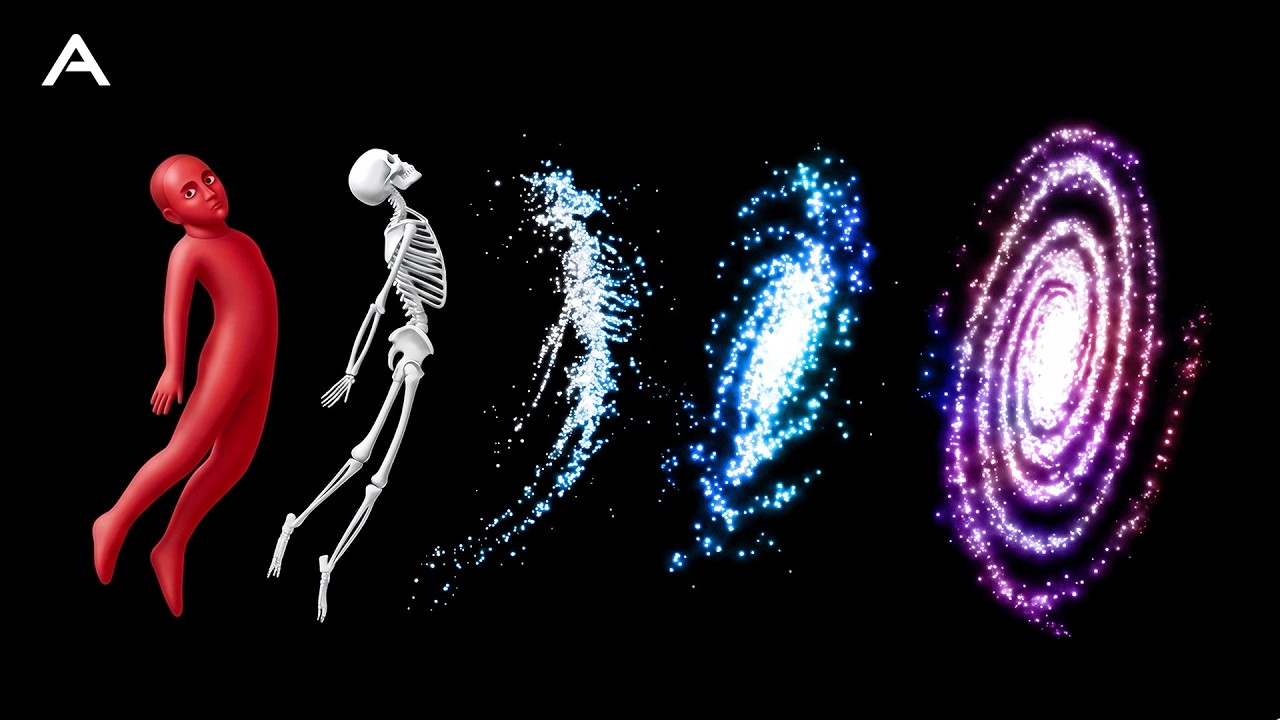
Benn Jordan starts from a deceptively simple question, what does the world sound like to a dog, and follows it straight down a rabbit hole into the fourth dimension: time. The engine of the whole video is critical flicker fusion frequency, or CFF, the fastest flicker a brain can still resolve before it smears into steady light. Treat it as the frame rate of perception. Armed with a flashlight, a stopwatch, a stroboscope, and a camera that slows the world by 41 times, Benn maps the CFF of dogs, cats, rodents, ducks, songbirds, houseflies, elephants, reptiles, and even glowing algae, and shows that a higher CFF means an animal lives in slow motion while a lower CFF means the world rushes past as a blur. Because CFF stretches or compresses time, it also stretches or compresses sound: a dog does not merely hear higher pitches, it hears Benn's voice slowed down. The payoff is a working theory of why every animal slices time the way it does, tied to metabolism, body size, and the ancient math of what you eat and what eats you.
The setup: a simple question with a mind bending answer
Benn opens with the format he loves most, what he privately calls a rabbit hole video: take one simple question, often one people ask him, that turns out to have a deep, perspective altering answer, and keep it light. Today's question is the one people ask about their dogs: what does the world actually sound like to them?
The obvious part first. Dogs have far more sensitive hearing than we do and reach higher frequencies than any human ear. They carry about 18 separate muscles in each ear that let them aim precisely at a direction and a frequency, and when something really grabs them they do the adorable head tilt. Benn points out how odd it is that humans never evolved the reflex, because it is a genuinely smart move. We are excellent at telling whether a sound came from our left or our right, but poor at placing something above or below us, in front of or behind us in three dimensional space. You would think we would viscerally tilt and triangulate every time we sensed danger, and yet, for reasons still unknown to science, we do not.
Then comes the turn that makes the whole video: what about the fourth dimension, time?
Time is a dimension every animal lives in differently
Most of us never think about it, but every animal we share the planet with has evolved to experience time at a different scale, speed, and resolution than we do. So while a dog hears higher frequencies, it is also living in a slow motion version of our world, and that includes sound. Benn demonstrates the idea out loud: you hear him talking to Lucy at normal speed, but Lucy hears that same sentence stretched and slowed. He promises to do the math, on the budget he has, and to show what the world both looks and sounds like to a whole zoo of animals.
Which raises the fair objection: animals cannot talk, so how could we possibly know how they perceive anything?
How we know: the flashlight, the strobe, and your 60 frame per second brain
Benn answers with a demo, after a quick and genuine warning for anyone with epilepsy or seizure sensitivity to look away for twenty seconds. He grabs a standard Energizer flashlight, a stopwatch, and a second camera that can slow motion by 41 times. To the fast camera the flashlight is visibly pulsing. To any human watching in real time it is simply a light that is on, because your brain cannot register more than about 60 flashes per second. Past that rate it stops resolving individual flashes and hands you the illusion of one steady glow. The temporal resolution of your reality, Benn says, is essentially capped near 60 frames per second.
He notes how meta this is to prove on video, because video itself runs the same trick. When you watch him toss the flashlight, you are really seeing 24 still images played in sequence to fake motion. That is how every motion picture works.
Next he brings out a stroboscope, a strobing tachometer, a strobe light you can command to flash an exact number of times per second. In this corner of neurology the threshold it probes has a name: the critical flicker fusion frequency, CFF, and the working hypothesis is that CFF is basically the FPS of your brain.
To find that threshold in a real eye, researchers use an electroretinogram, reading the electrical impulses the retina fires, and watch for the flash rate at which the eye stops treating each flash as new information and settles into the steady light illusion. The same approach, with more difficulty, works on animals whose CFFs are wildly different from ours, backed up by behavioral tests repeated until the result is reliable.
Benn flags the limits plainly. A lot of perception science is still theoretical, always tethered to whatever technology exists this year. Only a handful of species have been measured, and some living things cannot see at all, so entirely new methods are needed to find their CFF without using light, a puzzle he says he has been trying to solve and returns to at the end.
He then tells the anecdote that hooked him. A few years back he got his first phone with a 90 Hz refresh rate, well above the usual 60 Hz. Suddenly Lucy started paying attention to videos on the screen, even growling and whining at footage of squirrels. At 60 Hz the screen had been useless to her, because a dog's flicker fusion point sits above it. She had literally been seeing a strobe where we see a smooth video.
Reading the map: CFF across the animal kingdom
Before the tour, here is the whole spread of numbers Benn cites, from the brown rat at the low end to the housefly at the extreme.
The counterintuitive part is what a bigger number means. A higher CFF does not mean a faster life, it means the world appears to move more slowly, because the brain is taking more snapshots per second of the same reality. So the fly at 270 lives in extreme slow motion, and the elephant, sitting well below us, watches the rest of the world blur past.
The mammals
Dogs, CFF about 80
A dog's CFF near 80 is roughly 33 percent faster than ours, which means a dog perceives time about 33 percent slower, living in a mild bullet time. Its vision, by contrast, is downgraded from ours: low contrast and washed out, restricted to blue, yellow, and shades of gray, the classic dichromatic palette. Benn stitches all of it together, the eyes, the ears, and the slowed clock, to render the world as his dogs Lucy and Kora would take it in.
Cats, CFF about 50
Here is the surprise. You would expect a cat, with its elite hunting reflexes, to live in even deeper bullet time than a dog. Instead a cat's CFF is only about 50, roughly 9 percent slower than ours, so a cat's reality is actually slightly sped up compared to a human's. Cats do not see many more colors than dogs, but their sharpness beats both dogs and humans. That makes the reliable four legged landing even more impressive, because the cat has less time to compute it than we would.
Rodents, from neurotic to sped up
Wild rodents like chipmunks and squirrels tend to run high, around 120 Hz, so a jittery little squirrel that looks neurotic to us is simply living at half our speed. But not every rodent follows the rule. A guinea pig sits at 50, a touch slower than us, and a brown rat at just 39 perceives reality about 35 percent faster than we do. Benn's read is that this fits their niche: these rodents evolved to live alongside humans and eat our waste, rather than surviving on constant hunting or constant fleeing, so they never needed the fine time resolution their wild cousins carry.
The birds
Leave the mammals and the numbers climb. Benn's spoiled, well fed ducks clock a CFF around 105, about a 75 percent jump over humans, which means they experience reality almost painfully slowly given how relaxed their lives are. Wild ducks put that time budget to better use. He introduces Greg, a wild duck he has known for three years, with the note that if Greg does not want to be picked up, Greg is not getting picked up.
Smaller songbirds run all the way up to 145. What looks like a bewildering blur of speed to Benn is smooth and detailed to them. What fascinates him more is how they hear. Recording their calls with a wide range microphone at 192 kHz and 32 bit gives him enough headroom to slow the songs down while keeping decent quality, and he plays back a few years of recordings stretched into their own perceived time.
The insects and the price of bullet time
Measuring an insect's CFF is genuinely tricky, but it has been done several ways, and the housefly lands at an astonishing 270 Hz. That is a 350 percent increase in temporal resolution over us, the reason a fly can dodge every swat while it torments you. It must be wonderful to live in bullet time, right?
Not really, and this is the philosophical hinge of the video. A higher CFF is not better than a lower one. Each is an optimal time resolution a species evolved into. If humans could survive and reproduce better in bullet time, we would already live there. A housefly may feel like a big fancy pants with its fast clock, but move your hand slowly toward it and that hand becomes invisible, perceived the way we perceive grass growing or ice melting or paint drying, too slow to register as motion at all. Hence the life hack: to catch a fly bare handed, move slowly. Do not try it with wasps.
Elephants run the other way. They perceive time much faster than us. As herbivores with no natural predators, they gain from a slower metabolism, and a low CFF lets an elephant watch a rainstorm assemble or plants bloom, which is the information that actually matters to it. The fact that faster animals blur past an elephant matters no more than finches blurring past us. And recognizing patterns, not just detecting movement, depends on how you sample time in the first place. So the governing rule emerges: an animal's CFF is set by the time perception of what it eats and what eats it.
There are exceptions, but in general smaller, shorter living animals carry higher temporal resolution than larger, longer living ones, and the reason is metabolic cost. Bullet time is expensive. Many insects burn so much oxygen that there is no time to route it through lungs and a cardiovascular system, so instead they run microscopic tubes, the tracheal system, straight through the body to deliver oxygen directly to cells. Even with that engineering, a housefly lives only 28 days. The fast clock is paid for in a short life.
Reptiles hack time with a temperature knob
Some animals cheat the tradeoff. We cannot exactly chase wild reptiles around with a stroboscope strapped to their eyeballs, so this is not fully understood, but the research shows it is hard to get a stable CFF reading on anole lizards. Benn finds one in his basement studio once or twice a week and hoped one would perch on his shoulder, with no such luck. Anoles, like several lizards, can shift their color to match a background, and many reptiles can change their metabolism, body weight, body temperature, oxygen demand, and, crucially, their time perception.
Play it out. A lizard basks and warms up, sharpening its time perception so it can read the quick patterns of insects. Then it slips into a shrub, cools its body, slows its clock, melts into its surroundings, and waits for prey to make the mistake of getting close. Benn thinks crocodiles and alligators run a similar routine, lounging in the sun and then hunting land animals from the cool edge of the water. The everyday example you have probably seen yourself is a turtle or tortoise: it crawls through a time lapse reality on land, and the instant you set it in water it darts away at speed. The point is that many reptiles, just by changing body temperature, hold a knob that changes the speed of everything they hear and see. As Benn puts it, reptiles are Keanu Reeves.
Plants, fungi, and the algae room
Talking about the time perception of plants or fungi sounds silly, since they have no brains, eyes, or ears. But many of them can feel pressure, and pressure is exactly what sound is. The real obstacle is communication: how would you ever tell whether a plant perceives time at all, let alone how fast?
Benn's candidate is the one organism he can think of that reliably and instantly answers a stimulus under the right conditions, oceanic bioluminescent algae. For months a room in his house has been dedicated to cultivating and growing this glowing plankton, simulating a full day and night cycle and wiring it to electrical stimuli, audio transducers, and pressure sensors. He admits he is a long way from writing a paper on any of it, then lets the room answer for itself with a brief light show. The video closes on the note that it carried no sponsorship and was expensive to make, funded by his Patreon members, who get audio assets, unreleased music, ambisonic field recordings, monthly songwriting challenges, and game servers for as little as a dollar.
Key takeaways
- Critical flicker fusion frequency is the frame rate of perception. It is the fastest flicker a brain can resolve before separate flashes fuse into steady light, and it caps how finely an animal can sample time.
- Higher CFF means a slower perceived world, not a faster life. More snapshots per second make reality appear to crawl, which is why a housefly at 270 Hz lives in slow motion and an elephant, well below us, sees the world blur past.
- Time perception drags sound with it. A dog does not just hear higher pitches, it hears speech stretched and slowed, because the same clock governs hearing and vision.
- Humans sit near 60 Hz. That is why a 60 Hz screen looks smooth to us but strobes for a dog, and why a 90 Hz phone suddenly became visible to Lucy.
- CFF is set by metabolism, body size, and lifestyle. Smaller, shorter living, faster burning animals resolve time finely; larger, longer living ones do not. The rule of thumb is the time perception of what you eat and what eats you.
- Fast time is metabolically expensive. Insects skip lungs for direct oxygen tubes to feed a fast clock, and a housefly still lives only 28 days.
- Reptiles cheat the tradeoff with temperature. Warming or cooling their bodies slides their time perception between fast tracking and slow ambush.
- The science is young and honest about it. CFF has only been measured in a handful of species, it leans on emerging technology, and applying it to plants or algae is Benn's own open experiment.
Chapters
- 0:00 Intro
- 1:13 Time Perception
- 2:00 Critical Flicker Fusion Frequency
- 4:58 DOG REALITY
- 7:07 CATS
- 7:50 RODENTS
- 8:46 MY DUCKS
- 9:45 Other BIRDS
- 10:54 INSECTS
- 11:19 4 Dimensional Fly Trap
- 12:04 Pros and Cons of bullet time
- 13:14 Reptiles Hack Time
- 14:39 My Algae Room
Notable quotes
- "All the animals that we share this planet with have evolved to experience time at a different scale, speed, and resolution than we do." (1:13)
- "Your brain cannot keep up with more than 60 flashes per second, so it just shows you the illusion of a steady on light. The temporal resolution of your reality is essentially limited to 60 frames per second." (2:00)
- "This is referred to as the critical flicker fusion frequency, and the hypothesis is that this is essentially the FPS of your brain." (2:30)
- "Dogs have a CFF of about 80, which is 33 percent faster than humans, which means that they perceive time about 33 percent slower." (3:55)
- "A higher CFF isn't necessarily any better than a lower CFF. These are optimal time scale resolutions that every species has evolved to have." (12:10)
- "If you ever want to catch a fly with your bare hands, take your time. Don't do it with wasps." (11:45)
- "It seems like most animals' critical flicker fusion frequency is determined by the time perception of what we eat and what eats us." (12:50)
- "A lot of reptiles, by changing their body temperature, have a knob that changes the speed of everything they hear and see. Reptiles are Keanu Reeves." (14:20)
- "A lot of them can feel pressure, and guess what sound is." (14:45)
Resources mentioned
- Benn Jordan on YouTube, the channel this video lives on.
- Benn Jordan on Patreon, which funded the video (audio assets, unreleased music, ambisonic field recordings, songwriting challenges, game servers).
- Critical flicker fusion threshold, the central concept.
- Electroretinography, the retinal recording method used to measure CFF.
- Stroboscope, the strobing tachometer Benn uses to demonstrate flicker.
- Persistence of vision, why 24 still frames read as motion in film.
- Refresh rate, the 60 Hz versus 90 Hz screen point.
- Dichromacy, the blue and yellow color vision of dogs.
- Sound localization, the left and right versus up and down hearing problem.
- Respiratory system of insects, the tracheal oxygen tubes that feed a fast clock.
- Bullet time and The Matrix, the slow motion reference and the Keanu Reeves joke.
- Bioluminescence and dinoflagellates, the glowing oceanic algae in Benn's home experiment.
- Animals discussed: dog, cat, guinea pig, brown rat, chipmunk, squirrel, duck, songbird, housefly, wasp, elephant, anole lizard, crocodile, alligator, turtle, and tortoise.
Where it stands
Benn is unusually upfront about the ground under his own feet, so it is worth restating cleanly. The CFF numbers he cites are real published figures, though the literature spreads across a range for most species and measurement is hard, especially in insects and reptiles. The leap from a hertz value to a felt sense of time, the claim that a fly literally experiences slow motion, is a reasonable and popular interpretation rather than a settled fact, and Benn labels it a hypothesis when he calls CFF the FPS of the brain. The metabolic story, that smaller and faster burning animals resolve time more finely, lines up with mainstream work connecting body size and metabolic rate to temporal perception. The reptile temperature knob is grounded in the real fact that body temperature shifts a reptile's reaction speed and CFF, told as a tidy narrative. The plant and algae section is openly speculative and is his own unfinished experiment, presented as a question, not a conclusion. None of that dulls the core insight, which is solid and genuinely reframes how you think about the animals around you: the clock is not universal, and every creature is running its own.