At a glance
Animated Physics spends thirty four minutes dismantling one sentence most of us learned before we were twelve: nothing travels faster than the speed of light. The claim is not that the sentence is imprecise. The claim is that it is wrong at the root, because the number in it was never a fact about light. It is the conversion rate between space and time, a property of the room rather than the furniture, and light merely happens to be one of the things with no choice but to run at it.
The evidence opens with a fact that should not be possible if the old framing were right. On 17 August 2017 two neutron stars 130 million light years away collided and sent out two messengers built from completely unrelated physics: a burst of gamma rays, which is light, and a ripple in spacetime, which has nothing to do with electric or magnetic fields at all. After 130 million years of running they arrived here about 1.7 seconds apart. That is agreement to roughly one part in a thousand trillion between two things that share no mechanism. Something other than light is setting the pace.
From there the video builds one picture and refuses to let go of it. Everything in the universe carries an arrow of fixed length through spacetime. The only freedom anything has is where to aim it. Point it entirely into time and you sit still and age at the maximum possible rate. Tip it toward space and you trade some of your future for some distance, which is time dilation with no mechanism required and nothing reaching out to squeeze your clock. Light is the extreme case, aimed fully into space with exactly zero left over for time. Every result normally taught as a separate oddity falls out of that one shape: why the limit exists, why moving clocks run slow, why both observers are right about that, why the traveling twin comes home younger, why E = mc² has a speed of light in an equation where nothing is moving.
Unusually for a physics explainer, the video stops in the middle to tell you that its own central picture is contested. It names the source, Lewis Carroll Epstein's 1981 book Relativity Visualized, quotes Epstein's own description of it as a "good myth," lists the real objections professional relativists raise, and then hands you the rigorous one line identity underneath so you can check every claim it makes afterward. That honesty is the reason this page can rebuild the argument at full strength instead of hedging it.
The sentence that is wrong at the root
The video opens on a confession. "Here is a sentence I said for years without ever really thinking about it. Nothing travels faster than the speed of light." It sounds like a fact about light. Light is the fastest thing there is, everything else is stuck behind it, end of story. That is how the narrator was taught it, that is how he repeated it, and it is wrong. Not a technicality wrong. Wrong at the root.
The reason arrives immediately and it is an observation, not an argument. On 17 August 2017, two dead stars 130 million light years from here spiraled into each other and collided. That collision sent out two completely different messengers. One was a ripple in space itself, gravity, which has nothing to do with light. The other was a flash of gamma rays, which is light. They raced each other for 130 million years, and they arrived here about 1.7 seconds apart.
The video asks you to sit with that, and it is worth doing. Gravity is not made of photons. It does not care about electric fields or magnets or anything Maxwell ever wrote down. And it travels at the same speed as light to about one part in a thousand trillion. The analogy offered is the right size for the number: it is like running a marathon against someone and finishing so close that the gap between you is narrower than a single atom.
That, the narrator says, is a clue. The universe has a speed, and light is simply one of the things that happens to hit it. Which raises the question the rest of the video answers: if that number is not about light, what is it about? What is actually being measured?
The answer he lands on is stranger than the schoolbook version and a great deal more useful. The number is an exchange rate. It converts space into time. And once you can see it that way, the things that sound insane about relativity, time slowing down, the twins, E = mc², stop being a list of weird facts and collapse into one shape.
He also flags two promises up front. There is a sentence people repeat about all this, that you are moving at the speed of light right now, sitting still, doing nothing. He is going to show you exactly what that sentence means. And he is going to be honest about where it stops being true, "because almost nobody does that second part."
Where the number came from, and why the name is a lie
Maxwell was not looking for light
The first clue that we named the number after the wrong thing is where the number came from in the first place. James Clerk Maxwell was not hunting for light. He was fixing a broken equation about capacitors. He wrote down the four laws of electricity and magnetism, patched the hole in the fourth one (the correction we now call the displacement current), and out of the repaired set came a wave.
When he asked how fast that wave travels, the answer was one divided by the square root of two numbers. This is the pivot of the entire video, so the narrator slows down on it: those two numbers have nothing to do with light.
One of them you get by rubbing charges together and watching how hard they shove each other. That is the permittivity of free space. The other you get with wires and magnets, batteries and coils on a wooden bench. That is the permeability of free space. There is no lamp anywhere in that experiment. No sunlight. Nothing glowing. Multiply them, take the square root, and out falls 300,000 km per second.
The reason that landed like a bomb is that people already knew that number. It was the measured speed of light. So Maxwell concluded, correctly, that light is an electromagnetic wave. Enormous discovery, completely deserved. But look closely at what actually happened. A number describing how empty space responds to electricity, and a number describing how empty space responds to magnetism, combined into a speed. Those are properties of the vacuum. Of nothing at all.
"They describe the room, not the furniture. We measured the speed of the room, and we named it after the first thing we saw running at it."
The postulate is a receipt, not a reason
Next comes the complaint that motivated the video, and the narrator says he found the same complaint written out by hundreds of other people trying to learn this. Every explanation of relativity eventually arrives at the same sentence: the speed of light is the same for every observer, no matter how fast they are moving. And then it says, this is a postulate. An assumption. Einstein assumed it, the maths works, the experiments agree, moving on.
All of which is true, and none of which explains anything. "It is a receipt, not a reason."
So he makes the claim as absurd as it actually is. You are on a spaceship traveling at half the speed of light and you switch on a torch pointing forwards. Common sense says the light leaves you at c. You are already doing 0.5c, so someone watching from outside should clock that light at 1.5c. That is how everything else in your life behaves. Throw a ball forwards on a moving train and the ball does train speed plus throw speed, every single time, without exception.
That is not what happens. The person outside measures the light at c. So do you. So does someone flying towards you at 90 percent of light speed. Same flash, three observers in wildly different states of motion, one identical number.
Which should be impossible, and the video makes the impossibility precise in one move. Speed is distance divided by time. If we all agree on the answer while disagreeing about how fast we are moving, then one of the two ingredients has to give. Our distances and our durations cannot be the same as each other. That single line is the doorway into everything else on the page.
Einstein at sixteen, chasing the beam
Einstein ran into this at sixteen. He imagined chasing a light beam, riding alongside it, and asked what he would see. If he could catch up, the light should be sitting there beside him, frozen. A standing wave of electricity and magnetism hanging in space, going nowhere.
Maxwell's equations have no such solution. The entire mechanism, the thing where a changing electric field creates a magnetic field and a changing magnetic field creates an electric field, only functions while the wave is moving. Stop it and it stops existing.
So a sixteen year old had a choice. Either Maxwell is wrong, or nothing can ever catch up to light. He took the second one, "which turned out to be one of the better decisions in the history of thinking." But he still owed the world an answer to the question the video started with: why is it the same for everyone?
We stopped measuring it in 1983
One more clue before the picture, and the narrator calls it a proper piece of school betrayal that almost nobody mentions. We do not measure the speed of light anymore. We stopped in 1983.
Since then it has had an exact value by definition: 299,792,458 metres per second. Not approximately. Exactly. There is no uncertainty attached to it and there never will be again, because nobody is measuring it. The 17th General Conference on Weights and Measures turned the whole thing around. We define the second using a cesium atom. Then we define the metre as the distance light travels in one 299,792,458th of a second.
So when a modern lab measures the speed of light very carefully, they are not learning anything about light. They are calibrating their ruler.
The video asks you to notice what was quietly admitted the day that happened. We stopped treating c as a fact to go and find, and started using it as a conversion factor between two units, the way you would convert miles into kilometres. We just never said it out loud.
That gives a profile of the thing being chased, and the profile does not match a speed.
| Property | What a speed would look like | What c actually does |
|---|---|---|
| Where it comes from | A measurement of some particular moving object | Falls out of how empty space responds to electricity and magnetism, with no light involved mismatch |
| Does motion change it? | Yes. Every other speed depends on who is measuring | Every observer agrees on it regardless of how they move mismatch |
| What we use it for | Predicting how long a journey takes | Turning seconds into metres by definition since 1983 mismatch |
| Is it exact? | Never. Every measured speed has an error bar | Exact by fiat, zero uncertainty, permanently mismatch |
| Who else runs at it? | Whatever else happens to go that fast | Gravitational waves, which share no mechanism with light at all mismatch |
"Speeds do not behave like that. Geometric constants do." So the rest of the video goes to find out what it is the geometry of.
The number is a red herring
Before the picture, he clears the number out of the way, because the number is doing active damage. 300,000 km per second. Why so enormous? Why that particular value?
"The honest answer is because of the size of a human body." A second is roughly a heartbeat, the unit we invented for how long a moment feels. A metre is roughly a stride, the unit we invented for how far a body reaches. Both of those are facts about us. Neither is a fact about the universe. So when we express a cosmic conversion factor in heartbeats and strides, of course the number comes out absurd. It is not reporting that light is fast. It is reporting that our time unit is gigantic compared to our distance unit.
Fix that and the number evaporates. Stop measuring distance in metres and measure it in light seconds instead. A light second is just however far light gets in one second. Now, how fast does light travel? One light second per second. One. The speed of light is 1. That is its actual value. Every one of those nine digits is an artifact of the fact that a human stride and a human heartbeat were invented separately by people who had no idea they were measuring two directions of the same thing.
Physicists do this constantly. It is called working in natural units. You set c to 1 and never write it again. It is the equivalent of noticing that your equations get simpler once you stop measuring width in inches and height in centimetres.
And with the number gone, the real statement becomes visible. The constancy of the speed of light was never a claim about how fast light goes. It says that there exists one universal exchange rate between distance and duration. One second of time corresponds to exactly this much space. Everywhere, for everyone, permanently.
That is a statement about the arena. Your motion changes where you are inside the arena. It has no power over the arena itself, which is exactly why your motion cannot change the number.
The picture: everyone moves at c, always
"This is the part I would keep if I had to throw away everything else in this video." Once you have it, the narrator says, relativity stops being a list of strange results and becomes one shape you can rotate in your head.
A flat field and one fixed walking speed
Forget physics for a minute. You are walking across a completely flat field and you have exactly one speed, 5 km/h. You cannot go faster. You cannot go slower. The only thing you control is your direction.
You start walking due north. After an hour you are 5 km north. All of your motion went into northness.
Now turn 30 degrees to the right and keep going. Same speed. Nothing about you has changed. But after an hour you are only about 4.3 km further north, and you have picked up 2.5 km of eastness.
Did you slow down? Not at all. You are still doing five. You re aimed. Some of what used to be northward progress is now eastward progress. Nothing was lost. Something was traded.
Now turn all the way to due east. Your northward progress is zero. Every scrap of your 5 km an hour is going sideways.
"Hold on to that, because that is the whole of special relativity."
The substitution: north is time, east is space
Here is the swap. North is time. East is space. And the fixed walking speed is c. Everything moves through spacetime at that same fixed rate.
When you sit perfectly still, you are traveling due north at full speed and all of your motion is pointed through time. That is what sitting still is. It is ageing as fast as it is possible to age.
Get up and walk across the room and you turn your arrow slightly. A sliver of your motion through time gets re aimed into motion through space, and your progress through time drops. Not by much. Walking speed compared to c is a rounding error on a rounding error. But it drops, and with a good enough clock you can watch it happen.
That is time dilation in full. And notice what is absent from the explanation. Motion does not damage clocks. Nothing reaches out to squeeze time. "You simply cannot spend the same arrow twice. Every bit you aim into space is a bit no longer aimed into time."
Light is the extreme case. Light is due east. One hundred percent of its motion goes through space, which leaves exactly zero of it pointing through time. The video tells you to hold that thought, because it comes back later and gets much stranger than it sounds.
The honest part: this picture is contested
Here the video does the thing that separates it from most explainers. It stops and tells you the picture is disputed, and it does so before you can go and use it in an argument and get taken apart.
The arrow comes from a physicist called Lewis Carroll Epstein, in a 1981 book called Relativity Visualized, and Epstein was completely upfront about its status. He called it a good myth, his phrase: a description that is not technical, and maybe not exact, but is not wrong either, and captures the truth of what is going on in a loose way.
The narrator says he went and read what professional relativists say about the phrase, and there are real objections. The quantity involved is called the four velocity, and its length is fixed at c. But plenty of physicists will tell you that this is a consequence of how the quantity is defined rather than a discovery about the world. Others point out that in spacetime nothing moves at all: your entire life is already sitting there as one fixed line, and describing that line as a journey is a story we are importing (the block universe objection).
"Those objections are fair."
The rigorous version, in one line
So he hands you what sits underneath the myth, and it is one line.
Take any object. Take how fast its own clock ticks compared to yours, and square it. Take its speed as a fraction of c, and square that. Add the two together, and you get exactly one. Always. For everything.
That is Pythagoras. A right angled triangle whose hypotenuse is always one. And that is the entire mathematical content of the arrow picture. The arrow is a drawing of that identity, not a claim that something is shoving you through time at some velocity. Your clock rate and your speed are the two legs of a triangle whose hypotenuse never changes length.
So when the video says everything moves at the speed of light, what it means precisely is that for every object in the universe those two squares add to one. That version is honest, and it also lets you check every single claim made for the rest of the video. It is the same relation normally written as the Lorentz factor, only turned around so that the fixed hypotenuse is the thing you notice first.
Spending the arrow, and why both clocks run slow
Rest is the maximum
Start with a clock that is sitting still. Its arrow points entirely through time, so it ticks at the maximum possible rate. There is no faster clock than one that is going nowhere, "which is worth saying out loud, because most people have this backwards. Rest is the special case. Rest is the maximum."
Put that clock on something fast and the arrow rotates. The time component shrinks and the clock slows. Because it is a rotation, the shrinkage follows a cosine, which is exactly why the effect is invisible at ordinary speeds and brutal near c.
At walking pace you have turned the arrow by an angle no instrument on Earth could resolve. At 90 percent of c the time component has dropped below half. At 99.9 percent it is around a twentieth.
And this, the video insists, is not theory. It is a measured, load bearing, industrial fact. Two demonstrations follow, one exotic and one in your pocket.
Muons, which should not be here
Muons are particles created when cosmic rays hit the upper atmosphere, about 15 km up. A muon sitting still survives roughly 2 microseconds before it decays. Even at light speed, 2 microseconds only buys you about 600 metres. So essentially none of them should ever reach the ground, and we should not be able to detect them at sea level at all.
We detect them constantly. "They are pouring through your body while you watch this."
The arrow explains it without any new machinery. They are traveling at something like 99.9 percent of c, so their arrow is almost entirely aimed into space, and what remains pointing through time is tiny. Their internal clock is crawling, and the trip that should have killed them costs them almost nothing. This is the experiment David Frisch and James Smith filmed on Mount Washington in 1962, counting muons at the summit and again at sea level and finding far more survivors than a stationary lifetime allows.
GPS, or the clock built wrong on purpose
If you want something less exotic, use your phone. GPS satellites orbit 20,000 km up, moving at about 14,000 km an hour. Because they are moving, special relativity slows their clocks by about 7 microseconds a day. Because they sit higher in Earth's gravity, general relativity speeds them up by about 45. Those do not cancel. The net is a gain of roughly 38 microseconds every day.
Thirty eight microseconds sounds like nothing at all. But GPS works by timing light signals, so a timing error becomes a distance error at the speed of light. Left uncorrected, your position would drift by about 10 km a day.
| Effect on a GPS satellite clock | Size | Direction |
|---|---|---|
| Orbital motion (special relativity) | about 7 microseconds per day | clock runs slow |
| Altitude, 20,000 km up (general relativity) | about 45 microseconds per day | clock runs fast |
| Net drift if nothing is done | about 38 microseconds per day gained | clock runs fast |
| Position error that produces | roughly 10 km per day | navigation fails within hours |
| The fix | factory offset of about 4.5 parts in 10 billion, tuned downward before launch | relativity pushes it onto the correct rate in orbit |
And here is the detail the narrator says he loves. They do not fix this in software afterwards. They fix it at the factory. Every GPS satellite launches with its atomic clock deliberately tuned to run slow, offset downward by about four and a half parts in 10 billion, so that once it is up to speed and up to altitude, relativity pushes it onto the correct rate.
"There are engineers whose job is to build a clock that is wrong on purpose, so that Einstein can correct it. That is the confidence level we are operating at."
Keep the second row of that table in your head. The 45 microseconds from altitude is the only number in the entire video that the arrow picture cannot explain, and the video comes back to it at the very end as the door into its next episode.
Both of us see the other clock running slow
Which brings the obvious question, and the video calls it the right question. If I watch your clock run slow, what do you see when you look at mine?
You see mine running slow. Both of us, simultaneously, each entitled to say the other one is the slow clock, and neither of us mistaken.
"That sounds like a flat contradiction, and it is the exact point where most people quietly give up on relativity. So we are not skipping it."
It survives because comparing two clocks that are far apart requires you to decide what now means over there. And the hidden assumption in that sentence, the one nobody warns you about, is that now is something everybody shares. That there is a single universal slice of the present moment cutting across the whole universe, and we are all standing inside it.
There is no such slice. When you tilt your arrow, you also tilt your idea of now. Two events that happen at the same moment for me are not simultaneous for you if you are moving relative to me. Neither of us has a broken clock. Now is a direction in spacetime, and we are pointing slightly differently.
So when I call your clock slow, I am measuring it against my slice of the present. When you call mine slow, you are measuring against yours. Two different cuts through the same block, two correct answers to two slightly different questions. That is the relativity of simultaneity, the piece the narrator says took the world twenty years to swallow, and it converts time dilation from a paradox into bookkeeping.
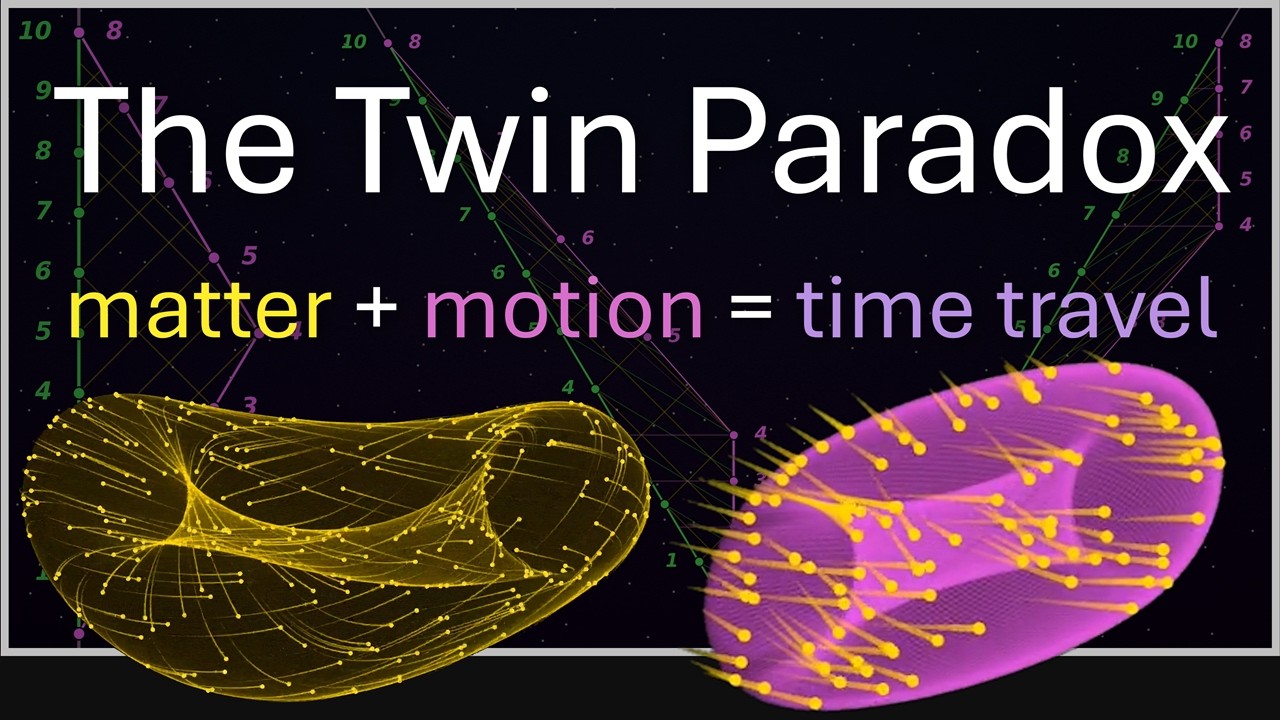
The twins, settled
Two twins. One stays on Earth. The other flies out to a distant star at high speed, turns around, and comes home. The traveler comes back genuinely younger. Not appearing younger. Not younger by some accounting trick. "Fewer birthdays, less grey hair, a shorter life lived."
The apparent paradox is obvious. If motion is relative, and each twin saw the other's clock running slow, why is the answer lopsided? Why does one of them actually win?
Because the situation was never symmetric. One twin turned around.
Staying on Earth is a single straight path through spacetime. The traveler's path has a corner in it. And at that corner, when the ship swings around and heads home, the traveler's idea of now swings with it. The slice of the present they were using tips over and sweeps across years of the Earth twin's life. Only one of them experiences that. Only one of them changed direction. "The symmetry breaks at the turn, and it breaks for the one doing the turning."
The straight path takes the most time
Then comes what the narrator calls the single most beautiful fact in the entire subject, and he is right that almost no explanation bothers to tell you.
In ordinary geometry, a straight line is the shortest distance between two points. That is drilled into you at school. In spacetime, it flips. The straight path between two events is the one that takes the most time.
Read that again. Sitting still is a straight line through spacetime, and it is the route that racks up the maximum possible ageing. Any detour, any bend, any acceleration, any deviation whatsoever, and you arrive having lived less. This is the principle of maximal ageing, and it is the reason the twin who stayed home wins.
"The twin who stayed home did not win because they were clever. They won because doing nothing is geometrically the longest possible way to get from one moment to the next. Every one of us is taking the lazy route through spacetime and calling it a life. And it is the route that buys the most of it."
The speed limit, and what causality really protects
You cannot turn more than ninety degrees
Why can nothing go faster? The arrow settles it in one move.
You cannot exceed c for the same reason you cannot turn more than 90 degrees away from north. The arrow has a fixed length. You may rotate it freely. You may not lengthen it. There is no direction more east than east.
So the speed limit was never a wall that things slam into. Nothing is holding you back and no barrier is being enforced. "It is the radius of a circle. You can spend your arrow however you like, but there is only ever one arrow."
This is what William Bertozzi filmed at MIT in 1962, pushing electrons from 0.5 MeV to 15 MeV and watching their measured speed refuse to climb past c no matter how much more energy went in. The energy was not vanishing. It was going into the part of the arrow that cannot be aimed any further east.
Why light in particular
Which finally answers the question the whole video is named after. Why does light travel at exactly this speed?
Because light has no mass. That is the entire reason.
Anything with mass has to keep some of its arrow pointed through time. It has a rest frame, a place where it can sit still and simply age. Anything massless has no such option, because there is no frame anywhere in the universe in which a photon is at rest. So its arrow is forced all the way over to due east, and it travels at the one speed the geometry permits.
"Light obeys the speed limit. It does not set it. Light is simply the thing with nothing slowing it down."
The photon has no point of view
Now the video collects on the thought it asked you to hold. If light's arrow has zero time component, something remarkable follows. A photon does not age. Its clock does not run slowly. It does not run at all.
And it goes further, because the same geometry that flattens its time also flattens its distances. Take a photon that left a galaxy 10 billion light years away and ended its life in your eye. From where we sit, that photon crossed an unimaginable gulf and spent 10 billion years doing it. By its own accounting, no time passed and no distance was crossed. Emission and absorption were the same event. It left that galaxy and arrived in your eye in the same instant, with nothing in between.
Then the caveat, delivered immediately rather than buried, "because this is one of those ideas that gets repeated badly." A photon does not have a valid point of view. There is no frame you can ride alongside it, which was exactly Einstein's problem at sixteen. So strictly speaking, a photon does not experience anything.
What can be said rigorously is that this is a limit. Push yourself faster and faster and your measured trip time shrinks, and the distance ahead of you contracts, and both of them head towards zero together. Light sits at the end of that road. "It is a destination we can point at without being allowed to stand on it."
Every photon that has ever reached us, from the sun, from a distant supernova, from the edge of the observable universe, made a journey that from its own side took no time and covered no ground.
Light cones, and the country called elsewhere
The deepest reason for the speed limit has not arrived yet, and it has nothing to do with speed.
Pick any event. A spark, a collision, this exact moment. Now ask which parts of the universe that event is able to influence. A signal leaves in every direction at the maximum rate, and after one second it has reached everything within one light second. After a year, everything within a light year. Draw that expanding sphere with time running upwards and the shape it sweeps out is a cone. That cone is your future. Everything inside it is somewhere you could still send a message to, or reach, or affect.
There is a matching cone pointing backwards into the past, holding every event that could have had any influence on you.
And then there is everything else. The entire region outside both cones, which relativity calls elsewhere. Those events are not in your future and not in your past. You cannot affect them. They cannot affect you. And there is no shared answer to whether they are happening right now, because different observers slice that question differently, and all of them are correct.
Right at this moment something may be happening in the Andromeda galaxy. It is two and a half million light years away, so it sits deep in your elsewhere. Not the future, not the past, and permanently beyond any conversation you could have with it. "Most of the universe at any given instant is in your elsewhere."
Those cones are not decoration drawn on top of spacetime. They are its structure. They exist at every event. And their edges are set by the one conversion factor the video has been chasing all along.
What the limit is actually protecting
Now the speed limit makes sense in a way it never did as a rule about fast objects.
Exceeding c would mean stepping outside your own light cone. And because different observers slice now differently, a signal that leaves your cone arrives, for somebody, before it was sent. "Not appears to. Arrives." The reply gets back before the question is asked. And worse, the order flips differently for different people, so there is no fact of the matter about which came first.
The limit is protecting the order of events. Light is not what it is protecting.
And that is why gravity travels at exactly the same speed. Gravity is not made of light, but gravity carries influence, and influence has to respect the shape of those cones. Which is what those two neutron stars demonstrated for us in 2017. Two completely unrelated messengers, one built from photons and one from bending space, running the same race for 130 million years and crossing the line together.
"They were not measuring light that night. They were measuring the room."
Why energy is squared
Neither side of the equation is light
One more thing before the landing: the most famous equation in the world, and a question almost nobody asks about it. E = mc². Energy equals mass times the speed of light squared. Why is the speed of light in there at all?
Look at what is standing on either side of that equal sign. Mass on the right, energy on the left. Neither of them is light. Neither of them is even moving, because this is the rest energy, the energy something has while sitting perfectly still, doing nothing whatsoever.
So why does a fact about light show up in the accounts? "It does not. And it never did."
That c is doing the same job it has done all video. It is converting units, and the logic follows from everything already built. Space and time turned out to be two directions of one thing, with c as the number that translates between them. Mass and energy are also two aspects of one thing, and the translation between them has to be assembled out of the spacetime conversion, "because that is the only conversion the geometry owns."
Why squared
Because energy is not a length. Its units carry a distance squared and a time squared inside them. So converting mass into energy means applying the spacetime conversion twice over.
The analogy the video reaches for is exact rather than decorative: it is like converting square metres into square feet. You do not multiply by the length conversion once. You multiply by it twice, because you are converting in two directions at the same time. The square in E = mc² is not a statement about light being fast. It is a statement about energy having two directional slots to fill.
In natural units, E = m
And then the punchline. Go back to natural units where c is one, where space and time are measured in the same currency, the way they should have been from the beginning.
E = m.
"That is the equation. That is what it has been saying the whole time. Energy is mass. Not related to mass by a big number, not convertible into mass under special circumstances. The same quantity seen from two angles."
The only reason a c squared ever gets written down is that human beings measure the two in different units. "The most famous equation in physics carries a speed of light because we never got around to fixing our rulers."
The landing
Back to the sentence the video started with. Nothing travels faster than the speed of light. Here is what it actually says once it has been taken to pieces.
There is a fixed exchange rate between space and time built into the structure of the universe, indifferent to who is looking and how fast they are moving. Everything that exists carries the same fixed arrow through spacetime, and the only freedom any of us has is how to aim it. Point it into time and you age at full rate. Tip it into space and you trade away some of your future for some distance. Nothing can be aimed further than all the way, which is where the speed limit comes from, and that limit turns out to be a fence around which events are permitted to influence which other events.
And light? "Light is the witness, not the hero." Light has no mass, so it has no choice, so it runs at exactly the rate the geometry allows, and by doing so it traces out the shape of the room we all live in.
"We looked at the fastest thing we could see, named the universe's most fundamental constant after it, and spent 150 years slightly misunderstanding our own vocabulary. It is not the speed of light. It is the speed of cause and effect."
- 1865Maxwell fixes a capacitor equation. Patching the fourth law of electromagnetism produces a wave whose speed is one over the square root of two vacuum constants. Neither constant has anything to do with light. The number that falls out matches the measured speed of light, so the wave gets named after light.
- 1887Michelson and Morley fail to find the ether in On the Relative Motion of the Earth and the Luminiferous Ether. The room has no preferred frame to be measured against.
- 1895Einstein, aged sixteen, chases a light beam and finds that Maxwell's equations have no solution for a frozen wave. Either Maxwell is wrong or nothing can catch light. He picks the second.
- 1905Zur Elektrodynamik bewegter Körper. The constancy of c becomes a postulate, the maths works, and physics gets a correct answer with an unsatisfying reason attached.
- 190821 September, Cologne. Minkowski's "Raum und Zeit" turns the postulate into geometry. Space and time become two directions of one arena, which is the frame this whole video is built inside.
- 1962Two films that made it concrete. Bertozzi's "The Ultimate Speed" pushes electrons from 0.5 to 15 MeV and watches them refuse to go faster, and Frisch and Smith count muons on Mount Washington and again at sea level.
- 1981Lewis Carroll Epstein publishes Relativity Visualized, the source of the arrow picture, which he labels a "good myth" rather than a technical claim.
- 1983The 17th General Conference on Weights and Measures stops measuring c. The metre is redefined in terms of it, fixing the value at exactly 299,792,458 m/s. From this day the constant is officially a unit conversion, and almost nobody says so out loud.
- 201717 August. GW170817: gravitational waves and gamma rays from a neutron star merger arrive 1.74 seconds apart after 130 million years. Two mechanisms, no shared physics, one speed. The name was wrong the whole time.
The loose thread
There is one loose thread the narrator says he cannot leave alone, and it is the honest bookend to the whole thing.
Everything in this video assumed the field was flat. All those arrows, all that clean Pythagoras, every straight line, the whole picture lives in flat spacetime. "That is what the word special means in special relativity. Special as in special case."
But remember those GPS satellites needing two corrections. Seven microseconds from motion, which the arrow picture has now explained completely. And 45 microseconds from altitude, which it has not touched at all.
Because mass bends the field. The flat sheet the arrows have been walking across is not flat. It sags. And when it sags, the arrows carry on doing exactly what the video said they do. They just do it across a curved surface. "And what we call gravity is what that curvature feels like from the inside."
That is the next episode. "Maxwell handed us the number. Einstein worked out what it meant. Next time, we find out what happens when the room itself starts to bend."
Where it stands
Everything the video presents as established physics is established physics. The 1983 redefinition, the muon flux, the GPS clock budget, the light cone structure of causality, the maximal ageing principle, and the GW170817 constraint on the speed of gravity are all textbook or peer reviewed, and the numbers quoted are the standard ones.
The one genuinely contested element is the arrow, and the video flags it itself rather than letting you discover it in an argument later. Worth restating plainly:
| The claim | Status |
|---|---|
| Clock rate squared plus speed squared equals one | Standard. This is the Lorentz factor rearranged, and every quantitative claim in the video follows from it. |
| The four velocity has fixed magnitude c | Standard, though many physicists regard it as a definitional consequence rather than a discovery about the world, which the video says out loud. |
| "Everything is moving through spacetime at c" | Contested framing. Epstein's own label was "a good myth." The Epstein diagram uses proper time as its vertical axis rather than coordinate time, which is why it looks Euclidean when spacetime geometry is not. It gives correct answers for time dilation and length contraction and is not a general purpose spacetime diagram. |
| "Nothing moves in spacetime at all" | The counter position, also given fairly in the video: on the block universe reading your world line simply exists, and calling it a journey imports a story physics does not supply. |
| A photon experiences no time or distance | Correctly caveated. There is no valid photon frame, so this is a limit you approach, not a perspective anyone holds. The video makes this correction itself immediately after making the claim. |
If you want the rigorous treatment of the same geometry without the myth, the video's own recommendation is the right one: Taylor and Wheeler's Spacetime Physics, released free by its authors under a Creative Commons licence.
Key takeaways
- c is a property of the room, not the furniture. It falls out of two vacuum constants measured with charges, wires and magnets, none of which involve light. Maxwell measured the speed of the room and we named it after the first thing we saw running at it.
- The number 299,792,458 is a fact about human bodies. A second is a heartbeat, a metre is a stride, and they were invented separately. Measure distance in light seconds and the speed of light is 1.
- Since 1983 nobody measures it. The metre is defined from c, so a modern precision measurement of the speed of light is a calibration of a ruler, and the constant is officially a unit conversion.
- Everything carries one arrow of fixed length through spacetime. The only freedom is aim. Rigorously: clock rate squared plus speed as a fraction of c squared equals one, always, for everything.
- Rest is the maximum, not the baseline. A stationary clock ticks faster than any other clock. Time dilation is not damage done to a clock, it is arrow spent on space instead of time.
- Both observers really do see the other clock running slow, because "now" is a direction in spacetime and they are pointing differently. The twins resolve because only one of them turned around.
- The straight path through spacetime is the one that takes the most time. Doing nothing is the geometrically longest way from one moment to the next.
- Light runs at c because it has no mass, so it has no rest frame and no option to aim any of its arrow into time. Light obeys the limit, it does not set it.
- The limit protects causal order, not light. A signal outside your light cone arrives before it was sent for some observers, with no fact of the matter about which came first. Gravity respects the same cones, which is why GW170817 came in dead level.
- E = mc² has a c in it only because our rulers are inconsistent. In natural units it reads E = m: energy and mass are the same quantity seen from two angles.
- All of this assumes a flat field. "Special" means special case. The 45 microseconds a day that GPS clocks gain from altitude is the thread that leads to general relativity.
Chapters
- 0:00 The sentence that is wrong at the root
- 2:24 Where the number came from, and why the name is a lie
- 8:40 The picture: everyone moves at c, always
- 15:47 Spending the arrow, and why both clocks run slow
- 22:53 The speed limit, and what causality really protects
- 29:00 Why energy is squared, and what bends next
Notable quotes
All lines are the narrator of Animated Physics. Timestamps are approximate except where they sit on a chapter boundary.
"Nothing travels faster than the speed of light, and it sounds like a fact about light. That is how I was taught it, that is how I repeated it, and it is wrong. Not a technicality wrong. Wrong at the root." (0:00)
"They describe the room, not the furniture. We measured the speed of the room, and we named it after the first thing we saw running at it." (3:41)
"Einstein assumed it, the maths works, the experiments agree, moving on. All of which is true, and none of which explains anything. It is a receipt, not a reason." (4:14)
"So when a modern lab measures the speed of light very carefully, they are not learning anything about light. They are calibrating their ruler." (6:31)
"The speed of light is 1. That is its actual value." (7:56)
"That is what sitting still is. It is aging as fast as it is possible to age." (11:06)
"He called it a good myth, his phrase. A description that is not technical, and maybe not exact, but is not wrong either." (13:04)
"Take how fast its own clock ticks compared to yours, and square it. Take its speed as a fraction of c, and square that. Add the two together, and you get exactly one. Always. For everything." (14:34)
"Rest is the special case. Rest is the maximum." (16:06)
"There are engineers whose job is to build a clock that is wrong on purpose, so that Einstein can correct it. That is the confidence level we are operating at." (18:42)
"The straight path between two events is the one that takes the most time. Read that again." (22:13)
"Every one of us is taking the lazy route through space-time and calling it a life. And it is the route that buys the most of it." (22:46)
"Light obeys the speed limit. It does not set it. Light is simply the thing with nothing slowing it down." (24:02)
"Emission and absorption were the same event. It left that galaxy and arrived in your eye in the same instant with nothing in between." (24:53)
"Most of the universe at any given instant is in your elsewhere." (27:33)
"They were not measuring light that night. They were measuring the room." (28:56)
"The most famous equation in physics carries a speed of light because we never got around to fixing our rulers." (31:19)
"Light is the witness, not the hero." (32:17)
"It is not the speed of light. It is the speed of cause and effect." (32:42)
Resources mentioned
The video and the channel
- The Speed of Light Was NEVER About Light. Here's Why!, the source video.
- Animated Physics, the channel. All 2D and 3D animation in the video is built in house by the Animated Physics team, with no stock footage.
- The previous episode on Maxwell, referenced in the opening ("if you saw the last video, you know the story") and the source of the story about the patched fourth equation.
- The companion e-book, linked by the creator.
The original papers
- A. Einstein, "Zur Elektrodynamik bewegter Körper," Annalen der Physik 17 (1905), 891 to 921. English translation: On the Electrodynamics of Moving Bodies.
- H. Minkowski, "Raum und Zeit," address at Cologne, 21 September 1908. English translation: Space and Time.
- A. A. Michelson and E. W. Morley, On the Relative Motion of the Earth and the Luminiferous Ether, American Journal of Science 34 (1887), 333 to 345.
- B. P. Abbott et al. (LIGO and Virgo), GW170817: Observation of Gravitational Waves from a Binary Neutron Star Inspiral, Physical Review Letters 119, 161101 (2017).
- B. P. Abbott et al., Multi-messenger Observations of a Binary Neutron Star Merger, Astrophysical Journal Letters 848, L12 (2017). This is the paper with the 1.74 second delay.
- 17th General Conference on Weights and Measures (1983), Resolution 1, which defines the metre in terms of the speed of light and freezes c at 299,792,458 m/s.
The experiments, on film
- W. Bertozzi, The Ultimate Speed: An Exploration with High Energy Electrons, MIT Science Teaching Center, 1962. The actual film of electrons being pushed from 0.5 to 15 MeV and refusing to go faster.
- D. H. Frisch and J. H. Smith, Time Dilation: An Experiment with Mu-Mesons, Physical Science Study Committee, 1962. The actual film of the muon count taken on top of Mount Washington and again at sea level.
Books
- E. F. Taylor and J. A. Wheeler, Spacetime Physics, 2nd edition, W. H. Freeman, 1992. The authors have released the entire book free under a Creative Commons licence.
- L. C. Epstein, Relativity Visualized, Insight Press, 1981. Credited in the video as the source of the arrow picture at its heart.
Concepts and people named
- James Clerk Maxwell and Maxwell's equations, including the displacement current correction.
- Vacuum permittivity and vacuum permeability, the two constants c is assembled from.
- Albert Einstein and special relativity.
- The caesium standard for the second and the metre.
- Natural units and the light second.
- Four velocity, the Lorentz factor, and proper time.
- The relativity of simultaneity and the twin paradox.
- Light cones and the block universe.
- Muons, GPS, and relativity corrections in satellite navigation.
- Mass energy equivalence and invariant mass.
- The Andromeda galaxy, the video's example of an event permanently in your elsewhere, and the Andromeda paradox it is drawn from.
- General relativity, where the next episode goes.