At a glance
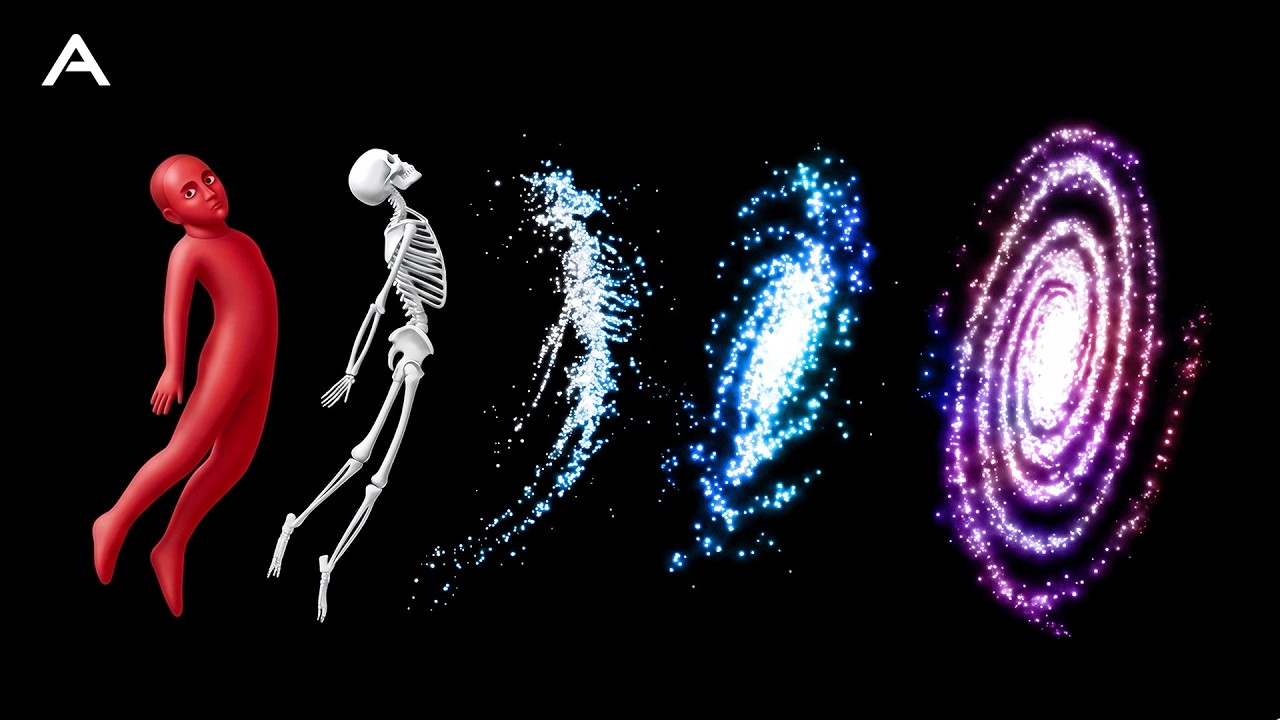
This is a thirty six minute film from Aperture that starts with one experiment and ends up arguing about what a person is. The experiment is the double slit. The claim is that the version of reality we quietly agreed on, a universe made of separate well behaved little objects each existing on its own whether or not anything is watching, was broken by a physics lab in Germany in 1961 and has never been put back together.
It runs the story in four datelines. London 1801, where Thomas Young put a beam of light through two narrow slits cut in a card and got stripes instead of two bars, and settled a hundred year argument against Isaac Newton. Germany 1961, where Claus Jönsson at Tübingen ran the same test with electrons and got the same stripes, which should have been impossible for little solid bullets. Belgium 1927, where Albert Einstein and Niels Bohr had already fought this out in a conference hall in Brussels at the fifth Solvay Conference, with Einstein proposing a slit on a spring that would catch the particle in the act and Bohr showing overnight why it could not work. And Earth 2026, where the film turns the result into a philosophy.
The physics half is more careful than most films of this kind. It puts the detector on and gets two clusters, turns the detector off and gets the stripes back, names superposition and decoherence correctly, and then explicitly refuses the fun answer: the observer in the double slit is not a mind, it is a detection tool making a small physical interaction, and reality does not need anyone to look at it in order to exist. What the experiment does show, the film argues, is that properties are relational. A cat is only a cat because it is interacting with air molecules and light and heat and your hands.
Then the second half spends twenty minutes cashing that in. Newton's indivisible atoms produced John Locke's sovereign individual, which produced the bootstraps, and if the atoms were never indivisible and never independent then the sovereign individual is standing on a foundation that quietly dissolved. From there: entanglement and nonlocality, David Bohm's undivided wholeness, Carlo Rovelli's relational quantum mechanics, Advaita Vedanta, Taoism, dependent origination, Michel Foucault, deep ecology, complexity theory. And a final act on quantum biology: enzymes that tunnel, DNA that mutates by tunneling, and a protein in a robin's eye that may be a working quantum compass. This page rebuilds the whole film in its order, names the actual experiments behind every claim it makes, and puts the corrections at the end where they belong.
Chapters
0:00 What the double-slit experiment proves about reality 1:15 London 1801 3:14 Germany 1961 7:28 Belgium 1927 12:23 Earth 2026 28:24 Quantum Biology and You
The cold open: the version of reality we all quietly agreed on
The film opens on the least controversial sentence in science.
Everything you are, everything you do, everything you see or touch or love, all of it is made of atoms. Trillions of them, arranged into separate individual entities. A person who can wake up, move, work. And the things they can sleep on, move around in, and work with.
That, the narrator says, is the version of reality we have all quietly agreed on. The universe is made of separate, well behaved little objects, each one existing on its own whether or not anything is watching.
Then the hinge at 0:31. In 1961, one quantum experiment completely shattered this assumption, and the single result from that experiment has haunted physicists for over sixty years.
Three questions follow, and they are the three the film spends the next half hour on. How can something exist in two places at once? How can the simple act of looking at something change what it is? And if the atoms making up your body, your home, your entire universe do not behave the way we have always assumed, then how do we know what is real?
This is the experiment, the narrator says, that changed everything we know about quantum physics, and by extension reality as a whole.
London 1801: Thomas Young settles a hundred year argument
In the summer of 1801, in a dim room in London, a physicist named Thomas Young was trying to settle an argument that had been running for over a century.
Isaac Newton, regarded as the father of classical physics, believed light was made of particles. Tiny bullets, all fired in a straight line. This is the corpuscular theory of light, and Newton laid it out in Opticks in 1704. Others believed light behaved like a wave, rippling outward the way water ripples when you drop a stone into a pond, a view most associated with Christiaan Huygens and his Treatise on Light of 1690.
The film is blunt about why the argument lasted so long, and it has nothing to do with evidence. Newton's reputation was so towering that for a hundred years almost nobody dared challenge him outright. At least not without a mountain of evidence to disprove him.
So Young decided to test it directly. He took a beam of light and passed it through two narrow parallel slits cut into a card, letting the light fall onto a screen behind them.
The prediction, if light is made of particles, is completely straightforward. Two bright strips on the screen, one behind each slit, and that is it. Bullets fired at a wall with two holes in it land in two piles.
That is not what Young saw. Instead, the screen lit up with a pattern of alternating bright and dark bands. Stripes, repeating again and again across the surface.
It was the exact result you would get if instead of a particle you had two waves colliding, rising together in some places and canceling each other out in others. The film reaches for the right analogy at 2:41: it is the same pattern you see when you drop two stones into a still pond and watch their ripples cross.
So there you go. Young had his answer. The experiment had shown it. Newton was wrong. Light was a wave. Case closed.
Case closed, the narrator adds, at least for the next hundred years. But physics was not finished with this experiment. Not even close. Because although it holds up perfectly at the classical scale, when scientists shrank it down to the level of quantum particles, the results got a lot stranger.
Germany 1961: the same experiment, with electrons
A hundred and sixty years after Young, in a physics laboratory at the University of Tübingen in Germany, a scientist named Claus Jönsson was preparing to rerun the experiment. Except this time, instead of a beam of light, he was firing electrons, one of the tiny particles that make up every atom in the universe, including the ones in your own body.
The film pauses on the irony, and it is a good one. A century and a half earlier, Newton had insisted that light itself was made of particles, and Young's experiment proved him wrong. But by 1961, while everyone had agreed that light was a wave and not a particle, we had picked up a new false assumption. Matter, the actual stuff of the universe, was made out of particles. Solid, discrete, countable.
Newton had lost the argument about light, but nobody even thought to reopen it about electrons.
So when Jönsson fired his electrons through two narrow slits, he expected them to travel through one slit or the other, each landing in one spot on the screen behind it, eventually building up two distinct clusters just like Newton had imagined.
They did not. Instead of two clusters, the electrons built up the same striped alternating pattern Young had found with light a hundred and sixty years earlier. The unmistakable signature of a wave interfering with itself.
The real paper is Elektroneninterferenzen an mehreren künstlich hergestellten Feinspalten, Zeitschrift für Physik 161, 454 (1961), and the detail that makes it heroic is the slit fabrication. Jönsson machined the slits into copper foil at a width of roughly three hundred nanometers, a scale nobody had reached before, and pushed the setup as far as five slits. In 2002, readers of Physics World voted the double slit with electrons the most beautiful experiment in physics, and it was the only entry in the top ten with no single name attached to it.
Then the film makes its strongest claim, at 4:53. Unlike Young, who fired a beam of light, Jönsson carefully fired his electrons one at a time. So there was nothing for each electron to interfere with. Which means something even more unsettling was happening.
Each electron alone was moving through empty space and somehow behaving as if it passed through both slits at the same time, and then interfered with itself on the way to the screen.
That is the single result the cold open promised, and it is the thing that has genuinely haunted physicists for sixty years. One particle. Two holes. No partner. Stripes anyway.
The film's line at 5:22 is the cleanest statement of the Copenhagen position you will hear in a YouTube essay: one of the things that keeps physicists up at night is the fact that reality at its most fundamental level only becomes real when it is observed. Before that, everything is just probability. A ghost of what could be.
The single electron buildup, and who actually did it
The image everyone carries in their head of this experiment, the one the film animates, is not Jönsson's photograph. It is the buildup: individual bright dots landing on a detector one by one, apparently at random, and slowly, over minutes, arranging themselves into the stripes without a single dot ever landing in a dark band.
Jönsson recorded his pattern all at once, on film. The dot by dot accumulation was first captured in Bologna by Pier Giorgio Merli, Gian Franco Missiroli and Giulio Pozzi, working in 1973 and 1974 on a Siemens Elmiskop 101 electron microscope and borrowing an image intensifier from the Institute of Anatomy in Milan to see individual arrivals. Their paper ran in the American Journal of Physics in 1976.
The version that made it onto every textbook cover came in 1989 from Akira Tonomura and his team at Hitachi, using an electron biprism and a source turned down to fewer than a thousand electrons per second, so that at any instant there was essentially never more than one electron inside the apparatus. It took more than twenty minutes to accumulate the pattern. Their published frames show it at eight electrons, at two hundred and seventy, at two thousand, and at sixty thousand.
And in 2013, Roger Bach, Damian Pope, Sy-Hwang Liou and Herman Batelaan at Nebraska closed the last loophole: a genuine pair of nanofabricated slits, a movable mask that could physically block one slit or the other, and single electron detection, so you could watch the same apparatus produce a single slit distribution, a second single slit distribution, and then the interference pattern that is emphatically not their sum.
The sponsor read, which is at least on theme
At 5:38 the film does the thing every long form YouTube essay does, and to its credit it finds a hook that is actually about the subject. Imagine all the files you store on a traditional cloud server. Your photos, your documents, your private conversations. Everything exists as just random zeros and ones until someone observes it. Most of the time the only person who should be able to observe it is you, and with a lot of big corporations that is not the case.
Hence Filen, the sponsor, which is a cloud storage provider built on zero knowledge encryption, meaning there is never any observer in the chain except you. Not hackers, not governments, not Filen themselves. Every file is split into chunks and encrypted on your device with AES-256, with a master key generated from your password, so by the time anything reaches their servers it is already unreadable. The encryption key never leaves the device.
The feature list the narrator reads: real time sync across devices, encrypted notes and chat built in, automatic photo backups, a virtual drive that behaves like a local folder, encrypted public sharing links, and for power users a CLI tool, WebDAV support and a developer SDK. The infrastructure is self hosted in Germany, ISO 27001 certified, runs on renewable energy, and the platform is open source so you can verify the encryption yourself.
Then: now, back to our story.
Belgium 1927: Einstein and Bohr, thirty four years early
Jönsson's electron experiment did not come out of nowhere. Decades before he ever loaded a single electron into his apparatus, two of the greatest physicists humanity has ever seen had a fierce debate on this exact topic. The only difference is that at the time neither of them could test their ideas.
In October 1927, in a conference hall in Brussels, the world's leading physicists gathered for what would become one of the most famous scientific meetings in history: the fifth Solvay Conference, on Electrons and Photons. Among them were Albert Einstein and Niels Bohr, two men who respected each other deeply and disagreed just as deeply about what quantum mechanics actually meant.
Bohr's camp believed that particles, before being measured, do not have a definite position at all. They exist as a spread of possibilities, a wave of potential, and they only choose a location the instant something interacts with them. That is the Copenhagen interpretation, and its formal core is Bohr's principle of complementarity: wave behavior and particle behavior are both real, both necessary, and mutually exclusive in any single experimental arrangement.
Einstein hated the idea. He believed the universe had to be definite whether or not anyone was looking. So he proposed a way to catch quantum mechanics in the act.
Einstein's trap: the slit on a spring
Picture a slit, Einstein said, cut into a screen so thin and delicate that it hangs from a tiny spring.
If a photon of light passes through that slit, it has to nudge the screen slightly on its way through. The same way a bird brushing a leaf makes it shiver. Momentum has to be conserved, so if the photon is deflected upward on its way to the screen, the diaphragm it passed through must recoil downward, and by exactly the right amount.
If you could measure that tiny nudge, you would know for certain which slit the photon went through, all while the interference pattern kept forming behind it. Particle and wave, caught at the same time. And that would be proof that Bohr was wrong.
This is the recoiling slit, and it is the sharpest thing Einstein ever aimed at Copenhagen. It does not deny quantum mechanics. It accepts the whole formalism and then tries to smuggle out one extra piece of information that the formalism says cannot exist.
Bohr's overnight rebuttal
Bohr took the challenge seriously. And it did not take him long to find the flaw.
To measure the spring's motion precisely enough to know which slit the photon passed through, Bohr showed, you would have to disturb the spring itself so much that it would blur the position of the slits. And the moment the slits themselves became uncertain, the interference pattern would have nowhere stable to form. It would just vanish.
The mechanism, in the form Bohr wrote it up twenty two years later in his essay Discussion with Einstein on Epistemological Problems in Atomic Physics, is Einstein's own quantum mechanics turned around on him. The diaphragm is a physical object, so it obeys the uncertainty principle too. To resolve a momentum kick small enough to identify the slit, the diaphragm's own momentum must be known to better than that kick, which forces an uncertainty in the diaphragm's position that is at least as large as the fringe spacing. Every slightly different position of the diaphragm shifts the fringe pattern slightly, and averaging over that spread erases the stripes exactly as fast as the which path information sharpens.
You could know which path the photon took, or you could see the interference pattern. Never both.
Even though Einstein walked away from Brussels unconvinced, Bohr won that debate, and physicists would spend the rest of the century proving him right over and over again in laboratories he never could have imagined.
Because Bohr's argument was never really just about photons. If it was true for light, it had to be true for the solid physical stuff of the universe too. Atoms, electrons, the particles making up your own body.
So decades later, when Jönsson fired those electrons through his own two slits, he was not stumbling onto something new. He was watching Bohr's forty year old argument play out in real time.
Earth 2026: detector on, detector off
In the decades since, scientists all over the world have run this same test in dozens of forms. With photons, with electrons, with atoms far larger than either. And every single time, Bohr's prediction has held.
The film lays out the actual experimental result with unusual care, and it is worth following the order because the order is where people usually go wrong.
When researchers place a detector at the slits, determined to catch which slit each particle goes through, it works. Each particle passes through exactly one slit and never both. Fifty percent take the left, fifty percent take the right. All clean and orderly, just like Newton's bullets.
But, the narrator says at 11:06, finding which slit the particle takes and finding how that particle behaves are two very separate issues. Finding how the particle behaves is where we get the strange results.
When the detector is on, you get two simple clusters of electrons, one behind each slit. Exactly what you would expect from tiny solid particles with nothing strange about them at all. But once you turn the detector off, the stripes return immediately, like waves washing over a sand castle.
This is wave particle duality, and it is at the heart of quantum mechanics. In isolation at the subatomic level, matter behaves like a wave whose position is not certain. That quantum state is called superposition. The particle could exist anywhere along the wavelength. It is not determined.
Only when there is some kind of physical interaction, like the detector, does matter behave like a particle that is predictable by classical physics. That process is called decoherence.
The tree in the forest, and the answer the film refuses to give you
Then the question everyone actually came for, at 12:11. Does this mean that reality essentially disappears when there is no one to observe? Or in simpler terms: if a tree falls in the forest and there is no one around to hear it, does it make a sound?
When the double slit experiment was first conducted at the subatomic level, the film says, some scientists suggested that conscious observation might be causing photons to behave like particles. This seemed to imply that reality was dependent on an observer. To be is to be perceived, which is George Berkeley's esse est percipi, three hundred years early and from a bishop rather than a physicist.
And here the film declines the easy sale, which is the single most respectable thing in it:
But the observer in the double slit experiment is not inactive the way we think of an observer. It is not just a mind. It is a detection tool that is making a very small physical interaction with the photon or the electron. It is that interaction that is causing the quantum object to go from behaving as an indeterminate wave to a particle.
Reality ultimately does not require an observer to exist. Which is, the narrator concedes at 13:07, sadly less fun. But still interesting.
The reason you do not see everyday objects like bricks or cats behaving like waves is that they are constantly interacting with things. Air molecules, light, heat. Those interactions cause immediate decoherence. A cat is therefore made of determinate particles. Or at least mostly, the narrator adds, which we will get to later.
What the experiment actually proves: relations
So if the double slit does not prove that consciousness makes reality, what does it prove?
The film's answer, at 13:39, is the thesis of the entire back half:
It reveals that the properties of matter depend on relationships and interactions with other systems.
Essentially, the cat is only a cat because it interacts with air molecules, with light and heat, and of course your hands, for those nice belly rubs. No single particle exists independently, at least on the subatomic level.
That is a modest claim by the standards of quantum YouTube, and it is the one the rest of the film builds on. Not that reality needs you. That reality is made of relations rather than of things.
Newton's atoms became Locke's individual
Here the film makes its pivot, and it is a bigger one than it announces. It stops doing physics and starts doing intellectual history, and the bridge it walks across is the idea of the indivisible thing.
In 1665, the narrator says, Newton demonstrated that the universe is made of indivisible self contained atoms governed by universal laws such as the law of motion and universal gravitation. To this day his laws remain useful for good approximations of most physical phenomena.
His description of a universe governed by natural laws went directly against the more religious understanding of physical phenomena. Instead of divine guesswork, Newton showed how the physical world could be understood and explained with rational laws and mathematical physics.
Philosophers were inspired by that scientific revolution and used it to charge their own movement, which came to be called the Enlightenment.
John Locke applies Newton's method to people
John Locke, a close friend of Newton, took his friend's method of relying on empirical observation and applied it to humans and society. Just as Newton discovered the natural laws of the universe, Locke set out to uncover the natural laws of humanity.
Locke rejected the idea that humans possess innate knowledge, as Plato's theory of knowledge as recollection had suggested. Instead he argued that humans begin life as blank slates, the tabula rasa of the Essay Concerning Human Understanding. All of our knowledge comes from experience. Through that experience we move from simple ideas to more complex ones, and eventually develop the ability to engage in moral reasoning.
To identify the natural laws of humanity, Locke explored a state of nature, much as the political philosopher Thomas Hobbes had.
Hobbes had suggested in Leviathan that humans in a state of nature were selfish and prone to violence and cruelty. To escape that condition of constant war, humans have to give up their freedom to the power of the monarch. According to Hobbes, that is the only way to maintain peace and safety.
Locke did not share the pessimism. He believed that in a state of nature humans were rational creatures, not innately selfish ones. Humans want to protect their lives, their liberty and their property, and are obliged by natural law to respect the lives, liberty and property of others. Locke called these natural rights.
To protect those rights, humans had to leave the state of nature and institute an impartial power. That same power is obliged to maintain natural rights by arbitrating disputes and addressing injuries. Which is, in theory at least, how our legal system operates. If the government does not uphold these natural laws it is betraying the social contract, and we would be justified in removing it by the majority's decree. That is the argument of Locke's Second Treatise of Government, and it is the sentence Thomas Jefferson took nearly whole into the Declaration of Independence.
The sovereign individual, and the bootstraps
In that connection from Newton to Locke, the film says, we get a specific idea of what a human being is.
Just as Newton identified individual atoms obeying the laws of nature, Locke identified the sovereign individual who by natural laws seeks to protect their life, their freedom and their property. Locke's work has had a tremendous impact on society from his time to ours, for better and for worse. He has even shaped our notion of what a person is.
But did he get it right?
Locke's understanding of human beings is a philosophy of individualism. Every person has ownership of and responsibility for their own body and their own labor. And in Locke's view that implies freedom not only from state control but also from state and communal support. In other words, Locke placed a big emphasis on self reliance.
Locke's individual has their own unique pursuits, and those pursuits are not vulnerable to outside influence. They are fixed. Sturdy. Capable on their own.
To this day, Western society has largely upheld this understanding of humanity as made up of sovereign individuals who need to carve our own path. We look inside to find our own unique calling, and we use our own faculties to pursue it. If we fail, it is because we need to try harder. When times are tough, we pull ourselves up by our bootstraps and march forward.
But this prevailing understanding of a person is starting to show signs of weakening. And it is in quantum mechanics, the narrator argues at 18:23, that we find the most clues about where humanity is headed in its quest to better understand itself.
From the double slit we can observe that reality is relational. Matter at the subatomic level does not exist as fixed particles in isolation. It is a probability until it interacts with other systems.
The rhetorical move is explicit and worth naming: Newton's indivisible atom was the physical metaphor that made the indivisible person feel obvious. Take away the first and the second loses the analogy it was built on.
Entanglement: the part where locality dies
But there is something even more confounding happening at the quantum level, the film says, and it could have big implications for how we understand ourselves in the future.
Those subatomic particles that behave as probabilities when isolated can be, and often are, linked together at the quantum level. That means when we measure linked particles they give matching readings, such as matching polarizations. Given that these measurements are the result of randomness, the narrator says, that is pretty extraordinary.
But even more interesting is that these linked particles do not have to be close together. They can be enormously far apart and still measure the same way.
This is why scientists now suggest that reality is nonlocal. Locality asserts that objects can only be influenced by their immediate surroundings. With quantum entanglement, that is clearly no longer true.
Which leads the film to its question, at 19:45. If subatomic particles can be linked together beyond locality, does that mean life might be full of other entanglements we just do not know about? And is it possible we are far more connected than John Locke would suggest?
The experimental backbone here, which the film does not name but which is the reason anyone takes the claim seriously, is Bell's theorem. In 1964 John Stewart Bell proved that no theory in which particles carry predetermined local properties can reproduce the correlations quantum mechanics predicts. The inequality he derived is testable, and it has been tested to death: by John Clauser in 1972, by Alain Aspect with fast switching in 1982, and in the loophole free experiments of 2015 at Delft, NIST and Vienna. Clauser, Aspect and Anton Zeilinger shared the 2022 Nobel Prize in Physics for exactly this. The current distance record is the Chinese Micius satellite, which in 2017 distributed entangled photon pairs to ground stations 1,203 kilometers apart and violated Bell's inequality across the gap.
The reality check: we are moist
Before we get too excited about the possibilities, the narrator says at 20:00, we do need a reality check. And this is the second place the film refuses an easy sale.
As you may recall, quantum particles decohere from a superposition state when they interact with any other system. Larger systems exist largely as objects of classical mechanics. They are no longer quantum.
In other words: organic life tends to be very moist and generates heat. To be part of such a system is to likely be an object of classical physics. The likelihood of quantum behavior impacting the human body, the film says flatly, is not super likely, given how squishy and heat generating we tend to be.
This is the standard and correct objection, and it has a number attached to it. Max Tegmark calculated in a 2000 paper that decoherence times for neurons and microtubules are on the order of 10⁻¹³ to 10⁻²⁰ seconds, roughly ten orders of magnitude faster than the millisecond timescales of neural firing. Warm, wet and noisy is the worst possible environment for keeping a superposition alive.
But, the film continues, just as Newton inspired the Enlightenment, quantum mechanics is at least coinciding with a movement away from individualism and toward philosophies that explore our interconnectedness, with quantum theories potentially bridging the gap between science and philosophy.
Note the hedge in that sentence. Coinciding with. Potentially bridging. The film is explicitly claiming resonance, not derivation, and it will say so outright twenty minutes later when it calls quantum mechanics a nice metaphor.
Bohm and Rovelli: two ways to say the world is relations
The theoretical physicist David Bohm suggested that the universe is an undivided wholeness. The three dimensional reality we observe is just a surface, where in reality the universe is wholly interconnected.
That is the argument of Wholeness and the Implicate Order, published in 1980. Bohm's picture is that the world we see, with its separate objects in separate places, is an explicate order unfolded from a deeper implicate order in which everything is enfolded into everything else. His favorite demonstration was a drop of ink stirred into glycerin: stir one way and the drop smears until it is invisible, stir the other way and it reassembles. The information was never lost, only enfolded.
Relational quantum mechanics, as developed by Carlo Rovelli, suggests that objects do not possess standalone intrinsic properties. Properties only exist in relation to other objects. As a result of this view, the universe is a vast interconnected web of relations rather than separate discrete parts.
Rovelli's 1996 paper is the source, and its central move is to take the double slit at face value and stop asking for anything more. There is no observer independent state of the electron. There is only the state of the electron relative to the detector, relative to the lab, relative to you. The measurement problem, on this reading, is an artifact of insisting that a system must have properties with respect to nobody.
These quantum theories from Bohm and Rovelli, the film says, have parallels with what is broadly categorized as Eastern religion and philosophy.
Three traditions that got there without the math
Advaita Vedanta: you are not a thing that has consciousness
In the Advaita Vedanta school of Hinduism there is no notion of a god external to us. Brahman is an all encompassing reality that pervades all things, including ourselves. Every one of us is Brahman, and Brahman makes up our entire existence.
Think of it, the narrator says, as a consciousness that manifests the world and everything in it. You are not a thing that happens to possess consciousness. You are consciousness.
In the Advaita school, seeing differentiation in the world is an error, the illusion the tradition calls maya and traces to avidya, a primal ignorance. We are all pure consciousness, not independent parts. The classical formulation is Adi Shankara's, around the eighth century, and the compressed version is the mahavakya tat tvam asi: that thou art.
This conception of reality, the film notes, aligns pretty well with Bohm's suggestion that the universe is an undivided wholeness.
Taoism: the shapes we cut from the garment
In Taoism, the narrator continues, there is the concept of the unhewn garment.
The basic idea is that the objects we distinguish and identify do not really exist in nature. We cut the objects out of the garment of existence, but the whole of the garment is reality, not the shapes we cut out of it. The shapes are practical, but we should not take them so seriously.
When you treat cutout pieces of the garment as truly separate, you cause real problems. You are severing things from their larger systems. When you remove a leaf from a tree, the leaf does not survive in its separated form. It withers and dies.
The underlying Taoist term is pu, usually rendered as the uncarved block or unhewn wood, the state of undifferentiated potential before human distinctions cut it into named things. Alan Watts is the writer who did most to move that image into English and paired it with unbleached silk, in his 1978 book Uncarved Block, Unbleached Silk, and the fabric version the film uses is his lineage. The source texts are the Tao Te Ching and the Zhuangzi.
Buddhism: nothing arises on its own
In Buddhism, there is the concept of dependent origination. According to the Buddha, no phenomenon exists independently of causation. A plant, for example, is dependent on a seed. And on the water, the air, the earth, the sunlight, and so on, and so on. Everything arises from some root cause. There is no uncaused cause.
Suffering is caused by craving and clinging. And Buddhist enlightenment is caused by the path to end suffering, which is the structure of the Four Noble Truths.
Then the film's best applied example, at 23:33. The Buddha famously asked numerous kings to address crime by reducing poverty instead of punishing people after the fact. Crime, after all, does not come from nowhere. It is caused by someone lacking the fulfillment of their basic needs. The text usually cited for this is the Kutadanta Sutta in the Digha Nikaya, where the Buddha tells a brahmin that suppressing banditry by execution fails and that supplying farmers with seed and merchants with capital works.
It is a small moment, but it is doing real work in the argument. It is the first place the film shows what a relational view of persons actually changes in practice: you stop treating the criminal as a self contained cause and start treating him as a node.
Foucault, and the invisible rules
Outside Eastern religions, the film says, philosophical movements rose in the twentieth century that sought to move beyond the values of the Enlightenment.
The postmodernist philosopher Michel Foucault wrote a well known essay called What is Enlightenment?, published in 1984, in which he offers critical insight into Immanuel Kant's text by the same name from 1784.
Kant described the Enlightenment as a movement away from relying on external authorities such as the state and the church, and toward thinking for ourselves and making our own decisions. His slogan was sapere aude: dare to know.
In Foucault's essay he suggests we need to take things a step further. We need to investigate the invisible rules, the norms and power structures that shape our reality and our sense of self. For Foucault, that is how we ultimately liberate ourselves from the limitations imposed on us.
To undertake that project Foucault used a genealogical method borrowed from Friedrich Nietzsche, specifically from On the Genealogy of Morality. It is a historical approach to deconstructing truths we take as self evident. In many of his texts Foucault would dissect the origins of concepts and map out the accidental and often messy way they emerged and became accepted as truths.
Famously, in Discipline and Punish, he explored how the way prisons functioned to impose self discipline spread to institutions throughout society. Mental institutions, and even schools. The architectural image at the center of that book is Jeremy Bentham's panopticon, a prison built so that every inmate might be watched at any moment and none can ever tell whether they are being watched right now, so that they eventually do the watching themselves.
Foucault's goal was not to find universal truths but rather to free ourselves from concepts that restrict us. Concepts such as the Enlightenment, and the idea of the self made individual.
There is a nice symmetry in the placement here that the film does not spell out. The panopticon is a machine that changes behavior purely through the possibility of observation, with no physical interaction required at all. It is the exact opposite of what the film just concluded about the double slit, where the observation only matters because it is a physical interaction. Two very different senses of the same word, sitting ten minutes apart.
Deep ecology and complexity theory
Without the so called truths of the Enlightenment weighing humanity down, the narrator says, non humanist philosophies have explored concepts that acknowledge the relationality implied by quantum mechanics.
Deep ecology is an eco philosophy movement that asks us to move away from a human centered worldview toward one that gives equal value to non human life. There are many different approaches and ideas within the movement, but it ultimately comes down to seeing non human life as valuable in itself, and to humans as well. We are all connected to our environment, and we pay the price for its degradation. When we excessively consume animals and materials we make the land less capable of regenerating itself, which is less productive land for us and for the rest of nature.
The movement generally maintains that humans do not have the right to reduce the richness and diversity of life except to satisfy vital needs. That is close to a direct quote from the third point of the eight point platform that Arne Næss and George Sessions drew up in 1984. Næss coined the term deep ecology in a 1973 paper, and his contrast was with what he called shallow ecology, which fights pollution and resource depletion for the sake of the health and affluence of people in developed countries.
Whether you fully agree with that assertion or not, the narrator adds at 26:20, it is pretty clear that our destructive impact needs to be greatly curbed. Perhaps acknowledging our interconnectedness with our environment is a good place to start.
Why the whole is hard
Resolving environmental problems faces many obstacles, but perhaps the greatest challenge is something quantum mechanics has already hinted at.
When we think of reality as relational and full of hidden quantum behavior, it makes understanding the whole rather complex. As it always must have been. We are not dealing with isolated parts that can be understood on their own and then built up into an understanding of the whole. We are dealing with complex systems, as described by complexity theory.
If you try to dissect a system in isolation, like an atom, it does not work. You are cutting off a source of much of its behavior. You lose understanding in the process. This is the failure of naive reductionism, and the canonical statement of the objection is Philip Anderson's 1972 essay More Is Different, which argued that the ability to reduce everything to simple fundamental laws does not imply the ability to start from those laws and reconstruct the universe.
Another issue, the film says, is that the computers we use to analyze systems are rule based. Nature and humans are not confined to rule following behavior. A computer can make approximations but not certainty. Just as quantum objects do not exist at a specific point.
Still, in addressing the relationality of systems, complexity theory can guide us toward a better understanding of system behavior, even if we are never able to capture it perfectly.
As you can see, the narrator concludes at 27:52, quantum mechanics serves as a nice metaphor for the emerging and ancient values of interconnectedness. It is helping us better understand our world and our place in it, improving on Newtonian physics and moving on from the values of the Enlightenment.
That sentence, "a nice metaphor," is the most honest word in the second half, and it is worth holding onto. The film is not claiming that entanglement proves deep ecology. It is claiming that the two rhyme, and that the rhyme is not an accident because both are reactions against the same picture of the world as a bag of separate things.
But there are still possibilities for uncovering meaningful quantum discoveries that could change everything we know about how we interact with our world. They may even give us scientific evidence of our interconnectedness on a much deeper level.
Which is the handoff into the last act.
Quantum Biology and You
There is a growing field called quantum biology, and it is turning up something very strange. Living things may be using quantum effects like entanglement, superposition and tunneling deep inside their own cells. Effects that classical physics simply cannot explain.
Enzymes that go through the wall instead of over it
A study of enzymes revealed that hydrogen was cutting through energy barriers using quantum tunneling rather than going over them.
This is the oldest and most solid result in the field. The classical picture of a chemical reaction is a hill: reactants have to be given enough thermal energy to climb over an activation barrier. Tunneling means the proton simply appears on the far side without ever having had enough energy to make the climb, because its wavefunction extends through the barrier. The landmark demonstration is Cha, Murray and Klinman in 1989, on yeast alcohol dehydrogenase, and the smoking gun is the kinetic isotope effect: swap hydrogen for the heavier deuterium and the rate collapses far more than any classical model predicts, because tunneling probability is exquisitely sensitive to mass.
DNA that mutates by tunneling
Another recent study, the film says, suggests that DNA mutations can also come from quantum tunneling.
Atoms of hydrogen provide the bonds that hold the two strands of DNA's double helix together. Under certain conditions hydrogen can behave like a wave, existing in multiple locations at once, a state of superposition. As a result of proton tunneling, these atoms occasionally appear on the wrong strand of DNA. And that leads to mutations.
The study is An open quantum systems approach to proton tunnelling in DNA by Louie Slocombe, Marco Sacchi and Jim Al-Khalili at Surrey, published in Communications Physics in 2022. What they modeled is tautomerisation: the proton in a guanine to cytosine hydrogen bond hops to the other base, producing a rare tautomeric form of the pair that mispairs at the next round of replication. The idea that this is the physical origin of spontaneous point mutations goes back to Per-Olov Löwdin in 1963. What Slocombe's group added was a treatment that includes the decohering, dissipating cellular environment rather than an isolated proton, and their result was that tunneling beats classical hopping by several orders of magnitude even at body temperature, and that the canonical and tautomeric forms interconvert far faster than the cell replicates.
And this is not just an interesting curiosity, the narrator says. If quantum tunneling really is responsible for some genetic mutations, it could change how we understand diseases that begin with a single tiny error in our DNA, including some cancers. Scientists studying this mechanism hope it could eventually lead to new ways of predicting which mutations are likely to occur, or even new drugs designed to stabilize these hydrogen bonds and prevent certain mutations before they happen.
The same tunneling behavior seen in enzymes is already inspiring researchers to design more efficient industrial catalysts and enzymes modeled directly on nature's own quantum tricks.
The bird that carries a quantum compass
Perhaps the most exciting discovery of all involves one of science's oldest mysteries. How do birds find their way home?
Every year birds fly back from winter climates to the exact same breeding grounds in spring. Some species land back in the same spot down to a few centimeters. And many of them do this completely alone at night, with no parents, no flock, and no daylight to guide them.
So how do they know exactly where to go? For a long time nobody had a good answer. But quantum biology may have finally found one. Birds might be sensing Earth's magnetic field using quantum physics.
Here is how it works, in the film's own words. Migrating birds have a special protein called cryptochrome 4. Inside this protein, electrons sometimes jump from one molecule to another, leaving behind unpaired electrons. When two of these unpaired electrons form together they become sensitive to magnetic fields. This pairing is what may let these birds sense which direction is north, all happening naturally inside their own cells.
The mechanism has a name, the radical pair mechanism, and it was proposed by Klaus Schulten in 1978, twenty years before anyone had a candidate molecule. The two unpaired electrons are born in an entangled singlet state, and the pair oscillates between singlet and triplet at a rate that depends on the angle of the surrounding magnetic field. Because the two states lead to different chemical products, the field direction gets written into a chemical yield the retina can read. The Earth's field is about fifty microtesla, roughly a thousand times weaker than a fridge magnet, which is why nothing classical about a protein should be able to feel it at all.
The direct evidence arrived in 2021, when Jingjing Xu and colleagues published in Nature that cryptochrome 4 taken from the night migratory European robin is magnetically sensitive in vitro, and measurably more so than the same protein from chickens and pigeons, which do not migrate. Site specific mutations let the team trace the effect to a chain of four successive flavin to tryptophan radical pairs. Peter Hore at Oxford and Henrik Mouritsen at Oldenburg have been the two names driving it.
This same protein also helps run the bird's internal body clock, the film adds, which fits, since it is already wired to track subtle natural signals. There is still a lot we do not understand about bird migration, but quantum biology has brought us closer to an answer than ever before.
And maybe the most exciting part is this. Nature may have already built its own quantum compass millions of years before we even knew quantum physics existed.
Consciousness, microtubules, and four kinds of xenon
Surely this cannot be the only example of quantum states explaining a biological phenomenon, the narrator says. In the years to come we are bound to discover other quantum behavior among life on Earth.
Perhaps quantum physics can even explain one of the most baffling features of the human condition. Consciousness.
How is it that something like consciousness exists in a world governed by classical physics? Scientists and philosophers have tried to reduce it to the physical states we can observe using technology. But the deterministic nature of that reduction seems incredibly unsatisfying. This is the neighborhood of the hard problem of consciousness, the question David Chalmers posed in 1995 about why any amount of information processing should feel like anything at all.
The answer to this concern, the film suggests, may lie in quantum.
Currently, quantum consciousness is entirely theoretical and it is met with considerable skepticism. Most scientists suggest that the brain is too wet and too warm to host conscious states. However, the narrator argues, we have likely found quantum behavior in bird proteins. So it is not impossible that it could explain our conscious experience.
The Nobel Prize winning Roger Penrose suggests that quantum superposition may create a moment of proto consciousness. Small structures in our neurons and other cells called microtubules might then weave these moments together into a tapestry of full conscious experience. This is Orchestrated Objective Reduction, the theory Penrose developed with the anesthesiologist Stuart Hameroff, and its distinguishing feature is that the collapse is not caused by an observer or by the environment but happens by itself, when a superposition's own gravitational self energy reaches a threshold. Other theories, the film adds, suggest that conscious experience may come when quantum superpositions form.
Ultimately though, quantum consciousness is still largely theoretical.
However, a 2018 study from China may offer some indication that consciousness may indeed be quantum.
The researchers explored how four forms of the noble gas xenon affected the consciousness of lab mice. Xenon possesses anesthetic properties, which would have an obvious impact on these rodents. Each of the four isotopes in the experiment was chemically identical, but each one had a different spin, which is a quantum property connected to particle momentum.
The result raised some eyebrows. Each form of xenon had different anesthetic effects in the mice.
The study is Nuclear Spin Attenuates the Anesthetic Potency of Xenon Isotopes in Mice, published in Anesthesiology in 2018, and the design is beautifully clean. Two of the isotopes, xenon 129 and xenon 131, have nonzero nuclear spin. Two, xenon 132 and xenon 134, have zero spin. Chemically they are the same gas. The spinning ones were significantly worse anesthetics: the mice were harder to put under. The authors checked electron cloud polarizability and found no difference, which rules out the obvious chemical explanation.
The findings suggested a possible link between quantum properties such as spin and changes in consciousness, the narrator says. The faster spin might be creating a larger superposition, resulting in more complex conscious experiences for the mice. This would suggest that consciousness could indeed be quantum based. Scientists are currently trying to replicate the experiment on lab grown brain cells for more answers.
A later modeling paper, Radical pairs may play a role in xenon-induced general anesthesia in Scientific Reports in 2021, reproduced the isotope ordering with the same radical pair machinery that runs the robin's compass. If that holds, the bird and the anesthetized mouse are the same physics.
The closing turn
So, as you can see, there is some potential evidence of consciousness being quantum. If true, it would completely change the science and philosophy of the mind.
And if consciousness is indeed quantum, the narrator says at 34:36, then it is possible there are entanglements operating below the surface. I am sure many of you have had that experience where you think about someone and moments later they call you or send you a text.
Then he pulls it straight back, which is the right instinct:
Now, it is all still fairly speculative at this point. But at the very least, in our exploration of quantum mechanics, we have strong evidence that reality is highly relational and intertwined in very interesting ways.
We should not just think of ourselves as divided, self reliant individuals. For all the good and bad things in our lives, there is a connected web of reality underneath the surface.
And then the last line, which is the whole film in one sentence, and which lands as an ethic rather than a physics claim:
We do not need to give ourselves all the credit, but neither do we need to take all the blame.
Everything we have talked about in this video exists only in theories and labs, the narrator concludes, before pointing viewers at the companion film on how quantum mechanics affects daily life.
Best quotes
- 0:23 "That's the version of reality we've all quietly agreed on. That the universe is made of separate, well behaved little objects, each one existing on its own whether or not anything is watching."
- 0:47 "How can something exist in two places at once? How can the simple act of looking at something change what it is?"
- 1:50 "Newton's reputation was so towering that for a hundred years almost no one dared challenge him outright. At least not without a mountain of evidence to disprove him."
- 4:12 "Newton had lost the argument about light, but nobody even thought to reopen it about electrons."
- 5:08 "Each electron alone was moving through empty space and somehow behaving as if it passed through both slits at the same time, and then it interfered with itself on the way to the screen."
- 5:22 "One of the things that keeps physicists up at night is the fact that reality at its most fundamental level only becomes real when it's observed. Before that, everything is just probability. A ghost of what could be."
- 8:47 "Picture a single slit, Einstein said, cut into a screen so thin and delicate that it hangs from a tiny spring."
- 9:00 "If a photon of light passes through that slit, it has to nudge the screen slightly on its way through, the same way a bird brushing a leaf makes it shiver."
- 9:45 "You could know which path the photon took, or you could see the interference pattern. But never both."
- 10:23 "He wasn't stumbling onto something new. He was watching Bohr's forty year old argument play out in real time."
- 11:06 "But finding which slit the particle takes and how that particle behaves are two very separate issues."
- 11:31 "Once you turn the detector off, the stripes return immediately, like waves washing over a sand castle."
- 12:44 "But the observer in the double slit experiment isn't inactive the way we think of an observer. It's not just a mind. It's a detection tool that is making a very small physical interaction."
- 13:07 "Reality ultimately doesn't require an observer to exist, which is sadly less fun, but still interesting."
- 13:53 "Essentially, the cat is only a cat because it interacts with air molecules, with light and heat, and of course your hands, for those nice belly rubs."
- 16:53 "Just as Newton identified individual atoms obeying the laws of nature, Locke identified the sovereign individual."
- 18:09 "If we fail, it's because we need to try harder. When times are tough, we have to pull ourselves up by our bootstraps and march forward."
- 20:19 "Organic life tends to be very moist and generates heat. So to be a part of such a system is to likely be an object of classical physics."
- 21:01 "The theoretical physicist David Bohm suggested that the universe is an undivided wholeness."
- 22:03 "You're not a thing that happens to possess consciousness. You are consciousness."
- 22:41 "We cut the objects from the garment of existence, but the whole of the garment is reality, not the shapes that we cut out of it."
- 23:36 "The Buddha famously asked numerous kings to address crime by reducing poverty instead of punishing people after the fact."
- 27:52 "Quantum mechanics serves as a nice metaphor for the emerging and ancient values of interconnectedness."
- 31:33 "Nature may have already built its own quantum compass millions of years before we even knew quantum physics existed."
- 35:19 "We don't need to give ourselves all the credit, but neither do we need to take all the blame."
Where it stands
The film gets the two hardest things right, and they are the two things almost every video on this subject gets wrong. It refuses consciousness caused collapse, and it names decoherence as the actual mechanism. That is a higher standard than most popular treatments clear, and everything below should be read against that credit rather than instead of it.
The 1961 claim is the one real error
The film's central factual claim is that Claus Jönsson "carefully fired his electrons one at a time," and that this is what makes the 1961 result unsettling. That is not what happened.
Jönsson's 1961 paper used a 40 keV electron beam from an electron microscope through slits he machined into copper foil, roughly three hundred nanometers wide, and he demonstrated interference with up to five slits. He recorded the finished pattern photographically. He had no way to detect individual electron arrivals and made no claim to have done so. As Physics World puts it, he could not create or measure individual electrons, so he could not prove that each electron itself has a wave character.
That proof came later, and it came from three different places. Merli, Missiroli and Pozzi in Bologna in 1973 and 1974, borrowing an image intensifier to see arrivals one by one. Akira Tonomura's team at Hitachi in 1989, with an electron biprism and fewer than a thousand electrons per second, which is the film everyone has actually seen. And Bach, Pope, Liou and Batelaan in 2013, which is the first version with true nanofabricated slits, single electron detection, and a mask that can close one slit on demand.
None of this weakens the film's point. The single electron result is real, it is reproducible, and it is exactly as strange as the narrator says. The film simply hangs it on the wrong year and the wrong man. Given how much weight the cold open puts on 1961, that is worth knowing.
- 1690 Huygens publishes the wave theory of light. Newton's Opticks follows in 1704 with the corpuscular theory, and Newton's reputation settles the argument for a century without settling the physics.
- 1801 Thomas Young passes light through two slits in London and gets fringes. Wave theory wins. The film's first dateline.
- 1924 Louis de Broglie proposes in his doctoral thesis that matter has a wavelength, lambda equals Planck's constant over momentum. Einstein backs it. Nobody has seen it yet.
- 1927 Davisson and Germer at Bell Labs scatter electrons off a nickel crystal and see diffraction. Matter waves are real. Months later, at the fifth Solvay Conference in Brussels, Einstein proposes the recoiling slit and Bohr answers it overnight. The film's third dateline, out of order.
- 1961 Claus Jönsson at Tübingen builds actual slits for electrons, three hundred nanometers wide in copper, and gets Young's pattern with matter. Beam, not single particles.
- 1974 Merli, Missiroli and Pozzi in Bologna record the pattern accumulating one electron at a time, published in 1976.
- 1988 Zeilinger and colleagues do single and double slit diffraction with neutrons. Slit widths measured in micrometers, machined in boron glass.
- 1989 Tonomura at Hitachi films the buildup with an electron biprism: eight dots, then 270, then 2,000, then 60,000. The image that defines the experiment in the public mind.
- 1991 Carnal and Mlynek run Young's experiment with helium atoms. Separately, Scully, Englert and Walther show in Nature that which path information destroys interference even when no momentum is transferred, which reframes the whole Bohr and Einstein debate.
- 1999 Arndt and Zeilinger in Vienna send C60 buckyballs, sixty carbon atoms and 720 amu, through a grating and get fringes.
- 2000 Kim, Yu, Kulik, Shih and Scully publish the delayed choice quantum eraser, the experiment most often misread as time travel.
- 2004 Hackermüller and colleagues heat C70 molecules and watch the fringes fade as the hot molecule radiates photons that carry away which path information. Decoherence, measured on a dial.
- 2007 Jacques and colleagues at the Institut d'Optique realize Wheeler's delayed choice with single photons and a quantum random number generator choosing the configuration after the photon is already inside.
- 2013 Bach, Pope, Liou and Batelaan at Nebraska: real slits, a movable mask, single electron detection. The textbook thought experiment, finally built exactly as described.
- 2015 Three loophole free Bell tests, at Delft, NIST and Vienna, close the last escape routes for local realism.
- 2019 Fein and colleagues in Vienna interfere molecules of about 2,000 atoms and 25,000 daltons in a two meter interferometer. Still no upper bound.
- 2022 The Nobel Prize in Physics goes to Aspect, Clauser and Zeilinger for entangled photon experiments and violation of Bell inequalities.
- 2026 Einstein's recoiling slit is finally built. Zhang and colleagues in Hefei trap a single rubidium atom in an optical tweezer, tune its momentum uncertainty, and watch the interference in the scattered light appear and vanish on cue. Bohr's trade off, measured directly, ninety eight years later.
The 2026 postscript: Einstein's slit, finally built
The film treats the Solvay argument as settled history. It is, but it stopped being purely historical this year. In January 2026, Yu-Chen Zhang and colleagues at the University of Science and Technology of China published in Physical Review Letters the first realization of Einstein's recoiling slit at the quantum limit, using a single rubidium atom held in an optical tweezer as the recoiling "screen."
They could dial the atom's momentum uncertainty. Squeeze it down, so the recoil would in principle reveal the photon's path, and the interference in the scattered light disappeared. Loosen it, and the interference came back. Crucially, the loss of interference came from entanglement between the photon and the atom's motion, not from classical noise or a clumsy kick. Bohr's conclusion survives. Bohr's stated mechanism does not, quite. Which is the next point.
Which path is about information, not about a bump
The film says the detector causes the collapse because it is "making a very small physical interaction" with the particle. That is Bohr's 1927 language, and it is the intuitive story, and it is not the modern one.
In 1991 Scully, Englert and Walther showed in Nature that you can destroy the interference pattern without transferring any momentum at all. Their scheme sends excited atoms through micromaser cavities in front of each slit; the atom deposits a photon in whichever cavity it passes, and the recoil from that emission is far too small to blur the fringes. The fringes vanish anyway, because the which path record now exists in the world. The mechanism is entanglement with a marker, not a nudge.
That is a real correction, and it matters for what the film is arguing. If disturbance were the mechanism, "observation" really would be about clumsy pokes and you could imagine a gentler poke that gets around it. Because it is about which path information becoming available in principle, no amount of gentleness helps. The universe does not care whether anyone reads the record. It cares that the record exists. The 2026 rubidium result above lands in exactly the same place.
Decoherence explains the disappearance, not the outcome
The film says decoherence is the process by which matter stops behaving like a wave, and that is correct. What it leaves out is that decoherence explains why you never see interference between the two branches, and does not explain why you see one particular dot in one particular place.
Decoherence turns a superposition into something that behaves statistically like a classical mixture. It does not pick a member of the mixture. The remaining question is the measurement problem, and it is genuinely open. Different interpretations answer it differently, and the answers are not cosmetic.
| Interpretation | What actually goes through the slits | What the detector does |
|---|---|---|
| Copenhagen Bohr, Heisenberg | Nothing with a definite path. Asking which slit is not a meaningful question absent an apparatus that answers it. | collapses The wave function collapses. The theory declines to say by what physical process, which is the complaint against it. |
| de Broglie and Bohm pilot wave | A real particle, through exactly one slit, always. A real wave through both, which steers it. | reveals Reveals a position that was already definite. Nothing collapses. The cost is explicit nonlocality. |
| Many worlds Everett | The wave function, through both, and it never stops being a wave function. | branches Entangles you with the outcome. Both results happen, in decohered branches that can no longer interfere. |
| Relational QM Rovelli | No observer independent fact of the matter. The state exists only relative to a system. | relates Establishes a fact relative to the detector. There is no view from nowhere in which the electron "really" did something. |
| Objective collapse GRW, Penrose | A wave that spontaneously localizes on its own, with a rate that grows with mass. | triggers Collapse is a real physical event with no observer required. This one makes testable predictions and is being squeezed by the mass records in Figure 4. |
| QBism Fuchs, Schack | The wave function is not a thing in the world at all. It is your betting odds. | updates You update your credences. Collapse is what learning feels like from the inside. |
For the argument over which of these to take seriously, and Everett in particular, the deepest treatment on this site is Sean Carroll and Brian Greene going at it for two hours. For delayed choice, the quantum eraser and the Bell results treated at length, see the Acronium film on physics when nobody is watching.
Delayed choice and the quantum eraser, since everyone asks
This film does not go near either one, which is a defensible editorial choice, but they are the two experiments people reach for the moment they hear "observation changes reality," and both are routinely oversold.
Wheeler's delayed choice, proposed in 1978 and realized by Jacques and colleagues in 2007, decides whether to measure wave behavior or path behavior after the photon has already entered the interferometer, using a quantum random number generator so nothing could have anticipated the choice. The result is what quantum mechanics predicts: you get interference when you set up to see interference, path information when you set up to see paths, and the timing of the decision makes no difference. The tempting reading is that the present reaches back and decides what the photon did in the past. The disciplined reading is that the photon never had a "what it did" to be decided, and the experiment is a demonstration that you cannot smuggle a classical trajectory in by choosing late.
The quantum eraser, proposed by Scully and Drühl in 1982 and given its famous delayed choice form by Kim, Yu, Kulik, Shih and Scully in 2000, tags each photon with which path information, destroying the fringes, and then erases the tag, apparently restoring them. The part that is almost always omitted is the coincidence counting. The raw pattern on the signal detector shows no interference, ever, before or after erasure. The fringes only appear when you sort the signal detections into subsets according to what happened to their partners. Erasing the tag does not change any photon's behavior. It changes which pile you file the data in. No signal travels backward, and by the no communication theorem none can.
Entanglement: three overstatements
"They can be thousands of light years apart and still measure the same" is the film's only unambiguous exaggeration in the entanglement section. The verified record is 1,203 kilometers, between Chinese ground stations via the Micius satellite in 2017. There is no reason in principle for a limit, but "thousands of light years" is not a measured thing and reads as if it were.
"Locality asserts that objects can only be influenced by their immediate surroundings, but with entanglement that is clearly no longer true" is too strong in a specific way. Nothing is influenced. Measuring your half of an entangled pair does nothing whatsoever that anyone at the far end could detect; their statistics are unchanged. What Bell's theorem rules out is local realism, the conjunction of locality with the assumption that the properties were sitting there all along. You have to give up one of the two. Most physicists give up the second.
And the film never mentions Bell at all, which is a strange omission, because Bell is the entire reason "reality is nonlocal" is a claim anyone can make with a straight face rather than a piece of poetry. Without Bell, correlated measurements are no more mysterious than a pair of gloves mailed to opposite ends of the earth.
Smaller factual notes
"In 1665, Newton demonstrated that the universe is made of indivisible self contained atoms." 1665 and 1666 are Newton's annus mirabilis at Woolsthorpe during the plague closure, when he did the early work on calculus, optics and gravitation. He demonstrated nothing publicly then. The Principia is 1687, and his atomism is stated in Query 31 of the Opticks, 1704 and expanded in 1717. Newton's atomism was also a philosophical commitment inherited from Gassendi and the ancient atomists, not something his laws demonstrated.
Locke as "a close friend of Newton." They were genuine correspondents and friends, and Locke wrote an early review of the Principia. But the Essay Concerning Human Understanding and the Two Treatises both appeared in 1689, two years after the Principia, and Locke's empiricism owes at least as much to Robert Boyle and to Gassendi as to Newton. The film's chain from Newton's atom to Locke's individual is a real and much discussed resonance in intellectual history, but it is a resonance, not a derivation, and Locke himself never argued from atoms to persons.
Roger Penrose "the Nobel Prize winning cosmologist." Penrose is a mathematical physicist, and his 2020 Nobel was for proving that black hole formation is a robust prediction of general relativity, which has nothing to do with consciousness. Orch OR is a minority position that most neuroscientists and most physicists reject, and the film says so, which is fair.
The xenon study. One study, one lab, published in 2018, and the film's gloss reverses the emphasis slightly. The title is that nuclear spin attenuates anesthetic potency: the spinning isotopes were weaker anesthetics. The film's rendering, that more spin means more conscious experience, points the same direction but sounds like a positive theory of consciousness rather than a null result on chemistry. It is a genuinely intriguing finding with a plausible radical pair explanation, and it is nowhere near evidence that consciousness is quantum. It is evidence that one anesthetic gas has a spin dependent mechanism.
"You think about someone and moments later they text you." This is the one moment where the film's discipline slips. There is no proposed mechanism connecting entanglement to that experience, entanglement carries no signal, and the phenomenon has a well studied mundane explanation in frequency illusion and confirmation bias: you do not count the thousands of times you thought about someone and nothing happened. The narrator does immediately say it is speculative, which is the right instinct, but it should probably not have been in the film at all.
The quantum biology claims, sorted by how solid they are
Solid. Hydrogen tunneling in enzyme catalysis. This has been measured for over thirty five years, the kinetic isotope effects are enormous and unambiguous, and it is standard biochemistry rather than a fringe claim. Photosynthetic energy transfer is the other well established case, though the interpretation of the long lived coherences seen there has moved substantially since 2007 and is now generally attributed to vibrational rather than purely electronic effects.
Strong and getting stronger. The radical pair compass. The 2021 Nature paper on robin cryptochrome 4 is careful, well controlled, and includes the right comparison species. The remaining gap is real and the authors say so: the magnetic sensitivity was demonstrated on purified protein in a cuvette at field strengths above Earth's, not in a living bird's eye, and nobody has yet shown the pathway from a chemical yield in the retina to a behavioral compass heading.
Live theory, not yet observation. DNA proton tunneling. The Surrey work is a computational open quantum systems model, and its conclusion is that tunneling makes tautomeric forms far more available than the classical picture allows. Whether those tautomers actually survive to cause the mutations we see in cells is not established, and the link to specific cancers is an aspiration rather than a finding.
Speculative. Quantum consciousness in general and Orch OR in particular. Tegmark's decoherence estimates remain the central objection, the counterarguments from the Penrose and Hameroff side turn on shielding mechanisms that have not been demonstrated, and there is no experiment that would currently distinguish a quantum brain from a classical one. The film labels this one clearly, which is to its credit.
On the philosophy
The move from relational physics to relational ethics is not a deduction and the film does not pretend it is. Its own word at 27:52 is "metaphor," and that is exactly the right register. Nothing about how an electron's properties depend on its interactions logically entails that welfare policy should be systemic rather than individualist. You can be a strict Bohmian and a committed libertarian without contradiction.
What the film is really doing, and doing well, is intellectual archaeology. It is pointing out that a particular picture of the world as a bag of separate self contained things had a physics behind it, that the physics quietly stopped being true a century ago, and that the picture kept running on inertia. That is a legitimate and interesting observation about how ideas propagate. It is not a proof that we should think differently. It is an argument that we no longer have the excuse we used to have.
And the closing line is better than the argument that produces it. We do not need to give ourselves all the credit, but neither do we need to take all the blame, is a serviceable ethic whether or not a single electron ever went through two holes.
Resources
The film and the channel
- Aperture, and the video itself, What the double-slit experiment proves about reality. Also on Spotify, Patreon and Discord.
- Filen, the sponsor, its CLI and its open source repositories.
The experiment itself
- The double slit experiment, and Thomas Young's original 1801 work.
- Newton's Opticks and the corpuscular theory of light; Huygens and the Treatise on Light.
- Louis de Broglie and matter waves; Davisson and Germer, 1927.
- Claus Jönsson, Elektroneninterferenzen an mehreren künstlich hergestellten Feinspalten, Zeitschrift für Physik 161, 454 (1961), and Jönsson himself at the University of Tübingen.
- Rodolfo Rosa, The Merli, Missiroli and Pozzi two slit electron interference experiment, Physics in Perspective 14 (2012), on who actually did single electron interference first, plus the 1976 American Journal of Physics paper.
- Akira Tonomura and the Hitachi single electron buildup films, 1989.
- Bach, Pope, Liou and Batelaan, Controlled double slit electron diffraction, New Journal of Physics 15, 033018 (2013); free preprint.
- Physics World's 2002 poll that named it the most beautiful experiment in physics, and Physics World's history of it.
Bohr, Einstein, and complementarity
- The fifth Solvay Conference, Brussels, October 1927, and the Bohr and Einstein debates.
- Niels Bohr, Discussion with Einstein on Epistemological Problems in Atomic Physics, 1949, where the recoiling slit argument is written out with diagrams.
- Complementarity, the uncertainty principle, and the Copenhagen interpretation.
- Scully, Englert and Walther, Quantum optical tests of complementarity, Nature 351, 111 (1991), the paper showing which path information kills interference with no momentum transfer.
- Zhang and colleagues, Einstein's recoiling slit experiment realized at the quantum limit, Physical Review Letters 135, 230202 (2026), with a single rubidium atom in an optical tweezer.
Superposition, decoherence, and how big it goes
- Superposition, decoherence, wave particle duality, and the measurement problem.
- Arndt, Nairz, Vos-Andreae, Keller, van der Zouw and Zeilinger, Wave particle duality of C60 molecules, Nature 401, 680 (1999).
- Hackermüller, Hornberger, Brezger, Zeilinger and Arndt, Decoherence of matter waves by thermal emission of radiation, Nature 427, 711 (2004), decoherence turned into a dial you can turn.
- Fein, Geyer, Zwick, Kiałka, Pedalino, Mayor, Gerlich and Arndt, Quantum superposition of molecules beyond 25 kDa, Nature Physics 15, 1242 (2019), and the Vienna group's publication list.
- Carnal and Mlynek, Young's double slit experiment with atoms, Physical Review Letters 66, 2689 (1991).
Entanglement, Bell, and nonlocality
- Quantum entanglement, nonlocality, the principle of locality, and the no communication theorem.
- John Stewart Bell and his 1964 theorem; the 2022 Nobel Prize in Physics to Alain Aspect, John Clauser and Anton Zeilinger.
- The three loophole free Bell tests of 2015: Delft, NIST and Vienna.
- Yin and colleagues, Satellite based entanglement distribution over 1200 kilometers, Science 356, 1140 (2017), via the Micius satellite.
Delayed choice and the quantum eraser
- Wheeler's delayed choice experiment, and Jacques and colleagues, Experimental realization of Wheeler's delayed choice gedanken experiment, Science 315, 966 (2007).
- Scully and Drühl, Quantum eraser: a proposed photon correlation experiment, Physical Review A 25, 2208 (1982), and Kim, Yu, Kulik, Shih and Scully, A delayed choice quantum eraser, Physical Review Letters 84, 1 (2000). The quantum eraser overview.
Interpretations
- Copenhagen, de Broglie and Bohm pilot wave, many worlds, relational quantum mechanics, objective collapse and QBism.
- David Bohm, Wholeness and the Implicate Order, 1980.
- Carlo Rovelli, Relational Quantum Mechanics, 1996, and the Stanford Encyclopedia entry.
Newton, Locke, and the Enlightenment
- Isaac Newton, the Principia, the laws of motion, universal gravitation and the annus mirabilis.
- John Locke, the Essay Concerning Human Understanding, the Two Treatises of Government, tabula rasa, natural rights and the social contract.
- Thomas Hobbes and Leviathan; the state of nature; Plato's anamnesis.
- The Age of Enlightenment and individualism.
Eastern philosophy
- Advaita Vedanta, Brahman, maya, avidya, Adi Shankara and the mahavakyas.
- Taoism, pu, the uncarved block, the Tao Te Ching, the Zhuangzi, and Alan Watts's Uncarved Block, Unbleached Silk.
- Dependent origination, the Four Noble Truths, craving, and the Kutadanta Sutta, where the Buddha argues for treating crime by ending poverty.
Foucault, deep ecology, complexity
- Michel Foucault, What is Enlightenment? (1984), Discipline and Punish, the panopticon and Jeremy Bentham.
- Immanuel Kant's 1784 answer to the same question, and Friedrich Nietzsche's On the Genealogy of Morality, the source of Foucault's genealogical method.
- Deep ecology, Arne Næss's 1973 paper, and the eight point platform with George Sessions.
- Complex systems, complexity theory, reductionism and Philip Anderson's More Is Different, Science 177, 393 (1972).
Quantum biology and consciousness
- Quantum biology, quantum tunneling and the kinetic isotope effect.
- Cha, Murray and Klinman, Hydrogen tunneling in enzyme reactions, Science 243, 1325 (1989).
- Slocombe, Sacchi and Jim Al-Khalili, An open quantum systems approach to proton tunnelling in DNA, Communications Physics 5, 109 (2022); free preprint. Background: Per-Olov Löwdin and tautomers.
- Xu, Jarocha, Zollitsch and colleagues, Magnetic sensitivity of cryptochrome 4 from a migratory songbird, Nature 594, 535 (2021), from Peter Hore's group at Oxford and Henrik Mouritsen's at Oldenburg. Background: cryptochrome, the radical pair mechanism, Klaus Schulten, magnetoreception and the European robin.
- Li, Lu, Yang and colleagues, Nuclear spin attenuates the anesthetic potency of xenon isotopes in mice, Anesthesiology 129, 271 (2018), and the follow up modeling in Radical pairs may play a role in xenon-induced general anesthesia, Scientific Reports 11, 6287 (2021).
- Roger Penrose, Stuart Hameroff, Orchestrated Objective Reduction, microtubules and the quantum mind. Penrose's 2020 Nobel Prize was for black holes, not minds.
- Max Tegmark, Importance of quantum decoherence in brain processes, Physical Review E 61, 4194 (2000), the standard objection. And David Chalmers on the hard problem.
Elsewhere on this site
- Brian Greene and Sean Carroll on the deep mysteries of physics, for the interpretation fight at full length, Everett included.
- Acronium on what physics does when nobody is watching, for delayed choice, the quantum eraser and Bell.
- Aperture's shared hallucination essay, the same channel arguing that perception is a controlled hallucination, which is the neuroscience companion to this film's physics.