At a glance
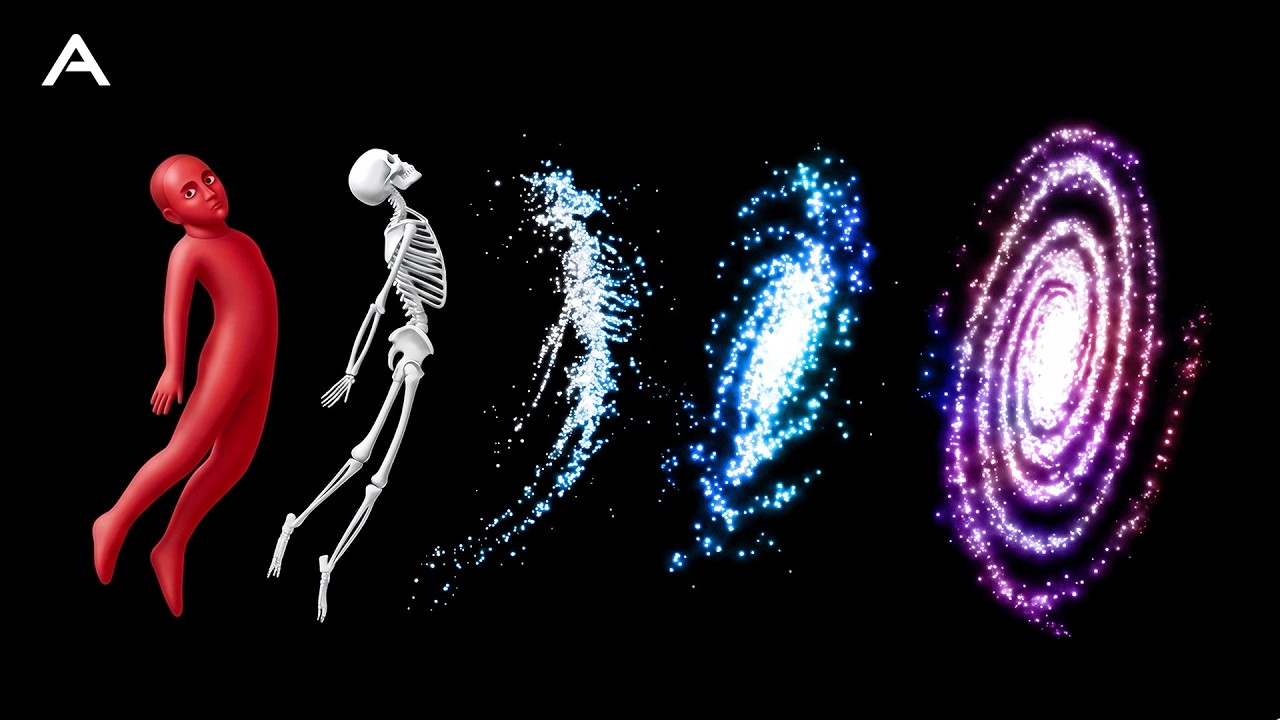
Forty seven minutes in which Jim Al-Khalili builds a single argument out of four separate sciences, and the argument is this: the universe does not need a designer to produce a human being, it needs a temperature gradient, a feedback loop, and enough time. He gets there by walking three pillars of physics in order (thermodynamics, chaos, quantum mechanics) and then handing the last twelve minutes to the people trying to make life happen in a laboratory.
The spine is the second law of thermodynamics, and the twist he pulls on it is the whole film. The second law says everything runs down, disperses, dies. Al-Khalili's point is that the running down is exactly what powers everything that is interesting. A car engine, a chocolate bar and a bacterium are all doing the same trick: standing in a stream of energy flowing from concentrated to dispersed, and siphoning a little of it off to build something ordered. Then chaos theory supplies the mechanism for how the ordered thing gets complicated (simple rules plus feedback), quantum mechanics supplies a candidate mechanism for how it gets to vary and evolve (a proton tunnelling inside a hydrogen bond in DNA), and the origin of life researchers supply the frontier.
Along the way: Sadi Carnot trying to save French industrial pride after the Napoleonic Wars, Rudolf Clausius giving entropy a letter, a mug of tea, an orrery, Edward Lorenz and a butterfly, Benoit Mandelbrot and a Romanesco broccoli, a PhD student's simulation of a helicase unzipping DNA, a frying pan of silicone oil, five arm flapping robots called smarticles that teach themselves to dance, Lee Cronin's Genesis engines in Glasgow, and Sara Walker arguing that physics has not yet invented the kind of theory that could explain life at all.
The upload is by Naked Science. The programme itself is the second of the two episodes of Jim Al-Khalili's Guide to Life, The Universe and Everything, made for MagellanTV and first aired on 16 November 2021, which is why he says "as we saw in the previous episode" when he refers to quantum weirdness, and "throughout the series" at the close. This page rebuilds all of it in the video's own order and keeps every number, every name and every experiment.
Chapters
Click any timestamp and the floating player jumps there and keeps playing. The upload has no chapter markers, so these are honest section markers taken from the captions' own timings.
- 0:17 The first pillar: the laws of thermodynamics
- 0:32 Steam engines nobody could explain
- 1:08 Sadi Carnot, and a French answer to British machines
- 1:58 The crucial insight: widen the temperature gap
- 3:08 Weighing heat against work
- 3:28 Thirty millilitres of water against a 12.5 kg weight
- 4:05 The first law: energy is never created or destroyed
- 5:10 Rudolf Clausius and the one way street
- 5:59 Heat cannot of itself pass from a colder to a hotter body
- 7:45 Entropy gets a letter
- 8:27 Clausius takes it to the whole cosmos
- 9:16 The universe must one day die
- 9:48 The turn: the second law is the reason you exist
- 10:42 The car engine
- 11:51 The chocolate bar
- 13:16 A human being for a few pounds
- 14:05 The second pillar: chaos theory
- 14:41 The clockwork universe and the orrery
- 15:38 Edward Lorenz and the weather that would not behave
- 17:25 Does the flap of a butterfly's wings in Brazil set off a tornado in Texas?
- 18:50 Feedback: the camera, the screen and the flame
- 20:24 The spooky bit: the same rules also make order
- 21:00 Benoit Mandelbrot
- 21:10 Self similarity: trees, lungs, rivers
- 21:59 The Romanesco broccoli
- 22:35 The Mandelbrot set, the thumbprint of God
- 24:33 Design does not need a designer
- 25:11 The third pillar: quantum mechanics enters biology
- 26:20 Quantum biology at the University of Surrey
- 26:39 Quantum tunnelling
- 27:49 Protons do not go over the barrier
- 29:01 The DNA double helix
- 29:30 Adenine, thymine, guanine, cytosine
- 30:02 Mutation is the engine of evolution
- 30:30 Max's simulation, and the helicase
- 30:58 Down to the hydrogen bond
- 32:24 Johnjoe McFadden
- 32:57 Snooker ball or ghost
- 33:41 Mutation, cancer, and single molecules
- 34:27 How did life itself begin?
- 35:33 Silicone oil and mica powder
- 36:05 Convection cells
- 36:37 Dissipative structures
- 37:12 Smarticles
- 37:53 Synchronised swimming, unprogrammed
- 38:50 A feedback loop on the primeval Earth
- 40:09 The gray spectrum between incoherence and life
- 40:43 Where do you draw the line between life and non-life?
- 41:30 Lee Cronin at Glasgow
- 41:38 Genesis engine number one
- 42:40 Life emerged in information
- 43:05 Sara Walker
- 45:20 An ambition higher than a Nobel Prize
- 46:04 Closing: physics as the path to reality
Part one: thermodynamics
Steam engines nobody could explain (0:17)
He opens flat and without ceremony. "I'm going to start this episode by looking at one of the fundamental pillars of physics. The laws of thermodynamics."
Then the thing people forget about those laws: they did not come down from theory, they came up out of machinery. As unlikely as it sounds, it was steam engines which led to the discovery of these beautiful simple laws. By the first half of the 19th century, steam technology was transforming human societies with bewildering speed. But although the engines clearly worked in practice, no one really understood the physics behind them. The engineering ran a full generation ahead of the science.
Sadi Carnot, and a French answer to British machines (1:08)
It took a brilliant French scientist working in the aftermath of the Napoleonic Wars to crack the problem. His name was Sadi Carnot.
Al-Khalili is careful about the motive, because the motive is not curiosity. What really bothered Carnot was the technological superiority that France's enemies seemed to possess. Britain had the engines. France did not. So Carnot vowed to really try and understand how steam engines work, and to use that knowledge for the benefit of France. The founding document of thermodynamics is an act of industrial patriotism.
Carnot saw that all heat engines have the same skeleton: a hot source sitting in cooler surroundings. That is it. Whatever the plumbing, whatever the pistons, every engine is a hot thing next to a cold thing.
Now the part that was wrong, and which Al-Khalili states without embarrassment because it did not matter to the conclusion. Carnot believed that heat was some kind of substance that would flow like water from the hot to the cool. That is the caloric theory, and it is false. But the hydraulic picture that came with it was productive: just like water falling from a height, the flow of heat could be tapped to do useful work. A mill wheel in a stream. That analogy carried him to the right answer using the wrong physics.
The crucial insight: widen the temperature gap (1:58)
Carnot's crucial insight was to show that to make any heat engine more efficient, all you had to do was increase the difference in temperature between the heat source and the cooler surroundings.
Read that again, because it is a strange claim. It says nothing about the design of the engine. Not the cylinder, not the valve timing, not the working fluid. Just the gap between hot and cold. Carnot had revealed that heat engines were not simply a clever invention. They were tapping into a deeper property of nature. They were exploiting the flow of energy between hot and cold.
But as the 19th century progressed, the study of heat, motion and energy began to grip the wider scientific community. Soon it was realised that these ideas could do much more than simply explain how heat engines worked. They were applicable on a much grander scale.
Weighing heat against work (3:08)
By the mid 19th century, scientists and engineers had worked out very precisely how different forms of energy relate to each other. They measured how much of a particular kind of energy is needed to make a certain amount of a different kind.
Al-Khalili gives one example, and it is the good one because it is the experiment that broke the caloric theory. The amount of energy needed to heat 30 millilitres of water by 1 degree Celsius is the same as the amount of energy needed to lift a 12.5 kilogram weight by 1 metre.
That equivalence is worth checking rather than nodding at. Thirty millilitres of water is thirty grams, and water takes about 4.18 joules per gram per degree, so heating it by one degree costs about 125 joules. Lifting 12.5 kilograms by one metre against gravity costs mass times g times height, which is 12.5 times 9.81 times 1, about 123 joules. The two agree to within about two percent, and they are agreeing across a boundary that nobody in 1820 believed was crossable. That is the whole content of James Joule's mechanical equivalent of heat, and it is why the unit of energy has his name on it.
The deeper point that people realised was that although mechanical work and heat may seem very different, they are in fact both facets of the same thing. Energy.
The first law: energy is never created or destroyed (4:05)
This idea would come to be known as the first law of thermodynamics. The first law reveals that energy is never created or destroyed. It just changes from one form to another.
And 19th century scientists realised what that implied at the largest possible scale: the total energy of the entire universe is fixed. Amazingly, there is a set amount of energy that just changes into many different forms. So in a steam engine, energy is not created. It is just changed from heat into mechanical work.
Then Al-Khalili does the thing that makes this a good documentary rather than a textbook. He points out that the first law, impressive as it is, begs an enormous question. What exactly is going on when one form of energy changes into another? In fact, why does it do it at all? Conservation tells you the books balance. It tells you nothing about which way the transaction runs.
Rudolf Clausius and the one way street (5:10)
The answer would in part be found by the German scientist Rudolf Clausius, and it would form the basis of what became the second law of thermodynamics.
Clausius realised that not only was there a fixed amount of energy in the universe, but that the energy seemed to be following a very strict rule. Put simply, energy in the form of heat always moved in one particular direction.
Al-Khalili's verdict on this, delivered straight to camera: "This insight of his is in fact one of the most important ideas in the whole of science."
Heat cannot of itself pass from a colder to a hotter body (5:59)
As Clausius put it, and this is the 1854 statement more or less verbatim:
Heat cannot of itself pass from a colder to a hotter body.
Al-Khalili demonstrates it with a mug of tea, which is the correct level of apparatus for a law this fundamental. If left alone, this hot mug of tea will always cool down. What that means is that heat will pass from the hot mug to his hand, and then again from his hand to his chest. A chain of transfers, all downhill, none of them ever spontaneously running back up.
This might seem completely obvious, but it was a crucial insight. The flow of heat was a one way process that seemed to be built very fundamentally into the workings of the entire universe. Left alone, energy always goes from being concentrated to being dispersed.
The word "obvious" is doing a lot of work there and he knows it. Nothing in the first law forbids the tea from spontaneously heating up while the room cools. Energy would be perfectly conserved. It simply never happens, and the reason it never happens is a separate law.
Entropy gets a letter (7:45)
Clausius brought together all these ideas about how energy is transferred and put them into mathematical context. It could be summarised by one equation, and what Clausius did was introduce a new quantity he called entropy, given the letter S.
What the equation says, in the context Al-Khalili gives it, is that as heat is transferred from hotter to colder bodies, entropy always increases. It appeared to Clausius that in any isolated system this process would be irreversible. Not difficult to reverse. Irreversible.
Clausius takes it to the whole cosmos (8:27)
Then comes the leap that Al-Khalili plainly admires. Clausius was so confident about his mathematics that he figured out that this irreversible process was going on out there in the wider cosmos. He speculated that the entropy of the entire universe had to be increasing towards a maximum, and that there was nothing we could do to avoid this.
That is a man taking a result about steam pipes and applying it to everything that exists, on the strength of the algebra alone. Clausius wrote it as two sentences in 1865: the energy of the universe is constant, the entropy of the universe tends to a maximum.
The second law of thermodynamics seemed to say that all things that gave off heat were in some way connected together. All things that gave off heat were part of an irreversible process that was happening everywhere. A process of spreading out and dispersing. A process of increasing entropy.
The universe must one day die (9:16)
The second law says the universe itself must one day reach a point of maximum entropy. Maximum disorder. The universe itself must one day die.
That is the heat death, and Al-Khalili lets it sit for a beat without softening it.
The turn: the second law is the reason you exist (9:48)
Then he turns it completely over, and this is the hinge of the entire film.
If everything degrades, if everything becomes disordered, you might be wondering how it is that we exist. Contrary to what you might think, it is precisely because of the second law that all this exists. The great disordering of the cosmos gives rise to its complexity.
It is possible to harness this natural flow from order to disorder, to tap into the process and generate something new. To create new order. New structure.
The second law is not a prohibition on order. It is a prohibition on order appearing for free. If you are willing to pay for your local order by dumping more disorder somewhere else, the books balance and the universe permits it. Every ordered thing you have ever seen, including yourself, is standing in a downhill stream of energy and taking a cut.
The car engine (10:42)
Al-Khalili makes it concrete with his own car, and he keeps the numbers.
The engine of his car, like all engines, is designed to exploit the second law. It starts out with something nice and ordered, like petrol, stuffed full of energy. But when it is ignited in the engine, it turns this compact liquid into a mixture of gases 2,000 times greater in volume. Not to mention dumping heat and sound into the environment. It is turning order into disorder.
What is so spectacularly clever about the car is that it can harness that dissipating energy. It can siphon off a small bit of it and use it for a more ordered process, like driving the pistons which turn the wheels. That is what engines do. They tap into that flow from order to disorder and do something useful.
Notice how well that pairs with Figure 2. The car is not clever because it is efficient. By the Carnot ceiling it is a fairly poor machine. It is clever because it can take a violently disordering event and steal a usable, ordered fraction out of the middle of it.
The chocolate bar (11:51)
But it is not just cars. Evolution has designed our bodies to work thanks to the very same principle. If Al-Khalili eats a chocolate bar packed full of nice ordered energy, his body processes it and turns it into more disordered energy, but powers itself off the proceeds.
Steam engines. Power stations. Life on Earth. All of these things harness the cosmic flow from order to disorder.
The chocolate bar and the tank of petrol are the same object as far as the second law is concerned. Both are stored, concentrated, low entropy chemical energy. Both get shredded into heat and dispersed gas. Both leave a little order behind on the way out, in one case a turning wheel and in the other a thought.
| What goes in | What comes out | The cut it takes | |
|---|---|---|---|
| Steam engine | Coal, concentrated and ordered, burnt against cool surroundings | Hot exhaust, warm condenser water, noise | Motion of the piston |
| Al-Khalili's car | Petrol, a compact liquid stuffed with energy | Gases 2,000 times the volume, plus heat and sound dumped to the environment | The pistons that turn the wheels |
| Al-Khalili eating a chocolate bar | Sugar and fat, nice ordered energy | Warmth, carbon dioxide, water, all more disordered than what went in | A living, thinking, moving body |
| Power station | Fuel burnt at high temperature against a cold river or cooling tower | Waste heat, which is why cooling towers exist at all | Electricity |
| Life on Earth | Sunlight arriving concentrated from a 5,800 K surface | Infrared radiated back to a 3 K sky, far more photons, far more entropy | the whole biosphere |
A human being for a few pounds (13:16)
But the laws of thermodynamics alone are not enough to explain why there is so much complexity in our world, such intricate and apparently ordered structure. Ours is a world where inanimate matter spontaneously creates exquisite beauty, where a chaotic and unpredictable universe has turned simple dust into human beings.
It is even more amazing, he says, when you consider that we ourselves are made up of just a handful of simple elements. He puts them on the bench. Almost 99% of the human body is a mixture of air, water, coal and chalk, with traces of other slightly more exotic elements like iron, zinc, phosphorus and sulfur.
Then the line that lands: "I've estimated that the elements which make up the average human cost at most a few pounds."
The deliberate crudeness of "air, water, coal and chalk" is the point. Air for the nitrogen and the oxygen, water for the hydrogen and more oxygen, coal for the carbon, chalk for the calcium. Nothing rare. Nothing expensive. Somehow trillions of these very ordinary atoms conspire miraculously to organise themselves into thinking, breathing, living human beings. How the wonders of creation are assembled from such simple building blocks is, he says, surely the most intriguing question we can ask.
The answer lies in the extraordinary world of chaos theory.
Part two: chaos
The clockwork universe and the orrery (14:41)
Before the coming of chaos theory, scientists had a pretty fixed idea of how everything in the universe worked. In essence, by the beginning of the 20th century, scientists saw the universe as a giant complicated mechanical device. A supersized version of the orrery Al-Khalili has on the table in front of him, brass planets on brass arms, driven by a handle.
The idea was that the universe is a huge and intricate machine that obeys orderly mathematical rules. If you knew the rules and how the machine was configured to start with, then as you turn the handle over and over again, it would behave in an entirely predictable way. That is the clockwork universe, and its most famous statement is Laplace's demon: an intellect that knew every position and every force could compute the entire future.
(The captions garble the next sentence badly. The sense of it, and the standard history, is that when a system refused to behave like the orrery, scientists assumed some outside influence must be to blame rather than the system itself.)
Edward Lorenz and the weather that would not behave (15:38)
The man who forced the scientific community to confront it was an American meteorologist called Edward Lorenz. In the early 1960s he tried to find mathematical equations that could help predict the weather.
Like all his contemporaries, he believed that in principle the weather system was no different to the orrery. A mechanical system that could be described and predicted mathematically. But he was wrong.
When Lorenz wrote down what looked like perfectly simple mathematical equations to describe the movement of air currents, they did not do what they were supposed to. They made no useful predictions whatsoever. It was as if the lightest breath of wind one day could make the difference a month later between a snowstorm and a perfectly sunny day.
So how can a simple system that works in the regular clockwork manner of an orrery become unpredictable? Al-Khalili answers it mechanically, with the orrery still in his hands, which is the clearest version of this explanation I have seen on television. It is all down to how it is configured. How the gears are connected. Under certain circumstances the tiniest difference in the starting positions of the cogs, differences that are too small to measure, can get bigger and bigger with each turn of the handle. With each step in the process, the system moves further and further away from where you thought it was going.
The point being that nothing has been added. No randomness, no outside force, no missing physics. The rules are still perfectly deterministic. The determinism just stops being useful, because you can never specify the starting position finely enough.
Lorenz's equations were published in 1963 as Deterministic Nonperiodic Flow in the Journal of the Atmospheric Sciences, and they are three lines long. Three ordinary differential equations, no randomness anywhere, and they will not repeat themselves and cannot be predicted far ahead.
Does the flap of a butterfly's wings in Brazil set off a tornado in Texas? (17:25)
Lorenz captured this radical idea in an influential talk he gave, and Al-Khalili gives the full title, which is a question and not a statement:
Does the flap of a butterfly's wings in Brazil set off a tornado in Texas?
It was a powerful and evocative image, and within months a new phrase had entered our language. The butterfly effect. The talk was given to the American Association for the Advancement of Science in Washington in December 1972, and the text of it is still worth reading, not least because Lorenz spends most of it being careful in a way the phrase never was.
It seemed unpredictability was hardwired into every aspect of the world we live in. Al-Khalili runs the consequences without flinching. The global climate could dramatically change in the course of a few short years. The stock market could crash without warning. We could be wiped from the face of the planet overnight, and there is nothing anyone could do about it.
Feedback: the camera, the screen and the flame (18:50)
Scientists realised that there was an unexpected link between nature's power to self organise and the chaotic consequences of the butterfly effect. Complex and unpredictable natural systems can emerge from surprisingly simple mathematical rules, and those rules have a unique property, often referred to as feedback.
Al-Khalili demonstrates it the analogue way. The screen behind him is connected up to the camera that is filming him. But the camera in turn is filming him with the screen. That creates a loop, with multiple copies of him appearing on the screen. This is the classic video feedback example. A picture in a picture in a picture.
At first it seems fairly predictable. But as the camera zooms in, some pretty strange things begin to happen. The first thing he notices is that the object he is filming, a lit match, stops bearing much resemblance to what now appears on the screen. Small changes in the movement of the match become rapidly amplified as they loop round from the camera to the screen and back to the camera. So even though he can describe each step in the process mathematically, he still has no way of predicting how tiny changes in the flickering of the flame will end up in the final image.
This is the butterfly effect in action, done in a studio with two pieces of consumer electronics and a match.
The spooky bit: the same rules also make order (20:24)
"But now here comes the spooky bit."
With just a slight tweak to the system, strange and rather beautiful patterns begin to emerge. The same system, one that is based on simple rules with feedback, produces chaos and order.
That word "and" is the whole second act of the film. It is not that some systems are chaotic and others are orderly. It is that the same system, with the same rules, sits on a knife edge between the two, and a small change to a parameter walks it from one to the other.
Benoit Mandelbrot and self similarity (21:00)
One scientist more than any other brought a fundamentally new understanding to this astonishing and often puzzling idea. His name is Benoit Mandelbrot.
Underlying nearly all the shapes in the natural world is a mathematical principle known as self similarity. This describes anything in which the same shape is repeated over and over again at smaller and smaller scales.
Al-Khalili's examples, in order, and he gives four:
- Trees. The branches fork and fork again, repeating that simple process over and over at smaller and smaller scales.
- Lungs. The same branching principle applies in the structure of our lungs, where the bronchial tree divides roughly twenty three times to reach the alveoli.
- Blood vessels. The way our blood vessels are distributed throughout our bodies is the same rule again.
- Rivers. It even describes how rivers split into ever smaller streams, or, running the other way, how tributaries gather.
There is a reason the same shape keeps turning up in all four: they are all solving the same problem, which is how to service a volume from a single point using a branching pipe. Nature does not need four separate designs because one recursive rule covers it.
The Romanesco broccoli (21:59)
And nature can repeat all sorts of shapes this way. He picks up a Romanesco broccoli, which is the correct prop and the one every physicist reaches for. Its overall structure is made up of a series of repeating cones at smaller and smaller scales. A cone made of cones made of cones, each one a scaled copy of the whole, arranged on a spiral.
Mandelbrot realised self similarity was the basis of an entirely new kind of geometry, and he gave it a name. Fractal, from the Latin for broken, coined in 1975 and developed into The Fractal Geometry of Nature in 1982.
The Mandelbrot set, the thumbprint of God (22:35)
"What I'm about to show you is one of the most remarkable mathematical images ever discovered. Epic doesn't really do it justice. This is the Mandelbrot set. It's been called the thumbprint of God."
Just as with the tree or the broccoli, the closer you study this picture, the more detail you see. Each shape within the set contains an infinite number of smaller shapes. Baby Mandelbrots that go on forever. Yet all this complexity stems from just one incredibly simple equation.
And that equation has a very important property: it feeds back on itself. Like a video loop, each output becomes the input for the next go. This feedback means that an incredibly simple mathematical equation can produce a picture of infinite complexity.
The equation is worth writing down because the film says "incredibly simple" and viewers rarely get shown how simple. Take a complex number c. Start at zero. Square it and add c. Square the result and add c. Keep going. If the numbers stay bounded forever, c belongs to the set. If they run away to infinity, it does not. That is all of it: z becomes z squared plus c, iterated. Everything in the picture, every filament, every baby copy, is that one line of arithmetic run over and over on a grid of starting points.
Design does not need a designer (24:33)
The really fascinating thing, he says, is that the Mandelbrot set is not just a bizarre mathematical quirk. Its fractal property of being similar at all scales mirrors a fundamental ordering principle in nature. Complex systems can be based on simple rules.
"That's the big revelation. Design does not need an active interfering designer. It's an inherent part of the universe."
So two of the major pillars of physics, thermodynamics and chaos theory, explain a great deal about the structures of life and the basic laws that underpin it. Thermodynamics says order is affordable if you pay for it in dispersed heat. Chaos says the order you buy can get arbitrarily complicated from arbitrarily simple rules. Between them they take you a long way from "a few pounds of air, water, coal and chalk" towards a person.
But not the whole way.
Part three: quantum mechanics enters biology
The third pillar (25:11)
"But in recent years, and this is an area I've personally become involved in in my research, it's been realised that quantum mechanics may also play a role in explaining some of the most important mechanisms of life."
He refers back to the previous episode of the series for the strangeness itself. The behaviour of subatomic particles is completely baffling. They behave as though they are smeared out in space. They pop in and out of existence all the time. And you can only express their location and movement in terms of probabilities, not certainties.
But for decades, no one had any idea that the Alice in Wonderland world of quantum mechanics could be important in the realm of biology. In recent years that has changed.
Quantum biology at the University of Surrey (26:20)
Quantum biology is a growing branch of science, and at the University of Surrey, Al-Khalili and his colleagues are heavily involved in pushing back its boundaries. Surrey runs the Leverhulme Quantum Biology Doctoral Training Centre, which he co directs, and which is the institutional home of everything in this section.
"We think spooky quantum effects may play an important role within living organisms."
He wants to show one example, a bizarre process called quantum tunnelling.
Quantum tunnelling (26:39)
First the terminology, and he is precise about it. When physicists say you have to put in effort to get something done, they have a special term for it: you have to overcome an energy barrier.
Al-Khalili wants to look at tunnelling because it is an extraordinary way in which particles can move, enabling them to cross energy barriers, barriers which are even more challenging than the walls of a medieval castle. It revolves around another strange fact from the world of quantum mechanics: particles can cross barriers in a very spooky way indeed. They act like ghosts.
Then he heads off the obvious objection, which is the mark of someone who has given this talk a hundred times:
I wouldn't blame you for thinking that this is an idea that a clever theoretician has come up with, that it's just mere speculation, something that we have no proof of. But we do. It takes place all the time.
Protons do not go over the barrier (27:49)
In the quantum world, protons do not have to go over barriers. They can tunnel straight through. A quantum particle can tunnel from one place to another even if it has to pass through an impenetrable barrier. In nuclear physics, this effect is a proven fact. It is how alpha decay works, it is how the Sun manages to fuse hydrogen at temperatures that classically should be far too cold, and it is what a scanning tunnelling microscope measures.
The most important advantage of tunnelling is its speed. It happens incredibly quickly. Much faster than if protons go over the barrier.
"As a nuclear physicist, quantum tunnelling is my bread and butter."
That is not throat clearing. It is the reason this particular physicist ended up in molecular biology: he already had the mathematics for particles crossing barriers, and DNA turned out to be full of barriers.
The DNA double helix (29:01)
"You'll probably recognise this as the famous DNA double helix discovered by Crick and Watson in 1953."
He gives the credit in that order. The paper is Watson and Crick in Nature on 25 April 1953, built on Rosalind Franklin's Photo 51.
This molecule contains our genetic code. It is the instruction manual for all life on Earth. The double helix structure is stable, like a twisted double spine, like a twisted ladder. But it is the rungs of the ladder that are of interest to him.
Adenine, thymine, guanine, cytosine (29:30)
The rungs are made up of four smaller molecules called bases: adenine, thymine, guanine and cytosine. And these bases fit together in a very special way, like pieces of a jigsaw puzzle. The two strands fit together when guanine fits to cytosine and adenine fits to thymine.
That is Watson and Crick base pairing, and the jigsaw metaphor is doing real work, because the fit is a shape fit, held together by hydrogen bonds. Three of them between G and C, two between A and T. Change the shape and the piece stops fitting.
Mutation is the engine of evolution (30:02)
But every now and again mistakes take place, and understanding how and why they happen is incredibly important.
The evolution of all living things depends on DNA mistakes, known as genetic mutations. Sometimes a mutation might give an organism an edge in their environment, and they can reproduce more efficiently over very long time scales. That is how species change.
But how do these mutations occur? Al-Khalili's answer is that he does not know yet, and that he is currently trying to find out, and here is the hypothesis.
Max's simulation, and the helicase (30:30)
He puts up a computer simulation produced by his PhD student, Max. That is Max Winokan, who did his doctorate at Surrey between 2020 and 2023 under Al-Khalili's supervision, and whose published work is exactly this.
In the foreground is the DNA double helix in colour. The grey blob in the background is the helicase, an enzyme that splits the two strands of DNA apart so that each can then make a copy of itself. The unzipping machine.
Zoom in, and you can see the bases all linked together inside the DNA, and then you get into the business end. Down at the molecular, at the atomic level, the green is guanine and the yellow is cytosine. These two bases are held together by hydrogen bonds, and one of those bonds is basically a proton.
"So now we're down at the quantum realm, which of course is my specialism."
Down to the hydrogen bond (30:58)
It is this subatomic bonding of the bases which most interests him, and the mechanism goes like this.
These protons spend most of their time on one side. But every now and again they can jump across to the other side. However, they just jump back again. Nothing happens. The pair is fine.
But if the two bases split with the protons in the wrong positions, then that changes the shape of the bases. This is tautomerism: move a proton within a molecule and you get a different structural form of the same molecule, with different bonding geometry.
Now when the strands of DNA make copies of each other, green would normally fit with yellow. However, now they cannot. They are like jigsaw pieces that do not fit together. But if an orange comes along, green can fit to it. However, this should not happen. Green should not fit with orange.
This is a mistake. This is a point mutation, caught at the instant it is made.
"Now, of course, you can guess how we think the protons jump. We think quantum tunnelling is happening inside DNA. Which means it could be one cause of mutations."
Johnjoe McFadden (32:24)
"I'm working on this theory with Professor Johnjoe McFadden."
Johnjoe McFadden is Professor of Molecular Genetics at Surrey, Al-Khalili's co author on the popular book Life on the Edge: The Coming of Age of Quantum Biology and, more to the point here, his co author on the 1999 paper that started this line of work: "A quantum mechanical model of adaptive mutation", BioSystems 50, pages 203 to 211. This collaboration is more than twenty years old at the time of filming.
McFadden opens by narrowing the claim properly, which is the most scientifically careful thirty seconds in the film:
Mutation can be caused by many different phenomena. Radiation causes mutation. Ultraviolet light causes mutation. So there are many mechanisms of causing mutation, of which the proton moving from one place to another is one of them.
Not the cause. One of them.
Snooker ball or ghost (32:57)
Al-Khalili then states the alternative honestly. If it is the moving proton that causes mutations, it could find its way across the energy barrier not by quantum effects, but by what we would call ordinary Newtonian physics. The proton might simply be getting kicked over the top by thermal energy.
McFadden frames the actual research question:
The question is whether they move by classical ways like a snooker ball moving from one place to another, or whether they move by quantum mechanical means in which they essentially disappear from one position and appear at another.
Al-Khalili: "Our preliminary results look very promising."
McFadden: "The recent work of our students then has revealed, if it moves at all, it moves quantum mechanically. If the proton moves from one place to another, it's doing it as a quantum mechanical particle."
Note the conditional he keeps in place: if it moves at all. The finding is about the mechanism of the move, not about how often the move happens or how often it survives to become a mutation.
| The question McFadden poses at 32:57 | Classical route | Quantum route |
|---|---|---|
| The picture | A snooker ball rolling from one place to another, over the top of the barrier | The proton disappears from one position and appears at another, straight through |
| What it needs | Enough thermal energy in the surroundings to climb the whole barrier | Nothing. The wavefunction has amplitude on the far side regardless |
| Speed | Slower. Waits for a big enough thermal kick | "The most important advantage of tunnelling is its speed. It happens incredibly quickly." |
| Is it proven anywhere? | Standard chemistry, everywhere | yes, in nuclear physics, where Al-Khalili calls it his bread and butter |
| Does it happen in DNA? | this is the open question the Surrey group is working on | |
| What the students found | "If it moves at all, it moves quantum mechanically." The mechanism is settled in their models; the biological consequence is not. | |
Mutation, cancer, and single molecules (33:41)
Then McFadden takes it somewhere the film has not been so far, and does it in four sentences:
And of course, mutation is responsible for evolution, but it also has a bad side. It's responsible also for making cancer cells cancerous. Cancer is caused by mutations. Single molecules have macroscopic effects. They change us. And mutations in single molecules can mean the difference between life and death.
Al-Khalili closes the section on the note the whole film has been building: "It's very exciting to me to think that the great pillars of physics, thermodynamics, chaos theory, even quantum mechanics, are being used to help us understand the ordinary natural world around us."
Three pillars down. One question left.
Part four: how did life itself begin?
The rock pool and the thermal vent (34:27)
"Now, I want to end this film by looking at one of the greatest mysteries in all of science. How did life itself begin?"
Think yourself back, perhaps 4 billion years, to a primeval Earth. Simple chemicals in a rock pool, and energy flowing in from a thermal vent. It is one of the great outstanding mysteries of science: how did simple chemicals become the complex forms we know as life?
And here the film loops back to its first act. It is not often realised, he says, that the underlying principles of life come from the laws of physics, such as thermodynamics.
Silicone oil and mica powder (35:33)
He can show the basic principles in action with a simple little backyard experiment, and it is a frying pan.
All he has in the pan is some silicone oil. There is a bit of mica powder in there, but that is just to add colour so you can see the flow. A physicist or chemist would say that until he puts it on the stove there is no energy going in or out, and of course it has no structure to it. A flat, featureless, boring pan of oil in equilibrium.
Then he heats it up.
Convection cells (36:05)
Quite rapidly, shapes appear. They are known as convection cells. They form because the bottom of the oil has suddenly become very hot. The system has lots of new energy pouring into it, and as the heat dissipates through the system, ordered symmetrical structures spontaneously appear.
This is Rayleigh Bénard convection, and what it produces is a tiling of hexagonal cells, each one a little loop of oil rising in the middle and sinking at the edges. Nobody arranged them. The hexagons are what the flow settles into when you drive it hard enough.
Dissipative structures (36:37)
These pretty convection cells are a classic example of something we see again and again in the physical world. They are called dissipative structures, a term and a research programme that come from Ilya Prigogine, who won the 1977 Nobel Prize in Chemistry for exactly this: order that exists only while energy is flowing through it, and vanishes the moment the flow stops.
Al-Khalili adds the crucial caveat, and it is the one people miss: "It's worth remembering that this isn't a chemical reaction. All that's happening to this oil is that heat energy has been pumped into it."
No reaction. No new molecules. Nothing chemical at all. Just a temperature difference, and structure appears for free. That is the second law paying out again, exactly as promised at 9:48.
Some scientists think understanding the flow of heat through dissipative structures is key in understanding the development of life.
Smarticles (37:12)
Recently an experiment was carried out by a team of scientists in America using little robots called smarticles, short for smart active particles.
Switch their batteries on and all they can do is flap their arms about. So generally they just crash about randomly. It is all a bit of a mess. They are acting individually, and the whole system is chaotic and unstable.
But then the scientists programmed these smarticles to move their arms in a more predictable up and down way. Quite quickly, collective behaviour spontaneously emerged, almost like synchronised swimming.
Synchronised swimming, unprogrammed (37:53)
This is the detail that matters. These smarticles look like they have been choreographed. Yet they have not been programmed to join up or to cooperate in any way. There is no communication between them, no leader, no shared plan. They just self organise into regular patterns, even leading each other in a little orbit around the ring.
The scientists realised the smarticles were somehow choosing the structures which would enable them to stay stable and avoid being knocked around by the patterns of energy flowing through the system.
A physicist from the team puts it directly:
They discover these dances, these kind of organised collective behaviours, because this is the way that they can work together so that the energy flowing through them doesn't disorder them and just kind of maintains them in that state.
The published work behind this is Low rattling: a predictive principle for self organization in active collectives, Chvykov and colleagues, Science volume 371, pages 90 to 95, January 2021, out of Daniel Goldman's lab at Georgia Tech with Todd Murphey's group at Northwestern and the physicist Jeremy England. The technical claim is that a driven system spends most of its time in the configurations where it "rattles" least, that is, where the driving does the least damage to the arrangement, and that this gives you a Boltzmann style rule for predicting which patterns a driven collective will fall into. The earlier robotics paper on the same hardware is A robot made of robots, Savoie and colleagues, Science Robotics, September 2019.
A feedback loop on the primeval Earth (38:50)
So the idea being explored is that on a primeval Earth, chemicals encountering a predictable source of heat may have entered a feedback loop, changing their shape to become more stable as the energy flowed through them.
The interviewee again:
One of the properties of living things is that they are able to maintain themselves in this specialised state only because the energy flowing through them has a very particular pattern to it. And that they've kind of adapted or emerged even in the presence of that kind of pattern. So it's an evolutionary process then.
In effect, it is a kind of natural selection process favouring the combinations of chemicals that find the most stable form. Selection, but with no replication and no genes. Just persistence under a particular kind of driving. Ideas like this, Al-Khalili says, may help us fill in a huge gap in our understanding of how life developed.
The gray spectrum between incoherence and life (40:09)
The best single answer in the film comes here, and it is about how to think about the problem rather than about any result:
I think that sometimes people have a tendency to kind of imagine that before there's life, you just have random mess, and that you need a completely unimaginably unlikely coalescence of recognisable life-like structure out of absolute vacuum, so to speak, out of nothing that looks like that at all. And this is about how I think the physics helps you to maybe fill in a gray spectrum between that extreme incoherence on the one hand and something that you'd call life on the other, where in between there's a lot of life-like emergence that you can argue for.
That reframes the origin of life question entirely. The problem is not "how did a miracle happen once", it is "how many rungs are there on the ladder between a convection cell and a cell", and physics may be able to supply several of them.
So, Al-Khalili asks, could it be that the physical laws of the universe actually make life more likely than we have previously imagined?
Where do you draw the line between life and non-life? (40:43)
"Here's a philosophical question for you. Where do you draw the line between life and non-life?"
His example is fire, and he builds the case for it rather than against it. We can all agree that fire is not alive. And yet it has a lot in common with life:
- It needs energy, heat, to survive, by burning fuel, in the same way that we burn calories.
- It can create beautiful, transient patterns.
- It has the ability to reproduce itself.
Metabolism, structure, reproduction. Three items off the standard checklist, and a candle flame ticks all three. So at what point did non-life become life?
Lee Cronin at Glasgow (41:30)
At the University of Glasgow, a major project is underway to try to actually create life in a lab. Professor Lee Cronin and his team have built a series of chemical computers called chemputers.
Cronin walks the camera down the row: "This is Genesis engine number one. Genesis engine number two. And there's a series of other origin of life machines."
The machines are designed to gather together the simplest molecules which might have been found in a rock pool on a primeval Earth, such as carbon dioxide and methane. Adding methanol and water, and then driving heat through them. Then the scientists study the molecules as they combine and recombine through cycle after cycle.
Notice that "driving heat through them" is the same move as the frying pan and the smarticles. The whole last act of the film is one idea applied at three scales.
Cronin explains what counts as a hit:
Now, what are we looking for? We're looking at molecules that are growing, getting bigger. Molecules that are related to one another. Maybe they have the same, almost the same identity, but a bit different. Because then that would be what we see when we see evolution starting, as the molecule parent makes a slightly different child, but you can see that they're related and they carry on going.
Heredity with variation, in a flask, without any biology. Not a molecule that is alive, but a lineage of molecules.
Life emerged in information (42:40)
Cronin believes any theory of life has to be based on information, because at the most fundamental level it is information that describes complex systems and which is necessary for things to evolve and change.
Probably life didn't really emerge in chemistry. It emerged in information, and chemistry just happened to be the substrate that carried it.
That is a large claim compressed into one sentence, and it is the claim that connects him to the last interviewee in the film.
Sara Walker (43:05)
He is working closely on this idea with theoretical physicist Professor Sara Walker of Arizona State University. She was interviewed remotely, which she mentions in passing in a way that dates the film precisely:
So, I'm working with Lee on some of these ideas because I had this kind of drive to develop a theory for what life is, which is really based on this concept that somehow information is going to be playing a critical role in what we might call the physics underlying life. Objects like you and me, the cup, the Zoom, complex molecules like proteins and things, all of those things require information or an evolutionary process to create them in the universe, and that's the physics we want to understand. How does the universe spontaneously generate information and information processing systems that then undergo this process that we call evolution and build all the complexity that we see in the world?
"The cup, the Zoom" is a good example precisely because it is throwaway. A coffee cup and a video call are both things that could not exist without a long prior history of selection and information. You will not find either of them by solving Schrödinger's equation for a box of atoms.
This is thinking on the grand scale, Al-Khalili notes: not just the origin of life on Earth, but everywhere in the universe.
An ambition higher than a Nobel Prize (43:45 and 45:20)
Cronin makes the scale explicit, and this is the most quotable passage in the film:
My mission in science is to basically come up with the plausible scenarios that would give rise to the origin of life on Earth. But actually, who cares about that? It's like saying we want to understand the origin of our Sun. But when you look in the sky, there's suns everywhere. So what I want to do, if this works, I'm not going to work out what did happen, I'm going to be able to work out what does happen. My very strong belief, and it is a belief, and what I'm trying to do is test this belief, is that life is everywhere. So by understanding the origin of life and making life now, we will be able to statistically map how life works in the universe.
The distinction between "what did happen" and "what does happen" is the entire argument for the laboratory approach over the historical one. History gives you one sample. A machine that makes origins gives you statistics.
Walker then says the thing that a physicist is not really supposed to say out loud:
One of the reasons physics hasn't been able to explain life yet: our concepts of what the theories need to look like are just not structured properly yet. And we haven't been creative enough to think about breaking free of the mould of physics as it's been done in the last 300 years, and invent new ways of doing it to address the problems that are in front of us now. Like what is life, what are minds and consciousness, how does intelligence evolve over planetary scale time scales, what other things like us might exist in the universe.
Three hundred years, measured from Newton. The claim is not that physics has the wrong answers about life. It is that physics does not yet have the right shape of question. This is the research programme that became assembly theory, Sharma, Czégel, Lachmann, Kempes, Walker and Cronin, published in Nature in October 2023, two years after this was filmed.
And then Cronin, on ambition:
Right now, life on Earth means nothing if Earth gets obliterated and we don't affect the rest of the universe. So my ambition? Nobel Prize, that's too low an ambition. The ambition is to create a technology that we could seed the universe with, to transmit our origin of life idea and create other living worlds where there were none.
(The auto captions mangle "seed" here into "deceive", which is worth flagging so nobody quotes the garble.)
He immediately raises the objection to himself, which is to his credit:
And I can imagine between us having an ethical debate in the future, when we know how to do this, and say: is it ethical to infect this planet with an origin of life scenario? Are we going to destroy the life that's on the planet? Is the planet definitely dead? So my ambition is to make sure that we find life elsewhere in the universe, understand life on Earth, and if there's not life elsewhere in the universe, we better make sure that we make the most of our universe by making sure life escapes Earth.
That is directed panspermia with a planetary protection debate attached, proposed as a career goal, on a science documentary, without anyone blinking.
Closing: physics as the path to reality (46:04)
Al-Khalili takes it home in three sentences:
As we've seen throughout the series, today's generation of scientists are pushing back the boundaries of what it's possible for us to know at a breathtaking rate. I believe that as a human race, we should take pride in our achievements. That science is at the threshold of answering the deepest questions of existence. And for me, physics is the true path to understanding the nature of reality. And with that understanding, we can shape our world and our destiny.
- 1824Sadi Carnot publishes Réflexions sur la puissance motrice du feu, working from the false premise that heat is a fluid, and derives the exact efficiency ceiling that still bears his name.
- 1840sJames Joule and others nail the mechanical equivalent of heat. Thirty millilitres of water raised one degree equals a 12.5 kg weight raised one metre. Work and heat are one currency. The first law.
- 1850 to 1865Rudolf Clausius states that heat cannot of itself pass from a colder to a hotter body, invents entropy and gives it the letter S, and extrapolates to the whole cosmos: the entropy of the universe tends to a maximum.
- 1953Watson and Crick publish the double helix in Nature. The rungs are base pairs, held by hydrogen bonds, and the fit is a shape fit.
- 1963Edward Lorenz publishes Deterministic Nonperiodic Flow. Three simple equations, fully deterministic, entirely unpredictable.
- 1972Lorenz asks the AAAS whether the flap of a butterfly's wings in Brazil sets off a tornado in Texas. Within months the phrase has escaped into ordinary English.
- 1975 to 1982Benoit Mandelbrot coins fractal and publishes The Fractal Geometry of Nature. Self similarity turns out to be the default shape of the natural world.
- 1977Ilya Prigogine takes the Nobel Prize in Chemistry for dissipative structures: order that exists only while energy flows through it.
- 1999McFadden and Al-Khalili publish a quantum mechanical model of adaptive mutation in BioSystems. The proton tunnelling idea enters the literature.
- 2019Georgia Tech and Northwestern publish a robot made of robots: five arm flapping smarticles that locomote as an ensemble although none of them can move alone.
- Jan 2021Low rattling appears in Science. Driven collectives fall into the configurations that the driving disturbs least. The smarticles discover their dances.
- Nov 2021This film airs on MagellanTV, the second of two episodes.
- May 2022Slocombe, Sacchi and Al-Khalili publish the open quantum systems treatment of proton tunnelling in DNA in Communications Physics. Tunnelling beats classical hopping by orders of magnitude.
- Oct 2023Assembly theory lands in Nature, from Walker, Cronin and colleagues. The attempt Walker describes in this film, to invent a differently shaped physics, becomes a formal proposal.
Best quotes
This insight of his is in fact one of the most important ideas in the whole of science.
Al-Khalili on Clausius, 5:44
Heat cannot of itself pass from a colder to a hotter body.
Clausius, quoted at 5:59
The second law says the universe itself must one day reach a point of maximum entropy, maximum disorder. The universe itself must one day die.
Al-Khalili, 9:16
Contrary to what you might think, it's precisely because of the second law that all this exists. The great disordering of the cosmos gives rise to its complexity.
Al-Khalili, the hinge of the film, 9:52
Almost 99% of the human body is a mixture of air, water, coal and chalk. I've estimated that the elements which make up the average human cost at most a few pounds.
Al-Khalili, 13:16
Does the flap of a butterfly's wings in Brazil set off a tornado in Texas?
Edward Lorenz's 1972 talk title, quoted at 17:25
But now here comes the spooky bit.
Al-Khalili, 20:24, immediately before the same chaotic system starts producing order
This is the Mandelbrot set. It's been called the thumbprint of God.
Al-Khalili, 22:35
Complex systems can be based on simple rules. That's the big revelation. Design does not need an active interfering designer. It's an inherent part of the universe.
Al-Khalili, 24:27
I wouldn't blame you for thinking that this is an idea that a clever theoretician has come up with, that it's just mere speculation, something that we have no proof of. But we do. It takes place all the time.
Al-Khalili on quantum tunnelling, 27:34
As a nuclear physicist, quantum tunnelling is my bread and butter.
Al-Khalili, 28:36
We think quantum tunnelling is happening inside DNA. Which means it could be one cause of mutations.
Al-Khalili, 32:15
The question is whether they move by classical ways like a snooker ball moving from one place to another, or whether they move by quantum mechanical means in which they essentially disappear from one position and appear at another.
Johnjoe McFadden, 32:57
Single molecules have macroscopic effects. They change us. And mutations in single molecules can mean the difference between life and death.
Johnjoe McFadden, 33:48
It's worth remembering that this isn't a chemical reaction. All that's happening to this oil is that heat energy has been pumped into it.
Al-Khalili, 36:37
They discover these dances, these kind of organised collective behaviours, because this is the way that they can work together so that the energy flowing through them doesn't disorder them.
A physicist from the smarticle team, 38:28
The physics helps you to maybe fill in a gray spectrum between that extreme incoherence on the one hand and something that you'd call life on the other.
A physicist from the smarticle team, 40:09
Probably life didn't really emerge in chemistry. It emerged in information, and chemistry just happened to be the substrate that carried it.
Lee Cronin, 42:56
I'm not going to work out what did happen, I'm going to be able to work out what does happen.
Lee Cronin, 44:15
We haven't been creative enough to think about breaking free of the mould of physics as it's been done in the last 300 years.
Sara Walker, 44:50
Nobel Prize, that's too low an ambition.
Lee Cronin, 45:20
For me, physics is the true path to understanding the nature of reality. And with that understanding, we can shape our world and our destiny.
Al-Khalili, the last line, 46:27
Where it stands
Rebuilt honestly, here is what in this film is settled, what is live research, and what is one scientist's stated ambition. The film mostly signposts these itself, but not always in the same breath as the claim.
Settled physics, not in dispute. The first and second laws, the Carnot ceiling, entropy as a state function, Rayleigh Bénard convection cells, and quantum tunnelling as a real and measured effect are all textbook. Al-Khalili's framing of the second law as the enabler of complexity rather than only its enemy is also standard among physicists, even though it still surprises most audiences. The Earth is an open system sitting in a stream of low entropy sunlight, and local order paid for by a larger export of entropy is exactly what the law permits.
Carnot was right for the wrong reason. The film says plainly that Carnot believed heat was a substance. It is worth being explicit that this was wrong, and that his result survived the correction anyway, because the efficiency limit depends only on the temperatures, not on what heat is made of. That is unusual and it is a genuinely interesting fact about how science sometimes works.
The heat death is a conclusion with premises. "The universe itself must one day die" is the standard extrapolation, but it treats the universe as an isolated system with a fixed volume of possibilities, which is not obviously true of an expanding, accelerating spacetime. Modern cosmology tends to reach a similar destination by a different route. The film gives Clausius's version, from 1865, and does not update it.
Proton tunnelling in DNA is live research, not established biology. This is the section where the film is closest to its presenter's own bench, and it is careful in the moment but easy to over read. McFadden explicitly says radiation and ultraviolet light also cause mutations and that the proton is "one of them". The strongest published result is Slocombe, Sacchi and Al-Khalili in Communications Physics, May 2022, which modelled the guanine cytosine hydrogen bonds as an open quantum system and found the tunnelling contribution to be several orders of magnitude larger than classical hopping, with canonical and tautomeric forms interconverting far faster than biological timescales. That is a statement about how the proton moves, not proof that this is a significant source of mutations in a living cell. The follow up question, whether a tautomer survives long enough for the helicase to separate the strands and lock the error in, is precisely what the Surrey group, including Max Winokan, worked on next.
The smarticle work is real, and the on-screen contributor is not named. The film shows the robots and quotes a physicist about them without a caption identifying who is speaking. The underlying science is Chvykov and colleagues in Science, January 2021, and the interpretation given in the film matches that paper's "low rattling" principle closely. The step from "five robots find a stable collective dance" to "this is how chemistry became life" is a large one, and the film presents it as an idea being explored rather than a result, which is the right register.
Assembly theory is contested. Cronin and Walker's information first programme is a serious research effort with a 2023 Nature paper behind it, and it has also drawn substantial published criticism about whether its central quantity is genuinely new or a repackaging of existing complexity measures. Nothing in the film is dishonest about this, because at the time of filming the theory had not been formally published. But a viewer in 2026 should know that "life is information" is a live and argued position rather than a consensus.
The seeding ambition is Cronin's, and he flags his own ethics. The passage about creating living worlds where there were none is an individual scientist's stated ambition, not a programme with funding or a timeline, and he raises the planetary protection objection himself in the next breath. Read it as what it is: a chemist saying out loud what he would like to be true.
One production note. The YouTube description on this upload describes a different programme entirely, promising Einstein's general relativity, the expanding cosmos, black holes, entanglement, a theory of everything and a holographic universe. None of that is in these 47 minutes. Some of it belongs to the first episode of the series, The Power of Uncertainty. If you came for the holographic universe, it is not here. What is here is better organised than the description suggests.
Resources
The presenter
- Professor Jim Al-Khalili at the University of Surrey, now Distinguished Professor Emeritus in Physics, co director of the Leverhulme Doctoral Training Centre for Quantum Biology
- Jim Al-Khalili on Wikipedia
- The Life Scientific, his long running BBC Radio 4 interview series
- Life on the Edge: The Coming of Age of Quantum Biology, with Johnjoe McFadden, the book behind Part three
- The World According to Physics, Princeton University Press
- Quantum: A Guide for the Perplexed, his popular introduction
- Pathfinders: The Golden Age of Arabic Science
- The Secret Life of Chaos, his 2010 BBC Four film, from which the orrery, Lorenz, the video feedback loop and the Mandelbrot material in Part two descend
This programme
- Jim Al-Khalili's Guide to Life, The Universe and Everything, MagellanTV, 2021, two episodes. This is the second, From Simple to Complex
- MagellanTV
- Naked Science on YouTube, the channel that uploaded it
Part one: thermodynamics
- Sadi Carnot and Reflections on the Motive Power of Fire, 1824
- Caloric theory, the wrong idea that got the right answer
- Carnot heat engine and the Carnot cycle
- James Prescott Joule and the mechanical equivalent of heat
- First law of thermodynamics
- Rudolf Clausius, the Clausius theorem and entropy
- Second law of thermodynamics
- Heat death of the universe
- Composition of the human body, for the air, water, coal and chalk claim
Part two: chaos
- Edward Norton Lorenz
- Deterministic Nonperiodic Flow, Journal of the Atmospheric Sciences, 1963
- Predictability: Does the Flap of a Butterfly's Wings in Brazil Set Off a Tornado in Texas?, the 1972 AAAS talk
- The Lorenz system, the three equations plotted in Figure 4
- Butterfly effect and chaos theory
- Clockwork universe and Laplace's demon
- Orrery
- Video feedback, the camera and screen demonstration
- Benoit Mandelbrot and The Fractal Geometry of Nature
- The Mandelbrot set and self similarity
- Romanesco broccoli
Part three: quantum biology
- Quantum biology
- Leverhulme Quantum Biology Doctoral Training Centre, University of Surrey
- Quantum tunnelling in DNA research, the group's own page on this project
- Quantum tunnelling
- Professor Johnjoe McFadden, and his own page on proton tunnelling in DNA mutation
- A quantum mechanical model of adaptive mutation, McFadden and Al-Khalili, BioSystems 50, 203 to 211, 1999
- An open quantum systems approach to proton tunnelling in DNA, Slocombe, Sacchi and Al-Khalili, Communications Physics 5, 109, 2022
- Max Winokan, the PhD student whose simulation appears at 30:30
- Enzymes could be key to understanding how DNA mutates, Surrey's write up of the helicase follow up
- Molecular Structure of Nucleic Acids, Watson and Crick, Nature, 25 April 1953
- Base pair, hydrogen bond, tautomer, helicase
- Mutation
Part four: the origin of life
- Rayleigh Bénard convection, the convection cells in the frying pan
- Dissipative system and Ilya Prigogine, Nobel Prize in Chemistry 1977
- Low rattling: a predictive principle for self organization in active collectives, Chvykov et al., Science 371, 90 to 95, 2021
- A robot made of robots, Savoie et al., Science Robotics, 2019, the smarticle hardware
- Daniel Goldman's CRAB Lab, Georgia Tech, and Todd Murphey's lab at Northwestern
- Jeremy England, co author on the low rattling paper and the originator of dissipative adaptation
- Spontaneous robot dances highlight a new kind of order in active matter, Georgia Tech's own write up
- Professor Lee Cronin and the Cronin Group, University of Glasgow
- What molecules should we make with a chemputer robot?, Chemistry World, on the chemputer
- Using an automated chemistry lab to find the origin of life, Discover, on the Genesis engines
- Professor Sara Imari Walker, Arizona State University, and her Santa Fe Institute profile
- Assembly theory explains and quantifies selection and evolution, Sharma, Czégel, Lachmann, Kempes, Walker and Cronin, Nature, October 2023
- A critique of assembly theory, for the other side of that argument
- Hydrothermal vent and abiogenesis
- Directed panspermia, for what Cronin describes at 45:20
Elsewhere on this site
- Cosmo explains thermodynamics, the same laws from a different angle
- Brian Greene and Sean Carroll on the deep mysteries of physics, where the quantum weirdness Al-Khalili refers back to gets argued out properly