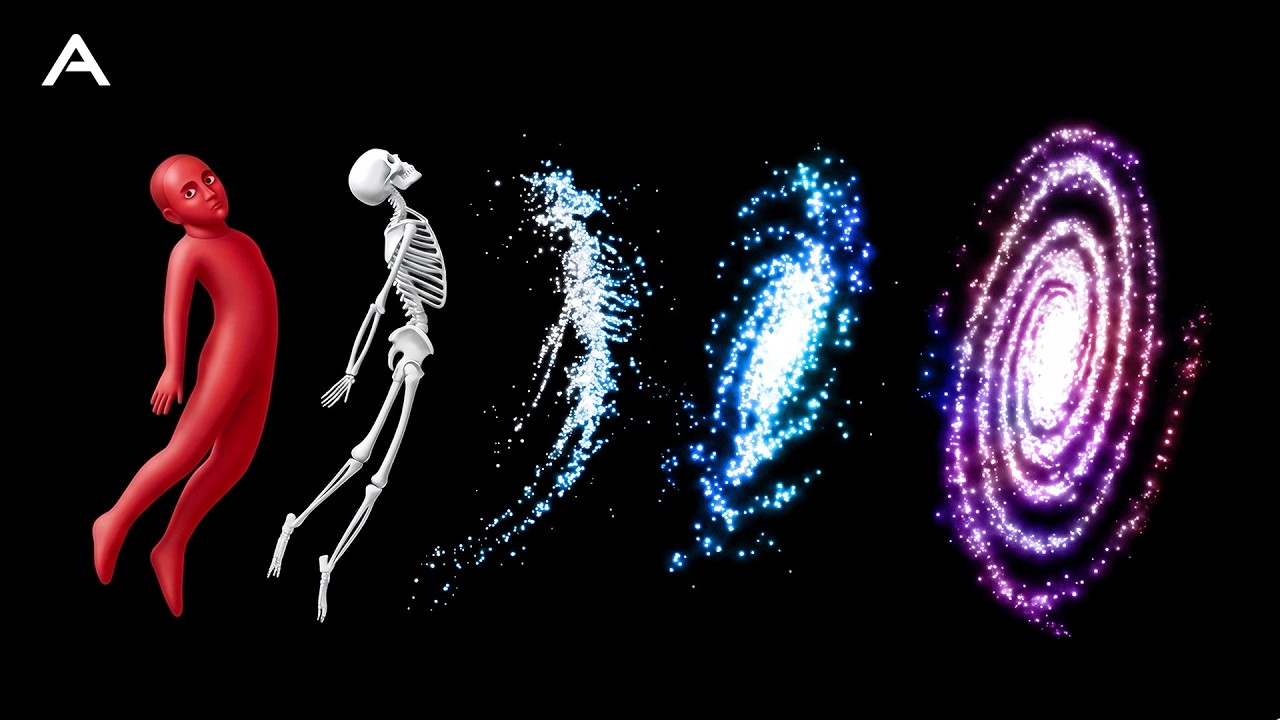
At a glance
An hour on the single biggest bookkeeping error in physics: the universe is made of matter, and it should not be.
Astrum Extra stitches three of Alex McColgan's films into one continuous run, and the three happen to line up into a proper argument. Act one is a thought experiment with real arithmetic in it: what would happen if a meteor made of antimatter hit the Earth, worked out from the mass of the atmospheric column, the density of chondrite, and E = mc², ending with a number that makes the Tsar Bomba look like a firework. Act two is the physics itself: Carl Anderson's cloud chamber in 1932, Paul Dirac's equation four years earlier that predicted the thing before anyone saw it, and then the systematic hunt for a difference between matter and antimatter across all four fundamental forces, finishing on the ALPHA collaboration's 2023 measurement of antihydrogen in free fall. Act three is the one that pays off: there is a genuine rain of antimatter hitting the Earth right now, the Alpha Magnetic Spectrometer on the space station has been counting it since 2011, and the most likely source turns out to be a dead star 800 light years away that spent fifty years pretending it was not there.
The through line is the baryon asymmetry. Every act is a different attack on the same question: if the Big Bang made matter and antimatter in equal amounts, and they annihilate on contact, why is there anything here at all? By the end you have the honest answer, which is that we still do not know, that only one of the four forces treats the two differently, and that the difference is nowhere near big enough to explain us.
This page rebuilds all three acts in the video's own order. Every number, every experiment, every collaboration, every physicist, every measured value, with the primary papers linked where they exist. The two charts McColgan builds on screen (the meteor sizing calculation and the ALPHA escape fractions) are redrawn here from his own figures.
Chapters
Click any timestamp and the floating player jumps there and keeps playing. This video ships without chapter markers on YouTube, so these are derived from the film's own structure and its own time markers.
- 0:00 The kind of meteor you would never see coming
- 2:13 Why antimatter means we should not be here
- 4:06 Coin flips, clumps, and antimatter solar systems
- 5:04 Fourteen antistar candidates in the Fermi catalog
- 6:22 1940: Rojansky asks whether meteors could be made of it
- 7:47 The atmosphere is the first line of defense
- 9:02 Weighing the air column
- 11:01 Finding the sweet spot: a three metre cube
- 11:33 608 kilograms of grand piano
- 12:07 Against the Tsar Bomba
- 13:52 So what are the actual odds?
- 16:05 Tunguska, 1908
- 17:15 Act two: the thing we did not see
- 18:52 Anderson's cloud chamber, 1932
- 20:29 Dirac got there first
- 22:02 The baryonic asymmetry of the universe
- 22:38 Force one and two: electromagnetism, then the weak force
- 24:43 Cronin and Fitch, and the math that did not work
- 25:20 Force three: the strong force says no
- 25:53 Force four: gravity, and why it is a long shot
- 28:28 Inside ALPHA: building an antihydrogen atom
- 31:14 The result: which way does it fall?
- 34:38 The ledger, and what is left
- 35:24 Act three: an antimatter factory 800 light years away
- 37:33 1972: something is emitting gamma rays in Gemini
- 38:30 1983: a weak X-ray signal
- 39:06 1991: it pulses
- 41:40 Why it looked radio silent
- 43:20 1997: Pushchino finally hears it
- 44:58 It is moving, and moving fast
- 47:50 Two ghostly X-ray tails
- 50:19 2005: the missing nebula turns up
- 51:06 Chandra, and the geometry that explains everything
- 55:00 Back to the positrons: AMS-02 and the dark matter hope
- 57:00 2017: HAWC sees a halo
- 58:20 Di Mauro's much bigger halo
- 59:57 Sixty years of pulsars
Act one: the meteor made of antimatter
The kind of meteor you would never see coming (0:00)
McColgan opens with the ordinary version of the danger, and it is reassuringly boring. Meteors have the power to transform our planet, to wipe out huge swaths of life on Earth in one impact, but most of that is not dramatic at all. The Earth is hit by more than 100 tons of small, sand sized particles every day, and they are essentially unnoticeable. About once a year a car sized meteor comes crashing through our atmosphere, but the resultant fiery streak burns up long before hitting the ground. It is only on the scale of millions of years that we are in danger of being hit by meteors a kilometre or two wide, big enough to do serious damage, and we have not seen one of those since the dinosaurs. Lucky for us.
Then the turn. Size is not everything. In fact the biggest impacts may not even be from the largest objects. If one particularly interesting theory is true, some very rare meteors may be made of something more exotic than rock.
Externally there would be nothing to differentiate them. In the vacuum of space they would look exactly the same as any other space rock. But while a regular meteor creates a fiery streak in the sky, these outliers would have impacts that exceed the largest of nuclear bombs. And those are just the small ones. If a kilometre sized one hit the Earth, similar in size to the perfectly normal rock that killed the dinosaurs, we might not have a planet anymore.
That is the power of a meteor made of antimatter.
Three questions frame the act. Could antimatter meteors really exist? What clues would help us tell them apart from regular ones? And how big would one have to be to become a major problem?
Why antimatter means we should not be here (2:13)
Antimatter is a funny substance, McColgan says, and the fact that it exists means that we should not be here.
It is almost identical to regular matter with a few key differences. One is that it has an inverted charge. Another is that when antimatter meets regular matter the two annihilate each other completely, converting almost entirely into energy.
Now, in the early universe, it was not just matter that was created. In theory an equal amount of antimatter came into being too. All the matter should have bumped into the antimatter and everything would have cancelled out, leaving no universe for us, because there would be nothing left to make a universe out of.
It is one of the mysteries of science that this did not happen. For some reason a slightly larger amount of matter coalesced into existence than antimatter. Perhaps as small a discrepancy as a billion and one matter particles to every billion antimatter ones. That single surplus particle in a billion is everything you have ever seen or touched. Scientists are still trying to figure out why, and the mystery remains unsolved. Perhaps there is some rule at play that we have not yet identified.
Whatever caused it, this imbalance is why the universe around us is almost entirely regular matter, and why the only place we reliably see antimatter is where we make tiny amounts of it in experiments at CERN and other particle accelerators. Some hospitals even have small particle accelerators to create positrons for PET scans, which is positron emission tomography. Antimatter is not exotic in the sense of being unobtainable. It is medical equipment.
Coin flips, clumps, and antimatter solar systems (4:06)
But just because we do not see it does not mean tiny pockets of antimatter could not exist.
When the raw primordial soup of the Big Bang, the quark gluon plasma, began to form into particles, there would have been more matter than antimatter overall. But in local areas there were fluctuations. So it is logical that clumps of matter could have emerged and dominated as gravity pulled them together. McColgan's analogy is the right one: if you flip a coin enough times you will inevitably end up with runs where you flip nothing but heads, or nothing but tails.
And the argument runs both ways. If these clumps were large enough in scale, they would not annihilate away in a burgeoning solar system. Instead they would be the solar system, and it would be the pockets of ordinary matter that eventually annihilated out, leaving behind stars and protoplanetary disks made entirely of antimatter.
This sounds highly theoretical. Could such solar systems actually exist?
Fourteen antistar candidates in the Fermi catalog (5:04)
For the most part an antistar would be visually identical to a regular one. Antimatter behaves in all the ways you might expect matter to. It obeys the same laws of gravity and mostly looks the same. The only telltale giveaway would be when regular matter interacted with it, such as when the interstellar winds met the edge of the fledgling solar system and the resulting annihilations emitted gamma radiation.
And curiously, there are some systems that seem to do exactly that. Fourteen gamma-ray emitting star candidates were found in the Milky Way thanks to the Fermi Large Area Telescope in 2021.
The work McColgan is describing here is Simon Dupourqué, Luigi Tibaldo and Peter von Ballmoos, published in Physical Review D and covered by the Institut de Recherche en Astrophysique et Planétologie. They combed roughly 5,800 sources in the ten year Fermi LAT catalog and pulled out fourteen that are not associated with any known class of gamma-ray source and whose spectrum is compatible with baryon and antibaryon annihilation.
The conditional matters. If these are antistars, and their profiles do match what we would expect out of antistars so this is not ruled out, and if they are not other objects that emit gamma rays like pulsars or black holes, then systems made of antimatter with planets and asteroids do exist. The ratio of antistars to stars would be about 1 in 400,000, which is the paper's upper limit of 2.5 x 10⁻⁶ expressed the friendly way.
So the stage is set. If antistar systems could exist, it is not illogical to think that antimatter meteors do too. Which leads to the question: what are the chances of one coming to Earth?
1940: Rojansky asks whether meteors could be made of it (6:22)
The idea is not a new one. Back in 1940, only a decade or so after the discovery of antimatter as a concept, the Russian American physicist Vladimir Rojansky began to speculate about their existence. His paper in the Astrophysical Journal, "The Hypothesis of the Existence of Contraterrene Matter", proposed that some comets and meteoroids might be made of what the era called contraterrene matter, and that you might detect it by the annihilation photons produced when it hit ordinary matter. Helge Kragh's history of antimatter in astronomy and cosmology is the place to go for how strange and how serious that whole period was.
All it would take, McColgan says, is for our solar system to have passed one of these antimatter solar systems at some point in the past. The sun's gravity would then knock a few outlying antimatter meteors out of their precarious orbits and into ours.
They could not have formed here. Antimatter meteors in our own solar system would have had their particles annihilated by interaction with matter far too early for that. But in space, an empty vacuum somewhat devoid of matter, there would be nothing for them to annihilate with. So there is a chance they could be among us. And if they were, would we even notice?
Soon after Rojansky, the American astronomer Lincoln LaPaz began to wonder whether any of the craters on Earth could be attributed to antimatter meteors. LaPaz, who would later run the Institute of Meteoritics at the University of New Mexico and whose book Sky Nomads is on Project Gutenberg, argued in Popular Astronomy that large terrestrial craters, and the craterless Tunguska explosion, might both be the work of contraterrene meteors. Hold that thought. It comes back at 16:05.
The atmosphere is the first line of defense (7:47)
Perhaps this is the time to consider what an antimatter meteor could actually do if it came in contact with the Earth, so we know what to look out for. Thankfully, McColgan says, it is not necessarily a simple journey.
The first issue an antimatter meteor would encounter before reaching the ground is our atmosphere. To be fair, this is a problem for regular meteors too. When one of those trades vacuum for air, the speed at which it is travelling causes it to generate incredible friction, causing some or all of it to burn up on the way down depending on its starting size. That is the fiery streak from the opening.
But antimatter meteors would have it much worse. Each particle of atmosphere the meteor encountered on the way down would annihilate a similar amount of the meteor. It is not being ablated. It is being subtracted, one for one.
To understand what happens next we need Einstein's famous equation, E = mc². The meteor's mass multiplied by the speed of light squared tells us how much energy would be released by the meteor on the way down. Technically twice that, because for each particle of the meteor that annihilates, a particle of atmosphere is doing so too. This is potentially a huge amount of energy being released.
Time for a thought experiment to work out how much.
Weighing the air column (9:02)
First, where does the atmosphere stop? The dividing line between the atmosphere and space is either 100 km up if you are talking to Europeans, or 80 km up if you are talking to Americans, as the two have not reached a consensus on that point yet. (The 100 km figure is the Kármán line used by the FAI; the 80 km figure is what NASA and the US Air Force use for awarding astronaut wings.)
It does not matter much, because over 90% of the mass of Earth's atmosphere is clumped below 16 km, clinging to the planet as closely as possible thanks to gravity. So by working out how much air exists between that line and the surface, we can get a rough idea of how much antimatter you would need before an antimatter meteor actually hits the ground.
This is a little tricky to calculate, but using the International Organization for Standardization's standard atmosphere tables, McColgan added up the sum total of atmosphere at different elevations between the surface and 20 km, and found that in a 1 m by 1 m corridor between space and the surface you would have roughly 10,132 kg worth of atmosphere. A meteor would need to be roughly this massive per square metre of frontal area to even reach the surface, assuming it travelled the most direct route straight down.
Next, density. Antimatter is similar in mass to matter, so we can assume comparable compositions. Most meteors are made of chondrites, so assuming an average antimatter meteor made of the antimatter version of the same stuff, we can put the density at around 3,400 kg per cubic metre.
Finding the sweet spot: a three metre cube (11:01)
Then comes the balancing act, and this is the genuinely clever bit of the segment. The bigger the meteor, the larger its surface area, and the more air it encounters before it reaches the surface. But volume scales up as a cube while surface area only scales as a square. So there is a sweet spot where the amount of air being annihilated by the meteor exactly matches the mass the meteor possesses, and above that threshold, everything gets through.
Using very rough math, McColgan found that a 3 by 3 by 3 metre meteor, 27 cubic metres, worked best for this calculation. Its mass is 91,800 kg, which is 3,400 kg per cubic metre times 27 cubic metres. On the way down it would only encounter about 91,191 kg worth of air, meaning 608 kg worth of meteor would actually hit the surface.
That is approximately the mass of a large grand piano.
608 kilograms of grand piano (11:33)
How much damage could 600 kg of antimatter actually do? Time for the equation.
600 kg of remaining meteor releases 5.4 x 10¹⁹ joules, or 54 quintillion joules. Then double it, because the ground being annihilated releases that amount too. So 108 quintillion joules, 1.08 x 10²⁰ J, from something the size of a piano.
For a point of reference, a 1 megaton nuke gives off 4.18 x 10¹⁵ J of energy. Even if we scale up to the largest nuke ever detonated, the Tsar Bomba, which had a yield of 50 megatons, we are still only looking at 2.09 x 10¹⁷ J.
McColgan calls that a full 5,000 times weaker than the antimatter grand piano. (Run the division and it comes out closer to 500 times. See the honest footnote near the end.) Either way the comparison lands, because the Tsar Bomba is not an abstraction. Its blast was so great that towns within 55 km, like Severny, were levelled. Wooden buildings 160 km away were reportedly damaged. The light from the blast was seen 1,000 km away. Windows in Norway and Finland were shattered by the explosion.
If just 600 kg of our antimatter meteor impacted in the middle of a state like Texas, the whole state would be destroyed. The centre vaporised, the rest devastated. And that is just the annihilation energy on the ground, not even going into things like kinetic energy.
But it is not only the 600 kg that lands that you need to worry about. When you consider the rest of that 91,200 kg of mass that was annihilated in the atmosphere, the blast radius becomes a lot bigger. Some of that energy will travel upwards into space, minimising the damage below. But suddenly you are not worrying about Texas. You are worrying about the entirety of the USA.
All of that from an antimatter meteor comparable in size to a car. As McColgan puts it with some understatement: we really do not want to get hit by an antimatter meteor.
So what are the actual odds? (13:52)
Suppose an antimatter meteor got swept up in the sun's gravity well millions to billions of years ago. Could it now be one of the 40,155 near-Earth asteroids that NASA tracks? (NASA's Center for Near Earth Object Studies keeps the running count.)
The good news is no, for one simple reason: space is not actually empty.
While we talk of space being a vacuum, even in space there are trace amounts of dust floating in the void. As such, an antimatter asteroid travelling even through the interstellar medium would not likely have a survival rate longer than around 300 years. It is being eaten the whole way.
And we last clipped another star 70,000 years ago, Scholz's star, in case you are interested. So it would have to have been an exceptionally lucky antimatter meteor to not only dodge all the other asteroids in that time, but also to have not encountered enough dust since then that it would have disintegrated into gamma radiation.
For the same reason, an interstellar antimatter comet coming through our solar system would be unlikely. Small ones would burn up before reaching us, and large masses would be noticeable: they would emit a steady stream of gamma rays as they travelled, making them detectable to our telescopes. No such sparkling asteroids have ever been detected.
So all in all, while it would be devastating to be hit by one, it is unlikely that an antimatter meteor would survive long enough to reach our planet, assuming they and antimatter stars exist in the first place. We are probably quite safe.
Tunguska, 1908 (16:05)
Besides, if antimatter meteors existed, we might have seen some evidence of them before. Meteor impacts with unusual destructive capacity, but leaving no traces of the meteor that caused it. We have not seen anything like that.
Have we?
In June 1908 a fireball lit up the sky in a remote part of Siberia. The meteor exploded before hitting the ground, its detonation causing massive forest fires and sending trees crashing to the ground like bowling pins in an area of destruction kilometres wide. Witnesses more than 30 km away reported seeing a flash brighter than the sun followed by a roar of thunder. Due to its remoteness, scientific teams did not arrive at the site until 1927, but even then the destruction caused by the blast was easy to see.
Strangely, for an object that caused such destruction, almost no trace of the meteor was ever found beyond a few microparticles.
But the Tunguska event could not have been caused by an antimatter meteor, could it?
McColgan then does the honest thing and drops the act at 17:08: "Don't worry, we know that it probably wasn't an antimatter meteor, but there was a lot of debate about the topic in the past, and we couldn't resist being a little spooky." The debate was real. LaPaz proposed it in 1941, and in 1965 Clyde Cowan, Chandra Atluri and Willard Libby published in Nature arguing that Tunguska tree rings should show a carbon-14 spike if antimatter was involved. The modern consensus, laid out in Nature's centenary review, is an ordinary stony asteroid that airburst at altitude, which is exactly why nothing much was left to find.
Act two: what antimatter actually is
The thing we did not see (17:15)
The second film opens by pointing at the room you are sitting in. Have a look around you. Everything you see, from the skin of your hands to the screen you are watching this on, is a different combination of the same three building blocks of matter: protons, neutrons and electrons.
Now look a little farther. Say at Mars, or the Andromeda galaxy, or even halfway across the observable universe, and still there is matter made of protons, neutrons and electrons as far as the eye can see.
At first this might not sound all that surprising. But here is the framing that makes the whole hour work: the mystery is not that we have seen something we cannot explain, but that we have not seen something we were expecting. A universe just as full of antimatter.
By the end of this act, McColgan says, you will probably agree that antimatter is a bit weird. But you will also see why some physicists are frustrated that it is not weird enough.
Anderson's cloud chamber, 1932 (18:52)
Let us get one thing out of the way first. Although it might sound like something straight out of science fiction, antimatter is very real. It forms a critical part of the standard model of particle physics, and particles of antimatter have been observed in experiments going back nearly a century.
The very first detection dates to a 1932 experiment conducted by Carl D. Anderson at Caltech, using a cloud chamber immersed in a magnetic field.
The setup is beautifully simple. When charged particles from outer space, broadly called cosmic rays, intercept the Earth's orbit and fly through the chamber, the magnetic field curves their paths according to the charge and mass of each particle, and the condensing vapour shows a visible imprint of their resulting trajectories. Anderson was hoping this would help determine just what kinds of particles were streaming into the Earth from the cosmos, and he may have found a little more than he bargained for.
What Anderson saw was that these cosmic rays included both positively and negatively charged particles. The masses of the negatively charged ones lined up exactly with the known mass of an electron. But some of the positively charged particles were far too light to be protons. Instead they appeared to have the mass of an electron despite having the opposite charge.
And so these never before seen particles came to be known as antielectrons, or later, positrons for short. In 1936 Anderson would win the Nobel Prize in Physics for the discovery, sharing it with Victor Hess for cosmic rays themselves. Anderson's original paper, "The Positive Electron", ran in Physical Review in 1933.
Dirac got there first (20:29)
Meanwhile a British physicist, also destined to win a Nobel, had been developing a description of electrons that would fit nicely within the framework of quantum field theory. His name was Paul Dirac.
By 1928 Dirac had realised that in order to describe electrons as quantum fields in a way that was physically consistent with special relativity, they had to be part of a larger mathematical structure, later known as a Dirac spinor, that inevitably gave rise to both positively and negatively charged versions of the same particle.
In this way Dirac had predicted the existence of positrons before Anderson had even built the cloud chamber that would detect them four years later. The paper is "The Quantum Theory of the Electron", Proceedings of the Royal Society A, 1928. Dirac took the Nobel in 1933, three years before the man who found what he predicted.
What is even more incredible is that electrons are not the only fundamental particle to come in a two for one Dirac spinor package. Other particles of matter, like the quarks that make up protons and neutrons, each have their own antiquark counterparts. These antiquarks can come together to form antiprotons and antineutrons, which can then bond with positrons to form antiatoms and antimolecules.
You could make a whole planet out of antimatter, and from the outside it would look quite similar to an ordinary planet made of ordinary matter.
The baryonic asymmetry of the universe (22:02)
And there is the problem, stated properly this time. If antimatter were too similar to matter, if the only difference were the sign of its charge, then it would be impossible to explain why our universe contains so much of one and so little of the other.
This cosmic mystery, known as the baryon asymmetry of the universe, sent physicists on a decades long quest to try and find as many differences as they could between matter and antimatter. That quest lives on today, spearheaded by particle colliders at CERN capable of producing, trapping and studying both positrons and antiprotons.
The structure of the rest of the act is simply: go through the four fundamental forces one at a time and ask whether each one treats antimatter differently. Three of the four answers are disappointing.
Force one and two: electromagnetism, then the weak force (22:38)
When studying antiparticles in isolation, experiments have confirmed with ever greater precision that their intrinsic properties, namely their masses, are exactly the same as for ordinary particles.
And when studying how antiparticles are affected by electromagnetic forces, experiments have again found that they behave the exact same way as ordinary particles, except with the opposite electric charge, just as Anderson had observed in his cloud chamber. So electromagnetism is out as an explanation. It is a mirror, nothing more.
But electromagnetism is just one of the four fundamental forces of nature, alongside gravity and the weak and strong nuclear forces. And as physicists began to better understand the weak force in the 1950s and 60s, they realised that particles and antiparticles are actually affected by it quite differently.
The first surprise was that ordinary particles could only feel the weak force if they were left handed, and antiparticles could only feel it if they were right handed. This is the parity violation that broke everyone's assumptions about mirror symmetry.
The concept of handedness, or chirality, is subtle and difficult to conceptualise for particles with mass. But a loose analogy can be drawn with a particle's helicity, which describes whether a particle is spin up or spin down along its direction of motion. In this analogy a spin up particle is called right handed, while a spin down particle is called left handed.
The second and even crazier surprise was that right handed antiparticles experienced a different strength of the weak force compared to left handed particles. In practice this means that the quantum probabilities for radioactive decay in ordinary nuclei are somewhat different from the probabilities of the analogous decay processes in antinuclei. That is CP violation, and it is the only real asymmetry anyone has ever found.
Cronin and Fitch, and the math that did not work (24:43)
This fundamental asymmetry between particles and antiparticles was first observed in a 1963 experiment run by James Cronin and Val Fitch of Princeton University, who would be awarded yet another Nobel Prize for their discovery. Their kaon experiment at Brookhaven produced the paper "Evidence for the 2π Decay of the K₂⁰ Meson", and the 1980 Nobel Prize followed sixteen years later.
When this asymmetry was discovered there was some hope that it would explain the baryonic asymmetry of the universe. Perhaps these differences in the weak force were responsible for the abundance of matter and utter lack of antimatter around us.
But the math did not quite work out. There simply was not enough of a difference between the strength of the weak force acting on particles versus antiparticles. Off by many orders of magnitude, and still off today.
Force three: the strong force says no (25:20)
That was when physicists began to turn their attention to the strong nuclear force. Theoretical models predicted that, just like in the weak interaction, there should be some differences in how left handed and right handed particles feel the strong force.
But antimatter just keeps surprising us. Every experiment to date suggests that the strong force treats particles and antiparticles just the same. The absence of that predicted difference has its own name, the strong CP problem, and it is one of the sharpest open questions in the standard model.
Force four: gravity, and why it is a long shot (25:53)
Which brings us to the last of the four fundamental forces and the subject of today's ongoing experiments at CERN: gravity.
To be honest, McColgan says, suggesting that gravity might treat matter and antimatter differently is kind of a long shot. Think back to the popular legend of Galileo tossing stones of different sizes and materials from the Tower of Pisa. They all fell at the same rate because the gravitational acceleration on Earth is 9.8 m/s² regardless of which object is falling. The experiment works even better in a vacuum chamber where air resistance is taken out of the equation.
Newton expanded on this idea and showed in the 17th century that your gravitational acceleration anywhere in space depends only on the mass of the object pulling you and your distance from it, but not on any of your personal properties, not even your own mass. This famous result, known as the equivalence principle, is the foundation of Einstein's theory of general relativity, our most accurate and successful model of gravity to date.
With that in mind, physics is still an experimental science at its core, and we cannot know for sure whether matter and antimatter obey the same laws of gravity unless we check for ourselves.
The physicists at CERN set out to do just that, motivated not only by the baryonic asymmetry but also by a few speculative papers suggesting that the cosmological properties of dark matter and dark energy could be more easily explained if antimatter had a negative gravitational charge. Or to put it simply: if antimatter fell up rather than down. (Dragan Hajdukovic's work is one of the more prominent versions of that idea.)
There are several ongoing experiments at CERN's Antimatter Factory testing the gravitational properties of antimatter, including AEgIS, GBAR and ALPHA. Today we focus on a key experiment out of the ALPHA group published in Nature. After decades of assumptions, this experiment brought us real world data on the gravitational acceleration of antimatter at the Earth's surface.
Inside ALPHA: building an antihydrogen atom (28:28)
Before the results, the apparatus, because the design is the whole achievement.
Step one. Secure a beam of several million positrons per second emitted from a radioactive isotope of sodium. Most of these positrons end up colliding with ordinary matter in the experiment, causing miniature explosions in which positrons and electrons annihilate and release a small burst of energy in the form of light. But a small fraction survive as they are guided through the apparatus, where they are cooled by low pressure gases and trapped by electric and magnetic fields.
Step two, and the reason for it. Observing the effects of gravity on those positrons would be nearly impossible. Their masses are so small that the tiny force of gravity felt by each particle is overshadowed by even the smallest fluctuations in the surrounding electromagnetic fields. So the collection of positrons is merged with a separate container of antiprotons, where they bond and form neutral antihydrogen atoms that are much less responsive to stray electromagnetic fields.
And where did the antiprotons come from? McColgan's answer is one of the best lines in the hour: "Suffice it to say that they were produced by firing ordinary protons into a block of metal really, really fast. Yes, physics is awesome like that."
Step three. Once the antihydrogen atoms are created they behave like tiny, weak magnets that can remain trapped by complicated arrangements of external magnetic fields. This magnetic interaction is weak enough that it no longer overwhelms the gravitational effects being measured.
Step four, the vacuum. The chamber containing these antihydrogen atoms is nearly a vacuum. There are just about 200,000 atoms of ordinary gas per cubic centimetre, compared to a typical atmospheric density of 20 quintillion atoms per cubic centimetre. That is a factor of a hundred trillion. Under these conditions the trapped antihydrogen atoms almost never collide or annihilate with atoms of ordinary matter. Instead they can more or less just float around the chamber for minutes or longer.
Step five, the measurement. As the magnetic fields used to vertically trap the antihydrogen are weakened, this random floating eventually allows the atoms to escape through either the top or the bottom of the chamber, where they collide with the apparatus wall, annihilate with some ordinary atoms, and release a small burst of light. In the ALPHA experiment this happens over the course of about 20 seconds.
The theory behind the experiment is elegantly simple. If gravity really pulls antimatter downwards, more of the antihydrogen atoms escape through the bottom than the top. The stronger the gravitational force, the more atoms escape through the bottom.
The result: which way does it fall? (31:14)
The simulations the ALPHA team ran gave three clean predictions:
- Under normal gravitational attraction, about 85% of the antihydrogen atoms should escape through the bottom.
- If gravity pulled antimatter upwards, only 20% would escape through the bottom.
- If there were no gravitational force at all, a more even distribution of 55% through the bottom, probably only differing from 50% due to asymmetries in the experimental apparatus itself.
What did the actual experiment find? Roughly 75% of antihydrogen atoms escaped through the bottom of the chamber, showing a clear preference for downward pulling gravity.
As any thorough scientist would, the ALPHA team repeated the experiment to collect a variety of data points that could tell a more complete story. They redid the procedure under various levels of magnetic field bias, which applied external upward or downward magnetic forces on the antihydrogen atoms. On the graph McColgan puts up at 32:37, a bias of -1 g means enough magnetic force is applied to counteract normal gravity, while +1 g means an extra g of magnetic force is applied to push the antihydrogen downward, and so on.
The team made predictions through simulations for each bias and for various possible gravitational interactions, producing the orange, green and purple curves on that plot. The experimental data points, shown in blue, best match the orange curve, which is the normal simulation where gravity pulls antimatter downwards.
But because the data falls just a bit below that curve, the best fit gravitational acceleration came out at 0.75 g, three quarters of the strength of gravity acting on ordinary matter.
Does this mean gravity affects matter and antimatter differently after all? Not necessarily. Look at the error bars. They indicate two major sources of uncertainty in the results, including an uncertainty in the applied bias, possible errors in alignment, and other systematic and statistical uncertainties. When you account for these, the best fit acceleration reported in the paper is 0.75 g plus or minus 0.13 g (statistical and systematic) plus or minus 0.16 g (simulation).
Which means a full 1 g is still entirely consistent with the collected data. Future experiments will be able to determine more precisely how strongly gravity acts on antimatter, but we can already rule out speculative theories that rely on antimatter falling up instead of down.
The ledger, and what is left (34:38)
In the end, despite how weird and backwards the world of antimatter is, it seems that only the weak force actually applies differently to particles and antiparticles.
| Fundamental force | Does it treat antimatter differently? | Evidence in the video |
|---|---|---|
| Electromagnetism | No. Identical behaviour, opposite sign of charge. Intrinsic properties including mass are the same to ever greater precision. | Anderson's cloud chamber, 1932, and every precision measurement since. |
| Weak nuclear | Yes, and it is the only yes. Particles feel it only when left handed, antiparticles only when right handed, and the two strengths differ. Decay probabilities in antinuclei differ from ordinary nuclei. | Parity violation in the 1950s and 60s, then CP violation from Cronin and Fitch's kaon experiment. |
| Strong nuclear | No. Theory predicted a left handed versus right handed difference. Every experiment to date says the strong force treats both the same. | The absence is itself an open question, the strong CP problem. |
| Gravity | Almost certainly no. Best fit 0.75 g, uncertainties large enough that 1 g fits fine. "Falls up" is ruled out. | ALPHA at CERN, published in Nature. AEgIS and GBAR are still running. |
Explaining the baryonic asymmetry of the universe would require much more drastic differences between the two, so scientists are still looking for them. Could there be new forces and particles that interact even more weirdly with antimatter? Or would you be willing to accept that having so much more matter than antimatter around us is a mere coincidence?
McColgan leaves the question open and asks the audience to weigh in, which is the correct place to stop.
Act three: an antimatter factory 800 light years away
The rain nobody could explain (35:24)
800 light years away, there is an unseen antimatter factory churning out high energy positrons, tiny particles of antimatter that are streaming through the cosmos and colliding with our planet.
For much of history we did not know this strange source existed. Most of the positrons bombarding us went completely undetected, instead getting absorbed in our planet's atmosphere. It was not until we started looking from beyond the bounds of our planet that we noticed them.
In 2011 NASA's Alpha Magnetic Spectrometer, a state of the art particle detector some 200 miles up aboard the International Space Station, was switched on. What did it find? Positrons.
The presence of these subatomic particles was to be expected, but not in the numbers they were finding. Such was the sheer volume that the usual sources, natural radioactive decay and cosmic rays, no longer offered a sufficient explanation. So where were they coming from?
We have only recently been able to trace the culprit of this cosmic antimatter shower, and it comes down to another high energy discovery: a strange gamma-ray haze named Geminga, first identified in the 1970s.
1972: something is emitting gamma rays in Gemini (37:33)
Up in our night sky, nestled in the Gemini constellation in the northern celestial hemisphere, there is something peculiar going on.
In 1972 NASA's Small Astronomy Satellite 2, or SAS-2, identified an unknown source of gamma radiation. But with the technology available at the time, the best it could do was trace its origin to a wider region of our Milky Way. So the radiation's ultimate source remained hidden among the stars for years.
Nevertheless it was given a name. Geminga, coined in 1976 by the Italian physicist Giovanni Bignami, who would dedicate his career to studying it. It is a play on words, a combination of Gemini, the region where it sits, and gamma, the type of radiation it emits. And it is also a pun in Bignami's Milanese dialect, where "gh'è minga" means "it's not there". A fitting name for a gamma-ray haze with unknown origin, and a joke that got funnier the longer the thing hid.
1983: a weak X-ray signal (38:30)
It was not until 1983 that Bignami and his team had their first big break. They managed to identify a weak X-ray signal from Geminga using the Einstein X-ray Observatory.
This meant that although its exact position remained unknown, they could narrow down the search area and were getting closer to uncovering Geminga's hiding place. But it did not answer the big question, "what is it?", as astronomers could still only offer vague guesses about the true nature of the source.
1991: it pulses (39:06)
That was until 1991, when they had another lucky break. Two separate missions identified radiation coming from Geminga, and it was not a constant signal. It was pulses.
The first of these discoveries was made with a German built X-ray telescope known as ROSAT, short for Röntgen Satellite, named after the German word for X-rays and the man who found them. ROSAT was first to identify pulses in the X-ray signal coming from Geminga, and soon after they were confirmed in the gamma wavelengths by the Energetic Gamma Ray Experiment Telescope, or EGRET, aboard NASA's Compton Gamma Ray Observatory.
Not only did these complementary observations demonstrate that the X-rays and gamma rays were both coming from Geminga, but for the first time they revealed what Geminga was.
With a period of 0.237 seconds, flashing as it spins around its axis a little more than four hertz, four times per second, Geminga behaved like a pulsar. A pulsar is a type of neutron star that spins rapidly, emitting beams of radiation that sweep across space like a cosmic lighthouse. From across the galaxy most pulsars appear to flash in radio waves anywhere from a few times a minute to as fast as 700 times per second.
And at this point in the early 90s, gamma-ray pulsars were incredibly rare. Before ROSAT and EGRET, only two other high energy gamma-ray pulsars had ever been identified: the Crab and Vela pulsars.
And Crab and Vela were different from Geminga in two key ways.
First, in addition to gamma rays, both also produced radio waves and were therefore visible using radio telescopes. So if Geminga was a pulsar, it would be the first discovery of one that was apparently radio silent, only emitting enough radiation to be seen in the gamma and X-ray wavelengths.
Second, Crab and Vela were surrounded by their respective nebulae, remnants from when they were created in supernova explosions. But Geminga's nebula was conspicuous by its absence.
So why is Geminga, this powerful source of gamma rays, so good at hiding from our radio telescopes? Where is its nebula? Or could it be a different type of object altogether?
Why it looked radio silent (41:40)
The answer to the first question is, in part, that we had not been listening properly, due to the limitations of the available technology and to our understanding of the radio emissions of such stellar remnants.
While radio pulsars can emit radio waves across a wide bandwidth, from as low as 17 MHz to above 87 GHz, around half the radio spectrum, not all of these frequencies travel well through space. Even though we have known since the 1970s that radio pulsars often peak between 100 and 200 MHz, where they are intrinsically brightest, things like the interstellar medium, background sky temperature and effects from the ionosphere mean lower frequencies are dampened as they cross space, resulting in very weak signals that are much more difficult to detect.
Because those radio signals are so weak, most radio telescopes had not been looking for them, instead confining themselves to searching for signals between 430 and 1,600 MHz.
This would have been fine had Geminga behaved as expected for one of its kind. Since it did not, it took until 1997 for scientists to realise what was happening.
1997: Pushchino finally hears it (43:20)
Three independent observations from the Pushchino Radio Astronomy Observatory were able to identify extremely weak pulses from Geminga using a sensitive transit antenna. The faint radio pulses came in at around 100 MHz, which explains why previous radio searches had come up silent. The detection, by Malofeev and Malov, ran in Nature at 102.5 MHz with the same 237 ms period, and made Geminga the weakest known radio pulsar. A companion detection at 103 MHz followed in MNRAS.
Turns out Geminga was not truly hiding. It had been sending us signals. We just were not listening correctly.
That same year, a team led by the late astronomer Janusz Gil theorised that another reason Geminga had appeared radio silent may be its magnetic field. Models showed that radio waves may be absorbed or refracted within the pulsar's magnetosphere, leaving only weak pulses around 100 MHz detectable, and effectively leaving it quiet at the higher radio bands most telescopes used.
Confirming Geminga was a pulsar, and specifically a gamma-ray pulsar, was a big deal. In fact 99% of its output is in the gamma range, making it one of the brightest gamma-ray sources in our entire galaxy. It is, as it turns out, all that is left after a star several times more massive than our sun exploded about 350,000 years ago.
It is moving, and moving fast (44:58)
But its relative radio silence and its apparent lack of a nebula were not the only unusual things about this pulsar.
When Italian astrophysicists, including Bignami, Geminga's name giver, compared a series of observations from the European Southern Observatory's 3.6 metre telescope and New Technology Telescope with observations from the Canada France Hawaii Telescope, they found that Geminga was moving.
Not only that, it was travelling at an unusually high speed of around 0.2 arc seconds per year.
McColgan then does a proper explainer on arc seconds, because the number means nothing without one. An arc second is a very small unit of angular measurement, used when we need more precision than a degree allows. Within each arc degree there are 60 arc minutes, and within each arc minute are 60 arc seconds. These are a common unit in astronomy for talking about the movement of objects across the sky from our perspective on Earth.
If you were to draw a circle around the orbit of the moon around the Earth, there would be 360° around that circular path. So at any given time of day or night, assuming nothing is blocking your view of the horizon, you can see about 180° of the sky. And from the horizon to the zenith, the top of the sky, it is 90°.
Then the one you can actually do tonight: if you hold out your little finger at arm's length and close one eye, the tip of your little finger covers about 1° of the sky. Try it on a clear night and see if your little finger can cover the moon. It should, because the moon takes up only about half a degree, about 31 arc minutes.
Geminga travelling 0.2 arc seconds across our sky each year may not sound like a lot, but from our perspective on Earth the typical star only moves a few thousandths of an arc second per year. Yet despite being 800 light years from us, Geminga will travel 30 arc minutes, the equivalent to the apparent diameter of the moon, across our sky in just over 10,000 years.
In other words, this stellar corpse is racing through the galaxy at nearly 210 km per second, heading towards the border between the constellations Gemini and Lynx. At its current rate of motion Geminga will remain in Gemini for another half million years. But it may need a new name after that.
Two ghostly X-ray tails (47:50)
It is that vast speed that helps produce the next feature scientists were about to discover. As it hurtles through space, Geminga leaves behind two ghostly X-ray tails that streak 3 trillion kilometres across the sky.
Despite being nearly radio silent, this fast moving pulsar certainly is not quiet in the gamma-ray and X-ray wavelengths. In 1999 ESA's X-ray Multi Mirror Mission, XMM-Newton, was launched to peer deeper into the X-ray universe, and four years later a team led by Patrizia Caraveo uncovered these comet-like X-ray trails. The paper, "Geminga's Tails: A Pulsar Bow Shock Probing the Interstellar Medium", ran in Science in 2003 and reported two roughly two arcminute tails aligned with the pulsar's supersonic motion, with a nonthermal spectrum produced by electron synchrotron emission in the bow shock.
Their shape and brightness are partly explained by the shock wave created by Geminga's motion through space and its rotation as a pulsar, but they also reveal another attribute: Geminga's colossal mass.
Measuring only about 20 to 30 kilometres across, Geminga is extremely dense, containing about as much mass as one and a half of our suns. To put that in perspective: if you had a teaspoon of neutron star material it would weigh about 4 billion tons, as much as 10,000 Empire State Buildings.
As this dense, high mass object races forward through the low density interstellar medium, just 0.06 to 0.15 atoms per cubic centimetre, it compresses the interstellar medium and its own embedded magnetic field by a factor of four. Meanwhile the incessant spinning of the neutron star creates an environment where electrons and their antimatter counterparts, positrons, can be accelerated to extreme energies, powerful enough to emit high energy gamma rays. While most of these electrons are seen in the gamma radiation escaping from the pulsar, some get trapped and spiral within this enhanced magnetic field.
In the computer model images McColgan shows, the tails can be seen streaking along the edges of Geminga's three dimensional shock wave, like the wake created by a boat going through water. Only this boat is more massive than our sun, and the wake is made of extremely high energy X-rays.
Hold on to the positron acceleration in that paragraph. It is the whole answer, sitting quietly in the middle of a section about tails.
2005: the missing nebula turns up (50:19)
The final piece of the Geminga puzzle was not discovered until 2005. Its nebula.
Taking the form of a shell of neutral hydrogen gas with a radius of 0.4 parsecs, it turned out to be what we call a pulsar wind nebula. This type of nebula is created from the wind plasma that emanates from a pulsar's magnetic poles. The plasma, made of charged particles that can be accelerated to near light speed, surrounds the pulsar, creating a nebula of high energy particles that give off strong X-ray emissions. The neutral gas study that found the shell used the Very Large Array in the 21 cm hydrogen line, and clocked the shell at about 0.8 solar masses of hydrogen with its inner face matching the brightest structure of Geminga's X-ray tail.
With the confirmation that Geminga did have a nebula, its identity as a pulsar could finally be confirmed. Every strange thing about it had an ordinary explanation. It just took thirty three years to find them all.
Chandra, and the geometry that explains everything (51:06)
But Chandra went even further. In addition to imaging Geminga, Chandra also looked at a second pulsar called B0355+54. And by comparing the two, astronomers uncovered another possible explanation for the absence of radio pulses from Geminga.
On the surface these pulsars seem quite similar. They are both about half a million years old and they spin about four to five times per second. However, Geminga is seen primarily in gamma-ray pulses with no bright radio emissions. By contrast the other pulsar, which McColgan calls pulsar B, is not seen in gamma rays at all and is instead one of the brightest known radio pulsars.
How could two pulsars be so similar yet so vastly different in how we see them?
The answer may be as simple as how each of these pulsars is oriented relative to our observation from Earth.
Astronomers believe the Chandra images of Geminga and pulsar B have revealed their spin axes and uncovered a reason why radio and gamma-ray pulses may be present or absent on different pulsars.
Here is the model, and it is the best explanatory device in the whole hour. Like Earth's own magnetic field, both of these pulsars have magnetic poles close to their spin poles, and these poles are where the beams of pulsing radio emission come from.
Skewer a little foam ball right down the middle. The foam ball is the pulsar, and the radio beams coming from the poles are the wooden skewer coming out both ends. Spin the ball around the skewer like a spin axis and you create an equator around the middle. To illustrate the gamma-ray source along the spin equator, called the torus, cut a hole in a paper plate and squeeze it over the foam ball. Now you have a disk of gamma rays beaming out from the equator in every direction.
With Geminga, the edge of the paper plate is pointing towards us, meaning the gamma rays are heading to Earth. But for pulsar B, its relative position to us is at a different angle, as if we are looking at the flat surface of the plate. The gamma rays are moving perpendicular to our line of sight, therefore missing Earth.
McColgan then walks the two real Chandra images. In the image of pulsar B, the long trailing blue tails are the radio jets emanating from its poles, the skewers coming out both ends. Only instead of being straight like a wooden skewer, pulsar B is moving so fast through space that these jets appear bent backwards, trailing behind as the pulsar moves.
Now look at Geminga. Here the long twin tails on either side of the image are the radio jets, also trailing behind as it rushes through space. But this time, instead of pointing almost directly toward and away from our vantage point, these jets appear to be coming off to the sides, not aimed at Earth.
So when astronomers look at Geminga they see powerful gamma-ray emissions from the spin equator, but the radio jets point to the sides and remain unseen. And when they look at pulsar B the opposite happens: the radio jets are pointed almost straight toward our planet, while the gamma-ray source at the equator is missing Earth.
Sometimes the most simple explanation is the correct one.
Back to the positrons: AMS-02 and the dark matter hope (55:00)
And that finally brings us back to the decades long mystery of an unusual abundance of antimatter bombarding our planet.
For more than a decade a particle detector called the Alpha Magnetic Spectrometer, or AMS-02, has been attached to the International Space Station, collecting information on antimatter, dark matter and cosmic ray sources. As a reminder, cosmic rays are energetic particles, fragments of atoms that travel through space at nearly the speed of light. These can be made by the sun, by supernova explosions, or by other cosmic means.
In 2013 the first results of the AMS-02 experiment were announced. The detector had recorded more than 400,000 positrons, the largest sample of cosmic ray positron data ever collected, increasing the world's total cosmic ray positron data by a hundredfold. The paper, "First Result from the Alpha Magnetic Spectrometer on the International Space Station", reported that the positron fraction falls from 0.5 to 10 GeV and then steadily climbs from 10 GeV to about 250 GeV, which is the anomaly. Something nearby is making fresh positrons.
For years, many astronomers and physicists hoped that this excess antimatter may be the byproduct of dark matter annihilation, offering possible clues about this mysterious substance. After all, dark matter could make up around 27% of the cosmos and yet we still do not know what it is. Like regular matter, dark matter holds mass and takes up space, but it does not seem to absorb, reflect or interact with light, at least not in a way we can detect. Some theorise that dark matter may be made of yet unidentified types of particles.
Whatever it is, scientists had high hopes that the overabundance of antimatter being detected aboard the ISS might hold clues about dark matter's true nature.
Unfortunately, they have been left disappointed. The more scientists dig into the data, the clearer it is becoming: the most likely source of these positrons is pulsars.
2017: HAWC sees a halo (57:00)
Astrophysicists had long suspected this, but until 2017 there simply was not proof.
It was the High Altitude Water Cherenkov Gamma Ray Observatory that finally added evidence to the hypothesis. A small halo of gamma radiation was identified surrounding Geminga with trillions of times more energy than is visible to our eyes, from 5 to 40 trillion electron volts. The sort of radiation usually produced by positrons. This was the first real observational evidence pointing to a pulsar as a potential source. The HAWC result, "Extended gamma-ray sources around pulsars constrain the origin of the positron flux at Earth", ran in Science and also caught the other nearby pulsar, B0656+14, the one sitting inside the Monogem Ring. Between them the two results founded the whole category now called TeV halos.
How does a pulsar make positrons? Pulsars naturally surround themselves with a haze of both electrons and their positron counterparts as a result of the star's intense magnetic field. This intense field pulls particles from the pulsar's surface and accelerates them to near the speed of light. Scientists think these accelerated positrons and electrons are then colliding with starlight, boosting the light to higher energies, which then radiates as the gamma-ray halo observed. That process is inverse Compton scattering, and it is why you see the halo in gamma rays rather than seeing the positrons directly.
But there was a catch. Based on the size of the halo the HAWC team saw, Geminga's positrons would rarely have the energy required to reach our planet. The diffusion looked too slow. And so they believed the excess positrons must have a more exotic source after all.
Di Mauro's much bigger halo (58:20)
That was until stunning new information was uncovered a few years later, thanks to a team led by the astrophysicist Mattia Di Mauro.
Using a decade of gamma-ray data from Geminga acquired from Fermi's Large Area Telescope, which is able to observe lower energy light than the HAWC observatory, Di Mauro's team was able to subtract out all other gamma-ray sources to reveal a spectacular glow coming from Geminga, much, much bigger than anything scientists had seen before.
The vast, oblong halo of glowing gamma rays at an energy of 10 billion electron volts spanned 20 degrees of the sky, similar to the area the Big Dipper occupies. And that is not all: the glow is even bigger at lower energies. If we could see it all with the naked eye, Geminga's gamma-ray glow would dominate our sky, covering an area 40 times bigger than the full moon.
With this new information, astrophysicists found that the size of Geminga's halo meant this one pulsar alone could be responsible for as much as 20% of the excess positrons detected near Earth. The paper, published in Physical Review D, reports the halo detection at between 7.8 and 11.8 sigma depending on the interstellar emission model used.
From there it is no stretch to imagine that other pulsars are the most likely culprit for the remaining antimatter abundance we found. This explanation may not have solved the mystery of dark matter, but it is certainly a magnificent revelation. The antimatter raining on the Earth right now has a return address, and it is a dead star in Gemini.
Sixty years of pulsars (59:57)
It was Jocelyn Bell Burnell who discovered the first pulsar in 1967, back when people thought those regular signals could be the work of extraterrestrial life. (The first one was catalogued, only half joking, as LGM-1, for "little green men".)
In the nearly sixty years that have passed since, we have found thousands of pulsars, and our understanding of these neutron stars has grown with every one. And since Geminga was identified as only the third known gamma-ray pulsar in 1991, we have now spotted over 300 thanks to NASA's Fermi mission.
But given Geminga's track record of defying expectations and furthering science, McColgan likes to think that this particular pulsar has more secrets still to reveal.
- 1967Jocelyn Bell Burnell finds the first pulsar. Regular radio signals, briefly filed as LGM-1.
- 1972NASA's SAS-2 picks up an unknown gamma-ray source somewhere in the Gemini region. No position, no identity.
- 1976Giovanni Bignami names it Geminga. Gemini plus gamma, and a Milanese pun meaning "it's not there".
- 1983The Einstein X-ray Observatory finds a weak X-ray counterpart. The search box shrinks. The identity does not budge.
- 1991ROSAT finds X-ray pulses at 0.237 s, EGRET confirms them in gamma. Geminga becomes the third known gamma-ray pulsar and the first radio silent one.
- 1997Pushchino detects extremely weak radio pulses near 100 MHz, below where anyone was looking. Janusz Gil's team models the magnetosphere as the reason.
- 2003Patrizia Caraveo's team, using XMM-Newton, uncovers two X-ray tails trailing the pulsar, a bow shock probing the interstellar medium at 210 km/s.
- 2005The missing nebula turns up as a neutral hydrogen shell 0.4 parsecs in radius. Geminga is a normal pulsar after all.
- 2011AMS-02 is switched on aboard the ISS and starts counting cosmic ray positrons.
- 2013AMS-02's first results: over 400,000 positrons, a hundredfold increase on the world total, and a rising fraction above 10 GeV that nobody can explain.
- 2017HAWC sees a 5 to 40 TeV halo around Geminga and Monogem. First real evidence for pulsars, but the halo looks too tight for the positrons to reach us. Chandra compares Geminga with B0355+54 and explains the radio silence with geometry.
- 2019Mattia Di Mauro's team subtracts every other source from a decade of Fermi-LAT data and finds a 20 degree halo at 10 GeV. Geminga alone can account for up to 20% of the positron excess.
The video closes without a sponsor, which McColgan points out on purpose: this one was brought to you by the channel's Patreon supporters, the "astronauts", which is what lets the team research deep into the topics they love without cutting corners or chasing clicks.
Best quotes
"Antimatter is a funny substance. The fact that it exists means that we shouldn't be here." (2:13)
"Perhaps as small a discrepancy as a billion and one matter particles to every billion antimatter ones." (3:10)
"If you flip a coin enough times, you'll inevitably end up with runs where you flip nothing but heads or nothing but tails." (4:27)
"That's approximately the mass of a large grand piano." (11:33)
"Suddenly, you're not just worrying about Texas. You're worrying about the entirety of the USA." (13:47)
"Don't worry, we know that it probably wasn't an antimatter meteor, but there was a lot of debate about the topic in the past, and we couldn't resist being a little spooky." (17:01)
"The mystery here isn't that we've seen something we can't explain, but rather that we haven't seen something we were expecting: a universe just as full of antimatter." (17:54)
"You'll probably agree that antimatter is a bit weird, but you'll also see why some physicists are frustrated that it isn't weird enough." (18:22)
"Suffice it to say that they were produced by firing ordinary protons into a block of metal really, really fast. Yes, physics is awesome like that." (29:41)
"We can already rule out speculative theories that rely on antimatter falling up instead of down." (34:30)
"Would you be willing to accept that having so much more matter than antimatter around us is a mere coincidence?" (35:05)
"If you had a teaspoon of neutron star material, it would weigh about 4 billion tons, as much as 10,000 Empire State Buildings." (48:59)
"Turns out Geminga wasn't truly hiding and had been sending us signals. We just weren't listening correctly." (43:41)
"Sometimes, the most simple explanation is the correct one." (54:55)
Where it stands
An honest read on what in this hour is settled, what is live, and where the video's own numbers wobble.
Settled. Antimatter is real, routine and industrially produced. Positrons run PET scanners in hospitals. Anderson's 1932 detection and Dirac's 1928 prediction are as solid as physics gets. The baryon asymmetry is a genuine, named, unsolved problem, not a rhetorical device. CP violation in the weak sector is real and Nobel decorated, and it is genuinely far too small to account for the matter surplus. The ALPHA result is real and is the first direct measurement of antimatter free fall. AMS-02's positron excess is real and well measured. Geminga's identity, distance, speed, tails, nebula and halo are all published, instrumented results.
Live. Whether pulsars account for all the positron excess is not closed. Di Mauro's Geminga contribution is capped at about 20% at the top AMS-02 energies, and how the remainder is distributed across other nearby pulsars depends on diffusion models that are still argued over. The anisotropic diffusion work on the asymmetric shapes of the Geminga and Monogem halos is an active thread. Dark matter annihilation is disfavoured as the source, not excluded. The ALPHA measurement has roughly 20% precision, so the interesting question, whether antimatter falls at exactly 1 g, is genuinely open and AEgIS and GBAR are pursuing it.
Speculative, and flagged as such in the video. Antistars. The fourteen Fermi candidates are candidates, and the paper's own framing is an upper limit on how many antistars there can be, not a claim that any exist. Antimatter meteors are a 1940s idea kept alive as a thought experiment. McColgan is careful about this throughout, and he explicitly retracts the Tunguska tease.
Where the arithmetic slips. Three small things worth knowing if you go and check the numbers yourself.
- At 12:34 the Tsar Bomba is called "a full 5,000 times weaker than our antimatter grand piano". Divide 1.08 x 10²⁰ J by 2.09 x 10¹⁷ J and you get about 517, so the correct factor is roughly 500, not 5,000. The point survives intact: a piano's worth of antimatter still beats the largest device ever detonated by more than two orders of magnitude.
- At 34:11 the second uncertainty on the ALPHA result is read out as "1.6 g". The published figure in Nature is 0.75 g ± 0.13 g (statistical and systematic) ± 0.16 g (simulation). A 1.6 g uncertainty would make the measurement meaningless, so this is a decimal that slipped somewhere between the paper and the voiceover.
- Cronin and Fitch are dated to 1963. The kaon experiment at Brookhaven ran through 1963 and 1964 and the result was published in July 1964. The Nobel came in 1980.
One structural note. This is a compilation. The three films were made at different times, and the ALPHA segment refers to results published "this past September", meaning September 2023, even though the compilation went up in July 2026. Nothing in it has been overturned since, but the "today's ongoing experiments" framing in act two is a couple of years old.
Resources
The video and the channel
- Where Is All the Antimatter in the Universe? on Astrum Extra
- Astrum, the main channel, created and presented by Alex McColgan
- Astrum Earth, the third channel
- The Astrum newsletter, the Astrum Patreon, the Astrum Discord and the Astrum podcast on Spotify
Papers and primary results
- Vladimir Rojansky, "The Hypothesis of the Existence of Contraterrene Matter" (Astrophysical Journal, 1940)
- Lincoln LaPaz on contraterrene meteorites (Popular Astronomy, 1941)
- Carl D. Anderson, "The Positive Electron" (Physical Review, 1933)
- Paul Dirac, "The Quantum Theory of the Electron" (Proc. Roy. Soc. A, 1928)
- Christenson, Cronin, Fitch and Turlay, "Evidence for the 2π Decay of the K₂⁰ Meson" (PRL, 1964)
- Cowan, Atluri and Libby, "Possible anti-matter content of the Tunguska meteor of 1908" (Nature, 1965)
- Malofeev and Malov, "Detection of Geminga as a radio pulsar" (Nature, 1997)
- Shitov and Pugachev, "A possible detection of radio pulses from Geminga at 103 MHz" (MNRAS, 1998)
- Caraveo et al., "Geminga's Tails: A Pulsar Bow Shock Probing the Interstellar Medium" (Science, 2003)
- Pellizzoni et al., "The neutral gas in the environs of the Geminga gamma-ray pulsar" (2005)
- AMS Collaboration, "First Result from the Alpha Magnetic Spectrometer on the ISS" (PRL, 2013)
- HAWC Collaboration, "Extended gamma-ray sources around pulsars constrain the origin of the positron flux at Earth" (Science, 2017)
- Di Mauro, Manconi and Donato, "Detection of a gamma-ray halo around Geminga with the Fermi-LAT" (Phys. Rev. D, 2019)
- Dupourqué, Tibaldo and von Ballmoos, "Constraints on the antistar fraction in the Solar System neighborhood" (Phys. Rev. D, 2021)
- ALPHA Collaboration, "Observation of the effect of gravity on the motion of antimatter" (Nature, 2023)
- Helge Kragh, "Antimatter in astronomy and cosmology: the early history" (Annals of Science, 2025)
Experiments, instruments and collaborations
- CERN and the Antiproton Decelerator / Antimatter Factory
- ALPHA, AEgIS and GBAR
- Alpha Magnetic Spectrometer (AMS-02) aboard the International Space Station
- Fermi Gamma-ray Space Telescope and its Large Area Telescope
- High Altitude Water Cherenkov Observatory (HAWC)
- Chandra X-ray Observatory and its Geminga and B0355+54 result
- XMM-Newton, ROSAT, EGRET aboard the Compton Gamma Ray Observatory, SAS-2 and the Einstein Observatory
- Pushchino Radio Astronomy Observatory, the ESO New Technology Telescope, the Canada France Hawaii Telescope and the Very Large Array
- NASA Center for Near Earth Object Studies, for the running near-Earth asteroid count
People
- Alex McColgan, creator and presenter of Astrum
- Carl D. Anderson, Nobel 1936, and Victor Hess, who shared it
- Paul Dirac, Nobel 1933
- James Cronin and Val Fitch, Nobel 1980
- Giovanni Bignami, who named Geminga and chased it for a career
- Patrizia Caraveo, who found its tails
- Mattia Di Mauro, who found the halo that closed the loop
- Jocelyn Bell Burnell, who found the first pulsar in 1967
- Vladimir Rojansky and Lincoln LaPaz, who started the antimatter meteor question in 1940 and 1941
- Janusz Gil, whose magnetosphere model explained the radio silence
Background reading
- Baryon asymmetry, CP violation and the strong CP problem
- The standard model of particle physics at CERN
- Antihydrogen, the equivalence principle and general relativity
- Geminga, pulsar wind nebulae, the Monogem Ring and inverse Compton scattering
- The Tunguska event and Nature's centenary review of it
- Tsar Bomba, Scholz's star and chondrites
- Dark matter and dark energy at NASA