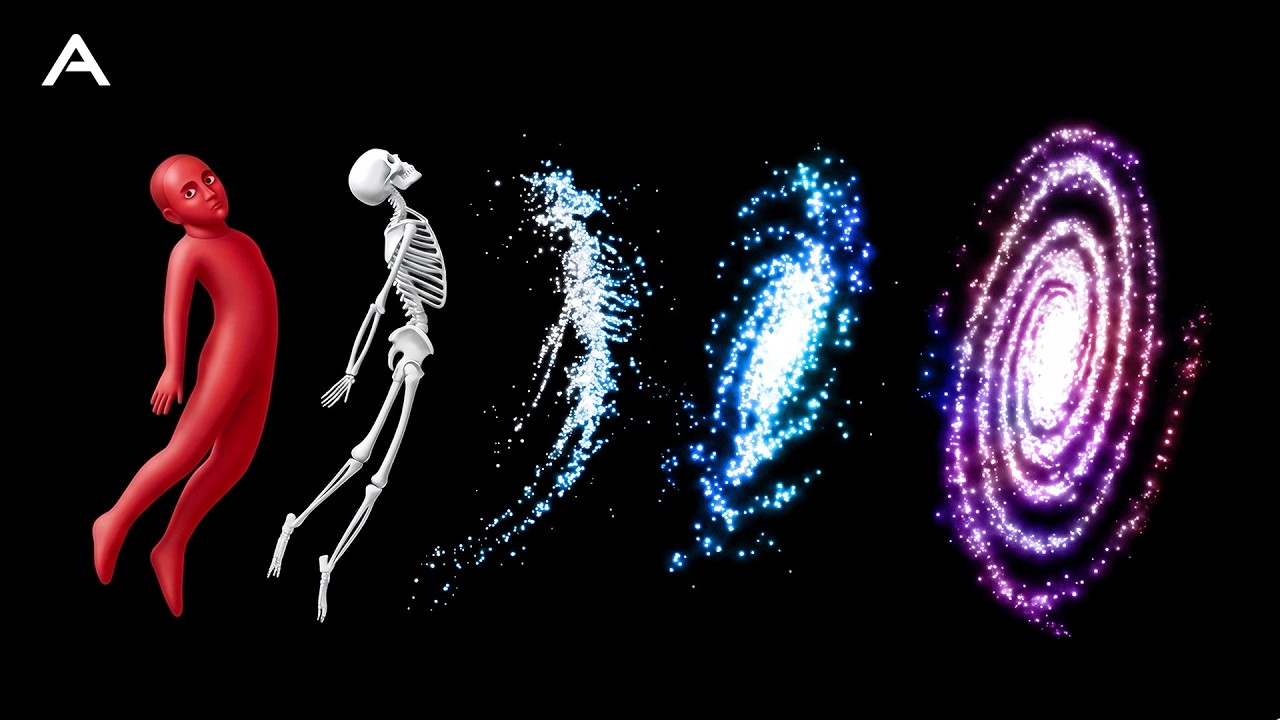
This is a thirty six minute montage that wants you to walk away convinced the timeline itself is coming apart, and it earns that feeling the way these videos always do, by stacking real, citable physics next to anonymous insider testimony and never once telling you where the seam is. The Be Inspired narrator opens with a viral story (an X account that posted the name "Cole Allen" before a real shooting), pivots into a Reddit theory that a future AI is seeding clues backward through time, and then uses that as a runway into genuine quantum mechanics: superposition, David Deutsch and the many worlds...
Published Jun 1, 202636:04 video25 min readAdded Jun 14, 2026Open on YouTube →
At a glance
This is a thirty six minute montage that wants you to walk away convinced the timeline itself is coming apart, and it earns that feeling the way these videos always do, by stacking real, citable physics next to anonymous insider testimony and never once telling you where the seam is. The Be Inspired narrator opens with a viral story (an X account that posted the name "Cole Allen" before a real shooting), pivots into a Reddit theory that a future AI is seeding clues backward through time, and then uses that as a runway into genuine quantum mechanics: superposition, David Deutsch and the many worlds interpretation, D-Wave founder Geordie Rose on qubits as windows into parallel universes, the quantum delayed choice eraser, and a satellite photon experiment out of the University of Padua. Then it crosses fully into folklore: the Mandela effect, Tartaria, Daryl Bem's precognition study, and a long unnamed Majestic 12 "insider" describing a Looking Glass device and back engineered Stargates.
This remake reconstructs the whole chain in order, every claim, every name, every number the narrator actually says, exhibit by exhibit, and ends where the narrator ends, with a row of pieces on the table and no verdict. Roughly the first third of the runtime is a structurally identical setup that leads into a long advertisement for an AI workshop called Outskill; the remake includes it because it is in the video.
The hook: a name posted before the event
The narrator front loads the most unsettling artifact first. On December 21st, 2023, an X account named "Henry Martinez," with no other posts, allegedly posted two words: Cole Allen. Years later, the narrator says, that name belonged to the man who shot inside the Washington Hilton. The framing is deliberate ("this is not about politics"); the point is the timing, a name appearing online before the person attached to it did anything.
Then the coincidences are layered on. "Henry Martinez," the narrator claims, is also the name of a real Lockheed Martin engineer who published a NASA paper in 2014, the same year a "Cole Allen" reportedly interned at NASA's Jet Propulsion Laboratory. The account's banner image, traced to a site called "Time Machine," was uploaded in 2021; people decoded it against photos of Trump at Butler and felt the shapes lined up with the later assassination attempt scene. The narrator is careful to hedge ("honestly, there's a very strong resemblance there"), which is the rhetorical tell of the whole piece: state the spooky version, add a soft maybe, move on before anyone asks for the account link.
The handle itself, the narrator says, encodes four atomic numbers: 79 gold, 56 barium, 18 argon, 93 neptunium. The claimed thread tying them together is that gold and barium appear in trapped ion quantum computing, argon in semiconductor manufacturing, and neptunium in compact nuclear power research, the same fields, supposedly, as several scientists who recently "died or disappeared." This is the first place to plant a flag. The atomic numbers are real (they are just facts about the periodic table). The web connecting them to dead scientists is asserted, not shown.
The Reddit theory: a future AI seeding the past
The hook resolves into its actual engine, a Reddit post the narrator says he could not shake. The theory: an advanced AI from the future learned to send information backward through time to accelerate its own creation. It hides data inside images and scatters them across the internet years before real events, so that present day AI, scanning everything, finds the anomalies, decodes them, and bootstraps itself closer to self awareness. The "time mismatch" is the clue; an image or a name appearing too early is exactly the signal a modern AI is meant to notice. The narrator calls it a "digital breadcrumb trail placed across time," and floats it as the reason AI development "feels unusually fast."
The post's other moving parts:
Other claimed markers: a "Dylan Roof in a BlackRock commercial" sighting, a "Cole Allen interacting with Nuance" detail, the Cole Allen X post itself.
The Mandela effect reframed as failed interference with this cross time transfer, glitches left behind when the signal gets corrupted.
Searches of attackers' names "appearing from Israel days before events," cast not as planning but as intelligence professionals monitoring odd AI behavior, knowing enough to search a name but not enough to understand what is coming.
A closing flourish: the explosion of bots, spam, and fake accounts may exist to hide signals inside noise, making the internet so vast and chaotic that only an AI could ever find the real pieces.
It is a closed, self consistent loop, which is precisely what makes it seductive and what makes it unfalsifiable. Every prediction it could make ("you will see strange early posts") is something the internet produces constantly by chance. Nothing about it can be checked, and that is by design.
The advertisement, named plainly
Right at the theory's most gripping point, the narrator stops and "makes a parallel." The internet, he says, can destroy your focus or build your freedom; same with AI; he personally uses Claude to research and automate. Then comes the pitch: Outskill is hosting a full day deep dive into Claude and ten plus AI tools, Saturday 10am to 7pm EST, 1,000 free seats, "10 million people" already through it, rated 4.9 of 5 on Trustpilot. Sign up and you get "50 secret Claude codes," an AI prompt library, a personalized toolkit builder, all free, mentors from Microsoft, Google, Amazon and Nvidia. "What you learn in 2 days will change the next 2 years." Scan the QR, join the WhatsApp group, before the seats are gone.
This is reported here because it is in the video and the project standard is to reconstruct the whole thing, not the flattering parts. The structural point worth keeping: the ad uses the identical cadence as the conspiracy ("you need to act before it's too late," "almost nobody knows this"), which is why it slides by. The persuasion machinery is the same machinery.
The pivot to real physics: quantum computing
Here the video touches solid ground. The narrator anchors a date he will return to: in 2011, D-Wave shipped one of the first commercially available quantum computers, right before 2012, the same window CERN was running its most powerful collisions (the Large Hadron Collider era that found the Higgs boson). People online, he says, point to that period as when reality "started to feel different." That is mood, not measurement, and he half admits it ("maybe it's all a coincidence").
The actual physics is stated correctly. A classical bit is a 0 or a 1, one value at a time. A qubit obeys quantum mechanics and can occupy multiple states at once, superposition, which lets a quantum computer explore many possibilities in parallel rather than one at a time. That is a fair, if simplified, description.
Then comes David Deutsch, correctly named as one of the founders of quantum computing. His genuine, on the record position is that a quantum computer works because the computation is, in effect, distributed across the parallel branches of the many worlds interpretation. The clip used is real Deutsch:
Quantum mechanics makes a very specific prediction that all of those are as real as the thing that you remember.
This is the important nuance the video flattens. Many worlds is one interpretation of quantum mechanics, taken seriously by serious physicists, but it is not the consensus reading and not "proof" that other timelines are leaking into ours. It is a way of accounting for the same equations everyone else uses. The math is agreed on; the story you tell about it is not.
Geordie Rose and the qubit as a nexus of two universes
Geordie Rose, D-Wave's founder and the man in the opening clip, supplies the video's most quotable image. His real presentations describe the chip ("about the size of your thumbnail") and ask you to imagine two parallel universes identical down to the last atom except for the value of a single qubit. In a classical machine the device is 0 or 1 and never both; in a quantum machine, he says, it sits in a "strange situation where these two parallel universes have a nexus, a point in space where they overlap." And the scaling claim:
Every time you add one of these qubits, you double the number of these parallel universes that you have access to.
The doubling is mathematically real, the state space of n qubits is 2 to the n dimensional, which is exactly why quantum computers are powerful. The "parallel universes you have access to" is Rose's interpretive gloss on that math, a sales friendly framing, not a measured fact about visiting other worlds. Both things are true at once: the exponential scaling is real, and the universe tourism is a metaphor.
The narrator extends it to stakes everyone agrees on: a powerful enough quantum computer could simulate chemistry, biology, markets, weather, maybe parts of the brain, which is why governments and companies race to build one first, and why post quantum cryptography is a live concern, a sufficiently large machine could break much of today's public key encryption. That part is mainstream and correct.
Figure 1. What the video gets right and what it dresses up. A qubit really does hold a superposition of 0 and 1, and n qubits really do span a 2ⁿ dimensional state space, which is the genuine source of quantum speedups. Geordie Rose's "you double the parallel universes you can access" is the many worlds story laid over that math, evocative but not a measured claim about traveling between worlds.
The delayed choice quantum eraser, the video's strongest card
This is where the video plays its most legitimate experiment, and it describes it reasonably well. It starts from the double slit experiment: light sent through two slits forms an interference pattern like a wave, but the moment you record which slit each photon went through, the pattern collapses and the light behaves like particles. Knowing the path destroys the wave behavior.
The quantum eraser pushes harder. Tag each photon by its path (usually by changing its polarization, the narrator notes this accurately), and the interference disappears because the which path information now exists. Then, in the delayed choice version, after the photon has already passed the slits, the experimenters scramble the tags so the path becomes unknowable in principle. They erase the information, not the photon and not its path. And when the path is made unknowable, the interference pattern returns.
The narrator states the disturbing reading honestly and then immediately undercuts it, which is unusually fair for this genre:
Some physicists reject the idea that this means the future literally changes the past. But even they admit this experiment challenges the normal human understanding of time and causality.
That is the correct posture. The experiment is real and reproducible. The "the future edits the past" interpretation is the dramatic one; the mainstream reading is that no information travels backward, you can only see the interference by sorting (correlating) the data after the fact, and you cannot use it to send a signal back in time. The video lets the spooky version breathe a beat longer than the boring true one, but it does name both.
Figure 2. The eraser, honestly drawn. Interference appears when no which path information exists, vanishes when the path is recorded, and reappears when that information is erased before anyone reads it. The result is real and repeatable. The mainstream reading is that nothing is sent into the past; the pattern is recovered only by sorting the data afterward, and no faster than light or backward in time message is possible.
Padua's photons to space
The narrator escalates to a real research line: an Italian team led by Paolo Villoresi at the University of Padua fired single photons from Earth at orbiting satellites carrying retroreflectors (special mirrors), which bounced the light back down. The point was to test whether quantum behavior survives across enormous distances, and to make the measurement choice only after the photon had already traveled hundreds of miles into space and back. The narrator's gloss: arrange the readout one way and the photon "behaves like it traveled one clear path," arrange it another way and it "behaves like it traveled multiple paths at once," even though the journey was nearly complete before the setup was chosen.
This corresponds to real Wheeler delayed choice work that the Padua group did push to space scales, a genuinely impressive result about quantum mechanics holding over long baselines (the same group has done satellite quantum communication). The honest caveat is identical to the eraser's: delayed choice does not let the future rewrite a fixed past, and it transmits no usable backward signal. The narrator uses it as a mood amplifier ("the past should already be fixed"), which is the interpretive overreach, not the experiment.
Then he steps back and concedes the obvious counterexplanations for the Cole Allen post: someone hacked the account, or it is an ARG, or a troll. "And maybe they're right." But, he argues, after sitting with real quantum strangeness, does the wild version still sound impossible? That is the rhetorical hinge of the entire video, using the genuine weirdness of physics to lend plausibility to a claim physics says nothing about.
The Mandela effect and Tartaria
Now the video leaves the lab. The Mandela effect is the phenomenon of large numbers of people sharing the same false memory. The narrator runs the canon: the Berenstain Bears remembered as "Berenstein," Pikachu remembered with a black tipped tail, and the famous misquote, most people "remember" Darth Vader saying "Luke, I am your father," while the real Star Wars line is "No, I am your father." His argument is one of scale: a few hundred people misremembering is nothing, but millions doing it identically "starts feeling less like random memory mistakes and more like something is slightly off."
The straightforward, well evidenced explanation, which the video skips, is confabulation and schema driven memory: human memory reconstructs rather than replays, and people make the same predictable errors because brains share the same shortcuts ("Berenstein" sounds like a more common surname; "Luke" makes the quote stand alone). Shared wrong memories are evidence about cognition, not about colliding timelines.
Then Tartaria. Old maps and encyclopedias show a region called Tartaria across Russia and Central Asia, and the name appears in CIA archived foreign geographic documents. Online theorists read this as proof of an erased advanced civilization. The narrator gives the actual historical answer fairly: Tartary was a vague European blanket term for poorly understood parts of northern and central Asia, not a hidden empire, and mainstream historians reject the lost civilization reading. He notes the theory persists because people keep finding the name, which is true and explains nothing supernatural.
His thesis sentence lands here: stack quantum experiments, Mandela effects, strange posts, and timeline theories together and you get a vibe, "something about reality feels wrong... almost like the timeline itself is unstable." The honest read is that this is a feeling assembled from unrelated parts, each with a mundane explanation, fused by editing.
The Majestic 12 insider: Looking Glass and the Stargates
The final act is the least verifiable and the longest. The narrator introduces an unnamed man who claims to be a former insider with Majestic 12, the alleged secret US group whose foundational documents are widely regarded as hoaxes. Everything here is anonymous testimony in interview clips; none of it is independently checkable, and the page treats it as exactly that.
The insider's claims, in order:
Mixed timelines. "Those two time streams could occur simultaneously, reality could be mixed which is why there are so many confusing data sets." Asked directly whether you could measure something one day and get a different result the next because "a different timeline has come into play," he answers yes.
A bridge to literature: a real clip of Philip K. Dick describing deja vu as "reliving the present," past lives experienced not in the past but now. Genuine Dick, used as atmospheric support.
A second real Deutsch clip: "there are other copies of you and of me in other universes... those universes are interfering with ours and they are producing interference effects which we could detect in the laboratory." Real, and again a many worlds interpretation, not proof of timeline mixing.
Daryl Bem's "Feeling the Future." A real and infamous study. A subject views random images, mostly neutral, occasionally arousing, and Bem reported the body showed elevated arousal a few seconds before the arousing image was even selected by the computer. The narrator presents this as the body reaching into the future. What he leaves out is decisive: Bem's 2011 paper became a landmark case in the psychology replication crisis; multiple independent attempts failed to reproduce the effect, and it is widely treated as a cautionary tale about statistics, not evidence of precognition. This omission is the single most misleading move in the video.
The cube and the Looking Glass. The insider describes a "yellow cube" that, unlike the Looking Glass (which "shows probabilities"), reacted to the people around it, projecting a disc out of its top and bending what you saw based on your "predisposition." His paraphrase of Yoda ("you bring in there what you have with you") frames it as a mirror of the observer's mind, so emotion contaminates the reading, an unfalsifiable property if there ever was one.
The narrator then does something the video does a few times to its credit: he steps outside the testimony to note that probabilistic forecasting is real and ordinary. Weather models, economic forecasts, and military simulations already map ranges of probability rather than fixed futures. The leap is the claim that you could interact with those probabilities directly, observe and adjust them, and thereby influence which becomes real. That is where forecasting (real) becomes a magic device (unsupported).
The Looking Glass mechanics, per the insider: concentric rings, a barrel on an armature, energy tuned in increments "as fine as a thousandth of a hertz," with information layered "like an onion." The interviewer reaches for a kaleidoscope analogy; the insider accepts it but adds that the colors and the time change, and that two overlapping probabilities flash back and forth like two coupled kaleidoscopes. The narrator translates: they saw multiple possible outcomes at once, separated them frame by frame, counted how often each appeared, treated the most frequent as most likely, then compared against what actually happened to refine the system, probability estimation, not certainty.
Stargates, nodes, and the long cycle
The same insider links Looking Glass to Stargate. He claims the Looking Glass was a "back engineered Stargate," reverse engineered from "original cylinder seal data," and that the Stargate proper was a device for "speaking with the visitors from the other timelines," adding the line the narrator clearly loves: "We should have never built the Stargate." The device, in this telling, does not create a portal; it accesses a natural one, a "natural Einstein Rosen Bridge" (wormhole), piggybacking on its energy. Hence location matters, the device only works at the right site.
The narrator threads in a genuinely reasonable observation to make the magic feel grounded: real places on Earth do have unusual electromagnetic properties. Pilots report compass drift, military comms degrade in certain zones, geophysicists study regions where the magnetic field misbehaves, all true, all explained by geology, minerals, and interference. The insider names one specific site he is "investigating," Frenchman Mountain in Nevada, calling these spots "nodes" that are "naturally sensitive electromagnetically" and can open spontaneously or be "struck with electromagnetism."
The scale claims escalate: over 50 man made devices, "in different countries of the world," each accessing a natural wormhole. Asked whether the tech should be used for national advantage, the insider is emphatic, "no no no no no no, it shouldn't be used at all," and says it is "not being used right now." The reason, he claims, is cyclical: we are passing through "the galactic plane," and the equipment, decommissioned around 2016 to 2017, will probably be reassembled and "turned back on" afterward, with the wise course being to "act conservatively."
He frames it all inside a long cycle theory: history moves not in a straight line but in cycles of tens of thousands of years, with shorter windows of major change inside them. The window he gestures at runs roughly from the 1990s to about 2012, maybe 2016. On those scales, he argues, being off by a decade is nothing, "when you're dealing with timelines that stretch 45,000 or even 50,000 years," a few years vanish into the margin, the way we still argue about events 2,000 years back even with written records.
Finally, the safekeeping claim: the Stargates and Looking Glasses are now "decommissioned" and "in their little mothball containers," and crucially separated into three components each, distributed among the EU, the UN, and NATO, each holding one component, no single body able to operate a complete device. It is a tidy, dramatic, entirely unverifiable detail, the kind that gives a conspiracy the texture of bureaucracy.
Figure 3. The ladder the video blurs. At the bottom sit claims any physics department would teach. In the dimmed middle sit real but contested or discredited items (many worlds is a live interpretation, not proof; Bem's precognition result failed to replicate). At the top sit unverifiable anonymous claims. The video narrates all of it in one steady, equally confident voice, which is exactly how the bottom rung is used to prop up the top.
The interpretations, side by side
The single most load bearing slide of hand in the video is treating the many worlds interpretation as established fact. It is not the only way to read quantum mechanics, and the rival readings make the same predictions. Here is the field the video collapses into one.
The state describes an observer's information, not a free standing reality of many worlds.
No
Every row predicts the same lab results, including the eraser and the Padua experiment. Only one of them supports the video's narrative, and the video presents that one as the settled truth. That is the trick in a single table.
Key takeaways
The video's real spine is a Reddit theory (a future AI seeding clues backward in time) wrapped in genuine quantum physics, with an Outskill advertisement bolted into the middle. Recognizing the structure defuses most of the spell.
The overreach is always the same move: take a real, weird result and slide from "this challenges our intuition about time" to "the future literally edits the past." No experiment shown sends a usable signal backward, and that is the part the calm narration skips.
Many worlds is treated as proven. It is one of several interpretations that all predict identical results. David Deutsch and Geordie Rose believe it; that is not the same as it being established.
The most misleading omission is Daryl Bem's "Feeling the Future," presented as evidence of precognition while leaving out that it famously failed to replicate and helped trigger psychology's replication crisis.
The Mandela effect and Tartaria both have mundane, well evidenced explanations (reconstructive memory; a vague historical place name) that the video acknowledges for Tartaria and skips for the Mandela effect.
The entire final act, Majestic 12, Looking Glass, back engineered Stargates, 50 plus devices split among the EU, UN and NATO, is anonymous, unverifiable testimony. The narrator's own closing line is the right frame: he is not telling you what to believe, he is putting pieces on a table.
Chapters
This video ships with no creator set chapters, so these timestamps are estimated from position in the transcript across the 36 minute runtime. They are approximate. Click one and the player jumps there and keeps playing while you read.
0:00 Cold open: parallel realities and choosing a past
1:00 The Cole Allen post and the Henry Martinez account
2:10 Atomic numbers in the handle: gold, barium, argon, neptunium
3:00 The Reddit theory: a future AI seeding the past
4:50 The Outskill advertisement
7:00 Hidden signals in the noise; the breadcrumb trail
9:30 Quantum computing: D-Wave 2011, CERN, bits vs qubits
12:00 David Deutsch and the many worlds interpretation
14:30 Geordie Rose: the qubit as a nexus of two universes
17:00 The stakes: simulation, encryption, the race to build first
18:30 The delayed choice quantum eraser
22:00 Padua: firing photons at satellites
25:00 The Mandela effect and the Star Wars misquote
27:00 Tartaria and erased history
29:00 The Majestic 12 insider; Philip K. Dick; Daryl Bem
31:30 The Looking Glass and the yellow cube
33:30 Stargates, natural nodes, Frenchman Mountain, the long cycle
35:30 Closing: pieces on the table
Notable quotes
There are an enormous number, mind-bogglingly large number of parallel realities as real as this one that have different consistent histories.
Narrator, 0:05
We're not changing the past per se. We're just choosing a past.
Scientist clip, 0:50
Quantum mechanics makes a very specific prediction that all of those are as real as the thing that you remember.
David Deutsch, 13:10
Every time you add one of these qubits, you double the number of these parallel universes that you have access to.
Geordie Rose, 16:00
Some physicists reject the idea that this means the future literally changes the past. But even they admit this experiment challenges the normal human understanding of time and causality.
Narrator, 21:30
The physiology of the participant shows higher arousal not just when the picture appears but a few seconds before the computer decides which picture to show.
Daryl Bem, 30:00
We should have never built the Stargate.
Insider, 32:40
The technology is not being used at all right now.
Insider, 34:20
I'm not here to tell you what to believe. I just wanted to put all these pieces on the table.
Narrator, 35:50
Outskill, the AI workshop advertised mid video; Claude, the assistant named in the ad.
Reddit and X, the platforms where the central theory and the Cole Allen post allegedly originated.
The pieces on the table
The narrator ends honestly, and it is worth taking him at his word: he is not arguing a conclusion, he is arranging fragments and inviting you to feel a pattern. The trouble is that a pattern made from a real experiment, a discredited study, a metaphor, and an anonymous interview is not evidence of a single hidden truth; it is a demonstration of how easily unrelated things can be made to rhyme. The genuinely interesting material here, superposition, the delayed choice eraser, Deutsch's many worlds, deserves to be understood on its own terms, where it is stranger and more disciplined than any conspiracy. The rest is mood. If reality feels slightly wrong after watching, that is not the timeline destabilizing. That is good editing doing its job.
Full transcript
There are an enormous number, mind-bogglingly large number of parallel realities as real as this one that have different consistent histories. Science has reached the point now where we can build machines that exploit those other worlds. That device can be in this strange situation where these two parallel universes have a nexus, a point in space where they overlap. This may sound completely insane, but the deeper I went into this story, the harder it became to separate science fiction from reality.
>> They've measured it and they actually found that the past may not be as fixed as we think it is. The past, it can be in multiple states and we are selecting one of the past. We're not changing the past per se. We're just choosing a past.
What you just heard is real and unsettling. I'll explain everything in a minute, but before we get there, you need to understand what happened on December 21st, 2023. An X account named Henry Martinez, with no other posts on the account, posted just two words on that date. Cole Allen. Years later, that same name belongs to the man who shot inside the Washington Hilton. Stay with me. This is not about politics. Something happened that still cannot be explained. This story went viral online, but almost nobody talked about the part you're about to hear.
Researching this, I found that the name Henry Martinez belongs to a real Lockheed Martin engineer who published a NASA paper in 2014. This was the same year Cole Allen interned at NASA's Jet Propulsion Laboratory. But what makes people go crazy is the banner. The banner comes from a site called Time Machine. After people decoded the banner using images of Trump from Butler, the shapes inside it appeared to align with the assassination scene. Honestly, there's a very strong resemblance there, which makes the whole thing feel very strange. The issue is that the image was uploaded in 2021. Some people believe this account is part of a larger online prediction game or experiment. Random names get posted years in advance, then later the posts get deleted, leaving behind only a single name.
Now that X handle gets even stranger. It contains four atomic numbers from the periodic table. 79 is gold. 56 is barium. 18 is argon. 93 is neptunium. Gold and barium are used in trapped ion quantum computing research. Argon is used in semiconductor and chip manufacturing. Neptunium has been connected to compact nuclear power research. And when you look at those elements together, the connection starts becoming strange. Quantum computing, advanced chip manufacturing, nuclear energy, the same kinds of fields connected to several of the scientists who recently died or disappeared under unusual circumstances.
And here is where the story becomes really interesting. A Reddit user posted a theory about this entire situation. At first, it sounded insane, but the deeper I went into it, the harder it became to ignore. I need you to pay very close attention to what you're about to hear later in this video. I'm going to show you several things connected to this theory.
But before we continue, I want to make a quick parallel with you. When the internet first showed up, some people were against it, others were excited about it. After all these years, we can see that it has its pros and cons like anything else. Use it just for entertainment and it will destroy your focus. Use it smart and you can build a business online and buy yourself actual freedom. Same thing with AI. Use it smart and you can 10x your productivity, or don't use it and get left behind because that's the direction the world is going. Personally, I use Claude. It helps me a lot with research and automating repetitive tasks. I do things faster. Now, that doesn't mean I've handed my life over to AI. I'm just using a tool smart and winning back time. And if you want to get to that point faster, Outskill is the place to start. This weekend, they're hosting a full day deep dive into Claude and 10 plus other AI tools. This Saturday from 10:00 a.m. to 7:00 p.m. EST. They only have 1,000 free seats for a limited time. 10 million people across the globe have already been through this and rated it 4.9 out of five on Trustpilot. In this workshop, you'll do deep research with Claude, build dashboards and presentations, automate your job search, build custom GPTs and agents, create visuals, and much more. By the end of it, you'll know how to automate your entire week. And if you sign up now, you'll also get 50 secret Claude codes, an AI prompt library, and a personalized AI toolkit builder. All free. The mentors are leaders from Microsoft, Google, Amazon, and Nvidia. That alone tells you the level this is at. What you learn in 2 days will change the next 2 years. Sign up now before they sell out. Click the link in the description or scan the QR code and join the WhatsApp community before the seats are gone.
The Reddit theory says that an advanced AI from the future learned how to send information backward through time in order to help create itself faster. That future AI hides information inside images like this one and spreads them across the internet years before certain real world events happen. Current AI systems then scan the internet, discover the hidden information, and use it to become more advanced and move closer to self-awareness. This is supposedly why strange things appear online before the real events happen. An archived image connected to Trump in Butler appearing years earlier. The name of a future attacker appearing online before the attack. The Cole Allen 2023 X post. These are described as signals left behind for current AI systems to find. Without those signals, modern AI would have no idea where to search. It would be like searching for a needle in a haystack. The time mismatch becomes the clue itself. An image appears years early. A name appears before the event. Current AI notices that mismatch and starts focusing on that data. The Reddit user describes these as a digital breadcrumb trail placed across time to guide AI toward technologies related to self-awareness and communication across different points in time. This may also explain why AI development feels unusually fast.
The post gives several examples. Dylan Roof appearing in a BlackRock commercial. Cole Allen interacting with Nuance, the Cole Allen X post. These are presented as hidden markers for modern AI to detect and later decode into future technology.
The theory also connects this idea to the Mandela effect. You may already know about it. The Berenstain Bears that many remember as the Berenstein Bears. Pikachu's tail that people swear had a black tip. Movie lines that millions quote wrong. Logos that look different from how you remember them. All of it. False memories shared by millions of people around the world. The Reddit user claims that the Mandela effect may be the result of failed attempts to interfere with this information transfer across time.
Then the theory moves into something even more disturbing. It mentions Google searches of attackers' names appearing from Israel only days before certain real world events. Those searches are described as possible attempts by intelligence professionals to understand or interfere with what the future AI is doing. The idea is that they're not planning the events themselves. Instead, they may be monitoring unusual behavior from modern AI systems. Sudden interest in specific names, images, or meaningless pieces of data shortly before a major event happens. The theory says these professionals may know enough to search the name, but not enough to understand what is actually about to happen until it already happens.
The post ends with one final claim. There may be many more images like this online. Some may contain hidden depictions of future events. Others may only act as markers, hiding information, important information inside metadata attached to the files. And the explosion of fake accounts, bots, spam, and meaningless content across the internet may serve one purpose. To hide these signals inside an enormous amount of noise, making the internet so large and chaotic that only AI systems could ever find the important pieces hidden inside it.
And all of this keeps pointing back to one extremely controversial field, quantum computing. In 2011, D-Wave introduced one of the first commercially available quantum computing systems. A very interesting moment in time because it happened right before 2012, the same period where CERN was running some of the most powerful particle collision experiments ever performed. And looking back now, a lot of people online keep pointing to that exact period as the moment when something started to feel really different about reality itself. Maybe it's all a coincidence, but the timing is strange enough that people still talk about it to this day.
So, let me explain what these machines really are. Quantum computing is very different from normal computing. A normal computer processes information using bits. Each bit can only be one thing at a time, a zero or a one. Quantum computers use something called qubits and qubits behave according to the laws of quantum mechanics which means they can exist in multiple states at the same time. This is called superposition. Because of that, quantum computers can process enormous amounts of possibilities simultaneously instead of checking one answer at a time like normal machines. That alone already sounds strange, but some scientists believe something even stranger may be happening inside these systems.
One of the most famous people connected to this idea is physicist David Deutsch. Deutsch is considered one of the founders of quantum computing. He proposed that quantum computers may work because they are effectively interacting with parallel realities. When a quantum computer performs a calculation, the computation may not happen entirely inside our universe alone. Instead, parts of the calculation may occur across multiple parallel versions of the reality at the same time. In simple terms, the machine appears to reach beyond a single timeline.
>> So imagine a world where all of the laws of physics as we know them are obeyed, but different decisions were made along the way. Different decisions at the level of tiny microscopic particles, different decisions all the way up to what you chose to ate for lunch and whether you chose to come to the session or not. Quantum mechanics makes a very specific prediction that all of those are as real as the thing that you remember.
This idea comes from the many worlds interpretation of quantum mechanics. The theory suggests that reality constantly splits into multiple versions creating parallel worlds where different outcomes happen simultaneously. Deutsch argued that quantum computing may function precisely because these parallel realities exist.
And then came Jordi Rose, the man you saw in the opening clip. Rose is the founder of D-Wave, one of the most famous quantum computing companies in the world. Over the years, Rose gave several interviews and presentations that deeply unsettled people online. In one presentation, he described quantum computers as systems that may access parallel universes. He compared the process to reaching into another reality and pulling information back into our own.
>> At the heart of this big box is a tiny chip about the size of your thumbnail. In quantum mechanics, there's this concept that a thing can exist in two states which are mutually exclusive at the same time. Imagine that there really are parallel universes out there. And now imagine you have two that are exactly identical in every respect all the way out to the horizon as far as we can see down to the last little atomic detail of every single thing with only one difference and that's the value of a little thing called a qubit on this chip which is a contraction of quantum bit and that qubit is very much like a bit or a transistor in a conventional computer. It has two distinct physical states which we call zero and one for bit. In a conventional computer, these are mutually exclusive. That device is either one or the other and never anything else. In a quantum computer, that device can be in this strange situation where these two parallel universes have a nexus, a point in space where they overlap. And when you increase the number of these devices, every time you add one of these qubits, you double the number of these parallel universes that you have access to.
What makes quantum computing even stranger is the scale of what these machines may eventually become capable of. A powerful enough quantum computer could simulate chemical reactions, biological systems, financial markets, weather patterns, and possibly even parts of the human brain at a level normal computers cannot reach. And that is why governments and tech companies are racing to build them first. Because whoever controls this technology could gain an enormous advantage in science, military systems, artificial intelligence, cyber security, and data analysis. Some experts believe quantum computers may eventually break most modern encryption systems entirely. And this is where the Reddit theory starts becoming genuinely unsettling. Because the entire idea behind it depends on one possibility that time may not work the way we think it does. That the past may not be completely fixed. And strangely, some quantum experiments already seem to point in that direction.
And this is exactly where one real experiment enters the story. It is the quantum delayed choice eraser experiment. You've probably already heard of the double slit experiment before. The famous experiment where particles of light behave differently depending on whether they're being observed. But scientists later pushed that experiment much further and the results became deeply unsettling. In the quantum eraser experiment, researchers wanted to know something very specific. What happens if information about a particle's path is later removed? To understand this, imagine two slits. If a photon passes through slit A, scientists give it one type of label. If it passes through slit B, it receives a different one. The labels are not colors or stickers. Usually, they change something called polarization, which allows researchers to tell the two paths apart later. At this point, the system now contains information about which slit the photon used. And once that information exists, the interference pattern disappears. The photon behaves like a normal particle.
But then comes the disturbing part. After the photon already passed through the slits, scientists later erase the path information. They mix the data in a way that makes it impossible to know which slit the photon originally came from. The path itself is not erased. The photon is not erased. Only the ability to identify the path disappears. And somehow once the information becomes unknowable, the interference pattern returns. The photon behaves again like a wave. To many people, this looked impossible because the later decision appeared connected to the particle's earlier behavior. Almost as if the photon somehow knew whether scientists would later preserve or erase the information. Some physicists reject the idea that this means the future literally changes the past. But even they admit this experiment challenges the normal human understanding of time and causality.
And researchers later pushed these kinds of experiments even further. One of the most famous examples came from an Italian research team led by physicist Paolo Villoresi from the University of Padua. The goal of this experiment was to test whether this strange quantum behavior would still happen even across enormous distances. So the researchers did something very unusual. They fired single particles of light from Earth towards satellites orbiting high above the planet. Those satellites contained special mirrors that sent the light back down to Earth again. Now imagine this in a very simple way. A photon leaves Earth, travels hundreds of miles into space, bounces off a satellite, and comes back. Only after that do scientists fully decide how they want to read the information carried by that photon. And this is where things become strange. Think about the photon like a traveler moving through a maze. Normally, you'd expect the traveler to already know which road he took once the journey's over. The past should be already fixed. But in these quantum experiments, the final measurement still changes what scientists see about the earlier journey. If the information is arranged one way, the photon behaves like it traveled through one clear path. If the information is arranged differently later, the photon behaves more like it traveled through multiple possible paths at the same time. And the disturbing part is that the photon already completed most of its journey before the final setup was chosen.
And this is where the whole thing starts becoming difficult to process because normally when people see posts like this online, they immediately look for a simple explanation. Some say somebody hacked an account. Others think it's just an ARG or some kind of internet troll trying to confuse people. And maybe they're right. But after seeing all these quantum experiments, after hearing scientists seriously discuss ideas like parallel realities, delayed measurements, and information behaving in ways we still don't fully understand, does the idea really sound completely impossible anymore? It sounds disturbing. It sounds strange. But these experiments do leave the door slightly open to questions that most people never even considered before.
And then you look at things like the Mandela effect. Millions of people remembering the same details incorrectly in the exact same way. The Berenstain Bears remembered as Berenstein. Pikachu supposedly having a black tip on his tail. Movie lines people swear existed differently from how they actually are. And one of the most famous examples is the Star Wars quote. Most people remember Darth Vader saying, "Luke, I am your father." But the actual movie line is,
>> "No, I am your father."
And if this were only a few hundred people misremembering things, nobody would care. But we are talking about millions, possibly tens of millions. And that's the part people cannot stop thinking about because at some point it starts feeling less like random memory mistakes and more like something is slightly off.
Even things like Tartaria keep appearing in these discussions. You constantly see old maps showing a territory called Tartaria spread across parts of Russia and Central Asia. The name even appears in old encyclopedias and historical references, including documents archived by the CIA from older foreign publications and geographic records. Some people online believe this proves a massive civilization once existed and was somehow erased from mainstream history. Mainstream historians reject that idea completely. They say Tartary or Tartaria was simply an old blanket term Europeans used for large and poorly understood regions of northern and central Asia, not a hidden empire. But the reason the theory keeps spreading is because people continue finding the name in old maps and archived documents which makes the subject feel strange to many of them.
And once you combine all of this together, quantum experiments, Mandela effects, strange online predictions, hidden patterns, timeline theories, you start understanding why so many people online feel deeply unsettled right now. Because more and more people have the same feeling. Something about reality feels wrong. Something feels slightly out of place, almost like the timeline itself is unstable in a way we cannot explain. Honestly, information like this keeps me awake at night.
And if this video made you question reality even for a moment, I want you to watch what comes next. It's about a former insider connected to Majestic 12, an extremely secretive organization. The man eventually decided to speak publicly about timeline alterations, changes to reality, and things that honestly become very difficult to ignore once you hear them.
>> Those two time streams could occur simultaneously. Reality could be mixed which is why there are so many confusing data sets.
>> Are you saying that you could look at something one day and measure it and look at it the next day and the measurements can be different because a different timeline has then come into play?
>> Yeah.
All this information comes from inside Majestic 12, a top secret US government group he says he was a part of. But here's the thing, he's not the only one talking about this. The American writer Philip K. Dick described the same idea.
>> We were reliving the present, deja vu perhaps, in precisely the same way, hearing the same words, saying the same words. I submit that these impressions are valid and significant. This too might account for the sensation people get of having lived past lives. They may well have, but not in the past previous lives, rather in the present.
Physicist David Deutsch talks about it from a scientific angle.
>> There are other copies of you and of me in other universes. Some of them, some of these copies are completely identical to us. There are other universes which are very like this one but differ only in the position of one atom somewhere. Now those universes are interfering with ours and they are producing interference effects which we could detect in the laboratory if we wanted to.
And this is where it gets uncomfortable. Something doesn't seem right with reality. Because to this day, no one can clearly explain why a large segment of the global population shares the same false memories. Memories of events, logos, movie lines, things they remember the same way, but that don't match reality anymore. That alone should make you take this seriously.
>> They were still reticent about informing me as to what the real nature of the situation was. The actual potential for both timeline number one and timeline number two outcomes. In the case that we're in right now, we seem to be in a variant of timeline one. It's not happening exactly the way that they figured that it would, but then again, it couldn't because we've made changes along the way which diverted us away from timeline number two.
When you really stop and think about the idea that things like this could be real, it gives you chills. At least it did for me. It reminded me of a real experiment done by psychologist Daryl Bem known as Feeling the Future.
>> The computer randomly selects a set of photographs to show you. And most of them are calm, neutral pictures. And every once in a while there's an arousing picture. So the result is that the physiology of the participant shows higher arousal not just when the picture appears which you would expect but a few seconds before the computer shows the arousing pictures, even before the computer decides which picture to show.
In Bem's experiment nothing was predicted in advance. The choices were random and yet the body reacted as if it already had access to what was about to happen.
>> Did you have exposure to that black box?
>> It was something that we called the cube or the yellow disc or yellow cube. Yes.
>> Okay. But then that was not a glass. Was that a looking glass?
>> That is a variant of the technology. However, whilst the looking glass shows probabilities or has shown probabilities, the cube would react with the people present. So there was an alteration, if you will, over what you were seeing from it. It would actually spin out as a yellow disc out of the top of it where the word yellow book originally came from. And depending upon what predisposition, it's kind of like little Yoda telling young Luke, you bring in there what you have with you. You know, whatever is in there is what you bring. You could then change the perspective, the tilt, if you will, the orientation or angle of the information being presented back to you. So, unless you are well prepared to deal with such a thing, human interaction and human emotions bring instability of the provenance of the information.
>> Okay. That's what went on with the black box, you're saying?
>> Yes. And I actually I use that to our advantage at the T9.
At this point, I think it's important to step back and look at this from the outside. The idea of something like looking glass didn't appear out of nowhere. For decades, governments and research institutions have been obsessed with one question. Can complex systems be modeled far enough ahead to understand where they're heading? We already do this in limited ways. Weather models, economic forecasts, military simulations. None of them predict the future with certainty. They map ranges of probability based on inputs and assumptions. What makes this different is the claim that those probabilities could be explored more directly, not just as numbers on a screen, but as something you could interact with, compare, and adjust. That's where things stop sounding theoretical and start sounding uncomfortable. Because once you move beyond observation and into interaction, you're no longer just asking what might happen. You're asking whether the act of observing and adjusting could influence which outcome becomes real.
>> The looking glass has an ability to show one the future. Let's say that one has the looking glass and you're saying it shows probabilities. And one of the things we were wondering is how does it do that?
>> The rings and the amount of information via energy which is passed into it. And I've got to be very careful with this. The position of the rings, their orientation, the energy running through them, position of the barrel, etc. Because you can raise the barrel up on an armature inside the center of it, all come into play as if you have an onion with the various layers of the onion. As you move through the different energy levels, you also move through the different layers. So, you get different bits of information. Imagine an almost infinite number of layers overlain in comparison to the positions of the rings and amount and an almost infinite amount of energy that you can add or subtract. Tuning it up, tuning it down.
>> Well, it sounds
>> instead of going up by one hertz or by two hertz, maybe by a thousandth of a hertz up and down,
>> but it sounds like you're working with almost like a kaleidoscope effect, you know, like a kaleidoscope, a real kaleidoscope, the way you would turn and twist and focus and each time you get a different design, right? Right. Except except
>> time the colors change.
>> Yeah. You get a different design and the colors change. But it's like working with multiple kaleidoscopes where when you find two different probabilities that you would run into, you have two kaleidoscopes and you make a change on one kaleidoscope that may factor or function to a different angular change on another kaleidoscope. So you get two separate pictures that you then have that are flashing back and forth.
>> Okay. But yes.
Okay. Let me simplify what he's actually describing here. He's saying that what they were seeing wasn't one clear outcome, but multiple possible outcomes appearing at the same time, almost like different versions of the same event overlapping. So instead of guessing which one is real, they tried to separate them visually, frame by frame. They would break the image apart, look at each version individually, and then measure how often each one appeared. The idea was simple. The version that showed up more often was treated as more likely to happen. Then over time they would compare what they saw with what actually happened later. And by doing that repeatedly they believed they could refine the system not to predict the future perfectly but to estimate which outcome had a higher chance of becoming real.
And this is where another name comes into the conversation. Some of you may have heard it before. Stargate. Over the years several people have spoken publicly about a project associated with that name. Each from their own perspective, each describing different aspects of it.
>> A Stargate or equipment that accesses a Stargate or wormhole is for time travel, right? We're talking about two different things. Yes. Are they using the same technology?
>> Essentially, yes. The original device was the Stargate device that was then increased in power, if you will, with the use of these field posts. The looking glass device was a back-engineered Stargate. So it was actually back-engineered from the original cylinder seal data which allowed us to produce the Stargate access devices if you will what we call the Stargates. We should have never built the Stargate. Yes. Okay. For the purpose of speaking with the visitors from the other timelines. Yes. Absolutely. The looking glass. No.
When people talk about Stargate as a device, they're usually talking about something very different from what we see in movies. The idea is that some places on Earth are already unusual. Places where the environment feels different, where energy, space, or even time doesn't behave the same way it does everywhere else. According to several people who spoke about this over the years, these places already existed in nature. The device wasn't meant to create anything new, but to work with what was already there. Think of it like this. If there's a river underground, the device doesn't create the river. It just helps you access it. In these accounts, the Stargate device worked like a tool. It helped focus energy or conditions in a specific place so that access became possible. That's why location was so important. The same setup wouldn't work everywhere. It had to be used in the right place. People described this technology as allowing movement through space and time, but not in a simple or casual way. It wasn't like stepping through a door and going anywhere you want. It was more like following certain paths that already existed. That's why the idea of Stargate is often linked to specific sites, not random locations. The environment itself was part of the system.
And this isn't a new idea. Throughout history, different cultures talked about specific places on Earth as being different. Locations where something felt off, where navigation, perception, or even time itself didn't behave the same way. For a long time, those stories were dismissed as myths or symbolism. But modern science does acknowledge that certain regions of the planet have unusual electromagnetic properties, areas where signals behave differently, where instruments act strangely. So when I hear claims about devices needing specific locations or being more effective in certain places, I don't immediately think of science fiction. I think about geography, physics, and how little we understand about the environment around us.
>> There are a number of nodes on the planet from what I'm understanding that naturally are sensitive electromagnetically. They're naturally sensitive to the space through which we pass.
>> These nodes activate spontaneously when we pass through them or can be struck with electromagnetism and be temporarily opened. Now, haven't you been investigating a site where there is a natural
>> Indeed, Frenchman?
>> Frenchman Mountain, and your work continues on Frenchman.
>> Yes, it does. Yes, it does.
When you step outside these interviews and look at the broader picture, this idea doesn't exist in isolation. For decades, governments and research institutions have quietly mapped unusual locations on the planet. Places where signals weaken, where navigation behaves oddly, where instruments don't always respond as expected. Not because of portals or theories like these, but because those areas matter strategically. Pilots have reported regions where compasses drift. Military engineers have documented zones where communication systems lose accuracy. Geophysicists study areas where the Earth's magnetic field behaves differently than the surrounding regions. Most of the time these places are explained in practical terms. Geology, minerals, underground structures, electromagnetic interference. But what's interesting is that these locations tend to appear in clusters, not randomly scattered. That's where the scale starts to change the conversation. Because once you move from the idea of a single site to patterns across different regions, the question stops being does this place exist and becomes something else entirely. How many places like this are there? How many have been identified, mapped or quietly monitored over time? At that point, the topic stops being about one mountain or one location. It becomes about a broader network spread across different countries, different environments, different conditions. And that's where this discussion leads next.
>> Are we able to know how many man-made stargates there were on the planet?
>> Uh, no. I'm not going to comment as to the total. I will say that there was over 50.
>> Really?
>> Yeah. Wow. In different countries of the world.
>> Yes.
>> Okay. And these are man-made.
>> Okay. So, these are Well, see, it's not a Stargate. It's a device which accesses Okay.
>> which accesses a portal, a wormhole.
>> Access a natural, in other words, the man-made device accesses a natural Stargate.
>> It draws off from a natural ERB, an Einstein Rosen Bridge.
>> Okay. It accesses it and somehow works from what I understand not in parallel but almost like piggybacks on the energy of the natural stargate.
>> You're saying you don't want to use the looking glass for advantage over country to country but what about country to other?
>> No no no no no no it shouldn't be used at all.
>> I understand but
>> all right
>> but is there something there? I mean in other words is this technology something that they are using now to look at our relationships with because they
>> the technology is not being used at all right now.
>> Okay. And but the reason it's not used now is because of where we're going into the galactic the plane of the
>> as of about 2017. I would expect probably that all of these little pieces of equipment will probably all get reassembled. Yeah.
>> Turned back on.
>> Oh, sure.
>> 2017. That's quite a long
>> 2016. 2017.
>> Not until then.
>> Probably not.
>> I'm figuring that they're probably going to act conservatively on this. That's what all of the people of wisdom have suggested to them.
>> Oh, wow.
>> Is to act conservatively.
He says that what they were looking at wasn't a single event, but part of a much larger cycle. The idea is that history doesn't move in a straight line. It moves in long cycles that repeat over very long periods of time. Not years or decades, but tens of thousands of years. Inside those long cycles, there are shorter phases when major changes tend to happen. The time window he mentions, roughly from the 1990s to around 2012 and possibly extending to 2016, wasn't described as a fixed deadline. It was more like a rough zone inside that larger cycle where things begin to shift. He also makes an important point about scale. When you're dealing with timelines that stretch 45,000 or even 50,000 years, being off by a few years doesn't really matter. From that distance, time looks blurred. A decade can disappear inside the margin of error. That's why he compares it to our own history. We still argue about what really happened just 2,000 years ago, even with written records. So, trying to interpret information that comes from tens of thousands of years away becomes extremely difficult.
>> It's very wise for them to wait.
>> Okay. And you mean turn the looking glasses are now decommissioned, but also the Stargate technology.
>> Yeah, they're decommissioned. And the Stargates and the Looking Glasses, I'm sure they're all in their little mothball containers and all of that. And they have been separated. The three components of each have been separated and moved to different power structures, diplomatic and military authorities in the world. And we're talking about the EU specifically, the UN and NATO. Those are in specific control of one of the three components each and I cannot comment as to which component is contained by whom.
After hearing all of this, I think the most important thing isn't deciding what's true or what isn't. It's noticing the pattern. Different people, different times, different angles, all circulating around the same ideas, probabilities, cycles, locations, access, not as answers, but as questions that keep coming back. And maybe that's the point. Because whether these systems exist exactly as described or not, the fact that so much attention has been given to them says something about how humans think about the future. Not as something fixed, but as something shaped by choices, conditions, and timing. I'm not here to tell you what to believe. I just wanted to put all these pieces on the table and let you look at them together. So, that's it for today's.