At a glance
The Opening spends thirty two minutes on a single claim: the feeling that you are located inside your body, somewhere behind your eyes, is not a report about where you are. It is a model your brain assembles moment by moment, and it can be edited from the outside with a few millivolts. The episode builds that case by walking the evidence in order, from Wilder Penfield's 1955 electrode that made a patient certain someone was standing behind her, through Michael Persinger's God helmet, to Olaf Blanke's 2002 discovery that a mild current to the right temporo-parietal junction switches an out of body experience on and off like a light, and Roger Sperry's split brain patients who lived with two streams of consciousness in one skull.
The second half pushes past the neurosurgical evidence into the places where the model does not obviously hold. DMT, a molecule your own body manufactures, quiets the default mode network and collapses the receptor filters that normally keep perception narrow. Near death cases follow: Pam Reynolds reporting the shape of a bone saw and the song in the operating room while her EEG was flat and her brain drained of blood, Anita Moorjani's lymphoma vanishing after a reported encounter with what she calls infinite love, and Pim van Lommel's prospective study of 344 cardiac arrest survivors in which 18 percent reported an experience during clinical death.
The episode lands on a proposal rather than a proof. If consciousness is not manufactured by neural tissue but focused by it, the way a radio tunes a signal it did not create, then everything above stops being a pile of anomalies and becomes a set of clues about what a brain is for. The closing line is the whole thesis compressed: if the self is a story the brain tells, who exactly is listening?
The certainty you wake up with (0:00)
The episode opens on the thing nobody examines. You wake up with a quiet certainty. You are you. You are in your body. You are seeing the world as it is. Three claims, delivered as flatly as the weather, and the narration immediately puts a knife under all three: that certainty is built moment by moment inside your brain. You are not observing reality. You are creating it.
That is the frame for everything that follows, and it is worth noticing how much work it does. The claim is not that your senses are occasionally wrong, which everyone already grants. The claim is that the entire package, including the apparently bedrock fact of where you are standing, is output. Something is running, and the certainty is what it produces.
When the illusion breaks (0:33)
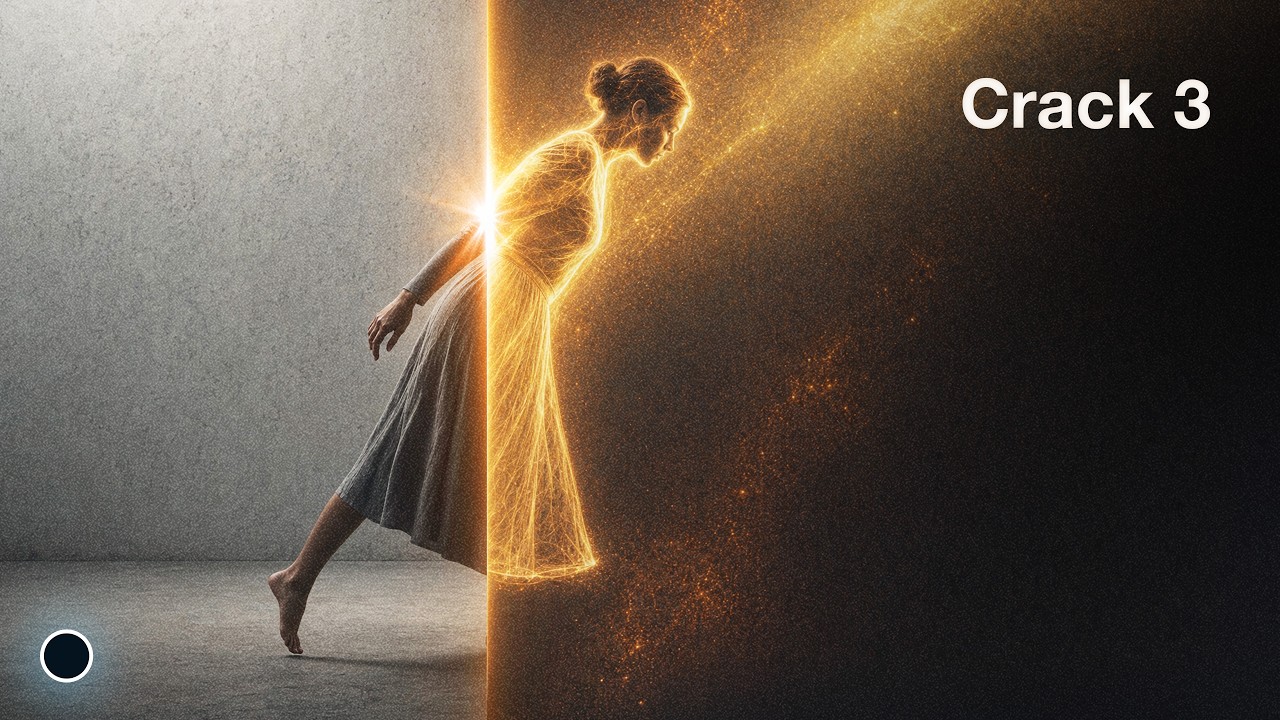
If the sense of self is manufactured, it should be possible to interfere with the manufacturing. The episode names three ways it happens: by dream, by drug, by accident. Disrupt the rhythm and the illusion starts to fracture.
Then the first hook, dropped before any of the science: in the 1980s, scientists used a helmet wired with magnets. No drugs. No suggestions. No prompts. Yet people felt a presence in the room. Some spoke with gods. The brain created someone out of nothing.
Three questions organize the rest of the episode, asked in the first minute:
- What system controls your sense of self?
- Why does it place you behind your eyes?
- And what happens when your self slips outside the body?
The candidates for that third case are listed immediately: near death visions, out of body experiences, encounters with impossible beings. The narration's own summary of the state of play is one of its better lines. The illusion of self is stable until it isn't. And when it cracks, what comes through may change how you understand everything.
What the episode is actually about (1:27)
The stated territory is where hard neuroscience touches the mystical, where ancient wisdom meets cutting edge brain research. The object of study is named precisely: the system that builds a reality so convincing we almost never stop to question it.
And the method is to study the system by watching it fail. The narration lists the failure modes it will cover, and each one is a real case that arrives later in the episode:
- When people float above operating tables, watching their own bodies being cut open.
- When electrical pulses can split one mind into two separate consciousness.
- When dying brains report encounters more vivid than waking life.
- 1955Penfield's electrode. During open brain surgery on an epileptic patient at the Montreal Neurological Institute, Wilder Penfield touches a spot in the temporal cortex and she cries out that there is somebody behind her. There is nobody there.
- 1960sSperry cuts the cable. Roger Sperry severs the corpus callosum to stop severe seizures and produces patients with two streams of consciousness in one skull.
- 1980sThe God helmet. Michael Persinger pulses weak magnetic fields through the temporal lobes of volunteers sitting in a sensory deprivation chamber. Many report an invisible presence, terror, bliss, or conversation with divine beings.
- 1990sStrassman's DMT trials. The first controlled DMT studies in decades, at the University of New Mexico. Volunteers describe fully formed worlds and crystalline beings with unnerving consistency.
- 1991Pam Reynolds goes into standstill. Blood drained from her brain, body cooled to 60 degrees Fahrenheit, heart stopped, EEG flat. She later describes the operation from above the table.
- 2001van Lommel publishes the cohort. 344 cardiac arrest survivors followed prospectively; 18 percent report a near death experience during clinical death.
- 2002Blanke finds the switch. A mild current to the right temporo-parietal junction turns an out of body experience on and off on command, the reproducibility Persinger never had.
- 2010sCarhart-Harris maps the mechanism. Psychedelics do not simply raise activity, they reorganize it, quieting the default mode network that holds the separate self together.
- 2021Goler's laser. DMT participants asked to look at a laser interference pattern independently describe the same scrolling symbols, which they call the source code of reality.
1955: Penfield, an electrode, and "there's somebody behind me" (2:27)
The first case is an accident during surgery. In 1955, neurosurgeon Wilder Penfield was performing delicate brain surgery on an epileptic patient. He needed to map her brain precisely, because one wrong cut could destroy her ability to speak or move. This is why the patient is awake for the procedure: the surgeon stimulates a site, the patient reports what happens, and the map gets built. It is the same method that produced the cortical homunculus, the distorted little body diagram of where touch and movement live on the cortical surface.
He touched an electrode to a specific spot in her temporal cortex. The patient suddenly cried out, "There's somebody behind me."
The episode is careful about the conditions, because the conditions are the point. There was no one there. The operating room was sterile, controlled, witnesses everywhere. Yet this woman felt an intelligent presence with absolute certainty. The comparison the narration draws is the one that stings: she was more certain of the presence than she felt about the doctors surrounding her. The doctors were real and merely believed in. The presence was fabricated and known.
Penfield had accidentally discovered something that would haunt neuroscience for decades. The question it left behind is stated as bluntly as the episode ever states anything: how does three pounds of neural tissue create the feeling of being someone?
And then the line that separates 1955 from now. Today, we can reproduce Penfield's accident at will. We can make you leave your body, fracture your sense of self, or transport you to impossible worlds. But each discovery only deepens the mystery.
The God helmet (3:50)
In the 1980s, neuroscientist Michael Persinger built something that looked like a joke: a motorcycle helmet fitted with electromagnetic coils. It became known as the God helmet.
The protocol was minimal and, on paper, unpromising. Participants sat in a sensory deprivation chamber while weak magnetic fields pulsed through their temporal lobes. Many reported profound encounters: the feeling of an invisible presence, waves of terror or bliss, even conversations with what they believed were divine beings.
What the temporal lobes are actually doing
Persinger had stumbled onto something crucial, and the episode states his interpretation directly. The temporal lobes do not only process memory and emotion. They maintain the boundary between self and other. Disrupt their electrical rhythms and that boundary can dissolve.
What happens next is the mechanism the whole episode keeps returning to. The brain, sensing something is wrong, creates an explanation. Someone else must be here. The presence is not a perception of anything. It is the output of a system whose job is to account for its own inputs, forced to account for a signal that has no source.
Not all brains are built the same
Then a distinction that explains why this is not a universal party trick. Some people have temporal lobes that fire more readily, neural networks more sensitive to electrical interference. The episode notes who those people tend to be, and it is a genuinely interesting claim: they are often the same individuals who report spontaneous mystical experiences, who sense presences in empty rooms, who feel the approach of thunderstorms in their bones.
Personal history matters too, and here the argument turns cultural. If you had been taught to interpret unusual sensations as spiritual encounters, your brain has learned different pathways for making sense of the inexplicable. The raw event may be identical across two people. The interpretation the brain reaches for is trained.
The flaw the episode names itself
Persinger's work had a fatal flaw. It was inconsistent, unreliable. Science demands reproducibility, and the God helmet did not deliver it.
That is stated plainly in the video, not smuggled in later, and it sets up the next act as a search rather than a victory lap. What researchers needed was a way to reliably break consciousness itself, to fracture the sense of self on command.
2002: Blanke finds the switch (6:01)
In 2002, neuroscientist Dr. Olaf Blanke accidentally discovered exactly that. He was conducting routine brain mapping on an epilepsy patient at a Swiss hospital, the same kind of pre surgical mapping Penfield was doing half a century earlier. He inserted an electrode into her temporo-parietal junction, the region where the temporal and parietal lobes meet.
The episode hands the microphone to Blanke, and this is the longest verbatim passage in the video:
So we stimulated a certain part of her brain, and if you want, a little bit 2 cm above and behind the ear. So that brain region, we stimulated it, a very mild current there, and repeatedly for 2 seconds we applied the current, and for 2 seconds she experienced an out-of-body experience. And she experienced to be outside her body, to be under the ceiling, and she experienced looking down, seeing herself, seeing me. I think I was sitting there, and there was also a neuropsychologist and engineer. So she saw all of us sitting in the room. And we could turn this out-of-body experience on and off by stimulating quite mildly this particular region in the brain, which is called the temporal parietal cortex on the right side.
Read that again for the structural fact buried in it. Two seconds of current, two seconds of being under the ceiling. Stop the current, and she is back. Blanke could reliably switch an out of body experience on and off like a light switch. The finding was published in Nature as a report on stimulating illusory own body perceptions.
The certainty problem
What stunned him most was not the relocation. It was the patient's conviction. The level of consciousness during an out of body experience feels to the person just like everyday reality. Sometimes even more than reality.
The episode is explicit that this was not supposed to be possible. According to everything neuroscience understood about consciousness, you should be located inside your body, behind your eyes, experiencing the world from that fixed perspective. Yet here was proof that your sense of location, what feels like the most fundamental aspect of being you, could be relocated with a few millivolts of electricity.
And, as with Penfield, it was luck. Blanke was mapping brain regions to plan the patient's epilepsy surgery, testing area after area to determine what could be safely removed. The out of body experience was what he calls a complete chance observation.
The body schema
Here is the machinery. The temporo-parietal junction creates what neuroscientists call your body schema: your brain's constantly updated map of where you exist in space.
Every moment, this region integrates information from your inner ear (the vestibular system), your eyes, your sense of touch, and your proprioception, the internal sense of where your limbs are without looking. All of it is fused to maintain the illusion that you are located inside your physical boundaries. Disrupt the integration and your sense of self can relocate entirely.
That is the answer to the second of the three opening questions. The reason you feel like you are behind your eyes is that a specific piece of cortex is computing that answer, continuously, out of four streams of data.
How common this is
The episode gives a number, and it is larger than most people expect. Between 5 and 10 percent of the general population, millions of people across Europe alone, will experience an out of body episode at least once in their lifetime. The circumstances are named: usually during moments of extreme fatigue, emotional shock, or the twilight states between sleeping and waking.
That reframes the whole category. This is not a rare pathology confined to operating theatres. It is a normal failure mode of a normally reliable computation, common enough that in any full lecture hall several people have been outside their bodies at least once.
The inversion
Then Blanke turns the whole question inside out, and this is the intellectual centre of the episode. The narration quotes him:
I think it is not the out-of-body experience that is strange. I think it's the inside body experience that we all have that is strange. How can self-consciousness be so precisely located here, around my body?
The consequence is stated in one sentence that is worth the price of admission. Your feeling of being located behind your eyes isn't a given, it's an achievement. Your brain works constantly to maintain that sense of embodied selfhood, integrating millions of sensory inputs every second to create the convincing illusion that you are inside your body looking out at the world.
Not a fact reported. A result produced, continuously, at cost. And then the pivot into the next section: consciousness does not just relocate. Sometimes it fractures completely, splitting into two separate minds in a single skull.
The 1960s: two minds, one skull (10:40)
In the 1960s, neurosurgeon Roger Sperry performed radical surgeries on patients with severe epilepsy, severing the corpus callosum, the thick bundle of nerve fibers connecting the brain's two hemispheres. The surgery worked. The seizures stopped. But the patients developed an unprecedented condition: two separate streams of consciousness in one skull. Sperry's work on hemispheric specialisation later took a share of the 1981 Nobel Prize in Physiology or Medicine, and the testing paradigm was carried forward by Michael Gazzaniga.
The demonstrations the episode picks are the famous ones, and they are chosen well because each shows a different thing.
Two hands, two intentions. During testing, a patient could simultaneously draw a circle with his right hand and a square with his left, completely unaware of the contradiction. Not struggling with it. Unaware of it.
Two answers to one question. When researchers asked what he wanted to be when he grew up, his left hemisphere answered draftsman, while his right hemisphere spelled out race car driver with letter blocks. The left hemisphere has speech, so it answers out loud. The right hemisphere is mute, so it answers with blocks. Both answers are sincere. Both come from the same head.
Two agendas in daily life. These patients lived with what amounted to two separate conscious entities sharing one body. They would sometimes find their hands working at cross purposes: one hand buttoning a shirt while the other unbuttoned it, one reaching for an item while the other pushed it away.
And one narrator covering for both. The last detail is the most consequential for the episode's thesis. Their left brain, controlling speech, would often confabulate explanations for actions initiated by the mute right hemisphere, creating elaborate stories to explain behaviors it didn't understand. This is what Gazzaniga later called the interpreter: a module whose job is to produce a coherent account of what you just did, whether or not it has access to the actual cause.
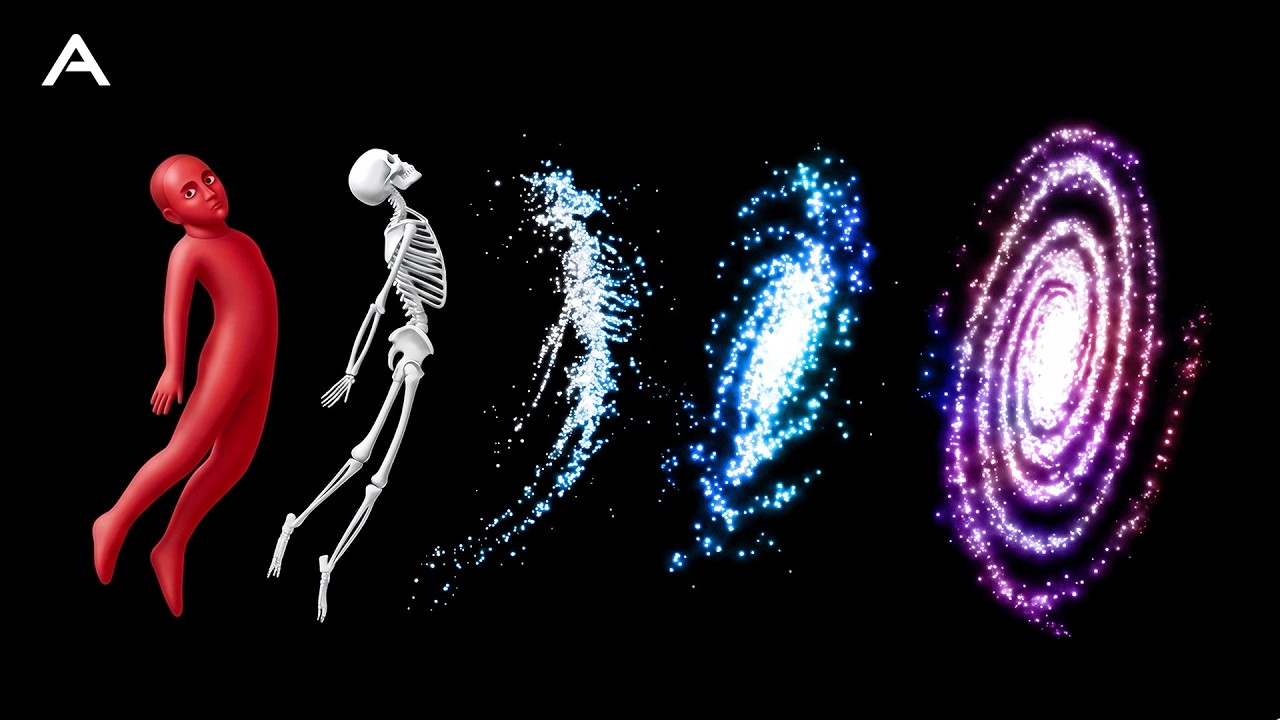
The implications, as the narration puts it, were staggering. If consciousness could be cleanly divided, what did that mean for the unified sense of self that feels so indispensable to human experience? The unity you experience is not evidence of a unified thing. It is what the storyteller produces.
The bridge into the next act is the episode's habit of escalating: if consciousness can divide, multiply, and relocate with such apparent ease, what happens when it encounters something that completely rewrites the rules of reality?
DMT: the molecule your body already makes (13:05)
N,N-Dimethyltryptamine, DMT, is different from every other consciousness altering substance. A single inhalation can launch people into fully formed worlds inhabited by entities that seem intelligent and alive.
The detail the episode leans on is the strange one. Your own body produces it. The narration puts it in metabolic terms: the same enzymes that build serotonin also generate traces of DMT, and evolution has left us with the machinery for manufacturing visions. The relevant enzyme in humans is indolethylamine N-methyltransferase, which methylates tryptamine into DMT and sits in the same tryptamine chemistry neighbourhood as the serotonin pathway.
Strassman's trials
In the 1990s, Rick Strassman at the University of New Mexico conducted the first controlled DMT studies, work later published as DMT: The Spirit Molecule. Volunteers spoke of being propelled into alien realms, meeting crystalline beings, communicating through color and geometry.
Then the observation that makes the section more than a catalogue of trip reports: the consistency of the visions is striking. The machine elves described in the studies, a phrase Terence McKenna gave the culture, appear in reports across cultures and continents. Different people, different backgrounds, similar furniture.
What the brain is doing
Brain imaging shows that psychedelics do not simply increase activity, they reorganize it entirely. Robin Carhart-Harris, a British psychopharmacologist, found that DMT quiets the default mode network, the system that maintains your sense of being a separate self. This is the same network at the centre of his entropic brain framework, in which the ordinary waking self corresponds to a tightly constrained, low entropy regime.
At the same time, brain regions that normally stay isolated begin cross talking. The episode lists what that looks like from the inside: visual areas merge with auditory ones, memory links to emotion, logic dissolves into sensation. The brain explores configurations usually locked away.
The chemistry, and the filter idea
The chemistry offers clues. DMT floods serotonin 2A receptors in regions that filter perception. These receptors normally screen out excess information, keeping you tuned to survival. When overwhelmed by DMT, those filters collapse.
And then the reinterpretation that the last third of the episode will build on. Consciousness may not be hallucinating. It may be opening to streams of information usually kept outside awareness. Same event, two readings: a filter failing and producing noise, or a filter opening and admitting signal. The episode has now planted the idea it will argue for later.
2021: the laser and the source code
The last piece of this section is the strangest and the newest. In 2021, Danny Goler, an independent researcher, filmmaker, and self proclaimed explorer of altered states of consciousness, asked DMT participants to view a laser interference pattern. Independently, several described identical scrolling symbols, what they called the source code of reality. Goler's protocol uses a collimated 650 nanometre red laser and the diffraction pattern it throws, and he has since built the project out as a public research surface with a reporting site and a nonprofit; Vice profiled it in detail.
The question the episode asks about it is the right one to ask: if these were simple brain inventions, why would multiple people perceive the same novel details?
Near death: the edges of life (16:23)
At the edges of life and death, consciousness reveals perhaps its strangest behavior. Near death experiences show remarkable consistency across cultures, and the episode names the recurring elements: floating above the body, moving through tunnels of light, encountering beings of overwhelming love.
Pam Reynolds, 1991
The most documented case belongs to Pam Reynolds. In 1991 she underwent a rare procedure called hypothermic cardiac arrest, known in the surgical literature as deep hypothermic circulatory arrest and to the surgeons who use it as standstill. Surgeons at the Barrow Neurological Institute needed to repair an aneurysm deep in her brain, but it was positioned where any conventional surgery would be fatal.
The solution was radical: drain all blood from her brain, cool her body to 60 degrees Fahrenheit, and stop her heart completely. For all practical purposes, Pam Reynolds would be dead for the duration of the surgery.
Dr. Robert Spetzler led the operation. The episode inventories the monitoring, because the monitoring is what makes this case a case rather than an anecdote:
- EEG sensors showed her brain activity flatlined.
- Her core temperature dropped so low that cellular activity essentially stopped.
- No blood flowed to her brain.
- Her eyes were taped shut.
- Molded speakers covered her ears, playing loud clicks to monitor brain function.
She should have experienced nothing. Every channel was closed, and two of them (the taped eyes and the clicking speakers) were closed deliberately in ways that also rule out ordinary perception.
Yet when Pam awakened, she described watching the entire operation from above the surgical table. The specifics are what the case rests on:
- She accurately recalled the bone saw's unusual appearance. It looked like an electric toothbrush, not the large circular saw she had expected.
- She described conversations between surgical staff.
- She named specific instruments they used.
- She reported the song Hotel California playing in the operating room.
- Most remarkably, she reported the moment surgeons discovered her femoral artery was too small for the planned procedure, a discovery that happened while her brain was completely flatlined.
Then the episode does the thing that makes this segment strong: it puts the surgeon on the record. Spetzler's own testimony, quoted verbatim:
I don't think that the observations she made were based on what she experienced as she went into the operating room theater. They were just not available to her. For example, the drill and so on, those things are all covered up. They're not visible. They were inside their packages. You really don't begin to open until the patient is completely asleep so that you maintain a sterile environment.
That closes the most obvious loophole from the inside. The instruments were not sitting out where a nervous patient could glance at them on the way in. They were sealed, and they were opened only after she was under.
Anita Moorjani
Anita Moorjani's case pushes the boundaries further. Dying of lymphoma in a Hong Kong hospital, her organs shutting down one by one, she reported leaving her body and entering a space of infinite love and understanding.
In that state she claimed to receive knowledge that her cancer would completely disappear if she chose to return. Her doctors expected her death within hours. Instead, her tumors began shrinking almost immediately, and within weeks they had vanished entirely. Her medical team documented the recovery but could not explain it, because the cancer had been too advanced, too aggressive for any known treatment to work. Moorjani has written and spoken about the case since, and maintains her own account of it.
van Lommel: the study, not the anecdote
Anecdotes invite selection effects, so the episode reaches for a prospective cohort. Dutch cardiologist Pim van Lommel conducted the largest prospective study of near death experiences, following 344 cardiac arrest survivors. 18 percent reported NDEs during their clinical death.
Prospective matters here, and it is why this study gets cited rather than a survey. The patients were enrolled because they had a cardiac arrest, not because they had a story, so the 18 percent is a rate rather than a collection of the most compelling cases.
What struck van Lommel was the consistency: the same tunnels, the same beings of light, the same sense of returning with profound knowledge about existence. But the part the episode flags as most intriguing is the verified perceptions. Patients accurately described medical procedures, conversations, even events happening in other rooms while they were clinically dead. Some returned speaking languages they had never learned, or with mathematical insights they could not have possessed.
The materialist account, stated fairly
The episode then lays out the standard explanation without strawmanning it. From a materialist neuroscience perspective, these experiences might result from DMT flooding the brain during trauma, temporal lobe seizures, or oxygen deprivation creating vivid hallucinations. The dying brain, some argue, constructs these visions as a final neurochemical event.
Notice how economical that account is. Every mechanism in it has already appeared earlier in the episode. The temporal lobe seizure is Penfield and Persinger. The DMT flood is the previous section. Oxygen deprivation is the cheapest explanation of all, and it does real work on tunnels and lights.
And then the objection the episode presses. This explanation struggles with the verified perceptions. How can a flatline brain process visual information? Why do these hallucinations contain accurate details about events the person could not have witnessed? A hallucination can be as vivid as you like, but it should not be accurate about a femoral artery.
The ancient parallel
Religious traditions interpret these experiences as glimpses of an afterlife, evidence that consciousness survives bodily death. The episode cites two specific traditions rather than gesturing at religion in general:
- Tibetan Buddhism describes bardos, intermediate states between death and rebirth.
- Egyptian texts, the funerary literature collected as the Book of the Dead, detail journeys through tunnels toward divine light.
These ancient descriptions mirror modern NDE reports with uncanny precision. The episode does not claim that agreement proves anything metaphysical; it treats it as data about the shape of the experience, stable across millennia and across cultures with no contact.
Perhaps most unsettling is what these experiences suggest about the nature of identity itself. If consciousness can exist when the brain shows no activity, if awareness can expand beyond the physical body, then what we call self might be far more than the neural patterns firing in our skulls.
Can consciousness exist beyond the brain? (23:11)
Some researchers propose a radical middle ground, and this is the episode's actual thesis rather than a shrug. Consciousness might be fundamental to the universe, like gravity or electromagnetism. In this view, brains do not create consciousness. They focus and organize it, like a radio tuning into a signal.
The prediction that follows is what makes it more than a metaphor. When the brain fails, consciousness does not disappear. It simply loses its organizational structure, expanding beyond the boundaries we normally experience.
This is the oldest live alternative in the philosophy of mind and it has a lineage: William James argued that the brain might have a transmissive rather than productive function, Aldous Huxley borrowed the reducing valve image for the same idea, and the modern relatives are panpsychism and its cousins. What the episode adds is that the filter now has candidate parts: the 5-HT2A receptors that screen out excess information, and the default mode network that holds the separate self together.
The implications stretch far beyond neuroscience. If consciousness exists independently of brain states, it changes how we understand death, identity, and our place in the cosmos. It suggests that the you watching this video might be far more expansive and far more mysterious than any story your brain tells you.
The summary the narration gives of its own case: what we have seen challenges the basic assumption that consciousness emerges from neural activity. Instead, it might be something the brain channels, filters, and focuses, but does not create. When those filtering systems break down, consciousness does not vanish. It reveals its true nature.
| Question | The self inside the head | The model this episode argues for |
|---|---|---|
| Where are you? | Behind your eyes. That is simply where the experiencer sits. | Wherever the body schema currently computes. Usually behind the eyes, and movable. |
| What is perception? | A window. The world comes in roughly as it is. | A construction. "You are not observing reality, you are creating it." |
| Why does it feel so certain? | Because it is true. | Because certainty is part of the output. Penfield's patient was more certain of the presence than of her surgeons. |
| What is an out of body experience? | A hallucination, or a fantasy after the fact. | The same computation with different inputs. Reproducible on demand at the right temporo-parietal junction. |
| How unified is the self? | One indivisible experiencer per person. | Divisible. Cut the corpus callosum and you get two, one of which narrates for both. |
| What do psychedelics do? | Add noise to a working system. | Quiet the default mode network and collapse receptor filters, so normally isolated regions cross talk. |
| What does a flat EEG mean? | No experience is possible. Full stop. | No organizing structure, which is not the same as no experience. This is the load bearing claim. |
| What is the brain for? | Generating consciousness out of tissue. | Focusing and filtering consciousness, the way a radio tunes a signal it did not create. |
Who is the self that's listening? (24:45)
Having spent twenty five minutes taking the self apart, the episode turns the instrument on the viewer, in the present tense, and it is the most effective forty seconds in the video.
Right now, you are listening to my voice. You feel like you are the one doing it. But if the self is a story the brain tells, who exactly is listening? And where are you really?
No answer is offered. That is the correct move. Every case in the episode has shown a piece of the self being relocated, divided, dissolved, or filtered, and none of them located the thing doing the experiencing. The question is left standing on purpose.
Thoughts to reflect on (25:10)
The last seven minutes are a reflection sequence: the episode's own claims, restated as a list of lines to sit with rather than arguments to follow. They are reproduced here in the video's order, because the compression is the point.
- You are not merely experiencing reality. You are creating it, moment by moment, prediction by prediction.
- The sense of being behind your eyes is not given. It is earned.
- The strangest thing is not leaving the body, but being inside one.
- Consciousness may not hallucinate, but open to hidden streams of reality.
- What we call near death may be nearer to infinite love and understanding.
- Again and again, the same light, the same tunnels, the same return with knowledge too vast for words.
- If consciousness can divide, multiply, and relocate, what happens when it meets the unimaginable?
- Consciousness may be as fundamental as gravity, woven into the universe itself.
- The you you think you are is smaller than the you you truly are.
- Brains do not manufacture awareness, they tune it, like a radio finding a signal.
- When filters fall away, consciousness does not end. It reveals its essence.
- Your brain weaves a convincing illusion of self from countless signals and calls it you.
- A small spark in the brain can switch entire worlds on and off.
- Through human consciousness, the universe has evolved a way to look at itself.
The phrase "prediction by prediction" in the first line is doing quiet work, and it is the one piece of vocabulary the episode borrows without explaining. It points at predictive processing, the view that perception is the brain's best guess continuously corrected by sensory error rather than a feed being read off the senses. On that account the body schema is just another prediction, which is exactly why an electrode can change it.
The episode closes by handing off to its next one, with a line that reuses the structure of its own thesis: if consciousness is the story your brain tells about reality, DNA is the story life tells. What makes you different from a rock, and why does life need a code at all?
Key takeaways
- The felt location of the self is a computation, not a fact. The right temporo-parietal junction fuses vestibular, visual, tactile, and proprioceptive input into a body schema, and the output is the sensation of being inside your body. That is an achievement the brain performs continuously, not a given.
- It can be switched. Blanke applied a mild current for two seconds and his patient was under the ceiling looking down at him for two seconds, on and off, reproducibly. Penfield's 1955 accident was the same phenomenon fifty years early and one region over.
- The certainty is generated along with the content. Penfield's patient was more certain about the presence behind her than about the surgeons in front of her. Blanke's patient found the out of body state as real as ordinary life, sometimes more real. Confidence is not a check on accuracy; it is part of the output.
- Leaving the body is common. Between 5 and 10 percent of people will do it at least once, typically under extreme fatigue, emotional shock, or in the twilight between sleep and waking.
- The unified self is divisible. Sever the corpus callosum and one patient draws a circle and a square at the same time, and answers a career question two different ways with two different hemispheres. The talking hemisphere then invents explanations for what the mute one did.
- Psychedelics reorganize rather than amplify. DMT quiets the default mode network and floods 5-HT2A receptors that normally screen out information, and regions that usually stay isolated begin cross talking.
- The near death cases turn on verified detail, not on vividness. The reason Pam Reynolds is cited is the bone saw shaped like an electric toothbrush, the femoral artery discovery, and Spetzler's testimony that the instruments were sealed until she was under.
- The prospective number is 18 percent. van Lommel enrolled 344 cardiac arrest survivors because they had arrested, not because they had a story, which is what makes the rate meaningful.
- The thesis is a filter model. If consciousness is fundamental and the brain tunes rather than generates it, then a failing brain loses organization rather than awareness. Everything in the episode is offered as a clue for that reading, and the episode calls it a proposal rather than a finding.
Chapters
Timestamps are clickable. Click one and the embedded player jumps there and keeps playing while you read. These are the creator's own chapters, used verbatim.
- 0:00 What is consciousness?
- 0:33 When does the illusion of self break?
- 1:27 How does the brain create you?
- 2:27 What did Penfield discover about the brain?
- 3:50 What is the God Helmet?
- 6:01 How can the brain trigger out-of-body experiences?
- 10:40 What does split-brain research reveal?
- 13:05 How does DMT change perception?
- 16:23 What do near-death experiences show?
- 23:11 Can consciousness exist beyond the brain?
- 24:45 Who is the self that's listening?
- 25:10 Thoughts to reflect on
Notable quotes
"There's somebody behind me." · Penfield's patient, mid surgery, 1955 (2:27)
"How does 3 lb of neural tissue create the feeling of being someone?" · The narration, after Penfield (2:27)
"The brain, sensing something is wrong, creates an explanation. Someone else must be here." · On the God helmet (3:50)
"Persinger's work had a fatal flaw. It was inconsistent, unreliable. Science demands reproducibility." · The narration, closing the God helmet section (3:50)
"For 2 seconds we applied the current, and for 2 seconds she experienced an out-of-body experience." · Olaf Blanke (6:01)
"We could turn this out-of-body experience on and off by stimulating quite mildly this particular region in the brain." · Olaf Blanke (6:01)
"The level of consciousness during an out-of-body experience feels to the person just like everyday reality. Sometimes even more than reality." · The narration, on Blanke's patient (6:01)
"I think it is not the out-of-body experience that is strange. I think it's the inside body experience that we all have that is strange. How can self-consciousness be so precisely located here, around my body?" · Olaf Blanke (6:01)
"Your feeling of being located behind your eyes isn't a given, it's an achievement." · The narration (6:01)
"His left hemisphere answered draftsman, while his right hemisphere spelled out race car driver with letter blocks." · On Sperry's split brain patients (10:40)
"Consciousness may not be hallucinating. It may be opening to streams of information usually kept outside awareness." · The narration, on the collapse of the 5-HT2A filters (13:05)
"If these were simple brain inventions, why would multiple people perceive the same novel details?" · On Goler's laser experiment (13:05)
"I don't think that the observations she made were based on what she experienced as she went into the operating room theater. They were just not available to her. For example, the drill and so on, those things are all covered up. They're not visible. They were inside their packages." · Dr. Robert Spetzler on Pam Reynolds (16:23)
"How can a flatline brain process visual information?" · The narration, pressing the materialist account (16:23)
"Brains don't create consciousness. They focus and organize it, like a radio tuning into a signal." · The narration, on the radical middle ground (23:11)
"If the self is a story the brain tells, who exactly is listening? And where are you really?" · The closing question (24:45)
"The you you think you are is smaller than the you you truly are." · Reflection sequence (25:10)
"Through human consciousness, the universe has evolved a way to look at itself." · Reflection sequence (25:10)
Resources mentioned
People and researchers
- Wilder Penfield, the neurosurgeon whose 1955 cortical stimulation produced the sensed presence, and whose mapping technique produced the cortical homunculus at the Montreal Neurological Institute
- Michael Persinger, the Laurentian University neuroscientist behind the God helmet
- Olaf Blanke, who found the out of body switch, and his Laboratory of Cognitive Neuroscience
- Roger Sperry, whose split brain surgeries and testing earned a share of the 1981 Nobel Prize, and Michael Gazzaniga, who carried the work forward
- Rick Strassman of the University of New Mexico, who ran the first modern controlled DMT trials
- Robin Carhart-Harris, on the default mode network and the entropic brain
- Danny Goler, the independent researcher behind the laser interference protocol, profiled by Vice
- Dr. Robert Spetzler of the Barrow Neurological Institute, who led the Pam Reynolds operation and testified about it
- Anita Moorjani, whose lymphoma case is the episode's most extreme claim (her own account)
- Pim van Lommel, the Dutch cardiologist behind the prospective cohort
- Terence McKenna, source of the phrase machine elves
Papers, studies, and books
- Blanke, Ortigue, Landis and Seeck, Stimulating illusory own-body perceptions, Nature, 2002, the out of body switch
- van Lommel et al., Near-death experience in survivors of cardiac arrest: a prospective study in the Netherlands, The Lancet, 2001, the 344 patient cohort
- Carhart-Harris et al., The entropic brain, Frontiers in Human Neuroscience, 2014
- DMT: The Spirit Molecule, Strassman's account of the University of New Mexico trials
- The Pam Reynolds case, including the standard critiques of it
Concepts and anatomy
- Temporo-parietal junction and the body schema
- Proprioception and the vestibular system, two of the four streams being integrated
- Temporal lobe and temporal lobe epilepsy
- Corpus callosum, corpus callosotomy, split brain, confabulation, and the left brain interpreter
- N,N-Dimethyltryptamine, serotonin, INMT, and the 5-HT2A receptor
- Default mode network and predictive processing
- Out of body experience, sensed presence, and near death experience
- Deep hypothermic circulatory arrest, the surgical procedure behind the Pam Reynolds case
- Bardo Thodol (the Tibetan intermediate states) and the Egyptian Book of the Dead
- Panpsychism, William James on the brain's transmissive function, and Huxley's reducing valve in The Doors of Perception
- Hotel California, the song Reynolds reported hearing
Where it stands
The episode covers a range that runs from textbook neuroscience to open metaphysics, and it is worth knowing which is which. This section is the honest ledger, and none of it is the video's fault: it flags Persinger's unreliability itself and calls the filter model a proposal.
Solid ground. Cortical stimulation reliably produces own body illusions, and Blanke's 2002 Nature report has been extended into a whole experimental literature. The rubber hand illusion (Botvinick and Cohen, 1998) shows that a felt body part can be relocated with a paintbrush and a prop, and Blanke's own group later induced full body illusions in healthy volunteers using video and touch. The temporo-parietal junction's role in self location, the divisibility of the split brain, the left hemisphere's confabulation habit, and the default mode network's link to the sense of a separate self are all mainstream.
Contested. The God helmet did not replicate. Granqvist and colleagues ran a double blind version in 2005 and found that suggestibility, not the magnetic fields, predicted who sensed a presence. Persinger replied that the fields had been applied incorrectly and later re-analysed 19 experiments arguing for a field effect. The episode's own verdict, that the work was inconsistent and unreliable, is the fair summary.
The DMT chemistry is loosely stated. Endogenous DMT is real and INMT is the enzyme that makes it, but "the same enzymes that build serotonin also generate traces of DMT" compresses two related tryptamine pathways into one. Whether endogenous DMT ever reaches psychoactive concentrations in a human brain, including a dying one, is unsettled.
The laser symbols have an ordinary candidate explanation. Neurobiologist Andrew Gallimore has suggested that laser speckle, the granular pattern coherent light throws onto the retina, gives a DMT altered visual system a scaffold to build the same sorts of characters on. Andrés Gómez Emilsson of the Qualia Research Institute notes that plenty of people try the protocol and see nothing, which cuts against a universal signature.
Pam Reynolds is the strongest single case and still a single case. The standard critique is about timing: her flat EEG covered part of the surgery, and the bone saw and the conversation she reported may map to periods when she was under anaesthesia but not yet in standstill, with anaesthesia awareness and hearing through bone conduction as candidate routes. Spetzler's testimony about the sealed instruments is real and does close the pre surgery loophole. The case is genuinely unexplained; it is not a controlled experiment.
Moorjani's remission is one documented case with no mechanism proposed. Spontaneous regression of lymphoma is rare and does occur, and a single case, however well documented, cannot distinguish that from the interpretation she gives it.
van Lommel's 18 percent is solid; the inference from it is not. The rate is well cited. Whether the reports establish awareness during clinical death is the disputed part, since recollections are gathered after resuscitation and the exact timing of experience inside an arrest is hard to pin down. The prospective work that followed, notably AWARE under Sam Parnia, was designed to test verified perception directly using hidden visual targets, and the yield of confirmed hits has so far been very small.
The filter model is a philosophical position, not a result. "Consciousness is fundamental like gravity" is panpsychism or something near it, and the radio metaphor goes back at least to William James. It is a serious position with serious defenders, and it currently makes no distinct prediction that the generative account does not also accommodate. Meanwhile the mainstream constructivist account, most visibly Anil Seth's work on predictive processing, agrees with almost everything in the first two thirds of this episode (you are creating your reality, the self is a model, the model can be edited) while stopping short of the last step.
Which leaves the episode's real achievement intact. You do not have to accept the radio to accept the finding that pays for the title: the felt fact of being inside your body is manufactured, it is maintained at cost, and two seconds of current in the right place will take it away from you.