At a glance
The Opening takes thirty four minutes to argue that the world you are experiencing right now has been edited before it reached you, and it proves the point five separate times in five separate places. A hole in your vision that your brain paints over. A table that is almost entirely empty space. A present moment that already happened. A word that freezes a living process into a noun. And the smallest word of all, "I", holding together a set of processes that never stop changing.
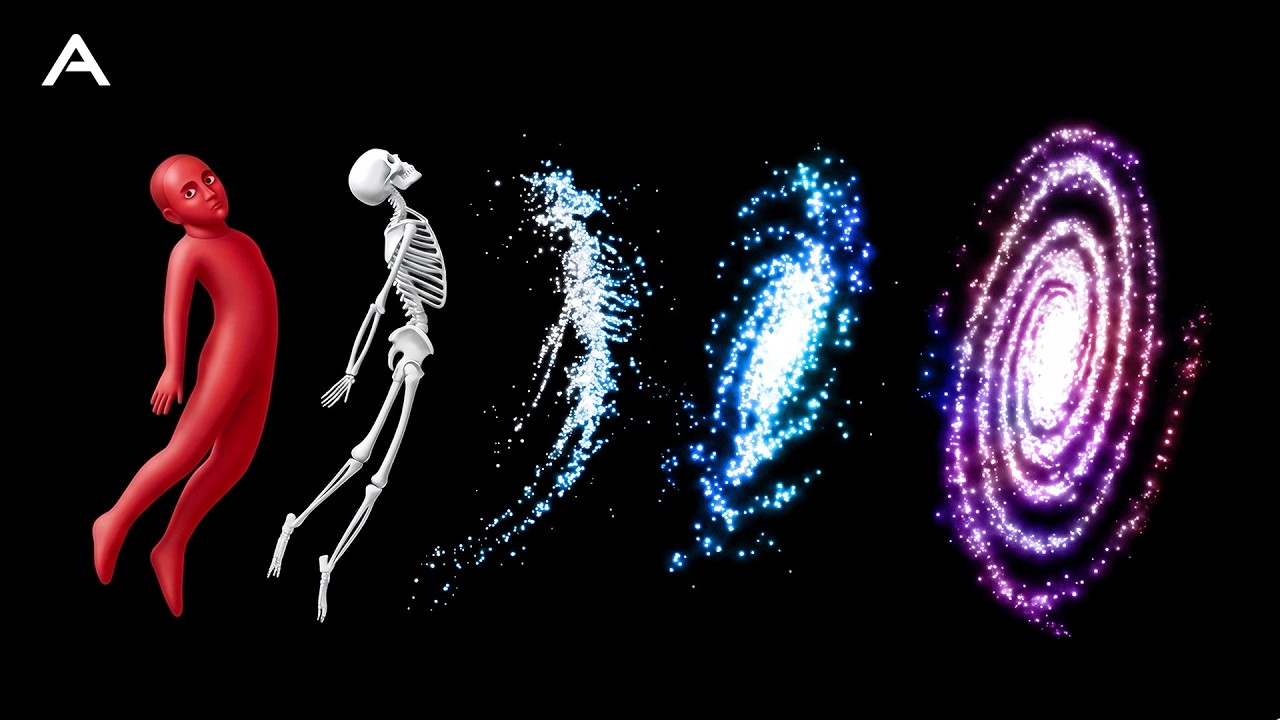
The episode opens on a real morning. On December 10th, 1996, the neuroanatomist Jill Bolte Taylor had a blood vessel rupture in her left hemisphere, and over the following hours she watched the machinery that builds the sense of being a separate self shut down while she was still expert enough to narrate the failure. She stepped into the shower and could not find the edge of her own body. The atoms of her hand and the atoms of the tile felt like the same thing. That morning is the destination the rest of the film walks toward, one crack at a time, on the claim that what happened to her brain in an emergency is happening in yours every ordinary second, just quietly enough that you never catch it.
The five cracks are not a demolition. The narration is explicit about this: the cracks were not showing us that reality is fake, they were showing us that reality is not separate from us in the way we usually imagine. The table still holds the coffee. The floor still stops you falling through it. What loosens is the assumption that the world is a finished object sitting in front of a separate observer, and what the episode puts in its place is a world made of events rather than things, in which you are one of the events. The closing line is the whole thesis in five words: you are the watching.
There is a hole in your vision (0:00)
The film does not open with a thesis. It opens with an accusation, delivered flat.
Right now, there is a hole in your vision that you cannot see. Your brain is hiding it from you. And it is not the only thing it is hiding.
Then it widens the accusation to include everything. The solid floor beneath you. This moment you are in. The person you think you are. All of it, the narration says, is being edited before it ever reaches you. Five pieces of the real world have been cut from your experience, and you have never noticed one.
That is the premise, and the promise that follows is the reason to keep watching. Today, we are going to let them back in. And by the time we are done, the world may not look the way you remember it.
Notice what is not being claimed. The word is not "fake" and it is not "illusion." It is edited. Something is happening, and something else is being delivered to you, and the gap between them is where the whole film lives.
The scientist who watched reality stop (0:51)
Before the cracks, one story, and the film is deliberate about why it comes first.
She is a brain scientist. She spent her life studying the organ that builds our experience of reality. And one morning in 1996, that organ stopped building it. What she felt in the hours that followed is where the rest of this video is taking you, through five cracks where that same unedited reality leaks into ordinary life. She just got there first.
Her name is Jill Bolte Taylor. On the morning of December 10th, 1996, a blood vessel ruptured in her left hemisphere: the side of the brain that handles language, the side that runs the steady inner voice telling you who you are, where you are, what you are doing next.
Over the next hours she watched the inner narrator go quiet. The voice that says "I am Jill" stopped arriving.
She stepped into the shower and lost the edge of her own body. She looked down at her arm and could not tell where her skin stopped and the wall started. The atoms of her hand and the atoms of the tile felt like the same thing. Her body stopped feeling like matter. It felt like energy moving through a space that had no edges.
And inside that, she felt a euphoria she had never known a brain could produce. The strange certainty that she was not separate from anything around her.
Here is the hinge of the whole sequence, and the reason this particular stroke is worth thirty seconds of a film about physics and language. Anyone else would have called this a mystical experience. Taylor could not. She had spent her career learning how the brain works. Her training kept running while everything else was falling apart. She could see the failure happening in real time.
And what she saw was not a revelation arriving. It was a service being withdrawn.
The separateness she had felt her whole life was something her brain had been doing for her. And it had just stopped.
That sentence is the film's entire method stated once, early, before any of the cracks. Separateness is not a fact that the brain reports. It is a job the brain performs. And any job can stop.
The narration then makes the move that turns a medical anomaly into a documentary. What Taylor saw is not only what happens when a brain breaks. The same thing is hidden in ordinary life, in everyone, every day, including right now, as you watch this.
Most of the time, the world feels solid, immediate and complete. We open our eyes and find ourselves in a world that already makes sense. But when we look closely, that certainty begins to loosen.
- 1660The blind spot is discovered. The French physicist Edme Mariotte works out that the point where the optic nerve leaves the eye is blind, and demonstrates it to the court of Charles II as a parlour trick that makes a person's head vanish. Crack 1 has been known for three and a half centuries and is still invisible to almost everyone who has it.
- 1911The atom turns out to be mostly nothing. Ernest Rutherford interprets the Geiger and Marsden gold foil results: the mass sits in a tiny central nucleus and the rest is open space. Crack 2, established physics for over a century.
- 1925Why the empty stuff still stops your hand. Wolfgang Pauli states the exclusion principle. Two electrons cannot occupy the same quantum state, which is the rule the film calls "rules that stop everything from collapsing into the same place."
- 1929Reality as events, not things. Alfred North Whitehead publishes Process and Reality, in which the basic units of the world are momentary events of becoming that inherit from the past and pass something forward. The film never names him, but the last third is his philosophy almost line for line.
- 1996December 10th. Jill Bolte Taylor, then a Harvard trained neuroanatomist, suffers a haemorrhage in her left hemisphere and spends the morning watching the boundary between herself and the bathroom tile dissolve. Recovery takes eight years.
- 2006She writes it down. My Stroke of Insight, the first person account by the only kind of witness who could have taken accurate notes.
- 2008The talk. Taylor's TED talk becomes one of the most watched in the format's history and puts "my brain stopped drawing the line between me and everything else" into general circulation.
Crack 1: The blind spot (4:26)
The first crack begins in the eye.
In each eye there is a small place where the world leaves no trace. It is inside your vision right now, and you cannot see it. It is called the blind spot.
The mechanism is plumbing, not mystery. It exists because the optic nerve has to leave the back of the eye. At that exit point the retina has no light detecting cells. The visual signal contains a gap before it reaches the brain. A small patch of the world is missing from the image your eye can provide.
You might expect to notice it, the narration says, like a gap in the page, a hole in the wall. But daily life appears seamless. The gap is handled before awareness ever receives it.
And here is the part that matters, because it is not "your brain ignores the hole." It is stronger than that. The brain studies the surrounding scene and completes the missing area. A white wall continues as white. Wallpaper carries on its pattern.
The absence is real, but it never arrives as absence.
By the time you experience the scene, the missing part has already been woven into the whole. You are not looking at a repaired image and failing to notice the repair. The repair happens upstream of you. There is no version of the scene, available to you at any level of attention, in which the hole is visible.
Vision does not finish in the eye
From the specific hole, the episode generalises, and this is where crack 1 stops being an ophthalmology fact and becomes the template for the other four.
This repair work belongs to vision itself. Your eyes begin the work of seeing, but they do not finish it alone.
Vision is built from fragments. The narration lists them, one per beat: light, edges, movement, colour, memory, expectation. Note that the last two are on the same list as the first four. Memory and expectation are not corrections applied to the picture afterwards. They are ingredients of the picture.
From these partial signals, the brain creates a world coherent enough to move through.
The analogy the film reaches for is the one everybody has lived through since 2020. Think of a video call breaking up, but you still follow the conversation. Your mind carries meaning across the missing pieces. Perception works the same way. It receives fragments and turns them into continuity.
And then the three part definition of what perception actually hands you, which is one of the most carefully built sentences in the film. It gives you reality as something lived: stable enough to walk through, meaningful enough to respond to, and incomplete enough to remind us that seeing is always an act of interpretation.
So, perhaps, we do not simply receive reality. We participate in its appearance.
That is the first crack. A place where information is missing. And from that missing place, a world is made.
Crack 2: The emptiness inside matter (7:51)
The first crack was hidden in vision. The second is hidden in matter. Because the world does not only contain gaps in how it appears to us. It contains gaps in what we are made of.
Put your hand on a table. It feels solid, firm, certain.
But if you could zoom in far enough, past the wood grain, past the cells, past the molecules, all the way down to the atoms, the table you know would begin to disappear. The closer you look, the less the table looks like a block of stuff. It starts to look like atoms arranged together with surprising amounts of distance inside them.
Atoms are not tiny hard balls packed together like marbles in a jar. Most of an atom is open space. At the centre is a tiny heavy core. Around it, electrons move in a fuzzy outer region, and the film is careful to kill the schoolroom picture on its way past: they are too strange and too small to behave like little planets going around the sun.
Then the image the episode builds the whole crack on.
If the core of a single atom were the size of a pea sitting in the middle of a football stadium, the electrons would be buzzing somewhere near the outer seats. Everything in between would be nothing.
And the follow through, delivered as four short sentences that get closer to you each time. That is what your hand is made of. And the table. And the floor. And every solid thing you have ever touched in your life.
So why does the table feel solid
Having emptied the table out, the film immediately refuses the cheap conclusion, and this is the section that separates it from a hundred lazier videos making the same point.
Why does the table feel solid? Because the atoms in your hand never truly pass through the atoms in the table. As they come close, the electrons around them push back. And at the smallest scales, matter follows rules that stop everything from collapsing into the same place. (Those rules have a name the film leaves off screen: the Pauli exclusion principle, which forbids two electrons from occupying the same quantum state and supplies most of what we experience as the stubbornness of stuff.)
You cannot see this resistance. But your body feels it as hardness. So at our size, it feels as if two solid things are touching. But deep down, touch is a force meeting force.
Then the correction, stated plainly, twice.
The table is still real. And so is its hardness.
It can hold your coffee, support your hand, and stop your body from falling through the floor. The hardness does not come from tiny solid balls packed tightly together. It comes from countless tiny parts holding their shape and pushing back together.
At the smallest scales, the table is no longer a smooth surface. It becomes a wide landscape of tiny centres, open spaces, and forces you cannot see. The table is not less real because of this. Its reality is in the way those forces hold together.
And the sentence that will turn out to be the thesis of the entire film, planted here in the second crack and not cashed in until the fifth. What we call a thing may often be a pattern of activity, stable enough to appear solid, useful and dependable at the scale of human life.
The closing move of crack 2 changes the picture of the universe rather than the picture of the table. For a long time, people imagined the world is a collection of tiny solid pieces, like little bricks stacked together to make everything we see. But the deeper we look, the less the universe behaves like a pile of bricks. It behaves more like a web of relationships.
So solidity has begun to loosen.
Crack 3: The delayed now (12:54)
But the third crack is hidden in the one place we rarely think to question. And that is the now.
The present feels instant, clear and complete. Everything seems to reach us in the same moment. But between the world happening and the world being felt, there is a hidden interval. And inside that gap, now begins to change.
You feel as if you are experiencing this moment live. This image, this sound, this sentence. But light needs time to enter the eye. Sound needs time to reach the ear. And touch needs time to travel through the body. Before any of it becomes experience, it has already taken a small journey.
The delay is tiny, usually too small to notice. Still, life does not feel delayed. You do not experience separate signals arriving one by one. You experience a room, a voice, a body, a world that appears to hold together.
Now is not only what is arriving
Here the film turns the crack from a physics point into something more interesting. Now is held together by more than incoming signals. It also carries the moment that came just before.
Think of a sentence. You only understand the word you are hearing because the earlier words are still present in your mind. They have passed, but they remain inside the meaning. What came before shapes what is happening now.
And then the sentence that quietly changes the subject from perception to metaphysics, and which the fifth crack will pick up and finish:
Reality was not a row of frozen instants. It was made of events, each moment receiving what came before, taking shape, and passing something forward.
The second analogy is music, and it does work the first one could not. Think about listening to a song. A single note is not music. Music exists in the movement from one note to the next. Each note carries the one before it. The meaning is in the relation, the timing, the change.
Time may be closer to that than to a container the universe sits inside. It is not an empty background where things happen. It is part of how things happen together.
The same thing at cosmic scale
Then the film pulls the camera back, hard.
The sunlight touching your skin is about eight minutes old. The light from distant stars may have been travelling since long before human beings existed.
So the moment you are living contains more than one time. It brings together the near and the far, the recent and the ancient, the body and the cosmos.
That is the third crack. The present feels like the simplest thing in the world, but it is already a relationship between what has happened, what is arriving, and what is becoming next.
Crack 4: Language, the photograph problem (17:34)
But now we run into a stranger problem. How do you describe a world that never stops moving? Because the moment we put reality into words, we begin to change its shape. Something alive, flowing and unfinished becomes a name we can hold.
That is the fourth crack. Language itself.
The film opens the section with genuine credit rather than a takedown, which is what keeps it from being a cheap attack on words. Language is one of the most powerful tools our species has ever built. It lets us name things, share ideas, write down what we have learned, and pass it forward to people we will never meet.
But it also does something else. It freezes the world.
The tree is green
The worked example is a single sentence, taken apart.
We say, "the tree is green." But the real tree is not a static object wearing greenness like a jacket.
What the tree is actually doing, in the film's own order, is a list of simultaneous processes: it is drinking water through its roots; in its leaves, gases are being exchanged with the air; sunlight is becoming chemical energy (photosynthesis, never named on screen); underground, the tree is in conversation with fungi; above ground, with insects, wind, temperature, soil and time.
And the greenness itself is not a property sitting on the tree either. It depends on light, pigments, your eyes, your brain, and even the atmosphere between you and it.
The tree is green is useful. But it is also a massive shortcut. It hides the process.
This is the central problem with words. We pull one feature out of the living flow of the world, give it a name, and then forget that we simplified it.
Read that last clause again, because it is doing the real work. The problem is not the simplification. Simplification is the whole point of a word. The problem is the forgetting.
The photograph
Think of a photo of someone you love. The photo captures their face, their expression, the colours of that one afternoon. You can show it to a stranger and say, "this is them."
But the photo is not them. The person in the photo has aged since the picture was taken. They have had thousands of thoughts the camera could not see. They are, right now, breathing and moving and changing. And the photo is just a single frozen moment pulled out of all that motion.
In a way, every word is like that. The film gives three, each one landing harder than the last:
- Tree is a photograph of a living process.
- Friend is a photograph of a relationship.
- Anger is a photograph of a feeling that may already be changing by the time you name it.
Most of the time, this works. We pass the photographs back and forth and understand each other. But over a lifetime, something slowly happens. We start looking at the photographs so often that we forget the real thing was ever there.
So language is not failing us. It is doing exactly what it was built to do. But it is also a filter sitting between you and the world. Between you and yourself. And most of us spend our entire lives never noticing it is there.
| The word | What the word hands you | What is actually going on |
|---|---|---|
| "the tree is green" | A fixed object with a colour attached, like a jacket it is wearing. | Water rising through roots, gases exchanged in leaves, sunlight becoming chemical energy, a running negotiation with fungi underground and with insects, wind, temperature and soil above it. The green itself depends on light, pigments, your eyes, your brain, and the air in between. |
| "friend" | A category a person belongs to, stable enough to list. | A relationship, which is to say a history of exchanges that is still being added to and that neither party has finished. |
| "anger" | A thing you have, the way you have a hat. | A feeling that may already be changing by the time you finish naming it. |
| "this is them" (a photo) | The person: face, expression, the colours of that one afternoon. | Someone who has aged since the shutter, had thousands of thoughts the camera could not see, and is breathing and moving right now. |
| "the table" | A solid block of stuff with a smooth surface. | A landscape of tiny centres, open spaces and forces, holding a shape by pushing back. Still real, not solid in the way the word implies. |
| "I" | One continuous owner of experience, the same one as yesterday. | Body, memory, attention, emotion and habit, all changing, gathered under a single pronoun. A real pattern, not a fixed thing. |
Crack 5: The self, the flame called "I" (21:47)
The final crack begins with the word we trust most. I.
It is the smallest word, but it carries an entire life inside it. It gathers many changing processes, the body, memory, attention, emotion, habit, and makes them feel like one continuous owner of experience.
But suppose for a moment that you could look beneath the word. Suppose you could see the world before language turns it into nouns. Then the self would no longer appear as one solid thing at the centre of it all.
Notice the construction: crack 5 is built on crack 4. The self is not being attacked directly. What is being questioned is the pronoun, and the pronoun was already shown to be a photograph.
The flame
Imagine a flame. You can point to it and say, "there is a flame." But what exactly is the flame?
It is not a single object sitting still. It is fuel meeting oxygen. It is heat, light, movement and change. Every second, new material enters, burns and disappears.
The flame has identity, but not because it is made of the same material the whole time. It has identity because the pattern continues.
Now, think about yourself. You feel like the same person you were yesterday. And in many ways, you are. The film grants that immediately, which is what keeps the argument from tipping into the cheap version where the self is declared not to exist.
But your body is constantly changing. Cells die and are replaced. Molecules move in and out. Thoughts appear and disappear. Emotions rise and fade. Even your sense of self shifts, depending on what your body and mind need in a given moment.
So the self is less like a stone and more like the flame. A pattern that continues by changing.
From the flame to everything
And this does not only apply to flames, bodies or minds. It points to something deeper about reality itself.
The basic units of the world are not best understood as tiny pieces of dead matter, but as events of becoming.
Each moment gathers what came before, responds to it, and creates something new. Then it passes away, leaving its influence for the next moment.
Your life is not one unchanging object moving through time, but a stream of moments inheriting from previous moments and passing something forward.
This is where the film cashes in the sentence it planted back in crack 3, and it draws a consequence about the past that is worth slowing down for. This means the past is not simply gone. It survives as influence. Your childhood is not sitting inside you like a file stored in a cabinet, but it shapes your reactions, your fears, your preferences, your sense of what is possible.
The past becomes part of the present as a pattern. And the present does not merely repeat it. It adds something.
Reality is not just repetition. It is the past arriving in a shape that has never existed before.
What the cracks were showing us (26:25)
We have followed five cracks through ordinary reality, and each one opened in a different place. But beneath them all was the same strange pattern.
Reality was never a finished object sitting in front of us. It was something still happening.
Then the clarification the whole film has been building toward, and the reason it earns the word "cracks" rather than "illusions":
The five cracks were not showing us that reality is fake. They were showing us that reality is not separate from us in the way we usually imagine.
Back to the bathroom, December 10th
Now the film returns to where it started, and the return is what makes the structure work, because everything learned in five cracks gets applied to one morning.
This is what Jill felt on the morning of December 10th. And the narration is scrupulous about what did not happen. Her body did not merge with the wall. The atoms still resisted. The forces still pushed back. Her hand was still a hand. The tile was still a tile.
What changed was the experience of being apart from any of it.
The line between her and the world had been a feeling, not a fact. When her brain stopped drawing the feeling, what was left was this: one field of matter holding itself together, experiencing itself from inside a body that had briefly forgotten where it ended.
That is the payoff of crack 2 arriving inside a human story. The physics never changed. The electrons kept pushing back exactly as hard. The only thing that stopped was the neural process that renders that physics as me here, wall there.
You are part of the process
We are part of the process we are trying to understand. And the film proves it with an inventory of your own body, one line at a time.
You are made of food that grew from soil. The oxygen moving through your blood was released by plants. The atoms in your bones were forged in ancient stars (nucleosynthesis, again unnamed). The neurons firing in your head are made of the same world as mountains, oceans, clouds.
You are reality briefly arranged in a shape that can ask the question.
So the cracks were never gaps in the world. They were places where reality slipped through.
We spend much of our lives treating the world as a finished thing waiting to be observed. But it is still unfolding, and you are part of that unfolding.
You were never just watching. You were the watching.
Recap (29:19)
The last five minutes are not a summary in the usual sense. The film re runs every crack as a second person statement, in the present tense, aimed at the viewer in the chair, and it is the strongest writing in the episode. The instruction that opens it is the point: let us stay with these cracks, not as ideas, but as the thing happening to you right now as you watch.
The frame. You think you are just looking at the world, but your eyes only catch fragments. Your brain builds the rest. What you experience, you helped create.
Crack 1. Right now there is a hole in your vision. Your brain is painting over it so you never see the gap.
Crack 2. A table feels completely solid although it is almost entirely empty space. You think your hand touches the table. It never does. What you feel as solid is just the push between you and it.
Crack 3. The sunlight on your skin feels like now. It left the sun eight minutes ago. The starlight you can see is older than your whole species.
Crack 4. A photo of someone you love is not them. They have changed since the shutter clicked. Every word works the same way. We stare at the snapshots until we forget the real thing was ever there.
Crack 5. Every cell in you will be replaced. You will still be you. You are not a thing. You are something that keeps happening.
The morning of December 10th, generalised. You feel like you stop at your skin and the world starts. That edge is not a fact. It is a feeling your brain draws. And it can switch off.
The close. You are the universe briefly shaped so it can wonder about itself. You are never just watching this. You are the watching.
The episode ends on a channel membership pitch: early access to new videos and the option to watch ad free, with the note that producing episodes like this takes a great deal of time and effort.
Where it stands: what is settled, what is a choice
The film presents its five cracks as one continuous argument with nothing on screen to tell you which parts are textbook and which are a philosophical position. They are not the same kind of claim, and sorting them makes the good parts stronger rather than weaker.
Cracks 1, 2 and 3 are established science, and old. The blind spot was demonstrated by Edme Mariotte in 1660 and you can reproduce it with Figure 3 in ten seconds. The near emptiness of the atom has been settled since Rutherford read the gold foil results in 1911. Sunlight takes eight minutes and twenty seconds to arrive, nerve conduction and cortical processing take tens to hundreds of milliseconds, and none of that is in dispute anywhere.
Three details in those three cracks are worth tightening.
- "Most of an atom is empty space" is the standard classroom picture and it gets the scale right, but "empty" is a classical word for a quantum situation. There is no localised lump of matter out at the electron's distance from the nucleus, yet the electron's wavefunction genuinely occupies that whole volume. The honest version is that the atom's mass is concentrated in a speck while the atom's extent is filled by something that is not a speck.
- "You think your hand touches the table. It never does." This is a definitional move rather than a discovery. Electromagnetic repulsion plus the Pauli exclusion principle is not a substitute for touching. At the level where the question is decided, it is what touching physically consists of. The film half concedes this when it says the table is still real and so is its hardness.
- "The starlight you can see is older than your whole species." True for the Andromeda galaxy at about 2.5 million light years, the farthest thing visible without a telescope, and safely older than the roughly 300,000 year history of Homo sapiens. Individual naked eye stars are much closer, mostly within a few thousand light years, so their light is old but not that old.
One line in the recap is simply not true as stated. "Every cell in you will be replaced." Carbon 14 dating of human tissue by Kirsty Spalding and colleagues showed that neurons in the cerebral cortex are as old as the person carrying them, and the crystallins in your eye lens were laid down before you were born. Plenty of you does turn over, and the film's actual point (identity by pattern rather than by material) survives untouched, because a flame does not need every atom replaced to make the argument. The absolute version of the claim just is not right.
The filling in of the blind spot is more contested than the film suggests. The narration says the brain studies the surrounding scene and completes the missing area, which is one reading. The competing account, argued most forcefully by Daniel Dennett in Consciousness Explained, is that nothing is painted in at all: the visual system simply never issues a report that anything is missing, and an absence of a report of a gap is not the same as a manufactured patch. Either way the film's conclusion holds, since on both readings you cannot see the hole. The mechanism is the open question.
Jill Bolte Taylor's morning is real and unusually well documented, and it is still a single case. The event was a haemorrhage from an arteriovenous malformation in the left hemisphere, her recovery took eight years, and the account in My Stroke of Insight is a first person reconstruction assembled after the fact by someone who had lost language for a period. The broad left hemisphere and right hemisphere division she uses to explain it is popular and contested; hemispheric specialisation is real, but the tidy narrator on the left and boundless present on the right framing is a simplification most neuroscientists would qualify.
The frame that binds the five cracks together is philosophy, and it has a name the film never says. "The basic units of the world are not tiny pieces of dead matter but events of becoming," each moment inheriting from the last, adding something, then passing away as influence, is Alfred North Whitehead's process philosophy, set out in Process and Reality in 1929. Crack 4's warning about mistaking the name for the thing is close to what Whitehead called the fallacy of misplaced concreteness, and crack 5's flame is the Buddhist argument against a fixed self, the same shape as the chariot in the Milinda Panha and of Heraclitus standing in his river. This is a serious minority position in metaphysics held by serious people. It is not a consequence of the physics. You can accept every empirical claim in cracks 1 through 3 and remain a perfectly good substance realist who thinks tables are things.
And the film does not touch the hard question, which is fair enough since it never claims to. Nothing in the five cracks explains why any of this processing is accompanied by experience at all, which is David Chalmers' hard problem of consciousness. "You are the watching" is a beautiful line and a restatement of the puzzle, not a solution to it.
Key takeaways
- The claim is edited, not fake. Five times over, the film shows a gap between what happens and what you get, and each time it insists the world on the other side of the gap is real. The table holds the coffee.
- The blind spot is the template for the rest. A real absence in the signal that never arrives in experience as an absence. Once you accept that vision hands you a repaired image with no seam, every other crack is the same shape at a different scale.
- Perception uses memory and expectation as ingredients. They are on the same list as light, edges, movement and colour. That is why the film can say we participate in reality's appearance rather than simply receiving it.
- Solidity is a force, not a substance. A nucleus the size of a pea in a stadium of nothing, and the hardness you feel is electrons refusing to share a state. The table's reality is in the way the forces hold together.
- The present is a composite of many times. Everything from seventeen nanoseconds to two and a half million years old arrives in the same felt instant, and the now also carries the moment just before it, which is why a sentence means anything and a note becomes music.
- Every word is a photograph. Useful, shareable, and frozen. The failure mode is not the simplification, it is looking at the snapshots long enough to forget the moving thing was ever there.
- You are a flame, not a stone. Identity by continuing pattern rather than by persisting material, which is why you can be the same person as yesterday while almost none of the same activity is going on.
- The past survives as influence, not as storage. Your childhood is not a file in a cabinet. It is the shape your reactions arrive in, and every present moment adds something that has never existed before.
- Jill Bolte Taylor's morning is the whole thesis in a bathroom. The atoms still pushed back. What stopped was the process that renders the pushing back as me here, wall there. The boundary was a feeling, not a fact.
Chapters
- 0:00 There is a hole in your vision
- 0:51 The scientist who watched reality stop
- 4:26 Crack 1: The blind spot
- 7:51 Crack 2: The emptiness inside matter
- 12:54 Crack 3: The delayed now
- 17:34 Crack 4: Language, the photograph problem
- 21:47 Crack 5: The self, the flame called "I"
- 26:25 What the cracks were showing us
- 29:19 Recap
Notable quotes
All quotes are the narrator of The Opening; timestamps are approximate positions within the named chapter.
Five pieces of the real world have been cut from your experience, and you have never noticed one. The Opening, narration, 0:35 (the opening accusation)
The separateness she had felt her whole life was something her brain had been doing for her. And it had just stopped. The Opening, narration, 4:05 (on Jill Bolte Taylor)
The absence is real, but it never arrives as absence. The Opening, narration, 5:55 (crack 1)
It gives you reality as something lived, stable enough to walk through, meaningful enough to respond to, and incomplete enough to remind us that seeing is always an act of interpretation. The Opening, narration, 7:15 (crack 1)
If the core of a single atom were the size of a pea sitting in the middle of a football stadium, the electrons would be buzzing somewhere near the outer seats. Everything in between would be nothing. The Opening, narration, 9:35 (crack 2)
What we call a thing may often be a pattern of activity stable enough to appear solid, useful, and dependable at the scale of human life. The Opening, narration, 11:55 (crack 2)
The present feels like the simplest thing in the world, but it is already a relationship between what has happened, what is arriving, and what is becoming next. The Opening, narration, 17:15 (crack 3)
We pull one feature out of the living flow of the world, give it a name, and then forget that we simplified it. The Opening, narration, 19:10 (crack 4)
Tree is a photograph of a living process. Friend is a photograph of a relationship. Anger is a photograph of a feeling that may already be changing by the time you name it. The Opening, narration, 20:30 (crack 4)
The flame has identity, but not because it is made of the same material the whole time. It has identity because the pattern continues. The Opening, narration, 23:20 (crack 5)
Reality is not just repetition. It is the past arriving in a shape that has never existed before. The Opening, narration, 26:15 (crack 5)
The line between her and the world had been a feeling, not a fact. The Opening, narration, 27:35 (what the cracks were showing us)
You are reality briefly arranged in a shape that can ask the question. The Opening, narration, 28:40 (what the cracks were showing us)
You're not a thing. You're something that keeps happening. The Opening, narration, 32:45 (recap)
You are never just watching this. You are the watching. The Opening, narration, 33:30 (the closing line)
Resources mentioned
Cited in the video and its description
- Jill Bolte Taylor, the neuroanatomist whose December 10th, 1996 stroke opens and closes the film. Her book My Stroke of Insight and her TED talk of the same name, also on YouTube, are the only sources the episode names.
- The Opening on YouTube, the channel, and its membership and support page for the early access and ad free viewing pitched at the end.
- The Opening on Spotify and on Apple Podcasts.
- Music, credited in the description: Ben Elson, "Space Waves"; Valante, "Alonia"; John Gegelman, "Back to Earth"; Solis, "Amb".
Named on this page, referenced but not cited in the video
- The blind spot, the optic nerve and the retina, plus Edme Mariotte, who found the spot in 1660.
- Ernest Rutherford and the Geiger and Marsden gold foil experiments, which emptied out the atom in 1911.
- Wolfgang Pauli and the exclusion principle, the unnamed "rules that stop everything from collapsing into the same place."
- Photosynthesis and mycorrhizal networks, the tree's actual activity behind "the tree is green."
- Stellar nucleosynthesis, how the atoms in your bones were forged in ancient stars.
- Alfred North Whitehead, Process and Reality and process philosophy, the unnamed frame behind "events of becoming."
- Anattā, the Buddhist no self argument, the Milinda Panha chariot, and Heraclitus, all standing behind the flame.
- Daniel Dennett, Consciousness Explained, for the competing account of what the brain does with the blind spot.
- Kirsty Spalding and colleagues, "Retrospective birth dating of cells in humans", Cell, 2005, the carbon 14 work showing that cortical neurons are not replaced.
- David Chalmers and the hard problem of consciousness, the question the five cracks leave standing.
- The Opening's earlier episode on the same territory, rebuilt here: You Don't Exist Inside Your Body.