At a glance
Sleepy Time Mystery spends two hours and fifty two minutes on a single question: has civilization risen and been erased more than once since the last ice age, and are we the seventh attempt rather than the first? The narrator builds the case in order, from the ice age world with sea levels 120 metres lower than today, through the Younger Dryas cold snap and the impact hypothesis that some researchers say caused it, across the drowned continents of Doggerland, Sundaland, and Beringia, into Göbekli Tepe, the birth of farming, the first cities, and the collapses at 1177 BCE, in the Maya lowlands, in the Indus Valley, and in Rome.
Along the way he takes apart the flood myths, Plato's Atlantis, Lemuria, and Mu, asks what an entire civilization would actually leave behind in the rock using the Silurian hypothesis as the measuring stick, and then turns the question on us: our own civilization is a network of power grids, supply chains, digital records, and shared trust, and it has failure modes no ancient city ever had. His answer to the title question is not the one the title implies. What follows is the whole documentary rebuilt in prose, chapter by chapter, in his order.
The unsettling pattern beneath human history (0:00:00)
He opens with a stack of what ifs. What if everything you know about the beginning of civilization is only half the story. What if underneath the pyramids, beneath the ruins we call ancient, there is an older layer we have completely missed. Not lost to time by accident, but erased by something catastrophic enough to wipe the slate clean and force humanity to start over. Again.
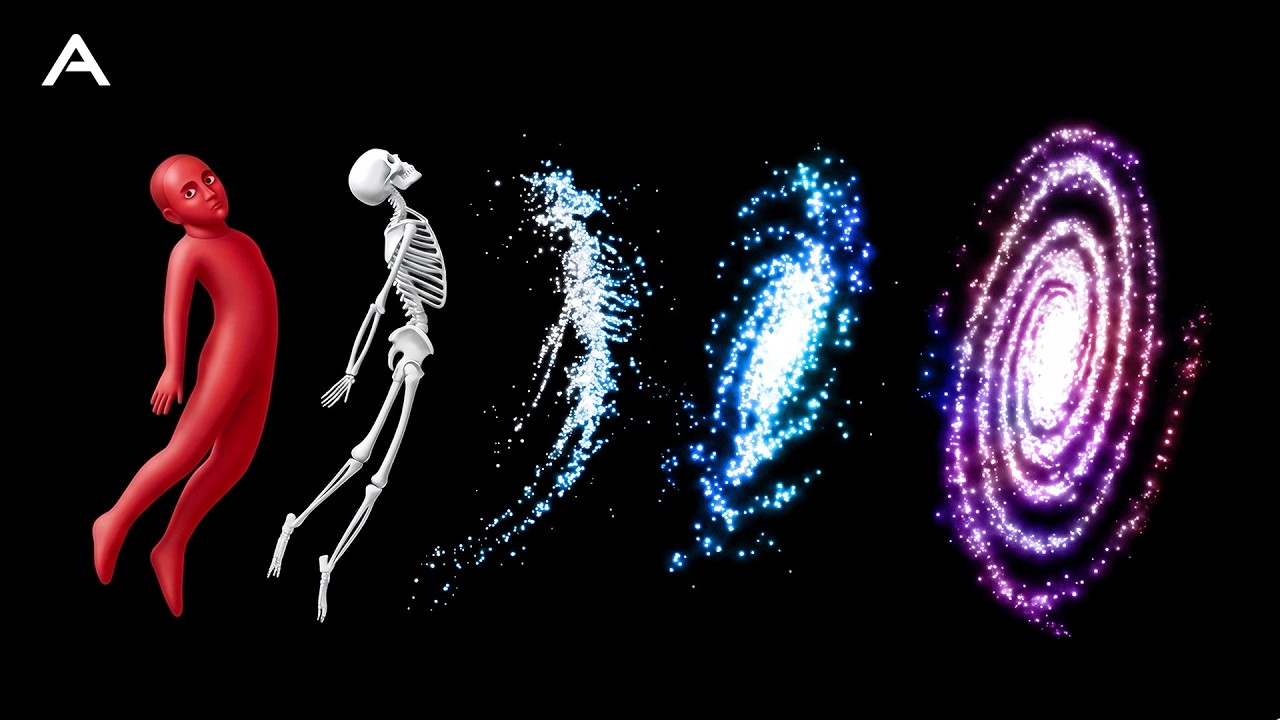
Then the actual question, the one he says has been quietly haunting archaeologists, geologists, and a growing number of independent researchers. What if civilization has not just risen once since the last ice age? What if it has risen and collapsed, risen and collapsed, over and over, in a cycle stretching back roughly 12,000 years? And what if we, right now, with our smartphones and satellites and skyscrapers, are simply the latest attempt. The seventh, according to some theories. The seventh civilization to climb up out of the ashes of whatever came before.
He is immediately up front about the status of that number. The 12,000 year cycle is not something mainstream archaeology accepts as settled fact. It is a provocative lens, a way of looking at scattered clues that do not quite fit the tidy story taught in grade school. Some of the evidence is solid. Some is speculative. Some is genuinely controversial, and he promises to be honest about which is which as he goes. But even the mainstream evidence, the part nobody disputes, is strange enough to keep you awake wondering how stable the ground beneath civilization actually is.
Then the hook that runs through all 172 minutes. Think about how permanent everything feels right now. Cities that have stood for centuries. Institutions. Governments. The internet connecting every corner of the planet instantly. It feels unbreakable. But history whispers a different story. Rome fell. The Bronze Age civilizations of the Mediterranean collapsed almost simultaneously in the span of a few decades, so completely that writing itself disappeared from Greece for centuries. Entire cities have vanished under sand, under jungle, under ocean, leaving barely a trace. If civilizations that felt permanent to the people inside them could disappear that thoroughly, what makes us so certain ours is different?
He lays out the route. Floods that reshaped continents. Coastlines that vanished beneath rising seas at the end of the ice age. Monuments built thousands of years before anyone thought organized civilization was possible. Myths of catastrophe told by cultures separated by oceans, echoing each other closely enough to be genuinely strange. The gaps in the archaeological record, the silences where history should be and isn't, and what kind of event could leave a silence that deep. By the end, he says, you will be able to decide for yourself whether this is coincidence, convergent myth making, or the fading fingerprint of something real.
Then the two housekeeping asides that are part of the channel's texture: drop a comment with your city and what time it is where you are (he loves picturing Sydney at sunrise, Toronto at midnight, London on a lunch break, all listening to the same mystery at different hours), and if you want to support the show, follow it on Spotify and leave a five star review. Then back to work: rewind the clock, not thousands of years, tens of thousands, because to understand what might have come before us we first need to understand how violently the world ended the last time everything changed.
What it would mean to be the seventh civilization (0:04:44)
Before going further he slows down to define terms, because the phrase seventh civilization gets thrown around like a settled number, as if archaeologists counted them off on a clipboard somewhere. They have not. Nobody has.
Being human and having civilization are not the same thing. Homo sapiens have existed for roughly 300,000 years. For the vast majority of that time our ancestors lived in small mobile bands, hunting, gathering, moving with the seasons, carrying everything they owned on their backs. That is not a failure, he insists. That is simply what human life looked like for almost the entirety of our existence. Civilization in the sense we usually mean it, cities, agriculture, writing, monumental architecture, is startlingly recent, a blink of an eye against the length of our tenure. So seven civilizations does not mean seven versions of humanity. It means seven attempts, real or theorized, at the complex, settled, interconnected societies we would recognize as civilization.
The number itself. He is completely up front: seven is not an archaeological consensus. There is no official tally. There is no buried tablet listing six prior civilizations. The number circulates mostly through alternative history circles, through certain interpretations of ancient myth and scattered geological anomalies. It is symbolic as much as anything, a way of framing a pattern that some researchers believe they can see. Other researchers look at the exact same evidence and see nothing more than coincidence, or the normal cycles of cultural rise and fall that require nothing mysterious at all. Hold the number loosely, he says. Think of it less as a fact and more as a lens, a way of asking a question rather than an answer already confirmed.
So what counts as a civilization? If we are going to talk about one collapsing or resetting or vanishing, we need to know what would be lost. Archaeologists generally look for a cluster of features:
- Permanent settlements. Places where people stayed put long enough to build with intention rather than camp and move on.
- Reliable food systems. Agriculture, or resource management sophisticated enough to support populations far larger than small foraging bands ever could.
- Trade networks. Goods, materials, and ideas moving across distances that require organization and trust between strangers.
- Institutions. Some form of leadership, law, religion, or shared authority coordinating large groups of people who are not all related to each other.
- Stored knowledge. Ways of preserving information beyond a single human lifetime, whether writing, oral tradition, or symbolic record keeping.
When most or all of those show up together, that is when archaeologists reach for the word civilization.
And then the distinction the whole video turns on. There is a real difference between collapse, continuity, migration, and total reset. A society can collapse politically while its people simply move somewhere else and carry their culture with them. That is transformation, not erasure. A civilization can decline gradually, folding its knowledge into whatever comes next, which is continuity, not disappearance. But a true reset, the kind this theory is actually asking about, would mean something far more severe: not just a government falling, but the near total loss of accumulated knowledge, with population crashing so completely that survivors are forced to start over from something close to zero.
So keep that standard in mind as the evidence arrives, he says. Floods, buried cities, strange monuments, myths that echo across oceans. Extraordinary claims like a hidden prior civilization demand extraordinary evidence, not just eerie coincidence. His stated job is not to convince you it is true. It is to hand you the evidence and let you weigh it.
- ~300,000 yr ago Homo sapiens. Anatomically modern humans exist. For nearly all of the time since, life is small mobile bands. Same brains, no cities.
- ~100,000 yr The long glacial world. Much of Earth locked into a glacial state. Ice sheets over northern North America, northern Europe, and huge parts of Asia, in places more than a mile thick.
- Last glacial maximum Sea level roughly 120 m lower. About 400 feet. Britain joined to Europe, the North Sea is Doggerland, the Bering Strait is Beringia, Southeast Asia is Sundaland, Australia and New Guinea form Sahul.
- ~19,000 yr ago The balance shifts. The planet begins warming. Ice retreats, forests move north, meltwater fills rivers, glacial lakes form behind retreating ice.
- 12,900 yr ago The Younger Dryas begins. Northern hemisphere temperatures drop sharply. Greenland ice cores record the change with startling speed. Near glacial cold returns for roughly 1,200 years.
- 12,800 yr ago The boundary layer. The dated horizon where impact researchers report platinum spikes, microspherules, nanodiamonds, melt glass, and the dark organic band called the black mat.
- 11,700 yr ago Pleistocene ends, Holocene begins. Abrupt warming. The start of the climate stability usually credited with making agriculture and civilization possible.
- 9,600 BCE Göbekli Tepe. The oldest known levels. T shaped limestone pillars over 5 m tall weighing many tons, raised by people who were not yet farmers.
- ~8,200 yr ago The Storegga Slide. A massive submarine landslide off Norway sends a tsunami across the North Sea basin, striking what was left of Doggerland.
- ~5,000 yr ago The first cities. Southern Iraq: Uruk, Ur, Eridu, Lagash. Writing appears, first as accounting. Egypt builds along the Nile.
- 2600 BCE Harappa and Mohenjo Daro. Planned streets, standardized brick sizes, drainage, weights to common standards, trade reaching Mesopotamia.
- 1200 BCE Late Bronze Age collapse. Hattusa abandoned, Mycenaean centres destroyed, Levantine cities burned, writing gone from parts of Greece for centuries.
- 1900 BCE onward The Indus transformation. Trade declines, cities disperse, standards fade. Not conquest. Rivers shift and monsoons change.
- 8th to 10th c. CE Maya southern lowlands decline. Monuments stop, courts weaken, populations fall. Northern centres continue. Maya people, languages, and descendants remain.
- 476 CE The last Western emperor removed. The symbolic fall of Rome. Latin, roads, law, coins, and churches carry on. The East runs another thousand years.
- 14th c. CE The Black Death. Perhaps a third to half of Europe dead. Villages emptied, labour systems broken. Civilization does not reset.
- 1815 Tambora. The eruption that produced the year without a summer, with crop failures and hunger across parts of the northern hemisphere.
- Now The seventh? A single global network of grids, supply chains, digital records, and shared trust. The narrator's real question is not what number we are, but what we would carry forward.
The world before 12,000 years ago (0:09:49)
Before you go looking for a lost civilization, he says, you have to understand the world it would have existed in. Not our world with its familiar coastlines, green river valleys, and crowded continents. The world of 12,000 years ago was an ice age world, and it was almost unrecognizable.
At the peak of the last glacial period, enormous sheets of ice covered northern North America, northern Europe, and huge parts of Asia. In places the ice was more than a mile thick. So much water was locked up in glaciers that global sea level sat roughly 120 metres lower than today. That is almost 400 feet. And when sea level drops by 400 feet, the map does not adjust. It changes completely.
The map you have never seen
- The English Channel was not a channel. Britain was connected to Europe by a broad stretch of lowland crossed by rivers, lakes, and migrating animals.
- The North Sea was not sea at all. It was a vast landscape now called Doggerland, where hunter gatherers likely lived, hunted, and travelled for thousands of years before rising water swallowed it.
- There was no Bering Strait. Between Siberia and Alaska there was Beringia, an enormous land bridge sometimes hundreds of miles wide. And he is careful here: it was not a narrow corridor people rushed across. It was a real landscape of grasslands, wetlands, rivers, herds, and human communities living at the edge of two continents.
- Southeast Asia was one landmass. Sumatra, Java, and Borneo were joined to the mainland in a single subcontinent archaeologists call Sundaland.
- Australia, New Guinea, and Tasmania were much closer together, forming the larger ice age continent of Sahul.
Think about what that means. Some of the places that would have been most attractive to human beings, coastal plains, river mouths, fertile wetlands, shallow fishing grounds, are now underwater. Not buried under dirt where somebody can dig a trench and find them. Under tens or even hundreds of metres of ocean.
That matters because coastlines are where people gather. They offer fresh water, fish, shellfish, birds, edible plants, transport routes, and access to several ecosystems in one place. A coastal group could hunt inland, collect food along the shore, travel by water, and trade with neighbours without crossing deserts or mountain ranges. If you were choosing a place to live in the ice age, a productive coastline would have been hard to beat.
But the coastline those people knew is mostly gone. And that, he argues, creates one of the most important problems in the entire lost civilization debate: we do not have a complete map of where ancient humans lived. We have a map of what survived above modern sea level. Those are not the same thing.
He then applies the brake in both directions, which is his habit throughout. That does not mean there was an advanced global civilization hiding beneath every continental shelf. It means the evidence is uneven. We have to be careful about confusing a gap in our knowledge with proof that nothing was there. And we have to be equally careful about treating that gap as proof that anything we want was there.
The ice age world was not empty
Far from it. Homo sapiens had already spread across much of Africa, Europe, Asia, and Australia. By at least 15,000 to 20,000 years ago humans were established in parts of the Americas too, though exactly when and how the first populations arrived is still debated. Some groups may have moved through Beringia. Others may have followed coastal routes. The details are contested. The broad picture is not: by the end of the ice age humans had reached almost every habitable corner of the planet.
But they were not living in cities. The accepted evidence says most people lived as hunter gatherers, in small communities, often mobile, adjusting their movements to seasons, animal migrations, plant harvests, and changing weather. Some numbered a few dozen. Others gathered into much larger seasonal camps when food was plentiful, when animals migrated through, or when neighbouring groups came together for trade, marriage, ritual, and storytelling.
And here he gets emphatic, because this is where the popular picture is worst. Hunter gatherer does not mean simple. It does not mean unintelligent. It does not mean isolated. And it definitely does not mean people were wandering around randomly waiting for farming to invent culture.
Ice age humans were skilled engineers of survival. They made tailored clothing in cold regions. They built shelters from wood, hide, bone, and stone. They made needles, cords, nets, spear throwers, traps, boats, and highly specialized stone tools. They understood animal behaviour, seasonal weather, medicinal plants, fire, migration routes, and landscapes in ways most of us have completely forgotten.
They created art. Cave paintings in Europe, Indonesia, and elsewhere show animals rendered with astonishing precision and imagination. Carved figurines, engraved bones, decorated tools, pigments carried over long distances. All of it points to minds capable of symbolism, ritual, and shared meaning.
And they maintained networks. A piece of obsidian found far from its volcanic source. Shells carried inland. Stone traded across hundreds of miles. Similar tool styles appearing across wide regions. These are clues that communities were connected, not necessarily by kingdoms or governments, but by relationships. Kinship. Exchange. Seasonal gatherings. Shared traditions passed from one generation to the next.
Some late ice age societies were getting especially complex. In the Levant, groups associated with the Natufian culture began living in more permanent or semi permanent settlements before full agriculture took hold. They gathered wild grains, hunted gazelle, built stone structures, and buried their dead in ways that suggest strong ties to particular places. In Japan, early Jomon communities were producing pottery while still relying heavily on hunting, fishing, and gathering.
So the old story, first primitive wandering, then suddenly farming, then civilization, is too neat. Real human history was messier. Different groups took different paths. Some became more sedentary because local resources allowed it. Some intensified the harvesting of wild plants. Some built ritual spaces. Some developed long distance trade. Some stayed mobile because mobility was the smartest response to their environment. There was no single road to civilization. There were countless experiments.
But there is still a line
And then, crucially, he draws it. There is still a major difference between complex hunter gatherer societies and the kind of civilization he defined earlier. Before 12,000 years ago we do not find persuasive evidence for cities on the scale of later Mesopotamia or Egypt. No writing systems. No states. No large bureaucracies. No industrial production. No global technological networks. There are no confirmed ice age roads linking continents, no archives of tablets, no clear remains of large scale metallurgy, no unmistakable machinery, no archaeological signature of a vanished high tech world.
And if such a civilization had existed, he says, it would be difficult to erase completely.
This is where the archaeological silence gets more complicated than it first appears. The deeper into the past you go, the less survives. Wood rots. Cloth disappears. Leather vanishes. Baskets, ropes, boats, houses made from reeds or branches: most of the actual material world of ancient people is simply gone. Even bones can dissolve in acidic soils. Coastal sites drown. Rivers shift their channels. Glaciers grind landscapes into rubble. Rising seas cover entire regions. Later farmers plough through older camps. Modern cities build over ancient settlements. A stone tool can survive 30,000 years. A wooden house usually cannot.
So of course the record gets thinner. It would be strange if it didn't. But thin is not the same as blank.
Archaeology still finds patterns. If millions of people had lived in dense cities for thousands of years, extracting metals, building ports, clearing forests, producing waste, trading across continents, and constructing monuments, we would expect more than a few ambiguous objects. We would expect layers of evidence. Mines. Quarries. Roads. Burials. Tools. Pollutants trapped in ice cores and sediments. Domesticated crops and animals spreading far beyond their natural ranges. The fingerprints of civilization are not always easy to find, but they tend to be everywhere once you know what to look for.
And so far, before the end of the ice age, those fingerprints point to something extraordinary but different. Not a lost industrial age. Not confirmed Atlantean cities. A world of adaptable human communities, increasingly skilled, increasingly connected, already building the cultural foundations that civilization would later stand on.
But that world was about to change with terrifying speed.
The end of the ice age, a world in violent transition (0:21:06)
The end of the ice age was not one event. It was not a single day when the glaciers melted and the modern world appeared. It was a long, uneven, often violent transition unfolding over thousands of years. But for the people living through it, it may have felt like the planet had become unpredictable.
For more than 100,000 years, much of Earth had been locked into a glacial world. Huge ice sheets covered northern lands. Global temperatures were lower. Rainfall patterns were different. Deserts expanded in some regions, grasslands spread in others, and sea levels fell far enough to turn entire continental shelves into dry land.
Then, beginning roughly 19,000 years ago, the balance started to shift. The planet warmed. That sounds like good news, and in many places it probably was: ice retreated from landscapes frozen or buried for millennia, plants moved northward, forests reclaimed regions that had been open tundra or cold grassland, rivers filled with meltwater, lakes formed behind retreating glaciers, and animal populations shifted to follow the changing vegetation.
But climate change does not hand out benefits evenly. A warming world is not simply a warmer version of the old one. It is a world where the rules are changing. The seasons change. The rains change. The migration routes change. The plants you have gathered for generations may no longer grow where they used to. The animals your community depends on may move away, decline, or disappear.
He makes it personal, which is his best move in the whole documentary. Imagine living in a place where your grandparents knew exactly when the river flooded, where the gazelle crossed, when the nuts ripened, where the fish gathered, and which valley offered shelter in winter. Then, over a few generations, those patterns begin breaking down. The river comes earlier, or later, or not at all. The old hunting grounds become forest. The familiar forest becomes dry scrub. A coastline that used to be miles away moves closer every year.
For communities without written maps, weather forecasts, grain silos, or governments capable of moving food across a continent, environmental knowledge was survival. And when the environment changed fast enough, knowledge inherited from the past could become dangerously outdated.
The Pleistocene to Holocene transition
This was the great transformation. The Pleistocene was the long ice age world. The Holocene is the warmer period we are still living in. The boundary between them, around 11,700 years ago, is usually presented as the beginning of the stable climate that made agriculture and civilization possible. Over the long term that is broadly true. But the route into that stability was anything but stable.
As temperatures rose, the great ice sheets collapsed back toward the poles. North America was still dominated by the enormous Laurentide ice sheet. Northern Europe had its own vast ice cover. Mountain glaciers retreated across many regions. Every year, meltwater entered rivers, lakes, and eventually the sea.
Which brings the lost landscapes back into the story. When water is locked in glaciers, sea level falls. When glaciers melt, sea level rises. That process raised global oceans by roughly 120 metres, around 400 feet, between the peak of the last ice age and the middle of the Holocene. But not at one smooth, gentle rate.
For long stretches, shorelines advanced inland gradually enough that people could adapt. A camp near the coast could be moved. A fishing ground could shift. Families could follow the waterline inland. But there were also periods when the rise accelerated dramatically, driven by pulses of melting ice and the destabilization of ice sheets. Scientists call some of these episodes meltwater pulses. The name sounds technical. The reality was enormous. At certain points, global sea level may have risen several metres per century, perhaps faster in particular regions depending on local geography.
That still sounds slow compared with a tsunami. But think about what several metres means for a flat coastal plain. It means salt water pushing up river valleys. It means freshwater marshes becoming tidal wetlands. It means villages that once stood safely inland becoming shoreline settlements, then islands, then memories. And because much of the land exposed during the ice age was low and flat, even a modest rise could drown huge areas.
Doggerland disappeared beneath the North Sea. Beringia was broken apart by the flooding of the Bering Strait. Sundaland fragmented into the islands of Southeast Asia. Coastal plains around the Mediterranean, the Persian Gulf, the Black Sea, the Bay of Bengal, and countless other regions were transformed beyond recognition.
For human beings these were not abstract changes on a map. They were lost hunting grounds, lost camps, lost burial places, lost routes between neighbouring communities, lost sources of stone, wood, shellfish, and fresh water. A group that had lived near a river mouth for hundreds of years could watch the sea move closer until the place itself was gone.
The plumbing of the planet changed too
The effects did not stop at the coast. Massive glacial lakes formed in North America and Eurasia. Some drained gradually. Others drained suddenly when ice dams failed, releasing astonishing volumes of water. Rivers changed course. Floodplains expanded. Sediment buried old landscapes. In some places the land itself rebounded upward after being freed from the crushing weight of ice. In others, rising water overwhelmed the shore.
Meanwhile rainfall belts shifted. As the climate warmed, monsoon systems strengthened in some regions and weakened in others. The Sahara, extremely dry during the coldest parts of the ice age, eventually entered greener phases with lakes, grasslands, and seasonal rainfall. Other areas faced growing aridity. Forests expanded into parts of Europe. Steppe environments contracted. The open grasslands that supported mammoths, woolly rhinoceroses, and vast herds of grazers began to fragment.
And many of those great ice age animals disappeared. The end of the Pleistocene saw the extinction of a remarkable number of large mammals: mammoths, mastodons, giant ground sloths, sabre toothed cats, giant deer, and many others vanished from parts of the world. The reasons are still debated. Climate change clearly played a role. Human hunting likely contributed in some regions. Disease, habitat change, and the combined stress of multiple pressures may have pushed vulnerable species over the edge.
The important point, he says, is that human communities were losing more than animals. They were losing entire ecosystems. If your people depended on a particular herd, a particular wetland, a particular seasonal run of fish, the disappearance of that resource could force a complete reorganization of life. You might move. You might broaden your diet. You might form new alliances. You might compete with neighbouring groups for territory. You might settle more permanently near a dependable spring or stand of wild grain. You might invent new tools, new storage methods, new rituals, new rules for sharing food.
Or you might not make it.
This is the part that gets lost when we talk about climate in averages. A global temperature change of a few degrees sounds almost trivial. Put on a sweater. Turn down the thermostat. But a few degrees in the global average can reorganize oceans, ice sheets, rainfall systems, coastlines, forests, and animal migrations. It can redraw the world.
And then the cold came back
Just as the warming seemed to be establishing a new direction, the climate delivered another shock. Around 12,900 years ago, temperatures in parts of the northern hemisphere dropped sharply. In Greenland the change appears in ice core records with startling speed. Conditions swung back toward near glacial cold. In Europe and North America, ecosystems that had begun adapting to warmer conditions were thrown into reverse. Colder, drier conditions returned to many areas. Glaciers advanced again in some mountain regions.
This is the Younger Dryas. It lasted roughly 1,200 years. That is a long time in a human life. Long enough for children to be born into a colder world than their parents expected. Long enough for settlements, migration routes, and food strategies to be remade. But in geological terms it was abrupt, a sudden interruption in the great warming trend.
The leading explanation involves changes in ocean circulation, possibly triggered by enormous releases of fresh water from melting ice sheets into the North Atlantic. Fresh water is less dense than salty sea water. Add enough of it to the ocean and you can disrupt the circulation patterns that transport heat northward. The exact sequence is still an active area of research, but the broad lesson is clear: Earth's climate system can change suddenly when it is pushed past a threshold. And humans at the end of the ice age were living close to those thresholds.
They did not need a planet wide apocalypse for their lives to be overturned. A failed rainy season could be catastrophic. A river changing course could break a local economy. A coastline moving inland could separate communities. A vanished herd could trigger hunger. A cold reversal lasting generations could undo adaptations that had taken centuries to develop.
This is why the end of the ice age matters so much to the question of lost history. Not because it proves a forgotten advanced civilization existed. It does not. But because it reveals a world where human societies were under extraordinary pressure at exactly the moment many of them were becoming more settled, more connected, and more dependent on particular landscapes. It was a world full of experiments. Some communities adapted. Some moved. Some changed their way of life. Some likely disappeared so completely that all we can see now is the empty space they left behind.
And the Younger Dryas has become the centre of one of the most controversial explanations for what happened next. Because some researchers and writers believe this cold reversal was not caused only by melting ice and disrupted oceans. They think something came from the sky.
The Younger Dryas impact hypothesis (0:33:30)
According to the Younger Dryas impact hypothesis, Earth may have encountered fragments of a comet or asteroid around 12,900 years ago. Not necessarily one giant object striking one obvious place and leaving a crater you could see from space. The proposed event is stranger than that: a swarm of cosmic fragments, perhaps from a breaking comet, entering the atmosphere over different parts of the planet. Some may have exploded in the air. Some may have struck ice sheets. Some may have hit land or shallow water. The result, supporters argue, was a chain reaction of fire, shock waves, ecological collapse, and abrupt climate disruption.
If true, it would be one of the most important disasters in human history. But that phrase matters, he says. If true. This is not settled science. It is not a proven impact event on the level of the asteroid that ended the non avian dinosaurs 66 million years ago. There is no universally accepted Younger Dryas crater. There is no single piece of evidence that forces every scientist to agree. What exists is a controversial collection of clues found in sediments across multiple continents, all apparently dating close to the beginning of the Younger Dryas.
The clues, one at a time
The argument begins in a very thin layer of dirt at archaeological sites, lake beds, peat bogs, and sediment deposits in North America, Europe, and elsewhere. Researchers have identified what they call the Younger Dryas boundary layer. In some locations it appears as a dark organic rich band. People sometimes call it the black mat. It sits right at the transition between the warmer period before the Younger Dryas and the sudden return of cold.
Within or near that layer, impact researchers report unusual materials.
Platinum. Platinum is rare in Earth's crust but relatively more abundant in certain meteorites and cosmic dust. Supporters point to platinum anomalies, spikes in platinum concentration in sediments dated to around 12,800 years ago. Similar spikes have been reported in Greenland ice cores, suggesting something unusual may have entered the atmosphere at roughly the same time. He immediately qualifies it: that does not automatically mean a comet hit Earth. Volcanic activity, normal extraterrestrial dust, local geological processes, and problems with dating or sampling can all complicate the picture. But a platinum spike is exactly the kind of clue you would expect scientists to investigate if they suspected an extraterrestrial event.
Microspherules. Tiny round particles, often smaller than a grain of sand. Some form when rock, soil, or metal is heated to extreme temperatures, melted, and rapidly cooled while flying through the air. Impact proponents argue that certain microspherules in Younger Dryas sediments show signs of extraordinary heat, containing unusual combinations of iron, titanium, and other elements, in some cases resembling debris produced by impacts or high energy air bursts.
He describes the mechanism plainly. Imagine a cosmic object entering the atmosphere at tens of thousands of miles per hour. The air in front of it compresses. Temperature rises. The object may fragment violently before reaching the ground. Material from the object, along with vaporized soil and rock from below, can rain down over a huge area as tiny melted droplets. That is what is being proposed. Not a Hollywood fireball that instantly destroys the whole planet. Something more uneven but still devastating: regional blast zones, massive wildfires, a shock to ecosystems already under pressure from rapid climate change, perhaps concentrated over North America where the Laurentide ice sheet still covered enormous areas.
Nanodiamonds. Diamonds so tiny they can only be identified with specialized instruments. Because nanodiamonds can form under intense pressure and high energy conditions, their presence has been presented as another potential impact marker.
And the rest. Other studies have described melt glass, magnetic grains, soot, and high temperature minerals.
Taken individually, he says, each clue has alternative explanations. But proponents say the pattern matters more than any single particle: platinum, microspherules, charcoal, melted materials, strange sediment layers appearing near the same point in time across widely separated locations. Their argument is that the simplest explanation is a cosmic encounter. And if that encounter happened, it may help explain why this particular moment looks so chaotic in both the archaeological and the environmental record.
What the hypothesis would explain
Around the beginning of the Younger Dryas, North America was losing many of its largest animals. Mammoths, mastodons, giant ground sloths, horses, camels, sabre toothed cats, dire wolves. Not every species disappeared at exactly the same moment, and not every extinction happened everywhere in the same way, but the broad pattern is real. By the early Holocene, much of the continent's great ice age megafauna was gone.
The impact hypothesis offers a dramatic answer: a cosmic disaster triggered continent scale fires, destroyed habitats, poisoned food chains, and delivered a final blow to animal populations already weakened by climate instability and human hunting. It is appealing, he grants, because it gives one enormous event the power to explain many mysteries at once. The cold reversal. The fires. The extinctions. The disappearance of the Clovis culture in North America. The widespread disruption facing human communities at the end of the ice age.
But nature is rarely that tidy
And here he turns the argument around, in the middle of the chapter, without softening it.
The extinctions. Most archaeologists and palaeontologists think the megafauna extinctions were probably caused by a combination of pressures, not one single catastrophe. Climate was changing rapidly. The grassland environments that supported mammoths and other large grazers were breaking apart. Forests, wetlands, and new plant communities were spreading. Humans were expanding into new territories, hunting animals that had never encountered such efficient predators. Different species declined at different times. Different regions show different patterns. Some animals survived far longer than the proposed impact date in isolated places: woolly mammoths held on at Wrangel Island in the Arctic until thousands of years after the Younger Dryas began. That does not rule out an impact contributing to stress in some regions, but it makes a simple one day extinction story much harder to defend.
The fires. Also debated. Some studies report major peaks in charcoal and soot around the boundary, suggesting widespread biomass burning. Other researchers argue those signals are inconsistent, locally variable, or too easily explained by ordinary wildfires in a changing climate. A warming, drying, shifting world can burn without a comet being involved. Forests and grasslands do not need an extraterrestrial trigger to catch fire. Lightning, he notes drily, is already very good at that.
The crater problem. Big impacts usually leave obvious geological scars. Chicxulub in Mexico left a crater roughly 180 kilometres wide. Even much smaller impacts can leave recognizable structures. For the Younger Dryas, researchers have proposed several possible sites, including a structure beneath the ice in northwest Greenland called Hiawatha crater. At first this seemed exciting: a crater under an ice sheet, near the right general region, associated with a period of major climate disruption. But later dating work suggested the crater may be much older than the Younger Dryas. The exact age remains difficult to pin down, but it is not currently accepted as proof of an impact 12,900 years ago.
And that is the central weakness. There is no agreed impact site. There is no universally accepted debris field. Several reported markers have been challenged by independent researchers. Some laboratories have failed to reproduce key findings. Others have questioned whether particular microspherules, nanodiamonds, or melt products are unusual at all. Dating sediments from 12,000 years ago is difficult. Layers can be disturbed. Material can move through soil. A sample that looks like one precise moment may actually represent decades or centuries of deposition.
Then the line that is the honest core of the whole chapter: in science, extraordinary claims do not become true because they are exciting. They become stronger when independent teams, using different methods, repeatedly get the same result. The Younger Dryas impact hypothesis has not reached that level of agreement. But it has not disappeared either. Researchers continue looking for clearer evidence, comparing sediment layers across continents, testing platinum concentrations, re examining melt glass, searching for impact structures beneath ice, ocean sediment, and changing coastlines. The hypothesis stays alive because the transition into the Younger Dryas was genuinely strange, genuinely abrupt, and still not fully understood in every detail.
And even if it happened, it proves nothing about a lost civilization
This is the sharpest passage in the documentary, and he does not hedge it.
Even if a cosmic impact or airburst eventually proves to have happened, there is another leap we cannot make. It would not prove a lost global civilization. A disaster is not evidence of a civilization. Fires do not reveal cities. Platinum does not reveal pyramids. Microspherules do not reveal an advanced people who possessed forgotten machines, mapped the stars, or ruled the world before the flood.
What an impact could demonstrate is something both more limited and more important. It could show that human societies living near the end of the ice age faced an additional, sudden, terrifying layer of disruption. Not just rising seas. Not just failing ecosystems. Not just a thousand year cold reversal. But perhaps a sky born catastrophe arriving when many communities were already vulnerable.
For small hunter gatherer populations, that would have been enough. You do not need an empire to lose a world. You only need a coastline where your grandparents lived, a valley where the herds once came, a trade route now buried under floodwater, a sacred place swallowed by fire, a season that never returns to normal.
And if people survived a shock like that, they would have carried its memory forward. Not as a scientific report. Not as a dated sediment layer. As stories. Stories of darkness, of fire from heaven, of a world drowned, of an age before the destruction.
And some of the strongest candidates for that lost human history, he says, may not lie beneath forests or deserts. They may lie beneath the sea.
Drowned landscapes, the lost coastlines of prehistory (0:46:24)
If the most important human landscapes of the late ice age are now underwater, then the apparent emptiness of the archaeological record may be partly an illusion. We keep searching on the land that remains above sea level. But 20,000 years ago the coastline was not where it is today. It was often hundreds of miles further out.
Entire river systems flowed across land that has since disappeared. Valleys where people could have lived, hunted, traded, buried their dead, and passed on stories are now sitting beneath the North Sea, the Persian Gulf, the Java Sea, and the waters between Alaska and Siberia. This was not a small strip of beach lost to erosion. It was a whole second world.
He walks the mechanism forward and back. Falling sea level: the ocean pulls back, continental shelves emerge, rivers extend outward across newly exposed land, cutting channels through broad grassy plains. Lakes form. Marshes develop. Animals follow fresh water and new vegetation. And humans, as they always have, follow the animals, the fish, the plants, and the reliable water. Then the ice age ends. The planet warms. Ice sheets melt. Sea level rises, not smoothly, but in powerful pulses over thousands of years. Lowlands flood. River mouths become estuaries. Camps near the old shore are swallowed. Eventually the sea moves so far inland that the people living there retreat, adapt, or disappear. The physical evidence of their lives goes underwater with them.
Underwater archaeology is hard
Really hard. On land an archaeologist can walk a field, spot a scatter of stone tools, dig a test trench, map a buried wall, examine layers of soil. Underwater, visibility can be almost zero. Currents move sediment. Waves erode surfaces. Fishing nets drag across the seabed. Modern ports, pipelines, and dredging operations disturb the bottom. A former settlement may be buried under metres of mud, or destroyed long before anyone had a chance to find it.
Even when researchers know where an ancient river valley once ran, they are not simply diving down and finding a prehistoric village in perfect condition. The sea is not a museum. It is a giant machine for breaking, burying, scattering, and hiding evidence.
But sometimes it preserves too. Waterlogged sediments can protect wood, bone, plant fibres, footprints, and other materials that would rot quickly on dry land. The problem is finding the right place. Researchers use sonar to map drowned river channels. They use seismic surveys, sending sound waves into the seabed to reveal layers hidden below. They take sediment cores, looking for ancient pollen, charcoal, animal bones, stone tools, and signs of human activity. It is slow, expensive work, and we have explored only a tiny fraction of the submerged landscapes that once stood above sea level.
Doggerland
The most famous example. Today the North Sea separates Britain from mainland Europe, but during much of the last ice age there was no North Sea as we know it. Britain was connected to the continent by a vast lowland plain stretching across areas now covered by water between England, the Netherlands, Denmark, and Germany.
It was not barren. Evidence from sediment cores and material dredged up by fishing boats suggests a changing landscape of rivers, lakes, wetlands, woodland, and open grassland. Mammoths, reindeer, red deer, wild cattle, and other animals moved through the region at different times. For hunter gatherers it may have been one of the richest zones in northern Europe: fresh water, wetlands full of birds and fish, herded animals, wood for fuel and shelter, stone and other raw materials carried along river systems. Fishermen have pulled up bones, antlers, ancient tools, and even pieces of worked wood from the North Sea floor.
None of this proves lost cities, he says. It does not reveal an ice age empire beneath the waves. But it proves something more solid: people lived in landscapes that are now gone.
And Doggerland did not vanish in a single day. Sea level gradually encroached for millennia, turning dry plains into marshes, marshes into islands, and islands into open water. But some events may have been terrifyingly sudden. Around 8,200 years ago a massive submarine landslide off the coast of Norway, the Storegga Slide, triggered a tsunami that struck parts of the North Sea basin. By then much of Doggerland was already flooded, but remaining coastal communities may have faced enormous waves sweeping across the last habitable areas.
Imagine watching the shoreline move inland within one lifetime. Then imagine a wall of water arriving across a landscape your grandparents remembered as dry land. That kind of experience, he points out, does not require a global flood to become a flood myth.
Sundaland
Far to the southeast lay another drowned world. During the ice age, much of what is now Indonesia was connected to mainland Southeast Asia. Lower sea levels joined the Malay Peninsula, Sumatra, Java, Borneo, and surrounding areas into a huge subcontinent. Rivers crossed plains that are now beneath the Java Sea and the South China Sea. The coastline was radically different, and so were the routes people used to move through the region.
Sundaland matters because Southeast Asia was already home to human populations long before the end of the ice age. Modern humans had reached the broader region tens of thousands of years earlier. They crossed islands, adapted to tropical forests, hunted, gathered, fished, and developed ways of surviving in one of the most ecologically complex places on Earth.
But many of the most favourable lowland zones were later inundated. As seas rose, the great Sunda plain fragmented into the islands we know today. Communities on higher ground became separated by water. Old river valleys became sea channels. Travel routes changed. Food sources changed. Entire ecosystems were rearranged. If archaeologists find fewer early sites in some coastal areas, that does not necessarily mean people avoided them. It may mean the sites are 50, 80, or 100 metres below the waves.
Beringia
Today the Bering Strait is a narrow body of water between Siberia and Alaska. During the ice age it was dry land, a broad region connecting Asia and North America. But Beringia was more than a land bridge people hurried across. For thousands of years it was a real homeland: a vast cold grassland steppe with rivers, lakes, grazing animals, and human populations adapted to the far north.
This matters because the first settlement of the Americas is still one of archaeology's biggest questions. People may have moved through Beringia in multiple waves. Some groups may have spent generations, even millennia, living there before expanding southward. Yet much of the old Beringian landscape is now submerged beneath the Bering and Chukchi Seas. The route into the Americas, he says, may literally be underwater.
The Persian Gulf basin
Today the Persian Gulf is shallow water bordered by Iraq, Iran, Kuwait, Saudi Arabia, Qatar, Bahrain, and the United Arab Emirates. But when sea levels were lower, much of that basin may have been a broad river valley fed by the Tigris, Euphrates, Karun, and other rivers. Some researchers have proposed that it formed a fertile refuge during dry phases of the ice age, a place with fresh water, wetlands, and resources capable of supporting substantial human populations. That is the Gulf Oasis hypothesis.
This remains a hypothesis. We do not yet have underwater excavations revealing a lost Gulf civilization. But the geography is compelling. Where major rivers meet a low basin near a changing coastline, humans tend to gather. That was true in later Mesopotamia. It may have been true much earlier too.
Why coastlines, and why it still is not proof
The central point of the chapter: early people were not idiots wandering randomly across empty continents. They understood landscapes. They knew where fresh water was. They knew which wetlands produced fish, shellfish, birds, reeds, and edible plants. They knew river mouths attracted animals. They knew coastlines offered predictable food in difficult seasons. Shellfish do not migrate. Tidal flats can be harvested. Estuaries concentrate life. Rivers are highways for mobile hunter gatherers.
Coasts were often not the edges of the world. They were the best places in it. Which means the places most likely to have supported dense populations, repeated seasonal camps, long distance exchange, and eventually more permanent settlements are precisely the places most vulnerable to post ice age flooding.
And then the brake again. That does not mean every mystery is solved by saying it is underwater. It does not mean a lost advanced civilization is waiting beneath the North Sea with temples, machines, and stone maps of the stars. If large urban societies had existed before 12,000 years ago, we would still expect traces on surviving land: mines, quarries, inland settlements, widespread tools, altered environments, unusual burial sites. The sea cannot hide an entire planet. But it can hide a huge and badly underexplored part of humanity's most favourable habitat.
That makes submerged landscapes the most plausible place to search for unknown chapters of early human history. Not a forgotten civilization in the grand fantasy sense. Something more likely and, in his framing, more profound: villages, camps, harbours, ritual sites, fishing communities, trading networks, populations whose lives were erased not because they failed to matter, but because the map itself changed beneath their feet.
The people of the late ice age may have watched their world shrink year after year. The old coast disappearing. The rivers drowning. Familiar hunting grounds becoming bays. Places of memory passing beyond reach. And as those displaced communities moved inland, they entered a world in crisis, competition, and rapid change. A world where, against all expectations, some people began building monuments.
Göbekli Tepe and the shock of early monument building (0:59:04)
One of the clearest signs of that transformation rises from a ridge in southeastern Turkey.
At first glance Göbekli Tepe does not look like the beginning of civilization. It looks like a hill: a rounded artificial mound built up over thousands of years by human activity, overlooking the plains near the modern city of Sanliurfa. But beneath that hill, archaeologists uncovered something that forced historians to rethink one of their most basic assumptions.
Massive stone circles. Not rough piles of rock, not a few temporary huts. Monumental enclosures built around enormous T shaped limestone pillars, some standing more than five metres tall and weighing many tons. The pillars were carefully shaped. Some were carved with foxes, snakes, wild boar, birds, insects, and strange abstract symbols. A few seem to represent stylized human beings, with arms, hands, belts, and garments carved into the stone.
And the oldest levels date to roughly 9,600 BCE, more than 11,000 years ago. That places Göbekli Tepe at the very beginning of the Holocene, in the unstable centuries after the Younger Dryas, when climates were warming, landscapes were changing, and human communities across southwest Asia were experimenting with radically new ways of living.
The sequence it broke
For a long time the standard story of civilization seemed straightforward. First people invent agriculture. Farming creates food surpluses. Surpluses allow larger populations. Larger populations create permanent villages. Villages produce labour specialization, religious institutions, rulers, and eventually temples, cities, writing, and states. Food first, monuments later.
Göbekli Tepe complicated that sequence, because the people who built its earliest known enclosures were not living in a world of fully developed farming villages. They were part of what archaeologists call the Pre Pottery Neolithic: a period before ceramics, before cities, before writing, and before agriculture had become the dominant foundation of life in the region. They hunted wild gazelle, wild cattle, deer, and boar. They gathered plants. They processed wild cereals. They used stone tools. They lived in communities already more settled and organized than older ice age bands. But they were not yet the grain growing societies of later Neolithic history.
And yet they hauled huge stones from local limestone outcrops. They shaped them using stone tools. They carved animals into them. They arranged them in circles and ovals. They built walls around them. Then, after generations of use, they deliberately filled some enclosures with rubble, bone, stone, and soil, burying their own monuments beneath the hill.
That is not the behaviour of isolated families meeting by chance. It suggests planning, coordination, and shared beliefs strong enough to bring people together repeatedly, perhaps from communities spread across the surrounding landscape.
The labour problem, stated honestly
He does not reach for anything exotic here, and he says so directly. Moving a multi ton pillar does not require alien technology or a vanished industrial civilization. Stone, rope, wooden levers, sledges, ramps, and a lot of determined people can accomplish remarkable things.
But it does require labour organization. Someone has to quarry the stone. Someone has to shape it. Someone has to prepare the site. Someone has to feed the workers. Someone has to decide what the carvings mean, where each pillar goes, and why people should return year after year to build more.
That means relationships bigger than a single household. Maybe seasonal gatherings. Maybe feasts. Maybe ritual obligations between separate groups. Maybe alliances created through marriage, exchange, shared hunting, and shared stories. In a changing world where food sources and territories were being rearranged, gathering at a sacred place could have been more than spiritual. It could have been a way to build trust between communities. A place to trade information. A place to negotiate access to resources. A place to find marriage partners. A place to remember ancestors. A place to turn scattered groups into something larger.
The carvings are wild, not civic
The imagery matters too. Göbekli Tepe is not decorated with wheat fields, kings, armies, or city life. Its imagery is overwhelmingly wild: predators, prey animals, dangerous creatures, birds, snakes, scorpions, foxes. The world of the monument builders was still deeply tied to hunting, wild landscapes, and the unpredictable forces of nature.
Some researchers see the enclosures as ritual structures. Others think they may have had multiple purposes: ceremonial gathering places, social centres, perhaps spaces where knowledge and identity were performed and passed down. We cannot read the beliefs of people who left no writing. But we can see that symbolism had become physically enormous. Ideas were being built in stone.
And it was not alone
This, he says, is one of the most important corrections to the mystery. Göbekli Tepe was not a single impossible site appearing out of nowhere, as if one isolated group had suddenly received knowledge from some lost super civilization. It belonged to a wider world of early Neolithic innovation across southwest Asia.
Nearby, Karahan Tepe has revealed more monumental T shaped pillars, carved figures, and complex structures. Other sites in the broader region, including Nevalı Çori, Çayönü, Tell Qaramel, and settlements across the Fertile Crescent, show communities building more durable architecture, storing food, gathering in specialized structures, managing wild plants and animals, and gradually changing the rhythm of daily life.
This was a regional transformation. Different communities trying different strategies. Some became more sedentary. Some intensified the harvesting of wild grains. Some began experimenting with cultivation. Some managed animals long before full domestication. Some created communal buildings. Some invested in ritual spaces. Over centuries and millennia, these experiments fed into the agricultural revolution.
So perhaps the question is not who taught hunter gatherers to build monuments. Maybe hunter gatherers, especially those living in rich environments with dense resources and strong social ties, were always capable of far more coordination than the old stereotype allowed.
That old picture imagined hunter gatherers as small, simple bands, moving constantly, barely surviving, with no time for architecture, ceremony, or complex social organization. But the picture was too flat. Hunter gatherer societies could be mobile without being primitive. They could have deep knowledge of landscapes, elaborate kinship rules, ritual traditions, long distance exchange networks, skilled artists, engineers, navigators, and social hierarchies. They could organize a feast for hundreds of people without having a king, a palace, or a tax system.
What the site actually shows
Göbekli Tepe does not show that civilization existed exactly as we know it before farming. It shows that the ingredients of civilization were already gathering: large scale cooperation, symbolic culture, shared sacred spaces, repeated gatherings, technical skill, social memory, and the ability to mobilize labour around an idea that could not be eaten, worn, or used as a weapon.
A monument is a message sent into the future. It says: we were here, we belong together, this place mattered, come back.
And that, he argues, is the real shock. Not that it proves a lost global civilization wiped from history. It does not. There is no evidence here for ice age empires, advanced machines, worldwide pyramids, or a single vanished people directing humanity from some hidden centre. The site is extraordinary precisely because it is human scale. It shows a local and regional society becoming more complex during a period of intense environmental and social change.
But it also warns against assuming that complexity begins only when we can see fields, walls, and cities. Before the first cities there were gathering places. Before writing there were symbols. Before kingdoms there were networks. And before agriculture fully transformed human life, people may have already discovered something that would transform it just as deeply: the power of bringing strangers together around a shared story.
When farming began, and why civilization accelerated (1:09:09)
That shared story may have helped create the conditions for the next transformation. Because once people began gathering in the same places more often, returning to the same valleys, storing food for the same seasons, and depending on the same patches of wild grain year after year, they began changing those landscapes.
At first the change may have been almost invisible. People cleared brush around useful plants. They protected stands of wild wheat and barley from grazing animals. They saved the largest seeds. They carried them back to camps. Some fell near homes. Some were deliberately planted. Over generations, humans began selecting plants without fully realizing they were doing it. The plants changed. And then humans changed with them.
This matters, he says, because agriculture was not invented on one morning by one genius who looked at a seed and said "I have an idea." It was a long experiment. Thousands of years of small decisions made by communities trying to survive in a world that was becoming warmer, wetter in some places, drier in others, and increasingly crowded with other people doing exactly the same thing.
Farming was invented more than once
- Southwest Asia. Communities began cultivating wheat, barley, lentils, peas, and flax, and gradually shifted from hunting wild sheep, goats, pigs, and cattle to managing them, breeding them, controlling where they moved and when they reproduced.
- China. Different communities began domesticating rice in the wetter river valleys of the south and millet in the drier north. Pigs became an important domestic animal. Later these farming systems supported some of the largest and most continuous populations on Earth.
- New Guinea. People were modifying wetlands and cultivating crops including taro and bananas surprisingly early. (The site he is pointing at is Kuk Swamp.)
- Mesoamerica. Communities experimented with squash, beans, chilli peppers, and eventually maize, a grass transformed through generations of cultivation into one of history's most important crops.
- The Andes. People cultivated potatoes, quinoa, and other highland crops while domesticating llamas and alpacas.
- Africa. Communities developed their own systems based on sorghum, pearl millet, yams, rice, and cattle, adapting agriculture to landscapes very different from the Fertile Crescent.
This, he says, is one of the biggest clues that farming was not simply a package handed down from one lost mother civilization. It emerged more than once. Not always at the same time. Not always using the same crops. Not always following the same path. But again and again, in places where people had settled into rich environments, formed larger social networks, and discovered that careful management of plants and animals could make food supplies more predictable.
The bargain
Predictable is the key word. For most of human history, survival meant following food. If the herds moved, you moved. If the berries failed, you moved. If one river dried up, you searched for another. Mobility was not a sign of failure. It was an intelligent response to a changing world.
But farming offered a different bargain: stay here. Work harder now. Plant seeds. Clear land. Build storage pits. Guard animals. Repair fences. Wait through the seasons. And if the rains come at the right time, if insects do not destroy the crop, if raiders do not take it, if disease does not sweep through the herd, you may harvest more food from one patch of land than a foraging group could collect from the same area.
That surplus changed everything. A family that produces only enough food for itself remains vulnerable, and one bad week can become a disaster. But a community that can store grain for months, perhaps years, has something new: a buffer against hunger, a resource that can feed people who are not farming. Which means some people can become tool makers, builders, traders, ritual specialists, healers, warriors, administrators. People whose daily work is no longer gathering food, but organizing the people who do.
This is where civilization begins accelerating. Not because farmers suddenly became smarter than hunter gatherers. They were the same humans, with the same brains, the same capacity for cooperation, invention, art, violence, and imagination. What changed was the energy system. Stored food is stored labour. A field of grain is sunlight turned into calories. Calories turned into human time. Human time turned into walls, roads, temples, boats, weapons, palaces, and eventually writing.
And population growth could be explosive. Mobile hunter gatherer mothers often had to space births apart, partly because carrying several very young children over long distances is incredibly difficult. Settled communities could support more children. Soft grain foods could help wean infants earlier. Villages grew. Villages became towns. Towns became cities.
The bill for the bargain
But this is where the old story gets misleading, and he spends real time on it.
Work. Early farmers often worked longer hours than foragers. Grinding grain is brutal work. Clearing land is brutal work. Planting, weeding, harvesting, threshing, hauling water, tending animals, protecting food stores: all of it is relentless.
Health. Early agricultural diets could be less varied than foraging diets. Skeletons from some early farming communities show signs of malnutrition, tooth decay, anaemia, and stunted growth. A person living on a narrow diet of grain might have more calories than before, but not necessarily better health.
Disease. Foraging bands were usually small and mobile, and waste did not accumulate in one place for generations. Permanent settlements brought people, animals, parasites, garbage, and contaminated water into close contact. A village is a powerful machine for creating security. It is also a powerful machine for spreading infection. Domesticated animals introduced new disease risks. Dense populations allow epidemics to persist and spread. As settlements grew into cities, sanitation often failed to keep up. Civilization gained the ability to concentrate people and resources. It also gained the ability to concentrate misery.
Theft, and then hierarchy. Surplus food created another problem: it could be taken. A stored harvest is visible. A granary is tempting. A herd can be stolen. A field cannot run away from an invading army. For a mobile group, conflict might mean abandoning a territory and moving elsewhere. For farmers, the land itself becomes the source of life, so boundaries matter more, ownership matters more, inheritance matters more. And once land, grain, animals, and labour can be controlled, inequality becomes easier to build and harder to escape. Some households accumulate more fields. Some lineages claim sacred authority. Some leaders organize irrigation, storage, and defence, then demand tribute for doing it. Over time, the people coordinating the surplus may become the people who own it.
He is careful with the causality: this is how villages can develop hierarchy. Not inevitably. Not everywhere. Human societies have always experimented with different arrangements. But agriculture made large differences in wealth and power possible on a scale small mobile groups could rarely sustain.
Dependence is the real product
So farming did not simply create civilization. It created a new kind of dependence. A farmer depends on the weather. A village depends on the harvest. A town depends on the villages around it. A city depends on trade routes, labour systems, water management, political order, and the continued flow of food from fields it may never even see.
The more productive the system becomes, the more moving parts it has. And the more moving parts it has, the more ways it can fail.
A drought that might once have pushed a small foraging group to seek another valley could now destroy the crops of tens of thousands of people rooted to one river basin. A flood could wipe out irrigation works. A new disease could race through crowded streets. A rival city could burn granaries at exactly the moment the rains failed. Farming made humanity more powerful, but it also made humanity more fragile in ways our ancestors had never experienced.
Civilization was not an inevitable destination waiting at the end of human progress. It was a delicate system. A bargain with the land, with the climate, and with each other.
The first known civilizations and their built in fragility (1:19:20)
Once surplus, population, trade, and political power reached a certain threshold, villages stopped behaving like villages. They became cities. Not everywhere, not all at once, and not because one single people discovered a secret the rest of humanity copied. Civilization emerged independently in several parts of the world, in different landscapes, with different crops, different gods, different languages, and different answers to the same basic problems. How do you feed thousands of people in one place? How do you organize their labour? How do you store enough food to survive a bad year? And how do you keep the whole machine from falling apart?
The first known large scale civilizations almost always appeared near rivers. That was not a coincidence.
Mesopotamia: mud, water, grain, and organization
Between the Tigris and Euphrates, farming communities had been growing for thousands of years. Then, around 5,000 years ago, settlements in southern Iraq began turning into some of the first true cities: Uruk, Ur, Eridu, Lagash.
It was a difficult landscape. The rivers could provide rich soil, but they were unpredictable. Floods did not arrive with the regular rhythm of Egypt's Nile. Rainfall was limited. Farmers depended on canals, levees, reservoirs, and constant maintenance. Mesopotamian civilization was built from mud, water, grain, and organization.
Someone had to direct workers to dig canals. Someone had to decide who received water when supplies ran low. Someone had to collect grain, distribute rations, record debts, organize temple labour, and defend the city against its neighbours. And eventually, someone had to write it down.
The earliest writing we know of appears in this world, probably first as an accounting tool. Marks pressed into clay, tablets tracking sheep, barley, beer, labourers, land, and deliveries. Writing did not begin with poetry. It began with paperwork.
But paperwork can become power. If you control the records, you can define who owes grain, who owns land, who has paid tribute, who belongs to which household, and who is expected to work when the city calls. From those clay tablets, kings, priests, merchants, and administrators step out of the darkness.
But most people do not. The people planting barley in flooded fields, carrying bricks in brutal heat, grinding grain until their hands ached, raising children during epidemics, or dying young in crowded neighbourhoods, rarely wrote their own stories. We know they existed because of their bones, their homes, their tools, their graves, and the ration lists that counted them. Civilization gave humanity history. But it also gave history a bias. The people closest to power left the loudest voices. Everyone else survives as a shadow.
Egypt: the most durable state, still waiting on rain
To the west, Egypt was building a different version of the same system along the Nile. Here the river's annual flood was often more predictable. Water rose, spread rich silt across the floodplain, then retreated. If the timing was right, crops could be planted in the wet soil left behind. That seasonal rhythm helped support one of the most durable states in ancient history.
Egyptian rulers could mobilize labour on a massive scale. They built temples, tombs, canals, storehouses, and eventually pyramids so enormous they still make us ask how a Bronze Age society moved that much stone.
But the pyramids can make Egypt look invincible. It wasn't. Egypt depended on the Nile continuing to behave within a narrow range. Too little flood and fields dried out. Too much flood and settlements, crops, and infrastructure could be destroyed. A sequence of weak inundations could mean hunger, unrest, and political breakdown. Even a kingdom that could build monuments for eternity was still waiting on the rain that fell far to the south.
And that is the pattern: civilizations looked powerful because they concentrated resources, but that concentration created vulnerabilities no small village had ever faced.
The Indus: complexity on a continental scale
In the Indus Valley, cities such as Harappa and Mohenjo Daro rose along river systems in what is now Pakistan and northwest India. By around 2600 BCE they had planned streets, standardized brick sizes, sophisticated drainage, long distance trade, and administrative systems spread across an enormous region.
Their cities were not just large. They were coordinated. Bricks made to common proportions. Weights measured to common standards. Goods moving between distant settlements. Trade reaching Mesopotamia by land and sea. This was complexity on a continental scale, and it depended on rivers, monsoon patterns, farming, transport, and political cooperation continuing year after year.
China, and the rest
In northern China, communities along the Yellow River developed millet farming, settled villages, bronze technology, walled centres, and eventually early dynastic states. Further south, rice agriculture supported dense populations in wetter regions. Here too, water was both the source of life and the source of danger. The Yellow River carried fertile sediment, but that sediment also made it unstable. Channels could shift. Floods could be catastrophic. Drought could devastate harvests. States that claimed to bring order to the land were always struggling against a landscape that refused to stay orderly.
And beyond these famous centres, other complex societies were taking shape. In the Andes, people built agricultural systems adapted to mountains, deserts, and extreme altitude. In Mesoamerica, farming communities using maize, beans, squash, and other crops would eventually produce cities, calendars, monumental architecture, and powerful states. In Africa, the Nile Valley, the Sahel, and other regions developed their own networks of trade, farming, cattle herding, and political complexity.
There was no single birthplace of civilization. There were multiple experiments. And each experiment discovered the same uncomfortable truth.
A city is not a pile of buildings. It is a flow.
Food flowing in from fields. Water flowing through canals. Goods flowing along trade routes. Orders flowing down through officials. Taxes flowing into storehouses. Information flowing through scribes, messengers, merchants, priests, and rulers. Stop enough of those flows and stone walls cannot save you.
A city can survive a bad harvest. It might survive a flood. It might survive war. But when several pressures arrive together, drought, conflict, disease, trade disruption, political division, ecological damage, the system can begin failing faster than anyone expects.
This is what makes collapse important, he says. Not as one giant mysterious event that wipes every civilization from the map at the same moment, but as a recurring process. States rise by solving problems of coordination. Then they grow dependent on the solutions they created. Their populations expand. Their institutions become more complicated. Their elites demand more resources. Their fields become more intensively used. Their trade routes stretch further. And eventually a system designed to control uncertainty can become too rigid to survive it.
The first civilizations were extraordinary achievements. They created writing, law, cities, engineering, bureaucracy, long distance trade, and monuments that still stand after thousands of years. But they were never separate from nature. They were built inside it. And when climate, water, disease, war, or political failure pushed too hard, even the greatest cities could discover that their strength had been fragile all along.
Civilizations that collapsed in plain sight (1:28:30)
And we do not have to imagine what that looks like. We have seen it happen. Not once. Again and again. Not in some unreachable lost age before writing, not in a world erased so completely that all we have are legends. These were civilizations with palaces, ports, armies, records, taxes, trade routes, kings, temples, and cities full of ordinary people who probably believed the system would continue because it always had.
Then it didn't.
The Late Bronze Age collapse, around 1200 BCE
For centuries the eastern Mediterranean had been one of the most interconnected worlds on Earth. Egypt traded with the Hittite Empire. Mycenaean Greece traded with cities in Cyprus, the Levant, Anatolia, Mesopotamia, and beyond. Copper came from one region. Tin came from another. Grain, timber, luxury goods, weapons, pottery, horses, and diplomatic gifts moved across the sea in vast networks. Kings wrote letters to one another. They arranged marriages between royal families. They exchanged gold, silver, ivory, and complaints.
It was, in his phrase, a Bronze Age version of globalization. And like any highly connected system, it was efficient right up until the moment it became fragile.
Then, within a relatively short period, palace after palace went dark. The Hittite capital of Hattusa was abandoned. Mycenaean centres in Greece were destroyed or declined. Major cities along the Levantine coast were burned. Trade networks fractured. Writing disappeared from parts of Greece for centuries. Egypt survived but emerged weakened from attacks, internal pressures, and economic strain.
For a long time people wanted one clean explanation. Maybe invading warriors, remembered in Egyptian texts as the Sea Peoples. Maybe drought. Maybe earthquakes. Maybe rebellion. Maybe the collapse of trade. But the evidence points to something more unsettling: it was probably all of those things interacting.
A drought reduces harvests. Poor harvests create hunger. Hunger drives migration. Migration triggers war. War interrupts trade. Interrupted trade means no tin for bronze. No bronze means weaker armies, broken tools, disrupted farming, and a government suddenly unable to provide the order it promised. One failure creates another. Then another.
The system does not collapse because one thing breaks. It collapses because too many things break before anyone can repair the first one.
And the people living through it may not have understood they were witnessing the end of an age. A farmer sees a bad harvest. A merchant sees ships failing to arrive. A soldier sees unpaid troops. A king sees enemies at the border. A family sees food prices rising. Nobody sees the whole machine coming apart.
(Here he pauses for the one plug in the body of the documentary: the channel's book on 12 unexplained mysteries is available through the website.)
The Maya: decline is not extinction
The classic Maya civilization did not vanish overnight. That, he says, is one of the biggest misunderstandings about collapse.
The Maya were never one single empire. They were a network of powerful city states spread across southern Mexico, Guatemala, Belize, Honduras, and El Salvador. Cities competed, formed alliances, fought wars, built pyramids, created astonishing art, developed sophisticated calendars, and recorded dynasties in stone.
Then, between roughly the 8th and 10th centuries CE, many major cities in the southern lowlands declined. Monuments stopped being commissioned. Royal courts weakened. Populations fell. Some urban centres were abandoned.
Why? Again, no single villain. Climate records from lake sediments and cave formations suggest repeated droughts struck parts of the Maya world during this period. In a landscape where rainfall was seasonal and water storage was essential, even several years of reduced rain could be devastating. But drought alone does not explain everything. Maya cities were already under pressure from warfare between rival states, competition among elites, population growth, environmental strain, and the enormous demands of feeding dense urban populations. Forests were cleared for fields, fuel, and construction. Soils could be exhausted. Political rulers were expected to maintain ritual order and deliver prosperity. When crops failed, when enemies attacked, when reservoirs ran low, faith in those rulers may have failed too.
The cities did not simply disappear. People moved. Power shifted. Northern Maya centres continued and in some cases expanded. Maya languages survived. Maya communities survived. Maya descendants are still here. What collapsed was not a people. It was a particular political and urban order.
That distinction matters, he says, because collapse often sounds like extinction. Usually it isn't.
The Indus: transformation under pressure
The Indus tells a similar story. At its height it was one of the largest urban cultures in the ancient world: Harappa, Mohenjo Daro, and hundreds of other settlements linked by shared standards, trade, craft production, and a writing system we still cannot fully read.
Then, after around 1900 BCE, the great cities began changing. Long distance trade declined. Urban populations dispersed. Standardized systems became less visible. Some settlements were abandoned. Others became smaller and more local.
For generations, popular accounts blamed an invading army. But archaeology has not supported the old story of a single violent conquest destroying the Indus world. What we see instead is transformation under pressure. River systems shifted. Monsoon patterns changed. Some agricultural zones became less reliable. Trade connections with Mesopotamia weakened. Large cities may have become harder to maintain. Communities adapted by moving eastward, reorganizing, and living in smaller settlements better suited to a changing environment.
The civilization did not blink out. It changed shape.
Rome: the word collapse at its most misleading
Rome is perhaps the ultimate example of how misleading the word collapse can be. The Western Roman Empire fell apart politically during the 5th century CE. Emperors came and went. Tax systems weakened. Armies fragmented. Provinces broke away. In 476 the last Western emperor was removed from office, a date often used as the symbolic fall of Rome.
But Rome did not vanish in 476. People still spoke Latin. They still farmed Roman land. They still used Roman roads, Roman laws, Roman coins, Roman churches, Roman titles, and Roman ideas of authority. The Eastern Roman Empire continued for almost another thousand years from Constantinople. In some Western regions life became poorer, less connected, and more dangerous: cities shrank, long distance trade declined, public institutions weakened. But in other places, old and new systems blended. Roman culture did not die. It became medieval Europe.
The lesson hiding in all of them
Real collapse is usually not a single global reset. It is complex, regional, uneven. One city burns while another grows. One kingdom disappears while its language survives. One trade network fails while people build another. A dynasty falls, but farmers keep planting. An empire breaks, but its religion, laws, genes, stories, and technologies move forward into the next world.
Civilizations can collapse in plain sight, he says, not because nobody leaves evidence, but because the evidence does not give us the simple ending we want. It gives us something far more disturbing: a world can be falling apart, and the people inside it may still be living ordinary lives, solving ordinary problems, right until the moment the old rules no longer work.
And when the old rules stop working, people do not just lose buildings, governments, and trade routes. They lose certainty. They need an explanation for why the world their parents knew is gone. And sometimes they preserve that explanation as a story.
Why disaster myths appear around the world (1:38:18)
A flood. A fire from the sky. A winter that never ends. A warning ignored. A small group of survivors climbing into a boat, a mountain, a cave, or some impossible refuge while the rest of the world disappears beneath water.
This is where the mystery gets especially tempting, because flood stories appear almost everywhere.
The catalogue
Mesopotamia. One of the oldest written versions. In the Epic of Gilgamesh, a man named Utnapishtim is warned that the gods plan to destroy humanity with a great flood. He builds a massive boat, brings living creatures aboard, survives the waters, and later releases birds to discover where the land has returned. The story is older than the biblical account of Noah, though the similarities are impossible to miss: a divine warning, a chosen survivor, a vessel, animals saved from destruction, birds sent out over endless water, then dry land, then renewal.
Greece. Deucalion. Zeus decides humanity has become corrupt and sends a flood to wipe it away. Deucalion and his wife Pyrrha survive in a chest like boat. When the waters recede they land on a mountain and begin repopulating the world.
South Asia. The story of Manu. A tiny fish warns him a devastating flood is coming. Manu protects the fish, and in return the fish tells him to build a boat. When the flood arrives, the fish guides Manu through the waters until he reaches safety. Afterward Manu becomes the ancestor of a renewed humanity.
North America. Among some Indigenous peoples, stories tell of an earlier world overwhelmed by water. In several versions, survivors escape on a raft or reach higher ground. Animals dive beneath the floodwaters to bring up mud, and from that mud a new world is formed. (This is the earth diver motif.)
Mesoamerica and the Andes. Traditions of earlier ages destroyed by floods, storms, or cosmic disorder before the present world began.
Oceania. Island communities preserved stories of rising seas, drowned lands, and communities forced to flee from coasts and low lying islands.
Australia. Some Aboriginal oral traditions may contain memories of coastlines changing as sea levels rose after the last ice age. Not a complete record of one single event frozen perfectly in words for thousands of years, he is careful to say, but possibly fragments of real landscapes remembered long after those landscapes vanished beneath the sea.
Similar enough to wonder, different enough to be careful
That is the key line of the chapter. These myths are similar enough to make you wonder, but different enough to make you careful, because a flood is not an exotic human experience. It is one of the most basic disasters imaginable.
If you live beside the Tigris and Euphrates, rivers can rise suddenly and destroy fields, homes, and entire settlements. Mesopotamia was built on fertile floodplains, and the same water that made civilization possible could turn deadly without warning. If you live in Greece, heavy rains can transform narrow valleys into violent torrents. If you live in South Asia, monsoon floods can reshape whole regions. If you live along the coasts of the Americas or Oceania, storm surges, tsunamis, and rising seas can erase familiar shorelines in a single day, or slowly consume them over generations.
A local disaster can feel global when it destroys everything a community knows.
He makes it concrete, and this is the best paragraph in the documentary. Imagine a village of a few hundred people living on a river plain. Their entire world might extend twenty miles in every direction. Their relatives live nearby. Their food comes from nearby fields. Their sacred places, burial grounds, and trade routes all exist within that small universe. Then the river rises. The fields vanish. The houses collapse. Bodies wash away. The survivors climb to a ridge and look down at water stretching across every place they have ever called home.
To them, it may as well be the end of the world. And for their world, it is.
How a memory becomes a myth
That experience can become a story told to children, then grandchildren, then people living centuries later, long after the original river has changed course and the details have become sacred.
The flood may grow larger with every retelling. The local valley becomes the whole land. The whole land becomes the whole world. A family becomes the only survivors. A warning from an elder becomes a warning from a god.
That does not mean the story is false. It means it has been shaped by memory.
Oral tradition can preserve astonishing information. It can carry place names, migration routes, ecological knowledge, seasonal patterns, and warnings about dangerous places across many generations. In societies without writing, memory is not a casual thing. It is a survival technology.
But memory is not a video recording. Stories change because people change them. They absorb new religious ideas, new languages, new enemies, new landscapes, and new fears. And separate communities can create similar stories independently, because they face similar disasters and ask similar questions. Why did this happen? Who survived? Could we have been warned? What do we do now?
That is why flood myths so often contain the same emotional structure: destruction, survival, warning, renewal. First the old world becomes corrupt, unstable, or cursed. Then a disaster arrives. Most people ignore the danger or cannot escape it. A small group survives through preparation, luck, courage, or divine favour. And from those survivors, a new world begins.
It is not just a story about water. It is a story about collapse, about the terrifying possibility that everything familiar can disappear, and about the equally powerful hope that something can continue. A seed. A boat. A family. A memory.
The leap too far
This, he says, is where people sometimes make a leap too far. They see flood stories from Mesopotamia, Greece, India, the Americas, and Oceania, and conclude they must all be distorted memories of one worldwide catastrophe.
It is possible that some traditions preserve echoes of major ancient events. The end of the ice age brought enormous sea level rise. Coastlines moved inland. River systems changed. Lakes burst through natural barriers. Volcanic eruptions, tsunamis, and regional floods struck human communities whose histories were never written down.
But similar myths are not proof of a single global flood. They may be evidence of something both simpler and more profound: humans everywhere have lived with nature's capacity to destroy the places we depend on, and humans everywhere have tried to make meaning from survival.
And then the question that refuses to go away. If the world after the ice age really did swallow vast coastal landscapes, if whole communities watched their homelands disappear beneath rising water, could some of those stories point toward places we have not found yet? Not lost continents. Not necessarily forgotten super civilizations. But drowned worlds that were once real.
And once you start looking for drowned worlds, one name rises above all the others.
Atlantis, Lemuria, and the seduction of lost worlds (1:47:03)
Atlantis. The word has become almost impossible to separate from the images it now carries: a magnificent island empire, crystal towers, advanced machines, secret knowledge, a civilization more sophisticated than our own, destroyed in a single night beneath a wall of water.
None of that, he says, is how Atlantis began.
What Plato actually wrote
Atlantis comes from Plato, the Greek philosopher writing around 360 BCE. The story appears in two dialogues, Timaeus and Critias. In them, an Athenian statesman named Solon supposedly heard an ancient tale from Egyptian priests. They told him that 9,000 years before his time, a powerful island kingdom beyond the Pillars of Hercules, what we now call the Strait of Gibraltar, had attacked ancient Athens.
Atlantis was rich, powerful, and vast. It had fertile land, great harbours, impressive architecture, and enormous military strength. But it had become greedy. Its people had abandoned virtue in favour of conquest and luxury. Athens, in Plato's version, resisted them. Then came the punishment: earthquakes, floods, and in a single terrible day and night, Atlantis disappeared beneath the sea.
That is the original story. And even there, he says, the mystery begins. Was Plato reporting a real Egyptian tradition? Was he preserving a distorted memory of an ancient disaster? Or was Atlantis a philosophical invention, a warning disguised as history?
Most classicists lean toward the last explanation. Plato was not writing modern history. He was using stories to explore big questions about morality, politics, and the fate of societies. Atlantis is presented as the opposite of Plato's ideal state: wealthy but corrupt, powerful but undisciplined, technologically impressive perhaps, but spiritually rotten. Its destruction makes a point. A civilization can look invincible right up until the moment its own arrogance destroys it.
And there is another complication. Plato never finished the story. Critias breaks off in the middle of the narrative, just as the gods are preparing to judge Atlantis. We never get the final speech. We never learn whether Plato intended a deeper explanation. The lost ending left a gap, and humans, he notes, have always been very good at filling gaps.
Donnelly, 1882
For centuries Atlantis remained mostly a strange philosophical tale from ancient Greece. Then, in the modern age, it became something much bigger.
During the 19th century, Europeans were discovering fossils, mapping continents, excavating ancient ruins, and realizing that human history was far older and stranger than anyone had imagined. Egypt had pyramids. Mesopotamia had buried cities. Troy, once thought to be pure legend, appeared to have a real archaeological foundation. If Troy had been real, people asked, why not Atlantis?
In 1882, an American writer named Ignatius Donnelly published Atlantis: The Antediluvian World. Donnelly argued that Atlantis had been a real lost continent in the Atlantic Ocean, the mother civilization from which Egypt, the Maya, and cultures across the world had inherited their knowledge. Pyramids, flood myths, similar symbols, ancient engineering: all of it became evidence in his eyes.
The problem, he says flatly, is that similarity is not the same as connection. Humans in different places can build pyramids because a pyramid is a stable way to stack stone. They can tell flood stories because floods happen. They can develop calendars because seasons matter. They can create myths about gods descending from the sky because the sky is where lightning, rain, eclipses, and terrifying celestial objects come from.
But Donnelly's book was enormously influential because it offered something archaeology often cannot: one grand answer, one lost source, one hidden civilization behind the scattered mysteries of the ancient world.
Lemuria, which started as science
Lemuria began as a scientific proposal, though not in the way people often imagine. In the 1860s, before plate tectonics was understood, the British zoologist Philip Sclater noticed that lemur fossils and related species appeared in Madagascar and India but not across much of Africa or the Middle East. To explain the pattern he proposed that a lost land bridge or continent might once have connected parts of the Indian Ocean. He called it Lemuria, after the lemurs.
At the time this was not unreasonable. Scientists knew continents and species distributions posed difficult questions. They just did not yet know that continents move.
Then plate tectonics changed everything. We now understand that India was once part of an ancient southern supercontinent, Gondwana, before drifting north and colliding with Asia. Madagascar separated through geological processes unfolding over vast spans of time. There was no need for a recently sunken human civilization called Lemuria.
But the name survived, and it changed. Writers, occultists, and spiritual movements turned Lemuria into an ancient paradise. Some claimed it was older than Atlantis. Others described it as the birthplace of humanity, populated by enlightened beings with psychic powers, forgotten sciences, or wisdom far beyond modern civilization.
And Mu
Then there was Mu, another supposed lost continent, usually placed in the Pacific. A writer named James Churchward claimed that ancient tablets revealed a vast civilization destroyed by catastrophe tens of thousands of years ago. Like Atlantis and Lemuria, Mu became a blank canvas for every dream of lost human greatness.
The evidence, however, never appeared. No ruins. No inscriptions. No artifacts that could be securely dated and connected to these continents.
And geology gives an even more basic problem. Continents do not usually sink suddenly into ocean basins like stones dropped into a lake. Continental crust is thick and buoyant. Oceans form through tectonic processes operating over millions of years. Islands can collapse. Coastlines can drown. Volcanic land can vanish beneath waves. But an entire advanced continent disappearing in a single catastrophic night is not how Earth's crust behaves.
The drowned worlds that are real
That does not mean there are no drowned worlds. There absolutely are, and he lists them again deliberately, right next to the fictional ones. The North Sea once contained Doggerland, inhabited by hunter gatherers before rising seas consumed it. The Sunda Shelf connected much of Southeast Asia during the ice age. Coastal plains around the Mediterranean, the Persian Gulf, the Black Sea, and countless river deltas were transformed as glaciers melted and oceans rose.
These places were real. People lived there. Some may have had settlements, trade routes, sacred sites, and stories we will never recover because they now lie beneath sediment and seawater. That is already astonishing enough.
But Atlantis offers something archaeology cannot. Archaeology gives us fragments: a stone tool, a buried wall, charred grain, a grave, a shoreline mapped beneath the sea. Atlantis gives us a complete lost world. It gives us the thrilling possibility that history has been hiding its greatest chapter, that somewhere beneath the Atlantic, the Pacific, or the polar ice lies proof that we are not the first people to build cities, master nature, or reach for something like civilization.
Every era builds its own Atlantis
And maybe that is why these stories keep returning. In Plato's time it was a warning about political corruption. In the 19th century it became a lost mother civilization that could explain the world. In the 20th century it became linked to psychic powers, aliens, secret technologies, and mysteries powerful enough to challenge every institution.
Today, he says, it often becomes a reset story. A civilization rose. A catastrophe erased it. A few survivors carried fragments of knowledge into the new world. And 12,000 years later we are rebuilding on the ruins without even knowing it.
It is a seductive idea because it turns uncertainty into hidden pattern. But seduction is not evidence.
The real question, he argues, is not whether Atlantis had crystal towers or whether Lemuria vanished beneath the Indian Ocean. The real question is harder. If a complex human society had existed before the end of the ice age, what traces would it actually leave behind after rising seas, erosion, earthquakes, scavenging, and 12,000 years of human activity? And would we recognize those traces if we found them?
The puzzle of ancient knowledge (1:57:28)
That leads to the question sitting at the centre of nearly every lost civilization theory. What if the evidence is not a buried city? What if it is knowledge?
Look at the ancient world and the achievements can feel almost unsettling. People with no electricity, no satellites, no computers, no steel cranes, and no modern maps were tracking the movements of the sun, moon, and planets with extraordinary precision. They were crossing open water by reading stars, winds, currents, clouds, and the behaviour of birds. They were building monuments aligned with solstices, measuring land, moving stone, creating calendars accurate enough to organize planting, harvesting, taxation, ritual, and the political life of entire kingdoms.
And from the present it is tempting to ask the dramatic question. How did they know?
The answer, he says, is usually less mysterious than people want it to be. But it may be more impressive.
Knowledge does not have to arrive all at once
It can accumulate slowly, patiently, across generations. Imagine living in one place for 500 years. Then a thousand. Then 2,000. Every year someone notices where the sun rises on the longest day. Every year someone records when a certain star appears just before dawn. Every year farmers compare flood levels with crop yields. Sailors compare wind directions with successful voyages. Builders learn which walls collapse, which foundations crack, which shapes can carry enormous weight without falling apart.
One observation means almost nothing. Ten observations create a pattern. A hundred observations create a tradition. A thousand years of observation can create knowledge that looks almost impossible to the people who inherit it.
Astronomy
Ancient Egyptians noticed that the star Sirius appeared in the dawn sky shortly before the Nile's annual flood. That heliacal rising became part of a calendar system that helped structure life along the river. In Mesopotamia, generations of sky watchers recorded planetary movements, eclipses, and lunar cycles on clay tablets, and their observations eventually became sophisticated enough to predict certain astronomical events. The Maya developed complex calendar systems and tracked celestial cycles with remarkable care. In parts of Europe, monuments like Stonehenge appear to have been built with alignments connected to the solstices. At Chichen Itza, the pyramid known as El Castillo produces a shifting shadow effect around the equinoxes, though he flags that exactly how much of that was deliberate astronomical design remains debated.
None of this requires telescopes. It requires time. It requires people willing to watch the sky every night, compare what they see with what their grandparents saw, and pass the records forward.
Navigation
The same is true of navigation. For most of history the open ocean looked like an empty, terrifying place. No landmarks, no roads, no signs pointing home. Yet Polynesian navigators crossed enormous distances across the Pacific, reaching islands scattered over one of the largest oceans on Earth.
They did not simply point a boat toward the horizon and hope. They developed systems of wayfinding based on stars, wave patterns, winds, ocean swells, drifting plants, bird migrations, clouds gathering over distant islands, and even subtle changes in water colour. The navigator carried a map, not necessarily on paper, but in memory.
That kind of knowledge is fragile, but it is real. And it demonstrates something we routinely forget: technology is not only machines. Technology can be a trained mind. It can be a technique repeated so many times that it becomes invisible to the people who use it. A master builder may not describe structural load distribution with modern equations, but he knows which arch will stand. A navigator may not use longitude and latitude, but she knows where the ocean is taking her.
Geometry, and the pyramids
Ancient surveyors in Egypt had to remeasure fields after the Nile flooded and erased boundaries. Mesopotamian scribes worked with arithmetic and geometry for land, construction, and trade. Greek mathematicians turned practical measurement into formal theory. Across the ancient world, builders learned proportions that made structures stable, impressive, and repeatable.
The pyramids are the obvious example. They are astonishing. The Great Pyramid at Giza contains millions of stone blocks. Its sides are oriented closely to the cardinal directions. Its construction required enormous planning, food supply, labour organization, stone quarrying, transport, measurement, and administration.
But astonishing is not the same as impossible. Archaeology has found quarries, workers settlements, tools, transport infrastructure, graffiti left by work crews, and evidence of the vast bureaucracy that supported pyramid construction. We do not know every detail. No ancient instruction manual has survived telling us exactly how every block was raised into place. But the evidence points toward human engineering, human labour, and human organization on a colossal scale. Not secret machines. Not lost super technology. Not visitors from another world. Just people. Very capable people.
And maybe that is the part some people find hardest to accept. We have been trained to imagine the past as primitive by default. We picture ancient people as barely surviving, too distracted by hunger and danger to calculate the heavens or build with precision. But ancient societies contained specialists: astronomers, craftspeople, engineers, sailors, priests, scribes, farmers with detailed environmental knowledge, generations of people whose entire lives were devoted to mastering a narrow, difficult skill. They were not modern. But modern is not the same thing as intelligent.
The part that keeps the mystery alive
Still, the mystery does not disappear entirely, because knowledge can be lost. A library burns. A city falls. A trade network breaks apart. A language vanishes. Teachers die before they can train the next generation. What took centuries to accumulate can disappear in a handful of years.
After the collapse of the Western Roman Empire, some engineering systems, administrative practices, and bodies of written knowledge became less accessible in parts of Europe. When the Maya political centres declined, many inscriptions and traditions were no longer produced at the same scale. In the Pacific, navigational knowledge was sometimes disrupted when populations were displaced or colonial systems damaged the institutions that preserved it. The people survived, but not always everything they knew.
That, he says, is the real lesson hidden inside ancient achievement. You do not need a vanished global super civilization to explain sophisticated old knowledge. Human beings are fully capable of creating it through observation, memory, cooperation, and time.
But you also cannot assume that surviving people means surviving knowledge. A disaster may leave behind families, villages, and languages while erasing maps, measurements, calendars, techniques, and stories. The survivors may remember that their ancestors once built great things without remembering how.
And if that happened 12,000 years ago, what would remain? Not a perfect blueprint for a lost world. Maybe only a strange alignment in stone. A myth about teachers arriving after a flood. A fragment of a calendar. Or silence.
But silence is not empty. Silence has a shape, and archaeology has spent more than a century learning how to read it.
The archaeological silence: what would a reset leave behind (2:06:23)
When people say maybe an earlier civilization existed and all the evidence was destroyed, the answer is not simply yes or no. It depends on what that civilization was made of, what it built with, where it lived, how large it became, and how completely the world changed after it was gone.
The record is a scrap heap, not an archive
The first thing to understand is that the archaeological record is not a recording of everything humans ever did. It is a tiny, damaged, wildly uneven sample. More like the scraps left after a fire than a complete archive.
Wood disappears. Textiles disappear. Leather, rope, baskets, paper, food, human bodies, wooden houses, boats, bridges, fences, tools, and clothing can all vanish with astonishing speed under ordinary conditions. Give rain, bacteria, insects, roots, oxygen, and thousands of years enough time, and most organic material returns to the soil. A village built from timber, reeds, mud brick, and thatch may survive for centuries in memory. Then it becomes a low mound. Then a discoloration in the earth. Then nothing visible at all.
And even stone is not immortal. Stone cracks. Rivers move. Coastlines drown. Glaciers scrape landscapes clean. Earthquakes shatter walls. Forests grow over cities. Sediment buries entire valleys. In the tropics, where heat, moisture, and vegetation work like an industrial demolition crew, ruins can disappear faster than most people imagine.
Human remains are fragile too. Bones survive best in dry caves, frozen ground, peat bogs, deep burials, or soils with the right chemistry. In acidic soils, skeletons can dissolve completely. A grave may remain as nothing more than a faint outline in the dirt. And eventually even that can vanish.
So yes: if a coastal people lived in wooden settlements 12,000 years ago, made cloth, carved tools from bone, travelled in boats, and passed knowledge through speech rather than writing, much of their world could be gone. Especially if they lived near the sea. At the end of the last ice age, sea level rose by more than 100 metres. Vast coastal plains where humans had lived for thousands of years were flooded. River valleys became estuaries. Campsites, hunting grounds, harbours, and villages disappeared beneath water. And underwater archaeology is difficult, expensive, slow. Vast areas of drowned landscape have barely been surveyed.
That is not proof of a lost civilization. But it is a warning against overconfidence. We have not excavated the whole past. Not even close.
Where the argument has to get precise
Here is the hinge of the chapter. A small sophisticated coastal culture could leave little behind. A global industrial civilization is another matter entirely. Because some things last.
- Ceramics last. Fired clay can survive for tens of thousands of years.
- Stone tools last.
- Quarries leave scars. Mines leave tunnels, spoil heaps, slag, and chemically altered soils.
- Agriculture changes pollen records, erosion patterns, river sediments, and the distribution of plants and animals.
- Large populations leave middens, burial grounds, foundations, roads, canals, and mountains of garbage.
Civilization leaves traces because civilization moves matter around. It digs. It burns. It cuts forests. It redirects water. It concentrates metals. It creates waste. And industry does all of that at a scale that becomes hard to hide from the planet itself.
Run the test on ourselves
Think about our world, he says. Modern cities may not remain standing forever. Steel rusts. Concrete cracks. Glass breaks. Skyscrapers collapse. Within a few centuries without maintenance, many buildings would be failing. Within a few thousand years, forests and sediments could cover enormous parts of our infrastructure.
But we would not vanish cleanly. Our mines would remain. Our open pits would remain. Our tunnels, boreholes, landfills, dams, and altered river systems would leave scars across the landscape. We have moved more rock, metal, and soil than almost any previous species in Earth's history.
Then the chemical fingerprints. Coal and oil burning changes the carbon cycle. Industrial activity releases heavy metals into sediments. Plastics break down but do not simply disappear, fragmenting into microplastics and chemical residues that may persist in soils and marine deposits. Nuclear testing and nuclear power create radioactive signatures, including plutonium isotopes, that future scientists could identify in a thin layer of rock. Even our livestock will leave a mark: the bones of billions of chickens, cattle, pigs, and other domesticated animals are being deposited at an extraordinary rate.
Future geologists may find a sudden layer containing plastic fragments, concrete particles, fly ash, industrial metals, altered carbon ratios, radioactive fallout, and the remains of animals bred by humans for food. That is what an industrial civilization looks like in deep time. Not necessarily a preserved city with intact roads and readable street signs. A planetary fingerprint. (What geologists have debated calling the Anthropocene.)
The Silurian hypothesis
So if there had been an industrial civilization before ours, millions of years ago, what would we expect to find? Possibly unusual spikes in carbon dioxide or methane recorded in ancient sediments. Rapid climate warming. Strange changes in the ratios of carbon isotopes. Persistent pollutants. Synthetic compounds. Large scale mining. Abrupt shifts in extinction patterns. A layer of metal rich dust. Perhaps evidence of widespread combustion, altered soils, or a sudden explosion in erosion caused by agriculture and deforestation.
Not one clue. Multiple clues appearing together.
This is the idea behind what scientists call the Silurian hypothesis. And despite the name, he stresses, it is not a claim that reptilian people, ancient humans, or a forgotten industrial empire actually existed before us. It is a thought experiment. Scientists (Gavin Schmidt of NASA and Adam Frank, in the 2018 paper the video's own source list cites) asked a fascinating question: if an industrial civilization existed millions of years before humans, would we even be able to recognize it in the geological record?
The answer was uncomfortable. Maybe not easily. After millions of years, buildings would be gone. Machines would be gone. Most artifacts would be crushed, recycled by geology, buried, melted, or eroded away. Earth is not a museum. It is an active planet with oceans, volcanoes, glaciers, shifting continents, and deep time working constantly to erase the surface.
But the civilization's environmental effects might still remain. And that is the key distinction.
The conclusion this chapter forces
Archaeological silence can hide a settlement. It can hide a coastline. It can hide generations of people whose houses, languages, rituals, and tools were made from materials that decay. But the larger and more industrial a civilization becomes, the harder it is for it to disappear without leaving an unusual signal in the rocks.
And so far, no convincing signal of a pre human industrial civilization has been found. No ancient plastic layer. No impossible mine network. No global band of synthetic chemicals. No unmistakable industrial carbon spike linked to a vanished technological species.
That does not mean we know everything. It means the evidence we would expect is missing.
So maybe the real lost worlds of the ice age were not industrial empires with factories and machines. Maybe they were coastal societies with advanced navigation, ritual centres, trade routes, astronomy, and knowledge systems that were perfectly real, deeply sophisticated, and almost entirely vulnerable to rising seas.
A reset would not need to erase every human being. It would only need to erase the places where knowledge was stored.
Could civilization really reset on a global scale (2:16:05)
Could one disaster, or one terrible chain of disasters, knock humanity all the way back? Not just collapse an empire. Not just burn cities, break trade routes, and kill millions. Could it erase writing, farming, metallurgy, navigation, engineering, medicine, astronomy, political systems, and every institution capable of preserving them?
To answer that, he says, we have to stop thinking about civilization as one thing. Civilization is not a single tower waiting to fall. It is a network. Cities connected to farms. Farms connected to rivers. Rivers connected to trade. Trade connected to ships, roads, languages, laws, markets, families, and memories. Some parts are concentrated. Others are scattered across continents. And that changes everything.
Regional collapse can be total. Global collapse is a different animal.
The Late Bronze Age collapse around 1200 BCE destroyed or weakened kingdoms across the eastern Mediterranean. Palaces burned. Trade routes failed. Writing disappeared from some regions for centuries. Populations fled. Cities that had stood for generations were abandoned. For the people living through it, it may have felt like the end of the world.
But it was not the end of the world. Egypt survived. Assyria survived. Small farming communities survived. Craftspeople survived. Knowledge survived in fragments, carried by people who had lost almost everything except what they knew how to do.
That is the pattern, again and again. The Roman Empire fractured in the West, but Roman law, language, roads, farming methods, religious institutions, engineering knowledge, and written texts did not vanish everywhere at once. They broke apart. They changed hands. They shrank. But they survived. The Maya lowland cities declined. Population collapsed in some areas. Political systems failed. Yet Maya people did not disappear. Their languages are still spoken. Their knowledge did not end. It transformed under pressure.
Collapse is real. But collapse is usually uneven. One region falls while another becomes a refuge. One capital burns while a village survives. One library is destroyed while a monk, merchant, sailor, farmer, or grandmother carries part of the old world forward.
For a true global reset, the disaster would have to be different. It would have to reach nearly everywhere. And it would have to keep reaching.
Running the candidates
He then tests each candidate catastrophe against that bar, one by one.
Pandemic. A pandemic could kill enormous numbers of people. We know that because pandemics have done exactly that. The Black Death may have killed between a third and half of Europe's population in the 14th century. Entire villages were emptied. Labour systems broke. Religious and political authority cracked under the pressure. But even the Black Death did not erase civilization. Fields were still planted. Ships still sailed. Books were copied. Survivors inherited houses, tools, roads, workshops, and institutions built by the dead. Disease can devastate a connected world, but disease also burns through its fuel. Some people survive. Some communities remain isolated. And the survivors are not starting from stone tools. They are standing inside the ruins of a world that still contains farms, wells, buildings, machines, and stored knowledge.
Volcanism. A massive eruption could darken skies, cool the planet, ruin harvests for years, and trigger famine, unrest, migration, and war. The eruption of Tambora in 1815 caused the year without a summer, bringing crop failures and hunger across parts of the northern hemisphere. The Toba eruption roughly 74,000 years ago was once proposed as a near extinction event for humans, though he notes the scale of its impact on human populations is still debated. But even an eruption powerful enough to disrupt global climate does not automatically erase every refuge. Some regions get less ash. Some crops survive. Some fishing communities endure. Some populations move. And if people are dispersed widely enough, catastrophe becomes less like a final blow and more like a brutal game of whack a mole: one group is destroyed, another endures, then another repopulates the empty ground.
Climate shift. The end of the ice age was a planetary transformation. Sea levels rose, deserts shifted, forests moved, rainfall patterns changed, some landscapes drowned forever, others opened for settlement. For coastal peoples it may have been a civilization ending disaster. For inland groups it may have been hardship, migration, or even opportunity. Global climate change does not produce one human experience. It produces a thousand local ones.
War. Even less likely to create a total reset, unless it becomes truly global and destroys the systems that keep survivors alive. Armies can conquer cities. States can collapse. Nuclear war could kill on a scale humanity has never experienced and could disrupt agriculture worldwide through soot driven cooling. But even then, the question is not simply how much is destroyed. It is what remains. Are there isolated islands, remote valleys, southern refuges, seed stores, books, tools, radio equipment, skilled technicians, farmers who know how to grow food without fertilizer, communities with clean water and functioning local networks?
Because, and this is one of the best lines in the video, practical knowledge is civilization's backup system. A person who knows how to make fire, purify water, grow grain, repair a roof, deliver a baby, preserve food, navigate by the stars, forge a blade, treat an infection, or organize a harvest is carrying a piece of civilization in their mind. Writing helps knowledge survive across centuries. People preserve it across disasters.
Asteroid impact. The hardest test. A sufficiently large impact could ignite wildfires, trigger tsunamis, throw dust and sulphur into the atmosphere, collapse food chains, and create years of cold and darkness. Sixty six million years ago the Chicxulub impact helped end the age of non avian dinosaurs. That was a genuine planetary catastrophe. If something similar struck Earth today, modern civilization could be devastated beyond recognition.
But would every human being die? Probably not. Would every book burn, every tool corrode, every seed vanish, every mind collapse, every radio fall silent, every memory disappear? That is a much higher bar.
A total reset requires more than destruction
It requires destruction without continuity. No refugees. No dispersed populations. No surviving networks. No recoverable knowledge. No communities small enough to escape notice but capable enough to rebuild.
Which is why, he argues, the most realistic model may not be a single clean reset where one worldwide civilization vanishes and humanity begins again from absolute zero. It may be fragmentation.
A great system breaks into islands of survival. Coastal centres are lost. Trade collapses. Populations shrink. Technologies become rarer. Literacy disappears in some places. Old knowledge turns into myth in others. A few communities preserve fragments, but no one preserves the whole. Then centuries pass, and the survivors rebuild from what they can remember, what they can salvage, and what their environment still allows.
Not a reset to nothing. A reset to pieces.
And perhaps that is the more unsettling possibility, because history does not need to erase everything to make the past almost unrecognizable. It only needs to break the chain of transmission.
Modern civilization and the new reset risk (2:25:26)
Which brings the uncomfortable part. The question is no longer only whether an ancient civilization could have been broken into fragments. The question is whether ours could.
Modern civilization has powers no earlier society could imagine. We can split atoms, map genomes, send machines beyond the solar system, move information around the planet at nearly the speed of light, feed cities of 20 million people, build skyscrapers, vaccines, satellites, and computer chips so small that billions of them fit on a surface smaller than your fingernail.
But all that power depends on systems so interconnected that most of us never see them.
One ordinary day, unpacked
You wake up, turn on a light, make coffee, check your phone, maybe drive to work, buy food, send money, stream a video, and go to sleep. It feels simple. Behind that ordinary day is an almost impossibly vast machine.
Electricity may come from a power plant hundreds of miles away, carried through transmission lines that require constant maintenance. Your food may have been grown in another country, fertilized with chemicals made from natural gas, harvested by machines built from metals mined on another continent, stored in refrigerated warehouses, then delivered by trucks that depend on fuel, roads, software, spare parts, and working banks. Your phone connects you to satellites, undersea cables, cell towers, data centres, electrical grids, and a global supply chain involving minerals from multiple continents. The money in your account is not a pile of physical objects in a vault with your name on it. It is a record maintained by layers of computers, institutions, laws, networks, and shared trust.
Modern civilization is not one tower. It is the largest network humanity has ever built.
And that makes it incredibly resilient in some ways. If one factory burns down, another may replace it. If one region suffers a drought, food can sometimes be moved from somewhere else. If a disease appears in one city, scientists on the other side of the planet can sequence its genome, share the data, and begin developing treatments.
Our interdependence gives us enormous strength. But it also gives us new forms of vulnerability. A problem in one part of the network can move faster than ever before. A drought can become a food price crisis. A cyberattack can disrupt hospitals, ports, banks, or power systems. A war in one region can interrupt fuel, grain, fertilizer, or shipping routes far beyond the battlefield. A pandemic can travel across the world before anyone fully understands what it is.
None of that means collapse is inevitable. It means the risks are connected. And connected risks are harder to manage because they do not arrive one at a time.
The cascade, in modern dress
Imagine a major heatwave striking a region already under water stress. Crops fail. Hydroelectric power drops because reservoirs are low. Air conditioning demand rises. Electrical grids strain. Food prices increase. Political tensions grow. Migration accelerates. Then a storm damages infrastructure that has not been maintained because governments are already stretched thin.
No single event has to end civilization. The danger is the cascade. The moment when one failure makes the next failure more likely.
The specific pressures
Climate disruption. Rising temperatures do not affect every place equally, just as ice age changes did not affect every ancient community equally. Some regions may become harder to farm. Others may face stronger floods, longer droughts, more intense heat, shifting disease ranges, or rising seas that threaten ports and coastal cities. The real danger, he argues, is not that the planet suddenly becomes uninhabitable. It is that the systems we built for one climate may struggle in another. Our farms, dams, highways, power plants, cities, and supply chains were designed around assumptions: predictable seasons, reliable rivers, stable coastlines, manageable heat, functioning infrastructure. When those assumptions change, expensive and complicated systems can become fragile very quickly.
Cyber failure. Ancient societies depended on scribes, messengers, storehouses, and roads. We depend on digital systems that coordinate almost everything: logistics, banking, water treatment, emergency services, hospitals, air traffic, power distribution. A cyberattack does not need to destroy a city physically to create confusion inside it. If payment systems fail, people cannot easily buy essentials. If communication networks fail, authorities struggle to coordinate. If industrial control systems are compromised, repairs become slower and more dangerous. If false information spreads faster than verified information, trust itself becomes a battlefield.
And then the line worth the whole chapter: trust is not a luxury. Trust is infrastructure. It is the invisible agreement that trucks will arrive, money will work, water will come from the tap, and help will answer when you call.
Conflict. Modern weapons can destroy more quickly than anything in ancient history. Nuclear war in particular would not simply be a larger version of past warfare: depending on its scale, it could devastate cities directly while smoke and soot interfere with agriculture far from the explosions. But even here the lesson of history matters. The future is not predetermined by the existence of dangerous weapons. Human choices matter. Diplomacy matters. Arms control matters. Communication between enemies matters. So do the boring, unglamorous institutions designed to stop one crisis becoming an irreversible disaster.
Pandemics. They expose the strange contradiction of a connected world. Connection allows disease to spread, but it also allows warnings, research, medical supplies, and scientific cooperation to move at unprecedented speed. The same network that carries danger can carry rescue.
What continuity would actually look like
So what would continuity look like if the larger system failed? Not saving every luxury of modern life. Protecting the foundations.
- Seeds, not just food. (The kind of thinking behind the Svalbard Global Seed Vault.)
- Water systems, not just bottled water.
- Medical knowledge, not just medicine cabinets.
- Paper archives and durable libraries, not just cloud storage.
- Tools that can be repaired locally, not only machines that require a global supply chain.
- Skills passed from person to person: farming, food preservation, basic engineering, sanitation, childbirth, first aid, metalworking, navigation, teaching, conflict resolution.
A seed vault can preserve crops. An archive can preserve ideas. But neither is enough by itself. Seeds need people who know when to plant them. Books need people who can read them. Machines need people who can repair them. Communities need people who can cooperate when normal life stops working.
That may be the deepest lesson hidden inside every collapse story: civilization is not preserved by monuments alone. It is preserved by redundancy. By having more than one source of food, more than one way to communicate, more than one place where knowledge is stored, more than one community capable of surviving without immediate rescue from the centre.
The ancient question was, did a lost civilization exist before the last great transition? The modern question, he says, is more practical. If our own age were tested by climate shocks, war, disease, infrastructure failure, or a combination of all four, what would we choose to carry forward? What knowledge would we protect? What systems would we rebuild first? And would we leave behind enough scattered, durable, human scale pieces for the next generation to remember who we were?
Are we the seventh, or the first to remember the question (2:34:41)
Maybe that is the real meaning of the seventh civilization idea. Not that we can prove six advanced global civilizations rose and vanished before us.
He states the negative case in full, without softening it. We can't. There is no accepted archaeological record showing lost industrial worlds beneath the oceans. No verified evidence of ancient aircraft, power grids, steel cities, or a planet wide civilization erased exactly every 12,000 years. There is no scientific basis for assigning humanity a precise number in a sequence: first civilization, seventh civilization, twelfth civilization. Those numbers make for a powerful story, but the evidence does not give us a ledger with six names crossed out above our own.
What it gives us instead
A pattern of repeated disruption.
At the end of the last ice age the planet changed with terrifying speed. Ice sheets collapsed. Sea levels rose more than 100 metres over thousands of years, swallowing coastlines where enormous numbers of people may once have lived. Rivers changed course. Grasslands shifted. Deserts expanded and contracted. Animal populations disappeared. Entire ways of life had to adapt, move, fragment, or die.
Then, in the millennia that followed, human societies began building in ways they had never built before. Monuments. Villages. Farms. Storehouses. Cities. States.
That sequence is real. So are the later collapses. The cities of the Bronze Age did not vanish because everyone suddenly forgot how to build. The Maya did not disappear into thin air. The Roman world did not end on one dramatic afternoon. In each case, people endured. Languages survived. Crops were planted. Children were raised. Knowledge moved into new hands. But the systems that had organized millions of lives broke apart. Palaces burned. Trade routes failed. Governments lost control. Writing became rarer in some places. Populations moved. Some technologies disappeared from everyday use because the networks needed to sustain them were gone.
That is the historical pattern we can actually see. Not total annihilation. Not a clean reset button. Rupture and continuity happening at the same time. A civilization can collapse without humanity collapsing. And humanity can preserve fragments of the past without preserving the whole picture.
That distinction matters more than ever, he says, because when people hear the phrase lost civilization they often imagine a single buried empire more technologically advanced than us, destroyed in one final cataclysm. A kind of prehistoric Atlantis complete with machines, secrets, and monuments waiting beneath the sea.
What is actually likely to be down there
It is possible that coastal communities from before the great post ice age floods remain undiscovered. In fact, he says, it is almost certain that many sites do. The continental shelves around the world were once dry land. They may contain camps, settlements, burial grounds, harbours, and perhaps much more. But underwater archaeology is difficult, expensive, and incomplete.
The absence of evidence from drowned landscapes is not proof that nothing was there. At the same time, it is not proof that everything was there.
That is where humility becomes essential. Göbekli Tepe showed archaeologists that people near the end of the ice age and the beginning of the Holocene could organize labour, create symbolic monuments, and build at a scale once thought impossible before agriculture. Sites like it force us to revise old assumptions. But revising an assumption is not the same as abandoning evidence. It means asking better questions:
- What kinds of societies existed along the coasts before sea levels rose?
- How much knowledge can be maintained by mobile hunter gatherer groups?
- Could complex ritual centres, trade networks, and seasonal gathering places have emerged long before cities?
- How often did climate shocks scatter populations and interrupt cultural transmission?
- How much of the human past is invisible simply because the places where people lived are now underwater, buried beneath sediment, or destroyed by later settlement?
Those are real questions. Important questions. The answer may turn out to be more complicated than the old story of simple hunter gatherers suddenly inventing civilization from nothing. But complicated does not automatically mean ancient super civilization.
History as a pulse, not a line
There is another possibility, and it is the one he clearly favours. Maybe the great mystery is not that a fully industrial civilization existed before ours and was erased. Maybe it is that human beings have been experimenting with complexity for far longer than we once understood. Building networks. Sharing ideas. Creating symbols. Organizing communities. Learning how to cooperate beyond the scale of a single family. Then losing parts of that achievement when the climate shifted, the food supply failed, the sea rose, or violence shattered the connections holding it together.
In that sense, history may not move in a straight line from primitive to advanced. It may move more like a pulse. Expansion, stress, fragmentation, recovery. Knowledge accumulating in one place, disappearing in another, returning in a new form generations later.
A people can remember how to make boats but forget how to build stone temples. They can preserve stories of a flood while forgetting the exact coastline their ancestors lost. They can inherit seeds, rituals, songs, and survival skills without knowing how old those things really are. And the stories may outlast the details.
That is why flood myths appear so often. Not necessarily because every culture witnessed the same global disaster. Not because every legend is a literal historical record. But because floods are among the most devastating events a community can experience. They destroy homes, erase landmarks, scatter families, and turn familiar land into water. For societies living through the end of the ice age, rising seas may have been not an abstract scientific process but a generational trauma. The shore moves. The old hunting ground disappears. The village of your grandparents lies beyond the waves. You tell your children. They tell theirs. After hundreds of generations, the memory becomes a myth. But the myth may still contain the emotional truth of a real loss.
So, are we the seventh?
His answer, at 2:42, is the thesis of the documentary, and it is not the one the title promises.
The honest answer is that we do not know what number, if any, belongs to our civilization. The 12,000 year cycle is an intriguing lens, not a demonstrated law of history. Climate shifts do recur. Civilizations do rise and fall. Human societies do face periods of sudden stress. But nature does not appear to run on a clock designed to erase us at regular intervals.
And then the objection he cares most about: the danger of the cycle idea is fatalism. The idea that collapse is scheduled. That it comes no matter what we do. That all civilization can do is wait for the next reset.
History says something more challenging. Societies are vulnerable, but vulnerability is not destiny. Some communities adapt. Some preserve knowledge. Some build new networks after old ones fail. Some disasters become endings. Others become transitions.
Maybe we are not the seventh civilization. Maybe we are the first civilization with enough evidence, enough science, and enough global communication to recognize the question while we still have time to act on it.
And that changes everything. Because the point is not to search the ocean floor for a perfect mirror of ourselves. The point is to understand what makes continuity possible when the world changes. What survives a flood? What survives a drought? What survives the fall of a city, a state, or an entire system of trade? Once we understand that, the 12,000 year mystery stops being only a story about the deep past. It becomes a warning. And maybe, if we are wise enough, a guide.
What the 12,000 year mystery teaches us (2:44:08)
The closing chapter is the moral, and he takes his time with it.
The deepest lesson of the 12,000 year mystery is not that we should fear a date on a calendar. It is that stability is more fragile than it feels.
For most of us, civilization seems permanent because it is all we have ever known. The lights come on. Food arrives in stores. Information moves across the planet in seconds. Hospitals function. Water comes from the tap. A problem in one place can bring help from another. That system is so vast, so familiar, that it can feel like nature itself.
But it isn't. It is a human achievement. A web of cooperation built over generations. And like every web, it depends on connections holding.
What the evidence does and does not say
He restates the ledger one final time, both sides.
The evidence from the deep past does not prove that six advanced civilizations existed before us, wiped away in a perfectly timed global reset. It does not prove Atlantis was real. It does not reveal a hidden sequence of lost industrial worlds beneath the sea.
But the evidence does tell us that human history has never been as simple or as secure as the old story suggested.
We know the climate changed violently as the last ice age ended. Temperatures shifted. Ice melted. Sea levels rose. Landscapes that had supported people for thousands of years disappeared beneath the waves. Coastlines moved inland, sometimes by hundreds of miles. Rivers changed. Ecosystems reorganized. Animals vanished from regions where they had once been abundant. And wherever people had built their lives around the old world, they had to change too: move inland, find new food, abandon familiar routes, rebuild networks, or disappear from the archaeological record entirely.
We know that much of the prehistoric world is now underwater. The places where early people may have most wanted to live, near rivers, estuaries, lakes, and coastlines, are often the hardest places for archaeologists to investigate. Beneath modern seas could lie campsites, villages, graves, workshops, ritual places, maybe settlements more complex than we have yet imagined. That is not fantasy. That is geography.
But there is a line he insists on protecting, and it is the single sharpest sentence in the documentary: a drowned coastline is evidence that evidence may be missing. It is not evidence for whatever story we most want to find there.
That distinction is everything, because real mysteries are powerful enough on their own. Göbekli Tepe was real. Monument building before full scale agriculture was real. The rapid expansion of farming communities was real. The rise of cities, writing, states, and long distance trade was real. So were the collapses that followed. The Bronze Age world fractured. Maya cities declined and transformed. Rome divided, contracted, and changed into something new.
Again and again, the pattern appears. Complex systems can become astonishingly capable. Then the pressures build: climate stress, resource depletion, war, disease, inequality, political failure, broken trade routes, loss of trust. No single cause explains every collapse. History is rarely that neat. But the outcome can be devastating all the same.
Why knowledge disappears
A society does not need every person to die in order to lose the things that made it work. It only needs the networks to fail. The specialists who maintain infrastructure. The farmers who produce surpluses. The traders who move critical materials. The institutions that store records. The teachers who pass down difficult knowledge. The communities that believe tomorrow will resemble today.
When those links break, knowledge can vanish with shocking speed. Not because human brains become less intelligent, but because knowledge is not stored only in brains. It lives in systems. In workshops. In libraries. In supply chains. In habits. In languages. In the quiet repeated work of people teaching other people how to do things.
And that may be the real warning hidden inside this mystery. Civilization is not an object we possess. It is a process we must keep performing.
Every generation inherits an enormous archive from the people who came before. We inherit science, tools, crops, maps, stories, buildings, institutions, and ways of understanding the world. But inheritance is not preservation. If we do not maintain it, test it, teach it, and adapt it, even the greatest achievements can become ruins.
Maybe that is why the idea of a reset grips us so deeply. We look at broken temples, submerged landscapes, and legends of drowned worlds, and we recognize something uncomfortable. We are not outside history. We are inside it. We are not guaranteed to be the final chapter.
But we are not powerless either. The people who survived past upheavals did not do so because they knew every answer. They survived because they adapted. They formed alliances. They carried skills across distance. They preserved what mattered. And when the old world could no longer support them, they learned how to live in a new one.
That is the lesson. Not certainty about an ancient cycle. Not panic about an inevitable reset. Responsibility.
The future may not depend on whether we uncover a lost city beneath the ocean. It may depend on whether we understand why cities fail above the water. Whether we can recognize stress before it becomes collapse. Whether we can build systems that are resilient instead of merely efficient. Whether we can preserve knowledge widely enough that no single disaster, no single war, no single failure can erase it.
He closes with the questions back to the audience. Are the flood stories and drowned landscapes fragments of a much larger forgotten human past? Does the 12,000 year pattern point to something real, or is it our modern desire to find order in catastrophe? And if civilization is more fragile than we imagine, what knowledge do you think humanity must protect above all else?
Then the last line, which quietly inverts the title: maybe we are not the seventh civilization. Maybe we are the first one with a chance to learn from every civilization that came before us.
Key takeaways
- The number seven is a lens, not a finding, and the narrator says so at minute five. There is no archaeological tally, no tablet listing six predecessors. The figure circulates through alternative history circles and is symbolic. He asks you to hold it loosely and then spends 165 minutes testing it.
- The ice age map is the strongest part of the case. Sea level was roughly 120 metres lower. Doggerland, Beringia, Sundaland, Sahul, and the Persian Gulf basin were real inhabited landscapes, and the coastal habitat humans would most likely have chosen is precisely the habitat now under water and barely surveyed. We have a map of what survived above modern sea level, which is not the same as a map of where people lived.
- The Younger Dryas is undisputed. Its cause is not. A sharp cold reversal around 12,900 years ago lasting about 1,200 years shows in Greenland ice cores. The mainstream explanation is meltwater disrupting North Atlantic circulation. The impact hypothesis proposes a comet fragment swarm, supported by platinum spikes, microspherules, nanodiamonds, melt glass, and the black mat, and undermined by the missing crater, failed replications, and dating difficulty.
- Even a confirmed impact would prove nothing about a lost civilization. His words: fires do not reveal cities, platinum does not reveal pyramids. A disaster is not evidence of a civilization.
- Göbekli Tepe is the one hard datum, and it argues the opposite of what it is usually recruited for. Multi ton T shaped pillars at 9,600 BCE, raised by pre agricultural people, then deliberately buried by their builders. It was not alone: Karahan Tepe, Nevalı Çori, Çayönü, and Tell Qaramel belong to the same regional transformation. It shows hunter gatherers were capable of monumental cooperation, not that someone taught them.
- Farming was invented independently at least six times, in southwest Asia, China, New Guinea, Mesoamerica, the Andes, and Africa, with different crops on different schedules. That is direct evidence against a single mother civilization seeding the world.
- Surplus buys specialization and buys fragility at the same price. Stored food is stored labour, and it is also something that can be taken, spoiled, or lost. The more moving parts a system has, the more ways it can fail.
- Every historical collapse we can actually inspect was a cascade, not a blow. 1200 BCE: drought, hunger, migration, war, cut trade, no tin, no bronze, dark palaces. The system does not collapse because one thing breaks, it collapses because too many things break before anyone can repair the first one.
- And every historical collapse left survivors. Maya descendants are still here and their languages are still spoken. Rome became medieval Europe. The Indus changed shape rather than blinking out. Collapse is usually rupture and continuity at the same time.
- Flood myths are similar enough to wonder about and different enough to be careful about. Gilgamesh, Noah, Deucalion, Manu, the earth diver stories, Oceania, Aboriginal Australia. A local disaster can feel global when it destroys everything a community knows, and oral tradition is a survival technology that is nevertheless not a video recording.
- Atlantis is a Plato text, and an unfinished one. Timaeus and Critias, around 360 BCE, Solon and the Egyptian priests, 9,000 years, the Pillars of Hercules, and Critias breaks off mid narrative. Lemuria began as a pre plate tectonics zoology hypothesis by Philip Sclater. Mu came from James Churchward. Continental crust is buoyant, so continents do not sink in a night.
- The Silurian hypothesis is the right measuring stick, and it comes back negative. Cities decay but planetary fingerprints do not: mines, isotope shifts, persistent pollutants, plastics, plutonium, a bone layer of domesticated livestock. No such signal has been found for any pre human industrial civilization. Silence can hide a settlement. It cannot easily hide an industry.
- The honest answer to the title is no, and the reframe is the point. Nature does not run on a clock that erases us at intervals, and the real danger of the cycle idea is fatalism. Maybe we are the first civilization able to recognize the question while there is still time to act on it.
- Practical knowledge is the backup system. Seeds need people who know when to plant them. Books need people who can read them. Civilization is preserved by redundancy, not by monuments, and trust is infrastructure.
Chapters
- 0:00:00 The Unsettling Pattern Beneath Human History
- 0:04:44 What Would It Mean to Be the Seventh Civilization?
- 0:09:49 The World Before 12,000 Years Ago
- 0:21:06 The End of the Ice Age: A World in Violent Transition
- 0:33:30 The Younger Dryas Impact Hypothesis
- 0:46:24 Drowned Landscapes: The Lost Coastlines of Prehistory
- 0:59:04 Göbekli Tepe and the Shock of Early Monument Building
- 1:09:09 When Farming Began-and Why Civilization Accelerated
- 1:19:20 The First Known Civilizations and Their Built-In Fragility
- 1:28:30 Civilizations That Collapsed in Plain Sight
- 1:38:18 Why Disaster Myths Appear Around the World
- 1:47:03 Atlantis, Lemuria, and the Seduction of Lost Worlds
- 1:57:28 The Puzzle of Ancient Knowledge
- 2:06:23 The Archaeological Silence: What Would a Reset Leave Behind?
- 2:16:05 Could Civilization Really Reset on a Global Scale?
- 2:25:26 Modern Civilization and the New Reset Risk
- 2:34:41 Are We the Seventh Civilization-or the First to Remember the Question?
- 2:44:08 What the 12,000-Year Mystery Teaches Us
Notable quotes
We do not have a complete map of where ancient humans lived. We have a map of what survived above modern sea level. Those are not the same thing. 0:12:48
Thin is not the same as blank. 0:19:28
Environmental knowledge was survival. And when the environment changed fast enough, knowledge inherited from the past could become dangerously outdated. 0:23:33
In science, extraordinary claims do not become true because they are exciting. They become stronger when independent teams, using different methods, repeatedly get the same result. 0:43:32
Fires do not reveal cities. Platinum does not reveal pyramids. Microspherules do not reveal an advanced people who possessed forgotten machines, mapped the stars, or ruled the world before the flood. 0:44:33
You do not need an empire to lose a world. You only need a coastline where your grandparents lived, a valley where the herds once came, a trade route now buried under floodwater, a sacred place swallowed by fire, a season that never returns to normal. 0:45:34
The sea is not a museum. It is a giant machine for breaking, burying, scattering, and hiding evidence. 0:49:07
They could organize a feast for hundreds of people without having a king, a palace, or a tax system. 1:07:02
A monument is a message sent into the future. It says, we were here. We belong together. This place mattered. Come back. 1:07:32
Writing did not begin with poetry. It began with paperwork. 1:21:26
Civilization gave humanity history, but it also gave history a bias. The people closest to power left the loudest voices. Everyone else survives as a shadow. 1:22:28
A city is not a pile of buildings, it is a flow. 1:26:34
The system does not collapse because one thing breaks. It collapses because too many things break before anyone can repair the first one. 1:31:13
A world can be falling apart, and the people inside it may still be living ordinary lives, solving ordinary problems, right until the moment the old rules no longer work. 1:37:54
A local disaster can feel global when it destroys everything a community knows. 1:42:31
Similarity is not the same as connection. 1:50:48
It is a seductive idea because it turns uncertainty into hidden pattern. But seduction is not evidence. 1:56:29
They were not modern. But modern is not the same thing as intelligent. 2:04:08
Earth is not a museum. It is an active planet. 2:14:24
Practical knowledge is civilization's backup system. 2:22:35
Not a reset to nothing. A reset to pieces. 2:24:37
Trust is not a luxury. Trust is infrastructure. 2:31:13
Seeds need people who know when to plant them. Books need people who can read them. Machines need people who can repair them. 2:33:16
A drowned coastline is evidence that evidence may be missing. It is not evidence for whatever story we most want to find there. 2:46:35
Civilization is not an object we possess. It is a process we must keep performing. 2:48:38
Maybe we are not the seventh civilization. Maybe we are the first one with a chance to learn from every civilization that came before us. 2:51:44
Resources mentioned
The video, the channel, and its own listed sources
- We Are the 7th Civilization: The 12,000-Year Cycle That KEEPS Resetting Human History?, the video itself
- Sleepy Time Mystery on YouTube, and the channel membership page
- 12 Unexplained Mysteries, the channel's book, plugged at 1:31:44
- Buy Me a Coffee, the channel's support link
- After the Ice Age: The Return of Life to Glaciated North America, E. C. Pielou
- The Oxford Handbook of the Archaeology of the Levant (c. 8000 to 332 BCE), edited by Margreet L. Steiner and Ann E. Killebrew
- Collapse: How Societies Choose to Fail or Succeed, Jared Diamond
- 1177 B.C.: The Year Civilization Collapsed, Eric H. Cline
- The Younger Dryas impact hypothesis review literature, including work by Mark Boslough, Robert Bunch, and James Kennett
- The Silurian Hypothesis: would it be possible to detect an industrial civilization in the geological record?, Gavin Schmidt and Adam Frank, 2018
Climate, geology, and the end of the ice age
- Last Glacial Maximum · Pleistocene · Holocene
- Laurentide ice sheet · post glacial sea level rise · Meltwater pulse 1A
- Younger Dryas · Atlantic meridional overturning circulation · ice cores
- Quaternary extinction event · Wrangel Island mammoths · Clovis culture
- African humid period, the green Sahara phases
- Storegga Slide · Black Sea deluge hypothesis
- Tambora, 1815 and the year without a summer · Toba catastrophe theory
- Chicxulub crater · Hiawatha crater
- Plate tectonics · Gondwana · continental crust
The impact hypothesis evidence
- Younger Dryas impact hypothesis · the black mat
- Platinum anomalies · microspherules · nanodiamonds · melt glass
- Comet Research Group, the main organized proponents of the hypothesis
Drowned landscapes
- Doggerland · Sundaland and the Sunda Shelf · Beringia · Sahul
- Settlement of the Americas
- The Persian Gulf basin and the Gulf Oasis idea, fed by the Tigris, Euphrates, and Karun
- Side scan sonar · seismic reflection surveying · sediment coring
- Atlit Yam, the submerged Neolithic village off Israel, the kind of site the chapter's argument predicts
Sites, cultures, and civilizations
- Göbekli Tepe, near Sanliurfa · Karahan Tepe · Nevalı Çori · Çayönü · Tell Qaramel
- Pre Pottery Neolithic · Fertile Crescent · Natufian culture · Jomon period
- Mesopotamia: Uruk, Ur, Eridu, Lagash · cuneiform
- Ancient Egypt, the Nile, the pyramids and the Great Pyramid of Giza, plus the workers village at Giza
- Indus Valley Civilisation: Harappa, Mohenjo Daro, the undeciphered Indus script
- Yellow River millet farming and early Chinese states · Sahel
- Late Bronze Age collapse: the Hittites and Hattusa, Mycenaean Greece, the Sea Peoples, the Greek Dark Ages
- Classic Maya collapse · Maya calendar · Mayan languages · Chichen Itza and El Castillo
- Fall of the Western Roman Empire, Romulus Augustulus in 476, the Byzantine Empire · Assyria
- Troy, the legend that turned out to have a dig site
- Black Death
Farming and knowledge
- Neolithic Revolution · rice · foxtail millet · taro and the Kuk Early Agricultural Site · maize · quinoa · sorghum
- Sirius and its heliacal rising · Stonehenge · Babylonian astronomy
- Polynesian navigation and wayfinding
- Cave painting · obsidian trade · middens · bog bodies
Myths, lost continents, and the deep time test
- Epic of Gilgamesh and Utnapishtim · Genesis flood narrative · Deucalion · Manu and the fish · earth diver myths · Aboriginal oral traditions of sea level rise · flood myths generally
- Oral tradition
- Plato, Timaeus and Critias, Solon, the Pillars of Hercules, Atlantis
- Ignatius Donnelly, Atlantis: The Antediluvian World, 1882
- Philip Sclater and Lemuria · James Churchward and Mu
- Silurian hypothesis · Anthropocene · microplastics · plutonium 239 · carbon isotopes
Modern risk
- Cyberattack · industrial control systems · nuclear winter · arms control · Svalbard Global Seed Vault
Where it stands
The documentary sits in a genre that usually plays fast and loose, and it mostly does not. It never claims Atlantis was real. It never invokes ancient astronauts, lost technology, or water erosion on the Sphinx. It says out loud, at minute five and again at 2:34, that the number seven has no evidentiary basis. It states the counter arguments to the impact hypothesis at length and in the same chapter as the arguments for it. It puts the Silurian hypothesis in correctly, as a thought experiment about detectability rather than as a claim about lizard people. Graded against its neighbours on YouTube, that is unusually careful work.
The honest complaint is structural: the title asserts a claim the body spends three hours dismantling. A viewer who watches the whole thing gets a fair briefing. A viewer who reads the thumbnail gets the opposite impression. Here is what separates the two layers.
What has real evidence behind it
The ice age geography is textbook. Sea level at the last glacial maximum was roughly 120 to 130 metres below present. Doggerland, Sundaland, Beringia, and Sahul were real, mapped, inhabited landscapes. This is not fringe material, it is standard Quaternary science, and submerged prehistory is a funded discipline: Vince Gaffney's Lost Frontiers project has seismically mapped Doggerland's river channels, and the Mesolithic site at Bouldnor Cliff off the Isle of Wight is a real submerged excavation. So is Atlit Yam, a Neolithic village off the Israeli coast dated to around 7000 BCE, complete with a stone circle and a freshwater well. Note what the field actually produces when it succeeds: villages and wells, exactly the scale the narrator predicts, and never a city.
The Younger Dryas is not in dispute. The abrupt cooling at roughly 12,900 years before present and the equally abrupt warming at roughly 11,700 are among the best dated events in palaeoclimate, resolved to within a few years in Greenland ice cores. The mainstream cause, a freshwater pulse disrupting North Atlantic overturning circulation, is itself still argued over (the routing of the Lake Agassiz outburst, whether south through the St Lawrence or north through the Mackenzie, is unsettled), which is part of why an alternative trigger has kept oxygen.
The impact hypothesis is a live minority position, not a crank one. It entered the literature through a 2007 PNAS paper by Richard Firestone and colleagues, and the platinum spike in the GISP2 ice core reported by Michail Petaev and coauthors in 2013 is a genuine anomaly that still needs explaining. Serious scientists including James Kennett continue to defend it in peer reviewed venues. The narrator's characterization, alive because the transition was genuinely strange and not fully understood, is fair.
Göbekli Tepe genuinely did upend assumptions. The site is real, the dates are real, the pillars are real, and it did force a revision of the food first, monuments later sequence. That is not a fringe reading, it is the excavators' own.
The collapses are correctly described, including the parts that undercut the reset idea. Multi causal readings of the Late Bronze Age collapse are the current consensus, backed by pollen and isotope evidence of a long eastern Mediterranean drought. The Maya drought record comes from real proxies, notably the Yok Balum cave speleothem and sediment cores from Lake Chichancanab. The abandonment of the old Aryan invasion explanation for the Indus is standard, with monsoon weakening and river shifts the leading account. The narrator gets all three right, and each one argues against a clean reset rather than for it.
Plato's Atlantis is a real text, described accurately. Timaeus and Critias exist, Critias does break off unfinished, and the scholarly majority does read Atlantis as a philosophical invention rather than a report. Lemuria really did begin as a pre plate tectonics biogeographical hypothesis from Philip Sclater. Mu really was invented by James Churchward. The video's history of these ideas is sound.
The Silurian hypothesis is quoted correctly, including the part people usually miss: Schmidt and Frank's point was about the limits of geological detectability over millions of years, not about the last twelve thousand.
Where it is loose, dated, or overstated
The cycle has no mechanism, and one interval is not a period. This is the deepest problem, and the video gestures at it without quite saying it. You cannot derive a 12,000 year cycle from a single transition 12,000 years ago. Nothing in Earth's climate system has a 12,000 year beat: glacial terminations run on roughly 100,000 year spacing, and the Milankovitch components are about 100,000, 41,000, and 23,000 years. The nearest real number is half a precession cycle at roughly 13,000 years, which produces no known civilization ending anything. There is no clock. The narrator says nature does not run on one, and he is right, but the framing device survives the whole video anyway.
The Holocene silence is much less permissive than the ice age silence, and the video blurs them. The drowned shelf argument is strong for coastal foragers before 12,000 years ago. It does almost no work for the period since, because the Holocene record is dense. Greenland and alpine ice cores register lead pollution from Greek and Roman silver smelting and show nothing comparable earlier. The domestication genomes of wheat, rice, and maize date their own origins and record no earlier lost domestication event. Human population genetics shows no bottleneck consistent with a species wide crash at 12,900 years ago. If a sixth civilization smelted anything, farmed at scale, or crashed a global population, those three independent archives would show it, and they do not.
Hiawatha is settled, and the video is a step behind. It says the crater "may be much older" and is "not currently accepted." Argon and uranium lead dating published in Science Advances in 2022 put the impact at about 58 million years ago. It is not a candidate for the Younger Dryas at all, and has not been for several years.
The black mat is not exclusively an impact horizon. C. Vance Haynes mapped black mats across many sites and many dates, and showed they form where the water table rises and wetland conditions develop. Their presence at 12,900 is real. Their presence is not itself an impact signature, which the video's framing slightly implies.
The replication record is worse than the video says. It reports that "some laboratories have failed to reproduce key findings," which is true but soft. Independent teams led by Tyrone Daulton repeatedly failed to find the reported nanodiamonds in the same sediments. Nicholas Pinter and coauthors published a 2011 review in Earth-Science Reviews titled, without much diplomacy, "The Younger Dryas impact hypothesis: A requiem." A 2023 review in the same journal led by Vance Holliday went further and argued the hypothesis is unsupported on every line of evidence. Mark Boslough, whom the video's own source list names, is one of its most persistent critics. The state of play is not two roughly equal camps. It is a well organized minority against a large and increasingly impatient majority.
The Göbekli Tepe portrait is the 2000s version. The video repeats two claims the excavation itself has moved away from. First, that the enclosures were deliberately backfilled by their builders: Lee Clare and the current German Archaeological Institute team now attribute much of the fill to slope wash and construction debris rather than ritual burial. Second, the temple in the wilderness framing, with no one living there. Recent seasons have found domestic architecture, water cisterns cut into the bedrock, and evidence of substantial year round occupation, which makes the site look less like a miracle dropped on a hilltop and more like a large settlement doing large settlement things. That revision cuts against the mystery, not for it, so it is a notable omission.
Storegga probably did not finish Doggerland. Modelling and coring work published in 2020 suggests parts of the remaining Dogger archipelago survived the tsunami and were resettled, with final submergence coming from continued sea level rise. The video's image of a wall of water ending the last habitable ground is dramatic and probably not what happened.
The Aboriginal oral tradition claim is contested. The Nunn and Reid work arguing that some Australian coastal stories preserve memories of post glacial sea level rise across 7,000 years or more is real, published, and genuinely interesting. It is also disputed by linguists and folklorists who doubt oral transmission fidelity on that timescale. The video hedges it appropriately with "may," which is the right call.
The ledger, claim by claim
| The evidence | In this telling | What the mainstream account says | Verdict |
|---|---|---|---|
| Doggerland, Sundaland, Beringia, Sahul | Real inhabited landscapes now underwater and barely surveyed, which is why the record looks emptier than it was. | Identical. Submerged prehistory is an active field; Bouldnor Cliff and Atlit Yam are excavated submerged sites. | no daylight |
| The Younger Dryas cooling | A sharp reversal at 12,900, near glacial for ~1,200 years, ending abruptly at 11,700. | Identical, and among the most precisely dated events in palaeoclimate. | no daylight |
| Cause of the Younger Dryas | Meltwater disrupting Atlantic circulation is the leading explanation. An impact is the controversial alternative. | Meltwater and AMOC shutdown, with the outburst routing still argued. The impact trigger is a minority position. | fairly stated |
| The impact hypothesis evidence | Platinum, microspherules, nanodiamonds, melt glass, the black mat. Pattern over particle. Some labs failed to replicate. | Platinum spike real and unexplained. Nanodiamonds repeatedly not replicated. Black mats form without impacts. Two major review papers, 2011 and 2023, argue the case fails. | understated critique |
| Hiawatha crater | Exciting at first, later dating suggests much older, not currently accepted. | Dated to about 58 million years ago in 2022. Closed, not open. | a step behind |
| Göbekli Tepe, 9,600 BCE | Monumental building by pre agricultural people, deliberately buried by its builders, a ritual site rather than a settlement. | Dates and monumentality confirmed. Deliberate backfill now doubted. Domestic buildings and cisterns point to year round occupation. | dated portrait |
| Farming invented many times | Independently in at least six regions, different crops, different schedules. | Identical, and it is one of the strongest arguments against any single mother civilization. | no daylight |
| Persian Gulf basin refuge | Compelling geography, a proposed refuge, explicitly labelled a hypothesis with no excavation behind it. | The Gulf Oasis hypothesis is published and taken seriously as a hypothesis. Still no submerged excavation. | correctly hedged |
| Flood myths worldwide | Similar enough to wonder, different enough to be careful. Local catastrophe plus oral drift explains them without a global flood. | The standard folklorist and archaeological reading. Convergent motifs, independent origins, some possible real memories. | no daylight |
| Atlantis | A Plato text from around 360 BCE, unfinished, most likely a moral invention. Donnelly in 1882 turned it into a lost mother civilization. | Same. Classicists overwhelmingly read it as invention, possibly coloured by Thera or Helike. | no daylight |
| Lemuria and Mu | Lemuria began as pre tectonics zoology, Mu was invented outright. Continents do not sink in a night. | Same, and the buoyancy argument is correct. | no daylight |
| A lost industrial civilization | No plastic layer, no impossible mines, no synthetic chemical band, no industrial carbon spike. The expected evidence is missing. | Same conclusion, from the same reasoning. This is the Silurian hypothesis used correctly. | no daylight |
| A metal using or farming civilization in the Holocene | Not directly addressed. The drowned coastline argument is left to cover it. | Excluded by three independent archives: ice core lead pollution, crop domestication genomes, and human population genetics. | gap in the argument |
| The 12,000 year cycle, and the number seven | Not consensus, symbolic, a lens not a law. Nature does not run on a clock designed to erase us. | No periodicity exists. One interval is not a period, and no orbital or geological cycle has a 12,000 year beat. | kept as framing anyway |
What to do with it
Read it as what it turns out to be: a long, patient, well sourced survey of Quaternary climate, early Neolithic archaeology, and comparative collapse, wearing a lost civilization costume for the algorithm. The strongest thing in it is not the seventh civilization idea, which the narrator himself abandons in the final twenty minutes. It is the cascade model of collapse, the observation that resilience and efficiency pull in opposite directions, and the point that the archive is not the same thing as the ability to read it.
The claim to carry away is his, and it is a good one. Inheritance is not preservation. The rest is a title.