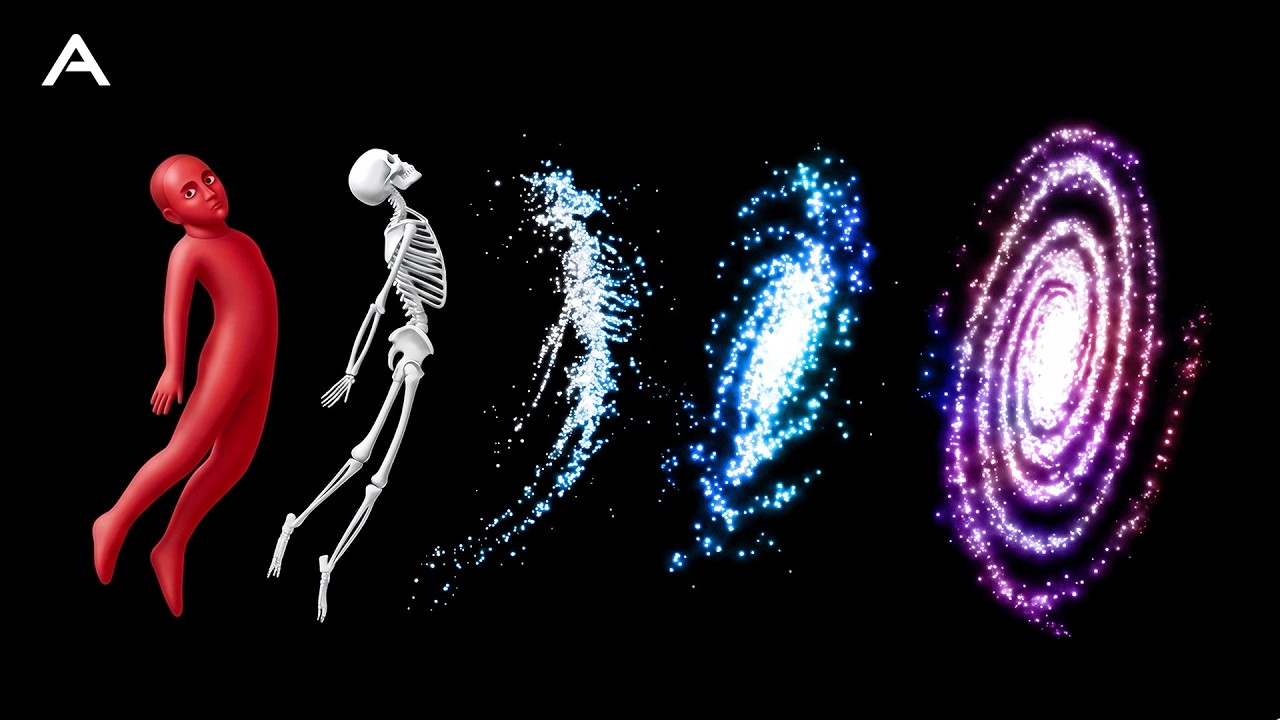
Chase Hughes steps away from body language to argue that more than 190 sacred texts from unconnected civilizations keep describing the same five truths: you are not separate, fear is an illusion while love is real, the mind projects reality rather than recording it, the ego is the only real enemy, and everything is connected. He frames the apparent contradictions between traditions as translation problems, since a finite human language cannot hold an infinite reality, so each culture compressed the same insight into metaphor and parable. He then traces how fear hardened from survival tool into a distraction driven culture that buried the message, and lays out a six step map the ancients supposedly left for waking back up. The talk reads as a confident take on the perennial philosophy, strong as practical reframing and looser where it leans on quantum physics as proof.
Published Feb 11, 202638:25 video26 min readAdded Jun 17, 2026Open on YouTube →
At a glance
Chase Hughes opens by stepping outside his usual lane. This is not body language and not persuasion, and he says flatly it is not about religion either. Since he was about ten years old he has read sacred texts the way other people read data reports, comparing versions and translations line by line, and he says he has gone through over 190 sacred writings from across human civilization: Christian, Hindu, Buddhist, Jewish, Islamic, Taoist, Gnostic, Egyptian, Mayan, Hermetic, Confucian, Sumerian, and indigenous. His claim is that texts written thousands of miles and thousands of years apart, with no way to influence each other, keep whispering the same five truths, and not in a loose family resemblance way but the exact same five over and over.
The talk has two movements. First he argues why the message was hard to carry across time at all: language is a net with holes too wide to catch the infinite, so every culture compressed the same thing into metaphor, parable, and silence, which is why the texts look contradictory until you zoom out far enough that the metaphors line up. Then he lays out the five truths in order: you are not separate, fear is an illusion while love is real, your mind is a projector and not a camera, the ego is the only enemy, and everything is connected. He closes by asking how we lost all of this, blames fear hardening into culture and a modern world engineered to drown the signal, and ends on a six step map the ancients supposedly left for waking back up.
Below is the whole talk rebuilt in order, every tradition he cites, every quote, and every move he makes.
The premise: one message, scattered on purpose
Hughes frames the project as detective work that did not feel like research. When the pattern first formed it felt like finding a message humanity buried, fragments of a treasure map the species was unconsciously assembling for some future generation to find. He sets three load bearing assumptions up front, and he is careful to say you do not have to agree with any of them to take something from the talk. He even names the resistance in advance: if your certainty about the world is very high this might itch, and in human behavior certainty shows up exactly when something needs to be protected.
If God or ultimate truth is real, it existed before any book, any language, or any single tradition, so truth would not belong to one place or one people.
When civilizations separated by oceans and centuries describe the same insights about reality, human nature, and meaning, that points at something universal being observed rather than something local being invented.
Truth with a capital T does not change with culture. Like gravity before it had a name, or mathematics working the same everywhere on Earth, it just gets described through different and very flawed human lenses.
That is why, he argues, the deepest spiritual experiences sound so similar across traditions, and why history's greatest teachers were not trying to fracture humanity but to wake it up to something it already carried. The failure mode is human: we get lost in arguments about who is right, in translations and rituals and politics and fear, and we end up defending our favorite book instead of noticing what all the books were trying to say. If dozens of civilizations that never met all described the same fundamental reality, then the greatest spiritual secret on Earth was never hidden, just scattered like a puzzle across the species story.
Why the truths were hidden: language is a cage
Before the five truths, Hughes wants one correction installed. The ancient texts, he says, were not trying to be mysterious, poetic, or confusing. They were trying to describe the utterly indescribable using a human brain and a human language never designed to grasp it. That is the core problem, and the core problem is language.
Any language is a cage, a net with holes too wide to catch something infinite, and the writers knew it. He points to Laozi opening the Tao Te Ching with what he calls the most brutally honest sentence in all the ancient texts: the Dao that can be spoken is not the eternal Dao. The moment you try to explain ultimate truth you have already distorted and contained it. He says Jesus understood the same thing, telling the disciples he spoke in parables because most people were not ready to take the truth directly. None of these writers had the language of quantum physics, non duality, or modern consciousness models, which he calls still an infantile vocabulary, so they had to compress the infinite into words.
Every culture hit the same wall. How do you describe an experience bigger than thought using a language built out of thought? How do you describe God, unity, infinity, or consciousness with a vocabulary built for farms, weather, and trading spices and chickens? How do you tell people the universe is one before they understand atoms, galaxies, or even their own mind? You cannot, so they used metaphor, symbol, myth, story, poetry, parable, riddle, and sometimes just silence. His image: standing before a sunrise so overwhelming that words feel stupid, then trying to explain that sunrise to someone who has never seen light. This is why the texts seem to contradict each other. The problem was never the message, it was the translation, the same truth filtered through different human limitations. Zoom out far enough and the differences disappear, the metaphors line up, the symbols overlap, and the contradictions dissolve into fragments of one map. That is when, he says, the patterns started connecting like constellations and the five truths revealed themselves.
Figure 1. Hughes's central mechanism. A single infinite truth gets forced through the narrow funnel of human language and comes out the far side as many different cultural metaphors that look like they disagree. His argument is that the divergence is an artifact of the funnel, not of the source, so the way to read the texts is to trace the rays back to where they meet.
Truth one: you are not separate
This is the truth he says the ancient world tried hardest to communicate and the one we have drifted farthest from. You are not separate, you never were, and you never could be. He runs the same idea through tradition after tradition:
The Upanishads of India say Tat Tvam Asi, which he glosses as "you are that," not connected to the divine and not loved by it but the divine wearing a human costume.
Jesus said the kingdom of God is within you, not in a building or a book.
Sufi texts say you are not a drop in the ocean, you are the entire ocean in a drop.
The Kabbalah, in one of his favorite lines, says creation is one emanation divided only in appearance.
Quantum physics, he adds, is starting to discover everything is one field fragmented by perception.
Different cultures, different metaphors, same truth: there is no you versus the world, only one universe experiencing itself from your point of view. Separation is a hallucination, division is a glitch, and isolation is not real. His chosen image is the wave. A wave rising from the ocean looks separate, with its own shape, motion, and lifespan, but it is not a thing, it is the ocean expressing itself in temporary form. Being born is the ocean rising. Death is the wave folding back in. You never stopped being the ocean, you just forgot for a minute. All the phrases the texts use, one spirit, one God and father of all, as above so below, you are that, the kingdom is within, all is mind, everything is the Dao, point at the same thing: you are the universe aware of itself, the divine looking out through human eyes temporarily.
Then the raw part the mystics only hinted at: if you are not separate, then your entire identity and worldview may rest on a misunderstanding, and that misunderstanding is the source of most suffering. Believe you are separate and you start fearing loss, death, rejection, and scarcity, and you start chasing significance, validation, and control, defending the ego as if it were sacred. Remember what you are and the fear, conflict, and loneliness dissolve, death changes meaning, and life resolves into a single field of consciousness playing out as billions of expressions trying to remember itself.
Truth two: fear is the illusion, love is the only real thing
If truth one is that you are not separate, truth two is the one that shapes your life without you noticing. Fear, he says, is the greatest lie ever told, and love is the only thing that is real. He calls the repetition almost suspicious:
The most repeated phrase in the entire Bible is "fear not" or "do not be afraid."
Jesus: perfect love casts out fear.
The Buddha: hatred does not cease by hatred, by love alone is hatred healed.
The Bhagavad Gita: the path of devotion and love leads to liberation, the path of ignorance and fear leads to suffering.
The Tao Te Ching: courage comes from love, paralysis comes from fear.
The Dhammapada: the mind is everything, meaning fear starts in the mind and not the world.
Rumi, in Sufi wisdom: your job is not to seek love but to find and remove the barriers you built against it.
Civilizations that never exchanged a word reached the same verdict. Fear is the illusion that keeps us asleep, love is the thing that wakes us up. He lines them up as opposites: fear shrinks the self, love expands it. Fear breeds ego, love dissolves it. Fear isolates, love reminds you who you are. Fear makes you chase approval and money and control, makes you compare yourself to everyone, makes you live as if something is missing. Love in the ancient sense, he stresses, is not romantic. It means oneness and alignment, the recognition that we are made of the same stuff, the same light or source. Fear feels bad because it is biologically incompatible with what you actually are. Every mistake, every relationship that blew up, every regret, every act of self sabotage is fear. Every spiritual leader was saying you suffer because you believe a lie. Drop the fear and you do not find love, you return to it, because it is your default state, the only real thing under the noise.
Figure 2. Hughes's fear and love ledger. He does not treat love as the opposite of fear so much as the thing underneath it, the default state you return to rather than acquire once the fear is set down. Every behavior on the left, he argues, is the same illusion wearing different clothes.
Truth three: your mind is a projector, not a camera
If love is real and fear is illusion, then who makes the illusion? Your mind. The brain does not record reality, it generates it. He calls this both the most ancient spiritual teaching and the most modern scientific discovery:
Hindu Vedanta: maya, the world you perceive is shaped by the mind's illusions.
The Upanishads: the universe arises from consciousness.
Plato: reality is the moving image of eternity, which he reads as the mind shaping what you perceive.
Quantum physics: observation changes the behavior of physical particles.
His read: consciousness is not inside the universe, the universe is inside consciousness. Every culture was screaming the same thing, that the mind is not reacting to life but constructing the version of life you experience. Your fears, beliefs, identity, memories, and stories are not interpretations laid on top of reality, they are filters that reshape reality before it reaches you. That is why two people can live the same moment and experience two different things, why suffering usually comes from the inside, why the texts focus far more on the inner world than the outer, and why every path teaches stillness, silence, presence, meditation, and surrender. Stop letting fear hijack the projector and you see reality clearly for the first time. The corollary lands hard: every limitation you hold is one you unconsciously built, and every breakthrough you chase is one thought pattern away.
Truth four: the enemy is the ego
The first three truths show you what you are. The fourth shows what has been blocking you, and he calls it the most dangerous of the five. The ego is the only real enemy you will face. No demons, no bad luck, no other people, not the world. The thing you call you is the thing hurting you:
The Bhagavad Gita: the self must conquer the lower self.
Jesus: unless a man dies to himself, he cannot live.
The Buddha: suffering begins with attachment to the self.
The Tao Te Ching: he who defines himself cannot know who he truly is.
Different continents, same diagnosis. Then his definition, the one he says will change your life if you adopt it: the ego is not your personality, identity, or sense of I. The ego is the story you built to survive your fears, a mask and a guard rail, a protective suit stitched from trauma, insecurity, expectation, and conditioning, and the suit becomes the prison. The ego wants one thing, separation, because it needs to feel separate to exist, separate from people, the universe, the divine, and truth. It has to compare, feeding on better than, worse than, smarter than, more deserving than, more important than. It needs three things, he says: hierarchy, conflict, and recognition. It needs to win, to be right, to be special, to be defended by you, which is why it never shuts up, the voice saying they are judging you, you are not enough, you are falling behind, what if you lose everything, what if they do not like you, you need to prove yourself, you need more, you need control.
The ancient secret almost nobody catches: the ego's whole existence rests on fear, and fear is already not real, so the ego is a hallucination, a survival instinct that does not understand who you are. You are the ocean, the ego is a ripple that thinks it is the entire Pacific. You are the divine, the ego is a child pretending to be the king. This is why every tradition told you to let it go, and he is emphatic that this was never about morality, obedience, purity, or going out to buy linen pants and wooden bead necklaces. You cannot experience truth while clinging to something untrue. You cannot be infinite while clinging to a story that makes you small, cannot feel oneness while protecting a self that does not exist, cannot wake up while defending the dream. Drop the ego even for a second and you feel something terrifying and beautiful at once: you never needed it, you were always complete, the armor was the wound. The ancients were not obsessed with humility, they were obsessed with liberation.
Truth five: everything is connected
Once the ego falls apart, the final truth appears, the one that ties the universe together and shows up from ancient temples to modern physics labs. Everything is connected, one system, everything influencing everything:
Sufi mysticism: the soul is a thread in the same cosmic fabric.
The Egyptian pyramid texts: the soul returns to the stars from which it came.
Native American wisdom: Mitakuye Oyasin, we are all relatives, with all beings I am related.
Nothing stands alone. Every action ripples, every emotion radiates, every intention vibrates through the whole. You are not a separate node but a neuron in a cosmic brain firing inside infinity, and your life is not happening to you, it is happening with you, through you, and as you. Here the five snap together like a lock opening: you are not separate, fear is an illusion, your mind shapes reality, the ego is the enemy, everything is connected. The conclusion he draws is that you are not a human trying to become spiritual, you are the universe temporarily being human, already spiritual, and everything you ever feared or doubted comes down to remembering what you were before the world told you who to be.
Figure 3. The five truths as Hughes stacks them. Truth one is the foundation that the rest rest on, and each layer follows from the one below: because you are not separate, fear is the lie, the mind builds the world, the ego is the only obstacle, and connection is the whole picture. He presents them as a single claim seen from five angles, not five separate ideas.
How we lost it: fear became a culture
If the truths sat in the open for thousands of years, how did humanity go from cosmic awareness to what he calls the psychological dumpster fire of today? Not a conspiracy, he says, something simpler, darker, and more human: we forgot who we were and got hypnotized by who we thought we needed to be. The moment humans began building civilizations they needed to gather resources, protect borders, and survive harsh winters, so fear became a tool. Over tens of thousands of years it became a habit, then a culture, and everything fear touches it corrupts.
That, he argues, is why every text including the Bible warns about the same traps: greed, ego, power, materialism, comparison, desire, control, attachment. These were not morality lessons, they were descriptions of psychological malware. The Tao Te Ching: when wealth and honors lead to arrogance, it brings evil. The Quran: do not commit abuse on the earth, spreading corruption. The Bible: do not store up treasures on earth. The Buddha: clinging is the root of suffering. Every tradition saw it coming, that once humans forgot who they were they would try to fill the emptiness with anything except the truth.
And that is what we did, he says. We built civilizations on the lie that we are separate, economies on the lie that we are lacking, and identities on the lie that we are not enough. A small tribal safety mechanism became the global operating system, and we started comparing, competing, hoarding, fearing, posturing, consuming, scrolling, and performing, turning life into a scoreboard and success into a good looking costume. We traded meaning for dopamine, replaced stillness and boredom and silence with noise and distraction, and stopped asking "who am I" in favor of "who do they think I am." The worst part is the distractions got addictively good: apps engineered to hijack the nervous system, news cycles feeding on cortisol and stress, algorithms weaponizing attention, cultures built on outrage and tribal division. We did not just forget the truths, we built a world designed to choke them. The symptoms are everywhere: anxiety normal, depression common, addiction everywhere, loneliness an epidemic, attention spans collapsing, people unable to be bored. We became the most technologically advanced species in history and the most spiritually disconnected. The truth did not disappear, the noise just got louder than the signal. The ancient warning, he says, was not a metaphor but a prophecy: if you forget yourself, you will forget everything that matters.
The other half of the prophecy: the awakening
The ancients also agreed, he says, that once the illusion becomes unbearable and the ego starts to look like a teetering Jenga tower, people begin to wake up, and he believes this generation is the moment it starts. The illusions are cracking, the distractions are working less well, and people are starving for something real without knowing why. He cites his friend Shawn Ryan and a series Ryan did called SCOP as evidence of the hunger. Then he lays out the six step map he says every tradition left for what happens after the collapse, with no rules, dogma, or ritual, only internal transformation.
One, waking up begins with truth.John 8:32, the truth will set you free, not obedience, not faith, but truth about yourself, the mind, fear, and ego. The Avesta of Zoroastrianism: truth is the best good, the everlasting light. The Buddha: three things cannot remain hidden, the sun, the moon, and the truth. This is why suffering precedes awakening, because pain breaks the illusion we hide behind.
Two, waking up requires presence. Awakening never happens in the future or someday. The Buddha: do not dwell in the past, do not dream of the future, concentrate the mind on the present moment. The Tao Te Ching: if you are depressed you live in the past, if anxious in the future, if at peace in the present. Matthew 6:34: do not worry about tomorrow. Plato: time is the moving image of eternity, it is just right now. Presence is not a spiritual idea, he says you can drop the word spiritual entirely, it is a doorway back into reality.
Three, waking up requires compassion and service. Every text links awakening to compassion, and not because you are morally good but because you recognize the truth: if I see you as myself, compassion is just me taking care of me. The Quran: give to the needy, the orphan, the captive. The Bible: love your neighbor as yourself. The Analects of Confucius, 12:2: a gentleman seeks virtue. Plato: be kind, for everyone you meet is fighting a hard battle. Compassion is recognized, not learned. Once you stop believing you are separate, compassion becomes the only behavior that makes sense.
Four, waking up requires stillness and self knowledge. The Upanishads: know thyself and you shall know the universe. Socrates: the unexamined life is not worth living. The Yoga Sutras: yoga is the stilling of the mind. The Nag Hammadi texts of Gnostic Christianity: know yourself and you will be free. The Buddha: in stillness, truth reveals itself. Awakening is not adding ideas or buying beads, it is removing noise, stripping away illusion, story, ego, and fear until what is left is you without distortion.
Five, waking up transforms suffering into wisdom.Romans 5:3: suffering produces perseverance, perseverance character, character hope. Buddhism's four noble truths make suffering the path to enlightenment. The Bhagavad Gita: in compassion I destroy the darkness of ignorance with the lamp of knowledge. The Egyptian pyramid texts: the soul ascends through trials. The ancients did not promise a life without suffering, they promised a life where suffering becomes a catalyst.
Six, waking up is just remembering what you are. Put truth, presence, compassion, stillness, and transformation together and every tradition lands in the same place. Awakening is not becoming something new, it is remembering something ancient and original you have always been. The Kabbalah: each soul is a spark of the infinite. The Emerald Tablet: all is one. The Popol Vuh: humans are the divine remembering itself. The final step is not new motivational material, it is recognition, a flash of "I am not separate, I never was, I just forgot for a minute." Awakening is not a destination, it is a return home, and he admits it will be rough at first.
The closing turn is that none of it feels radical, it feels obvious once you hear it, because you were never missing anything, you were taught to forget. Awakening does not feel like fireworks, it feels first like stress and then like relief, like setting down a backpack you did not realize you had been carrying your whole life: the pressure to become somebody, to prove something, to defend yourself, all built on the same misunderstanding. The world does not change when you wake up, your relationship to it does. Fear loses its authority, the ego loses its grip, the noise stops convincing you it matters, because you saw something clearly. The truth was never hidden, he ends, it was just waiting. "Love you. Take care."
Key takeaways
Hughes reframes 190 plus sacred texts not as competing religions but as flawed translations of one underlying truth, and says the contradictions dissolve when you zoom out far enough that the metaphors align.
The barrier was never secrecy but language: a finite, thought built vocabulary cannot hold an infinite reality, so every culture compressed the same thing into metaphor, parable, and silence.
The five truths build on each other from a single foundation. You are not separate, therefore fear is the lie and love the default, the mind projects rather than records, the ego is the only real obstacle, and everything is connected.
His most portable line is the redefinition of ego: not your identity but the story you built to survive your fears, which needs hierarchy, conflict, and recognition, and which rests entirely on a fear that is not real.
He blames the modern crisis on fear hardening from survival tool into culture, amplified by attention engineering, and reads ancient warnings about greed and attachment as descriptions of psychological malware rather than morality.
The awakening map is subtractive, not additive: truth, presence, compassion, stillness, and the transformation of suffering, ending in recognition rather than acquisition.
Chapters
00:00 Cold open and the obsession with 190 plus ancient texts
01:25 Three premises: truth predates every book, the same insights point to something universal
03:00 A buried treasure map, and why we defend our favorite book
04:45 Why the truths were hidden: language is a cage
07:10 Laozi, Jesus, and compressing the infinite into metaphor and parable
09:30 The sunrise image and why the texts look contradictory
11:00 Truth one: you are not separate, across the Upanishads, Sufism, Hermeticism and more
14:00 The wave and the ocean, and how separation creates suffering
16:30 Truth two: fear is the illusion, love is the only real thing
19:30 Fear versus love as opposite operating states, returning to love as the default
21:30 Truth three: your mind is a projector, not a camera
24:30 Truth four: the enemy is the ego, the definition that changes your life
28:00 Why every tradition said to let the ego go
30:00 Truth five: everything is connected, from pyramid texts to entanglement
32:00 The five truths lock together
33:00 How we lost it: fear became a tool, then a habit, then a culture
35:30 The modern symptoms and the prophecy of forgetting
37:00 The awakening: the six step map back, ending in remembering
Notable quotes
"The Dao that could be spoken is not the eternal Dao." (Hughes citing Laozi, 06:10)
"You are not a drop in the ocean. You are the entire ocean in a drop." (Hughes citing the Sufi texts, 12:20)
"When you were born, that was the ocean rising. When you die, the wave goes back into itself. You never stopped being the ocean. You just forgot for a minute." (15:10)
"The ego is the story that you built to survive your fears." (25:40)
"You're the ocean. The ego is a ripple that thinks it's the entire Pacific Ocean. You are the divine. The ego is a child pretending to be the king." (27:20)
"We stopped asking who am I? And we started asking who do they think I am?" (34:50)
"You were never missing something. You were taught to forget." (37:40)
"The world does not change when you wake up. Your relationship to the world is what changes." (38:00)
Resources mentioned
Chase Hughes, the speaker, usually known for behavior and influence work
Read as comparative mythology, the talk leans on a long tradition that scholars call the perennial philosophy, the idea of a single truth behind many faiths, associated with Aldous Huxley and Huston Smith. It is a genuinely contested position. Many religious studies scholars push back hard, arguing that the surface similarities are real but the underlying claims are not identical, and that flattening nirvana, the Christian kingdom of God, and the Dao into one message erases real and load bearing differences between traditions. Hughes selects the lines that converge and reads them generously, which is the method's strength as inspiration and its weakness as proof.
His repeated appeals to quantum physics are where a careful viewer should slow down. The observer effect in physics is about measurement disturbing a system, not about human consciousness creating reality, and most physicists reject the popular leap from one to the other as quantum mysticism. Entanglement is real but does not license "everything is one field," and the claim that the universe is inside consciousness is metaphysics, not a result that follows from the equations. Treated as metaphor the analogies are evocative, treated as evidence they overreach.
What survives the scrutiny is the practical core, and it is the part Hughes clearly cares about most. The reframing of ego as a fear built story, the case for presence over rumination, and the link between recognizing shared humanity and acting with compassion are claims you can test in your own life without signing on to the cosmology. He invites exactly that posture in the opening, saying you do not have to agree with any of it to take something from it, and on those terms the talk earns its time.
Full transcript
Since I was like 10, I've been obsessed with ancient texts. And I do mean obsessed. I read them and still read them like people read data reports. I compare all the versions and the translations, line by line comparisons, and something has always bothered me. I've been digging through ancient texts since I was little. And not like a handful, not like 10 or 20, I'm talking over 190 sacred writings from every corner of human civilization. Christian, Hindu, Buddhist, Jewish, Islamic, Taoist, Gnostic, Egyptian, Mayan, Hermetic, Confucian, Sumerian, indigenous. These are texts written thousands of miles apart, thousands of years apart with no way to influence each other. And yet somewhere between the lines, they're all whispering the exact same message. And it's not similar. It's not a kind of like message. It's the exact same five truths over and over.
So, this video isn't body language and persuasion, and it's definitely not about religion in any way. So, if your level of certainty about the world is super high, this might itch a little, and you know that certainty in human behavior shows up when something needs to be protected. So, you do not have to agree with any of this to get something powerful from it. All right? There's something worth considering regardless of your faith or your background.
First, if God or ultimate truth is real, then it or he or she existed way before any book, any language, or one single tradition ever appeared, which means that truth wouldn't belong to just one place or one people. Second, when civilizations that are separated by oceans and centuries describe the same insights about reality and human nature and meaning, it suggests they were observing something universal rather than inventing something locally. And just like gravity existed before we ever had a name for it, and mathematics works the same everywhere on Earth, truth, and I mean truth with a capital T, doesn't change based on culture or belief. It just gets described through different and very flawed human lenses. This is why the deepest spiritual experiences sound so unbelievably similar across traditions. And I think it's why history's greatest teachers didn't try to fracture humanity, but they tried to wake it up to something it already carried inside of it across every culture, every timeline, every belief system humans have ever built.
When I first saw the pattern forming, it didn't feel like research in any way. It felt like finding a message that humanity buried like fragments of a treasure map that we as a species were unconsciously developing for some future generation to find. And I think there are a few things that nobody wants to be said out loud. First, if truth is real, if it's fundamental, it should show up everywhere in every era, every tribe, every myth, every scripture. And I think that it actually does. But somehow, I think we miss something. We get lost in the arguments about who's right. We get lost in the differences, the translations, the rituals, the politics, and the fear. We started defending our favorite book instead of noticing what all the books were trying to say.
If you can imagine dozens of civilizations who never met, they never traded language. They never shared a single word with each other all describing the same fundamental truths of reality. What would that mean? What would that force us to consider? Because if that's true, then the greatest spiritual secret on Earth was never hidden at all. It was just scattered like a puzzle all across our species story. And if all of those pieces could come together, we might see something pretty astonishing.
But before we talk about the message they left us, you have to understand why these truths were actually hidden in the first place. And they were hidden. This isn't debated. I promise it's not conspiracy and churches and governments that did it. It's way older than that. Before we go any further, you need to understand something that almost everybody gets wrong about all these ancient texts, cuz I know there's a lot of videos out there that talk about them. These ancient texts were not trying to be mysterious. They weren't trying to be poetic. They weren't trying to confuse anybody. They were trying to describe the utterly indescribable by using a human brain and human language that was never designed to grasp any of this at all. That is truly the core problem. Language.
So language, any language is a cage. It's a net with holes that are way too wide to catch something that's truly infinite. And the people who wrote these texts, they knew that. That's why Lao opens the Tao Te Ching with the most brutally honest sentence in the ancient texts altogether. The Dao that could be spoken is not the eternal Dao. The meaning is the moment that you try to explain ultimate truth, you've already distorted it and filtered it and tried to contain it. Jesus understood this too. He literally tells the disciples that he speaks in parables because most people aren't ready to comprehend the truth directly. They didn't have language for quantum physics and non-duality or consciousness models like we do today, which is still an infantile language. They had to compress the infinite into words.
So, every ancient culture hit the exact same wall. How do you describe an experience bigger than thought itself with a language that's built out of thought? How do you describe God, unity, infinity, consciousness with a vocabulary built for farms and weather and trading spices and chickens with each other? How do you tell people the universe is one before they even understand atoms or galaxies or even their own mind? The answer is you can't. So they did the only thing that they could. They spoke in metaphors and symbols and myths and stories, poetry and parables and riddles. And sometimes it was just silence. And they didn't do this to hide the truth. The truth was just too large to fit through the doorway of our primitive little language.
If you can imagine standing in front of a sunrise so massive and overwhelming that words feel absolutely stupid to describe it. Now imagine trying to explain that sunrise to somebody who's never seen light before. This is why ancient texts seem contradictory. The problem wasn't the message. It was the translation. Different cultures, different metaphors, different symbols. It was the same truth filtered through different and extremely human limitations. And when you finally zoom out far enough, the differences disappear. The metaphors line up, the symbols overlap, and in my estimation, the contradictions dissolve. You start to see that these were fragments of maps.
And once I noticed that, something insane happened. The patterns in these texts started connecting like constellations across all these continents, across millennia, across belief systems that supposedly are against each other. They weren't opposing each other at all. They were completing each other. And that's when these five truths revealed themselves. So here's where we go next. If every civilization on Earth discovered the same truths, if humans who never met somehow described the exact same reality, the question becomes, what exactly did they all see?
Here's what they all agreed on. This is the first truth, the one the ancient world tried their absolute hardest to communicate to us. And it's also the one that we've gone the farthest away from. You are not separate. You never were and you never could be. Every single ancient civilization on earth figured this out. In the Upanishads from India, they had a saying called Tat Tvam Asi. I think that's how you pronounce it. But it basically means you are that, not connected to it, not loved by it. You are the divine wearing this human costume. Jesus even said this. He said the entire kingdom of God is within you. Not in a building or book, in you. In the ancient Sufi texts they said you are not a drop in the ocean. You are the entire ocean in a drop. If you look at hermetic texts, all is one. If you look at Daoism, everything is the Dao expressing itself in 10,000 forms. If you look at the ancient Mayan text which is called the Popol Vuh, you see heart of sky, heart of earth. This is the universe as a single living being. Even looking at Buddhism, there is no separate self. If you look inside the Kabbalah, which is one of my favorite quotes, they say, "Creation is one emanation divided only in appearance." And if you look into quantum physics, what are we starting to discover? Everything is one field fragmented by perception.
Different cultures, different metaphors, same exact truth. There is no you versus the world. There is only this one universe like experiencing itself from your point of view. Separation is what they're trying to show us is a hallucination. Being divided is a glitch in humanity and isolation is not really real. This is the kind of the metaphor they're trying to get us to understand. When a wave rises up out of the ocean, it looks separate. It has its own little shape. It has its own motion, its own lifespan, but the wave is not actually a thing. It's the ocean just for a few seconds, expressing itself in a temporary form. When you were born, that was the ocean rising. When you die, the wave goes back into itself. You never stopped being the ocean. You just forgot for a minute.
And when every ancient text says things like one spirit, one God and father of all, as above, so below, you are that, the kingdom is within, all is mind, everything is the Dao, they're all trying to point at the same thing. You are the universe aware of itself. You are the divine looking out through human eyes temporarily. You are not the world. The world is in you. And here's the super raw part that they didn't say outright. Every mystic hinted at this. If you aren't separate, then your entire life, your entire identity, your whole entire world view might just be built on a misunderstanding. And that misunderstanding is what makes most of us suffer. Because the moment that you've believed that you're separate, you start fearing loss and death and rejection and scarcity. And we start chasing significance and validation and control. We start defending our little ego like it's sacred. But the moment that we remember what we actually are, the fear goes away. Conflict all dissolves. Loneliness goes away. Death changes meaning entirely. And life becomes something that we can finally understand. A single field of consciousness somehow playing out as billions of expressions trying to remember itself.
This is why truth number one sits at the foundation of everything else. Because if we are not separate from each other and if you're not separate from the universe, then what comes next is the operating system of reality. Number two, fear is an illusion and love is the truth. So if the first truth is that you're not separate, the second truth is the one that keeps shaping your entire life without you realizing it. Fear is the greatest lie ever told. Love is the only thing that's real. Every ancient text, it doesn't matter the culture, it doesn't matter what language, repeats the same idea so many times it's almost suspicious.
The most repeated phrase in the entire Bible is fear not or do not be afraid. A quote from Jesus says, "Perfect love casts out fear." We hear the Buddha say, "Hatred does not cease by hatred. By love alone is hatred healed." In the Bhagavad Gita we read the path of devotion, love leads to liberation. The path of ignorance, fear leads to suffering. The Tao Te Ching we see courage comes from love, paralysis comes from fear. In the Dhammapada we read the mind is everything. Meaning that fear starts in the mind and not the world itself. In ancient Sufi wisdom, we specifically see from Rumi, "Your job is not to seek for love, but to find and remove the barriers you built against it." How beautiful is that?
All these civilizations that never spoke a single word to each other somehow arrived at the same conclusion about reality. Fear is an illusion that keeps us asleep. And love is the frequency or the thing that wakes us up. Fear shrinks self and love expands the self. Fear breeds ego and love dissolves it. Fear isolates you and love reminds you who the hell you actually are. Fear makes you chase approval, validation, and money and control. It makes us compare ourselves to everybody else. Fear makes us live like something is missing. Love in the ancient sense isn't romantic. What they mean is oneness. It's alignment. It's essentially the recognition that we're made of the same stuff, the same light or the same source, whatever you want to call it. That's why fear feels bad because it's biologically incompatible with what you actually are. Every mistake you've ever made, every relationship that blew up, every regret you carry, every time you sabotage your own potential, it's all fear.
Every spiritual leader across time was basically saying you're suffering because you're believing a lie. The moment that you drop fear, you don't just all of a sudden find love. You're not finding love. You're returning to it. It's your default state. That's why we're born with it. The only real thing underneath all the noise is just that. But all the ancients didn't stop there. They all said the same thing next, something that modern science is finally catching up to. And if love is real and fear is an illusion, then who's creating the illusion? Your mind. Which leads us to truth number three. Your mind is not a camera. It is a projector.
So your brain doesn't record reality. It generates reality. I'm talking about the most ancient spiritual teaching on earth. And it's the most modern scientific discovery at the same time. But let's go back. If you look at the Dhammapada, we see what you think you become. If you look at the hermetic texts, the all is mind. In the Hindu Vedanta, we see maya, the world you perceive is shaped by the mind's illusions. And then back to the Upanishads again, the universe arises from consciousness. That's pretty straightforward. And even looking back at Plato, he says reality is the moving image of eternity. And the translation for that would be the mind shapes what you perceive. If you look at quantum physics, observation changes the behavior of matter, physical particles. So I think the meaning here is consciousness is not inside the universe. The universe is inside consciousness.
Every single culture was screaming this exact same thing. Your mind is not reacting to life. It's constructing the version of life that you're experiencing. Your fears, your beliefs, your identity, your memories, your stories, all those patterns you have in your life. We think that they're interpretations. What they are is filters that reshape reality before reality reaches you. This is why two people can live through the exact same moment and experience two completely different things. This is why suffering usually comes from inside and not outside. This is why so many ancient texts focus way more on inner world than outer world. And this is probably also why every spiritual path teaches stillness and silence and presence and meditation and surrender. And I think this is because the moment that we stop letting fear hijack the projector, we start seeing reality pretty clearly for the first time. If your mind shapes reality, then every limitation you hold is one that you unconsciously built. And every breakthrough that you're chasing is just one little thought pattern away.
Truths one, two, and three combine into a single explosive idea. If you're not separate, if fear isn't real, if your mind is essentially shaping everything, then the only thing standing between you and freedom is the part of you that believes otherwise. And this brings us to the most dangerous truth of all. The enemy is not the world. The enemy is the ego. So if those first three truths show you what you are, the fourth truth shows you what's been blocking you from the beginning. So the ego is the only real enemy here. It's the only enemy that you're going to face. No demons, no bad luck, no other people, not the world. Every ancient text, every mystic, all these enlightened teachers, they all gave us the exact same warning. The thing that we call us, the thing that you call you is the thing that's hurting you.
If we look in the Bhagavad Gita, we see the self must conquer the lower self. If we read Plato, he says, all sins come from excess self-love. If you read the words of Jesus, unless a man dies to himself, he cannot live. In the words of the Buddha, suffering begins with attachment to the self. In the Tao Te Ching we see he who defines himself can't know who he truly is. Different continents, different countries, same diagnosis. The ego is not your personality or your identity. It's not your sense of I. Let me give you a definition of ego that's going to change your life if you adopt it. The ego is the story that you built to survive your fears. It's a mask. It's a guard rail. It's a little protective suit that we stitch together from trauma and insecurity and expectations and some conditioning and that suit becomes our prison.
But the ego desires one big thing, separation. It needs to feel separate to exist. Separate from other people, separate from the big universe, separate from the divine, separate from truth. The ego has to be able to compare. It feeds on better than, worse than, smarter than, more deserving than, more important than. So basically the ego needs three things. It needs hierarchy, conflict, and recognition. So it needs to win, to be right, to be special, to get defended by you. This is why it never shuts up. The ego is the voice that says they're judging you. You're not enough. You're falling behind. What if you lose everything? Or what if they don't like you? You need to prove yourself. You need more. You need control.
But here's the ancient secret almost nobody realizes. The ego's entire existence is based on fear. And fear is already not real. This means that your ego is a hallucination. It's a survival instinct that doesn't understand who you actually are. You're the ocean. The ego is a ripple that thinks it's the entire Pacific Ocean. You are the divine. The ego is a child pretending to be the king. This is why every ancient tradition told you to let it go. Not because they wanted you to be moral or have some enlightenment and go out and buy linen pants and wooden bead necklaces and like that. They didn't want obedience or anything or even purity. It's because you can't experience truth while you're holding on to something that isn't true. You can't be infinite while you're clinging on to a story that makes you small. You can't feel oneness while you're protecting a self that doesn't exist. You can't wake up while you're defending the dream.
And once you drop the ego, even if it's for a little second, you'll feel something terrifying and beautiful. You never needed it. You were always complete. The armor was the wound. Ancient teachings weren't obsessed with humility. They were obsessed with liberation. And once the ego falls apart, the final truth appears immediately. And this is the final truth that ties the entire universe together. This is truth number five. Everything is connected. This one shows up everywhere from ancient temples to modern physics laboratories. Everything's connected. Everything is one system. Everything influences everything. That's how everything it gets.
In the hermetic texts, we see this principle of as above, so below. In the Kabbalah, we see all creation emerges from a single tree of life. In quantum physics, no particle is truly separate. Every particle has some entanglement. In Daoism, we see this idea of opposites are not enemies. They're complementary forces of the same source. In the Mayan Popol Vuh, this is where we see the universe is one living organism. In Buddhism, we have the concept of what's called interbeing. Nothing exists independently. And in Sufi mysticism, the soul is a thread in the same cosmic fabric. Even if you look at the Egyptian pyramid texts, we see the soul returns to the stars from which it came. In ancient Native American wisdom, they have a phrase that's I think pronounced Mitakuye Oyasin, which is we are all relatives. Essentially saying with all beings I am related.
Nothing stands alone. So every action ripples, every emotion radiates, every intention vibrates through the whole. You are not some separate node in the universe. You're a neuron in a cosmic brain firing inside of infinity. And your life is not happening to you. Your life is happening with you, through you, and as you. And suddenly all five truths click together like a lock snapping open. You're not separate. Fear is an illusion. Your mind shapes reality. Ego is the enemy. Everything is connected. So if all that's true, then you aren't a human trying to become spiritual. You are the universe temporarily being human. You're already spiritual. So everything you've ever been scared of, everything you've obsessed over, everything you've doubted in your life, everything that you've ever questioned before comes down to remembering what you were before the world told you who to be. And that's what the ancients were trying to wake us up to.
So if the ancients all knew this, if the truths were sitting in the open for thousands of years, how the hell did we lose it? How did humanity go from cosmic awareness to this psychological dumpster fire that we're living in today? It wasn't a conspiracy. Personally, I think it was something a lot simpler. It's much darker and it's a lot more human. We just forgot who the hell we were. We got hypnotized by who we thought we needed to be. So the moment that humans started building civilizations, we needed to gather a bunch of resources. We need to protect our borders. We need to survive these crazy harsh winters. Fear became a tool. And then after tens of thousands of years, fear became a habit. And then fear became a culture. And everything that fear touches, obviously it corrupts.
That's why every single ancient text, even the Bible, they warn us about the same exact traps of greed and ego and power and materialism and comparison, desire, control, and attachment. They weren't trying to teach us to be moral. This had nothing to do with being a moral person. They were describing psychological malware. In Tao Te Ching, when wealth and honors lead to arrogance, it brings evil. If you read the Quran, you're going to see, "Do not commit abuse on the earth, spreading corruption." In the Bible, it says, "Do not store up treasures on earth." You read the Buddha and it says, "Clinging is the root of suffering." Every tradition saw this coming. The moment humans forgot who they were, they'd try to fill this emptiness with every single thing they can except the truth.
And that's exactly what we did as a people. We built entire civilizations on top of a lie that we're separate. These giant economies on top of the lie that we're all lacking. And we all built identities on the lie that we're not enough. The ego that starts off as a small little tribal safety mechanism became this global operating system. We started comparing and competing and hoarding and fearing and posturing, consuming, scrolling, performing. We turned life into a weird little scoreboard. And we made success a really, really good-looking costume. And we traded all of our meaning for dopamine. We replaced being still and mindful. Maybe just let's call it boredom. We replaced boredom and silence with lots and lots of noise and distractions. But I think the biggest one of all is we stopped asking who am I? And we started asking who do they think I am? We traded a lot of truth for distraction. And the worst part is the distractions got really really effing good. Scary, sexy, addictively good.
So, we engineered apps that hijack our nervous system. We have news cycles that feed off of our cortisol and our stress. We have algorithms now that weaponize our attention. We have cultures that are built on outrage and tribal division. If you live in America, you're in the middle of it. And we didn't just forget all these ancient truths. We built a world designed to choke the life out of them. And if you look around, you can see the symptoms everywhere. Anxiety is normal. Depression is common. Addiction is everywhere. Loneliness is an epidemic we're in the middle of. Attention spans are collapsing. People don't even know how to be bored. Replaced wisdom with content, contemplation with distraction. We became the most technologically advanced species in history and simultaneously the most spiritually disconnected.
Again, it's not cuz this truth just disappeared somehow. It's because the noise got louder than the signal. The ancient warning was not a metaphor. It was a prophecy. The prophecy is if you forget yourself, you will forget everything that matters. But there's another part the ancients also agreed on. Once the illusion gets to the point where it gets unbearable, once the noise gets super overwhelming, once the ego starts to look like a crazy Jenga tower, that's when people start to wake up. And right now in this era, in this generation, we are seeing that start to happen. The illusions are cracking. The distractions aren't working as well as they used to. My friend Shawn Ryan did an entire series about this called SCOP. People are starving for something real and they don't know why.
And this brings us to this final section. What did the ancients say about this awakening? Is it really an awakening? And what is it going to mean for our life? So if forgetting makes us suffer, then remembering is what sets us free. And every ancient tradition, everyone with no exception, they didn't just warn us about ego and fear and illusion. It also left very detailed instructions for what happens after the collapse. They left us a road map for waking up and the patterns are unbelievably clear once you know what to look for. And they don't give you a bunch of rules and dogma and rituals, just internal transformations. So, let me show you exactly what they said.
Number one, waking up begins with truth. In the Bible in John 8:32, the truth will set you free. Not obedience, not faith, truth. Truth about yourself, about the mind, about fear and ego. Truth is the solvent that dissolves the illusion. In the Avesta, which is a Zoroastrian text, we see the quote, "Truth is the best good. It is the everlasting light." From the Buddha, we see the quote, "There are three things that cannot remain hidden. The sun, the moon, and the truth." Every awakening starts here. The moment we stop running from reality and start seeing it. This is why suffering is what happens before awakening. Cuz pain breaks the illusion that we all kind of hide behind.
So number two, waking up requires presence. Every tradition says awakening doesn't happen in the future. Not someday. It doesn't happen when you're healed and calm and ready. The Buddha tells us don't dwell in the past. Don't dream of the future. Concentrate the mind on the present moment. In the Tao Te Ching, they say if you are depressed, you're living in the past. If you're anxious, you're living in the future. If you're at peace, you're living in the present. And Jesus said this in the book of Matthew 6:34. Do not worry about tomorrow. If we read Plato, he says, "Time is the moving image of eternity. It's just right now." Presence is not a spiritual idea. You can get rid of the whole concept of the word spiritual. It's a doorway back into reality. The ancients were not saying be mindful. What they're telling us is stop living in an illusion. Don't live in a fake world.
Number three, waking up requires compassion and service. And every single ancient text links awakening with compassion. And it's not compassion because you're a morally good person. It's compassion because you recognize the truth. Because if I see you as myself, compassion isn't morality. It's just me taking care of me. If you read the Quran, you see the quote, "Give to the needy, the orphan, the captive." In the Bible, it says, "Love your neighbor as yourself." In the Analects, Confucius 12:2 says, "A gentleman seeks virtue." And Plato says, "Be kind for everyone you meet is fighting a hard battle." Compassion is something that we recognize. We don't learn it, we recognize it. So once you stop believing that you're separate, love and compassion becomes the only behavior that makes any sense at all. It doesn't mean like I'm a good moral person. It just means I'm acting in something that makes perfect sense.
Step four, waking up requires stillness and self-knowledge. This shows up everywhere. In the Upanishads, we see know thyself and you shall know the universe. Socrates said the unexamined life is not worth living. In the yoga sutras, yoga is the stilling of the mind. In the ancient Nag Hammadi text, which is in Gnostic Christianity, it's a type of Christianity. Know yourself and you will be free. And the Buddha tells us in stillness, truth reveals itself. Awakening is not adding new ideas. Never ever let somebody sell you on this idea. It's not going out and buying beads and adding new ideas. This is removing noise. Awakening is about stripping stuff away, removing illusions and stories and ego and fear until what's left is the thing that was always there. It's you without distortion.
And number five, waking up transforms suffering into wisdom. In the Bible, in Romans 5:3, suffering produces perseverance. Perseverance, character, and character hope. In Buddhism, we have the four noble truths. Suffering is the path to enlightenment. If you look in the Bhagavad Gita, you'll see in compassion I destroy the darkness of ignorance with the lamp of knowledge. In the Egyptian pyramid texts, they say the soul ascends through trials. The ancients are not giving us some brochure promising us a life with no suffering. They're promising you a life where suffering becomes a catalyst for something.
Which brings us to point number six about awakening. Waking up is just remembering what you are. When you put all these pieces together, truth, presence, compassion, stillness, transformation, every ancient tradition lands in the same place. Awakening is not becoming something new. It's remembering something ancient, something deeper and original that you've always been. If you look in the Kabbalah, they say each soul is a spark of the infinite. On the Emerald Tablet, it says all is one. In the Popol Vuh, humans are the divine remembering itself. The final step of awakening isn't learning a bunch of new motivational stuff. It's recognition. It's a flash of remembering, oh, I'm not separate. I never was. I just forgot for a minute. Awakening is not a destination that you get to. It is a return home. And it will be shitty at first. And if this didn't feel new to you, it's because it wasn't. You are remembering.
I think the real unsettling part isn't how radical any of this is. It's how obvious it feels once we hear it. You were never missing something. You were taught to forget. And awakening doesn't feel like fireworks and stuff like that. It feels like stress. Then it feels like relief. It's like you're setting down a huge backpack that you didn't realize you were carrying cuz you've been holding it your entire freaking life. The pressure to become somebody, to prove something, to defend yourself, all of that built on this misunderstanding. The world does not change when you wake up. Your relationship to the world is what changes. Fear loses its authority. Ego loses its grip on you. The noise stops convincing you that it matters. It's just because you saw something clearly. And the truth was never really hidden. It was just waiting. Love you. Take care.