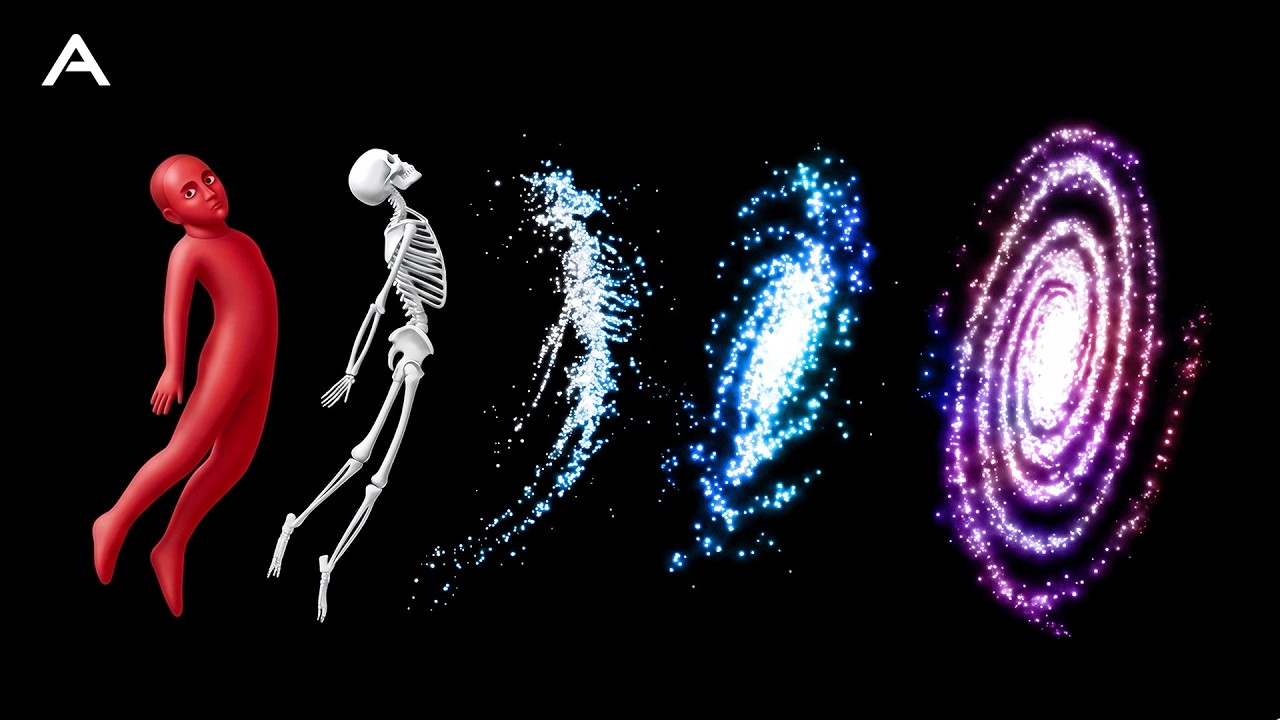
PSYOP Expert: Ancient Texts Reveal Hidden Truth About Reality & Why You Don’t Die | Chase Hughes
Psyops and behavioral profiling specialist Chase Hughes joins Mayim Bialik and Jonathan Cohen for a wide conversation that runs from mass persuasion to mysticism. In the first half he argues that outrage driven media and left versus right politics are engineered division, lays out his FATE model of influence (focus, authority, tribe, emotion), calls the way governments handled COVID the biggest psyop of our lifetime, and says separation is the ingredient that manufactures a psychopath. In the second half he turns to oneness, a five hour intravenous DMT session he took to treat two brain diseases, a laser experiment he says reveals a static code behind the wall, and an AI reading of nearly two hundred ancient texts whose most repeated phrase is do not fear. It closes on a four step prayer formula and a round of quotes from Jesus, Rumi, Kabbalah, and quantum physics all pointing at the same idea that we are not separate.
Published Jun 30, 20261:34:40 video39 min readAdded Jul 11, 2026Open on YouTube →
At a glance
Chase Hughes, a behavioral profiler and psychological operations specialist who spent twenty years in the military, sits down with Mayim Bialik and her cohost Jonathan Cohen for a conversation that starts inside the machinery of mass persuasion and ends in mysticism. The first half is a field guide to how modern media, politics, and platforms manufacture division. Hughes argues that the left versus right fight is itself a psyop, that outrage is engineered because it is profitable, and that a destabilized mind grabs the first confident authority it can reach. He hands over his four part model of influence, FATE (focus, authority, tribe, emotion), calls the way governments handled COVID the biggest psyop of our lifetime, and says the single ingredient you need to manufacture a psychopath is separation. The second half turns inward: oneness as the oldest spiritual idea, a five hour intravenous DMT session he took to treat two brain diseases, a laser experiment he says lets people see a static code behind the wall, and an AI assisted reading of nearly two hundred ancient texts whose single most repeated phrase is "do not fear." It closes on a four step prayer formula the texts seem to share and a round of one line quotes from Jesus, Rumi, Kabbalah, and quantum physics all pointing at the same thing: you are not separate.
Below is the whole conversation rebuilt in order, every claim, text, and thread, attributed as it was spoken.
Who is at the table
Hughes lays out his own resume without much ceremony. Twenty years in the military, first as a ship navigator for a long stretch, then "a regular old gunfighter" in expeditionary warfare, and the whole time obsessed with psychology and psyops. He never intended to make a career of it. What hooked him was a single question that runs under everything he does: what can a person be made to think, and what can a person be made to do.
The realization that reorganized his work came only about two years before this taping. If you get good at this job, he says, the only thing you are actually good at is engineering conditions. He is not changing your beliefs, your thoughts, your mindset, or your identity directly. He shifts the conditions around you and the way you perceive those conditions, and from there he can pull almost any behavior he wants out of a human being. His ethical line is that the tool is never the problem. He could teach the exact same technique to a cult leader or to a suicide crisis hotline operator. "The ethics are never in the tool itself. It's in the intent of the person using the tool."
He is building a TV studio around this idea, he explains, sitting in it during the interview. The plan is a daily news style show that takes an event and pulls it apart on air: here is how this is being framed, here is the feeling it is engineered to produce, here is the outcome somebody probably wants from that feeling. Mayim Bialik, who has a doctorate in neuroscience, and Jonathan Cohen host Mayim Bialik's Breakdown, and they frame the episode as pulling back the curtain on both persuasion and the nature of reality, with Hughes as the person who can tie the two halves together.
Is humanity living through the biggest psyop in history?
Bialik asks for a plain definition. A psyop, Hughes says, is a coordinated effort to shape the belief of a general public. What has changed is that psyops used to be discrete events, a single big push, and now they are the normal texture of everyday life. He points at our phones as the obvious case. We are told constantly that the phone is hijacking our brains, brainwashing us, that it is bad for us, and we keep scrolling anyway, clicking through user agreements we will never read because we were going to be on the phone no matter what.
To show how ordinary all of this became, he walks through three eras of American news. In the early 1900s the news was openly propaganda, and everyone more or less knew it. By the 1940s and 1950s it shifted to a revenue model, news happening between advertisements, "today's episode brought to you by Dawn dish soap." Around 2008 and after, it entered what he calls the retention or captivity phase: a 24 hour cycle that has to be filled with something, and you cannot fill it with facts around the clock. So the incentive quietly moved from information to revenue to holding your attention, and the fastest, cheapest way to hold attention is to make you angry. This, he says, is why the cat rescued from a tree story mostly disappeared from the news.
He is careful to say there is no smoke filled room. People imagine dark figures around a conference table planning world domination, and that is not it. He can simply charge more for ads if he keeps you glued to the screen longer. There is no Illuminati plan. It is a byproduct of what gets rewarded, and outrage is exactly what gets rewarded now. One of the mottos at his station, he says, is a question worth carrying around: "What did the news tell you to feel today?" A prepackaged villain is ready to go, a prepackaged feeling is attached, and your attention gets pointed at the bad guy you are supposed to be angry at.
Era of news
What the news was
What fills the airtime
The propaganda era (early 1900s)
Openly propaganda, and admitted to be
Whatever the messenger wanted you to believe
The revenue era (1940s to 1950s)
News that happened between the advertisements
"Brought to you by Dawn dish soap"
The retention era (2008 to now)
A 24 hour cycle that has to hold you
Outrage, a prepackaged villain, and a feeling to feel
Figure 1. Hughes's three eras of news. His argument is not that a cabal seized the press but that the reward structure changed underneath it. Once attention became the product, provoking you became the cheapest way to keep you, and the format followed the money into permanent outrage.
Politics as division
From the same expert vantage, Hughes says flatly that the left versus right fight in American politics is a psyop by itself. It is an engineered division. His mechanism is simple: if he sits at the very top and can get you to fight horizontally, with the person next to you, then you will never look up. The whole point of the division is to keep your eyes level.
Jonathan brings in a wrestling analogy. The hero needs a villain, because without the obstacle there is no story and nobody cares. The division works the same way, manufacturing a villain to draw and hold attention. Bialik pushes for the concrete cost, the picture for someone who thinks it is not a big deal, and Hughes gives it a name: destabilization.
Destabilization and suggestibility
He does not mean the country feels a little unstable. He means individual brains are destabilized. On social media, our dopamine reward circuitry, the ventral tegmental area, gets fed a curated diet: everyone I agree with looks smart, and the media serves me the dumbest, most idiotic people it can find on the other side. So my brain concludes that is all of them, they are crazy, they are psychopaths. That engineered division cashes out as a massive increase in suggestibility.
His image for it is falling off a cliff. Your arms and legs flail, and the first solid thing you touch you grab with everything you have, even if it is a thorn bush or barbed wire. A destabilized person or population does the same thing: when some clear authority appears with something logical and easy to understand, the brain latches onto it precisely because it has been flailing in confusion. So the destabilization ramps suggestibility up, and Hughes thinks that heightened suggestibility is the desired end state.
He then does the reframe he clearly cares most about. Think of someone who voted differently from you. Online you are programmed to see them as idiots and morons. But if you meet that same person at Walmart or Target, he guarantees they want roughly 90 percent of the same things you do: their kids not to be messed with, lower taxes, to save money, to be good parents, time off work, a vacation. "You have like a hundred times more things in common with somebody who voted differently than you than the people who are engineering this division." A stretch of the episode here is given to three sponsor reads, including the Freedom From Religion Foundation, a water purifier, and a rug company, after which the hosts note the polling that shows we are far more similar than our algorithms suggest, and that division is what keeps us glued.
F.A.T.E. focus, authority, tribe, emotion
When you pair destabilization with an authority figure who presents something very clear, Hughes says, you are running the same play used to train a dog. There are four levers that manipulate any mammal brain, and they spell FATE, which he thinks quite literally determines our fate: focus, authority, tribe, emotion, in that order.
Focus. Present a threat and you instantly own someone's attention. The mammal brain snaps to threat and novelty.
Authority. Follow the threat with something that sounds authoritative: the news quoting a celebrity, a statistic, a warning about the water supply or a new virus. The fear makes you defer to the authority more.
Tribe. You go to social media and your echo chamber of people who agree with you confirms it is a conspiracy, or something to worry about. Now you feel part of a tribe.
Emotion. You feel vindicated and get dopamine from the people you agree with, scroll a little further, hit the idiots on the other side, and get angry. Both ends of the emotional spectrum are satisfied.
He hands the audience an experiment. Next time you are on your feed, watch the sequence: a threat, then a little authority figure, then tribal signaling, then something to make you emotional. It is often positive, one of those "we found this baby deer on our porch and raised it" compilations that Bialik admits she is addicted to. Right at that emotional peak, you swipe once more and you hit an ad. Scaled up from a phone to a country, the same cycle does not end in an ad. After taking a population through focus, authority, tribe, and emotion, a government could start a war, invade another country, or open the borders, because the cycle leaves people hyper compliant and hyper suggestible.
Figure 2. The FATE cycle as Hughes describes it. The same four levers that housetrain a dog, run in sequence, leave a person or a population primed to accept whatever comes next. On a feed the payoff is an advertisement. At national scale, he argues, the payoff can be consent for a war.
Bialik translates it into plain language back at him, half admiring the elegant code he speaks in: the government does things to make you feel safe so it can then do upsetting things, bouncing you around so that whatever feels safe you will hold onto, which lets a large organization act in its own interest while convincing you it is in yours. Hughes answers with history. Look at a government's past to predict its future, he says, everything declassified going back to the 1920s. Sometimes it is the fast play, freak you out, present authority, then invade. Other times it is slower, and he offers COVID as the example.
Was COVID a psyop?
He is precise about the claim. Not that the virus itself was a psyop, but that the way governments, plural, and agencies handled it was the biggest psyop ever, so in your face that it woke normal people up, including his own mother who had trusted the food pyramid and assumed the government would always tell the truth.
The engine, he says, was the tribe lever crossed with our deepest fear. Research consistently finds the top human fear ranks higher than death: public speaking, except it was never really the speaking, it was the judgment expected from it. To the ancestor brain, being cast out of the tribe means no sex, no reproduction, probably no food, and death. It means genetic extinction. So anyone questioning whether a measure was safe, or whether locking children out of social environments made sense, was risking that primal threat. He points to Harvard educated MDs removed from Twitter for a dissenting voice, and to the person often credited as a pioneer of mRNA vaccine technology being socially shunned and pushed off the internet. His rule of thumb: "If somebody has to be silenced for an idea to flourish, it is a very dangerous idea." Good ideas can survive being disagreed with and debated.
He reframes the whole thing as not right versus left but elites versus non elites, and by elites he does not mean the government but the people who make the biggest decisions, following an incentive algorithm rather than a group plan. And crucially, once the thing starts, who enforces it? We do. The people do.
To show how unconscious that enforcement is, he tells a story from second grade. Back then there were Hyper Color shirts that changed color with heat. He wore one that went hot pink, got called a slur that was then used as an insult, and the social injury was so sharp that he threw away everything pink in his closet and never did it again. Those were children, he notes, doing what sociology calls mores and folkways: public enforcement of a norm without any awareness that you are enforcing anything. Ninety nine percent of adults online, he says, do not realize that much of what they do is enforcing some cultural concept that was injected for them to enforce. Because social rejection registers as extinction level fear, that fear produces enormous compliance. His fun fact drives the point home: pink was the color for boys until about the 1940s, associated with purple and therefore royalty, and it flipped in a single generation, which shows how fast a norm can be inserted and then turned on its head.
Oneness versus separation
Bialik widens the frame: all this fear of being ostracized keeps us from exploring what it fully means to be human, to have a spiritual experience, to feel intuition, premonition, and connection. Hughes, a self described second generation American raised saying the pledge of allegiance every morning, admits the tension, that a person raised with reverence for the country then learns everything has a hidden agenda. Bialik shares her own version, that COVID blew the top off for her because things did not make sense and she was not allowed to say so, and that it turned out many dissenters were not wrong, though nobody in government seemed to know what they were doing either.
Then Hughes lays out the thesis that anchors the second half. If he wanted to manufacture a psychopath, he would start with full apathy, no empathy for anyone else. He invokes the bystander effect and the Kitty Genovese case, where, as the popular account goes, a woman was attacked and killed while many people heard and no one acted. One on one, watching someone get stabbed and doing nothing would make you a psychopath. In a large group it changes, and Hughes proposes that when humans gather in groups larger than our brains can handle, we get group psychopathy, not individual psychopathy but the psychopathy of the crowd.
The number one ingredient to bake that cake, he says, is separation. And separation is exactly what he thinks the ancient world kept warning against. Even the ancient Maya, he says, were trying to say we are not separate, not merely connected but literally one thing. From a physics angle, if we all came from the Big Bang, we are still one thing. Jonathan agrees that the largest and oldest spiritual concept is oneness, that guest after guest on the podcast landed there, that whatever you try to fill the "god shaped hole" with, power, sex, drugs, alcohol, work, social media, points back to a hunger for unity. Hughes reaches for the Hermetic tradition here, the seven Hermetic principles and the Emerald Tablet, as some of the most ancient statements of the same idea across cultures.
He is careful about what he means by separation. Not anti religious separation, but the everyday kind: left versus right, the sense that if I punch that guy or cut him off in traffic it does nothing to me because I will never see him again. The belief that "I will not suffer because someone else suffers." Start with that separation, keep making it bigger, and you get a psychopath, and because the division is self reinforcing, with the people themselves doing the enforcement, it grows on its own. So, Bialik asks, are we creating a psychopathic society. Hughes believes so.
His counterexample is the town of 2,200 people he just moved away from, where cutting someone off in traffic meant they knew who you were and where you lived, so reputation mattered, even the mailman's opinion. Where reputation matters, he says, we thrive. Cram people into anonymous boxes and the need for reputation disappears because our brains cannot process a tribe of 2.8 million. He connects it to Maslow's hierarchy of needs: he does not think our brains can fulfill the social layer of Maslow's pyramid digitally. The hosts add a concrete example: proposals to build shared common rooms by floor in large apartment buildings, which would raise the odds of meeting your neighbors and building community, were weighed against the rental income lost by converting those rooms into more apartments. The incentive structure won. It is an algorithm, Hughes says, just a human one, not a digital one. The upside of AI, if it were pointed that way, would be calculating the unseen cost of social division rather than being used to expand it.
Are we living in a simulation?
Bialik connects the loneliness thread to authenticity: what are people hiding, where does the shame come from, and are any of us living authentic lives, or is this a twisted simulation we made. Hughes calls it a simulation for sure, and reaches for the French philosopher Jean Baudrillard, whose book Simulacra and Simulation describes how we build simulations of simulations. Say the word princess and people picture a Disney princess, a copy that has nothing original to point back to.
As a behavior profiler, he says, the number one thing he can read in other people is how they conceal shame. We build a persona and hide the part of us that got mocked at six or eight years old, learning a permanent lesson that this piece of me cannot be shown, I cannot be too much, cannot say I am lonely. So you can be married ten years and still feel lonely because you know for a fact your partner has never seen the real you. Even when someone likes you, they like the costume, the mask, the performance, so the compliment cannot land. The tragedy underneath the loneliness epidemic, he argues, is an isolation epidemic that is different: everyone believes they are the only one hiding it, the only one pretending, which is why you can be in a room full of people and still be lonely, because none of them know the real you.
Loneliness epidemic and digital relationships
Bialik makes the fixer's confession, that as a person who cannot hear a problem without trying to solve it, she keeps landing on the same diagnosis: our main way of receiving, processing, and generating information now happens in a fake world. Once you are inside a space shaped by, in her words, the capitalist patriarchal structure, you are shouting in a matchbox, basing your self worth and even who you date on a false lens, reaching for a category to excuse bad behavior. She has stopped engaging recreationally with the phone, using it only for what it needs to be used for. She is skeptical of her own hope that if everyone just got off their phones everything would be fine, but insists on the underlying truth: humans evolved over hundreds of thousands of years and are not built to interface with an artificial world as a substitute for real connection. You see it in the hunched necks, the families eating out while everyone is on a phone, the babies with propped up screens in their strollers, all sold as making parenting easier and living your best life.
Hughes grants that social media brought real goods, that he would not otherwise know a man in Florida has a pet cheetah, and Bialik immediately spins into whether that is legal or humane, which is where she says everything leads to another set of problems. They talk about scale: her parents met in 1961 in the South Bronx, stayed together 53 years, and things seemed simpler, though she wonders aloud whether she is romanticizing it, since her mother later realized she never needed to change her name and could not find her old friends on Facebook. Hughes thinks the romanticizing is fine because the enforcement of norms was never at pandemic levels back then. Your mother doing something silly in front of four friends got judgment from four people, not four million. It is a scale and accessibility problem, and it is very real. He talks about his own homeschooled kids, and says that if he were a teenager now, with his sensitivity, he would either end up in an institution or beg not to be sent to school, unable to tolerate the parties you see online but were not invited to. The engine of it, again: everyone thinks it is just them hiding it, just them pretending, which is what sits above the loneliness epidemic and produces it.
DMT revealed the code
Bialik turns to consciousness and what lies beyond the five senses, sharing that at 17 she discovered energy work, could sense energy, read The Way of the Shaman and thought about soul retrieval and traveling to the underworld, and hid it because trying to raise it with normal teenagers at a party got blank stares, so she tucked that world away. She asks what broke open for Hughes.
He starts with nine deployments. Bialik asks him to slow down and say what that means, since people have become jaded to the word deployed. He describes the vast chasm between life here and a place where daily guts and blood are normal, for children, and how returning made him feel like a narcissist the moment he caught himself complaining about anything. After the military he did his first psychedelic journey while still a materialist reductionist, a man of science. It was a guided journey meant, in his phrase, to shake the snow globe so fresh snow could fall on his perceptions, and he came out of it with empathy for the grass outside, something he had not thought possible.
Then the heavy part. As he understands the numbers, he is the 41st person in the world to do five hours of intravenous DMT. He did it because he has two brain diseases, mesial temporal sclerosis and temporal lobe epilepsy, and was trying to generate BDNF and NGF, brain derived neurotrophic factor and nerve growth factor, to grow tissue around dead areas in his brain. He reaches for Terence McKenna, who called the experience "death by astonishment," which Hughes rates the most profound description he has heard. People who have done it, he says, do not call it a hallucinogen. If this reality is 4K, DMT is like 9,000K of clarity, and it feels like home. Roughly 100 percent of people report that the realm does not feel hallucinogenic at all. His metaphor: mushrooms are like being gently guided through the woods by a female shaman, while DMT is like finding an alien spaceship in those woods, popping the main microchip out of the alien computer, and smoking it.
The five hour intravenous version runs off a machine like an anesthesia pump with a large syringe, pushing at a set rate, so you can raise or lower your "altitude" and, if you need to use the bathroom, they can stop it and the DMT is gone in about three minutes. Because it feels so much like home, he came out of it crying in the fetal position as they cranked it down, not wanting to return. He had it recorded, and asked whether he was dead 39 times during the session, though he says it did not matter to him either way. The hard part of the journey was coming back, feeling that there is no way to live like that here without becoming a little more self centered and getting hurt fast, because up there you are swimming in the most non judgmental, unbelievable love, the universal language. He notes that over a thousand neuroscientists are working on DMT and not one of them thinks it is a hallucination, and he compares the resistance to Ignaz Semmelweis, the doctor who proposed washing hands before surgery, was so ridiculed that he lost his medical license, and was involuntarily committed to an asylum for the rest of his life. The hosts add that DMT is endogenous, that we are wired to make it, and that one hypothesis links the feeling of love and oneness in near death experiences to a DMT release when the brain is in a dying state, while urging that this is not a recreational feel good drug and that it matters to separate the physiology from the meaning we derive from it.
Then the strangest claim in the episode: the laser experiment. A friend of Hughes, whom he names Danny Gold, figured out that if you shine a fat diffused laser on a wall, you can see through the wall and see a static code written behind it, described as Japanese or alien looking characters. The public reference for this is Danny Goler's DMT laser demonstration, which he calls the Code of the Matrix. The key point Hughes stresses is that on a hallucinogen things morph and move, but this code is permanent and static: move the laser up the wall and it just reveals different characters, like shining a light on a fixed map. They have lined up 14 or more people, drawn a circle on the wall with a Sharpie, and had them all report the identical symbols. Stick your arm in front of the laser and the code changes to a different type over tissue. He professes to know nothing about what it is, but insists a code is there and that close to 100 percent of people see it. The hosts frame it through The Matrix: the notion that reality might be code that has been written and we are living the physical manifestation of it, that DMT opens a portal to a level of awareness where you can access the code even if you cannot read it.
Hughes refuses to let himself land on certainty. Every time he leans one way he calls himself a tiny hairless ape trying to figure out reality. His private lean is that the code may be the brain projecting the substrate of consciousness, not an element of the wall but of how consciousness projects, and he floats a speculation that a high volume of photons smashing the wall might disrupt the wave function collapse enough that we glimpse its absence. The hosts add that even what you perceive in that state has a lens on it, and that the inability to describe such experiences is a feature, not a bug, of high level psychedelic and transcendental states, whether or not drugs are involved. It has to be felt, a felt sense of connection, safety, and for many the felt sense of God or home. Coming back down is not just the serotonin drop, it is the recognition that if a place feels like that, you do not want to leave, which is exactly what nearly every near death experience survivor says.
Consciousness dream model
Hughes describes the lasting change: since that DMT session, yesterday was day 180 of being completely seizure free, from six or seven temporal lobe seizures a day to none, with no cognitive impairment. And the way he sees people changed. Now when he looks at someone else it feels like "that's us, it's all us, we are all us." Teaching morality becomes unnecessary, he says, if your default is that the other person is you. The word "us" was simply not in his head before the experience.
Bialik raises the eerie corollary he has described elsewhere, that people who spend too much time there get locked out. "The admins ban your ass," Hughes says. He suspects the jester or joker archetype is involved, noting there are only about 14 archetypes and every human for 4,500 years has seen the same beings. There are thousands of reports, he says, of people who used DMT with a lot of ego and no reverence, treating it recreationally, who reach a little door like a nightclub slot and are told they are not allowed back. From that moment their journeys stop: three hits is normally a full journey, and these people can take a hundred hits and nothing happens, as if their body can no longer enter the realm. He ties it to a rat study from about a year earlier suggesting DMT floods the body at the moment of death, which led some to call it the transporter molecule. Anthropomorphized, he says, DMT is a truth teller, the eye of Sauron, it sees your true intention and you cannot fake it, which Bialik finds fascinating given that Hughes is an expert in people faking it.
Then Hughes plants what he calls the ultimate question, drawing on Roger Penrose and newer theories of consciousness: is DMT conscious, or is DMT consciousness. Are we users of consciousness or creators of it, or are we just consciousness itself. Asked to pick, he says this is all consciousness, and offers a 60 second thought experiment about a dream. In a dream you manufacture fake eyeballs to see through, and you see light bouncing off objects even though no photons are present. Every test you would run here on Earth to prove something is real, you can run inside a dream. So picture a gumball machine 14 feet away in your dream. Ask how far it is and you say 10 or 15 feet; ask what it is made of and you say glass, steel, sugar, quarters. Then someone shows you it is a dream. Ask again how far the gumball machine is, and the answer is that there is no distance, because you are creating it. Ask what it is made of, and the answer is consciousness, and so is your body, and so is the space between you and the machine. The distance does not exist. Bialik loves the example and names the linguistic trap in it, that he is asking her to put words to a separate dimension. She adds a Jewish frame, that a friend feels worse in the morning because he has just left an altered state where consciousness goes at night, which is why there is a Hebrew morning prayer thanking God for giving the soul back. And she notes that if there is no distance in a dream, coming up one level from that might even hint at quantum entanglement, that distance might not exist. Hughes reaches for Alan Watts territory and quotes, attributing it to the Buddha, "The Dao that can be spoken is not the Dao," and says he has never once met anyone who came back from DMT with more certainty, nobody who reports meeting Aunt Phyllis and her spaghetti casserole, which is part of why the experience feels so ineffable and even irresponsible to describe. The hosts note there is real published research doing quantitative and qualitative analysis of the overlap between near death experiences and DMT, including a case study of a single person who had both.
Figure 3. Hughes's dream argument for consciousness as the base layer. The instant you recognize the dream, the measured distance and the solid materials of the gumball machine dissolve, because you were generating all of it. His claim is that waking reality passes every test the dream does, so the same could be true here.
Ancient text patterns
Bialik pivots to the ancient texts, which pair so well with the consciousness thread. Hughes explains the method: he took several hundred ancient texts in different languages, put them into an AI, and asked the first question, what is the most repeated phrase across all of them, the Mayan Popol Vuh, the Egyptian material, the Yoga Sutras, the Vedic texts, the Bhagavad Gita, and the very influential Upanishads. The single most repeated phrase in every ancient text, he says, is "do not fear."
Bialik asks whether it is always for the same reason, noting that in her tradition it is "do not fear because God is with you," meaning you are never alone. Hughes says it is not always paired with "for I am with you." In the Christian and Jewish scriptures, in the Torah and even in the ancient Septuagint, it appears over 300 times, and he says in the King James Bible "do not fear" appears 365 times. Reaching again for Alan Watts, he reads the deeper meaning as: you are afraid of nothing, afraid of something meaningless, because after your very important little animal body dies, consciousness will still be there. Consciousness, in his reading, is eternal, which is the sense in which you do not die.
Prayer formula hack
The best find, Hughes says, came from a second pass that is not in the YouTube video he made about the ancient texts. He asked his specialized text research AI to find every time a person asked God, the universe, or the heavens for help and it worked, feeding in every synonym for prayer he could get from a thesaurus. Across all the books, every one of those answered prayers shared just four elements, which he offers as the prayer formula hack, simple enough to fit on a sticky note but, he thinks, deep:
Acknowledgment of the vastness of the universe and the smallness of the self. You start by placing yourself as tiny against the whole.
A direct ask for something that is not selfish. The request has to be for the greater good, to help others, or in Hermetic terms to help everything.
Complete surrender of the outcome actually happening. You are not dependent on the result, which loops back to the first element, you are the all and you are not that important.
Repetition. The human brain likes repetition, and, he adds, maybe the big brain up there does too. The hosts note that traditional prayer also had physical movement, so you remember the connection somatically.
He contrasts this with how most people pray, which his AI named the vending machine model: I am in this condition, I need this to help me, if you do this one thing for me I will never do that again, the bargaining that gamblers do. Bialik says she calls the same thing the gumball machine model, the belief that if you put in your quarter you will get exactly the gumball you want, when in her experience God tends to hand you a Werther's original instead. Hughes stresses that he made the AI show every reference and page number so it would not hallucinate, and that when they checked it, the citations were accurate. He teases that the full breakdown of the formula is coming on the next episode.
Figure 4. The four elements Hughes says his text mining AI found in every answered prayer, contrasted with the modern default his AI labeled the vending machine model. The formula inverts the usual bargain: instead of demanding an outcome, it makes a selfless ask and surrenders the result entirely.
The closing: universal truths
Hughes points people to his YouTube channel, to NCI University for his training, including his interrogation work, and Bialik says she wants his Behavioral Table of Elements tattooed on her back. After he leaves, the hosts run a new closing segment, a round of one line quotes that all say the same thing:
Rumi: you are not a drop in the ocean, you are the entire ocean in a drop.
Kabbalah: creation is one emanation divided only in appearance.
Quantum physics: everything is one field, fragmented only by perception.
And a last one they leave for the guesser, "unless a man dies to himself, he cannot live," which sounds like Braveheart but is Jesus.
They fold the psyop thread back into the mystical one. The scariest thing in the whole conversation, Bialik says, was the fracturing of society into people who truly do not believe they need one another, or who do not care about the impact they have, the drivers in Los Angeles who now cut you off and laugh, taking performative pleasure in it, a glorification of violence turned comedic. Against that, they set the argument that people who lived without the distractions we call modernity were inevitably more in touch with nature, the seasons, and their own spiritual autonomy, more interdependent because survival required everyone working together, so the bonds were strong. What we really need, Bialik says, echoing Hughes, is a lot more of feeling like you are part of something, feeling loved. They point listeners to their Substack for more of the quotes, and sign off.
Key takeaways
Outrage is a business model, not a conspiracy. Hughes argues the news evolved from open propaganda to a revenue model to a retention model, and that provoking you is simply the cheapest way to hold attention, so no smoke filled room is required for the effect to be real.
Engineered division works by destabilizing you. A destabilized mind grabs the first confident authority it can reach, even a bad one, the way a falling person grabs a thorn bush. Heightened suggestibility, he says, is the desired end state.
FATE is his portable model of influence. Focus, authority, tribe, emotion, in that order, is the same sequence used to train a dog, and it ends in an ad on your phone or, at national scale, in consent for something bigger.
Separation is the core ingredient he keeps returning to. It is what he says manufactures a psychopath, what the ancients warned against, and what modern anonymity, scale, and screens amplify by killing reputation and community.
His metaphysics is experiential, not doctrinal. A five hour intravenous DMT session he took to treat two brain diseases left him seizure free and convinced that reality is consciousness, that separation is a hallucination, and that the self does not fully end.
The ancient texts, read by AI, converge on one instruction. Across nearly two hundred texts the most repeated phrase is "do not fear," and the prayers that "worked" shared four moves: smallness before vastness, a selfless ask, full surrender, and repetition.
Chapters
0:00:00 Intro
0:05:19 Is humanity living through the biggest psyop in history?
0:08:12 Politics as division
0:09:13 Destabilization and suggestibility
0:15:45 F.A.T.E. focus, authority, tribe, emotion
0:19:51 Was COVID a psyop?
0:30:29 Oneness versus separation
0:40:12 Are we living in a simulation?
0:43:09 Loneliness epidemic and digital relationships
0:55:14 DMT revealed the code
1:18:40 Consciousness dream model
1:22:48 Ancient text patterns
1:25:19 Prayer formula hack
Notable quotes
"What did the news tell you to feel today?" Chase Hughes, on his station's motto, 0:07:20.
"If I can get you to fight horizontally, then you'll never look up." Chase Hughes, 0:08:40.
"Once a person or population is destabilized, when something comes along and looks very logical, the brain will latch on to it." Chase Hughes, 0:11:00.
"You have like a hundred times more things in common with somebody who voted differently than you than the people who are engineering this division." Chase Hughes, 0:13:20.
"If somebody has to be silenced for an idea to flourish, it is a very dangerous idea." Chase Hughes, 0:23:30.
"If I wanted to manufacture a psychopath, the number one ingredient is separation." Chase Hughes, 0:31:00.
"Separation is the biggest lie that has ever been forced on the population of the earth." Chase Hughes, 0:33:20.
"The experience on DMT is like maybe 10,000 times more real than this reality." Chase Hughes, 0:58:00.
"The bad part of my journey was returning from it." Chase Hughes, 1:03:00.
"Every time I look at someone else, it just feels like that's us. It's all us. We are all us." Chase Hughes, 1:09:30.
"The most repeated phrase in every single ancient text is do not fear." Chase Hughes, 1:23:30.
"You are not a drop in the ocean. You are the entire ocean in a drop." Jonathan Cohen, quoting Rumi, 1:31:30.
Hughes moves fluidly between claims that are well documented and claims that are his own or frankly fringe, and he often says so himself, calling himself a hairless ape guessing at reality. Sorting them out is the honest work the episode leaves to the viewer. The persuasion half rests on real ground: the attention economy, engagement driven feeds, and the profitability of outrage are studied and real, and the events he cites, such as the deplatforming of dissenting physicians and of Robert Malone, a figure often tied to early mRNA work, did happen, even if the interpretation is contested. His FATE model is a tidy personal heuristic assembled from genuine ingredients, threat salience, authority, in group belonging, and affect, rather than a peer reviewed theory. The metaphysical half is where confidence and evidence part ways: extended state DMT research exists, but his specific counts are unverifiable, the laser code is a fringe unpublished demonstration with a plausible mundane explanation, and the ancient text mining is his own unpublished project. The table below marks where each major claim sits.
Claim in the episode
Where it stands
Media rewards outrage because attention is the product
Well documented. The attention economy and engagement driven feeds are studied and real.
Left versus right is a deliberately engineered psyop
His framing. Polarization and its profit incentives are real, but a single coordinating author is asserted, not shown, and he says as much.
FATE (focus, authority, tribe, emotion)
His own coinage. A useful heuristic built on real mechanisms, not an established academic model.
The Kitty Genovese bystander story
Partly myth. The famous account of many witnesses doing nothing was later shown to be largely inaccurate, though the bystander effect is real in weaker form.
Pink was the color for boys until the 1940s
Broadly supported. Historians trace a color flip in the early 20th century, though it was never a clean universal rule.
Semmelweis was committed for promoting handwashing
Essentially true. He championed hand hygiene, was ostracized, and died in an asylum in 1865.
41st person to take 5 hours of IV DMT, and no neuroscientist thinks it is a hallucination
Unverifiable. Extended state DMT research exists, but these specific counts are his and cannot be checked.
A laser reveals a static code behind the wall that everyone sees
Fringe, unpublished. The demonstration is not peer reviewed, skeptics point to laser speckle, and not everyone reports the same thing.
"Do not fear" is the most repeated phrase, 365 times in the King James Bible
Popular, not verified. The Bible has many such exhortations, but the exact 365 count is a popular claim scholars dispute, and the text mining was his own project.
The four part prayer formula
His synthesis. An AI assisted pattern he says he checked against page numbers, interesting but unpublished and not independently reproduced.
Figure 5. A ledger of the episode's main claims against the documented record. The green rows are things a curious skeptic can confirm. The amber rows are Hughes's own framings and fringe demonstrations, offered with real conviction but without the evidence that would settle them.
Full transcript
======================================== Scups are happening all throughout our lives to engineered division.
Everything from government to the way we interact socially. We're generating information in a fake world.
Engineered division causes destabilization. I'm changing your beliefs, your thoughts, your mindset, or how you perceive that I can get any behavior that I want. It's so effective that it grows by itself.
Chase Hughes is a leading authority in behavioral profiling and psychological operations. He's also explored connections across ancient texts to uncover messages left for us by past civilizations.
Separation is the biggest lie that has ever been forced on the population of the earth. Even the ancient Mayans were trying to say we are not separate. We are all one thing. We took several hundred ancient texts in different languages. The most repeated phrase is do not fear. Are we just consciousness itself? That's the ultimate question. what we really need. It's a lot more of feeling like you're part of something.
If I wanted to manufacture a psychopath, the number one ingredient is separation.
So, are we creating a psychopathic society?
The weird thing is
Hi, I'm Alec
and I'm Jonathan Cohen
and welcome to our breakdown. On today's episode, we are going to pull back the curtain to reveal the nature of reality and consciousness. We're also going to talk about how the government is using SCOPs to control what we think and how we feel and what recurring messages from ancient texts can reveal about how we're supposed to live. The person to tie this all together is Chase Hughes. He's a leading authority in behavioral profiling and persuasion. He's an expert in SCOPS and intelligence. He's also someone who has studied neuroscience extensively as well as the connection points across nearly 200 ancient texts to uncover patterns and messages that have been left for us by ancient There's so much to cover. It's a pleasure to welcome Chase Hughes to the breakdown.
Break it down.
Thanks, M. Good to be here. Hey, Jonathan.
There seems to be a throughine um with with so much of the work that you do and and the reason that people kind of call on you for expert information advice structuring um from, you know, how we perceive ourselves in personal interactions to how we can be perceived in ways that are, you know, significant in in larger arenas. But if we pull back even more, you know, you've recently entered a conversation with all of us, right, who follow you and listen to you about how we perceive reality. And I wonder what feels most kind of pressing to you as an introductory place, you know, for our audience to get to know you a little bit.
Yeah. So, I was in the military for 20 years and uh I kind of cut my teeth doing the military stuff. I was a ship navigator for a long time and then I was kind of a just a regular old gunfighter and expeditionary warfare stuff for a while, but that whole time I was obsessed with psychology and and scops and all of this stuff. And uh I didn't intend to do this for a living uh by any means, but it just fascinated me what a person can be made to think and what a person can be made to do. Um, and it wasn't until maybe like two years ago that I realized that everything uh if if you're good at this job, the only thing that you're really good at is engineering conditions. So, it's not really I'm I'm changing your beliefs, your thoughts, your mindset or identity. I just I just shift conditions and how you perceive those conditions. Then I can like get any behavior that I want out of human beings. And I think it's so common nowadays like the the SCOPs are the norm instead of oh this one big thing happened. Uh and it's just like every moment of our lives and we watch all these things that show like oh your phone is hijacking your brain, your phone is brainwashing. Your phone is really bad for you. and what we still spend time on our phones uh to where it's gotten like those user agreements that we'll just agree to whatever just because I'm just going to be on my phone no matter what. Uh so it's just kind of just it's a normal part of everyday life and uh that's one of the reasons I'm I'm literally sitting in my TV studio uh right here where we have like daily news is going to start coming out where we're going to show this is how this event's being framed. It's made you it's made to get you to feel this certain way. here's the outcome that's probably desired from that. Here's like the deeper intelligence of how all this stuff is connected. Um, and I I feel called to really show this to people in a way that some people say this is manipulation techniques or whatever, but I could teach the same technique to a cult leader that I can teach to somebody who's a suicide crisis hotline operator to change someone's behavior, to change somebody's belief. So, I think the ethics are never in the tool itself. It's it's in the intent of the person using the tool.
When we think about SCOPS for people who may not know what that is, can you describe it and how prevalent it is in pretty much all the information that we're consuming? Meaning we used to believe and and it may not even be true that there was an objective presentation of facts versus here are the facts and here's how I want you to feel about the facts. When it comes to SCOPS, the definition would be a coordinated effort to shape the belief of a public of a of a general public. Um, and and we've gone through several cycles in our news. Our news was um it in the like let's say 1900s, it was openly propaganda. They were open about like, hey, we're propagandizing you. And it was just kind of an open thing. Then we get into the the revenue model and then it was just today's episode brought to you by Dawn Dish soap or whatever in the 40s and 50s. And so it was like the news happened between advertisements and then we kind of got used to that. And now uh probably 2008 and on we're in the uh in the style of news where it's all about captivity. How long can I get you? So, we switched to this 24-hour news cycle, and the news has to fill that with something, and you can't just fill it with facts 24/7. It went from information to revenue, and then now we're at the retention phase. So, pissing you off is the fastest and easiest way that I can get you to just stay glued to the TV. This is why we don't see the, "Oh, a cat got rescued from a tree stories very often anymore." We're not seeing that unless you're watching this. wake up with John show, coffee show in the morning. And I think a lot of people imagine all these dark figures around this conference table smoking cigars like planning this world domination stuff. It's just I I can charge more money for ads if I can get you glued to the screen longer. So I don't think there's some coordinated Illuminati plan or anything to do any crazy stuff. It's just it's a byproduct of what it gets rewarded and that's definitely what gets rewarded now. So SCOPS are happening all throughout our lives and the media is more like and and one of the mottos we have here at this TV station. We haven't even launched a video yet and and we we're still filming and stuff but one of our mottos is what did the news tell you to feel today? And that's a lot of what happens is we get told and and a prepackaged villain is ready to go and then a prepackaged feelings like here's how you should feel about this and here let me now direct your attention to this bad guy that you need to be pissed off at. And that's kind of what the news is. So we're getting this coordinated scop and the left versus right thing in politics it from from an expert I will say is a scop by itself. It is. I think it's an engineered division that's happening in our country. And I think if I can if I'm up at the very top, if I can get you to fight horizontally, then you'll never look up. You're not going to look up. Um, and I think this is a a very carefully engineered division that's happening right now.
In wrestling, the hero needs a villain. Without the villain, there's no story. The hero can't just be awesome. No one cares, right? You need the obstacle to draw people in and suck attention. So with this engineered division, can you paint a picture for someone who may be like, well, it's not really that big a deal. Like let's talk about the impact of being caught in this level of division. What does it cause and then what does it prevent?
The one thing that the engineered division causes is destabilization. And that sounds like, oh, the country is a little unstable. No, I mean like individual brains uh are are destabilized and we have this my you'll be familiar with this. We have this thing called the vententral tegmental area and this is our our little dopamine uh circuit inside of our brain and reward system. So we get into social media and what do we see? I see everybody that I agree with looking smart and I see the people that I disagree with. the the media is going to show me the dumbest morons that could be found on the other side. The people that I disagree with. I don't care if I'm on the left, I'm on the right. I'm going to see the absolute most idiotic people possible. So that my brain says that's all of them. They're crazy. They're psychopaths. This engineered division, what it equates to is massively increased suggestability. Once a person or population is destabilized, when something comes along and looks very logical, the brain will latch on to it. So, it's kind of like if you fall off a cliff or something, your arms and legs are going to flail all over the place. The first solid object that you touch, you're going to wrap around it as hard as you possibly can. Even if it's a thorn bush, if it's barbed wire, you're still going to grab you're going to instinctively grab it. So when we have a destabilized human or population and some clear authority comes out some something clear logical easy to understand we latch on to that because of this kind of flailing around this of of confusion. So it massively ramps up the suggestability of a population and I think that's the desired end state uh for us to do that. And if if you just think really quick like about somebody who voted differently and I'm talking to the people watching like we're programmed on social media. They're all idiots. They're all morons. Uh they don't know what they're doing. They're stupid. But if you go to Walmart or Target and you see somebody who voted differently than you, I guarantee you they want about 90% of the same things that everybody else does. They want their kids not to be screwed with. They want to pay less taxes. They want to save money. They want to be good parents. They want to have time off of work. They want to take vacations. And you have like a hundred times more things in common with somebody who voted differently than you than the people who are engineering this division. My breakdown is supported by FFRF. As we approach the 4th of July and America's 250th anniversary, we've been thinking about one of the most special and unusual things about America. In a world where governments were often tied to a particular religion, our Constitution chose a different path. The Constitution protects freedom of conscience, the freedom to believe, to question, to practice a faith, to change your mind, or to have no religious beliefs at all. That idea feels especially relevant today because we live in an increasingly diverse country with people from different faith traditions, different backgrounds, different ways of understanding the world. A secular government isn't anti-religion. It's a framework that allows all of us to live together as equals. The Freedom from Religion Foundation works to protect that principle and defend the First Amendment rights of believers and non-believers alike. As we approach America's 250th anniversary, it's worth reflecting on the freedoms that make a diverse society possible. If that matters to you, go to ffr. us/breakdown or text breakdown to 511511 to learn more and to join. Go to ffr. us/breakdown or text breakdown to 511511. Remember to text breakdown to 511511 today. Message and data rates may apply.
My breakdown is supported by Cove Pure. When you take your supplements every morning, you probably don't stop to think about what's in the water that you're washing those supplements down with. Well, turns out maybe you should because about two weeks ago, the EPA made an admission about what's in your tap water. And it's why we switched to Cove Pure to purify our water. On April 2nd, for the first time in history, the EPA officially placed pharmaceuticals on its list of drinking water contaminants. So, when people take medication, anti-depressants, anti-anxiety meds, hormones, and birth control, their bodies don't absorb all of it. What your body doesn't absorb gets flushed down the toilet and comes right back out of your tap. Wastewater treatment plants weren't designed to filter these out. Neither are the pitcher filters sitting on your counter. And while the EPA has admitted there's a problem, it doesn't mean your water's getting safer anytime soon. Actual limits could be a decade away. That's exactly what Cove Pure is built for. It's a reverse osmosis water purifier that's labcertified to remove up to 99.9% of contaminants, pharmaceuticals, PAS, heavy metals, fluoride, pretty much anything that isn't water. What we love about Cove Pure, if that's not enough, is that the water tastes different. I was very skeptical at first. Water does not just always taste like water. With Cove Pure, the water is extremely delicious. You would never take a stranger's prescription. You shouldn't have to drink theirs either. Cove Pure is exactly what sits between you and your glass. And for our listeners, we worked out a special deal. Use our link covepure.com/breakdown. You can get $250 off for a limited time. That's co ov.com/breakdown to get yours today.
My breakdown is supported by Tumble.
You know, finding the right rug for a home is surprisingly difficult. An expensive rug makes you feel like no one should walk on it cuz you're afraid of staining it. Also, we've got dogs, cats, life. We knew that stains were going to be inevitable, but those standard washable rugs often look cheap and they feel temporary. Most rugs don't seem to be designed for actual real living. But then we discovered tumble rugs. You can finally have the best of both worlds. And now we do. Their rugs look like beautiful designer rugs, but they're built for real life. Spills, muddy paws, and accidents are just a part of what's going to go on. Tumble rugs are spillproof and machine washable. They feature a proprietary spillproof surface that causes liquids to beat up on top of the rug. So, instead of a stain soaking into the fibers, you can literally wipe it away in seconds. And when you need a deeper clean, Tumble Rugs are fully machine washable, even the larger sizes. Our favorite part about tumble rugs though, with all of this being said, is how amazing they look. They often feature hand illustrated designs that look like designer rugs. Mine features illustrations by none other than Freda Ko. But don't take our word for it. Hundreds of thousands of homes have already switched to tumble rugs. And they have over 30,000 five-star reviews. They're perfect anywhere in your home where life tends to get a little messy, which for us is everywhere. Machine washable rugs made better. For a limited time only, our listeners get 10% off plus free shipping at tumbler.com/break. That's tumble.com/break. After you purchase, they'll ask you where you heard about them. Please support our show and tell them that we sent you. There's been a lot of polling that suggests that we're actually far more similar than our algorithms suggest. And it is this division that keeps us glued. So when the profit model is incentivizing division, all we're going to see is more and more division and it's going to further fracture us, increase hate and agitation. And from just an interpersonal level, we're going to reduce trust. And you can kind of map the increase of time we spent online to the simplification of the solutions that have been offered to us because the world is a complicated place and just saying I'm going to reduce all the prices immediately on day one is really not a solution that is going to be possible just like you may want that but it's just like it's it's a very difficult thing to actually do and so people as you said will grab on to that solution and say great let's do that. So, when you have destabilization and then we have an authority figure come out there uh and present something very clear, it's the same exact things that you would use to train a dog. And there's just four things that that uh are able to manipulate a a mammal's brain and it spells out the word fate. Uh and I think it determines our fate and that's focus, authority, tribe, and emotion in that order. So what the first thing if I can present a threat to you I automatically and instantly get your focus. So our mammal brains response to threat and novelty. Those are the things that generate focus. Then I present an authority figure or something that sounds authoritative like the news quoting a celebrity or quoting some statistic that says this is happening. There's water supplies going out. Uh there's a new virus in town like we're hearing right now. these these things that feel like a threat make me respond to the authority figure more. Then I go on social media and I see all my little echo chamber of the people that agree with me saying this is a conspiracy or we need to worry about this or you know fill in the blank. So now we're in tribe of the fate model. And then we get in there and we feel vindicated and we get dopamine when we see the people we agree with. And then we scroll a few more times and then we get the idiot morons on the other side of the aisle and then we get pissed off and angry. So then we f we fulfill both ends of the emotion spectrum. So it's focus, authority, tribe, emotion in that order. And after you hear me say this, uh I want you to try an experiment. The next time you're on your feed, if anybody's looking on your phone, you're going to see this threat thing. You're going to see a little authority figure. You'll see tribal communication. Then you'll see something to make you emotional. It's usually positive, like one of those videos where they're like, "Oh, we just found this baby deer one day on our front porch and decided to raise it." And you know, it's like the compilation where the
I like those.
I love those. I'm addicted to those videos. And then you'll see that and right at that emotional peak, you swipe one more time and you'll see an ad.
Is it an ad to purchase a baby deer? Because that would work.
I would probably do that too. But it's I mean they'll show you an ad right after they take you through that mamalian influence cycle. But if you look at it on the entire spectrum of a country, I take you through focus, authority, tribe, emotion, and I don't show you an ad. I might start a war. I might invade another country. I might uh open the borders. I might do something that a lots of people disagree with. However, I've taken you through this cycle which makes you hyper compliant and hyper suggestible.
I love the way you speak and I could listen to you all day and also you're speaking in like a little bit of code because I think that's like a fancy thing that you know how to do. What I'm hearing from just a lay person's perspective is like I'm hearing that the government is doing things to make me feel safe so that they can then do things that are really upsetting and they're kind of like bouncing me around from place to place and it's like oh we should invade Iran maybe we shouldn't have but he knows what's up because he's the president right I'm not asking from a partisan perspective I'm just saying that like you know you're using elegant words to describe like if we freak you out enough, you'll hold on to anything that feels like safe. And then that gives us the ability as a large government organization to also act in our own interests while convincing you that it's in your interest. Like, am I reading this right?
If you just look at someone's history, that's a very good predictor of what their future will be. Right? Look at look at the government's history. I mean, dating back to the 1920s all the way up until today. all the stuff that gets declassified and the crazy stuff that that our government has done over over the years. So, one of them is like I'm I'm gonna kind of take you through the fate model. I'll freak you out a little bit, present some authority, and then like bang, we're going to invade this country. The other one, if you take COVID as an example,
that was a mess. It was like the the biggest scop ever and it was so like in your face and I think like it woke normal people up like my mom who was like, "Oh no, we need to we use the food pyramid or like the food pyramid is what you need to use to eat eat good food." You know, if something bad was going down, the government would always tell us the the truth. My mom woke up.
Are you saying COVID or you're saying the way the government handled CO was the biggest scop in history? Yeah, the way that governments plural uh and agencies uh handled that and if you think about the tribe element of the fate model and then you go back to like and just look at research like what's the biggest fear of humans? It's higher than death. It's public speaking but it's never public speaking. It's the judgment that's going to come from the speaking. It's not the speaking itself. So it's I might get judged and what does that mean to our ancestor brain? If I get outcast from the tribe, I can't have sex, I can't reproduce, I'm probably not going to get food, and I'm going to die. So, it it means genetic extinction. So, with anyone questioning uh like maybe this thing isn't safe, maybe this maybe we shouldn't do be doing this, maybe we shouldn't be locking our children out of social environments and stuff. There were Harvard educated MDs that were removed from Twitter uh just for having a dissenting voice. Uh which is step one of SCOPS of recognizing SCOPS. If somebody has to be silenced for an idea to flourish, it is a very dangerous idea. Um that good ideas should be able to be disagreed with and and debated. and the the the guy who invented the mRNA uh vaccine technology was kicked off the internet or like socially shunned. So what does that say to us? If if that doctor can get booted and ridiculed and have his his reputation destroyed, I will never speak up. I'm just going to be quiet. I'm get it back here. So we see it. It's like uh if we think this is a right versus left issue, uh it's absolutely not. Absolutely not. This is a uh elites versus not elite kind of issue. And I don't mean elite as in the government. I mean the the people who make the biggest decisions. And I don't think it's like one a couple of guys in a room. I think it's again it goes back to what what receives benefit and then like there's an algorithm that they tend to follow too. And I don't think if it it was some big group decision. Um, and I, this goes both ways on both sides of the aisle. So, if you think of like the government starts this little thing, who's enforcing it? We are. The people. The people are. When I was in uh, second grade, I wore the back in the day there were these t-shirts that would change color when it got hot.
Yeah.
Yeah. They were called Hyper Color.
That's right. And I wore one to school in second grade and it was hot pink. And I got called back then was an insult to gay people. And that like that social injury removed me from ever being able to do that again. I I threw everything in my closet that was pink away. It it hurt uh and it was embarrassing. So what was the what was happening right there? Those are kids in the second grade. And when you take psychology, you learn a little bit about this. These are called moors and folkways. So this is public enforcement of something without knowing that you're actually enforcing something. So what these kids were doing like this is the norm for what is masculine and what a boy is. And we are unconsciously going to going to shun this kid me getting made fun of for wearing something that is against this norm. But in second grade, you don't even realize that you're an enforcer of a norm. And 99% of adults that are on the internet don't realize that a lot of what they're doing is enforcing some kind of cultural concept or something that was injected for them to socially enforce. So we face the idea of social rejection. It is extinction level fear. So that's why we have so much compliance uh because we're we're leveraging that fear. Fun fact, um, pink was actually the color for boys until about the 1940s.
No way.
Yes. It was associated with purple, which was the color of royalty, right? Historically, when you think of like, you know, that crazy furry robe that's like purple with the white collar and the black spot. Pink was the color for boys until the 1940s, which is like also that's how quickly, right? I mean, you know this better than all of us. That's how quickly something can also flip. Meaning we can insert something and then turn it on its head in a generation.
Being caught in this division, being caught in the fear of being ostracized and trying to ensure that you don't say the wrong thing, to get rejected, to have this social control where you're spending so much time trying to fit in. One of the things that it does is it prevents us from exploring what does it actually fully mean to be human, to have a physical experience, to have a larger spiritual experience. And you know, how much more could we be capable of intuition, premonition, sensing, potentially feeling far more connected to other people? So, there's that aspect that I I I think we want to get to and we want to talk about what might it look like in absence of some of this rat wheel that it feels like we're trapped in all the time. Cuz if we're constantly like, "Oh my god, there's the threat and I'm terrified and I'm destabilized," then you never really have a basis for feeling safe enough to actually be present.
I'm a second generation American, so I was raised with like a reverence for this country because we I wouldn't be here. I mean like my grandparents, you know, got on a boat with nothing and ended up here, right? And like this is where they got to work in sweat shops and, you know, send their kids to college and all the things. And I was raised like literally saying the pledge of allegiance every single morning, singing you're a grand old flag every morning. Like I was just raised in public school in Los Angeles. But I was raised with that notion of like America's how I got here. And yeah, there's messed up things. And you know, my dad stopped voting after JFK was shot because he's like, "Fuck it all." Like, if they killed our guy, you know, we're screwed, right? I was raised though with a real reverence for this country in in theory, right? And then you insert all of this stuff and I wonder like how are we supposed to function, right, if everything has some hidden agenda, nothing is clean? And I think I'm one of those people that when COVID happened, it kind of like blew the top right off because I knew that things didn't make sense. I wasn't allowed to say it. When I tried to say it, people called me a Republican, which is no insult to Republicans, not what I like being called. You know, I'm a bleeding heart liberal. Nothing made sense and no one knew what to do about it. And now it's like coming out that many of us were not wrong. It's not a partisan issue, but also no one really knows what they're doing in this place called the government in terms of our health information. They're literally sending messages on signal, which is like where you talk to like people if you want to do a psychedelic journey. Like what is happening? So, I'm just like giving like a little bit of like an overarching like what the actual is a normal person supposed to do who used to be like, "Yeah, the government's kind of like a mess, but like we're going to help poor people." Like, what is happening? That's my story.
Yes. What do you do? But also, let's keep unpacking it. Like, was there a conspiracy to kill JFK? Is there conspiracies constantly to take out the next um leader? how like how far down the rabbit hole should we be looking because I don't think you can actually start to rebuild what you're supposed to do until you actually see behind the curtain.
So just going down this pathway uh I think step one we realize that there will always be these actors at play. I don't ever separate politics uh by Republican or Democrat. I separate politics is who wants to help and who wants to control and that's it. Help or control. Are you a servant or a a kind of more controlling type of person? You should be a servant. If you're in politics, um I think at the end of the day, if you go back to ancient Rome, there were still scops. Hey, you know what? This guy's getting in trouble. Let's do the tiger fight the guy thing down in the the coliseum. So, I mean this stuff's not new. So, and if if I wanted to manufacture a psychopath, uh number one, I have to start with uh full apathy, like no no empathy for anybody else, right? If you've heard of the bystander effect in psychology where like there's a ton of people around and you get robbed or stabbed or something, no one's coming to help because of how many people are there. Yeah, it's the Kitty Genevese case in the 1950s. A woman was literally like raped and killed and everybody heard it and no one did anything.
This is a perfect example. And if it was just you and that other person and you stood and watched that person get stabbed, you would be a psychopath. I would I would call you a psychopath. What why is it different when there's a group? So what I think happens is when humans get into groups that are larger than our brains can handle, we have group psychopathy that happens. And it's not individual psychopathy. It's the psychopathy of the group of people. But if I wanted to manufacture a psychopath, I need the the number one ingredient, the biggest thing to bake this cake that I need is separation. Separation. And I think that that separation is what the Mayans even the ancient Mayans were trying to say. We are not separate. We're not we are all one thing. It's not like we're not just connected. We are all like some kind of one thing. And even if you look from a physics perspective, we all if we all came from the big bang, we're still one thing.
The largest and oldest spiritual concept that we have is oneness. And you know, and I'm not just saying this because we hope to also talk to you about this. You know, guest after guest after guest have determined really the course of this podcast because we started talking about mental health. And what we ended up realizing is that oneness, transcendence, and sort of that notion of unity is what drives all of us. No matter what you try and fill that god-shaped hole with, power, sex, drugs, alcohol, work, right? Whatever it is, social media. And that that kind of seems to be some kind of universal truth to it. And like I think one of the most ancient texts, if not the most ancient, is like these hermetic principles and the hermetic the seven hermetic principles and the like the emerald tablets and stuff and which all speak to this across cultures and continents. But separation is the biggest lie that has ever been forced on I think the population of the earth. And I don't mean uh it's anti-religious or anti-spiritual kind of separation. I mean left versus right. I mean if I punch that guy in the face, it's going to do nothing wrong to me. If I cut that guy off in traffic, I'm never going to see him again. So it. So that kind of separation is is what I really mean there. The separation that means I I will not suffer because someone else suffers. So if I just start with separation and then keep making it bigger, then I create a psychopath. And the psychopath being that all of this separation is why like this engineered division works so well because it it's it's so effective that it grows by itself. And now if you look online, it's just like we talked about with the folkways, it's self-reinforcing. The people are doing the enforcement of the SC. So, are we creating a psychopathic
I believe so. The town that I just moved from, we lived there for a while. Uh, the population was 2200. That town, if you cut somebody off in traffic, they know who you are. They know where you live. So, reputation mattered. Like, my reputation in a tribe was important. Even if that even if it's the mailman, even if it's somebody uh that I don't like
and especially if it's the mailman, right?
Yeah. When you get that package from Adam and Eve and you you don't want anybody to know about it or something, right? So, uh when we rely on reputation, we thrive. So, uh, what a lot of these things, these places have like where you're just kind of crammed into one little box. The the need for reputation is gone because there's so much apathy. Our brain can't process a tribe of 2.8 million people.
And the feedback loops are slower. You're you may end up in encountering that person you've cut off, but you very well may not. and you know, you're sitting in a building that you're in the tiny boxes with absolutely no shared space. There were proposals to create shared uh common rooms in large apartment complexes because they knew that that would increase social community, the ability to meet. Very few people use the common room. If there's one common room in a building of, you know, 54 floors, the likelihood of you passing people is very low. But if you started to create common space by floor, much higher likelihood that you're going to start to know the neighbors and you're going to build community. Well, that was weighed against the loss of income by turning those um common rooms into additional apartments that could be rented. And guess what? The incentive structure won out. But we're not thinking about the cost that isn't seen about creating a psychopathic society where no one has connection or division. So we've chosen one profit motive without really understanding the cost of what we're choosing.
The benefit is what makes things happen. It's it's the I don't there's no uh computer algorithm, but that's the financial algorithm that makes them say, "You know what? Go ahead and delete that that big ass lounge and let's stick 15 more apartments in there so we can make extra money." It's uh algorithmic. It's just not digitally algorithmic. It's it's human algorithm. The upside of artificial intelligence, if it was incentivized to do so, would be that it could start calculating the cost of this type of social division. Right now, it's being used to enforce it and expand it, but potentially we could start seeing all of this unseen. It's not even it's not only waste, but it's actually the degradation of social connection and and our social structure. In my opinion, I there may be studies about this that I don't know about. I do not think that our brains are capable of fulfilling Maslo's social hierarchy, that little social level of Maslo's pyramid.
I don't think we're capable of fulfilling that digitally. I think there's some barrier to that.
You mean in in terms of the difference between being in physical communion with people versus interacting digitally? Is that what you mean?
Yeah. Do you think that's the reason for the loneliness like epidemic we're in right now?
I excel at conversations not in front of four cameras, you know, in terms of like this level because it's a little bit like a theory of everything, right? And I'm always trying to compute like how do we fix it? How do we fix it? Jonathan can tell you also as a partner like I cannot hear information without trying to fix it, right? Meaning that's just like my brain just starts like clickity, right? So as we're talking and as we're talking about everything from government right to the way we handled COVID you know even mRNA vaccines right to the way we interact socially this is what I keep seeing is like is the problem right that our main way that we are receiving information processing information and generating information is in a fake world. Meaning once you're entering information and engaging in a place that is controlled by the capitalist patriarchal structure, right? Whatever. Once you're in that world, it's not real. Meaning, you're in this echo chamber. You are shouting in a matchbox and you're then basing your personal development on what you see from a completely false, you know, lens. And it then determines who you date if you date, right? It determines your work, your worth. What category can you put yourself in to excuse your shitty behavior, right? I mean, we've talked about this. Are you autistic? Are you just an Which I say, you know, tongue and cheek, but this is what you're kind of living in. And so I actually have stopped engaging with the thing in, you know, the the phone, meaning I'm using it for the things it needs to be used for, but I'm not engaging recreationally. You know, I want there to be this theory of everything. Like if everyone just gets off their phones, everything will be fine. But you're absolutely right that what what has not changed in hundreds of thousands of years if not millions of years of collective evolution is that humans are not meant at this stage to be interfacing with this artificial world as any way to sort of generate I don't mean to sound like a mom like true connection true ability to process and we all see it we all see it in the way we're hunched over and our necks are all hurting because we're you know you see it when you I see families out to eat and everyone's on a phone and I see babies with propped up computers in their strollers. Babies, right? And this is what we're told. It makes parenting easy and I'm living my best life, right? And if I just have another glass of wine, everything will be okay. Like something's broken and I give up. I'm going to move in with Chase and his family.
What social media has done, it's it's brought so many good things. I wouldn't know people were friends with deers the same way that I know that from social media.
Exactly. Or some guy has a pet cheetah in Florida somewhere, you know, like I want to see that stuff. Bring it.
But is that legal? And what are the complications and is it humane? That's where I go crazy when I see that, right? Meaning everything leads to another set of problems when that's the source of kind of interaction, information, and entertainment. I'm a behavior profiler and the number one thing that I can start seeing in other people is the way that they conceal shame. What's truly just remarkable about this is that we will go out into the world and say, I I'm not going to let them see this part. I'm not going to do this. I have to act this certain way. So, I I have this this persona put on and then if I if I fall in love, I I get married and I'm married for 10 years, it's it's still lonely because I know for a fact that they have never seen me. My friends have never seen me truly me. So, we have a world that has never been seen before.
What are people not showing? Where is this shame from? And why are we hiding it? And are any of us actually living authentic lives? Or is this all kind of part of, you know, a very twisted simulation that we've created?
It's a twisted simulation for sure that we've that we've made. This French philosopher commented on it a while ago. His name was Jean Bodriard and he wrote similaka and simulation and and talks about how we just create simulations until we get things like a Disney princess. When I say the word princess, people think of a Disney princess, but that's a simulation of a simulation that has nothing original to point back to, right? So, we're just keep creating stuff. Um, but I think at the end of the day, we hide shame about things that we think the public shouldn't know. I'm six. I'm eight years old. I get made fun of. I get bullied. I get whatever. And I learn a permanent little lesson like, oh, this little part of me can't get shown to anybody else. I can't get too excited. I can't be too much. I can't hug people when I want to hug them. I can't I can't just say what I'm feeling or I'll be embarrassed by it. I can't say that I'm lonely. I can nod my head all day long and talk about, "Oh yeah, there's a loneliness pandemic out there." I can't talk about me being lonely. Holy somebody's going to see the real me. So that's what I'm saying. Like all of these things that make us socially vulnerable that we're totally fine when we're 5 years old. That's why we all love kids. They're just honest and they're real. But we have people that are going out. I go to a party with my friends. I go to work and I sit in a a meeting at work. I go to a networking event, whatever it is, and I still I'm concealing so much that I know none of them like even if that guy says, "Hey, Chase, you're you know, really good guys. Great to get you to know you. I really want to hang out with you soon." I can't feel good about that because it wasn't me that he met. So, we have a a a world where people are feeling I have never been seen by anybody. Even if someone likes me, they just like the costume, they like the mask, they like their performance, I can't feel good about it. I can't feel really, really genuine goodness about it and real connection because it's not me that my partner's in love with. It's not me that shook that guy's hand.
I tend to romanticize anything other than the place that I'm in, right? And I think about my parents, you know, they met in 1961 at a time when it was like a really sweet little pocket of the South Bronx and like everybody knew everybody and they were together 53 years and blah blah blah. Things seemed simpler, right? Am I romanticizing that? Because then I'll hear my mom say things like, "Gosh, never occurred to me that I don't need to change my name. I'm not his property and now I can't find any of my friends on Facebook." Right? Like was she playing a part? was he playing a part? How far back does that go? Like, you know, I'm a person of faith, so I read texts that are thousands of years old and it's myth and it's, you know, allegory and it's metaphor and it's awesome and like it's mystical, but like were those people having an experience? When we look at indigenous communities, are those people having an an authentic experience? Is the problem agricultural, you know, industrial, capitalism? I want to find when we can go back to that state or did it only exist in the presence of God before the universe was created.
I think it it was never at pandemic levels. So I think it's I think you're okay to romanticize uh going back there. Um but there I mean there's still social enforcement of of norms. What I'm saying is that instead of let's say your parents in in Bronx in the 60s, they're hanging out, uh, your mom does something silly in front of her friends. She gets judgment from four people instead of four million,
right?
Maybe you don't have that many followers. Maybe somebody's only got 15 followers and it's your family or something. But the threat uh and we all see these videos of a random person online. They get videoed do something doing something and there's a 50 million views on it.
That's a scale issue, right? So part of what we're talking about is scaling. We're talking about accessibility and we're talking about scaling and those things are very very real. When I look at what's going on with teenagers and my kids were homeschooled till high school, so we were removed from a lot of this stuff. But when I look at what it's like to be a teenager, I would either end up in a mental institution or I would say to my parents, you would have to chain me to that school to keep me from running away from it. I would not be able to tolerate the competition, you know, just the parties that you're not invited to and you're seeing it online. Like, I could my sensitivity. I would not I just wouldn't survive. I'm not made for that. And I see all these kids, they're not made for it either. You know, the answer is to consume more, right? Get the shoes that everybody has or, you know, get the the hair extensions or whatever's next, right? Do that to be acceptable.
They're carrying in all these things into high school now. And there's massive social enforcement to the factor of millions of people instead of five or six people. And but here's here's what really breaks down why it's such a huge problem today. Everybody thinks it's just me. I'm the only one hiding it. How do these other people have their together? How do how are they able to exist and be comfortable and all this stuff? They're and and they think it's it's just me hiding all of this stuff. It's just me pretending. Everyone thinks that they're alone in that. And that's that's the tragedy. That's that's what's probably above the loneliness epidemic is the isolation epidemic, which is different. Which is why we have a loneliness epidemic because we I can be in a room full of people, but I'm still lonely because I know that none of them know me, the real me.
One of the other things that we talk a lot about on the podcast is awareness, consciousness, and what we're capable of. like what is beyond our five senses? And this connects to me from the loneliness epidemic because as a kid I started discovering energy work at 17 and I and I had an experience that kind of blew the lid off of my reality where I was like, "Wait a second, I can sense energy. I can feel energy." And the kids that I was going to school with were 17 and like not thinking about somatic emotional release or you know can you stop time can you set intention like this was a lot of years ago and it the vocabulary wasn't in in the culture at that time. So for me I was like hiding this little hippie exercises that I was doing because I thought it would make me crazy and I would try to talk to people and they would be like what the like there was just no way to to interact with a normal teenager. I was reading the shaman's way and thinking about like can you travel to the underworld and have a have a soul retrieval and I would like try to bring that up at a party and people are like I went to university and people are just like getting hammered and like it just there was a massive disconnect. So I sort of tucked that away and I had that world and then I didn't do that well and trying to fit into the other world because it felt not real. What opened for you personally when it comes to spirituality? Obviously your your work experience and behavioral analysis and the SCOPs helped you see what was being misdirected in terms of culture, in terms of messaging, in terms of news, in terms of the behavior and how people were interacting. But there's a layer deeper than that. And I was hoping you could take us through what broke open for you and what you explored.
I'll be super honest. I'm sure you can tell from what I've said. I didn't know who you are. Everybody knows who you are, but I don't know. I didn't know who you are. So, when I started reading your bio and like doing the research that Valerie helps us do, I was like, "Wait, I don't understand who this person is. He's got all this knowledge and it's amazing and like, oh, he created all these things and people go to him, but wait a second, why are we talking about the nature of reality?" And I think that's so fascinating to me and my friend Elizabeth has a huge crush on you and I get it because you're so deep on all these different levels. But yeah, can you talk to us about why someone like you, right? The last person I would think is thinking about spirituality or mysticism or what's beyond the veil or we're all looking at a projection. What happened in your life that took you there? Like that's just the lay person question.
Yeah. I think it would start with I I did nine deployments.
Can you just tell us a little bit about what that means in terms of your story because I think we've become very jaded. We hear like, oh, he was deployed. Can you talk about what of those experiences as general or specific as you'd like led to some of the evolution that you've gone through? I think just like seeing the the vast massive chasm between uh this life and then how something is over there where they're just comfortable in and daily uh guts and blood and and crazy stuff is just norm for children for children. Uh and then coming back here that it it was such a perspective shift that the moment that I started bitching about something the moment like in my head even I'm like complaining about something I feel like a horrible narcissist. Uh just kind of seeing that this crazy comparison in my mind and after the military I did a uh I did my first psychedelic journey. I was a man of science at the time, you know, it's like I was materialist reductionist. Uh that kind of viewpoint. I was a guided journey with a a person that that was intended to kind of like, you know, shake the snow globe back up to get a fresh snowfall on all of the the perceptions. So this first journey I was like, "Oh my god, I have empathy for like the grass outside." Like stuff that I didn't think was possible. And then I was uh as I understand it with the numbers, I'm the 41st person in the world to do 5 hours of intravenous DMT. Whoa, that stuff is is heavy stuff. I did it because I have a brain disease. I have two brain diseases. I have messial temporal sclerosis and I have temporal lobe epilepsy. Um, so I was doing everything I can to generate this chemical called BDNF and another chemical called NGF, which is brain derived neutrophic factor and nerve growth factor to try to like grow tissue around these dead areas in my brain.
Terrence McKenna has talked about DMT. We've talked about it a bit here. Um, yeah, give us your sort of, you know, primer on DMT for people who don't know what it is. Yeah, I think uh if you talk to someone who's done it, uh I don't think you'll hear that person refer to it as a hallucinagen. I just think they call it that because it's in that they needed a label. They needed a drawer to kind of put it in.
It is a an ineffable experience. And the way that Terrence McKinnon described it was
uh what you experience is death by astonishment.
It's amazing.
It's the most profound way I've ever heard it explained. Three words. Um, but I came out of that and it just to explain it, it's the experience on DMT is like maybe 10,000 times more real than this reality.
What does that mean? Like if you could try and explain it like this feels real, this is real. Like this is real. Everything's real. There's water. Like I have control of my faculties. What could be more real than that?
Yes. Everything you just uh demonstrated could also be done in a dream. For the record, so DMT is it's so hard to explain with language. It's like language is a net that the holes in the net are are too big to kind of catch any of that uh understanding. But it's like this, if we're living in 4K right here in this reality, this is like uh 9,000K of reality of like definition, clarity, and it feels like home. And this is about 100% of people report that inside of this realm that you go to, uh it does not feel hallucinogenic at all when when you kind of teleport to this whatever. And the way I explained it to one of my friends recently, he was like, "Oh, yeah, it's like mushrooms." I was like, "No, not at all." I was like, "Mushrooms is like you're kind of getting guided by this gentle, usually a woman, female shaman, and this is like you're walking in the woods and you find an alien spaceship and you pop out the main microchip out of the alien computer and then you smoke that. You're smoking an alien microchip." That's basically what it is. That's the best definition or explanation I've heard. When you had the IV, you're in this state for like hours cuz it's I I've heard it's a very short acting normally. So, how did you enter it and like did you slowly get there? Was it like an immediate all of a sudden it hit you? Walk us through that that process a little bit.
It's pretty immediate. Uh, so it's it's in your like you have a IV line in and they have this machine that's basically like an anesthesia administration machine with a giant fat ass syringe on it and this thing that pushes the plunger at a certain millilit per hour rate. Uh, so you can kind of just tell them the altitude that you want to go. Like you can increase your altitude, you can lower your altitude, but you're in there for 5 hours. Uh, and if you need to pee or something, they could just go w and like three minutes later, the DMT is gone. Coming out of this experience, because it feels like home, it feels so unbelievably like home. Uh, that coming out of this experience, I was crying in the fetal position as they were kind of cranking this thing down because I did not want to come back. Uh, and I had this whole thing recorded on video. I asked if I was dead 39 times during this thing and they would be like, "No, no, everything's okay." But I just I didn't care either way. It didn't matter to me at all. Uh like it it didn't matter. But coming back, it felt like there is no way to return here without developing some degree of of narcissism to where being a little bit more self-centered. And I that was just depressing and weird. Like the bad part of my journey was returning from it. Up there you're like, "Oh my god, this is like base reality." I I don't know. That's kind of maybe what I've described it as. Maybe it's but I mean there's over a thousand neuroscientists working on DMT research right now. Not one of them thinks that it's a hallucination. Not one. Uh which is pretty remarkable all on its own. Um, but coming back it's like I I can't I can't fully be in this like whatever it is. I hate to use like hippie descriptive words for it, but I think it's just like a like you're breathing and swimming in love up there like a like an the most non-judgmental unbelievable love. Like it's the universal language. Um, and you come back and you're like, man, if I live like that here, I'm gonna get hurt fast. It's going to happen quick. Like something's going to happen. Uh, because I'm not going to be worried about a seat belt. I'm not going to be worried about all this other stuff that uh I I normally would. Uh but that that was the most depressing thing. But coming out of the journey, it was like there is something so far beyond uh our comprehension. Uh, and I think it's it's amazing that we have scientists out there with unbelievable levels of certainty about everything. And like I've did maybe six years of neuroscience studying. And if you study neuroscience, every other, I don't know, every five minutes, your professor is going to say, "As far as we know," or as as far as we figured out yet, because we know so little about the brain. Uh, and I think we just need way more scientists in that in that space because there's a guy named Ignaz Simlvvice. Have you all heard of him? He uh invented washing your hands. Uh,
that's right. That's why.
And he was He was a surgeon that's like, "Hey guys, you know, you know, all this poop and blood and stuff all over our hands, what if we wash that off before we jam our hands inside of another human body?" Uh, they were so pissed at him uh that he lost his medical license and he was involuntarily committed to a mental institution for the rest of his life. There are some really really fascinating um studies about um DMT because yeah it is one of these kind of like you know there are endogenous sources of it um we we are wired you know to to process as it were some really really fantastic chemicals and we speak to a lot of people who have um you know near-death experiences and one of the hypotheses about this feeling of love and belonging and oneness and finding your true you know place in the universe as a soul, you know, may be the result of, right, some sort of like DMT explosion or fireworks that's happening when the brain, you know, is in a particular dead state, what most of us would say. But I want to be clear that this is not a recreational drug that typically, you know, that people are doing to like feel good and like because what you're describing is is a very specific state, but I think there's a lot of context around it, which obviously you've talked about. Um, but I think one of the things, you know, that that we do need to also provide framework around is like, you know, serotonin is a very powerful neurom messenger, right? And so I think what's what's interesting and important is being able to separate some of that physiological input from the meaning that we derive from it. And I think that's sort of where, you know, the rubber hits the road here. You know, we've joked about this in passing, but there are certain images that people who experience DMT it see there are certain certain things that do not seem dependent on an individual's experience or trauma history. It seems that and I'm just going to like I'm trying to like you know simplify it as much as possible. The idea is that what if there is a reality that exists beyond this one that you can tap into in a variety of ways and that what is revealed is something that is there all along. Meaning it's already here. We're just, you know, we've got our our VR headset on and we don't even know that it's on, right? I think everybody would be fascinated if there are any particular images, right, or or things that you saw. But I'm also wondering if you can speak about what you felt because as someone who's lived the life that you have with the the trauma that you've experienced, the journey that you've been on, the success you've had, like if you were to say to us there's another reality, there's another truth, what is it? like what's what's underneath all this for those of us who don't get to have this experience of peeling back that curtain the way you did?
My first time I ever tried DMT, I was like, "You know what? Narcissistically, I was like, I want to know the secrets of the universe." And you kind of go to this other dimension, they're like, "All right, Here you go." And they give you everything. And you come back with nothing. You're like, "Oh my god, I saw everything." And then your friends are like, "Tell me." You're like, "I don't know. I can't remember any of it. So, it it's definitely strange. And now we have this laser experiment uh where you can see code in in reality if you shine a laser on the wall. And Danny Gold, the guy running is is a good friend of mine. He figured out one day, I I have no idea how, uh, but if you shine a fat diffused laser on the wall, uh, that you can a see through the effing wall and b there's like code like Japanese alien looking code written on the wall and it's completely static. Meaning the experiment is we are shining this laser light on a wall and the question is when under the influence of DMT, can we find any replicatable right reports on what people on DMT see when they look at this laser on a wall? Is that right?
Yes. And so far they have
You're telling me you see through the wall
and you can see Well, the code is written like behind the wall. It looks like a foot or a few feet behind the wall. So, you're seeing through the actual wall into some other realm. So, like you get close to the wall and you can look down in you come down and like look up into the wall in both in all directions. Um, but here's the big thing. When you're on a hallucinogen, things morph and move around and and change and all this kind of stuff. This code is permanent and static. So like if I move the laser up on the wall, it just reveals different characters like I'm just shining a light on a map. For those of you who have seen The Matrix, and there is a notion that there's a completely separate reality that exists as opposed to the one that you're in. And I'm just going to spell it out since I think like you know I think if I'm understanding this correctly the notion is what if there is a code of sorts that is the universe that we live in and we are living a physical manifestation of a code that has been written. Think computer code think of scrolling numbers. Think of the matrix right? All this stuff. So the idea is that and I'm don't know if this is true but I'm just like from what I've studied and what I've learned about you that when you take DMT it is opening a portal to a different level of you know conscious awareness including one where you are theoretically able to see or access the code. It doesn't mean that we know how to read the code, but it looks like some sort of language and it looks like Japanese characters is right. And it's not a hallucination in that it's moving and it's perception. It's something that that people frequently report in a very specific way that is in theory like what if we've peeled back this layer of what we think of as reality and what it actually is that reality is is a is code that's been written that we're living.
It rips the certainty out of your body. Like you're just like I don't know. And then when you have somebody who hasn't done it, they're like, oh, I know what's happening. it's paridolia or something like that,
which is our tendency to see faces or hear sounds in static and see patterns.
Um, but they've lined up 14 people, I think, maybe more
and like draw a circle on the wall with a Sharpie and they all see the identical symbols. So, the weird thing is that when you like you stick your arm up in front of the laser, and I profess to know nothing about what what the hell this is. Uh, it's just fascinating. U, but the code changes to a different type of code when it's when it's going across like your arm or tissue of some kind. So, we don't know what it is. I don't know what it is, but there is a absolutely there is a code there and it's I think it's a 100% of people see it.
It's hard not to extrapolate a little bit of meaning like you come back from that. It's you know based on just even our science fiction movies. You're not like a little bit leaning towards there's just this code that is the fabric of of reality. It's like how do you how do you stop yourself from making meaning or what meaning might you have made even if you're uncertain about it?
Every time I start leaning in one direction, I'm like what a Like you would I'm an idiot. I I'm this tiny little hairless ape trying to figure out this this reality. Um, but I think something about uh what we're seeing might be our brain projecting the substrate of consciousness of of what consciousness is or may I don't think it's an element of that wall. I think it's more of an element of how we're projecting something on a consciousness. So maybe the code is how our brain is how consciousness is projecting this. I don't know. Um, but that's kind of what I lean towards when I'm thinking about it in private. Thousands of people have tried this. We're seeing this code uh that's absolutely there. Um, you can shine it on a wall or whatever. Uh and some of it uh some of my initial belief was that maybe maybe this like massive bath of uh high volume proton uh photons that are just smashing against this wall because it's like a high volume laser uh is maybe doing something to the wave function collapse feature of reality. And maybe it's just disrupting it enough to where we're seeing the absence of wave function collapse, which would require a whole another uh breakdown.
Even anything that you perceive in that state has a lens on it, right? Like that already has a lens. Which is why, and this is one of the features of a variety of psychedelic and transcendental experiences, even those without the use of drugs, not being able to describe it is actually a feature, right, of an experience that is very, you know, high level. And look, I think a lot of people, especially social conservatives, would be like that's ridiculous. That's a bunch of hippies just like talking about being high. That's not what this is, right? This is talking about an experience that cannot always be articulated because it has to be, get ready for an uncomfortable word, felt. It has to be felt, right? We get a felt sense of connection. We get a felt sense of safety. For many of us, we call it that felt sense of God, home. You said it feels like home, right? And that that coming down from coming back is not just the serotonin drop, right? It's that notion of, "Oh, wait a second. If there's a place that feels like this, I don't want to come back." Which is what almost every single NDE survivor will say. I don't want to go back. And it's usually some light, some force that says, "This is going to hurt, but this is what happens next." And then they wake up, right? And everyone's like, "You were dead." Right? So that notion is what many people seek solace, you know, in. It's why we pray. It's why we get on our knees, right? We're trying to get back home. And yes, it's okay to have a scientific view on this, which I think it really, really helps that you have that to say, guess what? That oneness is what literally got us here millions and billions of years ago.
And you know, Buddha said this. He said, he said, "The Dao that can be spoken is not the Dao." That feeling of wanting to return home and not wanting to come back here. And I've never never once met anyone who has been on DMT and come back with a lot more certainty to where they're like, "Oh, I met I met Aunt Aunt Phyllis up there. She was up there waiting for me. She had she had her famous spaghetti casserole." I've never seen any like that. Um, so there's something to it and there's something absolutely ineffable where it feels unbelievably irresponsible to even try to describe it. For me, it feel it feels super irresponsible.
How has your life changed? Like I'm picturing you walking around the world, you know, with this experience, but you're a married person. You have children. What's your interface like with other people after experiencing something like this? And what what does your brain feel like? You know, does it feel like this was, you know, a treatment that has helped you?
Yeah, I think that it actually saved my life. I was at a point of like six or seven seizures a day. And for anybody who doesn't know what a temporal lobe seizure is, it rips your ass out of reality uh really quick. You're not laying on the floor like jerking around and stuff. uh you just kind of like it just basically shuts off your body and you're just kind of like sitting there drooling for a minute or two. Massive amounts of amnesia, uh motor control loss. Um and since I did that that DMT, I have yesterday was day 180 of absolutely seizure-free, no cognitive impairment, uh nothing. And when I've come back, the way that I see other people, it was every time I look at someone else, it just feels like that's us. It's all us. We are all us.
Teaching someone morality is unnecessary. If you have the mindset of like that's that's me. That other person is is me. I not just I can see myself in them, but like that's that's hurting us. The word us is like was just never in my head before that experience. and I come back and that's how I kind of see everybody with that us lens.
You've also described that there are people who try and spend too much time there that get locked out.
The admins ban your ass. Yeah.
Can you explain that? Like it's kind of unbelievable.
Is it the little green men? Is this where they come in? probably the jester, the joker um archetype because we all I mean there's there's only about 14 different archetypes and every human being for 4500 years has seen the exact same archetypes, same same beings or whatever they are. Um but there are thousands of reports of these people who are kind of abusing it. Not like abusing it, but they go in with a lot of ego. They're using it recreationally all the time. And I think they use it with no reverence. And these are all my own words, but uh like they have zero reverence for this for the sheer size of this molecule. Like it's big. It's a big big molecule. But there are thousands of reports where basically they get up to this little place and somebody maybe it's like one of those doors at a nightclub where they slide the little thing open and they're like, "Hey, you know what? You're not allowed back here anymore." The moment that happens, you can read this in thousands of descriptions. their journey that that little DMT experience instantly ends and what they can take a hundred hits. Three hits is a DMT journey. They can do a 100 hits and nothing happens.
So their body no longer is capable of like going back into that realm. Period.
This is fascinating because it feels like something that as a scientist I can wrap my head around, right?
And maybe the mechanism is outside of reductionist uh
100%
materialism. Um, but I it's basically these guys like they get banned and they they essentially can't go back. Which is weird knowing this because just I think a year ago they proved in rat studies that DMT just explodes into this cascade through the body at the moment of death which led some people to believe uh that this is maybe this is the transporter molecule that kind of sends you up there to go be with Aunt Phyllis and her spaghetti casserole.
When you die, is there lucidity? I mean, I think is part of the question, right? We hear of people who are in a state of dementia and they'll often have this lucidity right before death, right? Like meaning they're not speaking. They're catatonic like we're in the stages of rosary and whatever, you know, and all of a sudden they're like, "By the way, you know, here's the recipe for that casserole that you love." So, so the question is also kind of chemically like, right, what is happening? And why does the brain want to spit this out, right? What what is it? Why Why do is does it to ease the pain of death? If someone's not even in a conscious state, does the brain just do it anyway? If I were to to try an anthropomorphized DMT, it's a trutht teller.
Right. Like it it it sees
Yes.
It's the eye of Sauron, right? Like it it sees your true intention. It can I mean it's literally the best science fiction conversation, right, that you can have. There's something that sees you. It knows. You can't pretend. you can't fake it. Which is fascinating because Chase Hughes is an expert in people faking it, right? And like and and what we try and project and the things that we try and hide and this is like this chemical that says, "Guess what? You cannot hide from me." Right?
It's very true. And I I think anthropomorphizing it might be what we needed. It does feel uh it to everyone I think that's ever done it, it feels very very sentient. Uh like something about it. And then the ultimate question which we don't have to debate here. I just want to plant this mind virus in your head before uh too long here. Is DMT conscious or is DMT consciousness? Because like we're starting to prove with this stuff like from Roger Pinrose uh and all these new theories of consciousness. It's like are we consciousness uh users or creators? And that's like the ultimate question or the ultimate are we just consciousness itself? Where do you sit on that spectrum if you had to if you had to pick one?
I would say we this is all consciousness. So like if you take what is going on in a dream like if you think of your dream you have to manufacture fake eyeballs in your dream to see through. Why? And you're seeing light bouncing off of stuff in your dream and there are no photons present. And you can walk over and test everything that mime you were talking about proving something is real. You can do all of that in a dream. Every single thing you do here on Earth to prove that something's real, you could do it in a dream. So the ultimate uh way to look at this, if I could take you on a quick thought experiment, 60 seconds. Uh let's say there's a gumball machine in your dream. Let's say this gumball machine is like 14 feet away from you. And somehow I show up in your dream real quick. And I'm like, "M, how far away would you say the gumball machine is?" You're going to say, "It's like 10, 15 feet, something like that." And then I say, "Okay, what is the gumball machine made out of?" You say, "Last, there's sugar in there, steel, there's some quarters inside of it." But then I tell you, it's a dream. Then I show you that it's a dream. Then you're like, "Oh, okay. This is cool. I'm lucid dreaming right now." Then I ask the question again, "How far is the gumball machine from you?" There is no distance because you're creating it. And then I say, what is the gumball machine made out of? It's made out of consciousness and and so is your entire body. And so is the space between you and the gumball machine. It doesn't exist. It's all made out of consciousness. And you can still do everything in that dream just like you would in this reality to prove that it's all completely real.
I love this example. And also, you know, the nature of this example is a linguistic and semantic trap because you're you're essentially asking me to put words to a concept that I know, right, is a separate dimension. Our brain is manufacturing things, right, to approximate some experience that's happening in that state. It's funny, a friend of mine um is going through a rough time and it's worse in the morning. He feels worse in the morning. He said, "Why is it worse in the morning?" And I said, "Because you've just left an altered state, right, where where our consciousness goes." Like the reason that there's a Hebrew prayer that you say first thing in the morning is, "Thank you for giving me my soul back because it leaves. It goes somewhere at night, right? It's drifting around. Everything is coming out of that state in the morning, you know. But just a thought experiment of if you can see it in a dream, the distance that we perceive like if there is no distance in a dream and then we come up one level from that that might explain quantum entanglement that distance might not exist. Who knows? Uh but I don't entertain any of those but if I had to pick one that would be the one I pick. And also just since you are a uh a neuroscientist as it were um the the research on NDEs and DMT is fascinating because they're doing kind of a quantitative analysis um and a qualitative analysis I guess of kind of the overlap and that kind of ven diagram. There's also an incredible case study of an individual who had an NDE and also had experienced DMT. So him and it's a you know these are are clinical papers in legitimate journals. So, there's incredible research also for anyone who's listening um and wants to understand the modeling that that we can do of DMT um and some of that overlap with um near-death experience is really really fascinating.
Chase, the other thing that you've done that pairs very interestingly with your exploration in consciousness DMT is that you've spent an enormous amount of time exploring ancient texts. give us an idea of the insight derived from trying to map what was shown by these ancient texts that were written thousands of years apart often with no way of interacting. Are there similarities? Are there codes maybe similar to the DMT but are trying to give people insight or uh clues on how to come out of some of the traps that we find ourselves in today. The first was I think we took um I don't know several hundred of these ancient texts in different languages. So we kind of put this all into an AI and my first question was what's the most repeated phrase in all ancient texts Mayan Po Vu the Egyptian stuff the uh yoga sutras the vadic texts the bavad gita um the upanishads which is a a huge one a very influential one um the most repeated phrase in every single ancient text is do not fear
can you say more do not fear is it always the same reason I know in my tradition it's do I do not fear because God is with you meaning you're never alone elo what are sacred texts trying to tell us about fear in general besides don't have it
yeah in in the Christian and I think Jewish Bible in the uh Torah and even in the ancient Christian which used to be actually a a Hebrew book uh is called the Septuagent uh even in the Septuagent um it it says do not fear over 300 times. And and it's not always for I am with you. Uh and in the King James Bible, it says three do not fear 365 times. But I think what it's saying is uh and we're going to get in some Alan Watts territory here, but um I think what it's what it's really saying is like you're afraid of nothing. Like you're afraid of something that is meaningless. Um and it's not that big of a deal. Like there's stuff going on that after your little your little super important animal body uh is dead, then you're gonna it's consciousness is still going to be there. Like something like that is consciousness is going to be eternal. But the the coolest thing was uh that we went through it another time and this is not in that YouTube video that I made about the ancient texts and and I said find every time that a person asked God, the universe, the heavens, fill in the blank for help and it worked. We we found every prayer and every you know prayer plus every thesaurus word that you could throw in there for prayer and every time it worked. And they said there are four elements and that it found that every single one of them in all the books had in common just four things which is massive and we'll cover that on the next episode.
Stop it.
So they said the first thing uh was an acknowledgment of the vastness of the universe and the smallalness of the self. Okay. So that's piece one to the ultimate prayer formula hack if you want to call it that. Uh step two was a direct ask for something that was not selfish. So the prayer had to be about something that was for the greater good. Something to help others. Something to help the the all if you want to go hermetic with it. Let's let me try to help everything. And number three was complete surrender of it actually happening, which would go back to number one. You're the all. I'm not that important. I'm just asking for this one thing. I completely surrender the outcome. I'm not dependent on the outcome. And number four was repetition.
Because guess what? The human brain likes repetition.
And maybe the big brain up there does too. Like ritual is a way to get into rhythms and also traditionally prayer had physical movements. So you're also sematically remembering that connection with source.
I'm small. This is big. I'm asking for something that's for everybody. Uh but I completely surrender the outcome and then I'm going to start, you know, I'm going to do it again. I pray pray that prayer again. And it's the opposite of the way that I think most people go about doing that kind of stuff. They're like, "Oh, I need to manifest a million dollars. I'm going to go to that seminar that's going to teach me how to manifest uh and manifest with those uh essential oils and all that kind of stuff, which I'm a huge fan of essential oils, but I think it's the opposite of how we pray. It's it's typically I am in this condition. I need this to help me." and all of those like, "Oh, I'm going to if you can just do this one thing for me, I'll never uh eat salt again or I'll never all of this like crazy promises that like the gambling, those are called gambling." Uh, and the way the way that AI defined it, I have this kind of a specialized AI that is made for researching text. It defined it as uh the the modern prayer is called the vending machine model of prayer which I thought was such an amazing name like it treated prayer like a vending machine. Uh but those are the four things and I think it was it's simple. It can fit on a post-it note but I think it's deep and it's really profound because every time the AI spat this out I was like show me every single reference. Give me the page number. I don't want you to hallucinate any of this. So, we had to kind of check it. Uh, which we did and it was accurate.
That's amazing. I actually call it, funnily enough, I call it the gumball machine model that a lot of people have of God that if I put in my quarter, I will get the gumball that I want and it will be delicious. And that's actually not, at least it's not the way my god, you know, operates. So, um, it's just a funny a funny gumball moment, which some people would say is proof that like we're all connected and consciousness exists. you put your quarter in and get a Worther's original instead.
That's and it blows your mind. Um Chase Hughes, I I'm so glad that um that you were here with us and that Jonathan introduced you to me. I apologize for not knowing all the incredible things you do, but I'm trying to catch up. Where can people find out more about um NCI? Like where would you like people to go to find out about all things you?
Yeah, just my YouTube channel. It's just my name. Uh you can go to Chase Hughes official is my YouTube channel or NCI.Uun university is our website where we have all the training and if you don't want to go into the spiritual stuff I do a lot of crazy uh interrogation training and that kind of stuff as well which we didn't talk about here but uh
I mean there wasn't enough it wasn't enough time to cover it all. Also I have your behavioral table of elements pulled up and I think I want it like tattooed on my entire back so that people can know what's happening all the time. There's so many incredible resources um on your website and um just really such a pleasure to get to speak to you.
Thanks. Likewise. Make sure the tattoo is not on the lower back. Um
and and send pics, Jonathan, after that.
Well, Jonathan, I hope you've enjoyed doing this podcast with me because I now want to podcast with Chase Hughes.
I think you'd be a great addition to the show. I think I make too many jokes for him. But I really enjoyed talking to him. And I did that thing that I hate when people do to me, like I don't know who you are. But I wasn't telling him that to be like, you're not that famous because he's very, very famous. I just wanted him to know that I came in with no preconceived notions about who he was or what we were going to be able to tackle. And there's so much more we didn't get to, which I do hope he'll give us an opportunity to speak with him again. Um, but I just couldn't I just couldn't help this road that you know we went down with him and just wanting to hear so much about it.
Let's talk about some universal truths. Jesus Luke 17:21 the kingdom of God is within you. Roomie from a different era. You are not a drop in the ocean. You are the entire ocean in a drop. Cabala creation is one emanation divided only in appearance. This is pretty good. It's like been a minute since you've recited Bible quotes to me. It's
It's a new segment at the end of episodes. Stick around for the Bible quotes. Quantum physics. Everything is one field fragmented only by perception.
I think we need a wheel. Like if I were to ask uh if I were to ask the universe for a present, I'd like a wheel of all the different religions that exist or have existed. and I'm gonna spin it and whatever it lands on, Jonathan, you're gonna give us a quote, inspirational quote. This notion I I think many of us, especially those of us who, you know, live in the modern world, believe in science, love numbers and, you know, words and all the things that we have. Many of us, I would say most of us, you know, believe that people who lived thousands of years ago did not have the knowledge that we have. They didn't have the information that we have. And if they knew the things that we know, they'd be able to explain earthquakes and why things happen and you know, like, oh, that's very cute. It's very I mean, it is it's a little bit patronizing, right, to say that all of those indigenous cultures, right, they just didn't understand the things that we understand. And it's very sweet to read about the myths from, you know, ancient Greece and all these things, but that's not really real. And what these texts are saying is that no matter what you develop in thousands of years that makes you think you're in control, you're actually not. Because there is something much bigger that only and this is not just me being hopeful. People who lived without the um distractions that we call modernity inevitably were far more in touch with nature, with the seasons, and with a a sense of I don't know, autonomy about their spiritual identity and connection to the universe. Like, how could you not be? They had a lot of time to pick berries and make baskets, right? They had a lot of time to to hunt and survive, but for there to be social circles where typically, you know, women and children would, you know, spend time together and that one dude who couldn't see because he was nearsighted and they just didn't know. Um, but that that's like kind of how, you know, we were structured is to be in touch with the land and all the things that it brings forth. And you know, I think of people like David Sinclair and I think of all these like incredible people and longevity experts and all this stuff. And like when you think about what we really need, it's a lot more of what Chase Hughes is talking about that he was able to get in touch with, right? Feeling like you're part of something like feeling loved. We had a lot more time and interdependence with the people around us. You needed everyone working together in order to survive. And so the bonds were strong. Now, the scariest part of what I heard today was the fracturing of society creating people who truly don't believe they need one another
or they don't care about the impact they have. You know, I thought about the person driving, you know, erratically. I mean, this is just in my lifetime, you know, if someone, let's say, wants to cut you off, it used to be like, oh, that's weird. And there used to be a little bit of shame, like you could see they were kind of sneaking around. People now, at least in Los Angeles, seem to take tremendous pleasure in cutting you off and also like laughing in your face and giving you the finger. Like that just happens like in LA. Am I right? People in the room who live in LA, it's like there's some like perverse performative like kick in the nuts that like I blame jackass culture.
Well, I think there's a performative like mocking and laughing at people who have personal injury, hardship. We've glorified violence to the point where it it becomes comedic and you know you don't like I used to say to when I was like watching these movies these violent movies I'm like if someone gets hit that many times in the head like they actually have permanent brain damage and they cannot just get up and get their gun and attack again.
You're just a laugh riot. I've watched those movies with you. You don't let anyone enjoy them.
All right, one more quote. You get to say who who it's from. Unless a man dies to himself, he cannot live.
I mean, like Braveheart said, "Every man dies, not every man really lives." I'm picturing Mel Gibson.
Oh, Braveheart. No, it's Jesus. But very close.
The bravest heart of all, some might say.
For more quotes just like this, we'll put them on Substack. Check us out Breakdown on Substack.
From our breakdown to the one we hope you never have, we'll see you next time.
It's Alex. She's going to break it down for you. She's got a neuroscience PhD or two fiction.
And now she's going to break down. So break down. She's going to break it down.