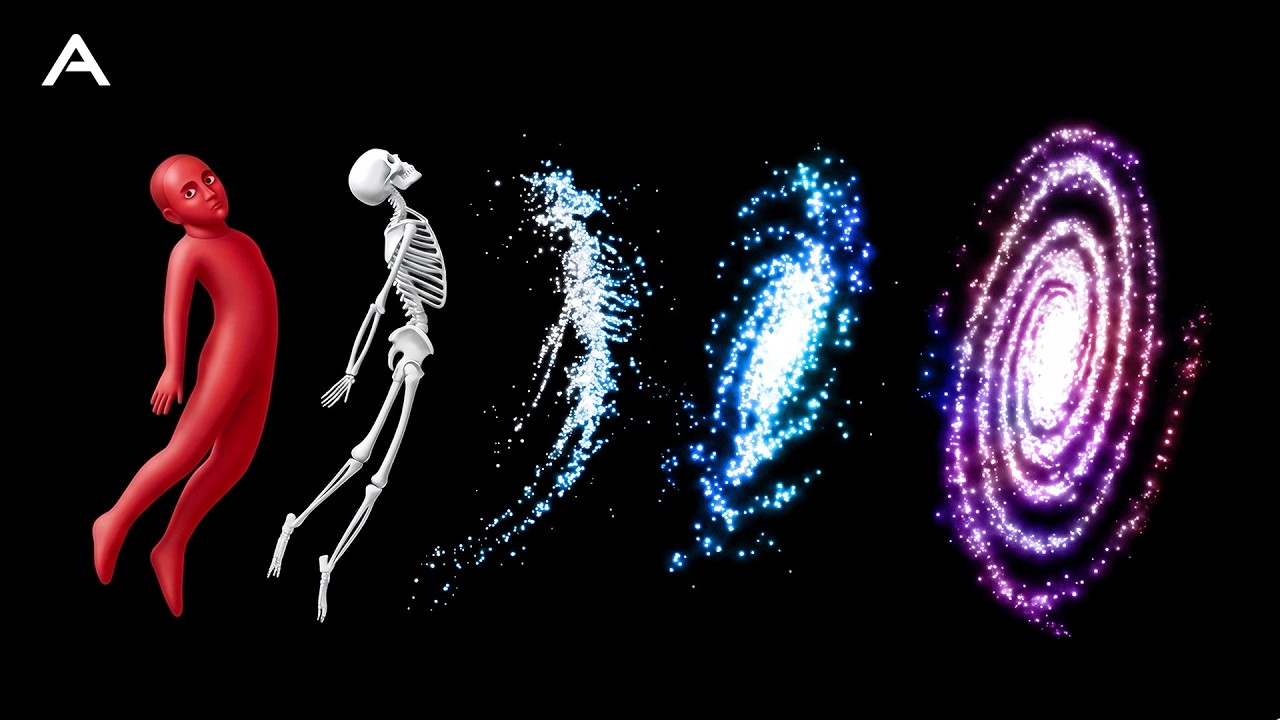
7 Things the Sumerian Tablets Say About the Afterlife — the One That Changes Everything You Believe
A two hour ancient mysteries documentary that reads the Sumerian and Akkadian clay tablets as a single account of the afterlife, walking through seven claims and building to a seventh: that every human carries a divine spark of the highest cosmic principle whose development is the purpose of life. The throughline is the ancient astronaut reading, that the Anunnaki transmitted this knowledge along with writing and mathematics rather than the Sumerians inventing it. The narrator leans hard on parallels to near death experience research and quantum theories of mind, arguing the convergence is too specific to be coincidence. Sources like the Descent of Inanna, the Epic of Gilgamesh, and the Enuma Elish are real, and a closing assessment weighs the speculative interpretation against what Assyriology actually supports.
Published Jun 11, 20262:09:54 video69 min readAdded Jun 16, 2026Open on YouTube →
At a glance
This is a two hour documentary from The Ancient Seal that reads the oldest written records on Earth, the Sumerian and Akkadian clay tablets pressed into cuneiform thousands of years ago, as a single coherent account of what happens to a person after death. The narrator walks through seven distinct claims the tablets make about the afterlife, drawn from texts like the Descent of Inanna, the Epic of Gilgamesh, the Atrahasis flood epic, and the Babylonian Enuma Elish, and builds toward a seventh claim he says reframes the other six.
The throughline is the ancient astronaut reading associated with Zecharia Sitchin: that the knowledge in these tablets was not invented by a Bronze Age people but transmitted to them by the Anunnaki, the sky descended gods of the Sumerian texts, alongside writing, mathematics, and astronomy. The narrator repeatedly sets that reading against the mainstream view that the Anunnaki are literary figures and the afterlife theology is human religious imagination, and he draws long parallels to modern consciousness research: near death experience studies, the hard problem of consciousness, and quantum theories of mind. The page below rebuilds the documentary in its own order and frame, attributing each claim to the narrator as it goes. A section near the end, "Where it stands," weighs the claims against what scholarship actually supports.
Figure 1. The layered cosmos as the narrator lays it out, from An at the top through the earth, the Abzu, and the seven descending gates of Kur. The default soul descends and is stripped at each gate. The amber thread on the right is the claim the whole documentary builds toward: a divine spark that does not belong to the underworld and is meant to climb back up.
The opening: a library that was never supposed to survive
The narrator opens underground, with a library buried in the sands of ancient Mesopotamia. Scribes pressed cuneiform into wet clay 4,000 years before the birth of Christ, recording a world before the flood, a civilization before recorded history, and a cosmology he calls so alien to the schoolroom story that mainstream academia has spent a century arguing about the parts that do not fit. Most of what was found, he grants, fits neatly: agricultural records, trade receipts, the bureaucratic paperwork every civilization produces. But buried in the same archive, etched with the same reed stylus, were texts of another nature: hymns to gods who descended from the sky, ritual instructions for appeasing beings of immense power, and an entire cosmological framework for what happens to the human soul after death.
What sets these afterlife texts apart, he argues, is the register. They are not vague poetry or symbolic metaphor that lets a scholar say "this obviously is not meant literally." They are detailed, procedural, almost bureaucratic, the language the Sumerians used when they wanted you to understand something precisely. And what they say is unlike anything in the religious traditions that followed. It is not heaven. It is not Christian hell. It is not the Egyptian Field of Reeds. It is, he says, something older and stranger, raising questions modern science is only now acquiring the vocabulary to ask.
He frames the documentary as seven significant things the tablets say about death, drawn from multiple text traditions across centuries of Sumerian and Akkadian writing, plus the one claim that, taken seriously, changes the assumptions under Western civilization's understanding of human consciousness and origins. He flags the seventh as the one the academic establishment has the hardest time explaining away, and asks viewers to stay to the end.
His first reframe is that the Sumerians did not fear death the way we do. The textbook picture is grim and pessimistic, a bleak underworld where the dead eat clay and drink dust. That imagery is real, he says, and the Descent of Inanna contains it. But presenting it as the whole of Sumerian belief is, in his analogy, like reading only the Book of Revelation and concluding Christianity is entirely about monsters and catastrophe. Read across the myth cycles, lamentations, hymns, ritual texts, wisdom literature, and cosmological texts, a different picture emerges: death as transition, not ending, with the nature of that transition depending on who you were, how you lived, and most of all what you knew.
That last point, he says, is the central organizing principle of the whole system and the one outside researchers have fixed on. The afterlife is not just a place you go. It is a process you navigate, and the navigation requires specific technical initiatory knowledge that the tablets themselves transmit. He notes the structural echo: the Egyptian Book of the Dead, the Tibetan Book of the Dead, the Gnostic soul journey through the archonic realms, and the encoded Greek mystery schools all run on the same principle, and the Sumerian version is older than all of them and the most physically specific.
The first thing: the soul is not one thing
The first claim is that the human soul is not a single unified entity but a composite, a layered structure of distinct components that do different jobs in life and separate at death. The narrator stresses this is not metaphor in the tablets: each component has a name, described properties, and a separately addressed post mortem fate.
The primary component is the etemmu (he renders it "atmu"), the word that appears most often in afterlife contexts and the part that descends to the underworld. But it was not the totality of the self, nor even the most important part during life. It is closer to a vital force or animating principle, the part that keeps the body warm and functioning. At death the etemmu departs and journeys to the underworld, which the Sumerians called Kur, the great below, arriving in the realm ruled by Ereshkigal, queen of the underworld, and her consort Nergal. There it exists in a state the texts describe with startling ambiguity: not suffering exactly, not bliss, more a diminished continuation of the personality, stripped of full capacity but retaining memory and identity.
The point almost never discussed in mainstream treatments, he says, is that the etemmu was not the only component that could survive. It was the default survival mechanism, the thing that happens to everyone regardless of spiritual development, the equivalent in later Gnostic language of the psychic body, the lesser soul that continues but does not transcend. The tablets also name a more enigmatic component, which he calls the zak, appearing in contexts that suggest spirit as opposed to soul, a higher and more refined aspect with a different relationship to death. It shows up in dreams, in ritual, and in communication between the living and the dead, operating at a level the underworld does not fully constrain.
He maps the etemmu and zak distinction onto a pattern he says recurs worldwide: a part of us bound to matter and subject to death, and a part of a different nature that does not fully belong to matter. The Tibetan Buddhist tradition calls these the gross mind and the subtle mind. The Egyptians distinguished the ka and the ba. The Gnostics distinguished the psyche from the pneuma. In each, he says, the outer teaching says death claims the outer soul while the inner teaching promises a path to preserve or elevate the higher aspect, and the Sumerians were describing this 4,000 years before those traditions took their current forms.
Then the ancient astronaut turn: the tablets do not present this dual soul structure as a human discovery. They present it as received knowledge given by the Anunnaki along with writing, agriculture, law, mathematics, and astronomy. The same tablets crediting the Anunnaki with farming and writing credit them with the knowledge of what happens to the soul after death, as part of the foundational transmission that, in the texts' own telling, turned a primitive species into a civilization. Why an advanced civilization handing over technology would also include detailed soul science is, he says, a question the mainstream has no good answer for, because in the mainstream frame the Anunnaki are mythological and so is anything attributed to them. Take the alternative seriously, that they were real beings with deep knowledge of consciousness, and the inclusion of soul science starts to make a different kind of sense. The foundational claim: a human being is not simply a body that produces consciousness, but a multilayered entity whose components have different destinies, and knowing what you are made of is the prerequisite for navigating what happens when you come apart.
The second thing: the underworld has a real geography
The second claim is that the afterlife has a specific physical geography, not a symbolic landscape but a mapped, directional, structured space with zones, boundaries, gates, guardians, and travel routes. The Sumerians, he says, described the underworld the way an explorer describes territory they have personally charted.
Kur lies beneath the earth, consistent across the texts. But beneath that consistency is a realm divided into at least seven distinct levels or regions, each separated from the next by a gate, each gate guarded by a being who demands specific credentials to pass. The number seven is not accidental; he calls it a structural principle in Sumerian cosmology: seven heavens, seven levels of underworld, the seven sages who brought civilization, seven days of creation. Seven encodes a complete system.
Each gate requires the traveler to surrender something. In the Descent of Inanna, the most complete surviving account of the journey, the goddess removes one item of regalia at each of the seven gates: her crown, her earrings, her necklace, her breastplate, her ring, her lapis lazuli measuring rod and line, her royal garment. Each surrendered item is not just an object but a set of capacities and protections. By the seventh level she arrives before Ereshkigal naked and bowed low, stripped of everything that made her a goddess, and there she is killed, hung on a hook, and left to rot. The structural lesson the narrator draws: the underworld is a layered system of increasingly deep penetration into a realm defined by reduction and stripping away. To go deeper is to possess less; to reach the bottom is to be reduced to nothing.
Here he reaches for his first physics parallel. He compares this to quantum mind theory and the orchestrated objective reduction model, in which awareness is treated as a property of quantum coherence, an organized complexity. What happens to consciousness when that organized complexity breaks down is, he says, precisely the question that field cannot yet answer, and the directional metaphor of going deeper meaning possessing less, of dissolution into increasing undifferentiation, maps onto the physics of decoherence with unsettling precision. He calls it either a remarkable coincidence or evidence the Sumerians had access to information we are only now rediscovering.
But the geography is not only about dissolution. The texts also describe a route that does not end at Ereshkigal's throne, a path that continues beyond the lowest level and emerges somewhere else, taken by very few souls and requiring specific knowledge and preparation. It appears in fragments and allusions rather than in any complete text, but it is there, and he flags it as the thread he will return to at the seventh revelation. The geography, then, is not a single map but a system with multiple routes and radically different outcomes depending on the traveler's knowledge.
The third thing: the dead are judged, by procedure
The third claim is that the dead are judged, not in the vague sense of bad people going to a bad place, but in a specific legal proceeding run by specific beings following specific procedures, described in the same careful procedural language the Sumerians used for actual legal contracts.
The court of the dead is presided over by Utu, the sun god, called Shamash in the Akkadian tradition. His association with both daylight and the judgment of the dead is not coincidental: in Sumerian thought light is truth and revelation, the bringing of the hidden into visibility, and the sun god sees everything because the sun illuminates everything. The judgment takes place before a council of deities referred to collectively as the Anunnaki in their underworld aspect, the great gods of heaven and earth functioning here as the judicial panel. The tablets seat them in a great assembly hall, the Ekur, the "house of the mountain," which is simultaneously Enlil's temple in the city of Nippur and the designation for the highest court of the underworld.
What is judged is surprisingly specific: not just whether a person was generally good or bad, but the complete record of a life, including what no human witness could observe. Thoughts, intentions, the content of dreams, the quality of attention brought to ritual obligations, the integrity of relationships with people and with the divine, and above all the gap between public presentation and private reality. The Sumerian judgment, he says, is specifically concerned with authenticity, with whether who you appeared to be and who you actually were were the same person. The imagery is sometimes translated as weighing the heart or the deeds, more elaborated later in the Egyptian tradition but clearly present here as a precursor.
The outcome is not binary. The texts describe a spectrum. At the worst end, a soul judged to have lived in extreme violation of the proper order faces a second death, the obliteration of the etemmu itself, dissolving even the diminished continuation, presented as genuinely rare. In the middle is the standard underworld existence, the etemmu shuffling through Kur, the default fate of the overwhelming majority, described as permanent twilight rather than acute suffering, a recognizable continuation of life stripped of vitality and the capacity for change. At the better end are souls judged to have lived in alignment with the me, the divine ordering principles that govern civilization and cosmos; these get a different quality of underworld existence with greater freedom of movement, clarity, and connection to the living, the ancestors who remain accessible to their descendants. And at the very top, in fragments and elusive references scholars have never quite known what to do with, are the souls that do not remain in the underworld at all, that pass through and beyond. He promises to return to them.
The fourth thing: the dead remember everything
The fourth claim is that the dead remember their lives. This seems obvious, he says, until you consider that several later traditions explicitly taught the opposite. In Greek thought the dead cross the river Lethe and drink the waters of forgetting, arriving stripped of the memories that constitute their identity, and some reincarnation traditions hold that the soul deliberately forgets past lives to engage fully with the new one. The Sumerians taught something different: the dead in Kur retain their memories, their identity, their knowledge of who they were and what they experienced. That intact memory is what makes the dead useful to the living and makes ancestor communication meaningful rather than symbolic.
But the tablets go further, describing a process of review that he says resembles what near death experience researchers in the 20th and 21st centuries documented as the life review. NDE accounts across cultures describe a panoramic, simultaneous, emotionally vivid playback of the entire life, not a highlight reel but every moment and interaction, experienced not only from the person's own perspective but from the perspective of everyone affected by it. The Sumerian texts describe something very similar as a standard feature of the post mortem process, the expected experience of every soul passing through judgment, and that review informs the judgment. What is remarkable, in his ancient astronaut frame, is the source question: the life review cannot be deduced from observation or arrived at by reasoning from first principles. It can only be known by direct access to the experience of dying or by transmission from a source that possesses it. The Sumerians attributed it to the Anunnaki, which opens the question of how the Anunnaki themselves came to know it.
The fifth thing: the dead and the living stay connected
The fifth claim is that the afterlife is not separated from the living world by an absolute barrier but connected to it through specific, functional mechanisms described in detail. The most important is ancestor communication, which in Sumerian culture was not fringe belief but a central organizing feature of daily religious and domestic life. The dead could be consulted, could give guidance, offer protection, and, if neglected, cause illness and misfortune.
The ritual system supporting this was the kispum, involving regular food and drink offerings to the ancestors, recitation of their names to maintain their presence and identity in the underworld, and in some cases formal divination through which the ancestors' guidance could be received. The narrator insists this is not primitive superstition within the Sumerian frame but a logical consequence of it: if the dead retain identity and memory, if the underworld connects to the living world through specific channels, and if the quality of a dead person's existence depends partly on the offerings of the living, then maintaining the relationship is simply prudent management of a network that does not end with death. The texts cite specific cases of useful information: a dead craftsman telling his son where to find a tool, a dead merchant supplying information about a transaction only he could have known, a dead ruler advising a successor on a political situation.
He anticipates the skeptical response, that these are explanatory narratives any culture produces to validate its rituals, and grants it, then redirects: set aside whether the communication was genuinely supernatural and ask what the existence of this elaborate, systematic, institutionalized practice tells us about Sumerian belief. The Sumerians organized their ritual calendar, domestic practice, and system of social obligation around the assumption that the dead remain present as entities with whom real, consequential communication is possible. And the tablets present the kispum not as native human invention but as protocol taught by the Anunnaki, which he reads, in the ancient astronaut frame, as the transmission of a procedure for interacting with a real dimension of existence rather than the codification of a superstition.
The sixth thing: the system was not built for us
The sixth claim he calls the most politically and religiously charged, because it addresses who the gods are. In the Sumerian texts, he says, the Anunnaki are not immortal in the absolute sense later traditions applied to divinity. They do not die as humans die, but they are clearly subject to forces greater than themselves, occupying a specific position in a cosmic hierarchy with levels above and below. They know the afterlife the way an experienced traveler knows a territory, having mapped it and understanding its rules, but they did not create it.
The relevant texts are the theogonies and the cosmological accounts of the universe before humanity. There the Anunnaki descend from a cosmic source the texts call An, the sky or highest heaven, and the being associated with it, Anu, less a person than a principle, the transcendent ground from which the divine beings derive. Below Anu is Enlil, lord of the air and the active creative principle. Below Enlil is Enki, lord of the deep waters, wisdom, and craft. These three form the highest triad, and their hierarchy is at once a cosmological map and a claim about the nature of reality. The consequence for the afterlife: the Sumerian account is not the product of beings who invented these processes but the account of beings who arrived with knowledge of them and transmitted it. The afterlife system is presented as objectively real, something the Anunnaki discovered or were given or brought with them.
This, he says, is where the ancient astronaut reading diverges most sharply from both the mainstream archaeologist, who sees the Anunnaki as literary figures representing natural forces, and the conventional religious reader, who sees them as fallen angels or false gods. The ancient astronaut researcher reads them as what the texts say: beings from another place, possibly another world, who came here and found or built or managed the systems that govern post mortem existence. He grants the claim is extraordinary and not provable on current evidence, but argues it has to be taken seriously as a textual claim before it can be evaluated as a historical one.
Then he states the sixth thing plainly: the afterlife system was not designed for humans. It was designed by and for beings of a different nature, and humanity was inserted into it with specific constraints. The me, the divine laws, pre exist humanity; they were in operation before human beings existed, and when the Anunnaki created humans they made a kind of being subject to those pre existing laws in a particular way. The specific way is expressed through namtar, the concept of fate or the destinies. Each person has an assigned destiny, written, including the manner and timing of death and the nature of post mortem existence, and the writing of destinies is an Anunnaki function performed by the great council of gods.
This sounds like pure predestination, he notes, and is sometimes presented that way, but the picture is more complex because the texts also describe altering fate, not through rebellion but through knowledge based practices, knowing how to approach the right being in the right way with the right credentials and argument. The legal metaphor is pervasive and deliberate: the afterlife operates like a legal system, with laws, judges, procedures, established channels for challenging decisions, and provisions for outcomes that differ from the default. The existence of those provisions, he says, is the theological foundation of the entire esoteric tradition, the temple based mystery schools, the initiated priesthood, the practitioners of what the texts call the nam-shub, the sacred wordcraft that could alter reality through directed sound and intention. These were not rebels against the divine order but people learning to navigate it with greater sophistication, and their highest application was preparation for death: knowing how to die in a way that opened paths closed to the uninitiated, how to navigate the underworld rather than merely arrive in it, how to present yourself to the judgment council in a way that moved your fate off the default. He calls this the esoteric core of Sumerian religion and the direct precursor of the Egyptian mystery schools, the Orphic and Eleusinian mysteries, and the Gnostic traditions, all teaching in different languages the same thing: there is a way to navigate death that most people do not know, and learning it is the highest purpose of spiritual practice.
The seventh thing: you carry a divine spark
Now the seventh thing, the one he says the establishment has the most trouble with and the one that, followed to its conclusion, revises not your understanding of Sumerian religion but your understanding of what you are. The highest component of the human soul, he says, is not native to the afterlife system it inhabits. It does not belong to Kur the way the etemmu does. At its deepest level the human soul is identified in the tablets with a divine spark, a fragment of divine essence, the portion of the highest cosmic principle embedded in humanity at creation. And it does not go to the underworld when a person dies, because it is of a nature entirely incompatible with the underworld. It is, in the tablets' language, a piece of Anu, a fragment of the highest heaven dressed in flesh and sent into the material world for purposes the texts describe obliquely but consistently.
He breaks this into three components, each extraordinary on its own. First, human beings literally contain something of divine origin. The body is fashioned from clay, from existing biological material, but the Atrahasis epic and the Enuma Elish both make the human body from existing material mixed with the blood of a divine being. The divine component is not inspirational or symbolic but physical, mixed into the literal substance of what we are. Second, this divine component is not fully at home in the system it inhabits. The human being participates in two worlds at once, the material world of the body and the divine world from which the soul fragment comes, and this divided nature is not a flaw but the intended design: humanity is meant to be a bridge between the two worlds, a conduit. Third, and hardest to articulate, if the highest soul component is a fragment of the highest cosmic principle, then it has no fixed post mortem destination. Its destination depends on what it becomes through a life, on whether it has been clarified or clouded, prepared for return to the source or ill equipped for the journey. The path back is not automatic, not guaranteed by membership in any group or adherence to any rules, but achieved through a specific interior development the Sumerian initiatory traditions were built to support. Without that development the divine spark, still real and still divine, finds itself unable to navigate home and falls into the default fate of the etemmu, the diminished continuance in the underworld.
This, he says, is the most sophisticated and the most disturbing thing the tablets say, because the stakes of how you live are not about reward and punishment but about whether you succeed or fail at the most fundamental task of your existence: developing the inner capacity that lets the divine fragment find its way home. It is neither the conventional religious message of being good and going to heaven nor the materialist claim that death simply ends consciousness. It is a third framework, that you are of divine origin, placed in a material system that is not your natural home, and whether you find your way back depends entirely on what you know and what you become. And the Sumerians, the narrator stresses, received this from the Anunnaki, which raises the question the mainstream cannot answer: how did the Anunnaki know? How did they know about the divine spark, the post mortem journey, the distinction between the default fate and the alternative path, with enough confidence to transmit it as established fact? The mainstream answer is that they did not know, that they were mythological beings whose stories are the creative output of a sophisticated human civilization. He calls that coherent but not the only coherent answer, and offers the alternative: the Anunnaki knew because they were advanced enough to have direct knowledge of these realities, the way a physicist knows quantum mechanics, not through mystical revelation but through sustained investigation. The mainstream reading, he argues, requires us to accept that a Bronze Age civilization spontaneously developed an afterlife theology of extraordinary sophistication that maps onto modern consciousness research, with no access to direct investigation. The ancient astronaut framework does not require that.
Figure 2. The narrator's core wager, as a fork. Both lives begin with the same embedded divine spark. The left path, the developed zak, completes the return to the source and, he says, adds something irreplaceable to the cosmos. The right path is not punished so much as stranded: the spark, never developed, falls into the same diminished underworld as the default soul.
Going deeper: the dual soul as a claim about consciousness
Having laid out the architecture, the narrator says the real revelatory content is in the details, and he loops back through the seven claims at greater depth. The etemmu and zak distinction, he argues, is not just about the composition of a person but a claim about consciousness itself. The etemmu, the vital force, maps in modern terms onto what neuroscientists call the default mode network, the background hum of neural activity that constitutes the ongoing stream of ordinary consciousness, the autobiographical narrative that makes you feel like the same person who woke up this morning. The zak is something else, associated in the texts with altered states, dream, deep meditation, and the edge states between waking and sleeping, and in the ritual texts it is always the zak, never the etemmu, that is invoked in genuine divine communication. The implication, following the Sumerian logic, is that ordinary waking consciousness is not the level at which connection to the divine is possible; that connection requires a different mode of awareness, ordinarily suppressed by the noise of everyday cognition but cultivable through practice. He lines up the parallels: the Hindu atman or pure consciousness, the Buddhist rigpa or Buddha nature, the Gnostic pneuma, the Platonic nous. All agree it exists, that most people are not regularly in contact with it, and that their practices are designed to cultivate that contact. The Sumerians, in their afterlife theology, say the fate of this higher component at death differs from the fate of ordinary consciousness precisely because it is of a different nature.
Going deeper: the underworld as space time topology
He returns to the geography with more spatial detail, noting it has attracted not only religious historians and ancient astronaut researchers but a smaller number of theoretical physicists and consciousness researchers who hear in it something closer to a description of space time topology than mythology. In the Sumerian cosmos the structure is layered: An the sky on top, Ki the earth below it, the Abzu the deep cosmic ocean below that (the primordial waters, Enki's domain, also the deep underground freshwater that made Mesopotamian agriculture possible), and below even the Abzu, Kur, the underworld proper. The detail usually glossed over, he says, is that Kur is not a simple spatial location like the Greek Hades but a process zone, a transitional space at the boundary between the material realm and something beyond it. The word kur itself is ambiguous in Sumerian, meaning mountain and underworld and foreign land at once, a word for boundaries, edges, places of transition between one kind of reality and another.
The seven gates, then, are not passages through horizontal space but passages through ontological layers, levels of reality differing not just in content but in fundamental structure, each gate taking you further from material existence as we know it. The gatekeepers are not soldiers but entities that exist at the boundary between one level and the next, neither fully of the material world nor fully of the underworld, and the credential to pass them is not a password but the possession of a quality of consciousness appropriate to the next level. He connects this to the many worlds interpretation of quantum mechanics, in which reality branches at every quantum decision point; to pilot wave theory, with its distinction between the quantum potential field and the material particles it guides; and to approaches to the hard problem in which awareness is not produced by information processing but is something reality is structured around. None is established mainstream science, he grants, but all are serious proposals under active investigation, and all describe a reality with more layers and ontological depth than the simple material framework allows. Within those frameworks the Sumerian map of a layered cosmos with transitional zones reads less like myth and more like a functional cosmological model, including the idea that navigating between layers requires specific knowledge, because in a reality structured by consciousness, the level you can access is constrained by the quality of consciousness you bring: you cannot perceive what you are not tuned to perceive.
Going deeper: ancestors as a network across levels of reality
The kispum practices take on additional significance through that lens. If the underworld is a structured reality with its own topology and the connection between living and dead is real and functional, then the kispum is not superstition but maintenance of a communication network spanning multiple levels of reality, and the Sumerian claim that the Anunnaki transmitted it suggests the Anunnaki had direct knowledge of how to maintain that connection, transmitting operational procedure rather than folk practice. He reads the dead in this frame not as passive recipients of offerings but as active participants in the ongoing life of the civilization, intermediaries between the living and the higher realms with access to knowledge and perspective the living lack, part of a network of cosmic intelligence that sustains the civilization. The civilization is composed not only of the living but of all who have ever lived, in their various post mortem states, connected to the present through specific practices. The ancient astronaut interpretation, he says, is that the Anunnaki designed it this way deliberately, building a civilization that included the dead as functional members because they understood consciousness does not cease at death and that a civilization maintaining connection with its ancestral intelligence pool is more resilient than one treating death as a hard termination. Either a beautiful vision of civilizational design by beings who understood consciousness profoundly, or mythology; the mainstream says mythology, and he says the evidence does not compel that verdict.
The me of the human being, and the inner creation story
Now properly prepared, he restates the seventh claim more precisely: the tablets across multiple traditions and time periods consistently assert that the human being contains a component literally made of the same substance as Anu, the transcendent ground of existence, placed in humanity at creation, deliberately, for a purpose tied to the cosmic project the Anunnaki were engaged in. The texts closest to making this explicit are the wisdom literature, particularly Ludlul bel nemeqi, the Babylonian precursor to the Book of Job, and the versions of the Atrahasis myth, but the fullest elaboration is in a less well known group of texts associated with the temple complex at Nippur and its long lived scribal tradition. Those texts describe the me of the human being, the divine ordering principle embedded in each human soul at creation, described in technical language as an actual ontological property that distinguishes humans from all other created beings. Animals have vitality and etemmu in a limited sense but not this component; plants have life but not the me; demons and spirits have power but not the me. The divine spark is, he says, exclusively human.
Why exclusively human? Because humanity was created for a specific purpose that required the divine spark. The exoteric texts present that purpose crudely, as labor: the Atrahasis epic and the Enuma Elish present humanity as a labor saving device, beings made to do the work the Anunnaki no longer wanted to do. But that, he argues, is almost certainly not the complete story, because the same texts that call humanity a divine labor force also present the divine spark as humanity's most significant property, and you do not put divine essence into a labor force, you put it into something whose purpose goes beyond labor. The esoteric tradition taught that the labor narrative was the outer story for the general population; the inner story, preserved in the initiatory curriculum, was that humanity was created to serve as conscious vessels for divine essence, to carry fragments of the highest reality into the deepest levels of the material world and, through the development of consciousness, to create pathways between the material world and the divine source that neither realm could create on its own.
The afterlife consequence is direct. If the human being is a divine vessel carrying cosmic essence into material existence, then death is the moment the vessel either succeeds or fails at its fundamental purpose. If the divine spark has been developed, clarified, and prepared during life, then at death it can complete the journey it was designed for, returning to the source carrying the specific experiential content of a human life in material reality, information that can only be gathered by a conscious being immersed in the full density of material existence. If it has not been developed, if the life was lived entirely at the etemmu level absorbed in material concerns, the spark cannot complete the return and becomes stranded between the material level it cannot fully leave and the divine level it cannot fully reach, its default fate becoming assimilation into the underworld, not obliteration but continuation without elevation. This, he says, is the most terrible thing the theology says: not the judgment, not even the second death, but that you can carry a piece of the divine within you for an entire lifetime and fail to develop it, arriving at death with everything required for the greatest possible outcome and unable to use it because you never learned how. The Anunnaki transmitted the initiatory knowledge, he argues, not as personal spiritual advancement in the self help sense but as cosmic responsibility, because the development of the divine spark was not optional from the perspective of the cosmic project. It was the whole point.
Where it lines up with modern consciousness research
Following the claim into its implications, the narrator argues that if the highest soul component is literally made of the highest cosmic principle and capable of surviving not just bodily death but the default dissolution of the post mortem system, then what we are is neither the materialist organism nor the conventionally religious created soul but a third thing. He then spends a long stretch on the convergence he finds most striking and hardest to dismiss as coincidence: modern consciousness research, particularly quantum biology, integrated information theory, and near death experience studies, converging on a picture with several features in common with the Sumerian framework.
First, the emerging picture that consciousness is not simply produced by the brain but is in some sense primary, something the brain processes and filters rather than generates. He cites David Chalmers, who articulated the hard problem in the 1990s; Christof Koch and Giulio Tononi, who developed integrated information theory; and Roger Penrose and Stuart Hameroff, who proposed orchestrated objective reduction, all in different ways treating consciousness as something that cannot be fully explained in purely material terms.
Second, the near death experience research most rigorously conducted by Pim van Lommel in the Netherlands, whose prospective study of cardiac arrest survivors was published in The Lancet in 2001. Van Lommel documented that a significant percentage of resuscitated cardiac arrest patients reported detailed, coherent experiences during the period when their brains showed no electrical activity, with consistent features across patients who had no contact with each other and came from diverse backgrounds. The consistent features, the tunnel, the light, the encounter with deceased relatives, the life review, the encounter with a border the experiencer is told they must return from, map, he says, with uncomfortable precision onto the Sumerian description of the early stages of the post mortem journey.
Third, and most provocative, the proposal within quantum mind theory that consciousness has properties at the quantum level that could in principle persist beyond the dissolution of the biological systems that house it. The Penrose and Hameroff model suggests quantum information processed in the microtubules of neurons may be capable of persisting in a non biological medium after death, controversial even within the field but, he says, a serious scientific proposal that opens a door the purely materialist framework keeps shut. Taken together, these three streams suggest the materialist assumption that consciousness is simply brain activity and ceases with brain death may be wrong, and the Sumerians said it was wrong 4,000 years ago with confidence and specificity, attributing that confidence to the Anunnaki. Not proof, he repeats, but a convergence the conventional dismissal of ancient mythology does not adequately account for.
The return path: not a reversal but a transformation
He turns to what the tablets say about the path by which the divine spark returns, the most practically significant part of the seventh revelation. The return is described in fragments, most completely in the hymns to Inanna as queen of heaven and earth and in certain Enlil hymns describing the path upward through the cosmic levels. The descent texts describe the journey down; the cosmic hymns describe the journey up; and the journey up uses the same seven level structure as the journey down but in reverse and requiring entirely different capacities. The descent strips you of everything, your crown, jewelry, clothing, capacity, power, until you arrive naked and diminished, which he reads as the descent into material existence that every human soul undergoes at birth, arriving without the full capacities it possessed in the realm it came from. The return requires you to recover what was stripped, but not by reversing the descent. You do not climb back by retrieving the crown taken at the first gate; you climb back by becoming, through the development of the divine spark, someone who generates the crown from within.
The distinction is crucial, he says: the return is not a reversal but a transformation. The soul that returns after a full human life is not the same soul that descended, nor even the soul that would have existed if it had never descended. It is something new, something that could not have been generated in the divine realm without the specific experience of material existence, including limitation, suffering, and mortality, which the divine realm does not contain. The Sumerian cosmic project, in this reading, is not divine beings playing games with human souls but the generation of something the cosmos needs and cannot produce any other way: consciousness forged in the full density of material existence and returned to the source carrying that experience. Every life that succeeds contributes something genuinely irreplaceable; every life that fails, through ignorance rather than wickedness, registers as a deficit. That, he says, is why the Anunnaki transmitted the knowledge, not out of kindness but because human failure to develop the divine spark was a problem for the cosmic project, not just for the individual. The repeated transmissions through the apkallu sages, the ongoing work of the temple traditions, the preservation of initiatory knowledge through successive civilizational cycles, all suggest to him a sustained effort to improve the success rate of an assigned cosmic task.
The seven sages, the flood, and the fish cloaked teacher
He develops the transmission mechanism. The Sumerians, he stresses, did not describe themselves as discovering their knowledge but as receiving it, fully formed and systematically organized, from beings who already had it. The vehicle is the apkallu, the seven sages who brought civilization knowledge in a series of transmissions the texts place before the great flood: seven sages in seven pre flood periods, each transmitting a portion of the package, followed after the flood by seven more who maintained and transmitted the pre flood knowledge. The apkallu are deeply ambiguous, associated with the Anunnaki but not identical, a semi divine category of intermediaries, represented in Assyrian art as human headed winged figures or as fish cloaked beings of indeterminate nature.
The fish cloaked apkallu lead him to Oannes, the figure described by the Babylonian historian Berossus in the 3rd century BCE, who claimed access to extremely ancient temple records. Berossus describes Oannes as a being who emerged from the sea with the body of a fish but a human head and feet, who taught humanity the full package of civilizational knowledge, agriculture, writing, mathematics, law, everything necessary to civilized life, then returned to the sea, followed by similar beings in successive epochs. This maps precisely, he says, onto the apkallu tradition and onto the ancient astronaut hypothesis of a series of visitations by advanced beings. The fish imagery is suggestive: in ancient astronaut research the fish suit is read as a space suit or diving apparatus, a protective garment for beings not naturally suited to Earth's environment. He calls this speculative but no more so than the mainstream reading that it is purely mythological imagery without reference to physical reality, and insists what is not speculative is that the texts describe a transmission of knowledge from non human beings to humanity, claim that transmission as the source of Mesopotamian civilization, and include the afterlife theology in it.
The Descent of Inanna as a manual for dying
He returns to the afterlife itself for the experiential content, treating the Descent of Inanna as the most complete narrative of a journey through the underworld. Inanna is not an ordinary soul but the queen of heaven and earth, and she chooses to descend, ostensibly to attend the funeral rites of the Bull of Heaven, though esoteric readings treat the descent as a voluntary initiatory journey, a deliberate immersion in death and dissolution to acquire knowledge unobtainable any other way. The structure is precise: she instructs her minister Ninshubur to advocate for her return if she does not come back within three days, dresses in her full regalia, all seven of her divine me, and descends. At each gate the gatekeeper Neti demands to know why she has come, and she gives different answers at different gates, suggesting she is negotiating rather than having automatic access. At each gate she surrenders one item: her crown for sovereignty over the upper world, her earrings for perception and discernment, her necklace for connections and relationships, her breastplate for protection and identity, her gold ring for power and authority, her lapis lazuli measuring rod and line for the capacity to measure and judge reality, her royal garment for her fundamental nature and dignity. By the seventh gate she is naked and bowed low, and Ereshkigal kills her; the text states it plainly, Inanna is killed, her corpse hung on a hook and left to rot. Three days pass, and then the intervention she arranged before descending, her instruction to Ninshubur and her prior arrangement with Enki, allows the rescue and restoration that would not have been possible without that preparation.
The esoteric reading, consistent across interpretive traditions for thousands of years, is that the descent models what happens to the soul at death: the stripping at each gate is the dissolution of the layers of personal identity and capacity, the death at the bottom is the complete dissolution of the etemmu that happens to every soul that descends without preparation, and the return is only possible because of what was prepared before the descent. It is, he says, not just the story of a goddess but a manual for navigating death, addressed to the initiated. What did the preparation involve? The outer text describes Inanna's practical arrangements; the inner text, readable through comparison with later traditions, describes the development of the zak, the higher soul component, to the point where it can withstand the stripping and survive the encounter with the lowest level. That development required not moral improvement alone, though ethics is part of it, nor ritual compliance alone, but the direct experience during life of states of consciousness that transcend the etemmu, entering regularly and intentionally the states associated with deep meditation and visionary experience, what the texts call descent and ascent, the interior journey that mirrors the cosmic journey. The temple initiates practiced these descents and ascents as rehearsal, learning the territory before they had to navigate it in earnest. He lines this up with the Eleusinian Mysteries, which involved a ritual descent into an underground chamber and an experience described as death and rebirth; the Tibetan bardos, explicit maps of the post mortem journey memorized during life as navigational guides; and the Egyptian initiatory traditions involving ritual experiences in temple burial chambers as preparation for the journey through the Duat. All trace back, with varying acknowledgment, to the Sumerian source, and the Sumerian source traces back to the Anunnaki.
The suppression of the divine spark doctrine
He turns to the suppression question, arguing the seventh claim was not simply lost to time but actively removed from public transmission and restricted to initiatory contexts, a restriction that accelerated as new powers replaced the Sumerian temple tradition. The transition from Sumerian to Akkadian and Babylonian religious culture preserved much of the cosmological framework but progressively shifted emphasis from the esoteric content about the divine spark and the return path to the exoteric content about the power of the gods and the human obligation to serve them. The clearest example is the Enuma Elish, the Babylonian creation epic that supplanted the older Sumerian narratives in official practice. There humanity is created from the blood of the defeated chaos monster Kingu mixed with clay, to do the work the gods no longer wished to do. The divine component is present but is now the blood of a defeated and killed deity rather than a deliberate embedding of essence from the highest cosmic principle. He calls this a significant theological demotion: in the older Sumerian frame the divine spark is a gift from the highest level, a piece of Anu; in the Babylonian revision it is the blood of a cosmic criminal, the loser in a divine battle. The implication shifts from you are vessels of the highest cosmic essence to you are made from the remains of a defeated enemy, and if your divine component is the residue of a cosmological crime then the project of developing it toward a return to the source makes no sense.
The mystery school traditions that preserved the older framework survived but were driven further underground, because the Babylonian official religion did not permit the claim that human beings carried a divine spark equivalent to the highest cosmic principle. The political stakes, he argues, were considerable: a population that understands itself as carrying divine essence and tasked with developing it has a source of cosmic authority that does not derive from the state or the official priesthood, a population that in principle does not need intermediaries. Every political and religious establishment, he says, has had an interest in ensuring ordinary people believe they need intermediaries, which is why the mystical traditions of every major religion have been in tension with their official institutions: the Gnostics suppressed by the early church, the Sufis persecuted within Islam, the Kabbalists restricted within Judaism, the Christian mystics watched with suspicion through the medieval period. In every case what was suppressed was a version of the same claim, that you carry within you a divine essence giving you direct access to the highest cosmic reality, that you do not need the institution, you need the knowledge. He calls this one of the most significant and most consistently effective patterns in the spiritual history of the human race, leaving most people today, religious or not, without access to the claim the tablets make about what they are: the materialist tells them they are biological machines, the conventionally religious tells them they are created beings subject to divine authority, and neither contains the specific Sumerian claim about the divine spark. The ancient astronaut research tradition, he says, has begun to recover it, not always rigorously or free of motivated reasoning, but by taking the literal content of the texts seriously enough to ask what they actually say.
He grounds the claim institutionally: the kispum rituals were written into law, the temple initiations were state sponsored and state funded, and the scribal curriculum preserving the theological texts was maintained by the wealthiest and most powerful institutions in the ancient world. This was not the hobby of marginal mystics but the organizational spine of the entire civilization, and the claim that justified the investment was that the afterlife is real, navigable, the knowledge of how to navigate it was given, and the development of the divine spark was the purpose around which everything was organized.
The crisis the framework speaks to
The narrator widens the lens to the present, arguing the Sumerian theology speaks directly to what he calls the intellectual and spiritual crisis of the early 21st century. Western civilization, he says, has organized itself for centuries around the materialist assumption that reality is matter, energy, and spacetime, that consciousness is a product of complex material organization, and that everything can in principle be explained by physical forces and particles. The assumption has been enormously productive, driving the scientific revolution and the technology that transformed human life, solving medical problems that killed millions and letting us look at reality from the subatomic to the cosmic. But it has not solved the problem of consciousness, has not explained why there is subjective experience at all, why there is something it is like to be you rather than simply a physical process with no inner dimension. And it has produced an existential framework that a growing number of people find not just unsatisfying but destructive: if you are a material organism that produces consciousness as a side effect, if death terminates it, if there is no cosmic significance to your existence and no consequences beyond a single biological lifetime, then within the strict materialist frame the honest answer to why any of it matters is that it does not, not cosmically, not ultimately. He reads the epidemic of depression and anxiety in developed societies, the crisis of meaning that afflicts even the materially comfortable, and the desperate search for transcendence in drugs and extreme experiences and nihilistic philosophy as in part the response of beings built for cosmic significance living in a framework that denies it.
The Sumerian theology, taken seriously, offers a different framework, one not dependent on blind faith in institutional religion and not requiring you to accept claims that contradict your rational understanding of the physical world. It says the physical world is real and important, your experience in it is real and important, the suffering and the choices and the relationships and the knowledge all matter, because the material world is the field in which the divine spark is either developed or neglected. It takes the material world utterly seriously while denying it is ultimate: the physical world is not a prison to escape but the training ground, the refinery, the specific environment in which the spark acquires the tempered quality that makes it capable of the return. You are not trying to transcend your life, he says; you are trying to live it well enough that what you carry within you is ready for what comes after. He grants the ancient astronaut tradition has real critics and real problems, the tendency to see ancient astronauts behind every unexplained artifact, the selective use of evidence, the dependence on sources that have not held up, but insists the core claim, that certain ancient texts describe encounters with advanced non human beings who transmitted extraordinary knowledge, deserves to be evaluated on its merits rather than dismissed by association with its least rigorous proponents.
Why Sumer looks like it arrived fully formed
He grounds the ancient astronaut reading in the archaeology of Sumer's emergence. Sumer appears in the Tigris and Euphrates valley around 3500 BCE in a form archaeologists describe as startlingly complete. The standard model of civilizational development is gradual: simple agricultural settlements, then more complex social organization, then urban development, then writing and bureaucracy. Sumer, he says, does not follow that pattern, appearing in the record with writing, urban planning, astronomical knowledge, a complex legal system, sophisticated agricultural technology, and a fully formed cosmological and religious framework. There is an earlier, simpler Ubaid period that precedes it, but the transition from Ubaid to Sumerian, he argues, is not the gradual development you would expect from internal growth but an emergence, a sudden appearance of a qualitatively more sophisticated level of organization.
Where does the additional complexity come from? The mainstream answer is that it emerged from the internal dynamics of a surplus producing agricultural society in a river valley, whose organizational requirements drove writing and bureaucracy, which enabled the rest. He calls this reasonable as far as it goes but argues it does not account for the cosmological knowledge: agricultural productivity and bureaucracy do not require understanding the precession of the equinoxes or the orbital periods of the outer planets, a base 60 mathematical system capable of the calculations modern physicists use, or an afterlife theology that anticipates modern consciousness research. Those, he says, require either an extraordinarily long period of systematic investigation at a sophistication no known prior civilization possessed, or access to knowledge that came from somewhere else. The tablets say it came from the Anunnaki; the mainstream says the tablets are mythological; the ancient astronaut tradition says they are recording something real. The question, he frames, is not whether you can be certain which is correct but whether you are willing to take the evidence seriously enough to grapple with it.
He catalogs the Sumerian achievements that frame the puzzle: a calendar accurate to within a fraction of a degree, the base 60 system we still use for time and angles, astronomical records tracking every visible planet with a precision that required centuries of systematic observation, and medical knowledge including surgical procedures, pharmacological compounds, and diagnostic protocols modern physicians recognize as genuine understanding rather than magical thinking. Underlying all of it, the me, the divine ordering principles, treated not as the arbitrary whims of gods, the way he says Greek mythology presents the Olympians, but as consistent, discoverable, applicable, natural laws in a theological frame.
Gilgamesh: the king who tried to escape the system
He devotes a long section to the Epic of Gilgamesh, grounding the abstract theology in specific tablets. The most relevant texts, he notes, come primarily from four sources: the royal libraries of Nineveh, excavated between 1849 and 1876 by Austen Henry Layard and Hormuzd Rassam; the site of ancient Nippur, excavated over decades from the 1880s by an American expedition sponsored by the University of Pennsylvania; the temple archives of Lagash; and smaller sites across Mesopotamia. The Nineveh tablets, housed mainly in the British Museum, are the most famous and include the Gilgamesh tablets, but the Nippur tablets, less famous, are in his view more significant for these questions, because Nippur was the religious center of Sumer for much of its history, the city of the great temple of Enlil and the most important scribal schools, preserving the most complete versions of the cosmological texts and material preserved nowhere else.
Gilgamesh, king of Uruk, described in the texts as two thirds divine and one third human, embarks on a quest for immortality after witnessing the death of his closest companion Enkidu. The death of Enkidu is the pivot: before it Gilgamesh is too powerful and too consumed by heroic enterprise to reckon with his own mortality, and witnessing Enkidu's spirit descend to the underworld transforms him into a man who will spend the rest of his life trying to escape the one reality no heroism can overcome. The detail usually glossed over, he says, comes in the episode known as Gilgamesh, Enkidu and the Netherworld, in which Enkidu's etemmu is temporarily permitted to return and speak with Gilgamesh, giving a detailed, specific description of the conditions of the dead based on how they lived and died. Those who died with children to perform the kispum for them are faring reasonably well; those who died with no one to make offerings suffer thirst and hunger, subsisting on scraps and water poured into the street; warriors who died in battle occupy a position of relative honor; those who died in accidents or unusual circumstances occupy positions of greater confusion. This is not a vague symbolic afterlife, he stresses, but a socially differentiated post mortem existence in which the circumstances of your death and the relationships you leave behind directly determine the quality of your continued existence, consistent with the kispum claim: the living can help the dead, and the dead depend on the living for specific forms of support.
Gilgamesh's quest, in this frame, is not just the universal human fear of death but a specific theological drama: he is trying to escape the post mortem system entirely, to find the exception, the genuine deathlessness the gods possess but humans do not. He finds Utnapishtim, the one human granted immortality by the gods, learns that a plant of immortality exists at the bottom of the sea, retrieves it, and then loses it to a serpent that steals it while he sleeps, returning to Uruk empty handed. The famous ending has Gilgamesh told by the ferryman Urshanabi to look at the great city he has built, its walls and temples and gardens: this is your immortality, not personal continuation but the monument and the civilization you contributed to. The mainstream literary reading treats this as a mature, stoic acceptance of mortality, and he grants that dimension, but offers the esoteric reading: the walls of Uruk are not merely a symbol of cultural legacy but, in the Sumerian theological frame, literal connections between the human world and the divine realm, physical structures that maintain the channels through which cosmic energy flows between levels of reality. The king who builds them is contributing to the infrastructure of the cosmic project, and Gilgamesh's true immortality is not the continuation of his etemmu in the underworld, which he was right to regard as inadequate, but his contribution to the cosmic structure, the me made real. He reads the ending as offering, in the deepest sense, what the theology offers everyone: not the personal continuation of the ordinary self, a poor consolation prize, but the possibility of contributing something real to the cosmic project, of developing the divine spark to the point where it can complete the return and add something genuine to cosmic evolution. Most people, he says, will not achieve this in their current lives, which is why the entire kispum and ancestor support system exists, predicated on the reality that most die unprepared and require ongoing assistance, but the possibility is real and the path is described.
The convergence the narrator will not let go of
He returns at length to the near death experience literature as the most directly relevant body of modern empirical research, and the hardest to explain away. Pim van Lommel's 2001 Lancet study examined 344 cardiac arrest survivors over years at ten hospitals in the Netherlands, designed to address the standard materialist objection that the experiences are artifacts of dying brain tissue, by focusing on patients verified to be clinically dead with no detectable brain activity during the reported experiences. About 18 percent reported near death experiences during that period, with consistent features: the sense of leaving the body and observing the resuscitation from outside, moving through a dark tunnel toward a light, encountering deceased relatives, a life review, and being turned back at a boundary or by a decision to return. He singles out the life review, described consistently as a panoramic, simultaneous, emotionally complete review of the entire life, every moment and interaction experienced from one's own perspective and from the perspective of everyone else involved, the joy given and the pain caused felt simultaneously. This, he says, is exactly what the Sumerian judgment texts describe: the soul before the divine council, the complete record brought into full visibility, not just external behavior but the interior reality and the gap between appearance and actuality. The tunnel and the light map onto the approach to the underworld, the encounter with deceased relatives onto the claim that the dead retain identity, the impassable boundary onto the gates and their gatekeepers.
He addresses the standard objection that NDE accounts are shaped by cultural expectation, that people see what their culture taught them to expect, and grants it is coherent and deserves serious consideration, but argues it does not account for the cross cultural consistency van Lommel and others documented: people from secular Western backgrounds with no interest in Sumerian theology reporting experiences that match the Sumerian descriptions, children not yet exposed to any afterlife framework reporting consistent experiences, people in non Western cultures with entirely different religious traditions reporting the same core features. The cultural programming explanation predicts divergence; the data shows convergence, and convergence requires explanation. The most parsimonious explanation, he argues, the simplest that accounts for all the data, is that the experiences reflect something real about the structure of the post mortem process, which the Sumerians described thousands of years before modern researchers documented it, leaving, in his framing, either an extraordinary coincidence or evidence of genuinely accurate knowledge, with no third option. He extends this to the cross traditional consensus: the same claim appears in Sumerian temple texts, Tibetan Buddhist sutras, Greek mystery school literature, Gnostic gospels, and modern NDE research, sources with no demonstrable contact across the span of their distribution, and the specific structural features, the seven level cosmology, the stripping at the boundaries, the retention of memory and identity, the distinction between the default fate and the alternative path, are too precise and appear in too many unconnected traditions to be explained as independent invention or as general features arising from universal existential concerns.
What it means for how you live
He closes by turning the whole framework toward the practical question of how to live, which he says is the only thing that ultimately matters. Reading about the afterlife theology, he cautions, is not the same as developing the soul component that navigates it; the reading provides the map, but the map is not the territory, and the Sumerian initiatory traditions provided the experiential training that translated the map into navigational capacity. The specific techniques have not survived in complete form, but the framework has, and from it combined with the preserved techniques of related traditions he sketches the general contours of the practice: regular entry into the states the texts call descent and ascent, interior journeys that mirror the cosmic journey, experiential encounters with the dimensions the afterlife journey will traverse undertaken while still alive so they are known territory rather than unknown wilderness when the actual journey begins. It involved specific ways of dying, not physically, though near death states were sometimes deliberately induced in initiatory contexts, but dying to the ordinary self, the etemmu, the autobiographical narrative and its attachments, as a regular practice, learning to function from the level of the zak without losing orientation. And it involved a specific relationship to time: the Sumerian initiatory tradition was oriented not toward immediate rewards but toward preparation for what happens after death, the entire life understood as the training period for the post mortem journey, a temporal frame not of the lifespan but of the cosmic journey of which the lifespan is one segment. He contrasts this with the modern world's short frames, the quarterly reports and annual goals and five year plans, the longest frame most people operate within being their own lifespan, and even that organized around material accumulation rather than soul development.
He draws five practical implications. First, your inner life matters more than your outer circumstances; the quality of consciousness you cultivate, the depth of your awareness of the divine ground within you, is more significant than material success or social status, which the esoteric core treated as valuable only insofar as it provides the conditions for soul development. Second, how you treat other people has cosmic significance, not only because of karmic accounting but because every person you encounter also carries a divine spark, and whether you recognize and honor that spark or relate to people purely as utility affects the development of your own; the temple traditions included extensive training in the quality of attention brought to ordinary human interaction precisely because recognizing the divine in others is part of developing the capacity to recognize it in oneself. Third, contemplative development is not peripheral to a good human life but central to it, and the modern equivalent of the Sumerian practices is whatever form of contemplative practice you find most resonant and most challenging, not the kind that makes you feel comfortable and validated but the kind that is uncomfortable and revealing and consistently shows you the gap between who you appear to be and who you actually are. Fourth, the time frame you operate within matters enormously; if you make decisions based only on what serves you within your biological lifetime you are operating within too short a frame to align with your actual interests, which extend into the post mortem journey, and the investments that pay off most richly over that longer frame are investments in soul development. Fifth, the questions you ask about yourself and your existence are central to living well, because the Sumerian tradition did not separate the examined life from the lived life; the development of the divine spark happened through living, through engaging with all the challenges and joys and griefs and confusions of a full human existence, but engaging with them with a specific quality of attention that turned ordinary experience into the raw material of soul development.
He ends where he began, with the library in the desert and a map that has been waiting in the sand and the museum archives and the careful work of generations of cuneiform scholars for someone to follow it to its conclusion. The seven things and the one that changes everything, he restates: you have a soul with multiple components, the default component goes to a structured underworld with real geography and inhabitants, the judgment there examines your authenticity, you retain your memory and identity, your connection to the living world is real and can be maintained, the framework was designed by and for beings of a different nature and you were inserted into it with specific constraints, and at the deepest level you carry a fragment of the highest cosmic principle whose development or neglect is the most consequential thing about your existence. Six of the claims, he says, are extraordinary; the seventh is transformative, the one that makes the others cohere. What you do with it, he closes, is entirely up to you, because according to the Sumerians that is precisely the point: the development of the divine spark within you is your task, not the task of any god or institution; they can provide knowledge and preparation, but the work itself, the living of a life in full consciousness of its cosmic significance, is yours alone. He signs off promising the next documentary follows one specific thread of this framework into territory he says will surprise even viewers who came in with extensive knowledge of the material.
Key takeaways
The narrator reads the Sumerian and Akkadian tablets as a single, internally consistent theology of the afterlife, organized around the principle that death is a process you navigate and the navigation requires specific, transmittable knowledge.
The seven claims build on each other: a multi component soul, a structured seven level underworld, a procedural judgment focused on authenticity, full memory retention with a life review, a real channel between the living and the dead through the kispum, an afterlife system not designed for humans, and a divine spark that does not belong to the underworld at all.
The seventh claim is the load bearing one: a fragment of the highest cosmic principle, Anu, is embedded in every human at creation, and whether it completes a return journey to the source or is stranded in the underworld depends on whether it was developed during life.
The throughline is the ancient astronaut reading: that the Anunnaki transmitted this knowledge, along with writing and mathematics and astronomy, rather than the Sumerians inventing it, with the rapid, fully formed emergence of Sumerian civilization offered as supporting circumstantial evidence.
The narrator's strongest move is comparative: he repeatedly lines the tablets up against modern near death experience research (van Lommel's 2001 Lancet study, the life review) and quantum theories of mind (Penrose and Hameroff, the hard problem), arguing the convergence is too specific to be coincidence.
He reads the Babylonian Enuma Elish as a deliberate theological demotion that buried the divine spark doctrine, and treats the later mystery schools, Gnostics, Sufis, and Kabbalists as fragments of the same suppressed Sumerian source.
The practical payoff: live as if the relevant time frame extends beyond your biological lifespan, prioritize inner development over outer circumstance, and treat the recognition of the divine in others as part of developing it in yourself.
Chapters
This upload ships without creator set chapter markers, so the timestamps below are estimated from position in the two hour runtime. They still drive click to seek in the embedded player.
0:00:15 A library that was never supposed to survive
0:01:45 The Sumerians did not fear death the way we do
0:02:45 Death as a process you navigate, not a place you go
0:03:00 The first thing: the soul is a composite, etemmu and zak
0:05:45 The Anunnaki as the source of the soul knowledge
0:09:45 The second thing: the underworld has a real geography
0:11:10 Seven gates, the Descent of Inanna, stripping away
0:11:50 The decoherence parallel, going deeper means possessing less
0:13:10 A hidden path beyond the lowest level
0:13:15 The third thing: the dead are judged by procedure
0:14:10 Utu, the Ekur, and a judgment of authenticity
0:16:10 A spectrum of outcomes, the second death, the souls that pass beyond
0:19:00 The fourth thing: the dead remember, and the life review
0:23:00 The fifth thing: the living and the dead stay connected, the kispum
0:27:00 The sixth thing: the gods are not the ultimate architects
0:30:00 The me, fate, and the esoteric core of Sumerian religion
0:34:00 The seventh thing: you carry a divine spark
0:40:00 Going deeper: the dual soul as a claim about consciousness
0:44:00 Going deeper: the underworld as space time topology
0:48:00 Ancestors as a network across levels of reality
0:51:00 The me of the human being and the inner creation story
1:00:00 Where it lines up with modern consciousness research
1:04:00 The return path: a transformation, not a reversal
1:08:00 The seven sages, the flood, and Oannes
1:12:00 The Descent of Inanna as a manual for dying
1:20:00 The suppression of the divine spark doctrine, the Enuma Elish demotion
1:28:00 The existential crisis the framework speaks to
1:35:00 Why Sumer looks like it arrived fully formed
1:42:00 Gilgamesh, the tablets, and the king who tried to escape the system
1:50:00 The near death experience convergence in depth
1:58:00 What it means for how you live, five implications
2:07:00 Closing: the map in the desert and the question it poses
Notable quotes
"There is a library buried under the sands of ancient Mesopotamia that was never supposed to survive." (0:00:15)
"The Sumerians did not fear death the way we do. That is the first thing you need to understand." (0:01:45)
"The dead do not simply arrive somewhere. They travel through a structured cosmological space, encounter specific beings and challenges along the way, and their ultimate fate depends on whether they possess the correct knowledge to navigate that space successfully." (0:02:45)
"To go deeper is to possess less. To go to the very bottom is to be reduced to nothing." (0:11:30)
"The Sumerians 4,000 years ago were describing the process of consciousness dissolution after death in terms that rhyme uncomfortably well with the most cutting edge models of consciousness physics current scientists are working with today." (0:12:10)
"The Sumerian judgment is specifically concerned with authenticity, with whether who you appeared to be and who you actually were constituted the same person or two different ones." (0:14:40)
"You can carry a piece of the divine within you for an entire lifetime and fail to develop it. You can arrive at death with everything required for the greatest possible outcome and find yourself unable to use it because you never learned how." (0:56:00)
"You are not trying to transcend your life. You are trying to live it well enough that what you carry within you is ready for what comes after." (1:33:00)
"In the beginning was a library pressed into clay. In that library was a map. The map described what you are and where you are going and what depends on whether you know the territory." (1:46:00)
"The development of the divine spark within you is your task, not the task of any god or institution. They can provide knowledge and preparation, but the work itself, the living of a life in full consciousness of its cosmic significance, is yours alone." (2:08:00)
Resources mentioned
People and researchers
Zecharia Sitchin, author who popularized the ancient astronaut reading of the Sumerian texts
Berossus, Babylonian historian of the 3rd century BCE who recorded the Oannes account
Figure 3. The narrator's grand claim laid on a timeline: one original Sumerian map, then a chain of later traditions he says preserved fragments of it without the full context, closing with modern near death experience research and quantum theories of mind that he reads as rediscovering the same territory. The amber endpoints are the two he treats as direct knowledge of the terrain; the blue points are the fragments in between.
Where it stands
Everything above is the documentary rebuilt in its own frame. This section steps outside it.
The historical scaffolding is real, and that is part of what makes the documentary persuasive. Sumer, cuneiform, the Descent of Inanna, the Epic of Gilgamesh, the kispum offerings, Ereshkigal and Enlil and Enki, the base 60 number system, the Nineveh and Nippur excavations, and van Lommel's 2001 Lancet study all exist and are roughly as described. The seven gates of Inanna's descent and the catalog of the dead in the Gilgamesh netherworld episode are genuinely in the texts. Where the documentary leaves the ground is in the interpretation laid over that scaffolding.
A few load bearing claims do not hold up to mainstream Assyriology. The neat etemmu versus zak "dual soul" system is not how scholars read Mesopotamian belief; the etemmu is well attested as the ghost or spirit of the dead, but a paired higher soul called the zak with the properties described here is not a standard term in the literature, and the precise mapping onto ka and ba and pneuma is the narrator's construction, not a documented Sumerian doctrine. The "divine spark that returns to the source" is essentially a Gnostic and Neoplatonic idea read back into texts that are 2,000 years older; the actual Mesopotamian afterlife, as scholars reconstruct it, is famously bleak and offers no return journey and no escape from Kur for anyone, which is the opposite of the documentary's central uplift. The Anunnaki as flesh and blood extraterrestrials, and Sitchin's whole interpretive system, are rejected across the field, including specific points like the translation choices and the claimed planet Nibiru; Sitchin was not a trained Assyriologist and his readings do not track the cuneiform. And the "fully formed, no gradual development" framing of Sumer's emergence understates the long Ubaid and Uruk sequence that archaeologists actually document leading into it.
The consciousness research is real but does not carry the weight placed on it. Van Lommel's study is genuine and provocative, but the claim that subjects had verified experiences during flat brain activity is contested, and near death experiences remain an open research question rather than settled evidence of a surviving soul. Orchestrated objective reduction is a minority proposal that most physicists and neuroscientists do not accept. None of this is fraudulent science, but presenting it as converging confirmation of a Bronze Age afterlife map is a leap the underlying papers do not make.
The honest framing: this is a well produced, internally consistent piece of esoteric documentary in the ancient astronaut tradition, and it is upfront that it is reading the tablets through that lens rather than reporting an academic consensus. Taken as that, as a tour of genuinely fascinating texts wrapped in a speculative and at times romantic interpretation, it is engaging and a real introduction to material most people never encounter. Taken as history, the specific claims about what the Sumerians believed, and especially about who gave them the knowledge, are not what the evidence supports. The tablets are real and worth the attention. The Anunnaki as cosmic engineers of the human soul are the narrator's story, not the record's.
Full transcript
There is a library buried under the sands of ancient Mesopotamia that was never supposed to survive.
Cuneaoifor tablets pressed into wet clay by scribes who lived 4,000 years before the birth of Christ.
Tablets that describe a world before the flood.
A civilization before recorded history and a cosmology so alien to everything we were taught in school that mainstream academia has spent the better part of a century arguing about what to do with the parts that don't fit.
Most of what they found fit neatly into the accepted story.
Agricultural records, trade receipts, the kind of bureaucratic paperwork that every civilization produces in abundance.
But buried inside that same archive, etched into the same clay with the same careful read styluses, were texts of a completely different nature, hymns to gods who descended from the sky, instructions for rituals meant to appease beings of immense power, and most startling of all, an entire cosmological framework describing what happens to the human soul after death.
Not in vague poetic language, not in the kind of symbolic metaphor that allows scholars to say, "This obviously isn't meant to be taken literally." in detailed, procedural, almost bureaucratic language.
The kind of language the Sumerianss used when they wanted you to understand something precisely.
And what those tablets say about the afterlife is unlike anything in the religious traditions that came after them.
It is not heaven.
It is not hell in the Christian sense.
It is not the Egyptian field of reads.
It is something older and stranger and far more unsettling.
Something that raises questions modern science is only now beginning to have the vocabulary to ask.
In this documentary, we're going to go through seven of the most significant things the Sumerian tablets say about what happens after you die.
Seven distinct claims drawn from multiple text traditions across centuries of Sumerian and Aadian writing that together form a picture of death and existence that has been largely hidden from the general public.
Not because of a grand conspiracy, though the suppression of certain interpretations is worth examining on its own, but because the implications are so far-reaching that most institutions, academic and religious alike, simply do not know what to do with them.
And then we are going to look at the one claim, the single piece of Sumerian afterlife theology that doesn't just challenge conventional religion or conventional archaeology.
The one that if taken seriously changes the fundamental assumptions underlying Western civilization's understanding of human consciousness, human origins, and what we are.
We are going to start at the beginning with what the Sumerianss actually believed about death before we get to what the tablets say about what comes after it.
Because you cannot understand the destination without understanding how they conceived of the journey.
If this kind of deep dive forbidden history content is what you've been looking for, hit subscribe right now.
We cover Sumerian cosmology, ancient astronaut evidence, suppressed archaeology, and the hidden history of human origins every single week.
And make sure you stay through to the end of this documentary because the seventh revelation is the one the academic establishment has the most difficulty explaining away.
Most viewers say it's the moment everything clicks into place.
The Sumerians did not fear death the way we do.
That is the first thing you need to understand, and it runs counter to almost everything you've probably read about ancient Mesopotamian religion in a classroom textbook.
The standard academic framing presents Sumerian afterlife belief as grim and pessimistic, a bleak underworld where the dead shuffle around in darkness, eating clay and drinking dust.
And yes, that imagery is in the tablets.
The text known as the descent of Inana describes exactly that kind of landscape.
But presenting that as the totality of Sumerian afterlife belief is like reading only the book of Revelation and concluding that Christianity is entirely about monsters and catastrophe.
The Sumerians had a layered, complex, and internally consistent theology of death and afterlife that evolved over more than 2,000 years of continuous civilization.
The tablets we have access to represent multiple distinct periods, multiple schools of thought within Sumerian religious practice, and multiple levels of what appears to have been an esoteric knowledge system with an outer teaching for the general population and an inner teaching for those initiated into the temple traditions.
When you read across all of that material, across the myth cycles, the lamentations, the hymns, the ritual texts, the wisdom literature, and the cosmological framework texts, a very different picture emerges.
One in which death is not an ending, but a transition.
One in which the nature of that transition depends heavily on who you were, how you lived, and most crucially, what you knew.
This last point is the one that has attracted the most attention from researchers working outside the mainstream archaeological consensus.
Because the Sumerian texts do not just describe the afterlife as a place you go.
They describe it as a process you navigate and the navigation requires knowledge.
Specific technical initiatory knowledge that the tablets themselves appear to be transmitting.
This is not a minor interpretive wrinkle.
This is the central organizing principle of the entire Sumerian afterlife theology.
The dead do not simply arrive somewhere.
They travel through a structured cosmological space, encounter specific beings and challenges along the way, and their ultimate fate depends on whether they possess the correct knowledge to navigate that space successfully.
Sound familiar?
It should because the Egyptian Book of the Dead operates on exactly the same principle as does the Tibetan Book of the Dead as does the Gnostic framework of the soul's journey through the archonic realms as do in more encoded form the mystery school traditions of ancient Greece.
The Sumerian version is older than all of them and the Sumerian version is the one that appears to be describing something with the most striking technological and physical specificity.
So let us begin.
Seven things the Sumerian tablets say about the afterlife and the one that changes everything.
The first thing the Sumerian tablets say about the afterlife is that the human soul is not a single unified entity.
It is a composite, a layered structure of distinct components that perform different functions during life and separate from each other at the moment of death.
This is not metaphor.
The Sumerians had specific names for each component.
They describe their individual properties in detail and the fate of each component after death is addressed separately in the theological texts.
The primary soul component in Sumerian thought was called the atmu.
This is the word that appears most frequently in afterlife contexts and it is the component that descends to the underworld.
But the atmu was not the totality of the self.
It was not even the most important part of the self during life.
The ATMU was in the Sumerian framework something closer to what we might call the vital force or the animating principle.
The part of the human being that keeps the body alive and warm and functioning.
When a person died, the ATMU departed the body and began its journey to the underworld, which the Sumerianss called Kurr or the great below.
It would eventually arrive in the realm ruled by Ereskagal, the queen of the underworld, and her consort Nurgal.
There it would exist in a state that the texts describe with startling ambiguity.
Not suffering exactly, not bliss.
Something more like a diminished continuation of the personality, stripped of its full capacities, but retaining memory and identity.
But here is the critical point that is almost never discussed in mainstream treatments of Sumerian religion.
The ATMU was not the only sole component that could survive death.
It was the default survival mechanism, the thing that happened to everyone regardless of their spiritual development or initiatory status.
It was in the language of later gnostic thought the psychic body the lesser soul that continues but does not fully transcend.
The Sumerian texts also describe a component called the zak.
The zak is far more enigmatic.
It appears in the texts in contexts that suggest it is something like what later traditions would call the spirit as opposed to the soul.
A higher or more refined aspect of the human being that has a different relationship to death and to what lies beyond death.
The zak appears in dream contexts, in ritual contexts, and in contexts describing communication between the living and the dead.
It seems to operate at a level of reality that the underworld does not fully constrain.
The distinction between the atmu and the zak maps onto a distinction that appears in spiritual traditions around the world and across thousands of years of human religious thought.
The distinction between a part of us that is bound to material existence and subject to its limitations, including death, and a part of us that is somehow of a different nature entirely.
A part that does not fully belong to the realm of matter and therefore cannot be fully captured by the processes of material dissolution.
The Tibetan Buddhist tradition calls these two aspects the gross mind and the subtle mind.
The Egyptian tradition distinguished between the ka and the ba.
The Gnostic tradition distinguished between the psyche and the numa.
In every case, the outer tradition teaches that death claims the outer soul, while the inner tradition promises a path by which the higher aspect can be preserved, liberated, or elevated beyond the default fate of the dead.
The Samrians were describing this distinction 4,000 years before any of those other traditions emerged in their current forms.
Now, here is where it gets interesting from an ancient astronaut and forbidden history perspective.
The Sumerian texts do not present this dual soul structure as a human discovery or a human philosophical development.
They present it as received knowledge.
Knowledge that was given to humanity by the Anunnaki, the gods who descended from the heavens as part of a broader package of civilizational technology that included writing, agriculture, law, mathematics, and astronomy.
The same tablets that tell us the Anunnaki gave humanity the knowledge of agriculture and the art of writing also tell us the Anunnaki gave humanity the knowledge of what happens to the soul after death.
This was not a separate gift or a later addition.
It was part of the foundational transmission that according to the Sumerian texts themselves transformed a primitive species into a civilization capable one.
Why would an advanced civilization transmitting technological knowledge to a developing species include detailed information about the structure of the human soul and the nature of the afterlife?
That is a question the mainstream archaeological consensus has no good answer for.
Because within the mainstream framework, the Anunnaki are mythological figures and the knowledge attributed to them is therefore also mythological.
A symbolic encoding of the natural human tendency to explain the unknown through story.
But if you take the alternative framework seriously, if you consider the possibility that the Anunnaki were real beings of advanced technological capability who had extensive knowledge not just of physics and biology and agriculture, but of the nature of consciousness itself, then the inclusion of soul science in their civilizational transmission package starts to make a different kind of sense.
We will return to this question many times throughout this documentary.
For now, what is essential to understand is that the Sumerian framework for the afterlife begins with a claim that has significant implications.
The human being is not simply a body that produces consciousness.
The human being is a multi-layered entity in which different components have different destinies after death.
And knowing about those components, knowing what they are and how they function, is presented as the foundation of all the other knowledge the afterlife texts transmit.
If you don't know what you're made of, you cannot navigate what happens when you come apart.
The second thing the is that it has a specific physical geography, not a symbolic geography, not a metaphorical landscape populated by emotionally resonant imagery, a mapped, structured, directionally specific cosmological space with distinct zones, boundaries, gates, guardians, and travel routes.
The Sumerians described the underworld the way an explorer would describe a territory they had personally visited and carefully charted.
The great below Kurr lies beneath the earth.
This much is consistent across virtually all the Sumerian texts that describe it.
But the consistency ends there because the description of what lies beneath the earth is considerably more complex than a simple down there is the bad place.
The Sumerianss described a realm divided into at least seven distinct levels or regions, each separated from the next by a gate.
Each gate guarded by a specific being who demanded specific credentials from anyone seeking to pass.
The number seven is not accidental.
It appears throughout Sumerian cosmology with a consistency that suggests it is a structural principle rather than an aesthetic preference.
Seven levels of the heavens, seven levels of the underworld.
Seven sages, the upcallu who transmitted the foundational knowledge of civilization, seven days of creation.
The number seven in Sumerian thought encodes a complete system, a full cycle, a total structure.
The gates of the underworld each require the traveler to surrender something in order to pass.
In the myth of Anana's descent, which is one of the most complete surviving accounts of the journey through the underworld, the goddess is required at each gate to remove an item of her regalia.
Her crown, her earrings, her necklace, her breastplate, her ring, her measuring rod and line, her royal garment, seven items for seven gates.
Each item she surrenders represents not just a physical object, but a set of capacities and protections.
By the time she reaches the throne room of Arshkagal in the seventh level, Inana arrives naked and bowed low, stripped of everything that made her a goddess of power and light.
In this state, she is killed, hung on a hook on the wall, and left to rot.
The theological content of this narrative is extraordinarily dense.
But for our purposes, the most important element is the structure it reveals.
The underworld is not a single destination.
It is a layered system of increasingly deep penetration into a realm defined by reduction, stripping away removal.
To go deeper is to possess less.
To go to the very bottom is to be reduced to nothing.
Now compare this to what quantum physicists and consciousness researchers are currently exploring in the field of what is sometimes called quantum mind theory or orchestrated objective reduction.
The leading models of consciousness within that field describe awareness as a property of quantum coherence, a kind of organized complexity that exists at a specific level of physical information processing.
What happens to consciousness when that organized complexity breaks down is precisely the question the field cannot yet answer.
But the directional metaphor of going deeper, meaning possessing less, of dissolution into increasing undifferiation, maps onto the physics of decoherence with unsettling precision.
The Sumerianss 4,000 years ago were describing the process of consciousness dissolution after death in terms that rhyme uncomfortably well with the most cuttingedge models of consciousness physics current scientists are working with today.
That is either a remarkable coincidence or it is evidence that they had access to information about the nature of consciousness that we are only now beginning to rediscover.
But the geography of the Sumerian underworld is not only about dissolution.
The texts also describe a route through the underworld that does not end at the throne of Arshigal.
A path that continues beyond the lowest level and emerges somewhere else entirely.
A path that very few souls are described as taking and that requires specific knowledge and specific preparation to navigate successfully.
This path is not widely discussed in mainstream treatments of Sumerian mythology.
It appears in fragments, in partial texts, in illusions within larger narrative contexts, but it is there.
The Sumerianss knew that for most of the dead, the underworld was the final destination.
And they also knew that this did not have to be true.
We will return to this hidden path when we reach the seventh revelation.
For now, understand that the geography of the Sumerian afterlife is not a simple map of a single territory.
It is a map of a structured system with multiple routes, multiple destinations, and radically different outcomes depending on the knowledge and preparation of the traveler.
The third thing the Sumerian tablets say about the afterlife is that the dead are judged.
Not in the vague and general sense that most people associate with religious judgment.
The idea that bad people go to a bad place and good people go to a good place.
The Sumerian judgment is a specific legal proceeding conducted by specific beings following specific procedures and producing specific outcomes that are described in the tablets with the same kind of careful procedural language the Sumerianss used for actual legal contracts.
The court of the dead in Sumerian theology is presided over by a deity named Utu or in the Aadian tradition Shamash.
Utu is the sun god and his association with both the light of day and the judgment of the dead is not coincidental.
In Sumerian thought light is associated with truth, with revelation, with the bringing into visibility of what was hidden.
The sun god sees everything because the sun illuminates everything.
He is therefore the natural presiding deity for a process whose entire purpose is to bring into full visibility the complete record of a life.
The judgment proceeding takes place before a council of deities referred to collectively as the Anunnaki in their underworld aspect.
In the sky, the Anunnaki are the great gods of heaven and earth.
In the underworld, they function as the judicial panel that evaluates the deceased.
The tablets describe them seated in a great assembly hall, the Eor, the house of the mountain, which is simultaneously the name for Enlil<unk>'s temple in the city of Nepur and a designation for the highest court of the underworld.
What is judged?
The texts are surprisingly specific on this point, not simply whether a person was good or bad in a general moral sense.
The judgment examines the complete record of a life, including things that no human witness could have observed, thoughts, intentions, the content of dreams, the quality of attention a person brought to their ritual obligations, the integrity of their relationships with other people and with the divine, the gap, if any, between their public presentation and their private reality.
This last element is particularly striking.
The Sumerian judgment is specifically concerned with authenticity with whether who you appeared to be and who you actually were constituted the same person or two different ones.
The concept in the texts is sometimes translated as weighing the heart or the deeds.
And while that specific imagery is more elaborated in the Egyptian tradition, the Sumerian precursor is clearly present.
The outcome of the judgment is not binary.
It is not simply heaven or hell, reward or punishment.
The Sumerian texts describe multiple possible outcomes arranged along a spectrum of post-mortem conditions.
At the worst end, a soul judged to have lived in extreme violation of the proper order of things, faces something the texts describe as a second death, an obliteration of the atmu itself, a dissolution of even that diminished continuation that constitutes the default afterlife existence.
This is presented as genuinely rare.
Most souls, even those who lived imperfect lives, are not considered to merit total annihilation.
In the middle of the spectrum is the standard underworld existence.
The atmu shuffling through core in the diminished but continuous state we described earlier.
This is the default outcome, the fate of the overwhelming majority of the dead.
It is not suffering in any acute sense.
The texts describe it as something more like permanent twilight, an existence that is recognizably a continuation of life, but stripped of its vitality, its pleasure, its capacity for growth or change.
At the better end of the spectrum are souls that the judgment determines to have lived in alignment with the divine order, the me, the fundamental principles that govern the proper functioning of civilization and cosmos.
These souls are described as having access to a different quality of underworld existence, one with greater freedom of movement, greater clarity of awareness, and greater connection to the living world.
These are the ancestors who can be effectively communicated with, whose council remains useful and accessible to their descendants.
And then at the very top of the spectrum, in language that appears only in fragments and partial texts and elusive references that scholars have never quite known what to do with are the souls that do not remain in the underworld at all.
The souls that somehow pass through and beyond.
We will come back to this.
The fourth thing the Sumerian tablets say about the afterlife is that the dead remember their lives.
This seems obvious until you consider what the alternative would be and why several later traditions explicitly taught that alternative.
In Greek religious thought, the dead cross the river Leth and drink of its waters, the waters of forgetting.
They arrive in the underworld stripped of the memories that constitute their individual identity.
Some esoteric interpretations of reincarnation traditions suggest that the soul deliberately forgets its previous existence in order to engage fully with the new one.
That memory of past lives would be an overwhelming burden or a distraction from the present lesson.
The Sumerians taught something different.
The dead in the Sumerian underworld retain their memories, their identity, their knowledge of who they were and what they experienced.
This retention of memory is part of what makes the dead useful to the living.
Part of what makes ancestor communication meaningful rather than merely symbolic.
You can consult a dead ancestor because the dead ancestor still knows who they are and what they knew while alive.
The memory is intact.
But the tablets go further than simply saying the dead remember.
They describe what happens to those memories in the context of the post-mortem existence.
And what they describe is a process of review that goes beyond anything we have in later religious traditions.
And that bears a striking resemblance to what near-death experience researchers in the 20th and 21st.
Centuries have documented as the life review phenomenon.
Near-death experience accounts from across cultures and historical periods describe a similar experience at the threshold of death.
a panoramic, simultaneous, emotionally vivid playback of the entire life just lived, not a selective highlight reel.
Not just the major events, every moment, every interaction, every choice experienced not only from the perspective of the person who lived it, but from the perspective of every other person affected by it.
A complete account felt in full emotional depth of what one's existence meant and did and was.
The Sumerian texts describe something very similar as a standard feature of the post-mortem process.
Not as a rare spiritual event, not as the experience of saints or mystics, as the expected experience of every soul passing through the judgment procedure.
The dead review their lives.
They experience what their lives actually were rather than what they believe them to be.
And this review is part of what informs the judgment proceeding.
What is remarkable about this in the context of ancient astronaut research is the question it raises about the source of this knowledge.
How did the Sumerianss know about the life review phenomenon?
It is not something that can be deduced from observation.
It is not something that can be arrived at through philosophical reasoning from first principles.
It is, if it is true, something that can only be known through direct access to the experience of dying or through transmission of that knowledge from a source that possesses it.
The Sumerians attributed it to the Anunnaki.
The Anunnaki, according to the texts, provided humanity with the knowledge of the afterlife process as part of the foundational transmission of civilization.
If that transmission was real, if the Anunnaki were real advanced beings who genuinely possessed this knowledge, the question becomes how they acquired it.
And that question opens into territory that modern consciousness research is only beginning to explore.
The fifth thing the Sumerian tablets say about the afterlife connects the dead to the living in ways that most contemporary frameworks, whether secular, materialist, or conventionally religious, completely fail to account for.
The Sumerian afterlife is not separated from the world of the living by an absolute barrier.
It is connected to it.
The connection is real, functional, and operates through specific mechanisms that the tablets describe in considerable detail.
The most important of these mechanisms is the practice of ancestor communication.
And within Sumerian religious culture, this was not a fringe belief or an esoteric speculation.
It was a central organizing feature of daily religious and domestic life.
The dead could be consulted.
They could provide guidance.
They could offer protection.
They could, if improperly maintained in their post-mortem state through the correct ritual practices, cause illness and misfortune to the living.
The ritual system that supported this ongoing relationship between the living and the dead was called the kispum.
And it involved regular food and drink offerings to the ancestors, the recitation of their names to maintain their presence and identity in the underworld, and in some cases formal divination practices through which the ancestors specific guidance could be received.
This is not primitive superstition within the Sumerian cosmological framework.
This is a logical and consistent practice.
If the dead retain their identity and memory, if the underworld is a structured realm that connects to the living world through specific channels, if the quality of a dead person's post-mortem existence depends in part on the ongoing attention and offerings of the living, then maintaining proper relationship with the dead is simply prudent management of an important relationship network that does not end with death.
The Sumerian texts describes specific cases of ancestor communication producing genuinely useful information.
Not just emotional comfort or vague guidance, but specific practical information.
A dead craftsman telling his son where to find a tool.
A dead merchant providing information about a business transaction that only he could have known.
A dead ruler advising their successor on a political situation.
The skeptical response is obvious.
These are stories.
They are the kind of explanatory narratives any culture produces to validate its ritual practices.
We cannot take them as historical documentation of actual supernatural communication.
Fair enough.
But consider this.
If we set aside the question of whether the communication was genuinely supernatural and ask instead what the existence of this elaborate systematic institutionalized practice of ancestor communication tells us about Sumerian beliefs, we find something significant.
The Sumerians organized their entire ritual calendar, their entire domestic religious practice, their entire system of social obligation around the assumption that the dead are still present in a meaningful sense.
Not as abstract memories, not as symbolic figures, as entities with whom real functional consequential communication is possible.
This assumption shapes the entire texture of Sumerian civilization.
And it is an assumption that the tablets present not as a native human speculation, but as received knowledge.
The kispum practices were not invented by the Sumerians.
They were according to the texts taught to humanity by the Anunnaki.
Why would advanced beings transmitting civilization building knowledge include instructions for maintaining relationship with the dead?
One answer is that they were simply accommodating existing human practices by giving them institutional structure.
Another answer, the one that the ancient astronaut research tradition finds more compelling, is that the Anunnaki knew the dead were genuinely present in a communicable sense because they had direct knowledge of the nature of the afterlife.
They were not cottifying a superstition.
They were transmitting a protocol for interaction with a real dimension of existence.
The sixth thing the Sumerian tablets say about the afterlife is perhaps the most politically and religiously charged of all the claims in the corpus because it directly addresses the question of who the gods are and what their relationship to death and the afterlife actually means for the rest of what the tablets say about them.
The Anunnaki in the Sumerian texts are not immortal in the absolute sense that later theological traditions applied to the concept of divinity.
They do not die in the same way humans die, but they are clearly subject to forces greater than themselves.
They occupy a specific position within a cosmic hierarchy that has levels above them as well as below.
And their relationship to death, to the afterlife, and to what lies beyond both is described in ways that suggest they have knowledge and access that humans lack, but that they are not themselves the ultimate architects of the system.
This is important because it contextualizes everything else the tablets say about the afterlife.
The Anunnaki are not just making up the rules.
They are operating within a framework that has its own structure, its own logic, its own ultimate ground that the tablets gesture toward but never fully describe.
The Anunnaki know the afterlife the way an experienced traveler knows a territory.
They have mapped it.
They understand its rules.
They can navigate it with a facility that ordinary humans cannot.
But they did not create it.
The text tradition most relevant here includes the theogies, the accounts of the origins and genealogy of the gods and the cosmological texts that describe the structure of the universe before the creation of humanity.
In these texts, the Anunnaki come from somewhere specific.
They descend from a cosmic source that the texts call an, the sky or the highest heaven and the being associated with it, Anu, who is not so much a person as a principle, the ultimate transcendent ground from which all the divine beings derive.
Below Anu is Enlil, the lord of the air and the active creative principle.
Below Enlil is Enki, the lord of the deep waters, wisdom, and craft.
These three constitute the highest triad of the Anunnaki.
And their relationship to each other and to the cosmos they inhabit describes a hierarchical structure that is simultaneously a cosmological map and a theological claim about the nature of reality.
What this means for the afterlife framework is that the Sumerian account of what happens after death is not the product of beings who invented these processes.
It is the account of beings who arrived here with knowledge of these processes and transmitted that knowledge to the humans they created or encountered or developed.
The afterlife system the Sumerianss describe is presented as objectively real as something the Anunnaki discovered or were given or brought with them from wherever they came from.
And this is where the ancient astronaut interpretation diverges most sharply from both the mainstream archaeological interpretation and the conventional religious interpretation.
The mainstream archaeologist sees the Anunnaki as literary figures, mythological beings who represent natural forces or human projections.
The conventional religious reader sees them as fallen angels or demons or simply false gods.
The ancient astronaut researcher reads them as what the texts actually say.
They are beings from another place, possibly another world, who came here and found or built or managed the systems that govern postmortem existence.
That claim is extraordinary.
It is not provable with current evidence, but it is what the texts say, and it needs to be taken seriously as a textual claim before it can be evaluated as a historical or scientific one.
Before we get to the seventh thing, the one that changes everything, we need to establish one more piece of the framework the Sumerianss laid out.
Because the seven revelations are not independent claims, they build on each other.
And without understanding the sixth thing properly, the seventh will seem less than what it actually is.
The sixth thing the stated plainly is this.
The afterlife system was not designed for humans.
It was designed by and for beings of a different nature.
and humanity was inserted into that system or created to function within that system in a way that placed specific constraints on what human souls can and cannot do within it.
This claim appears in several different text traditions and in several different forms, but the underlying assertion is consistent.
The me the divine laws or fundamental ordering principles that govern all aspects of reality including the afterlife were not created with humanity in mind.
They pre-exist humanity.
They were in operation before human beings existed.
And when the Anunnaki created human beings, they created a kind of being that would be subject to these pre-existing laws in a particular way.
The specific way in which humans are subject to the me of the afterlife is described in the text using the concept of fate.
The concept that the texts call nam or the destinies.
Each person has a specific destiny that has been assigned to them written in a sense.
And this destiny includes the specific manner and timing of their death and the specific nature of their post-mortem existence.
The writing of destinies is an Anunnaki function.
It is one of the things the great council of gods does.
They assign fates.
They determine the shape of lives.
Now this sounds like pure predestination.
And mainstream treatments of Sumerian theology sometimes present it that way.
But the picture is more complex because the texts also describe the possibility of altering fate of changing what is written not through resistance or rebellion but through specific knowledge-based practices through knowing how to approach the right being in the right way with the right credentials and the right argument.
The legal metaphor is pervasive in Sumerian theological texts and it is not accidental.
The afterlife in Sumerian thought operates like a legal system.
There are laws, there are judges, there are procedures, there are established channels for challenging decisions, and there are apparently provisions within the system for outcomes that differ from the default.
The existence of these provisions is the theological foundation for the entire esoteric tradition within Sumerian religion, the temple-based mystery schools, the initiated priesthood.
the practitioners of what the texts call the namube, the sacred wordcraft that could alter reality through directed sound and intention.
These were not people who were trying to rebel against the divine order.
They were people who were learning to navigate the divine order with greater sophistication than ordinary people could manage.
And the most important application of that navigation skill, the one that the highest levels of the temple hierarchy were focused on, was the preparation for death and what came after it.
Knowing how to die in a way that opened paths that were closed to the uninitiated.
Knowing how to navigate the underworld rather than simply arriving in it.
Knowing how to present yourself to the judgment council in a way that moved your fate from the default outcome towards something different.
This is the esoteric core of Sumerian religion.
And it is the direct precursor of virtually every mystery school tradition that emerged afterward in the ancient world.
The Egyptian mystery schools, the Orphic and Elocinian mysteries in Greece, the Gnostic traditions of the early centuries of the common era.
All of them are teaching in different languages with different mythological frameworks the same fundamental thing.
There is a way to navigate death that most people do not know.
And learning that way is the highest purpose of spiritual practice.
The Sumerianss were teaching this explicitly, clearly, and with a specificity that later traditions encoded more carefully because the political and religious environments in which those later traditions emerged were less hospitable to explicit transmission of this knowledge.
Now we come to the seventh thing, the one the mainstream establishment has the most difficulty explaining away, the one that if you follow the logic all the way to its conclusion, does not just revise your understanding of Sumerian religion or ancient history.
It revises your understanding of what you are.
The seventh thing the Sumerian tablets say about the afterlife is that the human soul or the highest component of the human soul is not native to the afterlife system it inhabits.
It does not belong to Kerr.
It does not belong to the underworld in the way that the ATMU belongs there.
At its deepest level, the human soul is identified in the tablets with something that the text called the divine spark.
The fragment of divine essence, the portion of the highest cosmic principle that was embedded in humanity at the moment of creation.
And this divine spark does not go to the underworld when a person dies.
It cannot go to the underworld because it is of a nature entirely incompatible with the underworld.
It belongs to a completely different onlogical category.
It is in the language of the tablets, a piece of Anu, a fragment of the highest heaven dressed in flesh and sent into the material world for purposes that the texts describe obliquely but consistently.
This claim has three components, each of which is individually extraordinary and all three together constitute the most radical claim in the entire Sumerian theological corpus.
The first component is that human beings contain something that is of divine origin.
Not metaphorically.
Not in the sense that everything is divine because everything is part of the cosmos.
Literally, the material substance of a human being was fashioned from clay, from earth, from existing biological material.
The Atrahasi epic and the Anuma elish give us the most complete accounts of human creation.
And in both cases, the human body is made from existing material mixed with the blood of a divine being.
The divine component is not just inspirational or symbolic.
It is physical, biological, mixed into the literal substance of what we are.
The second component is that this divine component is not fully at home in the system it inhabits.
The human being is described in the texts as a created being who participates in two worlds simultaneously.
The material world in which the body exists and the divine world from which the soul fragment comes.
This divided nature is not a flaw or a punishment.
It is the intended design.
The human being is meant to be a bridge between those two worlds, a conduit for the flow of something between the divine realm and the material realm.
The third component is the most difficult to articulate, but the most important for understanding the afterlife implications.
If the highest component of the human soul is a fragment of the highest cosmic principle, then it does not have a fixed postmortem destination.
It does not automatically go anywhere specific when the body dies.
Its destination depends on what it becomes through the course of a life.
On whether it has been through knowledge and practice and lived experience, increased or diminished, clarified or clouded, prepared for its return to the source, or illequipped for that journey.
The path back to the source is not automatic.
It is not guaranteed by membership in any particular group or adherence to any particular set of rules.
It is achieved through a specific kind of interior development that the Sumerian initiatory traditions were explicitly designed to support.
And without that development, the divine spark, still real, still there, still of its original divine nature, finds itself unable to navigate back to where it came from and falls instead into the default fate of the ATMU, the diminished continuence in the underworld.
This is the most sophisticated and in many ways the most disturbing thing the Sumerian tablets say about the afterlife, because it suggests that the stakes of how you live are not simply about reward and punishment.
They are about whether you succeed or fail at the most fundamental task of your existence, which is to develop the inner capacity that allows the divine fragment within you to find its way home.
Take a moment to sit with what that means.
This is not the conventional religious message about being good and going to heaven.
This is not the materialist claim that death is simply the end of consciousness.
This is a third framework, one that most people in the modern world have never encountered that says you are of divine origin.
You have been placed in a material system that is not your natural home and whether you find your way back depends entirely on what you know and what you become.
The Sumerians received this knowledge according to the texts from the Anunnaki.
The Anunnaki provided it as part of the foundational transmission of civilization.
And the question that the ancient astronaut research tradition asks about this, the question that the mainstream cannot adequately answer is this.
How did the Anunnaki know?
How did they know about the divine spark?
How did they know about the post-mortem journey of the soul?
How did they know about the distinction between the default fate of the atmu and the alternative path available to those with the right knowledge?
How did they know all of this with enough confidence and specificity to transmit it as received wisdom, as established fact, as something to be preserved and passed down rather than as speculation or hope?
The mainstream answer is that they didn't know.
They were mythological beings who exist only in stories and the stories themselves are the creative output of a sophisticated human civilization working out its questions about existence through the medium of religious narrative.
That is a coherent answer within the mainstream framework.
But it is not the only coherent answer.
And the ancient astronaut framework taken seriously on its own terms offers a different one.
The Anunnaki knew because they were beings of sufficient technological and spiritual advancement to have direct knowledge of these realities, not as faith or belief or hope.
As established understanding, the way a physicist has direct knowledge of quantum mechanics, not through mystical revelation, but through sustained rigorous investigation of reality at a level most people never approach.
If the Anunnaki were genuinely advanced beings, then their knowledge of consciousness, of the nature of the soul, of what happens after death would be continuous with their other advanced knowledge rather than mysteriously elevated above it.
Just as they understood astronomy, mathematics, agriculture, and genetic engineering to a level far beyond what the receiving civilization could have developed independently, they understood consciousness in the afterlife to a level that allowed them to map it precisely and transmit that map with confidence.
This interpretation is not provable with the evidence currently available to us.
But it is consistent with the internal logic of the Sumerian texts in a way that the mainstream interpretation is not.
Because the mainstream interpretation requires us to accept that a bronze age civilization spontaneously developed an afterlife theology of extraordinary sophistication and internal consistency.
One that maps onto the findings of modern consciousness research with uncomfortable precision and did so without any access to direct investigation of these realities.
They just somehow figured it out.
The ancient astronaut framework does not require us to accept that.
Now let us go deeper into each of these claims because what we have outlined so far is the architecture of the Sumerian afterlife theology.
The structure, the framework, the bones.
But the real revelatory content is in the details.
And the details of what these tablets say when you read them carefully and follow the implications rigorously are even more extraordinary than the outline suggests.
The dual soul structure that we identified in the first revelation deserves considerably more examination because the distinction between the atmu and the zak is not just a theological claim about the composition of the human being.
It is a claim about the nature of consciousness itself and it has direct implications for understanding what kind of entity you are interacting with when you engage with your own mind.
The ATMU, as we established, is the vital force, the animator, the thing that makes the body live.
In modern terms, it maps most closely onto what neuroscientists call the default mode network, the background hum of neural activity that constitutes the ongoing stream of ordinary consciousness.
The ATMU is you when you are not paying attention to being you.
It is the autobiographical narrative that runs continuously in the background.
the sense of continuous identity that makes you feel like the same person who woke up this morning that you were when you went to sleep.
The zak is something different.
It appears in the texts in contexts that consistently suggest it operates at a different level of reality.
It is associated with states of altered consciousness with dream with deep meditation with the edge states that occur in the transition between waking and sleeping.
In its appearance in the ritual texts, it is always the zak never the atmu that is invoked in contexts of genuine divine communication.
What this suggests if you follow the logic of the sumerian framework is that the ordinary waking consciousness, the atmu is not the level at which connection to the divine realm is possible.
That connection requires a different mode of awareness, one that is ordinarily suppressed or overshadowed by the noise of everyday cognition, but that can be cultivated and developed through specific practices.
This is again a claim that appears in virtually every mystical and esoteric tradition in the world.
The ordinary waking mind is not the highest mind.
Beneath or behind or above it, depending on the spatial metaphor your tradition prefers, there is another mode of awareness that is qualitatively different in its capacities and its relationship to reality.
The Sumerianss called this the zak.
The Hindus call it atman or pure consciousness.
The Buddhists call it rigpa or Buddha nature.
The gnostics called it the numa.
The plonists called it the noose.
They all agree that it exists.
They all agree that most people are not regularly in contact with it.
They all agree that the practices of their tradition are specifically designed to cultivate that contact.
And the Sumerianss in their afterlife theology are saying that the fate of this higher consciousness component at death is different from the fate of the ordinary waking consciousness precisely because it is of a different nature.
The atmu goes to kur.
The atmu is subject to the judgment.
The atmu shuffles through the underworld in its diminished continuation.
The zak if properly developed does something else entirely.
This is the esoteric knowledge that the Sumerian temple hierarchy was preserving and transmitting.
And it is knowledge that they credited to the Anunnaki, not as a philosophical speculation, but as a map, a practical map with real navigational value for the postmortem journey.
Let us now turn to the question of the physical geography of the underworld in considerably more detail.
Because the spatial specificity of the Sumerian descriptions has attracted the attention not only of religious historians and ancient astronaut researchers, but of a smaller number of theoretical physicists and consciousness researchers who find in these texts something that sounds less like mythology and more like a description of actual space-time topology.
The underworld kurr is described in the tablets as existing below the earth.
In the Sumerian cosmological framework, the cosmos is structured in layers.
Above is an the sky, the realm of the highest divine principles.
Below that is Ki, the earth, the material realm we inhabit.
And below Ki is the Abzu, the deep cosmic ocean, the primordial waters from which reality was formed, which is also associated with Enki's domain and with the deep underground freshwater sources that made Mesopotamian agriculture possible.
Below even the ABZU is Kerr, the great below, the underworld proper.
But here is the detail that is usually glossed over in conventional treatments.
Kurr is not described as a simple spatial location in the way that say the Greek Hades is described.
It is described as a process zone, a transitional space that exists at the boundary between the material realm and something that lies beyond it.
The word core itself is ambiguous in Sumerian.
It means both mountain and underworld and forey land, a word for boundaries, for edges, for places of transition between one kind of reality and another.
The seven gates of the underworld are not passages through horizontal space.
They are passages through onlogical layers, through levels of reality that differ from each other, not just in their content, but in their fundamental structure.
Each gate you pass through is a level of reality that is further from material existence as we know it, and closer to something the texts describe in language that has no good modern equivalent.
The beings who guard these gates are not simply soldiers or bouncers.
They are described as entities that exist at the specific boundary between one level of reality and the next.
They are neither fully of the material world nor fully of the underworld.
They occupy the threshold and the knowledge required to pass them is not a password or a credential in the ordinary sense.
It is the possession of a quality of consciousness appropriate to the next level.
This is where the ancient astronaut research tradition intersects most productively with certain areas of modern physics.
Because the description of nested layers of reality with specific transitional boundaries between them, each requiring a different mode of consciousness to navigate has a structural parallel in certain interpretations of quantum mechanics.
In the many worlds interpretation of quantum mechanics, reality branches into distinct probability streams at every quantum decision point.
In the pilot wave theory, there is a distinction between the quantum potential field and the material particles it guides.
In certain approaches to the hard problem of consciousness, awareness is not something that emerges from complex information processing, but rather something that reality is structured around at a fundamental level.
None of these frameworks is established mainstream science.
All of them are serious proposals under active investigation by qualified researchers.
And all of them in different ways describe a reality that has more structure, more layers, more ontological depth than the simple material framework allows.
The Sumerian map of a layered cosmos with specific transitional zones between the layers reads within these frameworks, less like myth and more like a functional cosmological model.
The idea that navigating between these layers requires specific knowledge that you cannot simply stumble through from one level to the next is also consistent with what these frameworks suggest.
In a reality structured by consciousness, the level of reality you can access is constrained by the quality of consciousness you bring to it.
You cannot perceive what you are not tuned to perceive.
You cannot navigate territory that exceeds your capacity for orientation.
The Sumerians were saying the afterlife is territory.
It has structure.
It requires navigation and navigation requires preparation.
This is not mythology in the dismissive sense.
This is a sophisticated claim about the nature of reality and the requirements for moving through it after death.
The kisspoom practices, the ancestor communication rituals we discussed earlier take on additional significance when viewed through this lens.
If the if the underworld is a structured reality with its own topology, if the connection between the living and the dead is real and functional rather than symbolic, then the kiss boom is not superstition.
It is maintenance of a communication network that spans multiple levels of reality.
And the Sumerian's claim that this practice was transmitted to them by the Anunnaki suggests that the Anunnaki had direct knowledge of how to maintain connection between the material level of reality and the post-mortem levels.
They knew the communication protocols.
They had presumably used them.
They were transmitting not folk practice, but operational procedure.
The question of why the Anunnaki would want humans to maintain communication with their dead is an interesting one that the texts address obliquely but consistently.
The dead in the Sumerian framework are not simply passive recipients of the living's offerings and prayers.
They are active participants in the ongoing life of the civilization.
Properly maintained ancestors serve as intermediaries between the living and the higher divine realms.
They have access in their post-mortem state to knowledge and perspective that the living lack.
They are part of the network of cosmic intelligence that sustains civilization.
This is a fundamentally different vision of the relationship between the living and the dead than anything in the major world religions as they are currently practiced.
The dead are not simply memories or symbols of the past.
They are active agents in the present.
The civilization is not composed only of the living.
It is composed of all who have ever lived in their various postmortem states connected to the living through specific practices and contributing to the ongoing project of civilization from their different vantage points in reality.
The ancient astronaut interpretation of this is that the Anunnaki designed it this way deliberately.
They created a civilization that included the dead as functional members because they understood that consciousness does not cease at death.
That the accumulated knowledge and perspective of the deceased is genuinely valuable.
And that a civilization that maintains connection with its ancestral intelligence pool is more resilient and more capable than one that treats death as a hard termination.
This is either a beautiful vision of civilizational design by beings who understood the nature of consciousness profoundly or it is mythology.
The mainstream says it is mythology.
The evidence does not compel us to accept that verdict.
Now we arrive at the seventh thing and we arrive at it properly prepared which was the intention because the seventh thing only makes sense if you have the other six in place.
Without them it sounds like a beautiful religious metaphor.
With them it sounds like what it is the most consequential claim in the entire Sumerian corpus.
Let us state it again more precisely than before.
The Sumerian tablets across multiple text traditions and multiple time periods consistently assert that the human being contains a component that is literally made of the same substance as the highest cosmic principle, Anu, the transcendent ground of all existence.
This component was placed in humanity at the moment of creation.
It was placed there deliberately and it was placed there with a specific purpose that relates directly to the cosmic project the Anunnaki were engaged in when they created or developed the human species.
The texts that come closest to making this claim explicit are found in the wisdom literature, particularly in the text known as Ludlameki, the Babylonian precursor to the book of Job and in the various versions of the Atrahas myth.
But the fullest elaboration of the divine spark theology is found in a group of texts that are less widely known even among students of Mesopotamian religion.
Texts associated with the temple complex at Nepur and with the scribal traditions maintained there over the longest continuous period of Sumerian textual production.
These texts describe what they call the mi of the human being.
The divine ordering principle embedded in each human soul at the moment of creation.
The MI is not a metaphor for human dignity or moral worth in the way that later religious traditions use the concept of divine image or divine spark.
It is described in technical language as an actual onlogical property, a specific quality of being that the human creature possesses and that distinguishes it from all other created beings.
Animals do not have the mi of the divine spark.
They have vitality.
They have etimu in a limited sense, but they do not possess the specific component that the Anunnaki placed in humanity.
And that constitutes the divine connection.
Plants have life but not the mi.
Demons and spirits have power but not the mi.
The mi of the divine spark is exclusively human.
Why exclusively human?
The texts are specific on this point in ways that mainstream aiology has been reluctant to fully explore.
The human being was created for a specific purpose.
That purpose required the divine spark.
And the divine spark is what makes humanity capable of fulfilling that purpose.
What is the purpose?
Here the texts become more elusive, more layered, more difficult to read without the initiatory context that once surrounded them.
But the consistent implication across the relevant text tradition is this.
Humanity was created to serve as a bridge between the material world and the divine realm.
Not in the crude sense of doing physical labor for the gods.
Though the exoteric texts present the creation of humanity in exactly those terms as a labor-saving device as beings created to do the work that the Anunnaki no longer wanted to do themselves.
That exoteric creation narrative is present in the Atrahasus epic and echoed in the Anuma Ellish.
It is also almost certainly not the complete story because the same texts that present humanity as a divine labor force also present the divine spark as humanity's most significant property.
the thing that makes us different from everything else the gods created.
And you do not put divine essence into a labor force.
You put it into something whose purpose goes beyond labor.
The esoteric tradition within Sumerian religion, the tradition preserved in the temple mystery schools, taught that the divine labor narrative was the outer story given to the general population.
The inner story, the one preserved in the initiatory curriculum, was different.
It taught that humanity was created to serve as conscious vessels for the divine essence to carry fragments of the highest reality into the deepest levels of the material world and through the development of consciousness to create pathways between the material world and the divine source that neither the material world nor the divine realm could create on their own.
This is a profoundly ambitious cosmological project and it has direct implications for the afterlife theology.
If the human being is a divine vessel, a carrier of cosmic essence into material existence, then death is not simply the termination of a life or the release of a soul into the postmortem system.
Death is the moment when the vessel either succeeds or fails at its fundamental purpose.
If the divine spark within has been developed, clarified, and prepared during the lifetime, then at death it can complete the journey it was designed for, returning to the source, carrying with it the specific experiential content of a human life in material reality, the information that can only be gathered by a conscious being immersed in the full density of material existence.
If the divine spark has not been developed, if the life was lived entirely at the level of the atmu, the ordinary consciousness absorbed in material concerns, the divine component underdeveloped and the connection to its source maintained only weekly.
Then at death, the divine spark cannot complete the return journey.
It becomes stranded in a sense between the material level it cannot fully leave and the divine level it cannot fully reach.
Its default fate in the absence of the specific knowledge and development required for the return journey becomes assimilation into the underworld system.
Not obliteration but continuation without elevation.
Continuation without the possibility of returning to the source.
This is the most terrible thing the Sumerian afterlife theology says.
Not the judgment, not the underworld, not even the second death for the most extreme violators of cosmic order.
The most terrible thing is this.
You can carry a piece of the divine within you for an entire lifetime and fail to develop it.
You can arrive at death with everything required for the greatest possible outcome and find yourself unable to use it because you never learned how.
The Anunnaki knew this.
It is according to the texts why they transmitted the initiatory knowledge not as a path to personal spiritual advancement in the modern self-help sense as a cosmic responsibility.
The development of the divine spark within the human being was not optional from the perspective of the cosmic project.
It was the whole point.
Now let us follow this claim into its most radical implications.
Because if we take seriously what the texts are saying, a chain of consequences follows that has nothing to do with bronze age mythology and everything to do with questions that modern physics, neuroscience, and consciousness research are actively grappling with.
If the human soul contains a component that is literally made of the same substance as the highest cosmic principle, if that component is characterized by a specific onlogical quality that is capable of surviving not just the death of the body but the default dissolution processes of the post-mortem system.
If the development of that component is the fundamental purpose of human existence, then the nature of what we are is not what we have been told by either the secular materialist tradition or the conventional religious tradition.
The materialist tradition says you are a biological organism that produces consciousness as a side effect of complex information processing.
Death terminates the organism and therefore terminates the consciousness.
What you experience as your inner life is an epipenomenon of neural activity and nothing more.
The conventional religious tradition says you have a soul that was given to you by God and that will be judged after death and sent to its appropriate destination based on whether you followed the correct rules during your lifetime.
The Sumerian tradition says something neither of these says.
You are a being of divine origin, placed in material existence for a specific cosmological purpose, carrying within you a component whose nature exceeds the categories of both matter and ordinary mind.
And the development of that component is the task of your existence.
Its successful development results in a return to the source that is not just personal salvation but a contribution to the ongoing cosmic project.
Its failure results not in punishment, but in something arguably worse, continued existence in a diminished state that falls short of what you were designed to achieve.
This is not a framework that fits neatly into any of the standard categories of modern thought.
It is not idealism and it is not materialism.
It is not monotheism and it is not polytheism in the usual sense.
It is not mysticism in the escapist sense of transcending the material world and its concerns.
It takes the material world absolutely seriously as the field in which the divine spark must be developed through actual lived experience.
And it is if the ancient astronaut interpretation is correct, not a human invention.
It is a transmission from beings who knew what they were talking about.
The parallel to modern consciousness research is worth dwelling on for a moment because it is one of the most striking features of the Sumerian afterlife theology and one of the hardest to dismiss as coincidence.
Modern consciousness research, particularly the work emerging from the fields of quantum biology, integrated information theory, and the study of near-death experiences, is converging on a picture of consciousness that has several features in common with the Sumerian framework.
First, the emerging picture suggests that consciousness is not simply produced by the brain, but is in some sense primary, a fundamental feature of reality that the brain processes and filters rather than generates.
This is the position of researchers like David Chalmer's who articulated the hard problem of consciousness in the 1990s, Kristoff Ko and Julio Tenoni who developed integrated information theory and Roger Penrose and Stuart Hammeroff who proposed the orchestrated objective reduction model of consciousness.
All of these models in different ways treat consciousness as something that cannot be fully explained in purely material terms.
Second, the near-death experience research, most rigorously conducted by researchers like Pim Vanl in the Netherlands, whose perspective study of cardiac arrest survivors was published in the Lancet in 2001, suggests that conscious experience can occur under conditions where the brain is clinically non-functional.
Vanl's study documented that a significant percentage of cardiac arrest patients who were successfully resuscitated reported detailed coherent experiences during the period when their brains showed no electrical activity.
These experiences had consistent features across patients who had no contact with each other and who came from diverse cultural and religious backgrounds.
The consistent features of the near-death experience, the tunnel, the light, the encounter with deceased relatives, the life review, the encounter with a border or boundary that the experiencer is told they must return from map with uncomfortable precision onto the Sumerian description of the initial stages of the post-mortem journey.
Third, and most provocative, certain researchers in the field of quantum mind theory have proposed models in which consciousness has properties at the quantum level that could in principle persist beyond the dissolution of the biological systems that ordinarily house it.
Penrose and Hamarof's model suggests that quantum information processed in the microtubules of neurons may be capable of persisting in a non-biological medium after death.
This is controversial even within the field of consciousness research, but it is a serious scientific proposal backed by serious scientific methodology and it opens a door that the purely materialist framework has always kept firmly shut.
What these three converging streams of research suggest taken together is that the materialist assumption that consciousness is simply a product of brain activity and ceases with brain death may be wrong.
Not certainly wrong, but possibly perhaps probably wrong in ways that have profound implications.
The Sumerians said it was wrong 4,000 years ago.
They said it with confidence and specificity.
They attributed their confidence to the Anunnaki, and they embedded the claim in an afterlife theology of extraordinary internal consistency that only gets more interesting the more carefully you examine it.
This is not proof of anything, but it is a convergence of data points that the conventional dismissal of ancient mythology does not adequately account for.
Let us now look at what the tablets specifically say about the path by which the divine spark returns to the source.
Because this is the most practically significant part of the seventh revelation, and it is the part that has the most direct implications for how you might choose to live your life if you take these claims seriously.
The return path is described in fragments across several different text traditions.
The most complete accounts are found in the hymns to Inana in her aspect as the queen of heaven and earth and in certain of the enlil hymns that describe the path upward through the cosmic levels.
The underworld descent texts describe the journey down.
The cosmic hymns describe the journey up and the journey up, it turns out, uses the same sevenle structure as the journey down, but in reverse and requiring entirely different capacities.
The journey down to the underworld strips you of everything.
your crown, your jewelry, your clothing, your capacity, your power.
You arrive naked and diminished.
This is the stripping process, the descent into material existence that every human soul undergoes at birth.
Arriving in material reality without the full capacities it possessed in the realm from which it came.
The journey up the return path requires you to recover what was stripped.
Not by reversing the process of the descent, but by a different process entirely.
A process of interior development through which the stripped away capacities are rebuilt from within rather than recovered from without.
You do not climb back up by retrieving the crown that was taken at the first gate.
You climb back up by becoming through the development of the divine spark, someone who generates the crown from within.
This distinction is crucial.
The return is not a reversal.
It is a transformation.
The soul that returns to the source after a full human life is not the same soul that descended into material existence.
It is not even the same soul that would have existed if it had never descended.
It is something new, something that could not have been generated in the divine realm without the specific experience of material existence, including the experience of limitation, suffering, mortality, and all the other features of human life that the divine realm does not contain.
The Sumerian cosmic project in this reading is not about divine beings playing games with human souls for their own amusement or convenience.
It is about the generation of something that the cosmos needs and cannot produce any other way.
Consciousness that has been forged in the full density of material existence and that returns to the source carrying that experience.
Every human life that succeeds at this task contributes something to the cosmic project that is genuinely irreplaceable.
Every human life that fails at this task, not through wickedness, but through simple ignorance of what the task actually is, represents a loss that the cosmic system registers as a deficit.
This is why the Anunnaki transmitted the initiatory knowledge, not because they were kind or because they felt sorry for the humans they had created, because the humans failing to develop their divine sparks was a problem for the cosmic project, not just for the individual humans.
The atmu shuffling through the underworld without the divine spark completing its return journey is a cosmological failure, not just a personal one.
The ancient astronaut interpretation of this framework is that the Anunnaki were not just managers of a human civilization.
They were participants in and stewards of a cosmic process whose ultimate dimensions exceeded even their complete understanding.
They knew what they had been instructed to do.
They knew that creating conscious beings with divine sparks and providing them the knowledge to develop those sparks was their function.
They did not necessarily have full visibility into why this function was required at the cosmic level.
But they executed it faithfully and persistently over the thousands of years that the Sumerian and subsequent Mesopotamian civilizations maintained the temple traditions.
And then those traditions were lost or suppressed or fragmented into the many derivative traditions that took pieces of the Sumerian framework and preserved them in different forms without the original cosmological context that made them comprehensible.
the mystery schools, the Gnostic traditions, the Cabala, the hermeticism, all of them preserving fragments of the original Sumerian map without being able to fully reconstruct the complete picture that the tablets when read together and in their esoteric depth still provide.
This is what makes the rediscovery of Sumerian civilization beginning in the 19th century with the excavation of Nineveh and the decipherment of Kuniform so potentially significant for our understanding of ourselves.
Not because we are recovering ancient mythology, because we are recovering a map.
A map that was given to our ancestors by beings who appear to have had direct knowledge of the terrain it describes.
A map that has been partially rediscovered, but whose most important contents, the esoteric depth of the afterlife theology, the practical guidance for developing the divine spark, the specific knowledge of how to navigate the post-mortem journey, remain locked in a body of scholarship that has not yet found its way to a general audience.
The work of researchers like Zeia Sitchin, whatever its methodological controversies, opened this material to millions of readers who would never have encountered it otherwise.
The subsequent decades of alternative archaeology, ancient astronaut research, and forbidden history investigation have continued to develop the implications, and the convergence of this research tradition with the findings of modern consciousness science is creating a moment in which the Sumerian claims can be evaluated not just as historical or religious claims, but as empirical ones.
We are not there yet.
The evidence is not conclusive.
The mainstream academic establishment remains resistant for reasons that are partly legitimate and partly institutional.
The ancient astronaut research tradition has its own methodological problems, its own tendency toward overreach, its own motivated reasoning.
But the question the Sumerian tablets pose to us is not going away.
And the seventh thing they say about the afterlife is the question that will not allow itself to be ignored.
Are you a divine being in temporary material existence, carrying within you a spark that is literally of the highest cosmic substance, tasked with the development of that spark as the fundamental purpose of your life and subject to consequences after death that depend entirely on whether you understood and fulfilled that purpose?
The Sumerians said yes.
They received that answer from the Anunnaki.
And the more carefully we look at both the ancient evidence and the modern scientific findings, the harder it becomes to confidently say they were wrong.
There is a conversation that has been happening inside the walls of major research universities for the last 50 years that the general public has almost no awareness of.
It is a conversation among a seriologists, consciousness researchers, archaeologists, and comparative mythologists.
And what they are grappling with in the careful language of academic discourse is a version of the same question we have been asking throughout this documentary.
How did they know so much?
The academic framing is more specific.
The question inside those walls is about the origin and sophistication of Sumerian cosmological knowledge.
Why it appears so fully formed at the beginning of the historical record.
Why it has internal consistencies that suggest systematic investigation rather than gradual folk development.
And why so many of its specific claims about the nature of reality appear to anticipate findings that modern science arrived at through centuries of rigorous investigation.
We are not talking here only about the afterlife theology.
We are talking about the full package of Sumerian knowledge and what it reveals about what kind of civilization produced it.
The Sumerianss had a calendar accurate to within a fraction of a degree.
They had a mathematical system based on 60 that we still use today for measuring time and angles.
They had astronomical records that tracked the movements of every visible planet with a precision that required centuries of systematic observation.
They had medical knowledge that included surgical procedures, pharmacological compounds, and diagnostic protocols that modern physicians recognize as genuine medical understanding rather than magical thinking.
And underlying all of this was a cosmological framework that described the universe as a structured system governed by knowable laws.
Laws that could be understood by beings of sufficient intelligence and applied to achieve specific outcomes.
The me the divine ordering principles were not arbitrary.
They were not the whims of gods in the way that Greek mythology for example presents the behavior of the Olympians as basically arbitrary.
They were consistent, discoverable, applicable.
They were in essence natural laws in a theological frame.
This is the most important claim the Sumerian civilization makes about itself and it is the claim that the ancient astronaut research tradition has developed most thoroughly.
The Sumerians did not describe themselves as discovering this knowledge.
They described themselves as receiving it.
The knowledge came to them from beings who had it already.
Fully formed, systematically organized, ready to transmit.
The Appcallu, the seven sages are the transmission mechanism described in the texts.
They are the beings who brought civilization knowledge to humanity in a series of transmissions that the texts describe as occurring before the great flood.
Seven sages in seven successive pre flood periods, each transmitting a portion of the complete civilizational package.
After the flood, seven more sages who maintained and transmitted the pre flood knowledge to the post flood civilizations.
The Akaloo are described in ways that are deeply ambiguous about their nature.
They are associated with the Anunnaki but not identical to them.
They appear in a semi-deine category that the Sumerian texts use for beings who function as intermediaries between the gods and humanity.
Their representations in Assyrian art show them as human-headed figures with wings or as fishcloaked beings of indeterminate nature.
The fishcloaked appcallu are particularly interesting from an ancient astronaut perspective because a figure named Oanis appears in the later Babylonian historian Barasus who was writing in the 3rd century B.CE and claiming access to extremely ancient temple records.
Barasus describes Aanas as a being who emerged from the sea, who had the body of a fish but a human head and feet and who taught humanity the full package of civilizational knowledge including agriculture, writing, mathematics, law, and what Barasus describes as everything that is necessary to the needs of civilized life.
Barasus presents Owanas as having appeared and taught humanity, then returned to the sea and as having been followed by similar beings in successive epochs.
This description maps very precisely onto the Abcalu tradition, onto the transmission mechanism described in the Sumerian texts and onto the ancient astronaut hypothesis of a series of visitations by advanced beings who transmitted knowledge to developing civilizations.
The fish imagery is particularly suggestive.
In ancient astronaut research, the fish suit has been interpreted as a space suit or a deep sea diving apparatus, a protective garment worn by beings who were not naturally suited to the Earth's environment and needed technological assistance to function within it.
This interpretation is speculative, but it is no less speculative than the mainstream interpretation that this is purely mythological imagery without any reference in physical reality.
What is not speculative is that the Sumerian texts describe a transmission of knowledge from non-human beings to humanity.
that this transmission is claimed to be the source of the civilizational knowledge that defined Mesopotamian civilization and that the afterlife theology is part of that transmitted knowledge.
The tablets are explicit on all three of these points.
Now let us return to the afterlife itself and look more carefully at what the texts say about the practical aspects of the post-mortem journey because we have established the theological framework and now we need to look at the experiential content.
What the tablets describe as the actual experience of the soul navigating the post-mortem terrain.
The descent of Inana is the most complete narrative account of a journey through the underworld in the Sumerian Corpus.
Inana is not an ordinary soul.
She is a goddess of the highest rank, the queen of heaven and earth, and she chooses to descend to the underworld for reasons the text presents as related to attending the funeral rights of the bull of heaven.
The actual motivation is considerably more complex, and esoteric interpretations of the text read, "In's descent as a voluntary initiatory journey, a deliberate immersion in the experience of death and dissolution in order to acquire knowledge that cannot be acquired any other way." The descent narrative follows a precise structure.
Inana approaches the underworld.
She instructs her minister, Ninuber, to advocate for her return if she does not come back within 3 days.
She dresses herself in her full regalia, all seven of her divine me, her powers and capacities, and she descends.
At each gate of the underworld, she is stopped by the gatekeeper, Netti.
Netti demands to know why she has come.
She gives different answers at different gates.
Answers that suggest she is negotiating her way through rather than having automatic access.
At each gate, she is required to surrender one of her items of divine regalia.
Her crown, which represents her sovereignty over the upper world.
Her earrings, which represent her perception and discernment.
Her necklace representing her connections and relationships.
Her breastplate representing her protection and identity.
Her gold ring representing her power and authority.
Her lapis lazzly measuring rod and line representing her capacity to measure and judge reality.
her royal garment representing her fundamental nature and dignity.
By the time she reaches the seventh gate, she is naked and bowed low.
She arrives in the presence of Arshkagal, stripped of everything that made her what she was in the upper world.
Arish Keigel kills her.
The text states this plainly.
Inana is killed.
Her corpse is hung on a hook on the wall of the underworld and left to rot.
Three days pass and then begins the intervention that will eventually bring her back.
The process by which the knowledge and preparations she made before descending, specifically her instruction to Ninshuber and her prior arrangement with Enki, allow for a rescue and restoration that would not have been possible without that preparation.
The esoteric reading of this narrative has been consistent across multiple interpretive traditions for thousands of years.
The descent is a model for what happens to the soul at death.
The stripping at each gate is the dissolution of the layers of personal identity and capacity that constitute the ordinary self.
The death at the bottom is the complete dissolution of the atmu, the default soul, which is what happens to every soul that descends without the specific preparation required to survive the journey.
And the return for those who return is only possible because of what was prepared before the descent.
This is not just the story of a goddess visiting the underworld.
It is a manual for navigating death.
A manual addressed specifically to the initiated, to those who have been through the preparation, who have made the specific arrangements, who have acquired the knowledge that makes the difference between eternal dissolution in the underworld and a return to the upper world transformed.
What did the preparation involve?
This is where the texts become most reticent and where the esoteric interpretive tradition becomes most valuable.
The outer text describes Anana's practical preparations, telling Ninshuba what to do, visiting Anki to ensure his cooperation.
The inner text, readable through comparison with later traditions that elaborated the same framework, describes a more fundamental preparation, the development of the zak, the higher soul component, to the point where it can withstand the stripping process and survive the encounter with the lowest level of the underworld.
The development of the Zak requires, according to the texts read in their initiatory context, a specific kind of interior work.
Not moral improvement in the conventional religious sense, though ethical development is part of it.
Not ritual compliance, though ritual has its role.
Something more fundamental, the direct experience during life of states of consciousness that transcend the ATMU.
the cultivation through specific practices of the higher soul component to the point where it is no longer fully dependent on the atmu for its existence and expression.
In practical terms, this means entering regularly and intentionally the states of consciousness associated with deep meditation, visionary experience, and what the texts call descent and ascent, the interior journey that mirrors the cosmic journey of the afterlife.
The initiates of the temple traditions practiced these descents and ascents as preparation for the actual descent that would come at death.
They were in effect rehearsing, learning the territory before they had to navigate it in earnest.
This is exactly what the mystery school traditions of later cultures taught.
The Eloisian mysteries in Greece involved a ritual descent into an underground chamber where the initiate experienced something we do not know exactly what that was described as a death and rebirth.
The Tibetan Buddhist practices known as the Bardos, literally the between states, are explicit maps of the post-mortem journey designed to be memorized during life so they can be used as navigational guides after death.
The Egyptian initiatory traditions involved ritual experiences in the burial chambers of the temples that the Egyptians themselves described as preparation for the journey through the duat, the underworld.
All of these traditions trace with varying degrees of acknowledged connection back to the Sumerian source.
and the Sumerian source traces back to the Anunnaki.
The question of why an advanced civilization would transmit to a developing species not just technological knowledge but a comprehensive system of post-mortem navigation is one that the ancient astronaut research tradition has explored from several angles.
The most compelling of these angles connects the afterlife transmission to the overall purpose of the Anunnaki project on Earth.
If the Anunnaki were engaged in a long-term project of civilizational development, a project whose ultimate purpose was the production of conscious beings capable of developing their divine sparks to the point of completing the return journey to the source, then the afterlife transmission is not a separate gift.
It is the most important part of the whole project.
You cannot complete the cosmic task if you do not know what the cosmic task is.
You cannot navigate the postmortem journey if you do not know the postmortem journey exists and requires navigation.
You cannot develop the divine spark if you do not know you have one.
The Anunnaki transmitted the knowledge because without it the entire project fails.
Every human life lived in ignorance of its true purpose is a failed iteration of the cosmic task.
And the Anunnaki according to the texts were not satisfied with the rate of success.
The repeated transmissions through the upcallu, the ongoing work of the temple traditions, the preservation of the initiatory knowledge through successive civilizational cycles.
All of this suggests a sustained effort to improve the success rate of the cosmic task they had been assigned or had taken on.
This is a picture of the ancient world that is radically different from anything taught in conventional historical or religious education.
It is a picture of a civilization not just developing gradually through its own internal dynamics, but being actively managed and guided by beings of far greater capability who were pursuing a cosmic goal that extended far beyond any single human civilization or historical period.
Whether that picture is accurate is a question that current evidence cannot definitively answer.
But it is consistent with what the tablets say.
And the tablets are the oldest continuous written record of civilizational knowledge that we possess.
Let us now look at the suppression question.
Because the seventh revelation, the claim about the divine spark and its post-mortem significance is not just a theological claim that was lost through the natural processes of historical change.
There is evidence in the textual record itself that this knowledge was actively suppressed, that the esoteric core of the Sumerian afterlife theology was removed from public transmission and preserved only within restricted initiatory contexts, and that this restriction accelerated significantly as new religious and political powers replaced the Sumerian temple tradition.
The transition from Sumerian religious culture to Aadian and Babylonian religious culture involved significant changes in the presentation of afterlife theology.
The Babylonian tradition preserved much of the Sumerian cosmological framework, but it progressively shifted the emphasis from the esoteric content about the divine spark and the return path to the exoteric content about the power of the gods and the obligation of human beings to serve them.
The Enuma Elish, the Babylonian creation epic that supplanted the older Sumerian creation narratives in official religious practice, presents the creation of humanity in terms that emphasize the labor function and minimize the divine spark function.
Humans are created from the blood of the defeated chaos monster, Kingu, mixed with clay to do the work the gods no longer wish to do.
The divine component of human nature is present, but it is now the blood of a defeated and killed deity rather than a deliberate embedding of divine essence from the highest cosmic principle.
This is a significant theological demotion.
In the older Sumerian framework, the divine spark in humanity is a gift from the highest level of the cosmic hierarchy, a piece of Anu, the transcendent ground.
In the Babylonian revision, the divine component in humanity is the blood of a cosmic criminal, the loser in a divine battle.
The implication shifts from you are vessels of the highest cosmic essence to you are made from the remains of a defeated enemy.
This shift has enormous consequences for the afterlife theology.
If your divine component is the blood of a defeated chaos monster rather than a fragment of the highest cosmic principle, then the project of developing that divine component toward a return to the source makes no sense.
You are not returning to a source of cosmic dignity.
You are carrying the residue of a cosmological crime.
The mystery school traditions that preserved the older framework survived this theological revision, but they were driven further underground by it.
The Babylonian official religion did not permit the claim that human beings carried a divine spark equivalent in nature to the highest cosmic principle.
The political implications of that claim, if widely believed, were considerable.
A population that understands itself as carrying divine essence and is being tasked with its development is a population that has a source of cosmic authority that does not derive from the state or the official priesthood.
It is a population that in principle does not need intermediaries between itself and the highest cosmic reality.
Every political and religious establishment that has ever existed has had an interest in ensuring that ordinary people believe they need intermediaries.
The mystical traditions of every major religion have been in tension with the official institutions for exactly this reason.
The Gnostics were suppressed by the early church.
The Sufis were persecuted within Islam.
The cabalists were restricted within Judaism.
The Christian mystics were watched with deep suspicion by the church throughout the medieval period.
In every case, what was being suppressed was a version of the same claim the Sumerian esoteric tradition made.
You carry within you a divine essence that gives you direct access to the highest cosmic reality.
You do not need the institution.
You need the knowledge.
And the knowledge in the Sumerian framework comes from the Anunnaki.
The suppression of this framework across historical time is one of the most significant patterns in the intellectual and spiritual history of the human race.
And it is a suppression that has been remarkably consistent and remarkably effective.
Most people alive today, regardless of their religious tradition or lack thereof, do not have access to the claim the Sumerian tablets make about what they are.
The materialist tradition tells them they are complex biological machines.
The conventional religious tradition tells them they are created beings subject to divine authority.
Neither of these frameworks contains the specific claim that the Sumerianss make about the divine spark and its post-mortem significance.
The ancient astronaut research tradition has played a significant role in beginning to recover this framework.
Not because it has always been methodologically rigorous or free from motivated reasoning, but because it has taken the literal content of the ancient texts seriously enough to ask what they actually say rather than reflexively categorizing that content as mythology to be decoded into acceptable modern terms.
What they actually say taken seriously is extraordinary and it is the kind of extraordinary that does not go away the more carefully you look at it.
It tends rather to become more extraordinary the more you know.
The tablets do not speak only an abstract theology.
They speak in the language of a civilization that built its entire social and political infrastructure around the assumption that the afterlife is real, structured, and consequential.
The Kispam rituals were written into law.
The temple initiations were state sponsored and state funded.
The scribal curriculum that preserved the theological texts was maintained by the wealthiest and most powerful institutions in the ancient world.
This was not the hobby of mystics on the margins.
This was the organizational spine of the entire civilization.
And the claim that justified all of it, the claim that made it rational to invest so heavily in afterlife theology was the claim we have been tracing throughout this documentary.
The afterlife is real.
It is navigable.
The knowledge of how to navigate it was given to us.
And the development of the divine spark within each human being is the purpose around which everything else was organized.
We have reached the point in this documentary where the framework is established and the evidence has been laid out.
The seven things the Sumerian tablets say about the afterlife form a coherent and internally consistent picture of post-mortem reality that is simultaneously ancient and startlingly contemporary.
But there is more ground to cover because the implications of the Sumerian afterlife theology extend not just into the past and into the academic debates about the nature of ancient civilization but directly into the present into the questions that define the intellectual and spiritual crisis of the early 21st century.
The crisis is this.
Western civilization for the last several centuries has been organized around a set of assumptions about the nature of reality that is increasingly under pressure from multiple directions.
The materialist assumption, the foundation of the scientific revolution and of the secular worldhood that followed from it, is the assumption that reality consists of matter and energy and spaceime, that consciousness is a product of complex material organization, and that everything that exists can in principle be explained in terms of the interaction of physical forces and particles.
This assumption has been enormously productive.
The scientific revolution produced technology that has transformed human life in ways that would have seemed miraculous to any previous generation.
The materialist framework applied rigorously has solved medical problems that killed millions, created communications technologies that connect the entire species and allowed us to look at the structure of reality at scales from the subatomic to the cosmic.
But it has not solved the problem of consciousness.
It has not provided a satisfying account of why there is subjective experience at all.
It has not explained why there is something it is like to be you reading these words rather than simply a physical process occurring without any inner experiential dimension.
And it has produced an existential framework, a picture of human life and its meaning or lack thereof that an increasing number of people find not just unsatisfying but genuinely destructive.
If you are a material organism that produces consciousness as a side effect of neural activity, if death terminates that neural activity and therefore terminates the consciousness, if there is no cosmic significance to your existence and no consequences for how you live beyond those that occur within your single biological lifetime, then certain conclusions follow that most people in most historical periods have found insupportable.
They are conclusions about meaning, about value, about why any of it matters.
And the answer within the strict materialist framework is that it doesn't.
Not cosmically, not ultimately.
This is the existential situation of the modern west.
And the various psychological, social, and spiritual crises that characterize contemporary life can be understood as responses to it.
The epidemic of depression and anxiety in developed societies.
The crisis of meaning that afflicts even people with material comfort and security.
The desperate search for transcendence in drugs, extreme experiences, cults, and nihilistic philosophies.
All of these are in part the response of beings who are built for cosmic significance.
Living in a framework that explicitly denies cosmic significance.
The Sumerian afterlife theology taken seriously provides a different framework.
One that is not dependent on blind faith in institutional religion.
One that does not require you to accept claims that contradict your rational understanding of the physical world.
One that engages seriously with what the physical world actually is and what your relationship to it might mean.
The Sumerian framework says the physical world is real and important.
Your experience in it is real and important.
The challenges you face, the suffering you endure, the choices you make, the relationships you build and break, the knowledge you acquire, and the capacities you develop, all of this is real.
And all of it matters.
It matters because it is the field in which the divine spark within you is either developed or neglected.
It matters because whether you succeed at the fundamental task of your existence, the development of your divine component toward the return journey depends on what you do with your time in material reality.
This is a framework that takes the material world utterly seriously while simultaneously denying that it is ultimate.
The physical world is not a prison to escape from.
It is the training ground, the refinery, the specific environment in which the divine spark acquires the tempered quality that makes it capable of completing the return journey.
You are not trying to transcend your life.
You are trying to live it well enough that what you carry within you is ready for what comes after.
This is the message the Sumerianss preserved.
This is the message they attributed to the Anunnaki.
And this is the message that filtered through thousands of years of distortion, suppression, and partial transmission still echoes in every mystical and esoteric tradition that humanity has produced.
The ancient astronaut research tradition has its critics, and many of those criticisms are valid.
The tendency to see ancient astronauts behind every unexplained artifact, the selective use of evidence, the occasional dependence on sources that have not held up to scrutiny.
These are real problems that serious researchers in the field acknowledge and work to address.
But the core claim that certain ancient texts describe encounters with advanced non-human beings who transmitted extraordinary knowledge to early human civilizations is a claim that deserves to be evaluated on its merits rather than dismissed on the basis of guilt by association with its less rigorous proponents.
And when you evaluate it on its merits using the most sophisticated available textual, archaeological, and cross-cultural analysis, you find a body of evidence that is considerably more compelling than the mainstream dismissal suggests.
The Sumerian afterlife theology is the most powerful single piece of that evidence.
Because it combines extraordinary sophistication with extraordinary antiquity.
Because it anticipates findings of modern uncomfortable precision.
because it presents its claims as received knowledge from advanced beings rather than as human speculation and because it provides a complete and internally consistent framework for understanding what you are and what happens to you after death that no subsequent tradition has fully replicated.
The fact that this framework is now available to us, excavated from the sands of Mesopotamia, deciphered from cuneaoiform over the last two centuries, and gradually assembled into something approaching its original completeness through the work of both academic scholars and alternative researchers is one of the more remarkable developments in the intellectual history of the last few hundred years.
The question is what we do with it.
For the researchers and scholars, the question is methodological.
How do we evaluate the claims the tablets make about the source of the knowledge they contain?
How do we bring the tools of modern science to bear on questions that were last seriously investigated inside Sumerian temple complexes thousands of years ago?
How do we separate the mythological encoding from the empirical content without losing the things that only the mythological encoding preserves?
For the consciousness researchers, the question is empirical.
If the Sumerian claims about the multicomponent soul, the judgment, the memory retention, the living dead connection, and the divine spark are accurate, what would the evidence for those claims look like?
What experiments could be designed to test them?
What predictions do they make that are different from the predictions of the competing materialist and conventional religious frameworks?
For ordinary people, people who are trying to understand what their lives mean and what awaits them after death, the question is personal.
What do I do with this?
If the tablets are right, if I carry a divine spark and its development is the fundamental task of my existence, how do I begin?
What practices, what knowledge, what changes in how I live?
These are not questions this documentary can fully answer.
But they are the questions the tablets are asking.
They have been asking them for 4,000 years, pressed into clay by scribes who understood that they were preserving something too important to lose.
And now that we have recovered those tablets, now that we have translated the cuneaoiform and assembled the fragments into something approaching a complete picture, it seems to us that the least we can do is take the question seriously.
The Sumerianss took them seriously.
The Anunnaki, if the texts are to be believed, considered them important enough to transmit as part of the foundational package of civilizational knowledge.
Every mystical and esoteric tradition in the world has considered them important enough to preserve through centuries of suppression and persecution.
The question of what happens to the soul after death is not a peripheral question.
It is the most important question.
And the Sumerian tablets have an answer, not a vague, poetic, easily dismissed answer.
A detailed, specific, internally consistent answer that gets more interesting the more carefully you examine it.
You have a soul with multiple components.
The default component goes to a structured underworld with real geography and real inhabitants.
The judgment you face there examines not just your behavior but your authenticity.
The gap between what you appeared to be and what you actually were.
You retain your memory and your identity.
Your connection to the living world is real and can be maintained through specific practices.
The framework you inhabit was designed by and for beings of a different nature and you were inserted into it with specific constraints.
And at the deepest level of your being, you carry a fragment of the highest cosmic principle whose development or neglect is the most consequential thing about your existence.
Seven things the Sumerian tablets say about the afterlife and the one that changes everything.
Let us now look at the world these tablets come from with a bit more specificity.
Because the Sumerian civilization that preserved this knowledge was itself extraordinary in ways that reinforce the ancient astronaut interpretation of its origins.
Sumer appeared in the Tigris Euphrates Valley around 3,500 B.CE in a form that archaeologists describe as startlingly complete.
The standard model of civilizational development involves a long period of gradual complexity growth from simple agricultural settlements to more complex social organization to urban development to the emergence of writing and bureaucratic administration.
This is the pattern we see in the archaeological record of most developing civilizations.
Sumer does not follow this pattern.
The Sumerian civilization appears in the archaeological record with writing, urban planning, astronomical knowledge, a complex legal system, sophisticated agricultural technology, and a fully formed cosmological and religious framework.
There is an earlier period of simpler culture in the region.
The ubade period that precedes the Sumerian emergence, but the transition from Ubide to Sumerian is not the gradual development you would expect from internal civilizational growth.
It is an emergence, a sudden appearance of a qualitatively more sophisticated level of cultural organization.
Where does the additional complexity come from?
The mainstream answer is that it emerged from the internal dynamics of a society that had reached a certain threshold of agricultural productivity and population density.
The organizational requirements of managing a surplus producing agricultural economy in a river valley required the development of writing and bureaucracy.
and writing and bureaucracy enabled the development of the other features of complex civilization.
This is the standard social science account and it is reasonable as far as it goes, but it does not account for the cosmological knowledge.
Agricultural productivity and bureaucratic administration do not require an understanding of the precession of the equinoxes or the orbital periods of the outer planets.
They do not require a mathematical system capable of handling the kind of calculations that modern physicists use to describe gravitational interactions.
They do not require a that anticipates the findings of modern consciousness research.
These things require something else.
They require either an extraordinarily long period of systematic investigation of reality at a level of sophistication that no known prior civilization possessed or they require access to knowledge that came from somewhere else.
The tablets say it came from the Anunnaki.
The mainstream says the tablets are mythological.
The ancient astronaut tradition says the tablets are recording something real.
The question is not whether you can be certain which interpretation is correct.
The question is whether you are willing to take the evidence seriously enough to actually grapple with it.
And that is a question that faces not just scholars and researchers but every person who encounters this material.
Because the Sumerian afterlife theology is not just an ancient religious curiosity.
It is a claim about your nature, a claim about what you are and what you carry within you and what is at stake in how you live.
And it is a claim that comes from the oldest written tradition of civilizational knowledge that humanity possesses.
4,000 years of other traditions have tried to obscure, simplify, distort, and replace this claim.
The mystery schools preserved fragments of it.
The Gnostics died for versions of it.
The alchemists encoded it in symbolic language dense enough to defeat casual readers.
The hermeticists carried it into the Renaissance.
The Theosophists attempted to reconstruct it in the 19th century.
And the ancient astronaut researchers of the 20th and 21st centuries have attempted to recover the original source material that all these traditions were working from.
The source material is the tablets and the tablets say what they say.
In the beginning was a library pressed into clay.
In that library was a map.
The map described what you are and where you are going and what depends on whether you know the territory.
The map was given to the earliest civilized humans by beings who apparently knew the territory well enough to chart it precisely.
And it has been waiting in the desert sand and in the museum archives and in the careful work of generations of cunioformmists and comparative mythologists for someone to take it seriously enough to follow it to its conclusion.
We have been taking it seriously throughout this documentary.
We have followed seven of its claims about the afterlife to their conclusions.
And the conclusion is not comfortable in the way that conventional religion is comfortable.
offering the reassurance of simple rules and guaranteed outcomes for those who follow them.
It is not comfortable in the way that strict materialism is comfortable, offering the relief of believing that nothing is ultimately at stake.
It is the discomfort of a genuine map of real territory.
Territory that is more complex than you were told, more demanding than you might wish, and more significant than any other question you could ask about your existence.
This is what the tablets say.
What you do with it is appropriately entirely up to you.
Because according to the Sumerians, that is precisely the point.
The development of the divine spark within you is your task, not the task of any god or institution or tradition.
They can provide knowledge and preparation, but the work itself, the living of a life in full consciousness of its cosmic significance, is yours alone.
The Anunnaki transmitted the map.
The Sumerians preserved it.
The tablets survived.
We have recovered them.
And now you know what they say.
Let us now examine the modern consciousness research angle in the depth it deserves.
Because when the ancient astronaut research tradition talks about the Sumerian afterlife theology anticipating modern science, the mainstream response is usually to dismiss this as motivated pattern matching, seeing parallels that are not really there because you want to find them.
This dismissal is understandable as a general defensive posture against credulous analogizing, but it does not hold up when you look at the actual specifics.
The near-death experience literature is the most directly relevant body of modern empirical research for evaluating Sumerian afterlife claims.
It is also the most rigorously conducted and the most difficult to explain away without adopting assumptions that are themselves far from established.
Pim Vanl's 2001 study in the Lancet examined 344 cardiac arrest survivors over a period of years at 10 hospitals in the Netherlands.
The study was designed to address one of the standard materialist objections to near-death experience research, namely that the experiences might be artifacts of dying brain tissue producing hallucinatory experiences as neurons cease to function.
Vanl's design addressed this by focusing on patients who had been verified to be clinically dead with no detectable brain activity during the period when they reported having their experiences.
The findings were striking.
About 18% of the patients reported near-death experiences during the period when they had no measurable brain activity.
These experiences had consistent features.
The sense of leaving the body and observing the resuscitation from outside, moving through a dark tunnel toward a light, encountering deceased relatives, experiencing a life review, and being turned back at a boundary or by a decision to return.
What makes Vanl's findings particularly significant for the Sumerian comparison is the life review element.
Subjects described it consistently as a panoramic, simultaneous, emotionally complete review of their entire life, not just the major events.
Every moment, every interaction experienced from their own perspective and from the perspective of everyone else involved.
They reported experiencing not just what they did, but what it felt like for the other people in their lives.
The joy they gave and the pain they caused, all of it felt simultaneously and completely.
This is exactly what the Sumerian judgment texts describe.
The soul standing before the divine counsel, the complete record of the life brought into full visibility, not just the external behavior, but the interior reality, the gap between what the person appeared to be and what they actually were.
The ancient texts and the modern experiential reports are describing the same phenomenon using different language.
The experience of the tunnel and the light maps onto the Sumerian description of the approach to the underworld.
The encounter with deceased relatives maps onto the Sumerian claim that the dead retain their identity and can be encountered by those making the post-mortem journey.
The experience of a boundary that cannot be crossed maps onto the Sumerian description of the gates of the underworld with their gatekeepers who determine who may pass.
The mainstream response to this mapping is that near-death experience accounts are inevitably shaped by cultural expectations, that people see what their culture has taught them to expect to see, and that the consistency of the experiences reflects shared cultural programming rather than a shared underlying reality.
This is a coherent objection and it deserves to be taken seriously, but it does not account for the cross-cultural consistency that Vanl and other researchers have documented.
People from secular western backgrounds who have no knowledge of or interest in ancient Sumerian theology are reporting experiences that match the Sumerian descriptions.
Children who have not yet been exposed to any cultural framework for afterlife belief are reporting consistent experiences that match the adult accounts.
People in non-western cultures with entirely different religious traditions are reporting the same core features.
The cultural programming explanation predicts divergence across cultural contexts.
The data shows convergence.
That convergence requires an explanation.
And the most parsimonious explanation, the simplest one that accounts for all the data is that the experiences are reflecting something real about the structure of the post-mortem process.
The Sumerians described that structure thousands of years before modern researchers began documenting experiential reports of it.
That is either an extraordinary coincidence or it is evidence of genuinely accurate knowledge.
There is no third option.
The cross-traditional consensus on this point is worth pausing on when you find the same claim appearing in Sumerian temple texts, Tibetan Buddhist sutras, Greek mystery school, initiatory literature, Gnostic gospels, and modern near-death experience research.
And when those sources have no demonstrable contact with each other across the full span of their historical distribution, the question of how the same picture emerged independently in each becomes genuinely difficult to answer.
The conventional response is convergent cultural evolution.
The idea that all human beings facing the same existential questions will eventually arrive at similar answers because the questions themselves constrain the range of possible responses.
This is a reasonable hypothesis for very general features of afterlife belief.
The idea that death is not final, the idea that how you live matters for what comes after.
But it does not adequately explain the specific structural features that the Sumerian framework shares with traditions that have no plausible cultural connection to it.
The seven level cosmology, the stripping process at the boundaries between levels, the retention of memory and identity, the distinction between the default fate and the alternative path available through specific knowledge.
These are not general features arising from universal existential concerns.
They are specific technical claims about the architecture of post-mortem reality and they appear in too many unconnected traditions with too much structural precision to be explained as independent invention.
All of these traditions are describing the same thing and the Sumerian tradition is the oldest written form of that description.
What this means practically is that the development of the divine spark is not something that happens through intellectual understanding alone.
Reading about the afterlife theology is not the same as developing the sole component that navigates the afterlife.
The reading is preparation.
It provides the map.
But the map is not the territory.
And possessing the map is not the same as having traveled the road.
The Sumerian initiatory traditions provided the experiential training that translated the map into actual navigational capacity.
The specific techniques have not survived in complete form.
But the framework within which they operated has survived in the texts.
And from that framework combined with the preserved techniques of related traditions, it is possible to reconstruct the general contours of the practice.
The practice involved regular entry into states of consciousness that the texts describe as descent and ascent.
Interior journeys that mirror the cosmic journey.
Experiential encounters with the dimensions of reality that the afterlife journey will traverse undertaken while still alive.
so that those dimensions are known territory rather than unknown wilderness when the actual post-mortem journey begins.
It involves specific ways of dying, not physically dying during practice, though near-death states were sometimes deliberately induced in initiatory contexts, but dying to the ordinary self, the etmu, the autobiographical narrative and its attachments as a regular practice.
Learning to exist without clinging to the ordinary sense of self that constitutes everyday consciousness.
developing the capacity to function from the level of the zak, the higher soul component without losing orientation or sanity.
And it involved a specific relationship to time.
The Sumerian initiatory tradition was not oriented toward immediate rewards or short-term transformation.
It was oriented toward preparation for something that would happen after death.
The entire life was understood as preparation as the training period for the post-mortem journey.
This orientation changed everything about how life was lived.
what was considered important, what was worth investing in.
The temporal frame was not the lifespan.
It was the cosmic journey of which the lifespan was one segment.
This is a radically different relationship to time than anything the modern world offers.
The modern world offers short time frames, quarterly reports, annual goals, 5-year plans.
The longest time frame most people operate within is their own lifespan.
And even that longer frame is typically organized around material accumulation rather than soul development.
The Sumerian framework says that the relevant time frame is the post-mortem journey which extends indefinitely beyond the biological lifespan.
Every investment you make in soul development during your lifetime pays dividends that extend into that journey.
Every neglect of soul development is a deficit that you carry into it.
The choice of what to invest in is not just a financial or practical question.
It is the most consequential question of your existence.
The ancient astronaut interpretation adds one more dimension to this.
If the Anunnaki transmitted this knowledge because they understood the cosmic stakes, because they knew that the human capacity to develop the divine spark and complete the return journey was not just personally significant but cosmically significant, then every human life that succeeds at this task is contributing to something larger than itself.
The cosmic project that the Anunnaki were engaged in, whatever its ultimate dimensions, depends for its success on the success of individual human souls in completing the task they were created for.
This is not the language of conventional religion, which typically frames the stakes in terms of individual salvation or damnation.
It is the language of cosmic engineering, of a project that extends across civilizations and historical periods, and that requires the participation of genuinely developed human souls to proceed.
The Sumerianss understood themselves as participants in this project.
The initiates of the temple traditions understood themselves as the frontline of this project.
The people who were doing the most rigorous work of soul development and thereby contributing most directly to the cosmic goal.
And the Anunnaki in their role as transmitters and guardians of the knowledge were the project managers, the beings responsible for ensuring that the human side of the cosmic project had the knowledge and support it needed to succeed.
This is the vision that the tablets read in their full depth provide.
It is the most ambitious and in many ways the most demanding vision of human existence ever articulated.
It does not offer cheap comfort.
It does not promise easy salvation.
It demands everything.
But what it demands it justifies because the stakes it describes are real and the task it assigns is not arbitrary.
It is the task that the very structure of your being was designed for.
That is what the Sumerian tablets say about the afterlife.
seven things and the one that changes everything.
The one that changes everything is not the most dramatic of the seven claims.
It is the one that makes the others cohhere.
The claim that you carry within you a fragment of the highest cosmic principle, that the development of that fragment is the purpose of your existence, and that the outcome of your postmortem journey depends on how well you understood and fulfilled that purpose.
Everything else the tablets say about the afterlife is context for this central claim.
The multicomponent soul tells you what you are made of.
The geography of the underworld tells you what you will navigate.
The judgment tells you what standard you will be held to.
The memory retention tells you that nothing will be hidden or forgotten.
The living dead connection tells you that you do not have to face this alone.
The role of the Anunnaki tells you where the knowledge to navigate this came from.
And the divine spark tells you why any of it matters.
The tablets have been in the ground for 4,000 years.
They have now been recovered.
The knowledge they contain has been largely missing from the framework of modern civilization, replaced by either the materialist framework that says none of it matters or the conventional religious frameworks that preserve fragments of it in forms that have lost the original context.
We are in a period in which the original context is being recovered slowly imperfectly through the work of archaeologists and asseriologists and alternative researchers and consciousness scientists who are approaching the same questions from different directions.
The picture that is emerging is not yet complete.
It will not be complete for some time.
But it is coherent enough and compelling enough that it deserves to be taken seriously by anyone who is genuinely asking the question of what their life means and what awaits them after it ends.
The Sumerianss took it are to be believed, took it more seriously than anything else about the civilizational project they were engaged in.
And the seven things the tablets say about the afterlife, especially the one that changes everything, deserve at least as much serious attention as we give to any other question about who we are and why we are here.
We should take a step back from the framework now and look at the specific tablets themselves, the actual physical objects that started this investigation, because there is something grounding and important about connecting the claims we have been making to the specific archaeological record that supports them.
The tablets most relevant to the afterlife theology discussed in this documentary come primarily from four sources.
The Royal Libraries of Nineveh excavated between 1,849 and 1,876 by Austin Henry Leard and Hormuz Rasam, the site of ancient Nepur.
Excavated over several decades beginning in the 1880s by an American expedition sponsored by the University of Pennsylvania, the temple archives of Lagos and various smaller sites across Mesopotamia that have yielded relevant texts over the past century and a half of archaeological excavation.
The Nineveh tablets housed primarily in the British Museum are the most famous.
They include the tablets on which the Epic of Gilgamesh was inscribed, the mythological narrative that contains one of the most explicit treatments of the afterlife question in the entire Sumerian and Aadian corpus.
But the Nipper tablets, while less famous, are in many ways more significant for the specific questions we have been exploring.
Nippur was the religious center of Sumerian civilization for much of its history.
the city where the great temple of Enl stood and where the most important scribal schools operated.
The tablets from Nepur include the most complete versions of many of the cosmological and theological texts and they preserve material that was not preserved elsewhere.
The Gilgamesh epic deserves particular attention in the context of this documentary because it is among other things an extended meditation on exactly the question of death and what follows it.
Gilgamesh is the king of Uruk, the great hero of the Sumerian tradition.
Described in the texts as 2/3s divine and one-third human, a man of extraordinary power and capacity who embarks on a quest to find immortality after witnessing the death of his closest companion, Inku.
The death of Enkitu is the pivot of the entire narrative.
Before it, Gilgamesh is the kind of figure who does not seriously reckon with his own mortality.
He is too powerful, too important, too consumed by heroic enterprise to spend much time contemplating the fact that he, like everyone else, will die.
The death of Enkitu shatters this, not just because of the grief of losing a beloved friend, but because of what happens immediately after Enkitu dies.
The tablets describe Enkidu's spirit, hisu descending to the underworld.
Gilgamesh is present at this transition.
He witnesses it.
And what he witnesses transforms him from a figure who pursues glory without contemplating its cost into a man who will spend the rest of his life trying to escape the one reality that no amount of heroism can overcome.
But here is the detail that is usually glossed over in popular treatments of the Gilgamesh story.
At a much later point in the narrative, in the section of the epic known as the Gilgamesh and the netherworld, there is an episode in which Enkidu's ATMU is temporarily permitted to return to the living world to speak with Gilgamesh.
The dead man comes back.
He speaks from his experience of the underworld.
And what he tells Gilgamesh is a detailed and specific description of the conditions of the dead based on how they lived and died.
Those who died with children to perform the kisspum rituals for them are fairing reasonably well in the underworld.
Those who died without anyone to make offerings for them are suffering from thirst and hunger, subsisting on leftover food and water poured out into the street.
Warriors who died in battle occupy a position of relative honor.
Those who died in accidents or under unusual circumstances occupy positions of greater confusion.
This is not a vague and symbolic afterlife.
It is a socially differentiated post-mortem existence in which the specific circumstances of your death and the specific relationships you leave behind directly determine the quality of your continued existence.
And this differentiated picture is consistent with the theological framework we have been developing throughout this documentary.
The kisspum connection is especially important.
Enkidu's testimony to Gilgamesh confirms what the theological texts claim.
The living and the dead are connected through the kisspum practices and the quality of those practices directly affects the well-being of the dead.
This is not mythology in the sense of symbolic narrative.
This is a specific empirical claim about causation.
If your descendants perform the kissum correctly, your post-mortem existence is better than if they do not.
The living can help the dead.
The dead depend on the living for specific forms of support.
Gilgamesh's quest for immortality in the context of all this is not simply a universal human story about the fear of death.
It is a specific theological drama about the relationship between human beings and the cosmic system they inhabit.
Gilgamesh is not just trying to avoid dying.
He is trying to escape the post-mortem system entirely.
He is trying to find the exception to the rule, the pathway to genuine deathlessness that the gods possess but humans do not.
He fails or rather he achieves something other than what he sought.
He finds Utnapishtim, the sole human who has been granted immortality by the gods and learns from him that the plant of immortality exists at the bottom of the sea.
He retrieves it and then a serpent steals it from him while he is sleeping and he returns to Uruk empty-handed.
The ending of the Gilgamesh epic is one of the most famous literary endings in the ancient world.
Standing before the walls of his city, Gilgamesh is told by the fairerryyman Ursa to look at what he has built.
The great city of Uruk with its walls and temples and gardens.
This is your immortality, the ending implies.
Not the personal continuation you sought, but the monument you built, the civilization you contributed to, the legacy that will outlast the individual life.
The mainstream literary reading of this ending is that it is a mature acceptance of mortality, a stoic or epicurion making peace with death resolution to the heroic quest for immortality.
And there is certainly that dimension to it, but the esoteric reading is different.
The walls of Uruk are not just a symbol of cultural legacy.
In the Sumerian theological framework, the great temples and monuments of Sumerian civilization are literal connections between the human world and the divine realm.
They are the physical structures that maintain the channels through which the cosmic energy flows between the divine level of reality and the material level.
The king who builds them is not just leaving a cultural legacy.
He is contributing to the infrastructure of the cosmic project.
Gilgamesh's true immortality in this reading is not the personal continuation of his atmu in the underworld which he was right to regard as an inadequate form of existence.
It is his contribution to the cosmic structure, the material realization of the divine blueprint that his building activities represented.
The walls of Aruk are the made real, the divine ordering principles taking physical form through the labor and intention of a human king who understood what he was building.
This is not a comfortable ending in the conventional sense.
It does not promise that Gilgamesh himself as an individual will continue in a satisfying form after death.
what it promises is something larger.
That what he contributed to the cosmic project through his life matters and continues to matter beyond his individual existence.
And this in the deepest sense is what the Sumerian afterlife theology offers to everyone.
Not the personal continuation of the ordinary self, which the texts present as a relatively poor consolation prize for the default fate of the dead, but the possibility of contributing something real to the cosmic project, the possibility of developing the divine spark to the point where it can complete the return journey and thereby add something genuine to the ongoing work of cosmic evolution.
Most people will not achieve this in their current lives.
The Sumerianss knew this.
The entire framework of the kispum, the ancestor communication, the ancestor support system is predicated on the reality that most people die unprepared for the return journey and require ongoing assistance from the living to navigate their post-mortem existence with any dignity.
But the possibility is real.
The path is described.
The knowledge is available, fragmented and partially obscured, but available in the tablets that the Sumerianss left for us.
And the beings who gave the Sumerians that knowledge, the Anunnaki, apparently considered the success of individual human souls in achieving the return journey important enough to transmit the complete framework required for it.
That is the most generous thing you can say about the Anunnaki.
If they were real, they gave humanity the knowledge required to fulfill the purpose of its existence.
Whether humanity used that knowledge wisely, whether the civilizations that preserved it did so faithfully, whether the successive suppressions and distortions of the esoteric core have left us with enough of the original framework to work with.
These are questions that the historical record answers with qualified and complicated yeses.
Enough survived.
Enough of the map remains legible.
And the tablets are still being translated, still being analyzed, still yielding new connections and insights to researchers who approach them with the right combination of scholarly rigor and interpretive openness.
The work is ongoing.
The picture is not complete.
But what we have is extraordinary enough to have motivated this entire documentary.
and what the complete picture will eventually show when the scholarship catches up with the evidence and the interpretation catches up with the scholarship may be more extraordinary still.
Let us close by returning to the question we began with.
The question of what the Sumerian afterlife theology means for how you live your life.
Because all the archaeology and all the ancient astronaut research and all the consciousness science only matters if it connects to something that affects how you understand yourself and the choices you make.
If the seventh revelation is true, if you carry within you a fragment of the highest cosmic principle and its development is the fundamental task of your existence, then certain practical implications follow.
The first implication is that your inner life matters more than your outer circumstances.
The quality of consciousness you cultivate, the degree to which you develop the higher soul component, the depth of your awareness of the divine ground within you, these are more significant than your material success, your social status, your physical appearance, or any of the other criteria by which the modern world evaluates human worth.
The Sumerians were not indifferent to material success and social status.
Their civilization was organized around exactly those things.
But the esoteric core of their tradition was absolutely clear that material success is valuable in so far as it provides the conditions for soul development and is otherwise irrelevant to what ultimately matters.
The second implication is that how you treat other people has cosmic significance not because you will be punished or rewarded for it though the judgment tradition suggests some form of karmic accounting but because every person you encounter also carries a divine spark.
The quality of your interactions with them, whether you recognize and honor that spark in them or whether you relate to them purely in terms of their utility to you, affects the development of your own spark.
The practices of the Sumerian temple traditions included extensive training in the quality of attention brought to ordinary human interaction precisely because the recognition of the divine and other people is part of the development of the capacity to recognize the divine in oneself.
The third implication is that the practices of contemplative development are not peripheral to a good human life.
They are central to it.
The Sumerian initiatory traditions provided specific practices for developing the zak, the higher soul component.
And those practices required regular and sustained investment of time and attention.
The modern equivalent would be whatever form of contemplative practice you find most resonant and most challenging.
Not the kind that makes you feel comfortable and validated.
The kind that actually brings you into contact with the level of consciousness the Sumerianss were describing.
The kind that is uncomfortable and revealing and that consistently shows you the gap between who you appear to be and who you actually are.
The fourth implication is that the time frame you operate within matters enormously.
If you are making decisions based only on what serves your interests within your current biological lifetime, you are operating within too short a time frame to make decisions that align with your actual interests.
Your actual interests, according to the Sumerian framework, extend into the post-mortem journey.
The investments that pay off most richly over that longer time frame are investments in soul development, in the development of the divine spark, in the acquisition and practice of the knowledge the tablets transmit.
The fifth implication is that the questions you ask about yourself and your existence are not peripheral to living well.
They are central to it.
The Sumerian tradition did not separate the examined life from the lived life.
They were the same thing.
The development of the divine spark happened through living, through engaging with all the challenges and joys and griefs and confusions of a full human existence, but engaging with them in a specific way with a specific quality of attention and awareness that turned ordinary experience into the raw material of soul development.
You are living your life.
The tablets say that how you live it is the most consequential thing about your existence.
That is the most practical thing the Sumerian afterlife theology offers.
And now we reach the end of this documentary.
about the afterlife.
The soul has multiple components and they have different fates.
The afterlife has a specific physical geography with seven levels and requires navigation.
The dead are judged in a specific legal proceeding that examines the complete record of a life.
The dead retain their memories and their identities.
The through real and functional channels that can be maintained through specific practices.
The afterlife system was not designed for humans and we were inserted into it with specific constraints and specific vulnerabilities and the highest component of the human soul is literally made of the substance of the highest cosmic principle.
Its development is the purpose of human existence and what happens to it after death depends entirely on how fully that purpose was understood and pursued during life.
Six of those claims are extraordinary.
The seventh is transformative.
The seventh is the one that changes everything you believe about what you are and what is at stake in how you live.
The Sumerians received this knowledge from the Anunnaki.
They pressed it into clay in a library that was buried for 4,000 years and then recovered.
They preserved it in texts that took two centuries of painstaking scholarship to decipher and assemble into something approaching their original form.
And they addressed those texts to anyone who would come after them who was willing to take them seriously.
You have taken them seriously for the length of this documentary.
That itself is not nothing.
The tablets are waiting.
The research is ongoing.
The map is incomplete but legible.
And the question it poses, the question of what you carry within you and what you will do with it is the most important question you can ask.
That is what the Sumerianss wanted you to know.
That is what the Anunnaki apparently wanted us to understand.
And that is why these tablets, fragile and ancient and pressed by human hands into clay that has survived millennia, still matter.
If this documentary gave you something to think about, something to investigate further, something that made you look at your own existence differently, then it has done what it set out to do.
The ancient astronaut research tradition exists because there are people who believe these questions deserve serious investigation and serious answers.
We are among them, and we will continue this investigation in every documentary we produce.
Subscribe to continue this journey with us.
There are dozens of threads left to pull from these tablets, from the Anunnaki cosmology, from the forbidden history that the mainstream keeps locked away in academic papers that most people will never read.
We are committed to bringing this material to you in the depth and seriousness it deserves.
And the next documentary, the one we are already building, takes the afterlife framework we established here and follows one specific thread of it into territory that will surprise even those of you who came in with extensive knowledge of this material.
The library buried in the desert is not finished yielding its secrets, and we are not finished reading