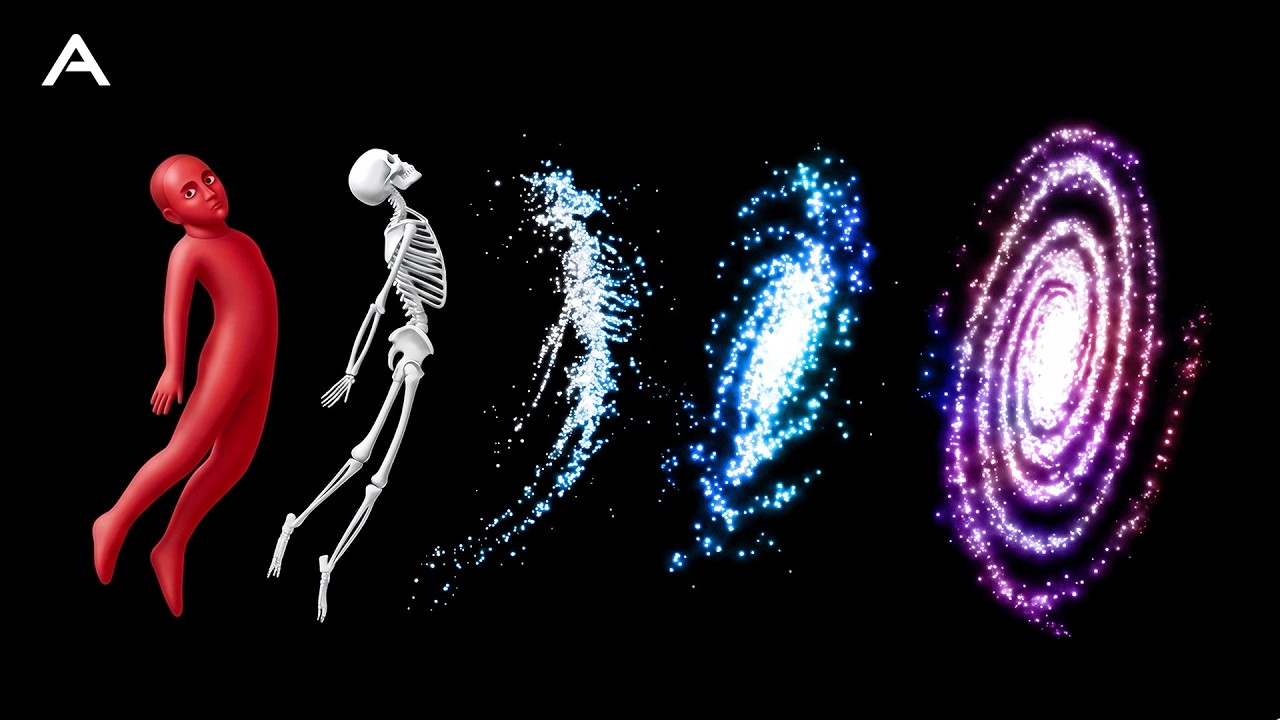
At a glance
Jules spends an hour rebuilding samsara, the four noble truths and the eightfold path from the ground up, and then turns every piece of the machinery on himself. The first half is a genuine walkthrough: what dukkha actually means once you stop translating it as "suffering," why the Buddha left the palace, what the eight limbs say when you read them out one by one. The second half is what the walkthrough costs him: the vultures and worms that will eat his corpse, the fly born in a carcass and finished in a web, a decade old video of a girl with a brain tumor recommended by an algorithm, and a marketing economy engineered to keep his ego hungry so it can keep selling him the next thing.
His thesis lands in three moves. Ego is the habit of treating yourself as exempt from a cycle you participate in daily, so the title of the video is a lie: you cannot kill something that was never there, you can only see through a mirage. The practice is not the extinction of desire but the selection of it, detaching from the desires that were installed in you so you can choose the ones you keep. And when the choice comes, he refuses nirvana and takes the Bhagavad Gita instead: do your duty without attachment to its fruits, keep loving your girlfriend and your family, bet on losing dogs.
He closes on the poem that hung in his grandparents' house, Desiderata, and the one line in it he says he worships: you are a child of the universe, no less than the trees and the stars. He was nineteen when he started writing this and twenty when he finished it.
Samsara, and the disclaimer he actually makes (0:52)
He opens with a definition rather than a hook. Samsara is a concept shared across many eastern religions, most notably Hinduism, Jainism, Buddhism and Sikhism. It is the concept of a continuous cycle of birth, death and rebirth that all beings are supposedly caught in. And because it is covered in so many different religions, all varying in style, belief and discussion, he says plainly that it is impossible to cover such a topic broadly without cherry picking. So rather than make sweeping statements, he narrows: he will focus on very particular philosophies and ideas within those religions, mostly the Buddhist and Vedic versions, because those are the ones he has followed most closely.
Then he undercuts his own authority before anyone else can. He learned about this in his religious studies class in high school, "so that pretty much makes me an expert," with the sarcasm hopefully noted. He has read some books. He has dabbled in some of the teachings himself, with a friend who is Vedic and committed to that religion. He is still very new to this and learning more every day. That is the whole credential, stated up front, and it sets the register for the rest of the hour: this is a person working through source material out loud, not a teacher issuing findings.
His working description of samsara is worth keeping intact, because the rest of the essay is built on it. Samsara is about the inevitable of living by confronting the inevitable of dying: the nature of both, the blend of both, the relationship of both, the cycle that it is trapped in, and the experience of that entrapment. Two of those clauses do a lot of work later. The blend of both is what he means when he says we are in the process of dying right now. The experience of that entrapment is what he means when he compares himself to a fly in a web.
The two traditions he is drawing from resolve the cycle differently, and he marks the difference. In Hinduism, samsara runs on karmic associations with the afterlife: a being's actions result in whatever next life they get, so some become higher life forms from their good deeds, such as divine souls, or remain human, and some become lower life forms, such as insects and animals. In Buddhism, samsara is the state one ultimately wishes to escape from. It keeps mystical leanings but takes a more pragmatic and material view of the cycle: all beings are constantly in a cycle of birth and death, and the more we cling to our individual life, the more attached we feel, the more we feel pain. In Buddhism, to free oneself from this pain, you go through the eightfold path.
Before describing that path he adds one more frame, and it holds for the full hour. He is not here to convince you of these religions. He is here to say there is genuine virtue in them regardless of whether you follow Buddhism absolutely or at all. He is agnostic himself, he likes learning about other religions, and he thinks a majority of these ideas could be applicable to anyone.
Dukkha, the axle that is out of place (2:12)
Buddhism centers on four noble truths, originally spoken by the Buddha in his native tongue, Magadhi. Jules makes the translation problem the first real content of the essay, because everything downstream depends on it. There are not a lot of direct translative words between Magadhi and English, which has made some of the English renderings over the years confusing and muddying. The first noble truth, translated into English, is "life is dukkha." But English has no translative word for dukkha. The closest is "suffering," and that closeness is exactly the trap: a reader will take the first noble truth to be saying, plainly, that life is suffering. Dukkha is much more complex and nuanced as a concept than suffering is.
His fix is the one the tradition itself uses. The East, he says, really does love its analogies and metaphors, and sometimes a metaphor describes these concepts better than a translation does. The most helpful analogy he has found for English speakers is to think of dukkha as the axle of a wheel that is out of place, so that when the wheel is in motion it wobbles, leading to unsteadiness, and if the thing is used as transport, a bumpy ride. Essentially, a grocery shopping cart.
The distinction he draws next is the load bearing one. Suffering has the connotation of pain: visceral pain, conscious pain, a hurt knee, a stubbed toe, a broken heart. Dukkha is about the concept before the pain, the thing that leads to it. It is the desire for steadiness while working with an unsteady framework, the desire for a smooth ride while working with a wheel that wobbles. Life is unsteady. Life is bumpy. Life is unease, because life is built upon dukkha, or more precisely upon an unsteady framework paired with a wanting of stability. So "life is dukkha" is not like "life is suffering." It is more like life is unsatisfying, and its primary reason for being such is the transitory nature of satisfaction.
Desire, and the lie of the satisfying ending (3:16)
The second noble truth follows straight out of the first: suffering, or the unsatisfying nature of existence, is due to desire. He tests it on himself in two lines. I would not care that life is unstable if I did not desire stability. I would not care that a ride is bumpy if I did not desire a smooth ride. Desire breeds dissatisfaction. We are dissatisfied because we desire.
Then, instead of leaving that as an axiom, he goes and finds it in the place he knows best, which is storytelling. One of the writing tropes most unlike reality, he says, is the concept of an indefinite happy ending, or really even a satisfying ending at all. Audiences want the satisfying ending. Authors want the satisfying ending. It almost justifies the commitment of staying invested with a story. Life does not have satisfying endings. We edit reality in retellings and in imagination to make it pleasing, satisfying and meaningful. We surround ourselves with stories of good and evil to satisfy our morality when the real world does not.
And we have been telling the same stories in slightly different ways since we began telling stories. His list runs from scripture to slop without changing tone: Cain and Abel, Adam and Eve, Romeo and Juliet, David and Goliath, egirl, roommate. Despite how many we make, and despite how similar they are, we are never satisfied and we will never stop telling them.
That gives him the image that carries the argument. Storytelling and mythmaking could be viewed like salt in a wound, or as the satiation of something that can never truly be satiated. It gives a comforting context to existence that existence itself does not provide. And the cost is not neutral: we set ourselves up for failure by basing our idea of life and morality on the imposition, on the edited version, on the satisfying version. Perhaps, he says, the only way to stop that unease and dissatisfaction is to stop seeking satisfaction, and to stop living life for the delusion that it should or ever will cater to me.
That is the hinge into the remaining two truths, which he states quickly because they are structural rather than descriptive. Third: there is a cessation of dukkha. Fourth: there is a path leading to the cessation of dukkha, and that path is the eightfold path, a general set of morality centering on the release and avoidance of craving and desire.
Before he reads it out, one aside about what kind of religion this is. Buddhism has no equivalent to the Bible or the Quran, no central text that explains the main story or the outlook on devotion, worship and life. Instead it is a vast library of different texts all centering on the Buddhist teachings, and reading all of it, even just the essential texts, is quite the undertaking. The Pali Canon alone runs about 12,800 pages and around 30 million characters, which he benchmarks against the only object of comparable length his audience has actually attempted: "so almost as long as One Piece, essentially."
The prince who was shielded from death (4:45)
The eightfold path was invented by the Buddha after his enlightenment, and Jules is careful to add, over a cut, "not to be confused with this enlightenment," meaning the European one. The biography he tells is the standard one, delivered with his own asides intact.
The man we know as the Buddha was raised as a prince. His parents did not want him clouded in judgment or running away from the kingdom, so to protect him they shielded him from things like death, illness, and, in Jules's rendering of the list, "don't take your dog here hiking" signs. Because of this his view of the world was a very safe and closed off one. But eventually, inevitably, death and illness surrounded him despite the protections. People he cared about grew old and began breaking down. Eventually, despite the forced rose tinted view of life, he came across the poor and the suffering in his own kingdom. Why does life have so much suffering? Why was he blind to it? It deeply disturbed his life of manufactured peace, and he could not then simply return to it. After meeting a poor ascetic he sought a spiritual journey and escaped in the night from his kingdom. "It's a bit similar to Moses, honestly."
What he tried first was asceticism, rigorous self discipline to not indulge in any form of pleasure. Here Jules stops to draw a border around the word, because he knows what his audience will picture. This is not the modern day "I have to take cold showers, stop talking to women, and run away into the woods to become a Viking" mindset. Asceticism is about truly divesting from pleasures and vanity: barely eating, no material possessions, for six years. The Buddha tried this with heavy meditation, and by the end he had grown near death from starvation and did not feel any closer to solving the root problem of suffering.
"If only there was some kind of middle way between endless hedonism and self flagellation and punishment disguised as virtue." And that is what he made: the middle way, which Jules glosses as "the enlightened centrist of feeling," without the pretentiousness, with the needs of the body. One should not heavily indulge in something, but also not never indulge in something. He notes that this seems incredibly simple to us and was quite counter to the narrative around the Buddha at the time, given the ascetics he had been living among, and that it was paired with the later teaching of the eightfold path.
The eightfold path, read out in full (6:03)
"Now, finally, what is the eightfold path?" He does not paraphrase it. He reads it off a Buddhist monastery website, all eight, in order, and that reading is the spine of the first act of the essay.
- Right view. Understand life's impermanence and the root of suffering to gain deeper insight.
- Right intention. Cultivate thoughts of compassion, kindness and renunciation.
- Right speech. Speak truthfully, kindly, and avoid gossip or harmful words.
- Right action. Act ethically and responsibly. Avoid harming others.
- Right livelihood. Choose work that aligns with compassion and does not cause harm.
- Right effort. Commit to positive habits while letting go of unwholesome ones.
- Right mindfulness. Stay fully present within your body, emotions and thoughts.
- Right concentration. Develop deep focus and meditative stillness for clarity and peace.
Recognizing the four noble truths, living the eightfold path, practicing like this: that is what leads to enlightenment. And Buddha, he points out, actually means "enlightened one." The Buddha practiced and lived by this example of mindset and philosophy until he reached a point where he ended the desire for craving. He achieved the third and fourth noble truths, and achieved nirvana.
Which gets the joke out of the way immediately: "Nirvana is more than just a fantastic grunge band." It is a state of being that arises when a person detaches completely from desire, detaches from earthly material wants. It is the end point of the eightfold path, the goal of the eightfold path, and what an enlightened individual wishes to achieve. "It's also what Kurt named the band after."
His summary of what the state actually consists of is precise and matters later, when he decides he does not want it. You are still under the body's needs. But there is no need for self flagellation, and there is no need for external material pleasures, no need for anything to feel complete. Through doing this one negates suffering by eliminating what causes it, and achieves true peace.
Why an agnostic bothers: the universe as a ship of Theseus (7:08)
"So why did I just do a large summary of samsara and Buddha's story just now, especially as someone who's not actually religious? Well, let me go cocoa bananas for a second, as I often do."
The move he makes here is the intellectual center of the essay, and he makes it as a conditional rather than a claim. If the universe is one big ship of Theseus, where matter is constantly forming consciousness, the universe perceiving its own reality through senses, then dying, then reforming and recycling itself, then the Buddhists were in a sense completely right. Material reality, samsara, is a never ending loop of matter changing into states of being, conscious and unconscious, in different ways. The universe being self aware about itself, just as he is self aware of himself writing that line.
And in that reading the self, or in Buddhism anatta, the doctrine of non self, causes pain because it clings onto a temporary state of consciousness in order to protect itself when it knows that state is temporary, and it would be in less pain to accept what it is and what it will be. We cling to permanence in an impermanent reality. Which means the four noble truths and the eightfold path are really about acceptance: of life, of what life is, and of what our relationship with pain is.
He immediately blocks the exit that most explainers take here, which is to leave it at the level of insight. It is not just knowledge. It is a process. It is a practice. And much like morality, it is really hard. "I would be better if I lived with it. And it's true. And it's really hard." Truth like this conflicts with the emotional reality he, as an individual, lives in, and he only gets more reinforced into that reality the older he gets.
Then comes one of the best original ideas in the hour, offered almost in passing. One could view the most ego driven point of a life as its medium, the middle between birth and death, because that is the point furthest in time from both sides of non existence, and therefore the point most likely to be concerned with the self. Which he offers as a likely reason people have midlife crises: you are in the typical middle of life, without the naivety of youth or the jadedness of age, and you still feel unfulfilled in some way. This is because we base the meaning of life on the impermanence of a permanent reality. Much like our satisfying fictional endings, made to soothe the unsatisfying poetry we live in, we imagine the plate will forever be in freefall and never hit the ground.
The last beat of the section is the one that stings, and he lets it. The material matter that makes him up existed long before him and will exist long after him. It is an insult to his ego to confront this fact: his individuality being made up of such a large whole, with a history and a future devoid of what he thinks of as him, engulfing all society and everything he has built up in himself.
The diss track against his own ego (8:34)
"Buddhism, unlike other philosophies, does not cater to ego." That is his summary judgment, and he means it as praise. Everything about Buddhism is an insult to his ego, "a perfect rap bar for bar diss track against my ego. And it goes too hard. It's too brutal in its lyricism." It makes him think about things that he, and society, try desperately not to think about.
The example he gives is one the tradition has used for two and a half thousand years, though he arrives at it from his own fear rather than from a text. Something that scared him up until recently was the visual image of vultures and worms eating his corpse. He flags the turn for anyone who would rather not (if you are squeamish, skip ahead), notes that yes, he is fun at parties, and then goes on. The image seems beastly, unkempt and unnatural, even though it is not. The specific context is probably not going to happen to him, but the vague details are inevitable and expected. His body is going to rot and will, one way or another, be consumed by the contents of the earth over time. And it scares him.
Then the argument arrives, and this is the passage that justifies calling the whole video a work of comparative religion rather than a mood piece. In a bird's eye view, pun intended, it really should not scare him. Is it not, in a sense, egotistical that throughout his life he has eaten and digested the dead, but when it comes to his turn he vainly views himself as more important, or as different in some sense? "This is where Buddhism clocks my ass in its unsoothing true lyricism." He engages in the natural cycle daily, and yet recoils at the thought of participating in it when the roles are reversed. That is his ego: viewing himself as different. And the entitlement brings him dissatisfaction precisely because he knows he is not entitled to be different from that which he eats. He just wants to be.
What he does next is refuse to resolve it cheaply, and the honesty of that refusal is why the section works. He does not pretend the analysis has cured him. People have kissed this body. He kind of likes this body. He preserves this body sometimes, and he does not want to disregard the sanctity he has built up with showers, working out, sex, swimming and sleep. But when he says he feels gutted at the natural disregard of everything it is, that is not really it either. The cleaning and the building up of his body's potential only to be knocked down at the end, slowly, as he loses himself. And then he checks that too: "I mean, I don't cry when ice changes to water."
The last move in the passage is the honest one. He does not care when trees fall down, or when he sees flies caught in a web, which he calls one of the most casually horrifying things you can briefly witness.
The fly (9:45)
The fly is the essay's set piece, and it earns its length, so here it is at length.
Can you imagine being a fly? Can you imagine being born out of the carcass of some dead deer or some neglected garbage, waking up surrounded by hundreds of your brothers and sisters, writhing around, eating the rotten flesh of that growing cold body, growing and changing at a rapid rate because of how short your lifespan is, sprouting wings only to use them wandering the world looking for more little bits these giant creatures have left, dying and neglected, so you can vomit on it and suck up all it has left to offer. And while searching, you get caught on this one thing you cannot get out of. It is sticky. And the more you struggle, the more you get caught in it. And then a terrifying, unfamiliar insect, larger than you, wraps you in the sticky material, cocoons you in it, and slowly eats you alive, sometimes with paralyzing venom. Born in decay, ending in paralysis. "Everyday bits of existence itself is more terrifying than any horror movie, I'm telling you."
And then he says even that is not what guts him. What guts him is the fear that there is nothing more here than the natural process. He is stuck in this body on this planet living out a script that everyone with him, everyone before him and everyone after him is living out. All he can do is enjoy the ride and be grateful it was not something worse, because this is as good as it gets. "This is all it is. This is samsara. This is wanting. This is losing. This is samsara."
The confession he attaches to that is important, because it is the thing the rest of the video has to answer to. Deep down, no matter what he is doing, no matter what stage of life he is in, no matter what he believes in that moment, he is always yearning for there to be something more than this cycle, wondering if he could ever get there, and hoping that maybe, if not him, then his descendants can escape the cycle we are trapped in. Because it does feel like that sometimes. Trapped, almost like the fly, born into a cycle without volition, under the constraints of a failing body, forced to live out its sentence.
Then he closes the loop on the fly with the difference that makes his case worse rather than better. He has comprehension of that failing body. Which means, in contrast with the fly, he hurts more than he would if he did not know, and he is half wishing for the cluelessness of his situation. "Is existential dread actually just the universe comprehending itself and not liking what it sees? Self awareness we were never actually supposed to reach?" Am I stuck in an existential web, where the more I struggle with it and try to get out, the more paralyzing and caught I become, realizing there is no escape until I stop struggling and accept my fate, as my own body fails me as it always was destined to, as it inevitably would regardless?
And then, in the same breath, the deflation that keeps the essay human: "Nah, I get to get head, eat gummy bears, boogie down, and play Doom."
The ordinary death (11:23)
"But it does still hurt sometimes." He can vaguely see his future. He has a rough estimate of when he is not going to be here. He is self conscious when just trying to enjoy himself, feeling like he is constantly wasting time, because he is always aware of that image of his body decaying and of his limited time to have it. Sometimes he becomes so focused on death that it is like he cannot live. "The fear of wasting time makes me waste time worrying about it."
What he does about it is the most confessional line in the video, and also a fair description of a research method. He looks up videos of people who have passed away talking about death, always offhandedly hoping there is some little bit of wisdom that will make him feel okay about letting go of all of this, and his heart stopping, and brain death, as he slips into oblivion. He asks everyone he knows what they believe and why they believe it. He tries every perspective he can, whether he believes it or not. "It's not that I'm open minded. It's that I'm passively desperate."
Then he asks you to actually picture it, which is the classical exercise the tradition calls maranasati, mindfulness of death, done in the first person. Can you actually imagine what it will feel like in those last few moments before the great unknown that you once knew? Paralysis. You lose the ability to speak. Everything you have grown accustomed to failing. Your body itself preparing to die. Left with nothing but the realization that this is it. Your awareness, your self, who you are, slipping. You can feel the last of those beats you have always taken for granted. Fragmented memories start playing from random points in your lifetime. Someone you cannot recognize anymore holds your hand, and you forget what is even happening.
And then he undercuts the solemnity of his own set piece, deliberately, because solemnity is part of what he is arguing against. "Or maybe you die skiing down a giant hill hitting a tree. Or maybe you die getting electrocuted in water. Or maybe you die getting stabbed repeatedly in an alley by a stranger with a Wii remote."
That is the actual thesis of the section: the horror is not just in dying, it is in realizing that death is so ordinary. It is not some great tragedy. Your death would probably matter as much as your life does to the general public's consciousness, which is to say, not very much. In the scenario he has built, he is providing the vultures and the worms with sustenance to live, and they are not really thinking about it much. His body and corpse is just another food source for them. There is no great evil here. It is just the natural cycle he has to come to terms with, even though he does not want to.
So he returns to the term, now filled in with an hour's worth of specific content instead of a definition. This is an example of dukkha. It has no single one word English translation, but the closest would be suffering, dissatisfaction or unease, and it refers to the more general inherent dissatisfaction that arises from attachment, from desire, and from our perception of separation from the natural flow of life. "The ego creates dukkha by viewing itself as outside of samsara, if that makes any sense. And that's actually a product of samsara."
The wants he lists as his own are the clearest statement of what ego means in this essay. I want my cake and I want to eat it too. I want to participate in endless cycles while being exempt from being in one. I want never ending reinforcement of my existence in the senses. I want endless validation from the universe and my fellow man. And if I have to bargain, I want a legacy at least. My death should be egotistically treated differently from what I know it is.
Everybody wants to go to heaven (13:17)
"Or put very eloquently and succinctly by people much wiser: everybody wants to go to heaven, but no one wants to die." The line is folk wisdom that has passed through gospel and country music, and he uses it as the compressed form of the whole first half. Everyone accepts death around them, but shields their eyes and cannot accept their own, or the deaths of the people they care about. Which is why it is so revered and respected when someone can overcome this and no longer fear the inevitable. Because it will happen.
He then states the bind plainly. This causes him immense suffering with an answer plainly in view: to let go of the ego and accept himself as part of the natural cycle. Which is very hard to do, especially in the society we live in. But, and this is the part most people skip, that objection misses that it is hard regardless. The society is an aggravating factor, not the cause.
And he refuses the consolation his own video is in danger of offering. "Bathing myself in an overstacked supply of Buddhist phrases and teachings won't make my father's eventual funeral hurt any less. There is no pleasure, only unconforming, unusual closure."
So he separates two things that get conflated. Facing Buddhism as a whole is a diss track against the ego. Facing samsara as a concept is not a diss track at all; it is something stranger and quieter. "It's like walking into a room and wondering why you're there, and then realizing your life is walking into rooms and wondering why you're there. It's like trying to stop day from turning to night for fear of the dark, growing more upset."
The greatest library, and the strangest (14:07)
The turn into the second half of the essay comes through the internet, and the bridge is impermanence. With our attention spans decreasing and our digital products becoming more addictive, it is hard to view the internet in a bird's eye view, or to see the components of it that are not the in your face qualities. We view it as a place of new information, of current information, of breaking information, "the casino roulette wheel of whatever will be the next thing," and we miss that it is also fundamentally an archive of information. A library. The greatest library. The strangest library.
His explanation for why the archive is invisible to us is mechanical rather than moralizing. Our brains like and are attracted to the quickness and surprise of information, the what will be of what we see, so that is how the internet stays in our subconscious. But that is not what it is. The algorithm pushes new information, and yet there are backlogs of buried channels and profiles, and sometimes, rarely, they get recommended.
Then the example, which he does not dress up. He had a random decade old video of a teenager with a brain tumor recommended to him recently. In the video she is explaining that while she is finding it hard to speak due to her new medication, and hard to balance when walking, she believes she is going to get better and that this is just the pain before the improvement. There are tears in her eyes as she says this. Her parents announced her passing a few videos later.
He generalizes it into a genre, because it is one. Seeing kids who get cancer upload vlogs, video by video, getting worse and worse with the process. Then, postmortem, retrospectively looking back on it as a chronological set of events. Then seeing a video where the parents speak about the kid after they have passed, trying to come to terms with all that has happened, if they ever can. And him, not knowing anything about these people beforehand, just stumbling onto it, but having such a private, intimate look at an absolute tragedy in their family.
"What a strange thing to be able to not just witness, but have randomly recommended. Should I even be able to witness something like this?" He does not answer that question. He answers a different one: regardless, it is going to keep happening. Not exactly like this, but with a similar framework.
The dead internet as a field of personal cemeteries (15:57)
This is the section where the essay contributes something genuinely new, and it is worth stating carefully because it is a reframe of a familiar phrase. It has not started properly yet, he says, but the internet will be filled with stories like that girl's, and profiles like hers. As our generation grows up and the next one takes our place and we slowly die off, our childhoods will not just be intertwined with media; our memorials will be tied to these platforms.
So dead internet, as a descriptive term for contemporary culture and traffic, will not just be describing active bots. It will be describing a collection of isolated personal cemeteries. There will be inactive but ever present, not tombstones, but frozen glimpses into who we were. Slideshows of what we stood for, the parts we showed of ourselves, that become who we were as a method of proof that we ever were. "The account you're watching this on, the account I've uploaded this on. All a collection of data that will likely outlive both of us."
He then runs it forward on himself twice, in both directions. In his fifties he is going to think back to middle school friends he has not spoken to in thirty years, and odds are one of them will be dead, but he will still have access to photos of them, how their life went, what they cared about, Instagram highlights of them eating muffins, getting wasted, running marathons, having kids. "And I can just view their entire life like an edit, a digital scrapbook, at any point viewable for me."
And the mirror of it: he might be the guy someone is remembering postmortem, with them going, oh, I wonder what Jules has been up to, and then, oh, he's gone. And they are left with this channel, this video. "As I'm speculating, them speculating that very thing, remembering me and being left with this weird digital archive filled with advertisements before, to the right hand side, and afterwards, whether I want them to or not. My very memory being turned into another thing in the attention economy to be swallowed and forgotten about."
The long digital footprint (17:33)
The point, he says, is that all of this is an archive of our lives. We do not view it that way in the moment, but it is that way. And that leads him to take a common phrase apart.
When we think of digital footprints, it is almost always in the boogeyman sense: companies, agencies, cookies, hackers, keeping track of private information, what kind of porn you watch, your medical worries, purchasing habits, what products you like. Or else it is parents, elders and teachers warning against leaving a notable footprint. Do not make that political statement. Do not be risque or against the grain. What if a future employer were to see such a thing? Do you want this connected to you? Endless etcetera.
But a digital footprint, divorced from how we speak of a digital footprint, really is the sum total of all your decisions online. From something as large as creating a new platform, a political movement, posting something risque or against the grain, all the way down to simply clicking like, viewing a video, or lurking on a forum. Even by watching this, he tells you, you have impacted the YouTube landscape, even in a minuscule way, and left a tiny footprint of watch history, personal choice and recommendation. Each minuscule action over time, one after another. That is our long digital footprint.
And what is missed, again, is the ending. A digital footprint ends. There is a long string that eventually stops after a point, revealing a scattered, line to line, never finished portrait of someone who was here at some point. Maybe it ends with some self aware, conscious, grandiose statement that it is the end. Or maybe it comes out of the blue and just abruptly stops. Either way that footprint will be left, and sand, dirt and cement will cover it over time, but its effects will live on. And if you were vocal enough, spoke enough or were heard enough, spectators might one day find it and wonder who you were as a person, when you could still ponder about such a thing. "For me, it's this ghost of a girl crying while smiling, thinking she's going to get better when she dies a few weeks later."
The tightrope: grateful for pain without romanticizing it (19:13)
When you think about things like that, he says, trivial celebrity gossip, tiny issues like waking up on the wrong side of the bed, missing a train, bad weather, it does feel like an insult to care about in comparison. And a blessing. The fact that we have so little occupying our brains that it can be filled with he said, she said, instead of lost wills and testaments and the consciousness of such a thing.
Then he names the failure mode of his own line of thinking, which is the habit that separates this essay from the genre it resembles. "This is a tightrope." There is a fine balance between being thankful for having pain, in comparison to feeling nothing at all, in comparison to death, and the unhealthy extreme of experiencing Stockholm syndrome with the idea of trauma and pain itself. Romanticizing the shittiness as if you should be grateful you got anything at all. He will walk back onto this tightrope twice more before the video ends, and both times it is to stop his own argument from becoming an apology for cruelty.
Death breaks the mythmaking (19:52)
Death is where he locates the fault line in all of it. This is the case that is never closed or well stated. Death is the breaking point in human psychology that all idealism has to adapt around and fails to. It breaks apart the mythmaking of fairness, of competition, of strategy.
And then the enumeration, which is the rhetorical high point of the first hour and works because it does not exempt anyone. Everyone you hate politically. Everyone who ever pissed you off. Your exes, your crushes, your family friends, the people you thought were annoying, the people you thought were cool, the people you thought did not deserve more time, the people you think did deserve more time, the people you have forgotten about. "Everyone's inner monologue eventually goes silent. Everyone gets forgotten or misremembered. None of us win. It's not in the cards for us. We are all going to die."
His revision of the cliche is one line and it does real work: "It's not really survival of the fittest. It's just survival."
The practical claim he draws from it is not a mood but a warning. If you do not acknowledge that fact, if you do not have it as part of consciousness, even compartmentalized, you are going to meet the end very painfully. Something much more than physicality or brutality or the endless loss of all that we have gained. Regardless of the cause of death, not acknowledging what is inevitable makes it feel blindsiding in a way it should not when it comes. "We have the gift of foresight and we use it to avoid that which we can see."
Everyone becomes ugly. Everyone loses the ability to speak. We are in the process of dying right now. And here he makes the distinction that keeps his acceptance from being passivity: you can rage against the dying of the light while acknowledging and accepting that at some point it will go out. It is not mutually exclusive. "I don't like passive acceptance, but I will deny denial. I am going to die. It is going to happen."
What you will never see discussed (21:28)
Hanging on to the endless vapor of material pleasures as if it is indefinite: that is the habit he is describing. You live a hallucination through senses, more than the body already is, and it will always fade.
Then an observation about the culture that is easy to verify and rarely said. You will not see death discussed very much in life. You will see depictions of grief. You will see reactions to events. You will see discussions of an afterlife. You will see endless shots of people sitting with an empty expression on their face at a kitchen table. "But you will hardly ever see people confront their own mortality in a way of acceptance or meditated inevitability. You will see people ask questions around a definitive answer that everybody knows."
He then withdraws part of the accusation, unprompted. The judgment he is giving is very general and, unless specified, admittedly unfair, because it is a different story within the different stages of life. If you are getting wasted at 22 and partying, not thinking about death, that is very different to doing it at 42. He does not expect a teenager to have mastered his ego and accepted his mortality. But the longing that can never be fulfilled should be confronted whenever someone is ready to.
And then the lie, which he calls beautiful and genius in its construction: the one we tell ourselves until death. Once I get this thing I will be happy. Once I get this girl or boy I will be happy. Once I drink this drink, even temporarily, I will be happy. "And it never ever works."
What he does with that is the single best structural move in the middle of the essay. He gives you three different traditions diagnosing the identical mechanism, and notes that the outcome is the same in all three. A materialist might say it is the hedonic treadmill. A Buddhist might say it is seeing craving as salvation. A Christian might say it is looking at our reflection when we should be looking at God. Different vocabularies, one finding: we are not happy indefinitely and we never will be, so we must accept that as we accept our end.
He knows how that sounds. "And I know this sounds basic, which it is, but often the things that are the most basic need the loudest reminder and need to be at the front of our daily consciousness."
The proof he offers is morality, and the analogy is exact. We all know within ourselves not to be rude, cruel or condescending, and yet often we are rude, cruel and condescending. It is no great sin that needs atonement, but it is a fault that we all see in each other and still commit nonetheless. We can think to ourselves, look at these people, so vapid in their consumption, so thoughtless in their action, so uncaring in their time, viewing morality or personal choice and freedom as a competition of virtue. And ironically, quite often, despite this, we still judge ourselves on these things, or do these things subconsciously, all the time. We are just not as concerned or as frequent as someone else. "There will always be someone worse or better than you. You can endlessly chastise or feel good about yourself."
Which gives him the formulation that the back half of the video keeps returning to: it is the example of courage and kindness that matters so much more than the speculation of it. It is the meditation of what it means to let go that matters much more than the offhand knowledge that one day you will. Without practice, what use is the knowledge? And not only is it a skill that needs constant usage, it is also a skill you will never fully learn or master.
Consumerism is the wall you throw things at (24:47)
The image he builds this section on is small and it is very good. Childishly, impulsively throwing something against a wall in anger or boredom is not happiness. It is an expression of impulse, a desire to be recognized, to express frustration and have reality tangibly react to it. "Consumerism is the constant option to throw something against the wall, to be recognized by reality, and then to be rewarded for doing such." It has been set up in such a way that you will have its desires even if you do not want to.
So much of the foundation of how we connect interpersonally, and how we view achievement within ourselves, sits in the backdrop and setting of our consumeristic society. The contemporary normal life is one littered with bright neon signs, product placement, wasted plastic, and the forgettable moments waiting to skip an ad. "Constantly catering everything it has to me and yet still feeling absolutely impersonable." Marketing slogans and descriptions enticingly written like a personal handwritten love letter, with him and the product, after purchase, discarded like a used condom.
Then he names what he thinks the actual lie is, and the construction of the passage matters: he lists three things that are not the worst part before arriving at the one that is. There is a lie at the bottom of every great marketing slogan, every glamorous advertisement filled with models, every do and do not of the self help charlatans, every chatbot flooding search engines and congratulating you for searching up how to tie your shoelaces. The lie is that it cares about you. That the people who bend over backwards catering their products to your every need and desire, so you feel all warm and cozy, have any regard for your well being.
It is not the fact that the people at the top of these companies would see you dying on the sidewalk and would not care enough about you to even watch. It is not the fact that they have, since birth, trained you to put all your self worth and value into being a good little grindset mindset bootlicker for their private interests. "These values, these wants, these desires: did they actually come from your visceral life experience, or the self guilt into being brought into a well oiled machine that pays no attention to you if you don't get in line? Why the hell do you care about what watch you have or what car you drive?" It is not even the fact that they have conditioned you to accept that it is natural for us to walk past those slowly dying on the sidewalk.
"It's the fact that you are completely immaterial to all of these things and they won't actually bring you happiness. That's why it's got to be beaten into you. That's why there's so much guilt around it. That's why there's advertising in everything you see all the time. That's why when we all get these things, after the rush is over, it all means nothing to us."
And here is where the essay's two halves lock together, and the reason the religious material was necessary. Our contemporary society is built into us such that meaning does not last, so that it can sell the next thing. "A satisfied customer, a satisfied citizen, is one that can't be marketed to or sold." It wants you hating yourself. It wants you to feel like you have endlessly won or lost some great infinite thing. What it does not want is your desires to be external to it. What it does not want is you detached from the ego it will eternally feed. What it does not want is you thinking beyond these desires to better ones that can build something sustainable, renewable and reliable.
That is the second noble truth restated as a business model. Craving is not merely a private failing here; it is the product being manufactured, and dissatisfaction is the mechanism of repeat purchase.
He does not leave it in despair, and the register shifts audibly. Not the planned obsolescence rat race of endlessly consuming garbage. Not the brain fog apathy of placidly trying to make it one more day. "But the resilience to know that a better world is possible, much different than the one we live in. And the fact that there are so many of us who are going to try, to last bated breath, to achieve it. The tiniest act of breaking free from this is a victory. It is an upward climb. But there are so many of us growing every day everywhere that it won't slow down."
Where he was wrong about eastern philosophy (29:18)
He does not present his own position as arrived at cleanly, and this is the section where he says what he used to think and why he abandoned it. For a long time he was put off by eastern philosophy, absent mindedly waving it away as becoming passive to the pain of the world. Making personal escape look peaceful and free thinking, while subconsciously, quite literally absent mindedly, becoming the perfect model citizen who will accept any condition or situation no matter how unfair or oppressive. Escaping collectively into individual salvation, far from material reality, hurting those who still care about it. And, he adds, not to mention the caste system and other hierarchies that inherently disgust him.
Two things are worth noticing about that objection. It is the standard political critique of quietism, and he arrived at it honestly. And he does not retract the part about hierarchy; he retracts only the part about passivity.
What changed it was a person, not a book. A close friend guided him into thinking about it much differently, combining the resignation of Buddhism with Vedic pragmatism. Essentially, raising your consciousness to a higher level beyond the default desires of a body, or beyond the marketing you have had all your life. Detaching from letting those things be your values, and eventually creating your own desires. "Not escaping thinking or caring, but choosing what to truly think and care about, through careful meditation and reading, with heavy introspection and attunement."
Which produces the sentence that the entire back half of the video is an argument for, and it is a refusal as much as a program: "I do not wish to achieve nirvana. I want to detach from what I desire and, through meditation, choose what I desire."
The freedom he claims for that is specific. Once you stop viewing yourself through these things, once you detach the ego from what you have been hardwired to desire, that is the beginning of being free in choice, because you begin viewing existence free from simply the shackles of fulfilling the body or the expectation. "You can have anger, you can have lust, you can have happiness, you can have this body, you can have material possessions, you can have these things, but they are not you."
What ego death actually is (31:20)
Halfway through the hour he finally addresses the phrase in the title, and the first thing he does is take it away from the association it usually carries. When most people think of ego death, they think of the process of dissolution reported in intense psychedelic states: going far off the boat, not knowing where you have ended up, experiencing something out of body and having it change how you view yourself, in a sort of disillusionment with identity. He grants that this is a form of ego death. It is a process and a method, but not the idea itself.
His own position on that route is one sentence long and completely unmoralized. He is not a druggie, he does not partake in psychedelics, it is not his kind of thing, and if you are into that, go ahead, more power to you. But it is not what he is talking about or referencing when he says ego death. It may be a process that leads to it, but it is not the thing itself.
So he defines the thing itself, and asks to be held to it: "I want to get very concrete and definitive. The idea of ego death is to stop viewing life as this body and for this body." The pure idea of the concept, regardless of the framework or the lead up, is something that rips the veneer of the self down until an individual questions their self centered way of viewing reality, and detaches from their need of external or internal validation.
Note what that definition excludes. There is no altered state in it, no ritual, no threshold event required. It is a change in what you take yourself to be, and it can be reached from any direction.
The four gates (32:37)
"Truly, I would say it's a process as well as an event." What follows is his own taxonomy, not one he is quoting, and it is the most useful piece of original structure in the essay: four ordinary experiences, available to anyone, that each do a piece of the work that people usually assume requires something dramatic.
- OneThe stars. The first time an individual looks at the stars and comprehends how small they are. Almost like the first step in realizing how frivolous it is to view this body as truth, or as something grander than that which surrounds it.
- TwoMortality. The realization that we all eventually meet our fates, usually brought on by the first time someone we love passes away. The first time it really hits us that it will be us someday, and that it is already slowly happening, with no real off switch or moment of true pause. The fact that all these people you have read about in history, all the past generations, have done the same cycle.
- ThreeMundanity. The modern one. The fact that we spend so much of this doing things that are repetitive, predictable, and repetitive and predictable, "much like repeating a part of a sentence." The gray, claustrophobic, cramped office space. The repetitive, simple, boring actions of laundry. The dopamine high of a predictable, almost clinical orgasm. The slow build of annoyance of going through all of it once, and the overwhelming quiet frustration of doing it as a routine.
- FourSelfless beauty, goodness, or plain witnessing. The one he calls the most important, always the most overlooked, and the one we begrudgingly admit to. Not an argument about whether beauty is objective; he says he personally believes it is subjective, through senses, and that it is neither here nor there. Regardless of a person's conception of beauty or goodness, they would likely admit there is an element of it, and that there are examples of it completely detached from themselves. "Seeing beauty without it having anything to do with me, just witnessing whatever subject in its pure essence."
His definition of mundanity deserves separating out, because it is a genuine reframe. The mundane is not the process or the thing itself. "The mundanity is the predictability of how this certain event or thing doesn't fulfill me or my ego. That's the mundane aspect. Not the process or thing itself, but the element that does not cater to me." Boredom, on this account, is a report about the ego's expectations rather than about the laundry.
And the fourth gate is set against the way we are built. This is in contrast to how we have built our society, and to the intrinsic solipsistic nature of having a body. Everything about experience validates that I am the most important thing. I see things from my point of view. Things happen to me. I heard about this. Here is what I think. Here is how this makes me feel. Here is how I see this.
He is careful about where the blame goes, and this is the tightrope again. From birth, this is drilled into us: the way a parent clutches and rocks you as a baby as if they hold the world in their hands, because they practically are your world and you are theirs; the way education builds up in a student a personalized bureaucratic buffet of interests and hobbies and understanding of history and life. "None of this is inherently bad." But it has been put on steroids by our consumeristic society, and put on experimental, not ever fit for public consumption steroids by social media.
Witness instead of protagonist (36:35)
The asymmetry he draws here is the cleanest formulation in the video. "The universe does not need reinforcement or even acknowledgement. Ego does. It cannot survive, if you can even call it that, without it." When you fulfill the ego it just validates the temporary, making a momentary feeling seem like an eternal truth, constantly reaffirming that temporary feeling again and again, when real truth does not need affirmation or even witnessing.
From which: "The egotistical way to view existence is that it is a thing that happens to me. And the selfless way is that it is an experience I get to witness and participate in." He flags that the difference in mindset may seem minuscule, and insists its consequence is exponential.
The payoff he describes is not transcendence, it is attention, and the examples are deliberately unglamorous. Rather than viewing life as a thing I must do and cater to myself, it becomes a thing to witness and study. Tiny moments that were otherwise boring become fascinating. Daily grandiosity: the sun rays bursting through the clouds, the enormous stretch of grass beneath his feet. And the unnoticed trivialities: the way momentum forces clothes in the dryer to go round and round, the ants below him and their conundrum looking up at him, the wind slowly drying clothes on the line, thinking about how our ancestors studied the natural elements and made methods around them, methods he is now participating in. Rather than just doing a task, you are observing the things around it.
Then he extends it from tasks to people, and this is where the ethical content of the essay actually lands. Rather than talking to a person to fulfill something, to get something, to achieve something, their presence is enough. How often in life, when someone passes away, do we think: if only I had one more conversation with them, if only I could tell them the way they make me feel, if only I had paid more attention, if only I had not rushed aside them to gratify something in my life. "Do not allow yourself to have this regret. Be present with people, taking actual interest in what they say with no expectation of reward or validation."
And the summary line: when you stop viewing life as something that needs to cater to you, the moments that do not matter hold as much weight as the moments that do.
He tests it against himself one more time, with the same three pleasures he used to deflate the fly passage. "I still like getting head. I still like playing Doom. And you know, I like boogieing down. But I do not live my life for getting head and playing Doom and boogieing down. Nor do I view myself as these things." And then the list of negations, which is his version of the neti neti formula of the Upanishads, done in the vernacular: "I am not my birth. I am not my death. I am not my Call of Duty killstreak. I'm not even these videos or this channel. I am not all the things in between birth and death."
The dark night of the soul (39:48)
After going through this process of seeing so much outside the ego, when we have built our societies and lives around it, an individual can go through a hollowness in participating in any of it. Which is where the process becomes an event, and where he crosses traditions to name it.
The dark night of the soul is a spiritual term coined by St. John of the Cross. It originates in Christian mysticism but can be, and often is, applied more generally to spirituality. It comes from a poem he wrote about his own spiritual crisis and coming out the other side. He was a reformist of the Carmelite order and for this he was imprisoned by his brothers for nine months, put in a cell with little light, food or company, stripped of earthly pleasures and societal expectations, and left with himself and his thoughts. That cell is where he did the majority of his writing.
The poem, Jules says, is about being disillusioned by life, forgoing any sense of familiarity, and making peace with being in the unknown, losing yourself. He reads the last stanza: "I remained lost in oblivion. My face I reclined on the beloved. All ceased and I abandoned myself, leaving my cares forgotten among the lilies."
The pattern he wants from Christianity is the pattern of identity spent rather than protected. Saints often dedicate their lives to God in worship, slowly dissolving their identity until all actions and moments are made in service to the most high, their individuality made into an almost gesture of devotion. Even culturally, in Christianity, their uniqueness becomes a symbol for absolute servitude. His examples: Mary MacKillop's orphanage. Ignatius leaving his life of luxury. Joan of Arc being burned alive for her faith. St. John going through a transformative darkness that on the other side gave him the liberation of new purpose. The personal trial of trying to see through the darkest night and coming out with a clearer vision and purpose. And he notes the popular idioms that carry the same shape: the night is always darkest before the dawn; hope begins in the dark.
He states his interest in it exactly, and it is not devotional. "I'm not here to preach turning to God or anything like that. It's just that this is a good example of detaching from material pleasures for something that is truly meaningful and fulfilling for the individual." Realizing that the ego is a false, illusory comfort that we desperately try to convince ourselves exists.
Which brings the video to its own title, and the demolition of it. "This video's title is a lie. You can't kill something that ultimately isn't there. That heart was never beating. There is no ego death because there is no real ego. It's false. It's more so a realization of a mirage you've been telling yourself and had crammed down your throat: that this sensation is truth, that this body is you, that the purpose of life in this body is to validate it." The dark night of the soul is the process of breaking free of that validation.
Cherry picking, and why he does it anyway (42:42)
He raises the obvious methodological objection against himself before anyone in the comments can. One could argue that he is cherry picking different philosophies and religions that have vague conceptual overlap and squeezing them like fruits into his own wild mango mix of thoughts and theories.
His answer is not a defense of the method but a claim about the finding: "It's because the Buddhists were right and their observation is universal." Dissatisfaction, dukkha, is always going to be the end result regardless of who you are, out of senses. And the conclusion he draws from that is the one he keeps returning to in different metaphors. "You can't grow something that doesn't exist, just delude yourself that it does. You can't build a house out of sand, and you can't rely on pleasing the ego that is false."
On fire: what detachment is not (43:25)
"You may be thinking: what is the purpose of learning our false ego? How could this be implemented into action? How do I not lose my sanity in the process?" His answer to the third question is structural: we need to build and anchor our lives around something more than ourselves, otherwise our framework will break and rebuild and break and rebuild to infinity, until it breaks for a final time.
The illustration he uses to clear away the fantasy version of detachment is deliberately stupid, and it works. "If you set someone on fire who has a detached ego, they aren't going to then think suffering is but a temporary roadblock in the ever folding plan of the universe as it flows. They're probably going to go, OH, I'M ON FIRE."
Absurd as it is, he says, the scenario gives a good lesson on the outcomes of detaching from the false ego. Outsiders romanticize the practice as a complete detachment from the body: to be stabbed and not feel the blade go in, to have such mastery over emotion that it no longer matters to the body to feel the body. "This is a falsehood."
For the corrective he goes to a text rather than to his own authority. In The Perfection of Yoga, the Swami put it well by pointing out that there is no question of killing desire, for desire is the constant companion of the living entity. Contemporary civilization, in this age of kali, or age of darkness, has actually made it impossible for us to be alone, to be desireless, and to be possessionless.
"It is what we choose to do with these desires and feelings that is the practice. That is the real freedom within a body." Which is the thesis of the essay stated in its final form, and it is a redefinition rather than a compromise: the goal is not the extinction of desire but its authorship.
The questions he attaches to that freedom are all about response rather than circumstance. "The most humiliating and empowering thing about a man's actions is the real freedom in how he responds to what happens to him. Do you inflict the same trauma you receive? How do you deal with people you hate and who hate you? How do you deal with a body that is slowly dying every day?" Our choices, our consciousness, what we desire: this is freedom. Our pain, our feeling, the innate property of desire: this is what we base our choices on. It is the nature of being alive to have desire, and it is our choice to overcome it, or to let it be something different from fulfilling it indefinitely on a base setting.
Is this just nihilism? (45:45)
He states the objection in the voice of someone actually annoyed by the practice, which is a better version of it than most steel manning: I detach from this and I do not even get a reward. I do not even get to pose in the mirror while putting random quotes on my social media. I instead have to almost exactly not do that.
His response is a question rather than an argument, and it relocates the burden. "Do you view the meaning of life as satisfying yourself and the false ego? Why is life meaningless if it doesn't cater to you as an individual and your gratification?"
And then, immediately, the tightrope again, because he does not think that question settles anything on its own. He knows that life should not adhere to man's psychological comforts in a coddling way, because life will eternally disappoint anyone who tries. "But where does it, at what point does it become justifying and glorifying the horrific parts of life? Where does the measured reaction become obsolete? Because life's cruelty shouldn't be justified, and man should take pragmatic action against it instead of adapting to it."
That is the question the last quarter of the video exists to answer, and the answer is not Buddhist.
The Gita over nirvana (46:56)
"Well, my foolery was thinking that eastern philosophy was strictly passive. It's not."
The correction comes from the Bhagavad Gita, and he summarizes it in one sentence of plot: it is about Arjuna, a prince going to battle, and Krishna, the god, telling him to fight for what he believes in in a way that is selfless and for the benefit of others. The line he pulls out is the famous one: you have the right to perform your duty, but not the fruits of your actions. Or essentially, do what is right and is your duty, but without attachment to the result. And the detail he notices in how Krishna does it is sharper than the paraphrase: "He comforts Arjuna by saying to stop looking for comfort."
So virtue in the Vedic reading is not to become inactive or completely detached, but to become detached from the fruit of a good action so that it does not get in the way of doing good. Which gives him his final position, stated as a preference between two exits rather than as a rejection of either: "This is why personally I will never want nirvana. I have the desire to do good, but I must detach from valuing myself egotistically by the result."
| The question | The Buddhist resolution, as he reads it | The Vedic resolution, as he takes it |
|---|---|---|
| What is wrong | Life is dukkha: an unsteady frame paired with the wanting of steadiness. | Same diagnosis. He says outright that the Buddhists were right and the observation is universal. |
| What desire is | The cause of dissatisfaction, to be released and avoided. | "The constant companion of the living entity," impossible to be rid of in the age of kali. |
| The goal | Nirvana: complete detachment from desire and earthly material wants, the end point of the eightfold path. | Detachment from the fruits of action, so that action itself can still be done well. |
| What you detach from | Craving as such. | The result, the reward, and the ego's accounting of both. |
| Stance toward the world | Read from outside as escape, which is the reading he once held and later called his foolery. | Arjuna is told to fight, selflessly and for the benefit of others. Pragmatic, not passive. |
| Loving particular people | Complete detachment, which he says would train him to forget his humanity. | Keep the attachment, accept the pain it guarantees, and choose it anyway. |
| His verdict | refused He will never want nirvana. | taken Do the duty, drop the fruits. |
The hypocrisy objection comes next, because he can feel it coming. "Aren't we all just hypocrites? Knowing that senses are an illusion, knowing that this ego is false, and yet inevitably, even in tiny ways, still trying to feed it."
He answers it with the contemporary Buddhist line: first enlightenment, then laundry. Which means yes, you reach enlightenment and a different way of thinking, but you still have to do daily chores. You still have to eat. You still have to live within the material world. "A detached ego does not mean no more doing the dishwasher. It means you have a different attitude when doing the dishwasher. Overcoming desire does not mean you no longer feel pain. It means you change your reaction to pain."
Is ego always bad? Humility is the answer (48:42)
With all this talk of ego death and detachment, he says, it is important to ask whether ego is an inherently bad thing in all circumstances. Is an athlete egotistical because he measures himself in skill and achievement? Is it wrong to take pride in one's work, to like the look of a finished product, to cheer for a sports team, to go into the Marine Corps, "to start barking like a rabid dog when you see your girlfriend naked for the 400th time?"
"Humility is the answer to these questions." And the test he builds is about reasoning rather than behavior. The cleanliness one achieves in a house is not necessarily a vain thing. It can be: oh, look how neat my garden is next to neighbor Samantha's. But the practice can also be one of health, neatness and practicality. It can boost morale and productivity. It can be aesthetically pleasing in a way that is not tied to the knowing need of satisfaction. "The reasoning and assessment behind this is what is important."
Applied to himself, that produces the formula the section is built on. "I can be beautiful, but I am not my beauty." He does not determine his self worth, or the self worth of others, on the observation or expectation of that criteria. If he became ugly, was told he was ugly, or was generally considered by society's standards to be ugly, he should not define himself by that. "I am not my ugliness. I am not undesirable or desirable, because I don't value or evaluate myself by that standard." He likes to meet the standard for reasons of cleanliness, general presentability and impression. But he is not it. He is detached from the result. "Nothing defines you if you don't let it. Nothing can defeat you if you don't value yourself by defeat."
So the action or the innate property is not the problem. The why, and the assessment of self ("I am my beauty"), is the potential problem.
And then he adds the one benefit of detachment that has nothing to do with mortality, which is the most immediately usable idea in the video. Detachment is not only freeing, it can also be healing. Accepting that something did or did not happen. Accepting being hurt, or that you hurt others. Accepting that one event does not have to dictate future events. "Who you were doesn't have to be who you are. You are a blank canvas constantly being drawn on and erased. The question is, what do you paint?"
The attachments he refuses to give up (51:10)
"Now, are all types of attachments wrong?" This is the question he says is the reason Vedic texts generally speak to him more than Buddhist texts, and the answer is completely unhedged: "because no matter what I read, I will never be convinced to stop loving my girlfriend or care about my family."
Every time he has read or tried to be swooned by the song of complete detachment, he ends up thinking it is almost training him to forget his humanity, because he cares about people, "and that is not and will never be in my eyes a weakness."
The reference he reaches for is not a scripture. Anytime he reads about true nirvana he feels like Aang in that episode of Avatar: The Last Airbender, where he is asked to let go of Katara, sees that she is in pain, and goes, forget this, and tries to help her.
Then the passage that is the emotional resolution of the entire hour, and the reason the essay ends where it does. "The vulnerability of caring about people: if it is the fork in the road of becoming truly free, I will drive down it over and over again until the tires break and I run out of gas. I choose that desire because I value its outcome more than anything else. I want a healthy, happy relationship. I want my family to be in good health. I accept being defined, valued and vulnerable by desiring this. I let go of the attachment of achieving nirvana because I choose to feel the pain of caring and accept it, knowing it's a desire that can never truly be fulfilled. I bet on losing dogs and I always will. I accept that I will let go of you eventually, but I will hold you for as long as I can."
So the outcome of detachment, in his account, is not centering yourself on the disillusionment of all desire. It is that you center yourself on something other than yourself and the usual trappings of the body and senses. You purify your mind to the best of your abilities. "It does not mean we accept discomfort or allow ourselves to not care about the world. It's that we don't let what hurts us define us, or what pleases us." We let our virtue become our guide, and our actions become examples, rather than the highs and lows of neurochemistry or description. "Never accepting what causes us pain, but accepting there will be pain."
And the four negations he closes the argument with, before the poem: "I am never a finished statement. I am never a satisfied desire. I am never my lowest or highest action. I am what I choose to be."
The Desiderata, and the line he worships (54:06)
The last eight minutes are not argument. He says so before he starts: "This is something special and personal to me, and I hope you love it as much as I do."
It is a poem called Desiderata, written in 1927 by the Indiana lawyer and poet Max Ehrmann. "It's only a page long, but is filled with a book of depth." He has adored it since before he can remember, because it hung up in his grandparents' house.
He reads the whole thing, and the lines he leans on are the ones that answer the hour that came before it. Go placidly amid the noise and haste, and remember what peace there may be in silence. Speak your truth quietly and clearly, and listen to others, even the dull and ignorant, because they too have their story. If you compare yourself with others, you may become vain and bitter, for always there will be greater and lesser persons than yourself. Enjoy your achievements as well as your plans. Be yourself, and especially do not feign affection, neither be cynical about love, for in the face of all aridity and disenchantment it is perennial as the grass. Take kindly the counsel of the years, gracefully surrendering the things of youth. Beyond a wholesome discipline, be gentle with yourself. With all its sham and drudgery and broken dreams, it is still a beautiful world.
Then the four lines he says he specifically worships:
"You are a child of the universe, no less than the trees and the stars. You have a right to be here." (56:30)
"I think it's one of the most beautiful things I've ever read, and I have read some beautiful things. What a hauntingly comforting line."
And then he does the thing that makes the section work, which is to notice that his own reaction is inconsistent. "My admiration of it is strange, because lines similar to it I've heard all my life always annoyed me."
Mental health awareness lines were the bane of his childhood. Everybody has inherent value. You are enough. Especially "you matter." He hated that one. "It was a mental health slogan in my time, and was such a banal, socially unrealistic and knowingly or unknowingly ignorant platitude." It was blasted everywhere: social media, bumper stickers, graffiti.
His objection is not to the sentiment, which he grants is a very nice view. It is that the sentiment is contradicted by the street. When you look around and see people quietly dying on the sidewalk, "you quickly realize even if those quotes are nice, in the tangible day to day, some people seem to matter a lot more than others."
The analogy he builds for it is the sharpest image in the video. Slapping a social band aid on by saying you matter is "forcefully putting a binky to a crying baby. Rather than finding out why the baby is crying, you just want to politely shut it up. Rather than asking why people feel like they don't matter, you just blankly tell them they do."
And it backfires, in his account, for a specific reason. They are still likely going to feel that inner sense of worthlessness, "probably even more so, because generically trying to lift people up comes off as hollow and infantilizing when reality clashes with that idealized vision." If someone feels disconnected, ignored or undervalued, the worst thing you can do is give an impersonal generic affirmation that feels off with the reality around them. Their experience of whatever trauma, despair or grief needs a proper dissection rather than being reduced to a one size fits all solution "that solves nothing and everything at the same time." It almost validates the feeling of not mattering in the eyes of their fellow man: the solution is so impersonal that it implies they do not even warrant an argument, a discussion, or an actual judgment on worth.
You can do everything right and you will lose (58:10)
This is where the essay turns hard, and it is the passage that earns the poem rather than merely quoting it.
Even granting that you get some amount of choice, life can have moments that suck no matter how good your decisions are. "You could be murdered and your end reduction will be a nameless victim in one of those true crime videos people put on as they drift off to sleep."
He takes the Star Trek line, you can do everything right and still lose, and amends it to be worse and more honest: you can do everything right and you will lose. "This is the final greatest violation of everything society props to an individual."
Then he lists who feels it, and the list is deliberately concrete rather than abstract. It is what the soldier feels with a bullet breaking through their chest, in their last realization of being another body in the meat grinder. It is what the veteran feels having gotten PTSD from surviving, trying to forget what he saw and did, popping endless bottles and pills, wishing that he had died in combat rather than live as a husk of his former self: doing everything you were supposed to do, and it still hurts so bad, and the government has all but abandoned you for serving.
It is also, he argues, the economic lie. "This is the repeated sickening lie that we live in a meritocracy, when it's obvious that the rich have purposely made class mobility impossible to hoard it all for themselves." His charge against the middle class is not that it is oppressed but that it has become emotionally attached to its own suffering, finding endless justifications for its own exploitation. It is the betrayal of believing all of it: pulling yourself up by your bootstraps, working your entire life with a sense of personal responsibility for any flaw or disadvantage the system has, and finally, after losing so much to gain so little, getting replaced by a worker who will do the same work for lower wages, "or a bot who would do it for free." Wiped away with indifference for the greater good, by those with no interest in good or greatness but their own. "You have no one to appeal to, because you don't work for a boss. You work for a large, faceless head of bureaucracy that only seems to go up."
The conclusion he draws is the bleakest sentence in the hour, and it is aimed at the platitude directly. Society, "even if you do everything it wants and expects of you, will never care about you, and will guilt you till your last breath to fall in line and guilt trip yourself to care when it doesn't. And you will die with so much of your life feeling like it was your fault."
And then, having gone that far down, he reframes the despair itself as a form of knowledge rather than a symptom. "The clarity of this repeating indefinite moment of despair is the wisdom of foresight: already knowing the ending because you remember before the beginning." You can see the beginning and the ending over and over again in daily life. His image for it closes the loop back to samsara, the cycle he opened the hour with: "the flickering light of a flame sustaining itself off of a dying broken wood."
The counterbalance: a child of the universe (1:00:20)
Now the poem has work to do, and he states precisely what the line accomplishes that "you matter" does not.
"This line and larger poem is the counterbalance to this endless gnawing feeling of hating yourself and hating others for not being what we could never be or sustain." Hate filled utopia dreams, cursing something that never existed.
The mechanism is the whole point: "It doesn't depend on social validation or recognition. It's not tied to ego or societal hierarchies. It's not waving away anything. Instead, it grounds your existence in something eternal and all inspiring: the universe itself, which you are and are a part of."
That is why the two lines are not interchangeable. "You matter" asserts a rank inside a human hierarchy, and the street can falsify it. "You are a child of the universe, no less than the trees and the stars" asserts membership in something that no hierarchy adjudicates and no social outcome can revoke. It is the same move the Vedic reading made earlier in the hour, relocating your footing from the result to something the result cannot touch.
The quote he says he had been thinking about a lot while writing the essay is from Rumi: "Beyond all ideas of right and wrong, there is a field. I will meet you there."
He knows how that sounds. "I know often ideas like these seem purposely vague, impractical, pseudointellectual or wishy washy," so he makes it concrete. He is human. He is part of the human race, confined in the limitations of being human. But as well as being part of the human race, he is part of the universe. And here he names the error the whole hour has been circling: "Humanity tends to view itself as solely an observer rather than a different form of what it's observing. It's a unique form of self imposed isolation, because we are as meant to be here as what we are viewing here." Then the definition lands, and it is the tightest one in the video: "This is the ego: to view yourself as different than the cycle." No matter what you are, where you are, or what you are doing, you are always a part of something so much larger than yourself.
He closes autobiographically. When he was a Christian, and raised as a Christian, he viewed it as: you are a creation viewing and experiencing creation. "You're an act of God, an expression of his will. And as much as you may stray from the path, you come from divinity and an ultimate goodness that you can never really break, only fall from, or be cast aside by strife and evil." When you saw others in despair, they had forgotten their inherent worth and the potential embedded in them.
Since losing faith, "that purposeful individualistic grandiosity went, and naturally was replaced with feelings of cosmic insignificance, indifference and detachment." What he reports now is that the replacement did not stick. "But now, in my old elderly age of 19 years old as of writing this, 20 years old at finishing this, I even more so now feel connected to the universe and my fellow man."
And the last lines give samsara back to him in physical terms, which is the structural joke of the entire essay: he spent an hour refusing a religious cycle and ends by affirming a material one. "The universe, in essence, is a grand cosmic recycling system where matter and energy are endlessly recombined and repurposed. In this ever changing place, the universe is echoing to itself. Light bouncing from star system to star system, cycles developing and ending and then beginning."
"Nothing is truly lost."
Key takeaways
- Dukkha is not pain, it is a mismatch. The wobbly axle is the image: the frame is unsteady and the rider wants steadiness, and the gap between those two is the whole diagnosis. He accepts this reading completely and says the observation is universal.
- He accepts the Buddhist diagnosis and refuses the Buddhist cure. That is the load bearing move of the hour. Nirvana would cost him the attachments he has decided to keep, so he takes the Bhagavad Gita instead: detach from the fruits of the action, not from the action, and not from the people.
- The title is a lie and he says so. There is no ego to kill. There is a mirage to see through. The practice is not the elimination of desire but the deliberate choosing of which desires you keep and pay for.
- The ego, in his final definition, is the belief that you are outside the cycle. Not vanity, not pride, not self esteem: the specific error of treating yourself as an observer of the world rather than as another form of the thing you are observing.
- Humility, not renunciation, is the answer to whether ego is always bad. The action is not the problem, the accounting is. "I can be beautiful, but I am not my beauty." Detachment from the result is what makes pride survivable.
- Detachment is presented as healing rather than as numbness. Accepting that one event does not have to dictate future events is the most immediately usable idea in the video: "who you were doesn't have to be who you are."
- He rejects "you matter" and embraces "you are a child of the universe" for a structural reason, not a sentimental one. A claim grounded in social validation can be falsified by the street. A claim grounded in membership of the universe cannot, so it can still hold weight after you have looked at the worst of what he describes.
- He ends by affirming a cycle after spending an hour declining one. Matter and energy endlessly recombined, the universe echoing to itself, nothing truly lost. Samsara returns as physics.
Chapters
- 0:00 this is the weird part
- 0:52 samsara
- 2:12 Dukkha, the axle that is out of place
- 3:16 Desire, and the lie of the satisfying ending
- 4:45 The prince who was shielded from death
- 6:03 The eightfold path, read out in full
- 7:08 Why an agnostic bothers: the universe as a ship of Theseus
- 8:34 The diss track against his own ego
- 9:45 The fly
- 11:23 The ordinary death
- 13:17 everybody wants to go to heaven
- 14:07 The greatest library, and the strangest
- 15:57 The dead internet as a field of personal cemeteries
- 17:33 The long digital footprint
- 19:13 The tightrope: grateful for pain without romanticizing it
- 19:52 Death breaks the mythmaking
- 21:11 it will happen
- 21:28 What you will never see discussed
- 24:47 Consumerism is the wall you throw things at
- 29:18 Where he was wrong about eastern philosophy
- 31:20 What ego death actually is
- 32:37 The four gates
- 36:30 acceptance and ego death
- 36:35 Witness instead of protagonist
- 39:48 The dark night of the soul
- 42:42 Cherry picking, and why he does it anyway
- 43:25 On fire: what detachment is not
- 45:45 Is this just nihilism?
- 46:11 overcoming desire
- 46:56 The Gita over nirvana
- 48:42 Is ego always bad? Humility is the answer
- 51:10 The attachments he refuses to give up
- 54:06 the desiderata
- 56:30 The line he worships, and why the platitudes annoyed him
- 58:10 You can do everything right and you will lose
- 1:00:20 The counterbalance: a child of the universe
- 1:01:40 Nothing is truly lost
Notable quotes
"I bet on losing dogs and I always will. I accept that I will let go of you eventually, but I will hold you for as long as I can." (52:40)
"This is the ego: to view yourself as different than the cycle." (1:01:05)
"The vulnerability of caring about people: if it is the fork in the road of becoming truly free, I will drive down it over and over again until the tires break and I run out of gas." (52:10)
"This is why personally I will never want nirvana. I have the desire to do good, but I must detach from valuing myself egotistically by the result." (47:50)
"Never accepting what causes us pain, but accepting there will be pain." (53:30)
"I am never a finished statement. I am never a satisfied desire. I am never my lowest or highest action. I am what I choose to be." (53:50)
"Nothing defines you if you don't let it. Nothing can defeat you if you don't value yourself by defeat." (50:10)
"Who you were doesn't have to be who you are. You are a blank canvas constantly being drawn on and erased. The question is, what do you paint?" (50:50)
"Well, my foolery was thinking that eastern philosophy was strictly passive. It's not." (29:40)
"He comforts Arjuna by saying to stop looking for comfort." (47:20)
"You are a child of the universe, no less than the trees and the stars. You have a right to be here." (56:30, quoting Desiderata)
"Rather than asking why people feel like they don't matter, you just blankly tell them they do." (57:20)
"You can do everything right and you will lose." (58:30)
"The clarity of this repeating indefinite moment of despair is the wisdom of foresight: already knowing the ending because you remember before the beginning." (59:50)
"The universe is echoing to itself. Light bouncing from star system to star system, cycles developing and ending and then beginning. Nothing is truly lost." (1:02:00)
Resources mentioned
The video and the channel
Texts and traditions
- Samsara, the cycle of birth, death and rebirth the essay opens on
- Buddhism, Hinduism, Jainism and Sikhism, the four traditions he names as carrying the concept
- The four noble truths
- Dukkha, the term he spends the most time getting right
- The noble eightfold path, which he reads out in full
- Nirvana, the exit he declines
- Siddhartha Gautama, the prince shielded from death
- The Bhagavad Gita, the text he ends up preferring
- Arjuna and Krishna
- Kali Yuga, the age in which he says desire cannot be escaped
- The dark night of the soul, St. John of the Cross
- Rumi, for the field beyond right and wrong
The poem
- Desiderata by Max Ehrmann, 1927, the poem that hung in his grandparents' house and closes the video
Other references
- The ship of Theseus, his analogy for why an agnostic bothers with any of this
- Avatar: The Last Airbender, the Aang and Katara episode he uses against total detachment
- Star Trek: The Next Generation, for the line he amends
- Dead Internet theory, his frame for online cemeteries
- PTSD, meritocracy and social mobility, in the section on doing everything right and losing
- The United States Marine Corps, in the list of things it might not be vain to take pride in
Where it stands
Two notes for a reader who wants to know how this sits next to the academic material, kept here at the end because the essay deserves to be heard in its own voice first.
He is candid that he cherry picks, and he is right that he does. The essay treats Buddhist and Vedic sources as a single shelf to select from, and reads the eightfold path as a flat list of eight items rather than in its classical threefold grouping of wisdom, ethical conduct and mental discipline. His central contrast, nirvana as total renunciation versus the Gita as engaged detachment, is a real and much discussed difference, but the Buddhist side is drawn at its most world denying, and many Buddhist schools would not accept that portrait of their own goal. Scholars would also note that nirvana is not straightforwardly the extinguishing of all caring that the essay treats it as. None of that damages his argument, because his argument is explicitly a personal reckoning rather than a survey, and he says as much out loud.
The economic passage near the end is where the essay moves from religion to politics, and it is doing something different from the rest. The claims about meritocracy and class mobility are contested empirical questions with a serious literature on both sides, not extensions of the Buddhist material, and they are asserted rather than argued. Read that stretch as what it is: the emotional case for why the poem has to do heavy lifting, rather than as a demonstration that it does.