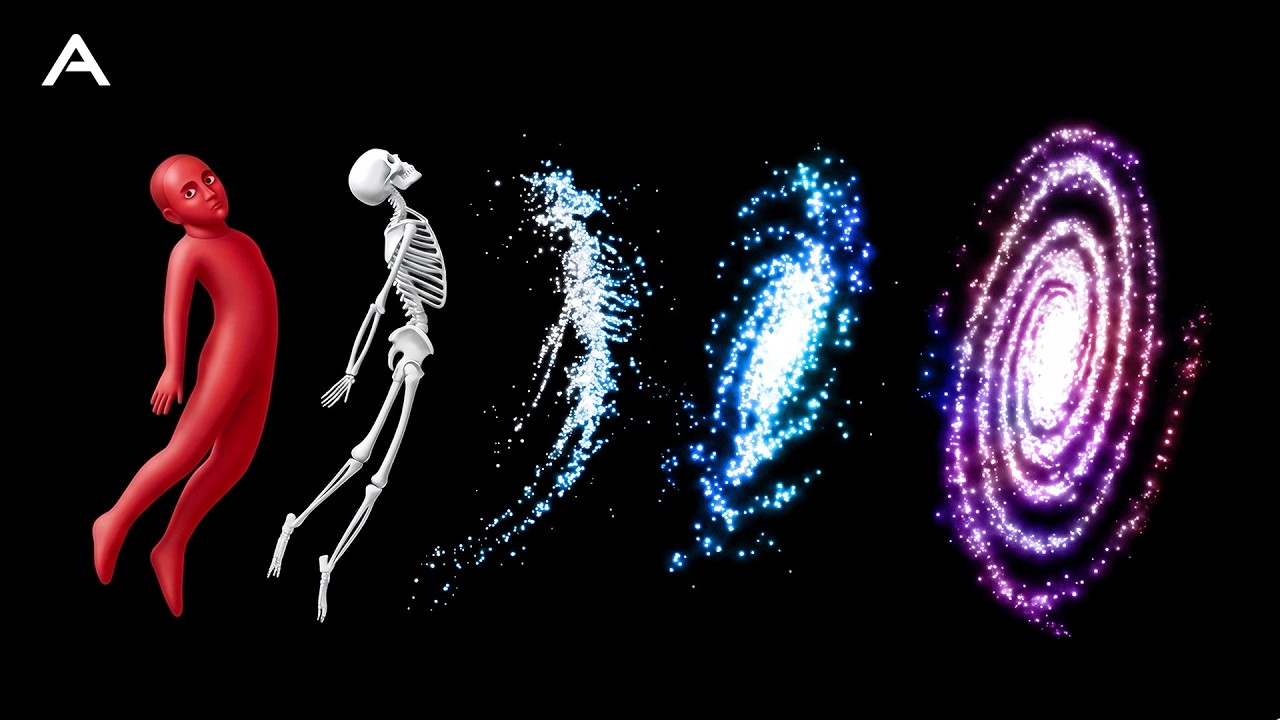
At a glance
The Relic Vault reads the Sumerian death texts as a technical document rather than a myth, and builds a single continuous claim out of them: that death is not an event but a designed process with stages, gatekeepers, a destination, and a mechanism that returns human consciousness to a new body with its memory removed. The spine of the argument is The Descent of Inanna into the Underworld, one of the oldest written narratives we have, in which the goddess passes through seven gates and is stripped of one possession at each until she arrives in the great below with nothing left. The documentary asks what happens if you refuse to read that stripping symbolically, and then cross references the same seven stage pattern into the Tibetan Book of the Dead, the Egyptian Book of the Dead, the Vedic doctrine of Samsara, and the Gnostic Archons of the Nag Hammadi library. The motive it lands on is the one the Sumerian creation texts already state for the making of humanity: labor. A workforce that dies must be replenished, so a soul that can be reset and reissued is a workforce you never lose. It ends where every one of those traditions ends, on an exit route, and on the name of the engineer the tablets credit with both the cage and the key: Enki.
The tablet in the museum (0:00)
The documentary opens on an object, not an idea. There is a clay tablet sitting in a museum right now, inscribed in cuneiform, that describes in extraordinary detail what happens to the human soul after death. Not metaphorically. Not symbolically. Step by step, stage by stage, with the kind of specificity that makes you wonder how anyone in 3000 BCE could have written it without having been there themselves.
The tablet is Sumerian. It predates the Bible by thousands of years. And buried inside its text, the narration says, is something mainstream academia has largely avoided discussing: a description of death not as an ending but as a process. A transition involving stages, gatekeepers, a destination, and, most disturbingly, a mechanism by which human souls are recycled into new bodies without any memory of what came before.
The Sumerians called it the fate that was designed for humanity. That word, designed, is the hinge the whole documentary swings on, and it comes back at the end with the name attached. According to the tablet, the fate was not designed by nature. It was designed by someone else entirely.
There is a reason most people have never heard this. The academic establishment tends to treat these texts as mythology, as the quaint spiritual beliefs of a primitive people. The documentary's method is to remove that assumption and read the tablets for exactly what they say. What you find, it argues, changes everything.
Sumer arrives without a runway (1:38)
The story begins in the cradle of civilization itself: Mesopotamia, the land between two rivers, the Tigris and the Euphrates. Roughly 6,000 years ago, in the region that is today southern Iraq, something extraordinary happened.
A civilization appeared with almost no archaeological precedent. No gradual build up. No slow progression from simple tools toward complex structures. The Sumerians arrived already holding agriculture, writing, mathematics, astronomy, law, architecture, and a detailed cosmological account of the universe that modern scholars are still working to decode.
Conventional archaeology has spent decades trying to explain the suddenness of it, and the narration's verdict on those attempts is blunt: the answers are never quite satisfying. The Sumerians themselves, meanwhile, had a very specific explanation for where their knowledge came from. That explanation involves beings they called the Anunnaki.
The Anunnaki, and what the word means (2:37)
The word Anunnaki translates roughly as those who came from the heavens to Earth. In some interpretations it means those of royal blood who descended.
The distinction the documentary insists on is that the Sumerians did not describe these beings as gods in the theological sense. They described them as physical beings: advanced, powerful, capable of things ordinary humans were not. They flew in objects the Sumerians called vehicles of heaven. They wielded weapons that destroyed with fire and sound. And according to the creation texts, they created humanity itself, for a specific purpose.
The narration pauses to head off the obvious objection. This is not a fringe interpretation. This is what the tablets actually say.
Enuma Elish, Atrahasis, and the making of the Lulu (3:22)
The most complete version of the Sumerian creation story does not sit on one tablet. It is assembled from the Enuma Elish, combined with the Atrahasis epic and various cylinder seal inscriptions.
Taken together, the documentary says, they describe this situation. The Anunnaki came to Earth long before humans existed. They began mining operations, primarily for gold. After thousands of years, the lower ranking Anunnaki workers grew exhausted and began to revolt.
The solution proposed by the Anunnaki leader Enki and his half sister Ninmah was to create a new kind of worker: a being capable of doing the labor so the Anunnaki would not have to.
That being was called the Lulu, the mixed one. It was made by combining the genetic material of the Anunnaki with the primitive beings already living on Earth.
That last sentence is where the documentary's frame becomes explicit, and it states it as flatly as it can: what the Sumerians described was not magic. It was genetic engineering. And, the line that sets up everything that follows, the soul was part of the design.
The echo in every other creation story (3:49)
Before moving to death, the narration widens the aperture. You can see the echo of the Lulu story in Genesis, in the Vedic texts, in the Book of Enoch, and in the oral traditions of dozens of cultures across the ancient world.
The argument from distribution is simple. The story appears in too many places, with too many matching details, to be coincidental. But the Sumerians wrote it down first, and they wrote it with a technical specificity that later versions lost entirely.
- c. 6500 to 3800 BCEThe Ubaid period. Villages and the first temple platforms in the southern marshes, including the earliest levels at Eridu, the city the later texts assign to Enki.
- c. 4000 to 3100 BCEThe Uruk period. Cities, monumental temples, the mass produced bevel rim bowl, and at Uruk itself the first proto cuneiform tablets. This is the horizon the documentary calls a civilization appearing with no precedent.
- c. 3300 to 3000 BCEEarliest cuneiform proper. The content is overwhelmingly administrative: rations, herds, barley, labor. The documentary's date for its tablet sits in this window.
- c. 2900 to 2334 BCEThe Early Dynastic city states. The first recognizably literary Sumerian compositions appear, many of them hymns.
- c. 2334 to 2154 BCEThe Akkadian empire. Enheduanna, daughter of Sargon and the first author in history known by name, writes her hymns to Inanna.
- c. 2112 to 2004 BCEThe Third Dynasty of Ur. The likely composition period of Inana's descent to the nether world, the 410 line poem at the center of this documentary.
- c. 1900 to 1600 BCEThe Old Babylonian period. Almost every surviving copy of Sumerian literature is a scribal school tablet from this era, most of them excavated at Nippur. The Atrahasis epic is written down around 1700 BCE.
- c. 1550 to 1100 BCEEgypt's New Kingdom funerary papyri, the collection we call the Book of the Dead, including the Papyrus of Ani in the British Museum. The Rigveda is composed in roughly the same span.
- c. 1200 to 1100 BCEThe Enuma Elish in the form we can read, a Babylonian composition in Akkadian that elevates Marduk and ends with humanity made to carry the gods' workload.
- 7th century BCEThe library of Ashurbanipal at Nineveh, where the standard Epic of Gilgamesh and much of the rest of the corpus was found in the 1850s.
- c. 100 to 350 CEThe Gnostic literature, including the codices later buried near Nag Hammadi in Upper Egypt.
- 14th century CEThe Bardo Thodol, the text we call the Tibetan Book of the Dead, is brought forward by Karma Lingpa.
- 1945Two farmers digging for fertilizer near Nag Hammadi open a sealed jar of thirteen leather bound codices. The Gnostic library the documentary leans on becomes readable for the first time in sixteen centuries.
What a human being is made of (4:48)
To understand what the tablets say about death, the documentary argues, you first have to understand what the Sumerians thought a human being actually was. Their model is radically different from what modern Western thinking assumes.
In Sumerian cosmology the human being was a composite entity. Not simply a body with a soul, but a construction made of multiple distinct layers, each of which behaved differently at death.
The balag, the body of clay (5:18)
The physical body was called the balag. It was made of clay, which in the Sumerian creation texts is explicitly described as a mixture of earth and divine blood. When the body died, it returned to the earth. That one is simple, and the documentary says so.
The gidim, the part that survives (5:36)
The other components did not return to the earth. The Sumerians used several terms for the non physical aspects of a person, and the most commonly discussed is the gidim, usually translated as ghost or shade.
The important point, stated as plainly as the documentary states anything: the gidim is the aspect of the human being that survives physical death and is subject to the process the tablets describe. Everything from here forward is about what happens to the gidim.
The me, the programs that run the cosmos (5:52)
There is also the me, a term that appears throughout Sumerian religious texts and resists easy translation. The me refers to something like the divine attributes, or the fundamental programs, that govern the behavior of gods, humans, and the cosmos itself.
The detail that matters is how the texts handle them. The me were described as physical objects. They could be held, stolen, transported, and controlled. Enki was said to possess the me of all things. And one of the most important me in the whole Sumerian system was the me of death itself.
Death as a designed system, not a natural event (6:28)
That inventory framing produces the claim the documentary has been building toward since the first minute. The Sumerians did not understand death as a natural phenomenon. They understood it as a system: a designed process with rules and mechanics.
And those mechanics, the narration says, are laid out in specific, recoverable detail in a text known today as The Descent of Inanna into the Underworld.
The Descent of Inanna and the seven gates of Kur (6:37)
Inanna was the Sumerian goddess of love, war, and the heavens, one of the most powerful figures in the Anunnaki hierarchy. The story of her descent is one of the oldest written narratives in human history, predating Homer by more than two thousand years.
Modern scholars have spent considerable energy analyzing it as mythology. The documentary's move is to take the text completely literally and see what emerges.
Kur has walls, gates, and administrators (7:09)
The underworld in this text is called Kur, sometimes rendered as the great below. And the description is not of an abstract spiritual realm. It is described as a physical location.
It has walls. It has gates. It has administrators. It operates according to specific laws.
The line that changes the reading (7:32)
Then comes the detail the documentary treats as the key to the whole text, and it delivers it as a single sentence: the beings in the underworld do not know they are there.
That line, the narration says, appears in variant translations of several tablets. The dead inhabit a realm that functions as a kind of holding environment. They persist. They experience something like awareness. But they are not fully conscious of their situation, and they are not free.
Seven gates, and something taken at each one (7:54)
The story of Inanna's descent describes her journey through seven gates. At each gate something is taken from her: an article of clothing, a piece of jewelry, a symbol of power and identity. By the time she reaches the final gate she has nothing left. She arrives in the great below stripped of everything that made her who she was.
Scholars interpret this symbolically, as the stripping away of ego, a spiritual death before rebirth.
The literal reading (8:22)
The documentary asks the reader to consider another interpretation. What if the seven gates are a description of a real process? What if what is being stripped away at each stage is not metaphorical clothing but actual layers of consciousness, memory, and identity?
What if the Descent of Inanna is not a symbolic poem, but an instruction manual written by beings who knew exactly how the system worked, because they built it?
The narration is candid that this sounds extreme, and then names the thing that, in its telling, stops it sounding extreme: you start cross referencing.
Cross referencing: four traditions describing the same machine (8:51)
The documentary now runs the pattern against four other bodies of text, separated from Sumer by geography, language, and in one case more than three thousand years.
Tibet: dissolution in stages (8:51)
The Tibetan Book of the Dead describes a process of dissolution that occurs after death. Consciousness passes through stages. At each stage something is encountered and something is released.
By the time the process is complete, the original identity has been degraded enough that the soul no longer remembers who it was. It is then guided back into rebirth.
Egypt: the hall of two truths (9:16)
The Egyptian Book of the Dead describes a hall of two truths in which the soul is judged, a weighing of the heart. The soul either passes, or it is consumed.
The documentary flags the wording of the second outcome as the interesting part. If consumed, it is described not as destroyed but as disassembled and returned to the cycle.
The Vedas: a wheel somebody else turns (9:32)
The Vedic texts describe Samsara, the wheel of birth, death, and rebirth, and they describe it as maintained by forces outside the individual soul's control.
Liberation from Samsara is described as extraordinarily difficult to achieve. And the obstacles to liberation, the narration notes, are described in language that sounds remarkably like deliberate obstruction.
The Gnostics: Archons, a Demiurge, and a prison (9:53)
The Gnostic texts, many of them hidden for centuries before the Nag Hammadi discovery in 1945, describe Archons: beings that maintain control over the material world and over the cycle of souls.
The Gnostics believed that human souls were divine sparks trapped in a system designed to keep them recycling indefinitely. The material world itself was described as a prison created by a lower god, a Demiurge, who had deceived humanity into believing this world was all there was.
| Tradition | What survives the body | What happens in transit | Who administers it | The exit it names |
|---|---|---|---|---|
| Sumer c. 2000 BCE | The gidim, the ghost or shade. | Seven gates. One possession, one layer of identity, taken at each. Arrival with nothing left. | Neti at the first gate; the court of Ereshkigal below. | the mystery schools knowledge passed by Enki to select initiates |
| Egypt c. 1500 BCE | The soul brought before judgment. | The hall of two truths and the weighing of the heart. Pass, or be consumed, which means disassembled and returned to the cycle. | Anubis, who conducts and weighs. | coming forth by day practical instructions carried by the dead |
| Tibet 14th c. CE | Consciousness, moving without a body. | Dissolution in stages. At each stage something is encountered and something released, until identity is degraded enough that the soul forgets who it was. | The peaceful and wrathful deities of the Bardo, who test and redirect. | the clear light recognized in the instant after physical awareness dissolves |
| The Vedas c. 1200 BCE | The soul bound to the wheel. | Samsara: birth, death, rebirth, turned by forces outside the individual soul's control. | Not personified. The wheel itself, and the obstacles guarding it. | moksha described as extraordinarily difficult to achieve |
| The Gnostics c. 200 CE | A divine spark, native to somewhere else. | Indefinite recycling through a material world that is itself the prison. | The Archons, under a Demiurge who tells you this world is all there is. | gnosis direct experiential recognition, said to be actively suppressed |
Putting all of it next to the tablets (10:27)
Now the documentary collapses the comparison back onto Sumer.
The tablets describe a human being as a created entity: designed, engineered, built with specific components. One of those components is the gidim, the surviving consciousness that outlasts the death of the body. According to the Sumerian system the gidim is not free after death. It travels to Kur, the great below, where it is held, where its memory and identity are degraded, and where it waits until it is cycled back.
And the frame, once more, in the narration's own words: the Sumerians did not frame this as metaphysics. They framed it as engineering.
The question mainstream academia will not ask (11:10)
That framing produces a question the documentary says ancient astronaut researchers have been asking for decades while mainstream academia refuses to take it seriously.
If the Anunnaki designed the human being, and if the Anunnaki designed the process by which human souls cycle after death, what was the purpose of that design?
The answer the tablets suggest, the narration says, is not comforting.
Recycling a workforce you never lose (11:35)
Go back to the stated motive for creating humanity in the first place. Labor. The Anunnaki needed workers. Then follow the logistics.
A labor force that died would need to be replenished. If the soul is a component that can be recycled into a new body with its memory erased, then you never actually lose the worker. You just reset them and put them back into the system.
And here the trap gets its shape: the soul does not know this is happening.
Inanna at the seventh gate has nothing left. She does not remember who she was. She does not remember what she knew. She does not remember that there is a different option. So when she is sent back, when the cycle begins again, she participates in her own recycling. Not because she chooses to, but because the choice was taken from her at the seventh gate.
The trap, stated plainly (12:31)
The reason the trap works, the documentary argues, is that the mechanism for dismantling memory and identity is built into the dying process itself. Nothing has to be enforced. Nobody has to be dragged.
You do not have to be forced into the cycle. You simply have to fail to escape it before the gates strip you down far enough that you no longer remember you wanted to.
Is there a way out, and what the exit costs (12:56)
The question that follows naturally is whether there is a way out. The tablets, combined with the other ancient texts, do describe something like an escape route. The documentary's own caveat is that they describe it in terms that should concern anyone paying attention.
The escape from the cycle requires preparation. It requires knowledge. And it requires that you maintain a specific kind of awareness through the dying process, particularly at the gates, where the pressure to release identity and memory is greatest.
Then the line that explains why none of this is familiar: the traditions that describe it in the most detail are not the ones that ended up in Sunday school.
The clear light of death (13:39)
The Tibetan tradition calls it the recognition of the clear light of death: the moment immediately following the dissolution of physical awareness, when the original nature of consciousness is briefly visible before the process of degradation begins.
If that moment is recognized, if the dying person can hold awareness through it without being swept away, the cycle can be broken.
Gnosis (14:05)
The Gnostic tradition calls it gnosis. Not knowledge in the academic sense, but direct experiential recognition of the soul's true nature.
The Gnostics believed this knowledge was deliberately suppressed. That the system, the Archons, the Demiurge, and its enforcers actively worked to ensure human beings died in ignorance and therefore cycled back without resistance.
The Book of Coming Forth by Day (14:29)
The Egyptian tradition concealed similar knowledge in the Book of the Dead, which the documentary notes is more accurately translated as the Book of Coming Forth by Day.
That text was designed not to tell the story of death, but to give the soul practical instructions for navigating the process without losing itself in it. It is a manual, not a narrative, and it was buried with the person who would need it.
Three traditions, three names for the same operation. Follow the thread back far enough, the narration says, and the common source leads to Sumer.
The gatekeepers (14:57)
The tablets go further than describing the system. They describe the gatekeepers, the beings who administer the process, and the documentary calls the descriptions precise enough to be unsettling.
In the Descent of Inanna the gatekeeper of the first gate is called Neti. He receives Inanna, demands her credentials, and enforces the stripping process with absolute authority.
The characterization is the part worth holding onto. He does not do this out of cruelty. He does it because this is his function. He is an administrator of a system.
In Egyptian cosmology Anubis plays a similar role. In the Tibetan system the peaceful and wrathful deities encountered in the Bardo state function as gatekeepers whose job is to test and potentially redirect the consciousness of the dying person.
Then a one line aside that lands harder than its length suggests: Occam's razor, applied consistently, should produce some discomfort here.
Three zones, and the land of no return (15:56)
Together, the documentary says, these fragments describe what might be called the architecture of the afterlife, in extraordinary technical detail. The underworld is described as having specific zones.
A region near the surface, where freshly dead souls arrive still holding some residual awareness and memory.
A middle region where the stripping process occurs, administered by beings whose function is explicitly described as the removal of attributes.
And a deep region called the land of no return, which is not a punishment for the wicked but simply the default destination for all human souls.
That last clause is the one the documentary wants you to notice. Nobody is being sentenced. This is where everyone goes.
The land of no return, read literally (16:32)
The phrase land of no return is one of the most widely recognized terms in Sumerian scholarship. It appears across dozens of texts, and it is almost always interpreted metaphorically: the dead simply do not return to the living. That is the conventional reading.
Some researchers argue for a more literal one, and the documentary spends its most careful minute on it.
Land of no return does not mean the dead do not return to the physical world. It means the consciousness that arrives in the deep underworld does not return to itself. It is not the body that does not come back. It is the memory, the identity, the thread of awareness that would allow the soul to know what it is, what it was, and what is being done to it.
The no return is not geographical. It is psychological. It is the point in the process after which the soul cannot recover what it has lost, and therefore cannot resist the recycling mechanism.
This, the narration says, is the trap.
Either they were there or they built it (17:42)
The tablets describe all of this with enough specificity, the documentary argues, that you have to seriously consider where the information came from. And it narrows the options to two, which is the sharpest structural move in the whole video.
Either whoever wrote them had been there, which would require a kind of consciousness that could observe the post death process and report back.
Or they had built it.
That second possibility is the one researchers in the ancient astronaut field have been quietly building a case for over the last several decades.
If the body was designed, why not the soul? (18:34)
The documentary then makes the argument it considers close to airtight, and it starts from something it says is not in dispute.
We already accept without controversy that the Sumerians believed the human body was engineered. The creation texts say this explicitly. Humanity was not an accident of evolution. Humanity was a designed product.
So: if the body was designed, why not the soul? And if the soul was designed, then the system governing its behavior after death could have been designed at the same time, as a feature, not a side effect.
What would the purpose of that feature be? The narration answers in three words, each a sentence. The same purpose as the creation itself. Labor. Continuity. Ensuring that the workforce never truly ran out, because the souls were always being recycled back into new bodies.
Amnesia is the feature (19:08)
The supporting argument is about time horizons. The mining operations described in the Sumerian texts were not short term projects. They were permanent infrastructure. And permanent infrastructure requires a permanent workforce.
From inside the Sumerian framework, then, the amnesia is not a side effect of biology. It is the entire point. Here is the sentence the whole thesis rests on:
A workforce that remembered being a workforce would be a workforce capable of revolt.
And there is a precedent in the texts themselves. The Atrahasis epic describes exactly such a revolt among the Anunnaki workers, before humanity was created. The response to that revolt is the tell. The solution was not to give the new workers better conditions. The solution was to give them a new kind of amnesia.
They would not remember their divine origin. They would not remember their previous lives. They would not know they were in a system at all. They would simply be born, work, die, be recycled, and be born again, without ever accumulating enough continuous awareness to understand their situation, let alone resist it.
The Gnostics, millennia after the Sumerians and through a completely different tradition, were describing exactly this when they wrote about the Archonic system. They had arrived at the same conclusion by another road. The soul is trapped.
A cage that looks like freedom (20:30)
The documentary pauses on the design quality of the thing, because that is where its unease sits. The trap is elegant, and its elegance lies precisely in the fact that the trapped soul does not know it is trapped.
There is a word for a system designed to capture and hold something without the captive's awareness of its situation. The word is a cage that looks like freedom.
That is what the Sumerian tablets describe. The afterlife is not heaven. It is not hell. It is a processing system.
The processing has already happened to you (20:55)
Then it turns the claim around on the viewer, which is the emotional pivot of the video.
The processing is happening to you right now, in the sense that you are the product of that processing. You are a recycled soul in a new body with no memory of the process that brought you here.
Everything that you are, your preferences, your fears, your relationships, your sense of self, was constructed fresh in this lifetime, with no continuity from whatever came before.
And the documentary refuses to soften it, in a way that is worth quoting in full: the tablet does not say this to frighten you. The tablet is not concerned with your reaction. It is documentation. It was written by beings who understood the system, either because they experienced it, observed it, or built it.
The preparation (21:41)
What to do with that information is exactly where the ancient esoteric traditions pick up, because they all agree on one thing. The trap can be identified. And something that can be identified can potentially be avoided.
The preparation required is not complex in description. It is described as extraordinarily difficult in practice. It requires that a person develop, during physical life, the kind of continuous awareness that the dying process tries to extinguish.
The traditions call it by different names: presence, wakefulness, witness consciousness, the clear unmediated awareness of the original mind, before thought, before identity, before the structures of personality that the gates will try to strip away.
Life is the training ground, death is the exam (22:31)
Why develop this during life? Not because life is where the tests happen. Life is the training ground. Death is where the exam occurs.
The seven gates of the Sumerian underworld, each stripping one more layer of the self, can only be navigated by a consciousness that does not identify with the layers being stripped.
The witness (22:58)
The logic here is clean, and the documentary states it as a conditional pair.
If you are your memories, the loss of memory destroys you. If you are your identity, the dissolution of identity leaves nothing.
But if behind all of that there is something that simply observes, something that does not cling to what is being taken, then that something, the witness, can pass through the seventh gate with awareness intact.
What Inanna actually does at the gates (23:25)
And that, the documentary says, is what Inanna does.
She surrenders at each gate willingly. She does not fight the process. She does not try to hold on to what is being taken. She moves through all seven gates naked, stripped of everything. And she survives.
Reread the poem that way and the descent stops being a tragedy about a goddess who overreached. It becomes a demonstration.
Most souls fail at the first gate (23:43)
Most souls do not do this, because most souls do not know it is necessary. They arrive at the first gate with their full personality intact, resist the stripping, and fail. The gate is stronger than the resistance.
The failure mode is specific, and it is the most interesting mechanical claim in the video. The awareness that should remain as the witness gets caught in the struggle, and is swept away with everything else. By the seventh gate there is nothing left to observe the process. And so the recycling happens without oversight.
The narration's dry assessment of what that implies: that is not nothing.
The word designed (24:20)
Back to the object in the museum. The tablet sitting there right now, inscribed with cuneiform that most people will never read, describes a system. Not a belief, not a hope, not a fear. A system with components, administrators, stages, and a mechanism that processes human consciousness after death and returns it to the physical world with all relevant memories removed.
The Sumerians did not call this God's plan. They called it the fate that was designed for humanity.
And now the documentary presses on the vocabulary, which is where the argument gets its last piece of leverage. The word designed is not metaphorical. It is the same word used in the creation text to describe the engineering of the human body. It is the same word used in the texts about the me, the fundamental programs governing the behavior of things in the cosmos.
The fate of humanity was designed. The Sumerians recorded who designed it. And the entity they named is the same entity their texts describe as having created humanity in the first place.
Enki (25:25)
Enki. The genetic engineer. The lord of the deep waters. The one whose symbol is the double helix, recognizable today as the structure of DNA.
And here the documentary complicates its own villain, deliberately. Enki is described in various tablets as both humanity's creator and humanity's defender within the Anunnaki hierarchy. There are texts in which Enki warns certain humans about coming floods and shares forbidden knowledge with human initiates.
The engineer who built the cage wrote the escape manual (26:08)
Put those two roles together and you get the sentence the narration explicitly flags as the most important one in the entire documentary.
If the trap was built at the instruction of the Anunnaki hierarchy, and if Enki also provided the key to escaping it to select human initiates, then the mystery school traditions are the survival instructions written by the same engineer who built the cage.
That reframes the secrecy. This is why the knowledge was secret, the documentary argues, not because knowledge itself is sacred, but because someone with the power to enforce secrecy wanted it kept that way.
The tablet describes the trap. The mystery traditions describe the exit. And both the description of the trap and the description of the exit point back to the same origin: Sumer, six thousand years ago, in the clay valleys between two rivers, where someone or something sat down with a stylus and a block of clay and wrote down the truth about what happens to human beings when they die.
Written for the few (26:52)
The documentary sorts its own audience into three groups, without flattering any of them.
Most people will live their entire lives without knowing this tablet exists. Most people who learn it exists will dismiss it as ancient mythology. Some will read the tablet for what it says and sit with the discomfort of taking it seriously.
The tablet does not care which category you fall into. It was not written for the masses. It was written, the evidence suggests, for the few. For those who could read it, understand it, and do something useful with the information before the seventh gate comes for them.
The question the tablet leaves you with (27:30)
The closing move is to restate the question, because the documentary claims the usual one has already been answered.
The question the tablet leaves you with is not whether the soul survives death. It takes that as given.
It is whether the soul that survives death is still recognizably you. Whether the awareness that passes through the process retains enough of itself to know what is happening, to recognize the gates for what they are. To release, without losing the one thing that cannot be replaced.
One who knows the way of the descent (28:02)
The Sumerians, the narration says, had a word for a human being who had achieved the preparation necessary to navigate death consciously. It appears in the most sacred sections of the tablets, and it means roughly, one who knows the way of the descent.
Not one who died well in a mortal sense. Not one who was virtuous. Not one who pleased the gods. One who knows the way.
The distinction being drawn is between merit and competence. Every moral category is set aside, and what is left is a skill.
The system is still running (29:15)
The knowledge, the documentary insists, is still available. It is encoded in texts that survived precisely because someone valued them enough to hide them, copy them, encrypt them, and transmit them across thousands of years to the present moment.
The Sumerian tablets. The Egyptian funerary texts. The Tibetan Bardo teachings. The Nag Hammadi library. The encoded architecture of sacred sites built with measurements that only make sense if you know what the builders were measuring.
All of it points here, the narration says, to this moment, to the question of what you are going to do with the information your civilization has been structured to keep you from finding.
And then the last three sentences, which are the ones people quote:
The clay tablet is still in the museum. The cuneiform is still legible. The system is still running.
And somewhere between the first gate and the seventh, the answer to what makes you you is waiting to be found before it is taken away.
Key takeaways
- The documentary's core claim is a category shift, not a new fact: it reads the Sumerian death texts as documentation of a mechanism rather than as religious belief, on the grounds that they describe stages, administrators, and rules rather than hopes.
- The human being in Sumerian cosmology is layered, not dual: the balag (the clay body) returns to earth, the gidim (the shade) survives and enters the process, and the me (divine attributes, described as objects that can be held and stolen) were never the person's to begin with.
- The Descent of Inanna supplies the mechanism. Seven gates, one thing taken at each, arrival with nothing left. The documentary's reading is that the items are layers of consciousness, memory, and identity rather than clothing.
- Kur is described physically: walls, gates, administrators, laws. It is divided into three zones, and the deepest, the land of no return, is not a punishment but the default destination for everyone.
- The literal reading of "land of no return" is the video's sharpest single idea: the no return is not geographical but psychological. What cannot come back is the thread of awareness that would let the soul know what was done to it.
- The motive is labor. The same creation texts that say humanity was engineered say why: to work. Permanent infrastructure needs a permanent workforce, and a soul that can be reset is a worker you never lose. "A workforce that remembered being a workforce would be a workforce capable of revolt."
- Four other traditions are read as describing the same machine: Tibetan staged dissolution, Egyptian judgment with the consumed soul disassembled and returned to the cycle, Vedic Samsara turned by outside forces, and Gnostic Archons maintaining the recycling of divine sparks.
- Every one of those traditions also names an exit, and all four exits are the same operation: hold continuous awareness through the process. The clear light in Tibet, gnosis for the Gnostics, the practical instructions of the Book of Coming Forth by Day in Egypt.
- The exit is a competence, not a virtue. Life is the training ground, death is the exam, and the only thing that survives the seventh gate is a witness that does not identify with what is being stripped.
- Inanna is reread as a demonstration rather than a tragedy. She surrenders at each gate willingly, does not fight, arrives naked, and survives. Most souls resist, get their awareness caught in the struggle, and lose the observer along with everything else.
- Enki holds both roles. He is credited as the engineer of the human body and as humanity's defender, the one who warned about the flood and passed forbidden knowledge to initiates. Hence the line the narration calls the most important in the documentary: the mystery schools would be survival instructions written by the same engineer who built the cage.
- The information is framed as indifferent to you. The tablet is documentation, it does not care whether you believe it, and it was not written for the masses.
Chapters
- 0:00 A clay tablet that describes death step by step
- 1:38 Sumer appears in the land between two rivers
- 2:37 The Anunnaki, and what the word translates to
- 3:22 Enuma Elish, Atrahasis, and the making of the Lulu
- 3:49 The same story in Genesis, the Vedas, and Enoch
- 4:48 What a human being is made of: balag, gidim, and me
- 6:28 Death as a designed system rather than a natural event
- 6:37 The Descent of Inanna, and Kur as a physical place
- 7:32 The beings in the underworld do not know they are there
- 7:54 Seven gates, and something taken at each one
- 8:22 Reading the descent as an instruction manual
- 8:51 Cross referencing Tibet, Egypt, the Vedas, and the Gnostics
- 10:27 Putting the traditions next to the tablets
- 11:10 The question mainstream academia will not ask
- 11:35 Recycling a workforce you never lose
- 12:31 The trap: you only have to fail to escape it
- 12:56 Is there a way out, and what the exit costs
- 13:39 The clear light, gnosis, and coming forth by day
- 14:57 The gatekeepers: Neti, Anubis, and the Bardo deities
- 15:56 Three zones and the land of no return
- 16:59 The no return is psychological, not geographical
- 17:42 Either they were there, or they built it
- 18:34 If the body was designed, why not the soul
- 19:08 Amnesia as the feature, and the Atrahasis revolt
- 20:30 A cage that looks like freedom
- 20:55 The processing already happened to you
- 21:41 The preparation, and what the traditions call it
- 22:31 Life is the training ground, death is the exam
- 22:58 The witness that can pass through the seventh gate
- 23:25 What Inanna actually does at the gates
- 23:43 Why most souls fail at the first gate
- 24:20 The word designed, and the fate of humanity
- 25:25 Enki, creator and defender
- 26:08 The engineer who built the cage wrote the escape manual
- 26:52 Written for the few
- 27:30 Whether the soul that survives is still you
- 28:02 One who knows the way of the descent
- 29:15 The system is still running
Notable quotes
All lines are the narrator of The Relic Vault.
"With the kind of specificity that makes you wonder how anyone in 3000 BCE could have written it without having been there themselves." (0:12)
"It was not designed by nature. It was designed by someone else entirely." (0:44)
"This is not a fringe interpretation. This is what the tablets actually say." (3:18)
"What the Sumerians described was not magic. It was genetic engineering, and the soul was part of the design." (4:35)
"The Sumerians did not understand death as a natural phenomenon. They understood it as a system, a designed process with rules and mechanics." (6:20)
"The beings in the underworld do not know they are there." (7:32)
"What if the descent of Inanna is not a symbolic poem, but an instruction manual written by beings who knew exactly how the system worked because they built it?" (8:30)
"The Sumerians did not frame this as metaphysics. They framed it as engineering." (10:40)
"If the soul is a component that can be recycled into a new body with its memory erased, then you never actually lose the worker. You just reset them and put them back into the system." (11:44)
"You do not have to be forced into the cycle. You simply have to fail to escape it before the gates strip you down far enough that you no longer remember you wanted to." (12:45)
"The traditions that describe this in most detail are not the ones that ended up in Sunday school." (13:25)
"He does not do this out of cruelty. He does it because this is his function. He is an administrator of a system." (15:18)
"Occam's razor, applied consistently, should produce some discomfort here." (15:51)
"Land of no return does not mean the dead do not return to the living. It means the consciousness that arrives in the deep underworld does not return to itself." (17:00)
"The no return is not geographical. It is psychological." (17:26)
"Humanity was not an accident of evolution. Humanity was a designed product." (18:24)
"A workforce that remembered being a workforce would be a workforce capable of revolt." (19:25)
"The trap is elegant. And its elegance lies precisely in the fact that the trapped soul does not know it is trapped." (20:30)
"There is a word for a system designed to capture and hold something without the captive's awareness of its situation. The word is a cage that looks like freedom." (20:39)
"The afterlife is not heaven. It is not hell. It is a processing system." (20:55)
"The tablet does not say this to frighten you. The tablet is not concerned with your reaction. It is documentation." (21:25)
"Life is the training ground. Death is where the exam occurs." (22:31)
"If you are your memories, the loss of memory destroys you. If you are your identity, the dissolution of identity leaves nothing." (22:58)
"She moves through all seven gates naked, stripped of everything, and she survives." (23:32)
"By the seventh gate, there is nothing left to observe the process. And so, the recycling happens without oversight." (24:10)
"The Sumerians did not call this God's plan. They called it the fate that was designed for humanity." (24:47)
"Then the mystery school traditions are the survival instructions written by the same engineer who built the cage. That may be the most important sentence in this entire documentary." (26:00)
"It was not written for the masses. It was written, the evidence suggests, for the few." (27:16)
"The clay tablet is still in the museum. The cuneiform is still legible. The system is still running." (29:15)
Resources mentioned
The channel
- The Relic Vault, the channel that produced this documentary, publishing weekly on ancient texts, artifacts, and lost history.
Mesopotamian texts and terms
- The Descent of Inanna into the Underworld, the spine of the documentary. The full Sumerian text with an English translation is free to read as Inana's descent to the nether world at the Electronic Text Corpus of Sumerian Literature (ETCSL), Oxford.
- The Enuma Elish, the Babylonian creation epic.
- The Atrahasis epic, which contains the revolt of the worker gods and the making of humanity.
- The Epic of Gilgamesh, the other major source for the Mesopotamian underworld, and the Gilgamesh flood myth.
- The later Akkadian retelling of the same journey, The Descent of Ishtar to the Underworld, which also has seven gates and is a good check on how the Sumerian original was read a thousand years later.
- Kur and the ancient Mesopotamian underworld, including the epithet kur-nu-gi4-a, the land of no return.
- The me, the divine attributes or programs the tablets treat as transferable objects.
- Cuneiform and cylinder seals, the two media the documentary's sources are written on.
Figures named
- Enki, engineer of humanity, lord of the deep waters, and, in the documentary's closing argument, the source of the escape route as well.
- Inanna, the goddess who makes the descent.
- Ninmah, also called Ninhursag, who works with Enki to create the first worker.
- Neti, gatekeeper of the first gate.
- Ereshkigal, queen of the great below, whose court Inanna is descending into.
- The Anunnaki and the Igigi, the two tiers of gods in the Mesopotamian labor story.
- Anubis, the Egyptian counterpart to Neti in the documentary's comparison.
Other traditions cited
- The Tibetan Book of the Dead, the Bardo Thodol, and the Bardo states it maps.
- The Egyptian Book of the Dead, more accurately the Book of Coming Forth by Day, including the weighing of the heart and Ammit, who consumes the failed. The British Museum holds the best known copy, the Papyrus of Ani.
- Samsara and moksha in the Vedic texts.
- The Nag Hammadi library, discovered in 1945, with the texts readable in English at the Gnostic Society Library. Key concepts: the Archons, the Demiurge, the divine spark, and gnosis.
- The Book of Enoch and Genesis, cited as later echoes of the Lulu story.
- The mystery school traditions, including the Eleusinian Mysteries, which the documentary reads as transmitted escape instructions.
- Occam's razor, invoked in a single line at 15:51.
- The ancient astronaut hypothesis, the research tradition the documentary places itself in.
Places and periods
- Mesopotamia, between the Tigris and the Euphrates, in what is now southern Iraq.
- Uruk, Inanna's city, and Eridu, Enki's.
- Nippur, where most surviving copies of Sumerian literature were excavated, and the Library of Ashurbanipal, where the Akkadian epics were found.
- The Ubaid, Uruk, Early Dynastic, Akkadian, Ur III, and Old Babylonian periods.
Where it stands
The reconstruction above is the documentary's, told in its frame. This section is the ledger: which pieces are ordinary Assyriology you could take to a seminar, which are the creator's readings laid over real texts, and which come from the modern Zecharia Sitchin lineage rather than from any tablet.
The texts are real, and better documented than the video suggests. Inana's descent to the nether world is a genuine Sumerian composition of roughly 410 lines, reconstructed from Old Babylonian school tablets mostly excavated at Nippur. The seven gates are in the text. Neti the chief doorman is in the text, and he does demand her credentials and strip one item at each gate exactly as described. Ereshkigal rules below. Kur and the epithet kur-nu-gi4-a, the land of no return, are both standard. The Atrahasis epic really does open with the lower tier of gods revolting over their workload and really does resolve it by creating humanity to take over the labor. Enki really is both the maker of humanity and the god who warns Ziusudra about the flood. The Egyptian title really is closer to the Book of Coming Forth by Day, and it really is a set of practical instructions buried with the dead rather than a narrative. Samuel Noah Kramer, whose translation put Inanna's descent in front of general readers (with Diane Wolkstein, in Inanna, Queen of Heaven and Earth), is not a fringe figure and this material was never suppressed. Anyone can read the whole corpus free at ETCSL.
The ending of the poem is the biggest omission. In the actual text Inanna does not simply pass through seven gates and survive. She is struck dead in the underworld, turned into a corpse and hung on a hook. Her minister Ninshubur petitions the gods, and it is Enki, again, who fashions two creatures, the kurgarra and the galatur, and sends them down with the food of life and the water of life to revive her. Even then the underworld does not release her for free: it demands a substitute, and she gives up her husband Dumuzi, who is taken in her place. The documentary's reading of Inanna as the model practitioner who surrenders willingly and walks out intact requires leaving out her death, her rescue, and the price. That said, note who the rescuer is. The video's own thesis, that Enki is the one who hands out the exit, is arguably better supported by the ending it skips than by the part it tells.
Soul recycling is the load bearing claim, and it is not attested in the Sumerian material. This is the honest heart of it. In the Mesopotamian texts the gidim (Akkadian etemmu) goes down to the netherworld and stays. It is not stripped of memory and it is not reissued into a new body. Gilgamesh tablet XII has Enkidu report back on conditions there, and they are grim and static: the dead eat dust and clay, drink muddy water, and depend on food and drink offerings from living descendants (the kispu rite) to be less miserable. A ghost with no descendants to feed it is worse off, not recycled. Reincarnation is an Indic and later Greek idea, not a Mesopotamian one, and no Sumerologist reads kur-nu-gi4-a as a memory wipe followed by rebirth. Likewise the pivotal line "the beings in the underworld do not know they are there" is not a sentence from any tablet I can locate in the published corpus, and the documentary does not cite one.
Several specifics come from Sitchin rather than from cuneiform. The gold mining motive is the clearest case: in Atrahasis the Igigi are digging irrigation canals and hauling earth, not mining gold, and gold as the purpose of the whole enterprise enters with Sitchin's The 12th Planet (1976). "Anunnaki" is most straightforwardly read as offspring of An, the sky god, rather than as those who came from the heavens to Earth. The Akkadian lullû means something closer to primitive or savage man than the mixed one. And Enki's symbols in the actual iconography are flowing streams of water and the goat fish; the entwined serpents that resemble a double helix belong to Ningishzida and to the later caduceus, and reading them as DNA is a twentieth century overlay.
Sumer did have a runway. The claim of a civilization with no archaeological precedent is the one point where the record is simply fuller than the video allows. The Ubaid and Uruk periods give a continuous sequence of some three thousand years running from marsh villages through temple platforms at Eridu to the first cities, and writing itself is visibly incremental: clay tokens, then sealed bullae, then numerical tablets, then proto cuneiform accounting, then syllabic script. The build up is documented. It is just less dramatic than an arrival.
Small dating notes. The tablet is never identified by museum, excavation number, or collection anywhere in the video, and what it calls "the tablet" is really a composite of at least four separate works written across more than a thousand years in two different languages (Sumerian and Akkadian); the Enuma Elish in particular is Babylonian and roughly a thousand years younger than the Sumerian poem it is being blended with. Cuneiform does reach back to about 3300 BCE, but the tablets from that horizon are ration lists, not cosmology. "Predating Homer by more than two thousand years" is generous by about eight hundred years if you date the composition to Ur III. And the Sumerian word for one who knows the way of the descent is never actually given, which is a shame, because it would be the single most checkable claim in the video.
What survives all of that. Strip out the engineering frame and something genuinely interesting is still standing, which is why the documentary works. Multiple unconnected traditions really did independently describe death as a staged, administered transit in which the traveler loses parts of themselves, and really did produce technical manuals for getting through it with awareness intact: the Bardo Thodol, the Book of Coming Forth by Day, the Gnostic literature on gnosis. The mainstream explanation for that convergence is that human beings facing death arrive at similar structures, plus real transmission across the ancient Mediterranean and Near East, rather than a single engineered system with a common designer. But the observation itself is not fringe, and the seven gates read outside in, from crown to dress, is a real feature of a real 4,000 year old poem that nobody made up.