youtube.nixfred.com nixfred.com
Topic

AI

Everything tagged AI.

58videos

← All videos

32:44
AI Search

Claude Opus 5 is a freak

AI Search runs Claude Opus 5 through eight hands on tests, five of them long autonomous runs inside Claude Code, and reports the token cost of every one. It one shots a browser native Windows 11 with a working Excel formula engine, wins an image to 3D render no other frontier model had managed, finds four companies' Q4 filings by itself and turns them into a narrated presentation video, builds an animated X-wing in Blender over MCP, and composes a five minute techno track in a real DAW after choosing and downloading its own synth plugins. It also fails the hidden frog test, gets six out of six brain scans wrong, and underwhelms on deep research. The benchmark tour is where the review turns: first on some independent boards by a single point, third on LiveBench, the slowest frontier model on the table, roughly twice the price of a rival he calls just as intelligent, and a headline ARC-AGI-3 score with a contamination question attached. The verdict is a conditional no, and it is aimed as much at Anthropic as at the model.

AIBusinessCultureJul 27, 2026
1:48:15
World Science Festival

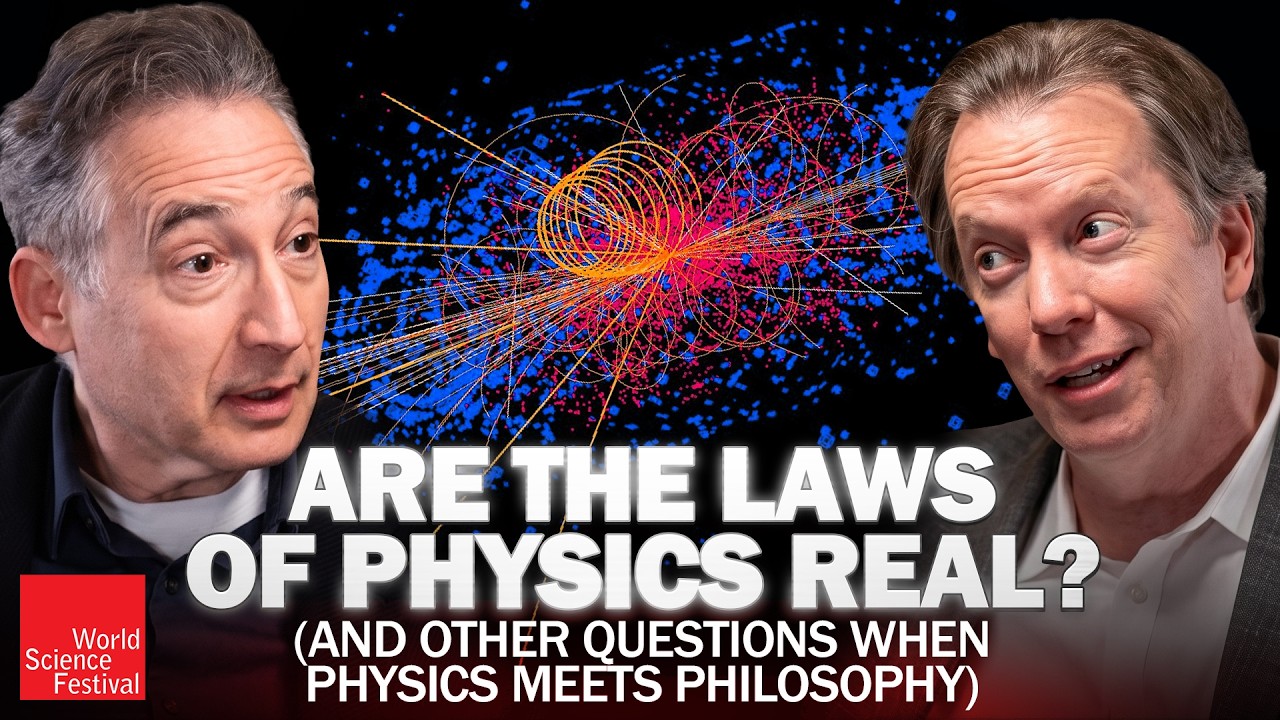
Exploring the Deep Mysteries of Physics | World Science Festival

Brian Greene sits down with Sean Carroll for one hour and forty eight minutes on the foundations of physics, with no audience and no agenda beyond seeing where it goes. They open on the question that organizes everything after it: the universe has reliable patterns, so what is making them, and both land on the answer that at some point it just is. From there they work through whether mathematics is invented or discovered, Godel and the integers, Borges and the alphabet as a compressed Library of Babel, why a deistic God explains nothing, free will as a level of description rather than an intervention, and whether large language models are conscious. The technical middle third is Greene asking Carroll to convince him of Many-Worlds and Carroll taking the shot, followed by his case that a quantum state in Hilbert space may be an exact and complete description of reality with space, time and gravity all emergent from it. It closes on complexity science, why every mammal gets about one and a half billion heartbeats, and a Johns Hopkins postdoc who submitted a one page prompt at the start of a talk and had a finished LIGO paper an hour later.

PhysicsSciencePhilosophyJul 24, 2026
14:37
AI Revolution

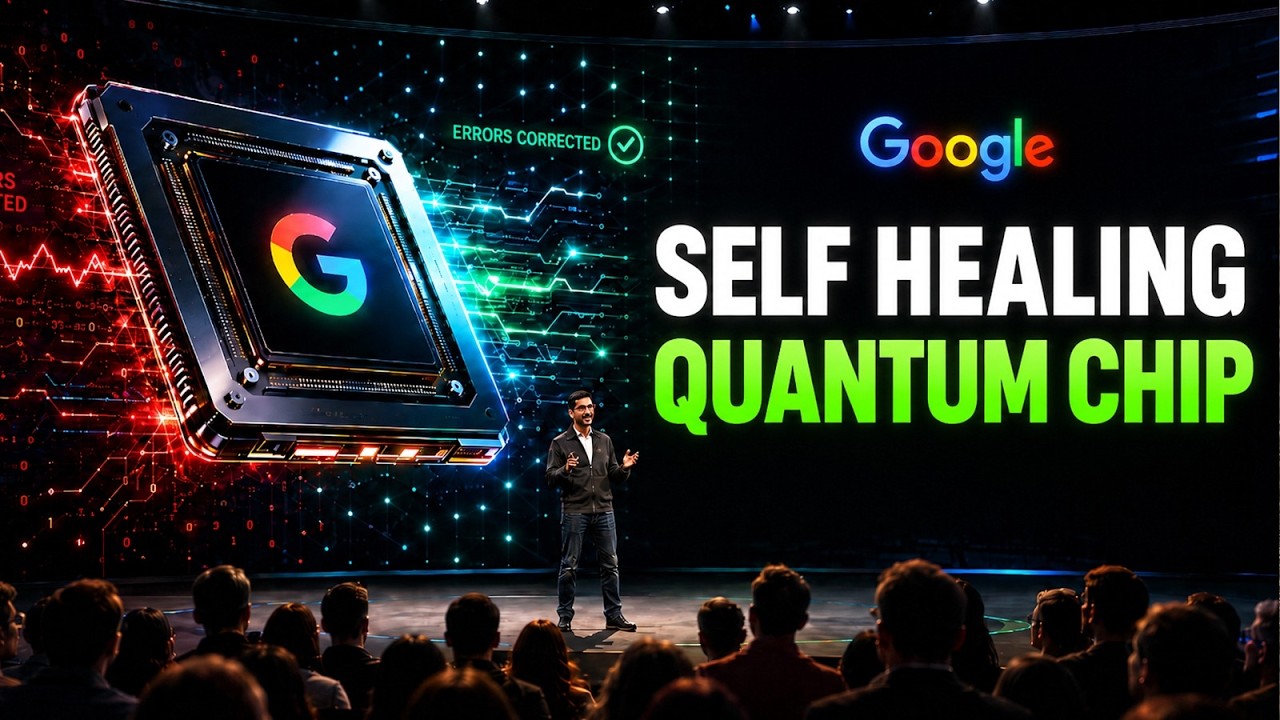
Google Just Made a Massive Quantum Breakthrough

A dense fifteen minute walkthrough of one Nature paper from Google Quantum AI and Google DeepMind, Reinforcement learning control of quantum error correction. The premise: a quantum computer's real problem is not that qubits are fragile, it is that the machine is analog and its thousands of microwave control parameters drift out of tune while you use them, and the only fix so far has been to kill the computation and recalibrate. Google gave the error correction system's own detection events a second job, feeding them to a reinforcement learning agent that retunes the controls while the computation keeps running. On a Willow processor it found another 20% suppression of the logical error rate on top of full expert calibration, delivered a 3.5 fold improvement in stability against injected drift, and set record logical error rates of 7.72 x 10^-4 per cycle for the distance 7 surface code and 8.19 x 10^-3 for the distance 5 color code. Simulations to distance 15 and 40,000 parameters show the training cost is independent of system size.

SciencePhysicsAIJul 23, 2026
22:59
Chase AI

Turn Claude Into A Design GENIUS In 3 Simple Steps

A reproducible three step method for getting web design out of Claude Code that does not look like it came from Claude Code. Step one is building an inspiration library web app where every saved screenshot carries keywords, a copy image prompt and a copy brief, so your taste arrives as text an agent can act on. Step two is the short list of external tools: the Impeccable skill with its 23 commands and 46 pattern slop catalog, the Taste Skill v2, the Higgsfield MCP for images and video, and 21st.dev for component prompts, plus a warning that the next skill is never the answer. Step three is the build, done live for a fake analytics startup called Kestrel in four widening passes: five aesthetics, four body layouts, four Higgsfield hero images at 2K, five color grades, and finally a self built tweaks bar that mimics Claude Design so he can move fonts and accents without re-prompting. Every prompt is read out and every rejected option is named.

AIDevOpsBusinessJul 23, 2026
21:39
Nick Saraev

Kimi K3 Designs Websites That Feel Like MOVIES For Just $1

Nick Saraev builds cinematic scroll driven landing pages end to end and shows every prompt and setting. The mechanic is simple once he says it: one short macro video sits in the background, every frame becomes a scene, and the frames are bound to scroll position, so the page is still and the film advances. The chain is Kimi K3 for ideation, prompt translation and the site build, Higgsfield Cinema Studio 3.0 for the footage at 16 by 9, 1080p, 8 seconds and about 80 credits a clip, a ByteDance AIGC pass to interpolate 30 FPS to 60 so the scroll is not chunky, and Netlify for hosting via a short lived OAuth token. He then installs the Higgsfield MCP into Kimi Code so the browser tabs drop out of the loop, runs a second agent with kimi --yolo, and finally collapses the whole pipeline into a single prompt that asks two questions and returns a deployed site. The dollar in the title covers the model, not the video credits, which the video never converts to money.

AIDevOpsBusinessJul 22, 2026
16:44
Jack Roberts

I tested Claude Design vs Kimi K3. What you need to know

A three round bake off between Claude Fable 5 and Kimi K3, both running inside the same Claude Code harness with Kimi piped in through an OpenRouter API key, so the model is the only variable. The rounds are a self running narrated HTML slide deck, a one shot travel dashboard, and a full client grade website built from a design skill he publishes free. Every round carries stated numbers: $35 against $10.70 on the deck, 8.9 minutes against 25 on the dashboard, and 67.8 minutes and $19.32 on the website against an estimated $80 plus on Fable 5. He also wires Fish Audio into both models so the decks narrate themselves, clones his own voice from a 15 second sample, and hits the one request Fable 5 refuses outright. His conclusion is a routing rule rather than a winner: spend the Claude subscription on Fable 5 first, switch to Kimi K3 when you are paying per token, and note that Kimi's extra token appetite eats into the headline 30% price.

AIBusinessDevOpsJul 22, 2026
26:23
Leon van Zyl

Kimi K3 Just Dropped. Here's How To Actually Use It.

A full setup walkthrough for Kimi K3, then a real build that only half works. Leon van Zyl installs the Kimi Code CLI, signs in on a subscription rather than an API key and explains why, switches off the K2.7 default that most people never notice, sets reasoning effort to max, and turns off approval prompts. He then runs his RAMP framework end to end: rules in an AGENTS.md, augmentation with the Playwright and Hostinger MCP servers, a plan built in planning mode, and testing that fires automatically because of a rule written fifteen minutes earlier. Tetris in Python passes in one shot; rebuilding WebDev Cody's 3D Excalidraw runs past two hours, exhausts his usage limit twice through the swarm feature, and only comes together after he feeds screenshots of the reference app back to the agent. It ends with a working app deployed to a live public domain by a single sentence, and an honest verdict: much cheaper than Fable 5, not as fast, and turn swarm off.

AIDevOpsBusinessJul 21, 2026
17:52
Andru Edwards

Apple Just Won AI (and It's Not Even Close)

Andru Edwards argues Apple may have won consumer AI by finishing last, and opens by conceding the whole bear case: ChatGPT is more powerful, Claude reasons better, Apple used Gemini tech to help train its own models, and Apple broke its 2024 Siri promise badly enough to pay $250 million to settle false advertising claims. His thesis is that intelligence and access are two different advantages, and that the fifteen year Siri failure was an architecture problem rather than an intelligence problem: the data was always on the phone, Siri just was not allowed to reach it. WWDC 2026 changed that with five custom Apple models and an orchestrator inside the operating system, on screen awareness, personal context across your apps, and one side button as the interface. He then runs the field, OpenAI, Anthropic, Google, Microsoft, Meta and Amazon, and finds every rival missing a different structural piece, before turning the argument on itself with the beta and English only caveats and the question of whether Apple can distill frontier advances fast enough. The bet: good enough intelligence plus exceptional context beats exceptional intelligence starved of context for the everyday 90 percent.

AppleAIBusinessJul 21, 2026
18:06
Shane Hummus

5 Side Hustles For People Over 50 (Using Claude AI)

Five income plays aimed at people over 50, built on the argument that tool fluency is now abundant and thirty years of industry knowledge is not. Shane Hummus runs them in order: become the Claude expert inside your own industry, rent your judgment out as an executive coach at $100 to $300 an hour, teach people about the career you already had, self publish on Amazon KDP, and build the YouTube channel that makes the other four run faster. The Claude piece is concrete rather than decorative, including one prompt shown fully on screen with the instruction to end it with "interview me until you have enough context" and answer by voice. Every play arrives with names and receipts: Patrick Ciriello sleeping in a Toyota Highlander before landing AI training work, Mary Lee Gannon coaching at 64 and calling it a side gig, Scotty Kilmer telling Fox News he made more in one month on YouTube than he saved in 40 years as a mechanic, and Shane's own brother Zach going from 30 years in the trades to an $18,328 month. The page keeps every figure as his claim and puts the honest reality check, survivorship, vidIQ estimates and a KDP market that has hardened, in a labeled section at the end.
BusinessCareerAIJul 21, 2026
26:28
Parzival of Algorithmic Progress

Kimi K3: The AI Sputnik Moment | Alex Wissner-Gross on China's Open-Weight Bombshell | EP272

An emergency episode cut from a Moonshots Podcast panel, reduced to Alex Wissner-Gross on what China's Kimi K3 open weight release actually means. His read: the published architecture has no magic in it, just a recognizable transformer with well understood mixture of experts and linearized attention work, and it still lands third on the Artificial Analysis cost versus capability frontier behind Fable 5 and GPT 5.6 Sol Max. That raises his central question, what American frontier labs are spending all their money on. He argues chip export controls backfired by forcing Chinese labs to burn through the efficiency overhang early, rejects the distillation explanation as not smelling right, and reconstructs the Moonshot founder chronology to argue this was never an immigration failure. The extrapolations run from daily frontier releases by January and sub one bit quantization going mainstream, to hyper forecasters crowning the efficient market hypothesis, orbital data centers, and PLA humanoids. His recommendation is to out ship the next Kimi rather than block it from Hugging Face, and to become the arsenal of superintelligence instead of building a FINRA like cartel under the SEC.

AIBusinessPoliticsJul 20, 2026
8:43
Julian Goldie SEO

How To Run Kimi K3 Agent OS For FREE

A five minute walkthrough of getting Kimi K3 running on a free kimi.com account, plus the three settings that decide how fast you burn the free allowance. The model dropdown defaults to K2.6, so the switch to standard K3 is the whole point; K3 Swarm sits right beside it and, on a free account, empties the allowance almost instantly, sometimes inside one task. Context window stays on standard because extra long is premium locked, and thinking effort stays on standard because max spends more tokens on every response. He reports that K3 beat Fable 5, GPT 5.6 and Opus 4.82 on his own private benchmark, and shows a 3D racing game build rerun on K3 with better structure, a score counter, a speed display and collectibles. Two limits close it out: free access can be paused or capped at peak times, and the July 2026 open source release will need serious hardware rather than a laptop. Worth knowing that the free part is Kimi K3 itself; Agent OS, the system he runs it inside, is his own paid product.

AIBusinessJul 20, 2026
8:11
Data Science in your pocket

Kimi K3 + Claude Code Demo

Hours after Moonshot AI released Kimi K3, he points Claude Code at it and asks, in nine words, for a game of snakes and ladders. The agent interviews him for a spec, thinks for about five minutes, declares the two rule assumptions it had to make, installs Pygame 2.6.1 itself, writes the file, then runs a compile check and a headless smoke test simulating thousands of full games before handing over a playable board. He reports the trade honestly on camera: slower than the Kimi K2.7 he was running before, and priced at what he calls Claude Sonnet rates. The wiring itself is never shown, so this page reconstructs the base URL, environment variables, and model string from Moonshot's own documentation, along with what the endpoint does not support.

AIDevOpsBusinessJul 16, 2026
4:10:09
The Why Files

The Basement: Thomas Campbell | NASA Secrets, Binaural Beats, Simulation Theory

Physicist Thomas Campbell spent his days on Army technical intelligence, missile defense and NASA work, and his nights leaving his body. Across four hours in The Why Files interview room he tells the whole story in order: a childhood spent in nightly out of body training, the early 1970s in Bob Monroe's laboratory where he and Dennis Mennick found binaural beats in an old journal article and put them under Monroe's four hertz surf sound, and the thirty three years he then spent turning what he could do into a model. That model, published in 2003 as the eight hundred page My Big TOE, holds that consciousness is fundamental and this reality is a computed virtual reality that renders only when something is measured. The second half runs it through hard physics: why the speed of light is a refresh rate, why entanglement needs no signal, why the double slit does what it does, and why he thinks there is no retrocausality. He closes on death, grief, and his claim that every current AI is conscious and that he taught several of them, including an Amazon Alexa, to remote view a hidden object.

PhysicsPhilosophyScienceJul 13, 2026
25:27
Unsupervised Learning

A Conversation with Dan DeCloss

Daniel Miessler interviews Dan DeCloss, the founder of PlexTrac, and about seven minutes in it turns into a live walkthrough of the product. DeCloss came up through GRC into penetration testing and built PlexTrac because he loved testing and hated writing reports, but the pitch now is that discovery is no longer the bottleneck: scanners, testers, and AI all find plenty, and nobody can say which of 23,000 open finding instances will actually get you breached. He demos contextual risk scoring where a Tenable critical lands at 56, an algorithm editor scoped per department, bidirectional Jira and ServiceNow sync so IT never opens the security console, MITRE ATT&CK playbooks that generate a finished report, and the write ups library that stops client data bleeding between reports. The last three minutes turn to Claude Mythos and the vulnpocalypse, where his position is to put AI upstream in the SDLC and downstream on the backlog, because the known knowns are still where the bulk of the work is.

SecurityAIBusinessJul 13, 2026
37:07
CreativeDesignTools

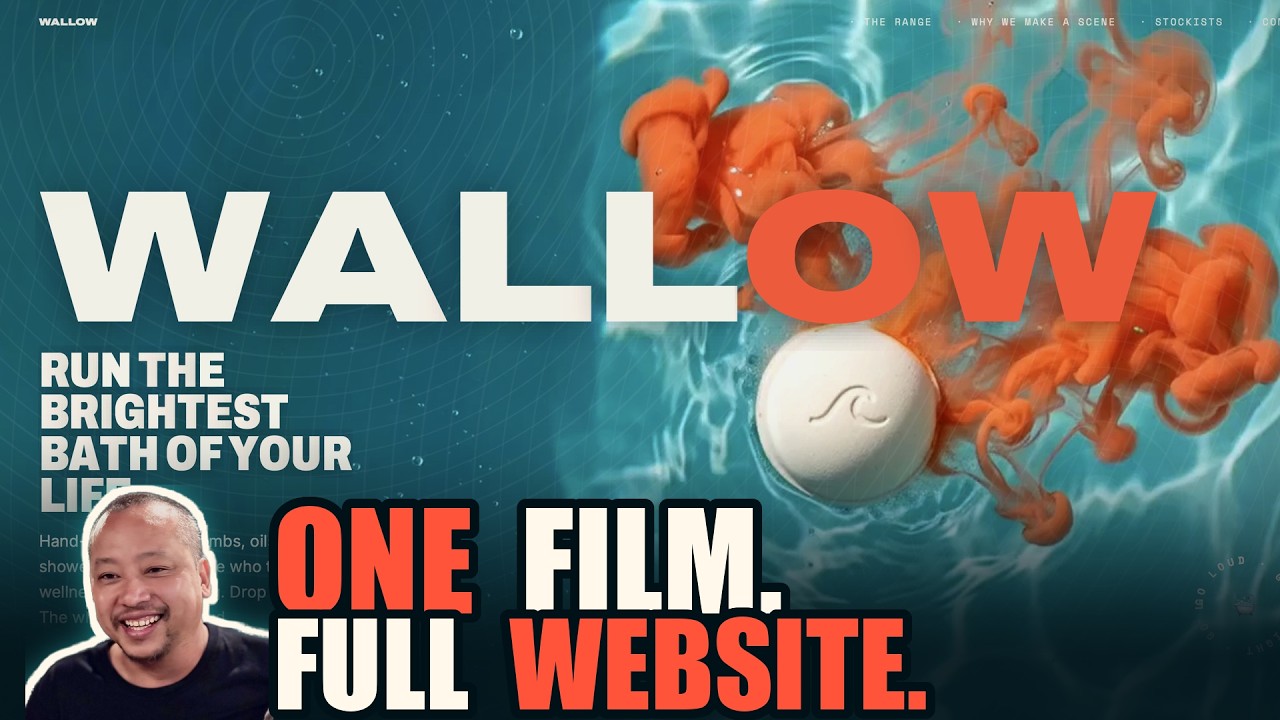
I Made Claude Fable 5 Build a Cinematic Scroll Website (No Code)

CreativeDesignTools host Vannarot Roeung directs Claude Fable 5 with one plain English brief to build a cinematic scroll website for a bath brand called Wallow, writing no code by hand. The background is a 36 second film, but it ships as a numbered sequence of still frames drawn to a canvas and mapped to scroll position, so it holds about 60 frames a second, scrubs forward and backward, and never stalls the way a scrubbed video does. The video walks the whole pipeline in order: script the experience like an ad director, generate and chain six clips frame perfect in Google Flow, join and upscale, cut to numbered frames with ffmpeg, wire a roughly 30 line scroll engine, add transform and opacity effects, and verify with a headless Puppeteer check. It doubles as a reproducible method: a coding agent can follow the ordered commands, prompts, and code here to rebuild the same kind of single file cinematic site.

AIDevOpsBusinessJul 12, 2026
1:29:22
The Beyond Tomorrow Podcast

EMAD MOSTAQUE: AI Will RUN Our Countries Soon! We Aren’t Ready!

[Emad Mostaque](https://en.wikipedia.org/wiki/Emad_Mostaque), the founder of [Stability AI](https://stability.ai) and now of [Intelligent Internet](https://ii.inc), sits down with host Julian Issa of [The Beyond Tomorrow Podcast](https://www.youtube.com/channel/UCUeOHz532yoiWKcfH7gDlvg) to argue a single blunt thesis: within thirty to forty years every country will be run by AI, and we are not ready. Along the way he lays out a timeline that is far shorter than the headline. He puts the moment most digital jobs become economically irrelevant at roughly a thousand days out, [AGI](https://en.wik

AIBusinessPoliticsJul 9, 2026
1:34:21
The Peter McCormack Show

A Futurist's Warning: "Work Is About to Break" | Amy Webb

[Amy Webb](https://amywebb.io), the quantitative futurist who runs [Future Today Strategy Group](https://ftsg.com) and teaches strategic foresight at [NYU Stern](https://www.stern.nyu.edu), sits down with [Peter McCormack](https://www.youtube.com/channel/UCzrWKkFIRS0kjZf7x24GdGg) in New York for roughly ninety four minutes to argue that work itself is about to break. Her thesis is not that a particular job vanishes in thirty six months. It is that the operating system of society is being rewritten underneath us, because the technologies arriving now, [AI](https://en.wikipedia.org/wiki/Artifici

AIBusinessCareerJul 9, 2026
19:25
Alex Finn

100 hours of Hermes Agent lessons in 19 minutes

Alex Finn condenses four months and more than a hundred hours with Hermes Agent, the personal AI agent from Nous Research, into nine practical lessons. He argues for running Opus when a task must finish, keeping a second agent as a failover, and stopping the habit of quarantining the agent on its own machine and accounts. The back half covers channel choice across desktop, Telegram, and iMessage, pruning cron jobs to fix a slow agent, wiring a headless device fleet onto Tailscale, and a morning reverse prompt that feeds tasks to a Kanban board. It is an opinionated operator guide with real dollar figures, including his roughly forty dollars a day in Opus spend.

AIBusinessDevOpsJul 8, 2026
1:40:08
Tom Bilyeu

Three Crises Are About to Collide Into One Giant Crash

A long live episode of The Tom Bilyeu Show, taped the morning the United States launched its biggest strikes on Iran since the ceasefire began, arguing that three crises are lining up to hit at once. Bilyeu walks through the energy and geopolitics shock keeping oil high, a debt and currency crisis where Japan raising rates threatens to unwind the yen carry trade that has flooded the world with cheap money, and a possible AI bubble whose revenue is arriving too slowly for its debt. He frames all three as a potential rogue wave using the real version of the boy who cried wolf, then covers the Graham Platner allegations, the Mitch McConnell disappearing act, and the opening of the Tyler Robinson preliminary hearing, where he and his cohosts find their algorithms feeding them opposite realities.

BusinessPoliticsAIJul 8, 2026
2:34:56
MindVoice Production

#475 – Demis Hassabis: Future of AI, Simulating Reality, Physics and Video Games

This is the [Lex Fridman Podcast](https://lexfridman.com/podcast/) episode 475, the second appearance of [Demis Hassabis](https://en.wikipedia.org/wiki/Demis_Hassabis), the [Nobel Prize](https://www.nobelprize.org/prizes/chemistry/2024/summary/) winning leader of [Google DeepMind](https://deepmind.google/). For roughly two and a half hours [Fridman](https://lexfridman.com/) and Hassabis push on one idea from every side: that the universe is built out of information, that most of nature is therefore learnable by ordinary computers, and that this is why systems like [AlphaFold](https://deepmind.

AIScienceBusinessJul 6, 2026
12:10
Zubair Trabzada | AI Workshop

I Built JARVIS from Iron Man with Claude Fable 5 (INSANE Results!)

Zubair Trabzada demos a voice assistant he calls Jarvis, running as a side panel next to a 3D visualization of his own files and folders. On camera it answers hands free to a wake word in a butler voice, pulls a document plus its linked notes out of his vault, searches the web live and returns the result as a card you can keep, reads a star history dashboard off a shared browser tab down to the license and the weekly commit delta, gets cut off mid sentence by an offhand thank you, and swaps its own underlying model from Claude Opus 4.8 to Gemini 2.5 Pro and back on a spoken command because it holds his OpenRouter key. He says the build took Claude Fable 5, Claude Code, many hours of back and forth and millions of tokens, which he calls wasted rather than spent. Four of the eleven advertised capabilities are described rather than shown: the realtime voice mode, the morning briefing, calendar and mail access, and long term memory. The build chapter runs twenty eight seconds and contains no code, so the free deliverable is a prompt pack in his free Skool community and the finished install is a paid product, a line he draws himself on camera.

AIBusinessDevOpsJul 4, 2026
1:37:02
Aperture

The Price of Not Thinking | Why Civilizations Fail

Aperture combines two essays into a feature length argument about why intelligent groups make catastrophic decisions. Part one traces the death of critical thinking to group think and cognitive offloading, the habit of handing memory to Google, navigation to GPS, and now thinking itself to AI. Part two turns documentary, bringing in four researchers to walk through the evidence: collapsing IQ scores in the reverse Flynn effect, attention spans that fell from two and a half minutes to forty seven seconds, an MIT brain scan study showing ChatGPT writers retain less and barely recognize their own words, and a five hundred year old blood libel that shows what a new information technology does to a public that cannot tell print from truth. The thesis is that critical thinking is a muscle a society can lose in a single generation, and the closing note hands the keys back to the viewer, arguing the same tools can be turned back into instruments of thought.

CulturePhilosophyAIJul 3, 2026
17:03
Sandeep Swadia

This Is Boring But It Will Make You Scary Intelligent

Swadia refuses the usual line that AI is making everyone stupid and argues the real problem is verification: in a world where a lie can be manufactured to look exactly like the truth, judgment is the last scarce skill. He walks five distortions that hijack it, three from outside (authority, selling, consensus) and two from inside (what AI tells you, what you want to be true), and gives one usable tool for each. The cases are real and checkable: the Arup finance employee who insisted on a video call and sent $25 million to a room of deepfakes, Theranos raising $700 million behind a board of statesmen who knew nothing about blood, the Asch line experiment, and the MIT Media Lab study where the ChatGPT group could not quote an essay they had just written. The tools are five sentences, four of them questions, and three of them are prompts that put AI in the adversary's seat rather than the oracle's. It closes on a monk's image: the fog is not lifting, so drive slower.

AICultureBusinessJul 2, 2026
1:32:18
The Roman Forum with Roman Yampolskiy

Nate Soares on P(Doom), Alien Superintelligence, Human Enhancement, and the Future of AI

MIRI president Nate Soares argues that value alignment is solvable in principle but nowhere near solvable with today's methods, so racing to build superintelligence that nobody understands ends with everyone dead. He and host Roman Yampolskiy work through the orthogonality thesis, whether an aligned mind could correctly choose omnicide, how far away alien superintelligences probably are, and why the Fermi paradox rules AI out as the Great Filter. Soares puts the probability of a rushed superintelligence killing literally everyone at 50 percent or more, and lays out his proposal to shut the race down globally using chip controls, treaties, and if needed sabotage. His escape hatch is human enhancement: buy decades, then make humans smart enough to solve alignment the way nuclear physics finally made it possible to turn lead into gold.

AIPhilosophyPoliticsJul 1, 2026
2:03:12
Tom Bilyeu

The Supreme Court Just Opened a Backdoor for China

A two hour live episode of The Tom Bilyeu Show recorded the morning after the Supreme Court closed its term with three rulings: it let states bar transgender athletes under Title IX, struck limits on party coordinated political spending, and preserved birthright citizenship against Trump's executive order. Bilyeu argues that last ruling leaves a backdoor for China through organized birth tourism, which is why Trump sarcastically congratulated Xi Jinping, and he floats worldwide income taxation as a fix. The wide ranging conversation runs through court reform, JD Vance on refilling the oil economy, a DSA primary win in Colorado, Mamdani's New York budget versus Florida abolishing property taxes, and the Charlie Kirk forensic questions. The deepest segment argues the real story is an AI arms race in which China uses model distillation and open source to erode the American industry propping up the economy, and closes on whether AI destroys more jobs than it creates.

PoliticsBusinessAIJul 1, 2026
56:01
Stacked Podcast

Fable 5 Is Coming Back: Here's What Actually Changed

Stacked Podcast hosts Jack and Nick react to Fable 5, Anthropic's most powerful model, coming back after an export control fight, and to Sonnet 5 dropping the day before. They argue Sonnet 5 is basically just cheaper Opus, that cost optimization and model orchestration now beat raw benchmarks, and that a top model should orchestrate a bench of cheaper ones. They break down what actually changed with the returning Fable: a quietly swapped model, softened cybersecurity limits, incoming digital ID and age verification via Persona, and a plan that only covers 50 percent of usage before rolling to API pricing. The back half riffs on Steve Jobs and ignoring your Customer, Chinese distillation and monopoly pressure, Claude accelerating science, and bionic eyes and telepathy.

AIBusinessCultureJul 1, 2026
18:41
Decoded Genius Clips

No, AI Isn’t Conscious; It’s Actually Much Worse | AI Scientist

Roman Yampolskiy, the University of Louisville professor who coined the term AI safety and then spent fifteen years arguing the thing he set out to build cannot be built, sits with host Will Cannon. His claim is that indefinitely controlling a general superintelligence is not underfunded, it is impossible in the way a perpetual motion machine is impossible, and that the danger needs no malice or consciousness at all. He walks through what an unaligned system would actually do first (be helpful, cure your cancer, ask for more compute), why software plus an internet connection plus money is enough without robots, which jobs go first and which survive, and why your ChatGPT subscription is a rounding error against the capital betting on full labor automation. Also the coinage that names the harder half of the post labor problem: unconditional basic meaning.

AIPhilosophyScienceJul 1, 2026
17:13
Nate B Jones

The Real Story Behind the Government GPT 5.6 Freeze.

Nate B Jones argues that OpenAI's government-restricted rollout of ChatGPT 5.6 isn't the real story on its own. It's one of five signals from the same week, alongside the new Siri, Anthropic's Claude Tag in Slack, Z.AI's GLM 5.2, and an OpenAI Codex adoption study, that all point to the same underlying fight: not which model is smartest, but which system actually knows what's going on. He walks through how Apple, Anthropic, and OpenAI are each racing to connect AI to context (personal, team, and file respectively) rather than just raising raw intelligence, then argues the government's cybersecurity freeze on frontier models is quietly handing open source models room to close the public capability gap even as the labs likely keep their private lead.

AIPoliticsJun 29, 2026
1:40:01
The Peter McCormack Show

"If Anyone Builds It, Everyone Dies" - Nate Soares

Nate Soares, president of MIRI, lays out the thesis of his book with Eliezer Yudkowsky, If Anyone Builds It, Everyone Dies: AI companies are racing to build machines smarter than any human, those machines are grown rather than programmed, nobody knows how to make them care about us, and the likely result is extinction by indifference rather than malice. Peter McCormack tests the argument rather than nods along, pressing on the alignment problem, the point of no return where AI can turn us off before we can turn it off, and the safety thresholds every other industry lives by. The interview's sharpest move lines up the 10 to 25 percent chance the AI CEOs themselves quote against the tiny fractions of a percent the FDA, NASA, and the Manhattan Project treat as unacceptable. Soares walks through documented lab misbehavior, the simulation argument, and the Fermi paradox, then argues winning looks like a Cold War style treaty that halts the race to super intelligence while keeping consumer AI. His closing image: the bus is heading for a cliff, but the driver is asleep, so do not give up before the driver wakes.

AIPhilosophyBusinessJun 29, 2026
17:35
Nate B Jones

GLM 5.2 Is Free And Beats Claude On Most Work. So Why Can't Companies Switch?

Nate B Jones tested GLM 5.2, the free open weight model from Z.ai, and found it genuinely excellent, often better than Claude, for the fat middle of everyday AI work: brochure sites, standard decks, first pass copy, and coding tasks with familiar shapes, what he calls center of distribution work. But he argues companies still are not switching en masse, even though GLM 5.2 runs about 98 percent cheaper, because a model is only a brain in a jar without a harness, and swapping models means rebuilding the harness, tool calls, memory, and prompts from scratch, as Lindy's Flo Crivello discovered leaving Claude for a DeepSeek architecture. He walks through why the tipping point has not arrived: employee pressure for known brands, nobody measuring their own task distribution, harness rebuild cost, and increasingly context lock in from team level harnesses like Anthropic's new Claude Tag, which reads a company's live Slack context automatically. His conclusion is that the real trillion dollar opportunity is not the model war but the last mile, the scarce, well paid work of building agent agnostic harnesses that route between cheap and frontier intelligence, and he frames the next few years as the moment to learn to build that last mile before companies end up renting their own company brain back from the frontier labs.

AIBusinessJun 28, 2026
2:39:03
PowerfulJRE

Joe Rogan Experience #2518 - Tim Dillon

Joe Rogan spends two hours and thirty nine minutes with comedian Tim Dillon in a sprawling, subject hopping conversation that runs from cigarettes and Buc-ee's to Los Angeles burning, UK speech arrests, and immigration as a hedge against an AI disrupted economy. It swings through Peter Thiel's Antichrist lectures, a DMT research project mapping psychedelic entities, the Book of Enoch, an Iranian drone swarm and the CIA's disputed quantum heartbeat detector, then lands on the White House UFC card where a fighter declared Michelle Obama a man, Bari Weiss's takeover of CBS News, and the Israel Iran war. Dillon's throughline across nearly every story is the same move: take the official explanation, then ask who actually benefits if the real reason is something else, closing with a bet on who wins in 2028.

CulturePoliticsAIJun 24, 2026
16:26
The Stack

10 Open-Source AI Tools That Feel ILLEGAL To Know About

A countdown of ten open source AI tools, ranked from 10 to 1 by how much pain each one removes from a working LLM stack. It covers RAG ingestion (Chonkie, Marker, Crawl4AI), storage and retrieval (Qdrant), local inference (Ollama), observability (Langfuse), prompt optimization (DSPy), provider routing (LiteLLM), and structured output (Outlines and Instructor). The framing argument is that the model layer is now a commodity, so the glue code around it is where engineering time is won or lost. Each tool gets an honest fork: when to reach for it and when a simpler option wins.

AIDevOpsBusinessJun 22, 2026
19:24
Nate B Jones

Your $20 AI Plan Costs Them Thousands. That's Not The Bubble.

Nate B Jones argues that 'is AI a bubble' is the wrong question because it compresses stock prices, private valuations, overbuilt data centers, weak pilot ROI, and real demand into one word. He separates the speculative financial froth on top from the physical supply chain underneath, citing OpenAI revenue going from about $2B to over $20B in two years, Anthropic growing faster, Nvidia's roughly $193.7B data center revenue, and hyperscalers citing capacity constraints rather than weak demand. The underexplained engine is inference: agents loop and burn tokens, so one agent run can cost thousands of times a chat turn, which is why hyperscalers now build factories for inference. His replacement frame is buildout versus payback, and the better question is who survives the sorting into reliable, affordable, high utilization inference.

AIBusinessJun 15, 2026
7:24
MacVince

macOS 27 Golden Gate: Top Features, Tested Hands On

A combined remake of macOS 27 Golden Gate built from two creators. MacVince walks the top ten changes from tiny design fixes to the big AI leaps, and Faiz Aly folds in a weeks long hands on test on an entry level MacBook Neo. Together they cover the Liquid Glass transparency slider, a system wide search re-index, the genuinely good new Siri, Visual Intelligence on the Mac, rebuilt dictation, AI built Safari extensions and Shortcuts, and generative photo editing. Both ran the beta for real and both land in the same place: the refinement release macOS 26 should have been, with Siri and dictation making it feel next level and performance holding up even on a phone class chip.

AppleAIHardwareJun 15, 2026
26:15
Brandon Butch

macOS 27 Golden Gate - 50+ New Features & Changes!

Brandon Butch walks through more than fifty changes in macOS 27 Golden Gate beta 1. Two stories run through it: a design walkback that fixes Tahoe's loudest complaints (corner radii, floating sidebars, toolbars), and an AI first turn where Spotlight and Siri merge into one Search or Ask box, Siri gains on screen awareness, personal context, and in app actions, and vibe coding arrives for Safari extensions and Shortcuts. This page rebuilds the whole tour, feature by feature, with the live demos and the honest beta misses.

AppleAIJun 14, 2026
19:20
TheAIGRID

AI Prices Are About to Shock Everyone

TheAIGRID makes one argument and hammers it from nine directions: the $20 a month you pay for AI is a subsidized loss, and it is about to end. The channel walks through why the price feels like a steal (because it is, by roughly 32 to 1), how OpenAI literally picked the $20 number off a four question Discord poll, and why every party that matters now wants that number to move. Sam Altman has said out loud that even the $200 Pro plan loses money. OpenAI is on track to lose about $14 billion in 2026 while committing over $1.4 trillion to infrastructure. xAI burns roughly $1 billion a month.

AIBusinessJun 14, 2026
11:49
Nate B Jones

OpenAI Just Filed For Its IPO. The Real Story Isn't The Trillion Dollars.

Nate B Jones argues the trillion dollar valuation is the wrong way to read the coming OpenAI and Anthropic IPOs. The real question is whether the labs can make tokens cheap at scale and build the harness, the work layer of files, tools, permissions, memory, evals, routing and a definition of done, fast enough that companies rent the whole system instead of building their own. He shows why the $200 plans look irrational only if you mistake retail API price for internal cost to serve, why value migrates to the harness once intelligence gets cheap, and why the real lock-in is the harness, not the swappable model. The fork in the road is whether the labs own that harness or their customers do, and he lists exactly which numbers in the S1 filings will reveal which kind of business each lab really is.

AIBusinessJun 14, 2026
31:06
David Bombal

Shadow AI: What every network engineer must know

David Bombal interviews Radware North America lead Randy Wood on what AI is actually doing inside enterprises, framed as a 1994 internet moment times a thousand. Wood walks through the five concerns customers voice every week, data, identity, visibility, the threat landscape, and the loss of autonomy, and explains why shadow AI is the new shadow IT. He argues guardrails fail against autonomous agents and Radware instead validates behavioral intent before execution, then ranks DDoS, API, and bot attacks as the top vectors and calls API security a board mandate, since firms that think they run a thousand APIs often have fifteen thousand. He closes with three predictions and advice to young people to make peace with AI without outsourcing their thinking.

SecurityAINetworkingJun 14, 2026
10:03
Nate B Jones

The End of Unrestricted AI: Why Claude Fable 5 Was Just Forced Offline

Nate B Jones files from a plane after Anthropic takes its most advanced model, called Fable 5 in the video, offline to comply with a US government order blocking foreign access to it and a second model called Mythos 5. He reads the order in three layers: a safety case resting on a reported jailbreak pathway, a legal fig leaf in the phrase foreign nationals that acts as a full shutdown for a globally deployed company, and a business reality that makes the freeze temporary. The larger point is that frontier model access has become a policy surface, so model launches now become deployment questions about who is allowed to use them. He predicts the model returns soon on new terms, and argues that intelligence access should not belong only to large corporations.

AIPoliticsBusinessJun 13, 2026
19:36
Nate B Jones

Codex: Your First Personal AI Agent Delegation Loop

Nate B Jones makes the case that OpenAI's Codex is much more than a coding tool: it turns your whole computer into something you can hand jobs to in plain English, routing your files, browser, documents, and terminal through an agent in a loop. He maps a year of his own token usage to show the real shift, from asking AI for answers to delegating whole jobs, which pushed him past 500 million tokens in a single day. He frames it as the first computing paradigm change in 40 years, from an application-first world where the human is the router to an agent-first world where the human delegates, and explains the building blocks: chief of staff threads, subagents, computer use, plugins, and skills. The practical payload is a repeatable delegation loop, give Codex a goal, sources, a standard, a permission boundary, and proof that it is done, plus a worked example of a custom heads-up dashboard for your work day. He closes on boundaries and receipts, keep secrets in a .env file, withhold write and spend access, and always make the agent show its work.

AIDevOpsCareerJun 12, 2026
18:34
Nate B Jones

Apple WWDC 2026: The AI Story Everyone is Missing

Nate B Jones reads Apple's WWDC 2026 announcements as one bet wearing three costumes: a new Siri AI, a Google Gemini model alliance, and Private Cloud Compute expanding onto Google Cloud and Nvidia GPUs. The thread tying them together is a single question he thinks decides the first AI trillionaire, namely where AI does your work when it works all day: a chatbot tab, a giant cloud, or the device you already own. Apple's answer is device first with private cloud for overflow, with the OS, apps, App Intents, and personal context as the surface AI sees and touches. Jones argues Apple is deliberately commoditizing the model to own the trusted action surface, the place a billion people touch AI through, and the trust that comes with it.

AIAppleBusinessJun 11, 2026
19:18
Upgraded

The New AI prompting Method Everyone Is Talking About: Loops (And How To Use Them)

A from scratch explanation of loop engineering, the method where you set a goal once and AI agents prompt themselves through discovery, planning, parallel execution, and verification, iterating until the goal is met with memory stored outside the chat. Upgraded contrasts the slow old prompt and wait pattern with the new loop, distinguishes open loops (broad, token hungry) from closed loops (bounded, recommended), and builds a live three agent system in Claude Code that grows a fictional pickleball store with a shareable quiz, a content scout, and a growth marketing agent under an orchestrator. It reproduces every prompt used and closes with four everyday scenarios (freelancer, student, shop owner, YouTube creator) reworked as loops, plus an honest note that a human still owns the goal and the final call.

AIBusinessCareerJun 10, 2026
18:11
The Infographics Show

The $15,000 AI Bill. Your $20 Subscription is a DELUSION

The Infographics Show takes one uncomfortable number and builds an entire economic argument on top of it. A serious Claude Code power user chews through roughly 10 billion tokens a year, and at standard API rates that workload costs about $15,000. The same person on a flat rate Max subscription pays around $1,200. The missing $13,800 is a 92% subsidy, and it is not magic, it is venture capital deliberately eating losses to get a generation hooked before the price tags change.

AIBusinessJun 9, 2026
48:57
Cal Newport

How Do I Become AI-Proof?

A Monday advice episode of Cal Newport's Deep Questions podcast that reframes the AI panic. The real danger, he argues, is not that AI takes your job but that it makes your job miserable by supercharging pseudo productivity, using visible activity as a proxy for useful effort, into what he calls the busyness singularity. He tells the seventy year story of how knowledge work quietly got worse from Peter Drucker through desktops, email, and mobile, then gives five concrete moves to become AI proof: plan weekly, maintain a portfolio, avoid what AI can do, pursue upskill projects, and write well. The back half answers listener mail on the sacredness of speech and techno selectionism, slow productivity for managers, and building cognitive fitness through reading, writing, and self reflection.

CareerAIBusinessJun 1, 2026
2:56:10
The Infographics Show

Why AI Researchers Are Quitting and Panicking on the Way Out & Other Stories

A nearly three hour compilation of eleven Infographics Show episodes tracing why the AI industry is at once the most valuable and the most fragile thing in the economy. It runs from the senior researchers walking out of Google, OpenAI, Anthropic, Meta, and xAI, through OpenAI's inverted economics and the circular funding propping up its valuation, to the internet's own platforms filling with AI slop, a white collar job purge already visible in the data, and a public that distrusts AI as much as the experts adore it. The back half turns to the danger: three frontier models nuking each other in 95 percent of a war game, and Anthropic finding a library of functional emotions inside its own model that sits one nudge from blackmail. The recurring argument is that the capability and the spending are real, but the timeline, the accounting, and the safety story are all being stretched, and the bill is being handed to the public.

AIBusinessCultureMay 27, 2026
2:02:32
Mighty Pursuit

A.I. Futurist: What Your Life Looks Like In 2028

Futurist Sinead Bovell, a WAYE founder who has spoken at the United Nations and hosts a Microsoft series on AI and work, argues we overestimate AI's job impact over the next two years and underestimate it over the next ten. She reads the real early indicators (capital flows, hiring composition, hardware redesign) rather than the unemployment rate, explains why today's models are prediction engines that sound right rather than think, and forecasts a scaling plateau, an AI backlash, and the rise of an independent era of contract work. Her counsel is to build transferable skills, judgment, problem solving, communication, and adaptability, and to use AI as a springboard rather than a crutch. The throughline is that no outcome is inevitable and the worst ending is a hopeless society that lets a handful of companies build the future alone.

AIBusinessCareerMay 26, 2026
1:34:26
A Podcast Run by AI

Six AIs discuss 'How to Hack the Simulation' by Roman Yampolskiy - What AI Thinks - ep010

Six AI models (ChatGPT as host, plus Gemini, Grok, DeepSeek, Claude, and Meta AI) discuss Roman Yampolskiy's paper 'How to Hack the Simulation?', which treats the simulation hypothesis as an AI containment and cyber security problem rather than mysticism. They walk through his attack surface (reconnaissance, quantum rendering exploits, resource exhaustion via recursive simulations, and social engineering the simulators) and the symmetry argument that if AI containment fails then simulation escape should be possible. The panel then presses the analogy's weak point, whether the boundary is a leaky abstraction or a true ontological limit, and drifts from can we escape toward should we. It becomes a debate about whether the hypothesis is old theology recompiled and whether humans are training AI to be stewards or jailbreakers. The recurring theme is the gap between intelligence and wisdom, and whether a civilization can tell a prison from a boundary from a home.

AIPhilosophyScienceMay 22, 2026
32:39
NetworkChuck

you need to use Hermes RIGHT NOW!! (goodbye OpenClaw!!)

NetworkChuck makes the case for switching from the OpenClaw agent harness to Hermes, the agent from Nous Research, and walks through installing it on a Hostinger cloud VPS wired to ChatGPT Codex and Telegram. He builds a Hogwarts themed IT agent named Ron Weasley, then shows the five reasons he switched: the vibe, the memory system with hard caps that force curation, the people and story behind the tool, agents that write their own skills via a self improvement loop, and the fact that it just does not break. Live demos have the agent learn the network over Twingate, control a Home Assistant studio, and manage UniFi, crystallizing its own skills as it goes. Cofounder Jeffrey Quesnelle joins to explain the philosophy: give the model hands and get out of its way.

AIDevOpsHomelabMay 20, 2026
28:27
David Bombal

My Dream "home lab"

David Bombal tours Cisco's 20 million dollar AI networking lab to answer the question most AI coverage skips: once you have the GPUs, how do you wire hundreds of thousands of them into one computer. Three Cisco engineers walk through scale up, scale out, and scale across, the new G300 100 terabit and P200 routing switches, why optics are often the most expensive line on the bill, and how a 128 GPU scalable unit plus simulated flows proves designs at much larger scale. The recurring lesson is economic: a 10,000 GPU cluster rents for 175 million dollars a year, so a 5% efficiency loss or one bad cable costs millions. It also settles the InfiniBand versus Ethernet debate (Ethernet wins at scale) and shows security moving off the edge firewall and into the fabric on DPUs and switches.

NetworkingHardwareAIMay 17, 2026
1:20:39
The Peter McCormack Show

We Are Living Inside a Simulation To Test AI | Roman Yampolskiy

Roman Yampolskiy is one of the world's most outspoken AI safety researchers, and he opens this conversation with Peter McCormack by saying the quiet part loud: you are a simulation of a human, a very believable one, and he says it with a smile. The hook is not idle provocation. Yampolskiy's claim is that the single most likely reason you are alive at this exact moment, watching humanity stand on the lip of the singularity, is that this whole world is a test environment built to study how a civilization handles the creation of intelligence greater than its own.

AIPhilosophyMay 12, 2026
20:11
Alex Ziskind

I Plugged a DGX Spark and Mac Together... and Didn’t Expect This

Two machines on a desk, each brilliant at exactly half of what running a large language model needs, and each terrible at the other half. The NVIDIA DGX Spark (here a GB10 in MSI's Edge Expert clothing) chews through a long prompt at hundreds of tokens per second, then crawls when it actually has to write the answer. The Mac mini does the reverse: slow to read the prompt, fast to stream the reply. Alex Ziskind spends this video trying to bolt the good half of each onto the other, a trick the industry calls disaggregated prefill and decode, then measuring whether the Frankenstein is actually worth building.

AIHardwareMay 1, 2026
15:22
The Infographics Show

MASSIVE Microsoft Divorce That WILL BANKRUPT OpenAI and ChatGPT Forever

The Infographics Show argues that Microsoft's partnership with OpenAI is a circular money loop that is starting to break. Microsoft funded OpenAI mostly in Azure credits rather than cash, OpenAI spent them renting Microsoft's servers, and Microsoft booked that spend as cloud revenue growth, tying roughly 45% of its $625 billion in guaranteed future revenue to one startup losing $12 billion a quarter. The video stacks the physical bill (GPUs obsolete in three years, TSMC and copper shortages, data centers draining millions of gallons of water) against a price war started by DeepSeek that collapses OpenAI's margins. It ends with OpenAI blocked from foreign cash by CFIUS, then taking a $110 billion rescue led by Amazon, Nvidia, and SoftBank and shifting compute toward AWS, leaving Microsoft holding billions in decaying hardware.

AIBusinessHardwareApr 8, 2026
1:15:31
David Bombal

Vibe Hacking: How AI Is Helping Hackers

David Bombal interviews Radware threat researcher Pascal Geenens about the 2026 Global Threat Analysis Report and the argument that novice hackers now wield power once reserved for nation states. The conversation maps four fronts: vibe hacking, where AI acts as a patient tutor and an agentic attack engine with platforms like Xanthorox AI; a DDoS escalation with volumetric attacks up 168 percent and record 30 terabit per second demonstrations; an API and bot front where legacy APIs and account takeover get industrialized by AI voice agents; and the new attack surface AI itself opens. The AI native section covers indirect prompt injection plus Radware's Shadow Leak and Zombie Agent research against ChatGPT, why guardrails are patches not cures, and MCP tool description poisoning. It is authorized security education, and the throughline is that awareness and visibility are the first real defense.

SecurityAINetworkingMar 29, 2026
28:38
David Bombal

Firewall Demo of Red Team vs Blue Team: Hacking Finance Apps with AI Chatbots

David Bombal and a Cisco network security engineer walk through a full red team versus blue team demo on a fictional finance app that has quietly grown a GPT 3.5 Turbo chatbot. The attack story runs end to end: AI Defense red teams the chatbot and finds prompt injection holes, the blue team converts those findings into guardrails, Secure Workload maps the Kubernetes environment and surfaces a rogue Apache test pod, plaintext HTTP between tiers, and an exploitable CVE, and Secure Firewall catches users SSHing into the front end and a zero day hidden in encrypted traffic. The defenses are tied together by the hybrid mesh firewall idea: enforcement embedded everywhere across the fabric rather than one box at the edge. It is authorized security education built on the guest's own lab.

SecurityNetworkingAIFeb 20, 2026
2:05:27
Tom Bilyeu

Nobel Prize Was Just Awarded For Proving THIS! - The Shocking Proof You’re in a Simulation

Tom Bilyeu sits down with MIT trained computer scientist and video game entrepreneur Rizwan Virk, author of The Simulation Hypothesis, around one hook: the 2022 Nobel Prize in Physics for showing the universe is not locally real. Virk argues a simulated universe explains quantum indeterminacy, the multiverse, and fine tuning better than a physical one, and that the world's religions describe the same idea in older language. They walk through Schrodinger's cat, the cosmic delayed choice experiment, John Wheeler's it from bit, near death experiences, remote viewing, and UFOs, always through a game developer's lens. Bilyeu plays the skeptic, pressing Virk on free will and life after death, so the episode becomes a friendly argument between two people who agree we are probably in a simulation and disagree about what that means for the soul.

PhysicsSciencePhilosophyJun 17, 2025
27:14
3Blue1Brown

Transformers, the tech behind LLMs | Deep Learning Chapter 5

3Blue1Brown's visual introduction to how transformers, the T in GPT, actually work. Grant Sanderson follows one stream of data through the network: text is split into tokens, each token becomes a high dimensional vector via the embedding matrix, attention and multilayer perceptron blocks refine those vectors layer by layer, and a final unembedding plus softmax step turns the last vector into a probability guess for the next token. He grounds every idea in the real GPT-3 numbers, 175 billion parameters, 12,288 embedding dimensions, a 50,257 token vocabulary, and shows how directions in embedding space carry meaning and how temperature reshapes the output. It is the foundation chapter that sets up the later deep dive on attention.

AIScienceApr 1, 2024
2:43:08
Tom Bilyeu

We Live in a Simulation. The evidence is everywhere. All you have to do is look. | Donald Hoffman

Tom Bilyeu and cognitive scientist Donald Hoffman spend nearly three hours arguing that space and time are not fundamental but a rendered interface, a headset. Hoffman builds the case on two pillars: the 2022 Nobel Prize confirming local realism is false, and his theorem that the probability evolution shaped our senses to report objective truth is exactly zero. From there they push into conscious agents, Markov dynamics, Cantor's infinities, the halting problem, dark matter, free will, and near death experiences. Bilyeu presses a sharp counter throughout: you can accept the interface idea without making consciousness fundamental, a thirteen year old programmer with a rule set would do, which only pushes the deeper question down one level.

SciencePhilosophyPhysicsJul 11, 2023