At a glance
The Infographics Show, hosted by Josh, argues that the most valuable partnership in technology is quietly coming apart, and that the way it was financed could take both companies down with it. The claim in one line: Microsoft never really paid OpenAI in cash. It paid in Azure credits, which OpenAI spent renting Microsoft's own servers, which Microsoft then booked as cloud revenue growth. The video calls it a flawless infinite money loop, and then spends fifteen minutes explaining why the loop is breaking.
The engine of the story is a single dependency: the video says roughly 45% of Microsoft's $625 billion in guaranteed future revenue is tied to one startup that loses $12 billion a quarter. Around that number it stacks the physical bill nobody wants to book, GPUs that go obsolete in three years, data centers that drink millions of gallons of water a day, and copper and chips the world cannot make fast enough. Then it adds the market shock, a price war started by Chinese labs using model distillation that collapses OpenAI's margins. The payoff is a reported "divorce": OpenAI takes a rescue led by Amazon, Nvidia, and SoftBank, agrees to pour money into Amazon Web Services instead of Azure, and leaves Microsoft holding billions in decaying hardware.
This is a fast, dramatized explainer built to alarm, and it moves quickly between hard reported figures and forward looking narrative. The reconstruction below keeps every number and beat in the order Josh delivers them. A plain accounting of what is grounded fact versus staged storytelling waits in "Where it stands" at the end.
The $3 trillion company that leans on one startup
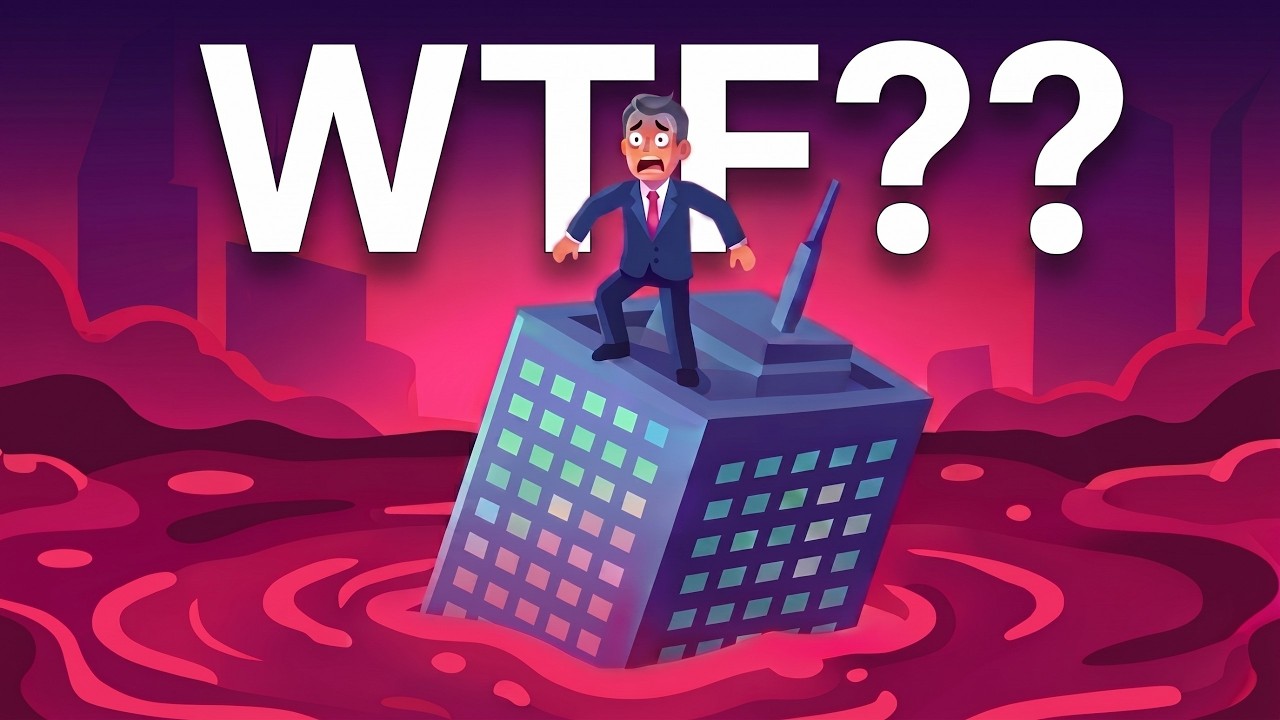
Josh opens with Microsoft's scale so the fragility lands harder: a $3 trillion market cap and $32.9 billion in cloud revenue. Then the hook. Could an empire that size collapse because of one startup? Because, he says, nearly half of Microsoft's future cloud empire depends on a single company, and that company is burning $12 billion every quarter.
The rest of the video is the mechanism behind that sentence.
The Azure trap: how Microsoft captures, not just invests
Microsoft, the narration argues, does not merely fund young companies. It captures them. The tool is generosity that turns into a cage. A founder is handed up to $150,000 in free Azure cloud credits. Not cash, digital vouchers. The startup spends months building on Azure, mapping every database and workflow to Microsoft's proprietary formats. By the time the free credits run out, ripping the backend out would crash the product, so they start paying real money. Corporate credit cards come out. Pay as you go tiers kick in. The free credits have quietly converted into real cash flowing straight onto Microsoft's books, and the company is locked into the architecture.
That, the video says, is the template. OpenAI is the same trick at a scale that can move a $3 trillion balance sheet.
OpenAI's $625 billion dependency
Here is the move that makes the whole story work. Microsoft plowed $13.8 billion in direct funding into OpenAI, but, Josh stresses, almost none of that money actually left Microsoft's coffers. Instead Microsoft handed Sam Altman customized digital vouchers. OpenAI spent those vouchers renting Microsoft's servers. And every one of those dollars was legally counted as Azure revenue growth on Microsoft's own books. The investment and the revenue are the same money going in a circle.
To show why Wall Street rewards this, the video reaches for an accounting term: the remaining performance obligation, a metric that tracks guaranteed future revenue. Microsoft's currently sits at a staggering $625 billion. Wall Street treats that figure as cash in the bank, feeding it into discounted cash flow models that justify Microsoft's share price all the way to the end of the 2020s. The problem is the concentration. The video puts 45% of that guaranteed $625 billion as locked into fueling OpenAI's machines. The future of the cloud empire hinges on one startup, and the market is already pricing in that it pays.
The hidden debt: a $662 billion trap off the books
On paper Microsoft's balance sheet shows $40.3 billion in debt, a number Wall Street shrugs at. Off the books, Josh says, is something else: a $662 billion trap. Shadow leases and custom deals keep OpenAI's servers running, and Microsoft is not alone, because in the cloud world the physical hardware routinely hides behind complex lease structures. The trap is that OpenAI does not have the cash to cover this hidden debt.
To size the hole, the video cites Deutsche Bank: its analysts projected OpenAI will burn through $143 billion before it ever turns a real profit. A company setting billions on fire every twelve months, Josh notes with a straight face, just handed its largest investor the biggest profit spike in recent corporate history.
Then the metaphor that anchors the rest of the show. OpenAI is an unemployed tenant facing eviction. Microsoft is the landlord holding the keys. Microsoft prints fake IOUs and hands them to OpenAI, the IOUs pay for renting the servers, and Microsoft legally reports that rent to Wall Street as cloud revenue growth. A flawless infinite money loop, he says, until the servers actually turn on.
OpenAI's failed escape plan: Project Stargate
If the loop is a trap, why not walk out of it and build your own data centers? Because, Josh says, the math does not add up, and Sam Altman knew it. Azure's credits could never fuel the endless compute OpenAI needed, so Altman engineered an escape route called Project Stargate.
The plan was enormous: a $500 billion master plan for independent data centers with 10 gigawatts of dedicated power, designed to bypass the Azure ecosystem entirely and sever the partnership. Altman flirted with sovereign wealth funds and foreign telecom giants. SoftBank and Oracle entered negotiations to provide alternative capital and infrastructure. Construction crews mobilized in Abilene, Texas, where OpenAI prepared to build a 1.2 gigawatt facility, one site meant to be the beachhead for a sprawling $665 billion infrastructure rollout stretching through 2030.
All they needed was the financing, and the financing is where it died. The banks opened the disclosures, ran the numbers on the deficit, logged the delays on permits, and tallied the shortage of engineers needed just to cool the massive racks. Wall Street refused the $500 billion gamble. Private investors would not touch it. So OpenAI quietly scrapped the master plan, slashed its projected independent compute spend, and retreated to the existing infrastructure. The verdict Josh delivers: OpenAI lacks the capital to build its own fortresses and the margins to keep renting Microsoft's servers. Azure's credit cannot sustain the burn, and Microsoft is left fueling a captive entity that cannot repay the principal.
The physical bill nobody wants to book
This is the section where the video stops talking about accounting and starts talking about steel, silicon, water, and copper. The argument: the real crisis is not the spreadsheet, it is the physics the spreadsheet is hiding.
Start with depreciation. Microsoft spreads its massive server costs over a six year accounting window, which keeps quarterly spending low on paper. But AI does not wait. Frontier training models make top tier GPUs obsolete in just 36 months, so every chip bought today is tomorrow's legacy hardware. Josh's analogy: a delivery company buying a brand new fleet of trucks that has to be replaced every 18 months, because the old trucks simply cannot deliver fast enough. Financial models expose $176 billion in hidden GPU depreciation quietly decaying across the tech sector. Microsoft is booking record profits today by ignoring the physical decay of its own hardware, and when the real replacement cycle hits the balance sheet, the capital expenditure bill will explode.
The burn rate makes it worse. OpenAI generates $12 billion in quarterly losses, and Forbes estimates that the Sora video model alone eats $15 million in hard cash every single day. Video generation, Josh explains, is not text on steroids, every single pixel must be calculated and rendered in sequence, which demands an exponential jump in raw computational power. To feed it, Microsoft's capital expenditures surged 66% to $37.5 billion in a single quarter, buying land and pouring concrete for a theoretical demand OpenAI literally cannot afford to use.
The supply chain says no
Even with unlimited money, Josh argues, the physical world caps how fast this can grow. Taiwan Semiconductor Manufacturing Company (TSMC) is the physical brake on global AI, producing 90% of the advanced silicon on earth, while corporate demand outpaces its factory capacity by a factor of three. You cannot speed up the Extreme Ultraviolet lithography process or skip the chemical etching. Each chip is born inside a hyper specialized clean room with perfect vacuums and extreme atmospheric control. Tech giants are sitting on billions in cash they cannot spend while their current servers lose value every day. TSMC is racing to expand with a $52 billion to $56 billion buildout in 2026, and even that cannot catch up.
Then copper. A single gigawatt data center needs thousands of miles of thick copper wiring, and copper is running out, with mines in South America struggling to meet demand. The cables, the power, the cooling all have to be perfect, and one missing component stalls the whole operation. Josh calls it a billion dollar waiting game.
The water problem
The constraint that turns local is water. Across the industry, data centers swallow 449 million gallons (1.7 billion liters) of water daily. A single hyperscale facility can drain up to 5 million gallons (18.9 million liters) of potable water every 24 hours just to stop the racks from literally melting, because standard air cooling maxes out entirely at modern rack densities and the facilities must pipe cold water directly onto the silicon.
Local governments are starting to panic as municipal supplies drop while server farms expand. In Florida, regulators wrote strict new rules to stop residents' utility bills from spiking, targeting the energy and water demands of new data center construction. The Midwest faces water stress, and city councils are passing emergency moratoriums on new permits, choosing drinking water for their citizens over AI infrastructure. Hyperscalers are being locked out of prime real estate because the local aquifer cannot support the thermal load.
The response is expensive plumbing. Hyperscalers are abandoning air cooling for direct to chip liquid systems, ripping out air conditioning units and bolting metal cold plates onto the hottest chips, then threading miles of pressurized coolant pipes over racks holding billions of dollars in active hardware. The material cost destroys the baseline construction budget, and a single leak dripping onto a motherboard destroys millions in silicon instantly. The upshot: the capital required effectively doubles the initial build cost, and Microsoft is footing this bill entirely upfront.
The price war that broke the margins
Generative AI, Josh says, only works as a business if the margins are massive, because those fat profits are what pay for the mountains of steel, silicon, water, and electricity behind the curtain. For a while OpenAI had those margins, charging premium prices for API access and using a near monopoly position to drain enterprise budgets. Then the API market turned into a commodity battlefield.
OpenAI launched its GPT-5.2 frontier model and priced it at $1.75 per million input tokens, assuming Fortune 500 companies would simply absorb the cost to keep access and that its dominance would hold. What came next was the thing it did not expect. Chinese competitors arrived, and they did not try to outspend OpenAI or build trillion dollar server empires from scratch. They used model distillation: instead of training from scratch, they bought API access to OpenAI's best model, asked it millions of advanced math and coding questions, captured the answers, and trained smaller, leaner architectures on those outputs, all without paying the training costs.
Then the number that, in the video's telling, breaks the spell. DeepSeek released its V3.2 architecture, matched the performance of the American frontier models, and dropped the exact same token package to 28 cents. Overnight the premium collapsed, a global price war erupted, and gross margins evaporated. Developers began routing daily tasks to cheaper alternatives, reserving OpenAI strictly for the hardest reasoning while funneling 90% of standard workloads to foreign or localized open source models. That strips away exactly the high margin volume OpenAI needs to survive.
Microsoft's counter: extract the value through Copilot
If OpenAI cannot generate enough revenue to pay off the hidden debt, Microsoft's answer is to stop waiting on OpenAI and extract the value itself. It integrated OpenAI's tech directly into its own products, making Copilot a core part of Word, Excel, and Teams, and charging a flat $30 a month per enterprise user. Fifteen million people already subscribe, and Wall Street assumes every $30 is pure profit.
The trap in that assumption is the same physics from before. Standard software is a printing press: build it once, distribute it forever, watch margins soar toward 90%. Generative AI obliterates that model, because every time someone clicks the Copilot button a supercomputer fires up and devours energy, and that $30 flat fee does not even cover the basic electrical cost. Microsoft eats the difference to keep the Customer locked into the ecosystem, actively subsidizing the enterprise workflows of the largest corporations on earth.
The pressure shows in the growth rate. Year over year cloud growth slowed to 39% in the second quarter of 2025, below the 40% Wall Street demands to justify a $3 trillion valuation, and profit margins slid from a strong 46.7% toward unsustainable levels. Josh sharpens the absurdity: Microsoft is using the most expensive computational infrastructure in human history to draft basic corporate emails. And it is boxed in. Raise the price of Copilot and clients defect to cheaper tools. Keep it at $30 and power users devour server capacity. Restrict Azure capacity for Copilot and the experience degrades instantly.
| Leverage | Microsoft (the landlord) | OpenAI (the tenant) |
|---|---|---|
| The asset | Owns the data centers, the chips, the power contracts, the distribution into Word, Excel, and Teams. | Owns the frontier model and the users, but rents every server it runs on. |
| The money | Paid its stake in Azure vouchers, not cash. Books the spend back as revenue. circular but self serving | Burns $12B a quarter, $143B before any profit. no cash to cover the debt |
| On the books | $625B RPO priced as guaranteed, with 45% tied to one tenant. concentration risk | No revenue to service the $662B hidden lease trap. exposed |
| Exit options | Extracts value directly via Copilot ($30 per user, 15M subs). | Tried Stargate ($500B) and Abu Dhabi ($50B). both blocked |
| The risk | Holds decaying hardware, GPUs obsolete in 36 months, capex up 66%. | Throttled compute, laggy ChatGPT, DeepSeek undercutting price by 6x. |
| The endgame | Left holding the bag on physical liabilities. stuck | Walks to an Amazon, Nvidia, and SoftBank rescue ($110B). escapes |
The collapse begins
The deficit, Josh says, is too big for standard venture capital, and Silicon Valley does not have the liquidity to cover a hole this size. What OpenAI needs is a single entity capable of writing a $50 billion check in one afternoon. So in January 2026 Sam Altman flew to the United Arab Emirates and pitched an $830 billion corporate valuation to sovereign wealth funds in Abu Dhabi, asking for $50 billion in hard cash, a Hail Mary to keep the existing Azure servers running while bypassing the domestic banking system entirely.
That is where national security walks in. The Committee on Foreign Investment in the United States watches every move, and the Pentagon classifies frontier AI as critical national security infrastructure, a weapon system in all but name. Middle Eastern funds are blocked instantly. Josh points to precedent: the government previously forced a Saudi fund to fully divest from an Altman backed AI chip startup. OpenAI is being starved of domestic liquidity and barred from foreign sovereign bailouts at the same time. Every lifeline cut.
The bond market reacted. Microsoft officially carries $100 billion in debt, and investors recalculated the risk premium as Azure's growth slowed and 45% of future revenue sat locked into a single unprofitable tenant. They watched $12.7 billion vanish in shareholder payouts while the data centers burned cash at record rates. Treasury yields climbed to 4.08%, cheap capital disappeared, every new facility suddenly had to prove immediate profitability, and OpenAI could not guarantee it. Expansion froze. The data halls began to implode. The operational bleed triggered internal panic, compute access was throttled to survive the cash crunch, ChatGPT responses lagged for everyday users, and the revenue curve flatlined.
Cornered, in late February OpenAI did the unthinkable. It betrayed Microsoft. To keep the lights on, Sam Altman secured a $110 billion bailout led by Amazon, Nvidia, and SoftBank. But this is not a Microsoft victory, Josh insists, it is a hostage situation, because to get Amazon's $50 billion, OpenAI had to agree to plow huge amounts of money into Amazon Web Services, cannibalizing Azure. The flawless infinite money loop is officially broken. Microsoft is left holding the bag on billions in decaying hardware while its unemployed tenant packs up and moves across the street.
The closing frame: Microsoft fed OpenAI billions in fake digital credits, and OpenAI returned the favor by walking away, leaving Microsoft with billions in real, physical liabilities. The accounting tricks were smoke and mirrors. And this, the video warns, is only the first domino, because while Wall Street stares at the software, the companies building the physical AI hardware are hiding a deadlier financial secret. The divorce is not finalized, Josh says, but they are spending time apart, and Microsoft is left thinking about what could have been.
- SetupMicrosoft hands startups up to $150,000 in free Azure credits, then converts the lock in into paying customers. The same trick runs on OpenAI at scale.
- The dealMicrosoft puts $13.8B into OpenAI as Azure vouchers, not cash. OpenAI spends them on Azure, and every dollar is booked as Microsoft cloud revenue growth.
- On the booksMicrosoft's remaining performance obligation hits $625B, with 45% tied to OpenAI. Off the books sits a $662B hidden lease trap.
- The escapeProject Stargate, a $500B plan for independent 10 gigawatt data centers with SoftBank and Oracle, dies when banks refuse the financing. OpenAI retreats to Azure.
- The shockDeepSeek V3.2 matches the frontier and drops the token price to 28 cents against OpenAI's $1.75. A global price war erupts and margins evaporate.
- Jan 2026Altman pitches an $830B valuation in Abu Dhabi for $50B cash. CFIUS and the Pentagon block foreign sovereign money instantly.
- Late Feb 2026OpenAI takes a $110B rescue from Amazon, Nvidia, and SoftBank, agrees to spend big on AWS, and cannibalizes Azure. The loop breaks.
Key takeaways
- The core claim is a circular financing loop: Microsoft funded OpenAI mostly in Azure credits, OpenAI spent them on Azure, and Microsoft counted that spend as cloud revenue growth that lifts its stock.
- Concentration is the danger. The video puts 45% of Microsoft's $625 billion in guaranteed future revenue (its remaining performance obligation) as tied to one startup losing $12 billion a quarter.
- The bill nobody books is physical: GPUs obsolete in 36 months, $176 billion in hidden sector wide depreciation, and capex up 66% to $37.5 billion in a quarter.
- The growth story runs into hard limits: TSMC makes 90% of advanced chips and cannot keep up, copper is scarce, and data centers drink up to 5 million gallons of water a day, triggering local moratoriums.
- Margins broke when DeepSeek's V3.2 matched the frontier at 28 cents per million tokens against OpenAI's $1.75, and developers moved 90% of routine workloads to cheaper models.
- Microsoft's Copilot counter loses money per click because a $30 flat fee cannot cover the compute, and cloud growth already slipped to 39%, under the 40% Wall Street demands.
- The ending: blocked from foreign cash by CFIUS and the Pentagon, OpenAI takes a $110 billion rescue led by Amazon, Nvidia, and SoftBank, agrees to spend on AWS, and starts leaving Azure.
Chapters
0:00 Microsoft's $3 Trillion Risk 0:25 The Azure Trap Explained 1:12 OpenAI's $625 Billion Dependency 2:26 The Hidden Debt Crisis 3:11 OpenAI's Failed Escape Plan 5:05 The AI Infrastructure Breakdown 9:16 The Price War That Broke AI 12:09 The Collapse Begins
Notable quotes
- 0:29 "Microsoft doesn't just invest in start-ups, it captures them."
- 2:50 "OpenAI is an unemployed tenant facing eviction. Microsoft is the landlord holding the keys."
- 3:02 "It is a flawless infinite money loop. Until the servers actually turn on."
- 11:47 "Microsoft is utilizing the most expensive computational infrastructure in human history to draft basic corporate emails."
- 14:08 "So, in late February, OpenAI did the unthinkable. They betrayed Microsoft."
- 14:52 "Microsoft is left holding the bag on billions in decaying hardware, while their unemployed tenant packs up and moves across the street."
Resources mentioned
- The Infographics Show, the channel, hosted by Josh
- Microsoft and Microsoft Azure, the landlord and its cloud
- OpenAI, ChatGPT, and the Sora video model
- Sam Altman, OpenAI chief executive
- Remaining performance obligation and discounted cash flow, the accounting metrics behind the $625 billion figure
- Deutsche Bank, source of the $143 billion burn projection
- Project Stargate, the scrapped $500 billion data center plan
- SoftBank and Oracle, the Stargate infrastructure and capital partners
- Abilene, Texas, site of the planned 1.2 gigawatt facility
- Forbes, source of the $15 million a day Sora estimate
- TSMC and Extreme Ultraviolet lithography, the chip supply bottleneck
- OpenAI API pricing for the GPT-5.2 token cost cited
- DeepSeek and model distillation, the price war weapon
- Microsoft 365 Copilot, the value extraction play
- Sovereign wealth funds in Abu Dhabi, the blocked $50 billion ask
- The Committee on Foreign Investment in the United States (CFIUS) and the Pentagon, the national security block
- Amazon Web Services and Nvidia, leaders of the $110 billion rescue
Where it stands
This is a fast, punchy explainer from The Infographics Show, and it is worth separating the parts that rest on real structure from the parts that are staged for drama.
What is grounded. The underlying tension is real and widely discussed. Microsoft and OpenAI's deal genuinely mixes cash and Azure compute credits, and circular financing across AI (chipmakers, cloud providers, and model labs investing in one another's demand) is a documented concern among analysts. Remaining performance obligation and discounted cash flow are real accounting concepts, and Microsoft's RPO really does run into the hundreds of billions. GPU depreciation and the six year accounting window, the surge in capital expenditure, the TSMC advanced chip bottleneck, data center water and power strain with local pushback, and the commoditization pressure that DeepSeek put on model pricing in 2025 are all real, reported phenomena. Project Stargate was announced as a roughly $500 billion effort, and Copilot really is Microsoft's route to sell OpenAI's technology directly.
What is dramatized. The video presents specific figures and events with a confidence the public record does not fully support. The precise numbers ($662 billion hidden trap, $143 billion burn, $176 billion sector depreciation, the exact GPT-5.2 and DeepSeek V3.2 token prices) are stated as settled fact without visible sourcing, and several are best read as illustrative. The clean narrative ending, a January 2026 Abu Dhabi rejection followed by a late February 2026 "$110 billion betrayal" rescue led by Amazon, Nvidia, and SoftBank that formally breaks the partnership, is the video's dramatization rather than confirmed history. The "divorce," "betrayal," "eviction," and "bankrupt forever" framing is storytelling, and the video itself softens at the very end to "the divorce might not be finalized, they are just spending time apart." Treat the mechanism as a useful lens on a genuine structural risk, and treat the specific dollar amounts and the tidy collapse timeline as narrative until confirmed by primary reporting.