youtube.nixfred.com nixfred.com
Topic

Hardware

Everything tagged Hardware.

11videos

← All videos

14:37
AI Revolution

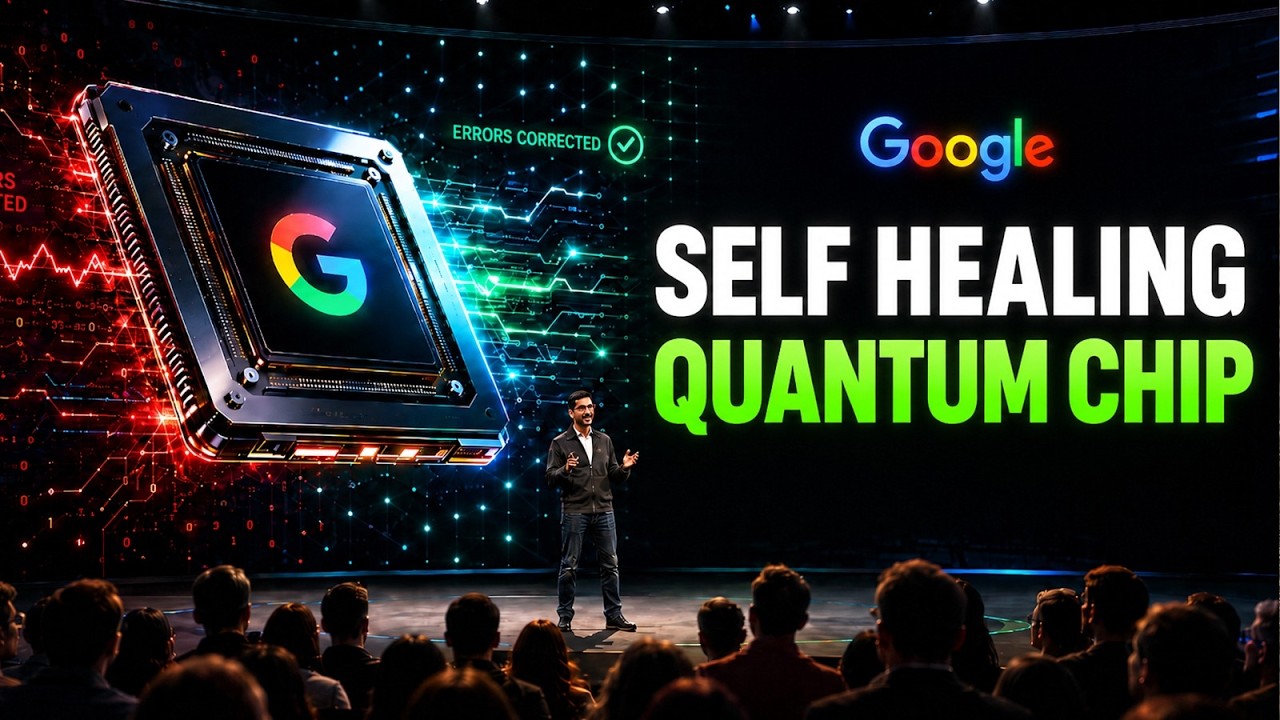
Google Just Made a Massive Quantum Breakthrough

A dense fifteen minute walkthrough of one Nature paper from Google Quantum AI and Google DeepMind, Reinforcement learning control of quantum error correction. The premise: a quantum computer's real problem is not that qubits are fragile, it is that the machine is analog and its thousands of microwave control parameters drift out of tune while you use them, and the only fix so far has been to kill the computation and recalibrate. Google gave the error correction system's own detection events a second job, feeding them to a reinforcement learning agent that retunes the controls while the computation keeps running. On a Willow processor it found another 20% suppression of the logical error rate on top of full expert calibration, delivered a 3.5 fold improvement in stability against injected drift, and set record logical error rates of 7.72 x 10^-4 per cycle for the distance 7 surface code and 8.19 x 10^-3 for the distance 5 color code. Simulations to distance 15 and 40,000 parameters show the training cost is independent of system size.

SciencePhysicsAIJul 23, 2026
17:52
Andru Edwards

Apple Just Won AI (and It's Not Even Close)

Andru Edwards argues Apple may have won consumer AI by finishing last, and opens by conceding the whole bear case: ChatGPT is more powerful, Claude reasons better, Apple used Gemini tech to help train its own models, and Apple broke its 2024 Siri promise badly enough to pay $250 million to settle false advertising claims. His thesis is that intelligence and access are two different advantages, and that the fifteen year Siri failure was an architecture problem rather than an intelligence problem: the data was always on the phone, Siri just was not allowed to reach it. WWDC 2026 changed that with five custom Apple models and an orchestrator inside the operating system, on screen awareness, personal context across your apps, and one side button as the interface. He then runs the field, OpenAI, Anthropic, Google, Microsoft, Meta and Amazon, and finds every rival missing a different structural piece, before turning the argument on itself with the beta and English only caveats and the question of whether Apple can distill frontier advances fast enough. The bet: good enough intelligence plus exceptional context beats exceptional intelligence starved of context for the everyday 90 percent.

AppleAIBusinessJul 21, 2026
26:28
Parzival of Algorithmic Progress

Kimi K3: The AI Sputnik Moment | Alex Wissner-Gross on China's Open-Weight Bombshell | EP272

An emergency episode cut from a Moonshots Podcast panel, reduced to Alex Wissner-Gross on what China's Kimi K3 open weight release actually means. His read: the published architecture has no magic in it, just a recognizable transformer with well understood mixture of experts and linearized attention work, and it still lands third on the Artificial Analysis cost versus capability frontier behind Fable 5 and GPT 5.6 Sol Max. That raises his central question, what American frontier labs are spending all their money on. He argues chip export controls backfired by forcing Chinese labs to burn through the efficiency overhang early, rejects the distillation explanation as not smelling right, and reconstructs the Moonshot founder chronology to argue this was never an immigration failure. The extrapolations run from daily frontier releases by January and sub one bit quantization going mainstream, to hyper forecasters crowning the efficient market hypothesis, orbital data centers, and PLA humanoids. His recommendation is to out ship the next Kimi rather than block it from Hugging Face, and to become the arsenal of superintelligence instead of building a FINRA like cartel under the SEC.

AIBusinessPoliticsJul 20, 2026
20:13
Maxinomics

Why Elon Musk is Really Building Starship

Phil Andrews argues that the right way to value SpaceX has nothing to do with landing boosters and everything to do with an empty room: the payload fairing at the tip of a Falcon 9, 17 feet across and 34 feet high, and one metric he calls return per ton. Sell a ton of that volume to somebody else and SpaceX collects about $4 million once. Fill it with its own Starlink satellites, 525 kilograms each, $800,000 to build, $1.5 million a year for a five year life, and the same ton returns about $13 million. That ratio explains why 123 of SpaceX's record 165 launches last year carried its own cargo, and the video walks the full P&L: a $30 million booster, a $10 million expendable second stage, $45 million all in for a new rocket falling to $16 million once the booster is flight proven, which turns $32 million of margin into $61 million selling seats and $171 million into $200 million owning the payload. The historical spine is the 19th century railroads, handed 175 million acres of land grant so they owned both the ride and the destination, set against the airlines, who own the plane and neither airport and now lose money per seat mile and make it back on credit cards. The last third argues the next rung is AI compute in orbit at $10 to $50 million a ton, a refinery rather than a pipe, and that Starship is the shipping container moment: five times the chamber, a ton ten times cheaper, and 100 launches worth $130 billion instead of $22 billion. Andrews is explicit that Starship has put exactly zero working payloads into orbit and that the whole bet rests on how often it can actually fly.

BusinessScienceHardwareJul 16, 2026
7:24
MacVince

macOS 27 Golden Gate: Top Features, Tested Hands On

A combined remake of macOS 27 Golden Gate built from two creators. MacVince walks the top ten changes from tiny design fixes to the big AI leaps, and Faiz Aly folds in a weeks long hands on test on an entry level MacBook Neo. Together they cover the Liquid Glass transparency slider, a system wide search re-index, the genuinely good new Siri, Visual Intelligence on the Mac, rebuilt dictation, AI built Safari extensions and Shortcuts, and generative photo editing. Both ran the beta for real and both land in the same place: the refinement release macOS 26 should have been, with Siri and dictation making it feel next level and performance holding up even on a phone class chip.

AppleAIHardwareJun 15, 2026
18:34
Nate B Jones

Apple WWDC 2026: The AI Story Everyone is Missing

Nate B Jones reads Apple's WWDC 2026 announcements as one bet wearing three costumes: a new Siri AI, a Google Gemini model alliance, and Private Cloud Compute expanding onto Google Cloud and Nvidia GPUs. The thread tying them together is a single question he thinks decides the first AI trillionaire, namely where AI does your work when it works all day: a chatbot tab, a giant cloud, or the device you already own. Apple's answer is device first with private cloud for overflow, with the OS, apps, App Intents, and personal context as the surface AI sees and touches. Jones argues Apple is deliberately commoditizing the model to own the trusted action surface, the place a billion people touch AI through, and the trust that comes with it.

AIAppleBusinessJun 11, 2026
28:27
David Bombal

My Dream "home lab"

David Bombal tours Cisco's 20 million dollar AI networking lab to answer the question most AI coverage skips: once you have the GPUs, how do you wire hundreds of thousands of them into one computer. Three Cisco engineers walk through scale up, scale out, and scale across, the new G300 100 terabit and P200 routing switches, why optics are often the most expensive line on the bill, and how a 128 GPU scalable unit plus simulated flows proves designs at much larger scale. The recurring lesson is economic: a 10,000 GPU cluster rents for 175 million dollars a year, so a 5% efficiency loss or one bad cable costs millions. It also settles the InfiniBand versus Ethernet debate (Ethernet wins at scale) and shows security moving off the edge firewall and into the fabric on DPUs and switches.

NetworkingHardwareAIMay 17, 2026
20:11
Alex Ziskind

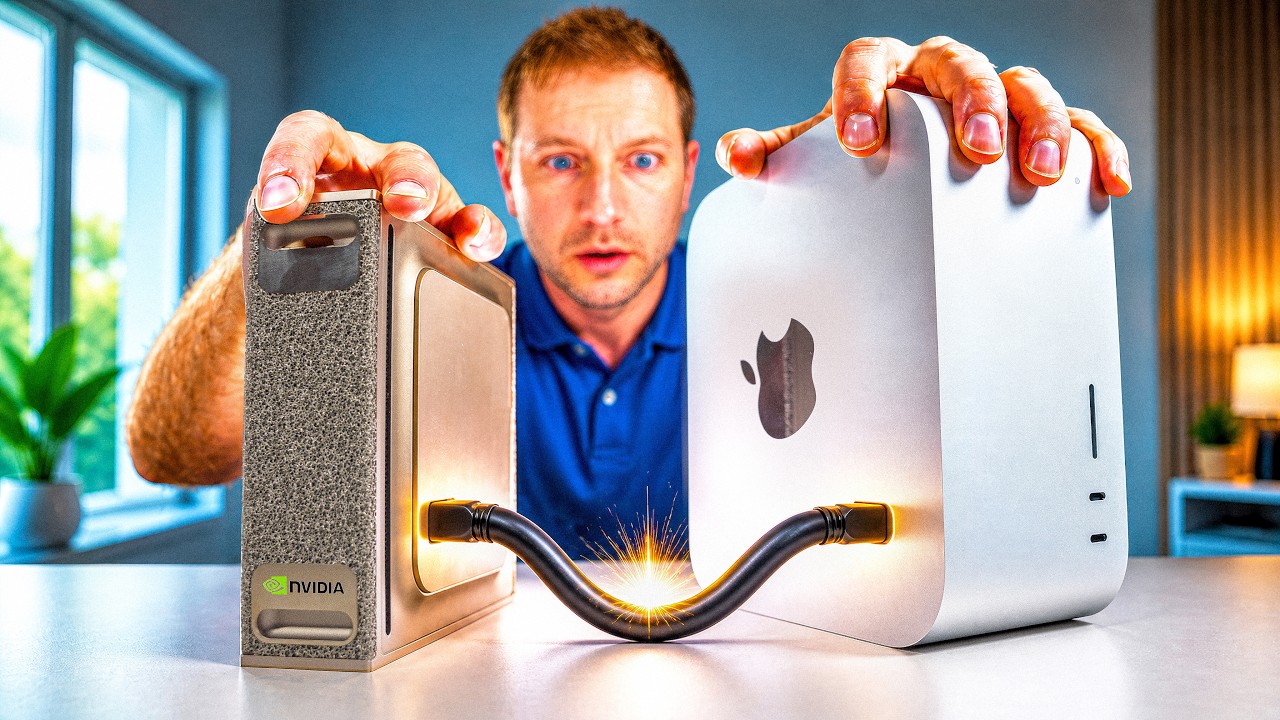
I Plugged a DGX Spark and Mac Together... and Didn’t Expect This

Two machines on a desk, each brilliant at exactly half of what running a large language model needs, and each terrible at the other half. The NVIDIA DGX Spark (here a GB10 in MSI's Edge Expert clothing) chews through a long prompt at hundreds of tokens per second, then crawls when it actually has to write the answer. The Mac mini does the reverse: slow to read the prompt, fast to stream the reply. Alex Ziskind spends this video trying to bolt the good half of each onto the other, a trick the industry calls disaggregated prefill and decode, then measuring whether the Frankenstein is actually worth building.

AIHardwareMay 1, 2026
15:22
The Infographics Show

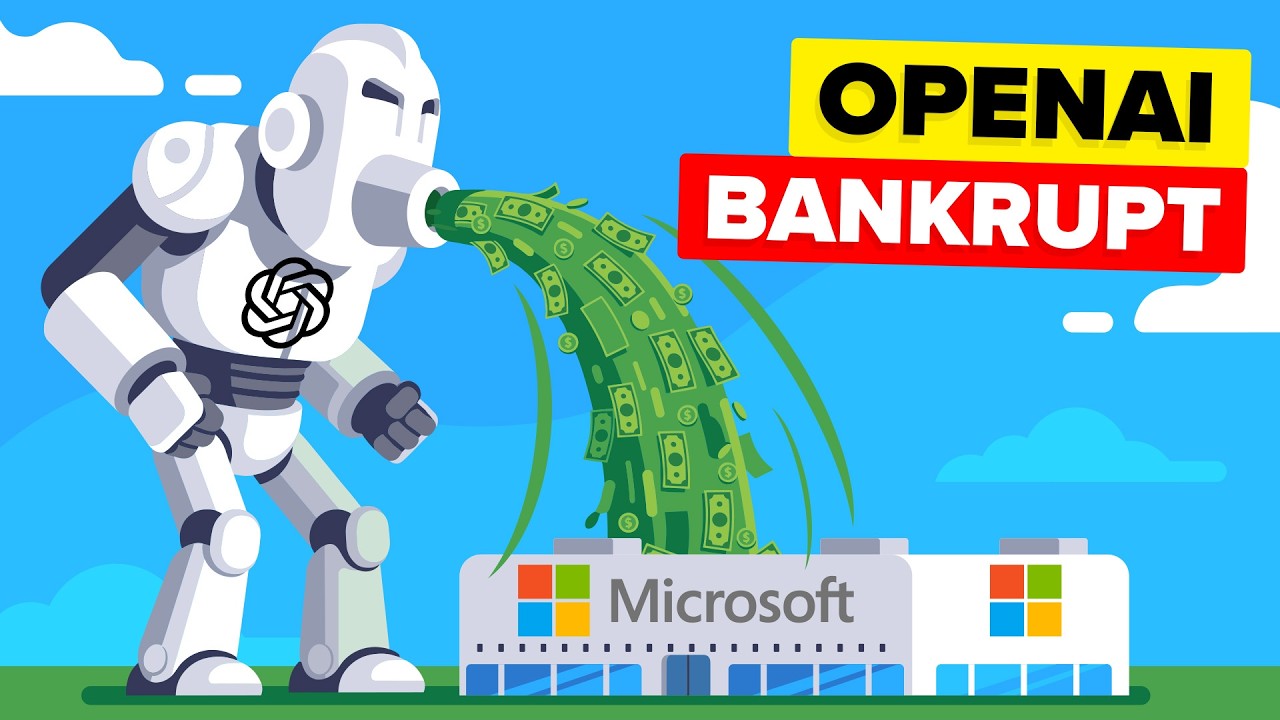
MASSIVE Microsoft Divorce That WILL BANKRUPT OpenAI and ChatGPT Forever

The Infographics Show argues that Microsoft's partnership with OpenAI is a circular money loop that is starting to break. Microsoft funded OpenAI mostly in Azure credits rather than cash, OpenAI spent them renting Microsoft's servers, and Microsoft booked that spend as cloud revenue growth, tying roughly 45% of its $625 billion in guaranteed future revenue to one startup losing $12 billion a quarter. The video stacks the physical bill (GPUs obsolete in three years, TSMC and copper shortages, data centers draining millions of gallons of water) against a price war started by DeepSeek that collapses OpenAI's margins. It ends with OpenAI blocked from foreign cash by CFIUS, then taking a $110 billion rescue led by Amazon, Nvidia, and SoftBank and shifting compute toward AWS, leaving Microsoft holding billions in decaying hardware.

AIBusinessHardwareApr 8, 2026
23:30
Data Slayer

The Internet, Reinvented.

Data Slayer argues the internet is not cables or towers but routing, and rebuilds it with Reticulum, a cryptography first networking stack that treats every radio as an interchangeable interface. He hand builds an RNode, then bridges a LoRa only device to a Wi-Fi only device through a dual interface node, proving mismatched hardware can share one network. Scaling up, he runs Reticulum over a long range Wi-Fi HaLow IP mesh on two Raspberry Pi Haven nodes with encryption and route based scaling. The finale routes the Department of Defense mapping app ATAK across that homemade network by hijacking its multicast traffic and fragmenting it to a 500 byte MTU. A build log for a parallel network you own instead of rent.

NetworkingHardwareSecurityFeb 22, 2026
57:00
Nutanix University

Running Kubernetes in Production with NKP | Global Nutanix User Group Webinar

A Global Nutanix User Group webinar making the case that raw Kubernetes is an engine, not a car, and that running containers in production needs the full vehicle around it. Technical Marketing Engineers Nimal Kunnath and Kapil Anandani introduce the Nutanix Kubernetes Platform (NKP) as an opinionated stack of pure upstream Kubernetes plus more than 22 CNCF projects, organized into three jobs: cluster provisioning via Cluster API, day two observability, and Fleet Management. Live demos show a production cluster built in about 20 minutes, troubleshooting a failing payment service through Grafana, Loki, and an AI Navigator chatbot, disaster recovery with NDK and Velero, and a Fleet Management trick where an application follows a label across clusters and clouds automatically. The session closes on multi tenancy for service providers and a question and answer round covering migration limits, optional components, licensing, project admin roles, and global load balancing.

DevOpsNetworkingHardwareDec 11, 2024