At a glance
The Infographics Show takes one uncomfortable number and builds an entire economic argument on top of it. A serious Claude Code power user chews through roughly 10 billion tokens a year, and at standard API rates that workload costs about $15,000. The same person on a flat rate Max subscription pays around $1,200. The missing $13,800 is a 92% subsidy, and it is not magic, it is venture capital deliberately eating losses to get a generation hooked before the price tags change. The video calls this the AI Uber moment, walks the same playbook from ride sharing into AI, and then shows why the math is actually worse this time: agentic workflows burn 5 to 30 times more tokens than old chatbots, the hardware rots in 18 months, the revenue is partly an accounting illusion, and the bill simply has not arrived yet.
This is an explainer that is really a warning. It argues, number by number, that cheap AI is a temporary promotional rate, that the correction is already penciled in, and that when it lands it will hit freelancers and small businesses first and hardest. Below is the full case, chapter by chapter, with every figure the narrator puts on the table and nothing softened.
The full walkthrough
The hook: a trillion dollar house of cards
The video opens by calling your bluff. You think the $20 AI subscription is the deal of the century. The narrator says it is a trap. A power user on a tool like Claude Code actually costs $15,000 a year to run, and you only pay a sliver of that because venture capitalists are footing the difference. You are living inside the AI Uber moment, a temporary illusion built to get you hooked before the prices reset. The money is running out. When this trillion dollar house of cards collapses, the tools you rely on every day will either vanish or cost you ten times more. The thesis, stated flat: the economics of AI are broken.
Chapter 1: the $20 illusion
It starts with your wallet. A serious Claude Code user runs through roughly 10 billion tokens a year. Tokens are the thought units of AI: every word it reads, every word it writes, every decision it makes spends a token. Run that 10 billion through a standard API and you would pay around $15,000 a year. That is the real unsubsidized price, no discounts, no incentives, just the raw compute cost. That same user on a flat rate Max subscription pays around $1,200 for the whole year for the identical workload. From $15,000 down to $1,200. A 92% hidden subsidy.
The narrator makes the absurdity concrete: imagine walking into a dealership, picking a car priced at $15,000, and being told you only owe $1,200 because someone, somewhere, covered the rest. It makes no sense, and the strangeness is the point. The explanation sits in OpenAI's own financial projections, leaked to The Information: the company is on track to lose $14 billion in 2026. Not revenue. Losses. A $22 monthly subscription covers about 1.7% of what an active power user actually costs to serve.
Which leads to the line the whole video pivots on: you are not a customer, you are bait. Every prompt, every line of generated code, every late night chat session is paid for by investors who are betting nobody will be able to live without the product once the real bill lands. Whole industries are being signed up at a loss. Law firms run document review at five cents on the dollar. Marketing agencies turn out campaigns at prices that would have been impossible eighteen months ago. Hospitals trial diagnostic tools at sticker prices no model provider could sustain at scale. Every deal is propped up by patient capital that expects ten times its money back. So why race to sign up more users if you lose money on each one? Because we have seen this exact playbook before, and we know how it ends.
Chapter 2: the ghost of Uber
Back in 2014, a black SUV pulled up outside your apartment in three minutes. The driver was polite, the car spotless, the trip to the airport cost eleven bucks. You wondered how it added up. It did not, and that was the point. It was never meant to. For the better part of a decade an entire generation lived inside what economists later named the Millennial Lifestyle Subsidy. Venture capitalists poured money into ride sharing, food delivery, co-working spaces, and meal kits on purpose, setting prices below cost to crush legacy competitors and build a habit. The plan was always the same: take over first, then raise prices until it turns a profit.
Uber's take rate, the slice of every fare the company keeps, tells the story. In 2022 Uber kept about 32 cents of every dollar a rider paid. By 2024 that had climbed to roughly 42 cents. Drivers got a smaller share, riders paid more, and the company eventually posted a profit. Now it is happening in AI, with the same investors, the same playbook, and the same pricing memo. Industry analysts expect consumer subscription tiers to roughly double in price over the next two years. Anthropic has rolled out new rate limits that gently push power users toward higher priced plans. Google is testing premium only Gemini features that used to be free. A 100% price hike is not a rumor, the narrator says, it is already penciled in on the calendar. Enterprise contracts follow the same curve: custom deals signed in 2024 are quoted much higher in 2026 renewals. Same product, multiple times the price, take it or leave it.
Then the video draws the line that makes AI worse than ride sharing. Ride sharing had to do one thing, move a car from A to B, and that cost does not explode as usage rises. If anything it gets more efficient with more drivers, more density, and better routing. AI works differently. The underlying math of thinking does not get cheaper the same way, it gets complicated fast. The narrator concedes the executives' favorite line is technically true: compute does get cheaper every year, chips are more efficient, models are leaner, and each individual word an AI generates is genuinely cheaper to produce than eighteen months ago. That is the part they want you to hear. The next chapter is the part they do not.
Chapter 3: the Claude Code math
Here is the trap inside the half truth. Modern agentic workflows, the kind that power Claude Code and ChatGPT's deep research tools, burn anything from 5 to 30 times more tokens than a simple chat session from two years ago. When you ask a code assistant to fix this bug, it does not write fifty words of response. It quietly spawns subtasks, rereads your files, checks its own work, writes draft after draft, throws most of them away, and runs tests in the background. A single user request can chew through hundreds of thousands of tokens before any answer appears on screen.
So the per word price falls while the words per request explode, and the total bill shoots upward anyway. The narrator names it: the token tax. It bankrupts scrappy AI startups burning through their seed rounds, and it threatens to wipe out one of the most profitable business models in the history of the internet. This is the engine fault under the whole industry. Cheaper tokens times vastly more tokens equals a bigger invoice, and the cheaper part is the only part anyone advertises.
Chapter 4: the search penalty
For 25 years Google printed money, and the mechanism was brutally simple. A user types a query, Google returns ten blue links pulled from the open web, and the total cost in servers, electricity, and indexing is a fraction of a cent per search. The ads next to the results earn far more than that. Margin, the narrator calls it, one of the great financial miracles of modern times. Now Google is rebuilding the entire system on top of generative AI. A single AI powered search response, the kind that writes a paragraph long answer instead of showing links, costs significantly more to produce than a traditional keyword search. Multiply that across billions of queries a day. If Google fully replaces traditional search with AI overviews, the most reliable profit machine of the 21st century vanishes, and the margins that funded YouTube, Android, Waymo, and Gmail begin to dry up. Wall Street analysts have quietly mapped the worst case, and the numbers are catastrophic.
It gets worse, because the advertising model goes redundant too. When AI just hands you the answer, nobody clicks the links, so advertisers stop paying. Google faces a future where it serves more queries than ever, costs more to run than ever, and earns less revenue per query than at any point in its modern history. So why do it at all? Because tech giants are willingly cannibalizing their most profitable businesses on purpose, having decided that the only thing more dangerous than killing a cash cow is letting a competitor kill it first. Business school has a name for this: the innovator's dilemma. When a new technology threatens the core business, an incumbent can sit still and defend the existing cash engine while a rival builds the future, or cannibalize itself on its own terms and hope to grow revenue on the next platform before the old one erodes. Google, Microsoft, and Meta are all betting on the second path, betting that AI eventually replaces the current money makers. Nobody can prove it is true, and everybody is in too deep to back out. Which raises the obvious question: if the unit economics are this bad, how are these companies posting record AI revenues every quarter?
Chapter 5: the round trip scam
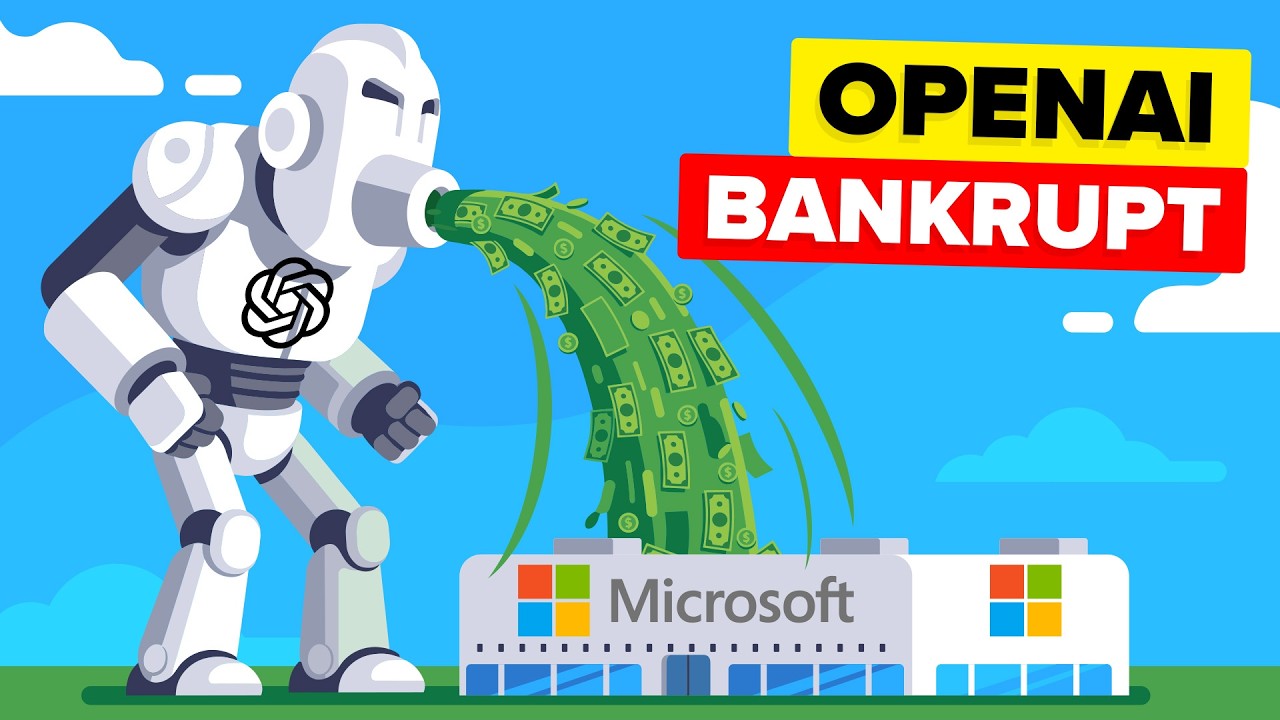
This is where it gets clever. Microsoft commits very publicly to investing $13 billion in OpenAI. The press release is slick, the headlines dramatic, stock prices rise, investors are happy. Read the fine print and a different story appears. A big chunk of that investment never hits OpenAI's bank account. It arrives as Azure cloud credits, essentially a gift card redeemable only at Microsoft's own data centers. OpenAI records the sum as capital raised. Microsoft logs the cloud usage as revenue. It is an investment and a sale at the same time. OpenAI has separately committed to spending up to $250 billion on Azure services, locking the loop in for years.
Now layer Nvidia on top. Nvidia announces tens of billions in commitments to OpenAI. OpenAI turns around and uses that capital to buy Nvidia GPUs. Nvidia posts a record quarter and its stock soars. The whole cycle takes a few months, almost no real money changes hands, and the same dollar simply gets a new name at each stop. Add Oracle, CoreWeave, and AMD to the list, each one investing and then selling services to the next, each one booking revenue as the dollar circulates. The technical name for this is round tripping. In Silicon Valley, the narrator notes, it is called strategic partnership.
Chapter 6: the hardware debt trap
The spending is the part that cannot be papered over. In 2025 big tech is projected to spend roughly $320 to $400 billion on AI infrastructure, and updated forecasts for 2026 push the figure toward $500 billion: data centers, GPUs, cooling systems, power delivery, entire grids reinforced to handle the load. Meanwhile total global consumer spending on AI services is only about $12 billion, according to the Menlo Ventures State of Consumer AI report. Hundreds of billions flow out while $12 billion comes in. The gap is the size of a midsized country's entire economy, and it is filled not with revenue but with debt: corporate bonds, structured credit, and private lending. Meta alone raised $30 billion in bond markets in late 2025, plus another roughly $30 billion through a Morgan Stanley arranged joint venture built to keep the liabilities off Meta's public balance sheet. Microsoft signed a 20-year power purchase agreement to restart Three Mile Island. Google partnered with NextEra Energy to reopen nuclear power plants. Those promises do not go away if AI revenue underperforms.
And the hardware itself does not last. A high-end Nvidia GPU, the kind powering most of this boom, has a useful life of just one to three years before the next generation makes it outdated, and it loses most of its book value the moment a new generation ships, which now happens roughly every eighteen months. A data center full of three-year-old chips is, in industry terms, dead weight. The narrator contrasts this with the original dot com bust. When that bubble popped in 2000, telecom companies left behind millions of miles of fiber optic cable buried in the ground. New companies bought it for pennies on the dollar and built YouTube, Netflix, and Spotify on top of it. The crash was brutal, but the wreckage was useful. This AI bubble will instead leave behind warehouses of useless silicon, locked into 20-year power contracts, and concrete shells in the middle of nowhere that nobody will know what to do with. Utilities will pass higher electricity rates to households for decades whether or not the AI revenue ever shows up. A gap of hundreds of billions cannot be papered over for long, and the companies running the race know it, so they are quietly slowing the bleeding before the public catches on. Most users have already felt it. They just have not connected the dots.
Chapter 7: the stealth nerf
The slowing of the bleeding has a texture, and you have probably noticed it. An AI model that used to one shot your code now forgets your project halfway through. A chatbot that used to write five paragraphs cuts off at three. An image generator that rendered a flawless portrait in thirty seconds now spits out something with seven fingers and asks you to upgrade to the next tier. Nobody is imagining it, the narrator insists. The product is getting worse. When the numbers stop working, the easiest lever a provider can pull is to quietly water the service down.
The signs are easy to spot once you look. Message caps that used to refresh every five hours suddenly refresh every eight. The default model in an app gets quietly swapped from a flagship to a smaller, cheaper version. Memory features get rolled back. Advanced reasoning gets locked behind a higher price tier. A god model promised in launch keynotes is quietly swapped for a cheaper, less intelligent one. Reddit threads about AI tools fill with users swearing their assistant has gotten lazier, and engineers post side by side screenshots of the same product producing visibly worse output than six months earlier. Companies almost always deny it, and sometimes they release selected benchmarks: clean prompts, controlled conditions, optimized scenarios designed to show performance at its best. It buys time. It does not fix the bigger problem, which has already started taking out the first wave of an entire ecosystem.
Chapter 8: the 2026 mass extinction
Roughly 40% of AI startups launched in 2024 have already shut down or been acqui-hired by bigger players, according to CB Insights data. Acqui-hire is the polite term for a fire sale, a struggling company sold for cents on the dollar to a rival who is not really buying a business at all. The buyer takes the engineers, shuts down the product, and absorbs whatever talent it can. These were not garage hobby projects. They closed series A rounds with serious investors, they had revenue, they had paying customers, they had glowing TechCrunch profiles. Then within eighteen months the lights went off.
The reason is almost always the same: cost of goods sold. The money these startups pay to model providers like OpenAI, Anthropic, and Google is so high it wipes out any margin they could charge. A startup that wraps a polished interface around GPT-4 might charge $50 a month while the same customer's API usage costs the startup $80. Every active user is negative revenue, so the more successful the marketing, the faster the company bleeds out. And then there is the cliff above them: when a foundation model provider ships a new feature, it often kills ten startups overnight. ChatGPT launches native voice mode, and a half dozen voice agent startups that closed series A rounds last quarter say goodbye. Claude releases native PDF reading, and a whole crop of document tools becomes useless in a single product update. An ecosystem of independent AI companies is collapsing under compute costs nobody can profitably absorb. And when those startups die, the cloud providers lose the round trip revenue that made the foundation model investments look like good business in the first place. That is when the final phase begins.
| The startup wrapper | Per customer, per month |
|---|---|
| Price charged to the customer | $50 |
| API cost that customer generates | $80 |
| Result on every active user | negative $30 |
| Effect of growth | more marketing, faster bleed out |
| Effect of a new foundation feature | whole category killed overnight |
| 2024 cohort already gone | roughly 40% |
Chapter 9: the great AI rug pull
Venture capital firms are no longer willing to cover losses on a promise of future glory. They want a path to profit in writing, with quarterly milestones, and they want it now. For foundation model companies that means one of two things. The first is a brutal, sudden repricing. A $20 consumer plan becomes a $100 plan, or it quietly disappears and is replaced by a pro tier that costs ten times more for the same features. A Claude Code user who paid $1,200 a year suddenly faces an invoice closer to the $15,000 the API actually costs. A freelance designer relying on a $10 image generation subscription gets an email explaining the plan is being moved to a new structure. Small businesses that built workflows on cheap AI face a choice: pay ten times more, or go back to doing it the old way.
The second option is worse: the services simply get shut down. We have already seen the first signs. Smaller AI companies have folded with thirty days notice, leaving customers scrambling to move years of work to whatever competitor is still standing. Specialized models for legal research, medical imaging, and customer support have been pulled because their economics never worked. An era of cheap AI ends with a thousand small invoices and a thousand small shutdown notices.
The deeper truth, the narrator says, is uglier than any single price hike. AI in 2026 is on track to become a luxury, not a basic product. The cheap versions trained an entire generation to need it, and the expensive version is the only one the balance sheets now allow to exist. Big companies that can afford the new pricing tier lock in their advantage. Freelancers, small businesses, and the early adopters who created the buzz get priced out first. An economy built on the idea of cheap intelligence is about to slam into the reality of expensive intelligence. Productivity assumptions made in 2024 will not survive in 2027. The promised AI revolution will arrive, just not for everyone, and not at the price they were sold.
And the timing may be vicious. History says crashes do not take a year to play out. The dot com bust took two years from peak to trough, but the AI bubble has more leverage, more concentration, and more debt baked into its foundations. When it tips, it can move in months, maybe weeks. When the margins shrink, when the first big enterprise customer publicly walks away from a renewal, the confidence can vanish overnight. The tools millions rely on every day were never as cheap as anyone thought. They were held up by investor money that is finally starting to dry up. An AI age might still be coming, but the cheap AI age, the one that fooled a generation into rebuilding their working lives on top of it, is already over. The bill simply has not arrived yet. And when it does, the narrator closes, that price will never feel real again. The video signs off by handing you to its sequel: what happens to the economy if the $2 trillion AI bubble bursts.
Key takeaways
- The unsubsidized cost of a Claude Code power user is about $15,000 a year for roughly 10 billion tokens, against the $1,200 a Max plan charges. That is a 92% hidden subsidy, and a $22 monthly plan covers only 1.7% of an active power user.
- The subsidy is funded by losses. OpenAI is projected to lose $14 billion in 2026. The strategy is the Uber playbook: price below cost, build a habit, then raise prices. Analysts expect consumer plans to double within two years.
- AI breaks the ride sharing analogy because agentic workflows burn 5 to 30 times more tokens than old chat sessions. Cheaper per word times far more words equals a rising bill. This is the token tax.
- Generative search threatens Google's core margin: AI answers cost more per query and kill the ad clicks, so Google may serve more queries, pay more to run them, and earn less per query than ever.
- The headline revenues are partly an accounting loop. Round tripping moves the same dollar through Microsoft, OpenAI, Nvidia, Oracle, CoreWeave, and AMD, booked as both investment and revenue at each stop.
- The spending dwarfs the income: $320 to $400 billion in 2025 infrastructure (toward $500 billion in 2026) against about $12 billion in global consumer revenue, the gap filled with debt and 20-year power contracts against GPUs that go obsolete in 18 months.
- The early warning is stealth degradation: longer message cap refreshes, flagship models swapped for cheaper ones, reasoning locked behind higher tiers.
- About 40% of 2024 AI startups are already dead or acqui-hired because a wrapper charging $50 can pay $80 in API costs, and a single new foundation feature can erase a whole category overnight.
- The endgame is repricing or shutdown. AI becomes a luxury, the early adopters get priced out first, and because of the leverage the correction could play out in months, not the two years the dot com bust took.
Chapters
Timestamps are clickable. Click one and the player jumps there and keeps playing while you read.
- 0:00 The Trillion Dollar House of Cards
- 0:36 Chapter 1: The $20 Illusion
- 2:38 Chapter 2: The Ghost Of Uber
- 5:03 Chapter 3: The Claude Code Math
- 5:56 Chapter 4: The Search Penalty
- 8:08 Chapter 5: The Round Trip Scam
- 9:35 Chapter 6: The Hardware Debt Trap
- 11:58 Chapter 7: The Stealth Nerf
- 13:21 Chapter 8: The 2026 Mass Extinction
- 15:02 Chapter 9: The Great AI Rug Pull
Notable quotes
You are not a customer. You are bait. narrator, 1:35
A $22 monthly subscription covers about 1.7% of what an active power user actually costs to serve. narrator, 1:28
Every single deal is being propped up by patient capital that expects 10 times returns. narrator, 2:11
It was never meant to. For the better part of a decade, an entire generation lived inside what economists later called the Millennial Lifestyle Subsidy. narrator, 3:00
A 100% price hike isn't a rumor. It's already penciled in on the calendar. narrator, 4:50
Each individual word an AI generates is genuinely cheaper to produce than 18 months ago. And that's the part they want people to hear. narrator, 5:18
A single user request can chew through hundreds of thousands of tokens before any answer shows up. narrator, 5:30
The total bill is shooting upward. It's known as the token tax. narrator, 5:38
Tech giants are willingly cannibalizing their most profitable businesses on purpose. narrator, 6:23
In Silicon Valley, it's called strategic partnership. narrator, 9:24
A data center full of three-year-old chips is in industry terms dead weight. narrator, 11:23
The crash was brutal, but the wreckage was useful. narrator, 11:31
Every active user is negative revenue. The more successful marketing, the faster a company bleeds out. narrator, 14:36
An economy built on the idea of cheap intelligence is about to slam into the reality of expensive intelligence. narrator, 16:40
The bill simply hasn't arrived yet. And when it does, that price will never feel real again. narrator, 17:45
Resources mentioned
- The Infographics Show, the channel that produced this explainer, narrated by Josh Risser. Full source list for the episode on Pastebin.
- Claude Code and the Claude models from Anthropic, the primary case study for token consumption and the $15,000 figure.
- ChatGPT and its deep research tools from OpenAI, cited for high token agentic workflows, and the leaked $14 billion 2026 loss projection.
- The Information, the publication that received OpenAI's leaked financial projections.
- Uber, the take rate case study (32 cents to 42 cents per dollar, 2022 to 2024) and the Millennial Lifestyle Subsidy.
- Google and Gemini, the search penalty and premium feature testing, with YouTube, Android, Waymo, and Gmail named as ad funded products at risk.
- Microsoft and Azure, the $13 billion investment and $250 billion commitment at the center of the round trip.
- Nvidia, Oracle, CoreWeave, and AMD, the other nodes in the round tripping cycle.
- Meta and Morgan Stanley, the $30 billion bond raise and the $30 billion off balance sheet joint venture.
- Three Mile Island (Microsoft's 20-year power purchase agreement) and NextEra Energy (Google's nuclear restart partner).
- Menlo Ventures State of Consumer AI report, source for the $12 billion global consumer spending figure.
- CB Insights, source for the 40% AI startup shutdown rate, and TechCrunch, the profiles those startups once earned.
- The dot com comparison: fiber optic infrastructure that later powered Netflix, Spotify, and YouTube, versus AI's stranded silicon.
The one thing to walk away with
The cheap AI you use every day is a promotional rate, not a price. The number that matters is the gap between what you pay and what your usage actually costs to serve, and right now venture capital is quietly closing that gap on your behalf. The video's whole argument is that this cannot last: the spending dwarfs the revenue, the hardware rots faster than it can earn back, the headline numbers are partly an accounting loop, and the patient capital is losing patience. When the subsidy ends, the bill does not get smaller, it just gets handed to you. The smart move is to know your real unsubsidized cost before the invoice arrives, because once it does, the narrator warns, the old price will never feel real again.