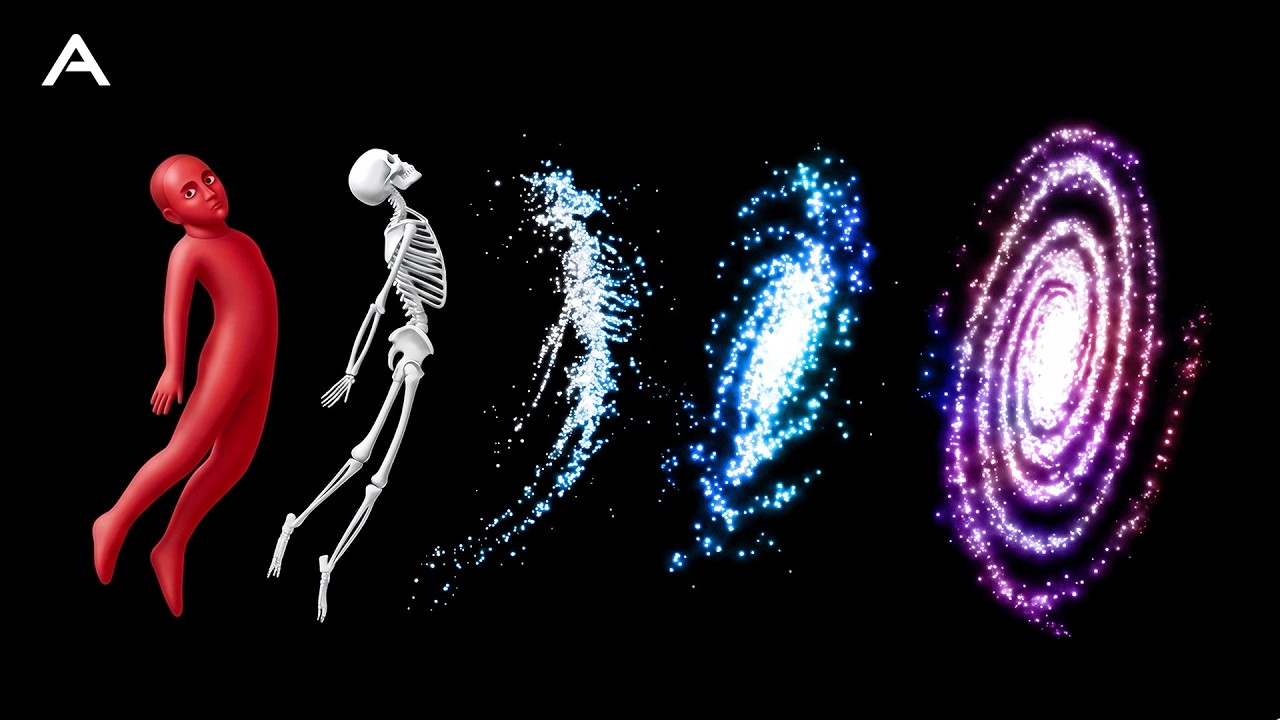
At a glance
Aperture opens with its own analytics and turns them into an accusation: fewer than 20% of the people who watch this channel ever went looking for it, which means roughly eight out of ten viewers, statistically including you, did not decide to think about free will today. Something else decided. From there the essay walks the whole intellectual chain, Pierre-Simon Laplace's demon in 1814, Baruch Spinoza's causal chain, Benjamin Libet's readiness potential, John-Dylan Haynes's duel between a human foot and a machine that can see the decision coming, and Daniel Wegner's argument that the feeling of authorship is a story the brain writes after the fact. Then it makes the move that gives the video its point: it does not matter who wins the metaphysical argument, because whatever you call the thing you do every morning when you pick eggs over cereal, it can be measured, and anything measurable can be studied, and anything studiable can be hijacked. The second half is the hijacking, run live on the viewer with a pair of Kahneman and Tversky gambles, then scaled up into Shoshana Zuboff's surveillance capitalism, where the philosophy of free will quietly stops being philosophy and becomes product design. It lands not on doom but on a muscle: agency may be partly illusory, but it behaves like something that can be trained or neglected, and the companies betting billions on your predictability have already made their bet about which one you will choose.
The number that ruins the next thirty minutes (0:00)
The video begins by showing you a statistic about yourself before it shows you anything else, and it does not pretend to be gentle about it. This is the actual back end analytics for the channel. Fewer than 20% of the people who watch ever go looking for these videos. Which means roughly eight out of ten of you, and statistically that probably includes the person reading this sentence, did not search for it. You did not type in a question. You did not go looking for an answer. You did not wake up this morning and decide that today was the day you wanted to think about free will.
Something else decided that for you.
That something is an algorithm which has been watching everything you do on the platform, tracking you across the rest of the internet, learning your likes, your dislikes, your interests, and, in the video's phrasing, reading your mood off the way you scroll. After all of that observation it ran a calculation and concluded that this specific video, out of everything in existence, was the one most likely to keep you here.
So the essay asks its opening question, and it asks it honestly rather than rhetorically. When you clicked on this, or on anything else you watched today, was that a clear, conscious, deliberate choice? Or did you click because it was the next interesting thing sitting in your feed?
There is a quiet assumption most of us carry around without ever examining it, which is that we are in control of our own attention. That every video, every scroll, every click is something we chose for ourselves. The video's proposal is that the machine got there first. That free will, the very thing you are using right now to trust your own judgment and to believe you are in control of this exact moment, has already been switched off. Not stolen in one dramatic act. Just worn away. Recommendation after recommendation after recommendation, quietly, without alarm, without objection, and without you ever noticing it was gone.
That is the thesis. Everything after it is the case.
Chapter one: is free will even real? (1:56)
First, agree on what is being lost
Before you can lose something you have to say what it is, so the video starts with a definition it can hold onto for the next half hour. Free will is the ability to have conscious control over your decisions. It is the sense that you could choose between one outcome with its consequences, or another with different ones.
The example is deliberately mundane. You could have had cereal this morning. Instead you chose eggs, because on some level you decided eggs were better for you today. That decision, however small and however forgettable, felt like it was yours.
The video then names the stakes attached to that feeling, and they are much larger than breakfast. That feeling is the entire foundation on which everything in life and in our society is built. Praise, blame, contracts, punishment, credit, love, guilt, every institution we have runs on the assumption that the person who did the thing could have done otherwise.
Unfortunately, as the narration puts it, it is not a very strong foundation.
1814: Laplace, and the demon that already knows
The first crack is more than two centuries old. In 1814 a scholar named Pierre-Simon Laplace published a thought experiment about causal determination: the idea that every particle in the universe has measurable interactions with every other particle, and that those interactions determine all future outcomes. The video quotes him at length rather than paraphrasing, because the sentence is the argument:
We may regard the present state of the universe as the effect of its past and the cause of its future. An intellect which at a certain moment would know all forces that set nature in motion and all positions of all items of which nature is composed, if this intellect were also vast enough to submit these data to analysis, it would embrace in a single formula the movements of the greatest bodies of the universe and those of the tiniest atom. For such an intellect, nothing would be uncertain and the future, just like the past, could be present before its eyes.
Put plainly: if an intelligent observer could know the position and motion of every particle in the universe at any given moment, that observer could predict with perfect accuracy the future location and motion of everything in it. The idea acquired a nickname over the following century, Laplace's demon, sometimes rendered as Laplace's superman. The demon would know the future exactly as well as it knows the past and the present, because to it there is no meaningful difference between the two.
The video is careful about why this matters, and it is not a point about planets and orbits. It was a direct argument against self determination. If our thoughts are made of material neurons and electrical charges, then under this theory the choices we make are simply the result of those interactions playing out, and they have nothing to do with free will. The demon does not need to read your mind. It only needs to read your atoms, and your mind is made of those.
Spinoza: the same argument, made personal
Baruch Spinoza arrived at a similar destination from a completely different road, and the video is right to give him his own beat rather than folding him into Laplace. Where Laplace was doing physics, Spinoza was doing philosophy, and his version lands closer to home.
Spinoza analyzed cause and effect and concluded that every action is wholly affected by the actions that came before it. Because of that causal chain, no action is, on its own, good or evil. It is simply a reaction to events that came previously. And he did not waste any time before turning that analysis on human beings: if all actions are wholly composed of reactions to past events, then free will as we experience it must be an illusion.
The difference in flavor is what makes Spinoza worth including. He did not argue for the measurability of the entire cosmos the way Laplace did. He expressed determinism personally. If our personalities are determined entirely by the events of our lives, then the drives we have are wholly the products of those events. Our experience of free will, in Spinoza's view, is a consequence of being one small part of a greater whole. How you act in a given situation is the result of every other action, past and present, rather than independent decision making.
Which means, if he is right, that who you are, what you do, and everything down to which shoe you put on first in the morning has nothing to do with you possessing free will and everything to do with a cosmic butterfly effect.
Libet, Haynes, and a duel you are guaranteed to lose
Modern science has done a great deal to demystify free will, and the video's centerpiece here is an experiment that turns the philosophy into a game you can lose in real time.
John-Dylan Haynes, inspired by earlier work from Benjamin Libet, put participants into a duel against a computer. You are hooked up to electrodes that detect activity in your outer cortex, the part of the brain most responsible for conscious thought. In Libet's original studies, people's brain activity surged in the moments right before they made the conscious decision to press a button. That surge has a name: the readiness potential, an early spike of activity that shows up before you have consciously decided to move.
Haynes took the finding and built an adversary out of it. Picture the setup. You are wired to sensors reading your brain activity in real time. You are sitting with your foot resting near a pedal. Your only job is to press it whenever you decide to. The computer's only job is to stop you.
The computer is watching your readiness potential. The moment it sees that spike, it throws up a signal telling you to freeze.
Here is the part the video says should worry you. Most of the time, it worked. The machine could catch the decision before you knew you were about to make it, and you could not stop your foot in time. The machine was not reading your mind in any mystical sense. It was simply looking at the part of the process that starts earlier than you do.
The narrow, closing, real vote
But not always. That is the qualifier the video refuses to skip, and it is the reason the essay is more interesting than the usual "science proved free will is fake" segment.
There is a narrow window, sometimes only a fraction of a second, in which you can still say no. The decision has already begun forming somewhere beneath your awareness, and you can still reach it and kill it before it becomes real. Researchers call the far edge of that window the point of no return, because past it there is no vetoing anything. The movement happens whether you want it to or not.
So which is it? Are you in control, or are you not?
The uncomfortable answer the video gives is: both, and neither. Your brain begins acting before you know you have decided anything. That part is settled. But somewhere in the gap between the first spark and the final movement, something that still deserves to be called you gets one last vote. A narrow one. A closing one. But a real one.
And the video makes the point that this is stranger and more disturbing than simply being a puppet. Being a puppet is at least clean. This is not clean. It means you are not fully in control and you are not powerless either. You are something in between, a flicker of agency operating on a deadline you cannot see, in a race you did not know you were running.
That should be reassuring. The next line is where the floor drops out: how do you know that flicker is really yours?
The press secretary
To answer that, the video turns to how often we act before we have consciously reflected on why. You instinctively catch a falling glass. You brake when someone cuts in front of your car. You finish someone else's sentence before realizing you knew what they were going to say.
And it is not only the split second reactions. Psychologists have repeatedly found that people readily construct explanations for their own behavior after the fact, and then believe those explanations with complete sincerity. The story we tell ourselves is coherent. It is logical. It is deeply personal. None of that makes it the true cause of our actions. It may simply be the brain's way of making sense of decisions that have already emerged from countless unconscious processes.
Then comes the image the essay hangs the whole chapter on. Consciousness, in this view, is less like a captain steering a ship and more like a press secretary stepping up to the podium after the decision has already been made, to explain why it was the only sensible course of action all along.
Which turns the flicker of agency back into a question. If that is true, then even the veto, even the last flicker of "no" that you just watched save someone from a machine's prediction, might not be an act of will at all. It might be another story the brain tells itself afterward, dressed up to look like control.
Wegner: The Illusion of Conscious Will (2002)
The video credits this line of thinking to Harvard psychologist Daniel Wegner, who explored it in depth in his 2002 book The Illusion of Conscious Will.
Wegner's argument is precise, and the video keeps the precision. The experience of consciously willing an action and the actual causing of that action are not necessarily the same thing. The feeling of agency may itself be something the brain generates after unconscious processes have already set the behavior in motion. We experience a thought immediately before an action, and we naturally conclude that the thought must have caused it, when in reality both the thought and the action may have arisen from deeper mechanisms operating beneath conscious awareness.
The video is then careful to state what Wegner was not claiming, which is the kind of care that separates a good essay from a viral clip. Wegner was not saying that consciousness serves no purpose, and he was not saying that human beings are merely biological automatons. What he suggested was that our sense of being the conscious author of every decision is an inference. A compelling story the brain tells itself, because it is the simplest available explanation for what we experience. It is easier for our minds to justify that we made a conscious decision than to acknowledge, on a regular basis, that we had no control over our actions.
Where that leaves the ledger
The video assembles the honest scoreboard rather than declaring a winner. Maybe the veto is real. Maybe it is not. Maybe the story your brain tells you about deciding is true, or maybe it is a press release written after the fact. We genuinely do not know. Neither did Laplace. Neither did Wegner. Neither, if we are honest, does Haynes.
| Position | The claim | What it concedes | What it leaves exposed |
|---|---|---|---|
| Laplace (1814) | Every particle interacts measurably with every other, so the full present state fixes the entire future. A sufficient intellect sees tomorrow as clearly as yesterday. | Nothing. It is total. Thoughts are neurons and charges, so choices are just interactions running their course. | fully predictable in principle, if anyone could ever gather the data |
| Spinoza | Every action is wholly a reaction to what came before. Personality is built entirely from the events of a life, so the drives are products of those events. | The experience of choosing is real as an experience. It is just not authorship. It is being a small part of a greater whole. | fully shaped by environment and history, which is a lever anyone can pull |
| Libet and Haynes | The readiness potential rises before conscious awareness of the urge. A machine watching it can catch the decision before you know you made one. | A narrow window survives before the point of no return, in which a veto is still possible. Most of the time, the machine still wins. | measurably early: the process is visible to instruments before it is visible to you |
| Wegner (2002) | Willing an action and causing it are not the same event. The feeling of authorship is generated after unconscious processes set behavior in motion. | Consciousness still has a purpose. We are not automatons. The sense of authorship is an inference, not a fiction with no function. | narratable: even the veto might be another story told afterward |
| The video's own landing | It does not matter which of these wins. Whatever you call it, the thing you do every morning behaves like a choice. | The metaphysics is genuinely unresolved and probably will stay that way. | observable and measurable, and therefore studiable, and therefore hijackable |
The hinge: measurable, studiable, hijackable
Then the video makes the move that turns a philosophy explainer into an argument about your phone.
Notice something, it says. Whether you side with determinism or with free will, you still, on some level, choose things every day, at least in the conventional sense of the word. You still picked eggs over cereal this morning. You still clicked this video over the thousand other things competing for your attention.
Call that choice an illusion if you want. Call it the last flicker of something real. It does not matter which one it is, because either way it behaves like a choice. It can be observed, and it can be measured.
And here is the problem. If it can be measured, it can be studied. If it can be studied, it can be hijacked.
You do not have to believe in free will to find that terrifying. You just have to look around and see what happens when somebody else learns your patterns well enough to predict the choices you will make with unsettling accuracy, and then, worse, to manipulate those choices to line their pockets.
That sentence is the bridge into the second half of the video, and the second half opens by running the hijack on you.
Chapter two: money games (13:00)
Round one
The video stops explaining and starts testing. Here is a game. You have two options, and you stand to make some money.
Option one: a 100% chance of gaining $450.
Option two: a 50% chance of gaining $1,000.
Which one do you pick? The narrator invites you to write it down in the comments to lock it in, which is a small piece of showmanship that also happens to be good experimental hygiene, because it stops you from revising your answer once you find out what the answer means.
Round two
Same game, except this time you have something to lose.
Option one: a 100% chance of losing $500.
Option two: a 50% chance of losing $1,100.
Pick again, and lock that one in too.
What you almost certainly chose
Then the video tells you what you did, before you told it.
In the first round, you took the guaranteed $450 and walked away from the coin flip, even though the coin flip is worth more on average. Half of $1,000 is $500, which beats $450, and you turned it down anyway.
In the second round, you chose the coin toss, gambling on losing $1,100 rather than accepting a guaranteed $500 loss, even though that is the worse bet mathematically. Half of $1,100 is $550, which is a bigger expected loss than $500, and you took it anyway.
Both times, you picked the mathematically inferior option. Both times you did it for the same underlying reason. The video makes the wager explicit and turns it into a call to action: if it got you right, hit like and subscribe. If it got you wrong, say so in the comments and explain the reasoning behind your pick.
But the important line is the next one. Those were not guesses.
Prospect theory: the reference point and the asymmetry
They are what most people pick, reliably, according to prospect theory, developed by psychologists Daniel Kahneman and Amos Tversky.
The video explains what prospect theory replaced, which is the part that usually gets skipped. Before Kahneman and Tversky, economists assumed that people made decisions by calculating expected value: weighing every outcome by its probability and picking whichever number came out highest. Prospect theory proved that this is not what we actually do.
What we do instead has two moving parts.
First, we measure everything against a reference point, usually wherever we currently happen to stand. Not against absolute wealth, not against some rational baseline, but against right now. Second, we do not treat gains and losses as mirror images of each other. Losing $100 does not feel like the opposite of gaining $100. It hurts roughly twice as much.
That single asymmetry, losses wounding harder than equivalent gains reward, is the foundation the entire theory is built on. It is also the whole explanation for both rounds of the game. In the gain frame, the guaranteed win is protected against the pain of ending up with nothing, so you lock it in. In the loss frame, the guaranteed loss is the certain pain, so you will pay a mathematical premium for any chance of avoiding it entirely.
Myopic loss aversion
The theory does not stop at the asymmetry. Kahneman and Tversky also found that we are wired to favor whatever protects us right now over whatever benefits us later, a pattern the video names as myopic loss aversion.
Stated plainly: we will trade a better long term outcome for a worse one, simply because the worse one feels safer in this exact moment.
Then the essay closes off the escape hatch that every viewer reaches for at this point, which is the thought that this is a thing other people do. It is not a quirk that shows up in some people and not others. It is not a personality trait, and it is not a mood you can be talked out of. It is closer to a default setting, wired in deeply enough that it shows up the same way across cultures, across income levels, and across decades of research.
Which means, the video says, that on some level your reaction to gain and loss was never really a mystery. It is calculable.
And we are back at the hinge, deliberately repeated: if it can be measured, it can be studied. If it can be studied, it can be hijacked.
The hijack, at industrial scale
This hijacking, the video argues, is exactly what modern tech companies have done in order to maximize shareholder value, and the most egregious example is social media algorithms.
It did not start out this way, and the essay gives the origin its due. We were sold connection and discourse without borders. Somewhere along the way the companies saw the dollar signs, and all of us were shoved into a multi billion dollar industry built entirely on our attention. Once your attention becomes the product being sold, your predictability stops being incidental. It becomes the entire business model.
The mechanism is short enough to state in one sentence. An algorithm notices what keeps you watching, and feeds you more of exactly that.
The video is careful to say what that is not. It is not guessing. It is applying the same principle Kahneman and Tversky already proved about you: that your reactions are stable enough to model, at a scale you cannot opt out of. And it is terrifyingly effective.
Then a test you can run on your own memory. Think about the last time you closed an app after an hour and felt like you had actually gained something. Now think about the last time you closed one feeling hollowed out, like you had just spent an hour running in place.
Scrolling does not feel like effort. It does not even feel like a decision. And that, the video says, is by design. It is built to exploit exactly the bias you just watched operate in the coin toss: our drive to avoid the small discomfort of the present moment, even when it costs us something much larger later. Every empty scroll is a myopic loss aversion trade, executed thousands of times a day, in a system built by people who know precisely which bias they are pulling on.
The part that should actually worry you
Here the essay makes its sharpest turn. The algorithm was never just watching you to understand you. It was watching you to shape you.
There is a name for what is happening underneath all of it. Harvard professor Shoshana Zuboff calls it surveillance capitalism: an economic system in which your private experiences, what you linger on, what you scroll past, what makes you pause, all become raw material. Not to serve you better. To predict you better, and eventually to steer you better.
And we hand it over willingly. Every account you have ever created came with a terms of service agreement that you almost certainly never read. The video puts the irony in one line worth keeping: you scrolled past the one document that might have told you exactly what you were giving away, in order to get faster to the thing that was going to take it from you.
What is being whittled down, in the essay's accounting, is specific. It is your ability to tolerate slow moments. It is your habit of enduring short term discomfort for long term gain. Both are being ground away by platforms that profit from our attention. We always want big and loud and sensational, and we want it now, and we want it over quickly so we can move on to the next big, loud, sensational thing.
Our free will, our ability to choose, is being destroyed to serve corporate interests. Which sets up the question that closes the chapter: if your patterns can be modeled, and your attention can be sold, and your scroll can be engineered, what exactly is left that is still yours?
Chapter three: engineering compliance (19:29)
The implication that goes past advertising
The video is explicit that the ad business is the small version of the story, and that there is another implication underneath it.
Suppose, for a moment, that the philosophers and the scientists already discussed are even partially correct. Suppose our decisions really are shaped by subconscious processes, by our environment, by cognitive biases and predictable patterns of behavior, long before we become consciously aware of making a choice.
If that is true, then human beings are, at least to some degree, predictable.
And here is the shift that gives the chapter its title. For centuries, that predictability was simply an interesting philosophical problem. Today it has become an extraordinarily valuable commercial asset.
The trail you leave without noticing
The central idea behind the whole trend is, in the video's words, surprisingly simple. Every time we interact with a digital platform, we leave behind a trail of behavioral data.
The essay then insists on the granularity, because the granularity is the point. It is not just what we clicked. It is:
- how long we hesitated before clicking
- how quickly we scrolled past something
- which videos we finished
- which ones we abandoned partway through
- what time of day we are browsing
- which notifications we ignore
- which notifications immediately pull us back into an app
These tiny fragments of behavior get collected, analyzed, and transformed into increasingly accurate predictions about what we are likely to do next. None of them is a statement you made about yourself. All of them are statements you made anyway.
The philosophical question becomes an engineering problem
Notice what has happened here, the video says, and this is the essay's cleanest single insight.
Companies do not need to settle the debate over free will. They do not need to know whether consciousness truly authors our decisions or merely narrates them after the fact. Wegner can be right or wrong, Laplace can be right or wrong, and not a single line of product code changes. They only need to know that our behavior follows reliable patterns often enough to make accurate predictions.
The debate got demoted from a question about the nature of the mind to a question about hit rates.
And every successful recommendation, every advertisement you click, every notification that manages to bring you back to an app is evidence that your future behavior was, to some extent, foreseeable. The systems are not perfect. The video is precise about the fact that they do not have to be.
If an algorithm can predict your next decision even slightly better than chance, and it can make that prediction billions of times each day across billions of users, that tiny statistical advantage becomes worth billions and even trillions of dollars.
That arithmetic is the whole justification for the shape of the modern internet. It is why the internet is built around surveillance and observation. The more accurately a platform can model your behavior, the more effectively it can anticipate what will capture your attention. Which produces the line worth pinning up: your digital footprint becomes less a record of who you were, and more of a forecast of who you are about to become.
The Smashburger detour: from predicting you to moving you
Prediction, the video insists, is only the beginning. And then it explains the escalation with the best analogy in the essay.
Imagine you discover that somebody always takes the same route home from work. Predicting their journey is useful. You can put your Smashburger joint somewhere along their usual route and hope to capture their business.
But you know what is even more valuable? Being able to convince them to take a different route entirely, one where you have not one or two shops but thousands, so that they simply have to stop at one of them.
Surveillance capitalism follows the same logic. Once a system becomes sufficiently good at anticipating behavior, the next step is learning how to influence that behavior in subtle, almost imperceptible ways.
Nudges, and the environment they build
What influence looks like in practice is a list of things so small that none of them registers as an event.
A recommendation appears at exactly the right moment. A notification arrives just as your attention begins to drift elsewhere. A headline is written to exploit your curiosity. A video automatically begins playing before you have decided whether you want to watch another one.
Individually these are tiny nudges. Not one of them is forcing you to act. Together, they shape the environment in which your decisions get made.
And that is what makes the free will discussion so relevant today rather than merely interesting. If our decisions are already constrained by unconscious drives, cognitive biases, and deterministic processes, then changing the environment around those decisions changes the outcomes that we are likely to produce. The platform does not need to override your will. It only needs to arrange your choices so that one path feels easier, more familiar, or more rewarding in the moment than the alternatives.
The video names the mechanism in three words: convenience becomes the mechanism of influence.
From academic findings to design principles
The result of all of this is the conclusion the chapter has been building toward. The same behavioral tendencies described by Kahneman, Tversky, Libet, and Haynes are no longer merely subjects of academic research. They have become design principles.
Every insight into how people actually make decisions can be incorporated into products whose success depends on capturing and directing human attention. The lab notebook became the specification document.
And the essay closes the chapter with a piece of intellectual honesty that is worth noticing, because it is the moment the video declines an easy claim it could have made. Surveillance capitalism does not prove that free will is an illusion. It simply assumes that we are predictable enough for prediction to be profitable.
And every year, those predictions become more accurate.
The recap: where all of this leaves us (24:27)
The video pauses and retraces its own path deliberately, because the shape of the path is the argument.
We travelled from Laplace's vision of a perfectly deterministic universe to Spinoza's argument that our choices are simply links in an endless chain of cause and effect. We looked at neuroscience suggesting that our brains begin preparing actions before we become consciously aware of making them. We watched psychologists demonstrate that our decisions are riddled with predictable biases. And finally we watched those same predictable behaviors become the foundation for one of the largest industries in human history.
At every stage, the same uncomfortable idea keeps emerging: perhaps we are far less in control than we like to believe.
- physics Laplace, 1814. Every particle interacts measurably with every other, so the present state of the universe is the effect of its past and the cause of its future. To a sufficient intellect, tomorrow is as visible as yesterday.
- philosophy Spinoza. Every action is wholly a reaction to what came before. Personality is built from the events of a life, so free will as we experience it must be an illusion. A cosmic butterfly effect, right down to which shoe goes on first.
- neuroscience Libet, then Haynes. The readiness potential rises before the conscious urge. A computer watching the spike can catch the decision before you know you made one, and most of the time you cannot stop your foot in time.
- psychology Wegner, 2002. Willing an action and causing it are separate events. The sense of authorship is an inference the brain draws after the fact, because it is the simplest explanation available for what we experience.
- economics Kahneman and Tversky. We do not compute expected value. We judge against a moving reference point, we feel losses roughly twice as hard as equivalent gains, and we trade long term outcomes away for present comfort. The same way, across cultures, incomes, and decades.
- business Zuboff. Private experience becomes raw material. Not to serve you better, but to predict you better and then to steer you better. Consent arrives through a document nobody reads.
- today Product design. The debate has quietly left philosophy and entered the specification. Every finding about how people actually decide is now a feature in something competing for your attention.
For centuries, the video points out, this was merely a philosophical curiosity. It was something debated in lecture halls and written about in books. Whether free will existed or not did not seem to change much about everyday life. If philosophers wanted to argue over determinism, let them. The rest of us still had jobs to go to, families to raise, and decisions to make.
Today the stakes have changed. Our growing understanding of human behavior is no longer confined to academia. It has become the raw material for products, platforms, and business models that compete for one thing above all else, which is our attention.
If Laplace, Spinoza, Libet, Wegner, Kahneman, and Haynes are even partially right, if our behavior really is influenced by unconscious processes, cognitive shortcuts, and predictable patterns, then those are not merely fascinating discoveries about the human mind. They are opportunities. Every insight into how people actually make decisions can be incorporated into systems designed to predict and influence those decisions.
The debate over free will has quietly left philosophy and entered product design. That is the sentence the whole first twenty six minutes exists to earn.
The turn: not doomed, just out of practice (26:30)
The mistake is the binary
Having built the case, the video refuses the despair it would justify. It does not think this means we are doomed. In fact it argues the opposite conclusion is far more useful.
The mistake, it says, is believing that free will must either exist completely or not exist at all, as though we are either perfectly autonomous beings or helpless biological machines with no agency whatsoever. Reality is probably far less dramatic than either pole.
And then the practical claim, which holds regardless of which side of the argument you are on. Determinist or libertarian, the agency to make decisions for yourself, illusory though it may be, is crucial to our experience.
Even if free will is a convenient lie that we tell ourselves, we need to believe in the lie. Otherwise those intangible things, good, evil, creativity, love, and passion, become meaningless.
And if free will is real, if we truly are the architects of our own fate, then it is even more imperative that we exercise it, the way we would exercise any other muscle.
Agency as a muscle
The analogy is worked out properly rather than tossed off, which is what makes it land.
Nobody would argue that because some people are born stronger than others, strength does not matter. We understand instinctively that strength is something that can be developed or neglected, even if we do not all start from the same baseline. A person confined to bed for years loses muscle. An athlete who trains consistently gains it. The potential was always there, but realizing it required effort.
Maybe agency works the same way.
Even if every thought begins in an unconscious process, consciousness still appears capable of reflecting on those thoughts after the fact. Even if our first impulse is not freely chosen, we still have the ability to influence what happens next. We can pause. We can question our instincts. We can deliberately place ourselves in environments that encourage better decisions rather than worse ones.
That may not be the absolute metaphysical free will philosophers have argued over for centuries. It is nevertheless something profoundly important.
The bet the architects already made
Then the video produces its best piece of evidence for that claim, and it is a beautiful piece of reasoning because the evidence comes from the other side.
The systems surrounding us certainly seem to think agency matters. Consider what their existence implies:
- If attention were meaningless, companies would not spend billions trying to capture it.
- If habits could not be shaped, recommendation algorithms would not exist.
- If environments did not influence behavior, casinos would not be designed without clocks, supermarkets would not place the essentials at the back of the store, and social media platforms would not endlessly refine every notification, every autoplay feature, and every recommendation in order to maximize retention.
The architects of these systems have made a remarkable bet. They are betting that human behavior can be influenced. And every year, that bet appears to pay off.
Read the other way, that is the most optimistic fact in the video. Billions of dollars are being wagered on the proposition that the environment around a decision changes the decision. If that is true when a platform does it to you, it is equally true when you do it to yourself.
Huxley's version, one swipe at a time (29:13)
The dystopia we chose
The video reaches for Aldous Huxley and Brave New World, and frames it against Orwell: the Orwellian dystopia of 1984 is less realistic than a world in which we gave up control willingly.
In Huxley's dystopia we are not dragged into the streets, marching in lockstep under the eyes of Big Brother. In Huxley's world we hand over our agency ourselves, blinded by easy pleasure, instant gratification, and the ever present availability of the path of least resistance. We gave away our free will one swipe at a time.
The narrator finds that vision remarkably accurate, and explains exactly why. We are given a choice every moment of every day. Algorithms and social media are not threatening us at gunpoint. They are simply making one choice easier than the other.
One more video. One more notification. One more swipe. What could it hurt?
Individually, these moments are trivial. Collectively, they become habit. Habit becomes routine. Routine becomes a lifestyle. And eventually we wake up one day wondering where the last five years went, convinced that every decision along the way was entirely our own.
The flame
Then the image the video ends on. Imagine your capacity for deliberate choice as a small flame.
If that flame burns brightly, then outside influences matter less, because they struggle to overpower it. But if the flame is already weak, distracted, exhausted, overwhelmed, and constantly reacting to whatever demands your attention next, then even a gentle breeze can determine which direction it moves.
The essay then makes the consequences concrete, one line at a time:
- A mind that never experiences silence struggles to reflect.
- A person constantly interrupted rarely thinks deeply.
- Someone endlessly rewarded for seeking novelty finds it difficult to tolerate boredom.
And boredom, ironically, may be one of the most important prerequisites for genuine freedom of thought.
Some of humanity's greatest ideas emerged not from constant stimulation but from long periods of uninterrupted reflection. Reading difficult books. Walking without headphones. Sitting with uncomfortable thoughts instead of immediately trying to escape them. These experiences are increasingly rare, and yet they are precisely the moments in which we examine our beliefs instead of merely reacting to them.
James, habits, and the competition to own them
The philosopher William James once wrote that our life is the sum of our habits. The video's observation is that modern technology has learned the same lesson, and has acted on it more aggressively than we have. It competes relentlessly to shape those habits, because habits are remarkably stable predictors of future behavior. Stability is the entire commodity, and a habit is the most stable thing a person has.
So if we wish to preserve whatever agency we possess, we have to become equally intentional about protecting our habits. The video's list of what that means in practice is short and specific:
- Create spaces where algorithms cannot follow you.
- Practice sustained attention in a world optimized for distraction.
- Choose difficulty when convenience would quietly make the decision for you.
- Learn to be bored again.
- Learn to think before reacting.
- Learn to ask, every now and then, not just what do I want to do, but why do I want to do it.
The framing on that last one is the closing argument of the entire essay. Free will will never free you from cause and effect. It is not an escape from your biology, and it may not even be real. But if we forsake it, there will always be others who are all too eager to bend it toward their own goals. And if it is fragile, then preserving our independence begins with protecting our attention.
The proverb
The video ends on an African proverb the narrator says he loves: "Who the gods want to kill, they first make mad."
The reading he gives it: before you are completely wiped out, the powers that be first take away your ability to think critically for yourself. Which is why, in the essay's telling, before they came for our free will, they first came for our collective critical thinking skills.
And then the final joke, which is also the final demonstration. Ignore whatever the algorithm is trying to feed you, and make the decision to click the video on screen right now, the channel's documentary on the death of critical thinking and how stupidity took over. The essay that spent thirty three minutes explaining how recommendations quietly make your choices for you signs off by serving you a recommendation, and it is entirely aware of what it is doing.
Key takeaways
- The opening statistic is the thesis in miniature. Fewer than 20% of this channel's viewers ever went looking for it. Roughly eight out of ten arrivals were routed, not chosen, and that includes you.
- Determinism is old news, and it comes in two flavors. Laplace's is physical: know every particle and the future is already visible. Spinoza's is personal: your personality is made entirely of prior events, so your drives are those events wearing your name.
- The readiness potential starts before you do. In Libet's studies brain activity surged before the conscious decision to press. In the Haynes duel, a computer watching that spike could throw a freeze signal before the participant knew a decision was underway, and most of the time the participant could not stop in time.
- What survives is a narrow, closing veto. There is a window, sometimes only a fraction of a second, in which a forming decision can still be killed. Past the point of no return, the movement happens whether you want it or not. Not a puppet, not a captain. A flicker of agency on a deadline you cannot see.
- Consciousness may be a press secretary, not a captain. People readily invent sincere explanations for behavior after the fact. Wegner's argument in The Illusion of Conscious Will is that the feeling of authorship is itself generated after unconscious processes have already started the action. He was not claiming we are automatons, only that authorship is an inference.
- The video's actual move is to sidestep the metaphysics. Illusion or not, the thing you do behaves like a choice, which means it can be observed and measured. If it can be measured it can be studied, and if it can be studied it can be hijacked.
- Both of your answers to the money game were predicted, not guessed. Prospect theory says we judge from a moving reference point and feel losses about twice as hard as equivalent gains. So you take a sure $450 over a coin flip worth $500, then take a coin flip worth negative $550 over a sure loss of $500. Worse math both times, for the same reason both times.
- Myopic loss aversion is the exploit. We trade better long term outcomes for worse ones because the worse one feels safer right now. That is the same lever an infinite feed pulls, thousands of times a day.
- When the product is free, your attention is the product and the advertiser is the Customer. Once that is true, your predictability stops being incidental and becomes the business model.
- Companies do not need the free will debate settled. They only need behavior to repeat often enough to model. An edge slightly better than chance, applied billions of times a day across billions of users, is worth billions and even trillions of dollars.
- Prediction is only step one; influence is the prize. Knowing the route home lets you put one shop on it. Changing the route puts them through thousands. Convenience becomes the mechanism of influence, and nobody has to be forced at any point.
- The findings became design principles. Kahneman, Tversky, Libet, and Haynes stopped being reading material and became specification. Surveillance capitalism never proves free will is an illusion. It only assumes we are predictable enough for prediction to be profitable.
- Agency behaves like a muscle. Even if the first impulse is not chosen, we can pause, question the instinct, and choose the environment we decide inside. Bed rest wastes muscle, training builds it, and the baseline was never the point.
- The strongest evidence that this works is that the money says so. Casinos are built without clocks, supermarkets put the essentials at the back, and every notification and autoplay is refined for retention. Those are billion dollar bets that environments change behavior.
- Huxley beat Orwell. Nobody is dragged into the street. One more video, one more notification, one more swipe. Habit becomes routine, routine becomes a lifestyle, and five years vanish while you remain convinced every step was your own.
- Boredom is a prerequisite for freedom of thought. Silence, difficult books, walking without headphones, sitting with uncomfortable thoughts. These are the moments in which beliefs get examined rather than merely reacted to, and they are exactly what the attention economy is built to abolish.
Chapters
- 0:00 The Death of Free Will
- 1:56 Is free will even real?
- 13:00 Money Games
- 19:29 Engineering Compliance
A finer map of the beats
- 0:00 The channel's own analytics: fewer than 20% ever searched for this
- 1:20 The quiet assumption that we control our own attention
- 2:00 Defining what is actually being lost: eggs over cereal
- 2:43 Laplace, 1814, and the thought experiment of causal determination
- 4:06 Laplace's demon as a direct argument against self determination
- 4:47 Spinoza: personality as a chain of prior events, and the cosmic butterfly effect
- 6:07 Libet's readiness potential and the Haynes duel against a machine
- 6:48 The freeze signal, and why most of the time you cannot stop your foot
- 7:30 The point of no return, and the narrow window where a veto still works
- 8:12 A flicker of agency on a deadline you cannot see
- 8:52 Catching the falling glass: acting before reflecting, and inventing the reason after
- 9:32 Consciousness as press secretary rather than captain
- 10:13 Daniel Wegner and The Illusion of Conscious Will, 2002
- 11:33 We genuinely do not know, and neither did any of them
- 12:15 The hinge: measurable, therefore studiable, therefore hijackable
- 12:55 Round one: a sure $450 or a coin flip for $1,000
- 13:37 Round two: a sure loss of $500 or a coin flip for a loss of $1,100
- 14:17 What you picked, and why Kahneman and Tversky already knew
- 14:57 Reference points, and losses hurting roughly twice as much
- 15:38 Myopic loss aversion, and why it is a default setting rather than a trait
- 16:19 The hijack at industrial scale: attention as the product
- 17:00 How the algorithm actually works, and what an hour of scrolling costs
- 17:42 Watching you to shape you: Zuboff and surveillance capitalism
- 18:23 The terms of service you scrolled past to reach the thing that would take it from you
- 19:04 What exactly is left that is still yours
- 19:44 If we are predictable, predictability becomes a commercial asset
- 20:24 The behavioral trail: hesitation, scroll speed, abandonment, time of day
- 21:04 The philosophical question quietly becomes an engineering problem
- 21:45 Slightly better than chance, billions of times a day
- 22:25 The Smashburger detour: predicting the route versus changing the route
- 23:05 The nudges, and the environment they build around your decisions
- 23:46 From academic findings to design principles
- 24:27 The recap: Laplace to Spinoza to neuroscience to psychology to industry
- 26:30 Not doomed: the mistake is treating free will as all or nothing
- 27:12 Agency as a muscle that can be developed or neglected
- 28:33 The bet the architects made: casinos without clocks, essentials at the back
- 29:13 Huxley's dystopia, given up willingly, one swipe at a time
- 30:36 The flame, and what a gentle breeze does to a weak one
- 31:16 Boredom as a prerequisite for genuine freedom of thought, and William James on habit
- 31:57 Protecting attention: spaces algorithms cannot follow you into
- 32:37 Who the gods want to kill, they first make mad
Notable quotes
This is the actual analytics for this channel. Less than 20% of people who watch ever go looking for our videos. That means roughly eight out of 10 of you, and statistically that probably includes you, didn't search for this. (0:00)
You didn't wake up and decide, "Today, I want to think about free will." Something else decided that for you. (0:20)
What if free will, the thing that you're using right now to trust your own judgment, to believe you're in control of this exact moment, has already been switched off? Not stolen in one dramatic act, just worn away. Recommendation after recommendation after recommendation. (1:20)
That feeling is the entire foundation of everything life and our society is built on. Unfortunately, it's not a very strong foundation. (2:20)
For such an intellect, nothing would be uncertain and the future, just like the past, could be present before its eyes. (3:10, quoting Laplace)
Everything down to which shoe you put on first in the morning has nothing to do with you having free will, and everything to do with a cosmic butterfly effect. (5:50)
The machine could catch the decision before you even knew you were about to make it, and you couldn't stop your foot in time. But not always. (7:05)
You're something in between, a flicker of agency operating on a deadline that you can't see in a race you didn't know you were running. (8:00)
Consciousness, in this view, is less like a captain steering a ship and more like a press secretary stepping up to the podium after the decision has already been made to explain why it was the only sensible course of action. (9:32)
It's easier for our minds to justify that we have made a conscious decision than to have us acknowledge on a regular basis that we have no control over our actions. (11:10)
It doesn't matter which one it is, because either way, it behaves like a choice. It can be observed, and it can be measured. But here's the problem. If it can be measured, it can be studied. And if it can be studied, it can be hijacked. (12:15)
Losing $100 doesn't feel like the opposite of gaining $100. It hurts us mentally roughly twice as much. (15:10)
We will trade a better long-term outcome for a worse one simply because the worse one feels safer in this exact moment. (15:38)
Once your attention becomes the product being sold, your predictability stops being incidental. It becomes the entire business model. (16:45)
The algorithm was never just watching you to understand you. It was watching you to shape you. (17:50)
You scrolled past the one document that might have told you exactly what you were giving away to get faster to the thing that was going to take it from you. (18:23)
The philosophical question has quietly become an engineering problem. (20:50)
Your digital footprint becomes less a record of who you were and more of a forecast of who you're about to become. (22:05)
Convenience becomes the mechanism of influence. (23:46)
The debate over free will has quietly left philosophy and entered product design. (26:15)
Even if free will is a convenient lie that we tell ourselves, we need to believe in the lie. Otherwise, those intangible things, good, evil, creativity, love, and passion become meaningless. (27:00)
If attention were meaningless, companies wouldn't spend billions trying to capture it. If habits couldn't be shaped, recommendation algorithms wouldn't exist. If environments didn't influence behavior, casinos wouldn't be designed without clocks. (28:40)
They're simply making one choice easier than the other. One more video, one more notification, one more swipe. What could it hurt? (29:55)
Habit becomes routine. Routine becomes a lifestyle. Eventually, we wake up one day wondering where the last 5 years went, convinced that every decision along the way was entirely our own. (30:20)
A mind that never experiences silence struggles to reflect. A person constantly interrupted rarely thinks deeply. Someone endlessly rewarded for seeking novelty finds it difficult to tolerate boredom. (30:50)
Free will will never free you from cause and effect. It's not an escape from your biology, and it may not even be real. But, if we forsake it, there will always be others who are all too eager to bend it towards their own goals. (32:20)
Who the gods want to kill, they first make mad. (32:37)
Resources mentioned
People and works
- Aperture, the channel that produced the essay
- Pierre-Simon Laplace, and the 1814 Philosophical Essay on Probabilities in which the demon passage appears
- Laplace's demon, the thought experiment the video also calls Laplace's superman
- Baruch Spinoza, and his account of causal determinism in the Ethics
- Benjamin Libet, whose button pressing studies found brain activity preceding the reported conscious decision
- John-Dylan Haynes, who built the duel between a participant's foot and a machine watching their brain
- Daniel Wegner, Harvard psychologist, and The Illusion of Conscious Will, 2002
- Daniel Kahneman and Amos Tversky, authors of prospect theory
- Shoshana Zuboff, Harvard professor, and The Age of Surveillance Capitalism
- Aldous Huxley and Brave New World
- George Orwell and Nineteen Eighty-Four
- William James, on life as the sum of our habits
Concepts
- Free will and the neuroscience of free will
- Readiness potential, the early spike the machine in the duel watches for
- Confabulation, inventing sincere explanations for behavior after the fact
- Prospect theory, loss aversion, and myopic loss aversion
- Expected value, the model prospect theory displaced
- Surveillance capitalism and the attention economy
- Recommender systems, the engines doing the routing
- Nudge theory, the academic name for making one path easier than the others
- Terms of service, the document nobody reads
- Casino design without clocks, the video's example of an environment engineered against reflection
The paper behind the duel
- Schultze-Kraft and colleagues, including Haynes, The point of no return in vetoing self-initiated movements, PNAS, 2016. This is the brain computer interface study in which a machine reading the readiness potential tries to stop participants before they move, and in which the point of no return the video describes was measured.
Where it stands
The video is a work of persuasion and it is honest about being one, but a few of its load bearing pieces sit differently in the literature than they do in the narration.
The Libet interpretation is genuinely contested. The readiness potential result is real and replicated, but what it means is not settled. The strongest modern challenge, from Aaron Schurger and colleagues, argues that the apparent pre decision ramp is largely an artifact of averaging trials that were selected by the moment of movement, and that it reflects ordinary fluctuating neural noise crossing a threshold rather than an unconscious decision being made in advance. That does not rescue libertarian free will, but it does soften the "your brain decided before you did" headline considerably. The video presents the finding as settled. The finding is settled; the interpretation is not.
The duel is more specific than the video makes it sound. The escalating experiment described belongs to the brain computer interface work from Haynes's group, and the point of no return is a measured quantity in that paper rather than a general property of human decision making. The video gives no millisecond figures, which is the right call given how much the numbers vary by task, but it is worth knowing that the window is a laboratory measurement on a simple foot movement, not a universal constant that applies to whether you take the job or leave the marriage.
Spinoza usually gets classified more carefully. The video reads him as a straightforward denier of free will, which is defensible and is roughly how he read himself when talking about the folk notion. Most scholars place him closer to a necessitarian who nonetheless thought a genuine kind of freedom exists, consisting in acting from one's own understanding of necessity rather than being pushed around by passions. That distinction actually strengthens the video's own conclusion about training the muscle, so the simplification costs the essay something it could have used.
Huxley did not respond to Orwell in Brave New World. Brave New World was published in 1932, seventeen years before Nineteen Eighty-Four, so the novel cannot contain a comparison to it. Huxley did make the argument in person, in a 1949 letter to Orwell, suggesting his own vision of control through pleasure was the likelier future. The framing as a head to head contest between the two dystopias was popularized much later by Neil Postman in Amusing Ourselves to Death, 1985. The substance of the point survives the correction intact.
Prospect theory is about as solid as behavioral economics gets, with a Nobel to show for it, though the exact loss aversion multiplier is an active argument. Roughly two is the standard textbook figure and the video uses it correctly, but published estimates range from about 1.5 to 2.5 depending on the domain, and a minority of researchers argue the effect has been overstated in some settings. The direction of the asymmetry is not in dispute.
Surveillance capitalism is a thesis, not a neutral description. Zuboff's account is influential and widely taught, and it is also argued against, mostly by economists who think it overstates the predictive power of the models and understates the ordinary market forces at work. The video presents it as the name for what is happening rather than as one framework among several. Its core empirical claim, that behavioral data is collected at scale in order to predict and shape behavior, is not seriously disputed by anyone.
The 20% figure is a channel statistic, presented as such, and it is not independently verifiable from outside the channel's back end. It is entirely plausible for a recommendation driven platform, and it is used as a rhetorical opening rather than as evidence for anything downstream.
None of that undercuts the essay's actual argument, which is deliberately built to survive an unresolved metaphysics. The video never needs determinism to be true. It only needs human behavior to be regular enough to model, which is a claim the entire advertising industry validates every quarter with its own money.