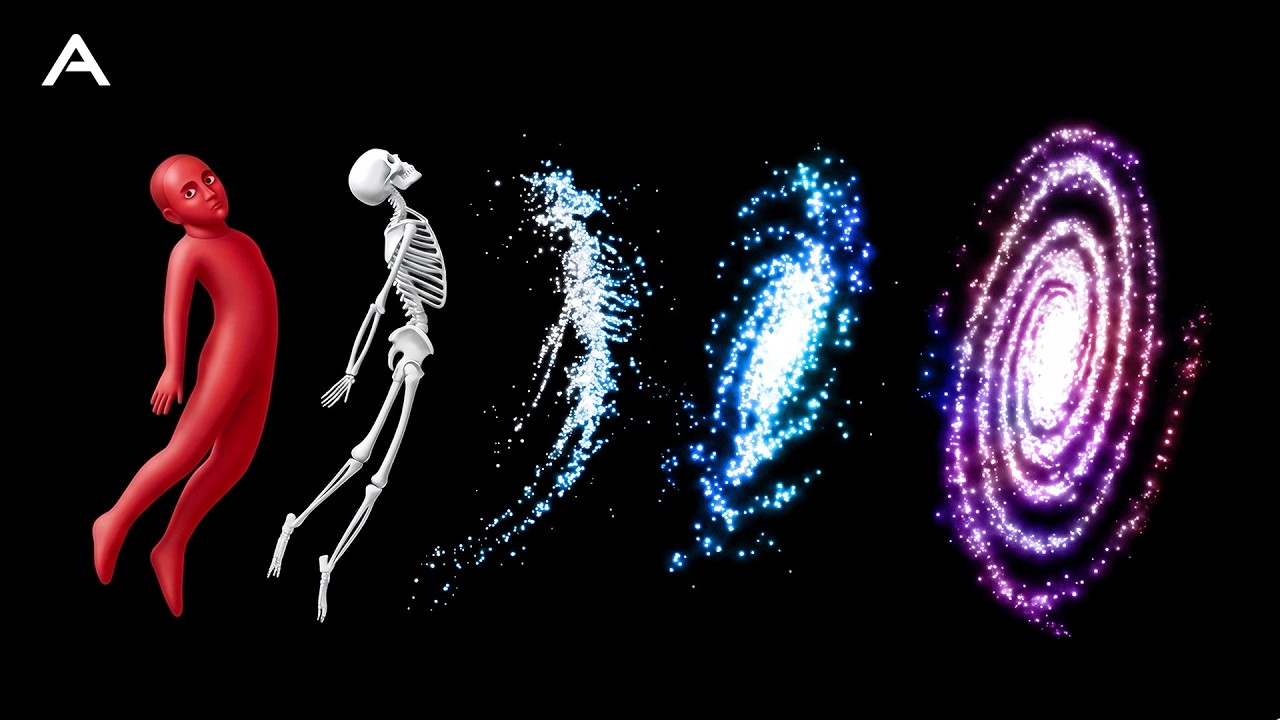
At a glance
Two hours and twenty minutes of narrated deep time, built around one uncomfortable ratio: anatomically modern humans have existed for more than 300,000 years, and everything we call history covers the last 5,000 of them. The documentary walks the other 295,000 in the video's own order, from the Jebel Irhoud skulls that came back dated at 315,000 years and pushed our species' origin back by more than a hundred millennia, through a world that held at least five human species at once, through a hunter gatherer life that ran on three to five hours of work a day, into painted caves eight times older than the pyramids, out across land bridges and 90 km ocean crossings that had to be planned, into the flower graves and red ochre and 20 ton pillars of a spiritual world with no scripture, and finally into the late plot twist of agriculture, which made people shorter, sicker and busier and won anyway because it made more babies. The reporting is honest about what the evidence cannot say: the record before 10,000 years ago is a few pages torn from a library of thousands of volumes, because wood rots, hide decays, and the coastlines where most people actually lived are now under 400 ft of seawater. What survives is enough to demolish the caveman cartoon completely. These were people with our brain, our capacity for language and grief and art, running knowledge systems so detailed that a modern specialist spends a career reconstructing a fragment of what an adolescent knew, and they are the reason you have the nervous system you are trying to run a city with.
The forgotten 95 percent (0:00)
The cold open is a subtraction problem. Think about everything you learned in history class. Ancient Egypt, the pyramids, Mesopotamia, the Roman Empire, maybe some Greek philosophers if your teacher was feeling ambitious. Now put a number on it. Modern humans, anatomically identical to you and me, have existed for over 300,000 years. Everything in those textbooks covers the last 5,000. That is less than 2 percent of our story.
So where is the other 98 percent? What were humans doing for those missing 295,000 years?
The answer, delivered flat and early, is going to sound crazy: we do not really know. Not in the way we know about Julius Caesar or Cleopatra. There are no written records because writing had not been invented yet. No kingdoms to study, because kingdoms did not exist. No cities, because nobody had built one. For most of human existence we left behind almost nothing except some tools, some bones, and mysteries carved into cave walls that we are still trying to decode.
This is not ancient history. This is something deeper and stranger. This is deep time, a scale so vast that civilizations rise and fall inside what amounts to a blink. And for reasons nobody really understands, we barely talk about it.
The brain that was already finished
Here is the detail that reframes everything that follows. A person living 200,000 years ago had the same size brain as you. The same capacity for language, emotion, creativity and problem solving. They could have learned to use a smartphone if you handed them one and gave them time. They were not primitive in the way we usually imagine. They were us, living in a world before everything we take for granted existed.
So what were they doing all that time? Sitting around waiting to invent farming? That does not make sense. Humans are too curious, too creative, too restless. For 295,000 years people were living full lives, raising children, telling stories, figuring out how to survive in environments that would kill most of us today. They were falling in love, making art, staring up at the same stars we see now and wondering what it all meant.
We do not learn about them. In school, history starts with writing. Before that it is a vague blur called prehistory, as if nothing important happened, as if the story only starts when someone figured out how to press symbols into clay tablets.
The narration calls that insane, and puts the imbalance in classroom hours. We spend weeks on the construction techniques of Egyptian pyramids, which are 4,500 years old. Impressive, absolutely. We spend maybe one class period, if we are lucky, on the fact that humans were creating sophisticated art 40,000 years ago. Cave paintings so beautiful and so technically skilled that when they were first discovered, scientists refused to believe ancient people could have made them.
The check in
Then, about three minutes in, the frame of the channel shows itself. If you are listening to this to fall asleep, perfect, that is exactly what this is for. But before you drift off, do me a favor and drop a comment. Where are you right now? What time is it? The narrator says he loves checking in and seeing Berlin at sunrise, Tokyo at lunch, Los Angeles at midnight, all of us connected across time zones, learning about people who lived across eons.
Because that, he says, is what this is really about. Connection. The people we are going to talk about are not aliens. They are not some separate species. They are our great great great grandparents repeated about 10,000 times.
And they did things that should be impossible.
The impossible things, listed up front
The intro lays out the promissory note for the whole documentary, and every item on the list gets paid off in a later chapter:
They crossed oceans without modern boats. They survived ice ages that turned most of Europe into an Arctic wasteland. They developed technologies we still do not fully understand. There is evidence they were performing complex surgical procedures 15,000 years ago. Evidence of long distance trade networks spanning thousands of miles. Evidence of astronomical knowledge, mathematical concepts, sophisticated social structures.
And then the part the narration says keeps archaeologists up at night: we have probably only found a tiny fraction of what existed.
Why the record is so thin
This is the methodological spine of the entire video, and it arrives before any of the content, which is the right place for it. Most traces of human activity from before 10,000 years ago have been erased by time. Wooden structures rotted away. Organic materials decomposed. Coastal settlements were swallowed by rising seas at the end of the last ice age. Entire chapters of human achievement are simply gone.
So what follows is not the complete story. It cannot be. The narration's image for it is exact: it is more like finding a few pages from a book that was thousands of volumes long.
But even those fragments are enough to completely change how we understand human history. They reveal a story stranger, older and more epic than anything in our history books. We are going back to the very beginning. Before civilization, before agriculture, before everything. Back to when humans were just another species trying to survive on a planet that did not care whether we made it or not.
Back to the missing 295,000 years. This is the story we forgot, the story of what humans did before history began.
Who were we? The first anatomically modern humans (5:52)
Picture someone who looks exactly like you. Same height range, same basic body proportions, same skull shape. Put them in modern clothes and they could walk down any street in the world without attracting a second glance.
Now imagine that person lived 300,000 years ago in Africa, in a world with no cities, no farms, no metal, no writing, no civilization of any kind.
That is the paradox at the heart of human prehistory. Anatomically modern humans, people who look just like us, emerged somewhere in Africa around 300,000 years ago. But for the next quarter million years they lived in ways that would seem utterly alien to us. They were not primitive versions of modern people. They were fully human, with the same cognitive potential we have, existing in a fundamentally different relationship with the world.
Jebel Irhoud, and the date that moved a species
The oldest fossils we have found come from a site called Jebel Irhoud in Morocco. The skulls show all the hallmarks of modern anatomy: high rounded craniums, small flat faces, and the distinctive chin that sets Homo sapiens apart from every other human species.
When anthropologists first dated these remains they expected them to be maybe 200,000 years old, fitting neatly into the existing timeline. Instead the dates came back at 315,000 years. The discovery pushed back the origin of our species by over 100,000 years.
And it shattered something else, which matters more than the number. It shattered the idea that modern humans emerged suddenly in one location, because similar fossils started turning up across Africa: in Ethiopia, in South Africa, in Kenya. All roughly the same age. All showing that distinctive modern anatomy.
This was not one population evolving in one place and then spreading. This was multiple populations across an entire continent, connected by networks of migration and gene flow, all evolving toward the same basic body plan. Our origin is not a point on a map. It is a continent wide braid.
A modern body is not a modern mind
Here is what the narration says keeps anthropologists awake at night. Having a modern body does not automatically mean having a modern mind.
Those early Homo sapiens, the ones from 300,000 years ago, had brains the same size as ours. They had the same neural architecture. But were they thinking the same way we think? Were they capable of abstract reasoning, symbolic thought, the kind of consciousness that lets humans wonder about the meaning of existence?
We do not know, and the uncertainty is maddening. The archaeological record from this early period is frustratingly sparse. Stone tools, yes. Evidence of hunting and gathering, yes. But nothing that screams modern human behavior. No art. No symbols. No clear evidence of the kind of abstract thinking that defines human culture today.
For over 100,000 years after anatomically modern humans appeared, the archaeological record looks almost identical to what Neanderthals and other human species were producing. Same basic tool types, same subsistence strategies, same apparent lack of symbolic behavior.
That gap created one of the biggest debates in anthropology, and the video states both sides cleanly. Did modern anatomy emerge first, with modern behavior following much later? Or did our ancestors always have the capacity for complex thought, and only started expressing it archaeologically when conditions were right?
Ochre at Pinnacle Point
The first hints of something different start appearing around 200,000 years ago. At a site called Pinnacle Point in South Africa, archaeologists found evidence of systematic ochre processing.
Ochre is a natural clay colored with iron oxide, ranging from yellow to deep red, and humans have been obsessed with it for hundreds of thousands of years. The question the video presses is: why? You cannot eat it. It does not make better tools. The only explanation that makes sense is symbolic. They were using it for decoration, for ritual, for marking bodies or objects as special.
That is the first real fingerprint of a mind that assigns meaning to things beyond their physical properties.
Beads, and the first deliberate graves
Around 100,000 years ago the evidence gets stronger. Shell beads start appearing, carefully perforated for stringing. These are not just pretty objects. They are symbols of identity. When you wear a bead you are making a statement about who you are, what group you belong to, what status you hold. That is abstract thinking: the ability to invest objects with meaning beyond their physical properties.
But the real game changer is burial. The first clear evidence of intentional burial by Homo sapiens appears around 100,000 years ago. Not bodies covered with dirt, but deliberate graves. Bodies positioned carefully, sometimes with objects placed alongside them.
This is consciousness confronting mortality. These are humans who understood that death was permanent, who felt the need to mark that transition with ritual.
The video slows down to make you feel the logistics of it, which is where the argument lands hardest. Someone dies. Instead of just leaving the body where it fell, the group stops everything. They dig a hole, a task that takes hours with primitive tools. They arrange the body carefully. Maybe they say words, perform rituals, express grief in ways we can only imagine. Then they cover the grave, and they remember where it is.
That requires abstract thought, emotional complexity, and the ability to conceive of existence and non-existence.
Were they wondering about the stars yet? When did a human first look up at the night sky and ask why? We will never know exactly. But burial suggests they were already asking the big questions. What happens after death? Why are we here? What does it all mean? These were not simple survival behaviors. These were the first stirrings of philosophy, religion and art, the emergence of the full human experience.
We were not alone
Then the chapter complicates itself, and this is the section that most changes the shape of the story. Our ancestors were not alone.
Between 300,000 and 40,000 years ago, Earth was home to at least five different human species, all living simultaneously, all competing for the same resources, all capable of sophisticated behavior.
The Neanderthals had Europe and Western Asia. They were manufacturing complex tools, hunting ice age megafauna, and creating the first systematic burial practices. Some evidence suggests they were using pigments, possibly creating cave art, definitely engaging in symbolic behavior. They were not primitive brutes. They were humans, just a different branch of the human family tree.
The Denisovans controlled huge swaths of Asia. We know less about them because we have found fewer fossils, just a handful of teeth and bone fragments from a cave in Siberia. But their DNA is everywhere. Modern populations from Tibet to New Guinea carry Denisovan genes, evidence that our ancestors encountered them and interbred with them across thousands of miles and thousands of years.
Then there were the others. Homo naledi in South Africa, with its strange mixture of primitive and modern features. Homo floresiensis in Indonesia, the so called hobbits, standing barely a meter tall but capable of making sophisticated stone tools. Homo luzonensis in the Philippines, known from a few fossils but representing yet another human lineage that survived into the age of Homo sapiens.
All of these species were human in the broadest sense. All had large brains, made tools, used fire, probably had language of some kind. And they all overlapped with us in time and space. Our ancestors knew they existed. They encountered them, competed with them, sometimes fought them, sometimes mated with them.
This is profoundly different from how we usually think about human evolution. We imagine a linear progression, one species evolving into the next in a neat chain leading to us. The reality was messy, chaotic, beautiful. Multiple human species, all experimenting with different survival strategies, all developing their own unique adaptations and cultures.
What made us different, and the four candidate answers
The question that haunts researchers is simple and unanswerable: what made Homo sapiens different? Why did we survive when all the others went extinct? Why are we the last human species standing?
The video walks the eliminations first.
It was not intelligence. Neanderthals had bigger brains than we did. It was not tool making ability. Other species created tools just as sophisticated as ours. It was not even symbolic thinking, because the evidence suggests multiple human species were capable of abstract thought.
Then the four candidates:
Social organization. Some anthropologists think Homo sapiens developed larger, more flexible social networks. Where Neanderthals lived in small bands of 30 or 40, maybe our ancestors formed coalitions of hundreds, trading information and resources across vast distances. Those networks would have provided resilience, allowing knowledge and innovations to spread rapidly.
Language. Not just communication, which other species certainly had, but true syntactic language with infinite generative capacity. The ability to express abstract concepts, tell stories about the past and future, share complex information with precision. If our ancestors developed language even slightly more sophisticated than other species, that advantage would compound over time.
Luck. This is the humbling possibility, and the narration gives it equal weight rather than treating it as a consolation prize. Maybe we survived not because we were superior, but because we happened to be in the right places when climate disasters hit, or because random chance favored our populations during critical bottlenecks. The fossil record is full of species that were wildly successful until they were not. Dominance guarantees nothing.
Or some combination that leaves no trace at all, which is the honest residue after the other three.
70,000 years ago: the record changes
What we know for certain is this. By 70,000 years ago, something had changed. The archaeological record shifts dramatically. Suddenly we see an explosion of sophisticated behavior: elaborate tools, long distance trade networks, musical instruments, sophisticated art, complex burial practices. Everything that defines modern human culture appears within a few thousand years.
Anthropologists call this the cognitive revolution, though the video says plainly that the name is misleading. It was not that human cognition suddenly improved. The hardware was already there, and had been there for hundreds of thousands of years. Instead, something unlocked the software.
Maybe language reached a critical threshold of complexity. Maybe population density increased enough that innovations could spread and accumulate. Maybe a genetic mutation affected brain development in subtle but important ways.
Or maybe nothing changed at all. Maybe the capacity was always there, waiting, and we only see it archaeologically when population sizes and preservation conditions finally made it visible. As the narration puts it, the absence of evidence, after all, is not evidence of absence.
By 60,000 years ago our ancestors were ready. They had the bodies, the brains, the social systems and the technologies to do something no human species had done before. They were about to leave Africa and conquer the entire planet.
But the world they were walking into was not empty. It was full of other humans, other species, all adapted to their own territories, all ready to defend their resources. The age of human diversity was ending. The age of Homo sapiens dominance was about to begin. First, though, they had to survive a journey into the unknown, carrying nothing but stone tools, fire, and the accumulated knowledge of 250,000 years of human experience.
- 2 million Homo erectus reaches Asia. Not the first exit from Africa, and not ours. Archaic humans ventured into the Levant repeatedly, established populations, then vanished when the climate shifted.
- 900,000 The great bottleneck. The near extinction event the narration references as the deepest crash our line survived, worse than anything in the ice age that followed.
- 315,000 Jebel Irhoud, Morocco. Skulls with rounded craniums, flat faces and a modern chin, dated a full 100,000 years earlier than anyone expected. Similar fossils turn up in Ethiopia, Kenya and South Africa.
- 200,000 Pinnacle Point, South Africa. Systematic ochre processing. You cannot eat it and it makes no better tool, so the only explanation left is symbolic.
- 130,000 The oldest deliberate burial found. A cave in Israel. Two bodies laid out with care, hands arranged, bodies oriented in a specific direction.
- 100,000 Beads, graves and flowers. Perforated shell beads for stringing; the first clear intentional Homo sapiens burials; pollen in a cave in northern Iraq from flowers carried to a Neanderthal grave; ochre crayons in South African sites.
- 75,000 Engraved ochre. Abstract patterns deliberately carved into chunks of pigment. Not representational art, but intentional marks: symbols before pictures.
- 70,000 The record changes. Elaborate tools, trade networks, instruments, art and complex burial appear within a few thousand years. The so called cognitive revolution, on hardware that was already hundreds of thousands of years old.
- 65,000 to 60,000 Out of Africa, and out to Sahul. A footprint in coastal Arabian mud; within roughly 5,000 years, descendants reach Australia across open ocean.
- 50,000 Australia occupied, at minimum. Bones and tools on islands never connected to any mainland even at low sea level. The Divje Babe flute, from a cave bear femur, may be this old; its authenticity is debated.
- 40,000 The creative explosion is fully visible. Cave art, carved figurines and bone flutes with precisely placed holes. Modern humans reach Europe; within about 5,000 years the Neanderthals are gone as a separate species.
- 39,900 Hand stencils in Indonesia. Pigment blown around a hand pressed to a cave wall in Sulawesi, dated older than anything then known in Europe.
- 36,000 Chauvet Cave, southern France. Lions, rhinoceros and cave bears, painted with stumped charcoal shading and overlapping bodies. Eight times older than the Great Pyramid.
- 35,000 The Venus of Hohle Fels. Carved from mammoth ivory, small enough to fit in your palm, polished smooth by repeated handling.
- 30,000 Arctic Siberia colonized. Winters to minus 50, semi subterranean houses heated by bone fires, tailored clothing sewn with fine bone needles.
- 20,000 The Last Glacial Maximum. Ice two miles thick over Canada, Scandinavia and most of Britain. Sea level 400 ft lower. Land bridges open between continents.
- 17,000 Lascaux. Horses, bulls and deer, with shading and perspective, painted from wooden platforms by the light of animal fat lamps.
- 15,000 Complex surgical procedures. Evidence of medicine performed on living people, cited in the opening as one of the impossible things.
- 14,000 Altamira, and Tierra del Fuego. Aurochs painted onto the natural bulges of a Spanish ceiling; at the other end of the world, humans reach the southern tip of South America.
- 12,000 The ice age ends. Ice sheets retreat, forests creep north, rainfall patterns shift, and the Fertile Crescent becomes warmer, wetter and more predictable.
- 11,600 Göbekli Tepe. Twenty ton carved pillars in circular enclosures, raised by hunter gatherers. Older than the pyramids by 7,000 years and than Stonehenge by 6,000.
- 9,000 Jericho. Mudbrick houses with plastered floors, wheat, barley and date palms, a massive stone wall and a tower taller than any building their ancestors had seen.
- 8,000 Çatalhöyük. A town so dense it has no streets. People walk the rooftops and climb down ladders into painted rooms, with bull skulls set in the plaster and the dead buried under the floors.
- 5,000 Cuneiform. Wedge marks pressed into wet clay with a reed stylus in Mesopotamia. Prehistory ends and history begins, not because people got interesting but because their voices could finally outlive their bodies.
- 4,500 The Great Pyramid. The oldest thing most of us were taught to think of as ancient, and one of the youngest events on this list.
- 3,500 The remote Pacific. Deliberate voyages of colonization to Hawaii, Easter Island and New Zealand, thousands of kilometres apart, in double hulled canoes.
- 1,000 Every habitable place on Earth. The expansion that began with one footprint in Arabian mud finishes with essentially no habitable land left unoccupied.
Life before farming: the hunter gatherer world (19:04)
The chapter opens by killing a picture. When you imagine a stone age human, what do you see? Probably some brutish, grunting creature huddled in a cave, barely surviving, living a short, nasty, violent life. The classic caveman: half ape, half human, more animal than person.
That image is completely wrong. Dangerously wrong, actually, because it prevents us from understanding who these people really were.
The humans living 50,000 years ago were not primitive versions of us. They were us. Same brain capacity, same cognitive abilities, same emotional complexity. Drop a baby from that era into a modern family and they would grow up indistinguishable from anyone else. They would learn to read, use smartphones, understand calculus. The hardware was identical. Only the software, the accumulated cultural knowledge, was different.
And then the claim that the rest of the chapter defends: in many ways they were better adapted to their world than we are to ours. They possessed knowledge systems so sophisticated, so finely tuned to their environments, that modern scientists spend careers trying to reconstruct tiny fragments of what every hunter gatherer child learned before adolescence.
A day, from the inside
The narration then walks a typical day, and is careful to say this is not speculation. It is built from decades of archaeological evidence and from careful observation of the few hunter gatherer societies that survived into the modern era.
You wake as the sun rises, not because of an alarm clock but because your circadian rhythm is perfectly synchronized with natural light cycles. You have slept around nine hours, maybe more in winter, curled against your family for warmth.
Your sleep was interrupted several times during the night, which is normal. Nobody slept in one continuous eight hour block until the industrial era invented that pattern. You would wake, tend the fire, check on children, talk quietly with others, then drift back to sleep. (For a documentary designed to be listened to in bed, this is a well placed detail: the segmented sleep you are probably about to have is the older pattern, not a malfunction.)
The first task is breakfast, and here the picture diverges from the cartoon immediately. You are not desperate for food. You are not starving. Archaeological analysis of hunter gatherer skeletons shows they were generally well nourished, often healthier than early agricultural populations. There is food from yesterday: nuts and dried meat, maybe some berries. You eat enough to feel satisfied, then begin the day's work.
Three to five hours
And the day's work takes maybe three to five hours.
Anthropologists studying modern hunter gatherers have documented this consistently: the Ju/'hoansi of the Kalahari, the Hadza of Tanzania, indigenous Australian groups. All of them worked dramatically less than modern humans. A few hours gathering plant foods or hunting, and then the rest of the day was leisure. Socializing, playing with children, making art, telling stories, napping, having sex.
This is what the anthropologist Marshall Sahlins called the original affluent society. Not because they had lots of stuff, but because they easily satisfied their material needs with minimal work, then spent the rest of their time doing things they actually enjoyed.
The narration lets that sit for a beat. Your ancestors 50,000 years ago probably worked fewer hours than you do. They had more free time than most modern people. More time for friends, for family, for creativity, for rest.
The work was skilled labor
The hours were few. The competence was not.
Gathering plant foods was not picking whatever looked edible. It required encyclopedic knowledge of hundreds of plant species. Which parts were edible and when. How to process toxic plants to make them safe. Where different species grew in different seasons. How weather patterns affected availability.
A skilled gatherer, usually but not exclusively women, could look at a landscape and see what modern eyes would miss entirely. That patch of unremarkable grass has edible roots three feet underground. Those trees, their inner bark is nutritious in late winter when nothing else is available. That flowering plant, its seeds will not be ready for another two weeks, so mark the location and return then.
This knowledge was detailed, precise and scientific in everything but name. It had to be. Mistakes could kill you. Confuse one plant species with a toxic lookalike and you would die in agony. Miss the seasonal timing and you would go hungry.
Hunting required equally sophisticated knowledge. Tracking an animal across varied terrain. Interpreting days old signs to reconstruct its behavior. Understanding animal psychology well enough to predict movements. Knowing which hunting techniques worked for which species in which conditions.
The best hunters were not just strong or fast. They were naturalists, ecologists, applied psychologists. The narration puts the comparison bluntly: they understood their prey better than most modern biologists understand laboratory animals. They could predict where a herd would be three days from now based on weather patterns, vegetation growth and seasonal behavior.
And they did not hunt alone. Cooperative hunting was the norm. Groups of hunters working together using elaborate communication, sometimes spanning hours or days, driving game toward ambush points, coordinating movements across miles. That requires language, planning, trust and leadership: all the cognitive abilities that supposedly distinguish modern humans.
The health record, read off the bones
Here is where the evidence gets genuinely surprising, because it is not a matter of interpretation. Skeletons do not lie.
Pre agricultural humans were, on average, healthier than their farming descendants. Hunter gatherer remains show less tooth decay, less bone disease and better overall nutrition than early farmers.
They were taller too. Average height dropped significantly when humans adopted agriculture, and did not recover until the 20th century. Your Paleolithic ancestors were likely taller than your grandparents, and possibly taller than you.
They had fewer infectious diseases, because they lived in small groups that moved frequently. Epidemic diseases require dense settled populations to sustain themselves. Hunter gatherers were too mobile, too dispersed. A disease might kill one band, but would not spread further.
The narration is careful not to romanticize. Life was not perfect. Injury was dangerous. A broken leg could mean death if you could not keep up when the band moved. Childhood mortality was significant, though not as catastrophic as often claimed.
But if you survived to adulthood you had a decent chance of living into your 60s or 70s. Not the "everyone died at 30" myth you have probably heard, which is an artifact of averaging in infant deaths.
Bands of 20 to 50, and why nobody ruled
The social structure was radically different from anything most modern people experience. These bands, typically 20 to 50 people, were profoundly egalitarian.
And the reason given is the interesting part. Not because they had noble philosophies about equality, but because inequality was impossible to maintain. You cannot accumulate wealth when you are constantly moving. You cannot dominate others when survival depends on cooperation. You cannot claim ownership of land when your whole territory spans hundreds of miles and you share it with neighboring bands.
Leadership existed, but it was fluid and situational. The best hunter might lead during a hunt. The most knowledgeable elder might guide decisions about moving camp. The most skilled healer would direct medical care. But nobody ruled. Nobody commanded. Authority came from competence, not position.
The sharing economy, with the incentives spelled out
This created what anthropologists call a sharing economy, and again the video refuses the sentimental version. Not because people were selfless saints, but because sharing was the only rational strategy.
Kill a large animal and you cannot possibly eat it all before it spoils. No refrigeration, remember. So you share it with the whole band, knowing that when someone else makes a kill, they will share with you. The meat you cannot store is stored in the obligations of other people.
This extended beyond food. Knowledge was shared freely: toolmaking techniques, hunting strategies, medicinal plant knowledge. Hoarding information would be absurd when everyone's survival depended on the collective knowledge base.
Alloparenting, and an education that took years
Children grew up in this communal environment. They were not raised by just their parents but by the entire band, with multiple adults caring for them, teaching them, protecting them. This is called alloparenting, and the narration makes the reversal explicit: it is probably the ancestral human condition, and the isolated nuclear family is the weird modern innovation.
And the children were being taught knowledge systems that took years to master. How to read landscapes. Understand animal behavior. Process foods. Make tools. Treat illnesses. Navigate by stars. Predict weather. Maintain social relationships. This was education as rigorous as anything in a modern school, just conducted through apprenticeship and practice rather than formal instruction.
The pharmacy nobody wrote down
Plant medicine alone represents an astonishing intellectual achievement. Hunter gatherers knew which plants reduced fever, which treated infections, which eased pain. They understood that willow bark contains the compound we now call aspirin, that certain molds have antibiotic properties, that specific plants could induce abortion or ease childbirth.
This was not superstition. This was pharmacology developed through centuries of careful observation and experimentation. The narration's line for it: they were doing science, they just were not writing it down.
Why it lasted 200,000 years
So why did this lifestyle persist for over 200,000 years? Why did it work so well for so long? The video gives three reasons and then, honestly, the costs.
Because it was sustainable. Hunter gatherers existed in relative balance with their ecosystems. They were not passive victims of nature. They shaped their environments through controlled burning, selective harvesting, even proto agriculture in some regions. But they did not deplete resources faster than those resources could regenerate.
Because it was adaptable. When conditions changed, hunter gatherers could move, shift their diet, adjust their strategies. They were not locked into one way of life the way farmers would be, dependent on specific crops and specific territories.
Because it was affluent in the real sense. Not materially wealthy, but satisfied. Needs met without grinding labor. Time for rest, for creativity, for human connection.
And the limits, stated as features rather than failures. Band size stayed small because larger groups could not maintain the egalitarian sharing economy. Technology advanced slowly because innovation was local and knowledge transfer between distant groups was limited. Population density stayed low because the hunter gatherer lifestyle could not support more people per square mile. These were not stupid constraints. They were the shape of a successful adaptation.
For 200,000 years, this was the human condition. This was the life that shaped our psychology, our social instincts, our fundamental nature.
And when agriculture finally emerged around 10,000 years ago, it did not replace hunting and gathering because it was obviously better. Early farmers worked harder, ate worse and died younger than their hunter gatherer neighbors. But agriculture supported denser populations, and eventually numbers won. (The video returns to this ledger in full later, and settles it the same way.)
Still, we carry the hunter gatherer blueprint in our minds and bodies. Our craving for variety in diet. Our need for social connection. Our ability to learn complex skills through observation. Our egalitarian instincts, which make us uncomfortable with extreme inequality.
Understanding this is not just academic. It is about recognizing what kind of creature you actually are, what your mind and body were designed for, and why modern life sometimes feels so profoundly wrong. Your ancestors were not primitive. They were sophisticated, knowledgeable, and in many ways free in ways we have forgotten how to be.
The first artists: cave paintings and the birth of creativity (32:45)
This is the chapter where the documentary stops arguing and starts describing, and it is the best writing in the whole two hours. It opens in second person, in a passage.
Picture yourself descending into a cave in southwestern France. Not a modern tourist cave with electric lights and handrails, but a narrow passage discovered by accident in 1940, when a teenager's dog fell through a hole in the ground.
You squeeze through the entrance, your torch casting shadows on rough stone walls. You crawl forward through passages barely wide enough for your shoulders.
And then the tunnel opens up.
The walls explode with life. Horses gallop across the ceiling. Bulls charge through painted meadows. Deer leap and twist in impossible grace. The animals seem to move in the flickering torch light, muscles rippling, heads turning to watch you as you pass. The paintings cover everything, layered over each other in some places, carefully spaced in others.
This is not random graffiti. This is art. Sophisticated, intentional, breathtaking art.
Welcome to Lascaux. One of the most extraordinary art galleries ever created. And it is 17,000 years old.
And Lascaux is not even the oldest
Here is what makes your head spin. Lascaux is not the oldest. Not by a long shot.
The Chauvet Cave in southern France contains paintings dated to 36,000 years ago. The lions and rhinoceros and bears painted on those walls are nearly twice as old as Lascaux. Some hand stencils found in caves in Indonesia date back 39,900 years. And there is growing evidence that the creative explosion actually started even earlier, maybe 50,000 years ago or more.
Then the comparison that reorganizes your sense of scale. The Great Pyramid of Giza is 4,500 years old. The cave paintings at Chauvet are eight times older than the pyramids. Eight times. These artists were separated from ancient Egypt by more time than ancient Egypt is separated from us.
Sit with that. When Egyptian pharaohs were building monuments to their gods, the paintings in Chauvet Cave were already ancient history. Incomprehensibly old. As distant to them as they are to us.
They are not crude. That is the whole problem.
And yet if you look at those paintings today, if you really study them, you see something that stops your breath. They are not primitive. They are not crude approximations or simple stick figures. They are masterpieces.
The horses at Lascaux show shading and perspective. The artist understood how to create the illusion of three dimensional form on a two dimensional surface. They mixed pigments to create different colors: reds and yellows and blacks made from iron oxides, manganese and charcoal. They used the natural contours of the cave walls to give their animals volume and movement. A bulge in the rock becomes the shoulder of a bison. A crack transforms into the leg of a horse.
At Chauvet the technique is even more sophisticated. Artists used stumping, blending charcoal with their fingers or tools to create soft shadows and highlights. They showed animals in motion, legs positioned to suggest running or fighting. They understood overlapping, painting one animal behind another to create depth.
These were not lucky accidents. This was technique. Skill developed over years, maybe decades, passed down from master to apprentice across generations.
The aurochs bulls at Altamira in Spain, painted around 14,000 years ago, used the ceiling's natural bumps and hollows so effectively that the animals seem to breathe. Stand beneath them with a flickering lamp, the way the original artist did, and the paintings come alive. The cattle shift and move.
The effect is so powerful that when the paintings were first discovered in 1879, scientists refused to believe they were genuine. Nothing that old could be that good.
Except it was.
What it cost to make them
Before the video asks why, it inventories the effort, and the inventory is what makes the "why" a real question.
These were not doodles scratched during idle moments. The caves go deep, hundreds of feet into the earth, through passages that are cold, dark and dangerous. The artists had to bring in materials: pigments ground from minerals, animal fat for lamps, scaffolding to reach the high ceilings. At Lascaux there is evidence they built wooden platforms to paint the upper galleries.
They had to prepare the cave walls, sometimes scraping them clean. Mix their paints to exactly the right consistency. And work by firelight or the dim glow of stone lamps burning animal fat, which gives maybe one tenth the light of a candle.
This was not casual. This was deliberate, systematic, important. Important for what?
Hunting magic, and why it probably fails
The standard answer is ritual. Hunting magic. The theory goes that by painting the animals, prehistoric humans believed they could control them, ensure successful hunts, maybe even influence the animals' movements and behavior. Paint the bison, catch the bison.
It is elegant. It makes sense. And, the narration says, it might be completely wrong.
Because many of the animals painted in these caves were not primary food sources. At Chauvet the walls are dominated by dangerous carnivores: lions, cave bears, rhinoceros. These were not animals our ancestors hunted regularly. The archaeological evidence shows they mostly ate reindeer and horses, and those animals are far less common in the cave art.
If this was hunting magic, they were doing it wrong.
Three other readings, and one that is not a theory at all
Temples. Some researchers think the caves were sacred spaces, places where shamans conducted rituals and initiations. The deepest chambers, the ones requiring the most dangerous climbs and squeezes, might have been used for vision quests or coming of age ceremonies. The narration builds the scene: imagine being a teenager 20,000 years ago, crawling through absolute darkness, squeezing through gaps barely wide enough for your body, finally emerging into a hidden chamber where the walls explode with painted animals that would mark you, change you, make you understand you were part of something ancient and powerful.
Storytelling and record keeping. Others suggest the paintings were maps of migration routes and hunting territories, records of important events, teaching tools to pass knowledge to the next generation. The paintings do cluster in specific areas, almost like chapters in a book. Maybe they were meant to be read in sequence, telling stories we can no longer understand.
Or because they had to. The last possibility is not an anthropological theory and the video knows it. Maybe they did it for the same reason artists do anything. Because something in them needed to create. Because they looked at a blank wall and saw horses running, bulls charging, deer leaping, and they could not rest until they brought that vision into the world.
Stand in front of those paintings, really look at them, and you feel the presence of the artist. Not as an abstract prehistoric human but as an individual, someone who stood exactly where you are standing, who lifted their hand, touched pigment to stone and left part of themselves behind. Someone who had hopes and fears and dreams and frustrations. Someone who saw beauty in the world and wanted to capture it, preserve it, share it.
The handprints
And sometimes they left something more direct. Handprints. Hundreds of them, scattered across cave walls from France to Indonesia to Argentina.
The technique is simple. Place your hand flat against the wall. Blow pigment around it, probably through a hollow bone or reed. Remove your hand. What is left is a negative image, a stencil, a ghost of your presence.
These handprints are haunting. Touch one, place your hand directly over the print, and you are connecting with someone across 30,000 years. Your palm rests where their palm rested. Your fingers align with their fingers.
And the prints carry data. The size tells you things: small hands, probably women or adolescents. Some prints show missing fingers, possibly from frostbite or ritual amputation. One cave in Argentina has the handprints of an adult and a child side by side, as if a parent and child stood together to mark their presence.
They are saying something, these handprints. Maybe just: I was here. The simplest, most human impulse imaginable. The same reason people carve initials in trees or write their names in wet concrete. The desire to leave a mark, to be remembered, to matter.
| Site | Where | Age in the video | What is on the walls | What the technique shows |
|---|---|---|---|---|
| Indonesian hand stencils | Caves in Indonesia; the narration later names the artists of Sulawesi | 39,900 years | Negative hand stencils, pigment blown around a hand pressed to rock | Symbolic marking on the far side of the world, older than anything in France |
| Chauvet | Southern France | 36,000 years | Lions, rhinoceros, cave bears, dangerous carnivores dominating the walls | Stumping with fingers for shadow, animals shown mid motion, overlapping bodies for depth. Undercuts hunting magic, since they mostly ate reindeer and horses |
| Lascaux | Southwestern France, found in 1940 when a teenager's dog fell through a hole | 17,000 years | Horses galloping across the ceiling, charging bulls, leaping deer, layered and spaced | Shading and perspective, iron oxide reds and yellows, manganese and charcoal blacks, wooden platforms built to reach the upper galleries |
| Altamira | Spain | 14,000 years | Aurochs bulls across a bulging ceiling | Natural bumps and hollows used as anatomy, so the herd moves in lamplight. Rejected as a forgery in 1879, because nothing that old could be that good |
| The handprint caves | France, Indonesia, Argentina | Around 30,000 years where the narration dates them | Hundreds of stencilled hands, some small, some missing fingers, one adult and child pair side by side | The plainest message in prehistory: I was here |
Portable art
Cave paintings were not the only art form. Portable art exploded during the same period. Carved figurines appear in the archaeological record around 40,000 years ago.
The Venus of Hohle Fels, found in Germany, is carved from mammoth ivory and dates to about 35,000 years ago. It is tiny, it fits in your palm, but the detail is extraordinary. Exaggerated female features, carefully incised details, and a surface polished from being handled repeatedly. This was something precious, something carried and treasured.
Similar figurines appear across Europe: the Venus of Willendorf, the Venus of Lespugue, the Venus of Brassempouy, all showing similar stylistic choices, emphasizing fertility and femininity.
Were these religious idols, fertility symbols, portable representations of a goddess? Or were they something simpler: representations of specific individuals, prehistoric portraits carried by people far from home? The video leaves both live.
Tools became art too. Spear points carefully knapped not just for function but for beauty. Bone needles decorated with geometric patterns. Pendants carved from shells and teeth. Someone spent hours creating decorative beading on a leather pouch that would last maybe a few years before wearing out.
That is not survival. That is aesthetics. That is caring about beauty even when life is hard.
And they made music
Bone flutes appear in the archaeological record about 40,000 years ago. These are not simple whistles. They are sophisticated instruments with multiple holes, capable of producing different notes.
The Divje Babe flute, made from a cave bear femur, might be 50,000 years old, though its authenticity is debated. Later flutes, like those found at Geissenklösterle in Germany, are unquestionably instruments, carefully crafted with precisely placed holes that produce a musical scale.
Imagine that sound. A flute carved from bird bone, played in a firelit cave 35,000 years ago. What songs did they play? Lullabies, hunting songs, mourning songs for the dead? The music is gone, lost forever. But the instruments remain, silent testimony that our ancestors did not just survive. They sang.
They probably danced too. Some cave paintings seem to show figures in motion, possibly dances. Archaeological sites show areas that might have been cleared for performances, spaces with good acoustics where sound would carry and echo.
Music and dance and firelight and painted walls. Ritual and art and community, all woven together.
The art we will never see
Then the chapter turns its own evidence over, which is the move that gives the whole video its intellectual honesty. Was there art before this? Art that did not survive?
Paint fades. Wood rots. Leather decays. The earliest art we have found is all in caves or carved from durable materials. But what if they painted on bark, on hide, on their own bodies? What if the creative explosion we see 40,000 years ago was not the beginning at all, but just the point where art finally started being made from materials that could survive?
There is evidence pointing that way. Ochre crayons, pieces of pigment apparently used for drawing, appear in South African archaeological sites dating back 100,000 years. Abstract patterns carved into ochre chunks date back 75,000 years. These are not representational art like the cave paintings, but they are intentional marks, patterns, symbols. The beginning of symbolic thought.
Maybe the cave paintings we marvel at today were not revolutionary at all. Maybe they were just the latest expression of a creative tradition stretching back a hundred thousand years or more, a tradition we can only glimpse through the tiny fraction that survived.
But what we do see tells us something profound about who we were. We were not just trying to survive. We were trying to live, to create meaning, to transform the world around us into something beautiful and sacred. To leave messages for the future. To say: I was here. I mattered. I saw beauty and I made it real.
Those cave painters are our ancestors, and their creative impulse lives in us. Every painting, every song, every story we create today is part of that same unbroken tradition that started in firelit caves 40,000 years ago. The first artists are still speaking to us, still showing us who we are, still reminding us that being human means more than just surviving. It means creating, expressing, connecting across time and space through the universal language of art.
And in the quiet darkness of those painted caves, the narration says, if you listen carefully you can almost hear them. The ancient voices singing songs we have forgotten, telling stories that echo through millennia, inviting us to remember that we have always been artists, always been dreamers, always been human.
Myths of the Ice Age: surviving the extremes (48:23)
Picture the world 20,000 years ago. Ice sheets two miles thick covering Canada, Scandinavia and most of Britain. Glaciers grinding their way south across what would become New York, Berlin, Moscow. So much water locked up in ice that sea levels dropped 400 ft, pushing coastlines out for miles and exposing land bridges between continents.
The planet was a freezer, and your ancestors were living in it.
This was the Last Glacial Maximum, the deepest freeze of the most recent ice age. And somehow, impossibly, humans not only survived it. They thrived. They multiplied. They spread across frozen landscapes that should have killed them. They turned the ice age into an opportunity.
It was never one long freeze
Here is what most people do not understand about the ice age. It was not a single winter that lasted a hundred millennia. It was a series of climate swings that lasted over 100,000 years. Periods of intense cold punctuated by brief warming phases, then plunging back into glaciation.
The climate was unstable, unpredictable, capable of shifting dramatically within a single generation. Your ancestors had to adapt to that chaos. And the narration's claim, defended for the rest of the chapter, is that they did it through innovation that would make modern engineers jealous.
The needle and the coat
Start with the most basic problem: staying warm. When temperatures plunge below freezing for months at a time, exposure kills you in hours. Your ancestors could not just huddle around fires and hope for the best. They needed technology.
So they invented clothing as we know it. Not simple animal skins draped over shoulders, but tailored, fitted garments designed to trap heat and block wind.
The archaeological evidence shows they were sewing complex outfits 30,000 years ago, maybe earlier. Bone needles, incredibly fine and precisely made, show up in ice age sites across Europe and Asia. These were not crude implements. These were specialized tools that could pierce leather and sinew, creating watertight seams.
Think about what that means cognitively, and the video spells out the chain because the chain is the point. You have to kill an animal. Process its hide through days of scraping and curing. Cut pieces to specific patterns that match the human body. Then stitch them together with cordage made from animal sinew.
That is planning. That is abstract thinking. That is engineering.
And they did not stop there. Evidence suggests they were creating layered clothing systems: base layers against the skin, insulating middle layers of fur, weather resistant outer layers. The same principles modern mountaineers use, invented by ice age humans with nothing but stone tools and animal materials.
Houses made of mammoth
Clothing alone was not enough. They needed shelter. And in the treeless, frozen steppes of ice age Europe and Asia, there was no wood for substantial construction.
So they improvised. They built houses out of bones.
Mammoth bone houses: structures using hundreds of bones from multiple animals arranged in circular patterns, with mammoth skulls forming the foundation, long bones arched overhead to create dome shaped frames, all covered with hides and sod for insulation.
These were not temporary camps. These were engineered dwellings designed to withstand winter winds and heavy snow loads.
One site in Ukraine shows a mammoth bone house that required the bones from at least 95 different mammoths. The construction would have taken weeks, maybe months.
And it worked. People lived in these structures for years, maybe generations, successfully weathering winters that would kill an unprotected human in hours.
Running a fire economy
Inside these shelters they maintained fires using a carefully managed fuel economy. When wood was scarce they burned bone, which produces intense heat but requires sophisticated fire management to ignite and maintain. They created stone lined hearths that maximized heat output and minimized smoke. They developed ventilation systems that let smoke escape while preserving warmth.
This is survival engineering at the highest level, and the narration notes that we only know about it because stone and bone happen to survive. The parts of that system made of hide and cord are gone.
Hunting animals that weigh several tons
It gets more impressive when you consider what they were hunting. Mammoths. Woolly rhinoceros. Giant bison. Megafauna that could weigh several tons, animals that could kill a human with a single blow.
And your ancestors were taking them down regularly enough to build houses from their bones.
How do you hunt a mammoth with stone tipped spears? Very carefully, with very sophisticated tactics.
The evidence suggests coordinated group hunting strategies that required complex planning and communication. They identified migration routes and returned to the same locations year after year, places where terrain channeled animal movements into predictable patterns. They used natural features, cliffs, ravines, frozen rivers, to create kill zones where large animals could be trapped or driven. Some sites show evidence of systematic butchering operations that processed thousands of pounds of meat and bone.
This was not opportunistic scavenging. This was organized hunting, possibly involving dozens of people working in coordinated teams with planned roles.
And they wasted nothing. Meat for food. Bones for shelter and tools. Hides for clothing. Sinew for cordage. Fat rendered for fuel and waterproofing. A single mammoth could sustain a group for months if properly processed and stored, and in the frozen north natural refrigeration meant meat could be preserved through long winters, stockpiled against lean times.
The bottlenecks
Even the best hunters face disasters. Climate fluctuations. Animal migration pattern changes. Disease outbreaks. Accidents.
During the ice age, human populations experienced multiple bottlenecks, periods when total numbers crashed to frighteningly low levels. Genetic analysis shows several of these near extinction events, times when human populations dropped to a few thousand individuals worldwide. Not as severe as the great bottleneck 900,000 years before, the narration notes, but still moments when our species teetered on the edge of oblivion.
What saved us was the same metapopulation structure that had preserved our ancestors during earlier crises: small groups scattered across vast territories, connected by kinship networks and trade relationships, but independent enough that no single disaster could eliminate everyone. When one group failed, others survived. When resources collapsed in one region, people migrated to territories where conditions were better.
This flexibility, this ability to move and adapt rather than stay and perish, was perhaps the most important survival strategy of all.
The land bridges the freeze opened
And move they did. The ice age created opportunities for migration that had not existed before. Lowered sea levels exposed land bridges between continents:
- The Bering Land Bridge connected Asia and North America, a thousand mile wide corridor of frozen grassland that allowed humans and animals to walk between continents.
- The Sunda Shelf connected the Southeast Asian mainland with Indonesia, creating a vast peninsula where islands now exist.
- Bass Strait linked Australia and Tasmania.
- Britain was attached to continental Europe.
These land bridges were not just narrow crossings. They were extensive territories with their own ecosystems and resources. Humans exploited them brilliantly, following animal migrations across continental boundaries, establishing trade networks that stretched thousands of miles, sharing technologies and knowledge across populations that would eventually be separated by rising seas.
Coastal routes also became crucial. As ice locked up water, exposed coastlines provided resource rich corridors for human migration. Shellfish, seabirds, marine mammals, all concentrated in coastal zones that humans could exploit with relatively simple technologies. Evidence suggests some populations became specialized coastal dwellers, developing boats and fishing technologies that allowed them to follow coastlines around entire continents.
That might explain how humans reached Australia at least 50,000 years ago, a journey that would have required crossing significant stretches of open water even when sea levels were low.
Refugia, and a climate that kept moving
The ice age was shaping human destiny as a constant, relentless force. But it was not only making things harder. It was also creating opportunities, opening new territories, concentrating resources in refugia where humans could thrive.
In southern Europe, regions like the Franco-Cantabrian zone became ice age refugia where relatively mild climates and abundant resources supported dense human populations. Those regions became hotspots of cultural innovation, producing the magnificent cave art the video has already walked through and developing sophisticated tool technologies that would spread across the continent.
In Africa, shifting rainfall patterns created and destroyed lakes, grasslands and forests over millennia. Humans tracked these changes, moving with the resources, adapting to new environments as conditions shifted. The Sahara alternated between desert and grassland multiple times, each transition forcing populations to migrate or adapt.
Asia's diverse geography created dozens of isolated regions where populations developed unique survival strategies. High altitude groups in Tibet and the Himalayas adapted to thin air and extreme cold. Steppe populations followed vast herds across grasslands. Forest dwellers developed technologies for exploiting dense woodland resources.
And through it all the climate kept changing. Temperatures fluctuating. Ice advancing and retreating. Sea levels rising and falling. Your ancestors lived through climate changes more dramatic than anything modern civilization has experienced, changes that destroyed ecosystems and created new ones, that forced entire populations to move or perish.
They survived through intelligence, cooperation and technological innovation. Through social systems that maintained knowledge across generations. Through trade networks that shared resources and information. Through cultural adaptations that let them thrive in environments that should have been impossible for a tropical ape to inhabit.
By the time the ice age finally ended 12,000 years ago, humans had spread to every continent except Antarctica. They had developed technologies and survival strategies that would form the foundation for agriculture, civilization, everything that came after. But they were still hunter gatherers, still living in small groups, still following the ancient patterns that had sustained humanity for hundreds of thousands of years.
The ice age had tested them relentlessly, and they had passed every test.
The great migrations: how humans conquered the Earth (1:01:08)
The chapter opens on a single image, and it is the best cold open in the video.
Picture a single footprint in wet sand, on a beach in what would one day be called Arabia, 60,000 years ago, maybe less. One human foot pressing into coastal mud during low tide. Behind that person, Africa. Ahead, literally the entire rest of the world. Empty. Waiting.
That footprint, long since washed away, marked the beginning of the greatest migration in Earth's history.
Not the first attempt. The first one that took.
The narration is careful here. This was not the first time humans left Africa. There had been earlier attempts, earlier waves. Homo erectus had made it to Asia nearly two million years before. Other archaic humans had ventured into the Levant, established populations, then vanished when the climate shifted.
But this time was different. This time the migrants carried something their predecessors had not possessed: the full package of modern human cognition, enhanced by hundreds of thousands of years of natural selection, refined by the genetic bottleneck, sharpened by survival in Africa's unpredictable environments.
They were not planning to conquer the world. They were probably just following game animals along the coast, maybe fleeing drought or conflict back home, perhaps simply curious about what lay beyond the horizon.
But what they started would, within just 50,000 years, put human footprints on every continent except Antarctica. In every environment Earth had to offer, from Arctic ice to tropical rainforest, from mountain peaks to remote ocean islands.
The speed would have seemed impossible to earlier human species. Neanderthals had taken hundreds of thousands of years to spread across Europe and Western Asia. Denisovans had expanded through Eastern Asia over similar timescales. Modern humans went from a small population confined to Africa to a global species in what amounts to an evolutionary eyeblink.
The coastal road, at 5 to 10 km per generation
The first route out was probably coastal: following the shoreline of the Arabian Peninsula, then along the coast of South Asia.
The video explains why that makes sense for a species that evolved in Africa. Coastal environments offer reliable resources: shellfish, fish, seabirds, sea turtle eggs. You do not need to learn entirely new survival strategies when you are following a coastline. The beach in Yemen looks different from the beach in India, but the basic resource extraction techniques remain similar.
And here is the arithmetic that makes the expansion comprehensible. These coastal migrants were moving maybe 5 to 10 km per generation. That sounds like nothing. Compound it over a thousand generations and you have circumnavigated half the planet.
Genetic evidence suggests the descendants of those first migrants reached Australia within about 5,000 years of leaving Africa.
Australia, and the voyages that had to be planned
Australia. Sit with that for a moment, because it is the hinge of the chapter.
To reach Australia 65,000 years ago required crossing open ocean. Not paddling across a narrow strait, but making multiple sea crossings, some of them over 90 kilometres of open water, out of sight of land, navigating by stars, currents, bird flight patterns, whatever environmental cues they could read.
This was not accidental. The narration hammers the point twice, because everything else in the chapter depends on it: you do not accidentally build boats capable of carrying families and supplies across 90 km of ocean. You do not accidentally navigate to a continent you have never seen.
These were planned voyages, deliberate expeditions into the unknown. Some probably ended in disaster, boats swept off course, families lost to storms or currents. But enough succeeded that within a few thousand years humans had established populations across the Australian continent and even reached New Guinea, which was connected to Australia during the ice age.
And they did not just arrive and survive. They thrived. Aboriginal Australians developed sophisticated fire management techniques, essentially terraforming the continent to suit their needs. They created trade networks spanning thousands of kilometres. They developed some of the world's most complex kinship systems. All of this across environments ranging from tropical rainforest to burning desert to temperate woodland.
Meeting the others, and keeping them
Meanwhile, back in Asia, other branches of that initial out of Africa migration were pushing north and west.
Some groups moved into the Middle East, where they encountered Neanderthals. The genetic evidence shows they did not just compete with Neanderthals. They interbred with them. Modern humans of European and Asian descent carry roughly 2 percent Neanderthal DNA, the legacy of those ancient encounters.
Other groups pushed further east into what is now China and Southeast Asia. There they met Denisovans, and again interbreeding occurred. Modern Melanesians carry up to 5 percent Denisovan DNA. Some Tibetan populations have Denisovan genetic variants that help them process oxygen at high altitudes.
We literally carry pieces of these extinct human species in our genome. Souvenirs from meetings that happened 50,000 years ago.
Europe, replaced in 5,000 years
Around 40,000 years ago humans reached Europe. Not the first humans there, of course. Neanderthals had been living in Europe for hundreds of thousands of years.
But modern humans brought something new, and within about 5,000 years of arriving they had essentially replaced the Neanderthal population.
The video is careful about the mechanism. Not through violence necessarily, though conflict certainly occurred. More likely through competitive exclusion. Modern humans could simply extract more resources from the same environments, support larger populations, innovate faster when conditions changed. The Neanderthals, magnificent survivors who had endured ice age after ice age, could not compete with populations that could create art, develop complex symbols and maintain larger social networks.
By 40,000 years ago the Neanderthals were gone. Not extinct in the absolute sense, since they left genetic contributions in modern humans, but extinct as a separate species, absorbed into the expanding modern human population.
Siberia at minus 50
Modern humans were also pushing into environments no human species had ever successfully colonized: the Arctic reaches of Siberia, where winter temperatures could drop to minus 50 degrees.
The archaeological record shows they were there by 30,000 years ago. Developing specialized cold weather technologies. Tailored clothing made from multiple animal skins. Semi subterranean houses heated by bone fuelled fires. Sophisticated strategies for hunting mammoth and other ice age megafauna.
And, crucially, they were not merely enduring. They were creating art, burying their dead with elaborate grave goods, manufacturing complex tools from mammoth ivory and bone. Living, not just surviving, in one of Earth's most challenging environments.
The Americas, and the dates that keep moving
Then came the really big journey: the peopling of the Americas. And here the video does something valuable, which is to show a consensus in the middle of collapsing.
For decades the consensus was that humans first entered the Americas around 13,000 years ago, crossing Beringia, walking through an ice free corridor between massive glaciers, then spreading rapidly down through North and South America.
Recent discoveries have complicated that neat story. Archaeological sites in both North and South America are pushing the dates back. Maybe 15,000 years ago. Maybe 20,000. Some controversial sites suggest even earlier dates, though those remain hotly debated.
The route is being reconsidered too. Maybe, instead of walking through an ice corridor, the first Americans traveled by boat along the Pacific coast, island hopping down from Alaska to Chile.
What is certain is that once humans reached the Americas they spread with astounding speed. By 14,000 years ago they had reached the southern tip of South America. That is roughly 15,000 kilometres from the Bering Strait, in maybe 5,000 years or less.
Along the way they adapted to every environment the Americas offered. Arctic tundra. Temperate forests. Great Plains grassland. Amazonian rainforest. Andean highlands. Patagonian steppe. Each environment required new strategies, new technologies, new knowledge. How to hunt bison on the plains. How to grow manioc in tropical forests. How to extract resources from the ocean along thousands of kilometres of coastline. And they figured it all out fast enough that within a few thousand years complex societies were emerging across both continents.
The remote Pacific
The most impressive maritime achievements were still to come. Around 3,500 years ago humans began colonizing the remote Pacific islands. Not the near islands, which had been reached tens of thousands of years earlier, but the really remote ones: Hawaii, Easter Island, New Zealand. Islands separated by thousands of kilometres of open ocean.
These were not accidental discoveries. You do not accidentally sail 4,000 km to Hawaii.
Polynesian navigators developed sophisticated double hulled canoes capable of carrying families, livestock and plants across vast ocean distances. They navigated using stars, wave patterns, bird behavior and detailed knowledge passed down through generations. They could look at clouds on the horizon and determine whether land lay beneath them, read swells to detect islands beyond visual range.
By 1,000 years ago, humans had reached essentially every habitable place on Earth. We had gone from a small population in Africa to a global species present on every continent and thousands of remote islands. No other large mammal has ever achieved anything comparable.
DNA as a time machine
And we can track this expansion in unprecedented detail, because ancient DNA has become a time machine.
The mechanism is simple enough to state in two sentences. When populations split, they start accumulating different genetic mutations. The longer they are separated, the more differences accumulate. By comparing modern genomes, geneticists can reconstruct ancient migration routes, estimate when populations diverged, even identify interbreeding events with other human species.
The genetic map reveals details no archaeological site could tell us. There were back migrations: populations that left Africa, then returned. There were lost populations that left genetic traces but no archaeological record. There were multiple waves of migration into the same regions, with earlier populations replaced or absorbed by later arrivals.
The picture that emerges is not a simple tree with populations branching off and never meeting again. It is a braided stream, with populations splitting, merging, exchanging genes and ideas across thousands of miles and tens of thousands of years.
Some of those populations left only genetic ghosts: DNA sequences that do not match any known fossil humans, possible evidence of human species we have not discovered yet, known only through their genetic contributions to living people.
The history is still being written, and new discoveries constantly revise it. But one thing is clear. The humans who left Africa 60,000 years ago carried some combination of cognitive flexibility, social cooperation and technological innovation that made them essentially unstoppable. Once they started moving, nothing could contain them. Not oceans, not ice sheets, not deserts, not mountain ranges.
Within 50,000 years, human fires were burning on every continent, and human voices speaking hundreds of different languages were echoing across every landscape Earth offered. The age of global humanity had begun.
And they were not done adapting. Not even close.
What did they believe? Spirituality before religion (1:15:03)
"Here is something that will change how you think about everything. A hundred thousand years ago, someone took flowers to a grave."
Not just any flowers. Carefully selected blooms, arranged deliberately around the body of someone they loved. We know because archaeologists found the pollen preserved in the soil of a cave in northern Iraq. Unmistakable evidence, the narration says, that Neanderthals, our extinct cousins, were doing something no other animal had ever done. They were trying to make death beautiful.
Think about what that means. Not just that they grieved; lots of animals grieve. Not just that they buried their dead, which is impressive enough. But that they wanted the grave to be special. That they thought placing flowers there would somehow matter.
This was not survival. This was not adaptation or natural selection. This was something else entirely. This was the birth of spirituality, and it happened tens of thousands of years before the first churches, the first temples, the first priests or prophets or holy books.
Before anyone had written down a single prayer or commandment or creation myth, our ancestors were already grappling with the biggest questions of existence. What happens when we die? Does consciousness continue? Is there meaning beyond survival and reproduction?
They did not have answers. But they had flowers.
The oldest graves
The oldest deliberate human burial we have found dates back about 130,000 years, in a cave in Israel. Two bodies laid out with care. Not tossed in a pit or left where they fell, but positioned intentionally, hands arranged, bodies oriented in a specific direction.
Why? What were they thinking as they placed those bodies? Were they worried about the journey ahead for the deceased, trying to help them find their way to some imagined afterlife? Or were they just trying to hold on to their loved ones for a few more hours before the earth took them forever?
We will never know for certain. But we can make educated guesses, based on what hunter gatherers believed in more recent times and on the archaeological evidence that keeps accumulating from sites across the world.
Red ochre, everywhere
And what that evidence suggests is, in the narration's word, absolutely fascinating.
Red ochre shows up in graves everywhere. This iron rich mineral that produces brilliant red pigment: sprinkled over bodies, rubbed into skin before burial, sometimes packed around the deceased in quantities that must have required tremendous effort to gather and process.
It appears in Neanderthal graves. It appears in early modern human burials. It shows up in sites across Africa, Europe and Asia, spanning hundreds of thousands of years.
This was not random. This was ritual. But what did it mean?
Some anthropologists think red ochre symbolized blood, life force, the vital energy that animated living beings. By covering the dead in red, maybe they were trying to maintain that connection, to keep the life force present even after the body had stopped functioning.
Others think it represented rebirth. The red of sunrise. The promise that death was not the end but a transformation into something else.
We do not know. But we know it mattered desperately to them, because of what it cost to do it at all.
Grave goods, and what they imply
Then there are the grave goods.
Tools buried with the dead. Weapons, carefully crafted points and blades, placed within reach of hands that would never move again. Food offerings, animal bones showing cut marks, evidence that meat had been prepared and left for the deceased. Jewelry: shells and carved stones and animal teeth strung on cords, decorations that took hours to make, buried where no living eyes would see them.
The inference the video draws is crucial and modest at the same time. They believed the dead were going somewhere. That they would need things. That the journey did not end with the last breath.
The world was completely alive
But burial practices are just the surface layer. Beneath them lies something far stranger and more profound: a worldview so alien to modern thinking that most of us can barely wrap our minds around it.
Our ancestors, for hundreds of thousands of years, lived in a world that was completely, utterly alive. Everything had a spirit. Not metaphorically, not as some poetic way of appreciating nature, but as literal living consciousness inhabiting every aspect of the world around them.
The rock was not just a rock. It was a being with its own awareness, its own intentions, its own power. The river was not just water flowing downhill. It was an entity that could be pleased or angered, that remembered and responded, that had relationships with the humans who depended on it. Animals were not meat on legs. They were people. Different people, wearing different forms, but people nonetheless, with languages of their own, societies of their own, knowledge and wisdom that humans could only access through proper respect and negotiation.
This worldview, which anthropologists call animism, was not superstition or primitive confusion. The video argues it was a sophisticated philosophical framework that explained their entire reality, and then shows the reasoning that generates it.
When you live as a hunter gatherer, completely dependent on the natural world for every calorie of energy, every material for tools and shelter, every medicine that keeps your children alive, you develop an intimate relationship with that world. You notice patterns. You see how everything connects. How the behavior of birds can predict weather changes. How certain plants always grow near certain stones. How animal migrations follow rhythms that sync with star movements.
You are not separate from nature, observing it from outside. You are embedded in it, one participant among many in an endlessly complex web of relationships.
In that context, animism makes perfect sense. If everything is connected, if everything responds to everything else, then everything must be aware at some level. The rock that makes the best tools must want to be found by the skilled craftsperson. The deer that walks into your hunting ground must have chosen to give itself to you. The storm that devastates your camp must be angry about something your people did.
The world becomes a constant negotiation. A never ending conversation between human consciousness and the thousands of other consciousnesses sharing the same landscape.
Shamans, and the figures who are neither
And if everything has a spirit, then some humans must be better at communicating with those spirits than others.
Enter the shamans. Evidence for shamanic practices goes back at least 40,000 years, probably much further.
Cave paintings show figures that are part human, part animal. Therianthropes, anthropologists call them: human bodies with antlers or bird heads or lion faces. Beings that exist between categories, that can cross boundaries normal humans cannot.
These were not just artistic imagination, the narration argues. These were representations of shamanic practitioners who had learned to transform themselves, to leave their human consciousness behind and enter the awareness of other beings.
The doorways
How did they do it? Part of it was intense training. Techniques passed down through generations for entering trance states:
- Rhythmic drumming that could last for hours.
- Dancing until exhaustion shut down normal consciousness.
- Sensory deprivation in dark caves.
- Exposure to extremes of heat or cold.
- Fasting for days, until hunger began producing hallucinations.
But there was another tool too, one that appears in the archaeological and ethnographic record again and again. Plant medicines.
Hunter gatherers knew their landscapes intimately. They knew which plants healed wounds and which plants killed, which berries provided calories and which berries produced visions. We have evidence that ancient humans were using psychoactive plants for tens of thousands of years: ergot fungus on stored grains, psilocybin mushrooms from cow dung, datura and henbane and dozens of other consciousness altering plants that grew in specific locations, harvested at specific times, prepared according to careful protocols.
These were not recreational drugs. These were technologies for accessing non ordinary states of consciousness, for experiencing the spirit world directly.
And what did they find there? Based on modern studies of hunter gatherer shamanism and on the imagery left behind in cave paintings and rock art: a reality more vast and strange than the ordinary world. They encountered spirit beings, entities that shared knowledge, that showed them where to find game animals or medicinal plants. They experienced death and rebirth, their own consciousness dissolving and reforming in new configurations. They traveled to other realms, upper worlds of sky spirits and lower worlds of earth powers, returning with songs and stories and instructions for their people.
Were these experiences real? The narration's answer is the sharpest line in the chapter: that is the wrong question. They were real to the people having them. Real enough to shape their societies, to guide their decisions, to give meaning to their existence in a harsh and often terrifying world.
Göbekli Tepe, built by people who should not have been able to
And then, 11,600 years ago, someone built something that should not exist.
Göbekli Tepe, on a hilltop in what is now Turkey. Massive stone pillars, some weighing 20 tons, carved with intricate reliefs of animals and abstract symbols, arranged in circular enclosures that took decades to construct. The oldest known monumental architecture on Earth. Older than the pyramids by 7,000 years. Older than Stonehenge by 6,000.
Here is the thing that breaks every model we had for human development. The people who built Göbekli Tepe were hunter gatherers. Not farmers. Not settled villages with surplus grain and specialized labor. Nomadic people who still got their food from wild plants and animals.
And yet they organized themselves to quarry, transport and erect stones that required hundreds or thousands of people, and they maintained the site for centuries, holding gatherings and ceremonies that must have drawn people from hundreds of miles around.
Why? What could possibly motivate hunter gatherers to invest that much time and energy into something that did not help them survive?
The only answer that makes sense, the narration argues, is religion. Belief so powerful it overrode every practical consideration. They built Göbekli Tepe because the spirits demanded it. Because the rituals performed there were more important than food or shelter or safety. Because whatever happened at that hilltop temple, under stars that have not changed position in 12,000 years, mattered more than anything else in their world.
Note what this does to the standard sequence. The textbook order is farming, then surplus, then towns, then temples. Göbekli Tepe has the temple first, built by foragers, before the grain.
Watching the sky, and doing theology with it
And they were watching those stars. We know from sites across the globe: stone circles aligned to solstice sunrises, cave paintings positioned to catch light on specific days, megalithic structures that track lunar cycles with a precision that rivals modern astronomy.
These were not just pretty arrangements. These were sophisticated instruments for measuring time, for predicting seasonal changes, for connecting human ritual with cosmic rhythms.
The narration gets specific about what they knew. They knew when Mars went retrograde. They tracked Venus through its 584 day cycle. They understood that the summer solstice sun rose at a different point on the horizon than the winter solstice sun. And they encoded this knowledge in stone, preserving it for generations who would continue the observations, refining the measurements, maintaining the sacred connection between earth and sky.
Why did they care so much about celestial mechanics? Because the sky was where the spirits lived. Because the movements of stars and planets told stories about the gods, about creation, about the proper order of things. Because aligning your ceremonies with cosmic cycles gave them power, brought you into harmony with forces vastly greater than human consciousness.
They were doing astronomy, yes. But they were also doing theology.
The part we do not get back
The tragedy, the video says plainly, is that we will never fully understand what they believed. They left no written records. No sacred texts. No theological treatises explaining their cosmology.
All we have are hints. Burials and ochre and stone circles and cave paintings. Fragments of a belief system that sustained human communities for hundreds of thousands of years, that gave meaning to birth and death and the endless struggle to survive, that connected individual human consciousness to something transcendent and eternal.
But maybe that is appropriate. Maybe the mystery is the point. Our ancestors lived with uncertainty in a way we have forgotten how to do. They did not have answers. They had questions and rituals and the profound humility that comes from knowing you are a tiny spark of awareness in an incomprehensibly vast universe.
They had flowers for graves. They had red ochre and stone circles and shamanic journeys to worlds beyond imagining. They had each other, gathered around fires, telling stories about the spirits, trying to make sense of it all.
And sometimes, late at night, when the rational mind quiets down and you are staring up at stars humans have been watching for 300,000 years, you can almost feel what they felt. That sense of connection. That awareness of mystery. That recognition that consciousness is stranger and more wonderful than any explanation could capture.
They believed in a living world. Maybe, in our deepest moments, so do we.
Lost technologies and forgotten knowledge (1:30:35)
Now imagine lying back beside one of those ice age campfires. The stars are brutally bright. The night is cold enough to bite your lungs. And around you, a small band of humans is doing something that at first glance looks almost laughably simple.
They are hitting rocks together.
It does not look like technology. It does not look like genius. It just looks like banging stones.
Slow the moment down
But if you slow the moment down, if you watch every movement in slow motion, the illusion falls apart.
That flake of flint that just flew off: its thickness, its angle, even the way it curves, all of that was predicted, planned, controlled. The knapper knows exactly where to strike. Not a random blow, but a precise hit at just the right angle, with just the right force, using a hammer stone of just the right hardness.
They have learned to read the stone the way you read a book: grain, fracture lines, hidden flaws. One wrong strike and the whole piece is ruined.
Hundreds of thousands of years ago, some people were already good enough to make the same shape over and over again. Standardized spear points. Scrapers. Blades as thin as your fingernail, sharp enough to slice meat, tendons, skin.
Then the detail that settles the argument. Anthropologists who try to copy these techniques today often train for years and still cannot match the skill of so called primitive flintknappers. Some of those ice age hunters could turn raw rock into a perfectly balanced spear tip in minutes, by firelight, in freezing winds.
And that skill was not just individual talent. It was culture: a whole body of technical knowledge about which rocks to choose, how to heat them, how to repair damaged tools instead of starting from scratch.
Hidden in those flint chips, the narration says, is a quiet miracle. Human minds capable of long chains of reasoning, cause and effect, geometry and planning, all wrapped in a deceptively simple movement of hand and stone.
The boats that left no wreckage
Now shift the scene. You are standing at the edge of an ancient shoreline. The waves are rough. The horizon is a hard, dark line. And somewhere beyond it there is land you cannot see.
Your ancestors got there.
We know they did, because we find their bones and tools on islands that were never connected to the mainland even at lower sea levels. People reached Australia at least 50,000 years ago. They reached islands in Indonesia, the Mediterranean, the Western Pacific.
That means they crossed open water. No compasses. No maps. No metal. Just wood, fiber, skin and knowledge.
Picture a small group of humans pushing a boat into the surf. Maybe it is a bundle of logs lashed tight with plant fibers. Maybe it is a dugout canoe hollowed by fire and stone tools. Maybe it is something we have not even imagined correctly, because the sea took the wood thousands of years ago and left us only silence.
They watch the waves for days, maybe weeks, learning the rhythm. They study the way birds fly at dawn and dusk. They taste the wind, feel the currents, memorize the stars. Because navigation, at its core, is pattern recognition, and that our ancestors were very, very good at.
Some indigenous navigators in the Pacific, even in recent centuries, could sail hundreds of miles using nothing but stars, swells and the flight paths of birds. That same kind of mental map would have guided those first voyages tens of thousands of years earlier: invisible pathways written in the shape of the waves and the positions of the constellations.
And then the reframing that makes the chapter's title earn itself. To step into a boat when you cannot see the land you are headed toward is not just technology. That is faith in your knowledge. Trust in patterns that have been observed, debated, remembered and passed down for generations.
The living pharmacy
Travel with your imagination into a dense ancient forest. The air is wet and heavy. Every plant is a stranger. Some can feed you. Some can heal you. Some can kill you slowly and painfully.
Our ancestors walked into that living pharmacy with no written labels, no textbooks, no scientific journals. And somehow they figured it out.
Bark for fevers. Leaves for wounds. Roots for stomach pain. Smokes for parasites. Poultices, teas, chews, smudges, juices, concentrated in little bundles of fiber.
Modern pharmacology estimates that a huge proportion of our medicines ultimately trace back to traditional plant use. Aspirin from tree bark. Powerful cancer drugs from obscure vines. Painkillers from sap and seeds.
Now ask yourself, the narration says, how many discoveries were made and forgotten long before any of that knowledge ever touched paper.
And then it makes you feel the phrase "trial and error", which sounds bloodless until you unpack it. Someone experimented on themselves. Someone misjudged the dose and got sick. Someone changed the preparation method and discovered that boiling removes toxins, or that mixing two plants cancels out side effects.
Over tens of thousands of years, hunter gatherer societies built immense, detailed pharmacopoeias: lists of which plants to use, how to prepare them, which symptoms they treat, which plants you must never combine. That knowledge had to be memorized, tested, argued about, refined.
In some cultures today a single elder healer may know hundreds, even thousands of plant species by sight, smell, taste and effect. And that is in cultures already damaged by colonization and loss. Imagine the depth of knowledge in a world where the forest was your only pharmacy for a hundred thousand years.
Megaliths, and the toolkit that predates them
Now step out of the forest and stand beside a stone that has been waiting for you for 5,000 winters. You look up, and up, and up.
Megaliths. Massive stones weighing tens, even hundreds of tons. Sarsens at Stonehenge. Trilithons at Baalbek. Great blocks in prehistoric tombs scattered across Europe, Asia and Africa. All built with no steel, no cranes, no diesel engines.
We tend to imagine these as late wonders. But the mental toolkit that built them is much older. It is the same toolkit that let small ice age bands move huge animal carcasses back to camp. The same ability to coordinate dozens of people in a single complicated task, to plan weeks or months ahead, to test different methods and refine them.
Levers, rollers, sledges, ramps, wet clay, frozen ground, animal power, human power. And even if we do not know the exact tricks they used at every site, we know something more fundamental: somebody knew. Entire communities understood how to shape, move and fit stone so precisely that the joints are still tight after thousands of freeze thaw cycles.
They knew how to align those stones with solstices and equinoxes, with star risings and lunar standstills, using nothing but eyes, stakes and shadows.
None of that comes from a single stroke of genius. It comes from cumulative experimentation. Generations of craftspeople learning from their elders, adding tiny improvements, preserving techniques like a living code.
The library in your head
But how do you preserve complex knowledge when there is nothing to write on?
You tell stories.
Around those ice age campfires people were not just talking about the day's hunt. They were maintaining an entire library in their heads.
Oral traditions can be astonishingly precise, and the video gives the two best documented cases. In Australia, some Aboriginal stories remember coastlines that were flooded by rising seas over 7,000 years ago. Polynesian songs encode navigation routes as sequences of stars, winds and swells.
Myths that sound like fantasy may hide detailed instructions. Where to fish. When to plant. Which animal migrations to follow. Which valleys to avoid when the river runs brown.
Think about what that means for memory. A child hears a story not once but hundreds of times. They hear it sung, acted, whispered, argued over. Tiny differences are corrected by elders. Exaggerations might get laughed at, but the core facts are guarded carefully, sacred, embedded in myths about gods and monsters. Maps of safe harbors. Lists of medicinal plants. Warnings about rare disasters.
The narration then does the thing that makes the point unforgettable, and quotes the warnings as they might actually have been spoken:
Don't build here. Once long ago, the sea climbed the cliffs.
Don't eat that fish. It will make your hands twist.
When that star burns bright above the hills, the rains will fail.
In a world without writing, forgetting is not just embarrassing. It is deadly. So stories become mnemonic devices: rhythms, rhymes, dramatic images that hook into the brain's pattern loving circuits. Entire cosmologies arise around practical knowledge, because wrapping information in meaning makes it unforgettable.
What rotted, sank and vanished
And yet not everything survived. Some technologies left traces: stone, bone, burnt shell. But many were made of wood, fiber, leather, plant matter. Materials that rot, sink and vanish.
The video turns this into a list of open questions, and the list is the most haunting passage in the chapter:
How many forms of boat building disappeared when a particular coastal culture died out? How many weaving techniques, knot systems, musical instruments? How many ways of preserving food, fermenting drinks, tanning hides, smoking fish, storing grain disappeared with the last elder who remembered exactly how long, exactly how hot, exactly how much?
Even more haunting: how many ideas did humans try that never quite caught on? Experiments in planting seeds deliberately that stayed local rumors instead of spreading. Early attempts at animal taming that never became full domestication. Simple machines, counting systems, even proto writings scratched on bark or knotted into ropes that left no trace we can see.
When archaeologists find a single enigmatic artifact, a carved bone with unexplained marks, a sophisticated tool type that appears and vanishes, you are catching a glimpse of a much larger iceberg. A whole cloud of experiments, successes and failures, living technologies and fragile traditions, most of which melted away without a fossil.
We tend to imagine a straight line: primitive to advanced, ignorance to knowledge. The real story is messier. Branching, tangled, full of culs de sac and lost branches.
The anonymous geniuses
In that tangle, some of the greatest geniuses who ever lived might have been anonymous hunter gatherers. The video names three of them, without names:
- The person who first realized that heating certain stones made better tools.
- The woman who discovered that pounding a bitter seed, soaking it and roasting it turned poison into food.
- The navigator who connected the seasonal appearance of a star with a safe current that led to a distant island.
No monuments bear their names. No books record their thoughts. But you are living inside the consequences of their insights.
Where the word "primitive" falls apart
And this is where the word primitive begins to fall apart.
To survive as a small band on a harsh, unpredictable planet requires a kind of intelligence that most of us sitting in climate controlled rooms never need to develop. It means knowing 50 different animal tracks by sight. Reading weather from the smell of the air. Recalling from memory the exact location of a spring you last visited three years ago, hidden in a fold of hills two days' walk from here.
It means holding in your head a mental map of hundreds of square miles, layered with information: food sources, dangers, stories, sacred places, trails, seasonal camps. It means coordinating hunts, sharing food fairly enough that the group does not explode into conflict, and still raising children with songs and stories.
These were not half formed minds waiting for civilization to wake them up. They were fully human. Curious, observant, inventive geniuses of their environments.
When we look back on the missing 100,000 years before civilization, the long night before cities, before writing, before bronze and iron, we are not looking at a blank. We are looking at a vast, intricate tapestry of skills and insights, most of which left only the faintest traces. Every stone tool, every healed bone, every fragment of ancient DNA is a clue. But for every technology we can reconstruct, there are probably dozens we can only guess at, and hundreds we will never know existed.
Somewhere out there, beneath the ocean, under layers of silt and sand, lie the drowned camps of coastal peoples who knew the tides like we know the hours on a clock. Deep in soils and caves lies the dust of plants once used as medicines so effective we would call them miracles. In the unrecorded recesses of time, whole schools of thought, whole traditions of craftsmanship flared briefly and vanished.
And yet not everything was lost. Some of that ancient knowledge trickled forward, embedded in the DNA you carry, in the cultural instincts for cooperation, storytelling, pattern seeking. Some survived more directly in indigenous traditions that still honor stars, plants, stones and stories as living teachers.
As you drift towards sleep, the narration says, you can imagine your own mind as part of that long chain. The curiosity that keeps you listening even now in the dark is the same curiosity that once watched a spark leap from a fire and wondered what else can we burn. The same curiosity that tasted a strange berry, studied a strange star, shaped a strange stone.
The technologies may change. The tools may shine brighter, hum louder. But the mind behind them, restlessly asking, testing, remembering, imagining, is very old. It was forged in those missing 100,000 years.
And it was just about to do something it had never done before.
The late plot twist: seeds, walls and clay (1:46:31)
Now drift forward. You have watched your ancestors walk out of Africa. You have seen them endure ice ages, cross seas, paint caves by firelight and tell stories under skies full of unfamiliar stars.
For hundreds of thousands of years, through all of that, one thing stayed the same. They did not farm. They hunted. They gathered. They moved with the seasons. They followed the migrations of animals, the ripening of plants, the slow turning of the planet itself.
And then, almost like a plot twist that arrives very late in the story, something changed. Not everywhere. Not all at once. But in a few small corners of the world, quietly, gently, almost invisibly at first, people began to plant.
The Neolithic, and the climate that allowed it
We call it the Neolithic Revolution. Neolithic just means new stone age. But the change it describes is bigger than stone. It is the moment when humans stopped relying entirely on wild plants and animals and began to reshape the living world to feed themselves.
It began roughly 12,000 years ago, at the very end of the last ice age. The great ice sheets retreated. Forests crept north. Rain patterns shifted. Places that had been cold and dry became warmer, wetter, more predictable.
In a region we now call the Fertile Crescent, stretching from modern Israel and Palestine up through Syria and Turkey and into Iraq, wild grains like wheat and barley grew thickly on the hillsides. Gazelles and wild sheep wandered the plains. Fig trees and lentils, peas and flax, all rooted themselves in this new, gentler climate.
Your ancestors were already there. They had been there for thousands of years, living in small bands, following the cycles of migration and harvest, using stone tools and fire in ways that had been refined across continents and ages.
Nobody invented farming
At first nothing looked different. They still gathered wild seeds. They still hunted. They still roasted meat over embers and ground grain on stone.
But slowly, quietly, someone noticed something. If you scattered a few dropped seeds near your campsite, the plants came back. If you stayed in one place just a little longer, you could tend the ground, clear the rocks, pull the weeds. If you kept the animals close instead of chasing them, they got used to you.
No single person invented farming, just as no one person invented language or fire. It was a slow accumulation of tiny insights. A woman choosing the fattest seeds to plant near a spring. A child bringing home a young lamb instead of a carcass. A family deciding not to move camp this year because the grain grew so well last year, right here.
Generation by generation those tiny choices added up. Wild wheat slowly turned into domesticated wheat. Seeds that stayed attached to the stalks instead of shattering in the wind were easier to harvest, so people selected them without even realizing it. Wild sheep and goats turned into animals that were smaller, more docile, more tolerant of human presence.
And then the line that closes the section: by the time anyone would have thought to name the change, it was already too late. They were farmers.
Blessing or curse
You might expect this to be the happiest chapter of the story. More food, more stability, more people. The beginning of villages, towns, cities, civilization.
It is not that simple, and historians and archaeologists still argue about whether agriculture was a blessing or a curse.
For your hunter gatherer ancestors life was hard, but it was varied. Their diet came from dozens, sometimes hundreds of plants and animals: meat, tubers, nuts, berries, seeds, shellfish, roots, fruits. They walked miles every day, used their whole bodies, knew every bend of the river and every season of every plant.
Then came the fields. Now, instead of wandering through diverse landscapes, many people spent long days doing one thing: bending, weeding, planting, reaping. The diet narrowed to a few main crops. Wheat and barley here. Rice in East Asia. Maize in the Americas. Sorghum and millet in parts of Africa.
Archaeologists can see the cost written directly on ancient bones. Skeletons from early farming villages often show more signs of malnutrition than the hunter gatherers who lived just before them. Shorter average height. More tooth decay from starchy diets. Spine damage from carrying heavy loads and bending over fields. Evidence of anemia, infections and childhood stress.
So why did they do it?
Because farming did something that hunting and gathering rarely could. It created surplus.
A good harvest could feed more people than a few lucky hunts. Stored grain in clay bins could carry families through winter, drought or a failed season. Even if the diet was poorer, even if daily work was harder, farming could support more children per family.
And evolution has a favorite question: what leads to more surviving babies?
Farming did. So populations grew. Villages swelled. A way of life that might have been worse for any one individual was better for the success of genes over many generations.
| Measure | Hunter gatherers | Early farmers |
|---|---|---|
| Hours of work | Three to five hours a day, documented across the Ju/'hoansi, the Hadza and indigenous Australian groups. The original affluent society | Long days bending, weeding, planting and reaping the same crop |
| Diet | Dozens, sometimes hundreds of species: meat, tubers, nuts, berries, seeds, shellfish, roots, fruits | Narrowed to a few staples: wheat and barley, rice in East Asia, maize in the Americas, sorghum and millet in Africa |
| Height | Taller. Possibly taller than you are | Dropped sharply with agriculture and did not recover until the 20th century |
| Teeth and bones | Less tooth decay, less bone disease, generally well nourished skeletons | Tooth decay from starch, spine damage from loads and bending, anemia, infections, childhood stress |
| Epidemic disease | Too mobile and too dispersed to sustain an epidemic. A disease might kill one band and stop there | Dense settled populations are exactly what epidemic diseases need to persist |
| Society | Bands of 20 to 50. Fluid, situational leadership. Authority from competence, not position | Specialists, then landholders, then decision makers for everyone else. Hierarchy is born |
| Storage | No refrigeration, so the surplus is stored in other people through sharing obligations | Grain in clay bins, carrying families through winter, drought and a failed season |
| Children per family | Fewer, spaced by mobility | More surviving babies, which is the only question evolution asks |
| Verdict | Better for the individual | Won anyway, on numbers alone |
Jericho
Imagine one of the earliest farming communities: a cluster of houses near a spring fed oasis. Archaeologists call one of these places Jericho. It sits in the Jordan Valley in the modern West Bank, and it is one of the oldest continuously occupied settlements on Earth.
Nine thousand years ago, Jericho was already more than a camp. Mudbrick houses huddled together, some with plastered floors. People cultivated wheat and barley, tended date palms, and probably kept sheep and goats.
They dug a massive stone wall around their town, and near it they built a mysterious stone tower, taller than any building their ancestors had ever seen. No one knows exactly why they made it. Defense. Ritual. A community project to bind everyone together.
Whatever its purpose, it marks something new in the human story. This was no longer a band of 30 people following herds. This was a permanent settlement, a place that said: we live here, this is ours.
Çatalhöyük
A bit to the northwest, in what is now central Turkey, another strange experiment in living took shape. We know it as Çatalhöyük.
Eight thousand years ago it was a dense town of mudbrick houses pressed so closely together that there were no streets. People walked across flat rooftops and climbed down into their homes by ladders, through holes in the ceiling.
Inside, the walls were painted with animals and strange abstract forms. Bull skulls and horns were built into the plaster. Burials were made under house floors, so that the dead literally rested beneath the living.
The people of Çatalhöyük farmed wheat and barley. They herded sheep and goats. They crafted obsidian blades from black volcanic glass and traded them across long distances.
Here, in this maze of rooftops and rooms, you can see it all beginning. Permanent houses. Shared projects. Art that decorates daily life. Crops in fields, animals in pens, trade routes reaching beyond the horizon.
How surplus becomes a king
But farming brought something else with it. Surplus food meant that not everyone had to grow it.
Once you can grow more grain than your own family needs, someone can afford not to farm at all. They can spend their time doing something else. Some became full time toolmakers, potters or weavers. Some became priests, healers or specialists in ritual. Some organized irrigation, storage and the distribution of grain.
And slowly, over centuries, differences emerged. Some people controlled more land. Some families had more stored grain, more cattle, more tools. Some individuals started to make decisions for everyone else.
Hierarchy was born.
The mechanism the narration describes is almost bureaucratic, which is what makes it convincing. What begins as a practical need, someone keeping track of who owes what grain, or who repairs the canal, can turn into power. Power becomes status. Status becomes inherited. The first kings did not appear in a day. They rose out of a long drift toward inequality made possible by surplus.
In the earliest true cities, places like Uruk in Mesopotamia, or later the dynasties in Egypt, you see the pattern fully formed. Fields stretching to the horizon. Granaries full of stored crops. Temples at the center, overseen by priestly elites. Palaces housing rulers whose names are preserved in myths and monuments.
Writing, and the exact moment prehistory ends
But there is another invention, quiet and deceptively simple, that marks the official crossing of a threshold in human history.
Writing.
For hundreds of thousands of years your ancestors lived without it. Every story, every rule, every memory had to be carried in living minds, spoken and respoken.
Then, in the great river valleys, where farming societies grew largest and most complex, marks began to appear. At first they were simple tally marks on bones, shells or clay. A way to count sheep, jars of grain, days.
In Mesopotamia around 5,000 years ago, people began pressing wedge shaped signs into wet clay with a reed stylus. We call it cuneiform. These marks stood for numbers, then goods, then names, then ideas. Receipts and ration lists slowly transformed into myths, hymns, laws and letters.
In Egypt, pictures of animals and objects became hieroglyphs. In the Indus Valley, mysterious symbols we still cannot fully read appeared on seals. In China, oracle bones were scratched with characters asking questions of the future.
With writing, something profound happens. Prehistory ends. History begins. Not because people suddenly became more interesting, the narration insists, but because their voices could finally survive the bodies that spoke them.
We can read the complaints of a Sumerian student grumbling about school. The boasts of a king listing the cities he conquered. The recipe for beer on a clay tablet older than most civilizations.
The full invoice
But as you listen to this, relaxed in the dark, remember what was gained and what was lost. The video runs both columns without flinching.
Civilization brought monumental art, cities that glittered at sunrise, laws that could protect the weak as well as empower the strong. It nurtured philosophy, mathematics, astronomy, written literature, great temples and libraries. It allowed huge numbers of humans to coordinate, cooperate and sometimes even dream together.
It also brought crowded streets full of waste and disease, standing armies, organized warfare on a scale your hunter gatherer ancestors could not have imagined, slavery, taxes, and grinding peasant labor from dawn to dusk in fields they did not own.
The same surplus that fed full time poets and astronomers also fed bureaucrats and warlords. The same walls that sheltered families also penned in those who had no choice.
The people who said no to the plow
And through it all, something else remained. Something older than civilization, older than farming, older than language as we know it: choice.
Because not everyone said yes to the plow.
Long after the rise of Jericho and Çatalhöyük, long after the first cities rose in Mesopotamia and the Nile Valley, most humans on Earth were still hunters, gatherers, or mixed foragers who farmed a little and roamed a lot.
Some groups saw the new farming villages and walked the other way. On the fringes of the fields, in forests, deserts and highlands, there were people who chose to keep moving, to keep living in smaller groups, to keep following the old ways. Some traded with farmers, exchanging meat, hides and wild goods for grain and tools. Some raided them. Some ignored them entirely.
The line that carries the whole section: they were not left behind. They were making different tradeoffs. Less hierarchy, more mobility. Less surplus, more leisure. No palaces, no kings, but knowledge of landscapes that no city dweller could navigate alone.
Even today a few remaining forager and pastoralist societies carry echoes of these choices. They show us that civilization, cities and states are not the only ways humans can organize themselves. They were an experiment. Powerful, world changing, but not inevitable.
So, as you lie here listening, halfway between waking and dreams, hold this long arc in your mind. For most of our existence we were small bands under big skies. Only in the last thin slice of our story did we build walls, fields, temples and towers.
The dawn of civilization was not a single sunrise but a slow, uneven brightening, carried by seeds pressed into earth and marks pressed into clay. It brought wonders and horrors, comfort and constraint, beauty and brutality, all tangled together. We are its heirs. Farmers and foragers live inside us both.
And the people who first planted those seeds, who first stayed in one place and called it home, could not have imagined the world that would grow from their choice. Cities of glass. Satellites above the clouds. And you, now, listening in the dark, tracing their footsteps back through time.
Why this history matters: lessons from our deep past (2:02:32)
So why does any of this matter to you, lying in bed listening to stories about people who died tens of thousands of years before the pyramids were even a rumor?
Because this is not just their story. It is your story.
The stone age brain in the glass city
When you wake up tomorrow morning you will walk through a world of concrete, glass and glowing screens. But the brain doing the walking is not a modern brain. It is a stone age brain. A bottleneck brain. A brain sculpted by hundreds of thousands of years of scarcity, danger and tight knit community, dropped almost overnight into a world of supermarkets, skyscrapers and social media.
Understanding the deep past, the narration says, is like finally finding the instruction manual for a machine you have been using your whole life without really knowing how it works. It explains why you feel the way you do. Why some things calm you. Why other things exhaust you even when they seem harmless.
Think of all those generations you have just traveled through. Tiny bands of humans watching the sky, tracking the seasons, noticing the slightest change in wind or animal behavior because their lives depended on it. Their nervous systems were tuned for a very specific kind of world: small groups, open landscapes, slow changes, clear threats.
You inherited that nervous system. But it now has to survive in a reality our ancestors could never have imagined. Endless noise. Constant alerts. Faces on screens instead of faces around fires.
Your stone age brain is doing its best to interpret all this using tools that evolved to decide, very quickly, questions like: is that rustle in the grass a predator? Is that person in my group angry with me?
The mismatch
This gap between ancient wiring and modern environment is what scientists call the mismatch hypothesis. Our bodies and minds are adapted to one kind of world, but we are living in another.
In the bottleneck, anxiety kept your ancestors alive. If you were a little more jumpy, a little more cautious, you were more likely to notice danger early. Now that same cautiousness has to navigate traffic jams, email inboxes and online arguments. Your brain reacts to a bad comment or a missed deadline with the same stress systems it once used for leopards and blizzards.
Knowing this does not magically solve anything, and the video does not pretend otherwise. But it changes the story. Instead of thinking "what is wrong with me", you can think: my brain is doing exactly what it evolved to do, in a world it was not built for.
That shift, the narration says, brings a kind of quiet compassion. A gentler way of being with yourself.
Why loneliness hurts
And it goes deeper than stress.
For almost all of human history, nobody was alone for very long. Sleeping alone in a room the size of a Paleolithic hut, behind a locked door, is historically bizarre. Your ancestors slept shoulder to shoulder, listening to each other breathe, hearing the fire crackle and the night animals call. Babies were passed from arm to arm. Elders told stories to the whole group at once.
Isolation meant danger. Exile meant almost certain death.
That ancient logic still lives inside you. Loneliness hurts not because you are weak but because, for millions of years, being alone was a life threatening emergency.
So when you feel that ache of disconnection in a crowded city, or scroll for hours trying to feel close to someone on a screen, you are not defective. You are a hunter gatherer nervous system trying to find its band again.
We have done sustainability before, for a very long time
Our deep past also shows us something we often forget in modern life. Humans can live for astonishingly long periods of time without destroying the world that sustains them.
For tens of thousands of years, those small bands of foragers managed landscapes instead of exhausting them. They burned carefully to renew grasslands. They moved with the seasons to give plants and animals time to recover. They learned the habits, migrations and reproduction patterns of other species with an intimacy, as the narration puts it, that we now reserve for celebrity gossip.
They were not perfect. They made mistakes. They overhunted in some places, burned too hot in others. But over the long run the basic pattern was balance. Take, give, move on, return.
And the reason it worked is not a flattering one, which is why it is convincing. It was not a moral philosophy. It was survival mathematics learned over uncounted generations. If you overused a place, the place would punish your grandchildren.
That knowledge is still alive. You can see it in indigenous fire practices in Australia that prevent the megafires modern systems struggle to control. In Arctic hunting rules that limit when and how animals can be taken so herds remain healthy. In Amazonian agroforests that look like wild jungle but are actually carefully tended food systems thousands of years old.
These are not primitive leftovers. They are the most successful long term survival strategies our species has ever developed.
In a world now facing another self inflicted climate crisis, remembering that history is like remembering that somewhere, locked away in our cultural attic, we still have the tools we need. The formulation is the best sentence in the chapter: we are not newcomers to the problem of living within limits. We are veterans who have forgotten our own training.
The humility
Understanding the deep past also brings a different kind of humility.
Written history, everything we usually learn in school, is a sliver. Five percent, maybe less, of the full human story. Kings, empires, wars, inventions, all of it plays out on a timeline that begins long after your ancestors were painting caves, crossing seas and telling stories to the constellations.
For 95 percent of our existence there were no chronicles, no written laws, no monuments carved in stone. Just memory, voice, gesture, and the shared understanding inside a group that knew each other's faces from birth to death.
When you realize that, it shrinks the ego of our so called modern age. We are not the pinnacle. We are a strange experimental offshoot that has yet to prove it can last.
Those unnamed people with no history books and no writing kept the flame of our species alive through ice ages, mega droughts, volcanic winters and near extinction. They carried language in their throats, maps in their minds and encyclopedias in their stories. You, with your phone and your electricity and your late night streaming, are the newest chapter in a book that is almost entirely unwritten.
Living bridges
Indigenous peoples today are the pages where those earlier chapters are still barely visible. Living bridges between now and then.
Their languages, ceremonies and ecological knowledge are not just cultures in the modern political sense. They are active archives of experiments in how to be human that go back far beyond written records. When elders describe who may marry whom, or how to share meat from a successful hunt, or which plant can heal a wound and which can quietly kill, they are echoing social systems that were already old when mammoths still walked the earth.
Each time a language dies, or a land is stripped of the people who know it intimately, the bridge to that ancient knowledge collapses a little more. Another path back to understanding our own species is lost.
Taking this history seriously means understanding that these communities are not relics, not frozen in time. They are as dynamic, adaptable and clever as any other humans, and their perspectives may be some of the most valuable tools we have for navigating the future.
The picture is never finished
And the story is still changing. Every year new discoveries peel back another layer of the darkness covering that missing 95 percent. The video gives three examples of the kind of thing that keeps happening:
- A fragment of bone in a Siberian cave reveals a child with a Neanderthal mother and a Denisovan father.
- A footprint in hardened mud rewrites the date humans reached the Americas.
- A tiny flake of obsidian turns up hundreds of miles from its source, proving that ancient trade routes were far more extensive than we thought.
The picture is never finished. What you heard 10 years ago about human origins is already out of date. What we think tonight will probably seem naive in another generation.
But that uncertainty is part of the magic. Our ancestors spent countless nights like this one, staring into embers, listening to stories that tried to explain where they came from and how the world worked. Thunder spirits. Sky rivers. Animal ancestors walking out of caves of light.
Their stories were not less true than ours, the narration says. Just told with different tools. Now we have genetics, archaeology, climate modeling and satellite imagery. We can watch the shadows of vanished rivers across desert sands. We can reconstruct the faces of individuals who died 40,000 years ago. We can trace a single mutation, a fused chromosome, through every living human and back into the bottleneck that nearly erased us.
But we are still doing the same thing. Still trying to answer the same questions. Who are we? Where did we come from? What kind of beings are we really?
What the deep past actually answers
When you look at our deep past, some answers stand out.
We are survivors, yes, but not just because we are tough. We survived because we cooperated. Because we shared information. Because we cared what happened to one another. Genes favored not just strength but empathy. Not just quick reflexes but the ability to sit around a fire and listen, remember, and pass wisdom to the next generation.
If you feel a quiet longing for community, for shared meals, for conversations that last late into the night, that is not nostalgia for some recent golden age. It is your ancient programming, remembering how things were for almost all of human time.
You are the child of people who gathered to watch firelight flicker on the walls of caves. Who tracked the stars to know when the rains would come. Who learned to read a landscape the way we now read words on a screen. People who survived not by conquering everything but by learning how to belong somewhere.
As you drift towards sleep you are not just a solitary modern person with a busy mind. You are a continuation of that long, fragile, astonishing line. The bottleneck survivors. The ice age hunters. The artists of Lascaux and Sulawesi. The travelers who walked out of Africa and never stopped.
Their struggles live in your stress. Their resilience lives in your ability to adapt. Their need for connection lives in your loneliness and your love.
Remembering them is not just about the past. It is about giving your present a context big enough to hold it. Because once you know that almost everything that makes you human was forged long before civilization, you can stop expecting cities, screens and schedules to satisfy needs they were never designed to satisfy.
You can look for older solutions. Slower rhythms. Smaller circles of trust. More time under open sky. You can treat the earth not as a resource you stand above but as the same living system that once almost killed your ancestors, and then slowly, mercifully, let them live.
And you can listen to the quiet voices, in science, in indigenous traditions, in your own body, that are all saying the same thing. We have been here before. We know how to live through crisis. We know how to endure. We just have to remember.
Conclusion: dreaming with our ancestors (2:15:36)
So here you are, after a journey that has taken you across more than 100,000 years of human time. Across deserts and ice sheets. Across narrow sea crossings in the dark. Across campfires that burned out 40,000 years ago but still glow in your imagination.
You have walked alongside people who never heard the word civilization but who knew the night sky better than most of us ever will. You have stood in caves lit only by flickering fire, watching someone grind red ochre into powder, press their hand against the rock and leave a print that says: I was here. I existed. Remember me.
And the truth, the narration answers, is that we did. Because that hand, that mind, that life did not vanish. It continued, through a chain of parents and children stretching across millennia, all the way down to you, lying here now, listening in the dark.
Every story in the series, the bottleneck survivors, the first artists, the ice age hunters, the voyagers crossing into new continents, the quiet philosophers staring into the flames and wondering what comes after death, they are not strangers. They are chapters in a biography you inherited at birth.
When they looked up, they saw the same constellations you see now. Orion. The Pleiades. The band of the Milky Way like a pale river across the sky. They told stories about those lights: stories of animals and heroes and spirits, of worlds beneath the earth and paths through the stars.
We do not know the exact words anymore. But the impulse behind them, the need to explain, to imagine, to belong to something bigger, never went away. It lives in science. It lives in religion. It lives in the simple human act of telling each other stories before sleep.
So as you drift off, you can picture them. A small ring of people huddled around a fire. Sparks lifting into the night like tiny stars trying to return to the sky. Children leaning against their parents, eyes heavy, listening to tales of long journeys and great animals and mysterious dreams. Someone adding another stick to the fire. Someone sharpening a tool. Someone just staring into the embers, lost in thought.
And now you. Different clothes, different world, but the same nervous system humming. The same ancient brain settling as the light dims. The same soft pull of sleep coming on as a voice in the dark tells you about where you came from.
You are part of that unbroken line. Genes that scraped through the worst climate crisis in our history. Hands that remember, somewhere deep in their wiring, how to chip stone and tie knots and recognize edible plants. A mind shaped by a million nights of storytelling, fear, wonder and hope.
When you close your eyes tonight you are not just falling asleep in your own room. You are lying down beside those ancient campfires. You are listening to the wind in Paleolithic grasslands, to waves breaking on shores first touched by human feet, to the quiet breathing of people who had no idea what history was, because they were the ones creating it.
The outro is gentle and honest about its asks. If the journey helped you feel that connection, tap like and subscribe so the channel can keep exploring these forgotten ages. Leave a comment saying where on Earth you are falling asleep tonight. There is a channel membership if you want to support the work, entirely optional, and the stories will always be free either way.
And then the closing, which is also the video's thesis compressed into two sentences. For now there is nothing you need to do. The hard part, surviving ice ages, crossing oceans, outlasting near extinction, was done for you long ago. Your ancestors paid that price in full.
Your task tonight is simpler. Breathe. Let your eyes grow heavy. Let the images of stone tools and cave paintings and ancient migrations fade into softer shapes. The same stars that watched over every hunter, every gatherer, every wanderer are still shining above you now. Even if you cannot see them through the roof, even if city lights hide them from view, they are there. They have always been there.
And somewhere in the deep architecture of your mind, those old fires are still burning. Those old stories are still being told.
So rest now. You're the latest dream of a hundred thousand years of human nights.
Key takeaways
- The ratio is the argument. Anatomically modern humans have existed for more than 300,000 years. Written history covers the last 5,000, under 2 percent. Everything the documentary describes happens in the unlit 98 percent, and the reason we do not learn it is that school starts history at the invention of writing.
- The hardware was finished before the culture was. A person 200,000 years ago had our brain size, our neural architecture and our capacity for language, grief and art. What changed later was accumulated cultural software, not biology.
- Jebel Irhoud moved our species' birthday by more than 100,000 years, and moved its birthplace from a point to a continent. Similar skulls in Morocco, Ethiopia, Kenya and South Africa mean modern humans emerged from a network of African populations, not one valley.
- We were one of at least five human species, and we interbred with the ones we met. Roughly 2 percent Neanderthal DNA in non African genomes, up to 5 percent Denisovan in Melanesians, and Denisovan altitude variants in Tibetans.
- Nobody knows why we are the last one standing. Not brain size, since Neanderthals had bigger brains. Not tools. Not symbolism. The live candidates are larger social networks, more generative language, and plain luck, and the video treats luck as a serious answer rather than a consolation prize.
- The caveman is a cartoon. Foragers worked three to five hours a day, ate a wider diet, were taller, had better teeth, less bone disease and fewer epidemics than the farmers who followed, and lived in bands of 20 to 50 where authority came from competence rather than position.
- Agriculture was adopted despite being worse for individuals. Early farmers were shorter, sicker and busier. It won because stored surplus supports more surviving children, and numbers decide.
- The art is not crude and never was. Chauvet at 36,000 years uses blended charcoal shading, motion and overlap; Lascaux uses perspective and the cave's own bulges as anatomy; Altamira was rejected as a forgery in 1879 because nothing that old could be that good. Chauvet is eight times older than the Great Pyramid.
- Hunting magic probably does not explain the caves, because the animals on the walls at Chauvet are lions, bears and rhinoceros, while the bones in the middens are reindeer and horses.
- Ocean crossings had to be planned. Reaching Sahul meant more than 90 km of open water out of sight of land, and reaching Hawaii meant 4,000 km. You do not do either by accident, which makes boats and navigation the oldest lost technology.
- Göbekli Tepe inverts the standard sequence. Twenty ton carved pillars raised by hunter gatherers 11,600 years ago, 7,000 years before the pyramids, means the temple came before the farm.
- The record is a survivorship filter. Stone and bone last; wood, fiber, hide, paint and the coastlines where most people lived do not. Most of what humans knew and made is not missing from history, it is missing from preservation.
- Oral tradition is a storage medium with real fidelity. Australian stories that remember coastlines drowned more than 7,000 years ago, and Polynesian songs that encode navigation as sequences of stars, winds and swells.
- You are running ice age firmware. The mismatch between a nervous system tuned for small groups and open landscapes and a life of alerts and locked doors explains a lot of modern anxiety and loneliness without pathologizing either.
Chapters
- 0:00:00 Introduction: The Forgotten 95% of Human History
- 0:05:52 Who Were We? The First Anatomically Modern Humans
- 0:19:04 Life Before Farming: The Hunter-Gatherer World
- 0:32:45 The First Artists: Cave Paintings and the Birth of Creativity
- 0:48:23 Myths of the Ice Age: Surviving the Extremes
- 1:01:08 The Great Migrations: How Humans Conquered the Earth
- 1:15:03 What Did They Believe? Spirituality Before Religion
- 1:30:35 Lost Technologies and Forgotten Knowledge
- 2:02:32 Why This History Matters: Lessons from Our Deep Past
- 2:15:36 Conclusion: Dreaming with Our Ancestors
Notable quotes
Modern humans, anatomically identical to you and me, have existed for over 300,000 years. But everything we call history, everything in those textbooks, only covers the last 5,000 years. That's less than 2% of our story. narrator, 0:00:00
A person living 200,000 years ago had the same size brain as you. The same capacity for language, emotion, creativity, problem solving. They could have learned to use a smartphone if you handed them one and gave them time. narrator, 0:01:21
So what you're about to hear isn't the complete story. It can't be. It's more like finding a few pages from a book that was thousands of volumes long. narrator, 0:04:47
Having a modern body doesn't automatically mean having a modern mind. narrator, 0:08:13
The absence of evidence, after all, is not evidence of absence. narrator, 0:17:47
Your ancestors 50,000 years ago probably worked fewer hours than you do. narrator, 0:22:35
This wasn't superstition. This was pharmacology developed through centuries of careful observation and experimentation. They were doing science. They just weren't writing it down. narrator, 0:29:22
Leadership existed, but it was fluid, situational... But nobody ruled. Nobody commanded. Authority came from competence, not position. narrator, 0:27:18
The cave paintings at Chauvet are eight times older than the pyramids. Eight times. These artists were separated from ancient Egypt by more time than ancient Egypt is separated from us. narrator, 0:34:06
If this was hunting magic, they were doing it wrong. narrator, 0:38:10
They're saying something, these handprints, maybe just "I was here." The simplest, most human impulse imaginable. narrator, 0:41:38
You don't accidentally build boats capable of carrying families and supplies across 90 km of ocean. You don't accidentally navigate to a continent you've never seen. narrator, 1:04:52
They didn't have answers, but they had flowers. narrator, 1:16:24
Were these experiences real? That's the wrong question. They were real to the people having them. narrator, 1:24:40
To step into a boat when you can't see the land you're headed toward. That's not just technology. That's faith in your knowledge. narrator, 1:34:12
These weren't half-formed minds waiting for civilization to wake them up. They were fully human, curious, observant, inventive geniuses of their environments. narrator, 1:43:43
By the time anyone would have thought to name the change, it was already too late. They were farmers. narrator, 1:49:58
They weren't left behind. They were making different tradeoffs. narrator, 2:00:12
We're not newcomers to the problem of living within limits. We're veterans who have forgotten our own training. narrator, 2:07:46
We're not the pinnacle. We're a strange experimental offshoot that has yet to prove it can last. narrator, 2:09:07
You're the latest dream of a 100,000 years of human nights. narrator, 2:20:42
Resources mentioned
The channel and the video
- Sleepy Time Historian on YouTube, and this video
- Channel membership, the optional support the outro mentions
Species and human relatives
- Homo sapiens and anatomically modern humans
- Neanderthals
- Denisovans, known from teeth and bone fragments in a Siberian cave
- Homo erectus, in Asia nearly two million years before us
- Homo naledi, South Africa
- Homo floresiensis, the "hobbits" of Indonesia
- Homo luzonensis, the Philippines
- Archaic human interbreeding, the source of the 2 percent and 5 percent figures
Sites and finds
- Jebel Irhoud, Morocco, dated 315,000 years
- Pinnacle Point, South Africa, systematic ochre processing
- Blombos Cave, the South African site that produced the engraved ochre and ochre crayons the narration describes
- Chauvet Cave, 36,000 years
- Lascaux, 17,000 years, found in 1940
- Altamira, Spain, 14,000 years, dismissed as a fake in 1879
- Sulawesi cave art, Indonesia, the 39,900 year hand stencils
- Cueva de las Manos, the Argentine handprint cave
- Venus of Hohle Fels, Venus of Willendorf, Venus of Lespugue, Venus of Brassempouy
- Divje Babe flute, the disputed cave bear femur, and the Geissenklösterle flutes
- Mammoth bone dwellings, including the Ukrainian house built from at least 95 animals
- Shanidar Cave, northern Iraq, the site of the flower burial pollen
- Göbekli Tepe, Turkey, 11,600 years
- Stonehenge and the trilithons of Baalbek
- Jericho and its stone tower
- Çatalhöyük, central Turkey
- Uruk, Mesopotamia
- Great Pyramid of Giza, the 4,500 year yardstick the video keeps measuring against
Geography of the ice age
- Last Glacial Maximum
- Beringia, the thousand mile wide land bridge
- Sunda Shelf and Sahul, the ice age landmasses
- Bass Strait, then dry land between Australia and Tasmania
- Franco-Cantabrian region, the refugium that produced the cave art
- African humid period, the Sahara flipping between desert and grassland
- Glacial refugia
Concepts, people and methods
- Marshall Sahlins and the original affluent society
- The Ju/'hoansi of the Kalahari and the Hadza of Tanzania
- Alloparenting
- Behavioral modernity, the "cognitive revolution" the video says is misnamed
- Population bottleneck
- Ancient DNA, the time machine of the migration chapter, and chromosome 2, the fused chromosome every living human carries
- Animism, shamanism and therianthropes
- Ergot, psilocybin mushrooms, datura and henbane
- Ochre
- Flintknapping
- Polynesian navigation
- Oral tradition, and lunar standstills
- Fire-stick farming, the Australian burning practice, and terra preta, the Amazonian tended soils
- Neolithic Revolution, domestication of wheat, obsidian trade
- Cuneiform, Egyptian hieroglyphs, the Indus script, oracle bones
- Evolutionary mismatch, the framework behind the final chapter
- Aspirin, the willow bark compound, and pharmacopoeias
- Orion, the Pleiades, the Milky Way and the 584 day cycle of Venus
Where it stands
A note for readers who want to know which parts of this are settled and which are the narrator leaning forward, kept here at the end rather than salted through the story.
Solid. The Jebel Irhoud dates and their pan African implication, the roughly 2 percent Neanderthal and up to 5 percent Denisovan ancestry figures, the health and stature decline visible in early farming skeletons, the dating and construction of Göbekli Tepe by pre agricultural people, the ages of Chauvet, Lascaux, Altamira and the Sulawesi stencils, and the fidelity of Australian oral traditions about drowned coastlines are all mainstream. So is the video's best methodological point, that the record is a preservation filter rather than a complete inventory.
Genuinely open, and the video says so. Whether behavioral modernity was a switch or an illusion of sampling; when and by which route people first reached the Americas; whether the Divje Babe object is a flute at all. The narration flags each of these as contested rather than smoothing them over, which is the main reason the two hours hold up.
Where it leans further than the evidence. Three places. First, the Shanidar flower burial is presented as unmistakable; the pollen has a long standing rival explanation involving burrowing animals, and the burial is usually dated later than the 100,000 years the narration gives. Second, the claim that ice age skywatchers "knew when Mars went retrograde" and "tracked Venus through its 584 day cycle" is an extrapolation: those specific records come from literate societies in Mesopotamia and Mesoamerica, while the Paleolithic evidence supports solstice alignments and lunar attention, not planetary tables. Third, the three to five hour working day comes from Sahlins by way of 1960s fieldwork, and later studies that count food processing, tool maintenance and childcare put the total meaningfully higher, even if the broad contrast with peasant farming survives. Two smaller ones: psilocybin mushrooms growing in cow dung implies domesticated cattle, so that example belongs to a later world than the one being described, and the "great bottleneck 900,000 years before" refers to a recent and still disputed genomic reconstruction.
One internal wobble. The title says 100,000 years and the narration mostly argues 295,000, since it dates modern humans to 300,000 and writing to 5,000. Both numbers appear, which is worth knowing before you go looking for the missing span in someone else's telling.