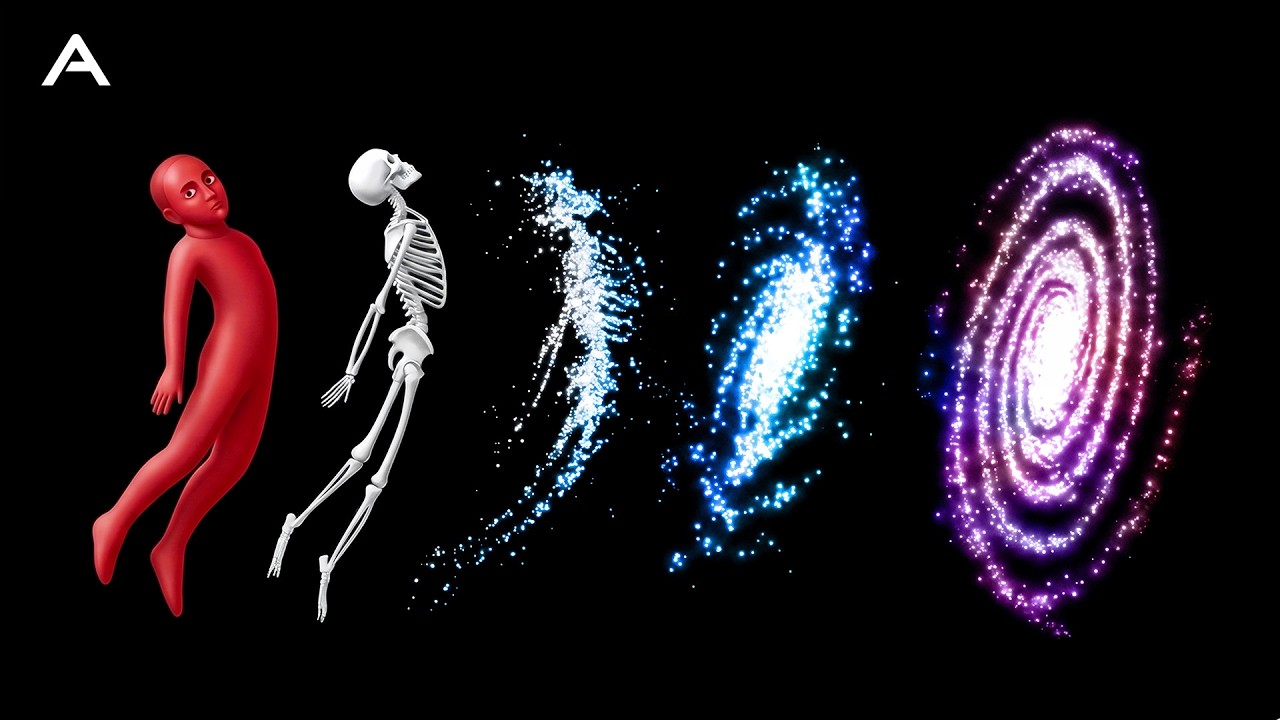
At a glance
This is an 83 minute narrated science documentary from The Cosmic Silence about one question: could a starship survive the dark between the stars, or would it freeze to death before it arrived? Its answer is a chain of physics. Space is a near-perfect insulator, so every warm object can only shed heat by glowing in the infrared, and the radiated power climbs with temperature to the fourth power (Stefan-Boltzmann law). Sunlight dies off with the square of the distance, so past Jupiter the ship must carry its own power, and every real power source we have either fades (plutonium 238) or has never flown at scale (reactors, fusion). The cold then attacks metals, seals, water and bolts, offers hibernation as a way to shrink the budget, and is joined by cosmic radiation that makes sleeping crews a gamble. The documentary closes on Project Daedalus, a natural reactor in Gabon that regulated itself two billion years ago, and the radioactive heat that keeps the Earth itself warm.
Cold open: nothing can touch you
The film opens in the dark. Out there, nothing can touch you: no wind, no frost, no air. And that, says the narrator, is exactly how a starship dies. Heat slips away as invisible light, second after second, and the void never gives a single degree back. Apollo 13 felt the first whisper of it. Now picture a hundred years of it. The question the whole film is built around is: what are you really fighting out there?
How space bleeds heat (0:00)
The first twist is that space is not cold the way a freezer is cold. A freezer is cold because air touches your skin and steals heat. Space has almost no air at all.
Three ways to lose heat, and two are dead
Heat can escape a body in three ways: touching something (conduction), being carried away by moving fluid (convection), or glowing (radiation). In a vacuum the first two are mostly dead. Only the third remains.
Everything warm glows. You glow right now, not in visible light but in infrared. Your body gives off roughly a hundred watts of heat, about the same as an old-fashioned light bulb, and the thermal cameras that see you in the dark are simply catching that glow. A starship does exactly the same thing. Its hull, its engines and its crew all leak energy into the void as faint infrared light, and the void never sends any real warmth back.
That is why a hot coffee in a vacuum flask cools so slowly: the vacuum blocks almost everything except the glow. Now imagine a thermos the size of a skyscraper that has to stay warm for a hundred years with people inside. The slow leak never stops.
The fourth power rule
Here is the detail that turns the leak from a nuisance into a death sentence. The rate of that glow scales with temperature raised to the fourth power. Double the absolute temperature and the object radiates sixteen times more. Hot ships bleed fast, cold ships bleed slowly, but they bleed forever.
Cosmic Microwave Background Temperature: where the bleeding ends (2:00)
So where does the bleeding end? Is there a floor? There is, and the narrator calls it one of the most beautiful facts in all of science. Even in the emptiest stretch of intergalactic dark, far from any star, space is not at absolute zero. It is filled with a faint, even glow called the cosmic microwave background, the oldest light in the universe.
The afterglow of creation
About 380,000 years after the Big Bang, the young cosmos cooled enough for atoms to form, and light was suddenly free to travel. At that moment the universe glowed at about 3,000 kelvin, roughly the heat of a lamp filament. Since then, the expansion of space has stretched that light and cooled it to 2.725 kelvin, about minus 270.4 degrees Celsius. The satellite Planck mapped that glow with astonishing precision between 2009 and 2013.
So here is the humbling picture. If you leave a dead, unpowered ship drifting between the stars, it will slowly sink toward the temperature of the afterglow of creation. In practice, starlight and cosmic rays hold it a few degrees above that. But this is a temperature colder than anything you will ever touch on Earth, cold enough to make ordinary steel brittle and rubber shatter. Your ship's final temperature is set by the birth of the universe itself.
We are good at cold, bad at warm
Engineers have a strange relationship with that cold. Planck's detectors had to be colder than space itself, chilled to about a tenth of a degree above absolute zero, because warm instruments would drown out the faint signal. The James Webb Space Telescope does the same in a different way. Its sun shield has five layers and is about the size of a tennis court, and it keeps the cold side below 50 kelvin, roughly minus 223 degrees Celsius. One of its instruments, MIRI, is cooled further to about 6 kelvin using a special refrigerator.
We are good at keeping things cold in space. The challenge for a starship is the opposite: keeping things warm for a very long time with a power source that does not run out. That, the narrator says, is the real villain of the story. It is not the cold. It is distance from the sun.
Inverse Square Law Limits: sunlight runs out (4:25)
Sunlight spreads out as it travels, like paint from a spray can. Double the distance and you get a quarter of the brightness. Triple it and you get a ninth. This is the inverse square law, and it is brutal.
| Where | Sunlight | What it means in the video |
|---|---|---|
| Earth (about 150 million km) | about 1,360 W on every square metre | The International Space Station runs on arrays producing roughly 75 to 90 kW (per NASA) |
| Jupiter | about 4% of the Earth value | Juno's three giant arrays: more than 14 kW near Earth, about 500 W at Jupiter |
| Pluto | about one thousandth | Solar panels are useless; New Horizons flew on a radioisotope source |
| Between the stars | no sun close enough to matter | The ship must make its own energy for the whole journey, every second, for generations |
Juno is the example. It orbits Jupiter on solar panels, a bold choice. Three giant solar arrays that would produce more than 14 kilowatts near Earth give about 500 watts at Jupiter, and that has to run an entire science mission, including the heaters that keep its electronics from freezing. Engineers had to design the whole probe like a puzzle in which every watt has a job.
Nuclear RTG Power Decay: a candle that burns lower each decade (5:45)
Go beyond Jupiter and solar panels become useless. There is simply not enough light to harvest. So missions to the outer solar system use something else: a radioisotope power source. These devices hold plutonium 238, a material that glows hot all by itself as it slowly decays. Thermocouples turn some of that heat into electricity, and the leftover heat keeps the machine warm. No moving parts, no dependence on the sun.
New Horizons on two light bulbs
Take the New Horizons probe, which flew past Pluto in July of 2015. Its power source produced about 245 watts of electricity at launch and about 200 by the time it reached Pluto. Two bright light bulbs. With that it photographed mountains of water ice on a world nearly 5 billion kilometers from the sun. When the people building that probe say every watt counts, they mean it literally.
The power plant is always weakening
But look at what is quietly happening. Plutonium 238 has a half life of about 88 years. Its heat output falls by roughly eight tenths of a percent every year, and the thermocouples that convert the heat age as well. So the power plant of a long mission is always weakening. It is a candle that burns a little lower each decade, and that candle must keep a crew alive.
Why a crewed ship is a different class of problem
A small robotic probe can survive on the power of two light bulbs. A crude starship cannot. People need warm air, light, water recycling, food production, and machines to run all of it. The International Space Station, orbiting right next to Earth in full sunshine, uses solar arrays that produce somewhere between 75 and 90 kilowatts according to NASA. Take that ship out where sunlight is a thousand times weaker and, to match the power with panels, you would need panels roughly a thousand times larger. Between stars there is no sun close enough to matter at all. So the ship would have to make its own energy for the entire journey, every second, for generations. And if that energy fails, the slow leak does not forgive.
Why Mars Rovers Freeze (8:00)
Here is a real example of how unforgiving it gets.
Spirit, stuck in the sand
In January of 2004, NASA landed a rover named Spirit on Mars. It was designed to last about 90 days. It lasted more than six years. Its electronics were protected from the Martian cold by small radioisotope heater units, each giving off about 1 watt of heat, placed inside the rover's body. But in 2009 its wheels broke through the crust and it became stuck in soft sand. It could not tilt its solar panels toward the sun for the Martian winter. Contact was lost in March of 2010. NASA kept listening for more than a year and ended the recovery efforts in May of 2011. The most likely explanation was that the rover did not have enough power to keep itself warm, and it froze.
Think about that. A machine on a planet with an atmosphere, with the sun in the sky, with a little plutonium inside, and it still lost the battle against the cold because of one stuck wheel. Now put a starship in the dark with no sun to tilt toward.
The Moon's long night
Spirit was not alone. On the Moon, nights last about 14 Earth days and temperatures drop to around minus 170 degrees Celsius. In September, India's Chandrayaan-3 lander and rover went to sleep as the lunar night approached. They had been built for a single lunar day. Mission controllers tried to wake them when the sun returned, and there was only silence.
Meanwhile Japan's little SLIM lander landed upside down in January of 2024 and then, against all expectations, survived a lunar night it was never designed to endure. Engineers still discuss why. Sometimes the cold wins, sometimes it does not, and not even the people building these machines can fully predict it.
The narrator asks you to hold on to the honest scientific position: we do not have a power source proven to run a crude ship for a century. We have ideas, and the film will get to them, but there is a difference between an idea and a tested machine.
The Pioneer anomaly: when heat fools you (10:41)
Everything so far has been about a ship getting too cold. The narrator now flags a twist engineers find even more unsettling: a ship moving through the dark between stars may also have a problem with getting too hot. The same vacuum that makes it hard to stay warm makes it equally hard to get rid of heat when you are running a reactor. And there is a famous case where a tiny leak of heat from a power source pushed a probe off its course so slightly that physicists suspected they had discovered new laws of physics. It took decades to figure out what was going on, and the answer was hiding in the glow described at the start.
A whisper from 12 billion kilometers
Picture a probe about the size of a small car, 12 billion kilometers from home, whispering to Earth with a transmitter weaker than the light in your refrigerator. In the 1990s a team of physicists listened to that whisper and noticed something that should not have been there: the probe was being pulled ever so gently back toward the sun. Nobody could say why. This is the story of the Pioneer anomaly, and it matters to the frozen starship because it shows how heat can fool you.
Pioneer 10 launched in March of 1972 and Pioneer 11 followed in April of 1973. They were the first machines to cross the asteroid belt and the first to visit Jupiter up close, and Pioneer 11 went on to become the first to reach Saturn in 1979. After that they kept falling outward into the dark, powered by four plutonium generators each.
Tracking by Doppler
Tracking was done with radio. Engineers sent a signal out, the probe sent one back, and any tiny change in that signal's frequency, a Doppler shift, revealed how fast the probe was really moving. Think of an ambulance siren changing pitch as it passes you: same physics, stretched across the solar system. The Doppler data kept showing a mismatch. A team led by John Anderson at NASA's Jet Propulsion Laboratory published the result in 1998. Both probes seemed to be slowing down by a minuscule amount, more than gravity from the sun and planets could explain.
The extra acceleration was about 8.7 times ten to the minus tenth metres per second squared. In plain terms, that is roughly 11 billion times weaker than the pull you feel standing on Earth. Give a car that acceleration and it would take about 1,000 years to reach walking speed.
Why anyone cared
Because it was real. It showed up on two different probes flying in opposite directions, and the people measuring it were some of the most careful navigators on the planet. When an error survives that kind of checking, you start to wonder whether it is an error at all. So the theories came flooding in.
- Dark matter clumped around the solar system and tugging on the probes. But dark matter, as far as we can tell, would have to be spread very thinly, and it would have shown up in the orbits of the planets, which we know extremely well.
- Modified gravity, a family of ideas in which gravity behaves differently at great distances. But it would have tugged on Neptune and Uranus too, and they behave just as Newton and Einstein predict.
- Drag from dust. Each idea had a problem.
Yet the probe still disagreed with the math. The narrator loves this moment in science: a small, stubborn discrepancy and an entire community unsure whether it was a bookkeeping slip or the doorway to a new universe. It has happened before. A tiny misfit in Mercury's orbit, a few arcseconds per century, was one of the clues that eventually helped overthrow Newton's picture of gravity. Nobody knew whether the Pioneer anomaly would be the next such door.
Meanwhile the probes went silent. The last contact with Pioneer 11 came in 1995, and the final faint signal from Pioneer 10 arrived in January of 2003 when the probe was more than 12 billion kilometers away. The plutonium had weakened until the transmitter could barely speak. The observing data stopped, but the mystery did not.
Counting every watt
Here the story gets good. A physicist named Slava Turyshev, who had been part of the original team, decided to settle it. He and his colleagues did something unglamorous and enormous: they dug up old engineering records, recovered tracking data stored on obsolete tapes and formats, and rebuilt a detailed heat model of the probes. They wanted to know exactly where every watt of thermal energy went, and in which direction.
Remember the plutonium generators. Their thermocouples convert only a small portion of the heat into electricity. The rest, a large amount, simply radiates away. On the Pioneer probes the generators sat on booms, but the heat they gave off was not perfectly even, and part of it bounced off the back of the big dish antenna, which acts like a mirror, pushing some of it out in one direction. Add the heat from the electronics inside the main compartment, which also leaked out preferentially one way.
And light carries momentum. This is not a metaphor. When a photon leaves a surface it gives that surface a tiny push in the opposite direction, the way a rifle recoils. If more heat radiates out of the back of the probe than the front, the probe is nudged forward. If the pattern is lopsided the other way, it is nudged back toward the sun. The same principle drives solar sails, like Japan's IKAROS, which in 2010 became the first to sail through interplanetary space on sunlight alone.
In 2012 Turyshev's team published their analysis in Physical Review Letters. Their thermal model accounted for the extra acceleration, with a remaining uncertainty small enough to explain the data without any new physics. The glow of a dying plutonium engine, reflected off a dish, had been pushing two probes for decades. Most researchers consider the case effectively closed.
The narrator asks you to sit with how remarkable that is: the mystery was solved by patiently counting the heat leaking out of a probe. No new law of nature, no hidden dark matter cloud, just the radiation discussed earlier in a very quiet form. And it is a warning for any ship traveling for decades. A tiny, steady push from the way you shed heat can change your course, and over a hundred years a small push could matter a great deal. A starship would not just have to survive its own glow, it would have to navigate by it.
Spacecraft Radiator Design Dilemma (18:05)
The same vacuum that makes it hard to stay warm makes it equally hard to throw heat away. Think about it on a human scale. On Earth, when your engine gets hot, air or water carries heat to a radiator and the air does the rest. In space there is nothing to blow on it. Heat can only leave by glowing.
The station's white wings
That is why the International Space Station carries enormous white radiator panels, and why it circulates liquid ammonia through loops to carry heat from the inside out to the panels. The station has to radiate away everything its occupants and equipment produce, every second of every day.
One megawatt, two radiators
Now scale up. Suppose your starship runs a reactor producing a million watts of useful electricity. A real reactor would produce several times more heat than electricity, because no power plant is perfectly efficient. Physics sets the exchange rate for radiators:
- At about room temperature, a perfect radiator sheds only about 460 watts per square metre on each face. To dump just 1 megawatt of waste heat at that temperature you would need a radiator on the order of 1,000 square metres, before accounting for imperfections.
- Run the radiator hotter and it gets smaller, because of the temperature to the fourth power rule. At about 220 degrees Celsius the same job takes around 140 square metres.
That is the trade. A hot radiator is compact but harder on materials. A cool radiator is gentle but enormous.
| Radiator runs at | Sheds per m² per face | Area to dump 1 MW of waste heat | The trade |
|---|---|---|---|
| About room temperature (300 K) | about 460 W | on the order of 1,000 m² | Gentle on materials, enormous |
| About 220 °C (493 K) | several times more (fourth power) | around 140 m² | Compact, harder on materials |
The ship's thermal loop
Put the pieces together and the ship is a loop with exactly one exit.
Kilopower and the bind
Engineers have been wrestling with this for decades. NASA's Kilopower project built a small fission reactor prototype that was tested in the Nevada desert in 2018. The experiment, called KRUSTY, ran at full power for 28 hours and showed a compact reactor could work as designed. It was a real, tested step, but its output was about 1 kilowatt of electricity. A starship needs vastly more, and nobody has flown anything remotely close.
So the ship faces a bind. When the reactor runs, the ship fights to cast off heat. When the reactor shuts down, the ship fights to keep any. And a ship that sleeps through the long dark would need a power source that wakes up at exactly the right moment after decades of silence.
Interstellar Dust Impact Physics (20:45)
There is a third problem, and the narrator finds it the most hair-raising. It is what the ship hits along the way. The space between stars is not empty. In our local neighborhood a typical cubic centimeter holds roughly a tenth of an atom, mostly hydrogen and helium. That sounds like nothing, but a ship moving fast sweeps through a huge volume, and each atom strikes with real energy. Add tiny dust grains. Ulysses, then Galileo and later Cassini all detected grains of interstellar dust drifting through the solar system from beyond, streaming in from a particular direction.
The one gram grain
The narrator says he did the numbers carefully. Take a grain with a mass of just 1 gram, about the weight of a paper clip. Hit something with it at 100 kilometers per second, a speed the Parker Solar Probe has comfortably exceeded near the sun (it reached around 190 km/s in 2024). That collision releases about 5 million joules, roughly the energy in 1.2 kilograms of TNT, from an object you could hold between two fingers. And there is no air to absorb it. Everything lands on the ship.
Real interstellar dust is much smaller than a gram, so the impacts would be more frequent but gentler. Still, they accumulate. Scientists worry about erosion of the front of a ship over a long trip, a kind of sandblasting that never ends, along with heating where particles hit. And since the ship can only radiate heat away slowly, even small bits of impact energy must be managed.
The pattern: every solution creates a new problem
Notice the pattern in everything so far. A starship must stay warm, but not too warm. It must throw off heat, but not so much that it freezes. It must shield its front from a constant drizzle of particles, yet carry enough power to push through. Every solution creates a new problem. That is what engineering at the edge of physics looks like.
Cryogenic Metal Brittleness Failure (23:00)
Everything so far has been about energy and temperature. The narrator has not yet talked about what the deep cold does to the ship's own body: the metal, the welds, the bolts, the very structure holding the crew in.
The Liberty ships
In the Second World War the United States built more than 2,700 Liberty ships, cargo vessels welded together at astonishing speed. A number of them broke in half, some in calm harbors, some in the cold North Atlantic with no enemy in sight. Investigators eventually traced many of those failures to something unsettling about steel: the colder it gets, the more it can suddenly lose its ability to bend, and it snaps like glass.
Imagine holding a rubber band in one hand and a cup of liquid nitrogen in the other. Dip the band in for a few seconds, pull it out, and tap it on the table. It shatters like a cookie. That is what happens to a material that looks tough, feels tough, and has worked perfectly its whole life once you drop it below a hidden line. A starship has to be built so it never crosses that line, and the people who learned this the hard way were not rocket scientists.
In January of 1943 a freshly built cargo vessel, the SS Schenectady, was sitting at a dock in Portland, Oregon. The water was calm, no storm, no enemy, no cargo loading. Then, reportedly with a bang that sounded like a gunshot, a crack raced across the deck and down both sides and the ship split in two.
Investigators found the steel itself was the culprit. Most ordinary steels have what metallurgists call a ductile to brittle transition. Above a certain temperature the metal bends and stretches before it breaks, which gives warning and absorbs energy. Below it, the same metal fractures with almost no stretching at all, and a crack can run through it at hundreds of metres per second. The Schenectady steel had a transition temperature uncomfortably close to a cold winter's day, and the sharp square corners on the hatches gave the crack a place to start. Over the war, well over a thousand cracks were reported across the Liberty fleet and around a dozen ships broke clean in half.
A detail the narrator loves: the older riveted ships were safer, because a crack hitting a seam had to stop and start again. The new welded hulls were one continuous piece of metal, so a crack had a clear highway from one end to the other.
Why cold does this: crystal structure
Inside a metal, atoms sit in a repeating crystal pattern, and bending happens when planes of atoms slide past each other. In some crystal layouts those planes keep sliding easily even when it is frigid. In others the sliding seizes up as the temperature falls, and the only way left to release stress is for the metal to crack. Ordinary carbon steel is in the unlucky group.
The hero: austenitic stainless steel
Open your kitchen drawer. A lot of stainless steel, the type in your sink and your good pots, belongs to a family called austenitic stainless steels, the 300 series. Their atoms stack in a different arrangement called face-centered cubic, and that arrangement keeps sliding even at extreme cold. These steels are used today for tanks that hold liquefied natural gas at about minus 162 degrees Celsius and for vessels that hold liquid hydrogen at around 20 kelvin (roughly minus 253 degrees Celsius). They do not turn brittle. In some cases they actually get stronger as they cool.
Here is a cosmic twist. The iron in that stainless steel was forged inside stars. Much of it was made in the final seconds of exploding white dwarfs and massive dying stars, then scattered across space and eventually gathered into the cloud that formed the sun and the Earth. The metal you trust to carry a crew between the stars is old stardust, and it is the right material for the job because of how its atoms happen to stack.
Aluminum shares that same friendly crystal structure, which is why alloys of aluminum and lithium were used for the giant external fuel tank of the space shuttle, a tank that carried liquid hydrogen and liquid oxygen. So for the metal frame the answer is not hopeless: engineers know which metals to pick. But metal is only part of the ship, and the rest is much less forgiving.
Challenger and the rubber that forgot to spring
Think about the morning of January 28th, 1986. The space shuttle Challenger was on the pad in Florida, and the temperature was about 2 degrees Celsius, far colder than any previous launch (the coldest earlier launch had been around 10 degrees). The rubber O-rings that sealed the joints in the booster rockets lose their springiness in the cold, and a seal that cannot spring back cannot do its job. Seventy-three seconds after liftoff the vehicle was lost.
Physicist Richard Feynman later made the point in a hearing by clamping a piece of that rubber and dunking it in ice water, showing that it failed to rebound. One of the simplest components on the whole machine had a temperature limit, and nobody was treating it like one.
Rubber, plastics, lubricants, adhesives, wire insulation and seals all have temperatures where their behavior changes. Many polymers go through a glass transition, where a soft, flexible chain of molecules locks into a hard, rigid state. Grease thickens until it acts like glue. Fluids in hydraulic lines turn to sludge. A starship is full of thousands of moving parts, every one with its own comfort zone.
Water, the secret saboteur
When water freezes it expands by about 9%. This is why pipes burst in your house during a hard winter. A starship with miles of tubing for drinking water, cooling loops and waste recycling would have to make sure no pipe, no tank and no valve ever dropped below freezing with liquid still inside. During Apollo 13, as the crew shut down the power, they reported water condensing on the walls. The crew survived because they were close enough to Earth to come home within days. On a voyage of decades, there is no coming home.
Everything shrinks, but not equally
Next, a subtle problem. Everything shrinks as it cools, but not by the same amount. An aluminum structure cooled to liquid nitrogen temperature contracts by about four tenths of one percent, while stainless steel contracts by somewhat less. That sounds small. Apply it to a structure 100 metres long: four tenths of one percent of 100 metres is 40 centimetres. If two parts bolted together shrink by different amounts, one of them gets pulled apart or crushed, or both. Every joint, every weld and every bolt becomes a place where invisible forces build up.
Webb, designed for a world it had not yet seen
The James Webb Space Telescope is the best real example of how to handle this. Its main mirror is made of 18 hexagonal segments of beryllium, a lightweight metal that holds its shape unusually well at extreme cold, coated with a thin layer of gold. Webb operates at about 40 kelvin, roughly minus 233 degrees Celsius. But engineers could not just build it at room temperature and hope. They had to figure out exactly how each segment would warp as it cooled, and then shape each one so it would be perfect only after it got cold. They tested the mirrors in a giant chamber at NASA's Marshall Space Flight Center in Alabama, cooled to cryogenic temperatures, and measured the distortion down to the width of a few atoms.
The telescope was designed for a world it would not see until it got 1.5 million kilometers from Earth. Its sunshield had to unfold flawlessly, with hundreds of points where a single failure could have ended the mission. Hundreds of them. And it worked. That is the kind of precision required, and Webb only had to survive for one or two decades in a stable location.
Tin pest
Another weird effect, and not a legend, though a famous story about it is. Tin, the metal used in old solder and organ pipes, can undergo what is called tin pest. Below about 13 degrees Celsius, ordinary shiny tin can slowly turn into a brittle gray powder, with the process running fastest at around minus 30. The transformation spreads like an infection, and it has been documented in museum objects and in old church organ pipes. The famous tale of Napoleon's army losing its tin buttons in the Russian winter is probably more legend than fact, and historians remain skeptical, but the chemistry is entirely real. Some materials do not just get stiff in the cold, they change into something else.
| Material or part | What the cold does | Real case in the film |
|---|---|---|
| Carbon steel | Crosses a ductile to brittle transition and snaps like glass | Liberty ships, SS Schenectady, January 1943: over a thousand cracks, about a dozen ships broken in half |
| 300 series stainless steel | Stays ductile, can even get stronger (face-centered cubic crystal) | LNG tanks near minus 162 °C, liquid hydrogen vessels near 20 K |
| Aluminum-lithium alloys | Same friendly crystal structure | The space shuttle external tank (liquid hydrogen and oxygen) |
| Rubber O-rings | Lose springiness, cannot seal | Challenger, 28 January 1986, about 2 °C, lost 73 s after liftoff |
| Polymers, grease, hydraulic fluid | Glass transition: soft chains lock rigid; grease turns to glue, fluid to sludge | Thousands of moving parts, each with its own comfort zone |
| Water in pipes and tanks | Expands about 9% on freezing and bursts the plumbing | Apollo 13 condensation on the walls |
| Mixed metals in one structure | Different contraction: aluminum about 0.4% to liquid nitrogen temperature, so 40 cm over 100 m | Webb's mirrors shaped to be perfect only once cold |
| Tin | Tin pest: crumbles to gray powder below about 13 °C, fastest near minus 30 °C | Museum objects and old organ pipes (the Napoleon button story is probably legend) |
Cold Welding in Vacuum (32:45)
There is one more danger that exists only in a vacuum, and it sounds like science fiction. On Earth, every piece of metal is covered by a thin film of oxide and a layer of adsorbed gas, and that film stops two clean surfaces from fusing together. In the vacuum of space, if those films are scraped away, two clean pieces of metal pressed together can bond into one with no heat and no welding. It is called cold welding. It has been demonstrated in laboratory vacuum chambers, and space agencies, including the European Space Agency, have studied it as a concern for sliding parts and hinges. How much it threatens a mechanism flying for a century is an open question, because nobody has run that experiment.
The theme: years versus generations
The narrator points to a theme of the whole video. We know a lot about how materials behave for months or a few years. NASA's Long Duration Exposure Facility, a school-bus-sized satellite carrying 57 experiments, spent almost six years in orbit and taught us a great deal about how materials age in space. But no human-built machine has ever been tested for a century at the temperature of the deep dark. We would be extrapolating from years to generations. That is an act of faith, and he would rather say so honestly than pretend it is figured out.
Every material is a bet
Step back to see the shape of the problem. Pick the right alloy and the frame survives. Choose the wrong rubber and the seals fail. Let one pipe hold water at the wrong moment and it bursts. Combine two metals that shrink differently and the joints tear. Every material is a small bet against the cold, and the ship needs thousands of them to win.
And here is a thought the narrator finds strangely comforting: every one of those lessons was learned by failure. The Liberty ships, Challenger, the rovers that fell silent on Mars and the Moon. Science does not advance by being right the first time. It advances by being brave enough to look at what went wrong and honest enough to say so out loud. The people who will one day design a ship for the stars will be standing on the shoulders of every broken hull and every frozen seal in history.
Can Humans Hibernate Safely? (35:20)
The film turns from metal to flesh. Soft tissue has its own opinions about cold, and that raises a question almost every science fiction story answers in the same way, which the narrator wants to test. If keeping a ship warm for a century is so hard, why not just let the crew sleep through it, chilled down and barely alive?
Anna Bågenholm, "warm and dead"
Anna Bågenholm was 29, a radiology resident on a ski trip in northern Norway, when she slid head first down a frozen stream and the ice closed over her. It was May of 1999. Her friends pulled at her skis, but she was wedged under a sheet of ice with her head in a small pocket of air. For about 80 minutes she was trapped in water just above freezing. At some point her heart stopped. By the time rescuers reached the hospital in Tromsø her core temperature was 13.7 degrees Celsius. By any ordinary definition she was dead: no heartbeat, no breathing.
A doctor on that team, Mads Gilbert, had a rule he lived by: nobody is dead until they are warm and dead. So they did something that sounds absurd. They kept going. For about three hours they performed resuscitation while connecting her to a heart-lung machine that slowly warmed her blood. Around the three hour mark her heart started again. She spent weeks in intensive care, was paralyzed for a while, and slowly recovered. Today she is a practicing doctor and has gone back to skiing. Her case is among the lowest body temperatures ever survived by an adult human.
Why cold saved her
Cold did not kill her. In a strange way, cold saved her. The brain is a furnace: about 2% of your body weight, burning around 20% of your energy. When it runs out of oxygen, damage begins within minutes. But as the body cools every cell slows down. Roughly speaking, each degree you drop cuts the brain's demand for oxygen by around 6 or 7%. At 13 degrees her brain needed only a small fraction of what it normally does, like a city during a blackout with only the emergency lights on. So the movie idea is not crazy. If you can slow the body down, you can stretch a tiny supply of resources across a very long time.
Nature's champions
Nature figured this out long before we did.
The Arctic ground squirrel. A small animal that lives in Alaska and northern Canada. In 1989 a researcher named Brian Barnes put sensors into hibernating squirrels and found something that shocked biologists: these animals let their body temperature fall below the freezing point of water, the coldest known body temperature of any mammal. Their blood does not freeze because the fluid is supercooled, held in a delicate state where ice has not yet started to form. A squirrel in that state has a heart that beats only a few times a minute and looks for all the world like a furry corpse. Then, every couple of weeks, it shivers its way back to a normal temperature for about a day and drops back down. Nobody has fully explained why. Some researchers suspect it is linked to sleep, which the animal seems to need and cannot get when its brain is that cold. That is a clue to keep in mind for a crew.
The black bear. Less extreme with temperature, sliding only to about 33 degrees, but it does things no human can. In the middle of winter, for several months, a bear does not eat, drink, or go to the bathroom. Its metabolism drops to a fraction of its normal rate. And a bear lying still for months should lose a large share of its muscle and bone the way astronauts do. It does not. Studies of hibernating bears have found they preserve most of their strength. Somehow they recycle waste products back into protein. If we could understand that trick, we could solve one of the worst problems of long space voyages.
The fat-tailed dwarf lemur of Madagascar. The only primate known to truly hibernate, up to seven months tucked inside a tree hole with a body temperature that follows the weather. It is not some distant relative; it is a primate like you. That fact keeps hibernation researchers awake at night, because it suggests the genetic toolkit might be buried somewhere in our family tree.
Sima de los Huesos. An idea that is still controversial, so the narrator is careful with it. In a cave in northern Spain called Sima de los Huesos, scientists found the bones of about 28 early humans who lived roughly 400,000 years ago. In 2020 two researchers argued that the bones show seasonal patterns of damage resembling the bone problems seen in hibernating animals, and proposed that these ancient people might have spent the winter in a kind of torpor. Many scientists doubt it and there is no direct proof, but it is a thought-provoking possibility, and it would mean the ability to slow down was not invented by science fiction.
| Who | Cold trick | Limit the film stresses |
|---|---|---|
| Anna Bågenholm | Core temperature 13.7 °C, heart stopped, about 3 hours of resuscitation, survived | Accidental, with a full hospital team and a heart-lung machine |
| Arctic ground squirrel | Body temperature below freezing, blood supercooled, heart a few beats a minute | Must rewarm every couple of weeks; nobody knows exactly why |
| Black bear | About 33 °C for months with no food, water or bathroom; keeps muscle and bone | Recycles waste into protein, a trick humans lack |
| Fat-tailed dwarf lemur | True primate hibernation, up to 7 months | Body temperature follows the weather |
| Wood frog | Freezes solid, about two thirds of body water as ice, heart and breathing stopped | Survives only to about minus 8 °C for days to weeks |
| Tardigrade | Dries into a "tun", survives near absolute zero and 10 days of vacuum in orbit (2007) | Body so simple it can lose almost all its water |
What research has actually done with humans
Doctors already use therapeutic hypothermia. After a cardiac arrest, patients are cooled to around 32 to 36 degrees for a day or two to protect the brain while it recovers. It is routine in many hospitals, but notice the time scale, days not years, and that patients under it are sedated, ventilated and monitored by a team of specialists, the opposite of an autonomous ship.
Space agencies have looked into this seriously. In 2013 NASA funded a study by a company called SpaceWorks exploring whether a crew heading to Mars could be put into a cooled, sedated state for much of the trip. Their concept, which they later extended, imagined lowering the crew's body temperature by a few degrees to cut metabolism by roughly half or more. The goal was smaller, lighter, cheaper ships, because sleeping people eat less, breathe less and need less room. In 2021 the European Space Agency also looked into the idea. But these were concept studies. Nobody has put a human into long-term torpor, not for weeks and certainly not for decades.
And there are real puzzles. If you lie still for months, your muscles waste, your bones thin out, and your blood is more likely to clot. Your immune system gets sluggish. Hibernating animals have countermeasures; we do not. And a ship that takes a century would not need a few months of sleep. It would need something like 30 times longer than the longest hibernation of any primate.
Chemistry and the brain's switch
In 2005 a researcher named Mark Roth reported that mice breathing small amounts of hydrogen sulfide, the gas that smells like rotten eggs, dropped their metabolism dramatically, and their body temperature fell to near that of the room. They woke up fine. It made headlines around the world. But when other teams tried the same thing on larger animals like pigs and sheep, the effect did not hold up. A trick that works on a mouse can fail on something bigger: a mouse loses heat quickly and cools fast, while a large body behaves differently.
More recently scientists have found the switch inside the brain. In 2020 a team led by Sinisa Hrvatin at Harvard identified a set of neurons in the hypothalamus of the mouse brain that appear to trigger a torpor-like state. In 2023 researchers at Washington University in St. Louis used focused ultrasound to stimulate that region in mice and rats, and the animals cooled down and slowed their metabolism with no drugs. It is early, and the work was done on animals that naturally have this ability. Whether the same trick would work on a human brain, and what it would take for a person to stay in that state for years, is still unanswered.
Freezing outright
What about freezing outright? Most of us have heard you can freeze someone and wake them later. The honest answer is that no one has done it with a mammal that has been truly frozen. The problem is ice. When water freezes inside your cells it forms sharp crystals that pierce the membranes, and it pulls water out of cells so they shrivel and rupture. Thaw a frozen strawberry and it turns to mush: same phenomenon.
But one animal has solved the problem. The wood frog, which lives as far north as the Arctic Circle in Alaska and Canada, freezes solid every winter. Around two thirds of the water in its body turns to ice. Its heart stops, its breathing stops, it has no brain activity anyone can measure. Then in spring it thaws, its heart starts up, and it hops away. In the fall, when the temperature drops, its liver pours huge amounts of glucose into its blood, and that sugar acts like antifreeze, keeping the inside of its cells from freezing while the outside turns to ice. The frog survives temperatures down to about minus 8 degrees Celsius for days to weeks, not centuries, and only to minus 8, not minus 270. Humans do not have that.
Vitrification
The alternative is vitrification: replace water in the tissue with a chemical antifreeze and cool it so rapidly that the liquid turns into a glass without forming ice. It has worked for single cells, embryos and small pieces of tissue. In 2023 a team at the University of Minnesota (the narration names researchers Bischof and Etheridge, two of the paper's authors) vitrified a rat kidney, rewarmed it using tiny magnetic particles, and transplanted it into a rat, where it worked. That is remarkable, but a rat kidney is about the size of a kidney bean and a human body is a very different challenge. No one has revived a whole large mammal after vitrification. Companies offering human cryopreservation exist, but they do not claim it has been proven, and most scientists regard it as a long shot.
The tardigrade, and the human problem
One more creature the narrator cannot resist, because it plays tricks with the very idea of cold: the tardigrade, a microscopic animal about half a millimetre long that can dry itself out, curl into a little capsule called a tun, and survive temperatures near absolute zero in laboratory experiments. In 2007 tardigrades were taken into low orbit on a European mission, and some survived 10 days of exposure to the vacuum of space. Nothing larger than a few cells has managed that. But a tardigrade is not a person. Its body is so simple it can afford to lose almost all its water, and it cannot think, plan or dream.
That brings the film to a deeper issue nobody likes to discuss. Suppose we solve the engineering problems and a crew sleeps for a century and wakes rested in a distant system. Who are they then? Everyone they knew on Earth is gone. Their language may have shifted. The people who sent them are history. Even if their bodies are fine, the human story keeps moving, and they have been taken out of it. That is not a technical problem. It is a human one, and the best science fiction understands that.
The summary: the cold is not simply an enemy. It is a tool nature uses with incredible subtlety, from the lemur in Madagascar to the frog in Alaska. We have learned enough to see that the door might exist. We have not found the key.
Cosmic Radiation and Shielding (48:30)
All the talk about keeping a body alive and warm, the narrator admits, assumes the body is safe from one other thing: something invisible, silent, and utterly indifferent to how warm or cold you are.
Flashes behind closed eyelids
Apollo astronauts reported it in the 1970s when they closed their eyes in the dark of the cabin and saw sudden streaks and flashes of light with no light source anywhere. Imagine you are floating in a dark cabin on the way to the Moon and you see a flash, then another: streaks, specks, little blue-white stars exploding behind your eyelids with the lights off. Buzz Aldrin and Neil Armstrong both reported seeing them. Crews on later missions saw them roughly every few minutes.
Those flashes were individual atomic nuclei traveling at nearly the pace of light itself, passing straight through their heads. They were watching the universe hit them, one particle at a time. This is cosmic radiation, and for a starship it may be a bigger threat than the cold ever was.
In 1952 the physicist Cornelius Tobias had predicted that a fast particle crossing the eye could produce a flash either by striking the retina directly or by making a faint glow called Cherenkov light in the fluid inside the eyeball. Years later the Apollo crews proved him right. NASA even ran experiments on the last two lunar flights where astronauts wore detector helmets and logged each flash while the instruments recorded the particles. The matches were close. Your eyes can literally see subatomic particles. (See cosmic ray visual phenomena.)
Where the particles come from
The honest answer is that we know part of the story. In 2013 the Fermi Gamma-ray Space Telescope found a telltale signature in the remnants of two exploded stars called IC 443 and W44: a pattern of gamma rays that points to protons being whipped up to enormous energies in the shock waves of supernovae. So the radiation threatening your starship is partly the debris of dead stars flung across the galaxy and accelerated by their own explosions. The same stardust that built your bones is also the bullet.
The highest energy particles are a real mystery. On the evening of October 15th, 1991, a detector in the Utah desert called Fly's Eye recorded a single particle carrying about 50 joules of energy, the energy of a baseball thrown at roughly 90 kilometres an hour packed into one subatomic particle far smaller than an atom. Physicists nicknamed it the Oh-My-God particle. For scale, protons in the Large Hadron Collider, the most powerful accelerator ever built, carry tens of millions of times less. We still do not know for certain what cosmic machine launched it. In 2017 the Pierre Auger Observatory in Argentina reported that the highest energy arrivals seem to come from outside our galaxy. That is a real finding, and the exact sources are still being hunted.
What is actually hitting you
Most of what hits you in deep space is protons, about nine out of every ten particles. Around one in ten is helium nuclei. Then there is a tiny fraction, roughly 1%, of heavy nuclei: the whole periodic table stripped of its electrons, including iron. That small fraction matters enormously because damage grows with the square of a particle's charge, and an iron nucleus carries 26 units of charge. Physicists call these heavy irons the villains of space radiation. A proton is like a bullet. An iron nucleus is like a cannonball tearing through a cell, leaving a trail of broken molecules along its entire path.
By common estimates, over a long voyage every cell nucleus in your body would be crossed by a proton every few days and hit by an iron nucleus about once every few months. Most hits are repaired. Some are not.
On Earth you are protected twice over: the magnetic field deflects many of these particles, and the atmosphere above your head is the equivalent of roughly 10 metres of water. In deep space you have neither. You are standing in the open.
The dose, measured
Here is what was actually measured. When NASA's Curiosity rover traveled to Mars in 2011 and 2012, it carried an instrument called RAD, which sat inside the capsule and recorded radiation the whole way. The result, published in 2013, was an average of about 1.8 millisieverts per day. A millisievert is a unit of biological dose. The average person on Earth receives about 2 to 3 millisieverts in an entire year from natural background. So in deep space you would collect about a year's worth of Earth radiation every day or two. Aboard the International Space Station, which still enjoys some protection from Earth's magnetic field, astronauts receive roughly a third to a half of a millisievert per day.
Do the arithmetic. One year in deep space comes to around 670 millisieverts. NASA's career limit for astronauts is 600 millisieverts, so a single year out there would use up an entire astronaut's lifetime allowance. The same study estimated that a Mars round trip, with about 180 days in each direction and 500 days on the surface, would add up to about 660 millisieverts. And a starship would not be gone for a year. It would be gone for generations.
What that dose does
It breaks DNA. Radiation can snap both strands of the double helix. Cells have repair crews for that, but the repairs are not perfect. The risks include cancer, damage to the heart and blood vessels, cataracts, and a puzzle that worries researchers: the brain. At the NASA Space Radiation Laboratory in New York, scientists fire beams of iron and other heavy ions at mice and rats. The animals show problems with memory, learning and behavior, and the damage can show up weeks to months later. How closely that matches what would happen to a person is still an open question, and researchers say plainly that the uncertainty is large.
The storm that did not happen, and the heliosphere
Now a story about a disaster that never happened. In August of 1972, between Apollo 16 and Apollo 17, a series of enormous solar eruptions blasted energetic particles across the inner solar system. No one was in space. If a crew had been on the Moon or on the way, NASA analyses say they could have been seriously ill from radiation sickness. They got lucky.
The sun is the second source of danger. A flare or a coronal mass ejection can deliver a lethal dose in hours. The good news is that storms like these can be forecast a little, and a ship can build a small shielded shelter, a storm cellar for the crew to hide in. Between the stars, though, there is a catch. The sun's wind blows a giant magnetic bubble around the solar system called the heliosphere, and it deflects a good share of the lower energy cosmic rays. Leave the bubble and the shield thins: a starship would sail out of the one protective umbrella we have.
Shielding: not lead, hydrogen
How do you shield a ship? You would think the answer is lead, thick and heavy. In practice the answer is the opposite. Dense metals can make things worse, because when a fast particle slams into a heavy nucleus it shatters it and throws out showers of secondary particles, including neutrons. The best shields are rich in hydrogen, because hydrogen nuclei are light and do not shatter into debris. That is why researchers study polyethylene, which is basically plastic, and plain water.
And here is a clever thing. A starship carries water anyway, and food and waste. Wrap the crew quarters in those and your supplies become your armor. Even so, the heaviest, fastest particles carry so much energy that no practical thickness stops them.
Active shields, and cold as the solution
There is also the idea of an active shield: a magnetic field strong enough to bend the particles away, the same trick Earth uses. European and American teams have studied superconducting magnet designs. It is an elegant idea, and it has not been built or flown at the scale a ship would need. The magnets would be heavy, they would need to stay cold, and the strength required is significant. Once again cold appears, this time as the solution rather than the problem.
Borrowing from the tardigrade
Another approach comes from biology. In 2016 a Japanese team led by Takuma Hashimoto found that tardigrades make a protein now called Dsup, short for damage suppressor. When they put the gene into human cells growing in a dish, the cells suffered roughly 40% less DNA damage from X-rays. That is a lab result in cultured cells, not in a person, but it hints at a future where the crew's biology is part of the shield.
Cosmic Rays Flipping Bits (58:35)
Electronics suffer too. A single cosmic particle can flip a bit in a computer's memory, turning a zero into a one. It sounds like a joke, but it likely happened in Belgium in May of 2003 (a single-event upset). In a local election one candidate was suddenly credited with exactly 4,096 extra votes. That number is 2 to the power of 12, exactly what you get when one bit flips in the counting software. Officials spotted the error and corrected it, and a cosmic ray is considered the most likely cause. If it can fool an election, it can fool a navigation computer. A starship would need three or more computers voting on every decision, so the one corrupted by a stray particle gets outvoted.
Honesty about the human body
The narrator promised honesty: we do not know how well a human body can handle a century of this. Everyone who has flown beyond low Earth orbit did it for days. The longest single stay on the space station is about 437 days, by Valery Polyakov in the 1990s. NASA's Twins Study in 2019 compared astronaut Scott Kelly, after almost a year on the station, with his identical twin Mark on the ground. It found many changes in gene activity, in the length of telomeres (the caps on the ends of chromosomes), and in the immune system, and most settled down after he returned. That is encouraging, but it was one person, one year, in low orbit.
And something more unsettling. Hibernation, the trick discussed earlier, slows metabolism. Does it slow DNA repair too? Does a cold sleeping crew accumulate radiation damage faster than a waking one can fix it? Nobody knows. It is an open question, and a serious one.
The universe is indifferent
Notice what the cold has done through this story. It threatens the metal, the water and the seals. It offers a way to put a crew to sleep. Then radiation arrives and complicates the sleeping plan. Every answer has a catch. Yet this is exactly how science moves forward, and the narrator finds that beautiful. The universe is not hostile or friendly. It is simply indifferent, and we are the only part of it that stops to ask what it would take to cross it.
Project Daedalus Fusion Propulsion (1:01:20)
So far the narrator has been quietly assuming the ship has some way to stay warm and powered for a hundred years. But what could that be? Not solar panels, not the plutonium that weakens each year. Is there any power source, even on paper, that could run for centuries? There is a real design drawn up by British engineers in the 1970s for a ship powered by tiny fusion explosions, fueled by helium harvested from the atmosphere of a giant planet. It was serious engineering with real numbers, and a few decades later researchers found that a key part of its logic may have an unexpected floor.
Slide rules and one strict rule: no magic
In 1973 a handful of British engineers started meeting in their spare time to design a starship on paper. They were not dreamers with sketchbooks. They had slide rules, physics textbooks and one strict rule: no magic. Every part of the ship had to follow from physics already known. When they finished five years later they had a machine taller than a 60-story building with an engine that fired 250 tiny hydrogen bombs every second. They called it Daedalus, and it is the most serious attempt ever made to answer the question the video is about.
The group was the British Interplanetary Society, led by Alan Bond and Anthony Martin. Their target was Barnard's Star, about six light years away. They picked it partly because in those days astronomers believed it had planets. That claim later fell apart, though in recent years astronomers have reported evidence of small planets circling it, so the star may be getting its revenge.
The ship
Daedalus would weigh about 54,000 tons at launch. Nearly all of that was fuel. The payload, the part that does the science, was only a few hundred tons. It was built in two stages. The first stage burned for about two years, dropped away, and then the second stage burned for another two. After that the engines went dark and the ship coasted for decades toward Barnard's Star at roughly 36,000 kilometers per second. That is fast enough to cross the distance between Earth and the Moon in about 10 seconds.
The engine: pellets, beams and magnetic nozzles
How does an engine like that work? Not with a flame. It uses pellets of fuel, each a tiny frozen bead of deuterium mixed with helium 3. Every pellet is dropped into a huge magnetic chamber, hit from all sides by electron beams, and squeezed until the atoms fuse. The resulting explosion is small, but 250 of them per second add up to a roar. A magnetic field acts as the nozzle and shoves the burning plasma out the back. No material wall could survive that heat, so the engine was not contained by metal at all. It was held in place by invisible fields.
The exhaust is the radiator
Notice what that does for the freezing problem. The real nightmare of a hot reactor is getting rid of the waste heat. Since space has no air to blow it away, a fusion rocket cheats. Most of its energy leaves in the exhaust as a stream of particles shot out the back. The heat does not need a radiator, because it is thrown overboard at thousands of kilometers per second. That is one reason pulse fusion looks so attractive. But it only works while the engine is firing. Once the burn ends and the ship coasts, the old problems come back.
Robot wardens and a sacrificial front door
This is where the Daedalus designers did something clever and a little chilling. The ship carried no crew. Instead it carried a set of robot caretakers, which the designers called wardens, along with a fleet of repair robots, because nobody believed a human crew could be kept alive for the whole trip. Over the decades of coasting those machines would patch damage and fix failures. No human hand would touch any of it. The designers figured that a ship that cannot be fixed by hand must fix itself.
Daedalus also had to face the dust problem. At that speed a speck of dust hits with colossal energy. So the ship carried a thin disc shield of beryllium at the front, designed to be worn away slowly, and the study even considered scattering a cloud of dust ahead of the ship to take the first hits. Think of it as a sacrificial front door. By the time the ship arrived, a significant part of that shield would be gone.
Arrival without brakes
Then there was the arrival. Daedalus had no brakes. There was no fuel left to slow down. The plan was a flyby: a few days of frantic observation as the ship screamed through the system, dropping off small probes to photograph whatever it found. Fifty years of travel for a few days of data. That is the price of speed.
- 1973A handful of British Interplanetary Society engineers begin designing a starship in their spare time, with the rule: no magic.
- About 1978Five years later: a two-stage ship of about 54,000 tons, nearly all fuel, with a payload of a few hundred tons.
- Years 0 to 2First stage burns, 250 pellet micro-explosions per second, then drops away.
- Years 2 to 4Second stage burns, then the engines go dark at roughly 36,000 km/s.
- DecadesCoast. Robot wardens and repair robots patch damage; the beryllium disc shield erodes from dust.
- About 50 yearsFlyby of Barnard's Star at full speed, no braking, a few days of data and small probes.
The weak link: helium 3
The narrator owes a promise from earlier: researchers found a possible flaw in the design's logic. The truth is more interesting than one single mistake. The weak link is the fuel. Helium 3 is rare on Earth. It exists in tiny amounts, mostly as a byproduct of aging nuclear weapons material. The Daedalus team's answer was to mine it from the atmosphere of Jupiter. Jupiter does hold helium 3; in 1995 the Galileo probe dropped into the planet's atmosphere and measured the ratio directly. But the amount is minuscule, about one atom of helium 3 for every few thousand atoms of ordinary helium.
To collect the fuel the ship needed you would have to process a staggering volume of gas from the bottom of a gravity well so deep that escaping it takes a speed of about 60 kilometers per second, while sitting inside one of the harshest radiation zones in the solar system. The design assumed industry on that scale would exist. Today, the narrator says, we cannot even do it on the Moon.
The engine has its own problem. Fusion of deuterium with helium 3 is the hardest fusion reaction to ignite among the common ones. It needs far higher temperatures than the deuterium and tritium reaction that today's experiments chase. Some of the deuterium also fuses with itself on the side, producing neutrons that the design wanted to avoid.
Where fusion honestly stands
Fusion has only recently crossed a historic milestone. In December of 2022 the National Ignition Facility in California got more fusion energy out of a target than the laser delivered to it. That was real, and it was a landmark, but it was a single tiny burst at a facility that fires only a few times a day, and the laser itself took far more energy from the grid than it put on the target. Nobody has yet built a fusion power plant. Nobody has made a fusion engine that runs for years.
So was Daedalus a failure? Not at all, says the narrator: he calls it a ruler. It showed with real numbers how big the gap really is between what we have and what an interstellar ship requires. In the 2010s a group of volunteers called Project Icarus, working with the same British Society, took up the baton and revisited the design with modern knowledge. They did not announce a finished ship. What they did was keep asking the question seriously, which is how science works.
Orion: bombs behind the ship
There was an even older idea, the most startling of all. Project Orion in the late 1950s and 60s proposed propelling a ship by detonating nuclear bombs behind it. Physicist Freeman Dyson worked on it, and it was not a joke. A pusher plate would absorb the blasts, and giant shock absorbers would smooth the ride. It was studied for years, and a small non-nuclear test model flew on conventional explosives in 1959. The Partial Test Ban Treaty of 1963, which banned nuclear explosions in space, effectively ended it. On paper, though, it was one of the few ideas that could have moved a really big ship.
The tyranny of the rocket equation
Step back and look at what both designs have in common. They solve the speed problem by making the energy source enormous, and every time you make it enormous you create a bigger heat problem, a bigger shielding problem and a bigger fuel problem. It is the same trap the video has been circling since the beginning. You want to cross the dark quickly, so you burn a lot, but then you must carry the fuel, and carrying fuel means more mass, which means more fuel. Engineers call that the tyranny of the rocket equation.
There is a humbling thought hiding in here. The one machine in the universe that has no trouble keeping warm for billions of years is a star. A star does not carry fuel in tanks; it holds its fuel together with its own gravity. That is the only fusion reactor we know that works, and it is about 150 million kilometers away. It has been running for four and a half billion years. Which brings the narrator to a question he cannot stop thinking about: if a ship needs a power plant that runs for centuries without being touched, has anyone ever seen a power plant like that? Not one humans built, but one nature built.
Oklo Natural Nuclear Reactor (1:11:00)
It turns out there is one. Two billion years ago, in what is now the country of Gabon in West Africa, a natural nuclear reactor switched itself on and ran on and off for hundreds of thousands of years. Nobody designed it. No one ran it. It regulated its own temperature using nothing but groundwater. And when it was discovered, scientists first suspected somebody had stolen uranium from a French mine.
The missing uranium
A little over 50 years ago, a technician at a uranium processing plant was running a routine check on ore from a mine in Gabon. The uranium was off. Natural uranium has a fixed recipe, a fraction of a percent of the lighter fissile kind called uranium 235, and that recipe is the same in rocks from every corner of the Earth, the Moon, and even meteorites. This sample came up short, not by much, but some of it was missing. And in nuclear accounting, missing uranium is the kind of thing that sets off alarms. For a moment people worried someone had been stealing fissile material.
The truth was far stranger. The uranium had not been stolen. It had been burned two billion years ago by a reactor nobody built. In June of 1972 French physicist Francis Perrin and his colleagues announced the explanation. At a place called Oklo, deep in the rock of Gabon, nature had assembled a nuclear reactor. Eventually scientists found 16 separate zones where it had happened. It is the only natural fission reactor ever found.
Three ingredients
Time loaded the fuel. Uranium 235 decays faster than the heavier uranium 238, so it was more plentiful in the past. Two billion years ago it made up around 3% of natural uranium, about the same as the fuel in a modern power plant. Today it is just over seven tenths of one percent.
Oxygen made the fuel gatherable. For billions of years Earth's air had almost none. Then tiny photosynthetic microbes called cyanobacteria changed the atmosphere in what we call the great oxidation event a little over two billion years ago. Oxygen made uranium dissolve in groundwater, which carried it along and left it concentrated in a thin layer of rock like a bathtub ring. A living planet, by breathing out, made the fuel gatherable.
Water slowed the neutrons. In a reactor, neutrons from one fission must slow down before they can trigger the next one. Water does that. At Oklo, groundwater seeped into the uranium-rich layer and slowed the neutrons, and the chain reaction began.
A thermostat made of physics
Here is the beautiful part, the part a starship designer would pay a fortune to copy. The reactor controlled itself. As the chain reaction heated the rock, the water boiled away. Without water, the neutrons stayed too fast and the reaction shut down. The rock cooled, groundwater flowed back in, and the whole thing started again. No valves, no sensors, no operators, just physics acting as the thermostat.
How we know: the xenon clock
In 2004 a team led by Alex Meshik at Washington University in St. Louis studied the element xenon trapped in tiny mineral grains from one of the zones. Xenon is a gas made by fission, and it gets trapped in minerals only when the rock is cool enough. The pattern suggested a rhythm: the reactor ran for roughly half an hour, then rested for about two and a half hours, over and over like a geyser. It happened for something on the order of hundreds of thousands of years at a modest power, likely tens of kilowatts, about enough for a few dozen homes today.
Negative feedback, from Oklo to Kilopower
The narrator connects this to the cold, because there is a lesson that is easy to miss. A ship needs a power source that runs for decades without failing, and Oklo is a proof of concept for one principle: negative feedback. A good reactor should be built so that if it gets too hot, it slows down by itself, and if it gets too cool, it picks up. Modern reactors use this principle, and NASA's small Kilopower test in 2018 was built around it. During the test, engineers deliberately stressed the reactor, simulating failures, and it adjusted its own power through simple heat expansion. No computer needed. Nature did it two billion years ago, and the engineers confirmed it works.
Waste that stays put
Oklo also tells us something about waste. Over its entire run the reactor produced the same kinds of radioactive leftovers that modern power plants do. Researchers have studied where those products went. Many of them stayed within a few meters of where they were made, locked in the mineral grains for nearly two billion years. For people designing sealed reactors that must work for centuries without a repair crew, that is very good news. And a ship's reactor, unlike a power plant, cannot pump its waste away. It has to live with it.
The honest catch: size, fuel clock and poisoning
Oklo only worked because it was very large, roughly the size of a geological formation, with fuel richer in uranium 235 than anything we find today. A starship cannot carry a rock formation. Fission fuel for a ship would have to be refined, packed and engineered. And if the reactor runs a century, the fuel gets used up and the fission products build up. Engineers call it poisoning, because some of those products swallow neutrons and choke the reaction. So even a self-regulating reactor has a fuel clock.
Americium 241: heat is not power
That is why researchers are also looking at an approach that does not depend on a chain reaction at all. Remember plutonium 238, the fuel in New Horizons, with a half life of about 88 years. There is another candidate: americium 241, with a half life of about 432 years. It gives off less heat per gram, so you need more of it, but it fades about five times more slowly. The European Space Agency has been developing generators based on it, and the first flight use is still ahead. A power source that loses about a tenth of one percent of its heat each year is a candle that burns for centuries. It is not enough to run a whole crewed ship, but it could keep the engine bays and the water tanks above freezing while everything else sleeps. Heat does not have to be power. Sometimes the warm pipe is what saves the whole voyage.
Earth, the ship that has been coasting for 4.5 billion years
Now zoom all the way out, because there is one more power plant to meet, under your feet. Our planet's interior is hot, very hot. The core is about as hot as the surface of the sun, around 5,000 degrees Celsius or more, and heat flows steadily upward through the crust, a total of around 47 terawatts. That is roughly three times all the energy humanity uses. For a long time we assumed this was mostly leftover heat from when the Earth formed. But in 2005 a detector in Japan called KamLAND caught something remarkable: geoneutrinos, ghostly particles produced when uranium, thorium and potassium decay inside the Earth. Later measurements, including from Borexino in Italy, helped establish that radioactive decay supplies something like half of the planet's internal heat.
The reason you are not standing on a frozen ball of rock is that billions of years ago exploding stars scattered radioactive atoms through space, and some of them landed in our young planet. They have been quietly ticking ever since. The ground beneath you is warmed by the ashes of dead stars. Earth is a ship that has been coasting for 4.5 billion years, and it has solved the exact problem the film has been talking about: a slow, steady, decaying heat source, buried inside, wrapped in a thick blanket with the heat leaking out gradually.
In the long run even Earth loses that battle. The radioactive elements are running down. Mars, which is smaller and has a smaller heat reservoir, lost its magnetic field long ago and its atmosphere thinned. Our planet is simply losing the race more slowly. Everything in the universe, from a starship to a world, is in a negotiation with the cold, and the cold does not walk away from the table.
Can Interstellar Ships Survive? (1:20:20)
So the narrator answers the question he put at the start. Why would a starship freeze before it reached its destination?
- Because space is not cold by itself. It is a perfect insulator that hands you only one option, to glow away your heat, and gives you no warmth in return.
- Because sunlight falls away so quickly that past the outer planets you are on your own.
- Because the best power sources we have all fade with time, and the ones that do not fade have not been built.
- Because materials that work perfectly on Earth turn brittle in the dark.
- Because a sleeping crew is a beautiful idea that no one has yet proven.
- And because radiation attacks the very bodies we are trying to keep warm.
Pieces of an answer
But he does not want to leave you in the dark. Look at what has been found: a telescope with a sunshield the size of a tennis court that keeps itself colder than anything on Earth. A probe that reached Pluto on the power of two light bulbs. A frog that freezes solid every winter and wakes up in spring. A reactor that regulated itself two billion years ago with nothing but water and rock. Each one is a piece of the answer. None of them is the answer yet. And that is the part he loves most.
We are made of the same material as the stars that would guide such a ship. The iron in your blood, the calcium in your bones, the oxygen in every breath were forged inside suns that died before ours was born. When we ask how to cross the dark between stars, the universe is asking itself about its own distances. Maybe the ship that finally makes the crossing will not look anything like what we have imagined. Maybe it will be very small. Maybe it will carry seeds or data or something we have not invented words for. Perhaps the solution is hiding in a mouse lab, a fusion chamber, or in the mind of someone watching right now. Science has always been a shared adventure, and the next page is blank.
The next video: the enemy inside
The film ends on a hook. The cold is only one of a starship's enemies, and there is a bigger one that works from the inside. Time itself can tear a ship full of people apart before it ever gets close to a star. The narrator points to a follow-up video on why deep space would tear a generation ship apart, and what really happens when a whole civilization has to live inside a machine. (For a related reconstruction on this site, see Sleep on Science: the spaceship that has to become Earth.)
Key takeaways
- Space is a near-perfect insulator. With conduction and convection dead, heat leaves only as infrared glow, and the power radiated scales as temperature to the fourth power: double the absolute temperature, sixteen times the loss.
- The floor is the cosmic microwave background at 2.725 K (about minus 270.4 °C). A dead ship drifts toward it, held a few degrees higher by starlight and cosmic rays.
- Sunlight follows the inverse square law: about 4% of Earth's at Jupiter, about a thousandth at Pluto. Juno gets about 500 W at Jupiter from arrays that would give over 14 kW at Earth.
- Plutonium 238 (half life about 88 years) loses roughly 0.8% of its heat a year; New Horizons went from about 245 W to about 200 W by Pluto. Americium 241 (about 432 years) fades about five times more slowly.
- Spirit (frozen after getting stuck), Chandrayaan-3 (silent after the lunar night) and SLIM (survived a night it was not built for) show how unpredictable cold is, even with a sun and a planet to help.
- The Pioneer anomaly was heat. About 8.7 × 10⁻¹⁰ m/s² of extra acceleration was explained in 2012 by lopsided thermal radiation (photon recoil). A ship must navigate by its own glow.
- The same vacuum that blocks heat gain blocks heat loss: radiators are the bottleneck. 1 MW of waste heat takes on the order of 1,000 m² at room temperature or about 140 m² at 220 °C. Kilopower's KRUSTY test made about 1 kW.
- A 1 g dust grain at 100 km/s delivers about 5 million joules, about 1.2 kg of TNT, and there is no air to absorb it.
- Materials are bets against cold: carbon steel goes brittle (Liberty ships), 300 series stainless and aluminum-lithium do not, rubber seals fail (Challenger), water bursts pipes, mixed metals contract differently (40 cm over 100 m), tin can crumble, and clean metals can cold weld in vacuum.
- Nobody has ever tested a machine for a century in deep space; we extrapolate from years to generations.
- Hibernation is real in animals (ground squirrel, bear, dwarf lemur, wood frog) but unproven for humans over more than days; a century is about 30 times longer than any primate's hibernation. Waking up into a changed world is a human problem, not a technical one.
- Deep space delivers about 1.8 mSv a day; a year (about 670 mSv) exceeds NASA's 600 mSv career limit. Heavy iron nuclei are the villains. Shield with hydrogen-rich material (water, polyethylene), not lead; magnetic shields and the tardigrade Dsup protein are speculative.
- Cosmic rays flip bits (Belgium 2003, 4,096 extra votes), so ships need three or more computers voting.
- Daedalus (54,000 tons, 250 pulses a second, about 36,000 km/s, robot wardens, flyby only) is a "ruler" for the gap between what we have and what a starship needs, and its helium 3 supply chain is its weak link.
- Oklo shows a self-regulating reactor with negative feedback (about 30 minutes on, 2.5 hours off), but a ship cannot carry a geological formation, and fuel clocks and poisoning remain.
Chapters
- 0:00 How Space Bleeds Heat
- 2:00 Cosmic Microwave Background Temperature
- 4:25 Inverse Square Law Limits
- 5:45 Nuclear RTG Power Decay
- 8:00 Why Mars Rovers Freeze
- 18:05 Spacecraft Radiator Design Dilemma
- 20:45 Interstellar Dust Impact Physics
- 23:00 Cryogenic Metal Brittleness Failure
- 32:45 Cold Welding in Vacuum
- 35:20 Can Humans Hibernate Safely?
- 48:30 Cosmic Radiation and Shielding
- 58:35 Cosmic Rays Flipping Bits
- 1:01:20 Project Daedalus Fusion Propulsion
- 1:11:00 Oklo Natural Nuclear Reactor
- 1:20:20 Can Interstellar Ships Survive?
Notable quotes
"Out there, nothing can touch you. No wind, no frost, no air. And that is exactly how a starship dies."
The narrator, 0:00
"Hot ships bleed fast, cold ships bleed slowly, but they bleed forever."
The narrator, 1:33
"A starship wouldn't just have to survive its own glow, it would have to navigate by it."
The narrator, on the Pioneer anomaly, 17:53
"Every material is a small bet against the cold, and the ship needs thousands of them to win."
The narrator, 34:29
"Nobody is dead until they are warm and dead."
Mads Gilbert's rule, as told by the narrator, 36:05
"The same stardust that built your bones is also the bullet."
The narrator, on cosmic rays, 50:55
"I'd call it a ruler. It showed with real numbers how big the gap really is between what we have and what an interstellar ship requires."
The narrator, on Daedalus, 1:08:16
"Heat doesn't have to be power. Sometimes the warm pipe is what saves the whole voyage."
The narrator, on americium 241, 1:18:07
"Everything in the universe, from a starship to a world, is in a negotiation with the cold, and the cold does not walk away from the table."
The narrator, 1:20:11
"Each one is a piece of the answer. None of them is the answer yet."
The narrator, 1:21:15
Resources mentioned
- The Cosmic Silence (channel): the creator of this documentary.
- Cosmic microwave background and the Planck satellite: the 2.725 K floor and its 2009 to 2013 mapping.
- Stefan-Boltzmann law and the inverse-square law: the two relationships behind the heat and power budgets.
- James Webb Space Telescope: five layer sunshield, beryllium mirror, 40 K.
- Juno, New Horizons and radioisotope thermoelectric generators: solar versus plutonium power.
- International Space Station: the 75 to 90 kW array and ammonia-cooled radiators.
- Spirit rover, Chandrayaan-3, SLIM: the cold-night case studies.
- Pioneer anomaly, Anderson et al. 1998, Turyshev et al. 2012 thermal analysis, Pioneer 10, Pioneer 11, IKAROS.
- Kilopower and KRUSTY: the 2018 small fission reactor test.
- Ulysses, Galileo, Cassini, Parker Solar Probe: interstellar dust detection and the speed benchmark.
- Liberty ships, SS Schenectady, ductile to brittle transition, austenitic stainless steel: the steel story.
- Challenger disaster and the Rogers Commission report (Feynman's ice water demonstration), glass transition, tin pest, cold welding, Long Duration Exposure Facility.
- Anna Bågenholm, targeted temperature management, human hibernation, Sima de los Huesos, wood frog, vitrification, tardigrade: cold, torpor and survival.
- Cosmic rays, cosmic ray visual phenomena, Oh-My-God particle, Curiosity RAD, heliosphere, Dsup protein, single-event upsets, NASA Twins Study: radiation and its effects.
- Project Daedalus, British Interplanetary Society, Barnard's Star, Project Icarus, National Ignition Facility, Project Orion, Freeman Dyson, Partial Test Ban Treaty, rocket equation: propulsion.
- Oklo, great oxidation event, KamLAND, Borexino: the natural reactor and the Earth's own radioactive heating.
- On this site: Sleep on Science: the spaceship that has to become Earth and Space After Midnight: generation ship reaches the nearest star, related reconstructions on living inside a ship.
Where it stands
The film is candid about its own limits, and it is worth gathering them in one place. What is established: the radiative physics (σT⁴, the 2.725 K floor, inverse square sunlight), the Pioneer thermal explanation, the metallurgy of brittle fracture, the measured cosmic ray dose from Curiosity's RAD, and Oklo's self-regulation. What has been demonstrated only at small scale or short duration: Kilopower's roughly 1 kW reactor, NASA's fusion ignition shot at the National Ignition Facility, therapeutic hypothermia over days, torpor induced in mice and rats, a vitrified rat kidney, Dsup protection in cells in a dish. What has never been tested: a machine, a mechanism, a seal or a human body for a century in deep space; fusion propulsion that runs for years; magnetic shields at ship scale; hibernation and DNA repair together; and a power source that runs for centuries on a crewed ship. The narrator's own phrase is the fairest summary: each finding is a piece of the answer, and none of them is the answer yet.