youtube.nixfred.com nixfred.com
Topic

DevOps

Everything tagged DevOps.

20videos

← All videos

22:59
Chase AI

Turn Claude Into A Design GENIUS In 3 Simple Steps

A reproducible three step method for getting web design out of Claude Code that does not look like it came from Claude Code. Step one is building an inspiration library web app where every saved screenshot carries keywords, a copy image prompt and a copy brief, so your taste arrives as text an agent can act on. Step two is the short list of external tools: the Impeccable skill with its 23 commands and 46 pattern slop catalog, the Taste Skill v2, the Higgsfield MCP for images and video, and 21st.dev for component prompts, plus a warning that the next skill is never the answer. Step three is the build, done live for a fake analytics startup called Kestrel in four widening passes: five aesthetics, four body layouts, four Higgsfield hero images at 2K, five color grades, and finally a self built tweaks bar that mimics Claude Design so he can move fonts and accents without re-prompting. Every prompt is read out and every rejected option is named.

AIDevOpsBusinessJul 23, 2026
21:39
Nick Saraev

Kimi K3 Designs Websites That Feel Like MOVIES For Just $1

Nick Saraev builds cinematic scroll driven landing pages end to end and shows every prompt and setting. The mechanic is simple once he says it: one short macro video sits in the background, every frame becomes a scene, and the frames are bound to scroll position, so the page is still and the film advances. The chain is Kimi K3 for ideation, prompt translation and the site build, Higgsfield Cinema Studio 3.0 for the footage at 16 by 9, 1080p, 8 seconds and about 80 credits a clip, a ByteDance AIGC pass to interpolate 30 FPS to 60 so the scroll is not chunky, and Netlify for hosting via a short lived OAuth token. He then installs the Higgsfield MCP into Kimi Code so the browser tabs drop out of the loop, runs a second agent with kimi --yolo, and finally collapses the whole pipeline into a single prompt that asks two questions and returns a deployed site. The dollar in the title covers the model, not the video credits, which the video never converts to money.

AIDevOpsBusinessJul 22, 2026
16:44
Jack Roberts

I tested Claude Design vs Kimi K3. What you need to know

A three round bake off between Claude Fable 5 and Kimi K3, both running inside the same Claude Code harness with Kimi piped in through an OpenRouter API key, so the model is the only variable. The rounds are a self running narrated HTML slide deck, a one shot travel dashboard, and a full client grade website built from a design skill he publishes free. Every round carries stated numbers: $35 against $10.70 on the deck, 8.9 minutes against 25 on the dashboard, and 67.8 minutes and $19.32 on the website against an estimated $80 plus on Fable 5. He also wires Fish Audio into both models so the decks narrate themselves, clones his own voice from a 15 second sample, and hits the one request Fable 5 refuses outright. His conclusion is a routing rule rather than a winner: spend the Claude subscription on Fable 5 first, switch to Kimi K3 when you are paying per token, and note that Kimi's extra token appetite eats into the headline 30% price.

AIBusinessDevOpsJul 22, 2026
26:23
Leon van Zyl

Kimi K3 Just Dropped. Here's How To Actually Use It.

A full setup walkthrough for Kimi K3, then a real build that only half works. Leon van Zyl installs the Kimi Code CLI, signs in on a subscription rather than an API key and explains why, switches off the K2.7 default that most people never notice, sets reasoning effort to max, and turns off approval prompts. He then runs his RAMP framework end to end: rules in an AGENTS.md, augmentation with the Playwright and Hostinger MCP servers, a plan built in planning mode, and testing that fires automatically because of a rule written fifteen minutes earlier. Tetris in Python passes in one shot; rebuilding WebDev Cody's 3D Excalidraw runs past two hours, exhausts his usage limit twice through the swarm feature, and only comes together after he feeds screenshots of the reference app back to the agent. It ends with a working app deployed to a live public domain by a single sentence, and an honest verdict: much cheaper than Fable 5, not as fast, and turn swarm off.

AIDevOpsBusinessJul 21, 2026
8:11
Data Science in your pocket

Kimi K3 + Claude Code Demo

Hours after Moonshot AI released Kimi K3, he points Claude Code at it and asks, in nine words, for a game of snakes and ladders. The agent interviews him for a spec, thinks for about five minutes, declares the two rule assumptions it had to make, installs Pygame 2.6.1 itself, writes the file, then runs a compile check and a headless smoke test simulating thousands of full games before handing over a playable board. He reports the trade honestly on camera: slower than the Kimi K2.7 he was running before, and priced at what he calls Claude Sonnet rates. The wiring itself is never shown, so this page reconstructs the base URL, environment variables, and model string from Moonshot's own documentation, along with what the endpoint does not support.

AIDevOpsBusinessJul 16, 2026
37:07
CreativeDesignTools

I Made Claude Fable 5 Build a Cinematic Scroll Website (No Code)

CreativeDesignTools host Vannarot Roeung directs Claude Fable 5 with one plain English brief to build a cinematic scroll website for a bath brand called Wallow, writing no code by hand. The background is a 36 second film, but it ships as a numbered sequence of still frames drawn to a canvas and mapped to scroll position, so it holds about 60 frames a second, scrubs forward and backward, and never stalls the way a scrubbed video does. The video walks the whole pipeline in order: script the experience like an ad director, generate and chain six clips frame perfect in Google Flow, join and upscale, cut to numbered frames with ffmpeg, wire a roughly 30 line scroll engine, add transform and opacity effects, and verify with a headless Puppeteer check. It doubles as a reproducible method: a coding agent can follow the ordered commands, prompts, and code here to rebuild the same kind of single file cinematic site.

AIDevOpsBusinessJul 12, 2026
19:25
Alex Finn

100 hours of Hermes Agent lessons in 19 minutes

Alex Finn condenses four months and more than a hundred hours with Hermes Agent, the personal AI agent from Nous Research, into nine practical lessons. He argues for running Opus when a task must finish, keeping a second agent as a failover, and stopping the habit of quarantining the agent on its own machine and accounts. The back half covers channel choice across desktop, Telegram, and iMessage, pruning cron jobs to fix a slow agent, wiring a headless device fleet onto Tailscale, and a morning reverse prompt that feeds tasks to a Kanban board. It is an opinionated operator guide with real dollar figures, including his roughly forty dollars a day in Opus spend.

AIBusinessDevOpsJul 8, 2026
12:10
Zubair Trabzada | AI Workshop

I Built JARVIS from Iron Man with Claude Fable 5 (INSANE Results!)

Zubair Trabzada demos a voice assistant he calls Jarvis, running as a side panel next to a 3D visualization of his own files and folders. On camera it answers hands free to a wake word in a butler voice, pulls a document plus its linked notes out of his vault, searches the web live and returns the result as a card you can keep, reads a star history dashboard off a shared browser tab down to the license and the weekly commit delta, gets cut off mid sentence by an offhand thank you, and swaps its own underlying model from Claude Opus 4.8 to Gemini 2.5 Pro and back on a spoken command because it holds his OpenRouter key. He says the build took Claude Fable 5, Claude Code, many hours of back and forth and millions of tokens, which he calls wasted rather than spent. Four of the eleven advertised capabilities are described rather than shown: the realtime voice mode, the morning briefing, calendar and mail access, and long term memory. The build chapter runs twenty eight seconds and contains no code, so the free deliverable is a prompt pack in his free Skool community and the finished install is a paid product, a line he draws himself on camera.

AIBusinessDevOpsJul 4, 2026
16:26
The Stack

10 Open-Source AI Tools That Feel ILLEGAL To Know About

A countdown of ten open source AI tools, ranked from 10 to 1 by how much pain each one removes from a working LLM stack. It covers RAG ingestion (Chonkie, Marker, Crawl4AI), storage and retrieval (Qdrant), local inference (Ollama), observability (Langfuse), prompt optimization (DSPy), provider routing (LiteLLM), and structured output (Outlines and Instructor). The framing argument is that the model layer is now a commodity, so the glue code around it is where engineering time is won or lost. Each tool gets an honest fork: when to reach for it and when a simpler option wins.

AIDevOpsBusinessJun 22, 2026
19:36
Nate B Jones

Codex: Your First Personal AI Agent Delegation Loop

Nate B Jones makes the case that OpenAI's Codex is much more than a coding tool: it turns your whole computer into something you can hand jobs to in plain English, routing your files, browser, documents, and terminal through an agent in a loop. He maps a year of his own token usage to show the real shift, from asking AI for answers to delegating whole jobs, which pushed him past 500 million tokens in a single day. He frames it as the first computing paradigm change in 40 years, from an application-first world where the human is the router to an agent-first world where the human delegates, and explains the building blocks: chief of staff threads, subagents, computer use, plugins, and skills. The practical payload is a repeatable delegation loop, give Codex a goal, sources, a standard, a permission boundary, and proof that it is done, plus a worked example of a custom heads-up dashboard for your work day. He closes on boundaries and receipts, keep secrets in a .env file, withhold write and spend access, and always make the agent show its work.

AIDevOpsCareerJun 12, 2026
29:54
Veritasium

Google Maps is unreasonably fast. Let me explain

Veritasium, with the animation channel 2swap, rebuilds the chain of algorithms that lets Google Maps route across a 64 million intersection continent in seconds when brute force would take longer than the age of the universe. It starts with Edsger Dijkstra inventing his shortest path algorithm in 20 minutes over coffee in Amsterdam in 1956, then climbs through breadth first search, Dijkstra's cheapest cost first method, A star with a straight line distance heuristic, bidirectional search, and the manual road hierarchies of 1990s GPS units. The payoff is contraction hierarchies, which rank every intersection by importance using graph cuts and nested dissection, add shortcut edges, and search only upward to hit roughly 200 microseconds on North America, about 35,000 times faster than Dijkstra. The throughline is that every modern routing method still has Dijkstra's 70 year old algorithm at its core.

ScienceDevOpsNetworkingMay 30, 2026
32:39
NetworkChuck

you need to use Hermes RIGHT NOW!! (goodbye OpenClaw!!)

NetworkChuck makes the case for switching from the OpenClaw agent harness to Hermes, the agent from Nous Research, and walks through installing it on a Hostinger cloud VPS wired to ChatGPT Codex and Telegram. He builds a Hogwarts themed IT agent named Ron Weasley, then shows the five reasons he switched: the vibe, the memory system with hard caps that force curation, the people and story behind the tool, agents that write their own skills via a self improvement loop, and the fact that it just does not break. Live demos have the agent learn the network over Twingate, control a Home Assistant studio, and manage UniFi, crystallizing its own skills as it goes. Cofounder Jeffrey Quesnelle joins to explain the philosophy: give the model hands and get out of its way.

AIDevOpsHomelabMay 20, 2026
28:27
David Bombal

My Dream "home lab"

David Bombal tours Cisco's 20 million dollar AI networking lab to answer the question most AI coverage skips: once you have the GPUs, how do you wire hundreds of thousands of them into one computer. Three Cisco engineers walk through scale up, scale out, and scale across, the new G300 100 terabit and P200 routing switches, why optics are often the most expensive line on the bill, and how a 128 GPU scalable unit plus simulated flows proves designs at much larger scale. The recurring lesson is economic: a 10,000 GPU cluster rents for 175 million dollars a year, so a 5% efficiency loss or one bad cable costs millions. It also settles the InfiniBand versus Ethernet debate (Ethernet wins at scale) and shows security moving off the edge firewall and into the fabric on DPUs and switches.

NetworkingHardwareAIMay 17, 2026
53:00
Veritasium

The Internet Was Weeks Away From Disaster and No One Knew

In late March 2024 the internet came within weeks of catastrophe, and almost nobody outside a small circle of engineers noticed. A patient attacker operating under the name Jia Tan spent more than two years grooming his way into a tiny, beloved data compression tool called XZ, then planted a backdoor so surgically engineered that it would have handed him a master key to OpenSSH, the lock on essentially every Linux server on Earth.

SecurityDevOpsFeb 25, 2026
28:38
David Bombal

Firewall Demo of Red Team vs Blue Team: Hacking Finance Apps with AI Chatbots

David Bombal and a Cisco network security engineer walk through a full red team versus blue team demo on a fictional finance app that has quietly grown a GPT 3.5 Turbo chatbot. The attack story runs end to end: AI Defense red teams the chatbot and finds prompt injection holes, the blue team converts those findings into guardrails, Secure Workload maps the Kubernetes environment and surfaces a rogue Apache test pod, plaintext HTTP between tiers, and an exploitable CVE, and Secure Firewall catches users SSHing into the front end and a zero day hidden in encrypted traffic. The defenses are tied together by the hybrid mesh firewall idea: enforcement embedded everywhere across the fabric rather than one box at the edge. It is authorized security education built on the guest's own lab.

SecurityNetworkingAIFeb 20, 2026
2:06:25
freeCodeCamp.org

Kubernetes Course – Certified Kubernetes Administrator Exam Preparation (2026 Update)

A full Certified Kubernetes Administrator (CKA) prep course aligned with Kubernetes 1.34 and the 2026 exam environment. It walks the entire official curriculum in order, building a real multi node cluster with kubeadm and demonstrating every task hands on: cluster architecture, installation, upgrades, etcd backup and restore, RBAC, deployments and rolling updates, autoscaling, services and ingress, network policies, persistent storage, and systematic troubleshooting. Every concept comes with the kubectl commands and YAML manifests, mapped to the exam domain weights where troubleshooting is the heaviest. You could study for the CKA from this course alone.

DevOpsLinuxCareerFeb 10, 2026
49:12
Learn Linux TV

Complete Kasm Deployment Guide - Proxmox, Cloud & More

Jay LaCroix of Learn Linux TV deploys Kasm Workspaces, the self hostable platform that streams apps and full Linux desktops into a browser tab, four different ways. He builds it in a Proxmox VM (the same recipe as bare metal), hand builds it on an Akamai cloud instance, hardens that instance with a real Let's Encrypt certificate, and finishes with a one click DigitalOcean marketplace droplet. The installer is identical everywhere: download the Linux Server tarball, extract, run sudo bash install.sh, and log in as [email protected]. Along the way he covers the standard new server hygiene (non root user, sudo, hostname, updates, reboot) and the certificate swap that turns the self signed warning into a trusted green padlock.

LinuxHomelabDevOpsJun 10, 2025
57:00
Nutanix University

Running Kubernetes in Production with NKP | Global Nutanix User Group Webinar

A Global Nutanix User Group webinar making the case that raw Kubernetes is an engine, not a car, and that running containers in production needs the full vehicle around it. Technical Marketing Engineers Nimal Kunnath and Kapil Anandani introduce the Nutanix Kubernetes Platform (NKP) as an opinionated stack of pure upstream Kubernetes plus more than 22 CNCF projects, organized into three jobs: cluster provisioning via Cluster API, day two observability, and Fleet Management. Live demos show a production cluster built in about 20 minutes, troubleshooting a failing payment service through Grafana, Loki, and an AI Navigator chatbot, disaster recovery with NDK and Velero, and a Fleet Management trick where an application follows a label across clusters and clouds automatically. The session closes on multi tenancy for service providers and a question and answer round covering migration limits, optional components, licensing, project admin roles, and global load balancing.

DevOpsNetworkingHardwareDec 11, 2024
49:33
Learn Linux TV

Kasm Workspaces Simplified: The Essential Guide for New Users

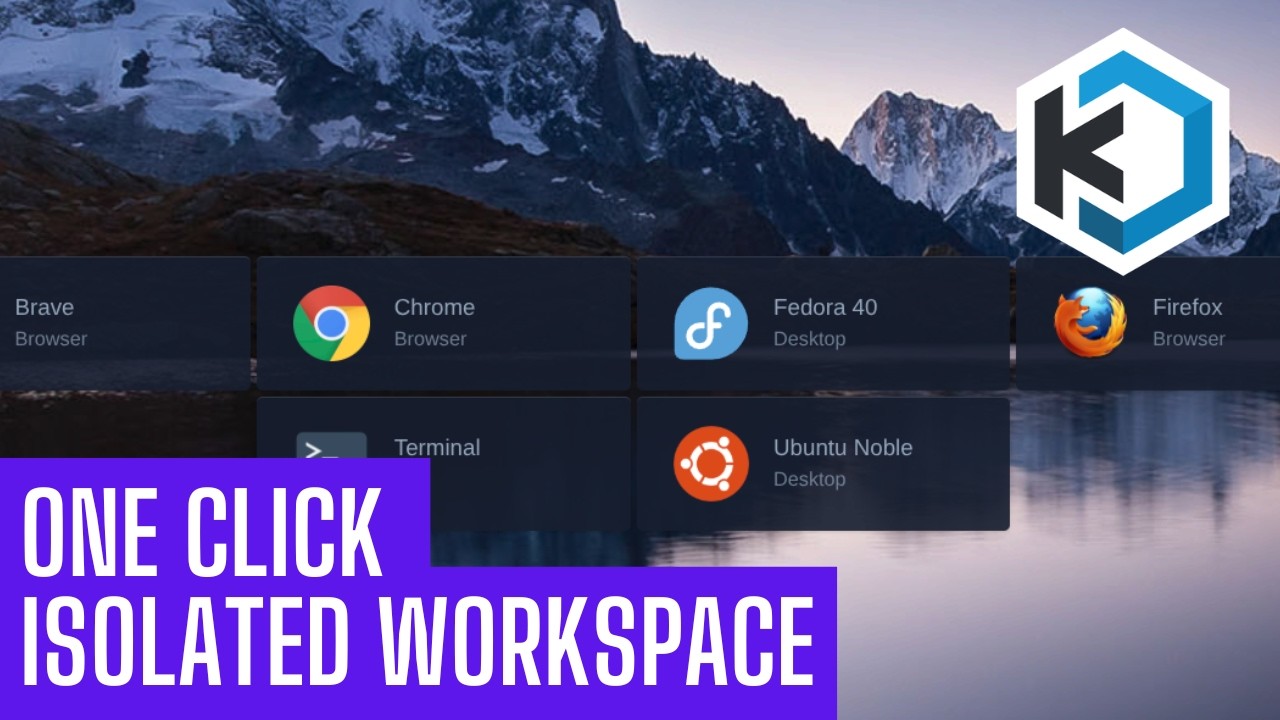
Jay LaCroix of Learn Linux TV gives a complete getting started guide for Kasm Workspaces, the container based platform that streams individual apps and full Linux distributions into a web browser tab. He covers what Kasm is and its use cases, the server requirements and supported distributions, the standard installer, and a full tour of the admin console. Then he launches and manages workspaces (Alma Linux, Doom, Firefox), closes sessions, wires up the Open in Isolation browser plugin, adds a third party linuxserver.io registry, removes workspaces, and breaks down the self hosted and cloud pricing tiers. A hands on companion to his separate Kasm review, aimed at anyone ready to self host it.

LinuxHomelabDevOpsNov 14, 2023
1:12:03
TechWorld with Nana

Kubernetes Crash Course for Absolute Beginners [NEW]

Nana Janashia teaches all of Kubernetes in one hour. It starts with what container orchestration is and why microservices made it necessary, walks the cluster architecture of master and worker nodes, then explains every component you use day to day (pods, services, ingress, ConfigMaps, secrets, volumes, deployments, and StatefulSets) by building one example app. The second half is hands on: install Minikube and kubectl, write four YAML files, and deploy a MongoDB database with a Node.js web app reachable in a browser through a NodePort service. A reader finishes able to stand up a real application on Kubernetes.

DevOpsLinuxNetworkingSep 30, 2021