youtube.nixfred.com nixfred.com
Creator

Sundown Science

7videos

← All videos

2:05:39
Sundown Science

Why The Universe Doesn't Experience Time The Way You Think

Two hours arguing that time is not a flow but a direction, and that once you accept it, every famous result in relativity turns into bookkeeping. The spine is the four velocity: an arrow every massive object carries whose length is always exactly the speed of light and which no force can lengthen or shorten, only turn. Sitting still, all of it points at tomorrow and you cover 300,000 km of future every second; move, and a sliver lies down along the floor instead, at an exchange rate measured six independent ways, from muons over Mount Washington to four atomic clocks that were bought airline seats in 1971. It then takes the tilting arrow away and replaces the circle with a hyperbola, works out that you are a filament roughly 80 light years long and under two metres wide, shows that a photon has no clock and no slot where a clock would go, and lands on the promised answer: the universe does not experience time at all, because there is no whole thing quantity that could have a rate.

PhysicsScienceJul 28, 2026
2:04:55
Sundown Science

The More Precisely We Measure Gravity, The Less We Understand It

Newton wrote the law of gravity without the number in it, and 228 years after Henry Cavendish first measured that number in a garden shed, nobody can agree on it. This two hour film traces how the gravitational constant became the worst known quantity in fundamental physics: how CODATA had to multiply its own uncertainty by twelve in 1998 because the better experiments disagreed more violently than the crude ones, how a team inside a hill in Wuhan spent thirty years and got two answers that formally exclude each other, and why that means nobody on Earth can tell you what the Sun weighs to better than four digits. It then follows the failure outward, to the untested distances above and below our narrow band of experiment, to dark matter and dark energy, to a theory that describes gravity perfectly and explains nothing about it. The closing argument is that the divergence is not noise obscuring the answer. It is the answer.

PhysicsSciencePhilosophyJul 27, 2026
1:53:20
Sundown Science

What Light Itself Will Experience at the End of the Universe

Sundown Science takes apart the comfortable picture of light as a heroic traveler and shows that, for a photon, the journey across the cosmos takes no time at all, because the proper time along a beam of light is provably zero. The essay then walks the entire death of the universe in our own frame: the close of the age of stars, the last red dwarf, the decay of matter, the slow evaporation of black holes by Hawking radiation, and a final dark era where every surviving photon is stretched colder and fainter forever without ever truly dying. It explains why energy is not conserved on the scale of the expanding universe, tying the loss to Noether's theorem and the changing cosmic stage. The payoff is a paradox held rather than solved: light is the most patient witness to the end of everything and the one thing that was never present to witness it, since from its own side birth and the end of time are the same instant.

PhysicsSciencePhilosophyJun 28, 2026
1:56:27
Sundown Science

The True Scale of the Universe… And Why It Keeps Getting Larger

A nearly two hour physics essay that earns the size of the universe one rung at a time, climbing from the width of your hand to the whole cosmic web before resolving why the observable universe is 93 billion light years across when it is only 13.8 billion years old. The answer is the expansion of space itself, which lets light arrive from a source now far more distant than the road the light ever traveled. From there it follows the consequences: galaxies receding faster than light without breaking any law, the night sky as a museum of the past, the cosmic microwave background as a wall made of time, and dark energy driving an acceleration that is quietly carrying 97 percent of the visible universe permanently out of reach. It closes on the strange luck of living in the narrow window when the evidence of the Big Bang is still legible in the sky.

PhysicsSciencePhilosophyJun 24, 2026
1:52:55
Sundown Science

There Is No Such Thing as "Now" — and Physics Can Prove It

You have always believed in now, the single present moment you imagine the whole universe shares. Sundown Science spends almost two unhurried hours taking it from you, not with a trick but with ordinary physics. The same relativity that steadies the blue dot on the map in your pocket says that two people merely walking past each other on a sidewalk carry different presents, and out at the distance of Andromeda those presents come apart by days, then by centuries.

PhysicsScienceJun 12, 2026
2:12:36
Sundown Science

What Happens After The Universe Ends?

A two hour Sundown Science essay on what physics says happens after the universe dies, and Roger Penrose's radical answer that the ending is a new beginning. It walks the full far future timeline, the end of the age of stars around 100 trillion years, proton decay, and black hole evaporation out to 10 to the power of 100 years, then makes the case for conformal cyclic cosmology, in which heat death is a smooth geometric boundary that hands off into the next universe's Big Bang. Along the way it explains why the far future loses all clocks and all scale, why the Big Bang began in an almost impossibly ordered state, and how a supermassive black hole merger in a previous cosmos might leave circular Hawking point fossils in the cosmic microwave background filling your room. It is careful to separate the settled physics from the four unconfirmed requirements the theory depends on, and treats the Hawking point claim as a live, contested, still testable prediction rather than a settled discovery.

PhysicsSciencePhilosophyMay 14, 2026
2:12:15
Sundown Science

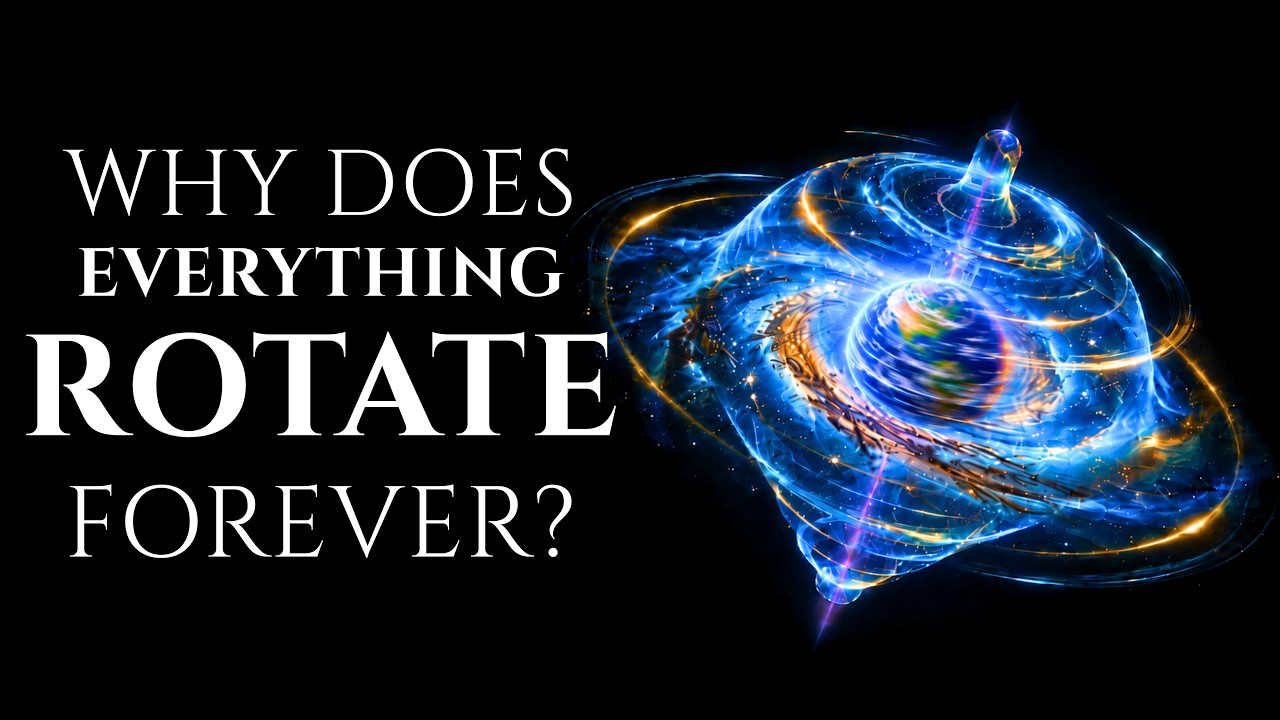
Why Does Everything In The Universe Spin?

A two hour Sundown Science essay that follows rotation across twenty orders of magnitude, from the intrinsic quantum spin of electrons and protons up through planets, stars, and galaxies, to argue that spin is closer to the default state of matter than an exception. It shows how conservation of angular momentum, guaranteed by Noether's theorem, makes rotation inevitable whenever gravity acts on a cloud that carries any spin at all, and walks the key physics along the way: the Stern-Gerlach experiment, the electron that would have to turn faster than light, the Pauli exclusion principle that gives matter its solidity, Vera Rubin's flat rotation curves and dark matter, and loop quantum gravity's radical claim that spacetime itself may be built from spin. It ends on the strangest fact in the story, that the total angular momentum of the observable universe appears to be exactly zero even though every piece within it spins, and on why Kurt Gödel's rotating universe suggests that this precise cancellation may be what keeps time itself coherent. Throughout it separates the settled first layer, why spin is conserved, from the open second layer, why the universe began with any spin at all.

PhysicsSciencePhilosophyApr 23, 2026